MAGAZINE
DECEMBER 2025
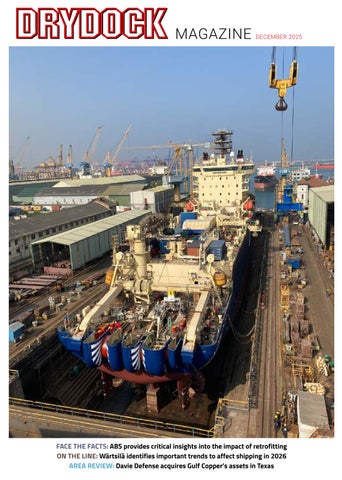
FACE THE FACTS: ABS provides critical insights into the impact of retrofitting ON THE LINE: Wärtsilä identifies important trends to affect shipping in 2026 AREA REVIEW: Davie Defense acquires Gulf Copper’s assets in Texas
BOOTH Provides a safe and comfortable work environment for the operator or supervisor.
HOSE PROTECTION Protects areas that are difficult to safeguard with PPE, e.g. the armpit.
PROTECTIVE BARRIER Our Safety Curtains are lightweight, quick to set up, easy to clean, and can be configured to the desired length.
PPE Head-to-toe protection for the operator, from 200 to 3 000 bar (2 900 to 43 500 psi).
SCUFF GUARD Protects valuable hoses from wear and tear.
COMPLETE PROTECTION – FROM HEAD TO TOOL Our products provide complete protection – safeguarding operators from head to toe and securing the entire work area, from nearby personnel to essential equipment and costly tools. With us, you can save lives, time, and money. Not much to think twice about, right?
For distributors and more information visit TST-SWEDEN.COM
MAGAZINE
DECEMBER 2025
Contents 2
8
Face the Facts
Lefteris Karaminas, Global Sustainability Manager, ABS, provides critical insights into the impact of retrofitting in the drive for efficiency
On the Line
As the maritime industry prepares to enter a new year, technology group Wärtsilä has identified four important trends that will affect global shipping in 2026
14 Spotlight FACE THE FACTS: ABS provides critical insights into the impact of retrofitting ON THE LINE: Wärtsilä identifies important trends to affect shipping in 2026 AREA REVIEW: Davie Defense acquires Gulf Copper’s assets in Texas
The spotlight is turned on the cruise & ferry sector where we focus on a celebration at Damen, an Alaskan test completed by Wärtsilä and a new cruise centre for DNV
22 Area Review ILE DE BREHAT, Alcatel Submarine Networks cable ship, managed by LD Armateurs, undergoing dry docking and lay-up repairs at Colombo Dockyard PLC – reaffirming our position as the preferred service provider for cable vessels, offering world-class expertise in repairs and new builds.
Our attention is on the Americas, where we feature acquisitions, a selection of repairs, and how artificial intelligence is helping with preventative maintenance and the skill shortage time bomb
34 Market Intelligence
Steve Gordon, Global Head of Clarksons Research, provides an update of ship repair data points from Clarksons World Fleet Register, including the Americas
42 Mechanical Matters
A look at on-site repairs by MarineShaft and the latest emissions abatement and fuel efficiency technology from Panasia and WinGD
48 In Focus Issue: December 2025 Volume No.49 No.4 ISSN No. 0143-5000
Editor: Mark Langdon Advertisement Manager: Nick Carugati Design & Production Manager: Fiona Andreanelli Accounts: Claire Long Subscriptions: Molly Andrews Publisher: Andrew Deere
Subscribe Today!
Visit www.drydockmagazine.com
MPI Group Peel House, Upper South View Farnham, Surrey GU9 7JN, UK Tel: +44 (0)1252 732220 info@mpigroup.co.uk www.mpigroup.co.uk
MPI Group, as a body, are not responsible for any opinions expressed in DryDock by contributors. All rights reserved. No part of this publication may be reproduced, stored in a retrieval system, or transmitted, in any form or by any means, electronic, mechanical, photocopying, recording or otherwise, without prior permission of MPI Group. © Marine Publications International Ltd 2025
Biocides – a necessary tool for managing biofouling investigated by Jotun, antifouling coating scheme designs explained by Safinah and a new model for sustainable hull performance from GIT Coatings
68 Analysis
Navigating towards net zero with Armacell and protecting assets against corrosion with Belzona
78 Worldwide
Underwater mobdock repairs under investigation
82 News
The latest products, appointments and news
2 – FACE THE FACTS 2025
The role of retrofits in driving efficiency
DRYDOCK 2025 – 3
The latest industryleading analysis from ABS, Retrofits for Energy and Emissions Improvements, provides critical insights into the impact of retrofitting, including classification and statutory requirements, as well as best practices for implementation. The ABS-classed Pacific Sentinel is fitted with three of bound4blue’s 22m eSAILs
4 – FACE THE FACTS 2025
Lefteris Karaminas, Global Sustainability Manager, ABS, is a classification society executive, serving many years with ABS and Lloyd’s Register. He is practical solution-orientated, with knowledge management and human element skills. He attended the University of Newcastle-uponTyne where he obtained a BSc and MSc and has a CEng, EurIng, FRINA. Lifework capabilities include: • R&D, rule development, IACS representation • Resistance & propulsion, ship performance, energy efficiency, model tests • Marine business development, newbuilding technical specifications • Applications, tools, interactive training Q: What was the key rationale behind producing the Retrofits for Energy and Emissions Improvements report now? A: Regulatory pressure from regional and global air emission legislation is the main catalyst for the increased demand in energy efficiency technologies and onboard carbon capture. While it is generally easier to apply these to new vessels under construction, the long operational life of a vessel, the potential lack of newbuilding capacity and lack of future demand for second-hand vessels may lead to increased demand for retrofits. Q: How is ABS helping clients address their environmental objectives? A: Through its Advisories and Guides, ABS provides the industry with a clear understanding of classification and statutory requirements for retrofitting, explores options for improving efficiency, and offers best practices and market insights to support informed decision-making.
Damen’s system (pictured here) is one of several air lubrication options available
ABS has a dedicated team of subject matter experts who work with stakeholders while they evaluate retrofit solutions for their vessels. We help clients address environmental objectives with a range of sustainability services, including assessments of alternative fuels and energy efficiency measures. In addition, ABS drives awareness of new technologies and measures by engaging the industry with seminars, informative meetings and advisory publications. ABS has supported the industry’s trend toward improving energy efficiency since the beginning. Q: How does the rapid development and adoption of new technologies fit in, and how are the risks with using new technology being addressed? A: New technologies start as ideas, often undefined and uncertain until they are refined using available tools. The goal is that the product meets the same standards for asset integrity, environmental protection and safety as conventional projects.
DRYDOCK 2025– 5
Schottel can equip existing vessels with new, hydrodynamically optimised propeller blades to improve efficiency
As the maritime industry evolves towards a future of more sustainable operations, achieving our desired economic and environmental goals demands a focus on innovation and collaboration as key drivers. The rapid development and adoption of new technologies have already driven the incorporation of goal-based standards for regulatory compliance into ABS Rules – offering a path to class approval for alternative and novel concepts. Existing class requirements often prescribe a specific technical solution but since goal-based standards do not dictate specific technical solutions, they are better suited to accommodate and support future technological developments. Q: How can the performance of these technologies be evaluated? A: Exploring EETs [Energy and Emissions Technologies] means investigating the impact on a vessel’s energy profile without compromising safety. To achieve this, shipowners must take some specific steps when implementing EETs. These include assessing the present performance of shipboard systems and
identifying energy savings from specific improvements based on the vessel’s design and operational characteristics. Owners must also identify and address potential hazards to the vessel and crew through hazard identification (HAZID) and hazard and operability study (HAZOP) workshops. It is also important to optimise energy demand by deploying mathematical techniques, such as computational fluid dynamics for a bulbous bow optimisation study or non-heuristic optimisation algorithms for a voyage optimisation study. Q: What ships are leading the uptake and what are the main technologies being adopted? A: EET retrofits, such as ducts, propeller modifications or replacement and air lubrication may increase the efficiency of the vessel, reducing fuel consumption and thus tank-to-wake emissions. Similarly, wind propulsion technologies (WPTs), such as Flettner rotors, suction wings and rigid sails will also reduce the power required for propulsion, leading to tank-to-wake emission reductions. WPTs are a prime example of robust decarbonisation technology that is
6 – FACE THE FACTS 2025
Figure 1 (top): Retrofit projection – Scenario 1 [MSI, ABS]. Figure 2 (above): Retrofit projection – Scenario 2 [MSI, ABS].
effectively independent from sea-trade volumes, as it generates no direct emissions, and which also decouples sustainability efforts from the price of green fuels, which are generally available at a premium accounting for their CO2 abatement cost. Q: Will global shipyard capacity be sufficient to satisfy the rising need for engine retrofits and EET installations? A: While shipowners have historically relied on a global network of repair facilities to absorb cyclical peaks, new evidence from market tracking and scenario analysis suggests that
yard capacity could become a binding constraint before 2030. Under the right conditions, this could lengthen lead times, raise costs and shift competitive advantage toward those who act early to secure their slots. For our 2025 publication ‘Beyond the Horizon: Vision Meets Reality’, two retrofit demand scenarios were developed by ABS and Maritime Strategies International (MSI). Scenario 1 – Full Conversion, assumes all eligible oil-fuelled vessels are converted due to escalating oil costs. It would require yard capacity expansion before 2030.
DRYDOCK 2025– 7
In Scenario 2 – Base Case, which is deemed the more likely, around half of the existing eligible tonnage and 80% of relevant newbuilds are converted. This would place demand within the range of existing and planned capacity, especially if lead times can be reduced from the current 18 months to a target of 14 months. The steepest climb comes in the late 2020s, as regulatory compliance deadlines, fuel-switch strategies and decarbonisation commitments converge. Comparing total yard demand against the theoretical maximum capacity reveals the crunch point. With only modest capacity growth assumed (+1.5% per year after 2030), the moderate scenario turns negative in 2029, with a 43 million gt-day shortfall, a gap widening to over 400 million by 2031. In the aggressive retrofitting case, the deficit emerges a year earlier (2028), reaching over 1 billion gt/days by 2030. For owners, this means that the shoulder years just before the deficit (2027 and 2028) will be critical for locking in yard time on favourable terms. Q: Do you think the industry’s ambitious emissions targets are likely to be met? A: The recent ABS publication – Beyond the Horizon: Vision Meets
Reality – makes clear that the maritime industry’s approach to decarbonisation hinges on navigating three critical hurdles: safety, availability and affordability of alternative fuels, challenges that are significant but not insurmountable. While safety is a non-negotiable prerequisite, the associated risks for alternative fuels are manageable through a combination of engineering and operation. The industry is actively developing the necessary solutions, but this will require a fundamental upskilling of crew and a zero-tolerance approach to operational drift. The most significant barrier to the energy transition is that sustainable alternative fuels are not yet produced anywhere near the scale required. While fossil LNG has a developed infrastructure, the green versions of methanol, ammonia and hydrogen are still being developed. Lastly, green fuels are currently far more expensive than conventional fuels, and market forces alone may be insufficient to bridge this gap. The cost disparity is a universal hurdle. Compared to very low sulfur fuel oil (VLSFO), green fuels carry a significant price premium.
Econowind, with its VentoFoil technology, says wind propulsion technologies are gaining real momentum
8 – ON THE LINE 2025
Shaping the future of shipping in 2026
As the maritime industry prepares to enter a new year, technology group Wärtsilä has identified four important trends that will affect global shipping in 2026.
DRYDOCK 2025 – 9
10 – ON THE LINE 2025
F
rom the rise of digitalisation and big data to the growing importance of flexible decarbonisation strategies, these trends are set to redefine competitiveness, efficiency and sustainability for vessel owners and operators worldwide.
Lifecycle optimisation
Peter Hanstén – Director of Business Development, Project Services – Wärtsilä Marine
With rapid technological advances and evolving regulations, vessel owners are shifting from short-term fixes to holistic, long-term strategies. Lifecycle optimisation considers environmental impact, operational efficiency and economic viability from vessel design through to end of life, supporting smarter investment decisions and asset value preservation. Collaboration and transparency between owners, operators and OEMs are key to maximising benefits and navigating future uncertainties.
Flexible decarbonisation strategies
Roger Holm, President, Wärtsilä Marine
Decarbonisation approaches must be tailored to each vessel’s operational profile, available fuels and business priorities. A flexible strategy – encompassing planning, integration and continuous monitoring – ensures vessels remain competitive and compliant as technology and regulations evolve. Investments in fuel-flexible engines, hybrid propulsion and methane slip mitigation are among the solutions enabling owners to future-proof their fleets.
Retrofit option “Retrofitting is rapidly becoming the most practical decarbonisation pathway for much of the existing fleet,” says Peter Hanstén, Director of Business Development for Project Services at Wärtsilä Marine. “Owners are under pressure to cut emissions, but few can afford to commit to a single fuel or technology today. That is why flexibility is so critical. Upgradable engines, hybrid power solutions, energy-saving devices and digital optimisation allow vessels to reduce emissions now, while keeping future sustainable fuel options open. The most successful retrofit strategies
DRYDOCK 2025– 11
12 – ON THE LINE 2025
are not about chasing one solution, but about building step-by-step resilience into assets that still have decades of service ahead.”
Digitalisation, big data and analytics
LEGISLATION IS CRITICAL TO ACCELERATING INVESTMENT IN ALTERNATIVE FUELS, BUT IT IS NO SILVER BULLET
The increasing complexity of vessels – featuring hybrid setups, advanced power management and alternative fuel systems – demands robust digital integration. Harnessing onboard data through advanced analytics enables real-time operational recommendations, driving significant reductions in fuel consumption, emissions and operational costs. While some industry leaders are already leveraging these capabilities, widespread adoption is still hindered by challenges such as data governance and integration. But the path forward is clear.
Less predictable regulations Despite the recent delay in the IMO’s Net-Zero Framework, the regulatory landscape continues to evolve, with regional initiatives like the EU Emissions Trading System and FuelEU Maritime impacting a significant portion of global shipping. As businesses prepare for stricter emissions requirements, robust
compliance and reporting protocols are becoming essential.
Looking ahead “As we look ahead to 2026, collaboration will play a vital part in driving the sustainable transformation of shipping and shaping a cleaner and smarter future for the maritime industry,” says Roger Holm, President, Wärtsilä Marine. “Wärtsilä’s leadership in fuel flexibility, integration and cross-industry partnerships reflects the growing need for OEMs, operators, ports, fuel providers and regulators to work together. We stand shoulderto-shoulder with our customers, bringing innovative solutions, expert guidance and a clear focus on enhancing efficiency and creating long-term value. “Legislation is critical to accelerating investment in alternative fuels, but it is no silver bullet,” he continues. “Decarbonisation is a team effort. The maritime ecosystem is full of remarkable ingenuity and world-class technical excellence that we can use to drive decarbonisation and digitalisation hand in hand. We already have the tools in the toolbox to build a cleaner, smarter future for global shipping.”
LET´S GET TO WORK
Shaft Line Repair Expertise In-house and On-site
DK-9850 Hirtshals I info@marineshaft.com I Tel. +45 96 56 02 02 I marineshaft.com
14 – SPOTLIGHT 2025
Disney Fantasy approaching Damen Shiprepair Brest for dry docking
Spotlight on Cruise & Ferry A cruise ship celebration at Damen, an Alaskan test completed by Wärtsilä and a new cruise centre for DNV.
DRYDOCK 2025 – 15
16 – SPOTLIGHT 2025
D
amen Shiprepair Brest has just marked the conclusion of its 50th cruise ship project since becoming part of the Damen Shipyards Group in 2012. Over the past years, the yard has been using its facilities, knowledge and extensive experience of the cruise sector to advance efficiency and sustainable performance. Damen Shipyards is taking a clear leadership role in driving the global transformation toward sustainable maritime solutions. With the ambition of
becoming the world’s most sustainable and connected maritime solutions provider, Damen is implementing innovative approaches across its worldwide operations. This commitment is especially evident in the ship repair and refit sector, where Damen Shiprepair Brest is fulfilling its role, supporting and servicing its clients with advanced, environmentally responsible solutions. The Brest yard, home to one of Europe’s largest docks and strategically located near the
DRYDOCK 2025– 17
English Channel, is at the forefront of sustainable change-delivering green refits for cruise ships. Through its work, the yard enables customers to benefit from enhanced efficiency, reduced emissions and extended vessel lifespans, actively shaping the future of sustainable shipping. Damen Shiprepair Brest recently completed such a refit on the 340m-long Disney Fantasy – its 50th cruise project in the last 10 years. The project follows one with a similar scope
undertaken by the yard on sister vessel Disney Dream last year. In its execution of projects such as these, the yard has developed a strong track record in preparing cruise vessels for more sustainable operations. Work has included installation of increasingly efficient propulsion and manoeuvring systems, application of biocide-free silicon paint systems and even the in-house fabrication of bulbous bows of 160 tons to reduce resistance in the water, thereby lowering fuel consumption and emissions.
Damen Shiprepair Brest recently completed a refit on the 340m-long Disney Fantasy
THE BREST YARD, HOME TO ONE OF EUROPE’S LARGEST DOCKS AND STRATEGICALLY LOCATED NEAR THE ENGLISH CHANNEL, IS AT THE FOREFRONT OF SUSTAINABLE CHANGEDELIVERING GREEN REFITS FOR CRUISE SHIPS.
18 – SPOTLIGHT 2025
Strength in collaboration The French yard is well placed to serve the cruise sector, both geographically and in terms of its high-standard facilities. One of its primary assets is dry dock number 3 at 420m x 80m. In addition, it has in place a team of over 180 personnel well versed in undertaking complex, large-scale and logistically challenging projects.
During the 2024 Alaska cruise season, 14 vessels equipped with Wärtsilä’s Hamworthy MBR systems achieved a 98.2% compliance rate under DEC’s public testing programme
“Our ability to deliver these ambitious vessel transformations comes from the skill of our personnel, our onsite facilities and the strength of our collaborations,” says Damen Shiprepair Brest Commercial Director Ronan Scolan. “Loyal customers such as Disney Cruise Line – and many others – have trusted us with 50 cruise vessel projects over the past decade. Our collaboration with Meyer RE, with whom we work hand in hand on complex engineering projects, and with our strong network of local subcontractors with whom we’ve built long-lasting partnerships, are also an important part of our success. This collective expertise is what truly drives us forward and enables us to support the maritime industry’s transition towards greater sustainability.”
Damen Shipyards Group has been in operation for over 95 years and offers maritime solutions worldwide, through design, construction, conversion, maintenance and repair of ships and ship components. “By integrating systems, we create innovative, high-quality platforms which provide our customers with maximum added value,” says Scolan. “Our core values are fellowship, craftsmanship, entrepreneurship and stewardship. Our goal is to become the world’s most sustainable shipbuilder, via digitalisation, standardisation and serial construction of our innovative vessels and through use of circular materials.”
PROTECTING MARINE ECOSYSTEMS Wärtsilä Water & Waste, part of technology group Wärtsilä, continues to deliver exceptional wastewater treatment performance in one of the world’s most closely-monitored marine environments through its Hamworthy membrane bioreactor (MBR) systems, according to independent regulatory data from the Alaska Department of Environmental Conservation (DEC).
DRYDOCK 2025– 19
During the 2024 Alaska cruise season, 14 vessels equipped with Wärtsilä’s Hamworthy MBR systems achieved a 98.2% compliance rate under DEC’s public testing programme. This performance surpassed the overall fleet average of 94.7% and other manufacturers’ systems, which averaged a 90.8% compliance rate. Each year, Alaska’s DEC requires all large cruise ships operating in its waters to collect treated wastewater samples for laboratory analysis, with every result published vessel-by-vessel. The data represents one of the most rigorous and transparent performance programmes in maritime environmental regulation. “Alaska’s Environmental Compliance Report provides real-world validation of system performance,” said Peter Satchwell, Global Sales Director, Wärtsilä Water & Waste. “Our MBR systems are tested under genuine operating conditions on vessels sailing in Alaskan waters – and the results speak to the reliability and consistency of our MBR solutions. This independent verification reinforces the confidence our customers place in our technology to meet the most demanding environmental standards.”
Dual system Wärtsilä’s Hamworthy MBR technology combines biological treatment and membrane filtration to achieve stable, high-quality effluent without chemical disinfectants. Continuous monitoring of process parameters and a digital feedback loop with Wärtsilä’s technical support teams ensure that performance remains consistent across different ships, crews and itineraries. “Independent verification builds trust,” says Satchwell. “The fact that our performance is independently verified through Alaska’s open reporting system demonstrates the advantage of our design philosophy, where compliance is paramount. We are proud to have reached this high watermark for performance and to support our customers to operate safely, cleanly, and efficiently no matter where they are in the world.”
The findings reaffirm Wärtsilä Water & Waste’s long-term commitment to system reliability and environmental stewardship. The company’s solutions enable ship operators to meet demanding discharge standards while supporting global efforts to protect marine ecosystems.
NEW CRUISE CENTRE FOR DNV DNV has launched a new cruise centre based at its London offices. The London Cruise Centre will strengthen DNV’s support for cruise owners, operators, ports and yards throughout Europe and beyond – providing local, time zonealigned support, alongside DNV’s global technical capabilities and competencies, for the entire cruise value chain. Cruise line operators are growing their footprint in the UK, with forwardlooking owners and operators focused on innovation and modernisation through new construction designs, the rapid adoption of alternative fuels, implementation of energy efficiency measures, digital integration, safety, and cyber resilience. As a result, the UK is emerging as one of the world’s most important hubs for the cruise market. The London Cruise Centre expands DNV’s global cruise network, bringing experts closer to customers across the UK and Europe, and supporting stakeholders in managing the increasing complexity of the industry’s transformation. It will help accelerate decarbonisation and digitalisation, while enabling efficient and compliant newbuilding and in-service operations.
Fast-changing “Cruise is changing fast – with greener fuels, new propulsion systems, advanced digital tools, and more complex and demanding regulations setting new expectations,” says Alberto Manfredini, Head of London Cruise Centre. “This means that as DNV we need new ways of making sure our customers can access the services they require in the way they need them. The London Cruise Centre is about providing the best of our global technical network
OUR MBR SYSTEMS ARE TESTED UNDER GENUINE OPERATING CONDITIONS ON VESSELS SAILING IN ALASKAN WATERS – AND THE RESULTS SPEAK TO THE RELIABILITY AND CONSISTENCY OF OUR MBR SOLUTIONS. THIS INDEPENDENT VERIFICATION REINFORCES THE CONFIDENCE OUR CUSTOMERS PLACE IN OUR TECHNOLOGY TO MEET THE MOST DEMANDING ENVIRONMENTAL STANDARDS.
20 – SPOTLIGHT 2025
and proven cruise expertise under one roof. Our customers here will get a single, local point of contact backed by world-class specialists – working hand in hand.” The London Cruise Centre will offer a coordinated suite of services that can be delivered locally or in close collaboration with technical teams in Europe, North America and Asia – ensuring customers receive both immediate, on-the-ground support and access to the full breadth of DNV’s specialist knowledge. “We are expanding our footprint in a way that keeps customers closer to the experts they need,” adds Robert
From left to right: Aakash Dua, Regional Business Development Manager DNV UK, Cristina Saenz de Santa Maria, COO DNV Maritime, Knut Ørbeck-Nilssen, CEO DNV Maritime, Robert Galinski, DNV’s Global Business Director for Cruise, and Alberto Manfredini, Head of London Cruise Centre
Galinski, DNV’s Global Business Director for Cruise. “By combining DNV’s global network, deep technical expertise, and local insights, the London Cruise Centre is designed to foster collaboration – accelerating innovation while delivering consistent, practical solutions that reduce risk and support long-term value. This is a model we have pioneered in our Miami Centre – providing turnkey services for our customers in Europe, so we can be in the same time zone, even the same room when critical decisions need to be made. Helping our customers tackle complexity and stay a step ahead.”
THE LONDON CRUISE CENTRE IS ABOUT PROVIDING THE BEST OF OUR GLOBAL TECHNICAL NETWORK AND PROVEN CRUISE EXPERTISE UNDER ONE ROOF.
22 – AREA REVIEW 2025
The Americas IN FOCUS
Acquisitions, unusual, Navy, Coast Guard and FPSO repairs, and how artificial intelligence is helping with preventative maintenance and the skill shortage time bomb.
Davie’s facility in Canada is in the process of performing midlife refits of patrol frigates for the Canadian Navy
DRYDOCK 2025 – 23
24 – AREA REVIEW 2025
A
s mentioned elsewhere by Clarksons, the Americas represent a comparatively small part of global repair activity, at only 3% of repair yard calls in January to November 2025, but the region does account for a substantially higher proportion of work in the offshore sector, with the largest repair destinations being the US and Canada. Davie Defense is a US shipbuilder and part of Inocea, a privately-held British marine industrial group with operations spanning the United States, Canada and Finland. Together, these facilities design, build and maintain missioncritical vessels including icebreakers, warships, ferries and cruise ships. Davie Shipbuilding, based in Quebec, Canada is building the world’s largest orderbook of heavy icebreakers, and Finland’s Helsinki Shipyard is the recognised global leader in icebreaker construction. Davie’s facility in Canada is currently undergoing an $800M upgrade. The yard is also in the process of performing midlife refits of patrol frigates for the Canadian Navy. “The midlife refits are part of a long-term contract to perform vessel life extensions on the Canadian Patrol Frigates, Canada’s primary surface warship fleet,” explains Alex Vicefield, Co-Founder, Inocea Group. “We have also just completed the first dry docking/maintenance of the new Arctic Offshore Patrol Ship class.” The yard has also started the topside construction for the Coast Guard’s polar icebreaker.
Davie Defense acquisition Davie Defense recently announced that it had acquired Gulf Copper & Manufacturing Corporation’s shipbuilding assets in Galveston and Port Arthur, Texas. Gulf Copper & Manufacturing has more than 75 years of ship repair and fabrication experience on the Gulf coast. The transaction includes all required US government approvals. As part of the Inocea Group, the acquisition makes Davie Defense America’s newest specialised shipbuilder – backed by Davie
Shipbuilding in Canada and Helsinki Shipyard in Finland – at a time when the Trump government is prioritising the Arctic. The acquisition reinforces Inocea’s presence in the US as Davie Defense advances its capabilities and prepares to compete for major programmes, supporting the Administration’s broader focus on revitalising American shipbuilding. Gulf Copper will continue to operate as a leading repair and fabrication centre, backed by its experienced management team and workforce, which will remain in place. Its work, including the recently-expanded scope on the Flight III Arleigh Burke-class destroyer units, underscores its capability to execute complex, high-precision defence projects in Texas. Kai Skvarla, CEO of Davie Defense, will assume the role of CEO of Gulf Copper, with current CEO Steve Hale staying on in an advisory role to ensure a smooth transition.
A principal ICE pact partner The Gulf Copper acquisition comes as the US deepens cooperation with its
DRYDOCK 2025 – 25
Arctic and shipbuilding partners. On October 9, 2025, the presidents of the US and Finland signed a historic Memorandum of Understanding at the White House on icebreaker construction. This was followed on November 18 by a Joint Statement of Intent between the US, Canada and Finland to advance shipbuilding and Arctic defence collaboration under the Icebreaker Collaboration Effort (ICE Pact), a trilateral initiative first announced in July 2024. As a principal industrial partner in the ICE Pact, Davie Defense looks forward to the upcoming contracting process and to working with the US Coast Guard to determine how best to advance the Arctic Security Cutter (ASC) project in America. Davie Defense is in negotiations to deliver five ASCs. The ASC is based on a proven fourthgeneration polar icebreaker design from Helsinki Shipyard, the world’s premier icebreaker builder having delivered approximately 50% of the world fleet and 100% of the polar icebreakers built in Finland over the past 25 years. Key ASC features include seven reference vessels already in service; a track record of over
85 Arctic winters completed and the ability to deliver the first vessel within just 26 months of contract signing. “This acquisition confirms Davie Defense as a permanent part of the United States shipbuilding industry,” says Skvarla, incoming CEO Gulf Copper. “We are proud to be an American shipbuilder, and the new Texas facilities which have over 350 existing employees will be key to expanding our US operations. Our focus is simple: deliver the capability, capacity, and ships that America urgently needs. While others debate new approaches, Davie Defense is executing – building polar icebreakers, looking at other opportunities to grow our workforce, and applying decades of proven expertise to support our Coast Guard and government partners.” “Integrating Gulf Copper into Inocea is a major step in our ambition to be the world’s leading specialised shipbuilder,” explains Inocea’s Vicefield. “Our transatlantic platform – spanning the United States, Canada and Finland – is purpose-built to deliver the industrial strength and trusted capability our
The midlife refits are part of a longterm contract to perform vessel life extensions on the Canadian Patrol Frigates
26 – AREA REVIEW 2025
government and commercial partners need. Operating in Texas solidifies our long-term commitment to the United States and strengthens the Western maritime base at a time when allied shipbuilding collaboration has never been more important.”
Gulf Copper completed the inspection and preparation of the TX-10000 earlier this year,
“Gulf Copper has been part of the fabric of shipbuilding on the Gulf Coast for more than 75 years,” says Steve Hale, outgoing CEO, Gulf Copper. “Joining Davie Defense opens an important new chapter – bringing long-term stability, new opportunities for our people, and continued support for the maritime communities we proudly serve.”
INNOVATIVE PROJECT AT GULF COPPER The Gulf of Mexico’s vibrant energy sector relies on innovation, and sometimes that innovation comes in the form of sheer scale. Earlier this year, Gulf Copper celebrated the successful completion of a truly remarkable project: the inspection and preparation of the TX-10000, a one-of-a-kind salvage vessel and the largest of its kind in the US. This mammoth undertaking, a testament to Gulf Copper’s expertise in handling complex marine projects, marks a significant milestone for both the company and the industry.
DRYDOCK 2025 – 27
“Since the TX-10000’s arrival at our Galveston yard, our team has worked tirelessly alongside Xenos Marine and its partners,” explains Mark Ashwell, Director of Sales, Marketing and Business Development. Xenos Marine is the owner of the TX 10000. “The scale of this vessel presented unique challenges, demanding meticulous planning, precise execution, and unwavering dedication. Every aspect of the project, from initial inspections to final preparations, required a collaborative effort and a commitment to excellence that defines Gulf Copper’s approach.”
The TX-10000 is not just a vessel; it’s a symbol of resilience and preparedness in the face of maritime challenges. Its sheer size and specialised capabilities make it a critical asset for salvage operations, ensuring the safety and efficiency of vital offshore activities. “Gulf Copper’s role in preparing this vessel for its crucial mission underscores our commitment to supporting the energy industry’s most demanding needs,” says Ashwell. “Our team’s expertise extends beyond routine maintenance,” he explains. “We understand the intricacies of heavy-lift vessels and the critical role
28 – AREA REVIEW 2025
they play in the oil and gas sector. This project required a deep understanding of the TX-10000’s unique design and operational requirements, and our team delivered with precision and efficiency.” The work scope in dry dock included: • Steel replacement and repair of the hulls • Blast, coat, and painting of the hulls • Overhaul of eight thrusters, including mounting and installation • Removal and replacement of fendering • Tank cleaning. “Our GCES Gulf Copper Energy Services (offshore division) has also supported the TX-10000 over the past few years, including the Golden Ray project where we did all the rigging by rope access,” Ashwell continues. “We also did all the maintenance and inspection of the blocks, sheaves and wire ropes after each heavy lift. Three times now we have carried out extensive critical connect Eddy Current inspections by rope at the TX-1000 facility. We have repaired fractures by renewing cross bracing pipe structures in two locations, utilising both scaffolding and rope access. After dry docking we also changed out the wire rope in the
main blocks, removed the main block sheave, carried out an MRI inspection and installed new bearings, etc. This was an assist to the crew. We have renewed lighting and electrical boxes/ wire by rope access. And carried out miscellaneous maintenance throughout the structure, including spot painting by rope access.”
Project completion “The successful completion of this project is a testament to the collaborative spirit that thrives at Gulf Copper,” says Ashwell. “We are immensely proud of the craftsmanship, dedication, and teamwork displayed by our employees, the support we have received from Matt Fish, Managing Director at Xenos Marine – his team has been great to work with, and all project partners during the entire project. “As the TX-10000 embarks on its future missions, Gulf Copper stands ready to continue supporting the maritime energy sector with innovative solutions and unwavering commitment,” he concludes. “We look forward to tackling new challenges and contributing to the continued growth and success of this vital industry – this is just the beginning of more groundbreaking projects to come.”
DRYDOCK 2025 – 29
BUSY AUTUMN AT SEASPAN SHIPYARDS Located on the Pacific Northwest Coast, Seaspan Shipyards operations include Vancouver Shipyards, Vancouver Drydock and Victoria Shipyards. In May this year, Victoria Shipyards delivered HMCS Calgary back to the Royal Canadian Navy, marking the successful completion of the second full docking work period under Seaspan’s Halifax-Class Work Period contract. Work is continuing on the Royal Canadian Navy’s HMCS Winnipeg, the latest frigate to be undergoing a vessel life extension. Under the VictoriaClass In-Service Support Contract, maintenance and repair work is also continuing on HMCS Victoria.
Vancouver Drydock It has been a particularly busy autumn season for the Vancouver Drydock team in North Vancouver. After an influx of several barges in August, including Alaska Marine Lines’ Fairbanks Provider, which was docked in the floating dry dock
The Coast Guard vessel CCGS John P. Tully is currently alongside at Vancouver Drydock
30 – AREA REVIEW 2025
The repair of the rescue boat winch gearbox from the FPSO was completed in a weekend
and is currently alongside. It will soon begin a six-month long vessel life extension (VLE) project.
FPSO RESCUE BOAT REPAIR Metalock Brasil recently successfully completed the repair of a gearbox on a rescue boat winch from an FPSO vessel. The service was performed in the workshop, focusing on the structural and functional recovery of the equipment’s CNC structural base.
Careen from August 24 to September 20 for prep, paint work and steel repairs, other barges including the Commencement Bay, owned by Sause Bros, called. Commencement Bay was docked on the Careen from September 24 to October 6 for preparation and paint work. The Burrard Otter SeaBus was docked for two weeks in early October for some maintenance work.
Executed swiftly over a weekend, the repair was a true emergency operation that proved successful, ensuring operational continuity and preventing the unit from shutting down. The scope of work included: • Initial inspection with non-destructive testing (liquid penetrant – LP) to detect cracks and discontinuities • Removal of the damaged area measuring 200 x 100mm, and replacement with a new bevelled plate (100 x 200 x ¾inch)
The second cable-layer to call this year, the 139m-long Resolute, which hosts equipment including an ROV and a plough onboard that drags along the seabed to create trenches for undersea cables, was in dry dock from August 17 to September 2.
• Controlled welding, performed strictly in accordance with Metalock Brasil’s technical procedures
A significant project for Vancouver Drydock, the Coast Guard vessel CCGS John P. Tully, arrived on September 30
• Final dimensional inspection, ensuring the repair met all project specifications.
• Manual finishing to level the surfaces and reopen two M10 threaded holes on the contact face
DRYDOCK 2025 – 31
After completion, the component was approved by the client’s technical team and released for operation, confirming the efficiency of the process and the precision of execution. Metalock Brasil continues to provide reliable solutions that ensure the operational continuity and safety of vessels and offshore platforms in the marine and offshore sectors.
MANAGING RISING FUEL AND MAINTENANCE COSTS The North American workboat and dredging industry is undergoing a technological shift as vessel operators look to adopt condition-based monitoring (CBM) technologies to optimise machinery performance and better manage rising fuel and maintenance costs. Monitoring the system fuel, lube oil and water condition, along with machinery vibration and diesel engine performance analyses, is now becoming standard practice across US inland and coastal fleets. The move is driven by a growing recognition that real-time analytics can reduce operating costs, improve reliability and extend asset life. “Operators across the continent are using preventative maintenance technology to detect excessive wear, shaft misalignment and fuel or lubricant contamination long before they cause critical system failure,” says David Fuhlbrügge, the joint Managing Director of Germany’s CM Technologies (CMT), one of the world’s leading suppliers of machinery performance optimisers. “By trending data from vibration sensors and oil analysis kits, workboat crews can schedule maintenance precisely when it is needed to optimise machinery performance and avoid costly overhauls or unplanned downtime,” he says.
Proactive maintenance A proactive maintenance strategy uses artificial intelligence, machine learning and real-time data to not only predict equipment failures but also to
recommend specific, actionable steps to prevent them. Similar results are seen in Europe, where dredging companies such as Boskalis, Damen Dredging and DEME are adopting condition-based maintenance tools across their fleets as a matter of course. “Workboat operators work in environments where abrasive sediments, high electrical loads and variable fuel quality have a significant impact on machinery,” says Fuhlbrügge. “By routinely analysing vibration, and checking lubricant condition, operators can identify problems early and act before mechanical damage occurs.”
David Fuhlbrügge, the joint Managing Director of Germany’s CM Technologies (CMT),
CMT says it is seeing workboat maintenance costs fall by up to 20% and machinery availability improve considerably for those operators that have embraced the technology and routinely monitor equipment. “By investing in modern monitoring technology and adopting a more datadriven maintenance mindset, workboat operators can make real financial gains,” he says. CMT’s compact vibration analysers, for example, allow crews to monitor the health of rotating machinery, pumps and bearings within minutes, providing immediate guidance on whether an asset can continue operating safely or requires maintenance intervention. The same applies to the company’s new WBS IR Analyser. This all-inone infrared-based test kit allows engine room crews to quickly monitor
Condition-based monitoring technologies are being used to optimise machinery performance and better manage rising fuel and maintenance costs
32 – AREA REVIEW 2025
machinery for oil degradation and determine whether an oil change is necessary, reducing operational costs and preventing potential engine damage.
Dolgo founder Nithesh Wazenn
Uwe Krüger, CMT’s joint Managing Director, says: “By reducing unnecessary oil changes and extending service intervals, operators lower lubricant consumption and waste while improving fuel efficiency and cutting emissions. CBM turns maintenance from a reactive cost into a strategic decision that protects both profit and the environment. The data informs purchasing decisions, spare parts planning and crew training.”
Greater control Workboat operators understand that downtime on a dredger or tug doesn’t just cost repair money, it delays projects, disrupts logistics and damages customer confidence. Predictive maintenance gives them greater control over their assets. As digitalisation spreads through the workboat sector, the integration of data-based analyses with fleet management is expected to accelerate. And while no single technology can eliminate every risk, the workboat sector now has access to a range of diagnostic tools capable of measuring key machinery performance indicators. “By applying these tools in tandem with rigorous maintenance regimes, workboat operators can detect wear patterns, combustion anomalies and lubrication issues that would otherwise go unnoticed,” says Krüger.
USING AI TO COMBAT THE SKILLS SHORTAGE TIME BOMB Dolgo, a new maritime tech start-up spun out of the US National Oceanic and Atmospheric Administration (NOAA) Ocean Enterprise Accelerator, has announced the development of a new AI software platform to transform shipyard and ship repair yard skills training. Florida-based Dolgo says the software will retain expertise currently being lost as large numbers of workers retire from the sector. Dolgo is undertaking
trials of the prototype Large Language Model (LLM) with the University of South Florida College of Marine Science. The LLM enables workers to share knowledge, allowing companies to scale up skills for both new and existing roles. The software platform will officially be launched in February at the Blue Innovation Symposium in Rhode Island. Dolgo founder Nithesh Wazenn believes the software will enable yards to create a private LLM platform that continuously updates with proprietary knowledge from their workforce. Workers will be able to call each other on the platform to seek advice on engineering problems, with the AI learning on the job.
Skills shortage The software is being launched to ease pressure on the global shipyard sector which is facing a skills time bomb. In the US alone, the average age of the 146,500-strong US shipyard workforce is 55. The ageing workforce challenge is compounded by rising yard demand which is expected to more than double in the US over the next decade. In addition, turnover of younger workers is high, with yards reporting attrition rates of 20% leading to a growing skills gap and persistently high training costs. “The Dolgo software further aims to tackle the long-standing issue of ‘ownership’ of know-how,” explains Wazenn. “Shipyards are reporting that older workers can be reluctant to share valuable knowledge to younger workers being paid the same wage leading to a ‘race to the bottom’ as new workers’ skills cannot replace those retiring.” AI will incentivise workers to share expertise where the engineers are equitably rewarded with bonuses or benefits each time their knowledge is downloaded from the platform.
Prototype tested “We’re very excited to report positive testing on the prototype ahead of formally launching for the market in February 2026,” Wazenn says. “It is well established that one of the biggest
DRYDOCK 2025 – 33
challenges facing the industry is the looming cliff edge of large numbers of workers retiring and taking their expertise with them. We believe Dolgo’s AI software holds an answer. Retaining precious expertise will not only drive efficiency and improve safety; it can help prevent costly and time-consuming mistakes and equipment damage.” The platform can further be deployed in new and emerging maritime technologies such as autonomous vessels where the highly specialised nature of the work means there is a significant skills shortage in the sector. “Marine autonomy can only move as fast as the workforce within it,” Wazenn says. “Dolgo’s AI can supercharge innovation by enabling new workers to enter the industry and upskill at speed while fast-tracking the skill set of existing workers.”
Pioneering startup Dolgo is one of seven pioneering ocean startups to be chosen by the Seaworthy Collective, a Miami-based non-profit that supports blue tech entrepreneurs. With only 10% of startups accepted onto the programme, the companies are able to participate on full scholarships with no equity or fees as a result of Seaworthy’s $14M NOAA Ocean Enterprise Accelerators partnership, The Continuum. The Continuum is a coordinated network of accelerators that fast-tracks blue tech startups to market. “We were thrilled to see Dolgo successfully graduate from Seaworthy Collective’s first cohort under our partnership with NOAA and the Continuum,” says
Daniel Kleinman, Seaworthy Collective’s Founder & CEO. “Dolgo embodies the human-centred design we preach at Seaworthy and believe the company can change the industry for the better. We are proud to support Dolgo and their continued success with our partners and network.”
Coating Thickness Gauges Fast and accurate measurement of paint and coating thickness on all metal substrates Ready to measure—no adjustment required for most applications n Fast measurement speed—60+ readings per minute n Memory mode—Store measurement data, view live statistics, and analyze live graphs n Included PosiSoft software—easily create professional inspection reports n
PosiTector 6000 FS3
180+ readings per minute Advanced models feature 3 Scan modes to increase measurement speed to 180+ readings/min.
Scan here to learn more
Award Winning Interchangeability
PosiTector 6000 F1
PosiTector gauge body accepts ALL coating thickness, surface profile, environmental, soluble salt, gloss, hardness, and ultrasonic wall thickness probes manufactured since 2012.
+1-315-393-4450 n 1-800-448-3835
techsale@defelsko.com n www.defelsko.com
34 – MARKET INTELLIGENCE 2025
Steady ship repair growth amid an expanding fleet Whilst sulfur emission and ballast water regulation work has slowed, emission reduction efforts continue to increase, reports Steve Gordon, Global Head of Clarksons Research. The deepwater drilling ship Deepwater Atlas at Grand Bahama Shipyard
DRYDOCK 2025– 35
T
his year has seen continued steady growth in the ship repair industry amid an expanding fleet (January-November: +2.2% fleet growth in terms of number of ships), with a rising share of older tonnage (Dec 25: 59% of ships >15yrs old, +12p.p. vs Dec 15) and an elevated number of ships reaching their third to fifth special surveys. Moreover, although work resulting from ballast water and sulfur emission regulations has slowed, programmes linked to greenhouse gas (GHG) emission reduction efforts have increased, though they are still in their early stages. There were more than 18,300 recorded instances of vessels (2,000+ dwt/gt) undergoing work at a specific ship repair yard location in January-November, up 1.4% on 2024’s run rate (full year: 19,722). This is in line with the trend of steady growth seen in the sector across recent years (2019-24 CAGR: +2%), with the current upswing in special survey work a supportive factor. In addition to being a significant proportion of ship repair demand themselves, owners often plan other repair and retrofit work to coincide with dry docking. An estimated ~11,800 ships (2,000+ dwt/gt) of ~310m gt are scheduled to have undergone a special survey by the end of this year, up 3% y-o-y in terms of the number of ships and 9% in gt. This reflects a building ‘wave’ of special survey work expected over the coming years, which is set to peak in 2026-27 at potentially more than 12,000 ships of over 320m gt dry docked each year, as ships built during the late-2000s to early-2010s shipbuilding ‘boom’ reach their 15- and 20-year surveys (together ~45% of est. surveys in 2026 vs ~20% in 2016). Notably, the ageing fleet is further adding to the repair yard demand for special surveys by extending their duration. Some 70% of vessels undergoing a survey in 2025 are expected to be over 15 years old (2016: 45%), with older ships typically spending longer in dry dock (15-year survey avg. duration: ~20% longer than a 10-year survey)
Total Refurbishment & Repair Events In Jan-Nov 2025 By Repair Yard Country
China 47%
Other 30%
Netherlands 2% S. Korea 2%
UAE 3%
Japan 4%
Indonesia 4%
Turkey 8%
Note: Includes special surveys, scrubber/BWMS retrofits, repairs, cruise refurbishments and other activity. Data as of December 2025. Data subject to late reporting.
Total Refurbishment & Repair Events In 2024 By Repair Yard Country
China 44% Other 32%
Greece 2% S. Korea 2%
UAE 3%
Indonesia 4%
Japan 4%
Turkey 9%
Note: Includes special surveys, scrubber/BWMS retrofits, repairs, cruise refurbishments and other activity. Data as of December 2025.
36 – MARKET INTELLIGENCE 2025
Refurbishment & Repair Events In Jan-Nov 2025 In The Americas US 29%
Other 22%
Panama 4%
Bahamas 5% Mexico 6% Uruguay 7%
Canada 10%
Brazil 17%
Note: Includes special surveys, scrubber/BWMS retrofits, repairs, cruise refurbishments and other activity. Data as of December 2025. Subject to late reporting.
Refurbishment & Repair Events In 2024 In The Americas
Curacao 4%
Other 18%
US 29%
Bahamas 5%
Uruguay 5%
Mexico 8% Canada 11%
Brazil 20%
Note: Includes special surveys, scrubber/BWMS retrofits, repairs, cruise refurbishments and other activity. Data as of December 2025.
Fuel pricing narrowed Meanwhile, retrofit work has eased back amid comparatively smaller workflows related to the IMO’s sulfur emissions and ballast water regulations. The BWMS retrofit programme is now largely complete, following the IMO’s Ballast Water Convention’s full entry into force in September 2024. In January-November, ~210 BWMS retrofits were carried out, compared to ~1,750 in 2024 and ~6,000 at the programme’s peak in 2022. SOx scrubber retrofitting is continuing to provide work for yards, but the pace of retrofits has been slower, with ~270 carried out in January-November, down 14% y-o-y and significantly below the 1,000-plus carried out in 2020. More modest SOx scrubber retrofitting comes as fuel pricing has narrowed, with the Rotterdam VLSFO-HSFO price differential down 75% in 2025 compared to 2022, and as generally positive shipping market conditions discourage taking vessels out of service to be retrofitted.
GHG emission reduction efforts increasing However, while work streams linked to shipping’s broader GHG emission reduction efforts remain at an early stage, they are building, with over 510 vessels retrofitted with at least one EST since the start of the year, matching 2024’s record run rate and up from ~150 a year in 2020. Other prospective work streams, such as carbon capture scrubber retrofits and alternative fuel conversions, are at an early stage (~50 of each carried out since start-2020) Regarding destinations for repair work, China accounted for ~45% of visits to repair yards in January-November, giving it the largest market share in ship repair of any country, but still somewhat below its majority position in shipbuilding. In line with its marketleading position, China hosts 16 of the world’s 20 most active repair yards. Turkey is the next most active repair destination, accounting for 8% of repair yard calls in Jan-Nov and with four of the 20 most active non-Chinese yards based in the country. Other major
DRYDOCK 2025– 37
Repair Events By Repair Yard Jan-Nov 2025
Repair Events By Repair Yard Group Jan-Nov 2025
Zhoushan Xinya Huarun Dadong Daishan Changhong COSCO HI (Guangdong) COSCO HI (Shanghai) Zhoushan Huafeng SY Fujian Huadong SY Putuo Changhong SY Yiu Lian (Shekou) Drydocks World Dubai CUD (Weihai) SY Shanhaiguan SB COSCO HI (Zhoushan) COSCO HI (Dalian) SMI Shipyard Qingdao Beihai SB Daishan Huafeng SY Weihai Huadong Sanwa Dock Asyad Drydock
COSCO Shpg. HI CSSC CMHI Xin Chang Jiang Zhoushan Huafeng SY Zhoushan Xinya Huarun Dadong Damen Shipyards PaxOcean Group Nanyang Star Group Fujian Huarong Drydocks World Xinfa Holdings Tsao Pao Chee (TPC) EOS Group SMI Shipyard Weihai Huadong Sanwa Dock Seatrium Asyad Group
China UAE Indonesia Japan Oman 0
100 200 300 400 500
China Singapore Netherlands UAE Other 0
200 400 600 800 1,0001,200
Repair Events By Repair Yard Jan-Nov 2025 (Non-Chinese Yards)
Repair Events By Repair Yard Group Jan-Nov 2025 (Non-Chinese Groups)
Drydocks World Dubai SMI Shipyard Sanwa Dock Asyad Drydock Mukaishima Dockyard Dubai Shipbuilding PPA Repair Base Remontowa Repair Albwardy Damen ASRY Sefine Shipyard Nosco Repair Torgem Shipyard Tersan Shipyard Western Shiprepair ST Marine (Gul) Fayard Dentas Shipyard SK Hashihama Unithai SY & Eng
Damen Shipyards PaxOcean Group Drydocks World Tsao Pao Chee (TPC) EOS Group SMI Shipyard Sanwa Dock Seatrium Asyad Group Mukaishima Dockyard Dubai Shipbuilding Vietnam SBIC Shin Kurushima Group Palumbo Shipyard Onex Shipyards Besiktas Group Alimia Group ASL Marine Holdings Tersan Shipyard Gemak Group
UAE Indonesia Japan Turkey Other 0
50
100
150
200
Tsakos Industrias Grand Bahama SY RENAVE Shipyard Bollinger Fourchon ASTIBAL Damen Curacao Estaleiro Rio Grande Hutchison Ports TNG Cotecmar Tandanor SIMA Callao Astivik S.A. German Ship Repair ASMAR Talcahuano Ciramar Shipyards Vancouver Drydock Atlantico Sul Estaleiro Maua Vigor Swan Island Verreault Navigation
Colombia US Other 20
30
40
UAE Other 100
200
Bollinger Shipyards Tsakos Industrias Grand Bahama SY RENAVE Shipyard Damen Curacao Vigor Industrial Seaspan Estaleiro Rio Grande McDermott Intl ECO Cotecmar SIMA Callao Tandanor Gulf Copper Ciramar Shipyards Astivik S.A. ASMAR Group German Ship Repair Atlantico Sul Maua-Jurong
Canada
10
Japan
300
400
Repair Events By American Repair Yard Groups Jan-Nov 2025
Brazil
0
Turkey
0
250
Repair Events By American Repair Yards Jan-Nov 2025
Singapore
50
US Brazil Colombia Uruguay Other 0
20
40
60
38 – MARKET INTELLIGENCE 2025
Chart 4: Vessels Arriving At A Repair Yard v previous 12 months
No. Vessels
2,000
15.0%
1,800
12.5%
1,600
10.0%
1,400
7.5%
1,200
5.0%
1,000
2.5%
800
0.0%
600
-2.5%
Repair Yard Arrivals (LHS)
400
-5.0%
12 month trend (RHS)
200
-7.5% Nov-25
-10.0% Aug-25
May-25
Feb-25
Nov-24
Aug-24
May-24
Feb-24
Nov-23
Aug-23
May-23
Feb-23
Nov-22
Aug-22
May-22
Feb-22
Nov-21
Aug-21
May-21
Feb-21
Nov-20
0
,000 Days
No. Vessels
14,000
30yr+ 25yr 20yr 15yr 10yr 5yr
12,000 10,000 8,000
450 400
Total Vessel Days Spent Under Survey (RHS)
350 300 250 200
6,000
150
4,000
100
2,000
50 2026
2025
2024
2023
2022
2021
2020
2019
2018
2017
2016
2015
2014
2013
2012
2011
2010
2009
2008
2007
2006
2005
2004
2003
2002
2001
0 2000
0
Chart 6: Vessels Scheduled To Undergo Special Survey By Ship Type 3,500
No. Vessels Tanker
Bulker
Container
Gas
Offshore
Pax. & Cruise
Other
3,000 2,500 2,000 1,500 1,000 500
2026
2025
2024
2023
2022
2021
2020
2019
2018
2017
2016
2015
2014
2013
2012
2011
2010
2009
2008
2007
2006
2005
2004
2003
2002
2001
2000
0
Thousands
Chart 5: Vessels Scheduled To Undergo Special Survey By Survey Age
DRYDOCK 2025– 39
Chart 7: Repair Yard Activity By Event Type
No. Events
800
No. Events
160
BWMS Retrofit (LHS) SOx Retrofit (RHS) EST Retrofits (RHS)
600
140 120 100 80
400
60 40
200
20 Oct-25
Jul-25
Apr-25
Jan-25
Oct-24
Jul-24
Apr-24
Jan-24
Oct-23
Jul-23
Apr-23
Jan-23
Oct-22
Jul-22
Apr-22
Jan-22
Oct-21
Jul-21
Apr-21
Jan-21
Jul-20
Jan-20
Oct-20
0 Apr-20
0
Chart 8: Vessels Arriving At A Repair Yard By Country/Region
2,000
No. Vessels
1,800 1,600 1,400 1,200 1,000 800 600
repair destinations include Indonesia (5% of calls), Japan (4%) and the UAE (3%). Generally, ship repair work is more geographically dispersed: the top five ship repair destinations account for ~65% of repair work, in contrast to the top three shipbuilding countries’ over90% market share.
Repair in the Americas The Americas host an active ship repair sector, supported by the region’s local shipping fleet, engagement in international trade and strong offshore oil and gas sectors. Since the start of 2024, about 80 yards across 17 countries in the Americas have had
at least one 2,000+ dwt/gt ship call for repair work, with more than 1,200 such ships repaired in total. Overall, the Americas account for some 3% of global calls at repair yards, though the region’s yards are over-represented in the offshore sector, accounting for 14% of global calls since start-24, and the cruise sector, where they account for 17% of work. The US is the largest ship repair destination in the Americas, accounting for ~30% of the region’s yard calls since start-24. Offshore is the most active sector in US ship repair, accounting for around 55% of work in the country. The US’s yards primarily repair the domestically-owned fleet: approximately
Nov-25
Aug-25
Feb-25
Nov-24
Aug-24
May-24
Feb-24
Nov-23
Aug-23
May-23
Feb-23
Nov-22
Aug-22
May-22
Feb-22
Nov-21
Aug-21
Feb-21
Nov-20
0
May-21
200
May-25
Other Americas Europe Other Asia China
400
80% of repaired vessels are US-owned. The most active yards in the country belong to Bollinger Shipyards (26% of work in the US), with other major groups including Vigor, McDermott and ECO. Other major repair destinations in the Americas include Brazil, with some 20% of repairs in the region, and which is primarily focused on the offshore sector (about 50% of Brazilian work) but is also active in bulkers and tankers (~20% and ~10% of work each), and Canada (about 10%), which is focused on supporting the domestic ferry fleet (~45% of repair work in Canada) and bulk carriers (~20%). Meanwhile, there are also significant repair yards elsewhere in the region. They include the Grand Bahama
40 – MARKET INTELLIGENCE 2025
Shipyard, which has accounted for 5% of cruise ship repair work since start-24, making it the third most active cruise repair yard in the world. Uruguay’s Tsakos Industrias is the single most active yard in the region and accounts for around 35% of bulkers repaired in the Americas.
Repair outlook Turning to the outlook, the ship repair sector is expected to continue to see
steady growth in the coming years, supported by the fleet’s growth (2026/27f: ~4% in both years) and its age profile (~40% of the current fleet will be over 20yrs old by 2030). Furthermore, there is the potential for new ‘green’ regulations to further support the growth of the EST retrofit programme, with the possibility of more ‘nascent’ work streams, including CCS retrofits and fuel conversions, expanding in the future.
Equipment Group
Technologies
Example Projects
Vessels Equipped (Fleet & Orderbook)
Engine Room
Waste Heat Recovery Generator
Climeon, Alfa Laval, ABB, Hanwha, Calnetix Hydrocurrent
>186
Variable Compression Ratio
WinGD
>74
Fuel Emulsifier
FOWE, IPCO, Kawasaki
>187
Propeller Duct
Becker Mewis Duct, Kawasaki, other in-house shipyard designs
>3,691
Pre-Swirl Stator
Becker BTF, DSME Pre-Swirl, CMES-Tech, SDARI, Wartsila EnergoFlow
>4,681
Rudder Bulb
Becker, Kongsberg Promas, SDARI, Imabari Hybrid-Fin, Wartsila Energopac, other in-house shipyard designs
>6,982
Propeller Boss Cap Fin
MMG escap, CMES-Tech, MOL Techno-Trade, SDARI
>3,836
Wake Equalizing Duct
Schneekluth WED, CMES-WID
>803
Flettner Rotors
Norsepower, Anemoi
>67
Suction Wing
Econowind, Bound4blue, Oceanbird
>47
Rigid Sail
BAR Technologies, DSIC, AYRO, Oshima Shipbuilding
>41
Wind Kite
Airseas Seawing
>5
Air Lubrication System
Silverstream, DSM ALS, Samsung SAVER Air, Alfa Laval, Mitsubishi MALS, Armada
>627
Bow Enhancement (including Windshield)
Ulstein X-Bow, Damen Sea Axe, Kawasaki SEA-Arrow, other in-house shipyard designs
>5,091
Elogrid
Elomatic
>16
Hull Fin
Oshima Advanced Flipper fin, Namura NCF™ , Sanoyas Tandem Fin™, Japan Marine United A.L.V Fin
>2,031
Propeller
Wind
Hull
Table 1
LISNAVE
A worldwide reference for ship’s maintenance and repairs
www.lisnave.pt +351 265 799 363 comercial@lisnave.pt PORTUGAL
42 – MECHANICAL MATTERS 2025
Props, shafts & engine upgrades On-site repairs by MarineShaft and the latest emissions abatement and fuel efficiency technology from Panasia and WinGD.
MarineShaft recently completed an on-site repair on a vessel’s four fixedpitch propellers during its dry docking at Oresund Drydocks
DRYDOCK 2025 – 43
44 – MECHANICAL MATTERS 2025
M
arineShaft recently completed an on-site propeller repair assignment for a vessel during its dry docking at Oresund Drydocks in Sweden. The vessel was equipped with four fixed-pitch propellers – two aft and two forward – operating under conditions that require highly durable propulsion components. MarineShaft mobilised a service team of four certified welders to carry out manual metal arc welding on all four of the high-strength steel propellers, designed to operate in icy waters. The company has a wide range of classapproved welding procedures. The repair scope included: • Grinding of the damaged areas to prepare for welding • Controlled preheating before welding • Welding of new material, shaped to match the original blade geometry • Slow cooling to ensure structural integrity and prevent stress • Liquid penetrant inspection of all welded areas • Final inspection and approval by the classification society DNV.
In-situ bolt hole machining The Polaris Liberty, a 140m-long vehicle carrier, was in dry dock at a shipyard in
Klaipeda, Lithuania, for repairs, including the installation of a new hydraulic shaft coupling. During disassembly, scoring was observed in the fitted bolt holes connecting the intermediate shaft and the coupling. MarineShaft was brought in to resolve the issue by supplying 14 new bolts for the flange connection and performing in-situ machining of the damaged holes. “We manufactured 14 bolts with dimensions Ø95 x 289mm, featuring oversized bolt bodies to accommodate the re-machined holes,” explains Hanne Magnussen, MarineShaft’s Marketing Manager. “The bolts were made from 42CrMo4 steel and delivered with a 3.2 LR certificate. Our portable machining equipment was sent to the shipyard, and two of our service engineers carried out the in-situ machining of 12 bolt holes on the coupling and intermediate shaft flange.” Final machining of the bolt diameters to match the repaired hole dimensions was performed by the shipyard. All the in-situ work was completed within just three days.
KEEPING EXISTING VESSELS COMPETITIVE Swiss marine power company WinGD has signed a frame agreement with marine technology developer Panasia
DRYDOCK 2025 – 45
46 – MECHANICAL MATTERS 2025
upgrade our installed base to the latest efficient technologies. We are delighted to have found a partner, in Panasia, with so much expertise in the equipment and system integration of both Chinese and Korean-built vessels.” The partnership will initially focus on solutions that allow XDF engines already installed on vessels to deliver the same fuel consumption, emissions and low methane slip as WinGD’s latest newbuild engines. Retrofit options include intelligent control by exhaust recycling (iCER) and variable compression ratio (VCR) technology, effectively converting X-DF engines to X-DF2.0 engines.
The bolt holes connecting the intermediate shaft and the coupling on a new hydraulic shaft coupling were found to be scored and were repaired by MarineShaft
to upgrade XDF dual-fuel LNG engines in service with the latest emissions abatement and fuel efficiency technology from WinGD. The frame agreement, signed during Kormarine 2025, will support ship operators in reducing their cost exposure to maritime carbon pricing, keeping existing vessels competitive for longer. Panasia is a well-established company and already acts as a system integrator for several shipyards. Its technical capabilities and understanding of specific vessel configurations will support WinGD in delivering timely and cost-effective retrofit projects that offer the best possible return on investment through lower fuel consumption and reduced emissions penalties.
Unique expertise WinGD brings unique product expertise to its retrofit projects, as the original designer of an engine platform that is under continuous development. Using its strong supplier and project partner network, WinGD provides a one-stopshop for fuel conversions and energy efficiency upgrades, helping engine users to improve efficiency, reduce emissions and optimise operational costs. “Korea has been the biggest market for X-DF engines since they were introduced in 2016,” explains René Baart, WinGD Head of Retrofit & Upgrade Solutions. “It was therefore natural that we start here as we aim to
Improved methane slip While iCER uses exhaust recycling to improve combustion stability when using LNG, VCR technology increases fuel efficiency by automatically optimising compression ratio depending on the fuel used and engine load. When combined, iCER and VCR technologies can reduce methane slip to around 0.7% of fuel gas volume – a more than twofold reduction compared to firstgeneration XDF engines. Alongside significant fuel consumption reductions, improved methane slip dramatically reduces the cost of compliance with European and proposed IMO regulations. “This agreement builds on our strong system integration capabilities developed through supporting newbuild projects and will allow us to deliver X-DF upgrades alongside our current ballast water treatment, scrubber and other retrofits for existing vessels,” says Panasia Head of Sales Division Joseph Ohg. “In partnership with WinGD we are looking forward to revisiting many of those vessels to ensure they can benefit from the advantages of cutting-edge dual-fuel LNG technology.” WinGD and Panasia are already engaged in retrofit discussions with multiple ship owners. WinGD has already completed the first retrofit of its VCR technology on a vessel operated by CMA CGM, with strong initial results.
48 – IN FOCUS 2025
Biocides – a necessary tool for managing biofouling
The prevention of biofouling is a hot topic in shipping generally and for regulators in particular. Biocidal antifouling coatings containing active substances that control the growth of unwanted organisms can and do make a huge contribution to combatting the global issue, but the biocides themselves are under scrutiny even though the industry still considers biocides as a key contributor to sustainable shipping, explains Jotun.
DRYDOCK 2025 – 49
50 – IN FOCUS 2025
T
hroughout maritime history ship operators have been engaged in a struggle with nature that has seen them attempting to reduce or eliminate the impact of biofouling on the operation of their vessels. Today there are multiple options available, with antifouling coatings containing biocides the most popular and effective across the shipping industry. But questions are being asked about their sustainability in a world where ESG standards and regulation are forcing operators to think harder about the choices they need to make.
The pressure is more evident for carriers of consumer goods, such as liner operators
“Biofouling – the accumulation of marine organisms on the hull of a ship – reduces the efficiency of the vessel, causing it to slow down or to use more fuel to maintain operational speed,” says
Morten Sten Johansen, Global Category Director, Jotun. “That is a problem regardless of the owner’s operating strategy. Whether operating directly on the owner’s account, or through charterers, it reduces profitability.” Controlling biofouling has become even more important with the IMO EEDI regulations in 2013 for new vessels and the EEXI regulations for existing vessels in 2023, along with the CII operational limits on CO2 emissions. With these in place, owners are no longer combatting biofouling purely for their own operation and economic reasons but also to meet mandatory requirements aimed at reducing greenhouse gas emissions across the shipping industry.
DRYDOCK 2025– 51
To add to the complexity of the problem, protecting biodiversity by way of reducing or eliminating the transfer of invasive species has come onto the radar of many national governments and the IMO. Populations of invasive species in non-native waters can be facilitated in many ways, but the most obvious is by way of the biofouling on ships’ hulls. So far only a small number of national governments have enacted laws that require ship operators to keep their ships free of biofouling or risk expulsion from territorial waters, but the IMO appears to be moving away from its current voluntary recommendations towards a mandatory regime that would encompass shipping on a global scale. At
MEPC 83 in April 2025 the IMO agreed to a new output on the “Development of a legally binding framework for the control and management of ships’ biofouling to minimise the transfer of invasive aquatic species – a biofouling Convention”. The work will start in 2026, but how long the process will take is debatable. Work on the AFS convention began in 1990 but it did not come into force until 2008. The Ballast Water Convention took even longer to be developed and come into full effect.
Increasing pressure from customers Alongside their own benefits and regulatory compliance from combatting biofouling, some ship operators also face increasing pressure from their direct customers and others further along the value chain to both improve efficiency and protect biodiversity. Often this pressure is the result of public opinion and is more evident for carriers of consumer goods – liner operators and car carrier operators – than in the bulk and tanker segments. Attitudes of ship operators towards green issues naturally cover the whole spectrum from actively embracing them to doing the minimum necessary to meet legal requirements to keep their ships operational. Furthermore, across that spectrum budgetary issues mean that ambitions may need to be tempered to which products to combat biofouling are affordable and available. A survey by Jotun on shipowners’ considerations when choosing antifouling coatings revealed that over 66% agreed that coatings containing biocides are more effective than biocide-free coatings. Almost 20% had no strong opinion and just 14% preferred biocide-free coatings. Clearly, biocides are important to achieving the owners’ objective. But if it did happen that some, or in the worst case all, biocides are restricted or regulated out, the effect would be an increase in greenhouse gas (GHG) emissions and the environment would lose. It is important for stakeholders/ regulators to take a holistic approach.
BIOFOULING – THE ACCUMULATION OF MARINE ORGANISMS ON THE HULL OF A SHIP – REDUCES THE EFFICIENCY OF THE VESSEL, CAUSING IT TO SLOW DOWN OR TO USE MORE FUEL TO MAINTAIN OPERATIONAL SPEED.
52 – IN FOCUS 2025
“We firmly believe in taking a holistic view,” says Petter Andreassen, R&D Chief Chemist at Jotun. “The best performance is the best for the environment providing that the ingredients comply with relevant local regulations and an environmental risk assessment has been done.” For its part, Jotun manufactures a range of products to cover all operators’ antifouling needs, and although it is difficult to determine what the impact on biodiversity may be, for emissions reductions a good estimate can be made. In 2024 DNV Maritime Advisory carried out a technical evaluation for the company which verified that 11.1 million tons of CO2 was avoided in 2024 for Jotun-coated vessels.
Evolving technology offers multiple solutions Preventing organisms from attaching to ships is extremely difficult with current technologies, so the best way to do it effectively and economically is to use a coating on the underwater part of the hull that contains a biocide – a biocidal active substance that controls the growth of unwanted organisms. Such coatings also protect steel ships from corrosion in the same way as the conventional coatings used above the waterline. The effect of the biocidal coating can be reinforced by appropriate hull cleaning technologies. Biocide use is not confined to protecting ships from biofouling. Indeed most of the antifouling biocides commonly used today have applications in many other fields including agriculture, cosmetics, cleaning products and more. Over time, preventing biofouling has involved the use of many different materials and chemicals, from sheets of copper on wooden vessels to poisonous compounds. Some of these were very successful but their undesirable side effects attracted the attention of science and the environmental movement which want to see them controlled, or in some cases prohibited from use.
Unlike so much IMO regulation which details what ships must do or carry, the International Convention on the Control of Harmful Anti-fouling Systems (AFS) on Ships, which was adopted in October 2001 but only came into force on 17 September 2008, is totally geared to preventing the use of certain products. The convention covers all vessels including FSUs and FPSOs. Initially the product at which the convention was aimed was tributyltin (TBT), a substance developed through the 1960s and first used in the 1970s and which the IMO itself conceded is probably the most effective biocide so far devised for the maritime industry. Since 2023, the IMO has also banned the use of cybutryne, which was used in some antifouling coatings to control algae. Problems with TBT first surfaced in the 1980s and within a decade several governments became concerned about its impact on a wide range of marine creatures. In 1990 Japan banned its use on Japanese vessels, and the IMO took up the challenge. During the development of the AFS Convention, most coatings manufacturers began winding down TBT production and searched for alternatives, introducing them long before the AFS Convention reached the ratification stage. Copper compounds used extensively well before TBT was developed appeared to be the best choice, and most antifouling coatings today make use of copper in some form.
DRYDOCK 2025 – 53
Biocides best against biofouling – but under scrutiny Combatting the impact of biofouling is no longer something shipowners can ignore even if they wanted to. Coatings manufacturers have developed an array of options, most of which make use of biocides although a few are biocide free. The product ranges have been developed and tailored to suit operational profiles of different vessel types, intended regions of operation and operators’ budgetary restraints. “Coatings containing biocides are designed to remain effective for periods of up to five years or more for premium priced products and otherwise to give protection at least between dry dockings,” says Jotun’s Andreassen. “Although biocides are the most effective weapon against biofouling, it has to be acknowledged that they are hazardous chemicals. Therefore, the level in antifouling coatings should be minimised. However, a product with 5 w% of biocide A is not necessarily better for the environment than a product with 50 w% of biocide B. This is because toxicity and the risks involved in their use also needs to be considered. In the above example, biocide A could be 100 times more toxic than biocide B, meaning even though the level in the paint is only one tenth, the toxicity is higher.” Comparing the toxicity data of different biocides is a pure hazard assessment. For the exposure assessment in marine environments there is a need for reliable chemical fate models. Such models must handle the complex transport and exchange processes in coastal environments.
There are computer models in existence that are intended to measure risks according to various factors such as estimation of hydrodynamical exchange, compound properties/processes, emission estimation based on leaching rates and environmental/hydrodynamical parameters, among others. These models are of use when considering regulations and helpful to coatings manufacturers in developing sustainable and safer products, but likely have little of interest for ship operators who only wish to consider effectiveness and legality of their coating choices.
Biocides and their benefits Copper oxide is by far the most commonly used antifouling biocide giving protection against most of the 4,000-5,000 species associated with biofouling, including both hard and soft fouling organisms. Hard fouling is understood as the shell-forming organisms, such as barnacles, mussels, oysters and tubeworms. Soft fouling is understood as plants (algae), soft animals (tunicates, soft corals etc) and slime (microorganisms forming a biofilm on the surface). Some algae are quite tolerant towards copper; hence a co-biocide is often used in combination with copper. Copper oxide is used by all major coatings manufacturers and is found in >90% of all coatings applied for fouling protection of ships at levels ranging from 20-50 w%. Copper is a naturally occurring substance and is also a micronutrient. It is essential for life and necessary for all living cells. However, at elevated concentrations, notably on the coating surface during idling periods, the copper ions (Cu2+) are considered toxic. Copper from antifoulings will eventually end up in the sea, but for the most part will be confined to the sediment and typically convert to copper sulphide (CuS), which is insoluble and not bioavailable. There are two alternatives to copper oxide that are effective towards hard fouling organisms: tralopyril and medetomidine. Both are far more potent than copper, hence the volume consumption is lower.
54 – IN FOCUS 2025
Tralopyril (Econea) was the first alternative to copper with an effect towards hard fouling organisms. It has been on the market since 2007. Due to reactions with copper oxide, it is primarily used in copper-free products. It requires a co-biocide, typically zinc pyrithione, to give full protection including against soft foulings. Tralopyril is 6-8 times more potent than copper oxide, hence the use level is 3-6 w% in paints. It breaks down very quickly in seawater by hydrolysis. Medetomidine (Selektope) Antifouling paints with medetomidine were launched around 2014. Medetomidine works selectively towards barnacles and tubeworms. It may be used in copperfree paints, together with co-biocides, but is primarily used in combination with copper oxide as a barnacle fighter. It does not kill the fouling organisms but induces a physiological response that repels them from the surface.
Zinc and Copper pyrithione (CleanBio, Omadine, Pyrion) The pyrithiones are primarily used against soft fouling. Both were launched during the 1990s, but currently copper pyrithione is dominating in volumes, primarily due to the reaction between zinc pyrithione and copper oxide. Both pyrithiones degrade quickly in seawater, primarily via photolysis. Dichloro octyl isothiazolinone (Sea-Nine) has a high acute activity towards soft fouling organisms. It was introduced in the early 1990s to replace TBT. DCOIT works well with copper oxide and is typically used at 2-4 w% level in antifouling paints. It also works well in combination with other biocides, in copper-free products. It breaks down rapidly in seawater and sediment, primarily via biodegradation. Zineb (Zineb Nautec, Perozin Marine) has high activity towards soft fouling
DRYDOCK 2025– 55
The situation is generally complicated by a multitude of national and regional regulations which are not aligned, with demands for different approaches to assure compliance. The EU has the strictest regulatory system globally, and it is expected that other markets will follow and implement restrictions should there be any. There have been suggestions that biocide-free options represent the future, but this view is somewhat speculative given the availability of viable alternatives to biocidal coatings. In 2024, Washington State Department of Ecology conducted a thorough evaluation of all the available technologies for fouling protection of pleasure craft, including copper-free and biocide-free products. On biocide-free products, the report said that these mostly use silicone polymers and sometimes fluorinated chemicals which may pose their own hazards and for which scientific information on environmental impact is not yet available. Their conclusion was: “Ecology is not able to determine that safer and effective alternatives to copper based antifouling paints are feasible, reasonable and readily available.” organisms. It works well in combination with copper oxide. It degrades quickly in seawater. In addition to the relatively small number of biocides mentioned above there are some biocides being used on a smaller scale and in local antifouling coatings only. However, the list is getting shorter every year due to lack of supporting documentation and suppliers.
Looking ahead Even though two very effective biocides have now been banned, restrictions on biocides are expected to progressively tighten, and the expectation is that the current assortment of biocides available for use will reduce in the years to come. The environmental aspect of the six key biocides currently in use is now considered acceptable, as they are all approved by the EU.
Other reports have raised questions about the potential for foul release coatings to release PFAS – sometimes referred to as forever chemicals – and to leach persistent silicone oils into the oceans. “The issue of biofouling and means to combat its impact is high on the agenda of the IMO and regional and national authorities. Given the IMO’s ambitions around emissions, efficiency and biodiversity, based on current knowledge it is fair to say that the antifouling coating with the best performance is probably the best for the environment providing that the ingredients comply with relevant local laws and regulations, and an environmental risk assessment has been done. Over time, there will no doubt be improvements with coatings manufacturers at the forefront in this regard,” concludes Andreassen.
56 – IN FOCUS 2025
DRYDOCK 2025– 57
Antifouling coating scheme design Carl Barnes, Head of Marine Consultancy – Safinah explains the need to consider speed, activity and seawater temperature when designing an antifouling coating scheme.
58 – IN FOCUS 2025
Antifouling selection The selection of an antifouling coating is clearly a complex task with over 140 products to choose from, which is further complicated as a scheme then needs to be designed that is specifically tailored to the expected ship-specific operational and environmental factors. When designing an antifouling scheme, the dry film thickness (DFT) required is directly related to the expected vessel speed, activity and seawater temperature, along with the intended in-service period, i.e. 36 months, 60 months etc. In simplistic terms, the required DFT of an antifouling coating increases with increasing speed, activity, seawater temperature and longer inservice periods. If the vessel eventually trades at speeds and/or activities and/or seawater temperatures significantly lower than the antifouling scheme design, the following are the likely consequences: • Antifouling will have been applied in excess of what is required for the scheme life, which is a waste of upfront paint costs
Figure 1: Striped pattern of non-fouled coating/fouled coating
A
ntifouling coatings comprise a soluble or partly soluble resin system that contains a mixture of biocides effective against a broad range of fouling organisms. These coatings primarily differ by the resin system used, often referred to as the ‘delivery mechanism’, and the type and level of biocide(s) used. The solubility of the resin system and the efficacy of the biocides used are the key parameters in determining the overall efficiency of the coating. Simply put, the resin system ‘polishes away’ in service, delivering the biocides to prevent fouling settlement. Antifouling coatings currently make up around 80-90% of the fouling control market for marine shipping, with the remainder of the market comprising non-polishing foul release (both biocidecontaining and biocide-free), along with hard ‘scrubbable’ coatings and a biocide-free polishing system.
• At the following dry dock there will be a significant DFT of antifouling remaining on the hull, which may cause problems with excess thickness build-up and subsequently cracking and delamination/ detachment of the hull coatings. This can manifest itself as the coating dries out on entering the dry dock.
Antifouling issue However, if the vessel trades at speeds and/or activity and/or seawater temperatures significantly higher than the scheme design, the antifouling coating is likely to ‘polish through’ prematurely before the end of the designed in-service period. Polishthrough of the antifouling coating will expose the tie coat which will not provide any fouling protection, hence the tie coat will quickly foul even if the vessel is static for only a few days under normal port operations.
DRYDOCK 2025– 59
More than 20% polish-through Up to 20% polish-through No polish-through Figure 2: Observed polish-through levels
Figure 1 shows a striped pattern of nonfouled coating/fouled coating. The nonfouled areas are in way of spray overlap areas where additional antifouling paint has been applied. However, the areas between the overlaps have polished back to the tie coat and, as a result, have fouled. To understand how much of a problem premature polish-through of the antifouling coatings is on marine vessels, you need to look at data. Safinah, an independent coating consultancy, has a unique in-house database of coating condition assessments documented from dry dock supervision activities dating back to 2010. Safinah’s data from dry dock hull projects conducted between 20152024 showed that around 50% of the ships had a level of polish-through of the antifouling on arrival at dry dock, including around 30% of the ships with up to 20% polish-through and about 18% of ships with more than 20% polishthrough (see Figure 2). The data shows that premature polishthrough of the antifouling coating is clearly a significant problem, and the accumulation of biofouling on areas of polish-through will lead to the following key industry issues: • An increase in underwater hull roughness (from fouling species), which has a direct impact on fuel consumption and consequently the emission of air pollutants
(greenhouse gases) which the IMO has adopted regulations to address • An increased risk of translocating non-native, potentially invasive aquatic species.
Increased fuel consumption However, the most significant financial penalty for the shipping industry is the increase in fuel consumption (whilst maintaining a constant speed) due to the adverse effects of hull fouling on the hydrodynamic performance of the vessel. As such, the expected parameters for speed, activity and seawater temperature need to be carefully considered when designing the antifouling scheme. Typically, this is done using the vessel’s historical Automatic Identification System (AIS) data for the in-service period since the last dry dock, which is then analysed to obtain the required parameters. However, this historical data is only useful if the vessel is going to continue the same trade after the upcoming dry dock, and any predicted changes need to be carefully considered and taken into account. Whilst the vessel speed can be relatively easy to predict (for example, charter party agreements typically state expected speeds and a ship’s activity will generally remain within an expected range), predicting the expected seawater temperature over a three- or five-year scheme life is a significant challenge.
60 – IN FOCUS 2025
The polishing rate of all antifouling technologies is affected by seawater temperature and whilst a faster polishing rate, and hence an increased rate of biocide delivery in high fouling challenge warmer waters, can be a positive, it makes calculating the correct scheme DFT more critical.
Safinah’s findings Based on Safinah’s knowledge of antifouling schemes, a significant change in scheme thickness (DFT applied) can be seen for what appear as relatively minor changes to the seawater temperature. For example, moving from 25°C to 28°C, a relatively small increase of 3°C, the scheme DFT required significantly increasing by around 70µm (an approximate 30% increase in the total DFT required).
Hull fouling can have a huge impact on the hydrodynamic performance of a vessel
Therefore, assuming a linear polishing rate for simplicity, a vessel applied with a five-year scheme (for a seawater temperature of 25°C) which spends a high proportion of actual in-service operations at a temperature of 28°C, could expect to see significant areas
of polish-through of the antifouling a year before the next scheduled dry dock. These areas of polish-through would quickly foul, with a subsequent increase in fuel consumption (when maintaining speed) and greenhouse gas emissions as well as significantly higher future dry dock costs. These could include increased cleaning and blasting costs and/or increased paint costs, as exposed tie coats cannot be directly overcoated with new antifouling. To further add to the complexity, from analysis of antifouling schemes and in-service performance results from the dry dock database, Safinah has found that simply using average seawater temperatures is not accurate enough and a more in-depth analysis of the raw temperature data is required. By analysing the condition of the hulls at dry dock and the scheme applied, Safinah has developed a method to incorporate other factors into the seawater temperature calculation which provides a ‘functional seawater temperature’ more fitting to the conditions expected to be encountered
ENVIRONMENTALLY FRIENDLY
ECONOMICAL
HIGH QUALITY
Discover our high-performance
SHIP CLEANING SYSTEMS Hammelmann GmbH Carl-Zeiss-Straße 6–8 59302 Oelde / Germany
mail@hammelmann.de Tel.: (0) 25 22 / 76 - 0 Fax: (0) 25 22 / 76 - 140
Experience the full range of Hammelmann ship cleaning systems:
SAFE
62 – IN FOCUS 2025
A new model for sustainable hull performance Philippos Sfiris, Head of Market Strategy and Vessel Performance, GIT Coatings looks at the results obtained after a gas carrier completes a full year under a graphene coating and robotic grooming regime.
DRYDOCK 2025 – 63
64 – IN FOCUS 2025
I
n an industry long dominated by biocidal antifoulings and reactive cleaning, a different model of hull maintenance is beginning to emerge, and for the first time, it now has a full year of real-world proof. Over the past 12 months, a gas carrier has operated with a graphene-based foul-release coating on its hull, paired with an onboard grooming robot operated by the crew during idle periods. The combination is straightforward yet disruptive: the graphene coating provides an ultra-smooth yet hard surface engineered for frequent light cleaning, while robotic grooming removes earlystage slime before it develops into more persistent forms of fouling. This keeps the hull consistently close to ‘as-docked’ condition without biocide release, without abrasive cleaning and without depending on uncertain port permissions for reactive cleanings. This is the first documented case globally of such a system being used continuously in commercial operation for a full year. And it worked – not in controlled trials, but under the unpredictability of global trade.
A tailored plan before the vessel even left dry dock
LPG Carrier – One year of proactive hull management. Performance results
From the outset, the approach was not simply ‘apply the coating and hope for the best’. Before the vessel sailed, a ship-specific proactive cleaning (or grooming) plan was developed based
on its trading pattern and fouling-risk profile. High-risk regions, frequent idle periods and the vessel’s speed profile indicated that slime could accumulate quickly if not managed early. Instead of waiting for visible fouling or performance drop, the plan defined when inspections would take place, how often grooming would be needed and in which ports or anchorages cleaning was realistically feasible considering local restrictions and time availability. It was a strategic, data-informed framework intended to make proactive cleaning achievable – not a theoretical schedule detached from real operations.
A year of realworld operation Across the first 12 months, the vessel completed seven underwater inspections and three grooming events. As expected in commercial trade, the year included tight port schedules causing partial or delayed cleanings, early robot reliability issues, unexpected idle periods and regulatory constraints on where cleaning was allowed. Despite these conditions, each grooming restored the hull to clean condition with no damage to the coating, and no hard fouling developed at any point. The graphene coating showed no measurable degradation, maintaining the smoothness required for efficient operations and trouble-free grooming.
DRYDOCK 2025– 65
Better performance results Year One results were clear and verifiable: approximately 6% power improvement out of dry dock compared to the premium antifouling previously used, under similar trading conditions; less than ~2% added power across the entire first year, despite more than 180 idle days; 3–5% efficiency regained after each grooming as early-stage slime was removed. Taken as a whole, the vessel’s fuel consumption for the year using the graphene-coating and grooming combination was lower than with the conventional premium antifouling for the same period, even though execution of the grooming plan was far from perfect.
Lower emissions, no biocide release Because the graphene coating contains no biocides, no toxic substances entered the marine environment, as grooming did not require aggressive scrubbing. Maintaining a consistently clean hull also reduced fuel burn, directly lowering CO₂ and air emissions. The vessel delivered both sides of the sustainability equation: cleaner oceans and lower carbon output.
LPG Carrier – One year of proactive hull management. Performance compared to industry baselines
66 – IN FOCUS 2025
What the industry can take from this
4. There is still room to optimise.
1. It can be done.
The first year also highlighted where the industry can improve the model further: broader port coverage and approved service partners to complement onboard robots and addressing niche areas robots cannot reach; remote robot operation, reducing crew involvement and improving cleaning consistency across voyages. These refinements would narrow the gap between realworld execution and the theoretical optimum, unlocking additional efficiency gains and simplifying adoption for more vessels.
A full year in operation has now shown that a graphene-based foul-release coating combined with light, frequent robotic grooming can maintain a clean hull – continuously, predictably and without biocide release. 2. It performs better. Across the year, the vessel consumed less fuel than during the equivalent period on a premium conventional coating under similar trade conditions. Performance remained close to ‘asdocked’ levels despite significant idle time, and light grooming consistently restored efficiency without damaging the coating. 3. It requires a system, not just a coating. Perhaps the clearest lesson is that success came from a structured inservice support model, not from coating chemistry alone. The vessel operated under a tailored grooming plan built around its actual trade, followed by continuous visibility of hull condition through inspections, performance analysis and monthly reviews involving both the ship operator, the coating maker and the robot supplier. This ongoing feedback loop enabled timely adjustments – an essential element of making proactive hull management work in real operations.
A working blueprint for the future What makes this case compelling is that it survived the real world: operational challenges, port restrictions and all the unpredictability that defines global shipping. The vessel still maintained a clean hull, avoided hard fouling, preserved coating integrity, and delivered year-long efficiency gains – without releasing biocides and without fuel penalties over time. For an industry seeking solutions that reduce both emissions and environmental harm, this is proof that a new, sustainable category of hull management has matured to the point of practical application – and that it already works in everyday commercial operation.
Our passion is not new!
We work with the same passion since the day we started, despite the high demand on quality, and always with the same commitment.
68 – ANALYSIS 2025
DRYDOCK 2025 – 69
Navigating towards net zero The maritime industry has strict requirements for energy efficiency and noise control, whilst simultaneously having to ensure that material choices comply with IMO standards. Thomas Merton, Technical Manager at technical insulation specialist Armacell, sets out why innovation in insulation materials means that shipbuilders and refitters no longer need to make a trade-off in their route to IMO compliance.
70 – ANALYSIS 2025
T
he maritime industry’s commitment to reducing its environmental impact whilst maintaining the highest safety standards represents one of the most significant challenges facing the sector today. Until relatively recently, the challenge facing the industry was that the best-performing insulation products frequently didn’t meet IMO fire regulations, hindering attempts to reduce heat loss in pipework and other mechanical equipment. Set against this is the fact that the shipping sector is facing unprecedented pressure to reduce its environmental footprint. The International Maritime Organization (IMO) has already set ambitious targets to reduce greenhouse gas emissions by at least 50% by 2050 compared to 2008 levels. As a result, vessel operators are looking to find solutions that deliver both performance and compliance. “Historically, fleet operators were caught between a rock and a hard place,” Merton explains. “They required materials that could withstand the harsh marine environment whilst delivering exceptional thermal performance, but traditional highperformance insulation often contained materials that simply didn’t meet the stringent fire safety requirements demanded by international regulations.
UNTIL RELATIVELY RECENTLY, THE MARITIME INDUSTRY HAD BEEN FORCED TO CHOOSE BETWEEN OPTIMAL ENERGY EFFICIENCY AND REGULATORY COMPLIANCE.
“The challenge becomes particularly acute in engine rooms and mechanical spaces, where temperatures can be above 60°C and humidity levels remain consistently high. In these demanding environments, every degree of heat loss translates directly into increased fuel consumption and higher emissions – a costly proposition both financially and environmentally.”
Understanding IMO fire regulations The IMO’s fire safety regulations, particularly SOLAS Chapter II-2, establish comprehensive requirements for materials used in ship construction and equipment. These regulations mandate that insulation materials must
pass rigorous flame spread tests and demonstrate low smoke generation characteristics. Traditional high-performance insulation materials often rely on chemical compositions that, whilst excellent for thermal properties, can produce toxic gases or contribute to flame spread during fire incidents. This creates what the industry terms the ‘safetyperformance paradox’ – the better the insulation performs thermally, the more likely it is to fail fire safety requirements. “Until relatively recently, the maritime industry had been forced to choose between optimal energy efficiency and regulatory compliance,” notes Merton. “This compromise has real-world implications for both operational costs and environmental impact.” Consider a typical container vessel: inadequate insulation on steam lines and hot water systems can result in heat losses of up to 15-20%, translating to thousands of tonnes of additional fuel consumption annually. For a large container ship using 200 tonnes of fuel per day, even a 5% improvement in thermal efficiency could save 10 tonnes of fuel daily – and a significant amount of CO2 over a year. (Source: IMO)
IMO-compliant insulation materials “Our response to this industry challenge represents a significant technological breakthrough with NH/ ArmaFlex Smart C material, combining advanced polymer chemistry with innovative manufacturing processes to deliver what was previously thought impossible: exceptional thermal performance alongside IMO-certified and classified C-s2,d0 (EN 13501-1),” Merton continues. These new insulation materials perform best when they have a closed-cell structure because it provides resistance to moisture ingress – a critical factor in marine applications where condensation and humidity are an ongoing challenge. Being flexible helps shipbuilders because it allows for easy installation around complex pipework
DRYDOCK 2025– 71
configurations commonly found in engine rooms and mechanical spaces. “The pre-covering system over closedcell insulation materials is particularly significant. It eliminates the need for separate jacketing materials whilst providing additional protection against mechanical damage and UV exposure – common issues in marine environments.” Specifying a halogen-free formulation ensures that, even in extreme fire scenarios, the material will not produce the corrosive gases that can damage critical ship systems or pose additional risks to crew safety. This characteristic proves especially valuable in enclosed spaces where evacuation options may be limited.
Real-world applications Early adopters of closed-cell insulation materials such as NH/ArmaFlex Smart have reported impressive results across various vessel types, both during newbuild and refits. These materials’ versatility extends beyond traditional pipework applications, and they are increasingly being specified for HVAC ductwork insulation in passenger areas, chilled water systems in refrigerated cargo spaces, steam distribution networks throughout the vessel and noise control applications in crew accommodation areas. “What we’re seeing is a fundamental shift in how naval architects approach insulation specification,” Merton observes. “Rather than accepting
72 – ANALYSIS 2025
compromises on thermal performance, they are demanding insulation materials that support their path to net-zero whilst meeting compliance requirements.”
The path to maritime net zero The shipping industry’s journey toward net zero emissions requires an approach that considers every aspect of vessel operation. Whilst alternative fuels and propulsion systems capture headlines, the role of effective insulation in reducing energy consumption cannot be overstated. Advanced insulation materials contribute to net-zero goals through multiple pathways: direct fuel savings through reduced heat loss, improved HVAC efficiency reducing auxiliary power requirements, enhanced crew comfort potentially reducing accommodation energy demands, and extended equipment life through better temperature control.
Big enough to handle it Small enough to care
Industry analysts suggest that widespread adoption of highperformance, compliant insulation materials could contribute to a 2-3% reduction in overall fleet fuel consumption – a significant step toward meeting IMO emissions targets. As the maritime industry continues its transformation toward sustainability, the demand for innovative materials that balance performance, safety and environmental responsibility will only increase. Advances in new insulation materials demonstrate that the traditional trade-offs between thermal performance and regulatory compliance need no longer constrain vessel designers or refit companies. “We’re entering an era where material innovation will play a crucial role in achieving the industry’s ambitious environmental goals,” Merton concludes. “The challenge now is ensuring that these advanced solutions reach widespread adoption across the global fleet.”
Your Ship Repair Yard in Lisbon Estalerio da Rocha Conde de Obidos 1399 - 036 Lisboa - PORTUGAL Tel. Yard (+351) 213 915 900 www.navalrocha.pt navalrocha@navalrocha.pt
74 – ANALYSIS 2025
Protecting assets against corrosion Pourable shimming and chocking systems are used worldwide in marine, offshore and many other industrial environments. They provide reliable alignment, reduced vibration and long-term corrosion protection, explains Chloe Hirst from Belzona.
W
ithin heavy-duty industries, precision alignment is essential for ensuring safe and efficient operation. Shimming provides fine adjustments to correct uneven interfaces and achieve precise alignment, while chocking fills larger gaps and creates a continuous, loadbearing contact surface capable of supporting engines, propulsion systems, compressors, generators, gearboxes and other critical assets. When executed correctly, these processes help prevent costly failures caused by mechanical stress, misalignment and vibration. Conventional solutions such as steel plates, metal wedges or cementitious grouts have their limitations. Metallicbearing shims and load-bearing shims are vulnerable to corrosion and distortion, whilst cement-based products can shrink, crack or degrade under repeated thermal or dynamic loads. Over time, these weaknesses can lead to compromised structural integrity, vibration issues or accelerated wear.
Polymeric technology benefits Polymeric alternatives have proved highly effective in overcoming these challenges. Designed for resilience in demanding industrial environments, they offer excellent dimensional stability, high compressive strength and long-term protection against corrosion. The shimming material Belzona 7111 is widely used across the marine and industrial sectors. This 100% solids, two-component system is formulated for high-load precision chocking applications. Its self-levelling, pourable properties allow it to flow easily into complex geometries, ensuring uniform contact between equipment and its foundation. Once cured, Belzona 7111 forms a solid, monolithic block that resists deformation under static and dynamic loads alike. Because it is non-metallic and corrosion-resistant, it avoids the long-term deterioration seen with metal-based shims and wedges.
The Belzona 7111 flows easily into the application area. Photo credit: Rezitech
DRYDOCK 2025 – 75
76 – ANALYSIS 2025
applications. This system is frequently used when traditional or high-impact load-bearing shims cannot provide the continuous support required for heavyduty equipment. With its self-levelling characteristics and excellent performance in uneven or irregular foundations, Belzona 7211 ensures consistent load distribution – reducing the risk of mechanical fatigue, vibration-related failures and alignment drift.
Corrosion protection and dimensional stability
Fully cured shimming system provides long-term corrosion protection.
Photo credit: Rezitech
This stability helps maintain proper alignment, reduce vibration and protect mounting hardware throughout the life of the equipment. Belzona 7111 is approved by American Bureau of Shipping (ABS), Bureau Veritas (BV), Det Norske Veritas (DNV) and Lloyd’s Register (LR).
Complex shimming scenarios For installations that require largevolume pours or deep fills, Belzona 7211 can be used to create strong, void-free chocks in demanding
An equipment support created with Belzona 7211
A key advantage of polymeric shimming and chocking solutions lies in their ability to prevent corrosion at the equipment interface. Metal-based bearing shims and cementitious grouts can trap moisture, leading to crevice corrosion or cracking. Polymeric materials eliminate these vulnerabilities. They are non-porous and remain dimensionally stable in aggressive environments, including marine atmospheres, offshore platforms and high-moisture industrial settings. By maintaining stable geometry and resisting corrosion, polymeric systems such as Belzona 7111 and Belzona 7211 help to extend equipment life, reduce maintenance frequency and prevent costly unplanned downtime.
One Source
TOTAL SOLUTIONS
Navigating Excellence in Marine Automation & Technical Services
cmagreece.com
78 – WORLDWIDE 2025
UNDERWATER MOBDOCK REPAIRS
DRYDOCK 2025 – 79
Hydrex can perform a wide variety of operations with its flexible mobdocks (mobile mini-dry docks). These enable it to create a dry environment underwater for divers to work in. There is no need to send the vessel to dry dock for operations that can carried out alongside or at anchorage without interruption. The lightweight mobdocks allow for fast mobilisation and the necessary adaptability.
80 – WORLDWIDE 2025
DRYDOCK 2025 – 81
H
ydrex was the first company to use a prefabricated cofferdam for hull repairs, introduced as early as 1979. It was used to carry out repairs to the vessel Lunar Venture. By 1983 the technology was in use to perform insert repairs on double-bottom tanks from the inside. This concept has advanced extensively since then to ensure that fast, professional and class-approved work can be done while the vessel stays afloat and even while continuing normal commercial activities. Initially these techniques were applied mainly to the repair and replacement of bow thrusters. Using steel cofferdams as a mobdock to seal off the thruster tunnel, with an access shaft protruding above the water, work teams accessed the tunnel and from there could work on the thruster in complete safety. Since then, the technology has developed further using lightweight flexible mobdocks. These were first used in 2002 and have been further developed by Hydrex’s in-house R&D department ever since. Hydrex constantly invests in the research necessary to evolve repair techniques and procedures. It is now possible for the company’s diver/ technicians to perform permanent repairs on seals, thrusters and any other underwater part of the vessel without the need to go to dry dock. For many of these operations, Hydrex works together with OEMs. The most common type of mobdock operations are seal and thruster repairs or replacements. Mobdocks needed for underwater repairs on the standard sizes of seal assemblies and thruster tunnels are available in Hydrex’s fast response centres for immediate transportation. Tailor-made mobdocks can also be designed by its R&D department.
Two assemblies, 12 seals, one Hydrex team A team of Hydrex divers travelled to Veracruz, Mexico for a stern tube seal repair. The operation consisted of the underwater replacement of the damaged seals on both assemblies of a semi-submersible offshore platform. The unit left the field after its project was finished and was berthed alongside to
have repair and maintenance work carried out without docking. Hydrex was asked to perform the stern tube seal repairs during the available window of opportunity. After the diving team removed the rope guard of the portside stern tube seal assembly, it performed a thorough underwater inspection of the assembly. Next, it installed the flexible mobdock. The team then removed the four damaged aft seals one by one and replaced them with new ones. The two forward seals were also replaced during the repair. All parts of the assembly were then reinstalled and secured. Leakage tests were carried out with positive results, after which the divers removed the flexible mobdock. This part of the operation ended with reinstallation of the rope guard. All six seals of the starboard-side assembly were then given the same treatment. At the request of the customer, part of the diver/technician team remained on standby for a short time to make sure everything was in order. Once this was the case, they left the platform together with the rest of the equipment.
Keeping a cruise vessel on schedule A 208m-long cruise vessel sailing in the Caribbean suffered steering problems after one of its two bow thrusters malfunctioned. Having to depend on a tug every time the ship berthed would quickly become very expensive. Going off-schedule, however, to have the bow thruster replaced would cost the owner both money and reputation. A solution was therefore needed that could be carried out on-site without interrupting the vessel’s schedule. Enter the tried and tested flexible mobdock technique and Hydrex’s experienced diver/technicians. There was only a time frame of eight hours at each port of call during the cruise. It was therefore important that the operation was split up into parts that could be finished before the vessel had to leave again. Perfect planning and constant communication between the Hydrex technical department in the office and the team on location were essential in completing this complex series of operations.
DRYDOCK 2025– 83
NEW HEAD OFFICE FOR DDW Drydocks World has begun construction of its new head office complex in Dubai, marking a major step in the company’s continued transformation as a global leader in marine and offshore services and reinforcing its commitment to innovation and sustainability. Scheduled for completion in the first quarter of 2027, the new facility will centralise operations, strengthen collaboration and reflect Drydocks World’s long-standing commitment to innovation, safety and sustainability. It aligns with the vision of parent company DP World to create world-class, sustainable workplaces across the Group for its staff.
The modern 44,779-square-metre facility, built on a 13,390-squaremetre plot adjacent to the existing shipyard, will bring together nearly 700 employees under one roof to enhance communication, coordination and operational efficiency. Its location, just outside the fabrication zones, yet within close proximity to the yard, improves accessibility for visitors and clients, allowing meetings without passing through restricted industrial areas. Direct access from Jumeirah Beach Road will ease congestion and maintain strict security standards, while offering a more welcoming and connected environment.
84 – NEWS 2025
STRATEGIC AGREEMENT SIGNED A strategic agreement has been signed between AkzoNobel’s Marine Coatings business and Winning Shipping in China that will help accelerate the maritime industry’s transition to lower carbon operations. The two companies have been partners since 2016, and the expanded collaboration will involve AkzoNobel supplying a significant volume of International coatings for a number of dry docking projects in 2026. Focused on six vessels, it will enhance the fleet’s operational efficiency and environmental performance. At the core of the latest agreement is Intersleek 1100SR – the world’s first biocidefree fouling control coating to feature patented ‘slime release’ technology. It delivers outstanding fouling control and significantly reduces hull resistance, helping fleets to save fuel and cut greenhouse gas emissions. “The outstanding performance of International has been fully validated in
our existing fleet, delivering significant fuel savings and enhancing our market competitiveness,” says Yu Shan, General Manager of Qingdao Winning International Ship Management Co. Ltd. “This is why we’ve chosen to extend and deepen our partnership. Through this dry docking cooperation, we look forward to more vessels benefiting from these more sustainable advanced technologies, jointly contributing to a greener future for the industry.” Following the IMO’s introduction of emission reduction regulations, shipping companies are addressing their carbon footprint and actively adopting measures to optimise energy efficiency. China is also speeding up the implementation of its ‘dual carbon’ strategy in the maritime sector, promoting the widespread adoption of more sustainable technologies. In addition to Intersleek 1100SR, International will also supply the project with its Intercept 8500 LPP antifouling coating, which combines linear polishing
with an optimised biocide package. This is the highest performing antifouling product within the International range, specifically designed for deep-sea vessels.
NEW FLOATING CRANE FOR DDW Drydocks World has successfully launched its new 5,000 tonne floating crane Alnokhada, marking the completion of its primary fabrication phase and a major milestone towards delivery in Dubai in Q2 2026. The crane is being constructed by ZPMC Offshore, continuing a longstanding collaboration that reflects the engineering strength and shared capabilities of both partners. With the crane barge now afloat, the project has entered outfitting phase, which includes system installation and testing ahead of commissioning, scheduled for Q1 2026. The crane was officially named following a nationwide competition that received more than 3,000 submissions. The winning name was submitted by Kim
COMING UP
Drydock March 2026 The world’s leading ship repair and maintenance magazine
SPECIAL EDITORIAL FEATURES & ANALYSIS • Area Review: Asia Pacific • Spotlight: The Baltics • Analysis: Specialist Vessel Repair
Bonus event distribution APM: Singapore
Subscribe to receive Drydock Magazine
Drydock Magazine will continue to showcase its regular features: On the Line, Face the Facts, In Focus, Mechanical Matters, Worldwide repairs & International News. Editorial content is welcomed and will be published at the Editor’s discretion. DryDock Magazine is published quarterly by MPI Group. Peel house, Upper South View, Farnham, Surrey. GU9 7JN. UK To advertise in the magazine, on the website and/or newsletter, contact Nick Carugati: nick@drydockmagazine.com
86 – NEWS 2025
Alfonso, a certified lifting equipment engineer from the Philippines, who had previously worked for Drydocks World. Alnokhada is 138.5m long with a 52m beam and 5.8m draft. Its lifting system combines a 5,000-tonne main hook with a 600-tonne auxiliary hook reaching 180m. Once operational, the crane will join Drydocks World’s heavylift fleet, delivering the capacity required for complex offshore, industrial and energy projects, with greater speed, enhanced safety and the scale to meet rising demand. “Alnokhada represents a major step in the long-term development of our yard and the future of heavy-lift capability in the region,” says Capt Rado Antolovic, PhD, CEO, Drydocks World. “Beyond its engineering significance, the crane is central to our investment strategy, strengthening our capacity to deliver the next generation of offshore vessels and industrial mega projects, both offshore and onshore. As it enters its final phase of construction, we look forward to the role it will play in positioning Drydocks World at the centre of the region’s industrial transformation.”
CHINA EMBRACES ONBOARD OIL TESTING China’s leading marine lubricant suppliers are embracing onboard oil testing technology as they enhance product quality, strengthen customer trust and align with global efficiency and sustainability standards. The adoption of portable lube oil analysers represents a decisive shift in how the country’s oil majors, including Sinopec, PetroChina and CNOOC, look to service and support ships calling at Chinese ports. According to Germany’s CM Technologies GmbH (CMT), whose onboard test kits are already standard tool kits for European fleets, China’s lubricant producers are now integrating condition-based monitoring tools into their supply programmes. “The goal is to give ship operators immediate visibility into bunker quality and lubricant condition, contamination,
DRYDOCK 2025– 87
Drydocks World has successfully launched its new 5,000 tonne floating crane
88 – NEWS 2025
Drain Oil test kit, for instance, provides additional data on feed-rate efficiency and engine wear, helping operators optimise consumption and extend lubricant life.
NEWLIGHT COMPLETES FAT
CMT joint-Managing Director Uwe Krüger
Sustainable solutions provider Newlight has announced the successful completion of factory acceptance testing (FAT) for its hydrogen retrofit package for two- and four-stroke main engines that enable greater fuel efficiency and lower emissions – in a major step from prototype to ship installation. The system allows existing diesel engines to operate on a blend of hydrogen and conventional fuel, reducing carbon emissions without the need to replace the entire engine.
Junma Services Managing Director Yulin Ma
and performance, while demonstrating confidence in the quality of its products,” said CMT joint Managing Director Uwe Krüger. “We are seeing a real transformation in China’s fuels and lubricants market,” he said. “These companies are not only producing quality lubricants, but they’re also investing in technology that allows their customers to verify that quality. This level of transparency builds confidence and helps position Chinese oil majors on an equal footing with more established international brands.” CMT’s range of onboard test kits enables rapid testing of viscosity, density, base-number, water-in-oil, soot and iron content. Compact and portable, each kit delivers results in minutes, allowing crews to make informed decisions without waiting for laboratory analysis. The company’s Cylinder
Designed and built to the International Code of Safety for Ship Using Gases or Other Low-flashpoint Fuels Code (IGF Code) and validated to RINA Class Rules for hydrogen-fuelled ships, the RINAapproved FAT verified the package’s safety layers, control and monitoring logic, electrical integration and engine behaviour under representative duty profiles. From dock to deep sea, Newlight proved its performance on a four-stroke engine used as genset at a shore-based test and on a two-stroke engine used as main propulsion for a yacht on a sea trial. Greater fuel efficiency and lower emissions were demonstrated while retaining confident control of the engines through real-world sea conditions and load swings, up to full open-water passages. Newlight validated precise hydrogen-blend injection timing, rock-solid load tracking and continuous thermal/emissions monitoring – plus seamless, instant changeover between conventional fuel and hydrogen to maintain smooth engine performance with no downtime. Over a focused four-day FAT programme, Newlight exercised the full operating sequence of the hydrogen injection system end-to-end,
demonstrating predictable transitions of system states, layered safety in line with applicable regulations and calm, proportional responses to any alerts. Emergency stops worked from both local and remote controls, and fire and leak detectors were verified to support a safe, easy-to-maintain installation. In collaboration with lomarlabs, Lomar and Aurelia, Newlight’s solution is now ready for retrofit on a commercial vessel with all interfaces set, layouts optimised and approved according to class rules. With FAT complete, Newlight now moves into harbour acceptance testing (HAT), which will be conducted under RINA’s supervision, during commissioning of the first vessel.
ADVANCING SAIL TECHNOLOGY The venture catalyst lomarlabs, created by Lomar, has announced it is collaborating with Advanced Wing Systems to advance the adaptation of proven sail technology into a containerised, automated system, designed for global merchant shipping. Advanced Wing Systems is a pioneer of semi-rigid wing sails, offering many of the aerodynamic advantages of rigid wings but with fewer operational constraints. Its sails have powered yachts across thousands of nautical miles of ocean and even supported America’s Cup racing campaigns. Today, Advanced Wing Systems is scaling that same DNA of performance and practicality for vessels that move the world’s cargo, with the support of lomarlabs and Lomar. While traditional wind-assist technologies require heavy retrofits and dry dock installation, Advanced Wing Systems is pursuing an adapted and containerised modular approach for commercial shipping. Once deployed from a standard 40-ft container, its collapsible wing sails use artificial intelligence (AI) to optimise the wing sail for the precise wind conditions. The sails can then be retracted when not in use, ensuring no interference with port operations.
25 - 27 MARCH 2026
The 19th Edition Marina Bay Sands, Singapore Level 1 & Basement 2 Halls A, B, C, D, E & F
FUTURE OF VESSELS SOLUTIONS FOR TOMORROW SHIPBUILDING & MARINE • WORKBOAT OFFSHORE • PORT TECHNOLOGY ELECTRIC & HYBRID
APM 2024 KEY NUMBERS
6
18
exhibition halls across 27,000 sqm
official pavilions
15,717
710
unique trade visitors from Asia
exhibitors from 31 countries/ regions
The Proven Maritime Exhibition with 35 Years of Excellence
NEW IN
2026
Discover the Latest in Maritime Technologies & Sustainable Solutions
Supporting Partners:
@asiapacificmaritime
www.apmaritime.com
90 – NEWS 2025
This flexibility allows shipowners to trial wind propulsion without permanent and costly vessel modifications. They can lease the new Advanced Wing Systems’ solution, much like they would lease cold-ironing transformers or portable diesel generators for their other operational needs.
lomarlabs Managing Director
Through this collaboration, Advanced Wing Systems will not only gain handson expertise from lomarlabs in design, regulation and business model validation, it will also have access to the Lomar fleet of vessels, for a real-time maritime operational environment in which to test and develop its innovations. Together, this collaboration creates the pathway for this new technology to advance from concept to commercial reality.
NEW GLOBAL HQ FOR GIT
Greg Johnston co-founder Advanced Wing Systems
GIT Coatings (Graphite Innovation & Technologies Inc), a global leader in biocide-free, graphene-based marine coatings, has announced an additional $5m in Export Development Canada (EDC) funding during the grand opening of its new Global Headquarters and Flagship Operations at 409 Wilkinson Avenue in Dartmouth, Nova Scotia, Canada.
The opening event marked a major milestone in GIT Coatings’ mission to redefine marine sustainability through advanced materials innovation. The new building includes 10 times the square footage of its previous headquarters and manufacturing facility, allowing the company to scale manufacturing, R&D, quality control and global support functions under one carbon-neutral roof. During the event, an additional scaleup fund from EDC was also announced in GIT’s production area, which saw 100+ attendees including local MPs, MLAs, investors and stakeholders. EDC will contribute up to $5m in financial support to further expand GIT’s global market presence and export capabilities. With GIT coatings now applied to over 500 vessels across 20+ countries, the graphene-based technologies are enabling shipowners to reduce fuel consumption, cut CO₂ emissions and eliminate toxic copper and silicon oil release from oceans. Collectively, these deployments have prevented nearly 250,000 tonnes of CO₂ and copper pollution to date. A testament to Canadian innovation driving global environmental impact. “Today is a proud milestone for our entire team and for Canada’s ocean
92 – NEWS 2025
and clean-tech communities,” said Mo AlGermozi, CEO of GIT Coatings. “This world-class site lets us manufacture at scale, accelerate R&D, and serve customers in every major shipping market. All from right here in Dartmouth. With 95% of our revenue coming from exports, we’re proving that Canadian clean technology can compete globally while creating high-quality jobs at home.”
Greece is home to the world’s largest commercial fleet by tonnage, and Cyprus hosts a sizeable ship management cluster and a growing repair and retrofit sector, making both markets important for the delivery of proven marine corrosion-protection technologies.
Germany’s Steelpaint has appointed ADD Marine as its representative for Greece and Cyprus, strengthening the company’s position in two of the world’s most active shipping markets.
ADD Marine works with shipowners, managers and yards across the region on maintenance, regulatory compliance and retrofit projects. The company provides practical support during dry dock work, undertakes vessel condition assessments and advises on the introduction of new technical solutions. Its appointment will help customers access Steelpaint’s coating systems through a local point of contact.
The agreement supports Steelpaint’s strategy to increase its presence in regions where vessel maintenance, dry dock scheduling and long-term steel protection form a significant part of owners’ operational planning.
“ADD Marine understands how shipowners and managers approach their ship repair and newbuild work, and that makes it the right partner to represent us as we expand our activities,” says Frank Müller,
NEW REP FOR STEELPAINT
Steelpaint Director. “The company’s long experience in supporting day-today operational decisions and longterm maintenance planning will give customers clear and reliable guidance on where our Stelpant and Stelcatec systems can be used to reduce steel loss and support environmental and cost efficiencies.” Through the new agreement, ADD Marine will introduce the full Steelpaint portfolio, including the established Stelpant coatings and the more recently developed Stelcatec line.
Advance your career
in the Shipping Industry with a globally recognised online diploma • Maritime Law • Shipbuilding & Ship Repair • Ship Surveying • … and many more
Maritimetrainingacademy.com courses@maritimetrainingacademy.com +44 (0) 1252 739779
The Home of Shipping 1-5 June 2026 Athens-Greece
posidonia-events.com
RAPID RESPONSE AFLOAT REPAIRS
(+94) 765 911 911
“Drill Ship Aban Abraham” Heli pad removed at afloat at Hambantota Port