MAGAZINE
SEPTEMBER 2026
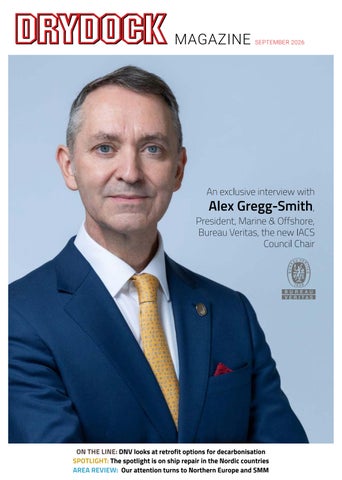
An exclusive interview with
Alex Gregg-Smith,
President, Marine & Offshore, Bureau Veritas, the new IACS Council Chair
ON THE LINE: DNV looks at retrofit options for decarbonisation SPOTLIGHT: The spotlight is on ship repair in the Nordic countries AREA REVIEW: Our attention turns to Northern Europe and SMM
JOIN BUREAU VERITAS
AT SMM 2026 SCAN TO KNOW MORE
HALL B3 BOOTH 103
HAMBURG, GERMANY 1st - 4th SEP 2026
MAGAZINE
SEPTEMBER 2026
Contents 2
An exclusive interview with
Alex Gregg-Smith, President, Marine & Offshore, Bureau Veritas, the new IACS Council Chair
Face the Facts
An exclusive interview with Alex Gregg-Smith, the new Chairman of IACS, who takes over when the maritime industry is at a crucial stage in its technical, digital and environmental evolution
12 On the Line
DryDock talks to Jason Stefanatos, Global Decarbonization Director at DNV, about where energy efficiency retrofitting stands in the light of ongoing regulatory uncertainty, commercial pressures and fuel cost increases
ON THE LINE: DNV looks at retrofit options for decarbonisation SPOTLIGHT: The spotlight is on ship repair in the Nordic countries AREA REVIEW: Our attention turns to Northern Europe and SMM
New IACS Council Chair Alex Gregg-Smith, President, Marine & Offshore, Bureau Veritas gives his views on the role of class in a time of change for shipping. www.group.bureauveritas.com
20 Upfront
A cruise and ferry repair showcase
30 Spotlight
The spotlight focuses on ship repair and conversion in the Nordic countries
46 Area Review
Our attention is turned to Northern Europe with SMM, retrofits and repairs at Damen, tankers and offshore vessel repair at BLRT and the acquisition of the APCL Group by Balaena
60 Market Intelligence
Steve Gordon, Global Head of Clarksons Research, provides an update of ship repair data points from Clarksons World Fleet Register
64 Mechanical Matters
A methanol dual-fuel upgrade by Everllence’s PrimeServ, a pioneering methanol-powered range extension system and expanded mobile lathe capacity at MarineShaft
Issue: September 2026 Volume No.50 No.3 ISSN No. 0143-5000
Editor: Mark Langdon Advertisement Manager: Nick Carugati Design & Production Manager: Fiona Andreanelli Accounts: Claire Long Subscriptions: Molly Andrews Publisher: Andrew Deere
Subscribe Today!
Visit www.drydockmagazine.com
MPI Group Peel House, Upper South View Farnham, Surrey GU9 7JN, UK Tel: +44 (0)1252 732220 info@mpigroup.co.uk www.mpigroup.co.uk
MPI Group, as a body, are not responsible for any opinions expressed in DryDock by contributors. All rights reserved. No part of this publication may be reproduced, stored in a retrieval system, or transmitted, in any form or by any means, electronic, mechanical, photocopying, recording or otherwise, without prior permission of MPI Group. © Marine Publications International Ltd 2026
72 In Focus
Another drone inspection first from Flyability and MaDfly, Ned Marine expands its inspection capabilities and PPG rethinks onboard maintenance
88 Analysis
Capt. Harshvardhan Kumar, Director – Marine Technical Services at Charles Taylor, explores biofouling risks on Gulf-delayed vessels
94 Worldwide
An AWESOME Horizon Europe-funded project that will help reduce uncertainty around wind-assisted propulsion systems
2 – FACE THE FACTS 2026
DRYDOCK 2026 – 3
AN EXCLUSIVE INTERVIEW with the new Chairman of IACS Alex Gregg-Smith is taking over as Chairman of IACS when the maritime industry is at a crucial stage in its technical, digital and environmental evolution. The advance of AI, emissions reduction and ever-increasing environmental legislation require that IACS’s role is fundamental to ensuring that these far-reaching changes are implemented at pace, uniformly and with safety at the core.
4 – FACE THE FACTS 2026
Alex Gregg-Smith brings more than 30 years of experience across classification, shipowner and shipyard leadership. He has spent over 20 years with Bureau Veritas across two periods, most recently serving as Senior Vice President, Marine & Offshore Asia Pacific, and Chief Executive for Marine & Offshore China. His earlier career at Bureau Veritas included senior technical and management roles across Europe, Africa and Asia. Beyond BV, he has held senior roles in the maritime industry including Manager of the London Maritime Service Centre at DNV, Vice President Technical at Siem Shipping managing the company’s owned fleet, and Chief Executive Officer for the owners of FSG shipyard in Germany. He holds an M.Eng in Naval Architecture & Marine Engineering from the University of Newcastle upon Tyne and a Master of Laws in Maritime Law, and is a Chartered Engineer and a Fellow of the Royal Institution of Naval Architects (F.RINA). Q. What made you want to become the IACS Chair? A. Over 20 years with Bureau Veritas, plus time on both the ship owning and the shipyard side, have given me a valuable perspective on the importance of classification from a number of different angles, as well as the essential nature of IACS’s work, which is more vital today than ever. It was a great honour to be elected to the position of Chair of the IACS Council, at a time when geopolitical volatility, new fuels, fastmoving technology and the erosion of the international rules-based order are converging on shipping all at once. I welcome the opportunity to help IACS speak with one clear, technical voice through this time of transition, and to play my part in reiterating the power of class, based on objective, independent and evidence-based support for regulators and industry that upholds IACS’s enduring goal of safer, cleaner shipping. Q. What qualifies you for this role? A. An attribute I bring to this role is having sat on more than one side of the class relationship: as a surveyor and manager within class but also running the technical side of a shipowner’s fleet and leading the parent company of a shipyard. That combination of class, owner and yard, alongside a background that spans naval architecture, engineering and maritime law, means I understand what the wider industry needs from IACS. What’s more, the needs of our industry, and those of the organisations served
by our 12 members, are evolving all the time. Technologically, digitally and environmentally, our industry is changing fast, and I fully understand the need for us to navigate this transition in a timely manner, uniformly and with safety at our core. I am proud to be charged with leading the IACS Council at this time and ensuring that we continue to deliver in line with our Strategic Plan. Q. What are the main things that you want to obtain during your tenure? A. From the perspective of IACS’s work programme, my priorities are practical. At the recent 93rd meeting of the IACS Council, which took place in Busan, I had the opportunity to highlight the issues that I hope to focus on in the coming months. This included a number of elements in our programme, such as the ongoing evolution of our Common Structural Rules, underpinned at every stage by engagement with industry, and our quality assurance programme, which is a vital but under-appreciated element of all that we do. Our Quality Management Standard is a requirement of IACS membership and a key component of upholding trust in class and the vital role of marine classification. Beyond our technical programme, I feel very strongly about the imperative for IACS to speak with a single, objective, non-commercial voice on so many of the defining issues facing shipping. We have a truly unique capability to engage with regulatory bodies, including IMO, and wider industry with unrivalled technical knowledge and expertise.
Trusted advisers by your side
Navigate the future of maritime operations with LR Advisory A global network for advice and expert services
Scan QR code or visit lr.org/advisory Lloyd’s Register’s Advisory services are independent of LR’s classification and statutory services, and any Advisory engagement does not affect any classification or survey decisions. Lloyd’s Register and variants of it are trading names of Lloyd’s Register Group Limited, its subsidiaries and affiliates. Copyright © Lloyd’s Register Group Limited, 2026. A member of the Lloyd’s Register group.
6 – FACE THE FACTS 2026
DRYDOCK 2026 – 7
To put this in numbers, in 2025 alone, IACS and our members authored 37 independent submissions to IMO, plus a further 20 co-sponsored papers. We have a vital contribution to make to the many debates taking place, from disruptive technologies to new environmental challenges, and I am determined to reinforce IACS’s independent voice and the wider importance of classification as the cornerstone of maritime safety. Q. Do you think IACS is as relevant today as it was when founded in 1968? A. More relevant, if anything. Classification’s core purpose of independent assurance of a ship’s condition has not changed since long before IACS itself was founded. What has changed is the scale and the pace. IACS members’ rules and standards now cover more than 90% of the world’s cargo-carrying tonnage, we publish several hundred technical outputs a year to keep that library current, and IACS remains the only maritime body with its own mandatory, externally audited Quality Management Standard for members. We have also responded with agility to the emerging challenges and opportunities facing shipping. As is often said, digitalisation and decarbonisation are reshaping our industry, and IACS has moved quickly to meet the urgent need for corresponding technical support, most obviously through the work of our Safe Digital Transformation Panel and our Safe Decarbonisation Panel. The world is changing fast, and the demands placed on classification as an enabler of safe transformation are growing. As an example of the speed with which we can move, earlier this year we published the results of a Concentrated Inspection Campaign on Emergency Power Supply Tests. This took place during 2025 and saw inspections conducted on over 36,000 ships. The results of this campaign led to a number of recommendations that will improve SOLAS compliance. Q. Shipping is probably under more pressure than it has ever been before.
How can IACS help shipowners navigate the ever-changing regulations? A. Owners are dealing with overlapping, and sometimes inconsistent, requirements from the IMO, the EU and individual flag states, on top of the practical challenge of building or retrofitting for fuels that are still commercially and technically immature. IACS’s job is to make sure new rules are informed by in-service experience rather than decided in the abstract and handed to class to interpret afterwards. For example, when a fuel such as ammonia is being integrated into ship systems, agreeing uniform minimum technical standards at an early stage is an important enabler for faster, safer and more predictable technological progress. This is why recent steps such as the revision of our Unified Requirement (UR M78) which introduced new safety requirements for ammonia-fuelled marine engines, or the publication of a new Unified Requirement establishing a safety framework for ammonia release mitigation systems on ammonia-fuelled ships (UR H2), are so vital. We also face a challenge of a more political nature: tonnage operating outside the rules-based order, the so-called shadow fleet. Bringing that tonnage back within a single, recognised regulatory regime is also a priority, because it affects the credibility and effectiveness of the whole global system. IACS has a valuable role in this debate, representing our 12 members and 90% of global tonnage with one voice. Q. New technologies, such as drones, are changing the way surveys are taking place. How do you see technologies like this evolving even more? A. Remote and autonomous inspection tools, drones included, are already changing which parts of a survey need a surveyor to be physically present and which can be done from a screen, using data captured remotely. This can deliver significant benefits, ranging from the quality of the data and speed with which it is collected to enhancing the safety of seafarers and surveyors, particularly when it involves enclosed spaces.
8 – FACE THE FACTS 2026
Interestingly, whilst drone and UAV technology is coming to the fore today, IACS was ahead of the curve when it comes to supporting their deployment. Recommendation 42 on ‘Guidelines for Use of Remote Inspection Techniques for Surveys’ was published 10 years ago in 2016. It’s fair to say that the use of innovative survey techniques and technologies has accelerated more recently and is becoming increasingly widespread, and this is an area where IACS’s Safe Digital Transformation Panel has an important role to play in providing the technical and safety assurance to support this journey. An important question remains where we find the right balance between remote and in-person, and automated or human, when it comes to surveys. My own expectation is a hybrid solution: routine, hard-to-access or hazardous inspection points handled remotely, with surveyors concentrating on judgement calls, anomalies and other areas where physical presence and human insight matter most. This technology will empower the expertise, experience and judgement of our surveyors. Q. How do you see the digital twin being used to enhance maintenance and conversion works in the future? A. A key element of the work of our Safe Digital Transformation Panel relates to mitigating the risks associated with digital technologies, in order to better support their utilisation.
Delegates at the 93rd meeting of the IACS Council, which took place in Busan
A good example is the use of 3D modelling. We need to close the gap between shipyards and designers that have made strong progress towards
the use of 3D working environments, and class society approval processes that still use 2D drawings and static documents in many cases, notwithstanding the innovative work of our members when it comes to 3D classification services. This gap can seriously undermine the potential of 3D modelling, which is why IACS is developing a Recommendation on the protocol for format definition and exchange of 3D models. When it comes to conversion, maintenance or repair work, there is immense value in testing how a structural change will behave before steel is cut, rather than during the work itself. The digital twin is a virtual testbed in which different options and configurations can be evaluated ahead of any physical work, lowering risk, reducing errors and cutting downtime. Digital twins can also support predictive maintenance by flagging issues in the digital model before they escalate into major failures in the asset. Of course, digital twins are only as useful as they are accurate to the vessel itself. The progress being made from static models to those actively updated with data sourced direct from the vessel will greatly support this process. From IACS’s perspective, we want to ensure that the assurance framework keeps pace with maintenance, repair and conversion needs, including digital tools that interact more directly with the classification process, so that a digital twin used to support a conversion or repair project carries the same confidence as a physical survey.
TECHNOLOGY TRENDS
Explore how the latest advancements in technology are reshaping how assets are designed, built and operated.
Download your copy today at www.eagle.org/techtrends26.
10 – FACE THE FACTS 2026
DRYDOCK 2026 – 11
Remote and autonomous inspection tools such as drones are already changing which parts of a survey need a surveyor to be physically present and which can be done from a screen, using data captured remotely © Flyability
Q. The biggest advantage of AI is its ability to handle large amounts of data quickly. How do you see AI impacting the ship repair and conversion sector going forward? A. The machine learning, data analytics and predictive capabilities of Al are already having a transformative impact across every facet of the shipping industry, and the ship repair and conversion sector is no exception. From a predictive maintenance perspective, the benefits are obvious. The use of drone and UAV technology to collect vast quantities of inspection data in hours rather than days, then AI tools to identify areas of potential weakness or risk, are a genuine step-change in capability. When it comes to planning for routine maintenance needs, such as coatings or corrosion repairs, the data can then be processed and analysed, before being presented to a qualified surveyor for review and validation. One of the most exciting aspects of such capabilities is the ripple effect of the benefits that are felt beyond the task itself. It enables earlier, more effective interventions, shorter and more efficient dry dock visits, reduced downtime and more predictable OPEX. And most importantly, reduced risk of failure and safer vessels. Of course, at the same time as harnessing the power of AI, we also need to identify and mitigate
the risks. IACS has a strong record already in respect of addressing the cybersecurity considerations associated with growing digitalisation, such as through our Unified Requirements UR E26 and UR E27, which support the cyber resilience of ships and onboard systems and equipment. This also remains an important focus of our Safe Digitalisation Panel. Q. What about Alex Gregg-Smith outside IACS? What do you do to relax and what are your main interests/ hobbies? A. Being in the maritime industry from my early days implies a love of travel, and this is very true. I have had the good fortune in my career to visit, live in and work in many locations starting at the age of 17 in Newcastle (I am a Newcastle United supporter), through France, Africa, Europe and Asia. I try to learn and experience new things to keep my brain active, and love to immerse myself in the cultures (including the people, their food and drink) and languages that this travel brings, including French and Mandarin. I try to play golf when time permits, but I find now with a young addition to my family, the best way for me to relax and appreciate life is to spend time together with them, whether at home or travelling. My next challenge I wish to set myself is to start learning Italian and experience more of the richness of the Italian culture.
12 – ON THE LINE 2026
Options for global decarbonisation
Bulbous bow retrofits are common practice in several segments and has already been applied to several thousand vessels, but primarily for boxships
DRYDOCK 2026 – 13
Retrofit – where does energy efficiency retrofitting stand in the light of ongoing regulatory uncertainty, commercial pressures and fuel cost increases, asks Jason Stefanatos, Global Decarbonization Director at DNV.
14 – ON THE LINE 2026
oday, commercial pressures, the rise in the fuel price and both regional and international regulations have led to energy efficiency (EE) and retrofitting for enhanced fuel performance becoming important once again. EE can help save costs today, while reducing emissions and building the foundation for the wider roll-out of new fuels.
T
Immediate benefits even in uncertain times
Regulatory frameworks were the initial force shaping shipping’s decarbonisation journey. The FuelEU Maritime, the EU Emissions Trading System (ETS) and the IMO’s Carbon Intensity Indicator (CII) set the current requirements, and the industry has been working towards the ultimate destination of net zero.
For DNV, there has never been a ‘silver bullet’ solution but a range including fuels, energy efficiency, onboard carbon capture, digitalisation and others. EE especially has the potential to provide shipowners with an immediate and cost-effective route to emissions reductions, a compliance tool that
However, the recent adjournment of the IMO’s Net-Zero Framework (NZF) vote has unsettled expectations, raising questions about timelines, compliance costs, and whether regional regulations will proliferate in the absence of global alignment.
DRYDOCK 2026 – 15
16 – ON THE LINE 2026
can also be a competitive advantage, reducing operating costs and enhancing resilience to fuel price volatility. Examples of this are wide and varied, starting from low-hanging fruit, such as slow steaming and weather routing, to more technical measures, such as hull and propeller maintenance, machinery optimisation and digital performance management. Going beyond this – and requiring a higher degree of investment – wind-assisted propulsion systems (WAPS) can drive further gains. There is a wide spectrum of retrofits, from the day-to-day to the firsts that can set the direction for the industry more broadly. To focus in on one and the challenges and benefits at the ‘top end’ of the retrofit scale can be illustrative.
Retrofit at the top end The world’s first methanol conversion project for a mega-container carrier was completed at CHI Shanghai’s yard in September 2025. At nearly 400m in length and with a capacity of 20,000 TEU, the seven-year-old COSCO Shipping Libra became the first ship of its kind to be retrofitted to run on methanol. The seven-year-old COSCO Shipping Libra became the first ship of its kind to be retrofitted to run on methanol
The general design was developed by MARIC, while CHI Shanghai carried out the detailed engineering and served
as EPC contractor. The scope included conversion of the ship’s MAN B&W 11S90 main engine and two of its four Wärtsilä auxiliary engines to dual-fuel operation. Fuel retrofits must be designed with flexibility in mind. At CHI Shanghai, this translated into preserving the original fuel systems where possible, ensuring automation compatibility and minimising cargo capacity loss. The vessel’s fuel system, designed only for conventional fuels, required fundamental changes to enable methanol operation across propulsion, auxiliaries, storage and safety systems. In parallel, new methanol fuel tanks with a total capacity exceeding 15,000 cubic metres were installed forward of the engine room, together with new fuel preparation and supply systems. To accommodate the methanol tanks and systems, the capacity of the vessel was reduced by just over 450 TEU, which required a reassessment of the vessel’s deployment and network planning. Delivering as a retrofit rather than a newbuild added complexity: the new systems had to be integrated into confined spaces, requiring innovative construction sequences and tight interface management between suppliers. For example, the original plan
DRYDOCK 2026 – 17
and intensive integration testing, remains consistent.
envisaged fabricating the methanol fuel tank and preparation room as a single integrated block, to be lifted and installed on board. In practice, this proved impractical, so instead major components were assembled at ground level before integrating them into the vessel.
Overall, the significance of the project lies in what it enables. By converting a technically demanding megaship, the project demonstrated a credible pathway for large-scale methanol retrofitting, as well as accelerating the development of repeatable processes at the yard, and for the owner, realworld insight into both the conversion and the operations of the vessel.
The total yard stay for COSCO Shipping Libra of 108 days included eight days of sea trials. When the sister vessel COSCO Shipping Gemini entered the yard later the same year, the same core team was able to apply lessons learnt from the first project. This resulted in completing the retrofit in just 90 days, demonstrating clear efficiency gains.
A vital puzzle piece to decarbonisation Decarbonisation of shipping is a complex puzzle with many different solutions. Energy efficiency is a vital part of this and will be crucial in helping the maritime industry reach its ambitious goals.
This project became a reference point for managing complexity at scale. CHI Shanghai has since applied similar methodologies to other projects, including multi-vessel methanol retrofits for Seaspan and potential LNG retrofits for MSC and COSCO Shipping. So while individual projects differ, the underlying approach, such as detailed design ownership, phased construction
Fleet decarbonisation strategies and plans can reduce and manage decarbonisation risks for the existing fleet. A three-step approach can
TRANSFER TROLLEY SYSTEM 30,000 MT TOTAL CAPACITY
138
TROLLEYS
4
250 MT & 125 MT CAPACITY Heavy-duty hydraulic transfer trolleys for synchronized movement of heavy structures.
High performance hydraulic
POWERPACK powerpacks for reliable and synchronized operation. UNITS
52
TRESTLES
AVAILABLE FOR SALE EXCELLENT WORKING CONDITION STATE OF THE ART EQUIPMENT
Heavy-duty support trestles suitable for load transfer and positioning applications.
COMPLETE SYSTEM WITH ALL ACCESSORIES Hydraulic & Electrical Accessories Hoses, Cables, Connectors & Control Panels All Supporting Equipment & Components
AVAILABLE FOR IMMEDIATE INSPECTION
SUITABLE FOR HEAVY INDUSTRIAL AND MARINE APPLICATIONS
IDEAL FOR
SHIPYARDS
TRANSFER TROLLEYS
POWERPACK UNITS
SHIPBUILDING
OFFSHORE FABRICATION
HEAVY ENGINEERING
FOR TECHNICAL DETAILS, INSPECTION & COMMERCIAL DISCUSSIONS +91 932 068 9988 SUPPORT TRESTLES SOLUTIONS@FWPL.IN
18 – ON THE LINE 2026
be applied when developing such strategies and plans: 1. Define GHG trajectory and goals: This should build on assessing both regulatory (e.g. IMO, EU) and commercial drivers (e.g. Poseidon Principles, Sea Cargo Charter) for decarbonisation along the timeline, deciding whether the fleet should meet the minimal regulatory compliance requirements or pursue more ambitious GHG targets, with opportunities for also offering green transport. 2. Assess pathways for meeting GHG trajectory and goals: Using fleet simulation tools (e.g. DNV's Pathway model) and optimisation models, different pathways available for meeting the GHG trajectory and goals are identified, accounting for the current fleet baseline and gaps. All promising compliance options relevant for the fleet, including EE measures, fuels, onboard CCS, pooling mechanisms, should be considered. 3. Develop fleet decarbonisation strategy and plan: Select one pathway based on step 2. The chosen pathway should be robust, consider various uncertainties and GHG risks (e.g. regulatory developments, technological progress, fuel supply, market developments, charter requirements, access to financing, etc.), and be aligned with any existing company strategy.
Energy efficiency retrofit uptake EE measures are widely implemented across the global fleet, in particular measures with low investment cost and short payback time. However, uptake varies significantly depending on vessel type, commercial contract type and vessel age. Shipowners should prioritise measures based on cost efficiency and other aspects such as technical maturity, complexity, safety and reliability, lack of experience, and crew training needs. Survey results indicate that operational measures have lower barriers than technical measures.
To look at a few common examples: Energy-efficient lighting systems can be installed on all vessel types and ages, but total energy consumed for lighting on a normal merchant vessel is estimated to be 0.25% to 5% of the total electrical power, up to over 10% for cruise and passenger vessels. This can be reduced through low energy halogen lamps, fluorescent tubes and LEDs in combination with electronicallycontrolled systems for dimming, automatic shut off, etc., with the added benefit that most energy-efficient lighting systems have an equal or longer lifetime than normal lighting systems and can also reduce maintenance hours and the need for spare parts. Optimisation of cargo handling systems and cargo operations is applicable for several vessel types and their respective cargo operations. Options include installing variable frequency drives (VFDs) for pumps and cranes or using advanced insulation and heat recovery systems for cargo heating and cooling. Monitoring and control systems can further enhance efficiency by optimising energy use in real time. These are especially of interest in the tanker segment. We should also not forget the bulbous bow retrofit. In several segments it is common practice and has already been applied to several thousand vessels, but primarily for boxships. DNV has already delivered retrofits to 23% of the relevant standard designs of the world’s container carrier fleet (500–15,000 TEU). There are still possible efficiency gains of up to15% if the vessel design does match to the whole operating range of the vessel and the common use of light draft conditions and slow steaming. There are many more examples available and assessed for CAPEX, OPEX, implementation time, segment applicability and regulatory impact in the DNV Energy Efficiency white paper.
Energy efficiency today and in the future Over the longer term, energy efficiency will also help to drive the large-scale emergence of carbon-neutral fuels.
DRYDOCK 2026 – 19
There is already a range of innovative, practical and effective technologies available today such as wind-assisted propulsion systems which can increase the energy efficiency of vessels
Future fuels will be more expensive than conventional versions, so combining these with EE measures will significantly reduce costs, improving the business case for shipowners adopting these fuels, and encouraging greater uptake. There is already a range of innovative, practical and effective technologies available today which can increase the energy efficiency of vessels, decrease net energy input and fuel demand and drive significant reductions in emissions. At the same time, they may potentially reduce the emission costs and penalties from regulation (CO₂ tax). Finding the optimal combination of measures and technologies is challenging, but when done effectively, it can enable shipowners to not only meet short- and mid-term regulatory requirements but also to gain a competitive edge for profitable operations well into the 2030s and 2040s.
20 – UP FRONT 2026
Cruise & ferry repair showcase Cruise vessel repairs and maintenance at Damen, Wärtsilä reduces engine overhaul time, a combined rudder trunk and shaftline repair in Greece by MarineShaft, an SGS underwater ALS cruise ship repair and a cruise first for Jotun.
The state-of-the-art polar expedition cruise vessel Le Commandant Charcot at Damen Shiprepair Brest
DRYDOCK 2026 – 21
22 – UP FRONT 2026
Le Commandant Charcot underwent a range of work including blasting and painting of the hull
Holland America Line’s Rotterdam in the Botlek yard dry dock for a five-year survey
A
pril saw the state-of-the-art polar expedition cruise vessel Le Commandant Charcot arrive at Damen Shiprepair Brest for its five-year survey and upgrade work. Ponant’s 150m-long vessel is designed for high-latitude polar expeditions in the Arctic and Antarctic. It features a PC2 hull able to break ice up to 2.5m thick and can host up to 270 passengers in highly comfortable accommodation.
Safe exploration During its time at the Brest yard, Le Commandant Charcot underwent a range of work including blasting and painting of the hull. To enable it to withstand regular contact with ice, an Inerta coating was applied beneath the waterline. To ensure the vessel’s ability to operate in remote regions, close attention was paid to checking and maintaining safety-critical systems and equipment. This included the vessel’s lifeboats, helicopter lifting platform and support systems for its 16 Zodiac expedition boats.
Tailored maintenance for Arctic conditions A further area of focus was Le Commandant Charcot’s propulsion equipment. The yard undertook a complete overhaul of its Azipod thrusters, polishing of its icestrengthened propellers and servicing of bow thrusters – essential in ensuring the vessel’s ability to manoeuvre in icy waters. Additional work included maintenance of the vessel’s stabilisers to ensure passenger comfort in rough seas, and maintenance of the LNG propulsion system.
DRYDOCK 2026 – 23
“Arctic cruise vessels like Le Commandant Charcot operate in some of the harshest conditions on Earth,” says Ronan Scolan, Commercial Manager at Damen Shiprepair Brest. “Taking care of such a ship requires a shipyard with the right facilities, craftsmanship and understanding of polar-class vessels. At Damen Shiprepair Brest, we combine deep technical expertise with a full lifecycle approach, working closely with our clients to ensure their vessels remain safe, efficient and ready for the next expedition.”
platform was set up, along with an exhibition on the history of Damen Shiprepair Rotterdam, and covered access to buses for day trips across the Netherlands.
On completion of the project, Le Commandant Charcot departed the yard on April 30, bunkering LNG in the port of Brest before sailing to Reykjavik to begin its next Arctic expedition.
Simultaneous arrivals
An unusual survey
Holland America Line’s almost 300m-long Rotterdam docked in the Botlek yard’s 405m x 90m dry dock for a five-year survey. The work carried out on the vessel included maintenance on both azimuth thrusters and a full repaint of the hull – both above and below the waterline.
Earlier this year, Damen Shiprepair Rotterdam’s Botlek yard welcomed AIDA Cruises’ 253m cruise ship AIDAmar for its annual bottom survey. What made this project different was that the vessel arrived with around 2,000 passengers still on board. While the yard’s technical team carried out the inspection in dry dock no. 6, guests were given a rare front-row view of a working shipyard. A viewing
Managing a safe, controlled operation with passengers on board required meticulous planning and close coordination with AIDA Cruises. The yard took great care to ensure that everyone could move freely and safely throughout the visit, something it is proud to have delivered.
There were also unusual scenes in the port of Rotterdam recently when two large cruise ships arrived simultaneously for maintenance work.
Meanwhile, TUI Cruises’ 295m Mein Schiff 3 entered Damen Shiprepair Rotterdam’s Schiedam yard, where it had a new steel plate installed on its port side bow – a job that was undertaken
Mein Schiff 3 in Damen Shiprepair Rotterdam's Schiedam yard
24 – UP FRONT 2026
Exchange parts are genuine, highquality original equipment manufacturer (OEM) parts that have been inspected and reconditioned according to strict quality management standards.
Scope of the Wärtsilä solution Molslinjen selected Wärtsilä to conduct a major 32,000-hour overhaul on both Wärtsilä 31 engines on the Hammershus. The service was delivered through Wärtsilä’s Exchange Parts service. The exchange power units for the Wärtsilä 31 engines on the Hammershus are complete pre-overhauled cylinder packages consisting of three subassemblies: • the cylinder head Molslinjen selected Wärtsilä to conduct a major 32,000-hour overhaul on both Wärtsilä 31 engines on the Hammershus
together with colleagues from Damen Shipyards Galati. Additionally, the vessel underwent painting work and a minor thruster overhaul.
REDUCED FERRY ENGINE OVERHAUL TIME Danish ferry operator Molslinjen operates the RoPax ferry Hammershus on the Rönne-Köge and Rönne-Sassnitz routes. These routes connect the island of Bornholm with mainland Europe. Molslinjen A/S is Denmark’s largest domestic ferry operator, with a fleet of 20 ships transporting more than 15 million passengers annually. The challenge was to complete a major engine overhaul on the Hammershus in a tight 14-day dry dock window, which did not allow time for parts to be reconditioned. Molslinjen needs to ensure that maintenance and overhaul work on its vessels is completed according to carefully-planned schedules because any unplanned downtime would impact service levels and profitability. Using exchange parts for major engine overhauls avoids the need to wait for parts to be reconditioned or repaired. Exchange parts also avoid challenges with delays relating to lack of availability of workshop labour or components.
• the cylinder liner and piston with connecting rod • the guide block. These ready-to-use components reduced the time and labour Molslinjen needed to reserve for the engine overhaul, which was completed in dry dock. The components removed from the engines were returned to Wärtsilä for reconditioning and re-use through the Wärtsilä Exchange Parts concept. Molslinjen completed the overhaul of all 16 cylinders, eight per engine, cost-efficiently at a fixed price, which improved budgeting predictability. Overhauls can be completed in a much shorter time because exchange parts are ready to use immediately. Vessel operators don’t need to wait for old parts to be reconditioned, which can reduce the time needed for an overhaul by up to 37%. There are three key benefits of using exchange parts: • less time spent onboard, reducing overall maintenance time • utilisation of pre-overhauled exchange components, which speeds up maintenance work • reduced risk of unexpected costs through fixed pricing.
26 – UP FRONT 2026
approved procedure before mobilising specialist machining equipment from Hirtshals, Denmark. A new rudder trunk lower section was manufactured in-house in 3.2 classcertified S355 steel from the material stock, with chamfer prepared in advance to reduce vessel downtime at the yard. On site, the remaining trunk section was machined with chamfer for a precise welded joint, and the replacement lower section was positioned and aligned with the steering gear. After welding and post-weld heat treatment, MarineShaft installed mobile machining equipment directly beneath the trunk and machined the lower bearing seat to final dimensions. The bottom surface was also machined to achieve the correct trunk length, followed by assistance with steering gear alignment and full documentation for owner and class.
Additional shaftline repair
Looking down the rudder line from top of the steering gear – the rudder stock has not yet been reinstalled
“Significant time savings can be achieved when parts are ready for use directly out of the box,” explains Jan Hauberg Jørgensen, Chief Engineer, Molslinjen. “Additionally, the process of removing and installing the piston, liner and connecting rod in a single lift further optimises efficiency.”
COMBINED RUDDER TRUNK & SHAFTLINE REPAIR MarineShaft has completed a combined rudder trunk and shaftline repair on a vessel at a shipyard in Greece, restoring critical steering and propulsion components to class-approved operating condition. The project began with an onboard inspection of a misaligned portside rudder trunk. Service engineers measured the damage, defined the repair scope and prepared a class-
During the same visit, damage to the coupling end of the portside aft intermediate shaft was repaired. MarineShaft mobilised portable machining equipment to Greece, where it was installed and aligned in the engine room, allowing the intermediate shaft coupling end to be machined in place. Scratches and damage from an angle grinder cut were removed by machining the intermediate shaft coupling end, removing 9mm of material to achieve a final diameter of 450mm over a length of 650mm, followed by polishing. To verify the shaftline condition, jack-up tests were carried out afloat afterwards in both cold and hot static conditions. The project demonstrates MarineShaft’s ability to combine in-house manufacturing, mobile machining, alignment, heat treatment coordination and class documentation into one efficient repair solution for both steering and propulsion systems.
UNDERWATER ALS CRUISE SHIP REPAIR A major cruise operator required the replacement of air lubrication system
DRYDOCK 2026 – 27
(ALS) cover plates on one of its largest passenger vessels during routine port calls in Miami. The vessel, measuring approximately 360m long with a beam of 65m, required the installation of upgraded cover units designed to improve system efficiency and support ongoing vessel performance initiatives. Subsea Global Solutions (SGS) was engaged to complete the underwater removal and installation work while the vessel remained in service, ensuring the project could be completed without interrupting the ship’s operating schedule.
The challenge The project involved replacing 20 existing ALS cover plates with a newly modified and more efficient design. Because the vessel maintained an active cruise schedule, all work had to be performed during regular port calls with strictly limited working windows. Each cover removed during the operation had to be reinstalled or replaced before the vessel’s departure, leaving no margin for delays. Additionally, the scale of the vessel and the location of the cover plates required careful underwater rigging and precise coordination between dive teams and topside personnel. The client relied on SGS based on an established working relationship and confidence in the
company’s ability to execute technicallydemanding underwater work safely within tight operational constraints.
The solution SGS’s US East Coast team deployed a five-person commercial diving team during scheduled port calls in Miami to complete the ALS cover replacement. Each operation required divers to unbolt and remove the existing ALS covers, perform controlled underwater rigging operations and install the upgraded units using new fastening hardware. The work demanded careful alignment and secure installation to ensure the integrity of the ALS system and vessel hull. Throughout the project, strict adherence to the vessel’s departure schedule remained the top operational priority. SGS ensured that any removed cover was fully reinstalled or replaced before the vessel sailed, eliminating
Left: The project began with an onboard inspection of a misaligned portside rudder trunk Above: The bottom surface was machined to achieve the correct trunk length Below: An SGS diver replacing the air lubrication system (ALS) cover plates on the passenger vessel during a routine port calls in Miami
28 – UP FRONT 2026
proactive approach also reduces fuel consumption, cuts carbon emissions and protects biodiversity. “Maintaining a clean hull is essential for efficient ship operations, and the Hull Skating Solution allows us to take a more proactive approach to hull maintenance,” said Jari Oinas, AVP of fuel performance and decarbonisation at Carnival Cruise Line. “As we evaluate the technology aboard Carnival Pride, we see strong potential to support ship performance while advancing our longterm sustainability goals.”
© Carnival
operational risk and ensuring the ship could depart each port call on time.
Conclusion SGS successfully completed the ALS cover replacement across multiple port calls without impacting the vessel’s operating schedule. The project demonstrated the company’s ability to coordinate complex underwater mechanical work within limited service windows while maintaining strict safety and quality standards. The client reported that while the service met operational expectations, the professionalism of the SGS team and the quality of the installation exceeded expectations, reinforcing the trusted partnership between the cruise operator and SGS.
CRUISE ROBOTIC FIRST Carnival Cruise Line has signed an agreement with marine coatings specialist Jotun to implement Jotun’s Hull Skating Solution (HSS), becoming the first cruise operator to use this proactive robotic hull cleaning technology. With this commitment, Carnival continues to utilise innovation and technology to reduce emissions and protect biodiversity. As one of the world’s largest and most influential cruise brands, Carnival’s adoption of HSS to its vessel Carnival Pride marks an important shift for the wider industry. The technology enables proactive hull cleaning, ensuring that vessels maintain an always-clean hull across typical cruise operations. This
Carnival first Carnival’s move is the first introduction of Jotun’s robotic hull cleaning solution in the cruise sector. “Carnival is demonstrating real leadership by embracing new technology that ensures consistently clean hulls and reduced environmental impact,” says Stein Kjølberg, Regional Vice President Americas for Jotun. “With our 100-year long track record in hull performance, and with presence in the US for over 50 years, we are proud to support an American icon that is both ambitious and forward leaning.” In addition to the HullSkater device, the agreement includes compatible hull coating, continuous monitoring and hull inspections, hull performance transparency through Jotun’s digital reporting solutions and an always-clean hull guarantee. Jotun recently received independent verification from DNV, verifying an always-clean hull with no measurable speed loss for vessels using HSS. For cruise operators, the ability to inspect and clean the hull before sailing to the next destination is particularly valuable. By maintaining a clean hull, Carnival can support fuel efficiency, minimise speed loss and reduce the risk of transferring invasive species between various waters and ports. “Our Clean Shipping commitment is dependent on collaborations with partners who dare to innovate,” says Kjølberg, applauding Carnival’s willingness to challenge and disrupt.
⚓ MINIMISE DOWNTIME CLASS APPROVED 🌐🌐 WORLDWIDE SUPPORT
High-performance composite bearing material for rudder and water-lubricated propeller shaft applications. Class approved by ABS, Bureau Veritas, DNV, Lloyd’s Register and RINA.
🕓🕓
🗪🗪
LOW MAINTENANCE
RAPID TURNAROUND
CLASS APPROVED
TECHNICAL SUPPORT
EXTENSIVE STOCK
📞📞
+44 (0)114 244 2363
info@tufcot.com
🖥🖥
www.tufcot.com
30 – SPOTLIGHT 2026
Midnatsol undocking after a major upgrade at Orskov Yard in Denmark
DRYDOCK 2026 – 31
Spotlight on the Nordics
A major cruise ship refurbishment, dry docking as an important tool for reducing emissions and improving vessel efficiency, an expedition yacht modernisation, upgrades in the offshore market, an LNG FSRU conversion and a major propulsion acquisition.
32 – SPOTLIGHT 2026
W
hen Hurtigruten’s passenger vessel Midnatsol underwent a major upgrade at Orskov Yard in Denmark in spring 2026, the project combined extensive technical repairs and upgrades with a complete interior refurbishment. Through detailed planning, prefabrication and close coordination, the complex upgrade was completed within a tight 50-day schedule. A comprehensive cruise ship upgrade brings multiple disciplines together. Once Midnatsol entered Orskov Yard, months of preparation gave way to a tightly-coordinated schedule, with interior refurbishment and extensive repair work and improvements progressing in parallel throughout the vessel, which shows why planning matters as much as craftmanship.
In close collaboration with ship interior specialist Norisol, Orskov Yard refurbished 243 passenger cabins and redesigned restaurants, lounge and bar areas to create a more modern, comfortable and inviting passenger experience. At the same time, significant technical work was carried out, including the renewal of the propulsion shaft system, an extensive overhaul of thrusters, gearboxes and stabilisers, the installation of a new ballast water treatment system and steel and piping renewals.
Preparations start long before the vessel arrives Over six months, Orskov Yard’s project team worked closely with Norisol and Hurtigruten to develop interior solutions and tailor the refurbishment scope to the project’s budget and requirements. All areas were visualised, allowing the custom-designed furniture and interior elements to be prefabricated ahead of the vessel’s arrival. This significantly streamlined the installation process, reducing the amount of work required on board and making the most efficient use of the time in dry dock. The long-standing partnership between Orskov Yard and Norisol has built trust and a shared understanding of how to approach complex projects, enabling the teams to respond quickly and flexibly when schedules are tight and requirements change along the way.
DRYDOCK 2026 – 33
Capacity for complex projects Located at the northern tip of Denmark, Orskov Yard specialises in ship repair, maintenance and conversions. Strategic investments in recent years, including the addition of a new and larger floating dock, have expanded the yard’s capacity and supported a substantial increase in activity. Orskov Yard currently operates four docks – two floating docks and two dry docks – providing the flexibility to handle a wide range of projects across different vessel segments. With specialised workshops and a network of trusted local partners, the yard brings together multiple disciplines through a structured, project-led approach. For a project such as Midnatsol, this means that extensive technical work, interior refurbishment and specialist activities can be coordinated within the same yard stay and around one overall project schedule.
Hurtigruten’s third Signature ship For Hurtigruten, the project represents a significant investment in the vessel’s operational reliability, environmental performance, passenger comfort and long-term service life.
The upgrade also gave Midnatsol a new role in Hurtigruten’s fleet. In May 2026, it became the company’s third Signature ship, as Hurtigruten expanded its premium offering in response to growing demand for voyages along the Norwegian coast and into the Arctic. For a vessel built in 2003, the transformation illustrates how a carefully-planned upgrade can do more than extend service life: it can prepare an existing ship for a new commercial role and a new experience for the passengers.
34 – SPOTLIGHT 2026
THE KEY TO LOWER EMISSIONS AND MORE EFFICIENT VESSELS Dry docking is no longer just a matter of maintenance. For Stena Line, it has become one of the most important tools for reducing emissions and improving vessel efficiency. Each docking is an opportunity to lower fuel consumption and take concrete steps toward the group’s targets to reduce CO2 emissions. Stena Line’s target is to reduce its carbon dioxide emissions by 30% by 2030, compared with 2019 levels. “There is no single solution that delivers 30% immediately,” says Hans Corneliusson, Group Head of Fleet Support at Stena Line. “We need to work with many different measures in parallel and continuously calculate the benefits.”
A technical & commercial puzzle
One of the most effective measures takes place where it cannot be seen – beneath the water surface
Passenger and RoPax vessels are normally dry-docked twice during a fiveyear period. The larger dockings (special surveys) are extensive and governed by classification rules. During these, the hull, valves, propeller shafts and anchor
chains, among other components, are inspected. At the same time, Stena Line takes the opportunity to carry out its own improvement measures while the vessel is out of service. “When the vessel is out of operation, we have full access,” explains Corneliusson. “That allows us to carry out work that would otherwise be impossible, both below the waterline and in engine rooms and systems.” Planning is complex. Dockings must be coordinated with timetables, replacement vessels, shipyard capacity and technical dependencies. Between December 2025 and April 2026, 15 of Stena Line’s total of 40 vessels have been in dry dock.
Major gains below the waterline One of the most effective measures takes place where it cannot be seen – beneath the water surface. By blasting the hull completely clean of old paint, a smooth surface is created that reduces friction. “Blasting and repainting with a conventional coating alone can reduce fuel consumption by up to 2% per vessel,” says Corneliusson.
The original delivers what copies promise WE KEEP PUSHING TECHNOLOGY FURTHER! • 20% higher operating pressure of 3,600 bar • 40% greater area performance of 180 m²/h • 45% less water consumption • More to come at SMM 2026
Hammelmann GmbH Carl-Zeiss-Straße 6–8 59302 Oelde / Germany
www.hammelmann.com mail@hammelmann.de Tel.: +49 25 22 / 76 - 0
Experience the full range of Hammelmann ship cleaning systems:
36 – SPOTLIGHT 2026
Further efficiency gains can be achieved through propellers modifications
After blasting, a silicone-based hull coating is often applied, further reducing resistance. This can provide savings of up to about 3-3.5% and also reduce the need for maintenance between dockings.
Propeller adaptions Further efficiency gains are achieved through the propellers. Many older vessels were built for higher speeds than they operate at today. By adapting the propeller blades to current operating conditions, efficiency is improved. “On vessels where we only replace the propeller blades, we see up to a 2% reduction in fuel consumption,” says Corneliusson. “That is significant, from both a climate and financial perspective.” In addition, continuous technical improvements are carried out in the engine room and onboard systems during and between dockings.
Innovation driving development In addition to established measures, Stena Line is working to test new technologies during dockings. These include new rudder solutions and air lubrication, where small air bubbles along the hull further reduce friction in the water. Each measure is carefully evaluated, including financially. The payback period averages between one and a half and two years, sometimes shorter when fuel prices are high.
A strategic tool By combining necessary maintenance with technical improvements, dry docking has become a strategic tool in Stena Line’s transition. Each docking contributes to lower emissions, reduced fuel costs and a more energy-efficient fleet – step by step toward the 2030 target.
ABB MODERNISES GALAPAGOS YACHT Between December 2025 and April 2026, 15 of Stena Line’s total of 40 vessels have been in dry dock
ABB is collaborating with expedition travel company Quasar Expeditions, based in Ecuador, to modernise the iconic yacht formerly known as Galú
ON-SITE MACHINING SPECIALISTS
Mobile repair solutions keeping rudder and propulsion systems moving
DK-9850 Hirtshals marineshaft.com
38 – SPOTLIGHT 2026
for hybrid-electric propulsion. The conversion will make the vessel, originally built by Italian shipyard Benetti in the 1970s, the first of its kind. The conversion from conventional combustion engines to hybrid-electric propulsion will allow guests on board the 52.9m vessel to experience quiet, comfortable and low-emission sailing in one of the world’s most sensitive biosphere reserves. Comprising ABB’s Onboard DC Grid power system platform, energy storage system (ESS), permanent magnet propulsion motors and modern diesel gensets, the hybrid-electric propulsion system allows the vessel to operate entirely on battery power while at anchor and during short crossings. In addition to minimising fuel consumption, this will support compliance with Galapagos National Park’s strict noise and emission regulations. “Our first visit to the Galapagos in 1979 changed us forever and inspired Quasar Expeditions,” commented Eduardo Diez, Owner and Chairman, Quasar Expeditions. “Today, tourism brings both benefits and risks to these islands
we love. That’s why we partnered with ABB to develop Quasar Conservation, a hybrid-electric yacht that redefines sustainable luxury without compromise.”
Aesthetics & craftsmanship preserved As well as extending Quasar Conservation’s operational life by up to 25 years, the modernisation project preserves the yacht’s classic aesthetic and craftsmanship – and is more costefficient and sustainable than building a new vessel. “Expedition cruising is one of the most technology-intensive growth segments in the maritime industry, with operators increasingly specifying advanced solutions that enhance efficiency while preserving luxury and passenger comfort,” said Tomas Arhippainen, Business Line Manager, Marine Service & Digital, ABB’s Marine & Ports division. “By using ABB’s hybrid-electric system, Quasar Expeditions’ Quasar Conservation perfectly demonstrates the benefits that can be achieved through a comprehensive, collaborative modernisation project.”
TAKE A TOUR
SHIP REPAIR & DECARBONISATION SOLUTIONS
Naantali Tallinn
Klaipeda
EVERY DETAIL MATTERS
40 – SPOTLIGHT 2026
Ideally suited to space-limited retrofit applications, ABB’s Onboard DC Grid provides the high fault-tolerance levels that are critical for exploration cruise vessels operating in remote waters. The modular DC power platform enables the seamless integration of the 814kWh battery ESS and modern diesel gensets. With ABB’s PEMS power and energy management system optimising the use of total onboard energy resources, this combined hybrid solution – including highly efficient permanent magnet motors – offers significant grid-topropeller efficiency gains compared to conventional mechanical drivetrains.
STRONG MOMENTUM IN THE OFFSHORE MARKET MacGregor has received a substantial volume of orders for offshore loadhandling service projects during the first half of 2026. By securing these vital modernisation and upgrade contracts, the company has solidified its integrated agreements and reaffirmed its position as a key global partner for complex offshore operations. The orders are booked into MacGregor’s first and second quarter 2026 order intake.
PosiTector Inspection ®
Unrivaled probe interchangeability Coating Thickness Probes n Ferrous n Non-Ferrous n Combination n Ultrasonic
Surface Profile Probes n Depth Micrometer n Replica Tape Reader
Environmental Conditions Probes n Integral n Cabled Magnetic Probe n Anemometer Probe n 1/2” NPT n Infrared
WiFi
Hardness Probes n Shore n Barcol
Salt Contamination Probe n Bresle Method
Gloss n 60 ° n 20 ° /60 ° n 20 ° /60 ° /85 °
Ultrasonic Wall Thickness Probes n Corrosion n Multiple Echo Thru-Paint n Precision n Low Frequency n Xtreme
Customized Inspection Kits... Build your own kit from a selection of gauge bodies and probes to suit your needs. Coating Thickness
Surface Profile
Environmental Conditions
Hardness
Salt Contamination
Scan here to learn more
Ultrasonic Wall Thickness
Backwards Compatibility! The PosiTector gauge accepts ALL coating thickness (6000/200), environmental (DPM), surface prole (SPG/RTR), salt contamination (SST), hardness (SHD/BHI), gloss (GLS), and ultrasonic wall thickness (UTG) probes manufactured since 2012. DeFelsko Corporation l Ogdensburg, New York USA Tel: +1-315-393-4450 l Email: techsale@defelsko.com 1-800-448-3835 l www.defelsko.com
42 – SPOTLIGHT 2026
Recently-won offshore load handlingrelated modernisation orders highlight the company’s ability to provide value throughout the entire lifecycle of a vessel. These initiatives provide specialised engineering, extensive upgrades and modernisations designed to enhance the operational performance of the global fleet currently in service. “Securing these contracts is a testament to our commitment to nextgeneration offshore technology,” says Tomas Hakala, SVP, Global Services at MacGregor. “We see a clear market trend where safety and precision are prioritised higher than ever and we remain the partner of choice for these complex requirements.”
Project scope & technical expertise A key highlight of these recent contracts includes the total rebuild of a customer’s crane control systems. This project replaces obsolete components with the newest technological advancements currently featured on MacGregor’s latest newbuild cranes. Additionally, the asset will be equipped with a brandnew, highly functional operator cabin boasting an advanced human-machine interface and enhanced operational features. MacGregor’s meticulously planned execution of similar projects in the past was a decisive factor in the owner placing its trust in the company once again.
Within the specialised field of modernisations and upgrades, MacGregor possesses industry-leading expertise across all technical disciplines, paired with a deep understanding of how equipment is operated in real-world conditions. This allows MacGregor to engineer bespoke upgrades tailored to the specific needs of each client and individual crane, maximising asset utilisation. For vessel owners, this adaptability is extremely important, as it enables them to quickly configure existing cranes to qualify for new bids and emerging markets.
LNG FSRU CONVERSION Nord Gas Solutions will supply an LNG regasification system module for Belgium-based Exmar, a market leader in liquid gas transport and floating LNG infrastructure. The system will be installed as part of the conversion of a Floating Storage Regasification Unit (FSRU) needed as part of the expansion of the EemsEnergyTerminal in Eemshaven, Netherlands. The order with Nord Gas Solutions was booked in Q2 2026. “Exmar and EemsEnergyTerminal continue to work towards an improved LNG import solution for Europe’s energy security, and the Nord Gas Solutions regasification technology will play an important role in this,” says Carl-Antoine Saverys, Chief Executive Officer, Exmar. “Our long partnership with Nord Gas Solutions and their unmatched
LISNAVE
A worldwide reference for ship’s maintenance and repairs
www.lisnave.pt +351 265 799 363 comercial@lisnave.pt PORTUGAL
44 – SPOTLIGHT 2026
AB, a leading designer and manufacturer of integrated propulsion and electrical systems for the marine market. The acquisition represents a strategic step to strengthen Kongsberg Maritime’s propulsion portfolio. Berg Propulsion is a well-established player delivering complete propulsion solutions. The company has demonstrated strong growth and a profitable market position in recent years. “This acquisition is central in our growth plan and strengthens our ability to serve a broader range of customers and vessel segments,” says Per Håvard Siljan Hjukse, EVP Propulsion & Handling at Kongsberg Maritime. “Berg Propulsion complements our portfolio in a highly attractive way, and together we will deliver greater value through a wider offering, stronger lifecycle support and shared expertise.”
Complementary businesses The combination of Kongsberg Maritime and Berg Propulsion brings together two highly complementary businesses. While KM has a strong position in highvalue, performance-driven segments, Berg Propulsion has built a leading presence in volume segments such as general cargo and product tankers. experience in delivering regasification systems for FSRU conversions was a key factor in selecting Nord for this project.” “Regasification systems represent a core segment for us in which we are market leaders,” comments Pål Steinnes, Head of Sales Midstream, Nord Gas Solutions. “Exmar is a longstanding customer, and we are delighted to have been selected again by them for this important project.” Exmar and Nord Gas Solutions have worked closely on a number of earlier projects, mostly involving systems for newbuild vessels.
KONGSBERG ACQUIRES BERG PROPULSION Kongsberg Maritime ASA is to acquire the Swedish company Berg Propulsion
“Joining forces with Kongsberg Maritime is an exciting opportunity for Berg Propulsion,” says Philip Chaabane, CEO of Berg Propulsion. “Our businesses complement each other well, and together we can create new opportunities for our customers and employees. We look forward to contributing our strengths while also benefiting from Kongsberg Maritime’s global scale and aftermarket capabilities.” At the same time, Kongsberg Maritime will further strengthen its position as a global lifecycle partner for propulsion solutions. Following completion, Berg Propulsion will operate as a separate brand and standalone business unit within Kongsberg Maritime’s Propulsion & Handling division. This approach ensures that Berg’s strong culture, agility and customer focus are maintained.
C
M
Y
CM
MY
CY
CMY
K
46 – AREA REVIEW 2026
The focus is on Northern Europe
DRYDOCK 2026 – 47
SMM is a hot-spot for maritime innovation; retrofits and repairs at Damen, tankers and offshore vessel repair at BLRT, and the acquisition of the APCL Group by Balaena.
48 – AREA REVIEW 2026
Themed “SMM – driving the maritime transition”, the 31st SMM will focus on the maritime energy transition and digital transformation. An attractive conference programme and a wide range of networking opportunities will supplement the exhibition. For the first time, the conferences will take place on open stages inside the exhibition halls – free of charge, and accessible to all fair visitors. Exhibiting companies will demonstrate how innovative solutions can increase efficiency, cut emissions and improve safety and security at sea.
T
he maritime economy is in the midst of the green transition, and advanced technologies are the enablers of this sweeping transformation. At SMM, from September 3-6 in Hamburg, international exhibitors will showcase the latest products and ideas paving the way into the future of shipping.
Baltic Timber at Damen Shiprepair Harlingen where two Econowind VentoFoils were installed
More than 2,000 exhibiting companies and around 40,000 visitors from over 120 countries are expected to attend. Covering the entire value chain of the maritime industry on 90,000m² in 12 exhibition halls, SMM is the world’s foremost platform for innovation and the latest technologies in the maritime sector, bringing together business leaders from around the world.
Digitalisation & AI Integrating digital technologies is big on the maritime industry’s agenda. “We want to discuss at SMM how standardisation can support increased safety and fair competition,” says Ronald Epskamp, Maritime Business Unit Manager at automation specialist Bachmann electronic. The new AI Centre will be an allembracing showcase of advanced AI technologies and their potential for maritime applications. Numerous established and start-up companies will present AI solutions addressing a variety of challenges, from optimising fuel consumption to improving operational efficiency.
RETROFITS & REPAIRS AT DAMEN The end of May saw Baltic Timber, a Damen Combi Freighter (CF) 3850, arrive at Damen Shiprepair Harlingen (DSHl). Recently delivered from Damen Shipyards Changde in China, the vessel underwent installation of two Econowind VentoFoils. Baltic Timber is the first of four CF 3850s that Damen has delivered to Reederei Sibum, and the first of its kind to be installed with Econowind’s Wind-Assisted Ship Propulsion (WASP) solution. The CF 3850 is designed with efficiency in mind. The vessel features a hydrodynamic hull, offering low levels of resistance in the water, resulting in reduced fuel consumption and emissions. It is also ready to sail on 100% biofuel.
Your partner for sustainable ship repair and retrofit solutions Damen Shiprepair delivers repair, maintenance and retrofit solutions that help vessel owners improve efficiency and reduce emissions.
Pictured here: Wind Assisted Ship Propulsion system
From advanced hull coatings to propulsion upgrades, wind-assisted propulsion
installed on Baltic Timber at
systems, DACS installations and bulb retrofits, we support the integration of proven
Damen Shiprepair Harlingen
technologies that enhance vessel performance and lower fuel consumption. Backed by a global network of eleven repair yards and extensive in-house expertise, Damen Shiprepair is your partner in navigating towards a more sustainable future. We offer 24/7 on-site and on voyage shiprepair.
Find out more on damenshiprepair.com
50 – AREA REVIEW 2026
An Econowind’s VentoFoil being readied for installation
Baltic Timber goes a step further, incorporating a range of additional solutions for increased efficiency. These include a hybrid PTO/PTI system allowing zero-emission electric operations for short period of time, and shore power connectivity.
Preferred partner for green upgrades Now, with DSHl’s retrofitting of Econowind’s VentoFoils, the vessel is expected to consume up to 12% less fuel. Over the years, DSHl has built up an extensive track record in the installation of complex systems on operational vessels. This expertise enables the yard to position itself as the preferred supplier for green upgrades and sustainability refits. The yard was able to undertake the installation quayside, without the need for docking. This enabled a smooth and efficient execution in line with the vessel’s operating schedule. All of the project planning and execution was undertaken by DSHl’s in-house team. Zeewolde-based Econowind’s development and production of the VentoFoils in the Netherlands further
enhanced the local Dutch content aspect of the project. During the installation, DSHl worked in close collaboration with Econowind. The cooperation continues post-integration, as Damen and Econowind will monitor the performance of the VentoFoils with the aim of further optimisation.
Data-driven performance enhancement The partners will draw upon Damen Triton – Damen’s IoT system – to harvest and analyse data from sensors around the vessel. This will be used to monitor not only the performance of the VentoFoils in isolation, but also the impact they have on Baltic Timber’s hybrid configuration. “Newbuild vessels entering the market are certainly an opportunity to apply the latest developments in efficient technology,” says Oscar van Wees, Sales Manager at Damen Shiprepair. “At the same time however, there remain a considerable number of existing vessels that will be in operation for years to come. If we are to achieve our maritime sustainability ambitions, and if these vessels are to maintain their relevance,
52 – AREA REVIEW 2026
then retrofitting has a vital role to play. Our team at DSHl has already gained extensive experience in such projects and is, therefore, well positioned to provide this support to currently operational vessels.”
Further WASP retrofits Damen Shiprepair’s Harbour & Voyage service (DSHV) has successfully completed the installation of a Wing 560 rigid wing sail on Wallenius Wilhelmsen’s RoRo vessel Tirranna. The wind-assisted ship propulsion solution from Sweden-based Oceanbird is specifically designed for pure car and truck carriers (PCTCs). The Tirranna is the first vessel to be outfitted with the wing sail, which is expected to reduce fuel consumption significantly.
DSHV undertakes work on vessels at locations all over the world, including afloat, at anchor, quayside and even underway. For this project, based on the client’s itinerary, it was decided to undertake the work at Damen Shiprepair Rotterdam’s Botlek facility.
Preparation & planning Prior to the vessel’s arrival, DSHV held a number of preparatory meetings with Oceanbird and Wallenius Wilhelmsen, while also undertaking a joint risk assessment. Before lifting the wing itself, upon the arrival of Tirranna, DSHV performed a pre-survey and a total station alignment measurement to ensure the support structure was positioned correctly.
DRYDOCK 2026 – 53
Damen Shiprepair recently supported offshore wind company Cadeler with the mobilisation of its newest vessel, Wind Ally
On 17 June 2026, the Wing 560 arrived in Rotterdam, having been transported from Sweden by a heavy-lift vessel. It was offloaded using two 450-ton cranes from Sarens. Tirranna arrived on 21 June, and with the vessel in position, the 40m × 14m, 98.5-ton Wing 560 was raised into place using two 750ton cranes, also provided by Sarens. Including its foundation, the wing sail stands 46m tall.
Efficient execution Thanks to favourable weather conditions, DSHV oversaw the installation of the wing sail in just three days. Installed horizontally, the Wing 560 is raised to a vertical position when in operation. This tiltable functionality enables the vessel to pass under low bridges and port infrastructure.
The Wing 560 has been developed over three years by Oceanbird, a joint venture between Wallenius and Alfa Laval. It was officially launched in August 2025 when a prototype version was raised on land in Landskrona, Sweden. This provided an opportunity for product optimisation and crew training prior to its installation on a live vessel. With the Wing 560 in place, Tirranna departed Rotterdam on 24 June. On board were members of the DSHV team, who sailed along with the vessel to Bremerhaven, Germany to complete their scope with some minor steel work.
Preferred WASP partner Damen Shiprepair has an enviable track record in the installation of WASP solutions to active vessels.
54 – AREA REVIEW 2026
client, before and during the project, as well as Oceanbird, whose project team supported us throughout. I’d also like to thank our project partners, including Sarens, who helped us to ensure a safe, efficient undertaking.”
Fourth green refit Damen Shiprepair Amsterdam has delivered the fourth green refit for CMA CGM, completing another successful bulb replacement on one of its LNGpowered container vessels.
The first installation of an Oceanbird Wing 560
BLRT Repair Yards Tallinn in Estonia
As it continues to support Damen in achieving its goal of becoming the most sustainable and connected maritime solutions provider, Damen Shiprepair aims to position itself as the preferred partner for this type of project. “This first installation of an Oceanbird Wing 560 is a milestone project and a great example of what can be achieved through cooperation,” says Nikhil Mathews Raj, Project/Cost Estimator at DSHV. “Its successful execution is the result of close collaboration with the
NIRON Staal Amsterdam handles the prefabrication of the new bulbs, while Damen Shiprepair Amsterdam takes care of removing the old bulbs and installing the new ones. Each new bulb reduces hull resistance, cutting fuel consumption and emissions. Repeated four times across CMA CGM’s fleet, that adds up to a meaningful contribution to a greener future for container shipping.
First mission mobilisation Damen Shiprepair recently supported offshore wind company Cadeler with the mobilisation of its newest vessel,
DRYDOCK 2026 – 55
Wind Ally, as it prepares for its first offshore project Preparing a vessel for its maiden deployment is a complex process that calls for close coordination between all parties involved. The team from Damen played an active role throughout the mobilisation, installing deck foundations to support the project equipment on board. Together with Cadeler and the supplier, it also assembled a spreader bar, critical lifting equipment essential for offshore wind operations. In addition, Damen provided on-site support to Huisman during its work scope onboard and replaced several shock pads for GustoMSC. With multiple parties working side by side, craftsmanship and timing were key to meeting the shared deadline.
TANKERS & OFFSHORE VESSEL REPAIRS AT BLRT Team BLRT Repair Yards Tallinn, Estonia, has completed the servicing of Scandinavia, an Alba Tankers bunkering tanker. The scope covered approximately 29 tonnes of steel renewal, tank washing and coating works, hull treatment and a full routine docking package, including piping and valve works, heat exchangers, electrical testing and motor repairs, hydraulic works, and auxiliary machinery works from windlass and steering gear to pumps, fans and the bow thruster motor. This was Scandinavia’s second call at the Tallinn yard and another project reinforcing the growing cooperation between Alba Tankers and BLRT Repair Yards. “The Scandinavia project was my third cooperation with BLRT Repair Yards Tallin in recent years, and each project has been a success, with the vessel delivered back on the agreed schedule,” says Kristian Olesen, Superintendent at ALBA Tankers. “Working in the yard, it is clear that quality, professional competence, occupational health, environmental and safety awareness are treated as real priorities. The daily cooperation
56 – AREA REVIEW 2026
between the yard and the owner’s team has always been excellent, and any challenges are handled promptly and professionally.”
Continued cooperation Following completion of the Scandinavia project, BLRT continued its cooperation with Alba Tankers, with chemical carrier Kattegat. The project once again highlights a shared focus on practical, reliable, and long-term solutions aligned with Alba Tankers’ operational strategy. For the shipowner, docking decisions are closely linked to operational efficiency, predictable performance, and selection of solutions during dry docking. With these priorities in mind, the underwater hull of Kattegat was coated with PPG Nexon 810 antifouling. The coating system was selected in line with the shipowner’s requirements for inservice performance, supporting reliable antifouling protection and long-term hull efficiency. The coating was applied using ESTA (electrostatic application), which enables more efficient paint transfer and a more even coating build across the treated surface. This supports consistent application quality while helping to reduce overspray and material loss.
Together, the selected coating system and application method provide a technically strong solution for hull protection and a more resource-conscious approach to ship repair. Sustainability is therefore supported both through coating performance in service and through a more controlled and efficient application process during docking. For BLRT, such projects are about understanding the customer’s operational priorities and translating them into practical technical solutions that deliver value beyond the scope of the repair itself, because vessel performance at sea begins with decisions made in the dock.
New-generation offshore vessel BLRT Repair Yards Klaipeda, Lithuania, completed comprehensive maintenance work on Aurora Coey, a modern batteryhybrid PSV, combining precision work with a full visual transformation. Owned and commercially/technically managed by Aurora Offshore AS, Aurora Coey reflects the same philosophy as its owner: quality, flexibility, and uncompromising safety. The project included full hull and superstructure preparation and a complete colour transition to red-white,
DRYDOCK 2026– 57
including high-elevation works at the top of the superstructure carried out by dedicated access teams. In parallel, a broad technical package covered propulsion, mechanical and electrical systems, touching every critical layer of the vessel. Further work covered safety valves, anchoring equipment, box cooler cleaning, steel works and checks of the vessel’s common systems.
Serviced for extremes Some vessels are built to work hard, and others are built to work where few can – Aurora Sandefjord belongs firmly in the second category. Following its first project with Aurora Offshore’s Aurora Coey, BLRT Repair Yards Klaipeda has now completed comprehensive maintenance work on Aurora Sandefjord, a multi-functional, ultra-deepwater AHTS engineered for demanding seabed operations and heavy anchor handling.
Kattegat was coated with PPG Nexon 810 antifouling
58 – AREA REVIEW 2026
Aurora Sandefjord at BLRT Repair Yards Klaipeda
Designed for some of the harshest offshore environments, Aurora Sandefjord arrived with the kind of ‘real offshore life’ signature you only see on vessels that have truly been working: grooves, wear patterns, and systems shaped by thousands of operating hours at sea. A dry docking shaped by offshore reality, and that reality translated into a technically dense docking, focused on restoring reliability, efficiency and operational confidence for the next offshore campaign. Ship repair is never just about steel – it is about keeping operations moving, protecting crews and supporting energy infrastructure worldwide.
Aurora Cooper before
BLRT Repair Yards Klaipeda has now completed the maintenance of another vessel from Aurora Offshore’s impressive fleet, Aurora Cooper. The modern DP2 PSV arrived at the yard for a work scope similar to that of Aurora Coey, requiring the same careful coordination across key vessel systems, the vessel crew and the yard.
BALAENA ACQUIRES APCL GROUP Balaena, the maritime engineering and shipbuilding group that owns Gibdock, the historic dry dock and dockyard facility in Gibraltar, and a shipyard in Padstow, Cornwall, has announced the acquisition of APCL Group, a leading British marine engineering company operating shipyards in Tyneside (A&P Tyne), Birkenhead (Cammell Laird) and Falmouth (A&P Falmouth and Falmouth Docks and Engineering Company). Aurora Cooper after
The acquisition marks a significant milestone in Balaena’s mission to expand and improve Britain’s maritime and naval shipbuilding and ship repair capability and capacity. Balaena says that not only will the new enterprise provide the basis for increased support to UK defence interests and underpin the government’s UK Industrial Strategy, but it will also offer one of the UK’s most comprehensive commercial ship repair and refit networks, serving operators in the offshore energy, cargo, cruise and ferry sectors. The enlarged
DRYDOCK 2026 – 59
group will provide enhanced dry docking, hull fabrication, and life-extension services, reducing vessel downtime and strengthening Britain’s position as a competitive hub for global ship repair.
Balaena integration The integration of Balaena’s modern facilities in Gibraltar and Padstow with APCL’s established infrastructure on the Tyne, at Birkenhead and in Falmouth will create one of the world’s most capable ship repair and shipbuilding groups – with a network of 12 dry docks and strategic reach across the UK and the Mediterranean. Together, under the one Balaena brand, they will provide a unified customer interface and flexible operational base, enabling Balaena to respond quickly to defence and commercial requirements and deliver consistent quality and reliability to clients worldwide. “We are delighted to welcome APCL Group into Balaena,” says Simon Gillett, Founder and Group Chief Executive Officer of Balaena. “This acquisition reinforces our long-term commitment to British maritime capability – creating jobs, expanding apprenticeships, and driving innovation in line with the ambitions of the Strategic Defence Review and the UK’s Industrial Strategy. “By uniting Balaena’s vision and ambition with APCL’s skilled teams in Tyne, Birkenhead, and Falmouth, we are strengthening the UK’s ability to deliver for both the Royal Navy and the global commercial maritime sector, while investing in the next generation of British shipbuilders and engineers”.
“Joining Balaena marks an exciting new chapter for APCL and our workforce,” adds David McGinley, CEO of APCL Group. “It secures the future of our shipyards, allows new investment in digital and green shipbuilding technologies, and renews our commitment to working closely with local communities on Tyne, Birkenhead and Falmouth to create jobs, apprenticeships, and lasting prosperity.” Balaena plans to invest in modernising APCL’s facilities, expanding capacity for ship repair, offshore fabrication and low-emission propulsion systems. A new national skills and apprenticeship programme will also be launched in partnership with local colleges and maritime training bodies to develop Britain’s next generation of maritime professionals. With a combined workforce of over 2,000 employees and operations spanning Gibraltar, Padstow, Tyne, Birkenhead and Falmouth, Balaena is now one of the UK’s most dynamic and regionally-anchored maritime groups – combining industrial agility, innovation and community partnership to support national resilience, commercial competitiveness and sustainability across both naval and merchant ship sectors.
60 – MARKET INTELLIGENCE 2026
Repair continues its upward trend
The Energy Saving Technology (EST) retrofit programme has good momentum. Here we see bound4blue’s eSAILs retrofitted to Bow Olympus ©bound4blue
Steve Gordon, Global Head of Clarksons Research, provides an update of ship repair data points from Clarksons World Fleet Register.
G
lobal ship repair activity continues to trend upwards, in line with continued growth in the world fleet. Moreover, a currently ‘peaking’ special survey wave and an ageing fleet are supporting repair demand. Significant equipment retrofits have been more modest as work streams linked to recent regulatory changes have slowed, while emerging retrofit programmes linked to developing 'green' initiatives are growing but remain at an early stage. In the first half of 2026, about 10,200 ships (2,000+ dwt/gt) visited a repair yard (+3% vs 2025’s run rate).
Special survey wave The current special survey wave is expected to peak this year as vessels built during the mid-2000s and early2010s shipbuilding boom reach their 15- and 20-year surveys, driving not only a record number of surveys but also a historically elevated share of surveys for older ships. An estimated 12,100 ships (2,000+ dwt/gt) are scheduled to undergo a survey in 2026, up 3% yearon-year, with some 70% of surveys expected to be for vessels undertaking their 15-year or later survey, while the volume and profile of surveys is set to remain stable into 2027.
DRYDOCK 2026– 61
The growing fleet of older ships is also driving additional work for yards, with older vessels typically spending longer in dry dock (avg. 15yr survey ~20% longer vs avg. 10yr survey). Meanwhile, with more complex vessels typically spending longer in dry dock, the elevated number of surveys scheduled in the gas carrier sector is also set to drive up repair yard demand. The total number of surveys this year is projected to be up 13% on the 2016-25 average and the total number of days the global fleet spends in dry dock is expected to be up 17%. Of note, not only do surveys create a significant work stream themselves, but they also drive other work as owners coordinate retrofits and repairs with dry docking.
Repair Events Summary
Retrofit programmes
10.0%
Geography of ship repair Chinese repair yards continue to lead work globally, with some 4,800
2023
2024
2025
1H-26
Total Repair Yard Visits1
19,109
18,385
19,382
19,777
10,160
Special Survey2
10,944
10,831
11,406
11,781
’26f: 12,135
SOx Scrubber Retrofit
245
520
335
301
124
EST Retrofit
396
468
567
570
182
BWMS Retrofit
5,963
3,645
1,764
256
66
1 Repair yard visits reflect the total number of Repair Event Groups (instances where a vessel is known to have undergone any repair work at a repair yard). 2 Estimated basis fleet age profile; includes in-water and in-dry dock.
Total Repair Yard Visits1 Trend2 y-o-y
7.5% 5.0% 2.5% 0.0%
2025
2024
2023
2022
2021
2020
2019
-5.0%
1H-26
-2.5%
2018
Emerging retrofit programmes linked to shipping’s broader emissions reduction are growing, but for now remain at an early stage. The Energy Saving Technology (EST) retrofit programme has good momentum (>180 ships retrofitted in 1H26), with owners interested in reducing fuel consumption, especially amid elevated fuel prices. However initial data suggests that the pace of retrofits may have eased y-o-y as strong shipping market conditions discouraged owners from taking ships out of service for work. Meanwhile, prospective workstreams, such as Carbon Capture Scrubber retrofits (CCS) and fuel conversions, continue to generally remain at the pilot stage.
2022
2017
The rate of retrofits for significant equipment has eased back as work programmes linked to recent regulatory changes have slowed. The Ballast Water Management System (BWMS) retrofit programme is now complete. Meanwhile, sulfur oxide (SOx) scrubber retrofit demand remained, though the programme ran at a more modest pace in first-half 2026 as strong shipping market conditions deterred owners from taking ships out of service.
Select Events
1 Repair yard visits reflect the total number of Repair Event Groups (instances where a vessel is known to have undergone any repair work at a repair yard). 2 1H-26 Annualised.
vessels – about 50% of global repair work – undergoing work in the country over 1H26. China’s position reflects both strong demand from a growing domestic fleet (Chinese-owned ships: ~95% repaired in China, ~40% of repairs at Chinese yards) and a build-out of ship repair capacity. The 15 most active repair yards are all in China. Elsewhere in Asia, Korean shipyards have seen a significant uptake in activity (~300 repair event groups in 1H26; up 30% y-o-y), while the country’s yards
62 – MARKET INTELLIGENCE 2026
Repair Events By Type No. Events
No. Events SOx Scrubber Retrofit (LHS) EST Retrofit (LHS) 250 Select Other Work (LHS) BWMS Retrofit (RHS) 200 300
800 700 600 500
150
400 300
100
200
50
100 Jun-26
Jun-25
Jun-24
Jun-23
Jun-22
Jun-21
Jun-20
Jun-19
Jun-18
Jun-17
0 Jun-16
0
Special Surveys By Vessel Age1 14,000
No. Surveys
10,000 8,000 6,000 4,000 2,000
Repair outlook 2028(f)
2026(f)
2024
2022
2020
2018
2016
2014
2012
2010
2008
2006
2004
2002
2000
0
Special Surveys By Vessel Type1 3,500 3,000 2,500 2,000
No. Surveys Tankers Bulkers Containers Gas Pax. & Cruise
1,500 1,000 500
2000 2001 2002 2003 2004 2005 2006 2007 2008 2009 2010 2011 2012 2013 2014 2015 2016 2017 2018 2019 2020 2021 2022 2023 2024 2025 2026(f) 2027(f) 2028(f)
0
1
Turkey remains the world’s second most active repair destination, with some 900 ships undergoing work in the country in 1H26, up 15% y-o-y following a somewhat slower 2025, while yards elsewhere in Europe were also more active (+10% y-o-y). Meanwhile, with Europe trying to put pressure on Russian energy exports, EU yards will be restricted from providing repair work to the Russian-linked ‘Arc 7’ LNG carrier fleet from the beginning of next year, while Denmark’s Fayard repair yard is under political pressure to halt work on such vessels before then. The ongoing conflict in the Middle East has disrupted repair work in the region. Whilst work volumes started the year normally, activity levels dropped to fewer than 50 ships per month visiting a repair yard following the outbreak of conflict on February 28th, its lowest rate since the Covid-19 pandemic disrupted work in 2020.
30+yr 25yr 20yr 15yr 10yr 5yr
12,000
are looking to pursue higher-value repair contracts with the US Navy. In January, HJSC became the third Korean yard to receive approval to bid for US naval repair contracts (Hanwha/HHI approved in July 2024).
Estimated basis fleet age profile; includes in-water and in-dry dock.
The ship repair sector is expected to see healthy growth in the longer term, amid projections for continued overall fleet growth leading to more vessels needing surveys and repairs in the future. Expectations that the repairintensive over-age fleet will continue to grow are also supportive of the outlook. Moreover, there is potential for the retrofitting of ‘green’ technologies to become a more significant source of work in the future. EST retrofitting has been in greater focus in recent years, with the installation of more significant wind ESTs receiving increased attention (14 retrofits in 1H26, 13 planned for 2H), while the pace of retrofitting may pick up further should shipping market conditions ease, allowing owners more time to dry dock ships for work. Meanwhile, there is potential for future ‘green’ regulation to support currently
DRYDOCK 2026 – 63
nascent repair work streams over the longer term, including CCS retrofits and fuel conversions (~50 of each since start-2020; ~30 more of both already planned). Note: Repair data basis vessels 2,000+ dwt/gt.
Repair Trends By Country/Region Repair Yard Visits1 25,000 Other Other Europe 20,000
Turkey Other Asia
1H-26 Repair Activity By Location Other 33% South Korea 3% Japan 4%
China
15,000
% 1H-26 Repair Yard Visits1
Indonesia 4%
China 47%
10,000
5,000
Turkey 9%
1H-26
2025
2024
2023
2022
2021
2020
2019
2018
2017
0 2016
Repair yard visits reflect the total number of Repair Event Groups (instances where a vessel is known to have undergone any repair work at a repair yard).
1
YOUR PROPULSION EXPERTS
Meet us on SMM Hall A4 | 310
WE KNOW WHAT MOVES VESSELS The SCHOTTEL Group, with its headquarters in Spay/Rhine, is one of the world’s leading manufacturers of steerable propulsion systems for ships and offshore applications. Founded in 1921, the company has been developing and manufacturing azimuth propulsion and complete propulsion systems with power ratings of up to 30 MW for vessels of all sizes and types for more than 75 years. Around 100 sales and service locations worldwide ensure customer proximity.
www.schottel.com
260717_AZ_DrydockMagazine_190x134mm_RZ.indd 1
17.07.26 12:13
64 – MECHANICAL MATTERS 2026
POWER UPGRADES A methanol dual-fuel upgrade, a pioneering methanol-powered range extension system and an expanded mobile lathe capacity.
DRYDOCK 2026 – 65
PrimeServ has completed a methanol dual-fuel upgrade of the main engine on the Seaspan Yangtze
66 – MECHANICAL MATTERS 2026
P
rimeServ – Everllence’s aftersales division – has completed a methanol dual-fuel upgrade of the main engine on the container ship Seaspan Yangtze. Owned by Seaspan Corporation, the world’s largest independent container shipowner, the work was carried out at COSCO Shipping Heavy Industry (Shanghai). The ship has already entered service and is the first in a five-vessel retrofit programme planned for the HapagLloyd fleet. The retrofit represents the 30th such upgrade of an existing vessel executed by PrimeServ across LNG, methanol and LPG platforms. Everllence says that the key message from its dual-fuel retrofits is the assurance that customers can rely on proven upgrade solutions that guarantee fast execution, low off-hire of under three months and protected operation earnings. Simultaneously, these enable fuel flexibility and improved emissions performance. “The Seaspan Yangtze retrofit shows that upgrading existing vessels to methanol dual-fuel operation is no longer a concept, but a proven and repeatable engineering solution,” says Dr.-Ing. Christoph Thiem, Director Fleet Innovation & Projects at Hapag-Lloyd. “By combining OEM engine expertise, careful project preparation and close coordination with Seaspan, Everllence and the shipyard, we were able to deliver a technically complex conversion on time and support the vessel’s readiness for lower-carbon fuel operation.” “The success of our methanol retrofit programme is rooted in strong collaboration across our partners,” says
CHOOSING TO UPGRADE AN EXISTING VESSEL ENGINE WITH EVERLLENCE IS NOT A TEST CASE, BUT RATHER A DEMONSTRATED AND DE-RISKED APPROACH BUILT ON STRONG OEM EXPERTISE AND EXPERIENCE ACROSS THE ENTIRE VALUE CHAIN.
Peter Jackson, Chief Technology Officer, Seaspan. “Together, we are proving that retrofitting existing vessels for methanol can be a viable and scalable pathway to emissions reduction, helping to bridge the gap between today’s fleet and the fuels of the future.” “The Seaspan Yangtze project is a clear proof-point of our proven, scalable and mature platform for upgrading existing vessels to dual-fuel – delivered with speed and reliability,” adds Michael Petersen, Senior Vice President and Head of PrimeServ Denmark, Everllence. “From a customer perspective, choosing to upgrade an existing vessel engine with Everllence is not a test case, but rather a demonstrated and de-risked approach built on strong OEM expertise and experience across the entire value chain.” Everllence further reports that the Seaspan vessels’ retrofit solution package also includes a two-year subscription to PrimeServ Assist, its 24/7 data-driven monitoring and advisory service. This uses AI and expert remote diagnostics to comprehensively monitor engine performance, detect and troubleshoot anomalies and support maintenance decisions for equipment – ultimately optimising performance. Post-retrofit, Seaspan says that the vessel’s Energy Efficiency Existing Ship Index (EEXI) is about 55% lower than the international minimum standard (Phase 0), with energy efficiency and carbonreduction potential ranking high globally.
PIONEERING METHANOL RANGE EXTENSION Archipelago Yachts and Chartwell Marine have successfully demonstrated a pioneering methanol-powered range extension system, capable of delivering approximately 12 times the effective energy density of today’s leading marine batteries, marking a major step forward for zero-emission maritime transport. The findings address one of the most significant challenges facing the marine industry’s transition to electric propulsion of energy storage.
68 – MECHANICAL MATTERS 2026
The breakthrough comes following completion of the Innovate UK-funded Methanol Pathfinder UK project, supported through the UK government’s Clean Maritime Demonstration Competition (CMDC6) and UK SHORE programme.
Stephen Weatherley, CEO of Archipelago Yachts
Developed and tested at Archipelago Yachts’ Isle of Wight facility, the prototype system successfully converted methanol into hydrogen and then electricity using a fuel cell, creating a practical range extender for electric vessels without the need for combustion engines. Testing demonstrated an end-to-end energy conversion efficiency similar to that of marine diesel engines. The resulting effective gravimetric energy density of consumed methanol (approximately 1.5kWh/kg) is around 10-12 times greater than the best marine lithium iron phosphate batteries currently available.
Bridging the gap
Andy Page, Managing Director of Chartwell Marine
While battery-electric vessels are increasingly viable for short-range operations, their comparatively low energy density limits their suitability for longer voyages, commercial operations and offshore applications. The Methanol Pathfinder UK project demonstrated that methanol can bridge that gap by providing a safe, practical liquid fuel capable of dramatically extending operational range while maintaining near-zero emissions when produced from sustainable sources. “The results exceeded our expectations and provide real-world validation of a technology that could fundamentally change how electric vessels are powered,” explains Dr. Stephen Weatherley, CEO of Archipelago Yachts. “We have demonstrated that methanol can be converted into usable electrical energy with sufficient efficiency to make it a viable range-extending solution for vessels that would otherwise be constrained by battery capacity. Achieving an effective energy density 12 times greater than marine batteries is a significant milestone for the industry.”
Commercial viability The project successfully integrated commercially-available technologies into a fully operational prototype, including an E1 Marine methanol reformer, an Auriga Energy hydrogen fuel cell, a 100kW electric propulsion system and a 100kWh high-voltage battery installation. The complete system was housed within a specially modified 20ft container, enabling the consortium to conduct extensive testing and collect performance data under representative operating conditions. Beyond validating the technology, the project has advanced the system from an estimated Technology Readiness Level (TRL) of 2-3 to TRL 5-6, moving it from concept stage to a fully integrated and tested prototype. The project also confirmed significant environmental benefits. Using green methanol, the system produces nearzero lifecycle carbon emissions while virtually eliminating NOx, SOx and particulate matter associated with conventional marine diesel engines. Analysis conducted during the project suggests the technology could reduce emissions by approximately 40 tonnes of CO₂ per vessel annually in leisure vessel applications, with substantially greater savings possible in commercial sectors such as offshore wind support vessels and crew transfer vessels. “One of the most important outcomes is that we’ve generated hard performance data rather than theoretical projections,” explains Andy Page, Managing Director of Chartwell Marine. “The technology has now been physically built, integrated and proven. “The results demonstrate that methanol offers a realistic pathway to overcoming the range limitations currently facing electric vessels. That opens up significant opportunities across the leisure, commercial and offshore sectors.”
Commercial interest The success of the project has already generated commercial interest,
70 – MECHANICAL MATTERS 2026
MARINESHAFT EXPANDS MOBILE LATHE CAPACITY MarineShaft has introduced a custommade mobile lathe for in-situ shaft machining, designed to handle larger shaft diameters and significantly reduce vessel downtime. As part of the company’s continuous development of its mobile equipment and in-situ service capabilities, shafts up to 1,100mm in diameter can now be machined directly on board or on site, an increase from the previous Ø800mm capacity. This increased capacity is particularly valuable for tail shafts, where damage or wear can lead to costly delays. By performing machining operations in situ, shipowners and managers can avoid disassembly, transport logistics and extended downtime. The result is a faster, more cost-effective repair process that minimises operational disruption.
with investor discussions underway regarding the creation of a dedicated business to bring the technology to market. The consortium has also identified a potential first customer interested in integrating the system into an all-electric Archipelago vessel. Looking ahead, Archipelago Yachts and Chartwell Marine are exploring the next phase of development, including a potential seagoing demonstrator vessel and further funding applications aimed at accelerating commercial deployment. The consortium believes methanol range extension technology could play a significant role in the decarbonisation of explorer yachts, pilot boats, offshore wind support vessels and other marine applications where battery-only propulsion remains challenging.
The upgraded mobile lathe is fully integrated into MarineShaft’s on-site service offering, covering the entire scope from inspection and repair to installation, alignment and supervision. Combined with an in-house logistics setup managing mobilisation and coordination, this ensures a seamless and efficient process from start to finish. The increased capacity and flexibility of the upgraded mobile lathe strengthen MarineShaft’s ability to respond to urgent repair needs worldwide, particularly when traditional supply chains or workshop access would delay operations. With this development, MarineShaft continues to enhance its in-situ service concept, delivering complete, fast-track solutions where and when they are needed. At SMM 2026, MarineShaft will present a smaller version of its mobile lathe at its stand, giving visitors the opportunity to experience the in-situ machining concept up close. Visitors can meet MarineShaft from 1- 4 September at stand B1.EG.407.
DRYDOCK 2026 – 71
72 – IN FOCUS 2026
ANOTHER DRONE INSPECTION FIRST Flyability and MaDfly recently performed the first UAV inspection of methanol fuel tanks on a container ship.
DRYDOCK 2026 – 73
74 – IN FOCUS 2026
M
aritime drone service provider MaDfly and Flyability, together with a leading container ship operator and classification societies ABS and Lloyd’s Register, have successfully completed the first dronebased inspection trial of an inert methanol fuel tank on board a container ship using the tethered Elios 3 UT. With the growing pressure on decarbonisation for the maritime industry, methanol has emerged as a primary alternative to traditional hydrocarbons. However, this evolution brings new operational complexities, requiring innovative approaches to the inspection and maintenance of methanol fuel tanks.
Remote inspection Traditional tank inspection methods require extensive tank cleaning, ventilation and risky personnel entry. However, with the development of advanced maritime UAVs, it has now become possible to inspect these tanks remotely, without requiring any human entry, and allowing faster recommissioning after the inspection. A particularly important step in the inspection of methanol tanks with drones is inerting, which involves introducing inert gas into a tank to reduce the oxygen content to less than 5-8% by volume, creating an inert condition. This minimises the risk of combustion during inspection and maintenance operations.
DRYDOCK 2026 – 75
“I am very happy with the results of this trial, which I believe has clearly shown that modern drone technology makes it possible to efficiently inspect lowflashpoint fuel tanks on our Net Zero methanol-fuelled vessels with highquality results and increased safety compared to traditional inspection,” said Bjorn Ola Stråby, Senior Lead Naval Architect at Maersk.
Two-hour flight
The drone is then able to safely fly inside the tanks to conduct the necessary structural assessment.
Container ship trial The trial tank inspection was successfully completed with the Elios 3 UT and Tether Power Unit on April 24th 2026, in Gdansk, Poland, on board the 2,100 TEU Laura Maersk and in the presence of representatives from both ABS and LR. The operation marked a major milestone in maritime safety, proving that inert tanks can be thoroughly and safely inspected in under two hours without requiring human entry into dangerous, enclosed spaces.
The operational execution was spearheaded by drone inspection specialists from MaDfly, whose longterm partnership with Flyability has helped push the boundaries of what remote inspection technology can achieve in confined spaces. “Since the early days with the Elios 1, MaDfly has had the privilege to follow and actively contribute to Flyability’s remarkable technological evolution,” said Thierry Guillot, CEO at MaDfly. “The test conducted on board the Laura Maersk perfectly demonstrates this level of maturity. Leveraging MaDfly’s operational expertise and thorough preparation in close collaboration with Maersk teams, and supported throughout by Flyability, we successfully demonstrated that a methanol-inert tank can be inspected in less than two hours, with a high level of accuracy and reliability, validated by ABS and Lloyd’s Register. “This success also reflects a strong alignment between innovation and
76 – IN FOCUS 2026
vision. We would like to highlight Ola’s forward-thinking approach and courage, having anticipated from the vessel design stage the integration of drone-based inspection methods. His trust in MaDfly and in these emerging technologies was instrumental in achieving this milestone. We thank Flyability for their continuous support, technical excellence, and positive mindset, as well as the classification societies for their constructive feedback. For MaDfly, this project marks a significant step forward in demonstrating the operational value of drone-based inspection solutions for the maritime industry.”
Class compliance The success of the trial also relied on a rigorous, collaborative framework. ABS and LR provided vital oversight to validate the drone’s methodology against strict maritime classification standards, ensuring that the data captured meets the regulatory requirements. “This demonstration was an important step in showing that unmanned inspections could be a solution for methanol tank surveys, looking to improve safety by avoiding personnel entry into an enclosed space,” said Georgios Koutsoumpas, Senior Technology Engineer at ABS, who attended the demonstration on the Laura Maersk. “ABS was pleased to
contribute to the development of the inspection procedure and the supporting risk assessment, all of which helped to ensure the demo was carried out on a sound technical and safety basis. The Elios 3 UT drone delivered clear image quality, reliable UTMs, and was able to access difficult-to-reach areas inside the tank.” Eduardo Antunes, Survey Regulations and Procedures Manager at Lloyd’s Register, who also attended the demonstration, commented: “This trial demonstrates that UAV-based inspection can significantly enhance safety by removing the need for confined space entry in certain cases, while delivering high-quality visual data to support survey decision-making. The livestreaming capability proved effective in enabling detailed inspection of structural features and coating condition. From a regulatory perspective, this trial provides a solid foundation for the continued development and acceptance of remote inspection techniques in classification surveys.”
The future of RITs By proving that remote technology (RITs) can safely deliver high-quality structural data inside methanol fuel tanks, Flyability, MaDfly and its partners have established a new benchmark for the future of sustainable fleet maintenance.
78 – IN FOCUS 2026
Expanding robotic inspection
DRYDOCK 2026 – 79
Dutch non-destructive testing specialist Ned Marine has expanded its inspection capabilities with the introduction of NDT drone services.
80 – IN FOCUS 2026
O
perating both drones and ROVs, the new service enables faster, safer and more efficient inspections of vessels, offshore installations and industrial assets – both above and below water and including confined spaces.
is especially relevant for container vessels and tankers.
With this move, Ned Marine strengthens its position as a fullservice inspection provider, combining traditional non-destructive testing (NDT) techniques with advanced remote inspection technologies. Ned Marine already inspects vessels globally. The new service is aimed at surveys for Dutch and wider European customers.
Subsea inspections
Faster inspections, less downtime Drone-based inspections allow Ned Marine to carry out visual inspections and thickness measurements in areas that are difficult to access, such as confined spaces on board vessels (ballast tanks and cargo holds), using conventional methods, e.g. scaffolding, rope access or diving operations. By eliminating the need for extensive access equipment and reducing human exposure to hazardous environments, these ‘flying inspections’ can be completed significantly faster, often within hours instead of days. This minimises operational downtime, which
Indeed, inspection times can be reduced by up to four times, while overall costs can be significantly lower compared with traditional methods.
In addition to its aerial services, Ned Marine now offers subsea NDT inspections using remotely-operated vehicles (ROVs), capable of operating at water depths of up to 300m. The technology serves as a practical and cost-efficient alternative to traditional diving operations. The ROVs provide high-definition live video streams and detailed inspection data, supporting: • Hull inspections • Cathodic protection assessments • Structural condition monitoring • Pre-docking surveys. “We are very proud to launch this new service,” says Leo Zwagemaker, Commercial Manager at Ned Marine. “By integrating aerial drone and ROV technology into our NDT services, we can allow our clients to further reduce downtime and make betterinformed maintenance decisions. The fact that our inspectors can now also work remotely, with real-time data accessible worldwide, also adds value: this method improves decisionmaking and facilitates a more seamless collaboration between vessel operators, surveyors and technical teams.”
Integrated NDT approach The new drone and ROV services are fully integrated into Ned Marine’s existing NDT offering, which includes visual testing (VT), ultrasonic thickness measurements (UTMs) and detailed inspection reporting. By combining visual data, measurement results and digital analysis, clients gain a complete and reliable overview of asset condition, enabling better maintenance planning and reducing the risk of unexpected failures.
FLOATING DOCKS
THE PREFERRED SHIP
REPAIR PARTNER
COMBINED LIFTING CAPACITY
IN WEST AFRICA
WORKSHOPS & FACILITIES
QUICK TURNAROUND TIME
Offering trusted quality, and cost-efficient solutions to keep your fleet moving. For more information contact us at: +264 64 218 6000 commercial@namdock.com Walvis Bay, Namibia
www.namdock.com
82 – IN FOCUS 2026
RETHINKING ONBOARD MAINTENANCE Ewout Bosman, PPG Global Marine Seastock Segment Director, Protective and Marine Coatings, explains why a straightforward coating maintenance routine can improve consistency and asset protection.
DRYDOCK 2026 – 83
84 – IN FOCUS 2026
O
nboard maintenance has long been recognised as an essential part of protecting vessel integrity between dry dockings. Yet the environment in which maintenance is performed has changed significantly. Today’s crews operate under increasing time pressure, vessels are expected to remain in service longer between scheduled maintenance periods and the industry continues to face persistent workforce shortages. For instance, the latest BIMCO/ICS Seafarer Workforce Report estimates that the global shipping industry is currently short of more than 39,000 officers. To meet future demand, the industry will need an additional 22,747 officers and 8,475 ratings or non-officer crew members entering the workforce each year through 2030. These changing conditions are prompting operators to evaluate maintenance systems based on how consistently repairs can be executed on board, how efficiently products can be managed and how maintenance practices can be standardised across fleets. This shift is driving renewed interest in maintenance solutions that simplify routine repairs without compromising corrosion protection.
Maintenance begins between dry dockings Every voyage exposes a vessel to saltwater, ultraviolet radiation, changing
temperatures and mechanical wear. Even minor coating damage can quickly develop into corrosion if left untreated, increasing repair requirements during the next scheduled dry docking and potentially affecting long-term asset integrity. Routine inspections and localised repairs remain among the most effective ways to preserve protective coating systems and extend service life. Industry data shows proactive maintenance programmes can reduce emergency repair costs by 20-30%.
DRYDOCK 2026 – 85
Across an entire fleet, improvements in routine maintenance can translate into significant savings while extending component life and improving operational reliability. Despite its importance, onboard maintenance rarely happens under ideal conditions and is seldom the primary purpose of a crew’s time on board. Instead, crew members perform repairs between operations, inspections, equipment maintenance and countless other responsibilities. They are professional seafarers. Every
minute spent preparing coatings, searching for products or correcting application mistakes is time they cannot spend on other operational priorities. Maintenance products should fit into that reality rather than add unnecessary complexity.
Why simplicity matters Two-component coating systems are the traditional solution for many applications where maximum durability, chemical resistance and long-term protection are required. However,
86 – IN FOCUS 2026
preparing a two-component coating requires crews to measure separate components accurately, follow specific mixing ratios and work within a limited pot life before the coating begins to cure. In practice, those tasks often take place inside confined paint lockers while crews balance other operational priorities. Mixing frequently happens by estimation rather than precision. Preparing too much coating creates unnecessary waste. Preparing too little interrupts the repair. Every additional step creates another opportunity for inconsistency.
can directly influence long-term asset performance and maintenance costs. Simplifying coating preparation and application helps reduce variability between crews operating in different regions and under different conditions. Standardised maintenance practices also simplify training, product forecasting and inventory management, while giving operators greater confidence that repairs are being completed consistently throughout the fleet.
Ready-to-use one-component coatings simplify that process. Crews prepare the surface, stir the coating and begin application immediately without measuring separate components or managing pot life. Fewer preparation steps reduce opportunities for mixing errors, while helping standardise maintenance practices across vessels.
Open the door to almost any vessel’s paint locker and you’ll find a variety of primers and topcoats, many of which require separate hardeners and thinners before they can be applied. Managing, storing and mixing these additional components adds complexity to onboard maintenance and consumes valuable storage space.
That maintenance consistency across dozens or even hundreds of vessels
Simplifying inventory management
Simplifying maintenance coatings can reduce the number of products crews
DRYDOCK 2026 – 87
need to manage, improve inventory control and minimise partially-used materials that ultimately require disposal. The result is a more efficient maintenance process that allows crews to spend less time organising products and more time completing repairs.
Supporting sustainability Environmental performance is becoming another consideration in routine maintenance decisions. Operators increasingly evaluate coatings for corrosion protection and for waste generation, volatile organic compound (VOC) emissions and inventory efficiency. Ready-to-use one-component coatings can help reduce leftover mixed material that ultimately requires disposal, while low-VOC formulations support evolving environmental expectations.
Innovation for better maintenance Advances in onboard maintenance extend beyond coating formulation. Digital inventory management tools are enabling operators to monitor coating consumption across fleets, optimise seastock inventories and identify recurring maintenance trends before they develop into larger asset integrity issues. Improved visibility allows operators to maintain appropriate stock levels while reducing unnecessary purchases and excess inventory. Training remains equally important. Standardised seastock programmes that combine classroom instruction with practical application help reinforce best practices in corrosion prevention, surface preparation and coating application, improving consistency regardless of crew experience. For example, PPG supports shipowners through global seastock training programmes. Having delivered more than 200 crew training sessions worldwide to date, these programmes combine classroom instruction with hands-on practice using the same products and equipment crews use on board. PPG’s One Range portfolio reflects this approach by offering ready-to-use
one-component coatings, including water-based, low-VOC and fast-drying formulations designed for onboard maintenance. The portfolio eliminates mixing errors, streamlines application and simplifies paint locker inventory by reducing the number of separate components crews must manage. The portfolio complements, rather than replaces, traditional two-component coating systems by providing an alternative for maintenance applications where ease of use, inventory simplification and reduced waste are key considerations. Together, simplified coating systems, structured training and digital maintenance tools enable a more standardised approach to onboard maintenance that supports both operational efficiency and long-term asset protection.
Looking ahead The future of onboard maintenance will not replace established coating technologies. High-performance twocomponent systems will continue to play a critical role in protecting vessels operating in demanding environments. However, maintenance strategies are evolving. As operators seek greater consistency across global fleets, coating selection will increasingly be evaluated not only on corrosion protection but also on ease of application, maintenance standardisation, inventory efficiency and lifecycle performance. For routine onboard maintenance, simplifying the maintenance process can improve execution, reduce variability and help operators protect assets more effectively between dry dockings. Ewout Bosman is PPG Global Segment Director for Marine Seastock, Protective and Marine Coatings, where he leads international initiatives focused on sustainable maintenance strategies for the maritime industry. With almost two decades of experience in the coatings industry, Bosman brings deep expertise in segment strategy, product and portfolio management and innovation across global markets.
TOGETHER, SIMPLIFIED COATING SYSTEMS, STRUCTURED TRAINING AND DIGITAL MAINTENANCE TOOLS ENABLE A MORE STANDARDISED APPROACH TO ONBOARD MAINTENANCE THAT SUPPORTS BOTH OPERATIONAL EFFICIENCY AND LONGTERM ASSET PROTECTION.
88 – ANALYSIS 2026
BIOFOULING RISKS ON GULF-DELAYED VESSELS
DRYDOCK 2026 – 89
An LR white paper looks at applying alternative fuels to existing ships as part of its Engine Retrofit Research Programme.
Maritime operators are grappling with a highly volatile, stop-start environment in the Persian Gulf in which fragile ceasefires are frequently overshadowed by renewed blockade activities and prolonged disruptions. As a result, an unusually large number of vessels has remained at anchor there for extended periods with consequences for hull condition, explains Capt. Harshvardhan Kumar, Director – Marine Technical Services at Charles Taylor.
90 – ANALYSIS 2026
AIS
data gathered by Marine Traffic puts the number of stranded vessels in the Persian Gulf at 958 as of mid-June 2026, with 602 stranded for 100 days or more. Whether these vessels return to service in the coming weeks or remain at anchor for several more months, prolonged inactivity or operating levels may have adversely affected vessel hull condition, creating operational, environmental and biosecurity concerns.
What happens to an idle hull Marine growth begins forming almost immediately once a vessel is in seawater. Within minutes, a conditioning film of organic molecules, proteins and microorganisms develops on the hull. A slime layer of bacteria, algae and diatoms follows within days. Left undisturbed for weeks or months – as many vessels anchored in the Gulf have been – the layer progresses to a macro-community and hard growth of barnacles, mussels, tubeworms, sea squirts and seaweed. If not removed periodically, these organisms multiply rapidly, increasing hull roughness and hydrodynamic drag. The operational consequences of biofouling include reduced vessel speed and performance, higher main engine loading, increased fuel consumption and a corresponding rise in emissions. According to Jotun’s 2025 report based on a survey among 1,000 shipowners and operators, more than half (50.4%) of shipowners canvassed reported experiencing increased fuel consumption and reduced operational efficiency as a result of biofouling.
Nutrient-rich coastal waters. Busy ports, industrial activities and coastal runoff can increase nutrient availability, supporting biological growth. Extended anchorage periods. Vessels waiting for cargo, instructions, security clearances or berth availability have remained stationary for prolonged periods, giving fouling organisms sufficient time to establish themselves. Reduced vessel movement. Many antifouling coatings are designed to perform optimally when a vessel is underway. Prolonged inactivity reduces their effectiveness. High salinity. Although the Gulf’s high salinity can inhibit some species, many fouling organisms are well adapted to these conditions and continue to thrive.
Biosecurity and invasive species Beyond operational impacts, biofouling presents a significant biosecurity risk. Fouled hulls can transport invasive marine species across international boundaries, introducing non-native organisms into sensitive ecosystems. This is a major concern for countries with strict biosecurity regulations. In the Asia Pacific region, Australia enforces comprehensive measures under its Biosecurity Act 2015. Vessels arriving in Australian territory must comply with one of three options: removing biofouling within 30 days prior to arrival; maintaining and implementing an effective Biofouling Management Plan and Record Book or using an alternative biofouling management pre-approved by the Department of Agriculture, Fisheries and Forestry.
Several factors present in the Persian Gulf make it particularly conducive to marine growth:
New Zealand’s Craft Risk Management Standard similarly requires vessels to be assessed against risk-based ‘clean hull’ thresholds, and to file a Biosecurity PreArrival Report – non-compliance can trigger a Notice of Direction, mandatory cleaning or refusal of entry.
Warm water temperatures. Sea temperatures remain high for much of the year, accelerating the growth of algae, barnacles and other fouling organisms.
Elsewhere, in California, the California Code of Regulations – via the State Lands Commission’s Marine Invasive Species Program – requires vessels of
Favourable biofouling environment
ELITE OPERATOR ® 3 000 bar 43 500 psi
2 000 bar 30 000 psi
10/28 2 800 bar 40 000 psi
1 000 bar 15 000 psi
ULTRA OPERATOR ® 2 000 bar 30 000 psi
700 bar 10 000 psi
PRO OPERATOR ® 500 bar 7 500 psi
200 bar 3 000 psi
BOOTS 1 200 BAR 1 200 bar 17 400 psi
300 bar 4 350 psi
NEW WAYS TO STAY SAFE Meet two new additions to our PPE range: UltraOperator® and Boots 1 200 bar. UltraOperator® introduces a new level of water jet protection, certified up to 2 000 bar / 30 000 psi. Lightweight and comfortable, it complements our existing range and makes it easier to choose the right level of protection for each job. Our new boots provide water jet protection up to 1 200 bar / 17 400 psi. Durable and waterproof, they combine reliable grip with the comfort needed for a full day’s work. For distributors and more information visit TST-SWEDEN.COM
92 – ANALYSIS 2026
EXTENDED IDLE PERIODS IN A BIOFOULING-PRONE ENVIRONMENT CAN CREATE INCREASED FUEL CONSUMPTION, MAINTENANCE REQUIREMENTS AND REGULATORY COMPLIANCE RISKS, WHILE ALSO RAISING SIGNIFICANT BIOSECURITY AND SECURITY CONCERNS. 300gt or larger to maintain a Biofouling Management Plan and Record Book, and file an Annual Vessel Reporting Form, with vessels idle for more than 45 days flagged for closer scrutiny. Brazil introduced a framework under NORMAM-401 which has been in force since June 2025. Described as a hybrid between the New Zealand, Californian and Australian models, it enforces a strict threshold of IMO Level 1 where only microfouling, or slime, is permitted.
Impact on vessel performance For vessels detained or delayed for several months, hull fouling should be considered as a potential contributor to any post-delay drop in service speed, rise in fuel consumption or engine loading, or general deterioration in voyage efficiency. Underwater inspections – by diver surveys or remotely-operated vehicle (ROV) – should be conducted to determine the
Capt. Kumar has over 46 years of experience in the maritime industry and began his career as a deck cadet, serving on merchant vessels in various ascending capacities and obtaining his command in 1997. He spent 28 years at sea, 11 of them as a Master on bulk carriers with major global shipping lines where he faced numerous challenging situations. He then hung up his ‘sea boots’ in 2008 and moved to Australia to work as a marine surveyor. Since then, he has undertaken a wide range of marine surveys, including damage assessments, risk surveys, project cargo discharge surveys, investigations into major maritime losses and surveys on behalf of various P&I Clubs. He is also a Master Mariner, Associate Member of the Association of Average Adjusters, Associate Fellow of the Nautical Institute, Senior Associate of the Australia New Zealand Institute of Insurance and Finance and Affiliate of the Australian Institute of Chartered Loss Adjusters.
extent of fouling and identify whether any remedial action is required.
Security considerations There is another risk from extended time at anchor: the possibility of a vessel being inadvertently used for illicit activities, including the attachment of contraband or other unauthorised items to the underwater hull. Regular underwater inspections and robust security procedures should therefore form part of the risk management process before the vessel resumes normal trading operations.
The bottom line The prolonged delays experienced by vessels in the Persian Gulf may have consequences that extend well beyond schedule disruption. Extended idle periods in a biofouling-prone environment can create increased fuel consumption, maintenance requirements and regulatory compliance risks, while also raising significant biosecurity and security concerns. Ship managers, owners, operators and charterers with vessels that have remained idle for extended periods should undertake hull inspections before returning the ships to service, and ensure compliance with destination-country biosecurity requirements well before arrival. Taking these steps can minimise operational disruptions, protect marine ecosystems and safeguard commercial performance.
COMING UP DryDock December 2026 The world’s leading ship repair & maintenance magazine
SPECIAL EDITORIAL FEATURES & ANALYSIS • • • •
Area Review: The Americas Spotlight: Middle East & Africa Analysis: Green Tech Special Feature: Emissions Subscribe to receive Drydock Magazine Drydock Magazine will continue to showcase its regular features: On the Line, Face the Facts, In Focus, Worldwide repairs & News. Editorial content is welcomed and will be published at the Editor’s discretion. DryDock Magazine is published quarterly by MPI Group. Peel house, Upper South View, Farnham, Surrey. GU9 7JN. UK To advertise in the magazine, on the website and/or newsletter, contact Nick Carugati: nick@drydockmagazine.com
94 – WORLDWIDE 2026
AN AWESOME PROJECT
AWESOME (Advanced Wind Energy System Optimisation & Monitoring for Efficiency) is a Horizon Europe-funded project that delivers validated tools, standardised methodologies and real-world performance data to reduce uncertainty around wind-assisted propulsion systems (WAPS).
T
shipping. AWESOME tackles technical, operational and regulatory barriers that still limit wider deployment of wind propulsion.
Led by Kongsberg Maritime and supported by 14 European partners, the project brings together industry clusters and research institutions to support the transition to low- and zero-emission
“Wind-assisted propulsion is one of the most attractive pathways to compliant, cost-effective shipping,” says Kjerstin Kleyne Braaten, SVP Emerging Solutions at Kongsberg Maritime. “We believe AWESOME represents a major step forward in scaling this technology.”
his enables shipowners and regulators to make informed decisions, lowering investment risk and accelerating the adoption of cost-effective emission reduction solutions in shipping.
RAPID RESPONSE AFLOAT REPAIRS
(+94) 765 911 911
“Drill Ship Aban Abraham” Heli pad removed at afloat at Hambantota Port
96 – WORLDWIDE 2026
Through strong collaboration with industry, research and academic partners, AWESOME aims to make wind propulsion a viable and scalable solution for reducing emissions in shipping through real-world validation and stronger integration with onboard systems. By combining transparent performance verification with holistic control and automation, the project will enable fleets to meet emerging frameworks such as FuelEU Maritime and future IMO standards. This allows shipowners to postpone the adoption of costly low-carbon fuels.
Reducing risk and scaling solutions Shipping must decarbonise quickly to meet climate targets, yet adoption of WAPS has been slowed by uncertainty over performance, cost and operational impact. AWESOME will tackle these challenges by delivering validated performance data and decision-support tools that strengthen confidence in investment decisions. A central element of the project is the use of two full-scale demonstrators – one retrofit and one newbuild. The retrofit case, one of Odfjell’s chemical tankers, will show how WAPS can be integrated into existing vessels, while the newbuild, Neoliner Origin (Neoline), will demonstrate how the technology can be optimised from the design stage. Together, these vessels will allow the consortium to validate performance models, test advanced methods for measuring thrust and energy savings, and assess long-term operational behaviour under real operating conditions. These demonstrators will provide robust real-world data across vessel types and operating conditions, helping the industry reduce risk and accelerate deployment at scale. “Wind-assisted propulsion is already delivering real results for Odfjell,” says Jan Opedal, Manager Project at Odfjell. “Through projects like AWESOME, we are building on our long-term efforts to reduce emissions by turning operational experience into knowledge that can
be scaled across the industry. We see considerable potential in wind, and initiatives like this are key to unlocking it by improving insight and reducing uncertainty.”
Supporting industry uptake and regulation “Europe is currently a global leader in wind assisted propulsion technologies. The AWESOME project is another important step to increase European leadership, by pooling public and private resources, ensuring large scale deployment of wind assisted propulsion,” says Jaap Gebraad, Secretary General, Waterborne Technology Platform. “This will not only result in lowering emissions, but in being able to sail as economically as viable with sustainable alternative fuels as well.” AWESOME will also support wider industry uptake by improving how WAPS performance is measured, documented and recognised. In parallel, the project will generate knowledge relevant to crews, operators and future regulatory development. AWESOME brings together 15 leading European partners spanning the full maritime value chain. This broad partnership supports an end-to-end approach, from design and simulation to onboard control, crew training, performance verification and market uptake. • Technology developers and system integrators: Kongsberg Maritime (NO) (Coordinator), Syroco (F), bound4blue (ES), Chantiers de l’Atlantique (F) • Shipowners and operators: Odfjell SE (NO), Neoline (F) • Research partners: SINTEF Ocean (NO), SINTEF Digital (NO), NTUA (G), MARIN (NL) • Design and engineering: MAURIC (F) • Classification and verification: DNV (NO & DE) • Centre for decarbonisation and dissemination: Maritime CleanTech (NO).
The Global Standard for Shipyard Coating Applicators Deliver world-leading, training to your workforce • Accredited by Lloyd’s Register & globally recognised • Specified by leading companies across the industry • Reduce coating failure & costly rework • Increase client confidence & reputation • Improve quality across every project
Register your shipyard with Train the painter arrow_right_roundel Scan to find out more
+44 (0) 1252 732236 ■ info@corrodere.com ■ corrodere.com
Forever forward. Forever decarbonization. Forever excellence. Retrofit solutions are among the most effective ways to achieve net-zero targets. Our experts convert your conventional fuel engines into dual fuel systems that can also run on green e-fuels. By upgrading existing engines and turbomachinery, we balance ecology and economy, and give your business a long, clean future.
AI-generated
Visit us in Hall A3 Stand A3.301
everllence.com