MPI Group, as a body, are not responsible for any opinions expressed in DryDock by contributors. All rights reserved. No part of
2 Face the Facts
Captain Rado Antolovic shows how a diversified operating model at Drydocks World is providing stability even during periods of geopolitical or market disruption
10 On the Line
Jason Smith at ABS Consulting explains the seven strategic steps needed to optimise fleet maintenance
16 Upfront
Fincantieri and Remontowa are building momentum in cruise and ferry repairs and major conversions
24 Spotlight
The spotlight focuses on Posidonia and ship repair and conversion in the Black Sea and Mediterranean
36 Area Review
Our attention is turned to the Middle East, where we hear how diversity and modernisation are key
46 Market Intelligence
Steve Gordon, Global Head of Clarksons Research, provides an update of ship repair data points from Clarksons World Fleet Register, including the Middle East, Black Sea and Mediterranean regions
52 Mechanical Matters
Afloat azimuth repairs by MarineShaft, shaft generator retrofits by WE Tech Solutions and a digital solution for faster and more informed maintenance decisions by Chris-Marine
62 In Focus
Marine coatings should be recognised as a ship performance priority, says International’s Chris Birkert, and there was a call for transparency in hull performance at the HullPIC conference
72 Analysis
An LR white paper looks at applying alternative fuels to existing ships as part of its Engine Retrofit Research Programme
80 Worldwide
A new JV to operate Damen Shiprepair Dakar on the West African coast, and two sister vessels are transformed by Western Shiprepair
88 News
The latest products, appointments and news
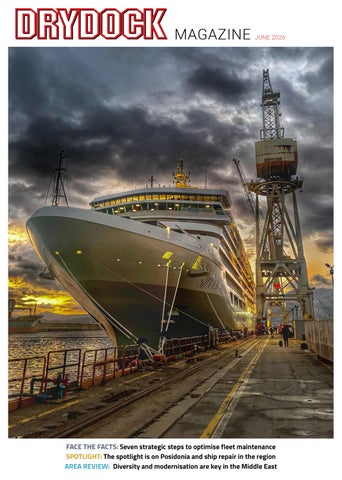
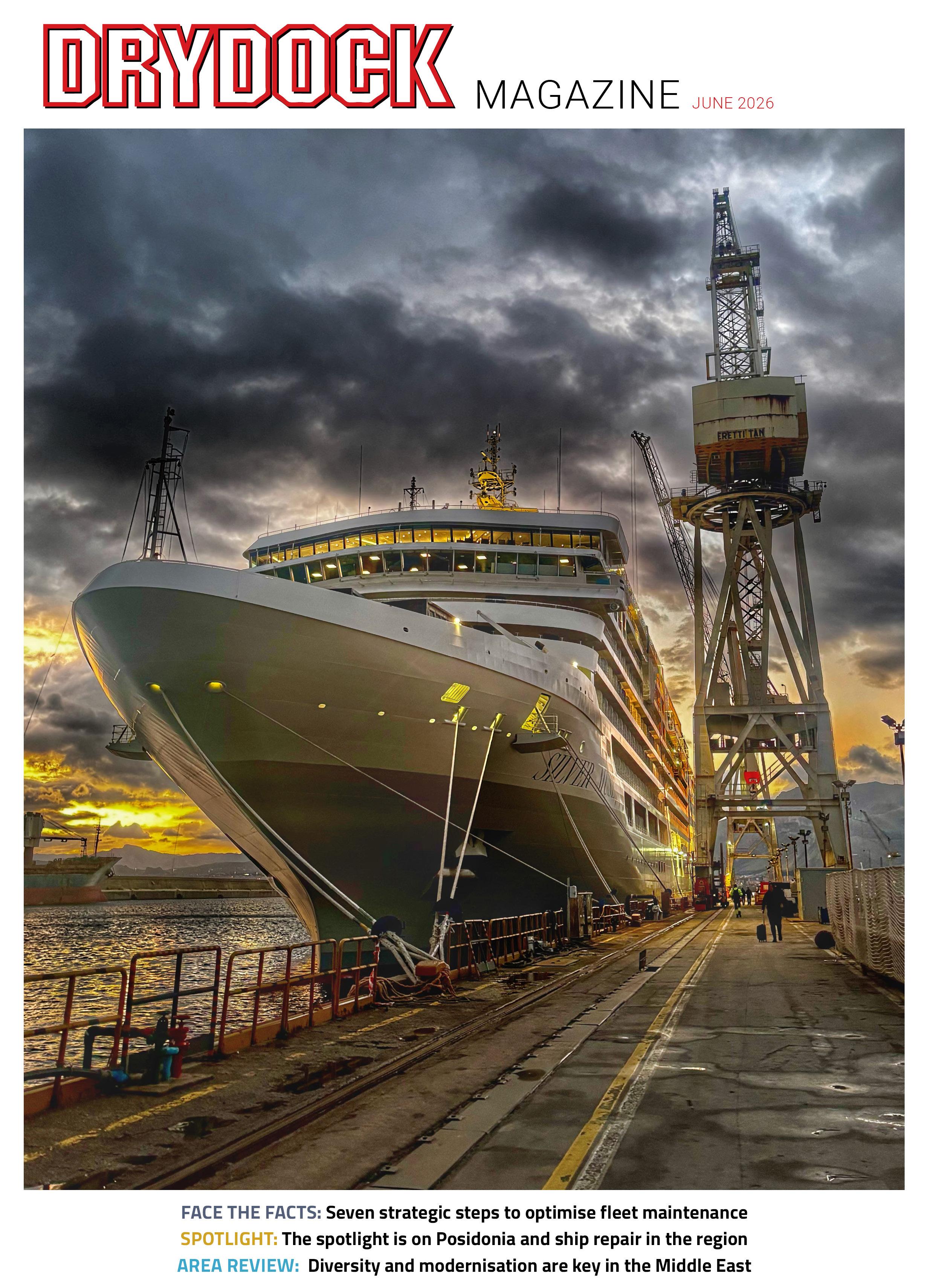
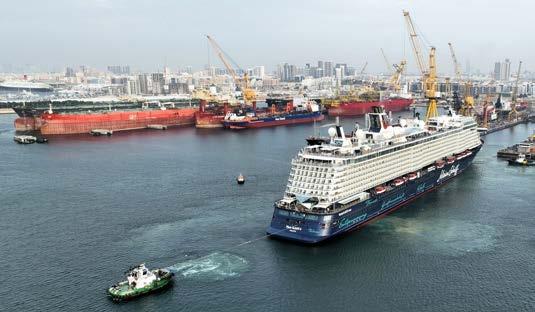
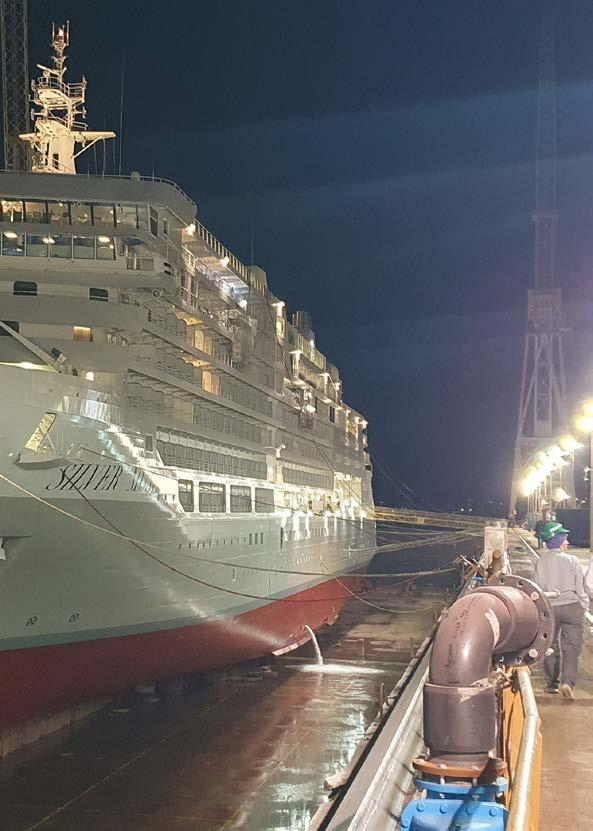
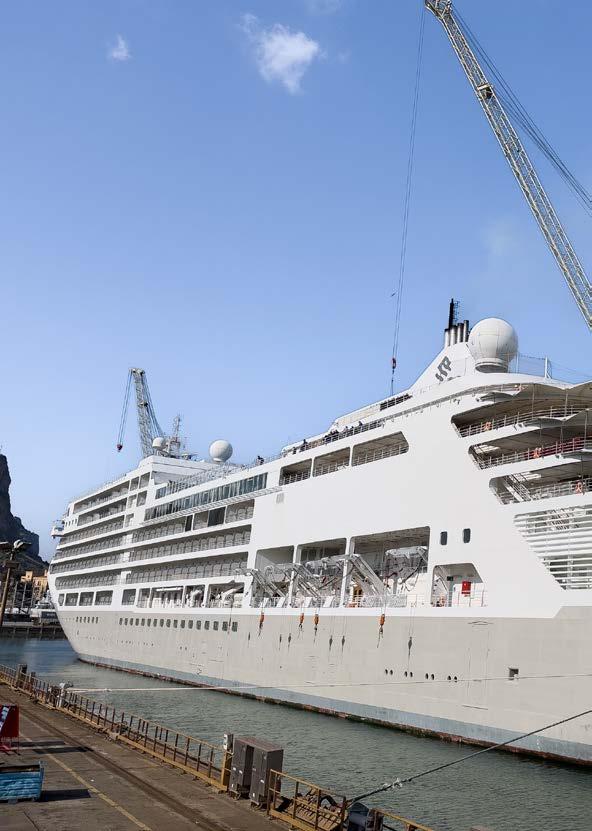
Silver Muse at Fincantieri in Palermo
FINCANTIERI S.p.A.
THE EVOLUTION of a ship repair yard
A diversified operating model at Drydocks World provides stability even during periods of geopolitical or market disruption.
Captain Rado Antolovic holds a PhD and an MBA in Transport and Economics. He was appointed CEO of P&O Maritime in June 2013, CEO and MD – Maritime Services Division of DP World in April 2017 and CEO of Dubai Drydocks World in January 2018. With a career spanning four decades across leading port and maritime industries, he has amassed a wealth of leadership and experience. In his previous roles as CEO and several senior positions, he successfully set up, restructured and managed numerous ports and marine businesses across the globe.
Q. Drydocks World has evolved far beyond traditional ship repair and conversions. How do you define the company’s role today within the global offshore energy and EPC landscape?
A. While maintaining its unparalleled position in the global market as a leading service provider to the maritime industry in vessel repairs and conversions, Drydocks World today is best understood as an integrated maritime, offshore engineering and EPCIC platform, not just a shipyard. Its role has expanded from repair and conversion into a broader delivery model that supports the full lifecycle of floating energy and marine assets.
That evolution is visible in the breadth of the portfolio. Drydocks World still performs ship repair, maintenance and life-extension work at scale to clients based globally, but it now also delivers major FPSO upgrades, FSO conversions, FLNG EPC, offshore wind platforms and complex modular fabrication.
The company has built this position over more than 40 years by combining engineering depth, execution discipline and infrastructure scale. It is one of the few yards in the region able to handle the world’s largest ships, offshore rigs and heavy offshore modules within a single integrated environment.
Recent projects show how that role has matured:
FPSO Baobab Ivoirien for MODEC, with major structural renewal, tank coating, piping renewal and a 15-year life extension.
FPSO Petrojarl Kong and FSO Yamoussoukro for Eni and Petroci, delivered on accelerated timelines for the Baleine Phase 2 development.
FPSO Petrojarl Knarr in partnership with Aker Solutions, combining refurbishment and partial electrification for North Sea deployment.
AMIGO LNG in Mexico, a landmark EPC project that extends DDW’s capability into the world’s largest floating LNG facility.
That matters because the market has changed. Clients are no longer looking only for a yard that can ‘fit the vessel in’. They are looking for a partner that can manage technical complexity, schedule pressure, regulatory requirements and lifecycle economics at the same time.
Drydocks World’s role in the global landscape is therefore to be a one-stop partner for complex offshore delivery. That means bringing engineering, procurement, construction, integration, heavy-lift, load-out, retrofit and commissioning into one framework.
The company’s position is also reinforced by its connection to DP World and Dubai’s logistics ecosystem. That gives Drydocks World access to a global supply chain, port connectivity, customs efficiency and integrated marine services that few competitors can match.
In practical terms, Drydocks World is helping redefine what a modern offshore engineering hub looks like. It is no longer just a place where ships are repaired. It is a place where floating energy infrastructure is designed, integrated, upgraded and launched into the next phase of its life.
Q. With the South Yard expansion announced last year, the incoming 5,000-tonne crane and growing digital capabilities, what do you believe will define the next generation of shipyards and offshore engineering hubs?
A. The next generation of shipyards will be defined by integration, not just size. Physical capacity still matters, but what really separates winners now is the ability to combine engineering, fabrication, heavy-lift, logistics, digital planning and safety into one operating model.
Drydocks World’s South Yard expansion is a strong example of this shift. The new 75,000 square metre yard has increased fabrication capacity by 40% and added major load-out and berth capability, allowing several large projects to be handled in parallel rather than sequentially.
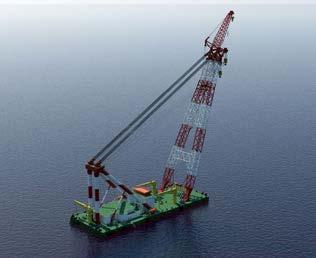
The incoming 5,000-tonne sheerleg floating crane is another sign of how the market is changing. The next generation of offshore projects is larger, heavier and more modular. That means yards need the ability to lift, position and integrate massive components with precision and confidence.
But the real differentiator is not only the crane or the yard space. It is the system around them. A next-generation hub needs digital planning, integrated execution, safety systems, trained people and supply-chain coordination that all work together.
This is where Drydocks World’s digital transformation becomes important.
AI, robotics, digital twins, real-time tracking, predictive maintenance and automated rostering are not add-ons. They are becoming the tools that allow the yard to run at a higher level of precision and reliability.
The same is true for workforce capability.
A modern offshore hub needs a highly skilled, diverse and continuously trained workforce that can move between repair, conversion, EPC, renewables and retrofit work. That is why the training centre, digital learning, AR and VR and safety systems matter so much.
Sustainability is also part of the definition. A next-generation shipyard cannot just be productive. It has to be cleaner, more efficient and aligned with global decarbonisation goals. Drydocks World’s carbon footprint reduction, renewable electricity use, waste recycling performance and participation in alliances such as the Global Green Shipyard Alliance (GGSA) and the Maritime Emissions Reductions Centre (MERC) all point in that direction.
In strategic terms, the shipyards of the future will be judged on four things: how much complexity they can handle, how safely they can execute it, how efficiently they can deliver it and how credibly they can support the energy transition.
Drydocks World is positioning itself around exactly those four pillars.
The South Yard, the crane, the digital systems, the sustainability agenda and the project portfolio together form a model of what a modern offshore engineering hub should look like.
So, the next generation of shipyards will not simply be bigger. They will be smarter, cleaner, more integrated and more globally connected. That is the direction Drydocks World is already moving in.
Q. Oil and gas still remain essential to global energy demand, while renewables continue to scale rapidly. How is Drydocks World balancing these two worlds, and what does that mean for your future project portfolio?
A. Drydocks World’s project portfolio today is still anchored in oil and gas, particularly through repair, maintenance,
life-extension and FSO, FPSO, FSRU, FSU conversions/upgrades. That remains a strong and steady part of the business because global energy demand is not disappearing, and operators continue to need existing assets to perform more efficiently for longer.
At the same time, renewables are becoming one of the fastest-growing parts of the portfolio. Drydocks World has already delivered offshore wind platforms for Europe and currently has additional platforms under construction. This shows that the company is not treating renewables as a side story, but as a growing business line with real strategic importance.
The balance between the two is not a contradiction. It reflects how the energy transition actually works in the real world. Oil and gas continue to provide the energy security, capital and infrastructure that support the transition, while renewables expand at pace. Drydocks World is positioned in the middle of that shift.
In oil and gas, the company is focused on making existing assets last longer, operate better and emit less. That includes FPSO upgrades, FSO conversions, rig repairs, scrubber retrofits, ballast water treatment systems and partial electrification projects like Petrojarl Knarr
In renewables, the company is scaling its ability to deliver large offshore wind converter platforms and grid infrastructure. Projects such as Ostwind 4 in Germany and Norfolk Vanguard East and West in the UK show that the same engineering and fabrication capability used in oil and gas can be applied to clean energy infrastructure at scale.
The result is that the future portfolio will become more balanced. Oil and gas will remain important, but renewables will take a larger share over time as global demand, policy and infrastructure investment continue to shift.
What makes that balance possible is Drydocks World’s integrated EPCIC model. This allows the company to support traditional offshore operators while also scaling into renewable
AI, ROBOTICS, DIGITAL TWINS, REAL-TIME TRACKING, PREDICTIVE MAINTENANCE AND AUTOMATED ROSTERING ARE NOT ADDONS. THEY ARE BECOMING THE TOOLS THAT ALLOW THE YARD TO RUN AT A HIGHER LEVEL OF PRECISION AND RELIABILITY.
infrastructure without fragmenting delivery capability.
That model is strengthened by the South Yard expansion, heavy-lift investments, digital systems and partnerships with companies such as Aker Solutions and GE VernovA. These relationships allow Drydocks World to move fluidly between sectors rather than being locked into one market cycle.
So, the answer is not that Drydocks World is choosing oil and gas or renewables. It is building a platform that can serve both, while gradually shifting toward a more balanced mix as the market evolves.
Q. Can you provide details of ship repairs carried out in the last four months or so, and has the type of ship repairs changed?
A. We have observed a noticeable increase in LPG carrier and dry cargo vessel repairs compared with previous years, particularly during the first part of 2026. At the same time, demand remains strong for offshore-related work, including drilling rigs and specialised support vessels.
More broadly, the nature of repair activity is also evolving. Owners are increasingly combining routine dry docking with lifecycle upgrades, energyefficiency improvements, emissionsrelated retrofits and reliability-focused maintenance programmes.
Q. What will Drydocks World’s focus be this year at Posidonia, and how important has the European market proved?
A. Europe remains one of Drydocks World’s most important markets and continues to be a key source of longterm business. Approximately 35% of our repair business volume comes from European clients, reflecting strong relationships built over many years.
Greece in particular is a strategically important market for us, contributing more than 15% of our annual repair business volume. We have seen steady growth from Greek owners and operators and continue to strengthen those relationships through reliability, technical capability and delivery performance.
At Posidonia this year, our focus will be on demonstrating how Drydocks World is evolving beyond traditional repair
activity into a more integrated offshore engineering and EPCIC platform. This includes our expanding capabilities across FPSO upgrades, FLNG infrastructure, offshore wind platforms and decarbonisation-related retrofits.
We also see increasing interest from European clients in lifecycle extension projects, emissions-reduction solutions and integrated engineering support, areas where Drydocks World continues to invest heavily through digitalisation, sustainability and heavy-fabrication infrastructure.
Q. How has the closing of the Strait of Hormuz affected Drydocks World?
A. The closure of the Strait of Hormuz has naturally had an impact on regional vessel movements and parts of the repair market. However, Drydocks World has remained fully operational throughout this period.
Our resilience comes from the diversity of our business portfolio. Alongside conventional repair activity, the yard continues to execute major EPC and offshore engineering projects, including FPSOs, offshore wind platforms and floating LNG infrastructure.
In addition, we continue to receive docking and repair work from vessels operating within the Arabian Gulf region, which has helped maintain operational continuity.
The strength of Drydocks World lies in its ability to balance multiple business lines simultaneously, from repair and maintenance to EPCIC delivery and offshore fabrication. This diversified operating model provides stability even during periods of geopolitical or market disruption. ■
Coating Thickness Gauges
Fast and accurate measurement of paint and coating thickness on all metal substrates
n Ready to measure—no adjustment required for most applications
n Fast measurement speed—60+ readings per minute
n Memory mode—Store measurement data, view live statistics, and analyze live graphs
n Included PosiSoft software—easily create professional inspection reports
Advanced models feature 3 Scan modes to increase measurement speed to 180+ readings/min.
Scan here to learn more
Award Winning Interchangeability
PosiTector gauge body accepts ALL coating thickness, surface profile, environmental, soluble salt, gloss, hardness, and ultrasonic wall thickness probes manufactured since 2012.
+1-315-393-4450 n 1-800-448-3835 techsale@defelsko.com n www.defelsko.com
180+ readings per minute
PosiTector 6000 F1
PosiTector 6000 FS3
Enterprise asset management for maritime: Seven strategic steps to optimise fleet maintenance
Vessel owners and operators do not overhaul their entire maintenance operations overnight. Successful vessel owners and operators take carefully planned steps. Starting with a critical failure mode such as piston ring damage, for example, then using years of repair and inspection data to build a machine learning model that shifts them from reactive to predictive maintenance. That strategic move enables earlier interventions and reduces unplanned downtime, says Jason Smith at ABS Consulting (part of the ABS Group).
Now that maritime vessel owners and operators have access to more data than ever, they can plan maintenance on their terms, not the failure’s. Improving fleet maintenance starts with the basics, including understanding asset criticality and investing in enterprise asset management (EAM).
Drawing on decades of maritime domain expertise and proven results across other asset-intensive industries, these seven essential steps will help target the right priorities and build a robust reliability strategy.
1. Rethink reliability as a business priority to reduce cost
Maintenance is planned around uptime, fuel efficiency, regulatory compliance, safety – not just original equipment manufacturer (OEM) calendars. Maintenance also is tied to costly budgeting decisions around dry-docking, retrofits and technology investments.
In many fleets, maintenance is overtaken by firefighting: reacting to failures, chasing parts and working overtime to save schedules.
Operators must connect maintenance priorities to business outcomes and translate data into foresight to gradually build a more reliable and resilient maintenance culture.
2. Match the maintenance strategy to the asset and the risk
The goal isn’t more maintenance; it’s the right maintenance. A better outcome is fewer surprises, better use of spares and labour and a clear rationale behind every maintenance task.
A robust strategy draws on four wellestablished maintenance approaches:
A. Preventive maintenance (PM): PM tasks are based on OEM guidance, regulations and actual experience. Tasks are reviewed regularly to omit those that do not add value.
B. Condition-based maintenance (CBM): Condition monitoring such as vibration, temperature, oil analysis, pressure and performance data is used to intervene when evidence
of degradation appears – not just when the calendar requires it.
C. Predictive maintenance (PdM): Analytics and models forecast failures using trends and operational context such as engine profiles, loading and environment.
D. Deliberate run to failure (R2F): Some low-risk components are allowed to run to failure by design with spares and plans in place. This frees resources for truly critical systems.
3. Build a single source of maintenance truth
In many fleets, crucial information is trapped in spreadsheets, logbooks or the memory of a single chief
engineer. That makes consistency and improvement harder to maintain. A well-implemented CMMS (Computerized Maintenance Management System) or EAM platform connects maintenance, operations, procurement, inventory and safety management into a unified maintenance platform – or single source of truth –for work orders, asset histories, failure modes, spares and more.
Start by mapping where data actually lives today, including legacy systems and spreadsheets. Standardise asset naming and coding on one vessel, then replicate fleet-wide. A dashboard tracking overdue critical work, unplanned downtime events, critical spares levels and top recurring failures further supports datadriven decision-making.
4. Make risk-based decisions
Not all equipment carries equal risk. Consider optimising your maintenance practices with formal analyses to identify key failure modes and drive maintenance task design and inspection focus.
In a risk-based inspection approach, you spend more time on high-risk systems and manage lower-risk systems with a lighter touch. When maintenance is aligned with the safety management system, it directly supports the vessel’s risk controls by tying maintenance activities to everyday procedures and permits.
5. Close the gap between ship and shore by investing in your maintenance teams
Close the gap between ship and shore by establishing clearly-defined roles and responsibilities, transparent communication and sharing of lessons learned across the fleet. Simultaneously, prioritise investing in the people who deliver maintenance every day: training, clear procedures and assigning the right level of authority helps to reduce risk. Engineers need up-to-date, practical procedures and the power to stop work if conditions change. Recognising reliability improvements reinforces the culture that keeps everything working well.
6. Integrate compliance into maintenance planning
In many organisations, compliance feels separate from real work. In an optimised maintenance, it’s built into standard practice.
Integrating and aligning class and statutory requirements into the maintenance planning system with automated alerts reduces administrative burden and helps maintain a consistent and sustainable compliance posture.
7. Make continuous improvement part of daily work
Incidents and near misses, along with everyday good performance, are treated as learning opportunities to strengthen the maintenance system and the organisation. Structured root-cause analysis, periodic fleet-level reviews focused on recurring failure trends and a feedback loop for superintendents and crews to flag maintenance issues transform individual incidents into systematic improvements.
Optimise for safety, reliability and compliance
Organisations do not have to apply all seven steps at once. Many start small, focusing on a few practical areas such as:
• Establishing or updating a clear asset criticality framework;
• Cleaning and standardising asset and maintenance data on one or two pilot vessels;
• Improving ship and shore maintenance processes and communication;
• Applying risk-based approaches to a few high-consequence systems; and
• Investing steadily in people, training and digital capabilities that support better decisions.
Even focusing on one of these areas can contribute to fewer disruptions and more predictable performance for safer, more reliable and compliant fleet operations.
Building momentum in cruise repairs & major conversions
Palermo continues to serve as the Fincantieri’s main platform for cruise ship class maintenance and conversion projects
Fincantieri sees mega yacht and offshore repair work in Trieste to complex cruise conversion projects in Palermo, and repairs and retrofits for European and Mediterranean operators by Remontowa.
Fincantieri is positioning its Italian repair network for a new cycle of integrated lifecycle projects. Its 2026 repair and conversion activity reflects the increasingly diversified nature of today’s service market, with projects spanning maintenance, repair, class-driven work and more complex cruise conversions.
Across its Italian footprint, Fincantieri is using the specific strengths of its yards to support different segments of demand. While Trieste has historically contributed to cruise repair and refurbishment projects, its 2026 activity has been more focused on mega yacht repair and selected minor offshore work. Palermo, by contrast, has continued to serve as the group’s main platform for cruise ship class maintenance and conversion projects.
Dry dock cycles changing
The mix of work is also a sign of how dry dock cycles are changing. Owners are increasingly looking to combine regulatory and class-driven activities with technical upgrades, hotel improvements and revenue-generating modifications in the same shipyard window. For shipyards, this requires not only dry dock capacity, but also the ability to integrate engineering, procurement, outfitting, hotel refurbishment and class-related work under tight operational schedules.
In this environment, Fincantieri’s service platform is being positioned around the ability to support owners throughout the full lifecycle of the vessel: from standard maintenance and repair to complex upgrade programmes that can extend the commercial relevance of existing tonnage.
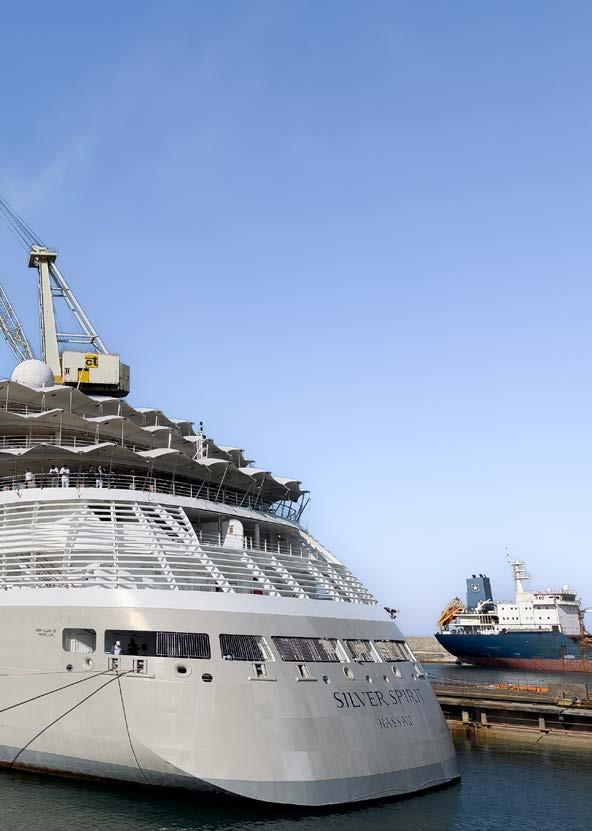
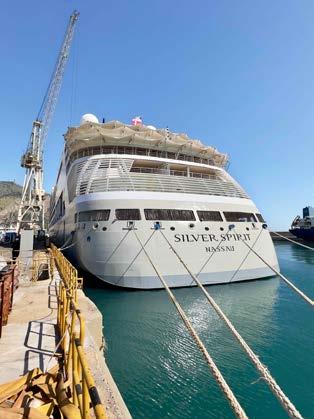
Silver Spirit at Fincantieri’s Palermo yard illustrates the growing complexity of cruise lifecycle management
Conversion showcase
A recent example is the completion of work on Silver Spirit at Fincantieri’s Palermo yard, a project that illustrates the growing complexity of cruise lifecycle management.
Silver Spirit has a long connection with Fincantieri. The ship was built by Fincantieri in Ancona and delivered in 2009 as the first ship constructed for Silversea Cruises, marking the group’s entry into the luxury cruise segment. The vessel also returned to Palermo in 2018 for a major renewal programme that included the insertion of a 15m mid section, an ultra-luxury cruise conversion project that increased both public areas and suite capacity.
The latest project continued that lifecycle approach, combining structural modifications, additional passenger accommodation, interior refurbishment and public space renewal in a single integrated work package.
The scope included the addition and reconfiguration of guest accommodation, with selected existing suites and cabins redesigned to support a revised onboard layout. The work also included the refurbishment of cabins and public areas, bringing the vessel’s interiors closer to the latest standards of the brand and improving the overall guest experience.
For Fincantieri, the project was not simply an interiors refresh. The cabin work required demolition, structural and outfitting modifications, adjustments to guest area arrangements and the integration of revised technical systems to support the new configuration.
Electrical and HVAC systems were adapted to the revised accommodation and public space layout, while lifesaving appliances and escape calculations were updated to support the revised capacity profile enabled by the conversion.
This type of work is where cruise conversion is becoming more technically demanding. A project that appears guest-facing from the outside – new accommodation, refreshed public areas and upgraded interiors – requires detailed coordination across steelwork, outfitting, safety, class, hotel systems, logistics and the ship’s commercial redeployment schedule.
Beyond hotel refurbishment
The Silver Spirit project also highlights a broader shift in the cruise market. Increasingly, major dry dock projects are being used not only to maintain vessels, but to reposition them commercially.
For owners, additional cabins and reconfigured public spaces can improve revenue potential and align older ships with newer brand standards. For shipyards, these projects require a combination of engineering depth and hotel refit execution. The value is created not by a single discipline, but by the ability to integrate naval architecture, class compliance, structural work, interiors, systems and procurement under a constrained dry dock schedule.
In Palermo, that integrated model is particularly relevant. The yard has become a natural platform for cruise conversion work because of its experience with large structural interventions, class maintenance and hotel area refurbishment. The same capabilities used for lengthening, deck additions and public space renewals are increasingly being applied to projects that combine capacity growth with guest experience upgrades.
Silver Spirit is a strong example of this model. The project required Fincantieri to manage a complex package of works that touched both the technical and hotel sides of the vessel, while maintaining the discipline required for a cruise ship operating within a fixed deployment calendar.
A new cycle of major conversions
Looking ahead, Fincantieri sees the major conversion market as one of the most promising areas of cruise ship repair and lifecycle services.
The next wave of work is expected to go beyond traditional refit packages. In addition to systems upgrades and interiors renewal, cruise owners are evaluating larger conversion programmes that can include the addition of new deckhouse areas, expanded accommodation, redesigned public venues and updated technical infrastructure.
“The market is moving toward more integrated dry dock programmes, where class, technical upgrades and hotel improvements are planned as one lifecycle project,” says Massimo Costa, Fincantieri’s Vice President of Ship Repairs and Conversions. “Silver Spirit is a good example of how conversion work can create value while respecting the operational constraints of cruise deployment.”
Fincantieri is exploring different cruise conversion opportunities between 2027 and 2031. These projects would reflect the same market logic seen on Silver Spirit: using a carefully-planned dry dock window to extend the commercial
The Silver Spirit project also highlights a broader shift in the cruise market
relevance of existing tonnage, increase capacity where feasible and bring onboard products closer to the latest fleet standards.
For Fincantieri, the opportunity is to position ship repair and conversion not as a reactive service business, but as a strategic lifecycle partner for cruise operators. As dry dock planning becomes more complex and slots are secured years in advance, the ability to offer feasible, practical and fully-integrated solutions is becoming a differentiator.
In that context, Silver Spirit is less a one-off project than a marker of where the market is heading: toward cruise conversions that combine class work, technical upgrades, structural modifications and hotel transformation in one coordinated programme.
For cruise owners, the rationale is becoming increasingly clear. In a market where newbuilding slots are increasingly scarce and shipyard orderbooks continue to fill up years in advance, major conversions can provide an effective alternative to fleet renewal through new construction. They allow operators to refresh existing tonnage, increase capacity where technically feasible, upgrade the onboard product and protect asset value, while avoiding the longer lead times and higher capital commitment typically associated with newbuild programmes.
REPAIRS AND RETROFITS AT REMONTOWA
The first half of 2026 saw Remontowa Shiprepair Yard continue an extensive programme of repairs, retrofits and offshore projects for a broad portfolio of European and Mediterranean operators. The projects completed in Gdansk covered ferries, chemical tankers, shuttle tankers, offshore support vessels and specialised tonnage, reflecting both the technical diversity of today’s ship repair market and the growing demand for propulsion efficiency upgrades, compliance-driven modifications and operational flexibility. Across all vessel segments, the repair programmes ranged from routine class renewals and intermediate surveys to complex structural repairs, propulsion overhauls, offshore mobilisation projects and emergency repairs carried out under demanding operational schedules. Particular focus remained on propulsion reliability, cargo-handling systems, hull preservation and upgrades supporting evolving environmental and operational requirements.
Ferries and RoPax
Ferry and RoPax vessels once again formed a major part of the yard’s repair portfolio, particularly for operators active in Northern Europe and the Baltic Sea trades.
Several Stena Line ferries underwent extensive repair and modification programmes in Gdansk. On Stena Flavia, the docking programme focused on propulsion efficiency and underwater equipment. Following inspection in dock, the damaged silicone coating in the underwater hull area was replaced with antifouling protection due to schedule constraints. The vessel also received new Berg propeller blades on both shaftlines, while work on stabilisers and bow thrusters included bearing repairs, welding and replacement of hubs and blades.
The class renewal of Stena Jutlandica developed into one of the most extensive ferry projects of the period. A major structural renewal programme covered
Remontowa’s repair programme on Optima Seaways combined underwater works with structural and machinery maintenance
large sections of the third deck, requiring steel replacement work extending almost the full length of the vessel. Extensive preparatory work had already been initiated during the vessel’s voyage prior to arrival at the yard, enabling immediate commencement of steel repairs upon docking. The programme also included repairs to the stern ramp structure, overhauls of steering and stabiliser systems, renewals of MGPS and ICCP systems, ballast tank piping renewals, and extensive accommodation area reinstatement work following structural modifications.
DFDS ferries return
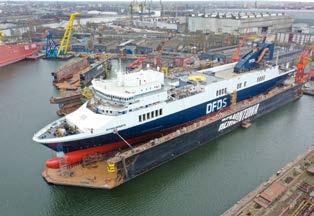
DFDS ferries also returned to Remontowa for another series of repair projects, continuing a long-standing cooperation between the operator and the yard.
The repair programme on Optima Seaways combined underwater works with structural and machinery maintenance. The vessel underwent stabiliser works, bow thruster inspections and shaft-seal renewals, while steel renewals were carried out in ballast tanks and vehicle decks.
Additional piping renewals and overhaul of generators, motors and cooling systems formed part of the technical scope. The vessel also received a replacement speed log system installed in a dedicated hull fairing arrangement.
On Ark Futura, the focus shifted toward cargo-handling systems and structural repairs. The project included replacing winches for both the stern ramp and lifeboat systems, overhauling the stern thruster and replacing propeller blades. Steel repairs were carried out in cargo areas, fuel tank regions and funnel structures, while electrical teams repaired navigation-related equipment and auxiliary systems.
Another DFDS ferry, Victoria Seaways, underwent propulsion-efficiency upgrades, including installation of a specialised energy-saving cylinder arrangement on the propeller and rudder system, combined with replacement of propeller blades optimised for lower fuel consumption. The scope further covered stern-ramp
hydraulics, hull modifications, shorepower preparation work and installation of new firefighting piping systems.
TT-Line vessel upgrades
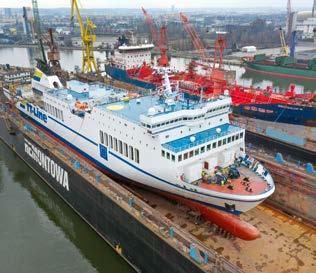
TT-Line vessels represented another important part of the ferry segment. The repair programme for Marco Polo was divided into two separate yard stays to accommodate operational requirements while maintaining service continuity. Structural repairs focused primarily on internal and stern ramps, with extensive steel renewals and reinforcement work carried out both onboard and ashore. Additional works included scrubber system maintenance, insulation renewals, fuel tank repairs and piping system overhauls.
Meanwhile, Huckleberry Finn underwent a broad repair programme combining preservation work with structural and mechanical repairs. Large-scale coating was carried out on the superstructure, funnels and lifeboat-support structures, while steering systems, rudders and shaftline arrangements underwent overhaul and inspection. One of the technically demanding tasks involved replacing a boiler tank, requiring the creation of a technological opening in the funnel structure.
The repair programme for Marco Polo was divided into two separate yard stays at Remontowa
Spotlight on Posidonia
With Posidonia looming we take a look at ship repair in the Black Sea and Mediterranean region.
Multimarine Shipyards has seen one of its busiest and most dynamic operational phases in its recent history
The global maritime industry’s accelerating return to windpowered shipping will take centre stage at this year’s Posidonia exhibition in Athens, as the Greek shipping market welcomes the largest-ever showcase of modern wind propulsion technologies at the world-renowned trade fair.
Held at the Metropolitan Expo in Athens from 1–5 June, Posidonia 2026 will attract thousands of international shipowners, operators, charterers, technology developers and maritime decision-makers from around the globe. Reflecting the rapid commercial growth of wind propulsion, 20 members of the International Windship Association
(IWSA) will be exhibiting or hosting wind propulsion-related events at the exhibition.
As the world’s largest ship-owning nation by deadweight tonnage, Greece continues to play a pivotal role in shaping the future direction of international shipping. The strong presence of wind propulsion technologies and expertise at Posidonia underscores the growing interest among Greek and international shipowners in practical decarbonisation solutions that can reduce fuel consumption, improve efficiency and support compliance with evolving environmental regulations.
Multimarine Shipyards has evolved into a versatile maritime and offshore support hub
Welcoming the swelling international interest in wind propulsion, IWSA
Secretary General Gavin Allwright comments: “So far this year, we have witnessed new project announcements, order confirmations and installation celebrations almost every week. This is a technology sector and renewable energy solution that is clearly moving into a phase of large-scale commercial adoption.”
IWSA is increasingly seeing fleet-wide investment strategies emerge, with shipowners placing multi-vessel orders rather than limiting deployments to single ships. Currently, there are more than 100 vessels that either have
wind propulsion systems installed or are classed as being ‘wind-ready,’ representing a combined total exceeding six million dwt and marking a nearly three-fold increase since the last Posidonia exhibition in 2024.
BUSY TIMES AT MULTIMARINE
As the global maritime community gathers for Posidonia 2026, Multimarine Shipyards enters the second quarter after one of the busiest and most dynamic operational phases in its recent history. With an intensive schedule of dry dockings, afloat repairs, offshore fabrication projects and regional energy support activities, the company continues to strengthen its position as a leading marine services provider in the Eastern Mediterranean.
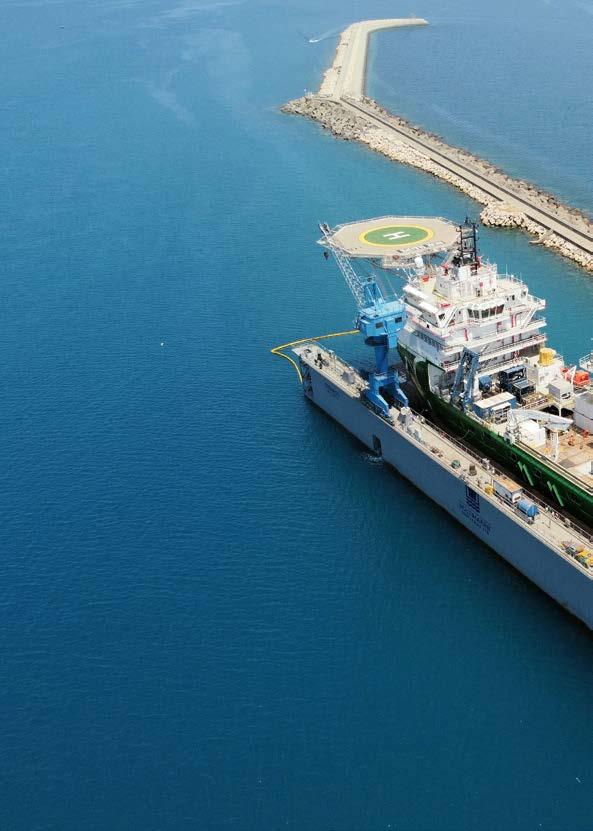
Strategically located in Cyprus, Multimarine Shipyards has evolved into a versatile maritime and offshore support hub, serving commercial shipping, offshore operators, naval fleets and the luxury yacht sector. In 2026 so far, the company has successfully managed a demanding portfolio of projects, demonstrating operational flexibility, technical expertise and the ability to deliver high-quality solutions under tight schedules.
A strong dry dock programme
The first half of this year has seen the successful completion of several major dry dock projects, covering a broad spectrum of vessel types and operational requirements.
Among the key projects completed was the platform supply vessel Swift Tide, which underwent an extensive programme of repairs, maintenance and class-related work. The project included steel renewal, machinery servicing, blasting and coating applications as well as technical inspections, all delivered within a carefully-managed schedule to minimise operational downtime.
Another significant achievement for the yard was the successful completion of work on the naval vessel Alasia. Naval support projects require strict
operational standards, reliability and precision, and Multimarine once again demonstrated its capability to support defence-related assets with professionalism and efficiency.
The dry docking of offshore supply vessel Sun further added to the yard’s busy operational schedule, involving hull maintenance, mechanical servicing and general repair works designed to ensure the vessel’s continued operational performance.
At the same time, the shipyard continued to expand its footprint within the luxury yacht segment through the successful handling of the superyacht Lohanka. The project involved a combination of technical maintenance, reflecting the yard’s growing capability to support the demanding standards of the superyacht industry.
Extensive afloat repair activity
In parallel with dry dock operations, Multimarine maintained a strong presence in afloat repairs throughout the year, supporting vessel operators with rapid-response technical solutions across the region.
Afloat repair projects completed during 2026 so far included work on board Nor Naomi, Britoil Courage, Fugro Venturer, Highland Chieftain, Stephen Wallace Dick and Lundstrom Tide. The repair scopes ranged from steel and piping works to mechanical maintenance, electrical troubleshooting and specialised engineering interventions.
The growing demand for afloat repair solutions highlights the industry’s increasing need for flexible maintenance services that minimise vessel off-hire periods while ensuring operational reliability. Multimarine’s experienced teams and strong project management capabilities have enabled the company to respond efficiently to these operational demands across multiple vessel categories.
East Mediterranean offshore support
Beyond ship repair and marine services, 2026 has also been particularly active for Multimarine in support of offshore exploration and energy developments across the Eastern Mediterranean. The continued momentum within the regional offshore energy sector
Swift Tide underwent an extensive programme of repairs, maintenance and class-related work
has created significant demand for fabrication, engineering, logistics and marine support services, with Multimarine playing an increasingly important role in supporting key offshore projects.
The company is currently engaged in numerous fabrication deliverables for Energean and TechnipFMC as part of the Katlan Project, one of the region’s notable offshore energy developments. These fabrication activities further demonstrate Multimarine’s ability to support technically-demanding offshore EPC projects while meeting strict quality and delivery requirements.
At the same time, Multimarine and its shipping agency company Atlas Offshore Operations continue to provide support services connected to the operations of the Saipem drillship Santorini, which is currently operating offshore Israel. The presence of major drilling and subsea construction campaigns throughout the East Mediterranean continues to generate strong demand for marine engineering and logistics support services, reinforcing the strategic importance of Cyprus as a regional offshore support centre.
The increased offshore activity throughout the region not only strengthens the Eastern Mediterranean’s position within the global energy landscape but also highlights the importance of having reliable regional marine infrastructure capable of supporting offshore assets and associated supply chain operations.
Advancing decarbonisation through innovation
Another important milestone for Multimarine during 2026 is the continued progress of the BlueBarge Project, a pioneering initiative aimed at supporting the maritime industry’s transition towards cleaner and more sustainable operations. The project represents an important step in the development of practical decarbonisation solutions for ports and vessels operating in the Eastern Mediterranean and beyond.
The final retrofit phase of the BlueBarge system is scheduled for completion in June 2026, while the live demonstration onboard a Cyprus-flagged vessel is planned for Q3 2026. This upcoming demonstration will mark a significant achievement for both the project consortium and Cyprus’s maritime innovation ecosystem, showcasing the practical implementation of advanced emissions-reduction technologies within real operating conditions.
The importance of the BlueBarge Project lies in its direct contribution to the decarbonisation of the maritime industry. As global shipping faces increasing regulatory pressure to reduce greenhouse gas emissions and comply with evolving IMO and EU environmental requirements, innovative energy solutions are becoming essential for the future sustainability of maritime transport.
By enabling cleaner and more efficient vessel operations, projects such as BlueBarge contribute towards reducing emissions during port operations and auxiliary power consumption; areas which remain key challenges in the industry’s path toward net-zero targets. The initiative also highlights the growing role of Cyprus and regional maritime companies in driving technological innovation and supporting the global energy transition within shipping.
Through its active participation in the BlueBarge Project, Multimarine continues to demonstrate its commitment not only to technical excellence and operational performance, but also to supporting the long-term sustainability and environmental transformation of the maritime sector.
Looking ahead
The demanding operational tempo of 2026 reflects both the growing confidence of clients in Multimarine’s capabilities and the continued expansion of maritime and offshore activity throughout the region.
By successfully delivering projects across commercial shipping, offshore support, naval operations and luxury
yacht services, Multimarine Shipyards continues to establish itself as a trusted regional partner for marine engineering, ship repair and offshore support solutions.
As Posidonia 2026 brings together key stakeholders from across the global maritime industry, Multimarine looks ahead with confidence, committed to further strengthening its technical capabilities, operational efficiency and long-term partnerships throughout the maritime and offshore sectors.
BRAZIL MEETS GREECE AND CYPRUS
With Posidonia in sight, Metalock Brasil carried out a series of visits to shipowners in Greece and Cyprus, two of the most important global hubs of the maritime industry. The agenda included the presence of CEO Paul Barton and General Manager Guilherme Barton, with the main objective of strengthening commercial relationships, reinforcing existing partnerships and identifying new business opportunities.
The visits took place from March 2-6 in Greece and March 9-12 in Cyprus, bringing together meetings with key players in the marine sector. This initiative reinforces Metalock Brasil’s international positioning and its close engagement with major decision-making centres in the global maritime industry.
During the meetings, the company presented its technical solutions, including cold repair services, on-site machining, laser alignment and structural applications using SPS (Sandwich Plate System) technology. Metalock Brasil also highlighted its global mobilisation capability, operational agility and extensive expertise in complex projects across the marine, offshore and industrial segments.
With a well-established presence in Brazil and integrated into a global network, Metalock Brasil continues to invest in relationships with clients and strategic partners, expanding its presence in key markets and reaffirming its commitment to quality and innovation.
HOME PORT FOR THE HISTRIA FLEET
In the competitive landscape of shipbuilding and repair in the Black Sea region, Romania’s Constanta Shipyard continues to demonstrate resilience, continuity and technical expertise. Since its privatisation in 2002 and integration into the Histria Group, the yard has maintained a balanced focus on both newbuilding and ship repair – two pillars that have defined its long-standing presence in the market.
A key element of the shipyard’s strategy has been its specialisation in medium range (MR) tankers, particularly IMO II chemical carriers. In collaboration with its partners, Constanta Shipyard developed a standardised MR tanker design that has evolved significantly over time. Continuous improvements –ranging from shallow-draft optimisation to enhanced operational performance and the integration of energy-saving
technologies – have ensured the design remains competitive and relevant in a demanding global market.
Between 2002 and 2025, the yard delivered 25 vessels based on this platform. While a substantial portion joined the fleet managed by Histria Shipmanagement, the shipyard has also attracted a number of international clients, consolidating its reputation across the Eastern Med and Black Sea regions.
Reliable maintenance hub
The relationship between Constanta Shipyard and Histria Shipmanagement extends beyond newbuilding. With a fleet of 14 MR tankers, Histria remains a key partner for repair and maintenance services. Regular dry docking, intermediate surveys and special surveys are frequently carried out in Constanta, reinforcing the shipyard’s role as a reliable maintenance hub for the fleet.
A recent example underscores this ongoing collaboration. In the spring of 2026, the tanker Histria Coral returned to Constanta Shipyard for its fourth special survey. Delivered in 2006 by the same yard, the vessel underwent a comprehensive refurbishment programme that went well beyond standard dry-docking requirements.
The scope of work included extensive ballast tank treatment, soft steel renewal, piping and mechanical upgrades, as well as cosmetic improvements. The objective was not only to meet classification requirements but also to restore the vessel as closely as possible to its original condition. Upon completion, Histria Coral emerged revitalised – technically sound, visually refreshed and fully prepared for continued service without interruption.
For the shipyard, the project carried a symbolic dimension. Welcoming back a vessel it had built two decades earlier offered a tangible demonstration of lifecycle support capabilities and long-term quality assurance. It also highlighted the enduring relationship between the yard and the Histria fleet –one built on consistency, technical trust and shared operational standards.
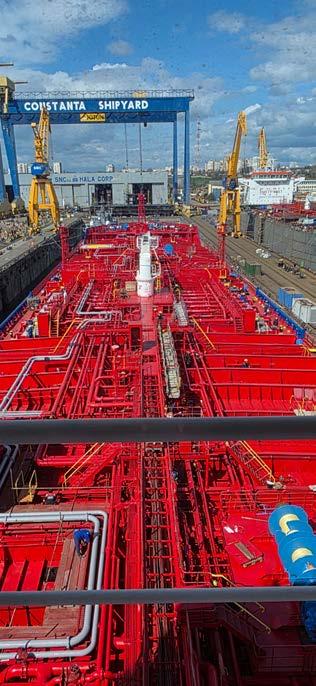
Histria Coral returned to Constanta Shipyard for its fourth special survey
“As Constanta Shipyard looks ahead, its dual strength in newbuilding and repairs, combined with a loyal client base and a proven tanker platform, positions it to remain a significant player in the regional maritime industry,” says Marian Marc, Ship-repairs Department Senior Manager.
A BESIKTAS SHIPYARD FIRST
With Besiktas Shipyard, Art Shipyard and Park Shipyard operating under the Besiktas Group Shipyards umbrella, the organisation continues to lead the Turkish maritime sector. The group not only offers geographical flexibility and capacity but also shared engineering know-how and operational synergy, allowing it to serve a wide range of global clients with efficiency.
Besiktas Shipyard, one of Europe’s most active ship repair yards, continues to build on its momentum heading into Posidonia 2026. With two floating docks over 300m in length, a total of six docks
across the group yards and over 300 complex ship repair and conversion projects completed annually, the group enters the second half of 2026 with significant new milestones.
Flagship project
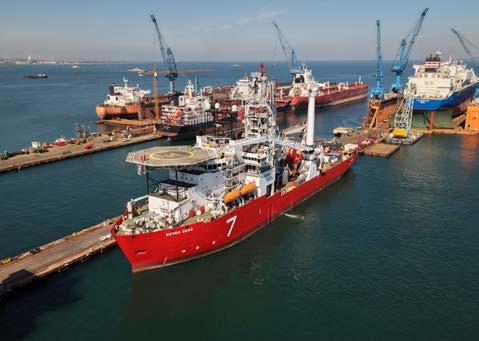
In a landmark achievement, Besiktas Shipyard completed the repair and refurbishment of Seven Seas, marking the first vessel from the oil and gas industry repaired in Turkish waters for Subsea 7 – one of the world’s leading offshore energy contractors.
The project involved an extensive and highly detailed refurbishment of the vessel’s VLS (vertical lay system) tower, including the successful erection of the 42m-high structure requiring approximately 8,000 cubic metres of staging – a complex operation demanding precision engineering and rigorous safety planning. The scope also included replacement of three azimuth thrusters in dry dock, a technicallydemanding operation that was completed within schedule.
Besiktas Shipyard recently completed the repair and refurbishment of Seven Seas
Green technology
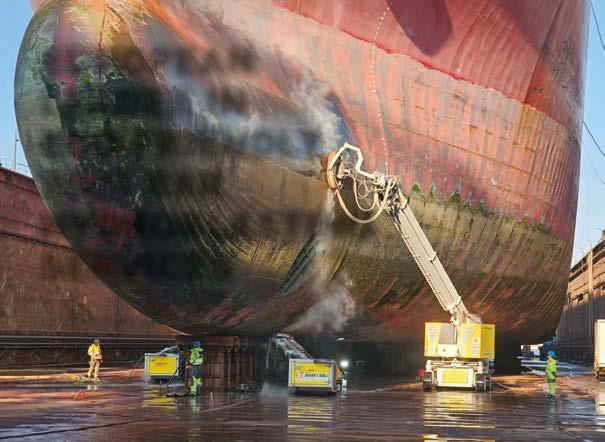
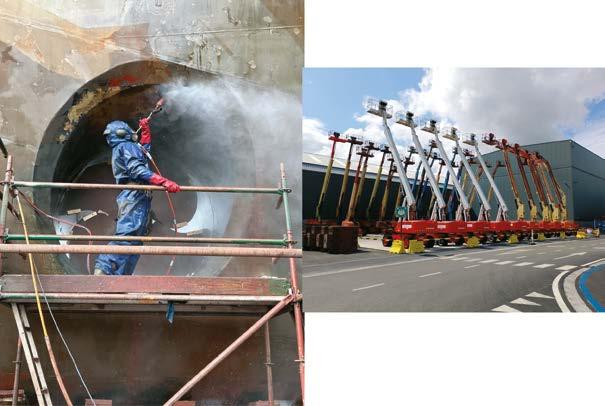
Since November 2025, Besiktas Shipyard has been operating its hydro blasting system – a water-based hull surface preparation technology that represents a significant step forward in environmentally-responsible ship repair. Hydro blasting eliminates the need for traditional abrasive methods, offering shipowners a cost-efficient, faster, and environment-friendly solution with highly satisfying surface quality. This green technology positions the yard as one of the few facilities in the region capable of offering eco-friendly alternatives for hull treatment.
Looking ahead
Having been the first accredited shipyard in the region for LNG ship repairs in 2021, Besiktas Shipyard continues to expand its LNG service portfolio alongside its growing capabilities in green technology and sustainable operations. With the hydro-blasting system now fully operational, the yard is positioned not only as a leading repair facility but as a forward-thinking partner for shipowners navigating the industry’s energy transition. The shipyard’s commitment to sustainability is further reinforced by its investments in solar energy. Through two major projects – a 220-acre (89 ha) solar farm and a rooftop installation, together providing a total capacity of 25MW – Besiktas Shipyard has been generating more than twice the energy it consumes annually,
significantly reducing carbon emissions and energy costs.
ADVANCED TECHNOLOGY AT GEMAK
With over 56 years of experience, Gemak Group has proudly served more than 3,000 projects for shipowners and managers from all over the world. As one of Turkey’s leading shipbuilding and repair groups, it employs over 150 engineers and more than 3,000 skilled staff.
Its modern facilities, including the region’s largest graving dock (300m x 53/56m) capable of accommodating Suezmax-size vessels, 47 cranes with a maximum lifting capacity of 570 tons and patented unique equipment such as propeller/rudder equipment, ensure safe, fast and reliable service.
Gemak’s expertise spans ship repair, conversion and new construction, combining advanced technology with decades of craftsmanship. Its dedicated team delivers tailored solutions to maximise efficiency and minimise downtime for every vessel.
Innovation ship repair solution
Although pipe scanning and isometric drawing preparation are already applicable methods in the shipping industry, Gemak is taking this approach one step further by introducing an innovative solution to ship repair. With the InnoSpool 3D machine, even old and complex pipes can be
Gemak Group’s modern facilities include the region’s largest graving dock Sixth Spread
precisely made by replicating the existing ones with exceptional accuracy.
By using advanced in-house 3D laser tracking technology, pipes can be scanned and measured directly in place without dismantling the existing systems. This allows vessel operations to continue while the relevant systems remain active. The captured data is converted into precise digital models, ensuring perfect alignment before production. With InnoSpool 3D technology, new pipes are manufactured in the workshop with millimetre accuracy. If required, measurement, fabrication, and delivery can even be completed while the vessel is sailing. This innovative approach minimises onboard intervention, reduces downtime, improves efficiency and ensures uninterrupted vessel operations.
HERSEK SHIPYARD BOOSTS REPAIR CAPACITY
Hersek Shipyard, located in Yalova, Turkey, has significantly enhanced its ship repair operations with a major infrastructure upgrade completed in early 2026. The highlight of this expansion is its newlyconstructed pier facilities, bringing total berthing capacity to nearly 1,000m.
This major upgrade, featuring drafts of up to 7.5m and supported by four heavy-duty slipways, allows the yard to comfortably and simultaneously accommodate multiple large vessels. It can handle a diverse portfolio, ranging from chemical and product tankers to bulk carriers, and is fully equipped with extensive lifting gear including a 110-ton mobile crane and two 75m tower cranes.
Since starting operations in 2022, Hersek has successfully completed over 200 repair projects. As an ISOcertified facility, it combines competitive pricing, fast turnaround times and class-approved workmanship. This recent pier investment solidifies Hersek Shipyard’s position as a premier, highly capable destination for ship repair and conversion in the region, and it looks forward to discussing its capabilities further at Posidonia 2026.
Hersek Shipyard has significantly enhanced its ship repair operations with its newly constructed pier facilities
Diversity & modernisation are key in the Middle East
ASRY and Priya Blue launch a recycling joint venture in Bahrain and Goltens shows its capabilities in a variety of afloat and docking repairs.
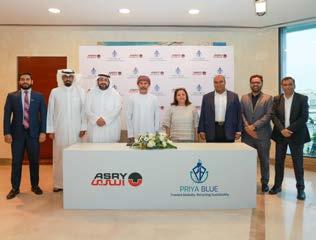
The arrival of the first vessel under the ASRY-Priya Blue joint venture marks the transition from strategic partnership to active operations, establishing a world-class facility for compliant and environmentallyresponsible ship- and offshore asset recycling in the Middle East.
Arab Shipbuilding & Repair Yard Company (ASRY), the leading industrial maritime hub, and Priya Blue Group, South Asia’s largest green ship recycling company, have formally launched their joint venture (JV) following the arrival of the first vessel for recycling in Bahrain. As part of this structure, Best Oasis, a leading cash buyer of ships and offshore energy assets for recycling, is supporting the joint venture in sourcing tonnage and managing the commercial acquisition of vessels brought to the Bahrain facility.
The partnership combines ASRY’s 49 years of marine and heavy industrial infrastructure with Priya Blue’s three decades of ship recycling experience. The JV provides an integrated recycling solution covering vessel sourcing, recycling operations, safety and environmental management, compliance documentation, hazardous waste management, dry dock and slipway access, heavy lifting infrastructure and regulatory support within Bahrain.
Complex vessel recycling
In addition to conventional vessels, the JV is particularly well positioned to support the recycling of complex offshore assets including FPSOs, FSOs, rigs and offshore structures.
The yard holds the licenses required to recycle vessels containing hazardous materials originating from production fluids. This includes the handling, storage, treatment, export and disposal of naturally occurring radioactive material (NORM) waste, which represents a key challenge in the recycling of offshore assets and production facilities.
Recycling operations can be performed using dry dock, slipway and alongside methodologies, with the capability to recycle vessels up to ULCC size as well as to receive rigs and offshore structures directly onto berth. The facility incorporates ship recycling, environmental protection and hazardous waste management systems.
The JV operates in alignment with the principles of the Hong Kong Convention and EU Ship Recycling Regulation (EU SRR), which supports the development of Bahrain as a regional hub for compliant ship and offshore recycling.
“ASRY has been and continues to be the most experienced maritime hub in the region for five decades,” said ASRY CEO Dr Ahmed Al Abri, commenting on the launch. “We have successfully delivered complex repair and maintenance operations for some of the world’s most demanding vessels, serving operators from across the globe.”
He added: “Partnering with Priya Blue to bring best practices in ship recycling to the Kingdom of Bahrain represents a strategic extension of ASRY’s journey and evolution, while this vessel marks the beginning of this new phase.”
“We have recycled over a hundred complex vessels at Alang,” added Sanjay Mehta, Chairman of Priya Blue Group. “We know what compliant, responsible ship recycling looks like – and what it takes to deliver it consistently. Bahrain is not an experiment – it is a deliberate expansion of a proven operation, and this vessel is its opening statement”
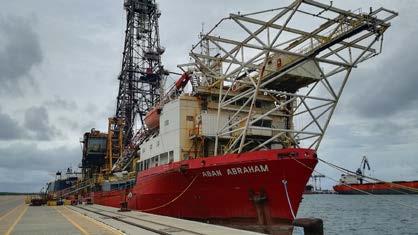
“Drill Ship Aban Abraham” Heli pad removed at afloat at Hambantota Port
DIVERSE REPAIRS AT GOLTENS
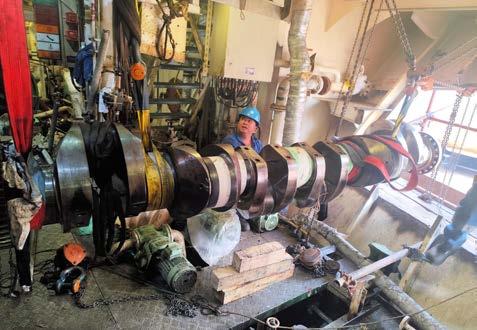
Earlier this year Goltens’ Engine Service Team, Dubai, was mobilised to attend a bitumen cargo carrier, following a major breakdown of its MAK 6M32 C main engine.
Due to the vessel’s critical operational requirements, the client supplied a reconditioned crankshaft and requested a reliable and technically-sound solution to restore the engine to full operational condition within a limited timeframe.
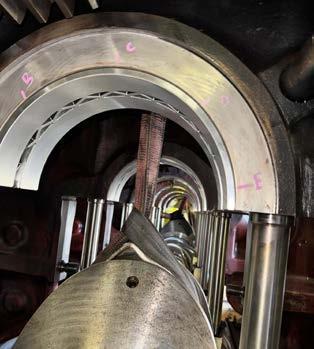
The project involved a complex crankshaft replacement operation, including removal of the damaged crankshaft, lifting of the engine block and securing it on a four-pipe support arrangement, cutting of ship-side plates to create sufficient access for crankshaft removal and installation of the reconditioned crankshaft, precision alignment and reassembly of the engine components. The job was executed in strict compliance with the manufacturer’s guidelines and standard marine repair procedures.
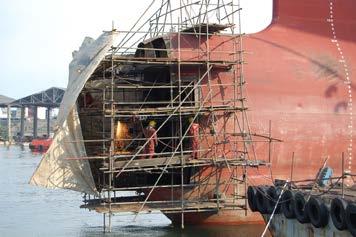
Manoeuvring the old crankshaft out of the ship side
Installation of the reconditioned crankshaft
Solution overview
After detailed inspection and analysis of the reconditioned crankshaft, undersize grinding was initially recommended. However, based on technical evaluation and client preference, the reconditioned crankshaft was approved for reuse after thorough dimensional, crack and tolerance checks. Installation was completed using strict quality control, precision alignment and compliance with bearing clearances and journal tolerances.
Successful installation of the crankshaft and engine block, including chock-fast and alignment. Dock and sea trials were completed smoothly, with engine performance validated up to 75% load.
The project received positive client feedback, highlighting Goltens Dubai’s technical expertise, rapid response and capability to execute complex marine engine repairs efficiently.
Four supply vessels repair
Late last year, a client approached Goltens Dubai for the docking of its platform supply vessels, based on Goltens’ strong industry reputation and proven track record in delivering highquality services while maintaining the highest safety standards. With extensive experience in vessel docking and repair works, Goltens was selected as a trusted partner to execute the project efficiently, safely and in full compliance with client and regulatory requirements.
The engine room and BWTR blower motors underwent complete stator rewinding, including coil extraction, insulation resistance testing, varnish curing and dynamic balancing of the rotor assembly.
The alternators were subjected to functional inspection involving slipring polishing, brush gear assessment, bearing replacement, excitation system testing and voltage regulation calibration, and a megger test was performed and recorded.
The refrigerated container socket assemblies were replaced, including terminal strip rewiring, insulation continuity checks, load-test verification
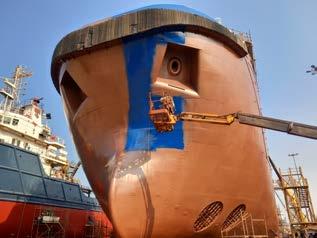
Azimuth steering seal removal on the platform supply vessel
and compliance checks with marine electrical distribution standards.
Multipurpose offshore vessel dry docking
Goltens Dubai recently successfully executed full docking repairs on a multipurpose offshore vessel, including blasting and painting of the hull and deck and thruster overhauls. Additionally, the team carried out essential work on the CPP systems, showcasing Goltens’ ability to deliver comprehensive repair solutions with precision and quality assurance.
Electrical jobs included the servicing of circuit breakers and thorough cleaning and inspection of main and emergency switchboards. The vessel’s two shaft generators, thruster motors and three alternators were overhauled, including the disassembly and internal inspection of components, bearing replacement and lubrication, electrical winding checks and insulation testing and reassembly and alignment, followed by functional testing to confirm performance.
Mechanical work involved servicing critical valves, including main sea chest, intermediate, overboard and safety relief valves. A major overhaul of the Fifi fire pump was also carried out, along with an in-house overhaul of the CPP propulsion system without OEM assistance, demonstrating advanced technical capability.
Fabrication work saw structural renewal works, including pad eyes, tyre fenders and deck wood replacement. Multiple piping systems in the engine room were also upgraded to ensure system integrity and compliance with operational standards.
The hull was also blasted and repainted, along with the decks, and various tanks were cleaned to meet operational and safety standards. Crossover pipes were hydro-jet cleaned to remove scaling and deposits, ensuring unobstructed flow and system efficiency.
A precision overhaul of the main and auxiliary engines was carried out to ensure compliance with manufacturer specifications and optimal performance.
Successfully completed project
The vessel completed sea trials with all operational parameters verified and reports fully accepted. The docking repair project was successfully completed in accordance with the planned scope and schedule. All major activities were executed with strict adherence to quality and safety standards and the vessel was delivered on time, demonstrating Goltens’ commitment to precision, reliability and timely project execution.
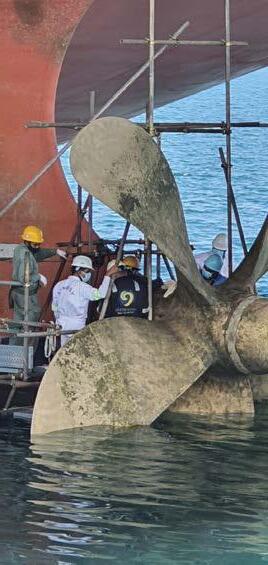
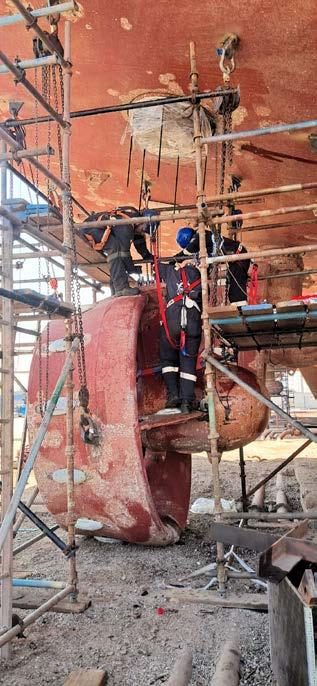
Tail shaft removal
TAKE A TOUR
SHIP REPAIR & DECARBONISATION SOLUTIONS
Tallinn
Klaipeda
Naantali
THE ENGINE THAT CLEANS ITSELF
A breakthrough born in a Nile Delta university lab, a team recognised from Cairo to Silicon Valley and a technology that could change everything about how the world ships its goods: Marine Technology Engineer Mohab Mohamed and project leader and researcher Ahmed Ghowel explain how an Egyptian startup could turn ship pollution into profit.
Nearly 90% of everything you own crossed an ocean. And all of it arrived powered by one of the most polluting industries on Earth – an industry that has, until now, had no realistic exit from its carbon crisis. The shipping industry has been backed into a corner. New EU and IMO regulations are hitting shipowners with crushing carbon penalties. Switching to clean fuels such as e-methanol or LNG requires billions in fleet retrofits. There seemed to be no third way – until a team of engineers from Mansoura, Egypt decided to build one.
TO
THE SOLUTION
SHIPPING’S CARBON PROBLEM MAY NOT BE A NEW FUEL. IT MIGHT BE A SMARTER
FILTER – ENGINEERED IN EGYPT, VALIDATED FROM MANSOURA TO NORTH AMERICA, READY TO CLEAN UP THE HIGH SEAS.
Meet Carbonless – and SENU
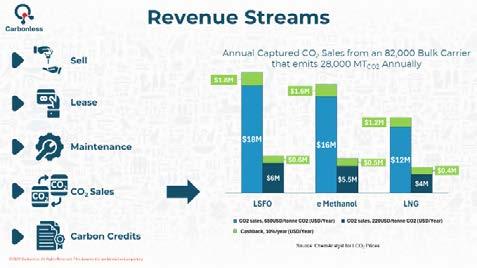
Carbonless is a Cairo-based research group with a deceptively elegant solution: don’t change the fuel. Capture the emissions before they reach the atmosphere, right on board the ship, in real time – and then sell them. Their technology, SENU – named after an Egyptian Pharoah and canal-builder, is an on-board carbon capture and storage system purpose-built for commercial vessels. It fits onto existing ships, it pays for itself and it transforms a regulatory liability into a new revenue stream.
The ‘Emissions to Profit’ model
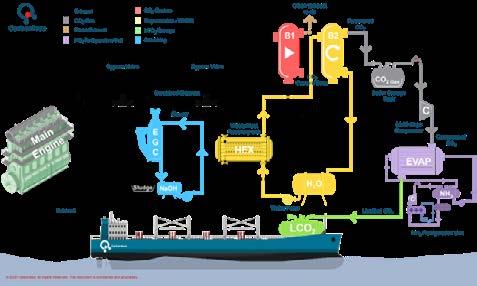
SENU captures CO₂ from exhaust and liquefies it onboard, and Carbonless sells it to industries producing e-methanol and CO₂ batteries. Shipowners receive an annual cashback from that sale.
tons of CO₂ emitted from shipping annually less energy than rival systems IMO Net-Zero deadline
Compliance becomes a business opportunity. Which pivots the way for closing the fuel loop and reaching negative emissions, when eventually maritime industry runs on e-methanol equipped with onboard carbon capture & storage (OCCS) systems. Carbonless is actively seeking research collaborators, strategic partners, and investors who want to be early participants in exploring one of the most urgent problems of our time.
The science that sets it apart SENU’s four-stage process – scrubbing, capture, regeneration and storage –is built around a proprietary capture agent that zeroes in on CO₂ with exceptional selectivity, ignoring sulfur oxides and soot entirely. By tapping the ship’s existing waste heat to power regeneration, Carbonless slashes energy consumption by 35–50% compared with conventional methods. The system also occupies half the cargo space of competing technologies; a critical advantage in an industry where every square metre matters.
The team the world is watching
Carbonless founder and CEO Mohab Mohamed began the work as a senior engineering project. What started as academic curiosity has grown into an internationally-validated research group including Dr. Ahmed Ghowel from Canada, Engineer Mahmoud Abdulsalam from Germany, Engineer Mahoumd Hassan from Bahrain and Eng Shaban from Alexandria University, with 11 engineers specialising in R&D, naval architecture, simulation and more. The startup has already won recognition from institutions in the US, UAE and Egypt.
The road ahead
Following a $4M pre-seed round, the team is building an on-land MVP using a 1 MW generator to simulate marine engine conditions. The next step is a fullscale installation on a tanker operating on the EU-Asia route via Suez.
The feasibility study is complete. Component readiness is at a high
technical level. The technology is validated and revenue can be estimated. What Carbonless needs now is partners who believe – as we do – that the shipping industry’s decarbonisation story doesn’t have to be one of sacrifice. It can be one of invention.
For more information, see: https:// carbonless-eg.com
2026 set to be a strong year
The cruise & ferry market is particularly active, China still remains strong and Turkey remains the most active repair destination in the Mediterranean. However, repair in the Middle East is being disrupted by the ongoing conflict in the region and the closure of the Strait of Hormuz, reports Steve Gordon, Global Head of Clarksons Research.
So far, 2026 has seen continued growth in ship repair work. In the year to start May, more than 6,700 ships (2,000+ dwt/gt) visited a repair yard, up four per cent on the pace of arrivals in full year 2025 (>19,800 ships) and up nine per cent against the five-year average. Looking ahead, 2026 appears set to be a strong year for repair work against the backdrop of a peak in survey work, with an estimated >12,100 ships scheduled to undergo a special survey this year.
Moreover, as many as 45% of surveys are set to be the ships’ third or higher survey as vessels built in the late-2000s and early-2010s ‘boom’ reach 15 and 20 years old. The last time older vessels accounted for such a high proportion of surveys was in 2011. Significantly, older vessels typically spend longer in dry dock (avg. 15yr survey ~20% longer vs avg. 10yr). Together, the increased number of surveys and higher age are expected to drive the number of vessel days spent in dry dock up three
per cent y-o-y and up ~30% vs 2016. In addition to being a source of work themselves, surveys can also support demand for other repairs and retrofits, as shipowners often coordinate work to coincide with dry docking.
Significant retrofits slow
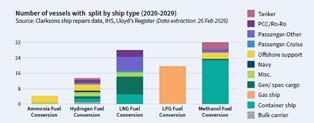
However, so far, 2026 has seen more muted levels of demand for significant retrofit work as previous work streams have slowed and emerging sources of work remain at an early stage. The BWMS retrofit programme is now complete (at its peak in 2022, >600 ships were retrofitted a month) while SOx scrubber retrofits have continued but at a slower pace (Jan-Apr avg: ~20 a month; 2025: ~25; 2019: ~120). Strong shipping market conditions are discouraging owners from taking vessels out of service to undergo work, while tight fuel price differentials (VLSFO costs only +7% vs HSFO at Rotterdam, +16% at Singapore) are limiting the upside from scrubbers. Meanwhile, work streams linked to shipping’s broader GHG emission reduction efforts are at an early stage. So far this year, more than 110 ships have been retrofitted with at least one Energy Saving Technology (EST), following over 560 ships in 2025, while other prospective workstreams, such as Carbon Capture Scrubber (CCS) retrofits and alternative fuel conversions, generally remain at the pilot stage (about 50 of each carried out since start-2020).
Cruise & ferry repair
Focusing on repair work for the cruise and ferry sectors, so far 2026 has been a particularly active year, with more than 85 cruise ships and 420-plus ferries seen entering a repair yard in January-April, up some10% and 15% respectively on the same period last year and marking some of the firmest start-year levels of activity in at least a decade. Notable repair work has included about 40 instances of cruise ship refurbishments (around 15 for 100,000+ gt mega ships) and two Stena ferries undergoing methanol fuel conversions. France and Singapore have been leading work in the cruise sector,
Refurbishment & Repair Events In Jan-Apr 2026 In The Mediterranean & Black Sea Region
Note: Includes special surveys, scrubber/BWMS retrofits, repairs, cruise refurbishments and other activity. Data as of May 2026. Subject to late reporting.
Refurbishment & Repair Events In 2025 In The Mediterranean & Black Sea Region
Note: Includes special surveys, scrubber/BWMS retrofits, repairs, cruise refurbishments and other activity. Data as of May 2026.
Refurbishment &
Events In Jan-Apr 2026 In The Middle East
Note: Includes special surveys, scrubber/BWMS retrofits, repairs, cruise refurbishments and other activity. Data as of May 2026. Subject to late reporting.
with ~15% each of repair yard calls, while Japan, Indonesia, Norway and China have accounted for the largest share of ferry work (~10% each), partially reflecting their large domestic fleets. Looking ahead, an estimated 90 cruise ships and 340 ferries are projected to undertake a special survey this year, representing a record number of dry dockings for the segments.
China remains strong
Turning to the geography of ship repair, China remains the leading destination for repair work, with about 45% of all repair yard visits in January-April taking place at a Chinese yard. Notably, however, this falls well below China’s ~70% orderbook share in CGT, reflecting the more fragmented nature of ship repair compared to shipbuilding.
Aside from China, the rest of Asia accounts for approximately15% of global repair activity, while European repair yards account for ~25%.
Mediterranean and Black Sea repair
Refurbishment & Repair
Events In 2025 In The Middle East
Note: Includes special surveys, scrubber/BWMS retrofits, repairs, cruise refurbishments and other activity. Data as of May 2026.
More broadly, two major destinations for repair work include the Mediterranean and Black Sea region and the Middle East, which in 2025 accounted for ~15% and ~5% of repair yard calls respectively. In the Med region, Turkey is the most active repair destination overall (and the second most active globally after China). It has accounted for some 50% of work in the region (~10% globally) so far this year and had more than 60 yards carrying out work on at least one ship in 2025. Work in the country is split across a range of yards and groups, with some of the most active including Sefine, Tersan, Besiktas and EOS’s Dentas and Torgem. Notably, Turkish yards have secured an outsized role in repair for some shipping sectors: the country’s yards account for ~25% of mid-sized LPG carrier work, ~20% of RoRo work and ~15% of repairs for Suezmax-to-MR-sized tankers in 2025.
Meanwhile, other major repair destinations in the Med/Black Sea in 2025 included Greece (about 10% of
work in the region), through the Piraeus Port repair facility and Onex repair yards, and Bulgaria (about 5%), with Odessos Shiprepair one of the most active yards on the Black Sea coast.
Middle East repair
Meanwhile, in the Middle East region the ship repair market is notably concentrated, with some 75% of work in 2025 carried out at only five yards: the UAE’s Drydocks World Dubai, Dubai Shipbuilding and Albwardy Damen; Oman’s Asyad Drydock and Bahrain’s ASRY. The yards’ work stream is led by the tanker and offshore sectors (~40% and ~25% of the region’s repair yard calls), while Nakilat’s Qatar Shipyard is
the most active large LNG carrier repair yard outside Asia.
Looking at more recent developments, repair in the Middle East is being disrupted by the ongoing conflict in the region and the closure of the Strait of Hormuz; repair yard calls in the Middle East, steady y-o-y in January and February, were down more than half for March and April.
Strong future demand
Regarding the outlook, the ship repair sector can expect to see continued support from steady fleet growth over the coming years (2026/27f: ~3% growth y-o-y in no. ships) and an ageing fleet: more than 40% of the current fleet
will be over 20yrs old by 2030, creating more demand for yard work. Moreover, the retrofitting of green technologies could also grow to be a more significant work stream in the future. The rate of EST retrofitting has risen over recent years, from about 150 in 2020 to more
than 550 in 2024-25, and there is potential for future green regulations to provide support for currently nascent work programmes such as CCS retrofitting and fuel conversions in the coming years.
Vessels Scheduled To Undergo Special Survey By Ship Type
Temprotech is a leading supplier of flame retardant and IMO approved materials specifically designed to protect a ship's flooring, sur faces, fixtures and fittings during newbuild, refits and revitalisation projects.
Temporar y protection creates safer workspaces and reduces the risk of accidental damage, minimising the delays and costs associated with unexpected end-ofproject repairs, cleaning and remedial work.
Temprotech
No. Vessels
Propulsion repairs, retrofits & solutions
Afloat azimuth repairs by MarineShaft, shaft generator retrofits by WE Tech Solutions and a digital solution for faster and more informed maintenance decisions by Chris-Marine.
has taken a strong step toward improving vessel efficiency and reducing emissions by opting to retrofit six vessels in its fleet with shaft generators
Klaveness Combination Carriers
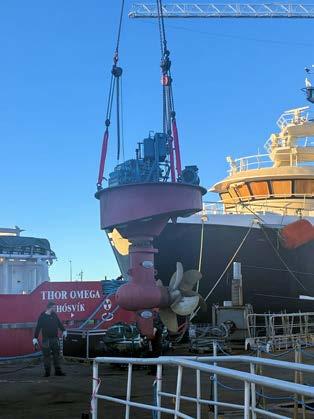
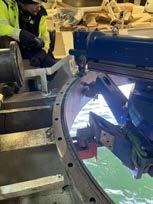
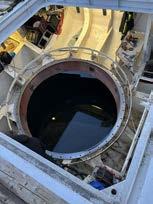
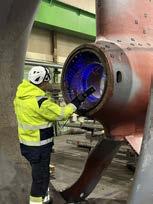
The offshore support vessel Thor Omega experienced a sealing issue on one of its azimuth thrusters. During inspection by the maker, Kongsberg, while the vessel was in dry dock in Spain, a non-planar surface on the thruster flange was identified as cause for seawater ingress. The measured flange deformation was 7.1mm.
Due to a tight docking schedule, the repair was postponed and later carried out afloat by MarineShaft service engineers whilst the vessel was alongside in Skagen, Denmark.
The repair plan was to machine the flange within Kongsberg’s approved tolerances, ensuring correct flatness while removing as little material as
possible. In addition, the O-ring groove was re-machined to restore the correct depth relative to the flange surface. The thruster flange had a diameter of 2,580mm.
MarineShaft utilised its portable milling equipment to carry out an afloat repair, thus avoiding another docking.
MarineShaft’s portable surface milling equipment can machine surfaces up to 6,000mm in diameter, enabling on-site repair of large flanges, crane foundations and similar components where precise alignment and flatness are critical.
A laser alignment of the electric motor was performed following the thruster reinstallation.
Thruster blade repair
An offshore support vessel experienced damage to its thrusters during operation which required it to head for a Danish shipyard for inspection and repair.
All three thruster shafts had suffered severe damage and required replacement. The vessel owner decided to order new thruster shafts directly from the OEM. The blades were also damaged and were sent to MarineShaft’s workshop for repair.
The shipyard requested MarineShaft’s assistance with on-site 3D scanning of the three azimuth thruster housings. The purpose of the scan was to verify the alignment and condition of the bearing seats in the thruster housings before installing the new shafts.
The high-precision 3D scanning provided accurate documentation of the internal geometry of the thruster housings, enabling the owner and shipyard to make well-proven technical decisions.
The measurements confirmed that all three thruster housings were intact and correctly aligned within acceptable tolerances. As a result, no further machining or structural repairs of the housings were required.
Whilst the thruster shafts were being manufactured, the three azimuth thruster propellers were transported to MarineShaft’s workshop in Hirtshals for repair.
The damaged blade edges were rebuilt using welding, and the blades were
ground to restore the original blade geometry. MarineShaft’s repair included balancing of the thruster propellers.
The work was carried out in accordance with approved procedures, after which the propellers were inspected and approved by an ABS surveyor, ensuring full compliance with class requirements.
SHAFT GENERATOR RETROFIT
Norwegian shipping company Klaveness Combination Carriers ASA (KCC) has taken a strong step toward improving vessel efficiency and reducing emissions with WE Tech Solutions (WE Tech), opting to install shaft generators on nine vessels in its fleet. This involves six retrofits and all three newbuilds joining the fleet in 2026. WE Tech and KCC started their cooperation in 2014, with the recent installations reflecting KCC’s broader strategy to optimise energy efficiency and reach its sustainability goals.
Optimising fuel efficiency
For KCC, the primary reason behind installing shaft generators was improving fuel efficiency. By generating electrical power from the main engine while sailing, the vessels can significantly reduce the use of auxiliary engines and in that way save on fuel costs.
“With the shaft generators we can better utilise the main engine, which has a much lower specific fuel consumption compared to the auxiliary engines,” explains Alison García Peña, Project
Manager Energy and Operational Efficiency at KCC.
Reaching ambitious decarbonisation targets has, for a long time, been an important part in KCC’s vessel design and operational strategy. Using a shaft generator allows the vessels to take advantage of the main engine’s efficiency while also supplying on-board electrical power. This further brings the main engine closer to its optimal operating range.
“Typically, the added load that the shaft generator is producing is maybe in the range of 15% of the total load of the main engine in normal operation,” says Martin Wattum, Head of Energy and Operational Efficiency at KCC. “That brings it closer to the optimal load of a diesel engine.”
Combined with other efficiency initiatives, for example hull performance improvements, the shaft generator contributes to better overall energy utilisation on board. “It reduces the total emissions as we use the efficient main engine, and it also contributes to less vibration, noise and heat in the engine room as the diesel generators are not running,” Wattum states. He adds that KCC is also trying to understand whether WE Tech’s solutions can have further beneficial effects when it comes to underwater radiated noise.
On-board operational benefits
In addition to efficiency gains, KCC’s team has observed practical operational benefits since installing the WE Tech shaft generators. The reduction in auxiliary engine running hours does not only lower fuel consumption, but is also expected to reduce long-term maintenance requirements. Crew feedback has been positive as well. The system integrates smoothly with the vessel’s power management system and is straightforward to operate.
“We see that they are using far less fuel on the auxiliary engines,” says Wattum. “They are running fewer hours in total, and we also expect to see a reduction in maintenance costs going forward.”
“I would say it has decreased the workload since we are running the auxiliary engines less, so they require less maintenance,” Peña continues. “It is also noticeable that there is less noise and heat in the engine room, which is very positive for the crew.”
Retrofit experience and lessons learned
Several of the shaft generators were installed as retrofits, which required careful planning and coordination between the partners. One of the initial challenges was space availability in the engine room.
“In the beginning it was a big question mark if we could find the space because the engine room space is very limited,” explains Wattum. “Trying to retrofit a shaft generator in such a tight space was one of the biggest hurdles.” But despite the complexity, the projects were completed successfully.
“If you have the right service engineers and the right yard to help safeguard a good installation, then it works well,” Peña states. The retrofit projects also provided valuable experience that will help to optimise similar installations in the future for KCC.
Reliable operation
Since the commissioning stage, the shaft generators have proved reliable in daily operation. While occasional alarms
or adjustments can occur, KCC strongly underlines the responsiveness of WE Tech’s technical support team.
“We have not had many issues, but sometimes there can be alarms like with all new equipment,” says Peña. “The response from WE Tech’s technical support has been great, and issues have been addressed very rapidly.” As crews gain more experience with the system, their confidence in operating the shaft generator has increased as well.
“In the beginning they were more conservative in how they used the shaft generator systems, but now they are getting more comfortable and are running the system optimally,” says Wattum. KCC describes the cooperation with WE Tech as constructive and solution-oriented.
“I think it has been very good cooperation with everyone that we have dealt with in WE Tech. The company is very solution oriented,” states Peña.
“KCC is a very proactive and creative company,” adds Petter Bodman, General Manager at WE Tech. “It is a pleasure working with the people there, and the synergies we can create with the end user and solution provider is a very good match.”
By combining improved energy efficiency, reduced emissions and better on-board working conditions, the shaft generator installations represent an important step in KCC’s strategy to operate more efficient and sustainable vessels, always with the strictest attention to safety in mind.
FAST ENGINE MAINTENANCE PLANNING
Engine maintenance provider ChrisMarine AB has introduced Engine Insights, a new digital solution designed to convert cylinder condition measurements into automatic, instant, standardised reports for faster and more informed maintenance decisions.
Engine Insights enables service technicians to upload measurement data directly from on-board tools such
as LDM (Liner Diameter Measurement), LCC, CTM and Replica Test and generate structured reports within minutes. While manual reporting today typically requires four to six hours of expert work, Engine Insights reduces this process to just a couple of minutes. These reports provide a clear basis for evaluating cylinder condition and planning maintenance action.
At the same time, the online platform gives fleet managers an accessible overview of vessel condition, supporting more efficient maintenance planning and extended component lifetime.
“Engine Insights simplifies a critical step in engine maintenance – automatically turning measurement data into something immediately usable for decision-making, while dramatically reducing the time required to produce reliable reports,” says Leif Abildgaard, Chief Commercial Officer.
Engine Insights is designed to work seamlessly with measurement data
from Chris-Marine tools, extending their value while enabling a structured and standardised approach to cylinder condition reporting.
Key benefits include:
• Automated generation of standardised reports
• Reduction of reporting time from hours to minutes
• Improved maintenance planning
• Increased component lifetime
• Insights that support more efficient lubricant oil usage.
• Maritime Law
• Shipbuilding & Ship Repair
• Ship Surveying
• … and many more
MAKING STRATEGIC MARINE COATINGS DECISIONS
In shipping, marine coatings are still too often treated only as a maintenance issue, when they should be recognised as a ship performance priority, says Chris Birkert, Global Marine Segment Manager at International, AkzoNobel’s marine coatings brand.
It is easy to overlook seemingly small decisions such as the choice of coatings for a ship, but the reality is that they directly influence competitiveness and performance standards, especially in today’s maritime markets.
Nowhere is this clearer than for two specific ship types: bulk carriers and tankers. They are navigating an increasingly complex market, with stricter environmental regulations and tighter operating margins. In these operating conditions, any opportunities to unlock efficiency and performance gains, particularly without significant upfront cost, must be seized.
Bulker and tanker markets are a good example because existing ships are a sizeable and ageing proportion of the global shipping fleet. Both also play a vital role in the global seaborne transport of essential cargoes, with tankers carrying liquid cargoes including crude and refined oil and chemical products, and bulkers carrying loose dry cargoes such as iron ore, coal, grain, cement and more.
With their respective important roles, bulk carriers account for 42.7% of the global fleet by deadweight tonnage, while oil tankers represent 28.3%, with chemical tankers adding a further 2.2%. At the same time, average vessel age has risen sharply, with bulkers nearing 13 years on average and the tanker fleet now more than 14 years old.
These older ships can continue to earn well, but only if owners manage deterioration, efficiency loss and dry dock investment with greater planning and attention to detail. Hull fouling sits at the centre of this discussion. Even relatively light slime and fouling increases hydrodynamic drag, forcing a vessel to burn more fuel to maintain speed. That immediately raises fuel cost, a major operating expenditure (OPEX). In today’s market, it also increases exposure to costs of regulatory compliance.
Hull fouling remains the most obvious issue that coatings can help to address because it links so many of the shipping industry’s current challenges
and regulations. Given the vast array of variables influencing vessel performance, data and digital tools such as our Intertrac Vision forecasting software are increasingly important in making accurate predictions. As outlined in a recent white paper, when assessing a very large crude oil carrier (VLCC), our simulation was within one per cent of the real operational performance.
Navigating an evolving maritime market
So, what are the most influential variables?
Mechanisms such as the EU Emissions Trading System (EU ETS) and FuelEU Maritime have made fuel inefficiency more expensive. Meanwhile, regulatory measures such as the Energy Efficiency Existing Ship Index (EEXI) and the Carbon Intensity Indicator (CII), introduced by shipping’s global regulator, the International Maritime Organization (IMO), have made poor performance harder to hide. Finally, evolving hull antifouling regulations have made clean hulls a priority.
Delving into the EU ETS, for bulkers and tankers, using a realistic EU Allowance (EUA) emissions credit price of €8095 per t/CO2, the regulation can drive annual carbon levies in excess of $2M.
While this is influenced by fuel type, consumption levels, EU exposure and trading patterns, the direction of travel is clear. Inefficient fuel consumption translates directly into significant annual OPEX exposure.
Looking at antifouling, Australia is an obvious starting point. Bulk carriers moving in and out of Australian ports must comply with stringent invasive species controls, making hull condition an issue of compliance as well as efficiency. Similar pressures are emerging elsewhere as regulators and ports continue to focus on minimising the spread of invasive aquatic species. In this environment, a hull coating should also be judged by how effectively it supports real-world cleaning, compliance and operational continuity. This is just the tip of the iceberg when it comes to the performance challenges
Chris Birkert, Global Marine Segment Manager at International, AkzoNobel’s marine coatings brand.
facing ships and the shipping industry. With this in mind, how can shipowners ensure they are making strategic coatings decisions?
Making informed coatings decisions
This is where the conversation around coatings deserves to mature. The coatings decision is still sometimes reduced to a debate about upfront cost, or an assumption that the most premium specification is always the right one. In reality, neither position is sophisticated enough for the market that owners now face.
No two vessels trade in the same way. Route, voyage length, speed, idle time, cargo patterns, cleaning opportunities and remaining asset life all shape what ‘good performance’ actually means. A coating strategy that makes sense for a highly utilised tanker on a demanding schedule may not be the best answer for an older bulker trading less predictably. For a shipowner, the objective is not to buy the most expensive solution; it is to balance performance and total cost of ownership based on the vessel’s real operating profile.
Off-hire costs also remain a decisive factor, especially when vessels are earning strongly or operating on tight schedules. Dry dock costs are already significant before a ship even leaves the yard, and unnecessary days in dock quickly increase the bill. In that context, coating choice is about application as much as end performance. Surface preparation requirements, application efficiency and project scope should be considered, so the vessel can return to service without avoidable delay.
For these ageing bulkers and tankers, the cost variables are wider still. The hull of the vessel understandably attracts the most attention because it influences fuel burn so directly, but cargo hold, ballast tank and cargo tank condition are also increasingly important with age. By maintaining these alongside hulls, shipowners can save shipyard and application costs. At a more strategic level, meanwhile, they are maximising
asset values, cargo integrity and chartering flexibility.
Performance technology
All these considerations and knockon effects show that hull coatings belong squarely in shipping’s most important conversations, alongside other commercial and regulatory priorities. That is one reason the industry’s attention has recently turned to initiatives such as RightShip’s Zero Harm Innovation Project, which International recently joined to help sharpen focus on the role of credible performance solutions in safer, cleaner and more efficient operations.
The most useful industry discussion is not about paint as a commodity, but coatings as performance technology. Marine coatings influence fuel consumption, greenhouse gas emissions, maintenance demands, cleaning efficiency and time in dock. They also affect how confidently an owner can operate an ageing asset in a market where every inefficiency is becoming more visible and more expensive.
A CALL FOR TRANSPARENCY IN HULL PERFORMANCE
Better data, technology and collaboration are steadily improving ship performance and biofouling management, but greater transparency between stakeholders is needed to drive sustainable outcomes across the industry, experts at HullPIC argued. The annual conference attracted a significant number of leading participants from the shipping industry.
Shipping faces a period of significant uncertainty. Geopolitical instability, shifting policy timelines and delays to the IMO Net-Zero Framework have prompted many operators to look inward, redirecting attention from regulatory compliance towards operational efficiency. Against this backdrop, over 90 participants recently gathered for the 11th HullPIC conference at Certosa di Pontignano, Italy, representing shipping companies, service providers, coating suppliers and technical experts.
The event, co-founded by Jotun and VB Conferences, covered the latest developments in ship performance and biofouling management.
Call for evidence-based performance claims
“Discussing developments in ship performance, technologies and practical solutions is of great interest and value to the industry, and even more so in light of the regulatory and commercial pressures that are impacting shipping trades, fuel prices and the environment,” said Morten Sten Johansen, Jotun’s Global Category Director, Hull Performance. “There is a sense that the industry, while moving in small steps, is steadily converging on better answers to long-standing questions, and that’s thanks in the main to the commitment of the HullPIC community to openly share knowledge, challenge conventional thinking and accelerate progress together.”
Johansen also called for evidence-based performance claims in the marine coatings sector. “Speed loss credibility matters because there is a growing disconnect between reported, claimed figures that introduce operational and regulatory risk. This not only affects individual vessels but may also distort fleet-level decarbonisation strategies”, he warned, stressing the need to use a common assessment methodology such as ISO 19030 applied through independent review.
A consistent message from participants was that operational performance improvements represent some of
the most accessible efficiency gains available to the industry – all dependent on reliable data foundation.
Bridging the reality gap
Conference organiser Volker Bertram identified long-term performance monitoring based on high-frequency data as the direction the industry is increasingly moving towards, with hull coatings, cleaning strategies and propulsion-improving devices all benefiting from more rigorous, continuous assessments.
Another speaker at the conference, David Pang from Swire Shipping, showcased a cost-benefit analysis of hull coatings across Swire’s fleet, arguing that decarbonisation efforts must bridge the gap between laboratory performance and operational reality. Several further presentations addressed data-driven optimisation, covering trim, data sampling and a new ISO 25817 initiative on fuel consumption evaluation.
At the same time, Hamed Vaseghnia of Jotun advocated for CFD-based digital frameworks as alternatives to purely empirical methods for vessel rating and performance assessments, while Albis Marine Performance’s Falko Fritz drew on 13 years of highfrequency monitoring data to highlight an 11-12 percentage point gap in hull overconsumption between two operators using identical monitoring systems. “The problem isn’t the tool,” said Fritz, “it’s the combination of commercial incentives, data discipline, and organisational willingness to act.” At roughly $400,000 per percentage point per year across a 25-vessel fleet, the stakes are considerable.
Energy efficiency investment drivers
A survey carried out during the conference demonstrated that fuel costs and ETS ranked first as the drivers of energy efficiency investment, with 56% of responders placing it top. Regulatory compliance came second, charter attractiveness third, and environmental responsibility
Morten Sten Johansen, Jotun’s Global Category Director, Hull Performance
last, confirming that financial and regulatory pressures remain the primary commercial motivators. On investment posture, close to 47% favoured investing soon to cut costs and 37% preferred acting immediately to stay ahead of regulation. Hull condition and fouling assessment was the most cited case for vessel performance management at 50%, followed by routing and speed optimisation at 28%.
The conference included a panel forum featuring Martin Koepke (Hapag Lloyd), Elgan Moses (TUI Cruises), Falko Fritz (Albis) and Richard Marioth (Idealship), moderated by Johansen and Bertram. Moses made a pointed case for end-user focus: “Captains and chief engineers have no interest in model sophistication or technical jargon. Output must be simple, accessible and actionable.” He proposed reframing ‘insights as a service’ as ‘useful and actionable insights as a service.’ The cruise industry, he noted, already faces data oversaturation with 80,000 data points per vessel at five-second intervals and tools that, despite considerable investment, are not being used. The human element, the panel agreed, is consistently underestimated.
AI and ML featured Artificial Intelligence (AI) and machine learning (ML) also featured prominently, with the panel taking a measured view: both are useful but currently overhyped, with physics remaining the necessary foundation. Marioth argued that the ML community should be held to documentation standards, requiring a minimum description of architecture, training data and safeguards so that methods can be independently
evaluated. On what comes next, the panel pointed to two priorities: integrating whole-voyage logistics so that vessels are not racing to port queues, and reforming charter party contracts, which Bertram described as copy-and-pasted from generations ago and ill-suited to modern performance monitoring. The panel called for standardised charter party templates that reward operational performance rather than legal representation.
“One of the biggest opportunities for further enhancing vessel performance is closing the gap between observation and impact,” said Malte Mittendorf (Mærsk Line). He added: “As an industry, we collect extensive performance data and underwater inspection reports, but they often exist in parallel. By improving data accuracy and directly linking hull condition observations to the vessel’s performance history, we can move from reactive fouling response to predictiveas well as value-based decision-making.”
Echoing the need for a predictive approach, Vivek Nair (Seaspan Ship Management) said: “The broader shipping industry has rapidly embraced condition-based maintenance and predictive models for engine rooms and onboard machinery, yet we continue to treat the hull, the single largest factor in fuel consumption, with archaic, calendar-based or highly reactive strategies. True improvement in ship performance requires us to bring the hull into the predictive era. By leveraging advanced data science to monitor micro-changes in resistance over time, we can pinpoint the exact inflection point where the cost of a proactive intervention is outweighed by the fuel penalty of degradation. It is time the industry manages hull fouling not as an
CLEARLY, PROGRESS IS BEING MADE ACROSS THE INDUSTRY IN MANY ASPECTS OF HULL PERFORMANCE OPTIMISATION. AT THE SAME TIME, IT HAS TO BE ACKNOWLEDGED THAT THERE IS NO ‘ONE SIZE FITS ALL’ SOLUTION, AND MUCH CAN DEPEND ON SHIP TYPE AND TRADING PATTERNS.
inevitable consequence of time, but as a preventable anomaly managed through rigorous, predictive algorithms.”
Entering an energy awareness era
Carsten Manniche (Navigator Gas) noted that the industry has entered an awareness era. “The next step is to create the necessary energy awareness onboard and onshore just as we have done regarding safety. We are moving into an era that can be difficult to grasp as it involves human beings and behaviours, and not just energy efficiency-improving devices. And do we have the right competencies for this new step?”
Nikos Mitropapas (CMA CGM) stated: “Improving ship performance is not primarily a technical challenge but one of leadership, governance, and culture. Sustainable gains require visible commitment from top management, treating performance and decarbonisation as long-term strategic priorities.” He added: “A holistic efficiency view must link hull, propulsion, machinery, operations and emissions. Also, credible performance depends on high-quality sensors, quantified uncertainty, and transparent reporting. All that said, experimentation and failure must be accepted as essential drivers of learning and technical maturity.”
Gerry Docherty (Ardmore Shipping) commented: “Clearly, progress is being made across the industry in many aspects of hull performance optimisation. At the same time, it has to be acknowledged that there is no ‘one size fits all’ solution, and much can depend on ship type and trading patterns. Being able to collect highspeed performance data is definitely an advantage, but only when this is combined with a proactive approach to coating application, hull performance, hull cleaning and fuel optimisation can the true benefits be realised.”
Collaboration at the core
The willingness of competitors, customers and partners to share knowledge openly, and the sense that the industry is steadily moving in the right direction through better data and deeper insights, was truly demonstrated at HullPIC.
“It is clear from the presentations, case studies and discussions during HullPIC that bridging performance measurement and biofouling management is seen by many as a central challenge the industry must continue to address, and we, the HullPIC community, remain committed to that because we firmly believe the critical conversations will help drive better outcomes across the industry,” concluded Jotun’s Johansen.
An LR white paper looks at applying alternative fuels to existing ships as part of its Engine Retrofit Research Programme.
Two headlines tell us what 2025 meant for the emerging alternative fuel engine retrofit market. The first is also arguably the story of the maritime year: the adjournment of the International Maritime Organization (IMO) Marine Environment Protection Committee’s vote on adopting of the Net Zero Framework (NZF).
Doubt over a global framework that would incentivise ship operators to adopt zero- or near-zero emissions (ZNZ) fuels and energy sources will have complex and wide-ranging impacts on the engine retrofit market. But one fact is clear: the longer new vessels are built
to run on conventional fuels, the more of those vessels will eventually need to be retrofitted for ZNZ fuels to meet the IMO’s ambition of reaching net-zero greenhouse gas (GHG) emissions from international shipping by or around 2050.
The second headline shows how, even during regulatory turmoil, shipowners and technology providers deliver the decarbonisation solutions that will eventually be required to meet that 2050 ambition. In October 2025, the world’s biggest designer of two-stroke marine engines, Everllence (previously MAN Energy Solutions), announced successful sea trials following one of the first ever retrofits of a two-stroke vessel for methanol fuel, on container vessel COSCO Shipping Libra
The milestone marks a crucial shift for the retrofit market, from technical feasibility to scalability. As LR reported in last year’s update to its Engine Retrofit Report, first published in 2023, technology providers and yards are building capability and capacity in anticipation of a significant market. Everllence predicts around 300 target candidates for its methanol retrofit in one engine size (90cm bore) alone.
As this update shows, those preparations continued in 2025, even as uncertainty around global policy and market conditions meant that new retrofit project announcements were scarce. Major engine technology providers including Everllence, Wärtsilä and WinGD all announced new retrofit offerings covering methanol and LNG fuels.
Advances were also made, with onboard pilots and engine developments around ethanol. While its decarbonisation potential can vary significantly depending on feedstock, production process and (crucially) regulatory acceptance, low-cost ethanol could support a more financially viable route to lower emissions. For some operators already using methanol-fuelled engines, ethanol requires a relatively minor engine retrofit.
If 2025 did not deliver a mass conversion wave, it did add to the scaffolding industry stakeholders build to support
a future retrofit market. But, as noted last year, sharper signals are still needed from regulators before shipowners feel compelled to switch their existing fleets to ZNZ fuel operation.
Regulatory context
The delay in the vote on adoption of the draft IMO NZF in October 2025 created doubt over how quickly global maritime regulation will begin to price emissions and reward ZNZ fuel uptake. At this stage there is uncertainty whether a global regulatory framework for GHG emissions from ships, with a financial penalty where compliance targets are not met, will be agreed in the near future. Should a global framework not be adopted, there is the risk of increasing fragmentation of decarbonisation measures through unilateral regulation at regional and national levels. While fragmented, penalties from the various measures may nevertheless create a need for retrofitting, depending upon the specific nature of the ship and its operation.
For shipowners, this uncertainty has a significant impact on appetite for retrofit investments. Faced with conversion projects requiring large upfront CAPEX, extended dry dock periods, and long-lead equipment procurement, owners will hesitate to make such commitments unless there is confidence in a compliance payoff.
However, the NZF delay is unlikely to remove retrofit demand permanently. The longer the global framework remains unresolved, the more likely a significant portion of conversion demand will be pushed into a narrower future time window once incentives sharpen. As conventionally-fuelled vessels continue to be built, more of them will need retrofits to enable reduced emissions and net-zero operation by or around 2050. This dynamic has important implications for shipyards and OEMs. A delayed regulatory trigger gives time to prepare developing and standardising retrofit packages, qualifying suppliers, training delivery teams and building repeatable integration templates. But it also increases the probability that demand
becomes compressed, driving higher prices, longer lead times and greater execution risk for late movers.
Retrofit activity
Publicly-announced alternative-fuel conversion projects remained relatively scarce in 2025, reflecting a market still in the early stages of its conversion cycle. Instead, the year was characterised by a small number of high-impact conversion milestones and a larger volume of bridge and optionality retrofits.
The most significant conversion milestone was Everllence’s announcement of successful sea trials following the first retrofit of a two-stroke vessel for methanol fuel on COSCO Shipping Libra. As part of the process, Everllence invested in a dedicated testbed engine in Japan, commissioned in early 2025. The testbed validated the S90 engine’s methanol performance under real operating conditions, with test performance then confirmed at sea trials.
The project demonstrated that methanol conversion is technically feasible at the large-bore, deep-sea end of the market and gives a reference case for future replication.
Another important project is underway with one of the industry’s methanol and engine conversion pioneers, Stena
Line. Having first converted the ferry Stena Germanica for methanol operation in 2015, the company began projects to convert two vessels, Superfast VII and Superfast VIII, late last year. The company described the projects as preparing for future e-methanol operation, without specifying a timeframe. Despite the availability of four-stroke methanol retrofit packages, few other ship operators are committing to join Stena while the availability of green methanol remains low.
Alongside conversion milestones, 2025 continued to see strong activity in ‘bridge’ retrofits. These include engine upgrade packages, propulsion optimisation and control system improvements designed to reduce fuel consumption and emissions regardless of future fuel pathways. Wärtsilä’s announcements give representative examples, including an upgrade package for RT-flex engines on two Ulusoy bulk carriers and a retrofit package on Corsica Linea’s ferry Pascal Paoli These retrofits can be viewed as a preparatory step towards future fuel conversions. They also compete with conversions by consuming the same scarce resources: dry dock time and multi-disciplinary engineering integration capability.
Technology and fuel developments
If 2025 was a relatively quiet year for new conversion project announcements, it still delivered material technology development. Technology companies continued to expand retrofit offerings and to build the industrial scaffolding required for future scale.
The Libra conversion milestone was accompanied by continued efforts to standardise retrofit delivery. Framework agreements and partnerships between engine makers and shipyards signalled a focus on repeatability: reducing engineering customisation, shortening delivery schedules and improving cost predictability.
The remaining challenge for methanol conversions is scale. Repeatability will
depend on the ability of yards and OEMs to standardise retrofit packages, reduce integration complexity and secure fuel supply at commercially viable prices.
In last year’s update, LR noted that appetite for LNG retrofits could resurge amid regulatory inaction due to its relative low-cost, wide availability and foreseeable transitional decarbonisation pathway through bio-LNG and synthetic methane. Multiple technology providers confirmed to LR that LNG retrofits are being discussed with shipowners, even if new orders have yet to be confirmed.
LNG benefits from an established supply chain, a growing bunkering network and a large installed base of dual-fuel technology. LNG demand for shipping could at least double by 2030, alongside continued fleet growth, reinforcing the view that LNG infrastructure and service ecosystems will deepen through the decade.
One interesting niche evolving market is for LNG dual-fuel engine upgrades already in service, tackling methane slip and improving overall emissions performance. WinGD’s frame agreement with Panasia to deliver emissions upgrades for X-DF dual-fuel LNG engines illustrates this pathway.
The emergence of ethanol
Ethanol emerged in 2025 as a credible candidate for marine fuel development, supported by both operator pilots and OEM announcements. Operator trials gave early signals as Maersk began testing a new blend of Brazilian ethanol mixed with methanol and marine diesel. The results confirmed that ethanol can be blended with methanol without compromising engine performance, paving the way for higher ethanol blends. Beyond the upcoming E50 test, Maersk plans to conduct a trial using 100% ethanol.
OEM announcements throughout the year further strengthened the case for ethanol. Everllence confirmed successful running on ethanol across all load points for both two-stroke and four-stroke platforms. WinGD announced an ethanol-fuelled two-
stroke engine roadmap with retrofit applicability.
The similarity between methanol and ethanol means that future methanol engines should be capable of using ethanol, while existing methanol engines could be converted relatively easily. The key difference between the fuels is that ethanol has a higher lower heating value (LHV), translating to higher energy density. This means that the volume of ethanol injected into the engine needs to be around 25% less than for methanol to generate the same output. That difference entails changes to injection pressure and atomiser design, as well as some modifications to the control system.
Beyond the engine, fuel supply systems and storage would need to be adapted to take different volumes and supply pressures into account. This is already accommodated in regulations. The same provisions for methanol under the IMO’s IGF Code and associated Interim Guidelines MSC.1/Circ.1621 for methyl/ ethyl alcohol fuels also apply to ethanol. Ethanol could have a material impact on the affordability of methanol retrofits. Low-cost ethanol could reduce the weighted-average cost of emissions reduction if it is accepted under lifecycle-based regulatory accounting. Its most immediate market impact may be as a complement to methanol, supporting blended strategies for methanol-capable engines.
Ethanol’s adoption will depend on sustainability certification, consistent
regulatory treatment and the development of bunkering and blending infrastructure. The use of ethanol may also require detailed assessment of material compatibility within the fuel handling and storage systems.
Closing perspective
The retrofit market developments of 2025, as in 2024, show an industry building capability ahead of demand. Regulatory uncertainty constrained the volume of announced conversions, but conversion credibility improved and technology providers expanded their retrofit offerings.
What will tip the scales for retrofits in 2026? The biggest factor will be whether the IMO NZF is adopted in November. If that happens, and with a strong enough incentive for ZNZ fuels, it could trigger both green fuel production and ZNZ fuel-capable engine uptake. That will help to advance engine technology, build installation expertise and potentially reduce ZNZ fuel costs through scale. All of which will support a future retrofit market.
That said, the absence of a global framework will likely exacerbate regional and national regulatory requirements for shipping to decarbonise, driving decisions to invest in alternative energy and engine technologies, albeit on a less clear and comprehensive basis, which will drive demand for a retrofit market.
Either way, in the long term, a bigger retrofit market is likely to emerge to convert conventionally-fuelled ships built today to be compliant with regulations at a national or global scale. Ultimately it will be the clarity of the regulation, determining penalties and incentives that will drive shipping towards its 2050 decarbonisation target.
It should not be forgotten that retrofitting a vessel means adding significant cost. By far the most efficient way for the industry to prepare for decarbonisation is to have a clearlydefined pathway at a global scale and set early enough so that vessels can be built from new – rather than adapted once in service – for the fuels they will have to use.
Damen starts repair activities in Dakar
Damen Shipyards Group and the Senegalese government have formed a joint venture (JV) to operate Damen Shiprepair Dakar on the West African coast. The Senegalese government is represented by the Société des Infrastructures de Réparation Navale (SIRN). Together, they will offer a comprehensive range of ship repair and maintenance services.
The Dakar shipyard has significant historical value and is one of the few repair facilities of its size in the region. Its strategic location will enable Damen to provide support to both existing and new clients operating in the area.
These include the many companies supporting the area’s offshore energy industry in the coming years. In addition to providing ship repair services, Damen has the long-term ambition to restore newbuilding activities at the shipyard.
The yard boasts a 191 x 25m dry dock, 235 x 38m floating dock, a 63 x 15m Syncrolift with a lifting capacity of 1,200 tonnes with four cradles, as well as 500m of quayside with a draft of 9m. It provides employment for over 300 personnel, as well as numerous subcontractors.
“This joint venture with Damen marks a key step in revitalising Dakar Shipyard, supporting sustainable growth, skills transfer, the upgrading of technical capabilities and long-term value for Senegal’s economy and workforce,” says Babacar Faye, Managing Director of SIRN.
High safety standards
Damen’s priority in its new role as operator is to bring the yard into alignment with the rest of its shipyards, in terms of health, safety, environment, and quality processes and procedures, IT landscape integration and HR management.
“We are very excited to begin this joint venture,” says Jeroen Heesters, Managing Director of Damen Shiprepair. “The Dakar shipyard is very well positioned to support our clients in the coming years. The yard enjoys an excellent reputation and benefits from extensive experience and knowledge generated over decades of operation.
“From the outset, we intend to develop those capabilities, committing ourselves to a considerable capital expenditure investment programme. This will provide the infrastructure required to bring the yard into line with our other repair yards around the world. It will also enable us to attain the high levels of safe practice demanded by the offshore energy industry.”
Investing in people
“We are honoured to take on this exciting challenge and are looking forward to this collaboration with the Senegalese Government, and with other partners and suppliers locally,” added Damen Regional Director Africa Frederick Vandepitte. “As is Damen’s practice wherever we operate in the world, we will be focusing on building sustainable ship repair capabilities. This includes the opening of a local training centre. With this, we will further develop the already high level of skills at the yard and help to create additional employment opportunities in the region.”
The JV partners are already welcoming their first clients to the Dakar yard.
THIS JOINT VENTURE WITH DAMEN MARKS A KEY STEP IN REVITALISING DAKAR SHIPYARD, SUPPORTING SUSTAINABLE GROWTH, SKILLS TRANSFER, THE UPGRADING OF TECHNICAL
Two sister vessels –one major transformation
Major modernisation work by Western Shiprepair turns Sea-Cargo sister vessels into next-generation RoRos.
Following the official presentation of Trans Sol during One Ocean Week in Bergen, BLRT shared the story behind the transformation of two sister RoRos, Trans Hav and Trans Sol. For operator Sea-Cargo AS, and under the supervision of Stödig Ship Management, Western Shiprepair in Lithuania transformed two proven vessels into modern, energy-efficient ships with greater operational flexibility and a reduced environmental footprint.
The vessels underwent a full-scale modernisation in Q2-Q3 2025 at Western Shiprepair, one of BLRT Repair Yards and part of the BLRT Grupp family of shipyards, ahead of their return to service in a more energy-efficient and future-ready form.
The scope of work included the installation of optimised propellers to enhance propulsion efficiency, NOX scrubber technology to meet stricter emission standards and hybrid-ready battery and frequency converter systems. In addition, the vessels were equipped with a fully integrated power management system, and feature approximately 1,600m² of solar panels for onboard renewable energy generation.
On the structural side, both ships were fitted with a new covered weather deck manufactured by Western Baltija Shipbuilding, another company within BLRT Grupp, thereby increasing cargo capacity and improving protection for sensitive loads. Provisions were also incorporated for future wind-assisted propulsion, with the installation of rotor sail foundations to support next-
generation emission-reduction solutions.
Project engineering was delivered by Western Baltic Engineering, another company within the group, in cooperation with Marine Design & Consulting and Naval Tec.
Scale, complexity and coordination
According to Simonas Keliotis, Commercial Director at Western Shiprepair, the projects stood out for their scale and technical complexity. “These were far from routine retrofits. A wide range of major upgrades were carried out in parallel, including the installation of scrubbers, deckhouse construction, the manufacturing and installation of a covered weather deck, and rotor sail foundations. In addition, executing the modernisation of two sister vessels within the same programme required detailed preparation and close collaboration across multiple teams.”
Keliotis adds that the scope of steelwork alone reached approximately 1,500 tonnes – a significant volume for retrofit projects of this type. “Managing such extensive work while maintaining the planned schedule required precise planning, careful sequencing of activities, and continuous alignment between all stakeholders.
“The result is two upgraded, efficient RoRos now supporting Sea-Cargo AS’s ambitious goal of reducing fossil fuel consumption by up to 50%, and we are proud to have contributed to a project that combines operational performance with a clear sustainability ambition.”
THE RESULT IS TWO UPGRADED, EFFICIENT ROROS NOW SUPPORTING SEA-CARGO AS’S AMBITIOUS GOAL OF REDUCING FOSSIL FUEL CONSUMPTION BY UP TO 50%.
Deliver world-leading, training to your workforce
• Accredited by Lloyd’s Register & globally recognised
• Specified by leading companies across the industry
• Reduce coating failure & costly rework
• Increase client confidence & reputation
• Improve quality across every project Register your shipyard with Train the painter
MAINTENANCE CONTRACT AWARDED
Maritime electrical services provider Alewijnse has been awarded a four-year contract for electrical maintenance of the entire Port of Rotterdam Authority fleet. The contract started on May 1, 2026, for a period of four years with an option for extension.
Under the contract, Alewijnse will be responsible for both preventive maintenance and 24/7 service handling, ensuring that the patrol vessels remain in optimal condition, thereby keeping the Port of Rotterdam safe, clean and efficient.
The contract covers 16 vessels, comprising seven incident response
vessels, two survey vessels, five patrol vessels, one RHIB and the Nieuwe Maze, the Port Authority’s official hospitality and protocol vessel. The fleet, with an age ranging from seven to 42 years, is increasingly operating on electric power. Two incident response vessels and the newest patrol vessel are already equipped with hybrid propulsion systems. Another patrol vessel will be converted to become fully electric this year, making it the first zero-emission patrol vessel in the Port of Rotterdam. Alewijnse will also proactively contribute to optimising the vessels and implementing innovations, as well
as undertaking remote maintenance. In addition, experienced planners will be on call 24/7 to deploy the right specialists on-site as quickly as possible in the event of malfunctions.
“Alewijnse is a trusted partner for the Port of Rotterdam Authority,” says Wouter Schouten, Service Coordinator at Alewijnse. “We have worked together for many years in the field of maintenance and service. We have already carried out various activities on the majority of vessels in their fleet, such as inspections, preventive maintenance and resolving electrical faults. On the patrol boats RPA 14 and RPA 15, we have even carried out complete refits. I look forward to a positive collaboration with the Port Authority.”
ABS and Fleet Robotics have signed a Memorandum of Understanding to collaborate on autonomous robotic systems for continuous hull cleaning and inspection. The collaboration reflects growing industry demand for technology-forward approaches to vessel maintenance.
“It is an honour to work alongside Fleet Robotics to advance autonomous robotic systems for the industry,” said Patrick Ryan, ABS Senior Vice President and Chief Technology Officer. “This collaboration is about more than innovation; we are working to establish the standards and frameworks needed for the maritime industry to confidently adopt these technologies and move toward safer, more efficient and datadriven vessel maintenance.”
“We’re proud to be working with ABS as we advance a future where hulls are continuously monitored, not intermittently inspected,” said Sidney McLaurin, CEO of Fleet Robotics. “By enabling in-water inspection and unlocking a new layer of high-quality data, we can transform how operators
(L to R): Dr Gu Hai, ABS Vice President, Technology, with Sidney McLaurin, CEO & Co-Founder of Fleet Robotics, at Singapore Maritime Week Fourth Spread
make decisions around performance, maintenance and safety. This work is critical to ensuring the data is trusted, standardised and can be used to support and enhance class inspections and broader industry practice.”
The project will include assessing the suitability of robotic systems for inspection tasks, validating the quality and integrity of sensor data and imagery for class use, and identifying pathways to integrate these technologies into existing class, regulatory and owner/ operator workflows.
ALUMINIUM MANUFACTURER RELOCATION
Ned Marine has relocated and rebranded its aluminium manufacturing division – formerly known as MTQ Products – to a new production facility at Damen Shiprepair Rotterdam. Operating under its new name Ned Marine Alucon, the facility designs and builds certified aluminium gangways,
bridges, cruise window wash systems and access structures for the maritime, offshore and civil engineering industries. The move to Damen Shiprepair Rotterdam marks a significant step in Ned Marine’s growth strategy. The new location, on the waterfront at the former Verolme yard in the Botlek area, provides direct quayside access, enabling the company to serve oceangoing vessels more effectively than was possible from Dordrecht. Inland shipping, which remains an important market for Ned Marine Alucon, also continues to be served from the new Rotterdam base.
Being located at Damen Shiprepair Rotterdam opens direct access to a diverse client base. Container vessels, cruise ships and offshore units, including platforms, barges and rigs, are among the vessel types regularly calling at the yard. For Ned Marine Alucon, this proximity translates into shorter lead times, faster on-site support and a stronger position in the market for oceangoing vessels.
COMING UP
Drydock September 2026
The world’s leading ship repair and maintenance magazine
SPECIAL EDITORIAL FEATURES & ANALYSIS
• Area Review: Northern Europe
• Spotlight: The Nordics
• Analysis: Container ship & tanker repair
• Special Feature: Ballast water treatment
Bonus event distribution
SMM, Hamburg
Subscribe to receive Drydock Magazine
Drydock Magazine will continue to showcase its regular features: On the Line, Face the Facts, In Focus, Worldwide repairs & News.
Editorial content is welcomed and will be published at the Editor’s discretion.
DryDock Magazine is published quarterly by MPI Group. Peel house, Upper South View, Farnham, Surrey. GU9 7JN. UK
To advertise in the magazine, on the website and/or newsletter, contact Nick Carugati: nick@drydockmagazine.com
LONG-TERM SERVICE AGREEMENT
Wärtsilä has signed a new long-term overhaul frame agreement with Swedish ship operator the Erik Thun Group. The agreement has been developed jointly with long-standing fleet management partner MF Shipping Group, and includes comprehensive overhaul services, technical services,
field services, workshop support and parts supplies. The aim is to ensure the longevity and performance of the four-stroke medium-speed engines, propulsion machinery and shaftline equipment installed throughout the Erik Thun fleet. The agreement was booked by Wärtsilä in Q1 2026.
The shipping industry is shifting from transactional services to long-term lifecycle partnerships, prioritising
operational continuity and efficiency in response to market demands for reliability and sustainability. Enhanced digitalisation and regulatory pressures are driving companies to adopt futureready models that ensure safety, resilience, and ongoing value creation.
“This agreement reflects our commitment to reliable operations and continuous improvement,” comments Henrik Källsson, Deputy Managing Director, Erik Thun Group. “We continue to introduce new and increasingly sustainable generations of vessels, and in this, the know-how and expertise of Wärtsilä plays an important role.”
Wärtsilä will deliver field services to minimise vessel downtime through proactive maintenance. Workshop support will be provided to recondition and restore components to working condition and to meet OEM standards. In addition, a reliable supply of spare parts will ensure consistent operational reliability.
FUEL CELL RETROFIT APPROVAL
RINA has granted an Approval in Principle (AiP) to ST Engineering Marine for a retrofit concept involving the installation of a hydrogen-powered fuel cell system on board Asean Raider I, a 25m aluminium fast passenger ferry operated by BatamFast.
The AiP covers the substitution of one of the vessel’s auxiliary diesel generator sets with a hydrogen fuel cell system, supported by supplementary lithiumion batteries. The proposed solution aims to reduce carbon emissions while ensuring appropriate levels of safety, performance and regulatory compliance for passenger operations.
The assessment was carried out in accordance with the process described in the RINA Guide for Approval in Principle for Novel Technologies, based on the technical criteria set out in the RINA Rules for the Classification of Ships, the International Code of Safety for Ships using Gases or other Lowflash-point Fuels (IGF Code) and the International Code on Intact Stability.
The AiP activities were performed by RINA’s South Asia Pacific Plan Approval Centre, which supported the project through the assessment of this novel application of hydrogen fuel cell technology to an existing fast passenger ferry. The Approval in Principle certificate was presented to ST Engineering during Singapore Maritime Week.
“This Approval in Principle represents a key feasibility milestone in expanding our retrofitting capabilities, as we explore practical pathways to introduce hydrogen fuel cell technology into maritime operations,” says Lim Nian Hua, Deputy President, Marine, ST Engineering. “Achieved in collaboration with RINA, it validates the robustness of our retrofit concept and demonstrates our engineering expertise to safely integrate new technologies into existing vessels. This work will advance the adoption of lower-emission solutions for maritime applications, while maintaining a strong focus on safety and regulatory compliance.”
“This project demonstrates how Approval in Principle can be used as an effective tool to assess innovative solutions at an early stage, particularly for alternative fuels and energy systems,” added Yong Song Pang, RINA’s Executive Director, South Asia Pacific Marine. “By supporting this feasibility study, RINA aims to facilitate informed design decisions and help smooth the transition from concept to detailed engineering for novel technologies applied to existing vessels.”
MARINE PUMP SPECIALIST ACQUISITION
Marine pump specialist Svanehoj has further expanded its marine service and after-sales business in the Benelux region by acquiring H&K Services BV, a Dutch company specialising in the service and repair of marine fuel and cargo gas pumps. H&K Services will operate under the Svanehoj EPS name from its current location in Stellendam, the Netherlands, close to Svanehoj’s regional service site in Oud Gastel. The transaction closed on May 1, 2026.
In recent years, Svanehoj has made significant investments in a global service and after-sales network, strengthening proximity to customers and ensuring fast, proactive support worldwide. Now, the expansion continues with the acquisition of H&K Services, a company with decades of experience in measurement, control and technical services for industrial and maritime applications. H&K Services is an established specialist in Svanehoj’s deep-well pump solutions with strong shipowner and shipyard relationships.
“H&K Services brings strong expertise in cargo and fuel gas pumps, including in-depth knowledge of Svanehoj deepwell products, and they already have a deep understanding of the technology, applications, and the customers we serve,” says Søren Kringeholt Nielsen, Group CEO, Svanehoj.
The acquisition of H&K Services follows last year’s acquisition of European Pumps Services (EPS) BV in Oud Gastel, now serving as Svanehoj’s main service hub in Benelux. As the official distributor and service provider for two other major ITT brands, Bornemann and Goulds Pumps, Svanehoj EPS delivers turnkey solutions, backed by in-house engineering and project management capabilities.
GREASE TRAP SOLUTION INTRODUCED
Wärtsilä Water & Waste, part of technology group Wärtsilä, has introduced a flexible and modular grease trap product line designed to separate fats, oils and grease from galley wastewater streams on merchant vessels, cruise ships and offshore platforms. The solution supports improved wastewater management while contributing to protection of the marine environment by capturing fats, oils and grease before they can enter discharge systems, and ensuring they are removed and disposed of in line with regulations.
Effective management of fats, oils and grease is an essential part of
on-board wastewater handling. If not properly controlled, grease can accumulate within pipework and treatment systems, increasing the risk of blockages, operational disruption of the vessel and additional maintenance requirements. By separating grease at source, Wärtsilä’s new product line, the Grease Trap – GM Series, helps reduce blockages and maintain reliable wastewater system operation.
The system is designed in accordance with BS EN 1825, the European standard for grease separators, and operates using a gravity-based separation process. Wastewater enters the unit where solids settle, while lower-density grease rises to the surface and is retained within a dedicated collection chamber. The clarified water then flows onwards through the vessel’s discharge system.
The Grease Trap – GM Series is available in four sizes to suit different vessel requirements, with options to support easier grease handling and disposal. Depending on the configuration, operators can choose a straightforward manual solution or a version designed to make grease removal easier and reduce hands-on maintenance. This helps crews manage galley wastewater more efficiently, supports more reliable system performance and reduces the risk of blockages and unnecessary disruption on board.
“The Grease Trap – GM Series addresses a routine but important aspect of on-board operations,” says Fraser Scott, Managing Director,
Wärtsilä Water & Waste. “Separating grease at source is essential for maintaining reliable wastewater system performance on board, helping to reduce the risk of blockages and unplanned maintenance while supporting consistent downstream treatment and more responsible wastewater handling at sea.”
DRONE HEADQUARTERS VISIT
In a move underscoring its commitment to technological advancement and operational excellence, a high-level delegation from the Singapore Maritime and Port Authority (MPA) recently visited the headquarters of Flyability, a global leader in confined-space drone inspection technology. The visit served as an opportunity for the MPA team to gain first-hand insight into how collision-tolerant drone technology is being used by the maritime industry to improve safety and efficiency during inspection processes, aligning perfectly with Singapore’s vision for a digital and innovative port environment.
The maritime industry plays a vital role in global trade but faces constant pressure to enhance safety protocols, limit vessel downtime and reduce operational costs. Traditional inspection methods require inspectors to enter confined spaces such as ballast tanks, cargo holds and cargo oil tanks, a practice that is time-consuming and carries inherent risks. During the visit, the Singapore MPA delegation engaged with Flyability’s teams to learn how the company’s drones are able to meet class society data requirements without having to put anyone at risk, witnessing first-hand demonstrations of the drone’s capabilities and new autonomous features.
The Singapore MPA has consistently positioned itself as a global maritime hub driven by innovation and digital transformation. This visit to the Flyability headquarters directly supported its strategic initiatives focused on accelerating technology adoption to build a safe, efficient and sustainable Maritime Singapore.