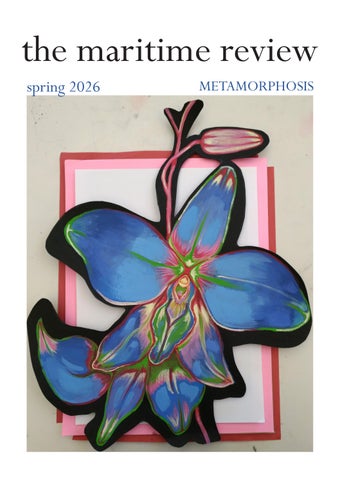
the maritime review
spring 2026
METAMORPHOSIS
Dear Readers,
Welcome to The Maritime Review: the 2026 edition of the Country Day Literary Magazine.
With the 2025-2026 school year marking the second publication of The Maritime Review, a concept that became exceedingly relevant to our magazine is the idea of change. This edition reflects a shift in the artistry of both our written and art pieces. Inspired by this shift, we chose this year’s theme to be metamorphosis. Metamorphosis is defined as “a striking alteration in appearance, character, or circumstances.” This literary magazine includes a broad range of alterations, from car crashes to identity to historic reform to reincarnation. Many pieces also grappled with the metamorphosis that is growing up, a deeply resonant topic in our last year as editors in chief and with several of our featured artists graduating. As this literary magazine will continue to grow and change beyond our time at Country Day, we hope you enjoy this snapshot of its transformation.
Signed, The Editors in Chief
Madeleine Seal and Magdalena St. Louis
Editors-in-Chief
Madeleine Seal
Magdalena St. Louis
Prose Editor
Nayara de Silva-Ahmed
Art Editor
Mireille Luparello
Layout and Design Editors
Ben Morvant
Magdalena St. Louis
Editorial Staff
Harper Emmett
Zoey Gallagher
Jolie Leonard
Thank you to our faculty sponsor Mr. Ferguson, and to everyone who submitted artwork/writing to the magazine.
From all of us at The Maritime Review, thank you. We hope you enjoy.
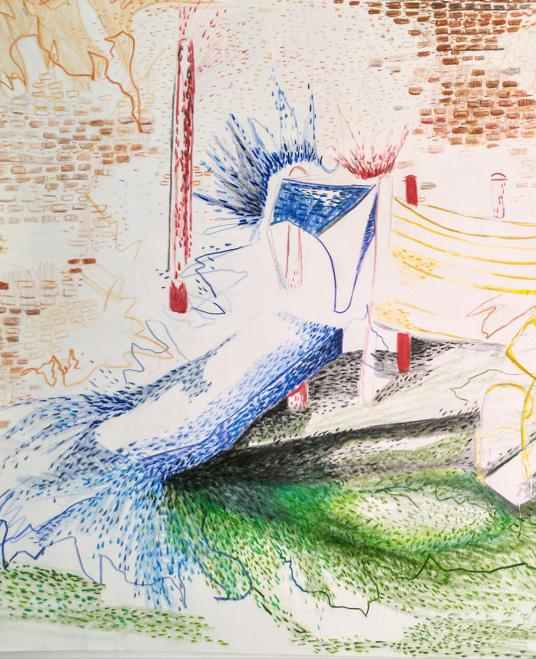
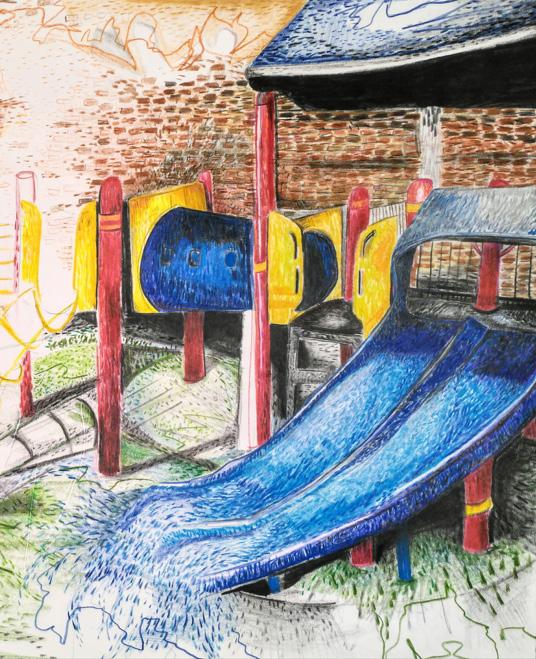
Playground Piece
I grew up with Kevin, so my mom made me be nice to him. Kevin was fun… when we were seven. To be honest, these days he’s just an asshole with no redeeming qualities. Kevin’s parents are dirt poor and senile. I mean so old they must have pushed him out when they were fifty-five. In addition to his unfortunate familial situation, he is not much to look at. I mean physically he is pretty big, yeah, but it’s just hard to look at his pudgy, sweaty face covered with rosacea and pimples. Every word that comes out of his mouth is offensive, dirty, and gross. I do feel bad for him though. He doesn’t have any friends besides me and this lonely middle-school kid. I’m usually with my real best friend, James, but I’m not exactly drowning in invitations to parties or people to hang out with on Friday nights. I might as well hang out with Kevin. That’s fine.
As I pedal on my bike, the cold Michigan air threatens to rip my beanie off. I speed over to James’s house in record time. I don’t have or really need a car, it’s easier to get around town on bike. As I turn the corner, I pass my miserable high school. Our football field (if you can even call it that) is covered in crispy brown grass. I bike through the field as a short cut, saving only a minute. On the outer wall, I see the senior class photo, hung beneath a poster reading 1988. I stare a little too long at Violet Whittaker’s picture. She graduates this year but has to be the prettiest girl on the planet. We have Bio together, since even though she’s heavenly, she’s also kind of an idiot. Taking tenth grade biology as a senior is sad. But hey, at least I get to stare at her long, pretty hair and red lips during class. I turn my bike away from the overgrowth of trees behind the field that the upperclassmen call “The Spot.” I crane my neck to see who’s congregating there this afternoon. I pray it’s Violet and her friends smoking cigs beneath the oak trees. Such a shame, that I only see Raymond Riles and Charles Tutherman. The burnouts. I can smell their pot from my bike as I pass by.
Turning yet another corner, I arrive at James’s parents’ house, an ugly brick single-story place with dying grass. I throw down my bike and bang on his door.
“James, open the goddamn door. Violet Whittaker talked to me today. Oh, and you’re gonna wanna hear the shit she said.”
With that, I hear him stumble down his stairs and throw open the door.
“Oh man, you’re lying. I just know you’re lying. Did she talk ‘bout me?” I laugh and push him away from me. I hate when he comes too close. The upperclassmen already think we’re gay.
“Dude, you have to tell me like right now—nah, you’re screwing with me.”
“No man, I’m serious, she wants you real bad.” Fanning myself and mocking Violet’s high-pitched voice, I continue, “She just needs you in her bed tonight.”
“Man, shove off,” he says, hopping out of the door frame and pushing me to the ground with his dirty Converse.
I’m on my bike as James runs over to his and chases me down the street. We pedal as usual to the town’s only drugstore.
“You know when you’re like biking so fast that like, I don’t know, you feel like you are the fastest you can be?” James pants out.
“Nah man, I’m the fastest person ever. Ask the Flash, he knows.”
“Maxwell. Like actually shut up. You’re so much more annoying than Kevin and that weird-ass little middle schooler.”
“Nah, man,” I pant, “actually what the hell is that? Why are they friends? We’re gonna be upperclassmen next year and he’s hanging out with a middle schooler.”
“What a big fat loser.”
Sometimes I have to remind myself I’m not as mean or harsh as James, so I have to keep him in line.
“Hey, he is nice. My mom makes me hang with him sometimes. He just is… probably… lonely.”
Sucking the air through his teeth, James whispers, “Dude, shut up… Speak of the goddamn devil.”
Kevin comes bounding around the corner on a bike far too small for him as his middle school friend sits on the handle bars. Kevin hops off the bike and runs over to me, giving me one big smelly hug. His breath smells dry like he needs a glass of water.
“Yo! Max, this is Richie, he’s chill. His sister’s that senior, the one with giant boobs.” Richie makes a disgusted face and whispers, “Man, shut up, that’s so gross.”
James refuses to come inside with us, so he stays outside out of protest. We each buy cans of Coke and barbeque sunflower seeds. I pay for Kevin because that boy doesn’t have a cent to his name. Kevin chugs his Coke in seconds and belches the ABC’s as the rest of us laugh along. Richie stops laughing, “Wait, don’t throw the cans away. My dad’s got this new BB gun. We should totally go shoot up cans at The Spot.”
James’s face lights up. “Wait for real? Bike and get it and meet us there.”
Kevin snorts, “Guys, I heard Jessica B. gave Charles Tutherman a handy there.”
James’s face drops.
“Hell no. We aren’t going to the actual Spot. Why would we do that? Just going to the woods behind it. You know that ditch back there.”
We ride off on our bikes together. Richie bikes off in the opposite direction. Looking back, I realize Kevin was riding Richie’s bike earlier. Probably because he doesn’t have his own. Richie’s bike still has the training wheels on. Christ, how old is this kid?
Kevin rides my bike and I sit on the handle bars. James bikes near us as I suck on the
sunflower seeds and spit them at the design on the back of his shirt. Arriving at the woods, we start throwing sunflower seeds in each other’s mouths. Kevin tries to throw a sunflower seed in James’s mouth and completely misses. Barbeque seasoning flings into his eyes.
“What the hell, man. Holy shit. I think I am gonna be blind. No-ow-shit.” Kevin starts laughing incessantly. “Dude. Do you think this is funny?”
Still laughing, Kevin says, “You are such a baby. Max’s little girlfriend, I see. You on your period or something?” Kevin notices how he’s hit James’s soft spot and keeps going. That kind of stuff bothers us both. We’ve been bullied since freshman year for those things.
“What did you say to me?”
Kevin steps closer, “You heard me. You’re a little girl.” James walks even closer to Kevin and weakly punches him. Throwing myself between them, I raise my voice, “Woah, break it up, you guys, it’s not that serious.”
“Hey, guys!” Richie says, “I got the gun!”
I turn around and see him standing there, this goofy little kid with a pistol in his hand.
“Yo, what the hell, Richie. That’s a real-ass gun.”
Kevin stands up, “No, shut up, it’ll still be fun to shoot it. We can be careful.”
For some reason, without arguing with Kevin, we begin setting up the cans. James wants equal distance between them, so we rearrange. Again. James insists, because he loaded the gun and taught us how to use it, that he should go first. He lies on his stomach aiming at the cans. He hits the middle can right in the center. Kevin runs over to the cans to reset. “Holy shit, I found a condom wrapper!”
“Ew. Gross, Kevin.”
With not much else to do while we wait our turn, Richie and I run behind the trees scoping for lighters and cigarette butts. None of us smoke but I think we like to pretend we would if given the chance. Rummaging through the fallen leaves, I find one halfsmoked with cherry red lipstick on the filter. I secretly hope it was held gingerly between Violet Whittaker’s beautiful red lips. I turn and look both ways. First to make sure James isn’t watching and second to make sure him and Kevin aren’t arguing. I put the cigarette to my mouth and let the lipstick rest on my lips. I get lost in the moment. My eyes close as I hold the dirty cigarette. I pretend we’re sharing a kiss. But then it becomes more about the lipstick on my own mouth. I roll the filter back and forth, getting every drop of pigment on my lips.
I open my eyes, and on the ground is a white lighter with V.W. written in bubble letters. I raise the lighter and light the cigarette. The first puff ignites a big sputter of coughs. I take a second puff and feel like Violet. Smoking in secret like her, in red lipstick.
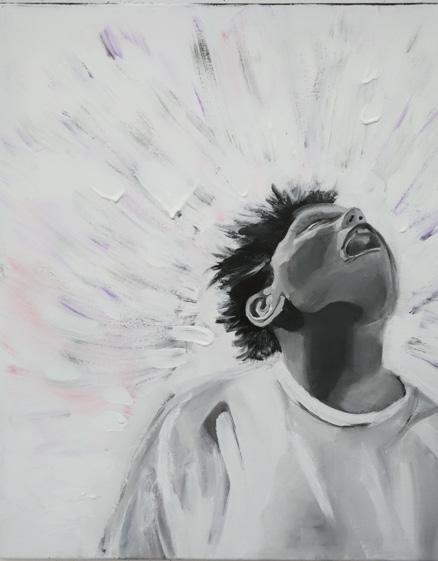
The girl never expected to leave her seat in the center of the universe. She had existed there for lifetimes, longer than is comprehensible by your human mind. Amidst the tumbling of galaxies and stars around each other, she was the sole thing that was even remotely constant, holding the knowledge of whatever she pleased. Upon the fleeting touch of the star closest to her, she could access every memory previously created and every memory that had yet to be created: the boarding of a plane, the blowing out of candles on a birthday cake, the surfacing of a swimmer from a salty ocean dive. Although she had the ability to experience each dose of humanity stored in every burning star, it was her decision, time after time, not to do so. The being (or girl, for the ease of telling this tale) preferred to allow the moments to hurtle by. When she existed inside herself, there was no chaos, no feelings, no problems. She was content with only the occasional dose of emotion. She was content with the abstraction of just her own existence. She was content with the serenity of her soul, the hollowness of her thoughts.
But here the girl now lies, pale arms outstretched at each side. Soft tendrils of grass caress each wrist as her fingers twitch lightly for the first time. Her silvery blonde hair, mimicking the reflection of the moon, blows gently from the wind of the incoming storm. She lies in a large clearing while the surrounding trees groan in the wind. The clouds reveal the deep night sky in patches, stars appearing for mere moments before again being cloaked by the unforgiving gray.
It’s an unfortunate moment to have been brought down to Earth; sunshine with clear skies would have been a nicer introduction to the planet the girl had spent eons gleaning memories from. Her descent had been gentle, a slow fall as her spirit glided through the atmosphere, coming to rest in the lush grass. She didn’t know why she had been sent down, or how, or by who. Up there, on her throne as she liked to imagine it, everything was in order. She was the one who held everything. The other blips in the universe had nothing to do with her, as she only interacted with them if she chose to. However, it becomes clear to her that down here, choosing even the basis of every interaction around her isn’t her decision to make. Everything is interlinked. The trees talk to the raindrops as they rush down to greet the leaves, the clouds talk to the sky during every storm as they thunder across the horizon. She’s no longer alone by choice; rather, she is now unwillingly connected to the very existences she previously shied away from.
The girl is still, staring up at the bright pinpoints in the sky. After testing it out, she moves her right arm and reaches out, expecting to be pulled back up to where she had been since the beginning of time. Nothing moves.
She exhales with the wind as it mimics the fall of her chest and blows across her newly formed skin. Gaze never leaving the sky, she slowly stands to her feet in the tall grass. Even as the first raindrops fall around her eyes, her arm stays outstretched. Even as the first flashes of lightning strike the trees around her, she remains motionless. It becomes clear to her that she will not be able to return and thus, she produces one of the first thoughts that is uniquely her own. The girl finds herself hoping that whoever is in her place now is kinder than she was, and pays attention to the passing star that holds the story of her new life.
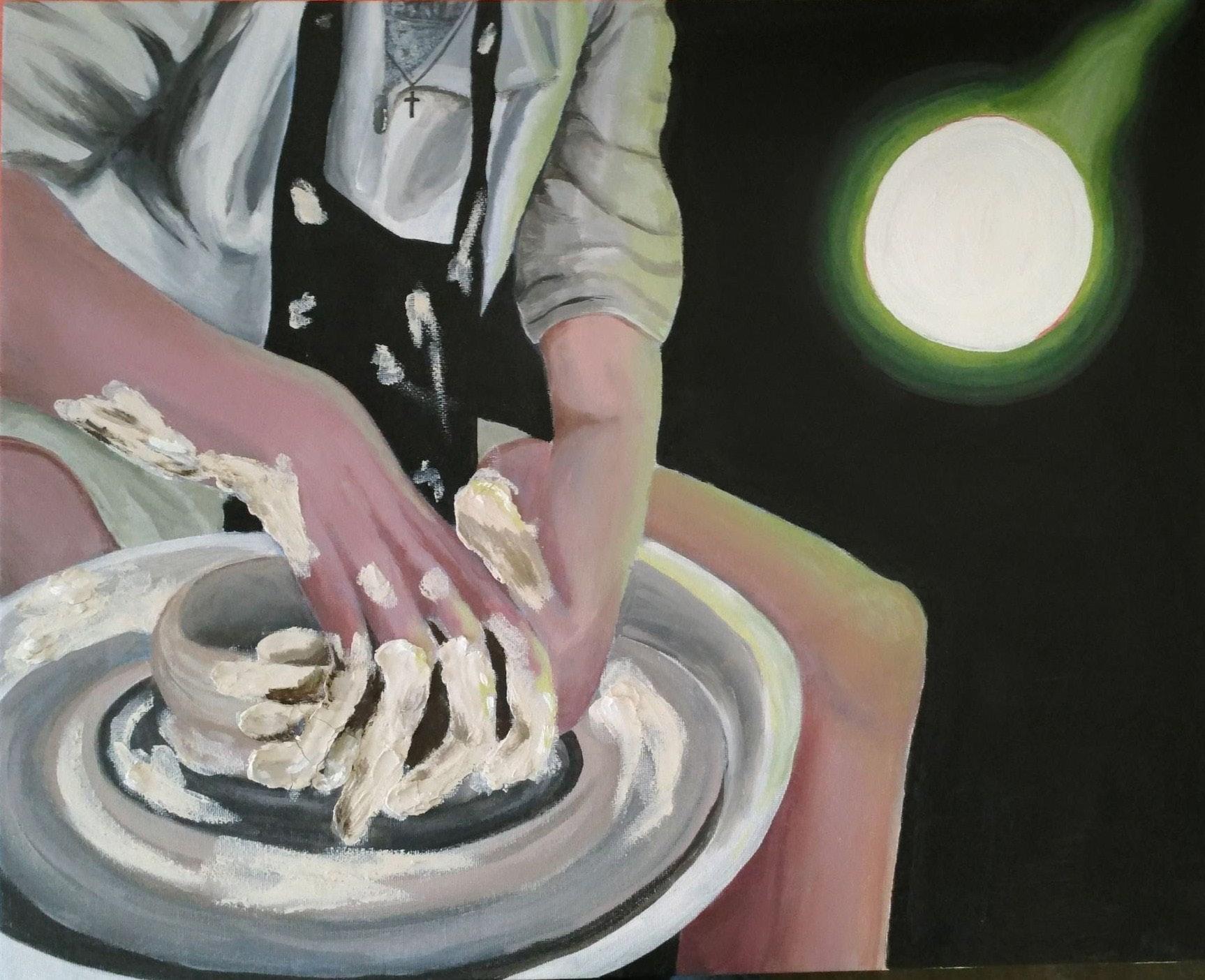
Norah Wood, 12th
It is hotter than a summer should be
The weight of thick august air sticks on the body
And mind too tired too sore to work or to rest
When the water does come
Drooling from the sky
Moistening the hot earth and road
And trees and grass when the water pools in low tides
And brown mirrors that sit stagnant
And wait under gray cover
Then the red heat of sun and summer sky will rest
But not too long
And not too far
For no matter the weight of rain above
Cold sun will puncture the wet blanket
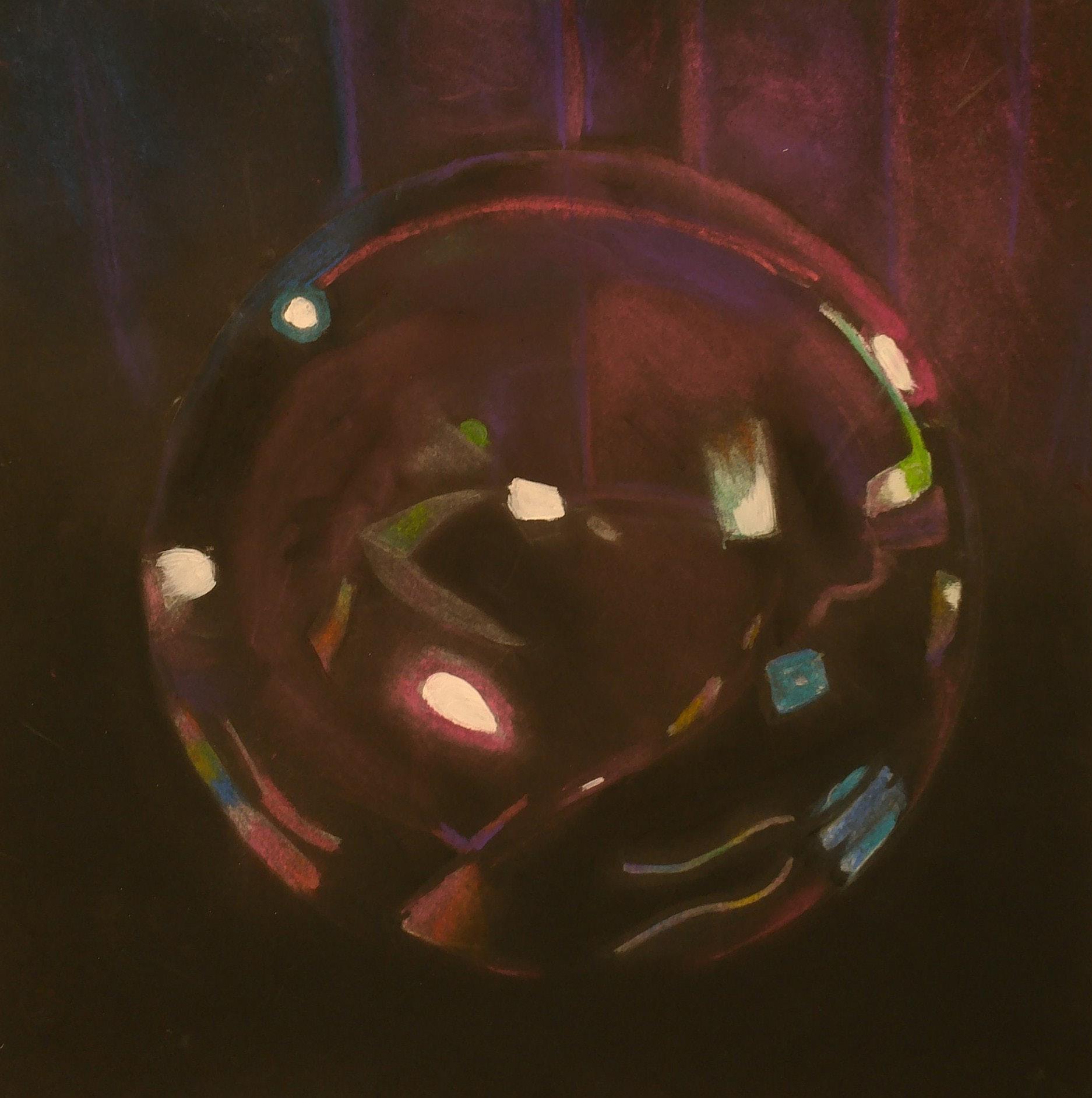
Libbie Miller,10th
Due to a series of clerical errors, there is exactly one typo (an extra letter, a removed letter, or an altered letter) in the name of every department at the University of Chicago. Describe your new intended major. Why are you interested in it and what courses or areas of focus within it might you want to explore?
A fig tree stands outside of my bedroom window, watching me grow with the seasons. This particular tree is the third of its kind. The last two died from freak southern frosts. Each replacement was planted in the same spot, producing less fruit than the last. I was morbidly fascinated by this representation of decay: an invisible rot through generations. When I saw “Big Fig Problems” listed as an interdisciplinary course of study at UChicago, this fascination was triggered once more.
Figs are deceitful. They are not fruit but syconiums, or inverted flowers, making each seed within a fig its own tiny fruit.1 The classification of this flower is not the only secret the fig hides. The seemingly innocent fig has played a dark role throughout history, which I’ve explored in the “Fig Problems” track. Not wanting to forget what I’ve learned, I’ve documented my journey through this interdisciplinary opportunity.
The first course I took was Biological Foundations of the Genus Ficus. Before the lecture began, we were invited to pile plates high with fig treats. Our professor then launched into the life cycle of the fig and the fig wasp. Although today some fig species are self-pollinating, many require a wasp to reproduce. In such cases, a wasp crawls inside a fig, lays eggs, and dies. The wasp siblings hatch and mate, and the males dig an escape route for the females to fly off and pollinate more figs. Meanwhile, the males remain inside the fig, broken down by enzymes to be used as protein for the tree.2 My honey-baked fig fell from my mouth as I questioned whether that crunch I just felt was truly from seeds. While this gruesome cycle is the most visceral example of darkness intertwined with figs, it is far from the last. We also learned about the strangler fig, and how this parasitic species leeches the nutrients of the host it chokes to death.3
1 Datwyler SL, Weiblen GD. On the origin of the fig: phylogenetic relationships of Moraceae from ndhF sequences. Am J Bot. 2004 May; 91(5):767-77. doi: 10.3732/ajb.91.5.767. PMID: 21653431.
2 Weiblen George D., Yu Douglas W. and West Stuart A. 2001. “Pollination and parasitism in functionally dioecious figs”. Proc. R. Soc. Lond. B.268651–659 http://doi.org/10.1098/rspb.2000.1389
3 Britannica Editors. “strangler fig.” Encyclopedia Britannica, July 10, 2019. https://www.britannica.com/plant/strangler-fig-
While the fig is a harbinger of death in ecological life cycles, it also has strong connections to tragedy in the humanities. In my Figs and Classical Civilization Course, I learned of the fig’s cultural weight in ancient society. Historic links between figs and death range from the strange (the philosopher Chrysippus is said to have laughed himself to death seeing his donkey eat figs4) to the murderous (Roman emperor Augustus was rumored to have been poisoned by his wife bearing a dish of figs).5 It is also believed that Cleopatra hid the poisonous asp she used to commit suicide in a basket of figs.6
In addition to literal links between figs and tragedy, symbolism of the fig has shaped cultural paradigms, often to harmful effect. I explored this connection in Figs, Gender, and Sexuality. In many languages today, the word for fig is a euphemism for female anatomy.7 The course challenged students to critically examine the role of language and objectification in entrenching sexist norms. We also covered how figs were interwoven with Western society’s approach to femininity, dissecting the role of Christianity in gender philosophy starting from the Middle Ages. During this period, the story of Adam and Eve was used to promote rhetoric reducing femininity to a means of temptation, in a way to justify patriarchal societies.8 Many interpretations of the bible in the Middle Ages and Renaissance claim that the “forbidden fruit” in the garden of Eden was in fact a fig instead of an apple, as the Book of Genesis references clothing made of fig leaves.9 The use of this passage to enforce gender roles gains a more profound dimension when the fruit that introduced sin into the world was a fig, a symbol of womanhood itself.
The story of figs throughout history extends to modern times in devastating circumstances. In the course, Figs: the Story of Colonialism, I saw how even positive cultural meanings of figs have been poisoned. For example, Banyan fig trees, a symbol of life in Indian tradition, were used by British colonial forces as gallows in India’s first war for independence. Accounts by British officers at the time stated that as many as 257 rebels were hanged in a single day of public executions, where locals were forced to watch.10
Even today, figs continue to be linked to strife. Shortages in Europe threaten the economy and employment.11 Additionally, the water-intensive tree has the potential to exacerbate resource conflicts. Figs have also been linked to issues regardtree
4 Laërtius, Diogenes. Lives, Teachings and Sayings of the Eminent Philosophers, with an English translation by R. D. Hicks (1964–1965). Cambridge, Massachusetts/London: Harvard University Press/W. Heinemann.
5 Tacitus, Annals Book 5, Ch. 1
6 Plutarch: Parallel Lives (1916-) translated by Bernadotte Perrin (Loeb Classical Library)
7 Hugh, Chisolm, ed. (1911). “Sycophant”. Encyclopædia Britannica. Vol. 26 (11th ed.). pp. 276–277.
8 Jiřincová, Barbora, PhD. “Women in the Middle Ages: The Hidden Half of History.” Culture Frontier.
9 Genesis 3:7
10 Mike Shanahan, “The Trees of Life That Became Colonial India’s Agents of Death,” Science: The Wire, 11 “The 2025 Apulia early fig season has begun, and it is under strain.” Fresh Plaza.
ing trade and public health. In 2024, France rejected a massive supply of Turkish figs due to contamination of aflatoxin, a potentially deadly mold often found on figs.12
Despite all I’ve learned, I still sometimes enjoy the taste of these (false) fruits. I cannot indulge, however, without thinking back to tragedy and biology, symbolism and language. Was the point of these four years solely to conclude that figs are bad? Of course not. At the heart of this track is the essential purpose of a liberal arts education: to think critically about everything around you. No object, plant, or person is without a story, and these stories are never limited to a single discipline. To misquote a Kamala Harris meme, “You think you just fell out of a [fig] tree? You exist in the context of all in which you live and what came before you.”
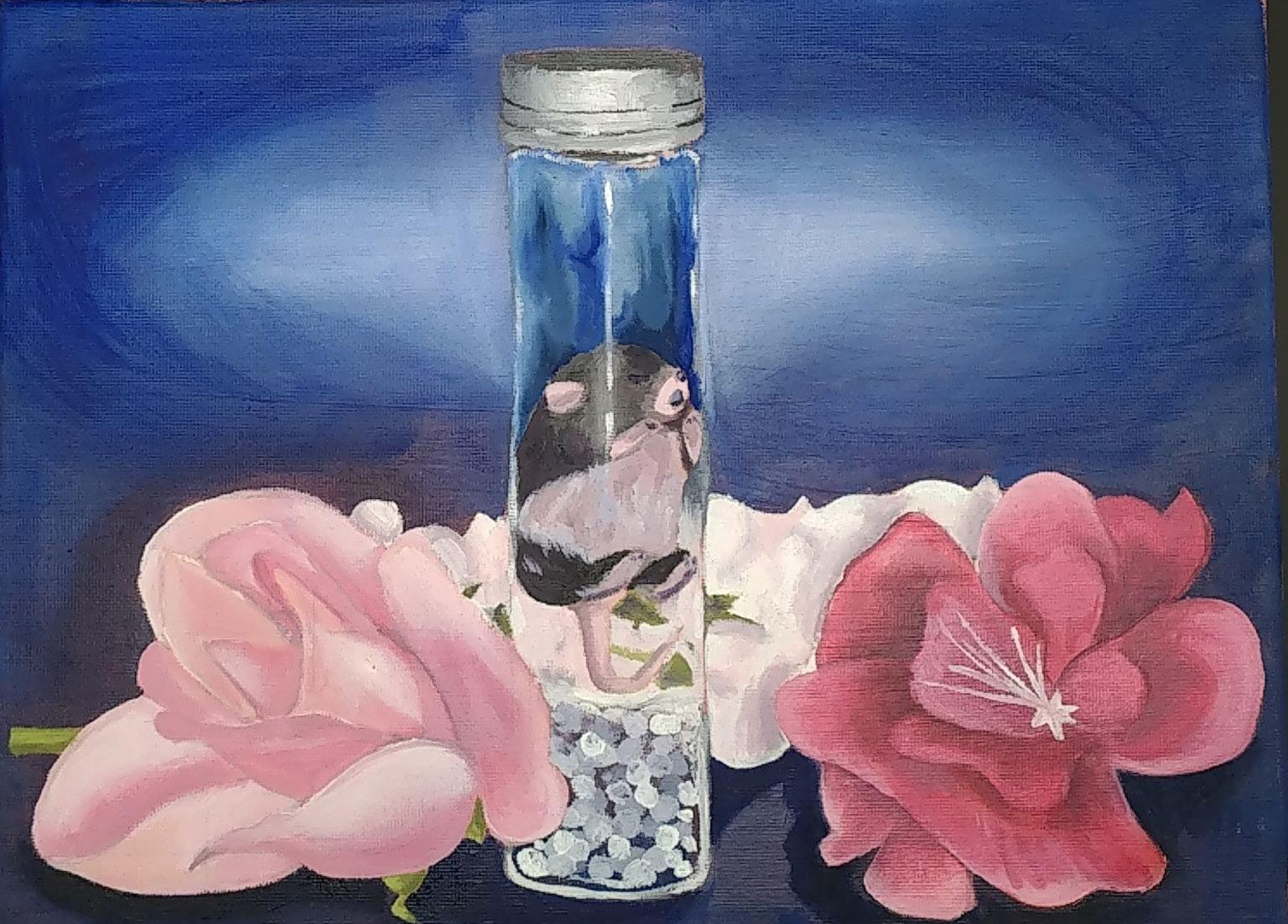
Norah Wood, 12th
Kiki Smith, born January 18, 1954 in Nuremberg, Germany, is an artist who portrays the experience of womanhood in her artworks.1 She works in a variety of mediums, including tapestry, lithograph, sculpture, and drawing, with a very distinct style. This style features scribbly yet precise linework and naturalistic forms. In her art, Smith often uses animal imagery and the relationship between predator and prey, fairytale motifs, religious imagery and stories, and bodily imagery. In her use of these symbols and ideas, Smith portrays the idea that to be a woman is to be simultaneously vulnerable yet resilient, both the lamb and the doe, yet also the wolf.
In this paper, I will discuss Kiki Smith’s art through an art-historical, anthropological, and archaeological lens, dissecting how all of the artist’s inspirations across history play into how she portrays the feminine experience. For example, I will discuss the art historical origins of Paleolithic cave paintings, how the archaeological evidence in these caves give meaning to the paintings themselves, and what these symbolic representations of animals reveal about how we as humanity view ourselves, and more importantly, women.
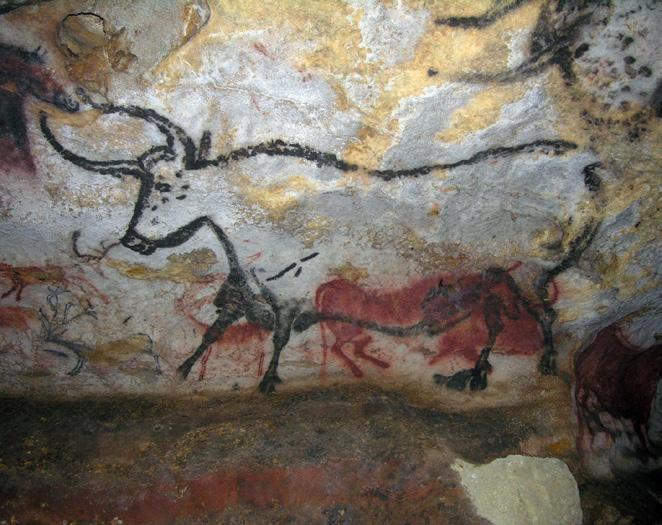
Animal imagery and symbolism have been an oft-used motif in the arts, going as far back as the Paleolithic Era.2 By using animal symbolism in her work, Smith communicates a sense of universality, inter-connectedness, and shared experience over time among humans, specifically among women. According to a study by scholars at the University of Cape Town, in the Paleolithic Era, animal imagery was gendered by factors like the area of the cave where the animal was painted, whether it appeared with a male or female figure, what symbols it appeared next to, how large the animal was, or whether it were predator or prey. Female animals were typically only depicted in the central area of the cave, with oval, triangle, rectangle, and bracelike symbols appearing near them, representing both wounds and female genitalia. Animals commonly characterized as female included ox and bison. Male animals were depicted everywhere else in the cave, appearing with dots, short brushstrokes, and barbed signs, representing both weaponry and male genitalia. Animals commonly depicted as male included horses, ibexes, stags, and reindeers. Animal symbolism as a whole in the Paleolithic Era was representative of the life cycle, with both animals symbolically representing love and procreation as well as death, with male animals representing violence and female animals representing injury and suffering.3 From the start, femininity has been associated with both pain and power, as seen through the duality of feminine symbols representing both agony and fertility, and furthermore the ability to create life. (See Figure A.)
1 Kiki Smith et al., Kiki Smith, comp. Monnaie de Paris, ed. Stéphanie Molinard and Marie Chênel (Silvana Editoriale, 2020). 2 John Parkington, “Symbolism in Paleolithic Cave Art,” South African Archaeological Society 24, no. 93 (1969): accessed February 15, 2026, https://www.jstor.org/stable/3888361?searchText=%28au%3A%22John+Parkington%22%29&searchUri=%2Faction%2FdoAdvancedSearch%3Fq0%3DJohn%2BParkington%26f0%3Dau%26acc%3Don%26so%3Drel&ab_segments=0%2Fbasic_phrase_search%2Fcontrol&refreqid=fastly-default%3A3737e9d99faac4338cec4961354d7739&seq=1.
3 Parkington, “Symbolism in Paleolithic,”
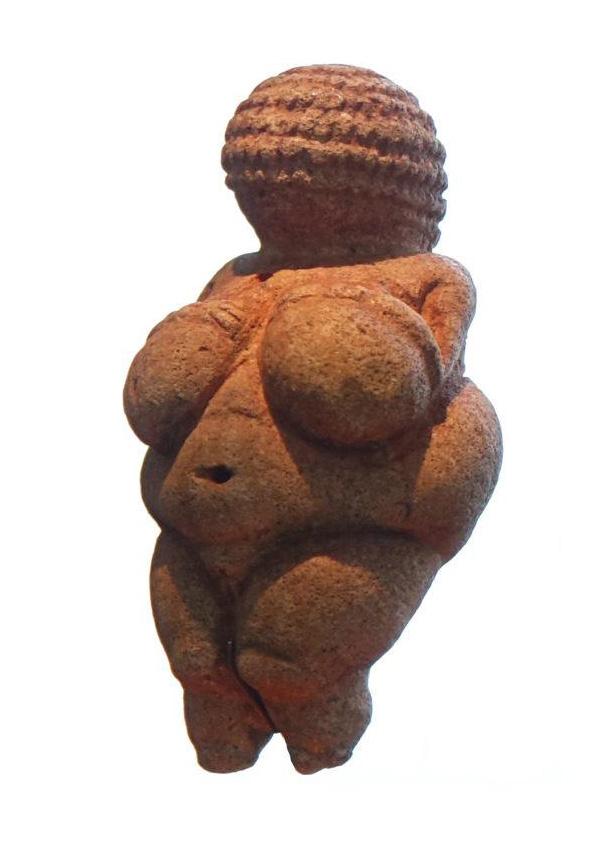
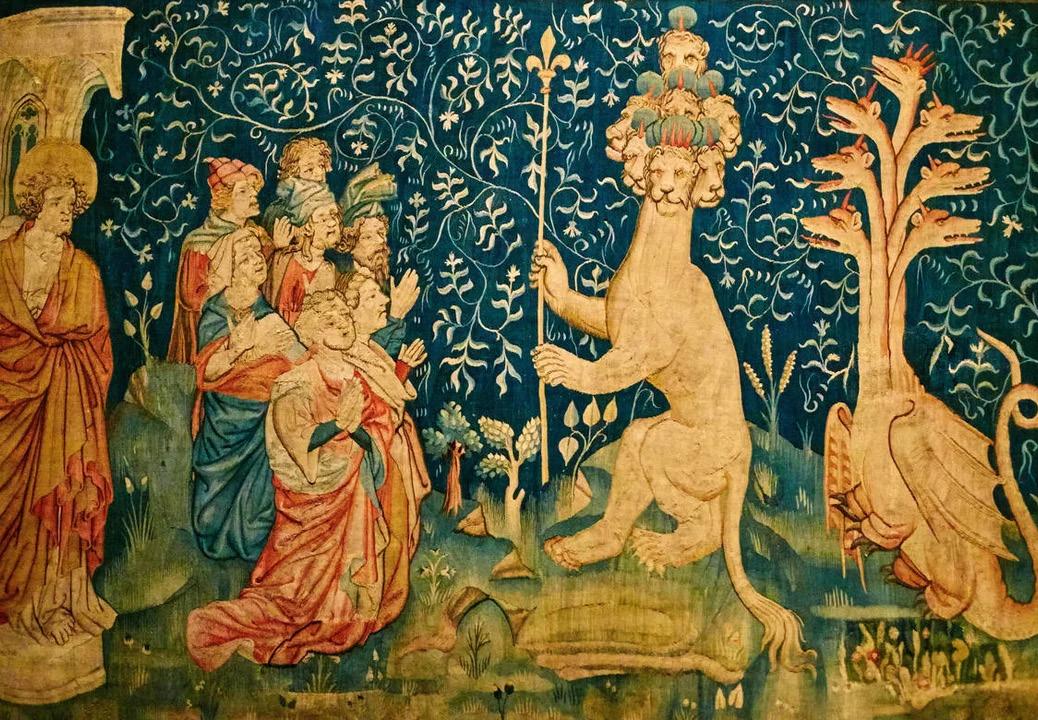
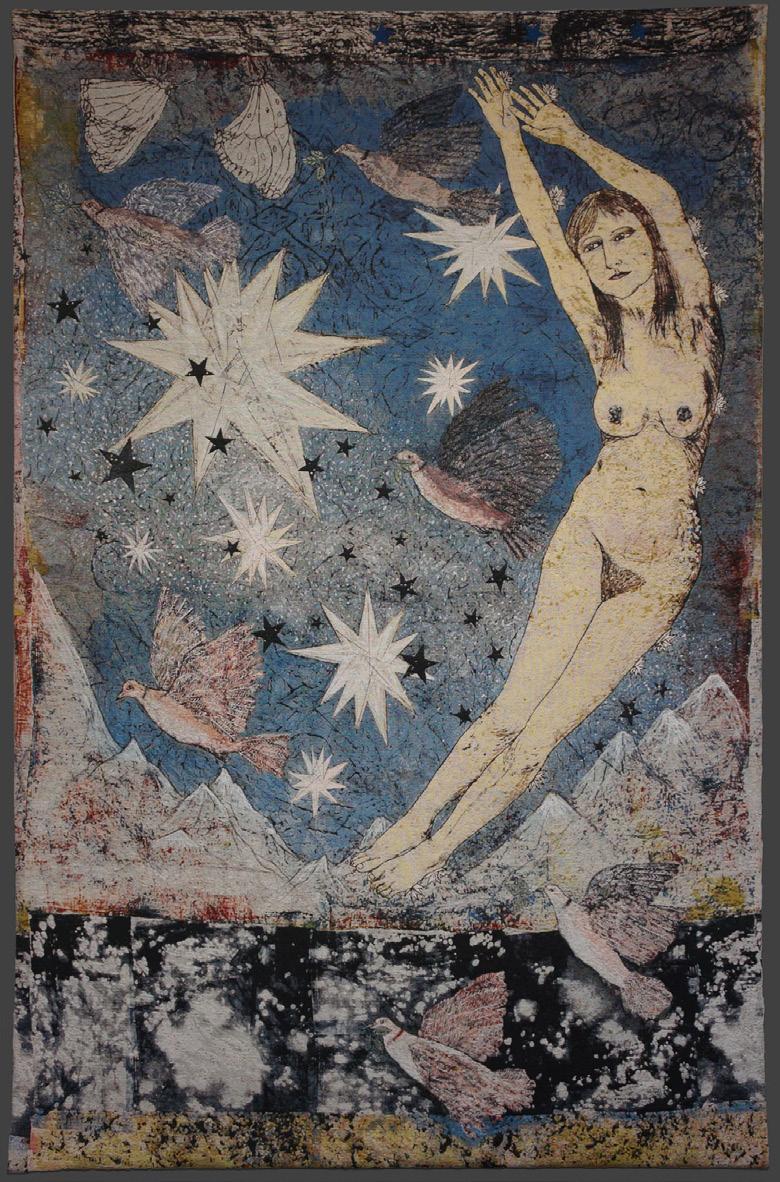
Venus statues are symbolic representations of femininity also created within the Paleolithic Era (See Fig. B).4 These statuettes are believed to have represented beauty and fertility, deifying women and establishing the idea of the divine feminine.5 The existence and worship of these statuettes represents how femininity was viewed as sacred. This idea, coupled with the representation of femininity as a wound in cave paintings, invokes how even in the Paleolithic Era, womanhood was seen as something powerful and sacred yet also tragic and full of pain. Smith uses the same animal imagery and often references the idea of the feminine divine in her art, creating a sense of universality and longevity. In her continuation of these ancient techniques and ideas, Smith invokes the idea that womanhood is something undefined by time. She portrays womanhood as an experience where one is susceptible to harm yet also resilient and strong, and these ideas are echoed throughout history, as far back as the Paleolithic period. The art of the Middle Ages has been a direct inspiration for Smith’s work, as stated both by the artist and by a multitude of sources, and her art can be described as a “blend of the medieval and the modern.”6 (Irwin) From her art being described as her own “bestiary,” or a collection of different animals and mythological creatures common in the Middle Ages, to her directly noted inspiration coming from the Apocalypse Tapestry, the influence of medieval art on Smith’s art is undeniable.7 The Apocalypse Tapestry blends the beautiful and the grotesque in its imagery, all based on the final book of the Bible, the Book of Revelations, which tells of the apocalypse and the biblical battle between Satan and Christ, where Satan is pictured as a dragon and Christ a lamb (see Fig. C).8 Animals surround every scene in the textile, with horses, birds, and mythical creatures adorning the tapestry. In addition, the style of millefleurs is used in the background, which the artist adorns with small flowers. The Apocalypse Tapestry was specifically a direct inspiration to many of the tapestries present in Smith’s 2019-2020 exhibition, I Am a Wanderer, with Modern Art Oxford. One of these tapestries, Sky (2012), refers to and employs many different images and symbols used in the medieval tapestry in her own textile work.9 Additionally, the structure and composition of the tapestry itself heavily resembles the compositions of pages in medieval codices, with the border surrounding the main image invoking the style of a medieval illuminated manuscript.10 The central figure in Sky is a nude woman, posed almost like a crescent moon, surrounded by birds, butterflies, and stars (see Fig. D). The blue-sky background uses stars and geometric patterns reminiscent of the millefleur style found in the skies of the Apocalypse Tapestry and medieval art more broadly, as well the emerging symbols in religious art that will come to unmistakably represent Catholic stories and figures, such as the color blue being symbolic of the Virgin Mary. This vivid blue enveloping the female
4 Bryan Zygmont, “Venus of Willendorf,” Smarthistory, last modified November 21, 2015, accessed April 22, 2026, https:// smarthistory.org/venus-of-willendorf/.
5 Zygmont, “Venus of Willendorf,” Smarthistory.
6 Smith et al., Kiki Smith; Natascha Domeisen et al., “Weaving Wonders: Medievalist perspectives on Kiki Smith,” interview, Modern Art Oxford (blog), November 27, 2019, accessed April 22, 2026, https://www.modernartoxford.org.uk/blog/weaving-wonders-medievalist-perspectives-on-kiki-smith; Jennifer Boland, “The Immediacy of Objects: Reassessing the Contribution of Art History to Feminist Medieval Studies,” Medieval Feminist Forum WMU, 2008, accessed April 22, 2026, https://scholarworks.wmich. edu/cgi/viewcontent.cgi?article=1744&context=mff; Jenny Irwin, interview by the author, Metairie, LA, April 21, 2026.
7 Smith et al., Kiki Smith, [Page 53]; Simona Cohen, “Review Essay: Animal Imagery in Renaissance Art,” Renaissance Quarterly 67, no. 1 (2014): accessed February 15, 2026,
8 John Kampfner, “The forgotten French tapestry with lessons for our apocalyptic times,” The Guardian, April 17, 2020, accessed March 3, 2026, https://www.theguardian.com/artanddesign/2020/apr/17/the-forgotten-french-tapestry-with-lessons-forour-apocalyptic-times; UNESCO, Apocalypse Tapestry of Angers, 2021, accessed April 22, 2026, https://www.unesco.org/en/memory-world/apocalypse-tapestry-angers#.
9 “Kiki Smith: I am a Wanderer,” Modern Art Oxford, accessed April 2, 2026, https://www.modernartoxford.org.uk/whats-on/ kiki-smith-i-am-a-wanderer; Smith et al., Kiki Smith.
10 Irwin, interview by the author.
figure invokes divine femininity. The figure’s nudity (while typically viewed as a state of vulnerability) coupled with the idea of the divine feminine gained from the celestial imagery and references to the moon, portray an air of sanctity and resilience, and offer the idea that to be a woman is to be strong and defiant despite the perception of weakness forced upon women by the patriarchy. The inspiration from the Apocalypse Tapestry, with its use of the beautiful and the grotesque, also helps portray this idea, as the nude female figure questions the viewer, asking whether the body is beautiful or grotesque, further emphasizing the defiance of patriarchal ideals. The way in which Smith portrays the female form is inherently medieval, as Jennifer Boland states in her essay “The Immediacy of Objects: Reassessing the Contribution of Art History to Feminist Medieval Studies”: “Kiki Smith’s work resonates with medieval representations of the bodies of women, offering a commentary not unlike contemporary feminist theory, but expressed through a physical and artistic language instead of the written work” (Boland).11
Smith’s art also shows medieval inspiration through her portrayal of animals, as they are never quite realistic, with uncanny oddities that make them unsettling.12 For example, the doves featured beside the figure in Sky seem “off”; their coloring is unrealistic, the proportions are slightly warped, the scale of the doves is larger than it should be compared to the female figure, and it looks as if the doves have no feet.13 In addition, the butterflies seen at the top of the textile are the same size as the doves, a gross inflation of size. Art in the Middle Ages is famous for its shoddy representations of animals as a whole, and in Smith’s disarrayment of animal figures, the artist invokes the medieval style.14
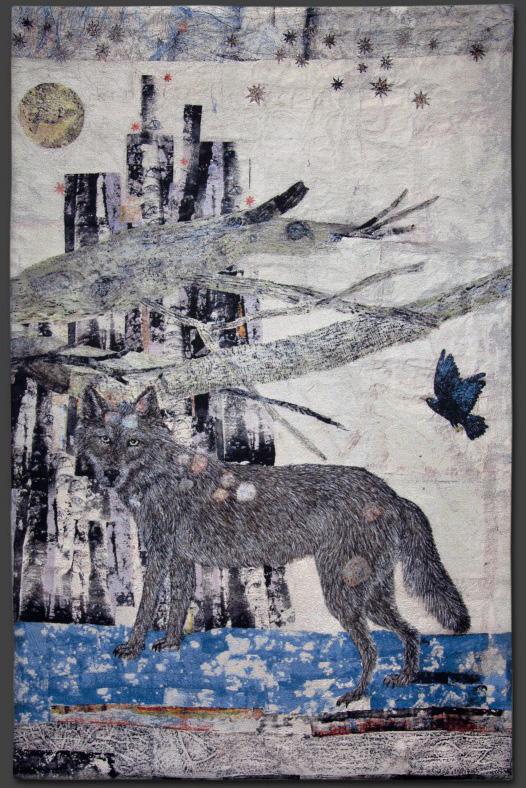
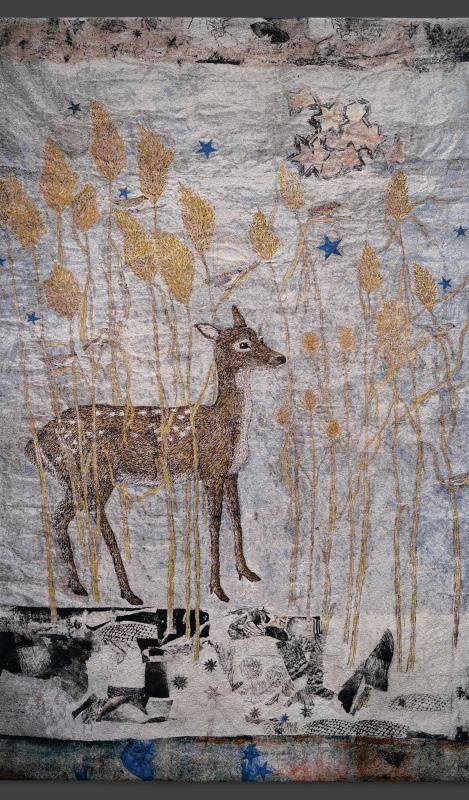
Additionally, some animals Smith portrays in her work have distinct meanings in medieval art. I will focus specifically on two animals portrayed in two of Smith’s textiles that are part of I Am a Wanderer: Cathedral (2013) and Fortune (2014). The main figure of Cathedral is a wolf staring at the audience, formatted in the same manuscript-like style as Sky. In the Middle Ages, wolves were symbols of evil and violence, yet in Cathedral, the wolf is calm, and its gaze is neutral (See Fig. E).15 However, the audience’s awareness that the wolf is in fact a predator that could pounce at any moment leaves a lingering sense of danger as one studies the piece further. The wolf represents women’s need to become violent in order to protect themselves, a violence that is rarely present, but often lurking in the shadows for when the need to defend oneself arises. Smith’s use of the medieval symbol of the wolf, coupled with the animal’s apparent calmness, portrays her idea that to be a woman is to be resilient and able to protect oneself. Conversely, in the Middle Ages, deer were representative of Christ, and therefore invoked both goodness and purity.16 The doe is pictured amid stalks of wheat, representing fertility and abundance. In Fortune, Smith uses the symbol of the deer in a manuscript-like format to draw upon these medieval associations, thus portraying femininity as vulnerable and pure (see Fig, F). Similarly, Smith often depicts lambs or sheep, which were used in medieval art to represent innocence, sacrifice, and the figure of Christ.
Smith is also inspired by religious, especially Catholic, figures, including their stories
11 Boland, “The Immediacy,” 61.
12 Irwin, interview by the author.
13 Irwin, interview by the author.
14 Melanie Holcomb and Barbara Drake Boehm, “Animals in Medieval Art,” The Metropolitan Museum of Art, last modified January 12, 2012, accessed April 22, 2026, https://www.metmuseum.org/essays/animals-in-medieval-art.
15 Elizabeth Marshall, “The Multifaceted Wolves of Early Medieval England,” Boydell & Brewer (blog), July 27, 2022, accessed April 22, 2026, https://boydellandbrewer.com/blog/medieval-history-and-literature/the-multifaceted-wolves-of-early-medieval-england/?v=0b3b97fa6688#:~:text=Wolves%20were%20multifaceted%20creatures%20that%20were%20thought,term%20*vargr*%20means%20both%20%22wolf%22%20and%20%22outlaw%22.
16 David Badke, “Stag,” Medieval Bestiary, last modified March 16, 2026, accessed April 22, 2026, https://bestiary.ca/beasts/ beast162.htm.
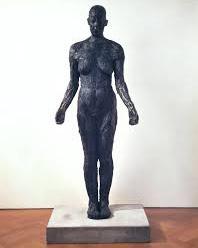
and depictions in art history.17 The artist finds inspiration in two primary religious figures: the Virgin Mary and Saint Genevieve.18 The Virgin Mary, as I have previously mentioned, is the ultimate representation (in a Christian context) of the feminine divine, representing the duality of female power and vulnerability. In Smith’s piece entitled Virgin Mary, the figure is portrayed as a flayed female body, with the muscles and veins visible (See Fig. G). The figure’s title and its literal exposure of the female body, both its surfaces and its interior, communicate the idea that despite all of the power one may have as a woman, one still cannot escape the fragility and exposure that come with womanhood. Despite this, the artist cites that the figure “has her arms open because she is willing to encompass all” (Smith).19 The image of a completely vulnerable figure that is still willing to help and let others in is a near perfect representation of Smith’s idea of womanhood being simultaneously vulnerable and resilient. This piece is also an example of the bodily imagery Smith often uses, which she employs to communicate the idea of vulnerability in her work.20
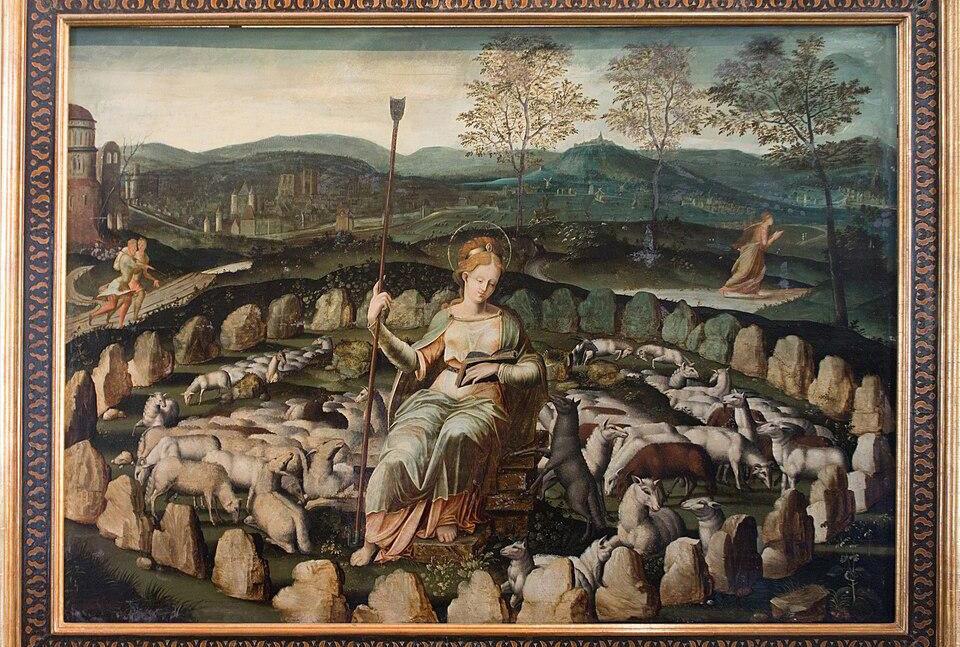
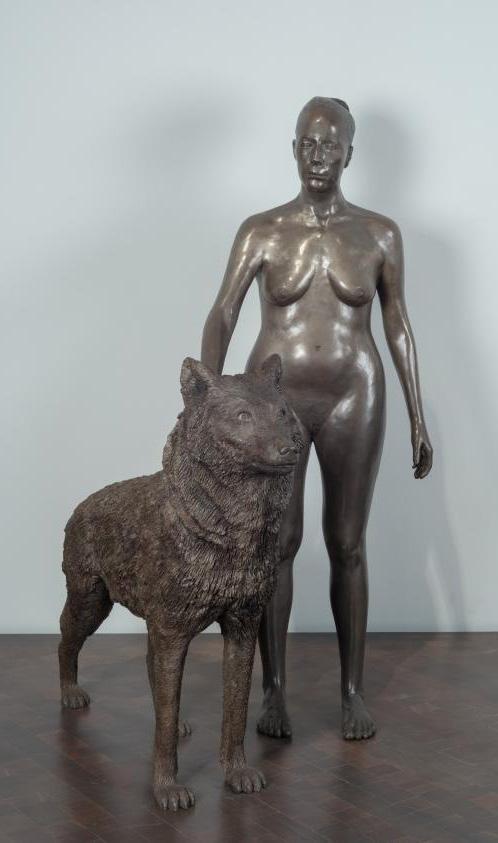
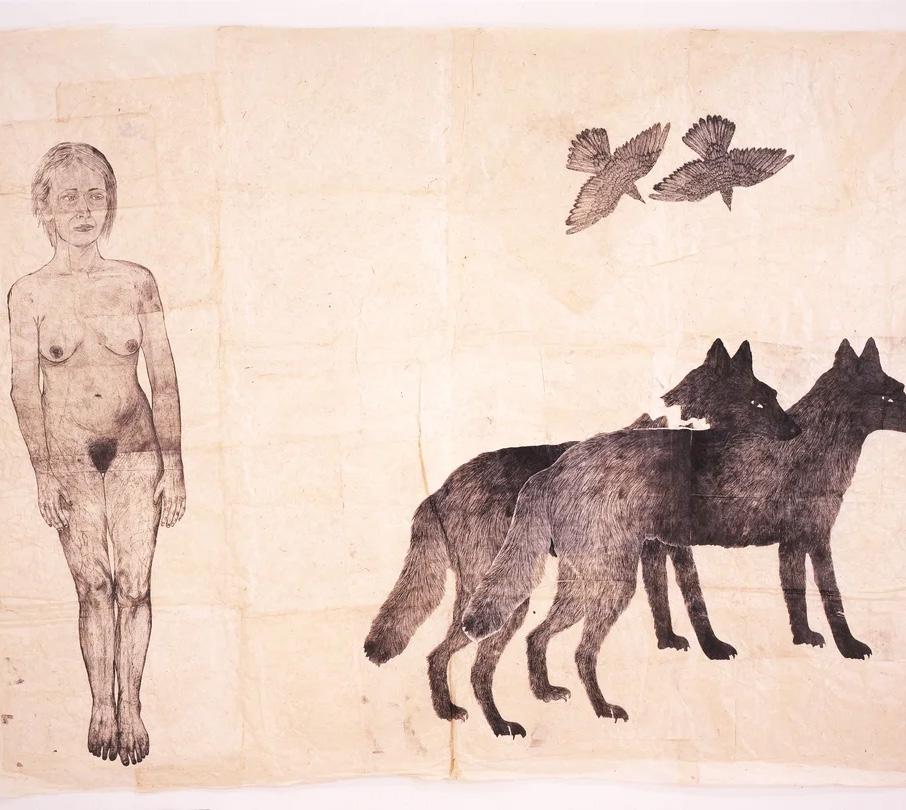
Saint Genevieve is the patron saint of Paris, often pictured as a shepherdess accompanied by her sheep, representing the people of Paris (see Fig. H).21 Kiki Smith frequently portrays her in her art, picturing her with sheep, but also sometimes with wolves.22 This depiction of Genevieve with both predator and prey is representative of how women are both vulnerable and resilient. In Smith’s 2000 piece Genevieve and the May Wolf, instead of tending to her sheep, Genevieve stands with the wolf (see Fig. I). Smith’s depiction of Genevieve in this way communicates that women must become predators in order to protect themselves and those they love. To sit passively is not to truly care or protect, but to allow those one loves to get hurt or even killed, like sheep getting picked off by a hungry wolf. To truly protect oneself and one’s family as a woman, one has to embrace violence. Smith’s piece Genevieve and the Wolves (1999) depicts a very similar idea, with most of the principles of the latter being true, but what makes this piece different is the wolf on the left’s decapitated head (see Fig. J). The seemingly vicious beast, capable of violence and protection, is irreparably hurt—a symbol of the dangers posed to even the fiercest of women, especially those who seek to defend themselves and the people they love against the injustices of a patriarchal system that seeks to exploit and destroy women at nearly every turn.
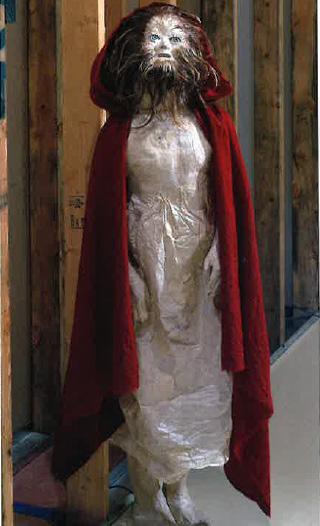
Smith uses folklore and fairytale stories to communicate her ideas, often using Little Red Ridinghood and Alice in Wonderland to portray womanhood. One piece of Smith’s that synthesizes folklore motifs, animal symbolism, and femininity, is Daughter (1999).23 The subject of the sculpture is a Little Red Ridinghood in the process of turning into a wolf, with added audio that growls and whines (see Fig. K).24 Some modern analyses of the Little Red Ridinghood story relate the story’s narrative with the wolf to predation.25 Taking this narrative to Smith’s
17 Smith et al., Kiki Smith
18 Smith et al., Kiki Smith
19 Smith et al., Kiki Smith, 146.
20 Smith et al., Kiki Smith
21 Smith et al., Kiki Smith
22 Smith et al., Kiki Smith
23 Peter Schjeldahl, “Queen of Arts,” The New Yorker, accessed February 15, 2026, https://www.newyorker.com/magazine/2006/11/27/queen-of-arts.
24 Schjeldahl, “Queen of Arts,”
25 Michelle Scalise Sugiyama, “Predation, Narration, and Adaptation: ‘Little Red Riding Hood’ Revisited,” Interdisciplinary Literary Studies 5, no. 2 (2004): accessed February 15, 2026, https://www.jstor.org/stable/41207031?searchText=%28%28wolf%29+AND+%28symbolism%29%29&searchUri=%2Faction%2FdoAdvancedSearch%3Fq0%3Dwolf%26q1%3Dsymbolism%26f0%3Dall%26c1%3DAND%26f1%3Dall%26acc%3Don%26so%3Drel&ab_segments=0%2Fbasic_ search_gsv2%2Fcontrol&refreqid=fastly-default%3Ac7a97ccb7c4eff768fea992e9fec2ad7&seq=1.
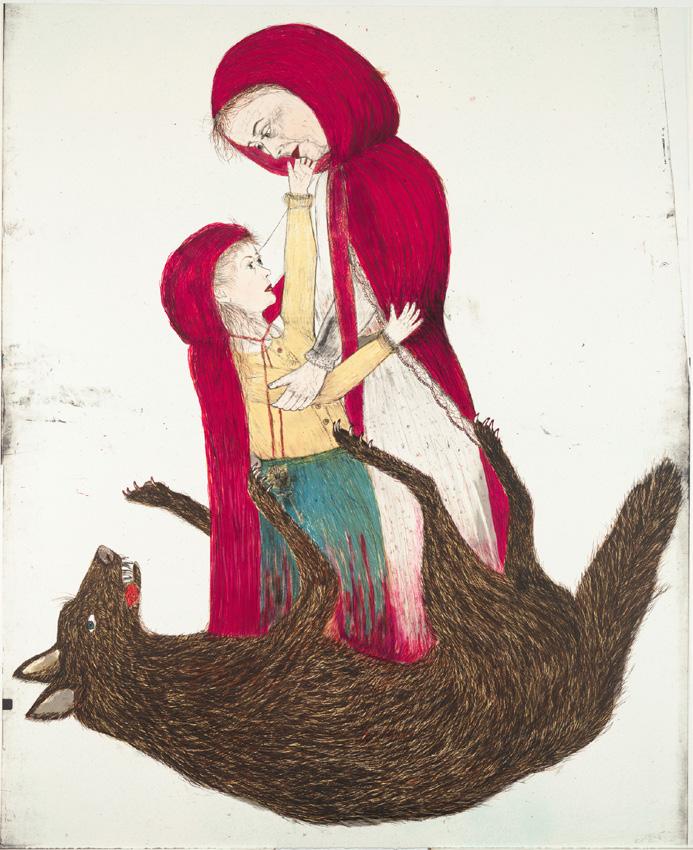
sculpture, the work uses the symbol of the wolf coupled with the innocent figure of a young girl, along with the snarling audio that plays from the statue, to communicate both a message of resilience and empowerment for women, affirming women’s ability to fight back against their abusers and testifying to how women and girls become susceptible to harm from a young age and thus have to be taught how to defend themselves almost from birth.26 Another piece in which Smith depicts Little Red Ridinghood is Born (2002). The piece depicts Little Red Ridinghood and her Grandmother bursting out of a wolf, or as the artist has described it, being born from the wolf (see Fig. L).27 The pair seem to embrace and comfort each other. This piece portrays that women can sometimes be defenseless, but at other times, with the power found within themselves and in feminine community, women can protect themselves and those they love from harm. To be a woman is to aid other women when they are most vulnerable, and to be aided by other women at one’s weakest moments. The two figures being born from the wolf represent that this ability to protect others is innate and almost expected of women.28
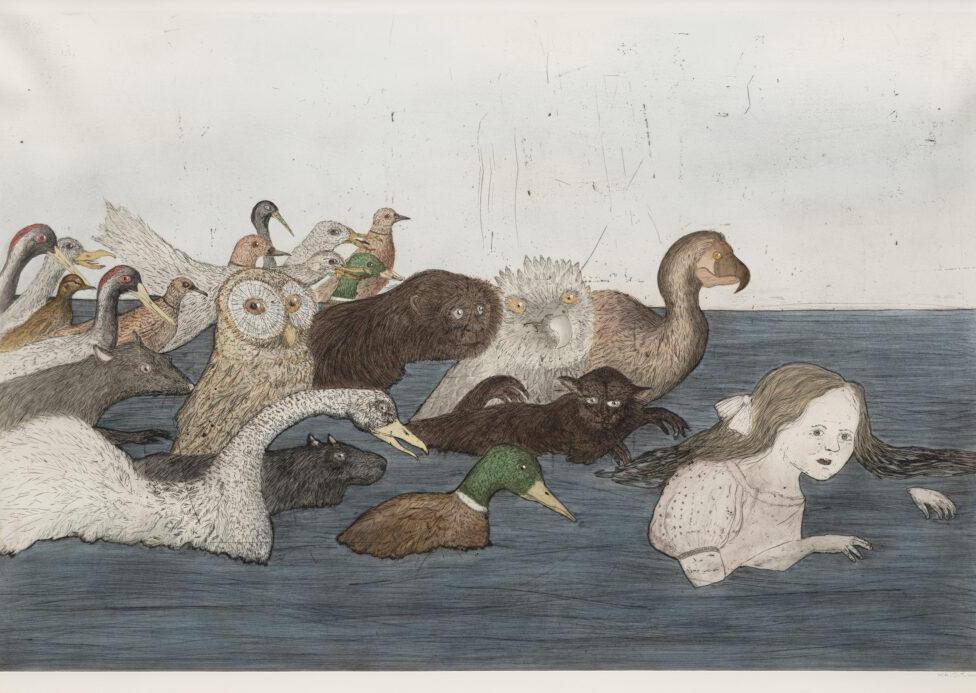
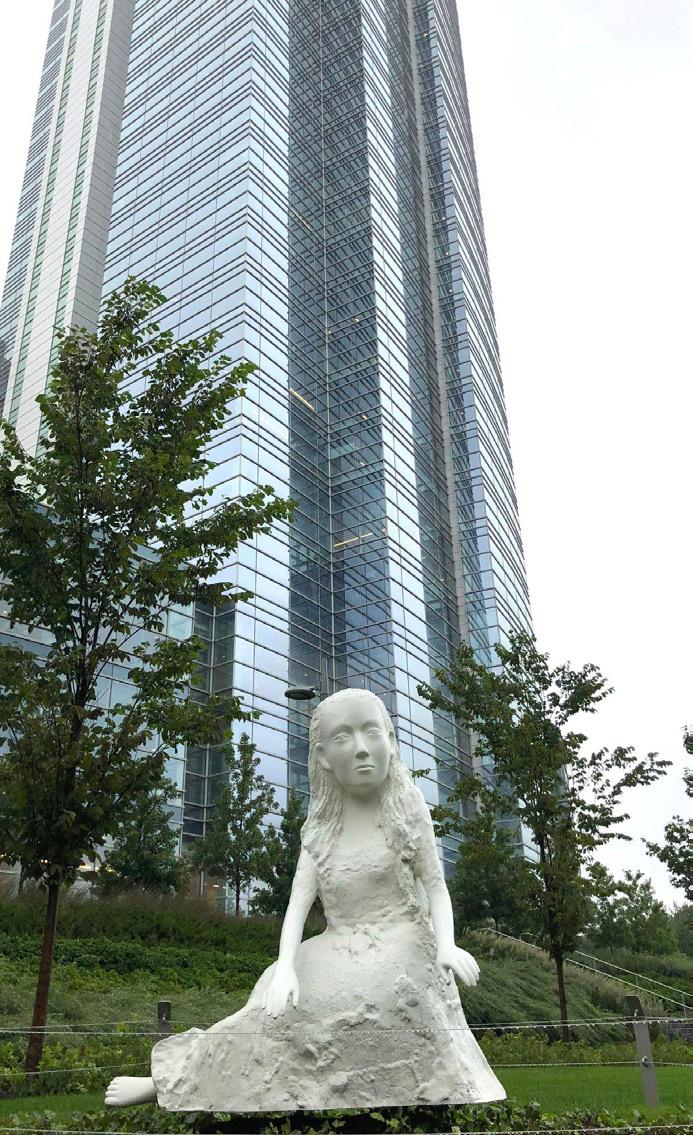
The figure of Alice is similar to that of Smith’s Little Red Ridinghood, as she uses the storybook character to portray how those who seem most vulnerable can in reality be the toughest.29 Alice is a character portrayed as bubbly and whimsical, and these traits make her seem especially fragile. However, Smith depicts her as equally strong as all of the women featured in her artwork, despite her seemingly childish personality, a personality that is traditionally seen as a feminine trait under the patriarchy.30 In her portrayal of Alice, Smith challenges this idea and argues that all women, no matter what, have the capacity to be resilient. In Pool of Tears 2 (After Lewis Carroll) (2000), Alice is seen in a horrific scene fleeing from life-size birds that look at the viewer (See Fig. M).31 In the birds’ unbroken stares, it is almost as if the viewer is drawn into the scene, chased, just like Alice, by the flock.32 The piece shows Alice’s immense vulnerability, and it seems as if Alice will succumb to the birds chasing after her. However, as the audience knows, Alice will survive. The piece shows that even when it seems that a woman is utterly exposed and most susceptible to harm, there is still an underlying, unbroken sense of strength within her. Another one of Smith’s pieces featuring Alice is Seer (Alice II) from 2005 (see Fig. N). The sculpture is of a small, youthful Alice looking at her reflection, and is placed outside of a skyscraper. However, instead of looking at her own reflection from her own perspective, she looks at her reflection in this tower of industry and commerce, areas often predatory towards women.33 The complete and utter vulnerability of Alice in this piece is echoed in both her smallness relative to the skyscraper and her physical placement directly in front of it. A common misconception of Smith’s art is that it represents the entirety of humanity’s vulnerability and resilience.34 However, to agree with this sentiment is to erase all of the small
26 Irwin, interview by the author.
27 “Kiki Smith: Prints, Books, and Things,” Museum of Modern Art, last modified 2026, accessed April 22, 2026, https://www. moma.org/audio/playlist/251/3242.
28 Irwin, interview by the author.
29 Irwin, interview by the author.
30 Irwin, interview by the author.
31 Lauren Moya Ford, “The Dark Fairytales of Kiki Smith,” Art and Object (blog), October 18, 2019, accessed April 22, 2026, https://www.artandobject.com/news/dark-fairytales-kiki-smith.
32 Ford, “The Dark,” Art and Object (blog).
33 Debra Brehmer, “Kiki Smith Makes a Subversive Sculpture of Alice in Wonderland at the Foot of a Skyscraper,” Hyperallergic, October 11, 2018, accessed April 22, 2026, https://hyperallergic.com/kiki-smith-seer-alice-in-wonderland-sculpture-milwaukee/.
34 “Kiki Smith: Light,” Pace Gallery, last modified October 31, 2020, accessed April 22, 2026, https://www.pacegallery.com/ exhibitions/kiki-smith-light/; Carol Real, “Kiki Smith: Exploring the Embodiment of Humanity and Nature,” Art Summit, last modified May 10, 2024, accessed April 22, 2026, https://www.art-summit.com/kikismith/; “Kiki Smith,” Whitney Museum of American Art, accessed April 22, 2026, https://whitney.org/artists/3383.
complexities and subtleties that give Smith’s work such nuanced meaning and emotion.35 There are so many qualities in Smith’s art, from the bodily imagery, to the portrayal of female fairytale characters, which are inextricably tied to femininity and womanhood.36 Additionally, after extensively looking through the artist’s work, I could only find four pieces that actually portrayed male human figures, and one of them was still accompanied by a female figure. It would be inaccurate, even unfair, to categorize Smith’s art as telling of humanity as a whole when the vast majority of her work deals with women’s experiences only.
It is important to analyze the works of artists such as Kiki Smith so closely not only to understand the artist and their art, but also the implications of the artist’s themes and ideas and how they have been seen over time. The idea of womanhood being both vulnerable and resilient is not, of course, an original notion of Smith’s, but a view of femininity dating back tens of thousands of years, and to better understand women’s roles in society today, it is important to look to the history (and the art) that set precedents for where we are today. Looking at history through the lens of art history, anthropology, and archaeology is where one can find the purest, most human version of humanity’s story, a history full of complex emotion and ideas that transcend timelines, whether it be the Stone Age or our world today. Kiki Smith’s oeuvre engages this history while moving it forward, into a world in which feminist ideals clash with the antiquated dictates of the patriarchy. Her art is indicative of the feminine experience, and the multitude of symbols she uses in her work, going back as far as the Paleolithic Era, communicate her works’ central themes and ideas. At the end of the day, Smith’s central theme is simple but potent: to be a woman is to embrace the duality of being both vulnerable yet resilient, fragile yet defiant, breakable yet strong.
Mireille Luparello,12th
Michael P. Sherman is driving to work. He is the regional internal finance assessment manager’s engagement coordinator for a front-end software auditing company.
“Radioactive” by Imagine Dragons is playing on the radio. It’s his favorite song.
Michael comes to the intersection below the interstate that shoots through the warm-toned suburbs. He stops his car behind the car ahead of him.
“Welcome to the new age, to the new age!” His voice cracks. Thinking about the day ahead, he plans his route to his cubicle. First, he will say hello to Gloria, the concierge. Then, he will make his way to the elevator and press the button that brings him to the eleventh floor. He will nod at Tom, because Tom is always first in the office. He will be second in the office, before Mary, and after Tom (Tom is first). Michael will set his backpack on the left side of his desk and begin working. He will not make coffee. He brings his own.
The traffic light turns green, so Michael gently lets off the pedal, waiting for the brake-lights in front of him to dim. But the car doesn’t move. He abruptly re-engages the brakes, hoping the jerk of his car in the rearview might awaken the driver ahead of him. Still, it does not move. Michael thinks about honking.
He sees the cars opposite him moving across the intersection. At the same time, an 18-wheeler hurtles off the down ramp and collides with the driver-side door of a bright orange sedan. A deafening noise blares across the intersection as the car’s body is crushed into the asphalt. The left side is flattened beneath the steel grate of the truck.
The drama of it all catches Michael off guard. He pulls to the shoulder and waits for the sound of inevitable sirens. Traffic continues as usual. An indeterminate amount of time passes. No ambulance, police cruiser, or firetruck has come, and, to Michael, it seems they might not come at all.
It begins to rain.
He feels he must do something. Opening the door and waddling into the shoulder, he looks down the road for a break in traffic. He finds a gap and bounds across the intersection. His black dress shoes clap wetly on the asphalt.
The driver of the 18-wheeler has long gray hair. It piles in a heap over the dash, unmoving. A pool of silky crimson blood stains the tips. Maybe the man has passed out from the shock. Michael’s eyes shift downward, below the driver, and below the silver arch of the truck’s bumper. The mess is completely unrecognizable. Michael’s jacket begins to feel heavy with rain.
Between the road and the truck there is a large crumpled orange ball, its creases exactly mimicking that of paper. Instead of safety glass shattered into fine dust, the windows have tumbled with the metal, taking sharp bends and creases as if malleable, still glowing red from a hot kiln. Michael thinks this might be some twisted performance art. He looks for signs of life, but he can’t find a window, can’t see anything inside. He is now completely soaked. His hair clings to his forehead and his gray suit shines black in the ambient light of the overcast sky.
Long fingers shoot forth from a seam in the wreck. They fish for a handle. A panel of crumple explodes outward. Long limbs come protruding from the hole. They are covered in singed hair and red stains. A human now stands before Michael. It begins to walk. Around the wreck, down the street, into the gray haze of the rain. Another follows it.
Hand after hand reaches out from the wreck and pulls itself out. The line of cyclical motion and mimicked strides stretches a dozen people. Then two dozen. Then three and four. Michael’s skin has turned pruny with rain, a rain so thick his clothes dissolve into him. He sits there watching the endless stream of bodies exit the crumple. He has become a puddle. Unable to move, or breathe, or think. He floats onto the asphalt, seeping into the rock below, then the soil below that.
Traffic continues as usual, and the sky begins to clear.
9th
Splintered wood crackling
:::::::::::::::::::::::::::::::::::::::::::::::::::::::::::::::::::::::::
Broken dishes dull pottery
Saline filled nostrils
Copper ankles still bleed:::::::::::::::::::even if there’s no knife : : : : : : :
Clammy palms: : : : : : : : Cologned trees sway: : : : : : : : sink into the muddy banks
Southward bound
Sour flaked skin : : : : : : : tufts of dirty brown hair
Handed to me
A secret to never know : : : : : : :
Winter will burn
Ash in your nails: : : : : : : : Sweet milk: : : : : : : : Warm jeans:::::: Down I n s id e
Counting my blessings: : : : : : : : My
Bone Marrow
Bleached white: : : : : : : : Gifts from foreign countries : : : : : : : : Eroding : : : : : : : : bottle the scent of your scalp : : : : : : : : burnt hair: : : : : : : : : : : : : : : :rusted chlorine nickels : : : : : : : :eyes of a crowd: : : : : : : :
Saliva dripping : : : : : : : :dry hands
Just trying to get home : : : : : : : : mouth the words: : : : : : : : this time. : : : : : : : :Your bruises: : : : : : : : are proof : : : : : : : : : : : : : : : : : : : : : : : : Of insatiable hunger: : : : : : : : : : : : : : : : a forceful kiss: : : : : : : :
Legacy Magdalena St. Louis,12th
Your vote is your voice. Throughout America’s history, securing the right to vote has been a central struggle, spanning race, gender, and age. When the American colonies were founded, only white, property-owning men of a certain age held voting rights. With the ratification of the Fifteenth Amendment in 1870, citizens of all races obtained suffrage. The Nineteenth Amendment extended this fundamental right to women, and in 1971, the Twenty-sixth Amendment was ratified, lowering the legal voting age to eighteen. Voting has taken a twisting road toward equality, and although much progress has been made since the time of the colonies, recent events continue to threaten voting rights, making it a critical issue in today’s America.
The Bloody Sunday march for Black voting rights in Selma, during which police brutally beat peaceful protesters, was a pivotal moment in the nation’s voting rights saga.1 The event gave President Lyndon B. Johnson and Congress the political resolve to pass the Voting Rights Act (VRA) in 1965. The discriminatory voting practices adopted by many states after the Civil War were outlawed, including literacy tests and poll taxes. The act enforced the Fifteenth Amendment through federal oversight, requiring states and local governments with a history of voter discrimination to receive federal approval before changing election laws.2 These actions dramatically increased minority voter registration.3 The VRA is considered one of the most important pieces of civil rights legislation in U.S. history, yet recent decisions by the U.S. Supreme Court have severely crippled it. In 2013, in Shelby County v. Holder, the Court struck down Section 5 of the VRA, which required states and localities to receive federal preclearance of voting changes. Research done by the Brennan Center for Justice shows that this change has resulted in a dramatic decline in the political participation of Black and other minority voters relative to white voters. Beyond this concerning data, the loss of preclearance allowed for the adoption of racially discriminatory laws, including strict voter ID rules and cuts to voting by mail, disproportionately impacting minority voters. The Court further
1 Kevin Morris, “The Bygone Era of Supreme Court Support for Voting Rights,” Brennan Center for Justice, last modified March 6, 2026, accessed March 11, 2026, https://www.brennancenter.org/our-work/analysis-opinion/bygone-era-supreme-court-support-voting-rights.
2 Morris, “The Bygone,” Brennan Center for Justice.
3 “Study Finds Voting Rights Act of 1965 Led to Greater Racial Representation in Local Governments,” University of Oxford, last modified April 21, 2023, accessed March 11, 2026, http://economics.ox.ac.uk/article/new-study-by-oxford-academic-finds-votingrights-act-of-1965-led-to-greater-racial-represent.
eviscerated the Voting Rights Act in 2021.4 In Brnovich v. Democratic National Committee, the Supreme Court narrowly interpreted Section 2 of the VRA, making it harder to challenge discriminatory voting laws.5 The strict “guideposts” created by the Court make it burdensome to prove that voting restrictions disproportionately affect voters of color.6 These two rulings by the Supreme Court have ravaged the enforcement mechanisms of the Voting Rights Act, degrading America’s progress in achieving equality for voters.
In a democracy, each person’s vote should carry equal weight. This principle is undermined by gerrymandering, the partisan manipulation of district lines. Parties create districts that dilute the voices of voters belonging to the opposing party. Two techniques are used to gerrymander: cracking and packing. Cracking splits voters of the disfavored party into multiple districts, rendering their votes ineffective. Inversely, parties use packing to force disfavored voters into as few possible districts, reducing their voting strength in surrounding districts and giving one party a greater overall number of seats. Map drawers often apply both techniques to create the maximum partisan advantage.7 Gerrymandered maps do not accurately represent voters’ preferences; they create predetermined results slanted by the political party in power. Gerrymandering subverts democracy, turning it into a system driven by a quest for political power rather than one motivated by the interests of the people. Louisiana’s gerrymandering has entangled it in the Supreme Court case Louisiana v. Callais, incited by challenges to Louisiana’s congressional map.8 Non-Black voters claim the map is an unconstitutional racial gerrymander, while supporters argue it creates necessary representation in compliance with the Voting Rights Act.9 The case tests whether state legislatures can create majority-minority districts using race-conscious redistricting or if doing so is illegal racial gerrymandering.10 America has greater social and legal equality today than during the Civil Rights Movement. However, political freedom has recently declined. In America, freedom means having the opportunity to express one’s voice and shape a government meant to be for the people and by the people. It should be the people who hold sovereign power; our lives are not meant to be dictated by the government. However, this essential foundation is cracking as voting rights are imperiled. When people are stripped of the power of their vote, their freedom to contribute to democracy is taken. Democracy is not meaningful when built off the desires of the few; only by hearing everyone does democracy become exceptional.
4 Morris, “The Bygone,” Brennan Center for Justice.
5 Jamaal Lockings, “Supreme Court Ready to Gut Last Vestige of Voting Rights Act,” Alliance for Justice, last modified April 29, 2025, accessed March 11, 2026, https://afj.org/article/supreme-court-ready-to-gut-last-vestige-of-voting-rights-act/#:~:text=Nearly%20a%20decade%20after%20Shelby,or%20unequal%20those%20practices%20were.
6 Lockings, “Supreme Court,” Alliance for Justice.
7 Li, “Gerrymandering Explained,” Brennan Center for Justice.
8 Michael Li, “Section 2 of the Voting Rights Act at the Supreme Court,” Brennan Center for Justice, last modified October 15, 2025, accessed March 11, 2026, https://www.brennancenter.org/our-work/research-reports/section-2-voting-rights-act-supreme-court.
9 Li, “Section 2 of the Voting,” Brennan Center for Justice.
10 Li, “Section 2 of the Voting,” Brennan Center for Justice.
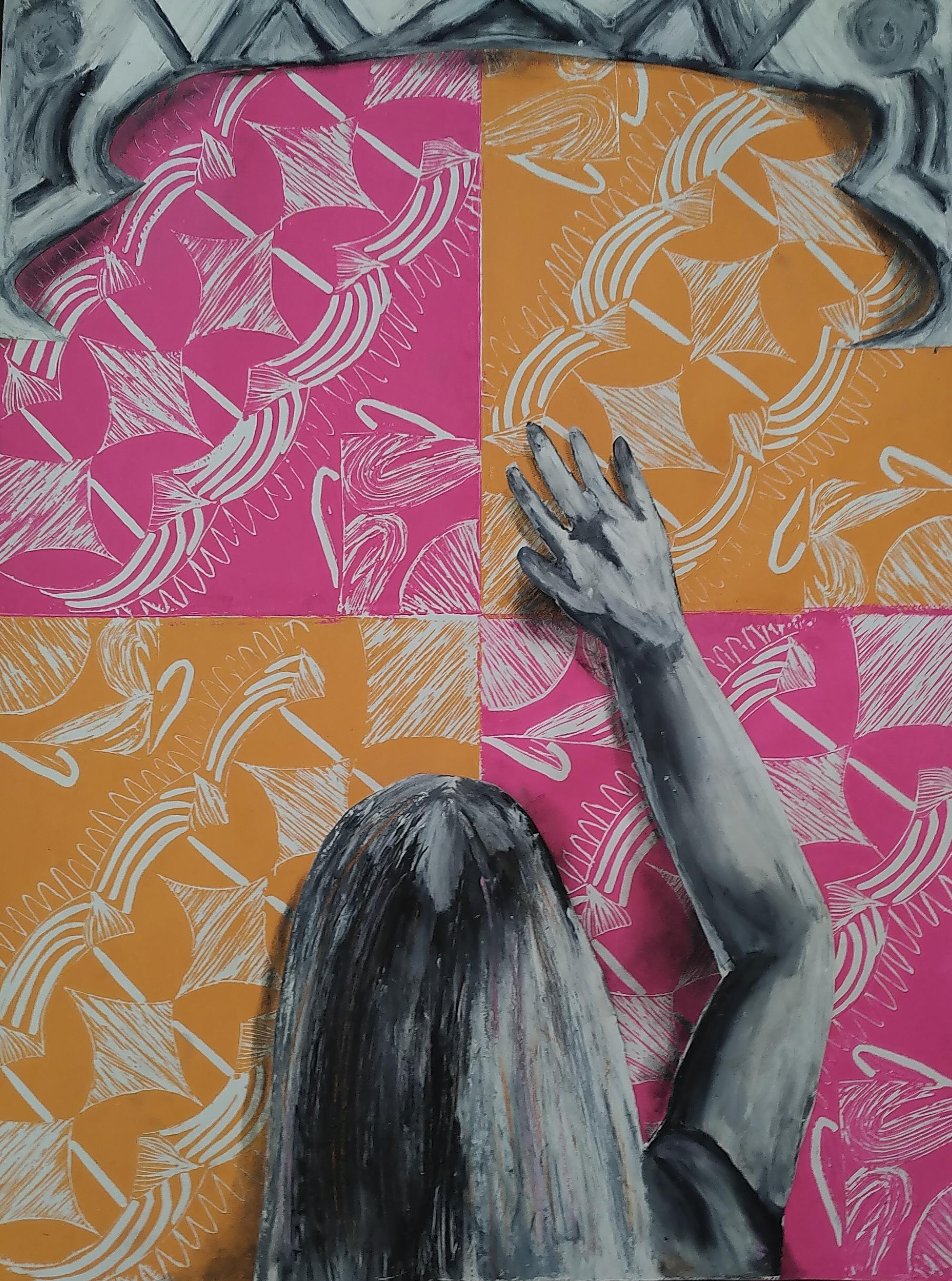
Untitled Isabel Berry, 11th
In this piece I explored how femininity is represented in Islamic art. I started with the tiled background, I chose to use bright pink and orange, very feminine colors. I learned that in Islamic art they practice aniconism, which is the avoidance of using human or animal faces in art. Instead, I used circles and vines in my printed tiles, which are common symbols for fertility and femininity in Islamic art. I used oil pastel to draw a girl looking at and interacting with the tiles; she is exploring how she is represented in Islamic art. I also used oil pastel to create an arch, commonly seen in Islamic mosques.
Gotta love us sports fans, lost in the moments, watchin’ some good old ball, sprawled out on the couch, cussing each other out, with eyes on the ball.
As the bartender hands more drinks, watch them fans cheer for every basket, wail over an interception, criticize a player’s move, like we can dribble a ball.
It’s tradition, we boast about our favorite team, despite their many flaws, post tweets saying “it’s our year,” and oh boy, people think you don’t know ball.
Crowds cry and cheer with hope, with their ten-year-old jerseys, chanting for their team, win or lose, you ride with your team, if not, you’re not worthy of watching ball.
Sundays, weeknights, playoffs, no matter the time, we gather up and holler, with our hearts striking at each play, as if our very life depended on the ball.
When the season ends, bitter or sweet, we’re still right there, just ask Ricky, loyal to the team, we would never let go, our eyes always on the ball.