VOLUME 30, NUMBER 2
In this issue:
Sailing Through The French School of Movable Books: Part 1 Restoration of a 19th C. Movable
2 / MOVABLE STATIONERY
IN THIS ISSUE
H
ere's an "I told you so" moment: In a 2018 interview with BestPopUpBooks.com, Denice and Jean-Paul asked me, "How could the future look for pop-ups and paper engineering?" My response: "France." (Gently edited. Click here for the full interview.) For years now, we've been collecting and savoring glorious titles (Long Live Popville!) as they roll out from French publishing houses. It's high time for this deep dive into The French School, where Maaike Van der Meulen DAZZLES with the breadth and depth of her reporting. Buckle up, friends. And enjoy!
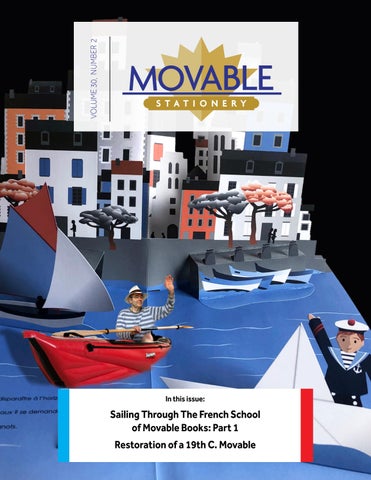
Cover: During the covid lockdowns, Patrick Lecoq, a retired theatre-technician and avid movable book collector decided to visit his book collection in an original way: he dug out his inflatable kayak from the basement and went on a trip… INSIDE his collection. And then he continued his journey throughout our article on the French School of Movables as well. © Patrick Lecoq. Matelot à l’eau! – Elmodie - De La Martinière Jeunesse 2016
Shawn Sheehy, Director, MBS
A
s the decline in the publication of movable books here in America continues its years-long slide, we noticed that our movable book friends in France and elsewhere are actually flourishing. More titles are currently being released in France, for instance, than here. So, over the next few issues we are planning to travel the world to investigate. Is the appetite for movables among the public overseas that much more robust than here? If so, why? What might be different in those markets? How are the publishers approaching the market? How are the paper engineers in those countries changing things up? Are there noticeable regional differences in paper engineering and design? First stop on our journey we visit France through the observant eyes and ears of Dutch collector, Maaike Van der Meulen. Join Maaike (with virtual companion Patrick Lecoq) as she expertly and inexhaustibly guides us through what is unquestionably now to be acknowledged: the French School of Movable Books. Next month, Maaike continues the journey with a discussion of the future of French movables in Part 2. Next, Jill Deiss of Cat Tail Run Hand Bookbinding in Winchester, Virginia, shares with us the meticulous restoration of a delicate movable from the 19th century. Additionally, Jill is hosting Carol Barton, master paper engineering instructor, for a pop-up workshop. If you (sadly like me) can’t make the trip to Italy this fall for the deliciously enticing two week-long paper arts retreat we told you about in our last issue, here is your chance to still learn from one of the best! And again, read our ongoing report of New Releases, as well as the new and noteworthy from Ellen G.K. Rubin in Poppits. Bruce Foster, Editor-in-Chief, MS
TABLE OF
CONTENTS
4 24 28 30 31
THE FRENCH SCHOOL OF MOVABLE BOOKS THE COBBLER: RESTORATION OF A 19TH C MOVABLE NEWEST RELEASES CAROL BARTON WORKSHOP POPPITS BY ELLEN G.K. RUBIN
Volume 30, Number 2 / June 2022 ©2022 The Movable Book Society All rights reserved. No content from this publication may be reproduced or shared without the expressly written permission of the editor or the board of The Movable Book Society. Art Direction and Design by Bruce Foster. Copyediting by Beth Stockdell. Send questions, articles, or suggestions to editor@movablebooksociety.org
This page: A wonderful display of French movable titles in the bookshop at the Librairie du Centre Pompidou in Paris. One rarely sees such a commitment by bookstores in America today. Photo © Maaike Van der Meulen
3 / MOVABLE STATIONERY
T h e F r e nc by Maaike van der Meulen Zwolle, The Netherlands
Part 1: 2000 to present Current status of Movable Books in France And how it got there.
I
would like to take you on a trip to the recent history, present and, in the next issue, the future of French movable books. Given all the European countries, we can say in the last two decades France has developed most extensively, in terms of movable books, a recognizable style of paper engineering and graphics, and which was quickly named the French School by collectors and connoisseurs. ORIGINS AND AESTHETICS In the 1980-90s the production of original non-Anglo Saxon pop-ups in France and Europe was marginal. Theo Gielen reported annually in Movable Stationery about European books spotted at children’s book fairs in Frankfurt and Bologna. One of the first descriptions of French originals is described in MS 3.3.4 – 1995, where Gielen talks about, “Five books that have to be mentioned, both for their paper engineering and unusual themes. Published in 1991 by Hatier in Paris, but originating from
Inset: Louis Rigaud and Anouck Boisrobert, creators of both Popville and Acrobat, at the Salon du livre animé in 2018.
ch School An essential example of the modern French pop-up: Popville by Anouck Boisrobert and Louis Rigaud. Minimalistic, use of primary colors, graphically illustrated, no unnecessary engineering frills. ©2009 Hélium
Maaike’s Definition of the French School of Movable Books • Less is more. Minimalistic approach. • Paper engineering does not exceed what is needed to express the idea. The engineering is not complex, nor does it need to be. But it can be ingenious. • The concept leads. Paper engineering, narrative, and illustrations enhance each other, and are not competitive, nor overrule each other. They are all equally at the service of the story to tell. • A clear, crisp illustrative style. Neither traditional nor too realistic, but recognizable, mood-enhancing, artistic, colorful with an attractive vibe. Inspired by graphic design and graphic techniques, by paper cutting, by contemporary artists’ books (like Bruno Munari), by Russian illustrations from the 1950-1970’s, by shapes from Bauhaus and Alexander Calder, by graphic novel traditions… • Modest, subtle typography. Artistic fonts are integrated into the illustration to enhance the page design and story. • Matt paper. It gives more intense colors and no distractions from light bouncing off the page. Subtle tactility is important. • Not afraid to be artistic in any appearance, or being too complex for kids, or differing from trends, or using weird sizes. Not afraid to be modest, introverted or subtle but viewing that aspect as a strength. It can be funny, original, sophisticated, playful, and modern with room for imagination and free interpretation.
5 / MOVABLE STATIONERY
houses Albin Michel, Bayard, or Casterman. Famous English titles from known packagers were translated into French. There was only one concern, one of the visuals: illustrations and typography in the complex pop-ups were not always to the taste of the French publishing houses. Apart from José Pons, I found another paper engineer mentioned, creating movable books in the early 2000s for French publisher MFG Éducation, Jean-Luc Cherrier². Around 2000 very few French book artists, such as Phillipe Huger aka UG and Gaëlle Pelachaud, were making artists books, UG using silk screen printing for limited editions. In those years the public and publishers were being spoiled with spectacular international movables, more and more (potential) collectors were infected with the pop-up virus, and more illustrators and graphic designers explored the dimensions of 3D in a book. One event that maybe now can be called the spark that ignited dormant pop-ups in France must be the 2003 exhibition of ‘livres animés’ at the Marché aux Puces de Paris-Saint-Ouen³. Organized by antiquarian bookseller Jacques Desse, who had collected many movables in just a few years, out of curiosity and love he started to research and describe them. Not able to fall back on a list of reliable French terms to describe movables (in any shape or form) he created one himself, in which he regularly consulted other collectors he met. The exhibition received great press coverage and the following year Desse organized another expo, called Pop-up! Au pays du livre animé at Librairie Nicaise, Paris.⁴ In 2011 Desse stated: “Recently a diverse range of talents have blossomed, all of
comprehensive experience for all. It speaks to the adult too, who would like to share it with his child. So, the challenge was to make more to their own tastes. Several events went on, the
whom share [the sentiment of] not wishing to imitate their American counterparts. For this group, the technical side of things is considered more as a means that exists at the service of an idea and aesthetic, rather than an end in itself.”⁵ For French publisher's movable books proved themselves to be commercially interesting because they were aesthetically pleasing and a pop-up added value to a book, improving the book’s sales. The approach changed from being an educational toy to being a
Together we designed a diorama book version of Moby Dick.6 The studio expanded so we could take on an order from Gallimard for Le Petit Prince (…) I had the idea of breathing new life into
time was there, and the contours of the French School had been laid out. PUBLISHING IN FRANCE Gérard Lo Monaco (1948, Buenos Aires, came to Paris when he was ten years old) and founded Les Associés réunies in 1995, a studio and packager in Paris, dedicated to book making. Lo Monaco: ”It was in a large extent born as a result of pop-up. Its first creation, a carousel made up of three-part scenes, was made to go with a box set of singer Renaud. This marked the beginning of our collaboration with illustrator Joëlle Jolivet.
Bécassine enfant. PE Colette David,©1994 Gautier-Languereau, 9782013904582 / Bécassine fait du sport 9782013904599. Photo © Maaike Van der Muelen
Alif/Les Éditions de la Méditerranée, a packager from Tunisia,” like L’Oasis and La Médina de Tunis (1989),1 paper engineering by José Pons. In the same article, Theo mentions five carousel books published in 1994 by GautierLanguereau Paris, all presenting Bécassine. In four mini-carousels and a large Les Adventures de Bécassine this comic character of a typical French girl might be one of the first modern French movables. One carousel earlier, in 1993, Bonsoir petit ours brun (Goodnight Little Brown Bear) by illustrator Daniel Bours got published by Bayard Éditions. This Parisian publisher has done a series of three other good pop-up books by François Michel, called Dans le secret des Roches (1989), La Terre qui bouches (1989) (also in English (The Restless Earth) by Viking, 1990) and in 1992 Le livre animé de l’eau. All geology inspired. In those years we did not see many pop-ups of French origin, but co-productions were made regularly, mostly with publishing For a French interview with Alif and titles click here. ² Movable Stationery 2003 vol. 11 issue 1 page 20 and Movable Stationery 2004 12.2.12 for pop-up titles by MFG Education. ³ An extensive report on the Saint Ouen exhibition by Theo Gielen in Movable Stationery 2003 11.1.2 1
6 / MOVABLE STATIONERY
Report in Movable Stationery 2004 12.1.3 by Theo Gielen. ⁵ Jacques Desse in The Art of Pop-Up by Jean-Charles Trebbi Page 15. Promopress 2012. ISBN 9788492810659 Original title: ‘L’art du pop-up et du livre animé’ - Editions Alternatives France. ⁶ Moby Dick, 2010 Gallimard Jeunesse. Recent English version: Moby Dick: A Pop-up Book, 2019 Chronicle Books. ⁷ The Art of Pop-Up by Jean-Charles Trebbi - Page 125. Le Petit Prince; 2009 Gallimard jeunesse. 4
In 2011 Desse stated: “Recently a diverse range of talents have blossomed, all of whom share [the sentiment of] not wishing to imitate their American counterparts. For this group, the technical side of things is considered more as a means that exists at the service of an idea and aesthetic, rather than an end in itself.” Left: Gérard lo Monaco, 2018. Photo © Maaike Van der Meulen Left below: Le livre des jouets de papier, Gérard lo Monaco, 2014 Hélium, 9782330030155 Below: Utopop, Marion Bataille and Fanny Millard, ©Extra 2021. 9782901018216. Nine Pop-up play-elements designed together with architect Fanny Millard, to let children play and get acquainted with space and as a didactical instrument at workshops.
L
e livre des Jouets de papier (2014, Gérard Lo Monaco) vs Lego pop-up, a Journey through the Lego Universe (2016, Matthew Reinhart) Jouets is a small hard cover pop-up book, to be opened at 90° and contains 11 pages with pop-ups of toys. The color scheme is mainly red, blue, yellow, and green with black and grey against a white background. Sometimes the background contains a color or an additional illustration. The texture in the plain colors of painted surfaces (Lo Monaco works with gouache paint) and has no hard edges. On every page is text: a small line with the name of the toy, and a little story; the sound the toy makes has his own type of font, matching the sound in a way, and three lines of text guide you through toy-land. The end page shows you all toys scattered through the room of the child, against a black background, leaving you room to imagine how you, or any child, played with it all. Compare this with the Lego pop-up book by Reinhart: This book is also a showcase of children’s toys, but the approach couldn’t be starker. In this book every inch of the page has pop-ups, is jam packed with explanatory text, and backgrounds are filled with color or patterns. The toys are far from subtle, they pop, move, ask for interaction and reaction in a totally different way from Jouet’s. It is a showcase of lots of different Lego models, and as much paper engineering techniques as possible to impress the reader. But it works as well. But what if ONE iconic Lego model per page was shown? Would there be more room for a story and imagination, as the ‘French school’ envisions? Would it appeal to the child or the Lego-collector more? –– Maaike
7 / MOVABLE STATIONERY
Lou la-haut, Anouck Boisrobert & Louis Rigaud, ©2021 Hélium, 9782330155018
the original edition by turning it into a pop-up, using Saint-Exupéry’s original drawings … and with the help of paper engineer Bernard Duisit we deployed a wide range of pop-up techniques that were adapted to each illustration from the book. The whole studio was closely involved in making the book.”⁷ Lo Monaco, a multi-talent auteur, graphic designer, illustrator, paper engineer, and creative director for different publishers, talks about an energetic ambiance. “Creators wanted to play with the movable book as a concept, they sought ways to express themselves in a new way." Hélium, a children’s book publisher founded by Sophie Giraud in 2009, had the intention to make movable books indeed more in the French style. As a former employee of publisher Albin Michel, Giraud was already familiar with co-editioning movable books. Running her own company, she says, “I only publish books for which I have a crush. But for pop-up books, we usually take in consideration the international co-production qualities of the project or possible partners.” According to Giraud it can be a complex book for a good price. They make only one to three a year, and usually working with the same paper engineers and/or authors. For pop-ups, it’s very important for Giraud that it includes a strong story,
in which the pop-ups illustrate the ideas. “The movements or pull tabs help to illustrate the story or discoveries, giving an incredibly lively image which carries the reader away, and are not meant for showing technical features.” As a recent example Giraud mentions Papillon Illusions (2021) by Bernard Duisit (pe) and Julie Brouant (illustrations). “We have published a book on butterflies which seem free and alive contrary to traditional butterfly books. The pop-ups are really needed to show these animals in a lively way.” She likes to give stage to young talented artists, and met Anouck Boisrobert and Louis Rigaud at a bookfair in Montreuil. This talented young couple created a book with a subject in which the pop-up “takes it’s true place.” They made Popville (2009) and collaborated with Duisit at Les Associés Réunis to tweak the design and make the movables work. Now it’s a bestseller for Hélium, translated in many languages and one of
Marion Bataille © Mamoru Sakamoto
the most popular international French movables. Together with Dans la Forêt du paresseux (In The Forest, 2011), Oceano (Under the Ocean, 2013), and the new Lou là-haut (Lou, Up There, 2021), all conceived by couple Boisrobert (illustrations) & Rigaud (pe), more than 200,000 copies sold. For first editions Hélium aims at a print run of 7-8,000 copies as a minimum, and depending on co-production the print run can reach 50,000 copies. ⁸ Information and quote from documentary La face cachée du pop-up 2014. A film by Olivier Cossu, auteur Marc Desrosiers, from Cross River Productions and AB Thematiques. Showed in 2017 at ‘La fête du livre animé’ in Paris, on Youtube since. ⁹ Prélivres’, Bruno Munari, Danese 1980.
Les trois Ourses – 1988. A non-profit organization dedicated to the artistic education of children by putting the book at the center. They stopped in 2018. I quote from their website: “End slate… For 30 years, Les Trois Ourses [the three bears - red.] have created a dialogue between art, books and children through their actions in libraries, schools and nurseries. Our adventure started with the desire to showcase the process of creating artistic books, be it those of rising artists or forgotten works of the previous century. Before reading the theories of Bruno Munari, we had already felt the need to “surprise” young readers in order to give them the desire to open new works and to spark their interest for art.(…) From exhibitions to workshops, conferences to courses, we have done much to promote books and the link they can have, as an object, with their reader, whether a child or an adult. Year after year, exhibitions and publishing works, we have forged strong links with artists such as Remy Charlip (USA), Bruno Munari (Italy) and Katsumi Komagata (Japan). Their works, based on the reader’s participation, were the perfect pedagogical tool to reach out to children through arts, craft and game. (…) This summer, at the Center For Book Arts in New York, “Look, look, look… A Playful Book” was another exhibition that showed the variety of our approaches. All stories end, so does ours. Thanks to everyone who has followed and supported us, it finishes well… or rather JUST RIGHT because the story will continue : the entirety of our archives will be kept at the Ministry of Culture (CNAP). – The entire team of Les trois Ourses association.” One of their famous artists, Katsumi Komagata, now publishes reprints or new work with Les Grandes Personnes. Marion Bataille has the honor of having the first international bestseller of this modern age of French pop-ups. As a graphic designer she played with pop-ups privately in her studio, just for pleasure. In 2006 Bataille created an ABC artist-book in an edition of 30, called Opup which sold for €845 apiece at Les Trois Ourses. It became a huge success when a trade edition was published by Albin Michel in 2008 titled ABC3D (Meggendorfer Prize winner 2010). Also, thanks to the internet, the popularity of this book spread wide and fast among designers, teachers, children, and collectors worldwide hundreds
Papillons Illusions, PE Bernard Duisit, 2020 Hélium, 9782330132699
Bernard Duisit signing at Salon du livre animé 2021. Photo © Maaike Van der Muelen
9 / MOVABLE STATIONERY
Couleurs du jour, Kveta Pacovska, 2010 Les Grandes Personnes, 9782361930165
of thousands were sold. Bataille proves that a pop-up without personages can be a success, the letters themselves have personality⁸. — we saw it with David Carter’s One Red Dot series in 2004 too. Bataille explains various forms of book and play already had an important role at publishing houses for children’s books, based on Bruno Munari’s ideas of "what’s a book for? It helps you live better."⁹ The strong bond between entertainment, play and education (call it the interactive aspect) created the French School in movable books. The whole process of creation is interesting according to Hélium, and the collaboration between illustrator and engineer makes the book beautiful. For Hélium, Bernard Duisit often works with illustrators like Janik Coat, Olivia Cosneau, Swedish Ingela P. Arrhenius (for the immensely popular Petit Pop-up series), and others. Giraud says: “The constraints of paper engineering create inventive solutions of great value” and it is appealing from three-year-old’s to adult pop-up fans. For publisher Les Grandes Personnes, founded in 2009 by longtime duo Brigitte Morel (publishing) and Sabine Louali (sales and rights) it is another aspect that makes a strong pop-up book. Morel never mixes an illustrator with a paper engineer, she publishes movables entirely created by the artist (just a few exceptions: couples count as one!). This publisher for children’s books – with a specialty in movables – is packager and publisher in one. Their approach gives opportunity to a group of artists: the ones who design, illustrate, and engineer. Morel and Louali started working at Albin Michel thirty years ago, then moved to Seuil Jeunesse and worked three years at Panama. When Panama stopped, Morel tried to save their authors by taking them to her new company Les Grandes Personnes, so skilled and talented book artists could continue making pop-ups. Among them were Kvéta Pacovská from Czech Republic (Couleurs du jour, 2010) and duo Pittau and Gervais (Axinamu, 2010). Annette Tamarkin made Tout Blanc and Tout Noir in 2010, all books with very simple movable flaps and play-elements. Philippe UG was still on board, and Drôle d’oiseau (Funny Birds, 2011) became an international bestseller with many to follow. Loyalty is important to Morel. The artists come to their office – a light space with huge windows at Boulevard Ménilmontant; 10 / MOVABLE STATIONERY
Giuliani) are easier to sell to other publishers. Also books by couple Dominique Ehrhard & Anne-Florence Lemasson are available in English, like Little Hazelnut, by independent UK publisher Old Barn Books (2017). And Chat Noir, 2020, a cute pop-up by Mathilde Arnaud is now printed in the US in an edition of 3,000 and 3,000 in Japan. A great example of a successful co-production is Le corps Humain by Joëlle Jolivet. Released in 2021, 4,000 French copies sold quickly. Les Grandes Personnes takes care of all production details and soon will print and distribute them in six languages: 7,000 in Spanish, 5,000 Italian, 5,000 in English (Thames & Hudson
bookcases filled with books, drafts, ideas and mockups on all surfaces – to present its (preferred complete) mockup, and Morel guides the whole process of the book being manufactured in China. Louali says:“We try to do co-productions, so we can print and assemble them all in one go, which is a cost reduction of course. Our first print-runs for pop-ups are usually 2,000/3,000 up to 5,000. Distribution is done by Gallimard. But for Paris Pop-up – our first popup by Dominique Ehrhard in 2015 – we sell the copies ourselves through museum-shops in Paris, like Versaille and Musée d’Orsay. The English edition (by Rizzoli) reaches 35,000 copies and French edition already printed 40,000 times. Also available: a Chinese edition of 4,000." Paris Pop-up is a small book, 11,5 x 15,5 cm with pop-ups of monumental buildings on the map of Paris, ideal as a souvenir. (Londres Pop-up, (2018) is available in the same format, New York Pop-up is coming. “By the way, Dominique has such a high production, we can’t publish all of his ideas, so his work you’ll find with other publishers too," says Morel. “We find selling to the US difficult,” Louali mentions, Joëlle Jolivet signing Le Corps Humain 2021. Photo Nicolas Codron. “but through Prestel (an imprint of Random House Publishing), it’s going well, they are have the UK rights), 4,000 for The Netherlands, based in Munich, London and New York”. Some of Finland releases 2,500 and Iceland 700 books. UG’s books are published there as well. Books Le corps Humain measures a whopping with flaps (like Egyptomania, 2016, by Emma 42 x 25 cm, has 16 pages with flaps that reveal
Office of publisher Les Grandes Personnes in Paris. Inset: Sabine Louali and Brigitte Morel (with stripes) earlier in their partnership. They still share back-to-back desks!
11 / MOVABLE STATIONERY
Éric Singelin and Mathilde Bourgon at the Salon 2018. Photo © Maaike Van der Muelen
Cerfs Volants, Mathilde Bourgon, 2017 Gautier-Languereau, 9782017024491
Jeux je t’aime, PE Camille Baladi, Éric Singelin, 2009 TANA. Photo © Maaike Van der Muelen
Engines et machines animés, PE Anne Sophie Baumann, 2018 Tourbillon. English editions published by Twirl. Photo: Anne-Sophie Baumann. Cover seen at right.
12 / MOVABLE STATIONERY
the human body, very detailed but stylized in Jolivet’s recognizable strong lino cuts. Les Grandes Personnes published an award winning board book bestseller, but calls it also a longseller: Prendre and Donner (Give and Take, 2014) by Lucie Felix. This is a perfect example of an interactive movable book (not pop-up, more a puzzle) for education and play by taking a form from the page and putting it on another page, ingeniously telling a story and teaching opposites. Now 25,000 French ones have sold, but far more in many languages. In general, reprints of multiple books are made as often as possible. As Morel expressed firmly, “We prefer long sellers better than bestsellers!” Éditions Tourbillon, perhaps not well known to collectors, but certainly to parents, is a publisher of stylish cutting-edge books for young children, aiming at 0-10-year olds. They publish educational books with a strong and innovative graphic identity, and quite a number are movables and some pop-ups. Publishing director Inès Adam writes to us, “We strive to pass on to children the knowledge of the world around us through manipulation. Each mechanism is pondered upon so that the movement is meaningful. For our pop-ups we have a paper engineer who has worked with us for years, Audrey Maillot-Simon. For example, L’ espace en Relief (Pop-up Space, published by Twirl 2021). Our best-sellers are books of the collection Anim’Action, documentary books on various topics. Particularly Engins et Machines Animées (Vehicles and Moving Machines) made by Anne-Sophie Baumann and illustrated by Didier Balicevic, published ten years ago, of which we have sold more than 25,000 copies in France. This book is translated into 24 languages (English, simplified Chinese, Vietnamese, German, Dutch, Korean, Croatian, Danish, Castelalno Spanish and Catalan, Estonian, Finnish, Hungarian, Italian, Japanese, Norwegian, Portuguese, Czech, Slovakian, Russian, Serbian, Slovenian, Swedish, and Taiwanese).” For collectors: Do I see a new goal? Are there collectors among you who have a purpose of having all different languages of one title? Just wondering?
Tourbillon, in general, has a first print run of 5,000 to 9,000 books, depending on the title. For reprints it is also common here to take advantage of coproduction to reduce costs. It depends on their stock, and as such they try to anticipate the long manufacturing times and transportation. Also, for Tourbillon, books are manufactured in Asia, mainly China. Little intermezzo: When I met Theo Gielen, (1946-2015, Dutch expert on children’s literature and pop-up books) we talked about pop-ups and collecting, of course. I asked him if he was a collector himself. He hesitated and mumbled, “No, not like others. But I have them of course. I like to buy the common movables, the ones that are not taken seriously by collectors, and cheap bright colored ones for toddlers. Books with simple mechanisms, toys and odd additions." I learned that he was made aware of toddler books and their ingenious simplicity and efficacy by a fellow collector, and has a focused on them since. After he passed away, it turned out he had a large collection, just like others, of all sorts of (collectable) movable books, but indeed, many boxes of happy toddler pop-ups appeared. From small-children’s literature to a hugely collectable and remarkable book: Jeux t’aime (Plays I Love) – also very educational – published by TANA in 2009 and engineered by Camille Baladi, Arnoud Roi, and Éric Singelin collaborating with different illustrators. What’s great about this story is that the publisher wanted something magistral and that doesn’t exist in France. They had a great budget because they wanted to score a hit and it had to be a carte visite for the company. They printed 7,000 copies (assembled in China). Baladi and Roi, at that time working together at studio Upupup developed several pop-up books, but also did film animations, graphic design and illustrations. To develop a movable book
Prendre et Donner, Lucie Felix, 2014 Les Grandes Personnes, 9782361933364
10Video of a talk about the making of a pop-up from
concept to fabrication with Baladi and Roi https:// reveilcreatif.com/camille-baladi-et-arnaud-roi/
13 / MOVABLE STATIONERY
“we draw on a large library of examples, and need expertise of others.”10 In order to get it printed and assembled correctly, Baladi created many examples and videos for the manufacturer in China. Roi created an editorial vocation for himself, and calls himself a good craftsman. He prefers calling artists books craftsmen’s projects which is another approach to the job. A few small (independent or museumrelated) publishers produce pop-ups of French origin, but I have to mention briefly Les Rêveurs, who took care of the French edition of Zahhak, La Légende du Roi Serpent by Hamid Rahmanian and Simon Arizpe (pe). In 2017 the first printrun of 2500 quickly sold out, and they funded a second one through Kickstarter, available since November 2021 with slipcase (which went on to earn Arizpe the 2019 Meggendorfer Prize). Also the French edition of Zahhak’s successor, Les sept Épreuves de Rostam is due November 25, 2022. Other publishers to be mentioned are regularly (once, or twice a year) bringing pop-ups to the public, for example Albin Michel Jeunesse, Auzou, Gallimard Jeunesse, Mango Jeunesse, Milan, and La Martiniere Jeunesse. Sometimes L’Agrume, Castermans, GautierLanguereau, Nathan, Palette, and Seuil Jeunesse publish a title or two. The field of publishing houses is complicated. You have for example Groupe Madrigall, a publishing holding company who houses publishing groups like Flammarion, Castermans, and Gallimard, they have children’s departments (add Jeunesse) and they have their own imprints, like Les Grandes Personnes (at Gallimard). For example, Hélium is an imprint of Actes Sud, Tourbillon is family of Groupe Bayard. My research did not go far into this, because I’m instead interested in the outcome: a good movable book. We didn’t get answers to our questions from big publishing houses either, so my focus is on the three who were so kind to answer, as you read above. PAPER ENGINEERING IN FRANCE French designers of movable books may approach the making of a book differently due to having a background as an illustrator, graphic designer, or they call themselves craftsman… but I see one consensus in all their work: every aspect of a pop-up book, words, illustration and animation, has to complement each other, and the pop can be simple or complicated, as long as it adds to the narrative. Pop-ups reveal things otherwise hidden in plain books... they can guide you. Olivier Charbonnel focuses on the engineering part. He works for different
14 / MOVABLE STATIONERY
publishers and a wide range of pop-ups internationally, and collaborates with illustrators and writers since the 1990s. Charbonnel: “For me, being a paper engineer is like being a professional handyman. In spite of the fact that I put everything into my work, I can’t help but find it totally futile. What gives it importance to me are the opinions of people who like what I do.”11 A recent series of books he worked on are Pop-up Earth and Pop-up Moon, both published in France by La Martiniere Jeunesse and by Thames & Hudson (2021) in England, both with some ingenious pages, illustrated by Annabelle Buxton. For Bernard Duisit working together with illustrators is very rewarding. For awhile he was part of the team at Les Associés Réunis. He is an autodidact on paper engineering. During his studies at l’École superieure d’art et de design d’ Amiens, in the 1990s, he experimented a lot and learned from his predecessors like Nister, Meggendorfer, Moseley, Diaz, Komagata, and many others. After graduation, with interactive experiments, books and sculptures, his life as a graphic designer concentrated on paper engineering. He works on advertisement and commercial pop-ups at l’Agence Pop-up and is a freelance paper engineer for many movable books, mainly with publisher Hélium. For Duisit it’s rewarding to work in a team, and design volume, but actually “readers create a fourth dimension in the pop-ups; they are the ones who bring it to life and create movements.”12 Most of the time the publisher has an illustrator in mind and asks Duisit to engineer it. His approach to engineering is “to work above all on creating an intelligent link between the flat and the volume. I just don’t want pop-ups to be a gimmick and fun. I’m obsessed by the idea that content has a role. How can I make story and volume interact, volume and rhythm of the story work, how to manage the story and create a surprise and staging.”13 His approach on designing is on screen, through advanced geometrics with very complex assembly diagrams. He sketches (existing) illustrations on the white mockups, and highlights edges and important parts with his favorite tool: a yellow fluorescent marker. A majority of popular paper artists in France design the complete book themselves, or at least design, illustrate and volumize it. Until 2015 Philippe Huger and Michel Ferrier offered a program on paper engineering at the Maryse Eloy School of Arts in Paris. At the moment, education at art schools is not providing a specialty in paper engineering, but a lot of opportunities come by to learn the skills. You can do internships with engineers or 11The Art of Pop-Up by Jean-Charles Trebbi – Page 109. 12– Page 126. 13 Livres Animés, entre papier et écran – Gaëlle
Pelachaud, Pyramyd 2016, iSBN 9782350173856. Page 153.
Olivier Charbonnel signing at Salon du livre animé 2016. Photo © Maaike Van der Muelen
Notre Dame Cathedral pop-up in Paris Pop-Up. Dominique Ehrhard 2015, Les Grandes Personnes
Dominique Ehrhard and Anne-Florence Lemasson, illustrator-paper engineer/writer power couple.
Bernard Duisit, Labyrinthe, November 2017, edition of 15. Photo © Maaike Van der Muelen Pop-up Moon, paper engineering by Olivier Charbonnel.
Esprit es-tu lá? (Spirit, Can you Hear Me?) © 2022 Les Grandes Personnes 978-2361936334 Paper engineering by Dominique Ehrhard, written by Anne-Florence Lemasson
15 / MOVABLE STATIONERY
Voyage, PE Elena Selena, 2021 © Gallimard jeunesse, 9782075146401 Top: Elena Selena. Photo © A. Balteno Middle page: Philippe UG at the Salon in 2017. Below that: Philippe UG, artist books, silk screen printed, limited editions.
16 / MOVABLE STATIONERY
publishers, or tear books apart to learn it yourself. It results in graduated graphic designers and illustrators engaging engineering, realizing highly attractive work on all domains. I’ve described some skilled engineers who have been working for a long time, but earlier I mentioned a name, a recent popular star whom I suspect never sleeps: Dominique Ehrhard. The amount of very attractive pop-ups, adapted in style and artwork to the narratives, is growing and growing. Together with his wife Anne-Florence Lemasson, who writes all the texts, they collaborate harmoniously and share a passion for making movable books. A multitalented painter, designer of board games, paper toys, and coloring books, Ehrhard started making voluminous books in 2015. Recently Esprit, et-tu lá? (Spirit, are you there? 2021) won a ‘Pépite 2021 - livre illustré’ at the Salon du livre et de la presse jeunesse. And next, the sequel to 10 Chaises featuring uniquely paper engineered designer furniture will be released Fall 2022. While Ehrhard’s fame and quantity of books extended quickly, also internationally, I would like to mention a few very talented and steady engineers who also take care of their complete book design: For example, Emma Giuliani, who also worked at Les Associés Réunis as a designer, now runs Atelier SAJE and designs many covers of pop-up books. Bulles de Savon and Grecomania are attractive pull tab and liftthe flap books. (Les grandes personnes). Elena Selena (1993) grew up in Lithuania, and went to the Vilnius Fine Arts School for two years, then moving to France to study at the Ecole Estienne in Paris. After being introduced to a workshop for pop-ups, falling in love with it, she did internships with Olivier Charbonnel and several publishing houses. And Mathilde Bourgon, whom I will describe further on, all have published several titles over the last years. Not quite popping but very animated and educational are flap-books by Hélène
Druvert, who has an impressive papercuttingoeuvre (for example Naissance, Anatomie, Oceano, Le Ciel) translated into many languages. Mathilde Arnaud, working in illustration, graphic design, and paper cutting, took on volumizing her work in recent years. She undertook some #PopUpTober challenges (initiative of Keith Allen) and is very active on Instagram, and her work is a feast for the eye. Elmodie (Elodie Laîné) has several books to her name (like Icebergs and Pixel City Pop) but is not doing pop-ups at the moment. And veteran Camille Baladi, who fought to be named as paper engineer on the cover of books, works a totally different job now. Jean-Marc Fiess created three lovely books published by Albin Michel Jeunesse, like ABC5languages and 9 mois. ARTISANS, ARTISTS, ‘DESIGNER PAPIER’ I have talked a lot about trade editions by publishers, but special attention should be paid to artistic popups in small editions: hand assembled and silk-screen printed for the collector and appreciative book lovers. You know, books that can spark some envy if owned by a fellow-collector. At the start of this article, I mentioned Phillipe UG. His work is described in Movable Stationery 2020-28.2, but his exquisite amount of hand assembled screen-printed limited editions is amazing. Explosive in style and color, he does not avoid adult topics. UG calls himself a compulsive designer. “I’m something of a maverick in the world of movable books who works outside of the traditional norms, and as a result I have produced books that are giant and not suited to the usual constraints of contemporary publishing. Instead, I produce pop-up scenes that are closer to theatre and spectacles, and bigger and bigger creations that present their own technical problems.”14 Jean-Charles Trebbi, whom you probably know by his book, The Art of Pop-Up – a book I quote often in this article! A richly illustrated and very informative book about the magical (international) world of threedimensional books. The first French edition has a venetian blind on the cover. Last year L’Art du livre origami (2021 Gallimard/Collection Alternatives) was released, and hopefully will be translated soon. Apart from a series of books on paper art (also Art of Folding 1 and 2) he is an artist’s book maker himself. “Born in 1951 in Paris, he lives and works in Seine-et-Marne
14The Art of Pop-Up by Jean-Charles Trebbi – Page 110 Aug 2011. 15 On Trebbi’s website orilum.com
and is a graduate in architecture-urbanism, a designer and a landscape-garden enthusiast. He has always had a passion for organic architecture and for all materials that can be transformed in a simple or sophisticated way from the moment the light modifies the space and the volume created. (…) In love with geometrical and artistic forms, exploiting the techniques of origami and kirigami, he creates paintings-sculptures representative of his perpetual interrogations on the generating light of ephemeral forms, always in movement.”15 There is a long list and photos are to be admired on his website. Maybe you remember Damien Prud’homme, 2nd runner up in 2016 for Meggendorfer Prize for best artist book. Fierce competition that year prevented him from winning, but Entomologie Origamique (2015) is one of the most poetic artist’s books I’ve ever seen.16
16 See The Movable Book Society Meggendorfer Awards
by Kyra E. Hicks, page 65. 17The Art of Pop-Up by Jean-Charles Trebbi – Page 128 Sep 2011.
Mayumi Otero and interior of Carriere on the table. Momotaro seen above.
ICINORI is the publishing company of Raphaël Urwiller and Mayumi Otero, founded because they wanted to control the whole process of book making without involving a third party. They are visual artists, drawing, printing and publishing together. Some of their books are pop-ups, and inspired by the work of Vojtech Kubašta. “A few years ago we were dazzled by an old, dusty Kubašta that we, found in the bowels of a library, and the experience planted the seed for a project of making movable books without constraints. We wanted to design in a way that paid homage to Kubašta’s ingenious resourcefulness (…) and to his rough, raw and astonishingly sensory design.”17 So Icinori created Momotaro, 2009 (edition of 110). Screen-printed and hand cut, fan folded scenes in a few colors appear delicate and balanced, but are slightly gruesome. Recently, from 2017, is a pop-up called Carriere (Quarry), a large experimental screen-printed leporello, with three pop-up spreads, in 14 colors in an edition of 160. Éditions a Mort has a taste for the morbid side of life too. Claire Andlauer (pe) and Tristan Perreton (illustrator) have been working together on pop-up books since 2010. After various micro-publishing projects, they specialize in silk-screen printed animated books. Subjects are a bit dark and gloomy, extraterrestrial and alien-like. “We design, print, cut, and shape our own productions in limited series of a hundred copies, in our workshop in Oullins (Lyon). At the same time, we regularly carry out unusual orders for communication brochures, greeting cards, business cards...” At the Salon du livre animé in Paris, about which I will talk about later in this article, I admire regularly (new) book artists who present movables, volumized cut-outs and pop-ups in small editions. Sometimes they are established names who have created a special edition, sometimes they are designers who started with
an art book and were later able to publish it as a trade-edition. One example is Mathilde Bourgon. In 2015 she presented Des Totems dans ma Tête (Totems in my Head, edition of 10) which was an utterly attractive book to my taste. The totem designs were inspired by countries she had travelled to, and as a fabric pattern designer at the time, this book is vibrant. The following year a simplified trade edition was released (Totems at Gautier-Langereau, 2016). Bourgon continues to make beautiful pop-ups, such as the recent Dôme Beauval, displays, and paper installations, and designed some cards for the Museum of Modern Art New York.
Dôme Beauval, PE Mathilde Bourgon, 2021 Nathan Jeunesse
17 / MOVABLE STATIONERY
José Pons, French paper engineer avant la lettre worked for Alif/Les Éditions de la Méditerranée in Tunisia from 1984-87 and 1991-93 and created several books, not always credited. His work was not yet called paper engineering but more the art of folding or paper design. Pons worked at l’agence Pop-up Kukurudz in Paris from 1988 until 1991, and returned, after his work for Alif, to the same company with a new name: l’agence pop-up. They still make elaborated avertisements. He worked there until his retirement in 2018, among Bernard Duisit and Mike Malkovas who are still continuing working for l’agence Pop-up. As far as Pons himself can remember, he is one of the first paper engineers in France making pop-up books. But he still does engineering for pop-up books, and nowadays his record contains 22 pop-ups. Most recent one, in 2021, is Alice, le carroussel at Éditions Soleil, illustrations by Benjamin Lacombe, isbn 9782302094949. Pons’ first animated book in France with publisher Albin Michel is called Didou à l’ecole (2002, ill. Yves Got). Didou is a famous French bunnycharacter for young kids, called Louie in Anglo-Saxon regions.
18 / MOVABLE STATIONERY
At la fête du livre animé (Paris, 2017, and MS 26.1) participating paper engineers and book makers at the Salon were asked to make a special artist edition to their taste. At that time Nicolas Codron was working at the organizing bookshop and entered Steps! to the party. This kirigami leporello is a very delicately cut white book, with subtle dots of color, and now has a range of variations, including very small ones. Small Night Steps, 2021, is included in the collection of the Metropolitan Museum of Art. Pursuing paper engineering as a career now, Codron has several special editions (like Tenniel’s Alice in different editions and La tour des horreurs) and works on trade editions and in advertising. Well known graphic novelist Xavier Coste created 1984 (by George Orwell) and for the first French edition (2021 Éditions Sarbacane), Codron engineered a large pop-up at the end-page, depicting a dystopian future. The first edition of 10,000 copies sold out quickly but reprints (and other languages) do not contain the pop-up. We must not forget street-artist, painter and performer Antoine Paris who creates work in a punk style, mixing collage and
drawing to humorous weird pop-ups (sometimes collaborating with artist Cyrille Buffet) at a very large scale (like 50 x 70 cm) bound in ethnic cloth covers. A very unique and different vibe! Over the years several book artists attended the salon and created 3D effects in their work. Check out Dominique Lagraula or purchase Trebbi’s work on the website Livres du ciel. Or discover artists books, if you are interested as a collector. When browsing for popups go to Réportoire Thématique and scroll to pop-ups. All French, but translation is no problem on your PC nowadays… The appetite for pops In what ways do people come in contact with livres animés? France has a good amount of (independent) bookstores, called a Librairie, who are not afraid to shelve pop-ups. In every children’s section I came across, there are numerous pop-ups and animated books to discover. But some have a lot. In Paris, it is worth visiting Centre Pompidou’s bookshop for a very complete overview of pop-ups on offer. To
Small Night Steps, Nicolas Codron, NC Paperworks 2021. Opposite: 1984 (George Orwell) graphic novel by Xavier Coste, PE Nicolas Codron, 2021 Sarbacane, 9782377315116
promote a new pop-up, a paper engineer might fill a display-window with matching artwork or blown-up pages. Displays like that make your heart sing. Promoting a pop-up book is often done by blowing up one page, we saw it with Phillipe UG in the early days and it has become a rewarding habit among designers. As a collector, you have to visit La Boutique du livre animé (movable-book store) and don’t let the thick iron door and closed façade hold you back. Just ring the bell at 3 rue Pierre d’Ermite, Paris. The name and accomplishments of Jacques Desse are laced throughout this article, so a little overview: Desse is an antiquarian bookseller at Chez les librairies associes. He specializes in (French) movable books and animated paper, so he decided to call this section La Boutique du livre animé supervised by his partner Thibaut Brunessaux. All reside behind the same door in Paris. They have a wide selection antique movables, but also contemporary ones and artists’ books. The space is a nice place to host meetings, signings, invite artists, and organize exhibitions in the basement. Desse maintains close contact with current creators. In 2007 they organized the first Salon du livre animé, (show of movable books) one evening where public and creators could meet and get books signed. At the website, a first photographic report can be found in the archives, at the second Salon in 2009. In 2017 it was time to celebrate 10 years of Salons. La Fête du livre
animé was jam packed with meetings, signings, exhibitions and more.18 For people who are interested in French movables, antique ones, paper toys, and relatable, Desse wrote an extensive digital essay and bibliography called Figures Mobiles – les premier livres animés français pour la jeunesse (Mobile figures, first French movable books for children). Completely in French by the way. It can be acquired online, as a PDF. On the first page a justified comment, “This book requires payment, because (…) it required hundreds of hours of work and years of unpaid research, therefore do not pass it along to other people." It is richly illustrated and counts 504 pages! Desse also contributed to numerous books on movables or paper related art and wrote solid catalogues for his exhibitions, always crediting the help he‘s having on his explorations.
18Report in Movable stationary 26.1.1
19 / MOVABLE STATIONERY
Affiche for the Salon 2021, designed by Gérard lo Monaco
Gérard lo Monaco, dummies Magique circus tour, 2010 Hélium, 9782358510493. Photo © Maaike Van der Meulen
What a French Librairie does very well, is to organize signings with the artist, often combined with workshops for children, for example at the local city-hall or school. Paper engineers are paid for these events and benefit by keeping their backlist alive. Going to schools and giving workshops, they are right in the eye of the public! Nowadays we can follow several paper engineers on social media showing results of creative little hands. For a search and find of antique or secondhand pop-ups, the small bookstalls, bouqinistes, along the river Seine in Paris are fun to visit. Almost every Sunday you can visit Marché du Livre Ancient et d’occasion at Parc GeorgesBrassens, 104 Rue Brancion. You might find your treasure… While there are fixed book prices for new books, here you can probably negotiate a good deal! Website Livresanimes.com and (FB) (First website about French pop-ups, actual information and reviews about new releases, upcoming exhibitions and background stories. Most French books, sometimes import. An extensive archive per year/month in the left bar of the website is a rich source of information. All in French, but with translators on your digital devices…no problem!) For Thierry Desnoues, founder of the website, it started as an assignment for a multimedia training. The freelance graphic designer and pop-up book collector chose to combine his two interests into a website, because nothing existed at that time in his native language. After a newsletter and announcement, it launched November 2003 during the Montreuil Book Fair. Jacques Desse encouraged Thierry and had agreed to write a text on the history of animated books. The site now has a daily average of 575 visits and 950 pages seen. Additional is their Facebook page, to reach a global audience more easily, with 3200+ followers at the moment. Longtime members of the writersteam of Livresanimes.com are Graziella Albanèse and Patrick Lecoq, collectors, and Anne-Sophie Baumann, paper engineer. At the moment, the team joins 13 people together (collectors, writers, photographers, a director, teacher…) and one interlocutor in Lima (Peru). All are passionate about pop-up books. Desnoues and team also curated two exhibitions with a catalog in 2013: Waouh! 100 livres animés collectors in Paris, at the basement of Le Boutique du livre animé19 and in 2015: Architectures et Jardins Pop-up at Château du Val-Fleury in Gif-sur-Yvette. Both accompanying catalogs are packed with photographs of all international books showing. The third exhibition in 2016 Pop-ups in Wonderland at Théâtre du Châtelet in Paris is not catalogued. Exhibitions In my experience you can always find some exhibit of movable books, in a bookshop, gallery, local townhall, or museum. For example Julien Laparade of Ohpopup is an active
workshop-leader and organizes lots of colorful exhibitions, of different impact and size, for children and those interested. In 2018 Gérard lo Monaco was honored by an exhibition of his work at Médiathèque François Sagan, Paris. For Dans l’atelier de Gérard lo Monaco everything was pulled from his archives, and it was a very satisfying glimpse into his creative mind. His background and love for theatre, automata, puppeteering and circus illustrated the many showcases including his pop-up books, cd packaging (with pop-ups) accompanied with mock-ups, ideas and dummies… A mesmerizing exhibit was held September 2021 in Cluny at the Écuries de Saint-Hughes, called Livres Animés Pop-up presented by L’association Pop-Up Livres et Cie. What was intriguing and new for me was the tremendous effort to MOVE pop-ups by using ingenious small automata (made by Joël Dedianne) with arms, flaps, and rotators to flip pages in many different ways, to move volvelles(!) and animate moiré-effects… just calm, delicate and perfect. Over-all they used a very calming display-arrangement made out of brown cardboard to show an international selection of movables. Salon du Livre Anime A now well-established event, each end of November in Paris. Here you can meet and greet paper engineers and buy their books to be signed. A dédicace like a few words, a drawing or even an additional pop-up into a book is a treasure of course! Organisation is in the hands of Thibaut Brunessaux and Jacques Desse of La Boutique du livre animé. Welcoming entertainment, wandering in paper land, escape to a happy place – it was again possible November 27, 2021. The 13th Salon took place at the spacious Mairie du Neuvième, this time with patronage of the Ministère de la Culture. Gérard lo Monaco designed a pop-up affiche. Lo Monaco’s wife Marina Cedric (composer, singer, musician, producer) performed a musical spectacle for children at a theatre at the back of the building, using a large pop-up book as prop. You know when you go to the Salon as a collector bring bags, a large empty suitcase, and some money. It’s almost impossible to resist that one special edition, that surprise, or an opportunity to get your books signed by the engineers present. In your hotel room it’s a game of Tetris, trying to get all treasures into your suitcase, including books you found while walking the
Exhibition ‘Dans l’atelier de Gérard lo Monaco’, Médiathèque François Sagan, Paris 2018. Photo © Maaike Van der Meulen
streets of Paris, at cute and indie bookshops or Centre Pompidou. It was all possible again this moment, with noticeable restrictions like a facemask, distancing and the European corona-check-app in restaurants. I felt some hesitance to go - because why travel in these times - but I had been so obedient to the rules and was looking forward to a trip into innocent realms of bookistan. So, I went by train with my travel companion and Dutch paper engineer, Rianne van Duin. The place was light, bright and spacious. At the entrance Desse, Brunessaux and assistants manned the shop, a long table stacked with pop-ups. Not only books, but also some MoMA holiday cards designed by French engineers. Sometimes I had to look twice to see who’s behind the masks, but at the end I recognized all acquaintances. The NEXT Salon, in 2022, is scheduled for November 29, in Paris. Au revoir! 19Report in Movable stationary 26.1.1
21 / MOVABLE STATIONERY
Maaike Van der Meulen is a Dutch book-artist living in Zwolle. She graduated as an illustrator and uses old printing techniques to make books and artwork. That year Maaike finished Licht, a handmade pop-up (edition of 3). One copy was acquired by the Dutch Royal Library of The Hague and several pop-ups are in the Museum of Books Meermanno in The Hague and in private collections. Maaike started collecting movables and pop-up books about 15 years ago. Maaike says: “The joy of looking into these catching books fuels pure happiness. It is my reason to get out of bed." For more information about Maaike and her wonderful projects visit her website www.tantepapier.nl or @TantePapier at twitter.
The Interview Editor’s note: The following is a transcript of the interview conducted on BestPopUpBooks.com with Maaike by Jean-Paul and Denise, hosts of the website. See issue Volume 28, Number 2 for more about BPUB. BPUB – What’s the first pop-up book you bought? MM – When I was a student I bought ‘Pooh’s enchanted place’ in a sale and gave some away as a gift. It brought back childhood memories, as it does for many collectors. It really began to take off when I bought One Red Dot by David Carter. It was an eye-opener to the artistic use of pop-ups and what was going on with paper engineering in the United States. So I got hooked. BPUB – Who’s your favorite pop-up book author or paper engineer? MM – More than one, of course. I’m very enchanted by the ‘French school’ at this moment. The duo Rigaud and Boisrobert surprise me every time. And I like Gérard lo Monaco’s style. I also admire the movable books by Katsumi Komagata. BPUB – What are your favorite books in your collection and why? MM – Komagata’s Little tree (petit Arbre) is sophisticated, simple and therefore strong design I seldom see. Trail by David Pelham almost made me cry. This book, with such complex engineering, all in white, is a beautiful and surprising ode to the garden. Shawn Sheehy’s Welcome to the Neighbourwood is a favorite, because he used handmade paper and letterpress in his design. The trade edition is mass-printed, and I’m actually curious about the look and feel of the earlier handmade limited edition of this book. The vintage books by Vojtech Kubasta make me smile, my favourite is Tip and Top on the Moon. These books are full of joy and ingeniously made. Brava, Strega Nona by Robert Sabuda and Matthew Reinhart. They made the story and illustrations by Tomie dePaola into a perfect pop-up book. The engineering gives power to the wise lessons of Strega Nona. I fell in love with this combination. I was very satisfied with the purchase of Momotaro by Icinori. This silk-screened limited edition reaches perfection in design and execution. BPUB – How many books are there in your collection? 22 / MOVABLE STATIONERY
MM – About 350. A lot of them are new, a lot of them are from the 60s-80s and some oldies. Because of my limited budget I can’t afford the antiques (yet). BPUB – What book is missing or will be the first one you’ll order next? MM – I try to complete my series of National Geographic action books. These are pretty and interesting, well-engineered illustrated books. My next order will be Sabuda’s The Dragon & the Knight or Dino Mania by Arnaud Roi. BPUB – If you could choose a subject for a new pop-up book by your favorite author, what will it be? MM – A story illustrated by Patrick Hruby that comes to life with spectacular American engineering. And make sure it enhances each other… (just dreaming). For now, I’m eager to see if Tina Kraus can get her Circus Zingaro published. BPUB – Is there anything else you would like to share with other pop-up book fans? MM – A warning. Collecting pop-up books is contagious, bad for your savings but very healthy for your creativity and happiness. I like being in contact with other collectors. I’m new in the field, and they have collections of thousands, knowledge and experience. Very helpful and fun. I think this group has a joint goal: take care of as many wonderful movables as possible. And they share a love of pop-ups. The rest of your family and friends are probably bored by your next story about a book hunt. And what should you collect? Since there are so many. By theme or paper engineer? My background as an illustrator plays a role in my choices. I look for engineering and pictures that appeal to me. Artistic and handmade books catch my attention. BPUB – What do you think of bestpopupbooks.com? MM – Keep on going! Make it grow. It looks very professional as do the videos. Thank you Maaike for sharing your impressive pop-up book collection with us and congratulations being Pop-up Book Collector of the Month January! Note: This interview was conducted a few years ago. In the meantime, Maaike's collection has grown considerably to over a 1,000 books, many from the 1950s until 1990s. This has given her a broader, more complete picture of paper engineering, and the history and development of pop-ups. The discovery of repeated techniques, the origin of ideas and popular topics fascinates Maaike deeply.
A great thank you To all paper engineers and their social media accounts and websites. To the paper engineers who provided me with pictures and information. To Jacques Desse and his outstanding efforts to describe the history, and organizing the Fair for movable books in France. To Jean-Charles Trebbi and his highly informative books. To the publishers who had the kindness to respond: Sophie Giraud, Sabine Louali & Brigitte Morel, Inès Adam. A personal thank you to Nicolas Codron, Thierry Desnoues and Patrick Lecoq for their tireless help in various ways. Beware, I might popup again sooner or later… Maaike Van der Meulen Display of Dominique Ehrhard at the bookshop at Centre Pompidou, Paris 2021. Selfie Maaike Van der Meulen
23 / MOVABLE STATIONERY
24 / MOVABLE STATIONERY
The Cobbler: Putting a Movable back in Motion:
Restoration of a 19th-Century Structure by Jill Deiss, Book Conservator
O
ur bookbinding facility was privileged to work on a most extraordinary book, and within that book was an even more extraordinary item: a movable structure of a cobbler at his bench made in the early 1800s. Just as interesting is the fact that the content of this truly remarkable book was created by a pair of ladies who not only were artists together but also were friends for decades. The artists were Mary Anne Harvey (1763 – 1853) and Sophia Bonnell (1748 – 1841), and they lived in the Berkshire area of southeast England. The book includes over 1500 riddles and puzzles along with various kinds of movable structures throughout: a perpetual calendar, figures with movable heads (topped with removable hats), and an early paper doll structure (where the figure’s dress can be bent forward to reveal the chemise she is wearing underneath) are among the wonders to be found with the book’s pages.
Opposite: The page containing the movable cobbler from the riddle book created 1771–1807 by artists Mary Anne Harvey and Sophia Bonnell.
The cobbler’s damaged left arm juts out from his body. Arrow points to the damaged shoulder tab (folded back onto the sleeve).
25 / MOVABLE STATIONERY
Above: Surgery underway to mend the broken cobbler. Video: This video shows the result of the mockup we made in order to understand the structure prior to making our repairs.
Sadly, Mr. Cobbler had in his day seen much use along with some overuse, and his left shoulder suffered a career-ending injury: the hole at his shoulder meant for the operating thread was torn through. Fortunately for our little cobbler, Mesdames Bonnell and Harvey were very thoughtful in their construction, leaving the sides of the unit open. Without disturbing any of the original stitching that held the structure closed, we were able to snake our bookbinding tools through the cobbler’s innards first to repair the blown-out shoulder, then to restring the mechanism. In Conclusion... The team of Bonnell and Harvey was by no means a one-trick pony. In addition to the book of riddles, Sophia Bonnell and Mary Anne Harvey have a vase in the Victoria and Albert museum made of glass and shells, and a wooden cabinet with a stand decorated by Mary Anne Harvey includes paper filigree (quilling) as well as hairwork panels. The book of riddles is held in a private collection.
26 / MOVABLE STATIONERY
A close-up view of the damaged hole after it was repaired. A small piece of new paper was adhered over the blown- out hole, and a new hole was punched. Ready for re-threading!
And now, Let’s Test your 19th-Century Wit! Congealed rain, and, an entertainment for the ladies,
Like the Cyclops of old I have but one eye, Which all my acquaintance know how to employ, With the last generation I was much in mode Tho’ the present seems trying my use to explode,
Needle My Fihish is part of our police My second an emblem of Captivity My whole, an appendage to my first,
Watch-Chain
he artistic style throughout this work incorporates much collage and is whimsical as well as documentary to the degree of natural history illustration. Birds, insects, shells, people, plants, and vistas were painted onto paper separate from the book’s pages and were then intricately cut out and adhered into the book. (Editor’s note: This practice was called “grangerized” and was coincidentally discussed in our last issue on page 25). Additionally, the artists made similar use of printed images and text from publications, and the riddles and other notations were handwritten directly onto the leaves. Fortunately, there is a key at the back of the book for the riddles—many of which contain subtleties lost to us across the distance of centuries.
Snow-Ball
T
27 / MOVABLE STATIONERY
WOODLAND PAINTING PARTY, AN EASTER POP-UP BOOK
PE: Yevgeniya Yeretskaya Jumping Jack Press March 14 2022 978-1623486600 $19.99
https://www.youtube.com/watch?v=rf5sePDUBc
SHAPES, MY FIRST POP-UP! PE: Matthew Reinhart Insight Kids March 22, 2022 978-1419749810 $14.24
R EC E N T LY PUBLISHED P O P- U P BO O K S POP-UP AND PEEK HATCH
PE: Mel Matthews Templar Publishing March 31 2022 978-1800780880 $19.99
28 / MOVABLE STATIONERY
UN CÂLIN?
PE: Bernard Duisit Helium 2022 9782330158156 €13,90
ON THE GO! A TRANSPORTATION BOOK
PE: ? Crenstone; Bendon Publishing Edition March 4, 2022 979-8885112550 15.95
POP-UP PEEKABOO! PETS PE:?
DK Children
978-0744056570 12.99
BUG WORLD: A 3-D POP-UP BOOK PE: Julius Csotonyi ? Applesauce Press May 17, 2022 978-1646431984 $29.99
29 / MOVABLE STATIONERY
Pop-Up Structures: The Essential Techniques As mentioned in the editor's note on page 2, Jill Deiss of Cat Tail Hand Bookbinding has announced a pop-up workshop with instructor Carol Barton. Students will learn a variety of popup structures—beginning with non-adhesive cut-and-fold pop-ups and progressing through a series of more complex, glued constructions. Students will receive instruction in folding and positioning techniques as well as suggestions for incorporating graphics into their pop-up designs. A slideshow of historical and artist-made popups will be presented in order to provide models
30 / MOVABLE STATIONERY
and departure points for the student’s own innovative new work. Students will be encouraged to explore new applications and to experiment with integrating visual content and text with their pop-ups. This is an ideal session for book artists, paper artists, art teachers, and graphic designers. No prerequisite. Location: School for Bookbinding Arts 2160 Cedar Grove Rd., Winchester, VA 22603 Contact: workshops@schoolforbookbindingarts.com or 540-662-2683
No online portal for registration. Printable registration form (for credit card or check) at www.SchoolforBookbindingArts.com or call 540-662-2683 to register with a credit card. Fee for the class is $295.
POPPITS POPPITS by Ellen G.K. Rubin
ANNOUNCEMENTS
The 33rd Annual Louie Awards for the best greeting cards is named in honor of Louis Prang [1824-1909], called the Father of the American Christmas card. On the winning team for the best Holiday card, “Happy Father’s Day, above $5," seen at right, was our very own Wunderkind, Rob Kelly. Congratulations for a well-deserved award.
pop-ups will cover the exhibit at New York City’s Grolier Club, the oldest bibliophilic society in the USA. It is open to the public. Send The Popuplady an email, and she’ll meet you there to docent the exhibit. popups@popuplady.com A reminder about the Frankfurt Book Fair, October 19-22, 2022, mentioned in the last newsletter.
BOOK FAIRS Printed Matter’s 2022 NY Art Book Fair, October 13–16, 2022, 548 W 22nd St, pmabf.org. Haven’t heard of Printed Matter, Inc.? It’s a privately-owned shop that hosts multiple events each year. Located in the Chelsea [think artsy] section of NYC close by the Hi-Line, the books for sale run the gamut from sheets of paper to huge tomes. The Popuplady finds occasional movables there, all on par with artist books. New York State book fairs are listed at https://www.nyla.org/list-of-book-festivals. Check your state for similar information.
EXHIBITIONS The Portuguese museum in a paper mill, The Museum of Moving Paper [Museu do Papel Em Movimento] in Santa Maria da Feira, is sponsoring an exhibition of pop-up books from the collection of André Garcia Pimenta, June 9-July 8, 2022, in the Biblioteca Municipal de Alvaiázere, Portugal. An adult workshop is scheduled for July 8. The exhibit will cover movable books from the 19th century. Examples of how pop-up books are created will be displayed. Elements of Making: Ideation to Creation; Ben Parker Studio, 1 North Main Street, Unit 6, Essex, CT 06426. This juried exhibition begins July 31-September 9, 2022. A panel discussion will be held Friday, August 19th from 5-8pm. This is a makerspace giving artists access to resources which will allow them to pursue their craft. Among the exhibit objects may be pop-up books. It’s never too early to plan for an exhibition excursion. Opening December 1, 2022 through February 11, 2023, will be Animated Advertising: 200 Years of Premiums, Promos, and Pop-ups, curated by Ellen G. K. Rubin, The Popuplady, from her collection. The exhibit will display over 200 movable objects beginning in 1824, all selling something. A color catalog with
Rob Kelly’s Winning Entry for American Greetings
MULTIMEDIA Have you been itching to make popups? No matter your level of expertise you can follow Shawn Sheehy to see how it's done. There are workshops, virtual and real, to sign up for at https://www.shawnsheehy.com/workshops. His workshops sell out, so sign up early. If you missed a celebration of Vojtěch Kubašta’s 100th birthday exhibit at the Bienes Museum of the Modern Book in Ft. Lauderdale, FL in 2014, you can see their extensive collection online here. Poppits has previously mentioned the video series, Bite Sized Book History. If you want the bite-sized history of pop-up books, check out this episode, Magical Movable Pop-up Books. If you want a bit more of pop-up history, watch this almost one hour talk by
Dominic Riley. He uses Movable Book Society’s very own Celebrat10n as a source for illustrating the history. A wonderful lecture. The Philadelphia Center for the Book (PCB) and the Art Department of the Free Library of Philadelphia (FLP) are looking for artists to give book or paper workshops. Check here for more information. Please, MBS members, if you know of an event or are preparing one, let The Popuplady know so that it can be broadcast to the membership. Log on to MBS’s Facebook page, so see timely announcements and friend it to read what members have to say or share your ideas. Matthew Reinhart has teamed up with Insight Editions to have his own imprint, Reinhart Pop-up Studio. Eight to ten books per year, some under Matthew’s supervision, will range from licensed books to board books to craft how-to books. Looks like we’ll be seeing a resurgence of pop-up books, at least from Insight Editions and Reinhart. Here is the Publisher’s Weekly announcement. And finally, as we all know, the quarterly Movable Stationery is an exclusive perk for our esteemed and valued members. But did you know that access to this treasure trove of movable information is opened up to the enjoyment of, dare we hope, millions(!) after a two year embargo? That’s right, we have quietly been unlocking access to individual issues one by one as they leave that 24-month window. So, spread the word, share the access! Issues Volume 27, Numbers 1 and 2, and Volume 28, Number 1 are no longer password protected! With the September release of Volume 30 and going forward each in turn, the next issue, in this case Volume 28, Number 2, will be unlocked as well. Let's share the love and perhaps expand our membership with others who love this wonderful art form.
VOLUME 30, NUMBER 2
the art of paper September 18-October 2, 2022
Italian Pop-Up, Paper, and Book Arts Retreat International Center for the Arts Monte Castello Di Vibio, Italy
Four internationally-known instructors, Carol Barton of Popular Kinetics, Amanda Degener of Cave Paper, Denise Carbone of the University of the Arts, and Helen Hiebert of Helen Hiebert Studio will be leading workshops in pop-up engineering, hand papermaking, paper forming, and bookbinding as part of a paperthemed retreat this fall, to be held in the beautiful Italian hill town of Monte Castello di Vibio. Students will participate in all the workshop sessions. The session will include trips to the Fabriano paper factory and to the museums and libraries of Florence. Monte Castello di Vibio is 34 miles from the direct center of Italy. It is not a tourist town but a real community in which people continue to live out rich traditions in a village whose foundations predate ancient Rome. The surrounding landscape is quilted with olive groves, vineyards and sunflower fields. Program participants benefit from the bounty of the countryside, with traditional Umbrian meals prepared each day with fresh, local ingredients. Visit https://www.icaitaly.com/retreats/the-art-of-paper for more information.