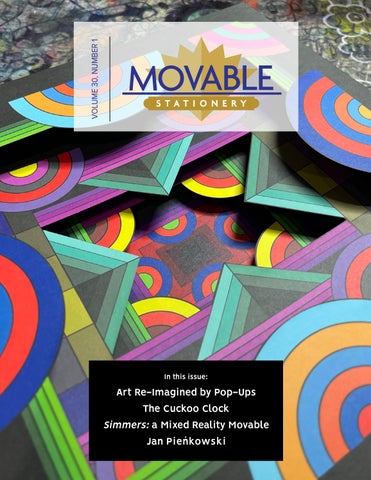
VOLUME 30, NUMBER 1
In this issue:
Art Re-Imagined by Pop-Ups The Cuckoo Clock Simmers: a Mixed Reality Movable Jan Pieńkowski
IN THIS ISSUE
A
s a paper engineer, I tend to think of structure in a sculptural way, without considering the surface of the structure (e.g. Sabuda’s Christmas books, with white sculptural forms that require no illustration). After reading this issue, I have renewed appreciation for engineering with surface in mind. Editor Bruce explores the intelligence and craft of paper engineers who aim to introduce new shades of expression into previously-established (and sometimes, overexposed) two-dimensional artworks. I expect that many of us have collected books that are featured in this issue; here’s our opportunity to enjoy them again with a more finely-tuned appreciation for the forms behind the surfaces. Shawn Sheehy, Director, MBS
A
ll pop-ups use art of some kind in its pursuit, most often as illustration. But when the subject of the pop-up is to actually BE an interpretation of the original art, what has this intervention done TO the art in question? Has it improved or added to the art in some way? Created a variant of that work? Is it then a NEW work altogether? Next join us as we look at a recent piece from Israel by Oran Schneider that recreates an installation art piece as pop-up. We further investigate what it means when pop-ups transform art into... something new. Dig into a fascinating exploration of mixed reality with Simmers, and what it portends for the very definition of “book” by Rebecca Rouse and Lissa Holloway-Attaway. The movable book community worldwide was saddened at the recent passing of pioneer children’s book illustrator and pop-up book collaborator, Jan Pieńkowski. We say goodbye and thank you with a look at his life and accomplishments. And as with each issue, celebrate with us the release of new pop-up books and with Poppits, news from our world of movable books. Bruce Foster, Editor-in-Chief, MS Cover: A tunnel book adaption of Dalek”s Geo Loop Tunnel art by Popositoin Press which features an animated appearance of his SpaceMonkey when viewed through AR. This page: Another work from Poposition Press transforming the original art of Sandra Chrevier into pop-up form, giving it depth and added mystery.
2 / MOVABLE STATIONERY
Artist Sandra Chevrier in her Paris studio working on a piece like the one that was used from the same series in the pop-up book, Cages, by Poposition Press seen left.
TABLE OF
W IKI ME DIA CO MM ON S
30
PO PP ITS BY EL LE N G.K . RU BIN
NE W RE LE AS ES
28
31
JA N PIE ŃKOWSK I
26
HISTO RICAL CO NN EC TIO NS AN D TH E MA KIN G OF SIM ME R, MI XE D RE AL ITY MOVA BL E BOOK
20
TH E CU CKOO CLOC K
12
4
ART IM ITATIN G ART
CONTENTS
Volume 30, Number 1 / March 2022 ©2022 The Movable Book Society All rights reserved. No content from this publication may be reproduced or shared without the expressly written permission of the editor or the board of The Movable Book Society. Art Direction and Design by Bruce Foster. Copyediting by Beth Stockdell. Send questions, articles, or suggestions to editor@movablebooksociety.org 3 / MOVABLE STATIONERY
IMITATING “I mitation is the sincerest form of flattery...” is a timeless proverb that, carried to a snarky conclusion by Oscar Wilde, “... that mediocrity can pay to greatness...” suggesting that imitation or emulation without acknowledgement of its source, is well, actually LESS than flattering: copycatting. But WITH the unmistakable visible connections in these works, this “imitation” elevates instead, to homage: an expression of high regard and respect. And in creating this tribute one is not copying, but rather re-interpreting that art, or ideally, adding a new, dare I say it, DIMENSION, to the artist’s work. Many art forms are translated from one form to another, for better or worse. Poetry becomes song, books become movies, movies become graphic novels, backwards AND forwards, etc. Paper engineers also reinterpret art through their own unique visions utilizing folded paper, volume, layers. However, in the service of this inquiry, we are ONLY looking at works that involve pre-existing or simultaneously created works of art or photography.
by Bruce Foster We will exclude biographies, surveys, and recreations of the artist’s living environments or museum displays. Sometimes they are meant as mementos of an event, like Red Grooms’ Ruckus Rodeo, by Barbara Haskell. Other times
they are a What IF scenario, adding dimension to that where there had been none, as in Courtney Watson McCarthy’s versions of works by various art masters. There are even examples where an art form has been completely REintepreted into another form, both physically with paper, but also with illustration or graphics, such as the minimalist pop-up Kandinsky by José Pons. We began wondering how often art has been reinterpreted into pop-up form while discussing the subsequent essay in this issue on The Cuckoo Clock, a 2022 pop-up book by Oran Schneider, itself a reinterpretation of a sculptural installation in collaboration with the artist, Vered Aharonovitch. The earliest example I could find is also my very first pop-up purchase, made long before I had developed an interest in paper engineering: a pop-up version of Red Grooms’ huge sculptural installation for the Modern Art Museum of Fort Worth in 1975 that was created by Haskell, curator at the Whitney
Opposite: Red Grooms’ Ruckus Rodeo. Above, Courtney Watson McCarthy’s M.C. Escher. Right, John Strejan’s Maxfield Parrish.
5 / MOVABLE STATIONERY
Museum later in 1988 when the installation traveled there. Fashioned itself quite liberally after another pop-up book, The International Circus by Lothar Meggendorfer, the book opens into a semi-circular drop-down collection of six scenes from the installation. I had been fortunate to have visited a similar Red Grooms installation, Ruckus Manhattan, on my very first trip to New York in 1976, so I was already primed to snatch up the Rodeo book when I came upon it, again, even though I was NOT yet into pop-up books! Red Grooms is best known for works which he calls “sculpto-picto-ramas”— three-dimensional sculptural environments constructed from materials as varied as glued cardboard, welded steel, paint, plaster, fabric, and mechanical devices. These works are rich in architectural detail, art historical reference, and the artist’s unique sense of humor. John Strejan paper engineered two books of specific artist’s works: The Pop-Up Book of M.C. Escher ©1991 Pomegranate Artbooks and The Maxfield Parrish Pop-Up Book ©1994 Pomegranate Artbooks. The latter is much more successful in capturing the spirit of the art, in this case of Maxfield Parrish, incorporating delightful movables, bringing the art to life. Figures swing, play the violin, and otherwise allow the viewer to participate. The Escher book is mostly an exercise in layering the illusions as best one can. After all, Escher is well known for his mindboggling optical illusion drawings that defy reality, a challenge for paper engineering, itself sometimes an exercise in optical illusion. More Philippe UG transformed Vasarely’s Op Art into pop-up forms. successful with the emotional processes of creativity, a favorite same subject is Courtney Watson subject of hers. The installation consisted of a McCarthy’s M.C. Escher ©2011 Thames and series of large (10-12 ft tall) ornate golden frames displaying sculptural compositions made of Hudson. Utilizing a few movables and a bit more exuberant use of dimensionality, this book aluminum, glass and other materials expressing comes closer to deciphering his optical illusions. Fear, Self-Doubt, Courage, etc. Rather than McCarthy also has created pop-up books of photograph the pieces and try to use those in works by Dali, Leonardo da Vinci, and Hokusai, the pops, Ginny and I combined new elements the latter a large art table sized book with to express the same pieces in graphic form. So, equally large three-dimensional interpretations these pops were truly a complete re-imagining of his watercolor and woodblock art. of her individual sculptures. Totally new yet From my own body of work, I beg evoking the original works. your indulgence to offer three entries that are 2005 brought an unexpected relevant to this essay, beginning in 2003 with telephone call: The Museum of Modern Art an invitation from the Montgomery Museum of in New York asked if I would be interested in Fine Arts to create a companion book to the creating pop-up versions of the sculptures of installation: Creativity, The Flowering Tornado, Elizabeth Murray for the upcoming retrospective by glass and conceptual artist, Ginny Ruffner. of her work at the museum. Years earlier in The installation was a treatise on the mental and grad school I must confess that I had ripped pages from Art in America featuring her work, 6 / MOVABLE STATIONERY
pasting them into my notebooks. Two days later I was standing in her Chelsea studio enthralled. Robert Storr, curator of the exhibit in his introduction to the book, summed up the essence of this very article: This book was born of... the possibility that of reproducing some of Elizabeth Murray’s relief paintings dimensionally, rather than leaving it entirely to the photographer’s skill and the reader’s imagination to conjure up a sense of volume from the evidence of flat representations... The solution... was to interpret original works of Murray’s three-dimensionally... taking pop-up technology to art to create new variants on existing compositions... The hope is that between the covers of this slender book the reader will experience the fullness, both formal and emotional, of Murray’s uniquely inventive art.
Joan Summers transformed a painting by Henri Rousseau in 2006. Fight Between a Tiger and a Buffalo was dissected and recreated as a lush jungle scene tunnel book. In 2008 the fashion and culture magazine entity, Visionaire, approached me to design a collection of pop-ups based on actual art and photography, some commissioned for the collection, some pre-existing. Each year Visionaire produces a special collectible art object as diverse as artist-painted shirts or toys to vinyl recordings. This was to be named Visionaire 55 Surprise. For this, it was not to be ONE artist, but a collection of eleven artists including Yayoi Kusama, Andreas Gursky, Cai Guo-Qiang, Sophie Calle, and Steven Meisel among others. In these a direct approach was taken by using their art to inform the pops. Individually bound, they were delivered in a box that when opened, caused the group to rise up
The original Elizabeth Murray relief painting, Can You Hear Me?, 1984, measured over 13 feet long. The pop-up version below is by contrast, only 12.5 inches long. Popped Art @2006 Museum of Modern Art.
Joan Summers’ Fight Between a Tiger and a Buffalo by Henri Rousseau, 1908.
as if levitating. These pop-ups took many forms, sculptural, a nine-slat blinds movable, and even an interactive animation of the “self-portrait” of Sophie Calle. Ten years later (2018) the fashion house, Hermes, did something similar in commissioning paper engineer Bernard Duisit to design a collection of diverse artists who each had painted art for their scarves. Unlike Surprise, this was a group of twelve pop-ups of the work of fourteen artists housed in a single bound book. Artists included Ugo Gattoni, Dimitri Rybaltchenko, Alice Shirley and Kermit Oliver, the latter ironically named winner of the 2017 Texas State TWO-Dimensional Award! Duisit employed an array of styles as well, including three-dimensional, tunnel book, and blinds
A mobile by Alexander Calder from Meet the Artist: Alexander Calder by Patricia Greis
movables, some using art from two different artists as a before and after effect.
There have been several books created through the years that were intended to introduce specific artists to children. Most of the time these are overwhelming biographic, as were the majority of the 2014 Princeton Architectural Press series, Meet the Artist by Patricia Greis. They included works by Matisse, Van Gogh, da Vinci, Picasso, and Alexander Calder. The latter did include a simple pop-up rendition of one of Calder’s standing sculptures. That same year Philippe UG published Vasarely Pop-Up Op-Art as an homage. This was an appropriately exuberant collection of brightly colored abstract pop-ups that built upon the illusions of op art to realize actual volume. Coinciding with a major retrospective of Sonia Delaunay the next year in 2015, paper 7 / MOVABLE STATIONERY
Two examples from Hermes: A pop-up version of Kermit Oliver’s Pony Express, 1993, and Nigel Peake’s Promenade Au Fauborg, 2013. Paper engineering by Bernard Duisit.
engineer Gérard Lo Monaco created a book for children, Madame Sonia Delaunay, to introduce them to the artist. It included several clever popup recreations of her works. 2020 saw the release of 5 Animaux D’Artistes, by Dominique Ehrhard from Les Grandes Personnes. Exquisite designs by Dominique recreate creatures depicted in works by Hieronymus Bosch, Albrecht Dürer, Francois Pompon, Robert Rauschenberg, and Louise Bourgeois. His recreations of these animals are a treat: clean, faithful reinterpretations of the originals, and efficiently, elegantly designed. We, of course, would be remiss without discussing Poposition Press, whose raison d’etre in many ways parallels this article. From their mission statement: Poposition works with contemporary artists to create pop-up books out of existing or new work. And when they say “contemporary” they mean it. Poposition Press has created popup books from the works of Jim Mahfood, Junko Mizuno, Sandra Chevrier, Kristen Liu-Wong, Dalek, and the artist known simply as Skinner. PP has worked with a cadre of paper engineers to bring these artworks to new dimensions, including Simon Arizpe, David A. Carter, Roger Culbertson, Ray Marshall, Kevin Steele, Isabel Uria, and even PP founder Rosston Meyer, all names familiar to this membership. Sometimes, as with Junko Mizuno’s Serpent, the artist was asked to create new artwork to augment the pop-ups to complete the paper engineer’s design! And the creative cycle comes full cycle. Even more exciting, Poposition Press has been experimenting with Augmented Reality, which allows for the artist’s work to become something it never was: animated. Geoloop Tunnel by James Marshall, aka Dalek, includes a code that when scanned, adds his Spacemonkey dancing between the layers of the actual paper pop-up book. So not only 8 / MOVABLE STATIONERY
has this version become three dimensional,
Below: A spread from Gérard Lo Monaco’s Madame Sonia Delaunay, Left: an example of Sonia Delaunay’s art similar to one that inspired the pop-up.
Detail from Triptych of the Temptation of Saint Anthony, Hieronymus Bosch, 1506.
Dominique Ehrhard’s Hieronymus Bosch from 5 Animaux.
The pop-up builds spread by spread, adding elements from the original painting. Kandinsky by José Pons. Right: Several Circles, Kandinsky, 1927.
9 / MOVABLE STATIONERY
Right: Junko Mizuma, Serpent. Below: Serpent pop-up from Triad, art colorized and augmented by the artist. Paper engineering by Rosston Meyer.
has this version become three dimensional, it has added a completely NEW level of creative content that would not be possible in the original versions. Upcoming Poposition Press projects include pop-up versions of the work of Andy Warhol, as well as that of the mysterious and anonymous international artist, Banksy. So, what should we take away from this exploration? Yes, paper engineering alters the art. It HAS changed it. It has added dimension. It has added surprise. It has added movement. But the very best of these transformations do not only evolve the art with new elements but realize in form and spirit something that was already lurking inside the original art. In short, re-imagining art with the use of popups can reveal hidden potential already lying dormant within the art but most certainly, providng a new way to perceive the original artwork.
10 / MOVABLE STATIONERY
From the upcoming Andy Warhol Pop Up Pop Art. ©/®/™ The Andy Warhol Foundation for the Visual Arts, Inc. Paper engineering by Rosston Meyer.
Below left: Yayoi Kusama Infinity Room, Private Tour. Below: From Visionaire Surprise 55, Yayoi Kusama by Bruce Foster.
11 / MOVABLE STATIONERY
... the book becomes an artistic object in itself.
The
Cucko
The final scene from the book which features delicious details like how the girl sways to dodge grandfather’s poke as grandmother and sister rotate into view.
12 / MOVABLE STATIONERY
oo
Hagar Raban -From the statement booklet accompanying the pop-up book he [pop-up} book [written in Hebrew and opening in reverse] was created [by Oran Schneider] following the exhibition The Cuckoo Clock by Vered Aharonovitch. The exhibition, curated by Dr. Aya Lurie, was displayed at the Herzliya Museum of Contemporary Art between September 2019 and January 2020. The exhibition featured a large-scale kinetic installation, the central part of which was a house built as Aharonovich’s childhood home. Through the windows and doors of the house, viewers could peek inside, and see the events taking place in it and the various figures who lived inside it, who were also inspired by Aharonovich’s family. Next to the house a few trees were set – on one hung a swing with an old woman sitting on it. On another, a wooden house was built, in which a father and daughter aimed a rifle at the roof of the house, and on the branches of the third tree, a girl
with bird wings was placed, watching the roof of a shelter beside which a grave for a pet rabbit was dug. Among the various scenes that took place inside the house, one could find a worried mother looking from the window to the street, not knowing what or whom she was expecting, a woman who was perhaps sinking, perhaps drowning herself in the bathtub, or a girl listening to the heartbeat of a father lying on the living room sofa. Hidden engines were attached to some of the components of the installation, which allowed the cyclical, endless and futile movement of objects and figures, while evoking thoughts of time, maturation and ageing, of life and death: the father running nowhere on a hamster wheel attached to the wall of the house, a woman repeatedly plucking greying hairs from her scalp, or a convoy of family members leaving the house, surrounding, and returning to it – led by the figure of a grandmother holding a black garbage bag, which never reaches its destination. The thing with exhibitions is, of course, that at some point they are no more. This is true for any exhibition, and even more so for an installation, whose chances of being presented in the same way again is very low to nil. And so,
oran schneider, Paper Engineer vered aharonovitch, artist
Clock 13 / MOVABLE STATIONERY
The installation of Vered’s original artwork.
here too, at the end of the exhibition period, the house was dismantled, and its parts were packed in boxes stored in Aharonovich’s studio without knowing if they would ever see light again. The desire to create and carry through the experience of the exhibition in the world – an experience of movement and franticness, along with intrusiveness and invasion of privacy – took shape in the form of this book: a pop-up book, which embodies something of the three-dimensionality of a sculptural installation, while allowing the reader a very personal and intimate experience. In addition, and as a continuation of what is happening in the exhibition, here the book itself requires us not only to take a closer look – but to take an active and real part in the movement that it offers, while we are asked to pull, open or fold its various parts, to find out what happens in it and dictate its mode of operation. Hence, the book... is not a documentation of the exhibition, but a complex and developed continuation of it: while in the exhibition we are unable to touch 14 / MOVABLE STATIONERY
the artistic object, here it is permitted and even desirable. And if in the exhibition we could only peek inside the house for a few moments - then now we get to bring the whole exhibition into our own home, forever. Those who have followed Aharonovitch’s work in recent years mostly know her as a sculptor. The Cuckoo Clock exhibition was also, certainly, a sculptural exhibition. But Aharonovich began her artistic career as a painter and came to sculpture after completing her master’s degree at the University of Haifa. Aharonovitch says that she then lifted by herself the statue she created, and in order to carry it she found herself embraced with the sculpted figure. This intimate contact first evoked thoughts about the physical relationship between a person and a statue - where one can touch it, caress it, pricked by it. In the book, Aharonovitch seems to complete the circle: it begins with a sculptural exhibition, where the scenes depicted in the book are taken from the rooms of the house presented in the exhibition. But its ending goes
back to the painting: all the images that appear before you were painted by Aharonovitch after and following the exhibition and were created especially for the book. The spatial perception made possible by a pop-up book, along with the integral flatness of painting allows Aharonovich to bind colour with volume, movement with mass, and image with space. In doing so, the book becomes an artistic object in itself, and every reading of it brings it to life: it becomes a home.
The Cuckoo Clock was produced and paper engineered by Oran Schneider, who writes, “As for Vered’s book, there is no Narrative here, but Vered’s and mine’s decisions about which scenes to take from her sculpture exhibition “The Cuckoo Clock” and take out a pop-up from them. We had to give up scenes,
The house she has created works like a large [cuckoo] clock: every fifteen minutes, a grotesque and bizarre procession of the family members emerges from the door for the purpose of emptying the garbage that has accumulated inside.... In Aharonovitch’s work, the family members’ desire to maintain order and cleanliness is doomed to fail: in short order the procession pulls all the garbage back into the house.
-excerpt from the preface by the curator, Dr. Aya Lurie
Oran’s complex pop of the girl with bird mask high above the page below.
15 / MOVABLE STATIONERY
A complex paper engineering of two articulated hands. Father is trimming daughter’s nails. There is an uncomfortable undertone of menace.
Editor’s note: After experiencing this book firsthand, I can tell you that this is an extremely well-crafted book with fascinating subject matter and exceptional engineering. A fine addition to your library! If you wish to add this limited-edition book to your collection, it is available on Vered’s website. Cost is $165 + $40 shipping to US. https://veredaharonovitch.com/SHOP 16 / MOVABLE STATIONERY
the book... is not a documentation of the exhibition, but a complex and developed continuation of it.
Details! Details! The pop-up, when viewed in the mirror, actually shows the girl slipping down into the water.
of course, and it was hard because I loved all the dramas that were in the exhibition. Vered wanted 15 spreads! I explained to her that it was unrealistic, that there are usually five to six in pop-up books. In the end we decided on seven pop-up spreads and another two with a drawing without a pop-up. I was so attached to her art that I wanted to challenge myself with mechanically complex popups. I wanted to innovate.
I’m proud of some innovations like the bent pages flying in the air. The scene here is that her father writing a will, and she, not wanting him to die, pulls the map while he writes, and all the pages of the will fly through the air, the plate falls and breaks, and so on. In the girl-bird on the tree I had to deal with the mechanics of an element distant from the V-fold (the girl on the branch) that is difficult to actuate. In the bathroom scene, Vered wanted to create a situation where you are the one drowning the girl when you open the spread! So, you will want to close back... but then you will miss the pop-up... and you will want to open again... it was challenging to create the levers under the tub that would drown the head, and the movement of the mirror angle that follows it.
In the last scene Vered wanted the grandfather in a wheelchair to push the stick into the girl’s rump, and she would dodge away. It was also mechanically challenging. It took me about nine months to develop all the scenes. It took me a lot of time and effort (I wasn’t expecting it to be so hard) to guide Vered for her paintings, and guide the graphical execution of how to devide the scans of her paintings and place parts on the nesting [sheet]. Vered and eight more people hand assembled all the copies. Three hundred pieces for the launch, and there are about three hundred more waiting to be assembled. I supervised the printing and cutting and of course the assembling.” 17 / MOVABLE STATIONERY
Oran uses a hidden slider to make characters and objects stand without visible support throughout the book. He has found a way in this spread to do that with the flying papers... and make them curved in the process!
18 / MOVABLE STATIONERY
19 / MOVABLE STATIONERY
Behind the Page:
Historical Connections and the Making of Simmer, A Mixed Reality Movable Book By Rebecca Rouse and Lissa Holloway-Attaway In this article we share Simmer (2019), an entirely handmade two-sided artist book and MR (mixed reality) application created in collaboration with composer Brendan Padgett, and excerpts from our related scholarship on movable books, active readership, digital media, and design. Simmer explores and expands John Cheever’s classic short story, “The Swimmer” (1964), and won the Excellence in Innovation jury award at the International Conference for Interactive Digital Storytelling (ICIDS) Art Exhibition in Salt Lake City, Utah in November 2019.1 While Cheever’s landmark story crafts an expert portrayal of its narcissistic protagonist Ned Merrill, Ned’s wife (Lucinda) and four unnamed daughters are left unexplored. This untold female side of the story was the focus of Simmer, where we bring to life a host of underdeveloped characters and engage the reader through both interactive paper and digital structures that work in combination to tell a new side of the story. Our title, Simmer, references the way we feature female perspectives that are mentioned but under-explored in the original story. To ‘simmer’ is to boil, to “bubble up,” and to bring something to the surface which otherwise might remain hidden below the water line. This simmering quality is materialized through the dark marbleized paper chosen for the book cover, hinting at the swirling depths of the story through which we expose deep family
secrets. Through the reader’s intimate interactions with the physical book and digital MR sound, the dark underbelly of Cheever’s too-perfect mid-century American suburbia is revealed. To develop the project the three of us (Rebecca, Lissa, and Brendan; then located in New York, Sweden, and Washington DC, respectively) worked over Skype to collaborate. Rebecca and Brendan had a history of artistic collaboration going back over twenty years, and Lissa and Rebecca had been working together for about a decade, mostly in a research context, prior to Simmer. The three of us came together in June 2019 around an experimental performance project at the Swedish Naval Museum, for which Rebecca and Brendan had created another pop-up book with music, The Golden Key Variations, a fairy tale story about climate crisis.
1 See Holloway-Attaway and Rouse (2020) “Augmenting Affect” book chapter for a more in-depth description and theorizatrion of the Simmer (2019) project.
20 / MOVABLE STATIONERY
During this time, Brendan and Rebecca were working on writing a musical theater adaptation of The Swimmer, but it was not progressing well. The musical theater form and an adaptation strategy just wasn’t capturing what truly fascinated us about Cheever’s material. We did not want to just reiterate the story; we wanted to dig into the cracks of what had been left out in the story–namely the female characters.
Visual triggers in the art while using the BlippAR app on a phone, illicites music and spoken dialog. Click the movie file above in the online version to watch and listen to the entire book.
Inspired by an article from the Movable Book Society archives about a children’s book that had a dual accordion fold/ carousel structure; Paulette Petrovsky’s 1987 Pooh and Some Bees Winnie the Pooh carousel book2, Rebecca thought that shifting from a stage production to a movable book could help move the project forward. Rebecca was intrigued by the discussion of how Pooh and Some Bees could be configured both as a linear
(accordion) and in a three-dimensional fashion. This felt like a wonderful fit for our project conceptually, with the linearity of Ned’s story, and the depth we sought to reveal by creating Lucinda’s side of the story. Around this time, Rebecca and Brendan began discussing the project with Lissa, whose background in performance, interactive media, literature, and creative writing made her a great fit for the collaboration, to focus on writing and performing
Images from Simmer (2019) showing panorama side of book (left) and carousel side of book (right). Image credit: author
the voice of Lucinda. Cheever’s short story had been a favorite of Lissa’s for decades, and she was excited to see how the story could be re-created in another context and medium. We worked together from June to November 2019 to create Simmer, using online file sharing and meeting on Skype to facilitate our collaboration. Rebecca first made a roughly quartersize mockup version, using a store-bought accordion fold notebook that was actually in a vertical orientation. Then Rebecca moved on to make the full-sized version, which she created entirely from hand, and decided to shift to a horizontal orientation, thus exaggerating the length of the panoramic side and increasing the size of the rooms on the carousel or dollhouse side. In tandem, Brendan began composing and orchestrating music for the project, and Lissa wrote many of the character texts and performed the voice of Lucinda. Rebecca worked on writing and recording voices of supporting characters, like Ned and Lucinda’s children and neighbors. The texts for Lucinda’s mother and Lucinda’s lover, written by Lissa, were voiced by both Rebecca and Brendan, and so the compositions came together collaboratively, despite our physical distance during the creative process. As we gathered the physical components of the book and our audio tracks together, Lissa worked with the mobile augmented reality application BlippAR to set up the audio interaction points. The intimacy of the MR voiced audio, often whispered and confessional, placing the listener as an 2 This was described in an article on Carousel Pop-Ups from the February 2001 issue of MS, written by Ulf Stahmer. 21 / MOVABLE STATIONERY
Images this spread: Simmer seen from the panoramic side.
eavesdropper outside the action, but drawn in by the secrets, combined with the musical scores and the visual material triggers create a polysensual story space. Touching the book and its objects, holding the phone in view to see the trigger images, and then drawing it closer to the ear to listen to the audio stories comprises a personal series of discoveries for the reader supported by our MR movable book design. Simmer opens as a linear accordion fold book or panorama that presents a re-telling of Ned’s story from his perspective, moving from left to right. The long, narrow surface of the panorama reflects Ned’s long-winded, narcissistic musings. Cutup quotations from Cheever’s original text, reflective of Dadaist poetry, are woven into the imagery, often filling the empty swimming pools that dot the landscape. Imagery from this side of the book is taken from midcentury magazine covers, sewing patterns, and print advertisements that Rebecca searched for online, formatted, and printed out to cut and glue into the book. The background of these pages is part road map of the suburbs north of New York City where the story takes place, and part handmade artist paper with embedded grass and plant materials. As the reader moves across the panorama, mixed reality audio plays on the reader’s mobile phone, using computer vision capabilities to recognize images from the panorama and que radio-play style dialogue and atmospheric music from Ned’s fantasy world, with other characters praising him as larger than life, legendary, and god-like. Moving from left to right across the panorama, the audio and imagery shift, 22 / MOVABLE STATIONERY
becoming more unhinged and tense, suggesting that something is not right, and Ned may not be the glorious suburbanite presented in the beginning of the story. A red thread sewn through this side of the book jumps out from the mostly black and white and pale green background of the page, and makes suggestive connections between the lounging characters represented in the images, soaking in an eternal suburban summer. Are neighbors from different backyards lovers? Merely friends? The red thread also makes metaphorical connections between linear and non-linear writing forms, which get revealed as the accordion book is turned insideout, transforming into a carousel or dollhouse structure. The red thread is visible here too, a tenuous connection between the two sides of the book, the two sides of the story. The red thread reminds us that the linear and non-linear stories share an historical base but also manifest an affective and secret connection between them. Further, the red thread on the carousel side ends in Lucinda’s writing desk, and the associated audio reveals her connection to 19th century poet Emily Dickinson through her desire to write undercover. Like Dickinson, and her fragmented poetry, Lucinda’s writing resists chronology, order, and propriety. On the carousel side of the book, we are within the domestic house space — Lucinda’s world — and the narrative experience here is nonlinear and associative in contrast to Ned’s linear narrative on the accordion side of the book. The wallpaper in the house is a handmade artist paper in a rich brown that has a paint layer
visibly imprinted by skin or leather. This texture suggests the intimacy of the body, and touch-themes which are echoed in the narratives revealed. Like the black and white imagery on the panorama side of the book, the furniture and decorations within the house are images Rebecca searched for from mid-century print advertisements and promotional materials, which she then formatted and printed to add to the book. This carousel side of the book is intended to be explored counterclockwise, as a rewinding or traveling back in time to understand Lucinda’s story and its own sinister backwardness. Lucinda is gradually revealed not as a simple victim of Ned’s narcissism, but rather as a complicated and powerful force of anger and selfishness within her own family as well. Inside the house, the reader pieces together a fragmentary narrative through exploration of its objects and by manipulating a variety of traditional pop-up and movable elements (paper dolls, animated flip book, miniature book, tunnel book, miniature LP records, flaps, fold-out map painted with thermo-chromic paint that responds to heat, revealing hidden text when touched by the reader). Rebecca worked to make careful dramaturgical connections between each movable element and the story content it reveals, working to forge a specific connection between form and content for each component. For example, the daughters who are sadly objectified by parents Ned and Lucinda are represented by paper dolls and voiced by archived recordings of Thomas Edison’s failed talking doll project from 1890,
as a way of indicating these characters’ eerie brokenness and relation to the long history of objectification of girlhood. The letter from Lucinda’s lover comes to life by warming black patches of thermochromic paint that obscure a map, revealing hidden text beneath, but also referencing Lucinda’s alcoholic blackouts that deteriorate both memory and relationships in the family. The teenage lover, a boy with no capacity for the copious amount of alcohol Lucinda (and Ned) can consume, painfully tells of his blackout too, and his audio letter exposes his illicit tryst with Lucinda where he, mistakenly, believes he is solely to blame for their sexual transgression. This work of designing for cohesion of narrative and interactive form was supported by Brendan and Lissa, who both have expertise in dramaturgy and interactive narrative, respectively. The narrative elements are fragmented, dream-like, and associative. Collectively they reveal a domestic history, of a family and a marriage told from Lucinda’s perspective, and to a more limited degree that of her daughters’, but they also tell of the intimate (dis-)connections among them. Liberated from the control of Ned’s narcissistic narrative world, and told through the objects that help form her experience, Lucinda’s story space offers a powerful and distributed scattering of reflections, confessions, and deep regrets that invite the reader inside to discover, to touch, and to examine up close. In the process of creating Simmer, we also looked back at the rich history of movable book design to gain inspiration and
deeper understanding of the form. In learning this history, it also became clear to us that the common notion of readership as passive and text-centered is wholly inadequate to capture the wide, active variety of readership practices particularly in relation to movable books This wider understanding of early interactive practices led us to question the emphasis on digitality today, which is often held up as radically unique or “more” interactive than older forms. To push back against this, we like to think of our work as coming out of a postdigital perspective. In our usage of the term, the ‘post’ does not indicate we are past or through with the digital. We have yet to finish sorting out how we are entangled culturally, socially, and politically with digital tools and contexts for design. In our usage of the term, the postdigital refers to an interactor (or reader) less dazzled by the digital, a state we actually find more exciting for us as creators, because it engages our readers in more nuanced ways with our digital projects. In working on the artistic development of Simmer, we were also interested as academics to better understand the postdigital reader today, in the context of the history of readership. Hannah Field’s (2019) research into “unruly readers” is a great example of
scholarship on the history of the book that reveals physical evidence of active readership through the many ways in which children resisted docility and instead asserted their active creativity with the texts they read. Scholarship from Patricia Crain (2013) and Jacqueline Reid Walsh (2018) also provides insight into historical practices of readership as active. Reflecting on this history of active readership, we can identify three broad modes of interaction: 1. Canonical interaction: i.e., you pull the tab marked “pull” or open the flap in the manner the designer has indicated. 2. Emergent interaction: i.e, you create a custom book jacket in which you also store hand-made paper dolls, or unbind and rebind a book to include extra illustrations or “grangerizations.” 3. Resistant interaction: i.e., you inscribe snarky commentary into the margins, tear out pages, layer over drawings directly on the page, or add other materials or inscriptions that substantially transform the book. Keeping these various modes of readership in mind, we also look to the long history of movable books in particular for a typology of movable design strategies, to help inspire us in our own mixed reality book 23 / MOVABLE STATIONERY
design practice. In looking back at a wide range of examples from renaissance manuscripts to contemporary commercial pop-ups, we developed a taxonomy of movable books, characterized by seven approaches, in which we also draw connections between pre-digital forms and contemporary examples3: 1. Book as Instrument: i.e., scientific volvelles and fold out maps in books that help situate a reader in a precise location. We can connect this with current technologies such as GPS and AR navigation. 2. Book as Intimate Object: i.e., miniature books and wearable books like Book of Hours with girdle bindings. We see connections here with wearable technologies today like fitness trackers, phone watches, and garments sewn with conductive thread or other sensing technologies. 3. Book as Secret Keeper/Giver: i.e., flap-based books, harlequin, and metamorphose books that both cover and reveal hidden information. We find a connection here with the layering capabilities of augmented and mixed reality technologies, which also center on juxtaposition of information. 4. Book as Substrate for Accretion of Objects: i.e., trompe l’oil manuscripts, grangerized or extra-illustrated books, commonplace books, scrapbooks, and contemporary books like the ‘ologies’ series or the Jolly Postman series. We can see a connection here to social media practices, as theorized by Good (2012), as well as connections to early 20th century cut-up and combinatory poetics, and digital culture aesthetics of re-mix. 5. Book as Illusion of Motion: i.e., the older blow books or flick books, as well as the more recent flip books. We can see connections here to other technologies of transformation and illusion of motion, such as thaumatropes and zoetropes, and to more contemporary cinematic technologies. 6. Book as Game or Puzzle: i.e., books like Carroll’s Through the Looking-Glass, Base’s The Eleventh Hour, Bantock’s Griffin and Sabine, and book forms that even more explicitly characterize the reader-as-player such as Mad Libs or Choose Your Own Adventure books. We can connect these works with narrative-based computer games like Colossal Cave Adventure or Undertale, and indeed Bantock has adapted his work as a CD-ROM game, called Ceremony of Innocence. 7. Book as Performative Space or Stage: i.e., tunnel books, paper doll books, and toy theatres. Here too we can see connections with computer game forms, in particular role playing games and platforms such as World of Warcraft, SecondLife, and The Sims. Reflecting on our experience making Simmer, working both to design for and theorize 3 We have published our research on this movable book taxonomy in: Rouse, R., & Holloway-Attaway, L. (2020). A prehistory of the interactive reader and design principles for storytelling in postdigital culture. Book 2.0, 10 (1), 7-42. 24 / MOVABLE STATIONERY
the postdigital reader, we are curious to think further about how postdigital culture may reframe what it means to be a reader. How will print-era form writing continue to develop and transform in our post digital age? How will the boundary between design and writing continue to blur or entangle? These questions provide not only an invitation to designers for consideration with regards to specific design challenges at hand, but also present openings to a range of trajectories for future research in the field. As digital media and books continue their evershifting dance and collaboration, we suggest a continuation of the pursuit of connection, back and forth, across time and technology. Awareness of this dense, rich, interactive, and inspiring past has great potential for helping us to create an increasingly diverse future of designed possibilities for our books and readers.
References Crain, P. (2013). “Reading Childishly? A Codicology of the Modern Self.” N. K. Hayles and J. Pressman, Eds. Comparative Textual Media: Transforming the Humanities in the Postprint Era, University of Minnesota Press. Pp. 155-82. https://www.upress.umn.edu/bookdivision/books/comparative-textual-media Field, H. (2019). Playing with the Book: Victorian Movable Picture Books and the Child Reader. University of Minnesota Press. https:// www.upress.umn.edu/book-division/books/ playing-with-the-book Good, K. D. (2012), “From scrapbook to Facebook: A history of personal media assemblage and archives”, New Media & Society, 15:4, pp. 557–73. https://doi. org/10.1177/1461444812458432 Holloway-Attaway, L., Rouse, R. (2020) “Augmenting Affect: Interaction, Materiality, and Mimetic Communication in Augmented Reality Movable Books.” In: Bown, R., Salisbury, B., Eds. The Art Exhibit at ICIDS 2019 Art Book: The Expression of Emotions in Humans and Technology. Carnegie Mellon ETC Press: Pittsburgh, PA. pp. 69-78. https://press.etc.cmu. edu/index.php/product/the-art-exhibit-at-icids2019-art-book/
Reid-Walsh, J. (2018). Interactive Books: Playful Media before Pop-Ups. Routledge. https://www.routledge.com/ Interactive-Books-Playful-Media-before-PopUps/Reid-Walsh/p/book/9780367346478 Rouse, R., Engberg, M., Parvin, N., & Bolter, J. D. (2015). “MRX: an interdisciplinary framework for mixed reality experience design and criticism.” Digital Creativity, 26(3-4), 175-181. https://doi.org/10.1080/14626268.2015.1100123 Rouse, R., & Holloway-Attaway, L. (2020). “A prehistory of the interactive reader and design principles for storytelling in postdigital culture.” Book 2.0, 10 (1), 7-42. https:// doi.org/10.1386/btwo_00018_1
Even the character pieces have AR stories to tell.
Left: Simmer’s carousel configuration seen from above. One progresses counterclockwise spread to spread, as if unwinding time... The book has many hidden treasures and mysteries to discover.
Our word for today:
To illustrate (a book) with material such as images taken from other published sources, such as by clipping them out for one’s own use, after James Granger, an 18th-century English biographer. Granger’s Biographical History of England (1769) included areas for readers to illustrate the pages.
https://en.wiktionary.org/wiki/grangerize
25 / MOVABLE STATIONERY
The legendary children’s book illustrator and frequent pop-up book collaborator, Jan Pieńkowski, passed away in February 2022 at the age of 85. Members of MBS of course know Jan due to his early and profound effect on the movable book industry in the 70s with his legendary Haunted House and Robot pop-up books, among many, featuring paper engineering by Tor Lokvig, James Roger Diaz, and David A. Carter. As an integral component of the Golden Age of Pop-Ups, Jan left an indelible mark on not only our history, but children’s literature as a whole. He was awarded the Kate Greenaway Medal for distinguished illustrations in children’s books twice: first in 1972 for The Kingdom Under the Sea and again in 1980 for Haunted House. No one has been honored with this award three times. He is best known by the world, however, for his Meg and Mog series, created with children’s author, Helen Nicoll. Jan, then just three years old and his family, fled Poland when it was invaded by Hitler,
26 / MOVABLE STATIONERY
It never “ occurred to
me that I’d do anything else.” Upon being awarded the BookTrust Lifetime Achievement Award in 2019
eventually settling in England. But his memories of childhood Polish folk tales, in particular, that of Baba Yaga, would go on to morph into the Meg character in the Meg and Mog series. It was
his goal to take “this terrible monster from my childhood and make it into a harmless toy.” Over his lifetime, Jan illustrated and wrote more than one hundred children’s books. Collaborating closely with authors, he once commented, “It is easier for me to write with a writer I know well. I’ve known Helen Nicoll since the early 70s, when I worked on her television programme Watch! and I did drawings on the screen live, which was quite hair-raising at times. Because we get on so well, the books benefit from both our ideas.” He developed one of his signature styles, that of cut paper silhouettes after being nervous his illustrations would not be well received, so he would black out the characters in his drafts. David Carter adds, “I worked with Jan once for two weeks in England [on Haunted House]... His work was a profound influence on me.” Jan worked closely on many books with his civil partner, David Walser, making the decades long relationship legal in 2005 as soon as the laws allowed.
This little “minipop” 4 book series from 1981 each measures only 3” x 4.25”. Paper engineering by Marcin Stajewski, James Roger Diaz, and David A. Carter.
Robot
The First Noel
Jan and David
27 / MOVABLE STATIONERY
THE ART OF PAPER CRAFT PE: Helen Hiebert Storey Publishing, LLC February 2022 978-1635862652 $22.24
MERMAID DANCE
PE: Matthew Van Fleet Simon & Schuster/Paula Wiseman Books January 2022 978-1665904919 $16.88
R EC E N T LY PUBLISHED PO P - U P BOO KS LET’S GO TO SEE THE BEIJING 2022 WINTER OLYMPICS TOGETHER (WINTER OLYMPICS POP-UP BOOK) PE: ? Xinhua Publishing House February 2022 978-7516661178 $83.99
28 / MOVABLE STATIONERY
ACQUA ALTA: CROSSING THE MIRROR PE: Adrian M & Claire B Contains 10 pop-ups, 8 with AR January 2022 order here €70 + shipping
LAGON BLEU PE: Philippe UG
Éditions des (Grandes Personnes) DELAYED to April 2022 978-2361936310 €26.50
SHARK WORLD: A 3-D POP-UP BOOK PE: ? Applesauce Press February 2022 978-1646431977 $29.95
29 / MOVABLE STATIONERY
Share your paper engineering with the world through Wikimedia Commons By Kyra E. Hicks
W
ikipedia, the free online encyclopedia, is the second most visited website in the United States. In August 2020, an average of 1.5 billion individuals visited the site. Wikipedia has articles in English, German, French, Spanish, Japanese, and 300 other languages. The site is open to anyone to share credible, attributable knowledge from a neutral viewpoint. More than 132,500 individuals, mostly volunteers, actively contribute to the site by editing and creating articles, among other activities.
Pop-Up Books on Wikipedia The Pop-Up Book article on the Wikipedia English language website was started in 2006 and currently includes information on the history and different types of pop-up and movable books. Interestingly a Pop-Up Book article appears on fourteen other Wikipedia language sites, with variations in content. Nearly 240 individuals have edited the topic. On average, the Pop-Up Book article receives 3,000 pageviews a month, slightly less than the 3,100 pageview average for the Artist’s Book article. More pop-up book fans and budding paper engineers would likely visit the Pop-Up Book article on Wikipedia if there were more engaging and educational photos, animated gifs, or video snippets.
Use Wikimedia Commons to upload images Images on Wikipedia are sourced from Wikimedia Commons, a media file repository for public domain and freely licensed content. When you upload work onto Wikimedia Commons with a free license, you allow anyone to use, copy, or modify that image, following specific rules. Works that are entirely created by you can be uploaded to Wikimedia Commons. These works can include photos or videos of “useful or non-artistic objects,” original graphs, diagrams, images of public figures, and people photographed in public places.
Four easy steps to upload images to Wikimedia Commons Adding images to Wikimedia Commons is not a time-consuming process. Your first time will take minutes and involve four easy steps:
1. Open a free account on Wikimedia Commons. 2. Upload your image file using the Wikimedia Wizard. 3. License your file. 4. Describe the file you uploaded in plain language and assign relevant categories, such as Pop-Up Book, Artist’s Book, or Miniature Book, for your image. If you already have an account, this link allows you to upload directly to the Wikimedia Commons Pop-Up Book category.
Help build out Pop-Up Book educational images The Pop-Up Book article on Wikipedia could be more educational and instructional if it included more visuals. On Wikimedia Commons now, there are less than 20 images related to pop-up books! The Origami article on Wikipedia was started in 2002, has had over 1,700 contributors, and averages 27,500 monthly pageviews. Wikimedia Commons includes nearly 450 origami images, folding diagrams, and video demos! Here are a few ideas of Pop-Up Book images or animated gifs that will help improve and grow the Pop-Up Book article on Wikimedia. Basic Pop-up Structures V-folds, parallel folds, zigzag folds, single or double slits, slots, platforms or floating layers, spiral pop-ups, or pull-tabs Movable elements Dissolving pictures or transformations, lift the flap, peep show or tunnels, rotating wheels, or volvelles Mock-up or Book Dummy Sample of a dummy spread and a completed spread
30 / MOVABLE STATIONERY
Animated gif or video snippet of one of your paper engineered movements Show pop-up features in a video Wikimedia Commons also allows for video uploads. However, you must convert the video file to a free format before uploading it. You can find Wikimedia video conversion instructions here and information on Video2commons, a free converter tool. That’s it! Once images or video snippets are in Wikimedia Commons, anyone can insert them in relevant articles on Wikipedia. As a community of those who love making magic with paper, consider sharing your paper engineering talents to help build out popup and movable images that could be added to the Wikipedia Pop-Up Book article(s) worldwide. Links: About Wikipedia: https://en.wikipedia.org/ wiki/Wikipedia:About Pop-up Book article on Wikipedia: https:// en.wikipedia.org/wiki/Pop-up_book Wikipedia sites with Pop-Up Book article: https://bit.ly/2S1MBsQ Artist’s Book article on Wikipedia: https:// en.wikipedia.org/wiki/Artist’s_book Wikimedia Commons: https://commons. wikimedia.org Pop-up Book images on Wikimedia Commons: https://commons.wikimedia.org/ wiki/Category:Pop-up_books Origami article on Wikipedia: https://en.wikipedia.org/wiki/Origami Origami images on Wikimedia Commons: https://commons.wikimedia.org/wiki/ Category:Origami Wikimedia Commons image help: https:// en.wikipedia.org/wiki/Help:Creation_and_ usage_of_media_files Wikimedia Commons help to convert video: https://commons.wikimedia.org/wiki/ Commons:Video Potential image with the article – or some element of Wikimedia Commons
POPPITS POPPITS by Ellen G.K. Rubin MBS ANNOUNCEMENTS
Mark your calendars: The next MBS Zoom Event will be on Saturday, May 7. Time and agenda TBA. MBS is proud to announce two additions to its Board. Welcome to Rosston Meyer and Larry Rakow. They are replacing Monika Brandrup and Jason Brehm who decided to step down. We are grateful for their service. Heather Doyle-Maier, who was a great help at the Denver conference, has agreed to be MBS’ bookkeeper, easing the job of the director. To answer the burning question you all have, the next MBS Conference, in 2023, will be in Cleveland, Ohio. We are excited that Larry Rakow and Isabel Uria have offered to be our co-chairs. Stay tuned for continuing information. If you have ideas for the conference, what you would like to see, learn about, or give a talk about, we want to hear from you, please. Send ideas and suggestions to: info@movablebooksociety.org.
BOOK FAIRS In-person book fairs are being revived. Yea!! Virtual ones are proliferating world-wide, especially those conducted by Getman Virtual Book. For a listing of up-coming fairs, go to: https://getmansvirtual.com/
April 17-24, 2022 is Rare Book Week in New York City: https://www.rarebookweek. org/newyork/ The 62nd annual ABAA New York International Antiquarian Book Fair is back! The in-person Fair is to be held at the Park Avenue Armory, April 21-24, 2022! This year’s Fair will feature 185 exhibitors. Whether you make a purchase or not, one gets to see and HOLD these wonderful books. It is a learning experience. And yes, booksellers do bring movable books and ephemera. Often there are satellite book fairs the same week. https://www. nyantiquarianbookfair.com/ Twin Cities Antiquarian & Rare Book Fair will be held July 8-9, 2022 in St. Paul, MN. at the University of St. Thomas. https://www. eventseye.com/fairs/f-twin-cities-antiquarianrare-book-fair-24017-1.html The 2022 Beijing International Book Fair, Aug 24 - Aug 27, 2022 in Beijing, China is not a bookseller’s fair; it is a trade fair. However, since English language books are sought after— every Chinese school child is required to read English—if you have a pop-up book looking for a publisher, this may be the place to present it. Remember! China has 2 billion people! The Frankfurt Book Fair is the world’s largest book fair based both on the number of publishing companies represented and the number of professional and public visitors. This year it will be held October 19-22, 2022. Even if you don’t have a book to promote, think of the experience of getting an early peek into upcoming books. https://www.buchmesse.de/en
New York State book fairs are listed at: https://www.nyla.org/list-of-book-festivals/ Check your state for similar information.
EXHIBITIONS Did you know that volvelles were used as ciphers to encode messages? Here is an interactive exhibit devoted to them: https://exhibits.library.cmu.edu/cipherdiscs/ Until April 10, 2022, the exhibition, Délires de livres - Double Je(u), will be held at the Gallery at Ecu de France in Viroflay, FR. Sponsored by Am’Arts, the exhibition explores the intersection of writing and art. Boundless is an exhibition of artist books exploring the nature of the book. Many movable elements are incorporated. March 4-June 22, Bainbridge Island Museum of Art, Bainbridge Island, WA https://bit.ly/3KylBKH
MULTIMEDIA The CBS TV show Evil has The Popup Book of Terrifying Things at the opening of each episode. See the video of the book—which uses some CGI— here: https://www.youtube.com/ watch?v=B03Gl08E96w or click the video cue in the online newsletter below.
VOLUME 30, NUMBER 1
the art of paper September 18-October 2, 2022
Italian Pop-Up, Paper, and Book Arts Retreat International Center for the Arts Monte Castello Di Vibio, Italy
Four internationally-known instructors, Carol Barton of Popular Kinetics, Amanda Degener of Cave Paper, Denise Carbone of the University of the Arts, and Helen Hiebert of Helen Hiebert Studio will be leading workshops in pop-up engineering, hand papermaking, paper forming, and bookbinding as part of a paper-themed retreat this fall, to be held in the beautiful Italian hill town of Monte Castello di Vibio. Students will participate in all the workshop sessions. The session will include trips to the Fabriano paper factory and to the museums and libraries of Florence. Monte Castello di Vibio is 34 miles from the direct center of Italy. It is not a tourist town but a real community in which people continue to live out rich traditions in a village whose foundations predate ancient Rome. The surrounding landscape is quilted with olive groves, vineyards and sunflower fields. Program participants benefit from the bounty of the countryside, with traditional Umbrian meals prepared each day with fresh, local ingredients. Visit https://www.icaitaly.com/retreats/the-art-of-paper for more information.