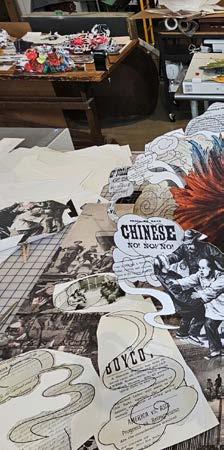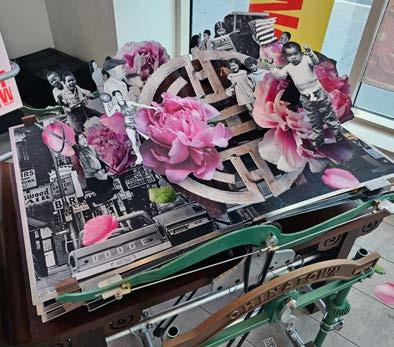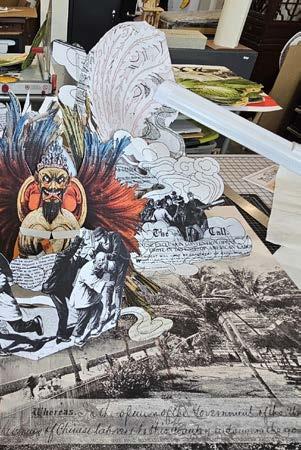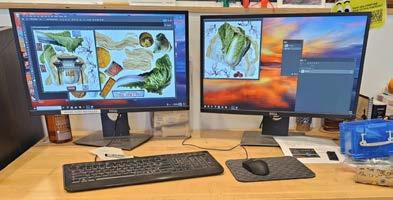
Larry Seidman Attends Biedermeier Card Show Colette Fu TableTop Pop in Philly
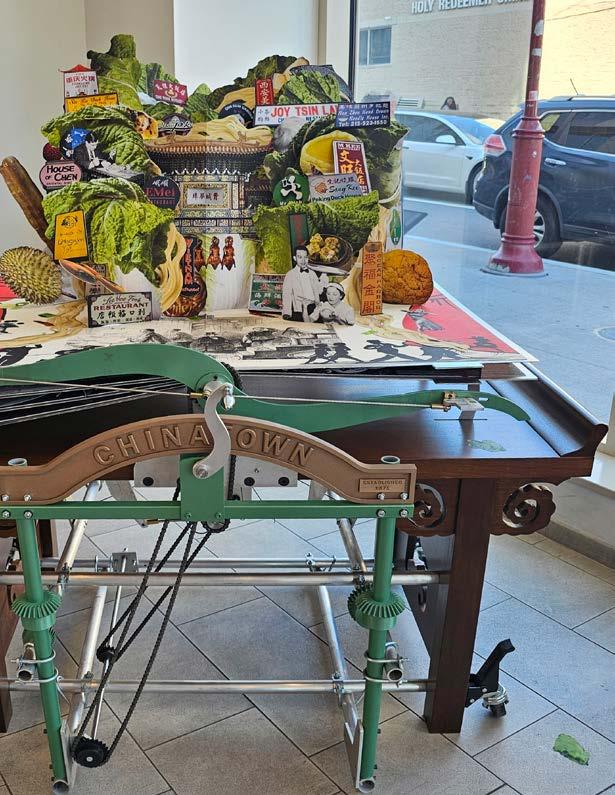
We continue our Europe-centric canvass of movable and pop worthy news this month. Beginning with the historic opening of the Pop-App Museum in Turin, a museum exclusively dedicated to our favorite art form, three of our board members were guest speakers. Next, MBS board member Larry Seidman traveled to Frankfurt to lend two Biedermeier cards to an exhibit there as well. Meanwhile, back in the US, Colette Fu expands her oversized book oeuvre with a FIVE spread book continuing her exploration of the historical Chinese experience in America. And be sure to peruse our permanent features: New Movable Books. And Poppits by Ellen G. K. Rubin And please, consider submitting your own stories and articles. Please, share your ideas!
Bruce Foster, editor
More Museums, More Pop-Ups?
This issue features even more exciting museum expansions and exhibitions throughout Europe and Colette Fu’s latest sizable
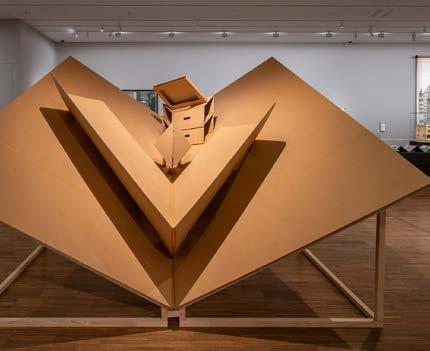
development in the US! From a deep dive into the Turin Pop-App Museum, newly expanded onto the first floor to feature Lothar Meggendorfer at his 100th deathiversary–to surprisingly funny greeting cards from the Romantic era at the Goethe-Haus in Frankfurt–the Movable Book Society has the scoop! One exhibition I regret not seeing in person was Fascination Paper, a trove of interactive artwork from early printmaking to the present (at Vienna’s Albertina from December 11, 2025 to March 22, 2026). As a consolation prize, I recommend the extraordinary exhibition catalogue, as it includes dozens of foldouts, transparencies, pages with dramatic slashes or diecut patterns, a devious and functional Protestant volvelle, and even a DIY geometric sundial with impossibly many faces! The installation was intended to mimic a parkour course, and seems to have succeeded. While much of the contemporary work was about texture rather than motion, there was one exception… a cardboard pop-up sculpture reminiscing about all things domestic: Liddy Scheffknecht’s
enormous Pop Up (Living Room)! See page 31 to see it installed at the Albertina Museum; wish I could have been there!
Suzanne P.S. As always, please reach out with any questions, suggestions or concerns:
Suzanne Karr Schmidt, Director info@movablebooksociety.org Movablebooksociety.org
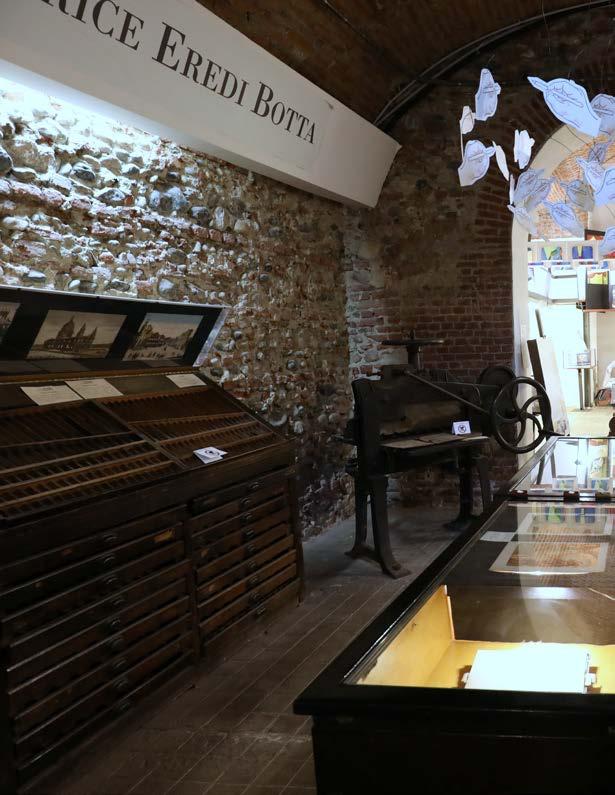
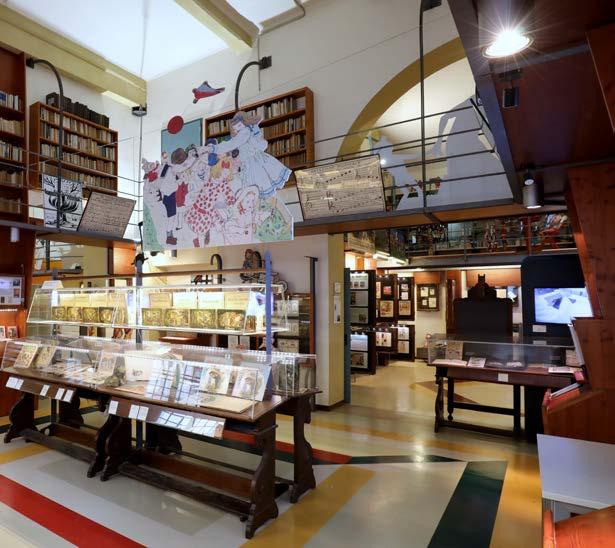
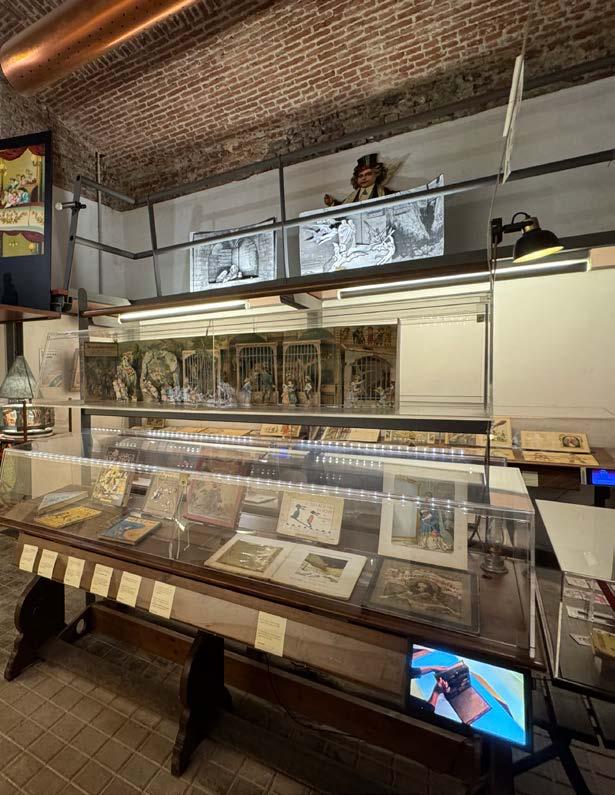
Cover: Logo for the Pop-App Museum in Turin, Italy. This page: The historic basement that once housed Tipografia Editrice Eredi Botta (19th-20th century) has been reconstructed with antique materials and original contemporary machinery to illustrate the art of bookmaking. Today, this space showcases interactive books on pre-cinema alongside vintage printing presses and movable type cabinets. In the center of the ceiling, a moving contemporary installation by artists Dylan Jonas Stone and Beth Campbell.
Volume 34, Number 2 / June 2026
©2026 The Movable Book Society
All rights reserved. No content from this publication may be reproduced or shared without the expressly written permission of the editor or the board of The Movable Book Society. Art Direction and Design by Bruce Foster.
Send questions, articles, or suggestions to editor@movablebooksociety.org
THE NEW POP-APP MUSEUM OPENS IN TURIN, ITALY
LARRY SEIDMAN ATTENDS BIEDERMEIER EXHIBITION
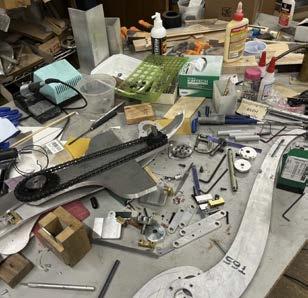
IRON AND PAPER: COLETTE FU IN PHILADELPHIA
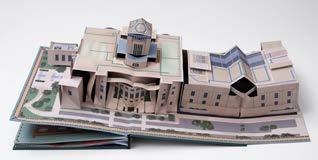
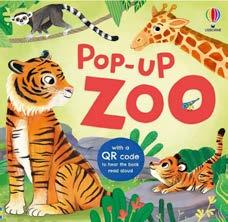
RECENT AND UPCOMING POP-UP BOOKS
POPPITS BY ELLEN G. K. RUBIN 4 14 16 22 30
BY POMPEO VAGLIANI PRESIDENT OF FONDAZIONE TANCREDI DI BAROLO – POP-APP ICIB
Launched in Turin in December 2025, the Pop-App Museum was conceived and developed by the Fondazione Tancredi di Barolo and its Pop-App International Centre on Interactive Books. The museum brings together years of research, international collaborations, and educational projects celebrating interactive book culture. This represents a major and ambitious undertaking for our institution, involving a considerable investment of effort, resources, and professional expertise. We look forward to completing the project over the 2027–2028 period, with the continued support of the institutions that have backed us thus far. In its present form, the museum comprises twelve exhibition rooms in total. At the heart of this contemporary visitor experience are four newly designed rooms, opened as part of the recent expansion and renovation, which currently represent the core of the museum’s public offering. The current itinerary is carefully structured to celebrate
and early 20th centuries.
the evolution of movable books, shifting beautifully between tangible craftsmanship and technological wonder. Upon completion of the next phase of the project, the museum will extend over more than 1,200 square metres distributed across two floors.
The Museum makes available to the public and to scholars the precious collection of movable books of the Fondazione Tancredi di Barolo, consisting of more than 1,500 Italian and foreign examples from the 16th to the 20th century. This core is accompanied by around 1,000 games, interactive materials, and artifacts (including paper toys and pre-cinema objects), documenting a long history in dialogue
with the contemporary world. The expansion of the collection was made possible through both the donation of archival fonds* and through materials personally acquired and selected in accordance with the overall project. Special attention was dedicated to tracing the timeline of movable books, illustrating the continuity and distinct characteristics of children's literature compared to early scientific movable books from the 16th century onwards.
Today, the Pop-App Museum stands as a cutting-edge cultural hub, offering a coherent and deeply immersive visitor pathway that seamlessly integrates prestigious historical collections with contemporary exhibition practices. This

evolution was made possible by a major investment in multimedia and digital innovation, which breathed new life into the spaces, harmoniously blending rooms that were already part of the pre-existing MUSLI (Museo della Scuola e del Libro per l'Infanzia/Museum of School and Children’s Book) with newly acquired and meticulously restored areas.
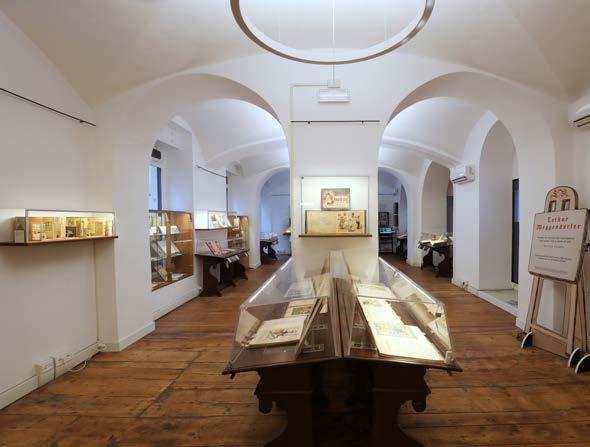
The temporary exhibition Sempre allegri, Bambini! Lothar Meggendorfer e il libro animato in Italia tra Otto e Novecento (Always cheerful, Children! Lothar Meggendorfer and the animated book in Italy between the Eighteenth and Nineteenth centuries) begins in the first three rooms on the left of the entrance and is dedicated to Lothar Meggendorfer, whose death centenary was commemorated in 2025. Renowned for his technical inventiveness, humor, and mechanical sophistication, Meggendorfer’s influence is explored here within the Italian publishing context. Through original editions, the exhibition highlights the transnational circulation of movable books and the European networks shaping children’s publishing. His movable books are presented and celebrated here as true works of art; among his most spectacular creations,
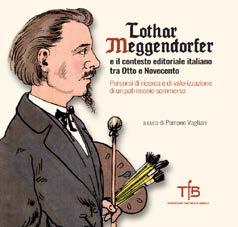
Below: Cover of the printed publication Lothar Meggendorfer e il contesto editoriale italiano tra Otto e Novecento (Torino, FTB, 2025). The volume was published on the occasion of the exhibition.
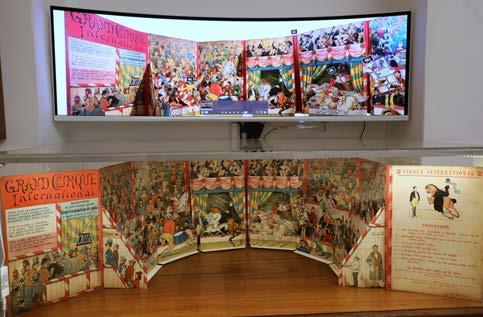
the famous Internationaler Circus is on display, accompanied by a dedicated multimedia installation.
The central area of the exhibition reconstructs Meggendorfer’s publishing history in Italy, a journey pieced together primarily through Hoepli’s detailed catalogues. This rare production has been carefully reconstructed, showcasing both Italian editions and their original foreign counterparts. Research also reveals that Meggendorfer’s earliest drawings appeared in Italy in 1882 within the children’s periodical Il Giornale per i Bambini (famous for serializing Collodi's Pinocchio), sourced from the German satirical journal Münchener Bilderbogen.
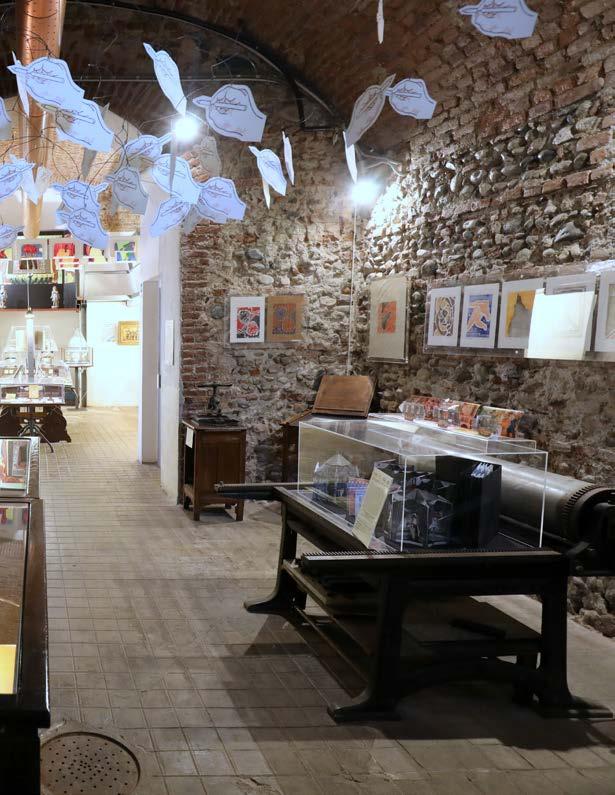
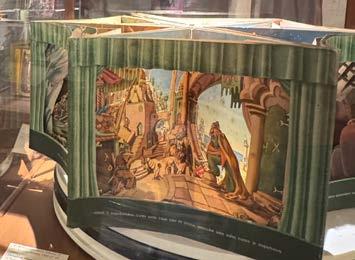
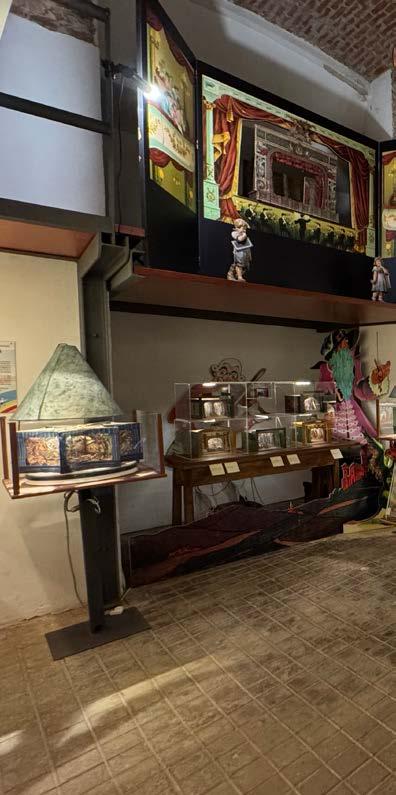
Right: A section of the historic basement showcasing the variety of the different types of animation in interactive books developed between the mid-nineteenth century and the mid-twentieth century (flaps, scenic books and pop-ups, dissolving picture books etc.). One last setting connects these artifacts to a very ancient history that goes back to Martin Engelbrecht's dioramas. Alongside each display case, a small screen demonstrates how they work.
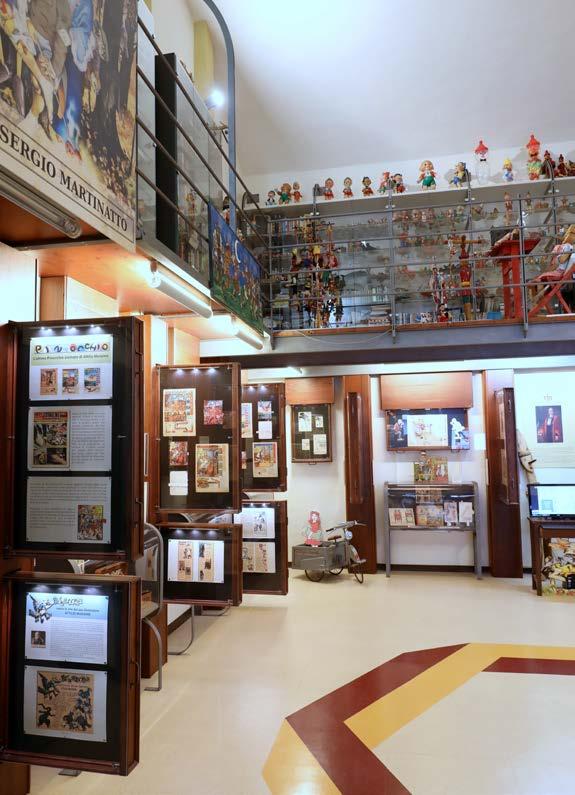
This section celebrates Pinocchio through the Italian historic illustrated and movable editions with artwork by
It highlights Mussino's later work from 1952-1953: a series of collectible plates, published serially in a children's periodical and designed to be cut out and assembled into movable cards.
The rare volume Pierino Porcospino vivente (Dean’s Living Struwwelpeter) receives special focus, transformed into an immersive experience through an interactive table installation. At the far end of the room, a display case accompanied by a multimedia installation illustrates the complex restoration process of a Meggendorfer movable book, alongside an experimental mechatronics project designed to replicate the movement of his book mechanisms.
An additional screening space next to the three rooms is dedicated to the showing of short films made by CSC
Terzi, one of the first women – not only in Italy – to create paper movable devices in the early twentieth century. Among others, the exhibition includes the 1914 picture book inspired by Paola Lombroso Carrara’s book Storie vere di Zia Mariù, with illustrations by Bona Gigliucci. This precious handmade work was recently restored by the Centro Conservazione e Restauro La Venaria Reale.
Next is the room permanently dedicated to Pinocchio, housing the Sergio Martinatto collection; it currently focuses on the history of illustrated and movable editions published by Bemporad between 1915 and 1922 with illustrations by Attilio Mussino.
Centro Sperimentale di Cinematografia students, which explore the role of music in Meggendorfer’s books.
The display also highlights the biennial Meggendorfer Prize, which has played a major role in preserving and promoting his legacy within the international community of movablebook scholars, collectors, and artists. In this same area, visitors can view two works by Italian artists, Caterina Capelli and Chiara Meneghetti, both shortlisted for the Movable Book Society’s Meggendorfer Prize 2025 in the Emerging Paper Engineer category.
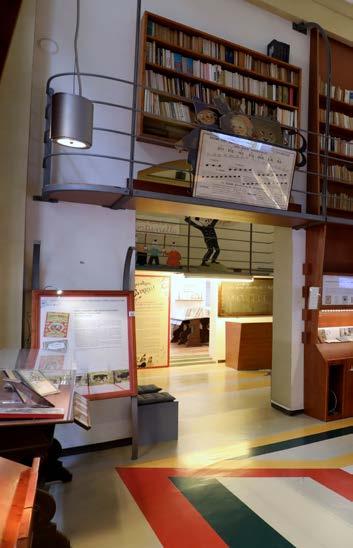
The itinerary continues to the right of the entrance in the large room called Biblioteca Fantastica, which regularly hosts public events, conferences, and book presentations. Part of the room is currently dedicated to the exhibition, highlighting the role of Hoepli and the Italian publishing context contemporary with Meggendorfer. This space features a specific section with four unique-copy movable artifacts created in Italy by the young Florentine schoolteacher Luisa
Before taking the stairs down to the palace’s historic basement, a small wallmounted display case is dedicated to the publisher Vallardi, and visitors can watch a video presentation providing an Englishlanguage preview of the lower floor. Upon entering the basement, you step into a magical world that brings you back to the materiality of the book, featuring original machinery that contextualizes the presence of the printing house Eredi Botta active in the Palace from 1869 to 1903. Set among the machinery, the theme of transparencies highlights the connection between the world of movable books and pre-cinema, which continues into a second, elevated room dedicated to peepshows. At the far end, a room inaugurated in 2021 traces the history of movable books, from the earliest scientific and anatomical examples to the first works for children.
A final room presents a rich overview of movable and interactive books, designed to showcase the main types of mechanisms and structures through video screens built into the display cases that illustrate how they work. The exhibition spaces are further enriched by contemporary art installations created by artist Dylan Jonas
Stone and a kinetic mobile realized by Beth Campbell, as well as contemporary works from students of the Liceo Artistico Passoni and the Accademia Albertina di Belle Arti in Turin.
The opening of the PopApp Museum received extensive media coverage both nationally and internationally through newspapers, television networks, digital platforms, and social media. In its first months of activity, the museum has already experienced a notable increase in visitor attendance. This success has been supported by a calendar of workshops, educational activities, guided tours, and public events aimed at audiences of different ages and backgrounds. Among the most appreciated initiatives are the Pop-Appuntamenti. The initiative aims to cultivate an ongoing dialogue between scholars, artists, educators, collectors, and the wider public, highlighting the inherently interdisciplinary nature of today's interactive book culture.
The inauguration of the PopApp Museum therefore marks not an endpoint, but the beginning of a dynamic new phase. Driven by the rich heritage of historical movable books in its collections, the institution is poised to become an international centre dedicated to both the history and contemporary practices of paper engineering, fostering research, creativity, and interdisciplinary exchange across past and present.
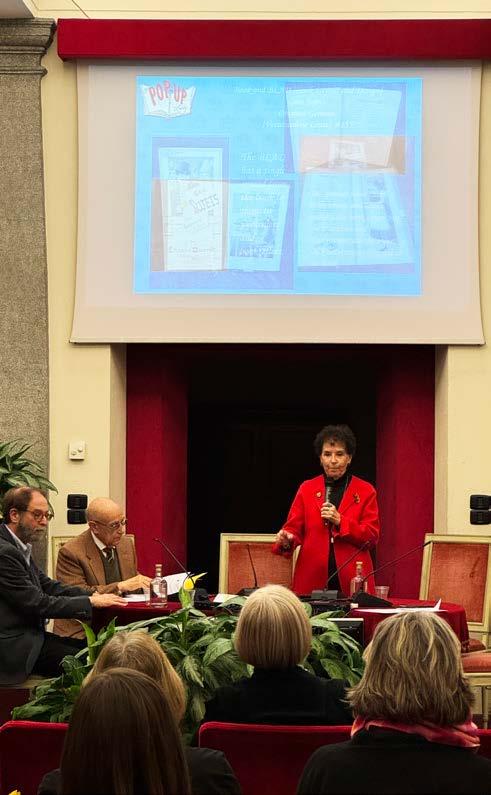
The Inaugural Event of the Pop-App Museum
The Pop-App Museum’s inaugural event took place on 11 December 2025 at Turin’s City Hall, with supporting public and private institutions.
The morning session featured an international round table coordinated by Jacqueline Reid-Walsh. Participants included Suzanne Karr Schmidt, Board Director of the Movable Book Society; Patrick Lecoq and Thierry Desnoues representing Livres Animés; and Carola Pohlmann, former Director of the Department of Children’s Literature at the Staatsbibliothek in Berlin.
The afternoon, coordinated by Lodovica Braida (University of Turin), centered on the volume Lothar Meggendorfer e il contesto editoriale italiano tra Otto e Novecento (FTB, 2025), which I edited. The essay authors discussed their respective research: Eliana Angela Pollone and myself on publishing history; Elisa Marazzi on Pasquale Fornari as Meggendorfer’s translator, educator, and mediator; Martino Negri on Pierino Porcospino Vivente as a playful and ironic reinterpretation of moralistic children’s literature through mechanical animation; Christian Bachmann investigated rhythm, sound, and musicality as structural principles in Meggendorfer’s cartoons and movable books; Ambra D’Aleo and Arianna Re on conservation of two precious items: a movable book by Meggendorfer and a custom, handcrafted album by Luisa Terzi; and my own study on Attilio Mussino’s interactive Pinocchio.
This was followed by two talks by members of the Movable Book Society, Ellen G. K. Rubin (The Popuplady) and Larry Seidman, who generously shared reflections on their respective collections and collecting practices, offering a valuable opportunity for discussion and exchange.
After presentations on the museum’s enhancement initiatives and a future development round table, the day concluded with a reception at Palazzo Barolo. Here, pianist Diego Mingolla performed a piano transcription of a polka by Meggendorfer with original variations (qr code). Both sessions are available online.
From MUSLI to Pop-App Museum: the History of Pop-App Project
Since 2008, the MUSLI (Museum of School and Children’s Book) has featured a dedicated section for movable books, complemented by multimedia stations illustrating their underlying mechanisms. In 2017, in collaboration with Sapienza University of Rome, the Pop-App Project was launched. This initiative culminated in 2019 in two temporary exhibitions held in Turin and Rome, accompanied by a scholarly publication Pop-App, Scienza, arte e gioco dalla carta alle app and an exhibition guide. The project advanced in 2021 with the international online conference POPAPP: Description, Conservation and Use of Movable Books (16-19 February 2021).
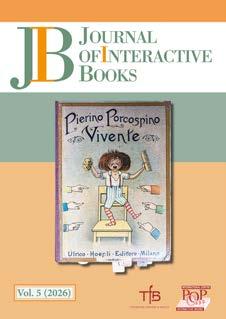

During the event, the Fondazione Tancredi di Barolo announced two major initiatives: the establishment of the Pop-App International Centre on Interactive Books and the launch of the open-access JIB – Journal of Interactive Books. The conference proceedings were subsequently published in the journal’s inaugural issue. Supported by an international scientific committee of professors from Italian and worldwide universities, the study centre coordinates research activities, puts forward cataloging standards, and promotes both digital and physical accessibility through a global collaborative network.
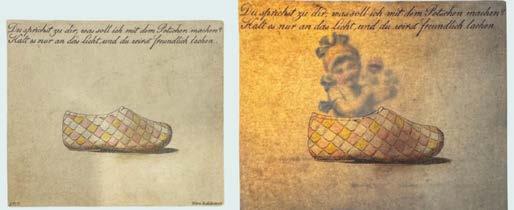
Movable congratulatory cards from the time of Romanticism (1796-1830)
BY LARRY SEIDMAN
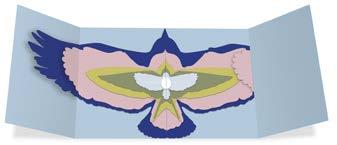
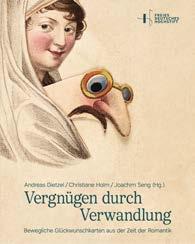
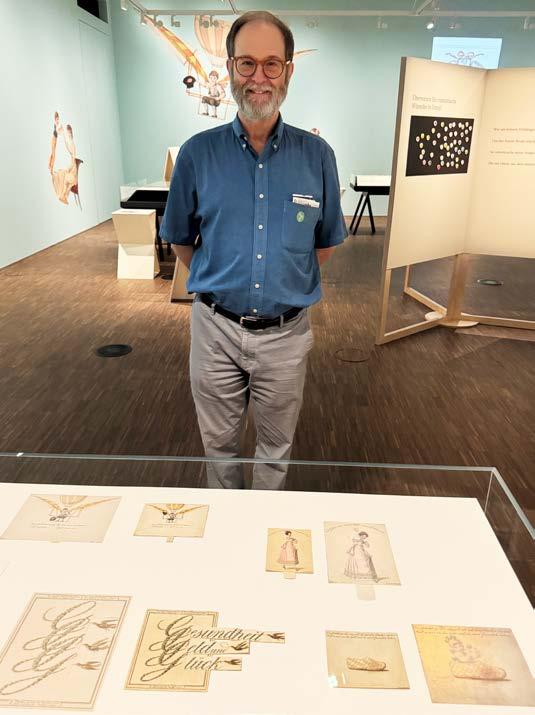
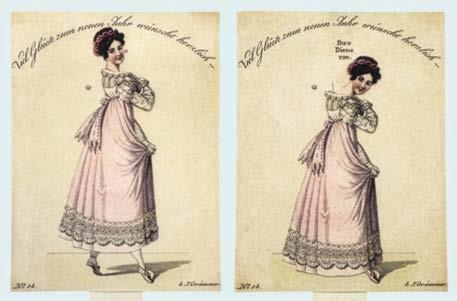
Last month in May, at the Freies Deutsches Romantik Museum in Frankfurt, I attended the opening of an exhibit of 400 movable Biedermeier cards from the collection of Andreas Dietzel. In this display are two Biedermeier cards from my collection: the first is a pull tab activated card and the second is a transformation / hold to the light card (more uncommonly seen).
Johann Wolfgang von Goethe had these two identical cards in his collection. In his journal entry of 1808, he excitedly wrote about receiving these cards as a gift from a friend. Apparently, he showed them off to his lady friends when entertaining in his home. They were a craze in Austria and Germany 200 years ago. And then disappeared. Many antiquarian book dealers and ephemera dealers have never seen one before. They
are some of the earliest predecessors of our modern movable books and have truly ingenious mechanisms. The visually spectacular exhibit, curated by Joachim Seng, will be on view at the Deutsches Romantik Museum and neighboring Goethe-Haus until September. A full color 144 page exhibit catalog in German is available for purchase from the bookstore. https://spikumech.de/eine-neue-ausstellung-mit-den-mechanischen-biedermeier-glueckwunschkarten-in-frankfurt-a-m
https://schwabscantechnik. de/verzeichnis/pdf/sample/ Leseprobe_978-3-945869-37-6.pdf
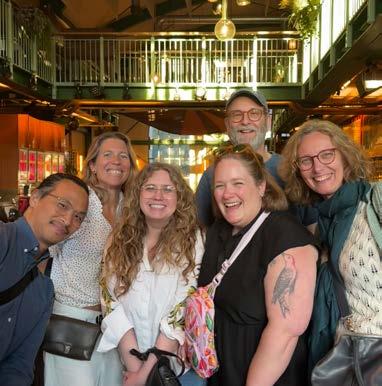
From Frankfurt, I traveled to Amsterdam where I met a couple of old friends, Rianne Van Duin and Maaike Van Der Meulen and a few new: Emily Beck and her colleagues Theresa Berger and Scott Lawan, all visiting from the University of Minnesota. Recently Emily circulated a survey to the members of the Movable Book Society regarding the digitalization of images from movable books.
Interestingly, a similar initiative is underway at Staatsbibliothek zu Berlin (State Library of Berlin).
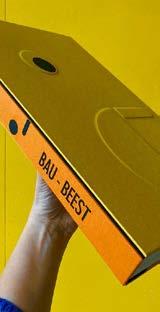
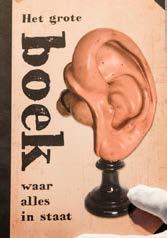
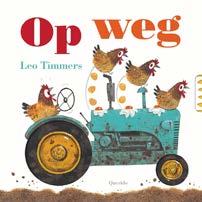
An upcoming issue of Movable Stationery will dive deeper into the efforts and methodology of both these studies. Rianne and Maaike shared their latest work with me that I now share with you here. Rianne's book, "Het grote boek waar alles in staat” (the big book with everything in it) for Boerhaave Museum in Leiden. They use it for an educational program with school classes visiting the museum. Teachers can borrow a smaller version for their classes. And Maaike’s lovely wordless artist book Bau-Beest is a leporello.
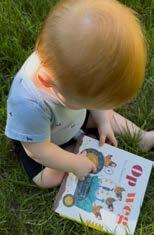
Left: As per Larry, Op Weg, paper engineered by Rianne Van Duin, is very clever, with simple yet sturdy mechanisms that his grandson played with for 20 minutes.
Illustrations by Leo Timmers.
Right: Maaike Van Der Meulen's handmade pop-up book, Bau-Beest. Edition of four, sold out.