BIOGRAPHY
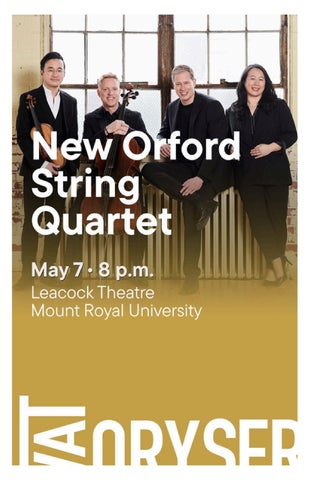
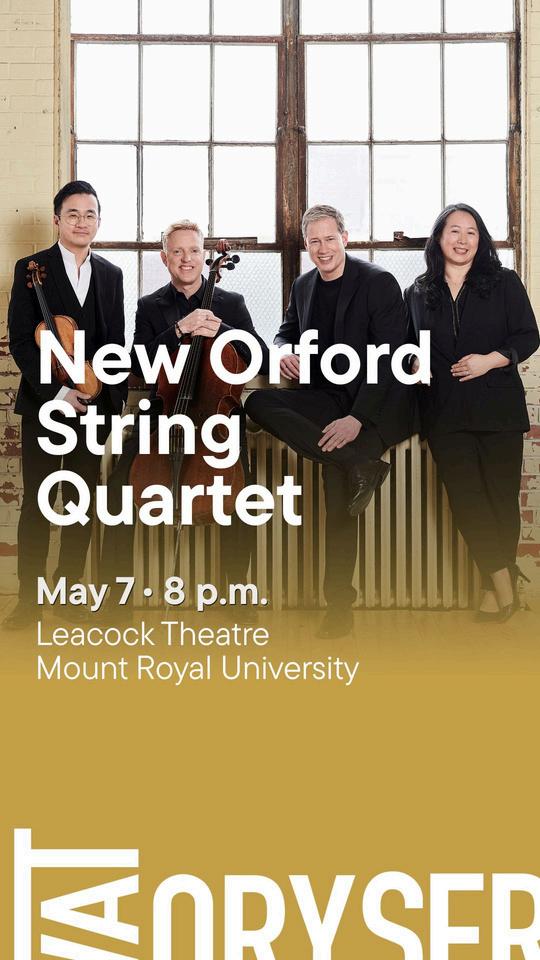
The New Orford String Quartet was formed by four distinguished musicians to reimagine the traditional touring string quartet. Bringing together leading orchestral principals and internationally recognized soloists who reunite regularly, the ensemble combines exceptional artistry with a vibrant, collaborative energy—praised by The Toronto Star as “nothing short of electrifying.”
Since its founding, the Quartet has achieved remarkable success, including frequent national broadcasts on the Canadian Broadcasting Corporation, two Opus Awards for Concert of the Year, and the 2017 Juno Award for Best Classical Album. They have performed in major cultural centres including Chicago, Montréal, Toronto, Vancouver, Los Angeles, and New York, where they made their debut on Lincoln Center Great Performers series.
Andrew Wan (violin) has been Concertmaster of the Orchestre symphonique de Montréal since 2008, while pursuing an acclaimed international career as soloist, chamber musician, and recording artist. He has performed with leading orchestras across North America, Europe, and Asia, appearing under conductors including Rafael Payare, Kent Nagano, Maxim Vengerov, Vasily Petrenko, Bernard Labadie, Carlo Rizzi, Peter Oundjian, Xian Zhang, Michael Stern, and James DePreist.
A dedicated chamber musician, Wan is a founding member of the New Orford String Quartet, one of Canada's most acclaimed ensembles, noted for its dynamic performances and award-winning discography. He has also collaborated with the Juilliard Quartet, Vadim Repin, MarcAndré Hamelin, Daniil Trifonov, Menahem Pressler, Jörg Widmann, Emanuel Ax, Johannes Moser, Arabella Steinbacher, James Ehnes, and Gil Shaham, and is a frequent guest at leading festivals such as Seattle Chamber Music, La Jolla SummerFest, Ottawa Chamberfest, Toronto Summer Music, Orford Musique, St. Prex, Colorado College, and Olympic. He regularly appears as guest concertmaster with the Pittsburgh, Houston, Indianapolis, National Arts Center, Toronto, and Vancouver Symphony Orchestras.
Wan studied at The Juilliard School, earning Bachelor, Master, and Artist Diploma degrees. He is Associate Professor of Violin at the Schulich School of Music of McGill University, where his students have gone on to win prizes at national and international competitions and to secure positions, including principal chairs, in major North American orchestras.
He was Artistic Partner of the Edmonton Symphony Orchestra in 2017–18 and received the Schulich School of Music's Part-Time Teaching Award in 2019. Wan performs on a 1744 Michel'Angelo Bergonzi violin, on loan from the David Sela Collection, and an 1860 Dominique Peccatte bow generously provided by Canimex.
Jonathan Crow (violin), One of Canada’s brightest talents, violinist Jonathan Crow exudes “masterful coolness” (The Montreal Gazette) as concertmaster of the Toronto Symphony Orchestra. Jonathan earned his Bachelor of Music in Honours Performance from McGill University, at which time he joined the Orchestre Symphonique de Montréal as Associate Principal Second Violin. Between 2002 and 2006, Jonathan was engaged as Concertmaster of that symphony, and notably during his tenure, was the youngest concertmaster of a major North American orchestra. In 2011 he was appointed Concertmaster of the Toronto Symphony Orchestra. Jonathan continues to perform as guest concertmaster with orchestras around the world, including the National Arts Centre Orchestra, Boston Symphony Orchestra, Pittsburgh Symphony, Mahler Chamber Orchestra, Filarmonia de Lanaudiere and Pernambuco Festival Orchestra (Brazil). Jonathan has also performed as a soloist with most major Canadian orchestras including the Montréal, Toronto and Vancouver Symphony Orchestras, the National Arts Centre and Calgary Philharmonic Orchestras, the Victoria, Nova Scotia and Kingston Symphonies, and Orchestra London, under the baton of such conductors as Charles Dutoit, Sir Yehudi Menuhin, Gustavo Gimeno, Sir Andrew Davis, Peter Oundjian, Kent Nagano, Mario Bernardi and João Carlos Martins. .
Jonathan joined the Schulich School of Music at McGill University as an Assistant Professor of Violin and was appointed Associate Professor of Violin in 2010. Current and former students of Mr. Crow have received prizes at competitions around the world, including the Menuhin International Violin Competition, Montreal Symphony Orchestra Competition, Shean Competition, CBC Radio's NEXT competition, Eckhardt-Grammatte Competition, Canadian Music Competition, and Stulberg International String Competition, and work regularly with orchestras such as the Los Angeles Philharmonic, National Arts Centre Orchestra, Toronto Symphony Orchestra, Orchestre Symphonique de Montréal, Camerata Salzburg, Konzerthausorchester Berlin, Verbier Chamber Orchestra, Vienna Kammerphilharmonie and Vienna Symphony Orchestra. Jonathan is currently Associate Professor of Violin at the University of Toronto and in Fall 2026 will join the Royal Conservatory of Music as Director of the Temerty Orchestra Program and Violin Faculty.
Sharon Wei (viola) is a dynamic and multi-faceted musician, establishing herself as one of the most respected violists on the scene today. She has appeared as soloist with orchestras including Kingston Symphony, Sinfonia Toronto, San Francisco Chamber Orchestra, and London Symphonia. In 2026 Sharon premiered Saman Shahi’s viola concerto inspired by the Northern Tornadoes Project with the Obiora Ensemble in Quebec and orchestras in Ontario, Nova Scotia and Prince Edward Island. She has performed recital tours across Canada with Debut Atlantic and Prairie Debut.
As a chamber musician, Sharon regularly takes part at festivals such as Marlboro, Verbier, Banff, and Seattle. She is the violist of the awardwinning New Orford String Quartet and has performed with renowned musicians including Claude Frank, James Ehnes, Joseph Silverstein, and St. Lawrence String Quartet. Sharon co-founded Ensemble Made in Canada in 2006 and their Mosaïque Project won a 2021 JUNO for Classical Album of the Year which toured across Canada in both traditional venues and eclectic ones such as the seabed of Hopewell Rocks at low tide.
Sharon has been guest principal violist of the Cincinnati Symphony, Canadian Opera Company, the Verbier Chamber Orchestra and Ensemble Matheus in Paris. She recorded with the Los Angeles Philharmonic on their Grammy recording of Ives Symphonies and 2025 JUNO album Messaien’s Turangalila with the Toronto Symphony.
Joseph Johnson (cello) has been heard throughout the world as a soloist, chamber musician and educator. His festival appearances include performances in all classical genres at the American festivals of Santa Fe, Bach Dancing and Dynamite Society, Bard, Cactus Pear, Grand Teton, and Music in the Vineyards as well as the Pacific Music Festival in Sapporo, Japan, and the Virtuosi Festival in Brazil.
Mr. Johnson has served as Principal Cellist for the Toronto Symphony since the 2009/2010 season. Concerto highlights with the Toronto Symphony include performances of the Dvorak Concerto, Saint-Saens Concerto, Tchaikovsky Rococo Variations, Brahms Double Concerto with Jonathan Crow, Beethoven Triple Concerto with Jan Lisiecki and Jonathan Crow, Schumann Concerto, and Strauss Don Quixote. Other recent recital and concerto appearances include the Brahms Double Concerto with Robert Uchida and Symphony Nova Scotia, CPE Bach Concerto in a minor at University of Toronto, Sofia Gubaidulina “Seven Words” Concerto for cello, accordion (bayan) and strings at the Eastman School of Music, and the Shostakovich Cello Concerto with the Niagara Symphony.
A champion of new Music, Joseph has played the Canadian Premiere of the Unsuk Chin Cello Concerto with the Esprit Orchestra, Canadian Premiere of the Miguel del Aguila Cello Concerto with the Toronto Symphony and Edmonton Symphony, North American Premiere of the Peter Oetvos Cello Concerto with the Toronto Symphony, and the MarcAndre Dalbavie Cello Concerto with the Esprit Orchestra. Next year he is scheduled to give the World Premiere of the Emilie Lebel Cello Concerto with the Toronto Symphony.
Mr. Johnson performs on a magnificent J.B. Vuillaume cello crafted in 1840.
Program Notes: Holberg Suite, Op. 40
Edvard Grieg (1843–1907)
Composed in 1884, the Holberg Suite was written to celebrate the 200th anniversary ofthe birth ofthe Norwegian playwright Ludvig Holberg. Ratherthan imitating Norwegian folk music, Grieg turned backward in time, crafting a work in the style of an 18th-century Baroque dance suite an homage to the era in which Holberg lived.
Originally composed for piano and later arranged by Grieg for string orchestra (the version most often performed today), the suite blends Baroque forms with Romantic expressiveness. Its five movements evoke traditional dances but are infused with Grieg’s characteristic lyricism and harmonic richness.
I. Prelude (Allegro vivace)
The suite opens with a bright, energetic movementfeaturing flowing arpeggios and lively rhythms. It sets a joyful and eleganttone, reminiscent of Baroque keyboard preludes butwith a distinctly Romantic warmth.
II. Sarabande (Andante)
A slow, stately dance in triple meter, the Sarabande is expressive and introspective. Rich harmonies and sustained lines give it a noble, almost solemn character.
III. Gavotte (Allegretto)
Light and graceful, the Gavotte has a charming, courtlyfeel. A contrasting middle section (Musette) suggests a pastoral scene, often evoking the sound of rustic instruments.
IV. Air (Andante religioso)
The emotional heart ofthe suite, the Air is lyrical and serene. Its long, singing melodies create a sense of calm reflection and spiritual depth.
V. Rigaudon (Allegro con brio)
The suite concludes with a lively French dance. Energetic rhythms and playful exchanges between voices bring the workto an exuberant and spirited close.
The Holberg Suite is one of Grieg’s most beloved works, admired for its elegantfusion of old and new. By reimagining Baroque dance forms through a Romantic lens, Grieg created a piece thatfeels both timeless and fresh. It remains a cornerstone ofthe string orchestra repertoire and a favourite among audiences for its charm, clarity, and emotional range.
Program Notes: String Quartet No. 1, “Kreutzer Sonata,” JW7/8
Leoš Janáček (1854–1928)
Composed in 1923, Janáček’s String Quartet No. 1, subtitled “Kreutzer Sonata,” is a gripping and emotionallyvolatile work inspired by Leo Tolstoy’s novella ofthe same name. Tolstoy’s story—itself influenced by Violin Sonata No. 9 (Beethoven) by Ludwig van Beethoven centers on jealousy, passion, and the destructive forces within a troubled marriage. Janáčekwas deeply moved bythe psychological intensity ofthe narrative, particularly its portrayal of a woman trapped in an oppressive relationship.
Unlike a traditional four-movement quartet, Janáček’s work unfolds as a dramatic, almosttheatrical sequence of emotional states. The composer did not aim to depictthe story literally; rather, he soughtto capture its emotional essence. He even described the piece as reflecting his empathyforthe female protagonist, whom he saw as a victim of societal constraints and male cruelty.
I. Adagio – Con moto
The opening movement is tense and fragmented, with abrupt contrasts and restless energy. Urgent motifs and sharp rhythmic gestures suggest agitation and inner conflict, as if multiple voices are struggling to be heard.
II. Con moto
The second movement continues the intensity, driven by nervous rhythms and insistentfigures. Sudden shifts between tenderness and violence create an unsettled, unpredictable atmosphere.
III. Con moto – Vivo – Andante
Here, fleeting moments of lyricism emerge, offering brief glimpses of warmth or intimacy. These are repeatedly interrupted by more agitated passages, reinforcing a sense of emotional instability.
IV. Con moto (Adagio)
The final movement is both passionate and tragic. Surges of intensity give wayto quieter, reflective moments, ultimately leading to a conclusion thatfeels unresolved and haunting.
The “Kreutzer Sonata” quartet stands as one ofJanáček’s most powerful chamberworks. Ratherthan telling a straightforward story, it immerses the listener in a psychological landscape of love, jealousy, and despair an intense and deeply human drama rendered in sound.
Program Notes: String Quartet No. 6 in Fminor, Op. 80
Felix Mendelssohn (1809–1847)
Mendelssohn’s String Quartet No. 6 in Fminor, composed in 1847, stands apartfrom his earlier chamberworks in its intensity and emotional urgency. Written in the final months of his life, the quartet is widely understood as a response to the sudden death of his beloved sister, Fanny Mendelssohn. Their close personal and musical bond made her loss devastating, and this quartet can be heard as an outpouring of grief unlike anything else in Mendelssohn’s output.
Departing from the elegance and balance often associated with his style, this work embraces a darker, more turbulent language. Its dramatic contrasts, restless energy, and expressive volatility reflect a composer grappling with profound sorrow.
I. Allegro vivace assai
The opening movement erupts with agitation. Driving rhythms, syncopation, and urgent, almost breathless motifs create a sense of turmoil. The music rarely settles, conveying anguish and emotional unrest.
II. Allegro assai
Ratherthan offering relief, the second movement is sharp and relentless a kind of demonic scherzo. Its biting rhythms and shadowy character suggest unease ratherthan playfulness.
III. Adagio
The slow movement provides the emotional core ofthe quartet. Lyrical and deeply expressive, it unfolds as a song of mourning. The long, singing lines and rich harmonies evoke both tenderness and profound loss.
IV. Finale: Allegro molto
The final movement returns to the agitation ofthe opening, pushing it even further. Urgent and impassioned, it drives toward a conclusion that feels unresolved, leaving a lingering sense oftragedy.
This quartet is often considered Mendelssohn’s most personal and emotionally raw composition. While his earlierworks are admired fortheir clarity and grace, Op. 80 reveals a more turbulent side, anticipating the heightened emotionalism of later Romantic composers. Though itwas notwidely performed during his lifetime, the quartet is now recognized as a masterpiece ofthe chamber repertoire one that offers a rare and intimate glimpse into Mendelssohn’s innerworld atthe end of his life.