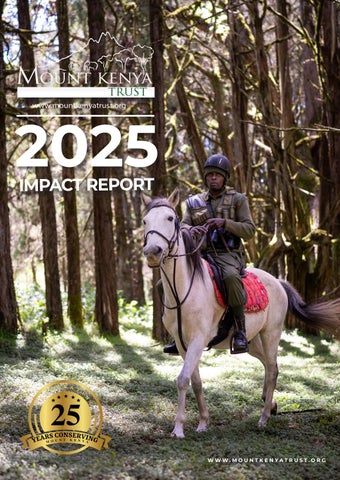
2025 IMPACT REPORT
WWW.MOUNTKENYATRUST.ORG
Executive Director’s Note 2025 was a truly special year for Mount Kenya Trust as we celebrated our 25th anniversary. Looking back to our humble beginnings with a very small team, it is incredible to see how far we have come and the impact we have achieved together. While the year presented challenges, particularly with changes in the fundraising landscape, it also reminded us of the resilience, dedication and innovation of our staff, partners and supporters. Our journey over the past 25 years gives us confidence and optimism as we continue working to secure the future of the Mount Kenya landscape.
Susie Weeks Executive Director, Mount Kenya Trust
Rooster ‘A thousand times we’ve needed you. If love alone could have saved you, you would never have died. In life we loved you dearly; in death we love you still. You held a space in our hearts that no other will fill. It broke our hearts to loose you. We will remember you for your resilience, courage and dedication for you never accepted defeat, you were always on the front line to make sure that our home and ecosystem was taken care of. You always fought easy where others fought hard. Your memories with us will be fresh forever. We will forever miss you and you did not go alone, part of us went with you’ A TRIBUTE TO OUR BELOVED HORSE, ROOSTER By the Horse Patrol Team
2025 IMPAC 23,529KMs Covered In Wildlife and Forest Protection Patrols
1399 Foot, Vehicle and Horse Patrols. 529 Snares Destroyed 13 Kgs of Bushmeat Confiscated 466 Logging Cases Intercepted. 1775 Timber Products Confiscated.
415 Hectares Under Active Restoration With 415,000 newly planted trees 40 Community Tree Nurseries Supported $ 2,3442,600 channeled back to communities through restoration-linked livelihood value chains.
CT 1,492 Elephant journeys through the Mount Kenya Elephant Corridor
174,074 People Reached With Healthcare Services And Information
55.1 Hectares Of Wildfire Controlled 4,944 Reached Through Community Sensitisation And Education
2025 PROGRAMME HIGHLIGHTS WILDLIFE AND HABITAT PROTECTION This year, our ranger teams stood at the frontline of the Mount Kenya ecosystem’s protection, carrying forward a legacy of vigilance, skill, and partnership. Rangers deepened their Ranger Life Saver training alongside KWS, and broadened their expertise through specialised courses in coexistence protection with Lion Landscape, counter-terrorism awareness with the National Counter Terrorism Centre, and GPS and QGIS mapping. Our rangers also stepped into the role of citizen scientists, joining the Lewa annual wildlife count across the Mount Kenya-Lewa landscape and supporting groundtruthing data collection for our active restoration project, that now sits alongside daily patrols tracking wildlife presence and movement across the ecosystem. Collaboration ran through everything our teams did this year. Joint operations with KWS and KFS dismantled illegal cannabis cultivation, intercepted illegal logging and charcoal production, and brought repeat offenders to court, while the horse patrol and community teams battled wildfires before they could spread into larger forest blocks. Community engagement deepened this trust further. Rangers convened forest users, Community Forest Associations, and local administration to address illegal grazing, logging, and firewood collection, and communities returned that trust with shared intelligence and support during emergencies.
EDUCATION In 2025, collaboration within the departments and the education teams, and externally with other organisations, government, community and educational institutions was evident. Across our programmes, the education teams delivered dialogues, community sensitisation and training around forest restoration, linking health to conservation, forest and wildlife protection through sessions in hotspot areas. The team also trained institutions like Kenya Wildlife Service and 5 Community Forest Associations on forest fire mitigation and response. The 5 CFAs have since been equipped for response. The Junior Ranger Programme on the other hand installed key infrustructure to integrate digital literacy in schools in preperation for the integrated programme launch in early 2026. However, the Junior Ranger Programme sessions still continued.
ACTIVE RESTORATION After concluding active planting of 370 hectares in Marania and Karuri, the team shifted focus to monitoring seedling growth and community benefits through TELIS, combining satellite-based NDVI tracking with ground survival assessments across all established plots. The survival exercise found a forest taking root, dominated by Red Cedar and Wild Olive planted deliberately to mirror the adjacent natural forest. Seedling health remains strong overall, though localised mortality in specific plots and gaps in photographic verification have prompted engagement with the Station Forest Manager and CFA leadership to address accountability and strengthen monitoring protocols. A focus group discussion with 40 TELIS farmers captured a season of early frost and drought that cut both ways: many lost their harvests, while others benefited from a sharp rise in market prices. Despite this divide, every farmer affirmed TELIS had strengthened their income, and their commitment to protecting the forest held firm regardless of harvest outcome, rooted in what the forest provides in water, grazing, and clean air. In Imenti, management of previously planted trees had stalled since late 2023 under government restriction. A joint site visit between KFS, Lower Imenti CFA, and MKT reopened the area for TELIS, and a twenty-member community team subdivided the plots to bring every gap in tree canopy into the scheme. Plots were allocated to CFA members, who began clearing the Lantana bushes that had regenerated and were choking the young trees beneath them, a hands-on revival of ground once left behind.
HEALTH A key highlight for this year was the official launch of our Menstrual Health project with 500 dignity packs distributed during the launch. The rangers graced this event in solidarity with the health project and showed up for the young girls in the community as well. We are grateful to all our partners who supported us this journey. Through your support, we will ensure that girls stay in school throughout their school year and that we reduce risks that plague teenage girls in the region as due to period poverty. We faced challenges on overall shortage of medical commodities to serve our outreaches. This is a nationwide concern that causes a hike in pricing, increase in medical costs and total stockouts thus limiting access. We however managed to achieve good coverage.
25 YEARS OF IMPACT
1999
2007
2011
E The founding trustees establish ‘The Bill Woodley Mount Kenya Trust (MKT) frollowing the publication of a report on the widespread destruction of Mount Kenya Forests
E The Trust begins an elephant fencing project in the Sirimon area to reduce Human/ Elephant Conflict. By 2012, MKT had built over 100km of two-strand fences and 7km of ‘short’ elephant fences in Nyeri and Meru Districts [now Counties].
E The Horse Patrol Team [HPT] is established with support from Kisima Farm and donor partners
2000 E In response to the report, the government gazettes Mount Kenya National Reserve, covering the Forest Reserve to enhance the protection of the indigenous forests. E MKT employs a Field Coordinator and Executive Officer to manage the Trust’s projects. In the same year, the first two-strand elephant fence and the first of the Trust’s ranger teams, the Marania Wildlife Guards [MWG], was established.
2002 E The inaugural 10 to 4 Mountain Bike Challenge is held. The course runs from the Mt. Kenya boundary at 10,000 ft elevation down to Il Ngwesi Group Ranch at 4,000 ft.
2004 E Indigenous forest restoration projects begin at Irangi, the first large-scale indigenous planting project on Mount Kenya.
2005 E The Trust conducts its first conservation education outreach programme with partners.
2008 E The Joint Wildlife Protection Team [JWPT] was formed at Ruthumbi. Community guards and KWS Rangers make up the team of nine. It quickly becomes an effective team curtailing illegal activities on the northern sector of the mountain.
2009 E The construction of the elephant corridor is carried out. MKT spearheads the project, working with partners Kisima Farm, Marania Farm, Lewa Wildlife Conservancy and Rhino Ark. This corridor re-established connection for wildlife movements between the Mt. Kenya forests and Lewa Conservancy and adjacent conservation areas, including through a road underpass
2010 E On New Year’s Day, ‘Tony’ becomes the first elephant to walk through the corridor underpass, East Africa’s first constructed wildlife corridor, just a day after the fences and underpass beneath the Nanyuki – Isiolo/Meru highway are connected
2012 E The MKT’s second major forest rehabilitation project begins in the Karuri area
2014 E The MKT Community Health Service Project begins with a one-year pilot project in collaboration with CHASE Africa. The project has grown ever since.
2016 E MKT supports a comprehensive elephant population survey run by the Wildlife Conservation Society. As of 2020, the elephant population in the Mount Kenya ecosystem was estimated at approximately 1,905 individuals
2017
E MKT begins new projects in the Imenti Forest Reserve [NE Mt. Kenya] and the Imenti Patrol Team [IPT] is formed.
2018 E Two automated elephant one-way gates are established in the Imenti forest to reduce HEC and fence breaking by annually migrating elephants. The herds follow their historic route between Samburu and Shaba to Imenti and Mt. Kenya forests.
2020
E MKT, Rhino Ark Trust and Tropic Air assist KWS and KFS in fighting a moorland fire that burnt an estimated 20,000 hectares. This includes coordinating logistics and raising emergency support to cover the costs of rations, equipment, fuel, vehicle hire and reconnaissance aircraft.
E MKT conducts a pilot survey to determine the condition and use of riparian land by wildlife, livestock and people on the Timau, Teleswani, Sirimon and Ontulili Rivers, which all feed the Ewaso Ng’iro River.
2022
2023
E MKT is first runner-up in the African Conservation Award conservation team category.
E MKT wins the Earth Ranger Conservation Tech Award 2023 for The Best Application of Technology through the Junior Ranger Programme.
E The Junior Ranger Programme is launched which, aligned with the Ministry of Education curriculum, aims to educate and inspire students around Mt. Kenya on environmental conservation
E Six MKT rangers graduate as Non-Commissioned Officers (NCOs) to the ranks of Corporal and Sergeant following a rigorous training course run by KWS.
2024 E MKT embarks on a transformative journey towards building its 5-year strategy in partnership with Maliasili. E The Community Health Programme launches its Menstrual Health and Hygiene project to provide free dignity packs to teenage girls in forest-edge communities, therefore keeping them in school and reducing risk to teenage girls in the region. The first batch was distributed to 500 girls. E MKT hosts a Nigerian delegation for a benchmarking visit on bushmeat hunting.
2025
2019
FOREST RESTORATION Humphrey Munene Restoration Manager
This year gave us an opportunity to better understand the long-term livelihood impacts of restoring degraded forests across the Mount Kenya landscape. Despite funding constraints affecting tree planting activities, our dedicated tree monitoring programme ensured we continued tracking the progress of active restoration sites. I was also pleased that, through generous donor support, we improved ranger welfare by cladding our ranger camps, creating better living conditions for the teams who protect our biodiversity every day.
One of my greatest highlights this year was seeing our community tree nursery groups become more self-reliant and sustainable. With Mount Kenya Trust’s support, many groups installed water harvesting systems that have helped overcome the challenges of unreliable rainfall, improving both the quality and quantity of seedlings produced. We also witnessed groups diversifying species of tree seedling being nurtures with some groups picking up growing of fruit trees to earn more.
Joseph Ngarira Community Forester
It has also been encouraging to see the groups strengthen their business skills by adopting procurement systems such as quotations, invoices and receipts, making them stronger and more resilient community enterprises.
WILDLIFE AND HABITAT PROTECTION Enock Ocheing Patrol & Monitoring Manager
A key highlight for me in 2025 was the increased effort and commitment shown by our ranger teams across the Mount Kenya landscape. Their patrols and monitoring generated valuable information that not only strengthened wildlife protection but also provided critical evidence to guide community engagement and proactive conservation interventions. Seeing the direct impact of their work reaffirmed the vital role rangers play in protecting this landscape.
COMMUNITY HEALTH Despite periodic shortages of medical commodities, our team successfully reached our target communities and continued delivering essential healthcare services. We were delighted to welcome new partners, including Paddy & Scott’s and the Olvea Foundation, whose support has been instrumental in expanding our impact, particularly in addressing period poverty. One of my proudest moments was launching our Menstrual Health and Hygiene Programme, which trained women to produce reusable sanitary pads and enabled us to distribute 1,058 dignity packs to vulnerable schoolgirls in Meru. On a personal level, being recognised as Staff Member of the Year shortly after returning from maternity leave was an incredibly humbling and encouraging experience.
Ketty Gitonga Community Health Manager
EDUCATION AND COMMUITY SENSITISATION Edwin Kinyanjui Community Sensitisation Manager
One of the most rewarding achievements this year was seeing improved community attitudes towards conservation through our awareness and sensitisation programmes. Stronger collaboration with communities also contributed to faster and more coordinated wildfire responses, significantly reducing response times. These partnerships continue to demonstrate that lasting conservation is built on trust, shared responsibility and active community participation.
Although the Junior Ranger Programme was temporarily paused during 2025, it provided a valuable opportunity to strengthen the programme from within. We focused on reviewing and improving the curriculum and learning modules while investing in digital learning infrastructure at our pilot school in preparation for the programme’s relaunch. These improvements have positioned us to deliver an even stronger learning experience for the next generation of conservation champions.
Paxton Maina Education Manager
What It Takes To Regrow A Forest Mount Kenya is Kenya’s principal water tower and one of its richest biodiversity strongholds, and its conservation cannot be pursued in fragments. It demands a strategy as expansive as the mountain itself, one that treats the landscape as a single interconnected system, its watersheds, wildlife corridors, riparian buffers and agricultural margins bound together ecologically. For MKT, this means active reforestation with indigenous species, facilitating natural regeneration where the land can recover unassisted, and safeguarding standing forest through ranger patrols, fire management and fencing, all anchored in the livelihoods of the communities who share the landscape with the forest.
The Reality: Adaptive Learning Restoring a mountain ecosystem of this scale rarely goes strictly according to plan therefore calling us to consistently learn and adapt. Over the past decade, dynamic environmental pressures have tested the resilience of both our planted sites, existing forest and naturally regenerating zones. This year’s planting seasons were characterised by a stark duality: a severe climate shock in the form of early frost and drought led to widespread crop failure for many farmers within and
A decade ago, sites such as Marania, Ontulili and Imenti
outside the TELIS areas. This climate shock, compounded by
were degraded, invasive dominated ground with little eco-
insufficient rainfall, was the overwhelming cause of poor har-
logical function remaining. Today, over three million young
vests and, in a few cases, complete crop failure.
indigenous trees anchor thousands of hectares of regenerating canopy, including 507,478 seedlings established across Marania and Karuri alone within the last two years. We also actively protect the 270,000 Hectare standing forest through thousands of kilometres of strategic patrols, monitoring and ongoing community education and sensitisation, and responding to threats including forest fires, logging, bushmeat hunting and human-wildlife conflict. Protection does more than protect old-growth trees, it secures the seed banks, water catchments and soil health necessary for the broader forest to heal itself and protects wildlife.
The same dry period that stresses vegetation also elevates fire risk across the landscape, a hazard historically managed through informal, reactive response. 14 fires were recorded this year. However, 4 Community Forest Associations trained on first response to fires made response relatively efficient, coordinated better and timely.
The forest area time-series analysis presented the temporal trend in forest cover within the Marania, Ontulili, Gathiuru and Narumoru forest blocks from 2022 to 2025. Across the wider ecosystem, stable forest cover has expanded from approximately 41,000 hectares in 2022 to over 45,000 hectares in 2025, with regeneration consistently outpacing deforestation through 2024. A modest modest resurgence in forest loss was evident this year this year highlighting need for insensified and strategic approaches to forest monitoring, community sensitisation and expansion into supporting or expanding access to alternative livelihood channels.
Forest Area Time Series Analysis 2022-2025
Our Next Chapter: A Mountain-Wide Restoration Strategy As our presence across Mount Kenya grows, our approach must evolve alongside it. We are leveraging our real-world learnings to sharpen our long-term strategy and by balancing active reforestation with natural regeneration, this helps us to adapt to dynamic conditions on the ground. Activities include mapping highrisk micro-climates and designing natural firebreaks to protect vulnerable growth zones before fires occur, strengthening our ground support by expanding local rapid-response teams, satellite monitoring of real-time work, and community tree monitor and ranger patrol networks, defending both newly planted plots and naturally regenerating areas. Ultimately, through this intensified FLR framework, we are ensuring that every intervention, protection patrol, and community effort works together to secure the long-term health of Mount Kenya’s entire ecosystem. This shift ensures our work doesn’t just restore what was lost, but safeguards the mountain for generations to com
What a Blood Pressure Cuff Has to Do With a Forest
Conservation and health organisations have long recognised that healthcare access and forest stewardship cannot be separated, they are two outcomes of the same intervention, shaped by how communities coexist with nature and sustainably use the resources around them. Where drivers such as food insecurity, poverty, health disparities and social inequality are addressed alongside environmental protection and restoration, communities gain the capacity for forest stewardship, and the pressures that drive environmental destruction ease. At the same time, healthy environments sustain healthy populations, the relationship runs both ways. Mount Kenya Trust’s Community Health Service began as a one year pilot in 2014 and has grown steadily since, now delivering mobile health services to over 40,600 community members every month across forest-adjacent areas that would otherwise have little or no access to quality care. Its health education reach extends to close to 450,000 people, addressing a stark gap given that only half of Kenyans can access a health facility within five kilometres, a distance that leaves many unable to afford or reach the care they need. Two accounts from a 2025 outreach in Meru County show what that access looks like when it reaches someone at the right moment. At Gatimbi, in Imenti Central, Kenya, an 80-year-old woman came to the outreach seeking treatment for persistent back pain, a condition she had lived with for years without knowing its cause. At triage, a Community Health Promoter ran the standard checks given to every client, blood pressure and blood sugar, and found both critically high. She had never been diagnosed with diabetes or hypertension, and given her age and financial circumstances, regular hospital visits had never really been within reach. The team stabilised her on-site with fluids and medication, and a clinical officer counselled her and her family together on how to manage both conditions going forward. She was referred to Gatimbi Health Centre for continued treatment and medication refill. “I understand my condition now,” she said. “If I had not gone to that outreach, I believe I would still be in pain, not knowing why.” Further north, in Gitine, Mutiokiama and Kionyo, the same outreach period identified a second case through routine cervical cancer screening. The woman, whose identity has been withheld at her request in line with the consent given for her story, had noticed bleeding and discomfort but assumed it was minor, distance and cost having kept specialised screening out of reach until then. The screening returned severe abnormalities, and she was referred immediately for a biopsy at Kanyakine Level 4 Hospital, which confirmed a serious condition requiring specialist treatment. What made her follow through, she said, was a nurse who personally escorted her to the referral appointment rather than leaving her to navigate the process alone. She now encourages other women in her community to attend outreach screenings rather than avoid them. A forest cannot hold if the people living beside it are too unwell or too stretched to think past survival. Every condition caught early is one less household pushed toward the forest to get by, and one more family with the stability to protect it instead. Mount Kenya’s future will not be decided by interventions that exclude the human population, but by whether the communities on its edges are healthy and prosperous enough to sustain it.
The Tropic Air 10to4 Mountain Bike Challenge returned in 2025 as one of East Africa’s premier mountain bike events, bringing riders from across the globe to take on the trails of Mount Kenya and Laikipia over three unforgettable days. Around 400 participants camped in the wild at Borana Conservancy, tackling daring terrain to advance our conservation work across the Mount Kenya ecosystems. We’re deeply grateful to Tropic Air, our Title Sponsor, and to every brand, big and small, that backed the challenge this year, and to every rider who showed up, pushed through the climbs, and chose to make their sweat count for the mountain. As one participant put it after the race, the experience is one their whole family will remember for years to come. Thank you for making 2025 unforgettable, we can’t wait to make more memories and more impact with you.
Looking back on 2025, I’m proud of how far Mount Kenya Trust has come. We’ve built stronger systems, sharpened our focus, and deepened our commitment to the communities and landscapes we serve. Growth, for us, has never just been about scale. It’s about becoming a more resilient and trustworthy partner for the long term.
Beatrice Koskei Operations Coordinator One of my biggest highlights in 2025 was seeing the organisation embrace systems that strengthened our day-to-day operations and improved efficiency across teams. I was equally encouraged by the introduction of our staff recognition programme. Celebrating outstanding team members boosted morale, strengthened teamwork and reinforced a culture where dedication and excellence are recognised and appreciated.
FINANCIAL OVERVIEW
Laila Kassam Head Of Finance And Operations
STATEMENT OF FINANC ACTIVITIES Year Ended In December 31st 2025
INCOME Donations and grants
104,361,495.00
Interest and other income
336,952.00
Exchange Gain Total Income
61,910.00 104,760,357.00
EXPENSES Project Costs Finance Costs Salaries and Wages
91,896,045.10 462,341.00 8,683,476.00
Operating Costs
3,381,542.90
Total Expenses
104,423,405.00
CAPITAL EMPLOYED Share Capital Retained Surplus Total Capital Employed
160.00 13,923,597.00 13,923,757.00
REPRESENTED BY Non-current assets Current assets Current liabilities
7,432,430.00 9,722,548.00 (3,231,221.00)
Total Income
104,760,357.00
CIAL
TROPIC AIR 10TO4 MOUNTAIN BIKE CHALLENGE SPONSORS AND PARTNERS DONORS We are hugely grateful to all our donors, supporters, and partners whose generosity and collaboration make our work possible. Darwin Extra Elephant Cooperation Tusk Trust International CHASE Africa Batten Foundation Minara Foundation Sukuma Twende Trust Eden Wildlife Trust African Fund for Endangered Wildlife Timaflor Limited Paddy & Scotts Coffee Ernest Kleinwort Foundation International Elephant Foundation Tusk Trust Limited Sheldrick Wildlife Trust Thin Green Line Foundation Anonymous Lewa Wildlife Conservancy Olvea Foundation Tree Nation Avenue Marania Limited Turkana Basin Institute Ltd Oldonyo Farm Timau Ltd Kisima Farm Ltd Tropical Health and Education Trust (THET)
Capacity-Building Partners LEAD Conservation Maliasili
Tropic Air Dormans Coffee Borana Conservancy Lewa Wildlife Conservancy Tropical Heat Bayer East Africa Kisima Farm Marania Farm Flamex Petroleum Born Free Foundation JW Seagon Southern Cross Safaris Uhuru Flowers HM CLAUSE Rift Valley Adventures Farmer Max Auto Express Mount Kenya Wildlife Estate Neo Wood Studios Rasvine Tours Oldonyo Farm Timau Well Hung Butcher Arijiju Borana Lodge Laragai House Tambuzi Roses Sirai House Leo Project Wild Rides Braeburn Nanyuki Rhino Ark Charitable Trust Nanyuki Cottage Hospital Savage Wilderness Bike Shop Kenya Wildlife Service Kenya Forest Service Ngare Ndare Forest Trust Rusty Nail Excel Chamicals Browns/Delias
Secure The Future Of Mount Kenya, A UNESCO World Heritage Site and Man and Biosphere Reserve, For People and Biodiversity. ONLINE DONATIONS
CHEQUES AND BANK TRANSFERS
Explore our secure donation options by visiting our donation page: https://www.mountkenyatrust.org/donate
For account details and other donation inquiries please contact our Head of Finance and Operations
PARTNERSHIPS AND COLLABORATIONS
lkassam@mountkenyatrust.org
SPONSOR THE 10TO4 MOUNTAIN BIKE CHALLENGE
Protecting the Mount Kenya ecosystem requires strong partnerships, shared knowledge, and collective action. Mount Kenya Trust works with government agencies, communities, private sector partners, researchers, and conservation organisations to deliver impactful, longterm solutions across the landscape. We are always looking to partner with organisations and individuals who share our commitment to conservation and sustainable development. If you are interested in working with us, we welcome the opportunity to explore how we can create meaningful impact together.
Be a part of the Tropic Air 10to4 Mountain Bike Challenge and fuel an unforgettable sporting experience that draws riders from around the world, while directly supporting the conservation of Mount Kenya’s ecosystems and the communities who protect them. Sponsors gain sustainability-driven branding, exclusive positioning before a diverse local and international audience, and high-impact media visibility across local and global platforms. Partner with us, where conservation meets adrenaline.
https://www.mountkenyatrust.org/collaborate
Contact: 10to4@mountkenyatrust.org
www.mountkenyatrust.org
Mount Kenya Trust · PO Box 690 · Nanyuki 10400 · Kenya