
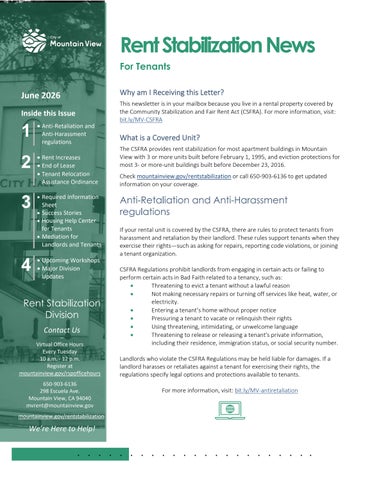
This newsletter is in your mailbox because you live in a rental property covered by the Community Stabilization and Fair Rent Act (CSFRA). For more information, visit: bit.ly/MV-CSFRA
The CSFRA provides rent stabilization for most apartment buildings in Mountain View with 3 or more units built before February 1, 1995, and eviction protections for most 3- or more-unit buildings built before December 23, 2016
Check mountainview.gov/rentstabilization or call 650-903-6136 to get updated information on your coverage.
If your rental unit is covered by the CSFRA, there are rules to protect tenants from harassment and retaliation by their landlord. These rules support tenants when they exercise their rights such as asking for repairs, reporting code violations, or joining a tenant organization.
CSFRA Regulations prohibit landlords from engaging in certain acts or failing to perform certain acts in Bad Faith related to a tenancy, such as:
• Threatening to evict a tenant without a lawful reason
• Not making necessary repairs or turning off services like heat, water, or electricity.
• Entering a tenant’s home without proper notice
• Pressuring a tenant to vacate or relinquish their rights
• Using threatening, intimidating, or unwelcome language
• Threatening to release or releasing a tenant's private information, including their residence, immigration status, or social security number.
Landlords who violate the CSFRA Regulations may be held liable for damages If a landlord harasses or retaliates against a tenant for exercising their rights, the regulations specify legal options and protections available to tenants.
For more information, visit: bit.ly/MV-antiretaliation
Not signing a new lease is not a reason for eviction.
What does this mean? The CSFRA limits the reasons for eviction to 9 “just causes.” Not having a lease or signing a new one, is NOT one of these 9 termination reasons. This means a tenant is not required to sign a new lease at the end of their current term or when a new landlord or property management company takes over. If a tenant chooses not to sign a new lease, the tenancy continues on a monthto-month basis under the terms of the prior lease. While the tenancy continues on a month-to-month basis, the landlord is still required to have a "just cause" to terminate the tenancy. The landlord may impose a rent increase on the tenant if 12 or more months have elapsed since the tenant’s move-in date or since the last increase.
Rent increases for rent-stabilized units are limited to the Annual General Adjustment (AGA), an increase based on the rate of inflation and approved by the Rental Housing Committee (RHC). Landlords may give this annual rent increase from September 1 through August 31 of each year. The 2026 allowed increase is 2.5% and can be given starting September 1, 2026
2026 AGA: 2.5%
(September 1, 2026 – August 31, 2027
If no increase is given, landlords may bank the increase and give it in a later year, together with the AGA for that year, for a total increase of up to 10%. To impose a banked increase, a landlord must provide a tenant with a banked increase notice that includes specific, mandatory language and must send a copy of the notice to the Division within 7 days of serving the tenant. Qualifying tenants can file a Tenant Hardship Petition to request an exemption from banked increases.
When can my rent be increased?
A landlord may increase rent when in substantial compliance with the law, which means:
• At least 12 months have elapsed since the last rent increase
• Annual Rental Housing Fees are paid

• Property is registered with the City at mvrent.mountainview.gov
• Landlord is otherwise in compliance the CSFRA (including not having outstanding code violations on the property)
• Tenant was served a 30-day written increase notice as required by state law
Displacement of tenants might require providing tenant relocation assistance through either the City’s Tenant Relocation Assistance Ordinance (TRAO) and/or the State’s Housing Crisis Act of 2019, also referred to as SB330. Relocation assistance is intended to help eligible households with the cost of moving and securing replacement housing. Eligible tenants also have the right of first refusal to a newly constructed unit if their home is demolished and redeveloped. Demolition of rental properties may also trigger requirements to replace the demolished units with affordable rental or ownership housing.
To determine which laws may be applicable to your situation, see the Tenant Relocation Administrative Guidelines. These guidelines provide an overview of key provisions from the City's TRAO regulations and State Law SB 330. The more generous or protective of the TRAO or SB330 requirements shall prevail where applicable. Please refer to each respective law for the complete text and requirements. These guidelines may be revised from time to time to clarify or revise procedures consistent with state law.
For more information, visit bit.ly/MV-TRAO For questions, please contact Andrea Kennedy by phone at (650) 903-6125 or by email at andrea.kennedy@mountainview.gov.
The CSFRA requires that tenants be provided with an Information Sheet at the beginning of their tenancy and with each rent increase notice. The Information Sheet provides general information about tenants' rights and landlords' obligations under the CSFRA. An updated Information Sheet has been published on the website and is available in English, Spanish and Mandarin.
You can find these forms at: bit.ly/MV-Forms
At a Día del Niño outreach event at a local elementary school in Mountain View, a brief conversation led to meaningful relief for a tenant covered by the Community Stabilization and Fair Rent Act. A Spanish-speaking resident approached our team to learn more about the Rent Stabilization Division. With staff assistance, she confirmed through the portal that her unit was covered under the law something she had not previously known. After learning about her rights, she shared concerns about significant rent increases and ongoing habitability issues. With guidance from staff, the tenant filed a petition. The Hearing Officer ordered a rent reduction for the affected period, a refund of unlawfully charged rent, completion of necessary repairs, and a recalculation of the lawful base rent.
This success story highlights the power of community outreach: one conversation connected a resident to her rights, prevented further harm by educating her landlord about their obligations and ensured her home was made safe and affordable.

The Housing Help Center connects tenants in Mountain View with support services and housing resources.
Contact the Program Today!

Visit us at the Housing Help Center
• Housing Programs: Learn about rent stabilization, apply for affordable housing, and connect with rental assistance programs
• Eviction Questions: Review eviction notices and the eviction process with staff to understand what's happening and the potential outcomes
• Legal Resources: Connect to legal resources and assistance
• Support Services: Get information on food distribution, financial assistance, mediation, homelessness prevention resources and more
p.m.
298 Escuela Ave. Mountain View, CA 94040 | Walk-ins welcome Attend virtually during clinic hours at: mountainview.gov/housinghelpclinics
Clinics are bilingual in English and Spanish. Email mvrent@mountainview.gov to request other languages 48 hours in advance.
Don’tknowhowtosolveanissueyouhavewithyourlandlordorneighbor?TryMediation!
The Mountain View Mediation Program provides free dispute-resolution services to landlords and tenants in Mountain View. As possible solutions arise, trained mediators help guide participants toward a resolution of their own making.
It’s fast, confidential, free and effective!
Successfully resolved cases include: mediate4mv@housing.org 650- 960-0495
• Landlord/tenant issues
• Security deposit issues
• Noise complaints
• Roommate conflicts
• Neighbor issues
City of Mountain View
298 Escuela Ave
Mountain View, CA 94040
ADDRESS CORRECTION
REQUESTED
Understanding Utility Adjustment Petitions
• July 7th, 2026 |6:00 p.m. | Virtual
I Got a Rent Increase...What's Next?
• August 14th, 2026 |6:00 p.m | Virtual
What to Know About Affordable and Below Market Rate Housing
• September 1st, 2026, 2026 |6:00 p.m. | Virtual
Understanding Anti-Harassment and Anti-Retaliation Protections
• September 15th, 2026 |6:00 p.m | Virtual
CSA Resources: Learn about the Community Services Agency (CSA) in Mountain View
• October 6th, 2026 |6:00 p.m |Virtual
Rent Stabilization 101 (Senior Focused)
• October 22nd, 2026 |2:00 p.m. |Senior Center Social Hall
For virtual webinars, go to mountainview.gov/rspwebinars
• Allowed Rent Increase as of September 1, 2026: The maximum allowed rent increase from September 1, 2026 to August 31, 2027 is 2.5% for fully covered CSFRA units.
• Tenant Relocation Assistance Ordinance Revised: Displacement of tenants might require providing tenant relocation assistance
• What happens at the end of a lease? Not signing a new lease is not a reason for eviction.
• Required Information Sheet: The CSFRA requires that tenants be provided with an Information Sheet at the beginning of their tenancy and with each rent increase notice
• Anti Retaliation and Anti-Harassment Regulations: If your rental unit is covered by the CSFRA, there are rules to protect tenants from harassment and retaliation by their landlord.
See inside for details!