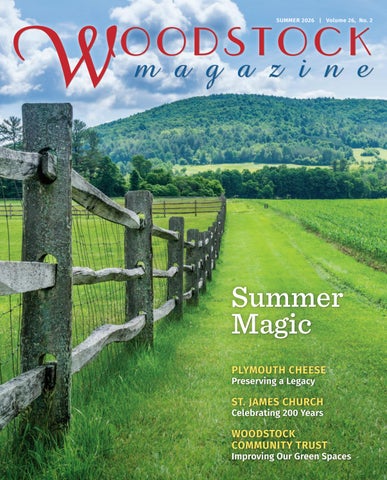
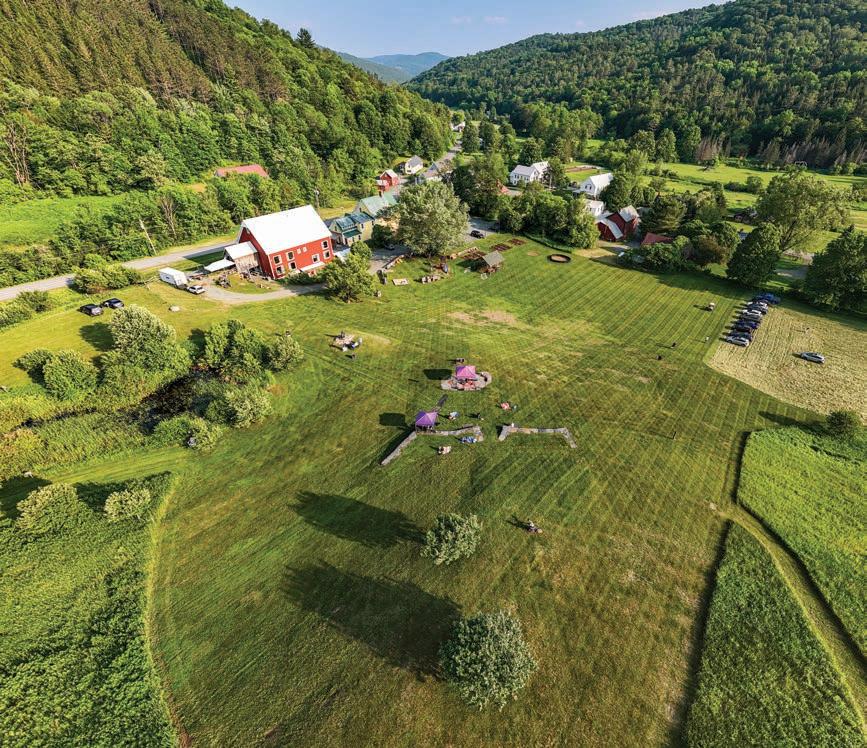
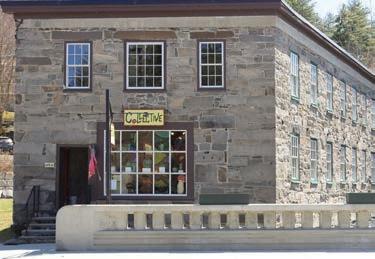
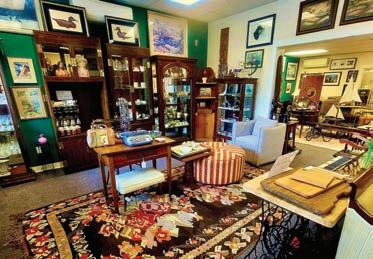
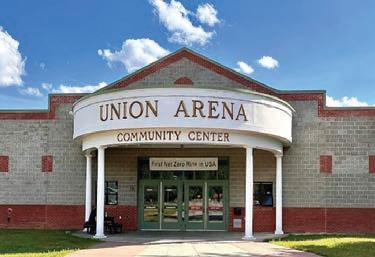
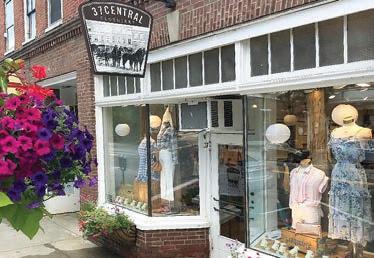
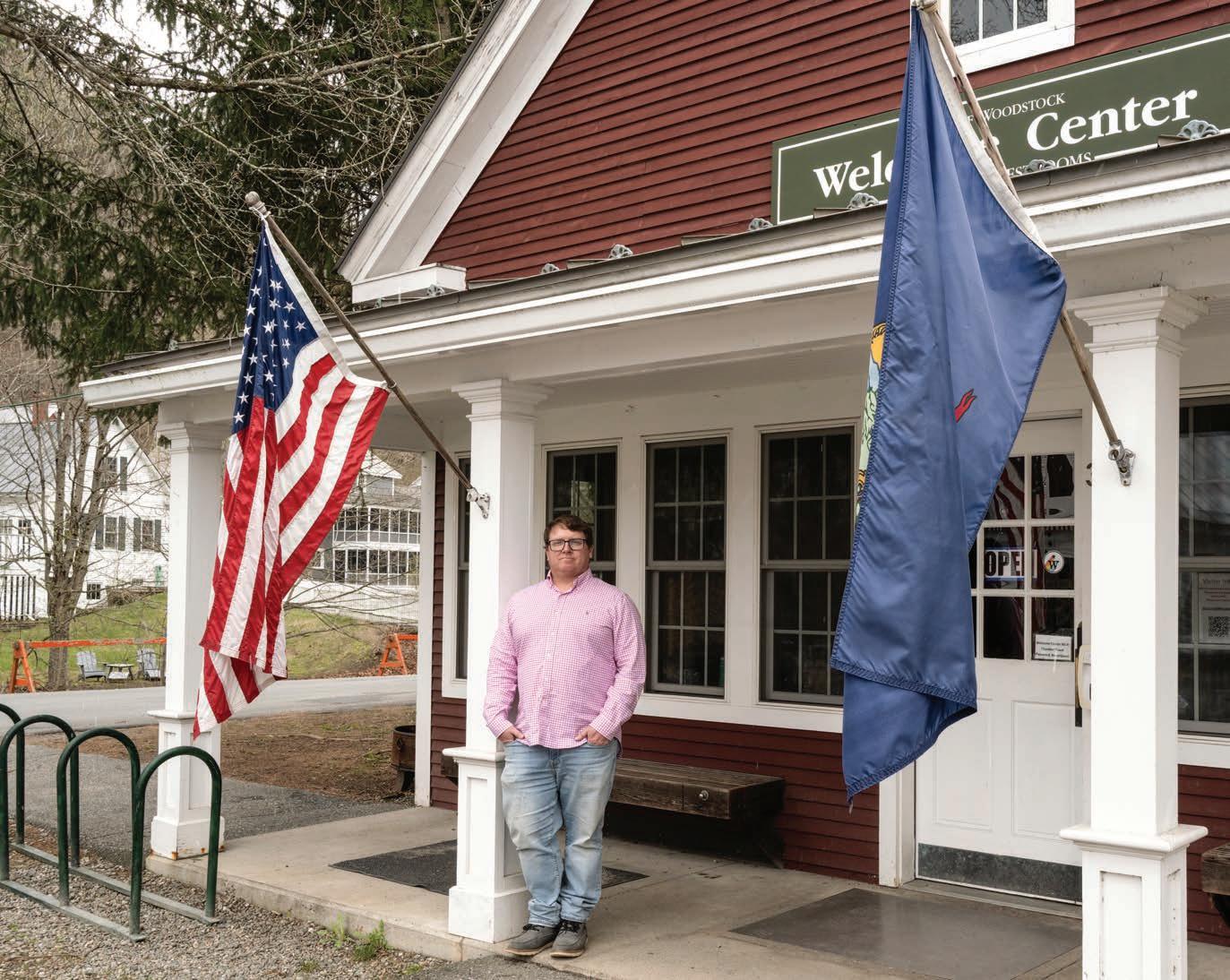
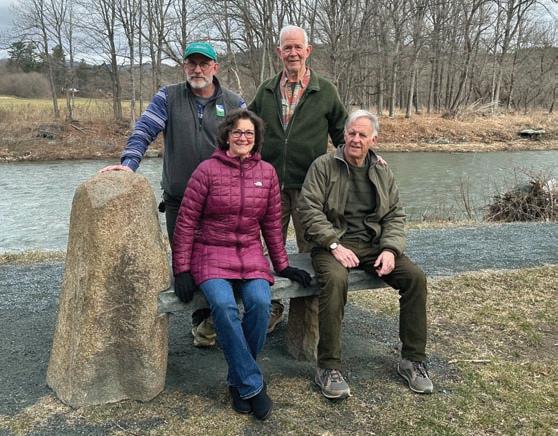
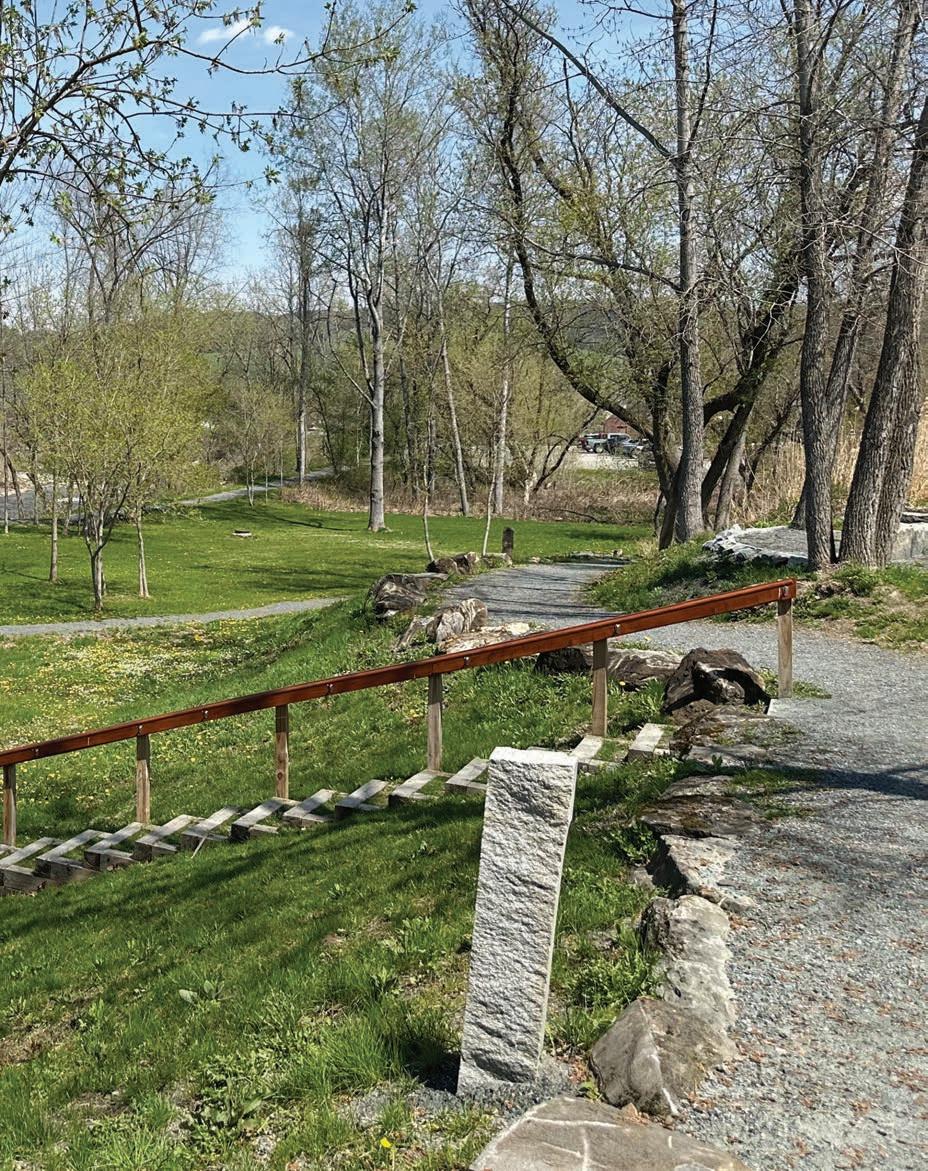
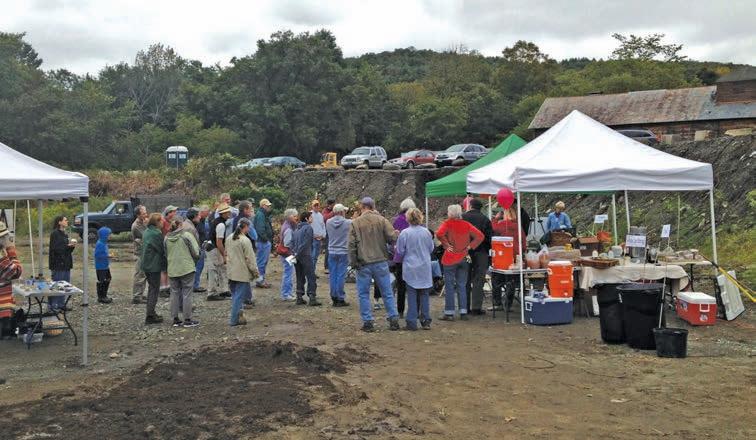
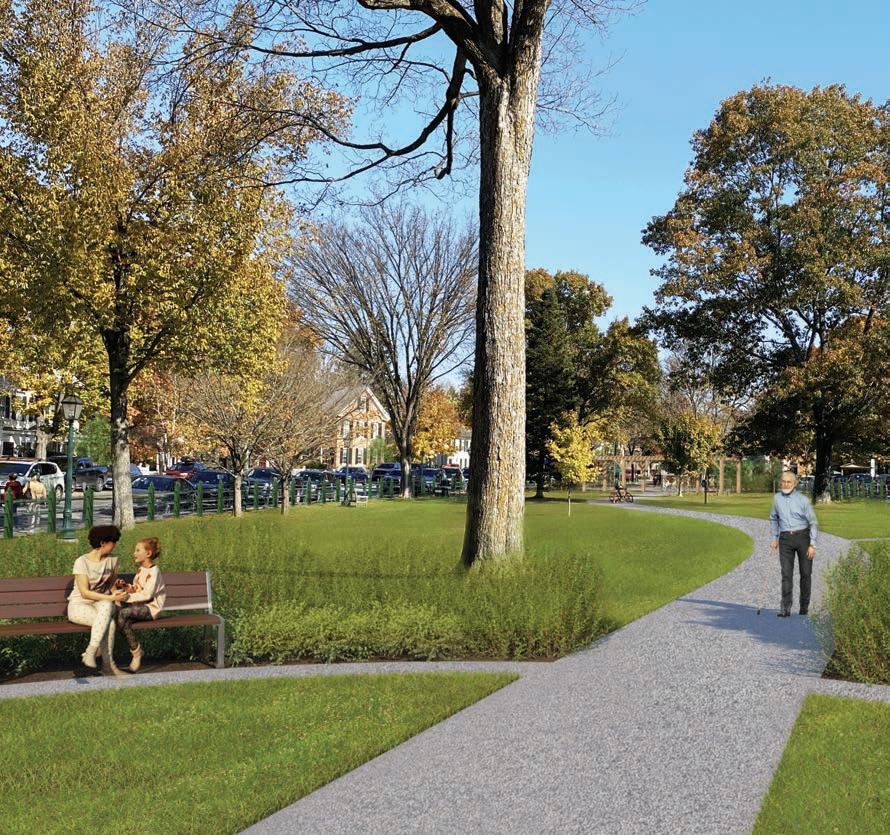
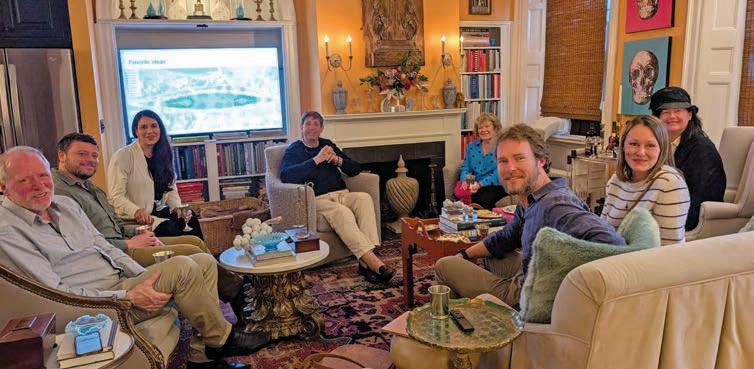
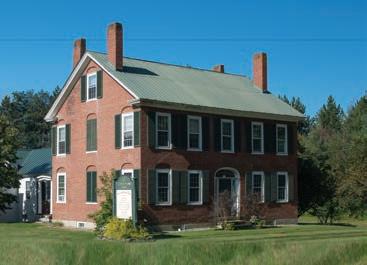
Woodstock Community Trust projects are impro ving our green spaces.
56 Stepping Back in Time
By
Kelly Sennott
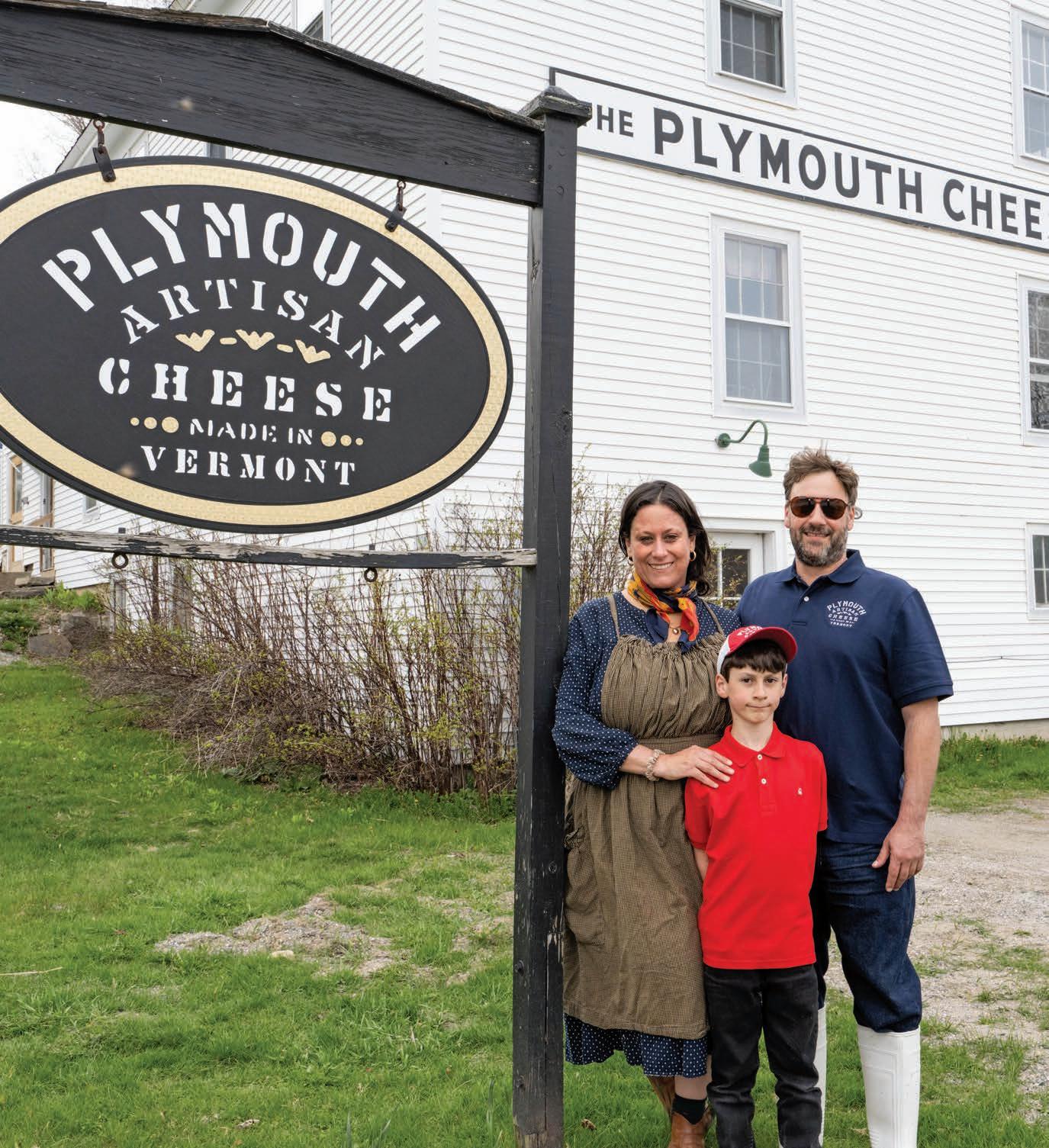
The care to revive Plymouth Cheese.
66 Curating the Unexpected
By
E. Senteio
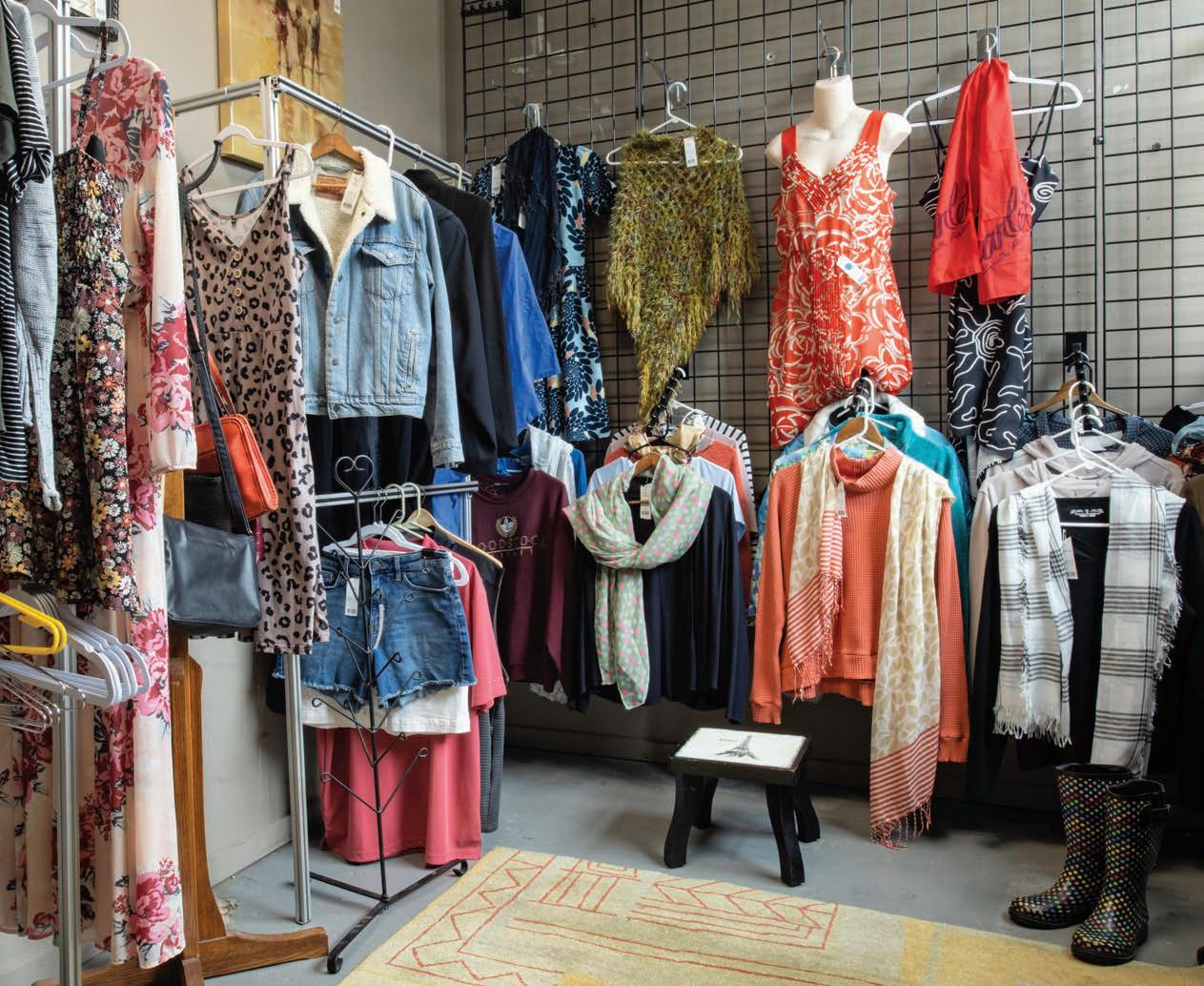
Disco ver the charm of secondhand shopping at Woodstock Consignment.
THE COVER
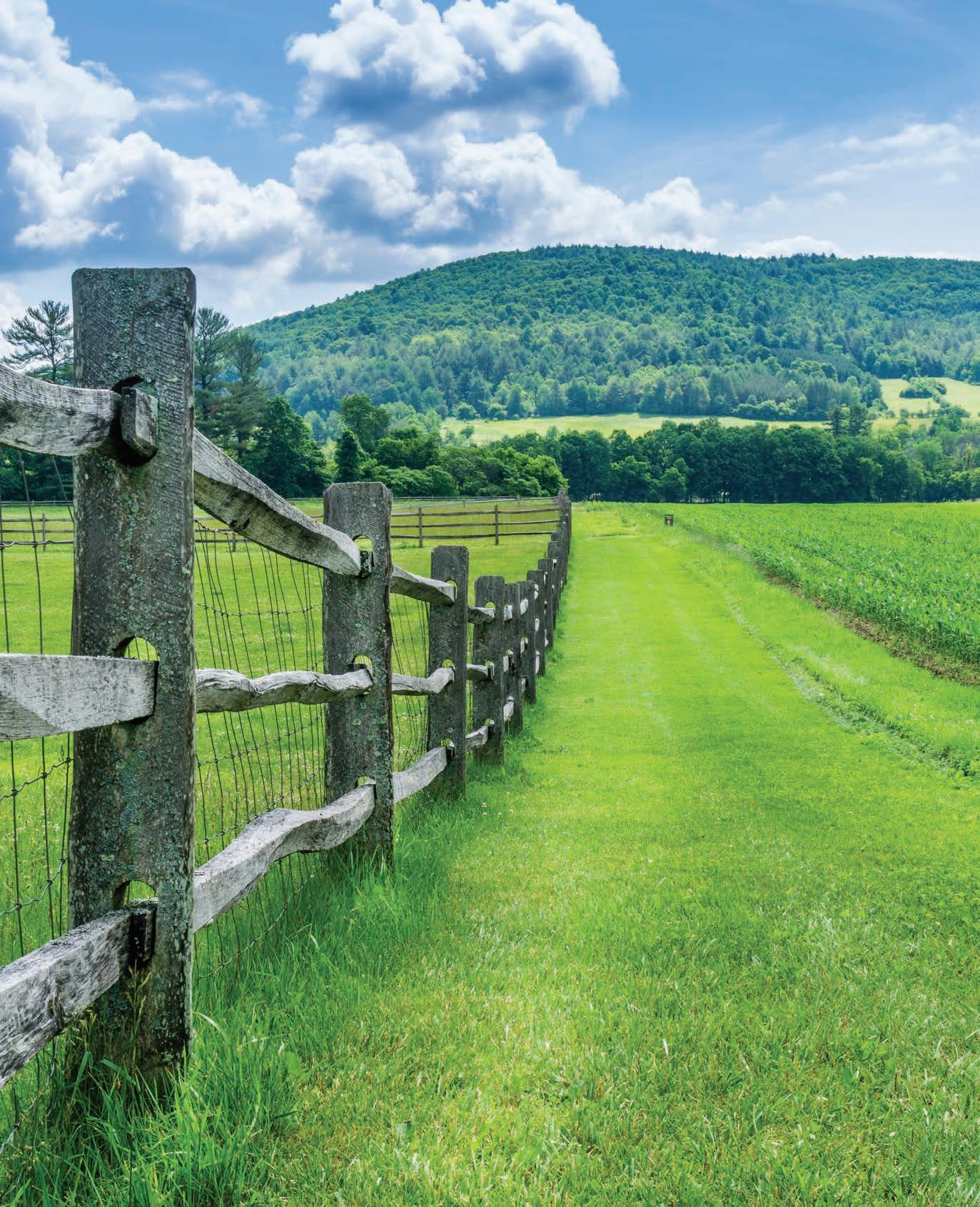
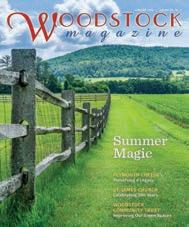
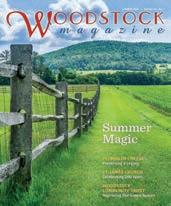
View of Blake Hill from the start of Billings Farm walking trail. Photo by Ejespo | Dreamstime.com.
Interior Design
Custom Fabrication
Renovations
MOUNTAIN VIEW PUBLISHING, LLC
135 Lyme Road, Hanover, NH 03755 (603) 678-2793
mountainviewpublishing.com greateruppervalley.com
Publishers
Cheryl Frisch
Ryan Frisch
Publisher Emeritus
Bob Frisch (1951–2025)
Executive Editor
Deborah Thompson
Associate Editor
Kristy Erickson
Creative Director
Ellen Klempner-Beguin
Art Director
Brad Wuorinen
Ad Design
Melanie Marston
Web Design Locable
Digital Manager
Erin Frisch Newton
Advertising Ryan Frisch
Calyn Frisch
KEEP US POSTED
Woodstock Magazine wants to hear from readers. Correspondence may be addressed to: Letters to the Editor, Woodstock Magazine, 135 Lyme Road, Hanover, NH 03755. Or email us at: dthompson@mountainviewpublishing.com. Advertising inquiries may be made by email to ryanfrisch@mountainviewpublishing.com.
This season in the Green Mountain State inspires locals and visitors alike to venture outdoors for hiking, biking, and swimming in the lush beauty that surrounds us. After a busy day soaking up the sunshine (remember to wear sunscreen!), what’s better than relaxing with family and friends for a backyard cookout? It’s great fun to follow dinner with toasting marshmallows for s’mores and having a casual sing-along or game of charades around the campfire.
As an aside, the word campfire takes me back a few decades to recall sitting around the dining room table for a game of Password. My husband and I usually played with the same couple, and it was always the ladies versus the men. My girlfriend and I were so much on the same wavelength, we won every game, but we really shocked the guys one night when on the first clue Peggy said “campfire” and I answered “marshmallow.” Both of us—being mothers who did the grocery shopping—knew the brand Campfire Marshmallows. Of course, our husbands were clueless, and we savored our victory—again! (Also, as a former Girl Scout, I experienced quite a bit of camping out, campfires, and Campfire Marshmallows!)
Around town, we’re catching up with Woodstock Community Trust and the work they’ve been doing in the area. Their dedicated corps of volunteers has completed Ottauquechee River Trail and East End Park, and Woodstock Conservancy is moving ahead with plans to improve the Green and plant trees in the downtown business district. Read about their remarkable accomplishments beginning on page 48.
In other stories, we’re getting to know Jim Kelly, the new director of Woodstock Area Chamber of Commerce (page 44), and we’re visiting Plymouth Cheese in Bridgewater (page 56). Come along as we browse for treasures at Woodstock Consignment (page 66), and join the celebration as St. James Episcoal Church observes its 200th anniversary.
Wherever your summer adventures take you, make the most of every day; this season of warm, carefree, lazy days won’t last for long. Keep in touch with local news and events at www.greateruppervalley.com. Enjoy!
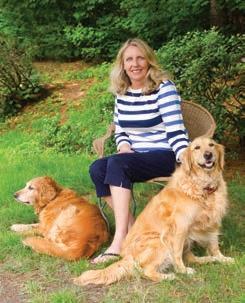
A full-time freelance writer and photographer, Lisa is a graduate of Dartmouth College who resided in the Upper Valley for another 25 years. She is the author of 13 books, including Best Hikes with Dogs: New Hampshire and Vermont, Hiking the White Mountains, and Hiking the Green Mountains. She covers all types of travel, outdoor recreation, and conservation topics for over 25 magazines. www.LisaBallardOutdoors.com
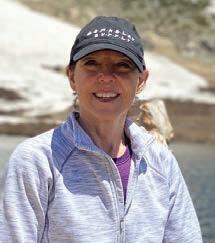
Kathy is a freelance writer and former writer and editor for The Keene Sentinel in Keene, New Hampshire. Her work has also appeared in the anthology Beyond the Notches: Stories of Place in New Hampshire’s North Country. She was also a writer and producer for Captured Light Studio, Inc., a video and interactive production company in Keene. Kathy likes to garden, travel, and hike, often combining hiking and traveling in one trip. She is a volunteer trustee on her local library board of trustees.
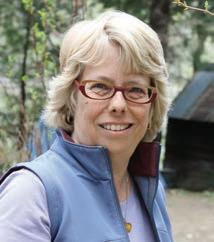
Cassie is a writer, editor, and publisher and the author of two historical novels, Lucy E.—Road to Victory and Charles F.—Road to Justice. Her roots in Vermont go back almost 200 years and inspire her love of the natural world and history. She lives in Plymouth, Vermont, with her husband and two dogs, an English Shepherd and a wire-haired Dachshund.
Mike is a columnist and 50-year radio and TV personality, and in the past decade has written three books, including his career memoir, a book on the history of the famed Red Arrow Diner, and another on modern history of candlepin bowling. He is the 2013 recipient of the Will Rogers Humanitarian Award from the National Society of Newspaper Columnists.
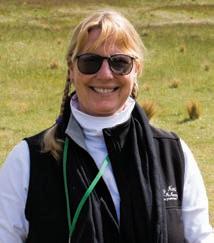
Nancy is the owner of Photos by Nanci, a photography business she started in 2009. She’s had a camera in her hand since she was in grade school and has honed her skills working for various newspapers: UMass Daily Collegian, The Campus Connection, The Valley News, and the Vermont Standard as well as Mountain View Publishing. She is also the codirector of the Covered Bridges Half Marathon race that takes place on the first Sunday in June.
Mike Morin
Lisa Ballard
Katherine P. Cox
Nancy Nutile-McMenemy
Cassie Horner
www.greateruppervalley.com is proudly brought to you by: community sponsor Subscribe to Our Newsletter
Visit us online to find the winner of this year’s Mother’s Day Giveaway, and subscribe to our newsletter at www.greateruppervalley.com/ newsletter to be notified about upcoming give-aways, new issues, and things to do around the Upper Valley. A big thank you to all who entered and to our sponsors!
www.greateruppervalley.com/newsletter
Follow Us on Facebook www.facebook.com/greateruppervalley
Find Past Issues
www.greateruppervalley.com/archives
Lake Morey Summer Concert Series Returns Check out these free concerts happening all summer long.
10 Golf Courses Within Driving Distance to Play This Summer Discover 10 great golf courses within driving distance of the Upper Valley and plan your next summer round.
10 Places to Grab a Sweet Treat This Summer Cool down this summer with must-try ice cream spots serving up creamy scoops, bold flavors, and sweet treats worth the trip.
ONLINE ADVERTISERS INDEX
Check out these local businesses in our directory.
3 PHASE LANDSCAPING, LLC
ALIGN INN VERMONT
BARTON INSURANCE / HILB GROUP
BELLETETES
CALDWELL LAW
CLAREMONT SAVINGS BANK
COLBY INSURANCE GROUP
COPELAND FURNITURE
CROSSROADS ACADEMY
DARTMOUTH AUTHENTIC
DATAMANN
DB LANDSCAPING
DESIGNER GOLD
DUTILLE’S JEWELRY DESIGN STUDIO
EYEGLASS OUTLET
FORE-U GOLF CENTER
HANOVER EYECARE
IVY IV AESTHETICS
JEFF WILMOT PAINTING & WALLPAPERING, INC.
LAVALLEY BUILDING SUPPLY
LEDYARD BANK
LITTLE ISTANBUL
MARTHA E. DIEBOLD REAL ESTATE
MB PRO LANDSCAPE DESIGN
MORNINGSIDE FLIGHT PARK
MVP MARINE
RAMUNTO’S OF CLAREMONT
RICHARD ELECTRIC
RIVER ROAD VETERINARY CLINIC
RODD ROOFING
THE FLYING GOOSE
THE HANOVER INN AT DARTMOUTH COLLEGE
TOP STITCH
UPPER VALLEY BUSINESS
ALLIANCE
VILLAGE PIZZA
WHITE RIVER FAMILY EYECARE
WISE
WOODSTOCK INN & RESORT
For more information about how your business can get listed on our ONLINE BUSINESS DIRECTORY or for other online advertising opportunities, contact Ryan Frisch at (603) 678-2793 or email ryanfrisch@mountainviewpublishing.com.
AROUND & ABOUT
By Cassie Horner
Garden Day
Enjoy Woodstock's Summer Blooms
Summer in Vermont is the time to celebrate gardens. On Saturday, August 22 from 10am to 5pm, Garden Day offers visitors the opportunity to explore three beautiful gardens in the Woodstock community. The three special places at Billings Farm & Museum, the Marsh-BillingsRockefeller National Historical Park, and the Woodstock Inn & Resort’s Kelly Way Gardens are closely linked with the goal of honoring Mary and Laurance S. Rockefeller. The couple’s legacy is their commitment to conservation, sustainability, and heritage that lives on in Woodstock.
Photos courtesy of Billings Farm & Museum
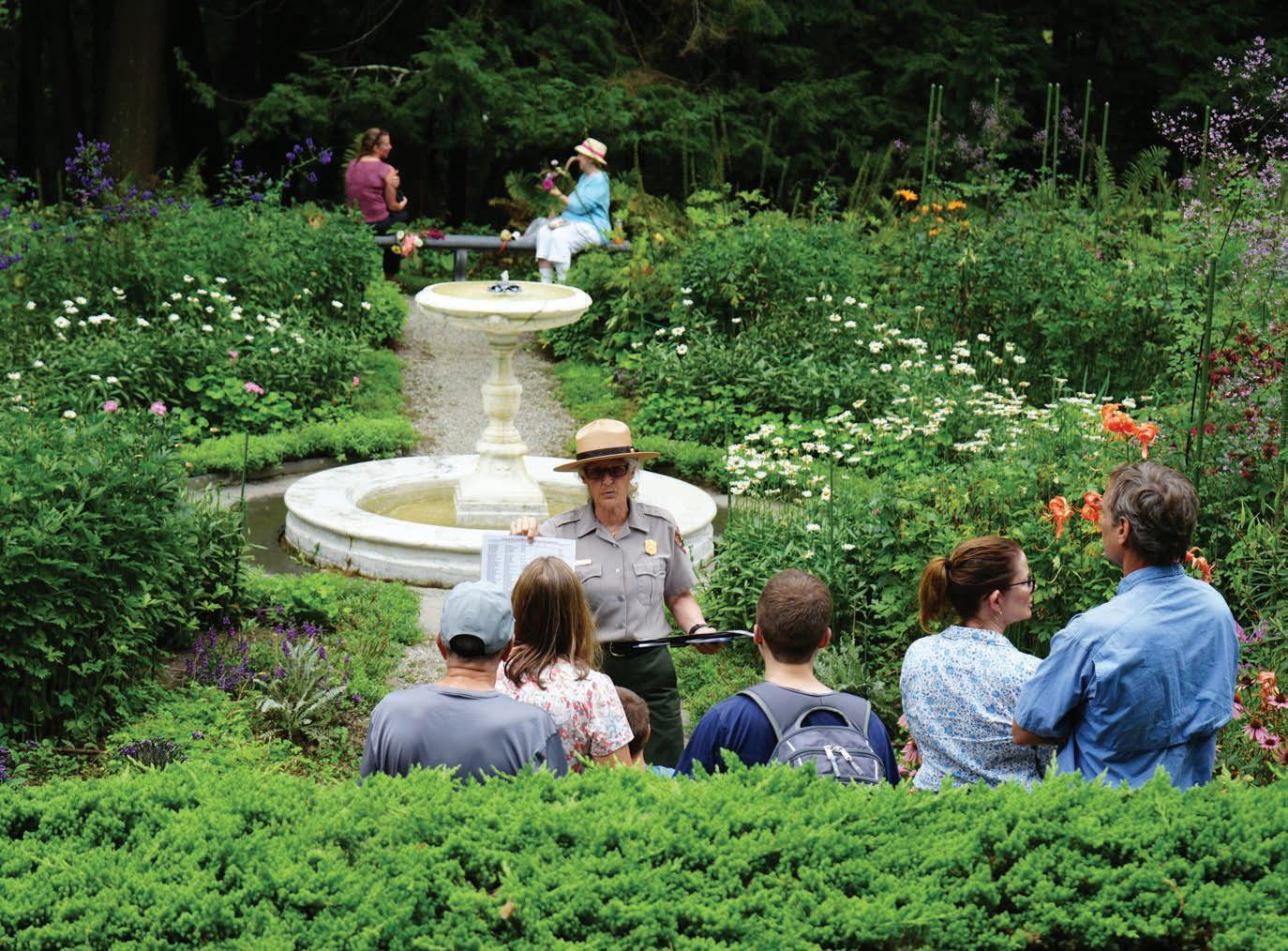
Top: Ranger-led programs invite visitors to explore the formal gardens at Marsh-Billings-Rockefeller National Historical Park.
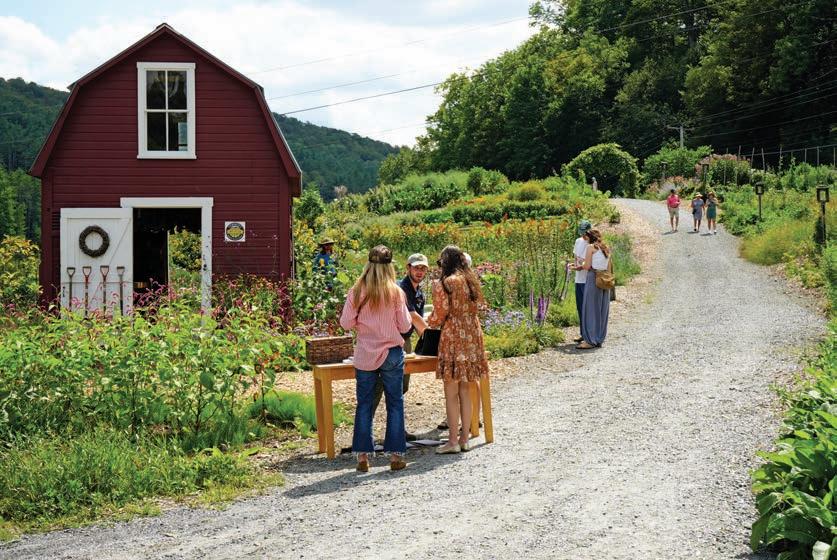
Right: Visitors wander through Kelly Way Gardens, where flowers and produce are grown for Woodstock Inn & Resort restaurants.
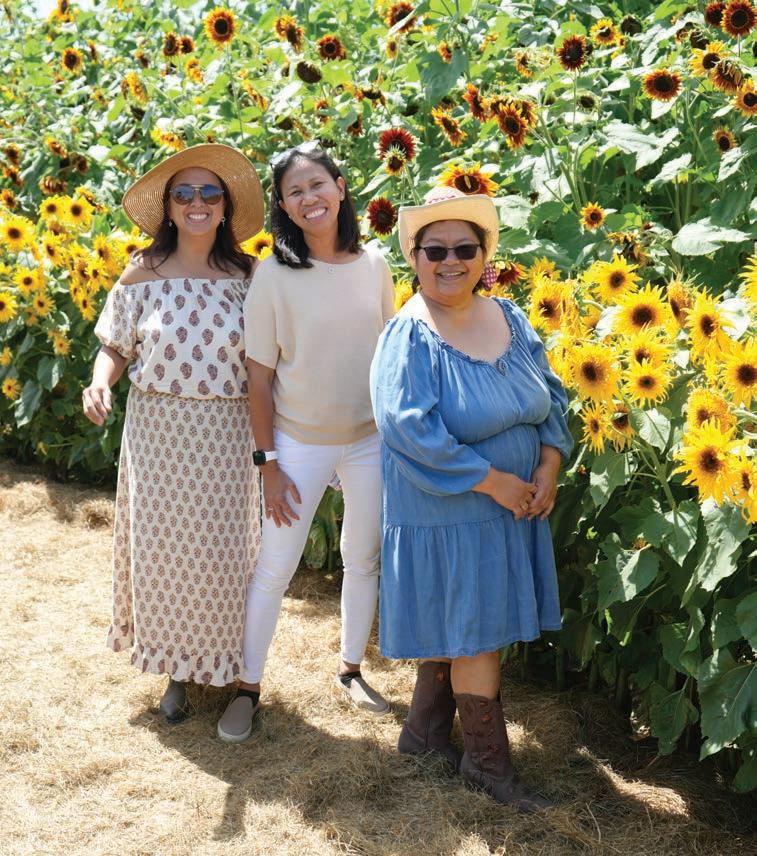
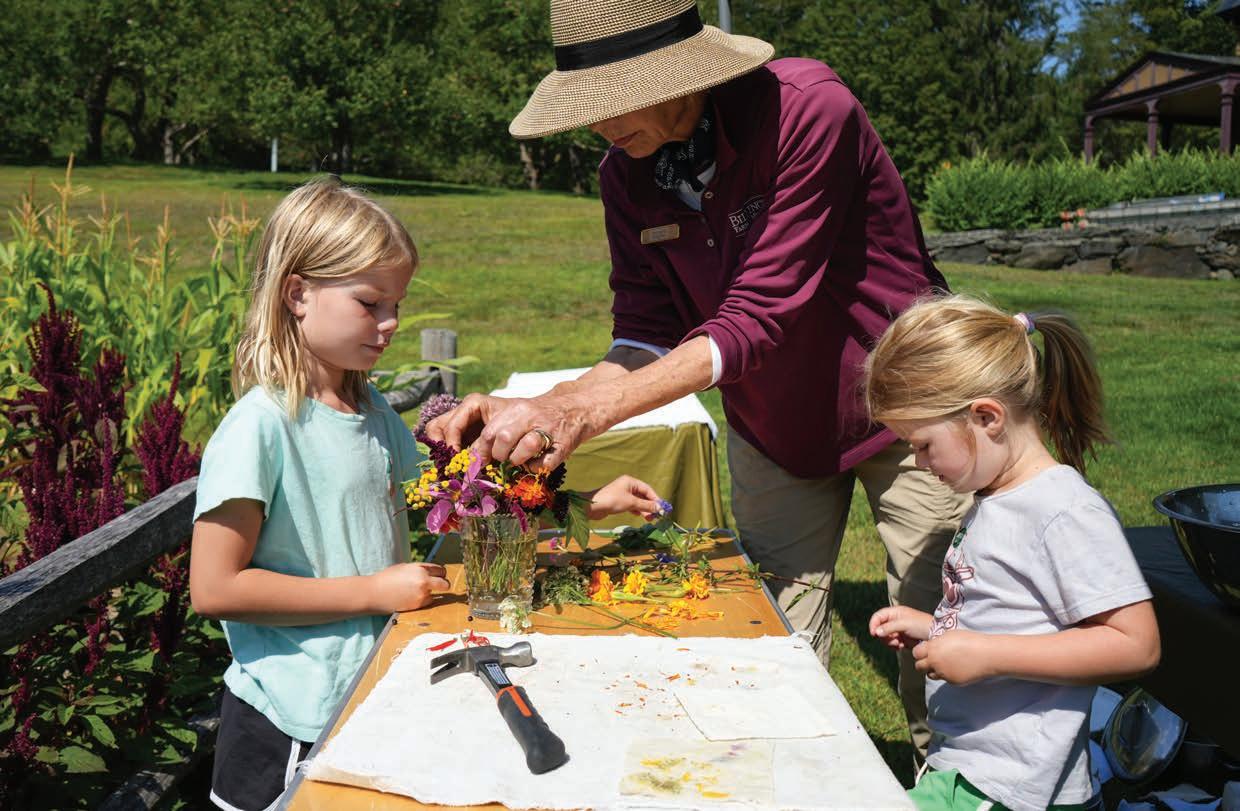
Clockwise from left: Local visitors enjoy exploring the Sunflower House at Billings Farm & Museum during Garden Day. Guests who visited all three gardens were entered to win a beautifully curated raffle prize. Hands-on flower pounding demonstrations showcased natural dyeing techniques using blooms grown in the Farmstead Gardens.
Each site offers a unique landscape complemented by activities designed for children and adults. There will also be live music.
Billings Farm invites visitors to admire the Sunflower House, a growing series of rooms and pathways that features sunflower varieties ranging from giant to small. People can also explore the education gardens. Activities include story time in the garden, botanical drying, sensory play, and ice-cream making. Ranger-guided tours of the historic estate gardens are a popular part of a visit to Marsh-Billings-Rockefeller National
Historical Park. The national park’s gardens reflect generations of stewardship and history. Other activities include creating mini bouquets from the cutting garden and other hands-on programs.
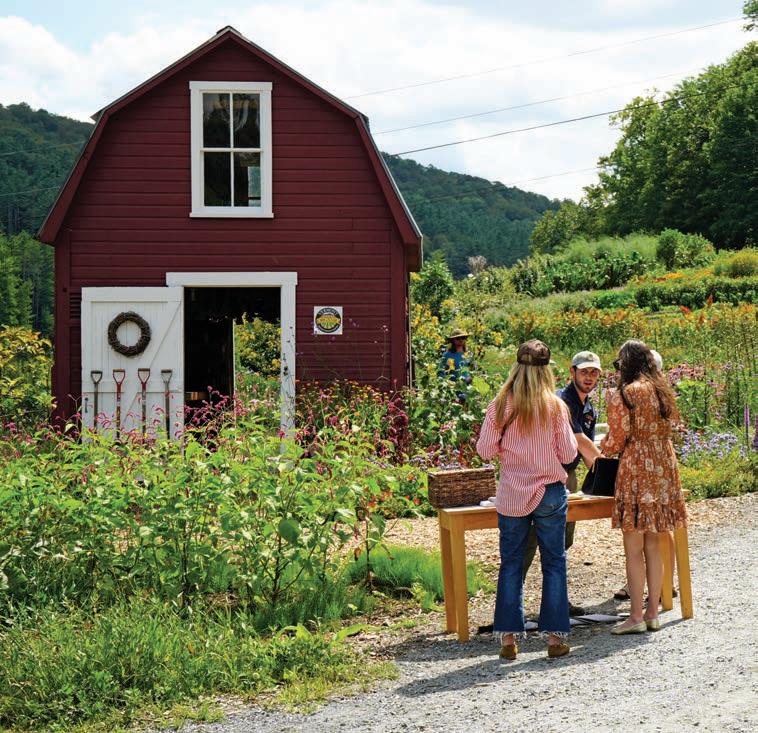
Kelly Way Gardens’ mission is to provide fresh ingredients to the Woodstock Inn & Resort’s restaurants. The lovely setting of the farm-to-table program is a fun place to explore. A highlight of the day is the tomato tasting. The site has over 200 varieties of vegetables plus a wide variety of herbs, edible flowers, ber-
ries, and cut flowers.
This year, on August 22, Vermont and New Hampshire residents will gain entrance to Billings Farm free of charge in honor of Laurance Rockefeller’s legacy. Visitors will check in at the admissions desk to show a valid ID. Admission and programs at Kelly Way Gardens and the national park are also free that day. BILLINGS FARM & MUSEUM
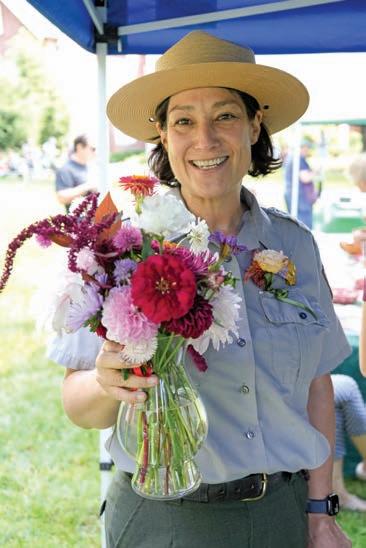
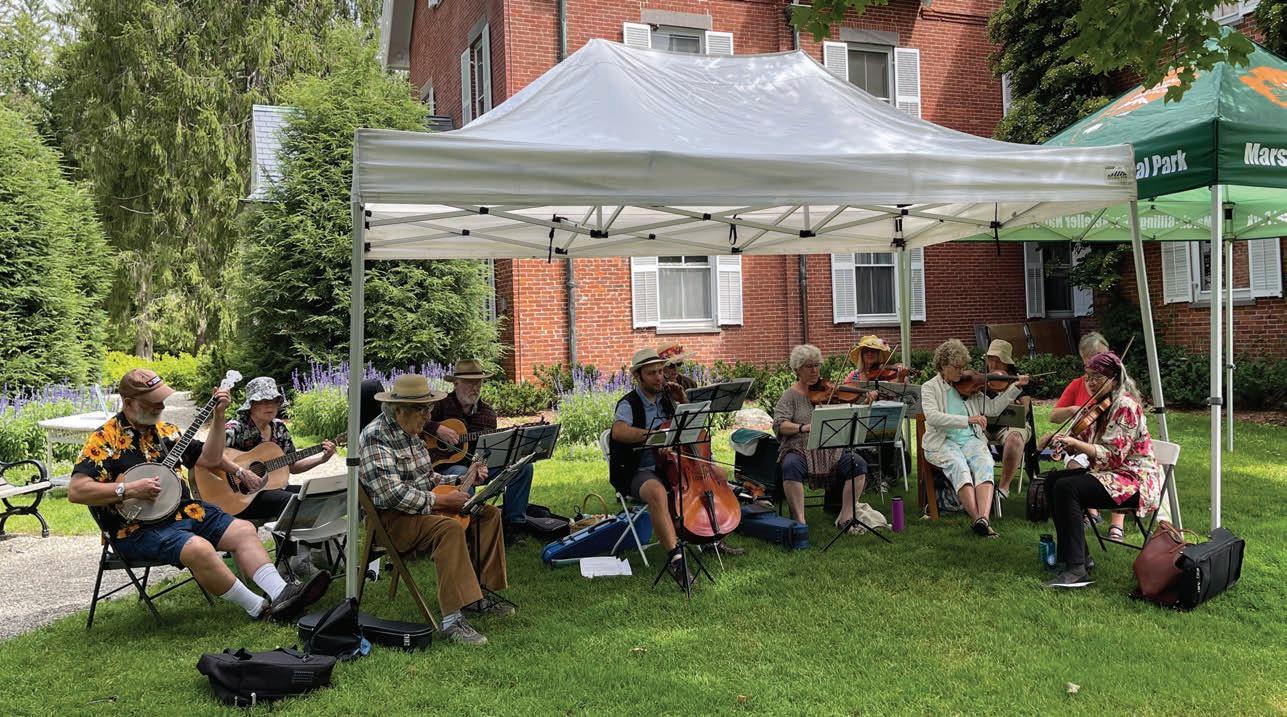
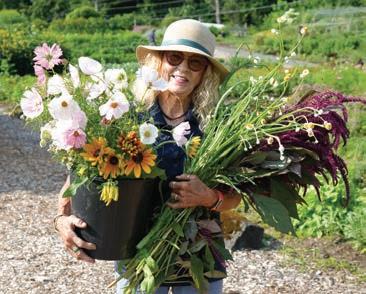
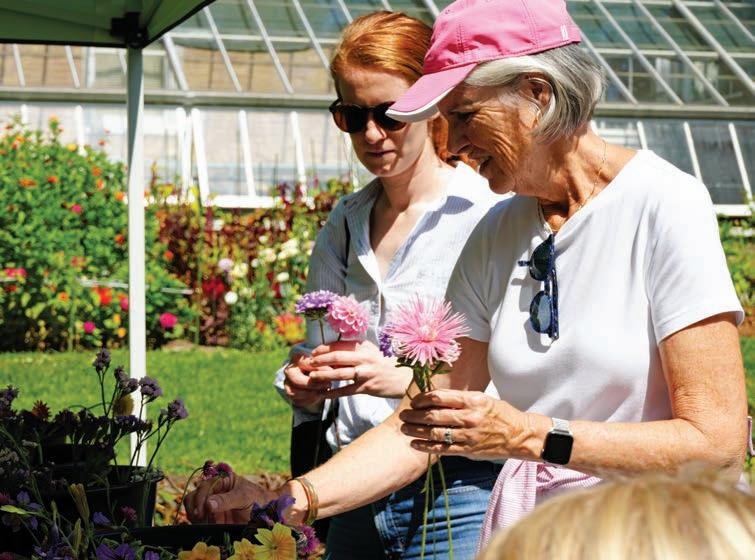
Clockwise from top: The Vermont Fiddle Orchestra performs on the mansion lawn during Garden Day at the National Park. The gardener at Kelly Way Gardens displays freshly harvested flowers and plants grown for the Woodstock Inn & Resort. Guests create bouquets from the cutting gardens at the Marsh-BillingsRockefeller National Historical Park.
Music on the Hill
Free concerts in a beautiful setting
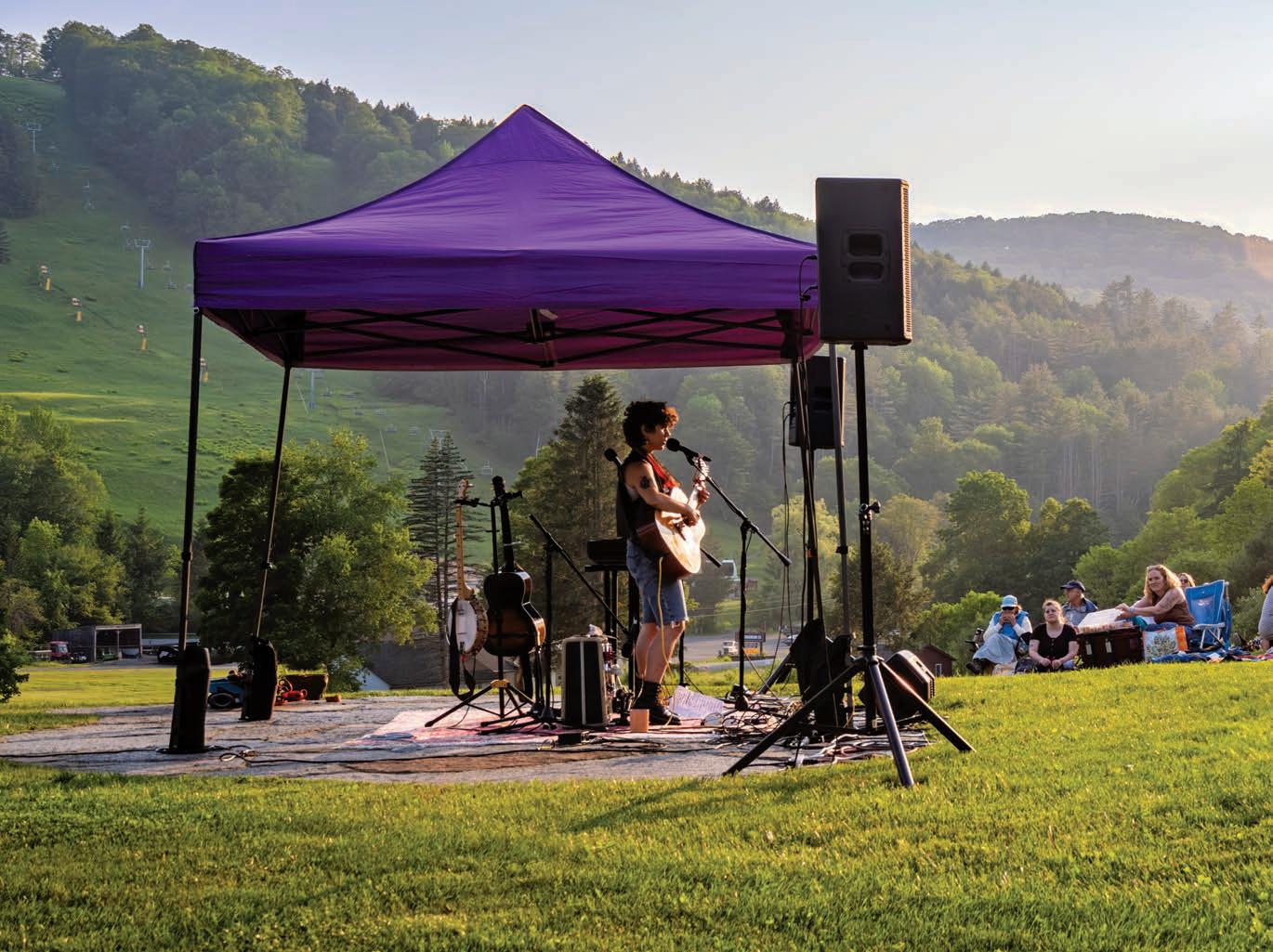
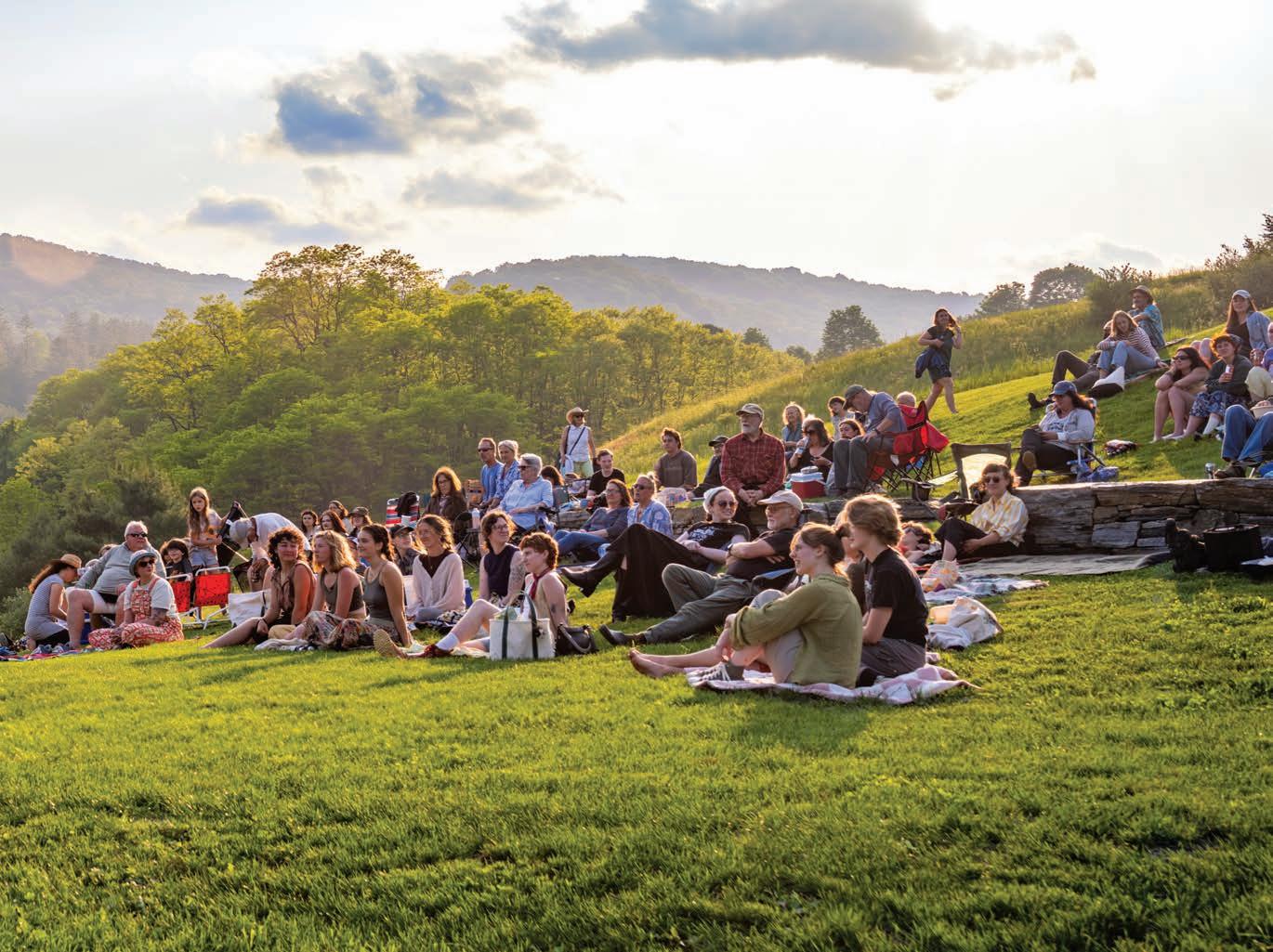
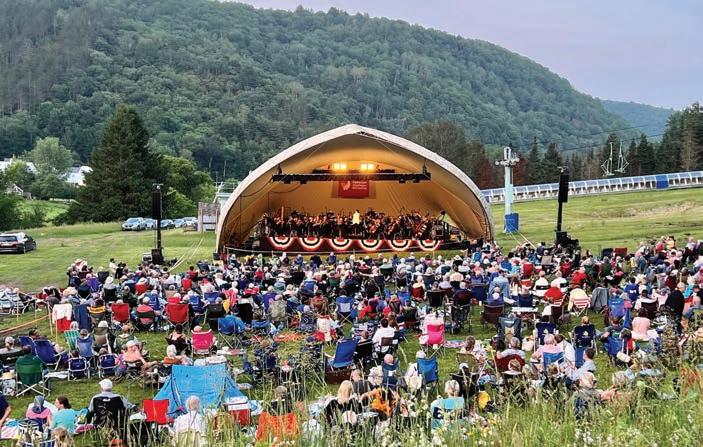
Summer music in a pastoral setting brings listeners back again and again to the annual Music on the Hill Summer Concert Series at Artistree in South Pomfret. Music on the Hill kicks off on June 24 and concludes September 16. Concerts start at 6:30pm. Bring a blanket, chairs, dinner, and your favorite beverage. Everyone is welcome and no reservation is required, and the concerts are free thanks to Haystack Needle, a strategic design and production agency. There is music for everyone to enjoy. Jazz, folk, and classical performances will grace the summer nights in this beautiful and relaxing venue. Featured performers include the Barnard-based Gray Cats Jazz Trio playing in an upbeat and fun style of acoustic jazz and blues, performing on July 22.
Bring a blanket, chairs, dinner, and your favorite beverage. Everyone is welcome and no reservation is required, and the concerts are free. Jazz, folk, and classical performances will grace the summer nights in this beautiful and relaxing venue.
Songwriter, multi-instrumentalist, and longtime Vermont favorite Bow Thayer from Stockbridge performs with Rutland-based Krishna Guthrie on August 5. Bow is a prolific songwriter whose music “emanates from the densely forested mountains of Central Vermont.” Krishna Guthrie, in addition to having a famous tradition of music in his DNA, is also a songwriter and multi-instrumentalist.
The two men have been teaming up for shows as far away as Alaska and bring a toe-tapping blend of music.
Please note that the lineup for Music on the Hill is subject to change without notice. If this is your first visit, the hillside at Artistree is located at 2095 Pomfret Road in South Pomfret. Entry to the field is directly across from Saskadena Six ski area and is marked with
signage. There is handicapped parking in the Artistree parking lot, but everyone else must park in designated field parking. Please leave your pets safely at home. Donations to support Artistree are welcome. The ArtFest Community Day at Artistree is on Sunday, October 4. Visit artistreevt.org for more details on the concert series and Community Day.
ARTISTREE
MORE
Above: Olive Klug, rising indie folk singersongwriter, opened the 2025 summer concert series. Photo courtesy of Artistree.
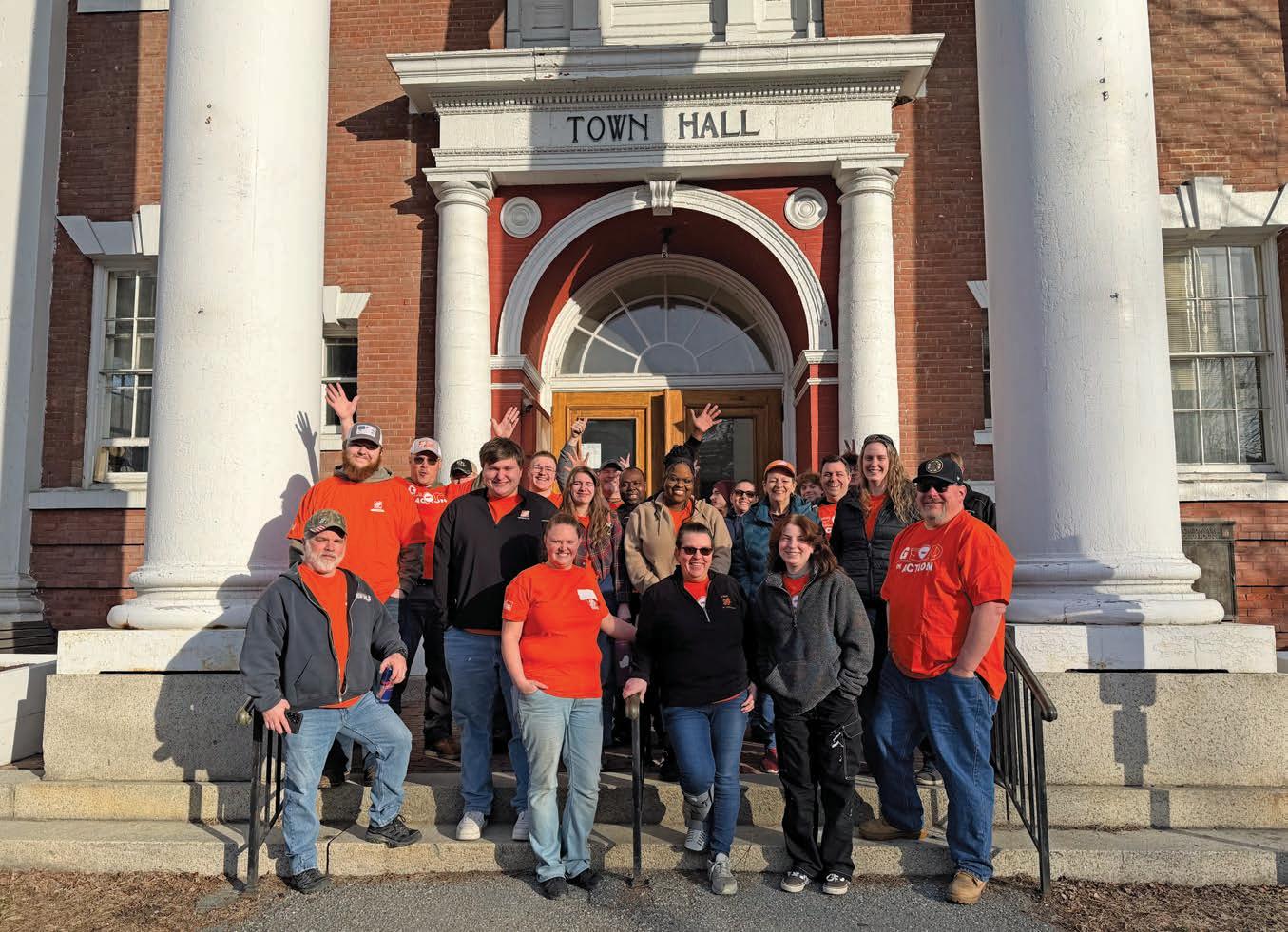
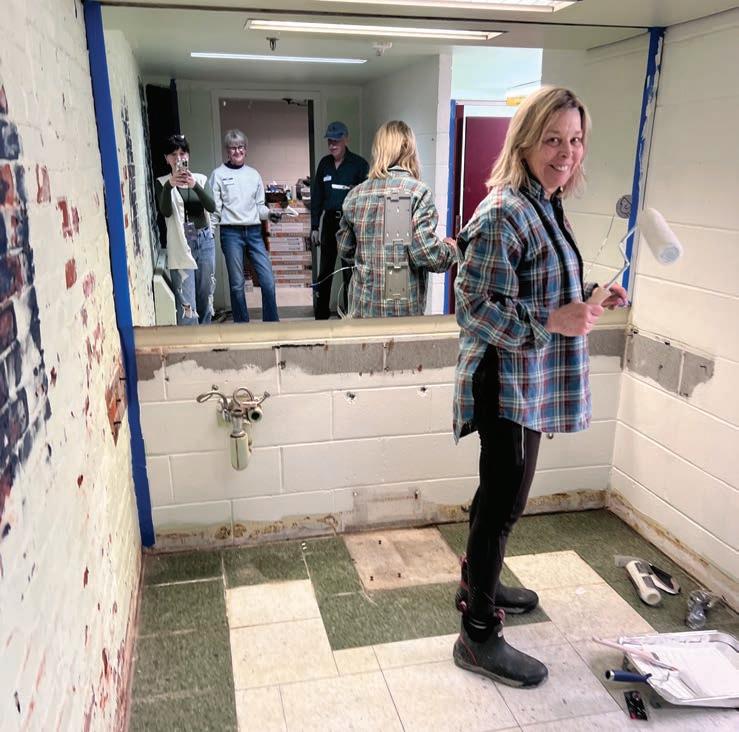
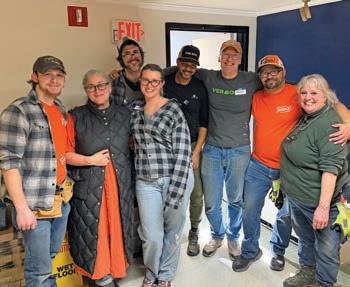
This spring, a crew of volunteers comprised of employees of area Home Depots and people from the Woodstock area went to work on giving the Town Hall Theatre restrooms a much-needed facelift. “Everyone rolled up their sleeves, from the work in the office to the actual painting,” says Deborah Greene, director of Pentangle. “It was a real bonding experience for people knowing they were making a difference to the town hall.” The revitalized spaces have new flooring, new sinks, and new mirrors. This project happened because a Pentangle board member, Alano Miller, asked Home Depot to sponsor the initiative.
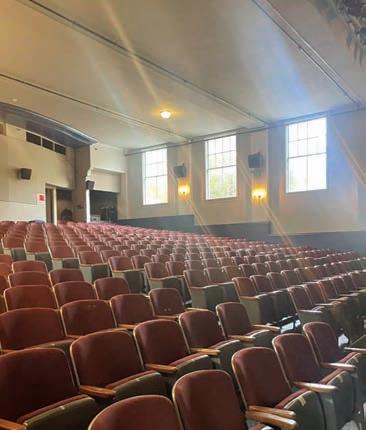
The restrooms project was the latest in a series of renovations that started with painting the building’s interior at the beginning of her tenure. “It is all fresh and looks so beautiful while still maintaining its history,” Deborah says. She arrived on the scene as director about two years ago. It was her suggestion to tackle one project at a time rather than trying to do a major renovation all at once. The concept that “Rome wasn’t built in a day” has been very successful in bringing the Town Hall Theatre back to life. For example, the huge windows in the theatre were boarded up about 65 years ago. To upgrade the space, the boards
Top: Home Depot volunteers came from stores in Rutland and Williston, Vermont, and Claremont, Keene, Tilton, Littleton, Bennington, Manchester, Hooksett, and Concord, New Hampshire.
Above: The theatre with windows exposed.
have been removed, and, working with Sustainable Woodstock guidance, Pentangle installed weather-proofing inserts that both insulate the windows and allow light into the big room. “The inserts create a barrier so heat doesn’t leak out,” Deborah says. “They are very energy efficient. Now people can have events and classes during the day. The room is very light and welcoming.” The windows also have remote control blackout shades for movie showings.
Another project was renovating the Green Room, the space for artists and performers under the stage. “It makes a big difference to the performers,” Deborah observes. “We want them to be in a creative space that says we care about artists.”
Deborah will soon be moving on from Pentangle for her own creative projects, including a documentary about her Our State of Peace Project in America and the upcoming TEDxWoodstock on July 27. But she feels good about what has been accomplished
in her two years as director. “I am so proud. I feel like I am going to leave things in good shape. I did this for my mom, who was an artist and sang in the choir here in Woodstock. This raises the level of everything. It is important for the town in general.”
Dail Frates joins in the painting at Woodstock Town Hall.
It takes a village . . . literaly! Helpers including Deborah Greene, Kristian Preylowski, Kari Meutsch, Alano Miller, Stuart Mathews, DJ Marshall, and Nancy Johnson take a break.
For Brain Health, Enjoy Summer Fruits & Veggies
According to a recent study, following a healthy plant-based diet prioritizing whole grains, fruits, vegetables, vegetable oils, nuts, and legumes in middle age appears to lower the risk of Alzheimer’s disease and other forms of dementia. But people in the study who ate unhealthy plant-based foods like French fries, refined grains, and fruit juices had a higher risk of these conditions.
“Our study found that the quality of a plant-based diet mattered,” says lead researcher Song-Yi Park. “We found that adopting a plant-based diet, even starting at an older age, and refraining from low-quality plant-based diets, was associated with a lower risk of Alzheimer’s and other dementias.”
Overall, people who ate the most plant-based foods had a 12 percent lower risk of dementia compared to those who ate the least.
DID YOU KNOW?
Read, Cook, Eat!
LA plant-based diet can lower the risk of Alzheimer’s disease and other forms of dementia.
ooking for creative new ways to prepare your latest haul from the Woodstock Farmers’ Market this summer? Check out Read, Cook, Eat!, the cookbook club at Norman Williams Public Library. If you like reading about cooking, experimenting with recipes, sharing stories, and eating good food, the library invites you to join their cookbook discussion group, which meets on the third Tuesday of the month at 6pm. The library will hold a copy of the month’s cookbook at the circulation desk for you to browse and pick out recipes and then either copy them at no charge or take photos with your phone. The day of the meeting is a true potluck affair! The goal is to discover new combinations of ingredients and flavors. For more information, visit normanwilliams.org.
Kids and Cleaning Products
An estimated 240,800 children aged five and younger visited emergency rooms between 2007 and 2022 after being injured or poisoned by a household cleaning product, reports Pediatrics. Bleach and detergents were the most common product types associated with these injuries, with detergent packets and pods accounting for 33 percent. These products can cause burns to the skin and eyes as well as hazards associated with ingestion. Spray bottles were also a concern, accounting for 28 percent of injuries. Children ages one and two were at the greatest risk. Researchers and the American Cleaning Institute recommend that parents store household cleaning products away from young children, preferably in a locked cabinet, and that products should be kept in their original containers.
Go Natural
You can cut through stains, grease, and grime in your home with a few basic ingredients: vinegar, lemon juice, baking soda, and castile soap. A quick Internet search will generate dozens of results for easy homemade cleaners to make your house sparkle.
Short Bursts of Exercise Matter
Everyday moments like running to catch a bus or quickly climbing a flight of stairs may lower the risk of heart disease, type 2 diabetes, and dementia. Short bursts of vigorous activity—the kind that leaves you out of breath—can help the heart work more efficiently, improve blood flow, and reduce inflammation.
“Vigorous physical activity appears to trigger specific responses in the body that lowerintensity activity cannot fully replicate,” says researcher Minxue Shen. Even 15 to 20 minutes per week of this kind of effort, just a few minutes a day, brought meaningful improvements in health. In this study, people with the highest levels of vigorous activity—even if the time spent on the activity was low—had a 63 percent lower risk of dementia, a 60 percent lower risk of type 2 diabetes, and a 46 percent lower risk of early death. Simple changes, like playing tag with your kids or taking the stairs, can do the trick.
AI and Health Advice
Nearly eight in ten adults in the United States turn to the Internet for answers to their health questions, and many find answers in the AI-generated summary that appears at the top of their results. Furthermore, one in five adults worldwide turn directly to AI chatbots to ask health questions. But can this information be trusted?
Experts at the Mayo Clinic warn that this information isn’t always reliable or accurate. They recommend keeping a few limitations in mind when it comes to using AI for health info.
1. Diagnosing and treating illnesses are too complex for a machine. These tools don’t have access to your full medical history (do not share it with them!), and they can’t examine you or run the appropriate tests. They don’t have the ability to reason like a human.
2. AI can be wrong, even when it sounds confident. Chatbots generate answers based on patterns in data—they don’t know facts in the way a health professional does.
3. AI information may be biased. It may not reflect everyone’s experience fairly. And small differences in how symptoms are described can completely change the answer from AI, making it inaccurate.
To use AI safely and effectively, use it for general information. Cross-check everything with credible and trusted sources like the Mayo Clinic or the American Medical Association. Finally, protect your privacy—don’t share any personal information with AI, like your full name, date of birth, or medical records. Remember that while AI can be a helpful tool for preparing questions for your doctor, the safest and most effective decisions are still made with a trusted healthcare professional.
St. James Church Observes a Special Anniversary
200 years of celebrating its history and its mission
By Cassie Horner
courtesy of the Woodstock History Center
On November 28, 1825, a group of citizens of Woodstock gathered at the courthouse to discuss “the establishment of a Protestant Episcopal Society” in the village. The assembly appointed Dr. Joseph Gallup as president and John P. Richardson as secretary. In an orderly fashion, the group next ap-
pointed a committee of two—Royal Blake and Captain Amos Warren—to invite the Reverend Mr. Joel Clapp to the meetings. The following order of business was to select a committee of three to determine a sum of money to be paid to the reverend for his services up to that time. The agreed upon $20 was to come from money already subscribed.
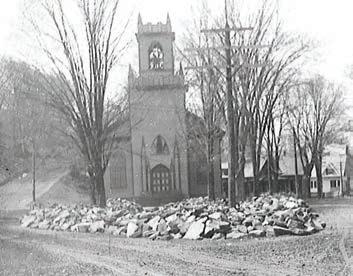
All of this careful planning would lead to the construction of a church building in the center of the village, facing the Green. Named St. James Episcopal Church, this beautifully designed Gothic wooden structure would serve the local
Photos
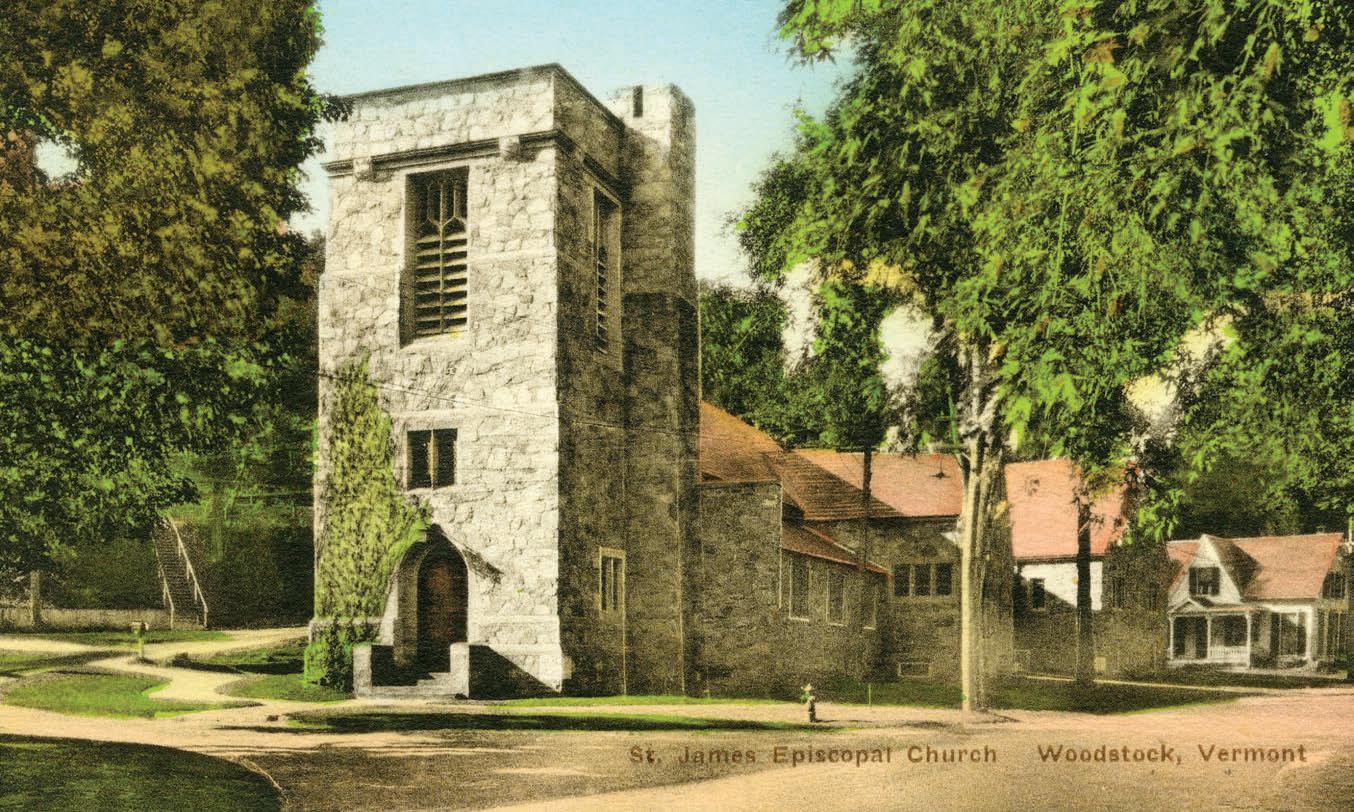
Postcard of St. James Church.
Episcopal community from 1827 to 1907 when it was replaced by the existing stone church. In 1927, the parish house/office was added. In 2014 to 2015, a $1.4 million renovation to the church and parish hall brought the building into the 21st century with changes that included handicapped accessibility to the exterior and interior, a new heating system, asbestos abatement, and relief from water seepage in the basement. This rich history is some of the background for the 200th anniversary celebration of St. James Episcopal Church in Woodstock.
THE EARLY DAYS
The history of St. James in its early days is closely linked to many of Woodstock’s leading citizens. Dr. Gallup, for example, was instrumental in giving the site for the church for $1 as long as the property was used solely for the erection and maintenance of a church. General Lyman Mower, whose name is still attached to the stately brick home on the Green,
The history of St. James in its early days is closely linked to many of Woodstock’s leading citizens. Dr. Gallup, for example, was instrumental in giving the site for the church for $1 as long as the property was used solely for the erection and maintenance of a church.
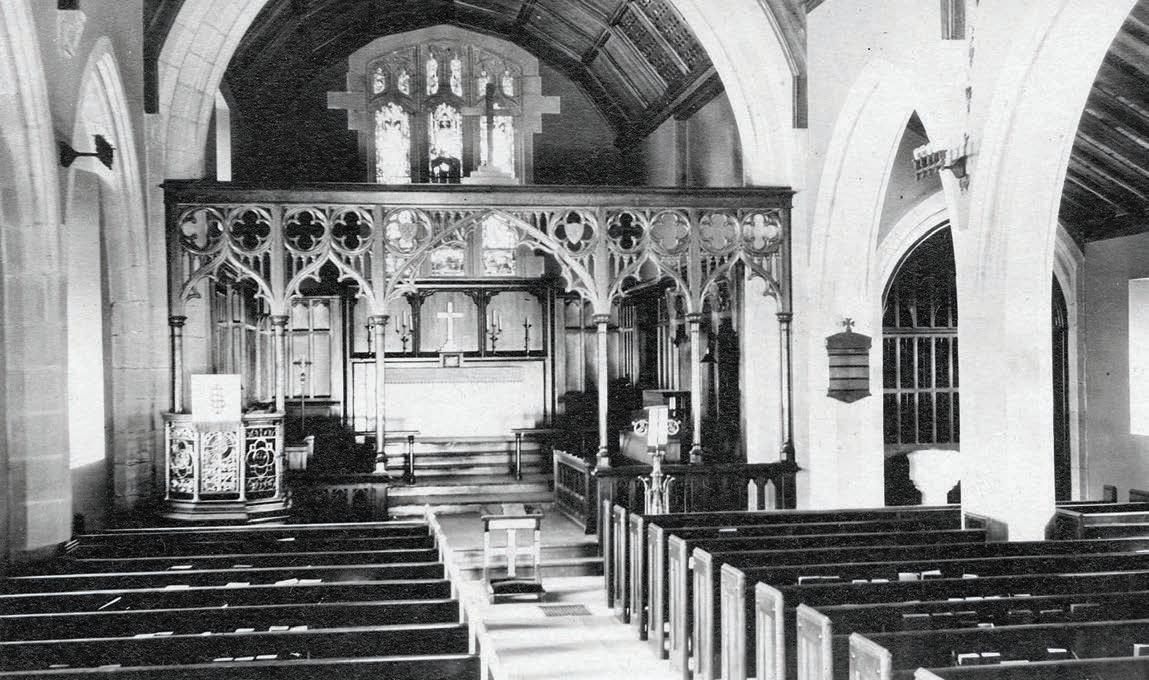
Above: Church interior.
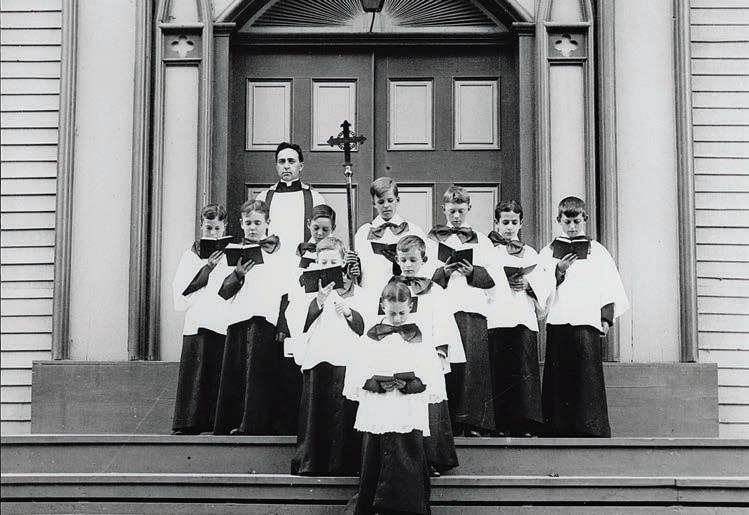
Right: St. James boys' choir, circa 1905.
and John A. Pratt, gave about threequarters of the cost of constructing the first church that was to have been built of stone. The stone had been brought from Bridgewater.
However, the site, which had been a depression filled so completely with water that boys could skate there in winter, proved to be unstable when excavation for the church began in the spring of 1827. People determined the ground was quicksand and unable to sustain a stone church so the plans were changed to a wooden structure. This building was completed in time for the Christmas Eve service on December 24, 1827.
PLANS FOR A NEW CHURCH
The wooden church served the congregation well, but by at least 1905, people were planning for a new church. Records show that at a parish meeting held on May 1, 1905, a committee was appointed to raise funds for a new St. James. By November 1 that same year, over $20,000 in cash and pledges had been subscribed. The largest contribution was $2,500 given by one of Woodstock’s important citizens, Frederick Billings. The smallest was $1.
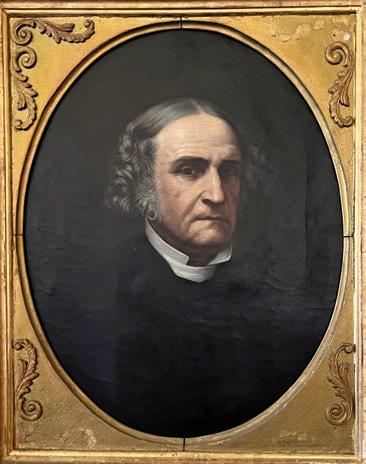
Above: An oil painting of the Reverend Joel Clapp hangs in the church. Photo by Cassie Horner.
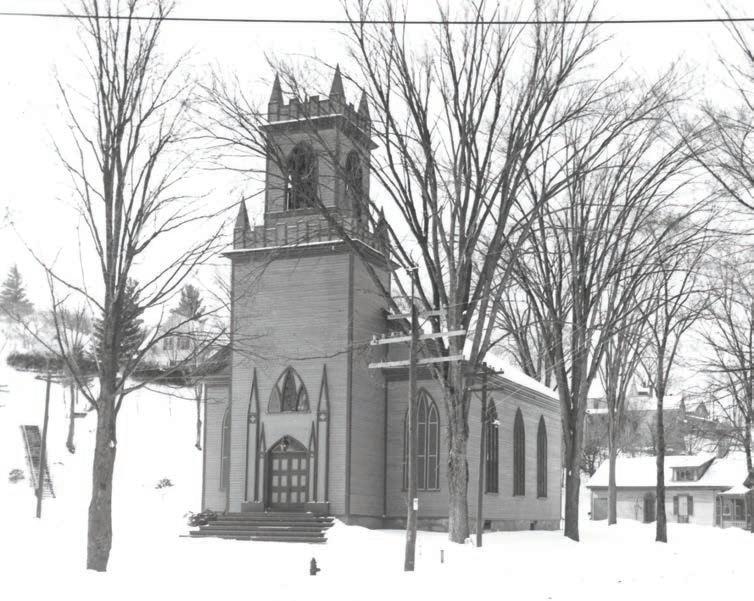
Right: Wooden St. James Episcopal Church built in 1827.
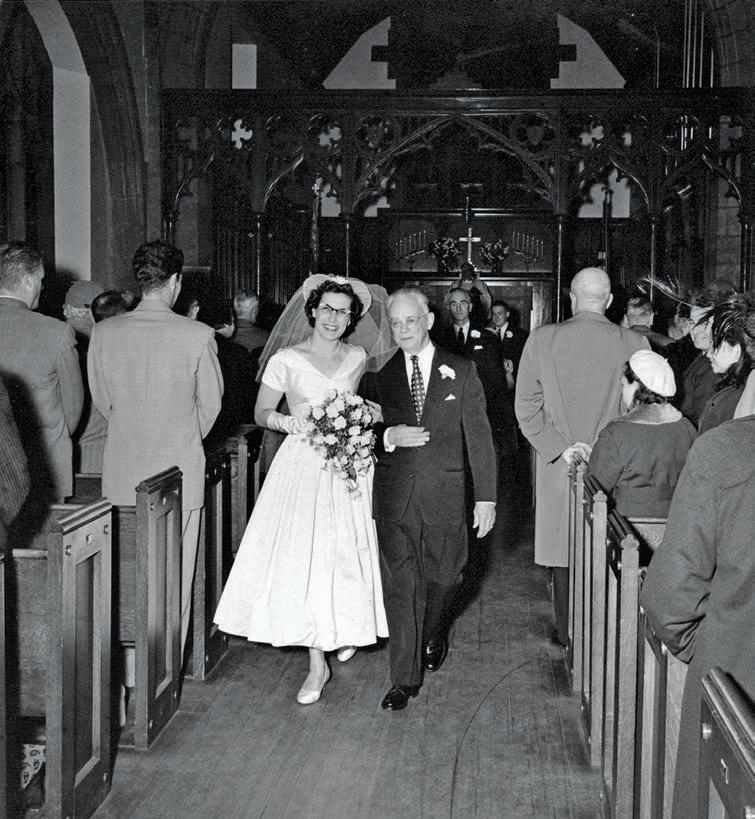
The wedding of Doodie and Jack Horner (the author's parents) in St. James Church, November 11, 1954.
The current stone church, built in 1907, was designed by renowned architects Cram, Goodhue & Ferguson of Boston and New York. This time, the stone was drawn from Quechee. Some of the fixtures from the old church were installed in the new building. These included the brass pulpit and lectern, the marble baptismal font, and three of the stained-glass windows. The parish house added in 1927 cost $13,000.
CHANGING WITH THE TIMES
Changing times were reflected in the 1928 church budget. The minister’s salary was $2,200 and outreach supported by the congregation that year ranged from the Vermont Children’s Aid Society to Near East Relief and the Puerto Rico–Florida Hurricane Emergency Fund. Light and power were budgeted at $247.40 and fuel at $543.19.
Celebrating special anniversaries is not new for St. James. In July 1926 the congregation observed the 100th anniversary of the founding of St. James’ parish. Part of the ceremonies included a tribute at River Street Cemetery to the Reverend Joel Clapp, the first rector and the only one buried in Woodstock. Two hundred years after its founding in Woodstock, St. James Episcopal Church continues to celebrate its history and its mission.
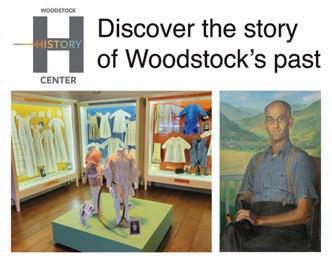
WOODSTOCK HISTORY CENTER
26 Elm Street Woodstock, VT
Stones from Quechee were used to build the second church.
Unique Shopping, Dining, and Services
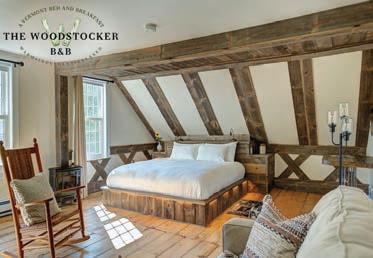
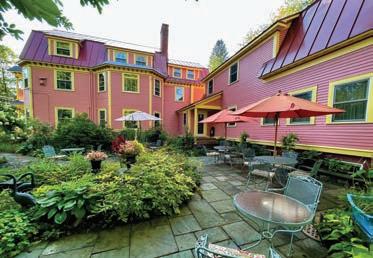
The Woodstocker Bed & Breakfast
61 River Street
Woodstock, VT (802) 457-3896
www.TheWoodstockerBnB.com
Dreamscape Coffee Specialty coffee, tea, and pastries!
Jim Kelly is a familiar name around Vermont. Aside from the legendary Buffalo Bills quarterback (born in Pittsburgh), there’s also the late Jim Kelly, charismatic and accomplished human resources professional and ski ballet performer. That brings us to another Jim Kelly, executive director of the Woodstock Area Chamber of Commerce, who, by the way, was a gifted mountain sports competitor himself on the slopes as a champion snowboard star. He was born up the road in Rutland and lived there until his parents moved to Woodstock in the early ’80s.
“My parents had an opportunity to live in Woodstock and they started a pizza place. It was actually, I believe, Woodstock’s first pizzeria. It was called
Jim at the Visitor Center, his new home base.
Jim
Cindy’s Pizza, and that was where Stay at Jimmy’s is currently, right on Pleasant Street,” Jim shares. He also confesses his childhood priorities were powder, method airs, and half pipes while attending school.
“Growing up, my whole mission during high school was ‘how can I get to Killington and snowboard?’ I would literally take the bus to the high school and get off the bus and find a way to go to Killington on every single powder day I could.” Journalist Jake Sullivan interviewed Jim, writing, “Every time I saw him on the hill at Killington, he was doing something huge, with more style than anyone I had ever seen.”
“Being a local certainly helps. People see me a lot on the streets. They see me in their businesses, in the grocery store, at restaurants. I love to network.”
— Jim Kelly,
executive director of the Woodstock Area Chamber of Commerce
LOCAL LIFE
“We have two boys,” Jim says. “Luke is eight. James is 12. We live in Bridgewater. My wife Kristen is great. We’ve been together for 13 years.” Jim also currently works at the Vermont Standard and has his own marketing business, Micro Agency. All these credentials made Jim Kelly the perfect selection as executive director to tell the area’s story locally and to the rest of the world.
“I think mostly it was because of my vast network, my local knowledge of marketing and sales,” Jim says. “Being a
local certainly helps. People see me a lot on the streets. They see me in their businesses, in the grocery store, at restaurants. I love to network. I love to be around people.” His history and personality checked a lot of boxes. As a new director, Jim is looking to improve the Chamber to be a better promoter of businesses around Woodstock.
REVITALIZING THE FARMERS’ MARKET
“There’s a lot of moving parts,” Jim confesses. “It’s also just myself and a
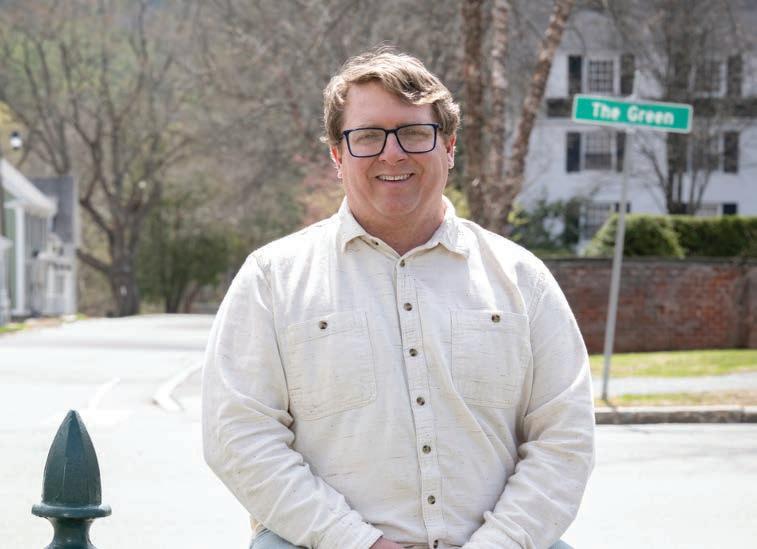
Jim at his favorite pastime spot, The Green.
part-time person, Jennifer, who’s awesome. We’ve recently hired a Market on the Green coordinator to help every Wednesday, because that’s a fairly large event that we do weekly from June to October.”
Jim credits Keri Ryan, former Montpelier Market manager, whom he claims is a wealth of knowledge and is a great partner for the Chamber’s Market on the Green plans. “I think we needed a little change to sort of reevaluate things, some areas where we knew we could use some revitalization,” Jim says. One of the first upgrades is a big one for merchants and shoppers alike: getting a good wireless carrier and signal, something talked about for a while but never put into place.
“That’s an integral part of Market on the Green because if you’ve been to any farmers’ markets, if you don’t have good reliable Internet or cell service, you can’t take payments. That’s a problem.” Cash may be king, but credit cards and services like Venmo help increase sales as
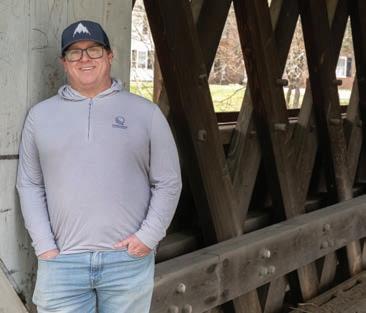
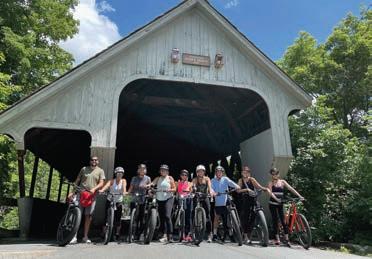
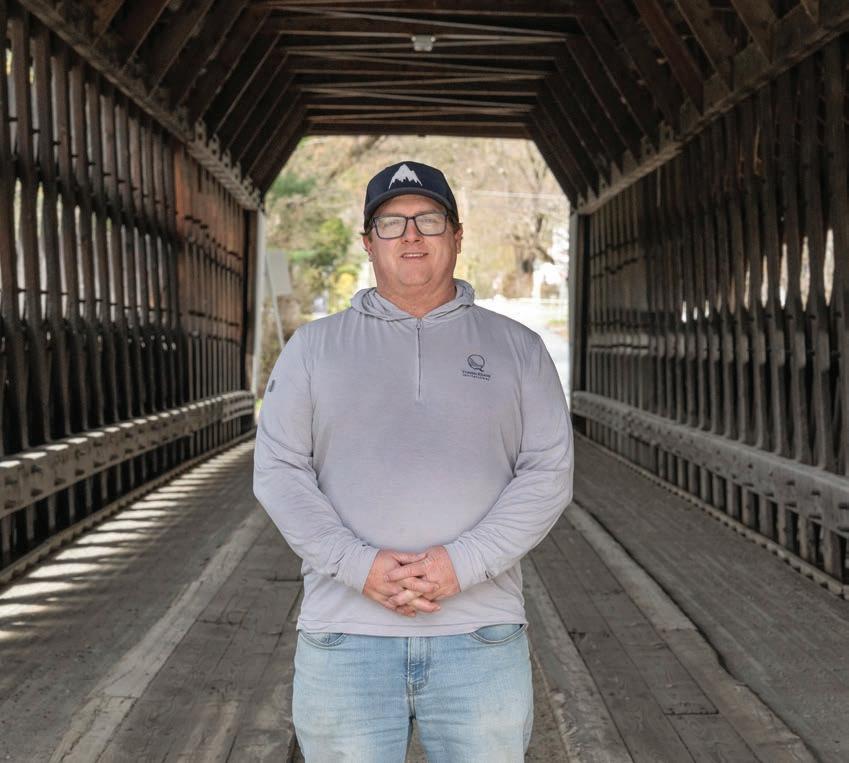
Jim pauses under the historic Middle Covered Bridge.
“There’s still a lot of businesses that need help, whether it’s marketing or a little bit of guidance or strategy. I really enjoy walking into a place and having a conversation and walking out feeling, ‘Okay, this is what I need to do to help this person.’”
— Jim Kelly, executive director of the Woodstock Area Chamber of Commerce
a major convenience to buyers and merchants alike.
WELCOMING VISITORS FROM NEAR AND FAR
Woodstock is blessed with beauty and outdoor assets like the nearby Appalachian Trail, an attraction that introduces the Woodstock area to transient hikers for the first time, Jim believes. “It’s funny, on a weekly basis, we probably get two or three phone calls from people just
asking about the area, inquiring about it. It’s their first time coming, [asking], ‘any suggestions?’ I mean, Google is great and online you can pretty much do anything, but I think they’re smart to call the Chamber just to get a good insight on where to start. But yeah, you see people coming through here all the time from all walks of life, all places, from hikers to Hollywood stars to athletes, you name it.” Celebrity spotting in town has included actors Steve Buscemi, Scarlett Johans-
son, Tom Cruise, and golf pro Keegan Bradley.
Has there ever been confusion with inquiring visitors about Woodstock, Vermont, and New York’s White Lake, famous for its iconic Woodstock festival 228 miles away? “For sure [we] hear about people that will call here thinking it’s Woodstock from 1969.”
When it comes to local businesses, Jim is passionate about helping them grow. “There’s still a lot of businesses that need help, whether it’s marketing or a little bit of guidance or strategy. I really enjoy walking into a place and having a conversation and walking out feeling, ‘Okay, this is what I need to do to help this person.’”
WOODSTOCK
AREA CHAMBER OF COMMERCE
3 Mechanic Street
Woodstock, VT (802) 457-3555
woodstockvt.com
www.wagnerhodgson.com
Connecting People with Nature and Each Other
Woodstock Community Trust projects are improving our green spaces
By Katherine P. Cox
Efforts by groups focusing on creating, enhancing, and protecting green spaces in Woodstock have resulted in the completion of Ottauquechee River Trail and East End Park over the course of many years. Beautiful public spaces have been shown to create economic opportunity, bring people together outdoors, and foster a greater sense of community. A third group, Woodstock Village Conservancy, is in its development phase, hoping to further improve public green spaces in Woodstock. All three groups are projects of Woodstock Community Trust, which provides legal, accounting, and financial oversight to all the projects in its portfolio.
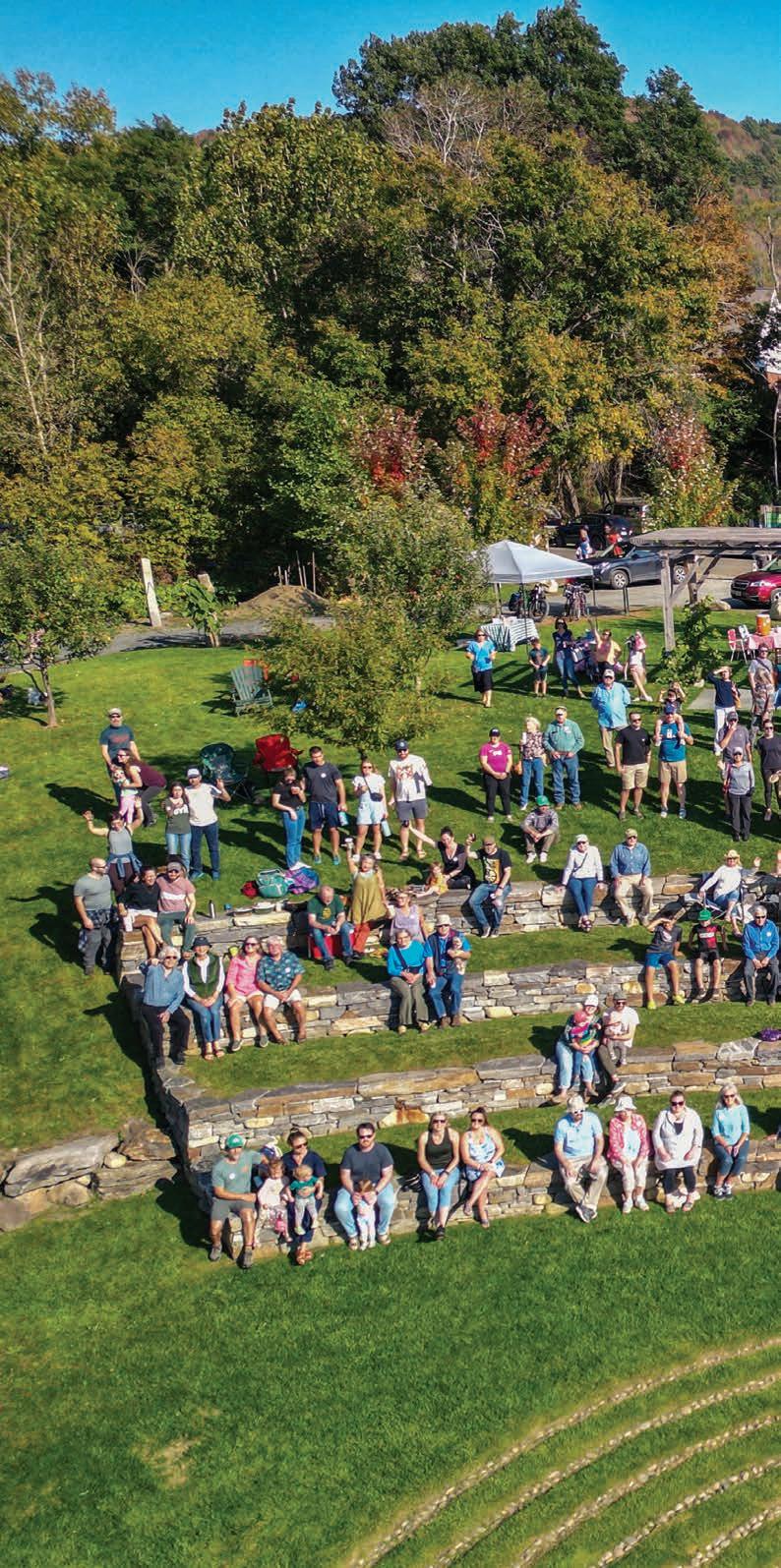
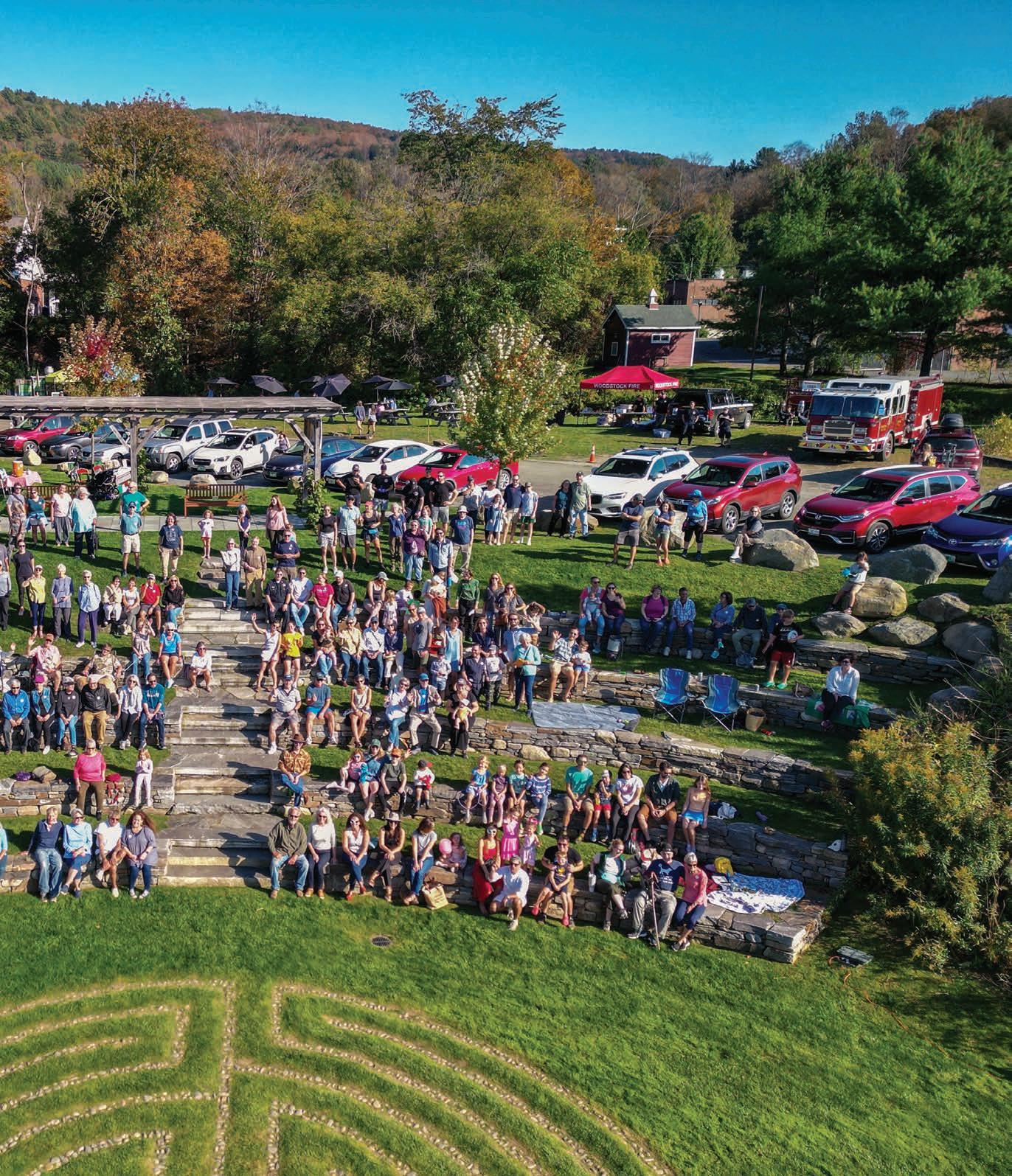
East End Park community celebration in 2023.
OTTAUQUECHEE RIVER TRAIL
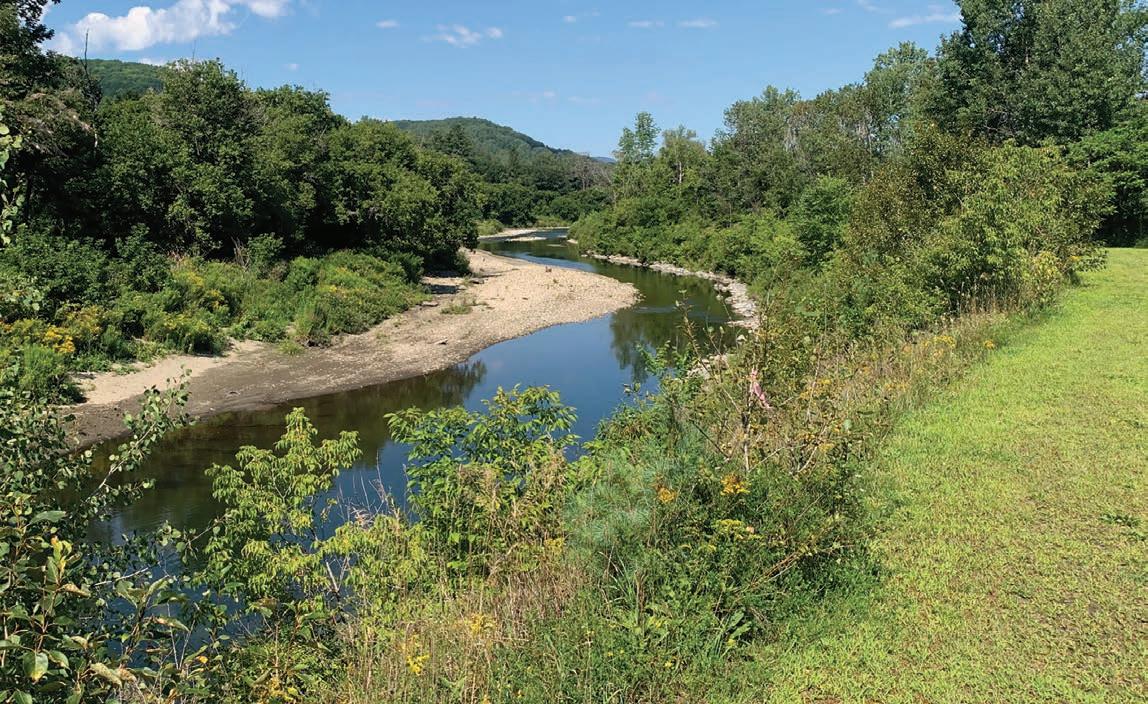
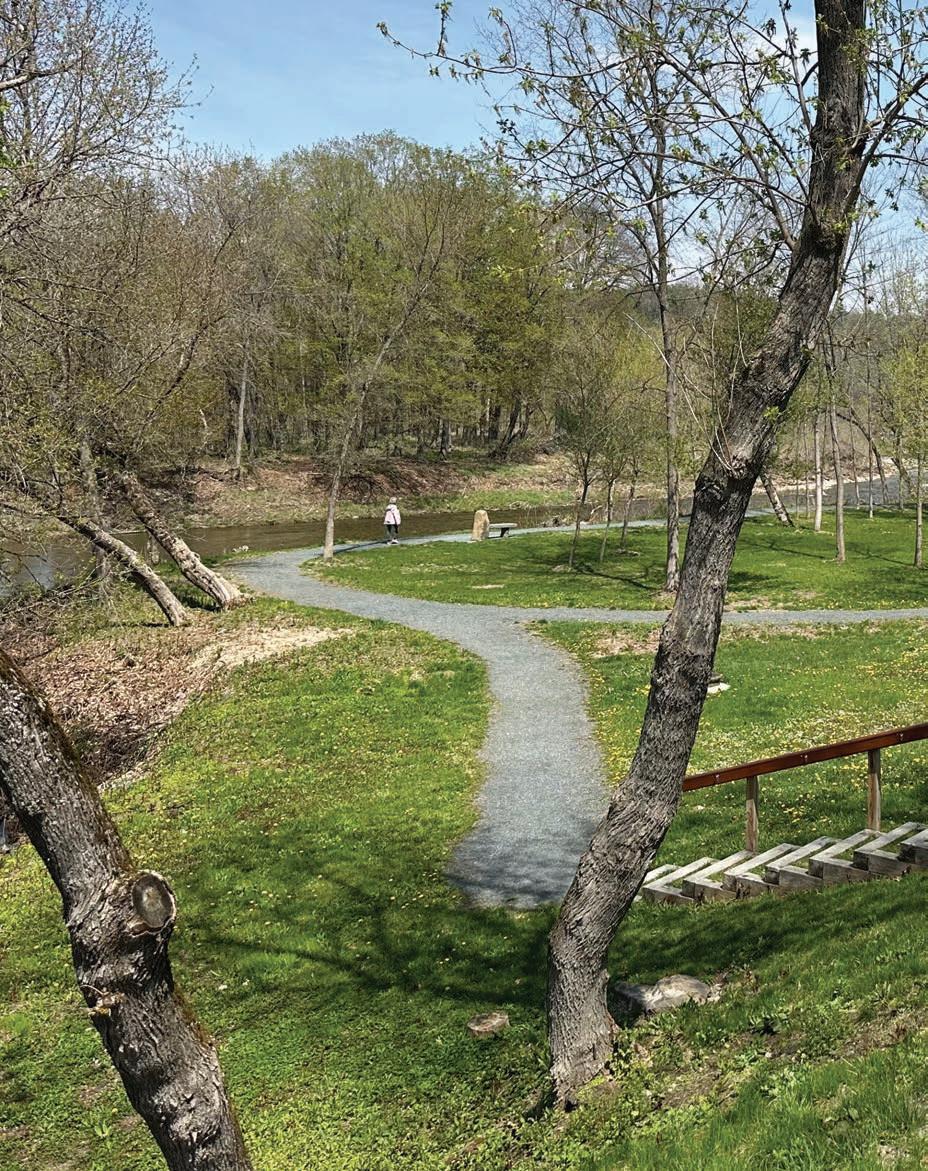
Ottauquechee River Trail meanders for almost three miles in a bucolic loop along the river on the east side of Woodstock. With over a mile of river access, it is used by some 400 people a week, appealing to children, families, runners, walkers, strollers, and anyone who wants to enjoy the year-round beauty of this local gem.
“The community has been very active in supporting the trail, both with volunteer hours and funding for the ongoing improvements and annual maintenance.”
—
Tom Weschler, project leader of Ottauquechee River Trail
“It’s magical,” says Tom Weschler, project leader and part of a group of about 15 citizens who came together in 2017 to walk properties, contact property owners, and lay out a vision of what a riverwalk would look like. Today, Tom is a project leader with a team that includes Randy Richardson, Wendy Jackson, and Phil Robertson that spearheads trail maintenance. The Woodstock Economic Development Commission provided the majority of funding for construction and building of the trail, which opened in 2020. “The community has been very active in supporting the trail, both with volunteer hours and funding for the ongoing improvements and annual maintenance,” Tom says. After a flood in 2023 left the trail under 10 feet of water and washed away benches, trail signs, and bog bridges, the community stepped
Above: An afternoon walk on Ottauquechee River Trail.
Right: (Back row) Randy Richardson and Tom Weschler. (Front row) Wendy Jackson and Phil Robertson.
up with a major fundraiser, “and now the trail is totally rebuilt and better than before, with stone benches.”
The 2.8-mile trail winds by a working agricultural field, with part of the trail on the 150-year-old Woodstock railbed, and traverses private property, including Woodstock Inn & Resort, East End Partners, Sunset Farms Condominium Association, and Town of Woodstock Wastewater Treatment Plant. The trail is maintained by dedicated volunteers and funded by donations and grants, “and the combination of East End Park and Ottauquechee River Trail has been a catalyst for the development of the east end of Woodstock, which has always been a priority for the town,” Tom says.
“There are a variety of constituencies that use the trail,” Tom says. Anybody who is seeking nature and peace and quiet will find it on the trail, he says. There are eight or 10 river access points with benches and picnic tables at many of those points. The trail is popular with families and children, dog walkers, and seniors. Woodstock Terrace, a senior living community, is near the trail, and Thompson Senior Center organizes walks on Mondays. “It’s a wonderful place for everybody. The trail is very friendly with universal access for wheelchairs and strollers,” Tom says. “There’s a tremendous amount of nature and wildlife.”
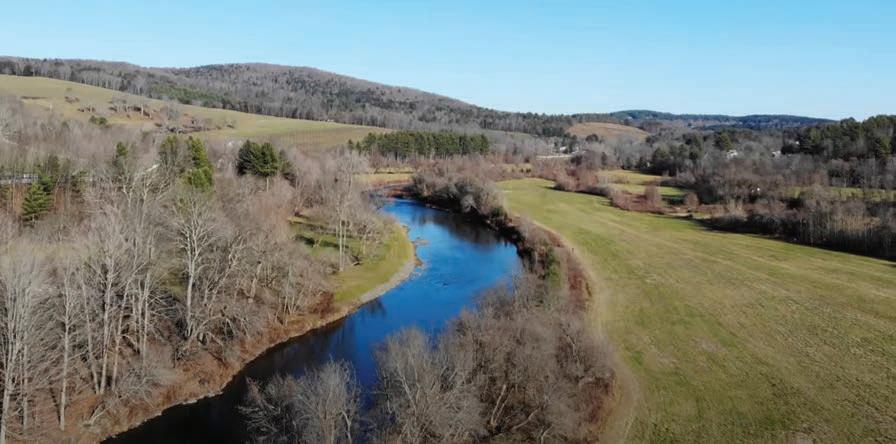
People use the access to the river to fish and it’s a birder’s paradise. “The agricultural field that is the heart of the trail is in a migration zone, so birders come from miles around, in the fall especially.” It’s beautiful any time of year, though. “It’s a four-season trail. It’s a beautiful walking trail, but in the winter, people snowshoe and ski on it. It is the best place to view the leaves and color in the fall because when you get to the trail and you’re down by the river, you get a 360-degree view of beautiful homes, beautiful landscape, and the mountains. The colors of the trees are spectacular. It’s a fun place and we’re lucky to have it. We’re so lucky that owners have contributed or allowed the public to use their lands.”
Ariel view of the river trail along the field and bird migration zone.
EAST END PARK
Transforming what was once a blighted area in the east end of Woodstock into what is now a beloved scenic park was an “unbelievable undertaking by a lot of really committed folks,” says Emily Friedman of the massive, years-long project that resulted in East End Park. The effort to establish a park in the east end dates back to 2009, when East End
“It was a community-led grass-roots effort to establish a park in a place that was the town’s designated snow dump, and beyond that people used it as an overall dumping ground. It was an area that was vital but had fallen into disrepair. It was colloquially called the jungle around here.”
— Emily Friedman, Woodstock Community Trust board member
Action Group formed to turn a former town snow dump into an area that was environmentally robust, would provide opportunities for economic development, and foster a strong community center around the east end, says Emily, project leader for East End Park and a board member of Woodstock Community Trust.
There were a couple of plans over the years, Emily says, “but East End Action Group really kicked things off around 2012.” They organized under Sustainable Woodstock and applied for grants, built
relationships with the town and village, and fundraised. “It was a community-led grass-roots effort to establish a park in a place that was the town’s designated snow dump, and beyond that people used it as an overall dumping ground. It was an area that was vital but had fallen into disrepair. It was colloquially called the jungle around here.”
The transformation of the site took
place over several phases that included volunteer labor, hiring contractors and experts, and bringing in the town and the village as essential partners, Emily says. The snow dump had to be moved first, she says, and East End Action Group worked with the town and the village to move it away from that site, which opened it up for the park’s development. Trash and debris removal fol-
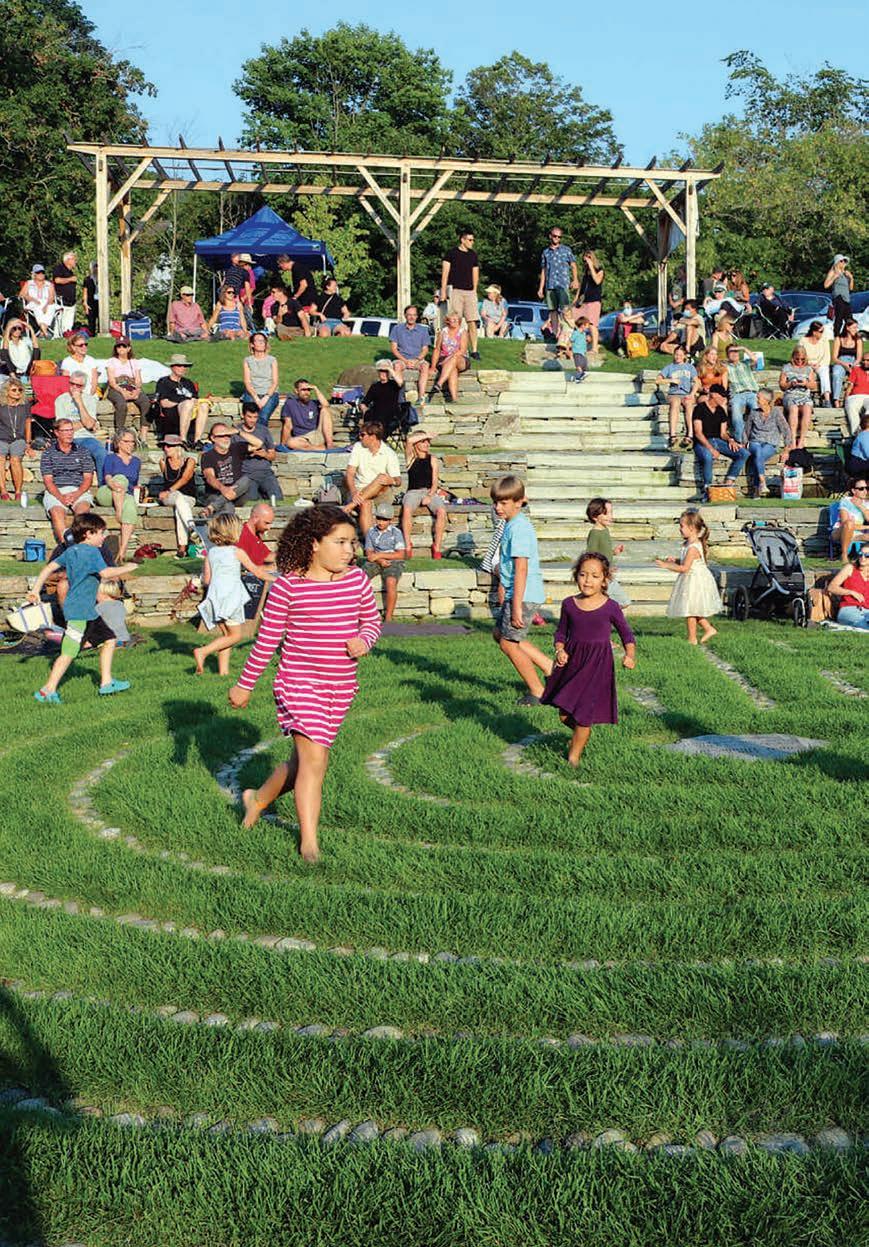
East End Park hosts many community events such as Music by the River.
lowed, and the soil had to be replenished for planting. “It started from a really rough point and volunteers came in and planted, built an amphitheater and a labyrinth, planted trees, built stone walls, and put up benches and picnic tables. Opening in 2020 was the culmination of years of putting in work. Now that it’s built, the joy has come from seeing how people use it.”
The stone labyrinth is much loved, especially by children who love running around it, Emily says. There’s a slide and a rock scramble for kids as well. Parents love the fact that their kids can play safely far from the road. Pentangle Arts, a Woodstock arts organization that brings a variety of arts experiences to the community, hosts Music by the River, a summer concert series. “The amphitheater was designed with that kind of thing in mind, so it’s thrilling to see it get such consistent use that way.” Community organizations can use the park facilities for events as well.
The trailhead of Ottauquechee River Trail is at the park and provides parking for its users. “We have the only public river access in the town of Woodstock because we are on public land owned by the town and the village. The trail is on private land that is open to the public. We are making sure there is river access available for the public in perpetuity in the park,” Emily says. “It’s such a nice
experience to go from one to the next,” she says of the connectivity between the trail and the park.
The park has also helped spur development nearby, which was always the hope, Emily says. New businesses such as Ottauquechee Yacht Club, Ranch Camp, and Farmer and the Bell have opened, and Emily sees more opportunities for development down the road. “It feels like
5K River Walk
it’s the very beginning of an exciting time for the east end.”
The bulk of the park’s budget comes from donations and grants, she says. “We do an annual appeal through Woodstock Community Trust, so when we talk about planting new trees or maintenance, the funds are not coming from tax dollars; it’s funded through private donations and grants,” Emily says. A combination of work keeps the park looking good— volunteers help plant gardens, the town and village does the mowing, and a park supervisor does additional maintenance tasks. “People continue to be engaged,” Emily says. “That passion hasn’t waned. It’s a people- and community-powered park and it brings together people of different ages and backgrounds. It’s a grassroots park. It’s by the community and very much for the community.”
East End Park group hosts a community celebration every fall “as a way to give back to the community, bring people together, and focus on local food and music,” Emily says. This year’s Woodstock Community Celebration will be held Sunday, September 13.
Ottauquechee River Trail is sponsoring a Fourth of July Firecracker 5K Run/Walk as part of Woodstock’s 250th celebration. ‘We’re trying to introduce the trail to more of the Woodstock community and invite people to experience it. It’s a way of giving back and giving thanks to the Woodstock community,” says Tom Weschler, project leader of Ottauquechee River Trail.
The Firecracker 5K is family friendly and the route is mostly flat, easy to walk or run, and surrounded by lots of great nature. The walk/run will start at 9am on Saturday, July 4, at the ORT kiosk in Woodstock’s 0 Maxham Meadow Way and follow the Ottauquechee River as it runs along hay fields, a vernal pool, and Woodstock’s 150-year-old railbed. The Firecracker 5K is intended to be a “fun run” and it will be untimed.
There is a registration fee of $30 and all proceeds will go toward the maintenance and improvement of the river trail “to ensure the trail remains safe, beautiful, and accessible for residents and visitors,” Tom says.
Other activities that weekend include music at East End Park on Friday night, July 3. After the 5K on Saturday, the celebration moves to the town center. Festivities will culminate Sunday night with fireworks. For more information and to register, visit runsignup.com/Race/VT/Woodstock/OttauquecheeRiverTrailRace.
The East End Park site in 2013, when it was still nicknamed ʺThe Jungle.ʺ
WOODSTOCK VILLAGE CONSERVANCY
In a lot of municipalities, the money available from taxes is not enough to adequately maintain and or improve public spaces, says Wendy Spector, project leader of Woodstock Village Conservancy. That’s where the Conservancy comes in, with the goal of helping Woodstock
“It will take many years to come to fruition. It involves basic infrastructure improvements such as irrigation; improving grass, pathways, safety, and traffic flow around the Green; and planting trees.”
— Wendy Spector, project leader of Woodstock Village Conservancy
with resources it needs to improve and enhance public spaces. “We’re also interested in connectors, whether it’s physical connectors like sidewalks, or figurative connectors like wayfinding, maps, or even engagement, people connecting through events and things that bring people to the parks and to each other.”
Woodstock Village Conservancy was founded two years ago with the understanding that many of its goals will take time. “So far, the group has obtained a Letter of Agreement with the town and village, which delineates our objectives, roles, and responsibilities,” Wendy says. “One thing we don’t want to do is burden them with meetings or take them away from other priorities.”
The Conservancy has a lot of initiatives in mind, Wendy says, but the largest initiative is to rehabilitate the Green. “It will take many years to come to fruition. It involves basic infrastructure improvements such as irrigation; improving grass, pathways, safety, and traffic flow around the Green; and planting trees.”
The Village Corridor project would cre-
ate safe, sustainable, and accessible streets and pathways for vehicles, bicycles, and pedestrians. Other initiatives include Branch Out Woodstock, which aims to plant trees in the downtown business district where trees have died, and developing a volunteer gardening corps to help maintain the spaces. To that end, the group wants to form Conservancy Corps,
One conceptual rendering of a rehabilitated Green.
Woodstock Village Conservancy Friendraising Event.
a volunteer group that would meet from April to October. “These things will all take time because we need to raise money, get public feedback, and get the town on board.”
Wendy continues, “Studies show public spaces are beneficial to communities and foster a sense of community. They bring people together, they’re a way for people to inexpensively recreate, and a way of mixing socioeconomic groups. Having beautiful spaces brings people outdoors.” They’re magnets not just for residents but for visitors too, which creates economic opportunity. She points to the development of East End Park generating new businesses in the east end.
Much of the prospective revitalization of green spaces is still aspirational, Wendy says, “but we did enlist the work of a landscape architect to help us conceptualize what a renovated Green might look like. We created some designs so we could prioritize design elements that would enable us to start a conversation”
with the public and officials. “We’re hoping to move forward with that in the next year or so. It’s important that all the officials be brought on board every step of the way. It’s not just us deciding to plant trees.” The Conservancy is trying to forge a new kind of public-private partnership, Wendy says, so that as they proceed, they will have the support of town boards and officials. “The initiatives have been presented to the boards. They know we have gone down the exploratory path on a number of these initiatives, with a handful that are more fleshed out. We’ve begun discussions with the Department of Public Works on some of them. We’re now waiting to hear back from them.”
WOODSTOCK COMMUNITY TRUST
PO Box 802 Woodstock, VT woodstockcommunitytrust.org
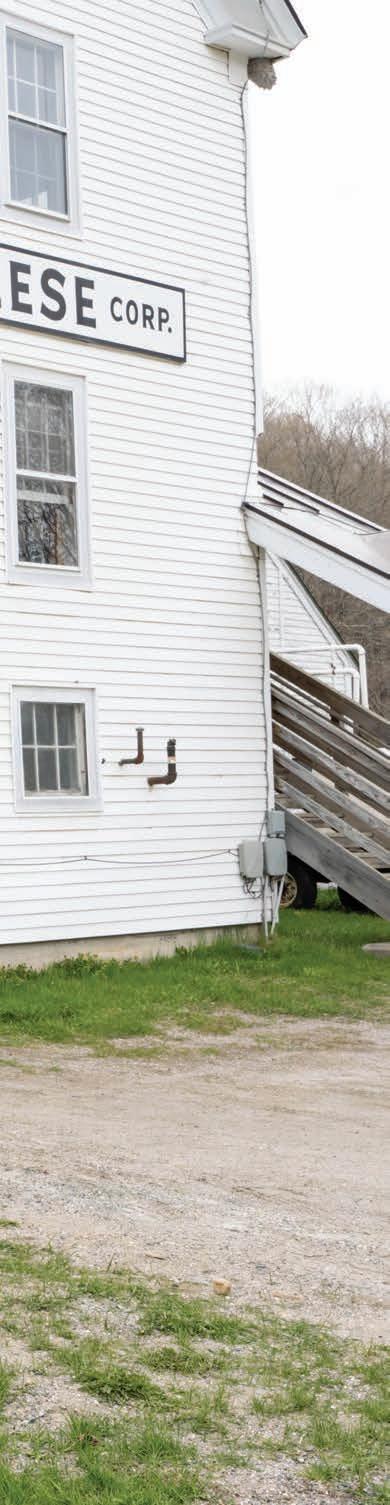
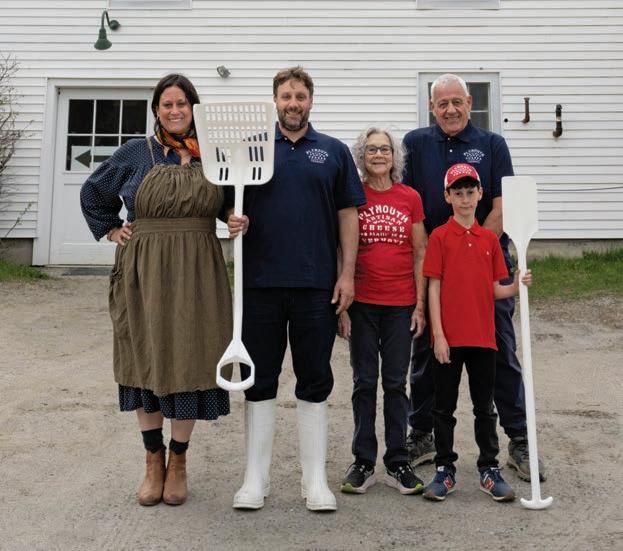
Sarit, Jesse, and Reuben Werner in front of the Plymouth Cheese Factory, where America’s oldest cheddar recipe is made.
Stepping Back in Time
The
care to revive Plymouth Cheese
By Kelly Sennott
Photography by Nancy Nutile-McMenemy
Visiting Plymouth Cheese is a little like stepping back in time. The factory, which resides within the President Calvin Coolidge State Historic Site, has been making cheese since 1890, and its owner, Jesse Werner, has been working hard to preserve that legacy, evident in the care with which he makes and sells the product.
During a visit, Jesse points out the site’s other buildings through the factory’s windows: That’s where the former president was born, that’s where he grew up. That’s where he was sworn in. From where we stand, we can see the post office, the general store, and centuries-old buildings connected by dirt roads. Since taking over in 2009, Jesse has been using the original Plymouth Cheese recipe sourced from Vermont state archives and has consulted with a woman in town who was head cheesemaker back in the 1960s. Was the texture right? The flavor? How could he create a profitable product while remaining true to the institution?
The Coolidge family had owned the building until turning it over to the state of Vermont to become part of the President Calvin Coolidge State Historic Site in 1998. In 2009, Jesse put together a plan to revive the factory and the original granular curd cheddar recipe.
Because, Jesse says, that’s one of the coolest things about this place: that it’s wrapped in farming, Vermont, and presidential history. It means a lot to the people who visit and the people who live here, many of whom have worked in the factory themselves or whose ancestors have.
BACK TO VERMONT
Jesse grew up on a small Vermont farm in Franklin County, and as a teenager, would help his neighbor make feta cheese after school. “He was an older Greek guy who had
some goats and liked to make feta cheese every day. I started helping him,” he says. “I thought it was really cool. I kept learning about it.”
He studied sociology at Brandeis, just outside Boston, but always wanted to live in Vermont—it was just a matter of figuring out what he was going to do. He took courses at the Vermont Institute for Artisan Cheese, apprenticed under cheesemaker Marc Andre St. Yves
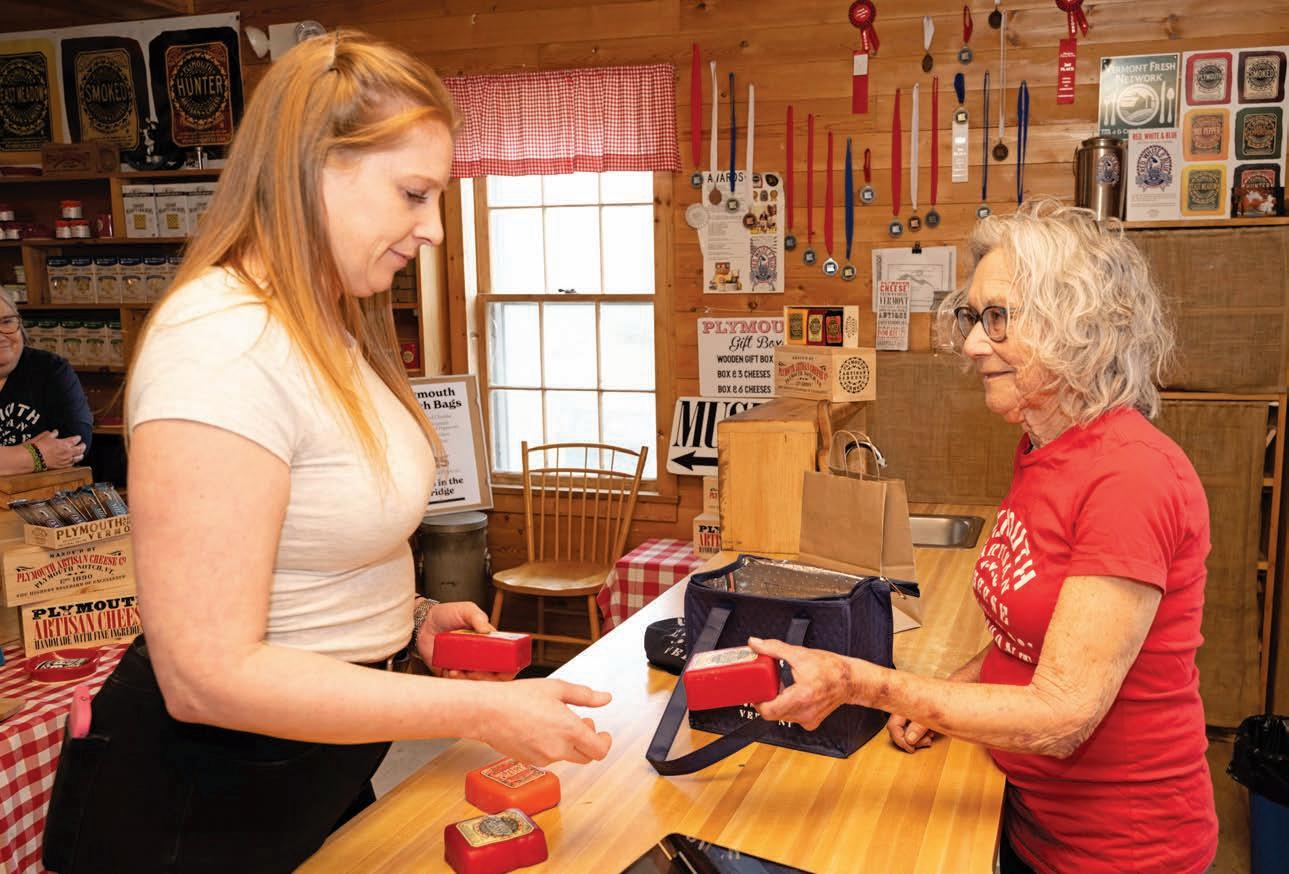
Linda Werner manages the factory store, which is open daily from 11am to 5pm. Here she assists a customer.
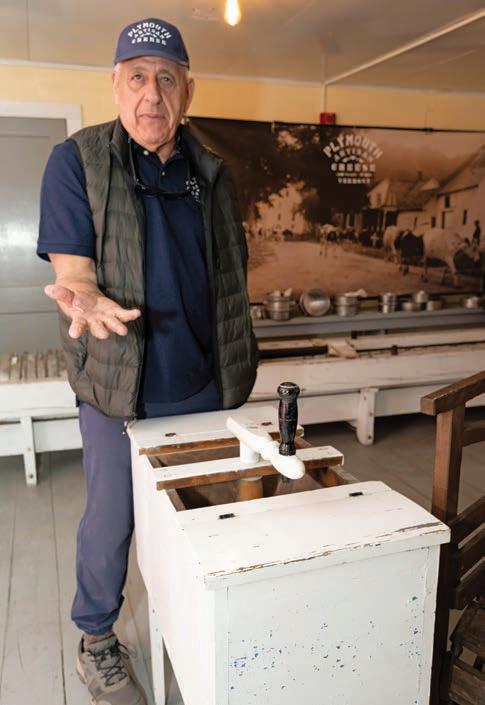
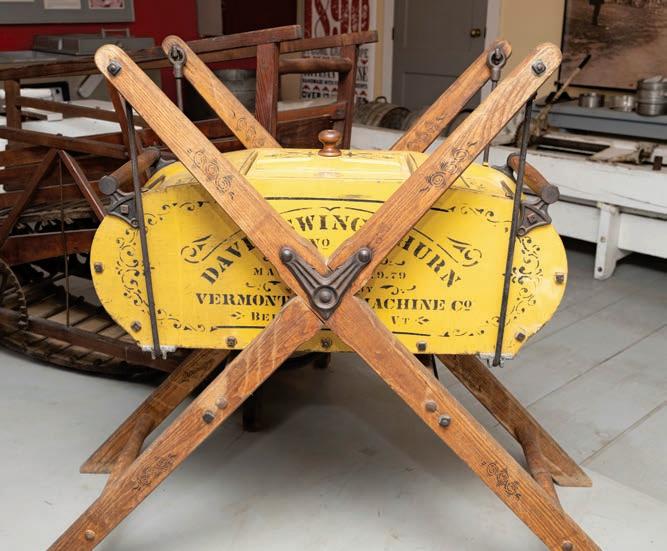
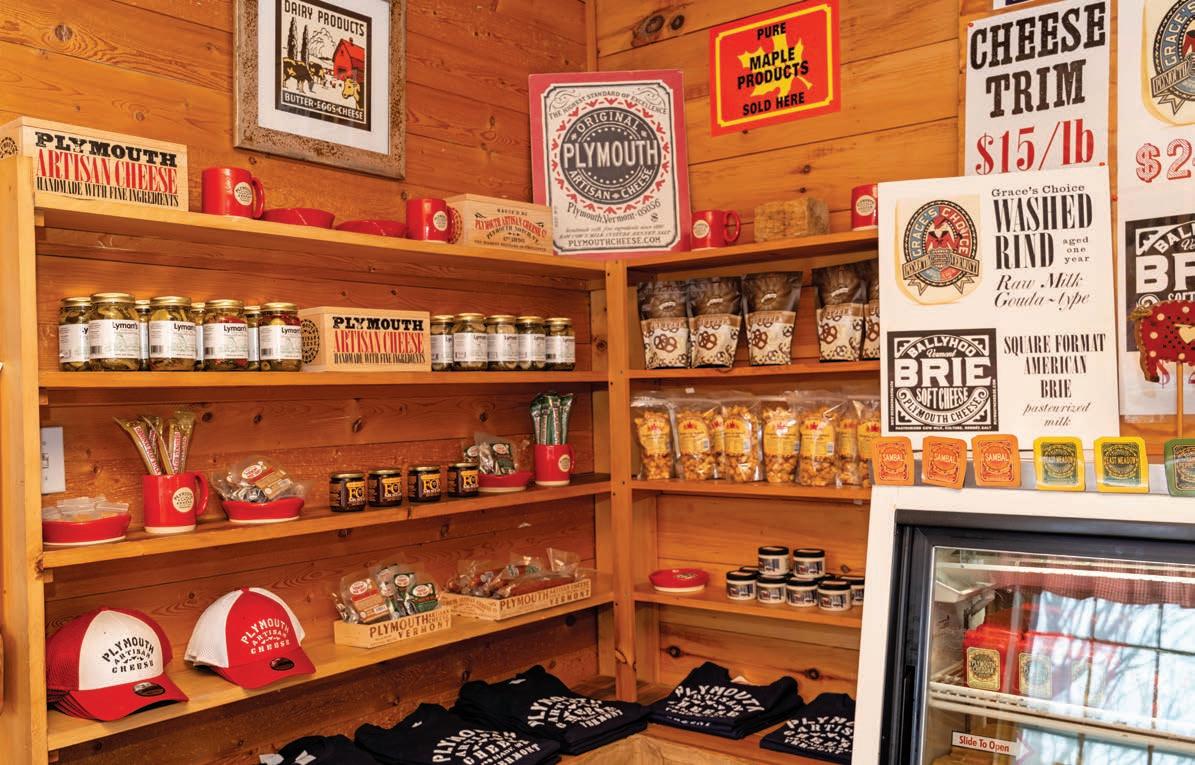
Clockwise from left: Leo Werner gives a great tour. An antique Vermont butter churn. A select range of local products is offered in the factory store.
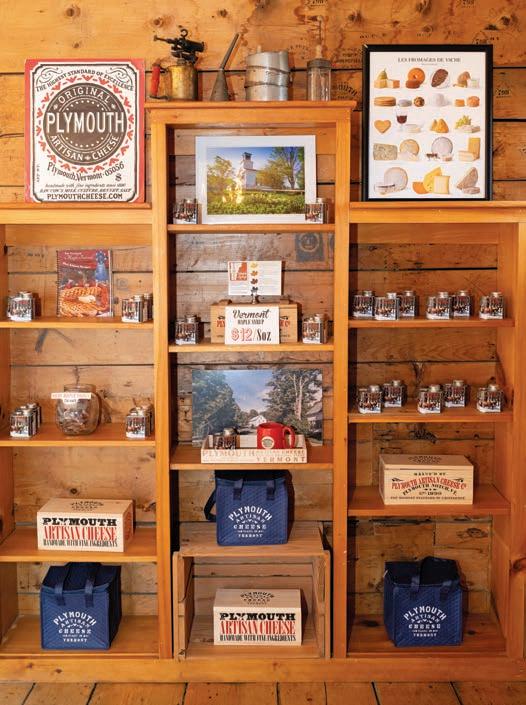
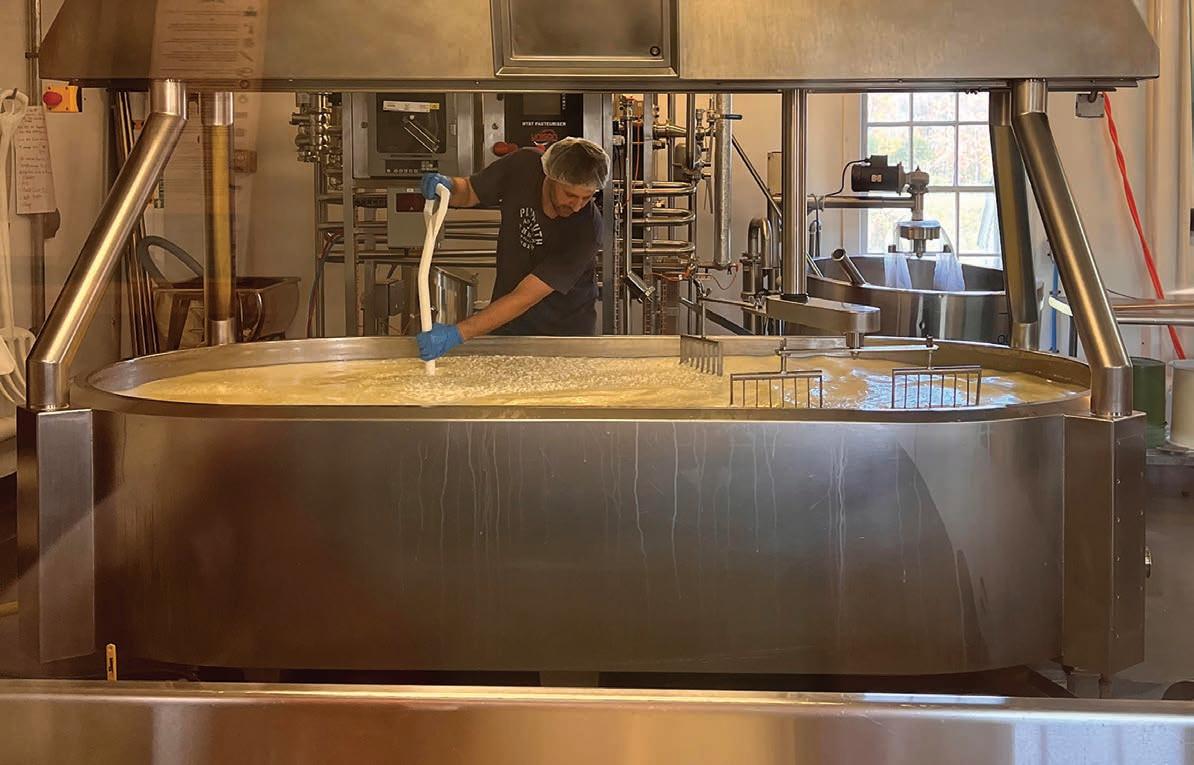
Clockwise from above: The Werner family. Original knotty pine shelving in the factory store. Jesse stirs the curds.
in Quebec, and in 2009, moved back to his home state.
“I came back to Vermont to try to start a cheese business,” he says. “I had heard that the state of Vermont wanted to rent this cheese factory out. So I came down and checked it out.”
The Coolidge family had owned the building until turning it over to the state of Vermont to become part of the President Calvin Coolidge State Historic Site in 1998. In 2009, Jesse put together a plan to revive the factory and the original granular curd cheddar recipe, which was accepted. He began making cheese that summer.
PRESERVING HISTORY
At times figuring out how to revive the original recipe and brand felt to Jesse like an archaeology project, and in the beginning, he’d consult with a woman in town who’d been the head cheesemaker in the ’60s. He thinks the finite
In Vermont, it was all about cheddar, which you could make in large quantities. “It’s salted the day you make it, so it can be made in a day. And then you can age it almost indefinitely if it’s made well, so it keeps,” Jesse says. “It didn’t need lots of refrigeration, so it lent itself to being a viable commercial product early on.”
differences in how cheese is made is an interesting way to look at history. “Why is the cheese the way it is? It usually comes back to the environment or the people. There’s always a reason for why it turned out the way it did,” he says. In Vermont, it was all about cheddar, which you could make in large quantities. “It’s salted the day you make it, so it can be made in a day. And then you can age it almost indefinitely if it’s made well, so it keeps,” he says. “It didn’t need lots of refrigeration, so it lent itself to being a viable commercial product early on.”
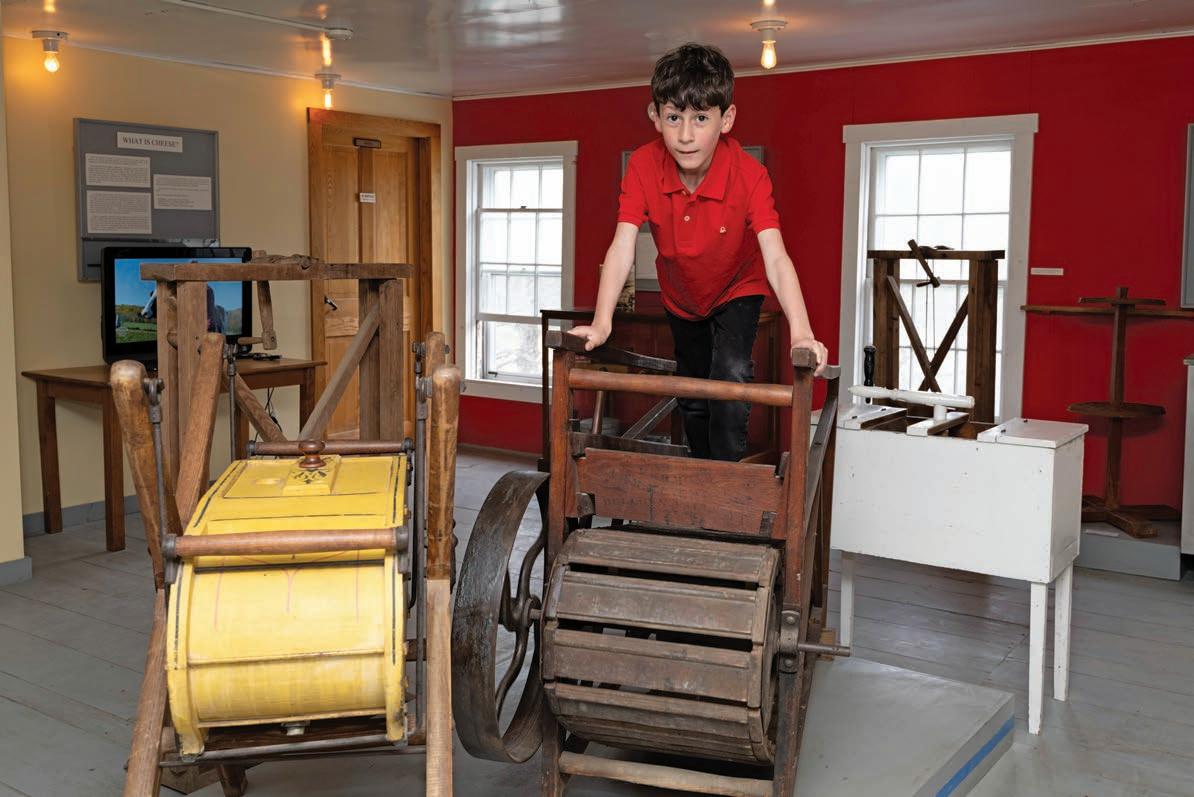
Reuben Werner demonstrates a conveyor belt designed for a child to help swing the old-fashioned butter churn.
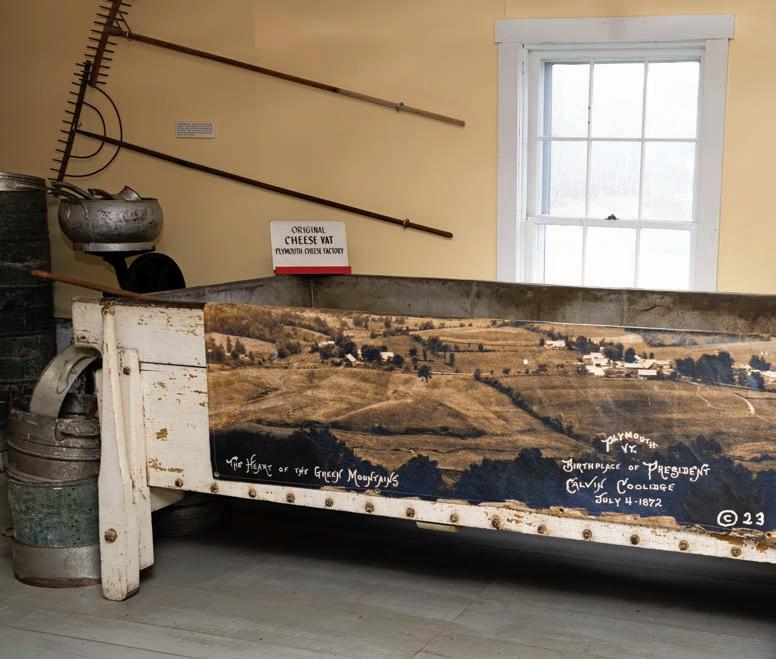
Jesse and his wife, Sarit Werner, also designed the branding to be reminiscent of original labeling, which visitors can see etched on signs in the second-floor museum alongside antique metal-lined cheesemaking vats and a butter churn linked to what appears to be a manual treadmill.
INTO THE MODERN ERA
Naturally, preserving Plymouth Cheese while making it viable and profitable in the 21st century is a delicate balance. When Jesse first took over, he made 40-pound wheels of cheese, like in the old days, but most buyers today don’t want to purchase 40 pounds of cheese all at once. Now they produce eight-ounce cheddar bars with milk from Woodlawn Farmstead in various ages and flavors, including black truffle, garlic peppercorn, and harissa, in addition to Brie via their own recipe.
There are limits to the physical building, too. A few years ago, Jesse and his family purchased a portion of the Bridgewater Mill for warehouse space to help with shipping and delivering. “This is great, but it definitely is an antique cheese factory,” he says, gesturing to the small building and winding dirt road.
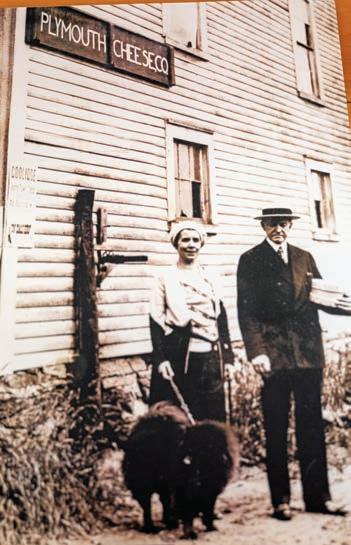
Grace and Calvin Coolidge in front of the cheese factory.
But he thinks some of those old practices are worth the effort and extra cost. That morning, they’d coated the cheese in wax packaging, a different color for each flavor. “Most places have gone to just plastic bags, which are cheaper and easier,” he says. “But we wanted to make something like the original, and it was wrapped in wax.”
He says he still enjoys the whole business cycle: taking raw materials, making something new, and then selling it, all right here in Vermont. “I think people these days are interested in knowing where their food comes from,” he says. “This is an expression of something you can make locally in a very small circle.”
PLYMOUTH CHEESE
106 Messer Hill Road
Plymouth Notch, VT (802) 672-3650
plymouthcheese.com
The original cheese vats are on display in the upstairs museum of the history of cheesemaking at the Plymouth Cheese Factory.
Discover the charm of secondhand shopping at Woodstock Consignment
By E. Senteio | Photography by Lynn Bohannon
Are you tired of big-box stores and particleboard self-assembly furniture? Perhaps you crave something a bit more unique. Shop owner Alexa Tsouknakis may have just the thing to spark your interest. She invites you to come in and browse her thoughtfully curated, ever-changing space: Woodstock Consignment.
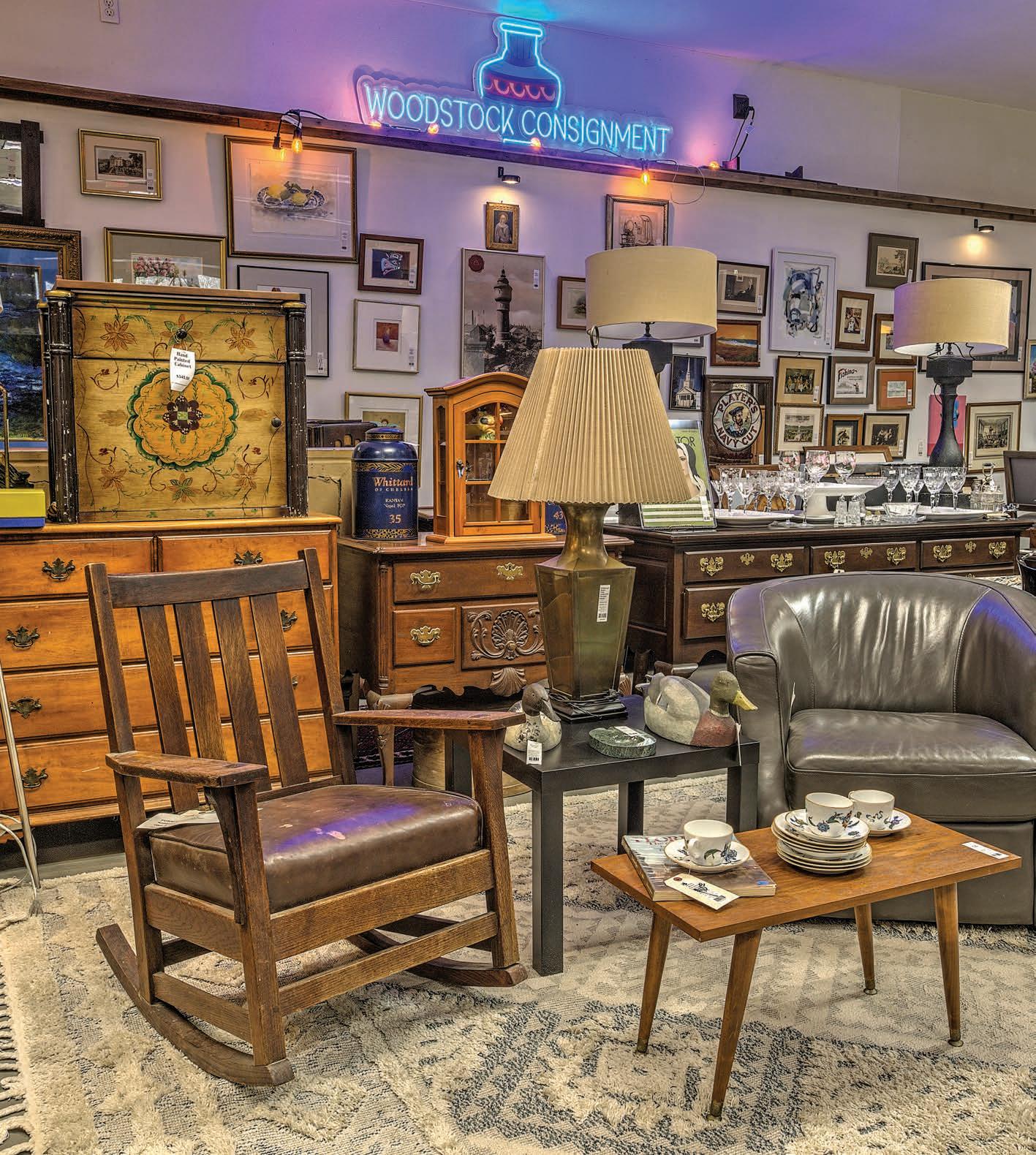
Opposite: A Stickley rocker is paired with a leather barrel chair.
Alexa at the checkout counter at Woodstock Consignment.
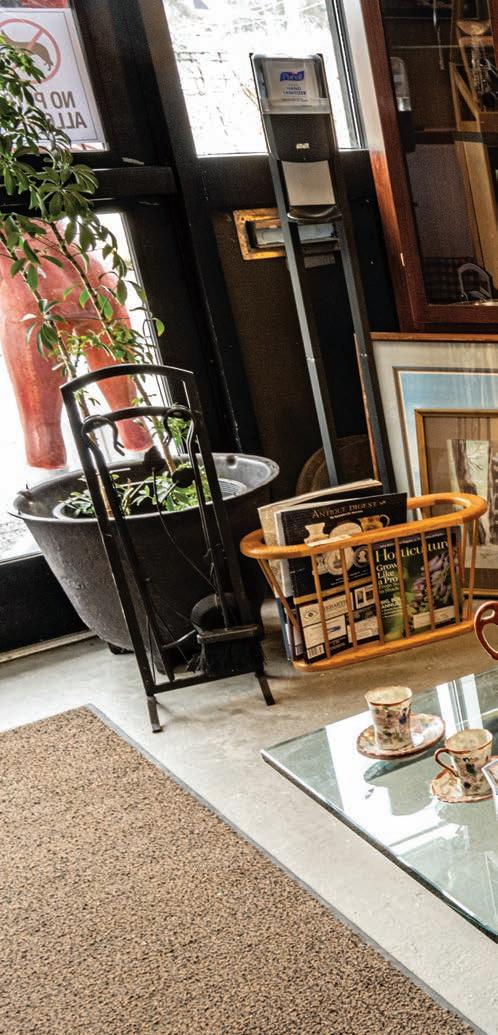
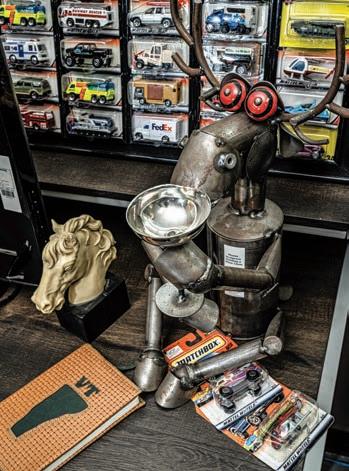
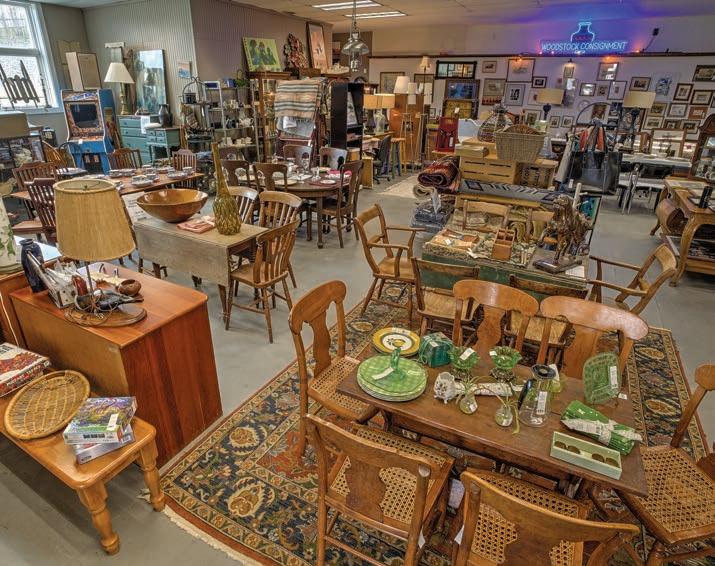
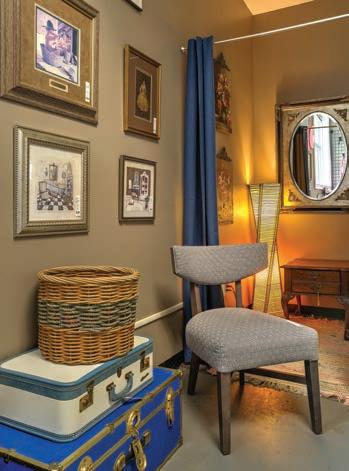
Woodstock Consignment is an eclectic blend of vintage, contemporary, and one-of-a-kind finds. The inventory ranges from furniture and home décor to smaller trinkets and accent pieces.
HAPPENSTANCE
Alexa didn’t set out with a lifelong plan to open a consignment shop; it came together organically. “I grew up here,” she says. Then, after traveling and returning home during COVID, she found herself looking for a new direction. With vacant space in a building owned by her father and uncle, and encouragement from family and local shop owners, she took a leap. “Everything kind of fell into place,” she says. “I’ve just been doing it for two years now, and I really love it.”
That sense of contentment is evident in the shop itself. Woodstock Consignment is an eclectic blend of vintage, contemporary, and one-of-a-kind finds. The in-
ventory ranges from furniture and home décor to smaller trinkets and accent pieces. And, Alexa adds, “I’m just starting a clothing section.”
But furniture remains a major draw. Shoppers often come in with specific needs, she says. It may be a table of a certain size, a dresser, or a statement piece. But just as often, they arrive with no agenda at all. “A lot of people come in just to browse and see whatever catches their eye.” That browsing experience is
Right:
Browse Matchbox cars and other treasures.
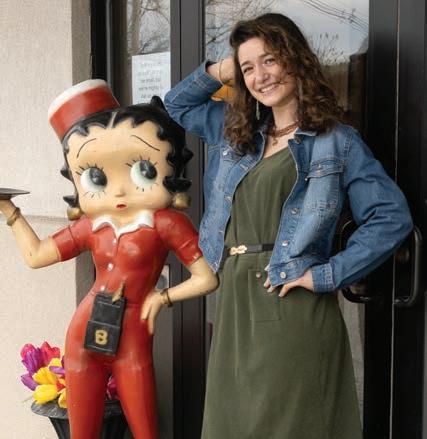
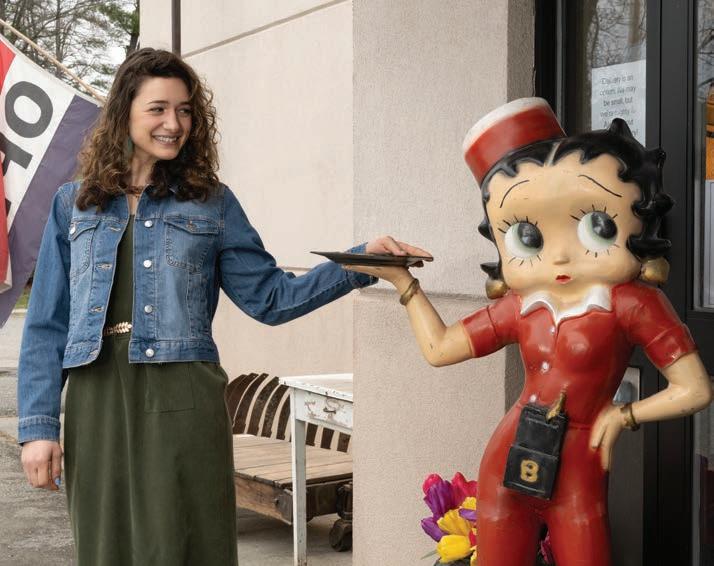
A life-size Betty Boop statue stands outside the front door.
Above: A contemporary seating set with a glass coffee table.
Left: A variety of costume jewelry is displayed throughout the store.
The essence of Woodstock
Consignment:
A bit of history here, a touch of craftsmanship there, a touch of nostalgia on a tabletop, a new experience tucked in a corner.
central to the shop’s appeal. It motivates her to keep “the inventory constantly rotating” so no two visits feel the same. “I want the store to always look fresh.”
MAKING THE CUT
Maintaining that freshness requires a careful balance of selectivity, turnover, and business sense. While Alexa welcomes a wide range of items, she’s clear about what doesn’t make the cut. “I don’t really care for super mass-produced stuff.” She emphasizes her preference for well-made pieces. Quality control, she says, is essential: Items must be clean, functional, and in good condition. “If it’s not clean, or is broken, chipped, or
doesn’t work, I’m going to give it right back.”
The shop’s inventory makes its way to her in a variety of ways: “I work with a mix of regular consignors, dealers, and one-time sellers. They might be people clearing out estates or locals parting with a single piece.” To streamline the intake process, consignors are encouraged to send photos in advance through email. This allows her to vet items before they ever reach the store or the floor.
Right: A new dressing room is now open for customers to try on clothing.
Antique tables and chairs are available in different styles.
Woodstock Consignment is now accepting clothing consignments.
Assorted brass vases and religious figures are displayed around the shop.
Above:
Left:
NUTS AND BOLTS
Pricing, Alexa says, is a mix of research and experience. She views online sales data, checks eBay and Facebook Marketplace, and consults with more seasoned dealers. When needed, she adds, “I rely heavily on other people’s expertise.”
Alexa operates her shop on a 90-day consignment model. Items are marked down after 30 days, then again after 60. This ensures that pieces don’t linger too long, and the store is different every time. “If something has been there over 90 days, I want it out of the store so that space can be used for something new.” Consignors can pick up their pieces at that point. However, if it’s someone else’s found treasure and it sells, Alexa splits the profit 50/50 with the consignor.
COMMUNITY OVER COMPETITION
Despite online resale markets, Woodstock Consignment has still managed to carve out its niche within the Woodstock community. The store has already built a loyal base of both customers and consignors, with some shoppers “stopping in weekly just to see what’s new. And there are a lot of new people coming in, too,” Alexa says.
She acknowledges the competition: “I guess I’m mainly competing with the online world,” but feels fortunate that the impact is not too direct. The success, she believes, is due to location, family, and community support, and the in-person experience her shop provides. The variety and quality of the items she curates also play a major part. Being in Vermont offers other advantages. During the foliage and winter seasons, the shop enjoys an increase in foot traffic. “December was a strong month,” and perhaps as consumers focus more on sustainable, secondhand shopping is more appealing. “People are starting to be more conscientious.”
While the business has grown, prompting a recent move to a larger, 2,000-plus-square-foot space, Alexa is still focused on its sustainability within the community and on attracting more
customers. “I like where I’m at,” she says, and the goal isn’t about scaling up. It’s about maintaining a manageable, community-centered shop that continues to evolve.
MAGIC MOMENTS
And evolve it does. You never know what inventory will show up or capture a customer’s fascination. “I recently sold a pair of early 20th-century Ivy League rowing oars tied to a Yale-Harvard race. They were massive, and the buyer was thrilled.”
Moments like that capture the essence of Woodstock Consignment. A bit of history here, a touch of craftsmanship there, a touch of nostalgia on a tabletop, a new experience tucked in a corner. But beyond the objects themselves, it’s the experience and the people that keep Alexa invested.
“I really enjoy what I do,” she says. “I love curating and found a way to give back to the community that’s always been kind to my family and to me.”
At Woodstock Consignment, you might find exactly what you need—and something you didn’t know you were looking for. Sometimes the best finds are the ones you happen upon and can only be discovered in person.
Puebla Mexican pottery dishes.
Paddling the Upper Mississippi
A famous river that’s full of
surprises
Story and Photography by Lisa Ballard
Ican’t remember a time when I didn’t know about the Mississippi River. In grade school, we jumped rope, chanting its catchy spelling, with its two double S’s and double P. I had a vague notion that this famous river cut down the middle of the United States because people referred to landmarks that were the biggest or most important as either east of the Mississippi or west of it.
My curiosity about the Mississippi River began to flow in middle school after reading Mark Twain’s Adventures of Huckleberry Finn. In the story, the main character, Huck, and his compatriot, Jim, used an abandoned raft to escape their troubles at home in Missouri by floating down the Mississippi River. Huck’s overbearing father had become intolerable, and Jim wanted to shed slavery. The story appealed to my sense of adventure, and its descriptive prose painted a captivating picture of the Mississippi in my young mind. In high
school, I learned more about the river—about how Napolean sold it to the United States as part of the Louisiana Purchase, its role as a commercial waterway and ecological corridor, and how it touches 10 states en route from its source at Lake Itasca in Minnesota to the Gulf of Mexico. Two Canadian provinces and 41 percent of the landmass in the Lower 48 drain into the Mississippi. Almost every drop of water between the east side of the Rockies and the west side of the Appalachians eventually flows into this mega-stream. It also provides critical habitat and navigational aid to migratory birds along the aptly named Mississippi flyway.
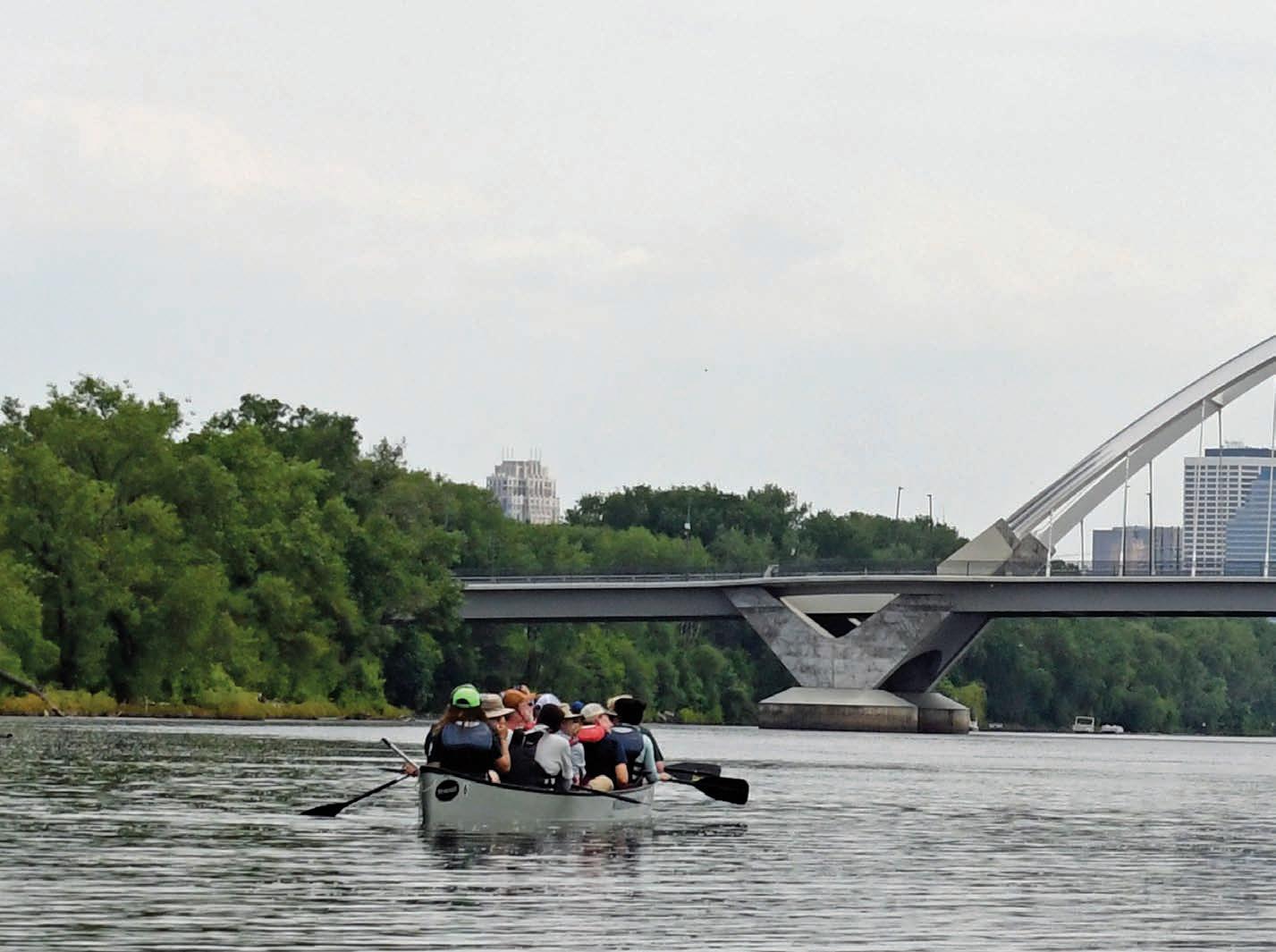
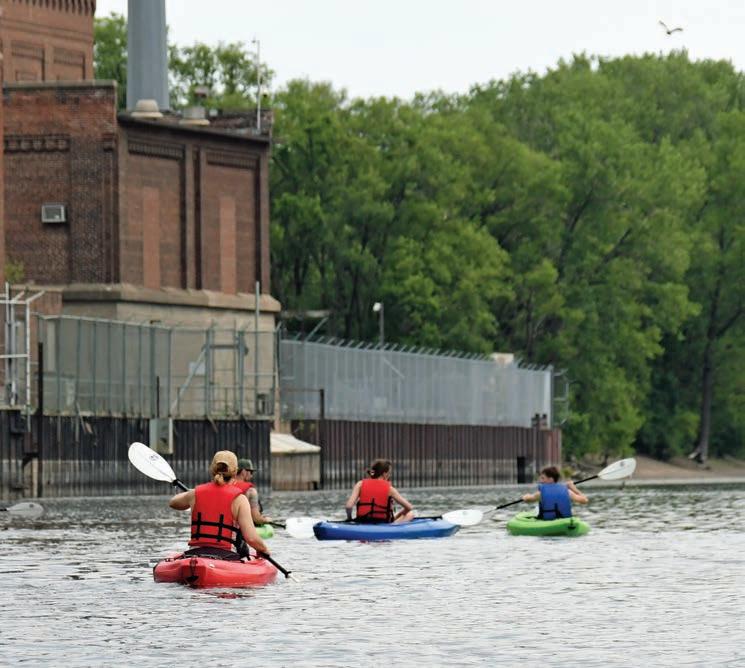
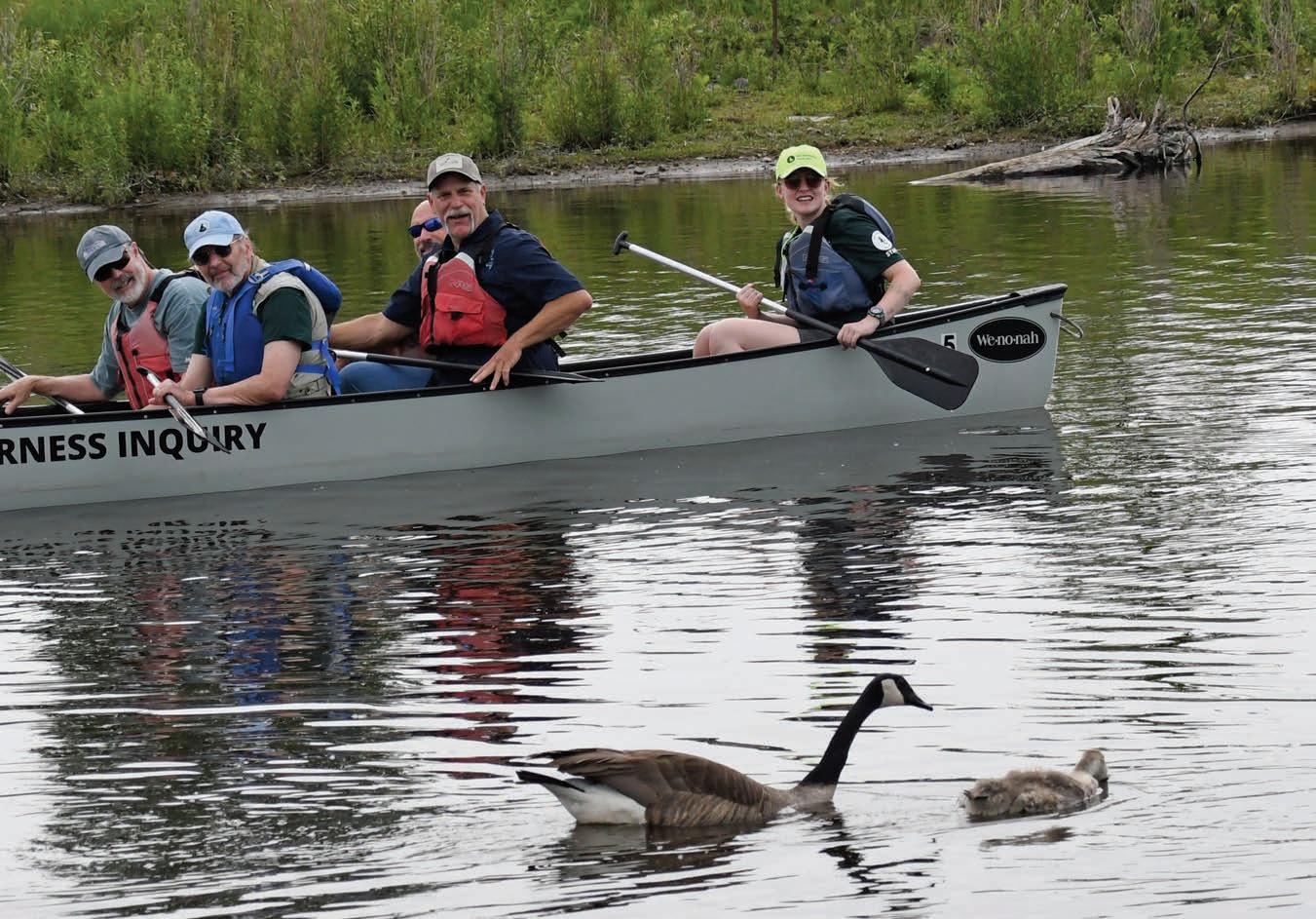
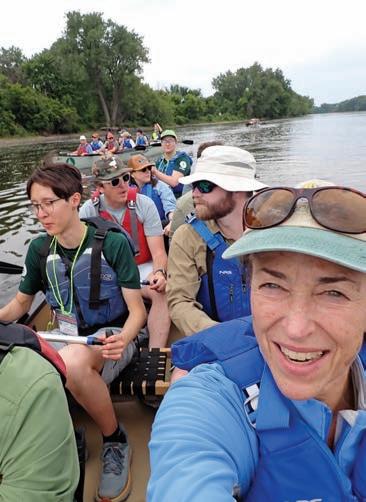
Clockwise from above: A canoe-mobile heads down the Mississippi River toward downtown Minneapolis. One of the guides from Wilderness Inquiry steers her canoe-mobile while enjoying the day. Kayakers check out a power plant on the on riverbank.
Over the last half century, I had stood on the banks of this renowned waterway on several occasions and at various locations along its 2,350-mile course, but I had never been on the water itself. That is, until last summer during the annual meeting of the National Wildlife Federation (NWF). The meeting, which moves around the country each year, took place in Minneapolis, Minnesota. One afternoon was reserved for outdoor field trips, including one canoeing on the Mississippi to see birds. I jumped at the opportunity without a clue what I was in for.
CANOE-MOBILES
Located 200 miles south of Lake Itasca, Minneapolis, with a population more than 3.9 million people, is the largest city on the Mississippi River—an interesting fact considering the lower river, from its confluence with the Ohio River to
the Gulf of Mexico, was historically a more major shipping, transportation, and recreational channel. The upper river was only periodically navigable until numerous locks and dams were installed during the first half of the 1900s.
The outing I signed up for would not take us through any locks. The plan was for 30 of us to paddle canoes led by guides from the outfitter Wilderness Inquiry along a six-mile stretch of the river where we might see some birds and other wildlife. I assumed we would form a large flotilla of 15-plus canoes.
“We call them ‘canoe-mobiles,’” said Manatee, one of the Wilderness Inquiry guides on the bus to the put-in. All of the guides had animal nicknames, which were etched in black sharpie on the backs of their life jackets. At the mention of canoe-mobiles, we all wondered what kind of watercraft awaited us. “Do they have motors?” asked one of the paddlers.
Top: A mother goose corrals one of her goslings that got a bit too close to a canoe-mobile.
Above: Paddlers in the the war canoe sit two across, except for the guide in the back.
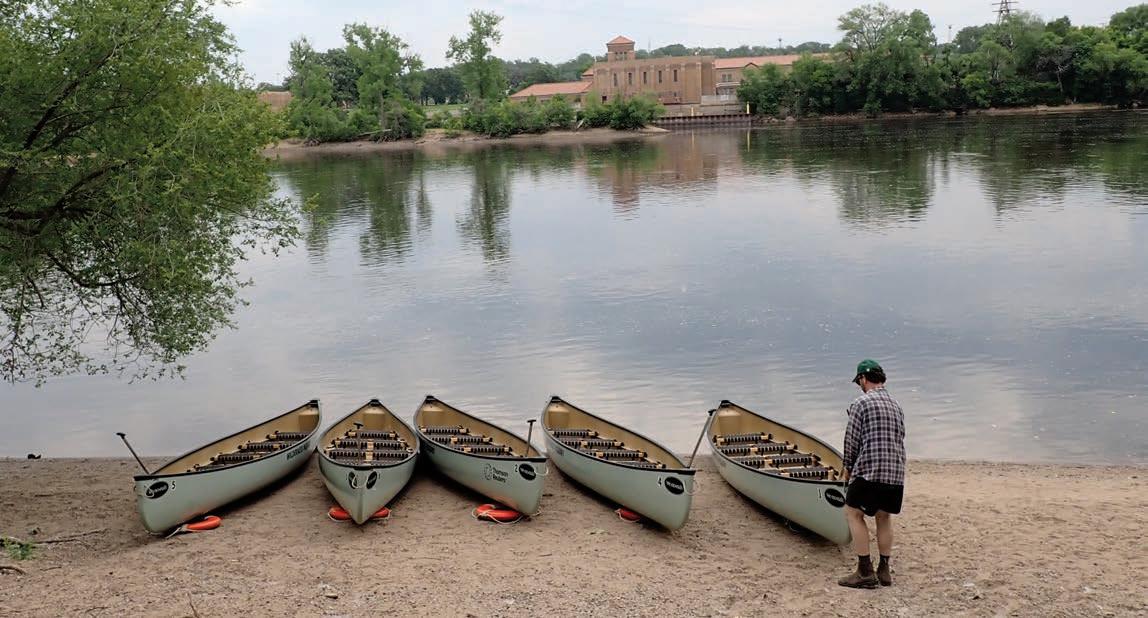
Five canoe-mobiles sat in an array on the beach where we stood, ready to be launched. They looked like oversized canoes. Instead of two seats, there were five, a single in the back for the guide plus four more for two people each. It was a war canoe!
“We’ll be entirely human-powered,” replied Chimpanzee, another guide.
When we got off the bus, a couple of other guides met us. The group walked to a large staging area framed by tall, leafy hardwoods. Life jackets and paddles were laid out for us. After introductions, a paddle lesson for the newbies, and a couple of team-building cues, we followed the guides down a short path to the riverbank.
The Mississippi! It wasn’t beautiful. The water was murky under a threatening sky. A large brick building filled up the opposite shore, 200 yards across the dark water. We might be paddling with an outfitter called Wilderness Inquiry, but this was not going to be a wilderness experience, especially since we would be heading toward the city.
Five canoe-mobiles sat in an array on the beach where we stood, ready to be launched. They looked like oversized canoes. Instead of two seats, there were five, a single in the back for the guide
plus four more for two people each. It was a war canoe! “What fun!” I thought. I had only paddled a war canoe one other time, in 1983 from Hanover, New Hampshire, down the Connecticut River to its mouth on Long Island Sound. That was a week-long canoe-camping trip that passed through a different city, Hartford, Connecticut. There was something about being on an urban stretch of river in a war canoe that ignited an incongruous joy. It made me smile just thinking about all those people at their desks in their skyscraper offices while my canoe-mates and I floated by on the water. The smile returned on the Mississippi, though we never quite made it to the skyscrapers.
ON THE WATER
We took up our positions in the boats, each canoe with a guide in the back and pushed off. The Mississippi flows at a lazy average of about 1.2 miles per hour, just fast enough to feel the current, though
Above: A white-tailed deer appears from under overhanging bushes to take a drink of water.
the water looked as calm as a lake on a windless day.
After clanking a few paddle blades, my boat quickly found its rhythm. Instead of concentrating on each stroke, we were able to take in our surroundings. The Minneapolis skyline towered ahead of us, a mix of tall and medium-height buildings in shades of blues, maroons, and silvers that gleamed against the dull gray sky. The surface of the water was covered with flecks of pollen and treecotton that looked like snow from the low angle of our war canoe.
We passed a sizeable pier, several municipal buildings, and a power station.
Top: Five war canoes on the riverbank await paddlers to get aboard and float the river.
The only sign of a residence was one houseboat moored to the riverbank. At one point, a mysterious structure that looked like an enormous red golf ball appeared through a break in the trees.
“That’s a randome,” explained Manatee, who was captaining our canoe-mobile.
“It’s a protective dome over radar equipment.”
After the randome, we passed a few mallard ducks and several Canada geese, some with goslings. One mother goose was nervy enough to lead her brood over to our boat showing off her offspring in hopes of something to eat. We had nothing to share.
BIRD ISLANDS
Although the outing had been billed as a birdwatching opportunity, I had low expectations beyond the mallards and geese. The trees had leafed out, so songbirds would be hard to spot. Plus, the main migratory season was over, but I was happy to be on the river, and not just any river—the Mississippi.
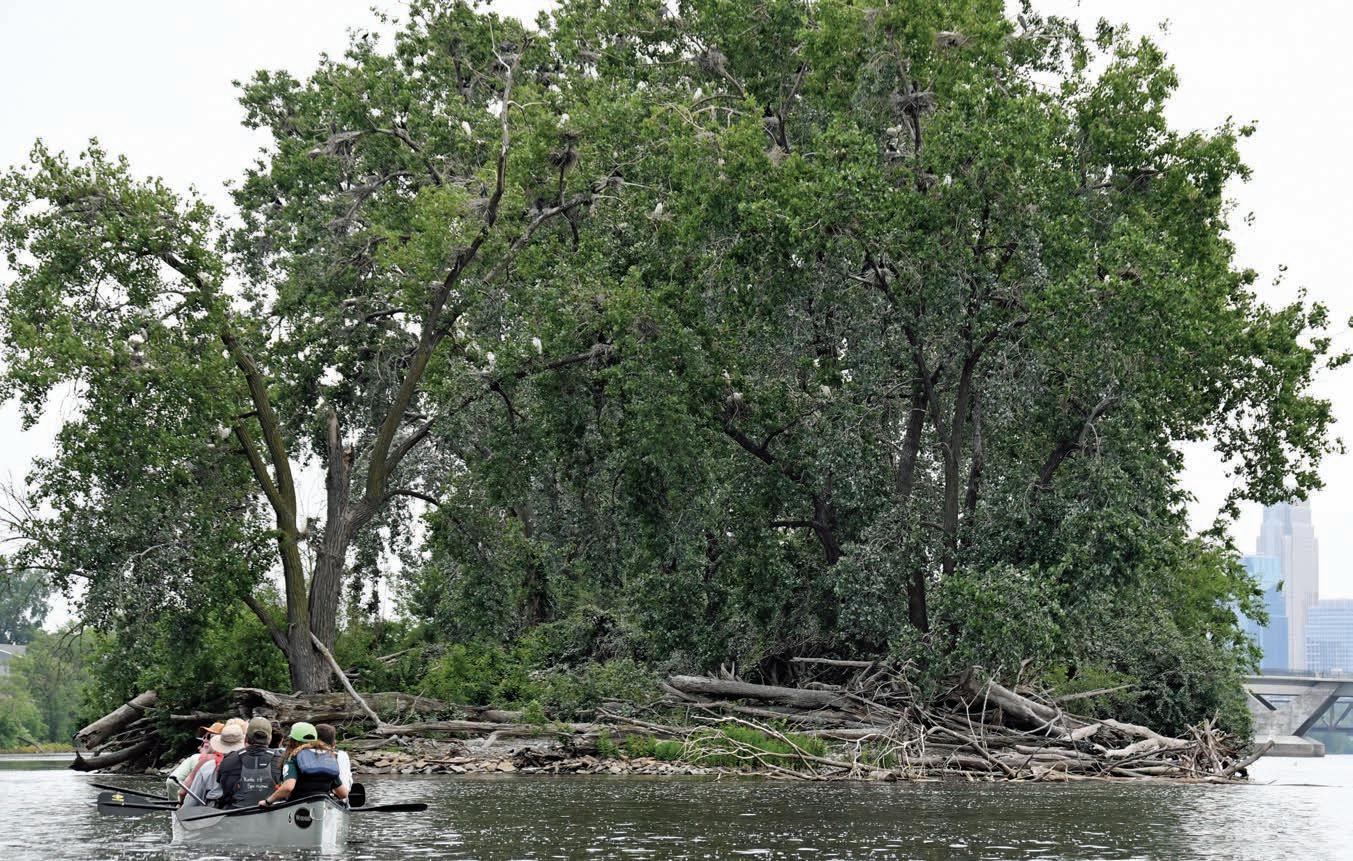
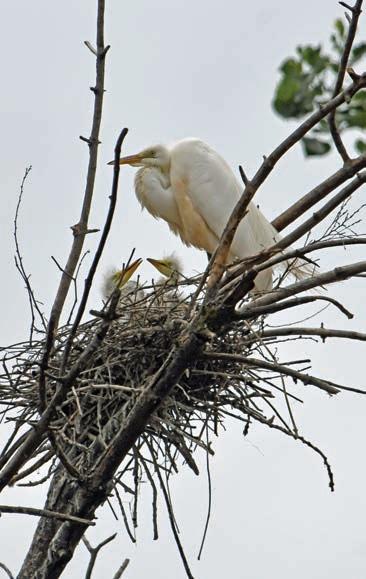
About an hour into the trip, we could see two small islands with several large trees on them in the middle of the river. A great egret landed on one of the branches and disappeared into the foliage. Then a great blue heron did the same, disappearing into another lofty part of the same island. As we floated closer, we could see other herons, egrets, and cormorants coming and going.
Soon a cacophony of squawks and rohroh-rohs filled our ears. Now this was something truly interesting, a rookery in the middle of the river with a mix of birds in it!
As we neared the two islands, Manatee explained that though the islands are a protected blue heron rookery, it’s common for other wading and water birds with similar tree nesting habits, like egrets and cormorants, to nest together. All of these species are “colonial birds” that form large groups to raise their young, mainly because the more nests in a colony, the less likely any one nest will get raided by a predator. We were
Top: A canoe-mobile approaches the larger of the two bird islands.
Above: A great egret watches over her two chicks.
lucky—in another week or two (by late June), most of the young birds would have fledged, and the adults would disperse throughout the area until it’s time to migrate south for the winter.
We stopped paddling and drifted slowly by the two small islands, with only Manatee’s paddle in the water to steer us. Everyone else in the boat pulled out their cameras and binoculars. The treetops were a veritable village of large birds coming and going, tending their hungry chicks, and preening their feathers. Great blue herons stand four feet tall with a six-foot wingspan. Great egrets are about a foot shorter but still large birds, their snowy plumage catching the breeze like long white fringe. The cormorants didn’t look as elegant as the egrets, but their similar size and black appearance complemented the white and blue of the other birds. There were over 350 nests! Every branch bigger than my paddle seemed support one. To be so close to such a large rookery was an unexpected, wonderful surprise.
As we drifted past the bird islands, we began paddling in earnest again, passing under several auto and train bridges. At one point, a white-tailed deer sipped the dark water from below overhanging bushes on the riverbank.
We eventually veered toward the narrow side of sandbar. The take-out lay ahead by one of the many paved bike paths that lace through the greater Minneapolis area. A jogger loped by as the bow of our boat scraped the gravel. Another mother goose looked at us, corralling her goslings.
“Thanks for paddling with us,” said Manatee as we dragged the canoemobiles farther onto the shore and put our PFDs and paddles in a neat pile. But the thanks really goes to him and the others at Wilderness Inquiry, who gave us the opportunity to paddle a portion of the Mississippi River past the bird islands. The name “Mississippi” comes from the Anishinaabe name, Misi-ziibi, or “great river.” And it was great, even for the few miles that I canoed it.
HAPPENINGS SUMMER 2026
Discover more than 50 varieties, including 13 “showstoppers.”
AUGUST & SEPTEMBER Sunflower House
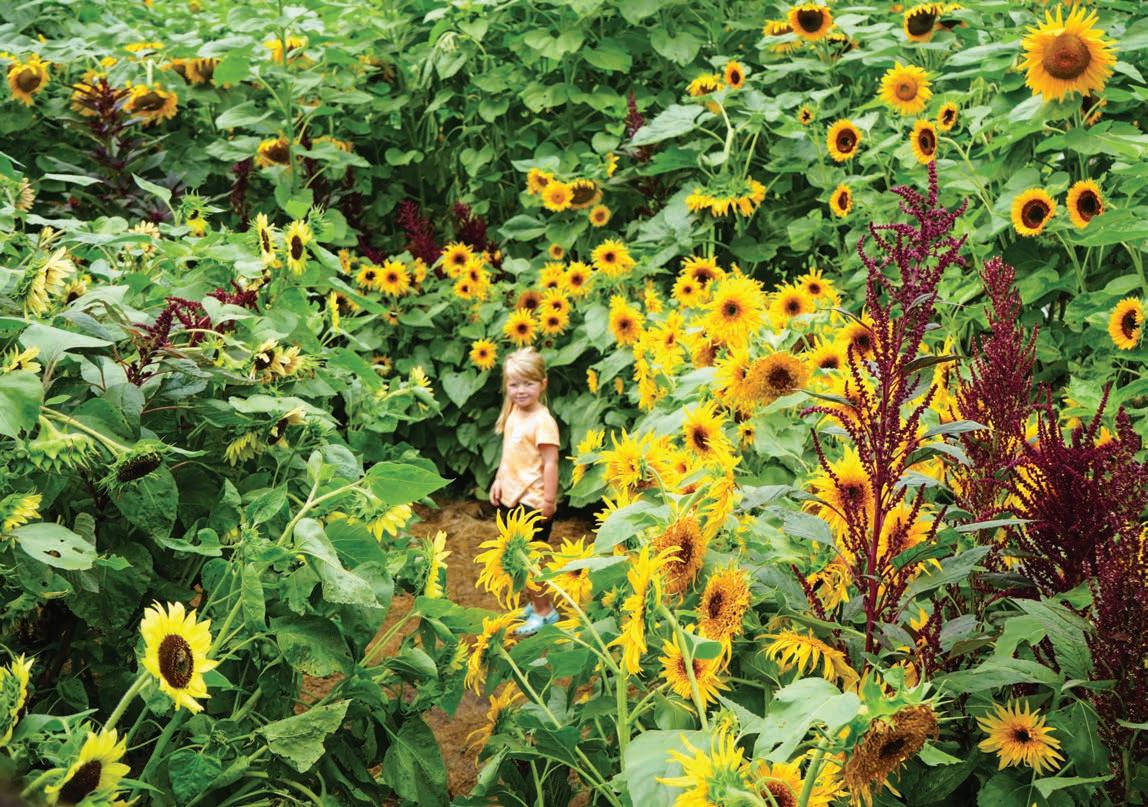
Get ready to be a-mazed by the 8th annual Sunflower House—a living masterpiece that sprawls across 20,000 feet of vibrant crop fields. Wander winding pathways through “rooms” and “hallways” formed by sunflower stalks and blooms, with zigzagging trails designed to reveal breathtaking views at every turn. Billings Farm & Museum billingsfarm.org
Exhibit: That’s a Good Question: FAQs
Woodstock History Center woodstockhistorycenter.org
Exhibit: Rigidity and Reckless Abandon: Women’s Fashion from 1870 to the 1920s
Woodstock History Center woodstockhistorycenter.org
Exhibit: Civic Ground: Governance and Gathering
Woodstock History Center
woodstockhistorycenter.org
Exhibit: A Glance Backward: 250 Years
Woodstock History Center
woodstockhistorycenter.org
MONDAYS Poetry Group
Norman Williams Public Library, 4pm normanwilliams.org
TUESDAYS Needlepoint Get-Togethers
Norman Williams Public Library, 10am normanwilliams.org
THURSDAYS Toddler Story Time
Norman Williams Public Library, 10:30am normanwilliams.org
THURSDAYS Knitters’ Meetup
Norman Williams Public Library, 2pm normanwilliams.org
THURSDAYS
Play Bridge at Norman Williams!
Norman Williams Public Library, 2pm normanwilliams.org
ALTERNATING THURSDAYS
Open Mic Night Artistree, 7pm artistreevt.org
FRIDAYS
Play Mahjong
Norman Willisams Public Library, 1pm normanwilliams.org
SATURDAYS Family Story Time
Norman Williams Public Library, 10:30am normanwilliams.org
PENTANGLE ARTS
31 The Green Woodstock, VT (802) 457-3981 pentanglearts.org
JUNE 17
Art & Film: Wojnarowicz Town Hall Theatre, 6pm
JULY 15
Art & Film: Olafur Eliasson: Space Is Process Town Hall Theatre, 6pm
AUGUST 19
Art & Film: Miral Town Hall Theatre, 6pm
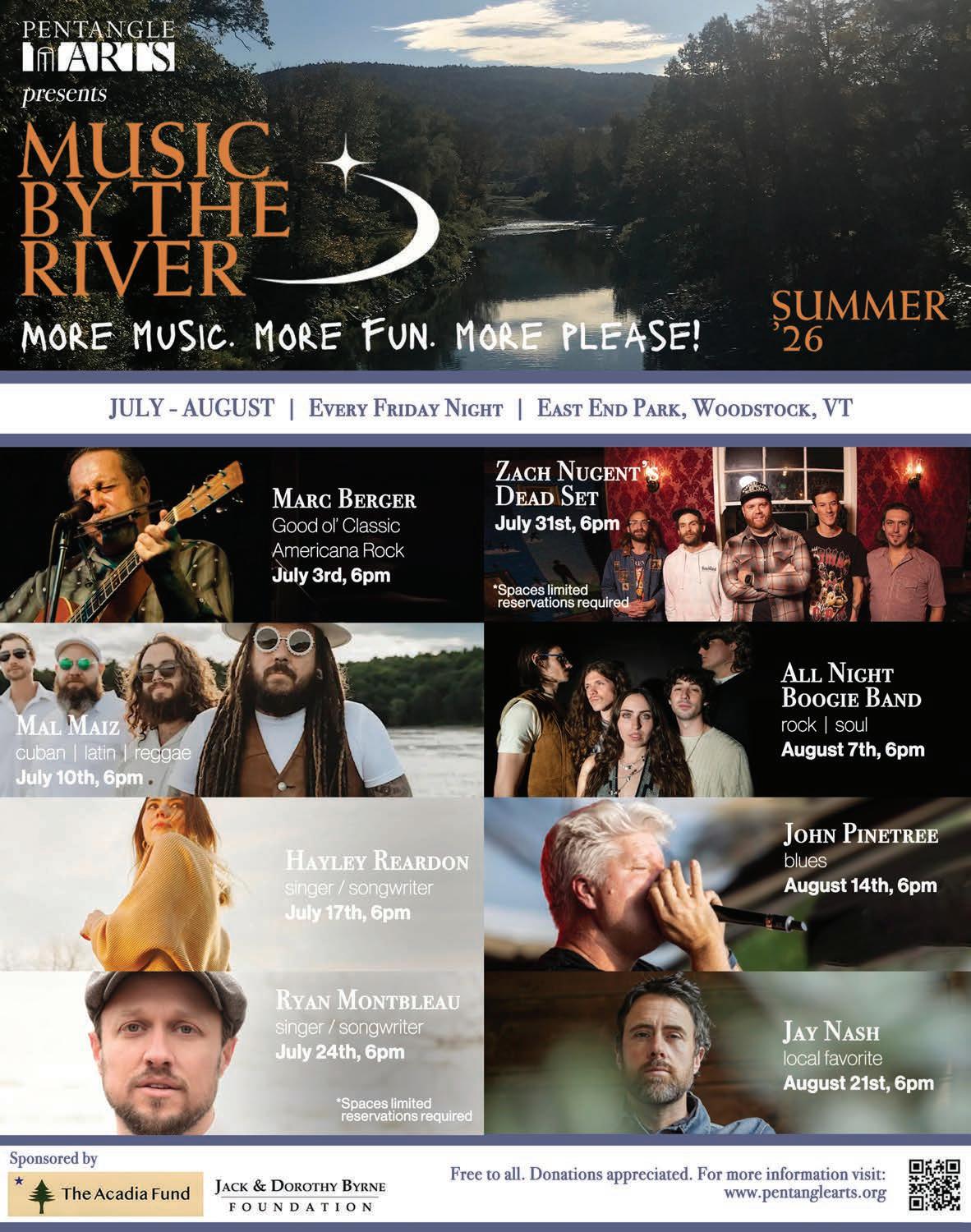
Music by the River East End Park, 6pm
JULY 3
Marc Berger
JULY 10
Mal Maiz
JULY 17
Hayley Reardon
JULY 24
Ryan Montbleau
JULY 31
Zach Nugent's DEAD SET
AUGUST 7
All Night Boogie Band
AUGUST 14
John Pinetree
AUGUST 21
Jay Nash
JULY 1
Vermont Symphony Orchestra Summer Festival Tour: America 250 Saskadena Six, 7:30pm
THROUGH NOVEMBER 2026
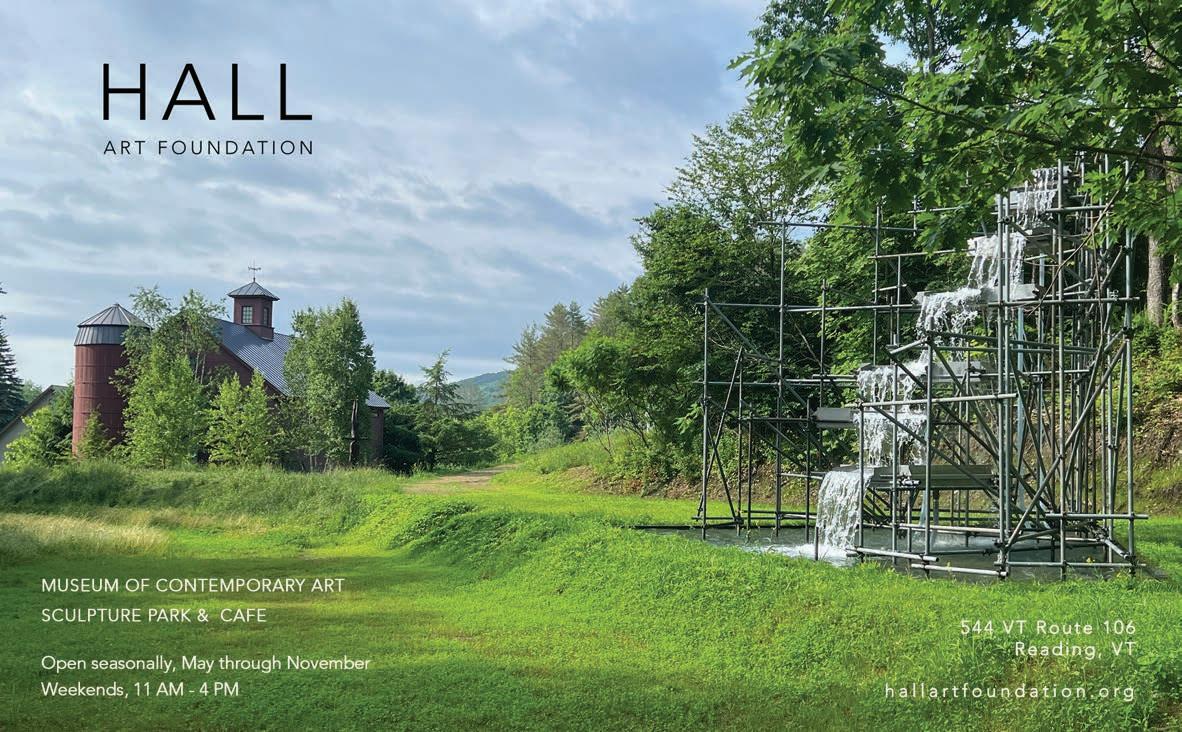
Exhibit: Christian Marclay: Made to be Destroyed Hall Art Foundation hallartfoundation.org
THROUGH JUNE 14
Exhibit: Our Working Lands Billings Farm & Museum billingsfarm.org
THROUGH SEPTEMBER 24, THURSDAYS Feast & Field Music Series Fable Farm barnarts.org
THROUGH NOVEMBER 2026
Exhibit: A Farewell to the Western World Hall Art Foundation hallartfoundation.org
THROUGH NOVEMBER 2026
Exhibit: Piotr Uklanski: The Nazis Hall Art Foundation hallartfoundation.org
JUNE 9, JULY 14, AUGUST 11
What’s on Your Nightstand? Book Discussion Group Norman Williams Public Library, 10:30am normanwilliams.org
JUNE 20
Ben Mezrich – Checkmate: Genius, Lies, Ambition, and the Biggest Scandal in Chess
Norman Williams Public Library, 2pm normanwilliams.org
JUNE 11
Candlelit Meditation in the Loft Artistree, 6pm artistreevt.org
JUNE 13
Worldwide Knit in Public Day
Norman Williams Public Library, 1pm normanwilliams.org
JUNE 16, JULY 21, AUGUST 18
Read, Cook, Eat! Cookbook Club
Norman Williams Public Library, 6pm normanwilliams.org
JUNE 19–28
Dancing at Lughnasa
Outdoors on King Farm barnarts.org
JUNE 23, JULY 28, AUGUST 25
Exploring Irish Literature Discussion Group
Norman Williams Public Library, 10:30am normanwilliams.org
JUNE 24, JULY 22, AUGUST 26
Read Between the Lines Book Discussion Group
Norman Williams Public Library, 4pm normanwilliams.org
JUNE 24, JULY 29
Zentangle Time
Norman Williams Public Library, 4pm normanwilliams.org
JUNE 27–SEPTEMBER 7
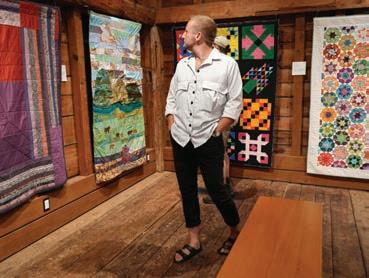
40th Annual Quilt Exhibition
Billings Farm & Museum billingsfarm.org
HAPPENINGS
JUNE 24–SEPTEMBER 16, WEDNESDAYS
Music on the Hill Summer Concert Series Artistree, 6:30pm artistreevt.org
JUNE 25
Bingo Night! Library After Hours
Norman Williams Public Library, 6:30pm normanwilliams.org
JUNE 27
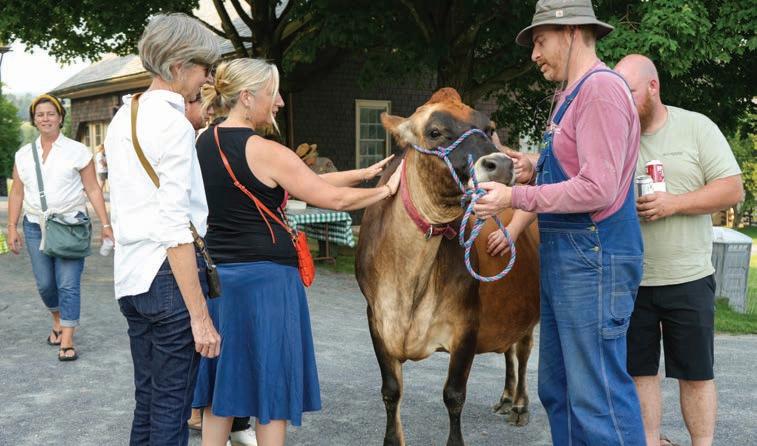
Dairy Celebration
Billings Farm & Museum billingsfarm.org
JUNE 27
Botanical Gel Printing on Fabric Artistree, 10am–2pm artistreevt.org
Creative Collage: Exploring Art with Handprinted and Handpainted Papers Artistree, 10am artistreevt.org
JULY 18
Family Ikebana Flower Arrangement Workshop Artistree, 10:30am artistreevt.org
JULY 26
Sequencing: A New Approach to Painting Artistree, 1pm artistreevt.org
AUGUST & SEPTEMBER Sunflower House Billings Farm & Museum billingsfarm.org
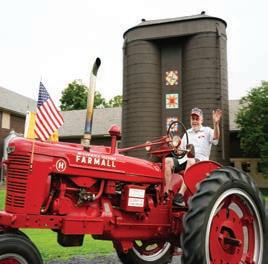
AUGUST 2
Antique
Tractor Day
Billings Farm & Museum billingsfarm.org
AUGUST 7–9
The SpongeBob Musical
Barnard Town Hall barnarts.org
AUGUST 11
Afternoon for Educators
Hall Art Foundation hallartfoundation.org
AUGUST 16
Program: Zadock Thompson and the Story of Vermont
Woodstock History Center, 2pm woodstockhistorycenter.org
AUGUST 22
Garden Day
Billings Farm & Museum billingsfarm.org
AUGUST 22
A Midsummer Night’s Gala!
The Quechee Club, 5:30pm artistreevt.org
AUGUST 27
Member Garden Party
Billings Farm & Museum, 5:30pm billingsfarm.org
AUGUST 29
Barnard Street Dance
Barnard Town Hall barnarts.org
AUGUST 30
Benefit Concert: Cameo Baroque
Hall Art Foundation hallartfoundation.org
ADVERTISERS INDEX
GET CONNECTED
Get listed on the greateruppervalley.com BUSINESS DIRECTORY and you will also be included on our printed list in every issue of WOODSTOCK MAGAZINE. (See page 23.)
HERE’S HOW!
Email Ryan Frisch at ryanfrisch@mountainviewpublishing.com, or call (603) 678-2793. Find out how you can connect with our readers. It’s easy, inexpensive, and another way to reach an affluent and educated audience.
SUBSCRIBE
Share the wonder of our beautiful area and the latest news all year long with a gift subscription. Friends and family who have moved away from the area will be especially appreciative. Be sure to order a subscription for yourself too!
Send a check for $19.95 for one year (four issues) to Woodstock Magazine, 135 Lyme Road, Hanover, NH 03755. Or conveniently pay online using
On the shore of nature’s magic, I dreamed summer knew no end.