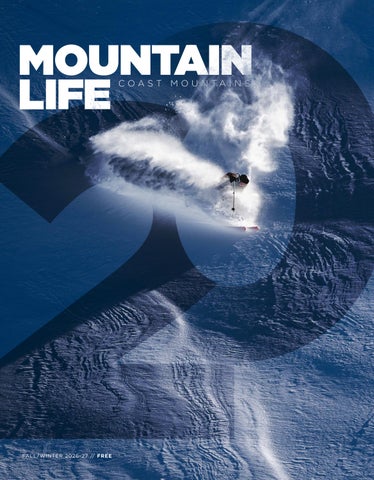
FALL/WINTER 2026-27 // FREE
STEAK NIGHT STEAK NIGHT By Snowmobile in Whistler
604 938 1616 CANADIANWILDERNESS.COM
We design apparel for fast and unrestricted movement in the mountains.
The New Guardian Terra, with GORE-TEX® PRO ePE.
Tantalus Provincial Park Lands of the Skwxwú7mesh Úxwumixw (Squamish Nation) N 49°50′29″
W 123°17′10″
JINGLE BELL
ROCK
SPRO ALPHA C BOA®
DESIGN AND PERFORMANCE REINVENTED
PROCLIVITY
Ride harder. Tread lighter.
©Photo: Florian Monot
Built for big mountain environments. Strategically designed and stress-tested by the best riders in the world.
TABLE of CONTENTS DEPARTMENTS
FEATURES
P. 14 FEET FIRST Editor’s Message
P. 28 COVER TO COVER The Best of 20 Years
P. 40 BACKYARD The Duffy or The Duffey?
P. 75 THE DREAM MAKERS Paul and Gail Morrison
P. 53 BACKYARD Back to the QP
P. 97 UNTIL THE LIGHT DIES Paul Bride and The Shadow People
P. 65 CULTURE The Canvas of the Can
P. 114 GALLERY Old vs. New
P. 93 ARTIST Jackie Chapman P. 107 PROFILE Downhill Defiance
ON THIS PAGE Eric Hjorleifson, Mount Cain, BC. ERIC BERGER ON THE COVER Andrea Byrne, Cirque Lake, Blackcomb. GUY FATTAL
10
11
Mountain Life Coast Mountains operates within and shares stories primarily set upon the unceded territories of two distinct Nations—the Sḵwx̱wú7mesh and the Li l̓wat7úl. We honour and celebrate their history, land, culture and language.
PUBLISHERS Jon Burak Todd Lawson Glen Harris
jon@mountainlifemedia.ca todd@mountainlifemedia.ca glen@mountainlifemedia.ca
EDITOR Feet Banks
feetbanks@mountainlifemedia.ca
CREATIVE & PRODUCTION DIRECTOR, DESIGNER Amélie Légaré
amelie@mountainlifemedia.ca
MANAGING EDITOR Kristin Schnelten
kristin@mountainlifemedia.ca
WEB EDITOR Ned Morgan
ned@mountainlifemedia.ca
DIRECTOR OF MARKETING, DIGITAL & SOCIAL Noémie-Capucine Quessy noemie@mountainlifemedia.ca
FINANCIAL CONTROLLER Krista Currie
krista@mountainlifemedia.ca
CONTRIBUTORS Jeremy Allen, Eric Berger, Mike Berard, Andrew Bradley, Paul Bride, MJ Castor, Chris Christie, Damian Cromwell, Guy Fattal, Mark Gallup, Ben Girardi, Mark Gribbon, Ben Haggar, Juan Hitta, Erin Hogue, Lani Imre, Christoff Johann, Blake Jorgenson, Yan Kaczynski, Randy Klassen, Reuben Krabbe, Diane Lepage, Stu MacKay-Smith, Jordan Manley, Jimmy Martinello, Mason Mashon, Paul Morrison, Dano Pendygrasse, Rob Picard, Bruce Rowles, Alastair Spriggs, Andrew Strain, Chili Thom, Jon Turk
SALES & MARKETING Jon Burak Todd Lawson Glen Harris
jon@mountainlifemedia.ca todd@mountainlifemedia.ca glen@mountainlifemedia.ca
COFFEE + COOL STUFF
Published by Mountain Life Media, Copyright ©2026. All rights reserved. Publications Mail Agreement Number 40026703. Tel: 604 815 1900. To send feedback or for contributors guidelines email feet@mountainlifemedia.ca. Mountain Life Coast Mountains is published every February, June and November and circulated throughout Whistler and the Sea to Sky corridor from Pemberton to Vancouver. Reproduction in whole or in part is strictly prohibited. Views expressed herein are those of the author exclusively. To learn more about Mountain Life, visit mountainlifemedia.ca. To distribute Mountain Life in your store please call 604 815 1900.
OUR COMMITMENT TO THE ENVIRONMENT Mountain Life is printed on paper that is Forest Stewardship Council® (FSC®)-certified. FSC standards for responsible forest management support healthy ecosystems and help protect the rights of workers, Indigenous Peoples, and local communities. Behind these standards is a rigorous, multi-stakeholder process, balancing environmental, social, and economic interests. www.fsc.org. This project was printed on paper with 10% recycled fibre (RF) content. Using paper with RF content reduces the consumption of resources like trees, water, energy, and diverts pollutants like solid waste and greenhouse gas emissions. Traditional petroleum-based inks emit volatile organic compounds (VOCs) during the drying process. This project was printed with UV LED inks on presses that cures the ink almost instantly, allowing the emission of virtually zero VOCs.
»
r i a open
Your adventure awaits Ziptrek Ecotours hosts a selection of breathtaking zipline tours. Our wilderness adventure area is located directly above Whistler Village, in the spectacular temperate rainforest valley between Whistler and Blackcomb Mountains. Experience the thrill and excitement already shared by over a million guests!
Discover eco-exhilaration®
ziptrek.com 604.935.0001
EDITOR'S MESSAGE
FEET FIRST Is there a cleaner metaphor for the pull of the mountains—that ethereal longing that brought us all here in the first place—than the literal pull of a T-bar gliding us uphill to potentially the best turns of the day? On the one hand, T-bars will never die because they are the lifeblood of small, family or communityowned ski hills. Shredding Vancouver Island’s Mount Cain in 2012, a lifer named Bill Coyle, 72 years old at the time, laid it down perfectly for me: “We’ll never have a chairlift,” Bill said. “Insurance, maintenance, everything goes up when you deal with chairlifts. These North Island storms can shut down a lift pretty fast and it’s a heck of a lot easier to rescue people from a T-bar.” Falling while riding a T-bar is a bit different though. Getting dragged uphill because a handle got caught behind your knee is a basic rite of passage for most skiers. (Murray Ridge, in Fort Saint James, BC, is where this first happened to me. Longest T-bar in North America, and I was dragged up at least 40% of it.) T-bars are also a nightmare to ride as an adult with a really young kid, but
Whistler Mountain.
14
JORDAN MANLEY
that’s part of it too: a bit of sacrifice to share the stoke. And sharing the stoke is important around here. With this issue, Mountain Life Coast Mountains celebrates our 20th anniversary. When the magazine started, Whistler Blackcomb had four T-bars; this season we are down to just one: T-bar 2, in Whistler’s aptly named T-Bar Bowl. Time is chasing all of us. Similar to those first sketchy, knee-hooking T-bar rides, this magazine is a testament to the value of not really knowing what you’re doing but doing it anyhow. And if you can keep your nerve and hold on… good things can happen. We’re proud we held on. Because, with any new endeavour or passion, that opportunity really comes just once—there’s only one first ride. And that’s a wonderful thing. This issue, I want to thank all the readers and advertisers and athletes and photographers and writers and artists and everyone who has taken the ride with us these past two decades. Here’s to taking chances. Hold on, up we go. –Feet Banks
Coline Ballet Baz & Stian Hagen Chamonix, France Photo: Christian Pondella
BEHIND THE PHOTO
MISSION: ICE POSSIBLE photography :: Jimmy Martinello climber :: Tim Emmett location :: Monmouth Creek, Squamish Jimmy: Great things will happen, and naturally present themselves, when you have that connection of being in the moment and open to opportunities. With ice climbing in the Sea to Sky corridor, it’s good not to have too high of expectations because ice season can last a few weeks or only a few days. What’s frozen one day could be a pouring waterfall the next. When the ice comes, you have to be ready to get after it. Tim: It needs to be seriously cold, but ideally a little cloudy, too, because the morning sun hits this wall and warms everything up surprisingly quickly. Finding that perfect window takes patience, persistence and sometimes many moons. Jimmy: We had a cold, winter-morning paddle across the Squamish River—paddleboards, drysuits, ice climbing gear and rallying for a sweet adventure. Tim and I were lucky enough to swing our tools, climb out into the cauldron and get some wild perspectives. Tim: I’d climbed this magical location in the summer [and got the cover of Mountain Life Summer 2024] but I’d always dreamed of returning to the waterfall with ice axes and crampons. After 35 years of ice climbing around the world, I can honestly say this was unlike anything I’ve ever experienced. The atmosphere, the setting, the journey just to get there—it all felt completely otherworldly. And doing it with Jimmy added another layer of enchantment. Some adventures are about the climb. Others are about the experience, the people and the magic of being in the right place at exactly the right moment. This was one of those days I’ll never forget.
Jimmy Martinello has been submitting photos and stories to Mountain Life Coast Mountains since the inaugural issue in 2006. No contributor has published as many pages of adventures near and far with us than he has. Here we go again! – Editor
16
17
The Future of Powder Skiing is in the North. Powder Perfection by the Numbers 100 + feet of snow annually 90 Times larger than Whistler/Blackcomb 8 Skiers max & unlimited vertical 5 Day fully-inclusive packages 2 Hours south of Whitehorse in Atlin, BC Join us mid-February through April for a boutique heli skiing experience unlike any other.
GoldRushHeliSkiing.com
UPFRONT
Going on 30 Whistler Valley Snowboard Club celebrates three decades of doing things differently Stoking the kids to shred for 30 years, Whistler Valley Snowboard Club (WVSC) is Canada’s longest-running snowboard club. Recognized as one the pioneering and premiere training institutions in Canada, WVSC has produced Olympic, X Games and World Championship athletes and has been pivotal in the development of a number of Whistler’s top professional snowboarders and characters. Established in 1996 as an independent avenue for young riders interested in freeride, park and pipe snowboarding, the WVSC stands as a true evocation of what founder Robbie Picard describes as, “giving back to a sport and a lifestyle that I love…exposing young snowboarders to a culture, a family and a way of life that is so cool.” “The club shows the equal importance of learning, living and leaning into our community,” reflects Darcy Sharpe, WVCS alum, Olympian and four-time X Games medallist. With just five members the first season, the WVSC’s early years ran a little renegade. Picard was an established coach, rider and videographer who had also worked with SIMS snowboards in research and development during the early ‘90s. He saw young local snowboarders looking for a structured program to ride together, progress and have fun, so he created it: a program by snowboarders, for snowboarders. For the 1997–98 season, the WVSC roster expanded from five to 11 riders, and a second coach—Olivier Roy. “I was taking care of a lot of [local] kids and families that the mountain valued,” Robbie says. The Whistler Valley Snowboard Club was invited to operate under the broader official umbrella of Whistler Blackcomb Snow School programming. Despite snowboarding’s roots as a punk rock, DIY alternative to ski culture and the resort establishment, Picard agreed to the merger and remained on board as both coach and administrator of the club. The next season saw the roster balloon to 40 members, and the WVSC now averages about 140 riders a year (from age 9 to early 20s) and a staff of about 20 coaches. Olivier Roy is still a coach with
ABOVE WVSC 1996/97. Nik Markovina, Katie Shomaker, Tyler Massey, Robbie Picard, Tim Orr, Adam Friesen. BELOW Colton McHatten, Blackcomb Park. ROBBIE PICARD.
ERIK GRAHAM
the club, and says that working with the WVSC, “feels like being part of the soul of Whistler.” Former club members often reminisce with Picard about how their WVSC years were the best of their lives.” Trevor “Trouble” Andrew is a two-time Olympic snowboarder turned visual/musical artist who worked with Picard even before the WVSC days. “Rob is really that guy when it comes to mentorship and coaching,” he says. “I’ve got a lot of respect for him and what he’s built.” “The club created a community,” says Mercedes Nicoll, a fourtime Olympian and five-time Canadian National Champion. “Everyone encouraged each other to try new things and challenge themselves. There was always a sense of motivation and excitement. It was the perfect foundation for a young athlete. And, more importantly, it was a really fun way to grow up.” Over the past 30 years, WVSC members have frequently swept the podium at provincial and national competitions. Others became coaches themselves, and one—Johnny Lyall—was the snowboarder tasked with jumping through the Olympic rings to kick off the 2010 Winter Games. As former members move on to accomplished careers both on and off their snowboards, Picard recalls the core values of the program that formed their foundations, saying, “At the end of the day, it’s all about fun. Snowboarding is a way to create good people.” – Bronwyn Preece whistlervalleysnowboardclub.ca
19
Born in New Zealand. Worn in Whistler. Now open in Whistler’s Marketplace.
4340 Lorimer Rd #126, Whistler, BC V8E 1A5 | (778) 770-1948
BACKYARD
Squamish 3.0 Is the industry-town-turned-tech/rec-hub ready to lean into the role of a four-season destination mountain town? words :: MJ Castor Squamish was tough in the 1990s. A rough-and-tumble forestry town where the only respite from the permeating fecal stench of the Woodfibre pulp mill was when the heavy and frequent Pacific Coast rainstorms temporarily cleaned the air. Local streets were awash with industry and port workers, early adopter mountain bikers, dirtbag rock climbers, quasi-tree huggers, increasingly annoyed loggers and at least two self-identified pirates. It was a solid community, but maybe a bit wary of outsiders. Then, in November of 2006, the premiere issue of Mountain Life hit the streets and kickstarted a total community revitalization. Just kidding! The pulp mill had already closed down earlier that same year, plans were underway to start cleaning the chemical wasteland at the oceanfront property, 2010 Olympic highway improvements brought new jobs to town and the Squamish Adventure Centre (and the Walmart) had just opened. Squamish dropped into the beginning of a transitional period that would severely change the vibe, focus and population of what had previously been best known as the place people stopped for gas and a Big Mac on the way to Whistler.
Two decades later, and well into a recreation-technology renaissance, Squamish 3.0 is one of the most desirable and fastestgrowing communities in Canada (an oceanfront natural paradise halfway between Vancouver and Whistler…go figure). And while the local rock climbing, wind sports and mountain biking scenes have long attracted summer tourism, winter Squamish is starting to punch above its weight class and truly come into itself—by embracing elements that have been here the whole time.
FORESTS One good thing about a coastal rainforest: It’s still amazing, even in the rain. And Squamish has always been a town built in, around and for the trees. The hipsters and influencers are calling it “forest bathing” but real people know that any long (or short) walk in the woods is regenerative, relaxing and a damn fine way to spend a day. Autumn, winter, spring or summer, the forest delivers peace of mind and rejuvenation of soul. Watching a beam of sunlight hit raindrops hanging from a cedar branch, or feeling the mist move through the canopy almost in tune with your breathing—those deep forest vibes are pure and plentiful in Squamish. Call it what you want, the forest delivers peace of mind and a reset of perspective, year-round. (Trees never worry about bills or schedules; take their lead.) And one of the cool things about Squamish 3.0 is those good times are accessible to people who may have missed out in previous, rougher, more core-adventure focused decades. The Sea to Sky Gondola trails are so well made you can roll a wheelchair down them.
Alex Cairns (front) and Sam Daniels out for a rip on Half Nelson, Squamish's premier trail that opened in 2010.
BEN HAGGAR
21
Featured: Tyler Morton Bennett Land Surveying Field Tech + Snowboarder
From property lines to pow lines, Bennett tracks ’em down. Bennett Land Surveying works and plays outdoors across BC. We’re always on the lookout for new clients and staff that love the mountain life. Let’s talk. BennettSurveys.com/ML 604.892.4816
P: Reuben Krabbe
Another fine day in the flow. Squamish winter steelheading.
JESSE PACKWOOD/TEAM FLYLORDS
Which means young kids, elderly grandparents or your buddy who blew their knee on the first day of ski season can all get up to the treeline for views and experiences that used to require a gnarly uphill slog. Same with the newly built Squamish Canyon boardwalk—a safe haven above the river’s chaos (with forest lounge patio accessible by vehicle for guests in wheelchairs). The point is simple: The more time people get to spend in nature, the more they’ll feel inclined to care about and protect it. Which isn’t to say the adventure has disappeared. For every wellmaintained Squamish trail, there are dozens of big-objective missions and no-messing-around scrambles, with plenty of local guides ready to ski, hike, splitboard and snowshoe you into the goods.
and refreshing feeling of standing in a floating mist of negativeion-charged micro water droplets. (It’s good for your skin and soul, they say!) Over on the Mamquam River, the Squamish Canyon boardwalk serves up the churning excitement of walking the edge of a narrow river box canyon and peering over the lip of Mamquam Falls. Watching water tumble endlessly over a lip of rock is a good way to feel the weight of time and the smallness of everyday stress. Less-thunderous flow-state vibes can be found fishing for steelhead or bull trout in the Squamish and Cheakamus rivers or sitting silently in a riverside (or ocean-floating) sauna/cold plunge. (Insider’s scoop: Over the next few years, Squamish will become a national leader in sauna and natural immersion experiences. You read it here first.)
WATER
AIR
It all starts with the Pacific Ocean. Glassy and tranquil one day, ravaged by winds and whitecaps the next, Átl’ka7tsem (Howe Sound)—the southernmost fjord in western North America—was designated as a UNESCO Biosphere Region in 2021. This is where storm days come to live. Watching dark clouds drift across the mountain slopes while big waves roll into the beach at Sp’akw’us Feather Park is a good way to remember that nature is in control around here. (Pro tip: get good rain gear, not an umbrella. The Squamish wind is not easy on umbrellas.) But there’s nothing wrong with taking in the same vibes from the heated, enclosed patio at the nearby House of Lager either. But the ocean is only half the story. Squamish is home to a number of big, heavy rivers, perfect for helping a person tap into that flow-state combination of motion and stillness and the power of nature. Especially when the waterfalls start pumping with the rains of autumn and winter. Easily accessed and close to town, many a resident will head out after work on a storm day to show the kids the power of gravity
The running local joke is you can tell someone is new to Squamish when they inform you that the Indigenous name Sḵwx̱wú7mesh means “mother of the wind.” But those winds—consistent and mindcleansing—mostly blow in the summer. In the autumn and winter Squamish’s famous winds get more playful: Sometimes the rain falls straight down, sometimes the snow blows sideways. But once, maybe twice a winter, a furious, freezing Arctic blast blows in from the north, bringing dry snow and crisp, clear days that will rip the breath from your lungs with a stark reminder: You’re in Canada now, enjoy it. When the winter air calms, hundreds of eagles come to the Squamish River to feast on salmon, and savvy sightseers take to the skies with Sea to Sky Air for flights over the snow-crusted peaks of the Tantalus Range or the jutting prominence of Nch’kay/Mt. Garibaldi and Mt. Atwell, while the snowmobile and ski touring crowds rip, shred and cherish the pow fields and forests below. (And keep an eye for BASE jumpers enjoying the scenic exits off the cliff faces of Siy̓ám̓ Smánit/Stawamus Chief.) 23
PEOPLE A key part of earning your “premiere mountain town” classification is ensuring there’s fun to be had when you get down from the mountains. Sharing a day’s adventures (and lessons learned) amongst friends as the sun sinks into the western skyline is more than just the cherry on top of a good day in the mountains. Squamish’s craft breweries and cideries have long extended a warm welcome to weary travelers and local thrill seekers alike, but in the past decade or so distilleries and craft cocktail joints have risen to the challenge, adding a bit more class to the typical plaidjacket-and-puffy-vest mountain town vibes. (Glass Half Full is the best-kept secret in the industrial zone while The Broken Seal caters to downtown Squamish’s legit foodie crowd.) With two donut shops on the same street, a dedicated pie shop at the other end of town, multiple bakeries everywhere and at least eight dedicated coffee shops (but only one that lets you buy an exotic house plant with your latte, shout out to Wonderlands Coffee), no morning mission into the mountains need be started without fuel. And the party doesn’t stop when the sun goes down: The Brackendale Art Gallery has built out a full slate of live acts and cultural nights, while Trickster’s Hideout does the same downtown, but also books enough DJs to make sure Squamish ravers are never too far from their roots. (Did you know the early Summer Love raves were held in Squamish in the mid-1990s? Or that the Bass Coast Festival started here? Or that, in 1969, the Vancouver Pop Festival brought the Grateful Dead, the Byrds and Alice Cooper to Paradise Valley? Music and nature go together like pumpkin and pie around these parts.)
ABOVE No rain, no gain. Squamish hiking is a year-round vibe.
24
WHAT’S NEXT? When Mountain Life began, Squamish called itself “The Outdoor Recreation Capital of Canada” before pivoting to the more rec-techfriendly vibes of “Hardwired for Adventure” in 2014. But the truth is, the stuff that really makes Squamish special has always been here, through every socio-economic era, population shift and partially attended community focus group. And there’s an older Squamish slogan, one a local high schooler came up with back in the days before beards were groomed in salons and people wore down jackets in the summer. It’s a slogan that celebrates what attracts us all to Squamish and what makes us stay: “Squamish: Winds, Woods and Wonders.” For those of us ready to get out and get after it—in rain, snow, sleet or gale—those words, those elements of Squamish life, will get us through the next 20 years and beyond. exploresquamish.com
REUBEN KRABBE. BELOW Who's watching who? Squamish's original farming settlement, Brackendale is also known as the winter home of the eagles.
TOURISM SQUAMISH
I SELL SQUAMISH H E R E ’ S W H AT I K N O W :
Sometimes you shouldn’t sell.
Kristen Dillon REAL
E S TAT E
*this is not a rendering
37940 fourth avenue • noven.living/noven-one
GOOD FRIENDS. GREAT RIDES. ELAN AMBASSADORS’ MEET-UP, RUKA, FINLAND.
elanskis.com
Proudly Recognized as one of North America’s 50 Best Restaurants, 2026
WHERE
C OA S TA L INF LUE NC ES
FROM ITALY, FRANCE, AND THE PAC IF IC NORTHWEST
ME E T THE MO UN TAINS
Fresh Seafood, Steak & Raw Bar Extensive Wine Menu C r a f t e d Co c k t a i l s Private Wine Room
Best Restaurant
Proudly Recognized
Distinguished Restaurants
in Whistler
Canada’s Best Restaurants
of North America
2024 | 2025 | 2026
2024 | 2025 | 2026
2026
C O M P L I M E N TA R Y U N D E R G R O U N D PA R K I N G
4 0 0 5 W h i s t l e r Way
@ w i l d b l u e re s t a u r a n t
R E S E R VAT I O N S : 6 0 4 . 9 6 2 . 2 2 3 3 o r w i l d b l u e re s t a u r a n t .c o m
WINTER/SPRING
2011
FEATURE The Supreme exTreme ISSue
COVER TO You can’t judge a book by its cover. Magazines on the other hand…that’s kinda exactly what we all do, and it’s by design. Traditionally, magazines would sit on racks in newsstands, dozens—hundreds even—all vying for attention. In the late 1800s, early magazines generally simple-printed the table of contents on the cover to showcase what magic their pages held. In the early 20th century, many prominent mags shifted to a cleaner, more artistic cover design: a striking image with minimal text in addition to the masthead. The mid-1960s saw the rise of cover lines, when Cosmopolitan magazine began encircling its cover image in a donut of enticing and provocative headlines and teasers. These days, newsstand magazines (those that have survived) have an estimated three seconds to capture a reader’s attention (it’s probably less) and cover lines can more quickly capitalize on cognitive biases like the fear of missing out (using words like “essential”) or our ingrained instinct to learn more (“Discover the secret to perfect pow!”). At Mountain Life: Coast Mountains, we threw that standard way of doing things right out the window in 2010 for our Collector’s Edition, which featured a nifty collage of Coast Mountain-y vibes set in Olympic Rings formation over a black-and-white Jordan Manley photo of Chad Sayers shredding some nice pow. From (pretty much) that issue on, the idea was “We’re not on a newsstand with dozens of other titles, and we work with some of the best photographers on the planet. Let the photos do the talking.” And they have. Mountain Life: Coast Mountains has published 62 issues—and 62 covers—over the past two decades. We fought amongst ourselves over many of them, and miscredited the photographer on at least one, but each cover is special to us, and hopefully to you as well. There was no plan, no strategic timeline or “key progress indicators,” we simply looked at beautiful and invigorating photographs of this incredible region and the people drawn to it and chose the one that sang the loudest to our hearts. So here’s to the covers and the photographers who captured them. And to the athletes who graced them and the landscapes that do so much more than simply provide background. And here’s to you all, our readers and advertisers and friends and guests, thank you for picking up this magazine again and again. And thank you for reading it…cover to cover.
28
DO-IT-OURSELVES COVER Wheels & Water (Summer 2015) Photographer: Mason Mashon “We couldn’t find an image that fit the theme,” says photo editor Todd Lawson. “And I remember the editorial meeting where someone had the idea and it was like, ‘Let’s just go do it ourselves.’ I knew Mason had the underwater housing and skills, and we all know Julia Murray is always down for anything. So we lined it up beside the nudey dock at Lost Lake, a perfect trail into the water, and she just rode in, barefoot. It’s hard to stay in good bike position when you hit the water with speed, so Julia did it six times or so. But in the end it was the first frame of the first attempt that made the cover. They both crushed it.” Mason also holds the honor of being the only person to have a cover as both a photographer and an athlete. For the Summer 2018 cover, Jussi Grznar captured him absolutely shredding a gnarly Fraser Canyon bike descent that remains one of our most badass covers to date.
REALISTIC COVER Deep ’n Delicious (Winter 2017) Photographer: Diane Lepage Sure, the River Issue (Summer 2009) had multiple kayakers on it, and there were a few others with two or more people walking/touring, but the first cover to properly showcase two friends ripping together featured skier Rory Bushfield (skier) and snowboarder Mason Mashon (on the cover again!) crushing a lap together beneath their teepee on a backcountry spot known as Burke’s Bumps. “Riding with a buddy is how everyone usually does it,” Bushy says. “Not enough covers show what really goes on. Friends, that’s what makes it fun.”
29
BADASS COVER The Badass Issue (Fall/Winter 2023) Photographer: Mark Gallup “For me the standout is the Gallup shot of Trevor [Petersen] and Eric [Pehota],” says pioneering snowboard photographer Dano Pendygrasse. “It’s just straight cowboy shit. Antics you’ll likely never see again, and extra special because of the legendary characters involved, including Chet, the pilot. Nothing I can say that isn’t printed right there beside them: Badass.”
THE
BADASS ISSUE
FALL/WINTER 2022-23 // FREE
BEST ART COVER
An Evening in the Islands (Summer 2017) // Artist: Chili Thom
Our first art cover was actually AI-generated before anyone knew what AI was. The Fall/Winter 2011 cover for The Character Issue was a portrait of Whistler icon John “Rabbit” Hare, composed of hundreds of pre-existing Mountain Life images. “This cover started as an email from one of the publishers at 1 a.m.,” says art director Amélie Légaré. “After some online research, I found this website which allowed me to upload hundreds or thousands of thumbnails to create a larger image—a cool concept at the time. It took forever, packaging all the photos from each magazine and batch downsizing them with my pathetic 2007 processor. Lots of crashes but we made it in the end. Not all weed-induced ideas are bad ideas.” Stu MacKay-Smith has loaned his artistic talents to four different covers over the years, including our only doublewide gatefold cover for The Camping Issue (Summer 2020) and The Time-Travel Issue collage of snowboarder Brett Tippie shredding multiple decades. (Amélie and I are both partial to the cover for the November 2012 Dave Barnes/Mark Gribbon Apocalypse Pow: The End of the World Issue because we put zombies on an outdoor sports magazine cover in 2012, and it worked!) But the winner is the Summer 2017 Chili Thom memorial cover, because Chili perfectly captured the magic and beauty that most of us spend our lives looking for. We miss you dearly, Chili! 30
It’s good to know what you’re made of.
WWW.RAB.EQUIPMENT
MICROLIGHT ALPINE JACKET 46.9156° N, 10.8557° E PIZTAL, AUSTRIA PHOTOGRAPHY: DANIEL HUG
SPECIAL THE “IS THAT EVEN A MOUNTAIN SPORT?” AWARD Freewheelin’ (Summer 2025) Photographer: Blake Jorgenson
SUMMER 2025 // FREE
Mountain Life founder Glen Harris definitely didn’t care for it, but the Freewheelin’ (Summer 2025) cover, featuring a pair of vintage roller skates sticking out of a convertible in the Pemberton Valley, certainly grabbed the eye. “There’s just something about it,” says veteran magazine editor and ML teammate Leslie Anthony. “I remember when it first landed, I went, ‘Oh wow.’ I mean, it’s a great photo—fun, throwback, nuanced, colour balanced, perfectly lit and all that—but it’s also not RAD!, which kind of speaks to me. We’re so used to all the A-list photographers and athletes who live here that it’s easy to forget for a minute that mountain life is not always just about getting after it—there’s lightness, laughter, whimsy and type-B days in the mountains as well. This cover is a great reminder.”
BEST BLACK-AND-WHITE COVER The Untamed Issue (Spring 2020) Photographer: Andrew Bradley A black-and-white cover is tricky to pull off (we’ve only tried a handful of them), but Andrew Bradley’s raven cover was an immediate hit with staff and readers alike. “The raven is so symbolic of this area,” says photo editor Todd Lawson. “And such an icon in mountain culture and Coast Salish Indigenous culture. Plus, this was a classic example where the image was perfectly aligned with the issue’s theme. This one was a no-brainer.” Amélie says this is her favourite cover of them all. “I always contemplate what can be stripped away,” she says. “How can something shine in its simplest form while carrying maximum impact? The raven cover achieved just that. Andrew's photo is powerful, raw and evocative. Why add to it?” Andrew Bradley has nabbed three Mountain Life covers, which ties him for first place with Blake Jorgenson, Guy Fattal and Jordan Manley. But one of Andrew’s covers was a self-portrait (Summer 2008) so that probably gives him a bit of an edge.
32
Integrative Care, Right Down The Hall From Your Doctor.
Family medicine and a full range of integrative care, all in one place. All Practitioners Accepting New Patients + Walk-Ins Welcome
Family Medicine
IV Therapy
Naturopathic Medicine
Manual Osteopathy *
Physiotherapy *
Registered Massage Therapy
Acupuncture + TCM
Clinical Counselling
Chiropractic *
Registered Dietitian* *only at Whistler clinic
Family doctors accepting new patients. Need care today? Rapid Access offers same-day, non-emergency care for everyone.
Book In Minutes
creeksidehealth.ca
Whistler
110 – 2059 Lake Placid Road Whistler, BC V8E 0B6
Squamish
Unit 5 – 40437 Tantalus Road Squamish, BC V0N 1T0
WILDERNESS SAUNAS WILDERNESS SAUNAS by Snowshoe by Snowshoe in W Whistler histler
Wood-fired Wood-fired Sauna Sa una
604 938 1616 CANADIANWILDERNESS.COM
Inspired by nature made to adventure
Shop open in downtown Squamish DINE IN – TAKE OUT www.sushivillage.com 604-932-3330
Whistler’s original locally owned since 1992
Located in the heart of Whistler Village 202-4204 Village Square, 604.932.4845 @mogulscoffee / mogulscoffeewhistler.com
38022 Cleveland Ave, Squamish BC
FAVE
OUR COLLECTIVE FAVOURITE COVER Ten-Year Anniversary (Fall/Winter 2016) Photographer: Paul Morrison
Let’s be straight, our covers are like our children and it was not easy to pick a single favourite (it also was not a consensus), but Paul’s black-and-white shot of his son Ian Morrison laying down a perfect pow turn still holds a special place in our hearts, even a decade later. The texture of the slope, the light, the kinetic power of the turn and the mushroom cloud of powder—this is a cover that makes us want to get out there. And even though we all know we will never look this good doing it, we can feel this good, this free, and focused and fun. Insanely, this is Paul’s only Mountain Life: Coast Mountains cover—he’s been with us since the very beginning—but hot damn if it isn’t a good one. (So good that, for the actual magazine, we paid extra to print the masthead in reflective silver foil.) Read more about Paul (and Ian) on page 74.
THE
BACK COVER
As a free magazine, Mountain Life simply would not exist with the support of our advertisers, especially those right here in the Sea to Sky that took a chance on us in the early years and understood what we were trying to do. There are many incredible companies to thank, and you can find them in the very pages of this mag, but Prior Snow holds a special distinction: Since the very first issue, they’ve purchased the back cover ad spot of every winter issue to showcase local rippers on local terrain riding locally made boards. It didn’t matter if it was the Olympic Games, the economic fallout of 2008 or the global shitstorm of Covid. And Ziptrek Ecotours has done the same for every summer issue. It fuels the entire magazine’s vibe to receive such full support, from true local businesses that have always had our back (cover). Thank you!
35
Find your balance M AK E T HE R MOTHE R A PY PA RT O F YOUR R ITUA L
SC A N DI N AVE.COM
PREMIERE THE FIRST COVER Inaugural Issue (Winter 2006) Photographer: Bruce Rowles
That first issue was only 32 pages, barely more than a brochure, with five contributing photographers: Paul Morrison, Jessica Butler, Todd Lawson, Mark Gribbon and Bruce Rowles— and it was Bruce who gave us the cover shot featuring legend-in-the-making Mike Douglas launching a natural hit on the iconic Salomon 1080 skis. A true artist, friend and dedicated chronicler of the Sea to Sky community, Bruce remained a key part of Mountain Life’s visual evolution all the way up to his untimely passing in 2022. “Asking me to pick my favourite Mountain Life cover is like asking what’s the most beautiful sunset I’ve ever seen,” says Mike Douglas. “It’s impossible! All I know is when I’m walking around town and spot the new issue, the cover image stops me in my tracks and sends my mind surfing to a better place. Thanks for keeping the dreams flowing for all these years!” – Feet Banks
COVERS BY THE NUMBERS 20 YEARS 62 COVERS 51 PHOTOGRAPHERS 23 SKIING 7
SNOWBOARDING
10 BIKING 9
OTHER SPORTS
16 LANDSCAPES, ART AND ZOMBIES
37
One Group. One Heli. Zero Waiting Around. Just 2.5 hours from Whistler and direct VIP helicopter transfers between Vancouver and Tyax, it offers access to 830,000 acres of spectacular wilderness. With over 375 alpine runs, abundant dry powder and remarkably few down days, the terrain delivers exceptional skiing all season. What truly sets Tyax apart is its one-group-per-helicopter approach. No waiting for other groups, just unlimited vertical, two certified
Where the Coast Mountains drop straight into the Pacific. Five-time winner of World’s Best Heli-Ski Operator at the World Ski Awards, Bella Coola Heli Sports takes you deep into BC’s Coast Mountains, where towering peaks meet the fjords of the Pacific Ocean. With 3.55 million acres of terrain, more than 1,100 named runs and new descents discovered every season, the possibilities are endless. Ski vast glaciers, steep couloirs, alpine spines and old-growth glades in the Great Bear Rainforest, all blanketed in deep coastal snow. Choose from four distinct basecamps, ranging from intimate wilderness lodges to a luxury expedition vessel cruising the fjords. Expect exceptional West Coast cuisine, hot tubs under the stars and groups of 4, each with an ACMG or CSGA guide.
Whether you prefer unlimited vertical, a private helicopter or a private lodge, there’s an adventure to suit your style. The 2027 season runs January 2 to April 21. Book your 2028 trip by January 1, 2027, and lock in 2027 rates using the link below.
Where Adventure Takes Flight. bellacoolaheliskiing.com/mountainlife
mountain guides and the freedom to make the most of every day. Set on the shores of Tyaughton Lake, Tyax Lodge combines spacious rooms, three-course dining and a full-service spa featuring three saunas, an outdoor hot tub and a yoga studio. For something more exclusive, the Platinum Package offers a private chalet, dedicated helicopter, personal chef, concierge and direct VIP transfers from Vancouver. Choose from four, five or seven-night packages, for groups of four to nine guests. All packages include unlimited vertical and safety equipment.
With only four helicopters operating across this vast tenure, there’s plenty of mountain to call your own. tyax.com
A Little Harder to Find. A Lot Harder to Leave. Silvertip offers an intimate heli-skiing experience in the heart of BC’s Cariboo Mountains, where deep snow, spectacular terrain and genuine wilderness come together. Accessible only by air, our historic lodge sits on the shores of Quesnel Lake, welcoming just 8 to 16 guests at a time. With no roads, nearby resorts or other skiers sharing the terrain, the experience feels entirely your own. From wide-open glacier bowls and perfectly spaced glades to remote old-growth forests, the skiing is as varied as it is exceptional. Our Classic program offers unlimited vertical with just two groups of eight skiers sharing a Bell 212
helicopter. Private heli-skiing options are also available. Back at the lodge, enjoy exceptional food around one grand table, unwind in the lakefront sauna or simply soak up the solitude. With packages ranging from three to seven days between January and March, and return charter flights from Vancouver included, Silvertip makes reaching this remote corner of the wilderness surprisingly easy.
Small groups. Endless terrain. An experience worth travelling for. silvertipheliskiing.com
landwithoutlimits.com
BACKYARD
40
The Duffy or The Duffey?
words :: Randy Klassen
Editor’s note: It was a different world when Mountain Life: Coast Mountains first hit the streets in the fall of 2006. We had the internet, but social media was still in its infancy and there were no GPS route-tracking and spot-sharing apps to be had (or at least no one around here had one). There were rules, though—unspoken ethics about certain ski touring and snowmobiling zones. Don’t talk about them, don’t put the actual location names in photo captions, DON’T BLOW UP THE SPOT! And the peaks, drainages, cabins and couloir accessible off the Duffey Lake Road definitely fell under that embargo (as did the mountains, community and grow ops around Bralorne). But as rumours of a printed Duffey Lake ski touring guidebook began circulating, we did it anyhow. “Touring the Duffey” screamed from the cover of our first full winter issue (Feb 2007). “There aren’t that many places where you can drive to a path, step out of your car, and start skinning,” local avalanche forecaster Scott Aitken announced. Certainly a few crusty locals looked down their noses at first, and a handful of irate emails rolled in. But the future quickly caught up: GPS trackers entered the chat, pins were dropped, trip report posts began popping up weekly and the spots got blown out. Kinda. The Duffey Lake region still offers some of the best backcountry shredding around and, sure, the cabins might be busier these days, but there’s still no shortage of turns for those willing to earn them. So rather than look to a potentially busier future for The Duffey, we asked BC historian Randy Klassen to look the other direction. – Feet Banks
Turns earned. Tom Peiffer.
ANDREW STRAIN
41
Sapper Duffy was found frozen to death in the snow on the long, lonely stretch of the Douglas Road between Port Douglas and Lillooet Lake.
Tom Peiffer, second lap.
42
ANDREW STRAIN
“How do you spell Duffey Lake?” I tossed the question at a handful of friends, all of them familiar with the undulating section of Highway 99 that snakes its way over the height of the Lillooet Ranges, between the head of Lillooet Lake and the town of Lillooet on the Fraser River. “D-U-F-F-Y,” each one confidently chucked back. “Nope,” I replied. “It’s D-U-F-F-E-Y.” My corrections bore no smugness. Days before asking, I’d sent off a manuscript for publication with a chapter entitled “The Duffy,” an incorrect spelling I was desperately clawing back at the last minute. That chapter was about Corporal James Duffy of the British Royal Engineers who, in 1860, had surveyed what my Ford Bronco’s navigation system labelled the Duffy Lake Road. I found it a bit odd to see the nav screen boldly project the word "Duffey" onto the blue lake immediately adjacent to a white line it labelled the Duffy Lake Road. Apparently, today’s mapmakers hit and miss the “E” too. It turns out my Duffy vs. Duffey confusion originated in confusing times. In 1860, two years after the Colony of British Columbia was hastily proclaimed to curtail an onslaught of American gold miners from erasing the
49th Parallel west of the Rockies, former Hudson’s Bay Company fur trader and colonial governor James Douglas hopped on a horse to tour the gold regions and inform the First Nations in the central and southern reaches of the colony of the particulars in regards to their new status as subjects of Her Majesty, Queen Victoria. He found his way to BC’s Interior via a route that would become known as the Douglas Road—the colony’s first commercial transport pathway, passing through St’át’imc territory from Harrison Lake in the south, up Lillooet Lake, along today’s Pemberton Portage Road from Mount Currie to D’Arcy, then over Anderson and Seton Lakes to Lillooet on the Fraser. On that trip he became acutely aware of the ongoing violence along the new road and the St’át’imc People’s desire that the miners take an alternate route to bypass the culturally significant valleys and lakes north of Lillooet Lake. Eager to assess the recommendation he’d received from the St’át’imc, Douglas approached the detachment of the British Royal Engineers stationed in Cayoosh (the fur traders’ name for the village of Lillooet) and asked for a volunteer to survey the trail. James Duffy, a young corporal, offered to take up the task and soon departed, led by St’át’imc guides.
THE NEXT PROGRESSION IN SNOWBOARDING The Intuition SNOWBOARD Liner
NIC HERINGA AT HOLY BOWLY PHOTO: EVAN CHANDLER-SOANES
INTUITIONLINERS.COM
ABOVE However you spell it, the touring terrain is bonkers up there. Paul Greenwood takes a look. BELOW Tobin Seagel will ski right to the truck today.
CHRIS CHRISTIE
Leaving Lillooet and traveling ancient St’át’imc foot trails, Duffy surveyed the daunting terrain up Cayoosh Creek, over the high pass where the trail merged with today’s Joffre Creek, then down that creek to the original site of Port Pemberton at the head of Lillooet Lake. That September, the corporal delivered the results of his survey to his superiors along with a map entitled “Exploration of the Indian Trail up Cayoosh Creek to Lillooet Lake.” He summarized his assessment of the trail’s prospects for becoming a wagon road in this way: “The line of the road is generally pretty good—as far as I can judge practicable for a wagon road… The greatest obstacle is at the Lillooet Lake end where there is a very rapid fall of about 1,000 feet to the lake. I think a wagon road could be made up this portion by zigzagging.” If you’ve driven the Duffey Lake Road, you know this zigzag. Duffy’s reward for surveying an Indigenousinspired route and working with the local Nations? He was instantly demoted from corporal to sapper, a glorified manual labourer. From what can be pulled from the records, Duffy’s commanding officers at the local detachment of the British Royal Engineers didn’t take well to 44
Shred Your Bucket List Small group heli riding to access vast, awe inspiring backcountry terrain, with daily departures from Whistler Village.
BOOK HERE
POWDERMOUNTAINCATSKIING.COM
subordinates volunteering for expeditions proposed by former fur traders on behalf of their Indigenous friends. In the words of fur trade historian Alexander Globe: “Colonel Moody, always antagonistic to Douglas, demoted Duffy to sapper for leaving his surveying post in Cayoosh without permission. The drop in salary would have placed a strain on his marriage.” Though speculative, Globe hints that the demotion (and the financial predicament that came with it) led to Sapper Duffy’s death just four months after he delivered his report on the route. On January 18, 1861, the British Colonist reported that Sapper Duffy was found frozen to death in the snow on the long, lonely stretch of the Douglas Road between Port Douglas and Lillooet Lake. His was the only death of a British Royal Engineer in the colony that year and, considering his training and the remote survival situations engineers like him were used to handling, the circumstances of Duffy’s death beg disheartening questions and paint a foreboding picture of the government’s refusal to follow the collaborative example that fur traders like James Douglas had established with the Indigenous Peoples as far back as the early 1800s.
ABOVE Renegade cabins offer a warm shelter from the storm.
46
DAMIAN CROMWELL. BELOW If you can find them.
JEREMY ALLEN
THERE’S MORE. 604-905-DEEP (3337) 1-888-HELISKI whistlerheliskiing.com @whistlerheliskiing
your local realtor SARAH MORPHY 604 906 1940 sarah@sarahmorphy.com
SARAHMORPHY.COM
2026 BZ XLE FW D EV
Purchase for:
Finance from
$49,043
0.99%
Less $4000 savings Fees Included
Vehicle show
O r lease at 1.49%
2026 BZ
2026nbZ XLE FW D EV 781907
XLE FWD EV
Purchase for:
w w w.squam ishtoyota.com
Finance from
$49,043 0.99% Less $4000 savings Fees Included
Or lease at 1.49%
*Drivers should always be responsible for their own safe driving. Please always pay attention to your surroundings and drive safely. Depending on the conditions of roads, vehicles, weather, etc., the Toyota Safety Sense systems may not work as intended. Please see toyota.ca, your local Toyota Dealer or O wner’s Manual for details. Delivery, Destinatin, Fees and Documention charge included. Taxes are additional. Finance at 0.99% Financing available upon approved credit. Example: $10,000 borrowed requires repayment of $282.04 per month at 0.99% for 36 months. The cost of borrowing $10,000 is $153.44.
Vehicle shown
2026 bZ XLE FWD EV 781907
www.squamishtoyota.com
*Drivers should always be responsible for their own safe driving. Please always pay attention to your surroundings and drive safely. Depending on the conditions of roads, vehicles, weather, etc., the Toyota Safety Sense systems may not work as intended. Please see
toyota.ca, your local Toyota Dealer or Owner’s Manual for details. Delivery, Destinatin, Fees and Documention charge included. Taxes are additional. Finance at 0.99% Financing available upon approved credit. Example: $10,000 borrowed requires repayment of
for 36 months. The cost of borrowing $10,000 is $153.44. $282.04 per month at 0.99%
On the map Duffy created of the route, he named a long lake tucked in a tight, landslide-debrisstrewn valley Lake Melvin (for an unknown person), but his British Royal Engineer colleagues renamed it Duffey Lake in Sapper Duffy’s honour, their “E-Y” spelling making its way to our maps today. Then, led by Colonel Moody who had little to no firsthand knowledge of the region, the colonialists all but ignored the new passage and instead blasted a wagon road up the Fraser Canyon at great cost. Historians estimate as many as 1,500 labourers lost [their lives] building transport routes in the Fraser and Thompson canyons alone, laying a foundation in blood for today’s Highway 1. The quick dismissal of the St’át’imc’s preferred route, and the death of the young man who surveyed it, are symbolic of the death of the cooperative era between the fur trading newcomers and their Indigenous hosts and the birth of the colonial bureaucracy’s refusal to accept Indigenous solutions. The colonial military had arrived by 1860, and their job was to fully lay claim to the land for their Queen. They did not envision themselves as guests of the Indigenous Peoples, nor were they interested in their trade, alliances or welfare. ABOVE Tom Peiffer, alpine start.
ANDREW STRAIN. BELOW Ross Mailloux goes back for more.
CHRIS CHRISTIE
49
Sadie Brubaker
Josh Crane
Kristen Dillon
WHISTLER • PEMBERTON
WHISTLER
SQUAMISH
Jenna Franze, PREC*
Ashley Freeman
Lindsay McIvor
SQUAMISH
SQUAMISH
WHISTLER • SQUAMISH
At home in the Sea to Sky. At Stilhavn, our team of local agents bring real insight into what makes life across the Sea to Sky so special. Whether you’re moving up, settling in, or starting fresh, we’re here to help you find your place in these beautiful and unique communities.
Madison Perry
Art Power
Caylee Sampson, PREC*
WHISTLER • PEMBERTON
SQUAMISH • WHISTLER
SQUAMISH
Neal Sikkes, PREC*
Em Smith
Nick Soldan Harriss, PREC*
SQUAMISH • WHISTLER
SQUAMISH
WHISTLER • PEMBERTON
Chris Spotzl, PREC*
Ian Tang, PREC*
David Wiebe, PREC*
WHISTLER
SQUAMISH • WHISTLER
SQUAMISH • WHISTLER
Local agents. Real results.
ST I L H A V N . C O M SQUAMISH | WHISTLER | PEMBERTON | SUNSHINE COAST | VANCOUVER | NORTH SHORE | OKANAGAN This publication is not intended to cause or induce a breach of an existing agency relationship. | *Personal Real Estate Corporation
ABOVE Winter conditions keep the riffraff away. BELOW Stan Rey, pillow paradise.
ANDREW STRAIN.
Historians estimate as many as 1,500 labourers were lost building transport routes in the Fraser and Thompson canyons alone, laying a foundation in blood for today’s Highway 1. The next time you’re ripping up the Duffey Lake Road, en route to an early morning skitouring session among some of the most accessible peaks in the southern Coast Mountains, maybe take a few minutes to ponder the young corporal-demoted-to-sapper—and consider the role he played in trying to help James Douglas work with the St’át’imc on a less disruptive pathway for foreigners to take through their land. Given a different decision or two, The Duffey could today be a portion of the Trans-Canada Highway, and the Fraser Canyon between Yale and Lytton might be untouched backcountry. Maybe they would have even spelled “Duffy” correctly—or, better yet, used the lake’s original Indigenous name, Teq.
Randy Klassen is the author of the recently released book The Mapmaker’s Omission: A fur trader’s map to gold, a trail of cataclysmic change, and BC’s escape from American annexation. 51
THE FINEST TUNE ON THE WEST COAST. High Performance Construction & Renovations
RIDER: DCP PHOTOGRAPHER: PHIL TIFO
premium hand-tuning repairs overnight service
FOLLOW US @UNDERGROUNDTUNING LOCATED INSIDE THE SUMMIT LODGE AT 4359 MAIN STREET, WHISTLER
604-938-3686 UNDERGROUNDTUNING.CA
web sitkareno.com email info@sitkareno.com IG @sitkawhistlerconstruction p. 604-906-2602
BACKYARD
Back to the QP Re-forming a classic Blackcomb feature (and scene) words & photography :: Dano Pendygrasse What is it about mountains? They are so often perceived as giant, immovable edifices, unchanged over time, but as snowboarders and skiers, we know—they change. Sometimes in tiny ways: creeks and rivers change their courses, forests grow; and other times in massive ways, as Whistler Peak demonstrated in March 2026 when a large chunk of the Whistler peak fell off in the early hours. That massive, in-bounds, mid-season landslide reminded us of the fragility of these places in which we play. And then speculation immediately shifted to what riding opportunities it would create for next season. In nature, change can also be cyclical. Sometimes the wind blows just right and the snow piles up in a way that strongly resembles the past. And that’s what happened last winter at the Blackcomb Quarterpipe. Back in the late 1980s and early ‘90s—when snowboarding was still figuring out what it was and before terrain parks took over—the Blackcomb Quarterpipe rose as an internationally famous piece of
LEFT Derek Heidt, 1995. TOP Truth Smith, 2026. ABOVE Mikey Ciccarelli, 2026
natural terrain. Easily visible to the left on the final ascent of the Seventh Heaven chair, the windswept pocket/snowdrift featured a fairly well-known step-up jump for skiers (known then and now as “Lemming’s Leap”), a place to showcase some sweet spread eagles in full view of the chairlift. But to the rider’s left, that snowdrift feature gradually increased in size and pitch until it went vertical and created a large, natural quarterpipe-esque transition that quickly became something of a snowboarder’s dream. Who hit it first? I couldn’t say, but the fact that it was under the chair meant that there were no secret sessions, so when people started to ride the vertical wall of snow, get airborne and re-enter like they would on a skateboard ramp, word spread quickly. By Blackcomb’s second season of operation (1989), local snowboarders had already started organizing dig sessions at the Quarterpipe. We would take the raw form and sculpt it as well as possible, creating a more consistent transition and fueling days of sessions that pushed boundaries and drew the attention of the growing snowboard media. 53
DEEP SNOW UTILITY TOURING TRAIL
778.894.0849 • SQUAMISHMOTORSPORTS.COM
101-1101 COMMERCIAL PLACE, SQUAMISH
LEFT Damian Sanders, 1992. RIGHT Martin Gallant, 1994.
ERIC BERGER. MIDDLE Tosh Osaka, 1995.
That spring, following the inaugural Westbeach Classic down the road at Cypress Mountain, a crew from Transworld Snowboarding Magazine made their way to Blackcomb to document the growing local snowboard scene. Naturally they were guided up to the Quarterpipe, where they witnessed local legends like Doug Lundgren, Alex Warburton and Don Schwartz riding the mountain like they would a skate park. The following season, a photo of Ross Rebagliati (still in his freestyle phase) appeared on the cover of Transworld and put the Quarterpipe on the radar of every skate-style snowboarder on the planet. Film crews flocked in from all over the world to test their skills. The speed needed to rise above the lip caused g-forces on the flat bottom that regularly crumpled legs, sending riders flying into the wall at terminal speed, so when Mike Ranquet hit it switch in 1991 (or fakie as it was called at the time), then launched into a perfectly grabbed Caballerial, it marked a monumental leap forward in what was possible on the feature. The mid-1990s saw continued progression of tricks and size. By ’94, Peter Line’s head-high switch methods were blowing minds, while locals like Kevin Young, Marc Morisset and Martin Gallant routinely produced standout sessions. Al Clark pushed the limits with tail grab McTwists (that became his signature trick) and I remember
that snowdrift feature gradually increased in size and pitch until it went vertical and created a large, natural quarterpipe-esque transition.
Tosh Osaka going absolutely massive in 1995, possibly the biggest anyone has gone. Until recently. Just before the turn of the millennium, a series of events took the spotlight away from the QP. First, the local crews all bought snowmobiles and took to the backcountry. A new arena of endless terrain, fresh snow and no crowds made shooting photos and video on the ski hill an overnight anachronism. Second: The terrain park era came into its own. Manmade jumps and features— including perfect quarterpipes—became ubiquitous at ski resorts and offered the kind of repeatable consistency that turbocharged progression. Third, and most significantly, the Blackcomb Quarterpipe just stopped forming up as nicely. For a number of years it was too small, too square or the transition was just all wrong. There were probably some half-hearted attempts (“Lemming’s Leap” remained pretty consistent for the huck-and-hope crowd), but the glory days of that magnificent natural feature appeared to be over. 55
NEVER JUST ANOTHER WINTER.
WWW.ISLANDLAKELODGE.COM
MATT KUHN PHOTOGRAPHY
Come home to Pemberton Pemberton isn’t just where I work—it’s home. As a fourth-generation local with over 20 years of hands-on real estate experience, I offer trusted guidance and deep local insight. From first homes to next chapters, I’m here to help you find a place that truly feels like home. Let’s connect!
www.realestatepemberton.com
604-698-5128
Toll Free: 1-877-242-2448 ext 333
danielle@wrec.com
@pembertonrealtor
The speed needed to rise above the lip caused g-forces on the flat bottom that regularly crumpled legs, sending riders flying into the wall at terminal speed. I never forgot. Since retiring from snowboard photography in the early 2000s, I’ve been digitizing my archived slides and found myself scanning photos of those early sessions and discovering new parts of the story. Derek Heidt’s flawless style, Wendy Wyvill pushing women’s snowboarding with her powerful backside airs, Boozy the Clown… And then, a few years ago, I saw a video on YouTube of a new QP session with the NOW Bindings team, who had clearly spent some time shaping the transition. It didn’t look big, but it didn’t look bad. And there was JF Pelchat, nailing it like only a veteran of tough transitions can. In 2025, I rode a lot with Rob Picard from the Whistler Valley Snowboard Club (WVSC). I mentioned how I’d been thinking about shooting a bit of snowboarding again—reviving some of the old on-hill hits we had all spent so much time on three decades before. He took the idea, got positive reactions from some of the
young emerging pros, and it only made sense that the Blackcomb Quarterpipe was the first spot on the list. Even better, peering over at the transition from Seventh chair as the season progressed, we saw it was shaping up pretty nicely. Rob made the calls, got the shovels together, set the date, and for the first time in a decade or so I set out to shoot some snowboarders. The crew that showed up was stacked: Truth Smith, Caleb Chomlack and Tosh Krauskopf came representing Shmobb, a crew of local shredders who have been killing it in recent years. Harnessing the energy of youth, they set to work with shovels and rakes, tuning the natural transition so they could air as high as possible and still find a smooth landing. The process was different to the days of old—both in tools and strategy—but in no time the first airs were popping off. Tentative at first, and then with some confidence. As much as the sport of snowboarding, the town of Whistler and the mountains themselves have changed, this Quarterpipe session delivered the same vibes. T-shirt weather, lots of laughs and snowboarding that pushed boundaries. Dane Menzies showed up
LEFT Raibu Katayama, 2026. RIGHT Alan Clark, 1995.
57
FIND THE PLACE THAT MOVES YOU HELPING LOCALS AND SOON-TO -BE-LOCALS FIND HOME IN THESE MOUNTAINS WE ALL LOVE.
PHOTO: JORGE ALVAREZ
Where Life Reaches Its Peak
Rob: 604-935-9172 Sherry: 604-902-7220 E: BoydTeam@evrealestate.com W: BoydTeam.evrealestate.com Engel & Völkers Whistler 36-4314 Main St. Whistler, BC
and brought his power and style to the session. Old-guard WVSC coach Oli Roy held his own with the youth, riding with a frenzied passion when many his age opt to stay home complaining about their backs. Shooting photos from angles that weren’t far removed from what I shot three decades ago, it dawned on me that these are the sessions that make scenes. Isolated crews deep in the backcountry can get the photos and video that command attention, but an open, everyone-welcome session with no stakes beyond bragging rights, where the only pressure is peer pressure, and the fee for entry is simply the talent to hit the thing and not make a fool out of yourself. Sessions like that are what builds community. So I wasn’t surprised when my old friend Gabe Langlois texted this past spring telling me about another session on the QP. Was I down? Dude, of course! Gabe had his film camera set up, veteran photographer Oli Gagnon was also ready and Lucas Ouellette from Arena Snowparks came to lend his expertise and craft a perfect transition. Long retired from working in the snowboard industry, I’ve become a fan of the newcomers, from the outside looking in. So having Sean Miskiman, Mikey Ciccarelli and Raibu Katayama show up in front of my camera was enough to make an old fart consider
coming out of retirement. The day was perfect: Kevin Sansalone rolled up to show off his textbook hand plants. Takeru Otsuka threw down one of the highlight hits of the day, Craig McMorris entertained on and off the board and Darrah Reid-McLean was determined to get that invert—and did. Revisiting a scene that I grew up in, so many years later, reinvigorated my faith in the culture. Some things are simple: Friends and a sunny day can be all you need. But add in a historic, scary-asall-hell 30-foot-high wall of snow and a little bit of courage, and you can go from anonymous to legendary in a matter of hours. Everything changes, but these are the days that we will remember forever.
The crew that showed up was stacked: Truth Smith, Caleb Chomlack and Tosh Krauskopf came representing Shmobb, a crew of local shredders who have been killing it in recent years.
With a little help from its friends (and Shmobb), the Blackcomb QP is back! 2026.
59
60
BEYOND
Bioelectric Expeditioning words :: Jon Turk // illustration :: Lani Imre For 30 years, I was an expedition adventurer, chasing the next “first” then securing sponsors, book deals, speaking gigs, magazine assignments and podcasts. Interviewers frequently asked me why I sought discomfort and risked mortal danger in the most inhospitable landscapes of the earth. And my answer was that putting myself in danger made me feel more alive; it’s a form of meditation, often called flow. And I still believe that answer. But years later, I know that the complete answer is so much more exciting and complex. I’m now 80 and my wife is 75. We live half our lives in a cabin in the mountains and the other half in our van, chasing the best mountain bike trails we can find. A few weeks ago, Nina was diagnosed with basal cell carcinoma— not super-serious, but a form of cancer, nevertheless. She is scheduled for five weeks of radiation treatment in a city about 3.5 hours from home. This is the new expedition adventure. We have enough money to rent an Airbnb, so we can live in comfort during the treatment period, spend time in coffee shops, eat out and enjoy an urban lifestyle.
We know that every living cell in every living organism produces bioelectric fields and these fields are the source of awareness, memory and response. But neither of us want to do that. Instead, the van is packed. We plan to live in the mountains nearby and ride our bikes between doctor visits. Question: At our age, why are we still intentionally seeking discomfort and embracing the dangers of backcountry adventure? The old answers are still there: I still seek the concentration and mediation of gravity sports, still seek the wondrous experience of flow, still exalt in the compression of a well-executed turn. But there also is the simple joy of being outside in nature. The Japanese concept of Shinrin-yoku, or forest bathing, documents that time in the relaxing quiet, beautiful scenery, pleasant aromas and fresh clean air of a forest has numerous scientifically proven positive health effects, including reducing the risk of cancer; reducing blood pressure, heart rate and stress hormones; and stabilizing the balance of the autonomic nervous system, among other benefits. No argument. But, even taking Shinrin-yoku into account, there is still some fundamental joy that extends beyond any of these simple answers. In her book The Light Eaters, award-winning science reporter Zoë Schlanger describes how plants are sentient; they are aware of
their environment and respond actively to changes in order to promote their own survival. Thus, a plant can “hear” the sound of caterpillars munching on the leaves of a neighbouring plant (or, as scientists found, even a recording of such munching) and will release caterpillar toxins to prevent being eaten in turn. But how can this be? A plant has no ears, no neurons and no brain to detect the sound or organize the response. Another example, this one taken from within the animal kingdom: Primitive aquatic flatworms called planaria can be trained to avoid unpleasant environmental obstacles on their journey to search for food. Cut off a planarian’s head, severing its brain and neurons from the rest of the body, and it will grow a new brain. This new brain will remember what the old brain learned. How does a headless planarian transmit old memories to a new brain? Where were the old memories stored? Through countless studies, scientists have learned that all living creatures, those with brains and neurons and those without brains and neurons—even single-celled protists—are sentient. All organisms are aware of their environments and able to respond to novel situations in a manner that enhances their probability of survival. Scientists do not fully understand all the mysteries and mechanisms here, but we know that every living cell in every living organism produces bioelectric fields and these fields are the source of awareness, memory and response—i.e. sentience. What does this have to do with our decision to live in the mountains during Nina’s radiation treatment? When we step into any natural environment, we are awash in fields of bioelectricity from all the living organisms around us. These invisible fields interact with our own cellular bioelectricity as all electric fields interact with all others. Our conscious brains might not be able to detect this phenomenon, but our bodies know the difference between the bioenergy of a forest and the absence of bioenergy in a city. If we ignore our handy think-too-much, know-it-all cerebral cortex and tune into our lizard brains and amoeba bodies, we will find that the mountains, the forests, the deserts or grasslands are interconnected and alive—sacred spaces communicating and engaging at a primordial level. Mountain Life is a great showcase for incredible adventures and athletes. As it should be. But for those of us who cannot execute a double black flip and/or no longer purposefully seek out mortal danger and discomfort to feel alive (but also those who do), I encourage you to sit in the forest and imagine the bioelectric synergy connecting us to all the surrounding life. Imagine it in the depths of your lizard brain and amoeba body. Imagine it until you feel it. Until you know, unequivocally, that this is where you need to be. 61
Find a store near you
DAR NTOUGH.CA
GRANGERSCANADA.CA
Because wet gear shouldn’t stop you from doing the activities you love.
DRYGUY.CA
LIVE WHERE YOU LOVE www.lgwhistlerrealestate.com • 604-935-9533
Find out what sets us apart gavanconstruction.ca WEST VANCOUVER - SQUAMISH - WHISTLER - PEMBERTON
Photo: Russell Dalby
CULTURE
The Canvas of the Can How the creativity of craft beer became one of the Sea to Sky’s most delicious little art galleries
words :: Mike Berard In mountain towns, a beer can is rarely just a beer can. It might be a miniature landscape, a local joke, a piece of cultural history or a love letter to mountain sports. But it wasn’t always this way. Before craft brewing arrived in full hop-fueled force more than 20 years ago, ski bum beer drinkers were left with only a bland logo or occasional mountainous landscape to illustrate their brew’s creativity. Beer can art was as flavourless on the outside as the brew within. Sure, there were examples that stood out, like Old Style Pilsner, with its mountains, hidden bunnies and motto: “Nostrum est vexillum vexillum” (Our flag is a flag). But this was the exception, not the rule. In the modern craft beer landscape—especially in mountain towns where snowy mountains represent a lifestyle rather than a faraway aspirational dream—the art of the can adds to the narrative of the beers we drink. Of course the beer matters, too, but over the past decade mountain town breweries have increasingly treated packaging as another place to tell a tale. The result is an unofficial gallery that fits inside the liquor store fridges, taprooms, restaurants and palms of thirsty skiers, snowboarders and mountainside DJs. At Whistler’s Coast Mountain Brewing, that art-driven philosophy existed almost from the beginning. When co-founder Kevin Winter and his team opened the brewery, they weren’t interested in making beer in isolation. “Of course, we need to and want to have the best beer we can possibly make,” Kevin says. “But we also wanted to bring in the community, and we wanted to bring in art.” From the start, Coast Mountain created a rotating gallery in its taproom, giving local artists a place to show their work and allowing them to keep full commission on sales. The brewery also began producing artist-designed bottles and labels, working with locals like Kate Zessel, Kris “Kups” Kupskay, Jessica Gilbert, Vanessa Stark and their own in-house talent, Andy Gimson.
BRUNO LÉVÊQUE
65
THE CAN STAR Originally from the UK and later based in New Zealand, Andy was a graphic designer by trade. But by the time he arrived in Whistler, looking for a place to get out of the office culture and search for what came next, his interests increasingly leaned towards illustration. Netting a job as a Coast Mountain delivery driver to slow his dwindling savings while struggling to find enough freelance design work to survive, Andy and Kevin would occasionally have the sort of passing conversation that so often happens in a brewery: “You should show me your artwork sometime,” Kevin would say. “Maybe we could do a label.” On a bad-weather weekend, Andy finally tinkered with one of Coast Mountain’s existing labels, and the resulting sample prompted the brewery to give him his own label to produce. Which led to another, then another. And another. The Coast Mountain relationship has now produced dozens of labels and other pieces of work. Beer cans helped Andy’s style evolve. He describes himself now more as an illustrator than a graphic designer—a distinction that sounds small until you look at the cans: dense, playful illustration, filled with characters, scenery, symbols and small details that reward a second look.
66
CRYSTAL HUT CRYSTAL HUT FONDUE FONDUE by Snowmobile by Snowmobile or or S Snowcat nowcat
604 938 1616 CANADIANWILDERNESS.COM
CAN ART ISN’T NECESSARILY THE REASON SOMEONE BUYS A BEER. BUT SOMEWHERE BETWEEN THE BREWERY, THE RESTAURANT, THE ARTIST AND THE DRINKERS, A LITTLE ECOSYSTEM FORMS.
THE SUSHI VILLAGE CAN At their best, beer can labels will transcend their job of bringing attention to themselves. As one of Whistler’s iconic establishments (maybe the most iconic), Sushi Village wanted a special beer to celebrate their 40th anniversary of slinging delectable fish and party-infused vibes. To mark this historic milestone with intent and deep respect, Coast Mountain beer was brought on to create a landmark rice lager. Andy Gimson was tasked with the can art and the challenge of how to represent Japanese culture without reducing it to a handful of generic visual clichés. He’d long been interested in traditional Japanese art, particularly its bold lines and strong colours, so he researched Japanese symbolism and celebration. Lanterns, for example, partly because of their association with ceremonies honouring spirits and the dead. This resonated, given that the beer was dedicated to the late Miki Homma, co-founder of Sushi Village. The symbols accumulated. The lucky cat, then the koi fish—symbols of good fortune and prosperity—and, of course, the sushi and the sake margaritas the restaurant is known for. Hokusai’s iconic Great Wave off Kanagawa became a visual influence, with the ocean motif helping carry the eye around the can. Yeah, it’s busy. Deliberately so. It pulls the eye in and tells a story of place, people and spirit.
BRUNO LÉVÊQUE
68
Our cider is made from Okanagan apples and fermented in small batches at the distillery. The brandy is aged with toasted oak, creating a spirit with both Calvados-style apple character and whisky-like oak notes. Our gin is charcoal filtered, then distilled through a heavily loaded gin basket. No artificial flavours are used. Bring us your own fruits and we’ll craft a bespoke gin or brandy just for you.
sixcatsdistillery.ca l 236-978-5515 101 - 39279 Queens Way, Squamish
Open 6:30 a.m. until late 8104 Mckeevers Pl., Whistler (604) 905-4663
Live Music • Patio • Drinks • Happy Hour Breakfast • Lunch • Dinner
CULTURE JAMMERS Mountain town breweries are often hyper-focused on maps and landscapes. Squamish-based Backcountry Brewing does it differently. They have a few traditional designs and flavours, but they release dozens of unique beers each year, and their labels take a more creative approach. “We’re always trying to walk the line with what is and isn’t appropriate,” says head brewer John Folinsbee. John’s main focus is to ensure Backcountry beer tastes great, but he recognizes the importance of a good can. “Collaboration helps us. We’ve worked with local artists but also an artist from Japan. And we work a lot with Cory Ransom, one of Canada’s most well-known beer photographers and a great designer.” Artists like Ransom are hired to take chances. Focusing on art—and the resulting metrics behind the marketing—allows the Backcountry team to make changes that affect their bottom line. “When we rebranded our beers, we tried to make the labels lighter in colour because they were heavy on the black before,” says marketing director Ben Reeder. “We increased the amount of colour and sales went up, sometimes almost 10 per cent.” We’re told to never judge a book by its cover, but apparently the rule doesn’t apply to cans.
Mountain Life Pale Ale (and Summer 2020 cover art) by Stu MacKay-Smith.
70
BEAUTY IS IN THE EYE OF THE BEER HOLDER This relationship between artwork and beer is part of what makes craft brewing interesting in the first place. A brewery can (and will) tell you that its ingredients are local and where the hops came from, and clever copy will explain the names or what inspired the recipe. But good can art tells the same story without using a single sentence. “The can is another form of creativity,” Kevin Winter says. What’s inside and outside the aluminum—one informs the other. Supporting artists is a way of building a brewery that feels connected to the place where it exists and the people and culture it serves. When Andy finished the Sushi Village can artwork, Kevin had a large, framed version printed to present to Sushi owner Naoko Homma and her team. The piece went straight onto the restaurant’s wall, and for Kevin that small moment mattered as much as anything. A beer can had briefly become something else: a physical record of a local story. Can art isn’t necessarily the reason someone buys a beer. But somewhere between the brewery, the restaurant, the artist and the drinkers, a little ecosystem forms. It’s not about making a prettier container. It’s about what happens when a brewery decides the people and culture around it see themselves in the process and on the label: Our flag is our flag.
SNOWMOBILE | SNOWCAT | FONDUE WOOD FIRED SAUNAS | TOURS
MOUNTAIN LIFERS
Ian Morrison skiing in the trees on Whistler Mountain.
74
The Dream
The master of light, the king of storms, the Hall of Fame— photographer Paul Morrison is a Whistler icon and a Canadian ski legend. But he didn’t do it alone. words :: Feet Banks It’s nearly impossible to quantify with hard facts or trackable data, but there’s a very strong chance that Paul Morrison is why you—guest or resident—ended up here in the Coast Mountains. “Paul is the reason I moved to Whistler,” says global freeski icon and Canadian Ski Hall of Fame inductee Mike Douglas. “When I looked at his photos, he made Whistler look like the best place on earth. He was the dream maker.” And in the pre-internet days when magazines, posters, marketing brochures and a once-a-year ski film on VHS were our only portals into the sport’s best places and faces, Paul’s photographs introduced much of the world to Whistler’s mountains, pow and people. Fitting then that, just a year after the Hall of Fame opened their doors to Douglas (and three years after they recognized Sarah Burke, the first freeskier inducted), Paul Morrison has also been given a spot amongst Canada’s greatest ski athletes, legends and builders of the sport. “Paul is the first person inducted into the Hall of Fame specifically for his work as a photographer,” writes Hall of Fame committee chair Chris Robinson in a letter to Mountain Life. “Chronically Canadian skiing over 50 years…he was a primary lens through which the world came to understand—and desire— the best of Canadian mountain skiing.” It’s nice to see the Hall of Fame is paying attention (Paul’s images have graced somewhere around 200 magazine covers over the years), but there’s always more to the story than will fit on a brass engraving plate. And in this case, her name is Gail.
75
The Moment Early afternoon, December 1975. Whistler Mountain. Gail Palfreyman, brand new to Whistler and ready to be a ski bum (and future ski patroller), was ready to call it a day. “It was early season and the skiing wasn’t that good yet,” she says. “You couldn’t ski to the valley, so everyone had to download from mid-station. And yeah, this guy gets in the gondola with me… His eye was all black and blue and full of stitches. He looked like a fighter or something, like a bad guy.” But of course he wasn’t a bad guy. He was future Hall of Fame ski photographer Paul Morrison. “I wasn’t that good of a skier yet,” Paul recalls. As a born-andraised Ontario kid, Paul fell in love with the sport in high school. “But I was crappy,” he reiterates. “Whistler snow was a bit deeper back then, it was warm and a bit heavy, and the skis were all 205s and 207s and skinny as anything. I’d had an accident; got a ski tip in my eye and for a while there I thought I was gonna lose the eye and be a guy trying to be a ski photographer who couldn’t ski and only had one eye. It was quite scary.” And, according to Gail, also scary to look at. And though Paul’s eye did heal up quickly, their romance was more of a slow burn. “It took a while,” Paul says. “We started just by skiing together with different groups of friends and got to know each other that way. Our first official date was the first day of spring, 1976.” (Both of Paul’s eyes were looking good and fully functioning by then.) Gail had found a winter home living in a basement with a couple of friends. “It was such a small town,” she says. “It was tough, because to do your grocery shopping you had to go to Squamish. And if you didn’t have a car, you had to hitchhike. It would be you and your laundry bag, standing in the rain.” They both left town in the off season to work and save cash. Gail did various jobs in Vancouver while Paul spent the summer in Ontario working in a sweltering-hot tin-can factory.
76
I’d had an accident; got a ski tip in my eye and for a while there I thought I was gonna lose the eye and be a guy trying to be a ski photographer who couldn’t ski and only had one eye. Paul takes a break from shooting photos to do some ‘80s hair modelling during a Whistler Mountain ski event.
DAVE STEERS
The mountains pulled them back full time the next winter. Over the next few years, Paul worked whatever jobs he could (rock blasting, excavating, construction), anything that would allow him to ski and continue learning to shoot photos. Eventually, in 1982 they moved in together “to economize and save money for a house,” Paul says. Gail had secured her dream winter gig with the Whistler Ski Patrol in 1981. “And in the summer we’d go up north and cook for mining or logging camps,” she says. “A lot of the Whistler girls did that.” In the fall, as is the Whistler standard, Gail would travel. Paul, less so. “Gail was making better money than I was,” Paul admits. “I was still figuring out the photography.”
Gail. Ripping into the '80s.
PAUL MORRISON
IT ’S ONE PART SH ARIN LOVE OF THE MOUN G YOUR TAIN WITH THE PEOPLE WHO MATTER MOST...
HEART
MENT OMMI T . C T R A ONE P SELVES ...AND SHING OUR U P TO
ENTS UT MOM IT ’S ABO ECTION.... OF CONN ...AND W F UN C IDE OPEN SP OMES FIRST, ACES WHER E NATUR ALLY.
skisilverstar.com
The Photography Paul had originally wanted to be an architect, but after a bad experience with a math teacher in Grade 13 (the final year of high school in Ontario) he left school and came up with a plan. “I told [my mom] I’d decided to be a ski photographer because it seemed like a good way to make a living in the mountains,” Paul explained to writer/friend Leslie Anthony in a recent feature story for Mountain Gazette. “Back then, no one in Canada really knew what a ski photographer did, because it wasn’t really a thing up here. But Mom saw right through it: I just wanted to be a ski bum. Which was true—but while I was learning to be a ski photographer.” That decision prompted Paul’s initial journey west in 1973, crossing the country with a buddy in a camper-ized Ford Econoline van that would double as their home as soon as they got to this barely-heard-of new ski town called Whistler. “Banff was the big draw back then,” Paul says. “But my friends had heard of Whistler and I inherited their desire to go there. I came for a season, then I went back to school to learn photography.” Back in Ontario, Paul enrolled in Sheridan College, a school well known for a very progressive and advanced hand-drawn animation program. “The story was that every animation student who graduated 78
Always nice to see two photos of Trevor Petersen givin'r.
there would get a job offer with Disney,” Paul says. “But I was in the photography department; it didn’t have the same standard. But it was a good beginning and a way to learn about photography.” But not ski photography. Paul realized quickly that the school was tailored more to people that wanted to work with studio lights and live in downtown Toronto. “That side of the business didn’t really appeal to me,” he says. “I just did one year there and then moved back to Whistler.” After recovering from his early season ski-tip injury, Paul spent the rest of winter 1975–76 learning to shoot ski photos (and trying to keep up with Gail). The photo career wasn’t an easy pursuit. “There was very little media,” Paul says. “There was Ski Canada magazine, thankfully.” Founded in 1971 as a newsprint publication, Ski Canada shifted to a glossy format in the mid ‘70s, just in time for Paul to get his first ski photo published. Only problem: He was the subject in the photo.
VENTURE EAST OR EXPLORE THE WEST! Ski and snowboard at some of Canada’s greatest destinations for less.
CANADIANLIFTPASS.CA
ABOVE Chad Sayers, Blackcomb Mountain, 2015. BELOW Mike Douglas, sunset on Whistler Mountain, 2007.
“She drove the film to town or dealt with the couriers. When I forgot extra batteries she’d bring them up the hill, or extra film when I needed it. I was sponsored by my wife, essentially.”
80
“My friend Alec had a picture of me published,” Paul says. “No skier credit in those days, but it still somehow helped get my name out there.” In 1981, after shooting the Canadian Alpine Ski Championships in Banff, Paul finally saw some of his own work get printed, proving to himself that the dream was possible. “I think I got paid like $25 for the picture. What are people getting now?” Paul focused on working with natural light, especially the “golden hours” at the start and end of the day. But he was using camera bodies without autofocus and shooting with Kodachrome slide film that needed to be processed in Vancouver (Gail would drive the film down on Fridays or days when the skiing sucked). It all made for a very steep (and costly) learning curve. “Imagine waiting a week to see if you got something framed correctly, or if it was in focus, or if a person’s tongue was sticking out,” Paul says. “All these things can make or break a picture. The big challenge was sometimes you’d see a mistake in the picture, but you might not remember what you did wrong because it was from so long ago.” Blackcomb Mountain had opened in the winter of 1980–81 and Greg Griffith, who had a small photography gallery in the earliest incarnation of Whistler Village, suddenly had the job shooting marketing photos for two mountains. “But on the first sunny pow day of the year, Greg was booked on Blackcomb,” Paul says. “Whistler Mountain was not happy with that.” The next season, Greg stayed on Whistler while Paul got a contract with Blackcomb, which netted him “something like $250 and 20 rolls of Kodachrome 64,” Paul says. “After so many years on Whistler, going to work on Blackcomb was new and different. There were no early lifts in those first years so that was a challenge. People said the Blackcomb runs all looked the same.” Shooting mainly for catalogues, brochures and marketing campaigns, Paul’s subjects/athletes/models at the time were “mostly friends in the ski school who were very good skiers and worked really hard for me—I owe them a lot.” Whistler weather didn’t always work on a photographer’s schedule. “All anyone wanted was sunny days back then,” Paul says. “And the Whistler weather was tricky—it’s gotten better; I think there is a lot more sun than there was 30 years ago—but I kinda lived in fear of leaving town or being away in case I missed one of the only sunny stretches of the season. No one was shooting storm days. That didn’t happen until later on, when the big mountain and extreme skiing started coming on. And Powder magazine really helped push that storm-day style as well.” Founded in 1972 by a couple ski bums tired of reading about ski racing, Powder magazine celebrated “the other ski experience” and within a decade was almost universally acknowledged as the bible of skiing with their “Powder to the People” slogan and a team that saw the value in the snow-saturated, Whistler-style storm-day images. “Blue skies are great,” Paul says. “But we actually live for the storm days, right? And living here, we get lots of storm days. By the '90s the terrain on Blackcomb had expanded and was really suiting the kind of photography I wanted to do.” The 1990s and the “extreme skiing” era brought a bit of a boom to the ski photography business that would carry through into the freeski era as well. “I met a lot of skiers on the hill,” Paul says. “Everyone was suddenly trying to make a living—dedicated skiers that would show up anytime I needed someone for a shoot. Without those guys, none of it would have been possible.”
cross country connection
snowshoe & XC ski rentals discover package $ 149 Lost Lake PassivHaus
snowshoe & XC ski rentals discover package Lost Lake PassivHaus
XC skiing
Rentals Lessons
STEEP SKIING CLINICS SNOWBOARD CAMPS AVALANCHE SKILLS TRAINING PRIVATE ADVENTURES BACKCOUNTRY TOURS
whistler • 604.905.0071 • crosscountryconnection.ca
onnection Advertisement 26 5-Ad-2
Files in PDF format, greyscale or CMYK
ze) 3.6 x 4.78 “ (W x H) 2026
technical concerns: Brian Hydesmith design@hydesmith.com or call 204.487.0067
Find your woah in Whistler. 4295 Blackcomb way
confirmation: call 604.905.0071
|
604.966.0571
Smartwool, the Smartwool logo, and go far. feel good. are trademarks of TBL Licensing LLC. © 2026 TBL Licensing LLC. All Rights Reserved.
EXTREMELYCANADIAN.COM 604-938-9656 SKI@EXTREMELYCANADIAN.COM
Founded in 1971 as a newsprint publication, Ski Canada shifted to a glossy format in the mid ‘70s, just in time for Paul to get his first ski photo published.
Two of those guys skiing in front of Paul’s lenses in the early ‘90s were Canadian ski mountaineers and “extreme” legends Eric Pehota and Trevor Petersen, whose big mountain descents (and the subsequent photos and videos) even got the attention of skiers south of the border. The Whistler ski scene had a fire under its ass and by the end of that decade it had evolved into a hotbed of ski talent. With new athletes, photographers and film crews arriving each season, Paul had a rotating crop of skiers to shoot, routinely hitting the hill with wild men like Dave Sheets, Richie Schley, Smiley Nesbitt, Mike Douglas and Dan “Big Air” Treadway. Dan, and more than a few other Whistler locals, began gaining notice for stomping huge cliff drops into deep Whistler pow, partially thanks to skiing’s newest innovation: fat skis. “Fat skis were huge for me,” Paul says. “By then I was already a little bit older than the athletes I was working with. Guys that were 10 or 20 years younger. And the places we’d go…I couldn’t have kept up without the wider ski. It wouldn’t have been possible.” It also wouldn’t have been possible alone. As his career and accolades grew—which required Paul to spend more and more time on the mountain—Gail kept the whole operation on the tracks. “Gail is really the glue that holds the whole thing together,” Paul says in Co-Workers, a 2023 Whistler Blackcomb short film about his career. “She is easily half of any success that I’ve had…It’s because of her.”
Vincent Gagnier on Blackcomb, 2015.
83
The Glue Holding It All Together Whistler Mountain accepted Gail’s application to become a full-time ski patroller in the fall of 1981. “It was the job I wanted most in my life,” she told Whistler’s Pique Newsmagazine in 2008. “I knew all the guys on the team, and I knew I could work just as hard as they could.” Gail’s introduction to skiing came from a learn-to-ski program in Grade 9. She recalls being excited to get her driver’s license just so she could go skiing, and credits a summer ski camp on Whistler in 1974 as what eventually drew her to the mountains for good. Which led to that fateful gondola download in 1975—though Gail remembers Paul’s skiing ability differently than he does. “He was a good skier,” she recalled in that Pique interview. “And he was kind of cute, too.” Gail and Paul got married in November of 1985. They built a house the same year, the home they still live in today. Gail worked ski patrol by day and waited tables by night before joining a friend’s catering business in 1987 to service the ballooning “Hollywood North” film industry down the road in Vancouver. “During the film season it was pretty much just work and sleep and drive back and forth to the city,” she says. “There was no time for a social life.” But it paid the bills. And made it easier for Gail to drop off and
Ian Morrison above Lakeside Bowl, Blackcomb, 2017.
pick up Paul’s slides at the processing lab in Vancouver. Gail also kept an inventory of all Paul’s images and compiled submissions for the various magazines and brand clients. “He was too busy on the hill,” Gail says. “Eventually the couriers started servicing Whistler and they’d be coming and going to our place a lot.” “Gail was handy with all of it,” Paul says. “She got me out the door in the morning. She drove the film to town or dealt with the couriers. When I forgot extra batteries she’d bring them up the hill, or extra film when I needed it. I was sponsored by my wife, essentially.” And then, to ensure no one ever really got to rest on their laurels, Paul and Gail welcomed their son Ian to the world in 1991 (on the first day of spring, exactly 15 years after their first date.)
“Blue skies are great, but we actually live for the storm days, right? And living here, we get lots of storm days.” 85
NOW OPEN FOR DINNER!
“I was basically child labour on catalog shoots from age 8,” Ian says—straight-faced—in Leslie Anthony’s Mountain Gazette story. “He was collecting an extra paycheck. But I mostly remember those shoots because I was getting out of school to go skiing.” “It was really convenient,” Paul explains in the Co-Workers film. “I had a kid who liked to get up early and get first tracks. It just seemed like a natural progression for he and I to work together.” The work they produced, unsurprisingly, was exceptional. Ian nabbed his first SBC Skier cover (shot by his dad) at age 13 or 14 and another Morrison collab image graced the Mountain Life 10-year anniversary issue in 2016 when Ian was just 15 years old. “There’s a very limited number of people in the world who get to work with their parents in the way I got to work with my dad,” Ian says. “To be able to share that time together in the mountains is pretty incredible.” The relationship between a photographer and an athlete is equal parts collaborative, intuitive and precise. The skier needs to hit a very exact place on the slope in order to create a coverworthy image that nails all the elements perfectly. “If you could hit the spot, chances are you’d get the shot,” Mike Douglas recalls of his days shooting with Paul. “Paul could make a career, and he made several of them.” “Once I was with Paul and another skier at Mount Baker, the year they had that world-record snowstorm,” says Dan “Big Air” Treadway. “We Rochambeau-ed to see who’d ski what face. I won and skied the face I wanted. The other guy skied the other face and got the cover of Powder.”
The Kid
ABOVE Ski camp. Young Ian soaks in some spring rays. BELOW And some summer rays.
“Early on, Ian felt very comfortable going fast,” Paul says. “And of course, you don’t want your kid getting into trouble on the ski hill, so…” “He wanted to go fast, and we wanted him to do it in a safe manner,” Gail adds. “We didn’t intend for him to become a full-time ski racer but he was good at it and he enjoyed it.” In the mid-1990s Whistler and Blackcomb merged, and Paul—still contracted as an official photographer for Blackcomb— suddenly had twice as much terrain to play with and twice as much responsibility to produce images. That, and a young son to care for, helped him reduce the number of travel jobs and focus mainly on staying home, working the ski hill terrain and capturing photos Whistler Blackcomb marketing, and a quickly growing ski magazine industry, would blast out to the world. “Having a kid changes a lot,” Paul says. “I would be driving Ian to school—Gail did most of the driving to be honest—but on the days I’d do it, he wouldn’t want to go and I couldn’t tell him how I felt pretty much the exact same about school at his age.” The good news is Ian, who had been drawing pictures of skiers and mountain bikers hucking and shredding since he was a toddler, didn’t have to attend all that much school, thanks to ski racing. Gail had a new parttime job as race-mom volunteer, and Ian had a parttime job skiing for his dad.
Shoot with the best, and watch what happens. Treadway admits even though he missed the glory shot that day, working with Paul has netted him dozens of other covers. Likewise, Ian has become known as one of most reliable and easy-to-work-with athletes (on skis or a mountain bike) because he intuitively knows how to frame a photo. “Ian looks at the mountain differently,” says Co-Workers co-director Ryan Regehr. “And he’s always thinking about how to frame the photo.” Like his father, Ian also prefers to stay close to home as much as possible, saying, “Why would I go anywhere else?” They say the apple doesn’t fall from the tree, even in the mountains. And it always hits the spot.
87
SOUTH OKANAGAN
The Fun-Sized City Between Two Ski Resorts Why settle for one mountain when winter gives you three ways to play? Stay in Penticton and chase fresh champagne powder, carve perfect corduroy and enjoy family fun at Apex Mountain Resort. Discover hidden glades, uncrowded runs and authentic mountain charm at Baldy Mountain Resort. Or trade downhill for Nordic and explore kilometres of pristine cross-country trails at Nickel Plate Nordic Centre, home to Canada’s longest Nordic ski season. And when the lifts stop spinning, the adventure is far from over. Head downtown and trade your ski boots for an après scene filled with award-winning restaurants, theatres, live music venues, local breweries, wineries and plenty of reasons to stay out just a little longer.
Ski More. Stay Longer. Penticton, British Columbia.
@visitpenticton | #visitpenticton | www.visitpenticton.com
Full Support There’s an obvious artistry in Paul Morrison’s photography: the rich light or tack-sharp detail, the kinetic motion of the moment captured, but also a hint of the moment to come. Paul’s images have a vitality built on years of hard work, natural creativity and a willingness to fail, learn and put in years of work before seeing much return. But aptitude and drive alone won’t get you into the Hall of Fame; they won’t even get you into Mountain Life. You need to have passion and a tight-knit crew of people that help you, and ski for you, along the way. Paul has always been willing to return the favour and help out an up-and-comer. “I probably met Paul and Gail by serving them food at Sushi Village or The Keg,” says Damian Cromwell. “I would have been 19 and stoked at the opportunity to ski in front of his camera [he and Paul got a Powder cover in Spring 2002], but as I became a bit of a photo nerd, Paul was super helpful. He taught me about pushing and pulling the film. Like take film that is speed 100 and set your camera at ISO 125 or 200…It changes the look of the image depending on how you process it. There was no internet back then; there was no way I’d ever learn about that stuff on my own. Paul knew all the techniques, and what he was doing with film was incredible. Me…I had mixed results.” Nearly every ski photographer to live in or pass through Whistler credits Paul as an inspiration, hero or mentor. “His photos stood out for their vast landscapes and incredible light,” says Swedish-born photographer Mattias Fredriksson. “Before visiting Whistler around
2000, I contacted Paul and was pleasantly surprised when he replied, inviting me to meet for beers and appetizers upon my arrival. I was slightly nervous to meet my idol, but he was incredibly kind, and we instantly became friends. I don’t think any other photographer has had a greater impact on my work over the years.” There are dozens of stories exactly like this. An important note on the 20th anniversary of this magazine: Paul always made sure to save some of his best images for a Mountain Life submission, even though no one had heard of us. “Paul was never competitive,” says Damian Cromwell. “He knows he is better than everyone. But he’s way too humble to say it. He’s just so easy going.” Paul Morrison became a photographer because he wanted to shoot skiing and spend his summers canoeing and hiking. He didn’t leave town that often because Whistler, the landscape and the community that grew within it, checked almost all the boxes. “Anytime we go away,” Paul says, “Gail and I will go up to the Yukon or canoeing deep into Ontario to really beautiful hard-toaccess places. Then when we drive home up the highway we just go, ‘Holy smokes, this is the most beautiful place.’ It always feels so good to come home.” Paul retired from shooting photographs in the winter of 2019–2020 after he was diagnosed with Parkinson’s disease. An incurable disease that can come on swiftly, one of the many possible symptoms of Parkinson's is shaking hands, not ideal for a photographer shooting athletes at high speeds. Paul’s age also played a role in his decision—he’s 73 this year—and so did the general wear and tear that comes with life in the big mountains. In 2007 Paul was caught in a Size 3 avalanche in Atlin, BC, that swept him over multiple rock bands and 1,600-plus vertical feet of mountainside, leaving him with a gash on his hip “big enough to slide your hand into” and a broken ankle. Eric Pehota dug him out
Eric Pehota, Whistler.
89
Cheers to Mountain Life for 20 years of stories, of adventures—and all the gear that comes with them.
Congratulations to Mountain Life Magazine for 20 years of outstanding local publishing!
ACUPUNCTURE • CHIROPRACTIC • NATUROPATHIC MEDICINE REGISTERED MASSAGE THERAPY • MANUAL OSTEOPAHY HYPNOTHERAPY • HOLISTIC NUTRITION • NATURAL PHARMACY
FLOORING CABINETS. ORGANIZATION. GOLDBARRGARAGES.COM
’
Direct Insurance Billing Available Book Online at WhistlerWellness.ca Central Whistler Village Location at 4368 Main St., unit 209 (2nd floor of Market Pavillion building) 604-332-0752
ABOVE Ian and Paul on the Co-Workers film shoot. Mountain south side, 2012.
JEFF THOMAS. BOTTOM RIGHT Ian in the Cake Hole, Whistler
and Paul was back working the next winter, though a complete recovery took longer. “It’s a funny thing when you get old,” Paul says. “Like I’m not that old, but I’ve been here a few years. And I look across from The Roundhouse on Whistler, over to the runs off the peak. And it’s like…I remember the day Dan Treadway skied that, or the day I got a good shot of somebody over there, or Ian off that spine there. The mind flashes back decades. Of course the photographs refresh my memory, but it’s neat to just go from spot to spot with all these vivid memories.” Paul says he has good days and bad days as far as it goes with the Parkinson's, but he doesn’t complain, and he’s still quick with a joke (not as quick as Ian…apple, tree and all that.) A few years back, a decade ago actually, Mountain Life ran a story about Paul collecting some of his favourite slides on an old light table. At the time he’d been a ski photographer for 35 years. “All these years working as a full-time pro ski photographer,” he said. “My library of images totals in the tens of thousands, maybe more than 100,000. But, if each image took an average of 1/500th of a second to capture, the total exposure time for all these images would be less than two or three minutes long. And yet, on just this one, old industrial light table, I can see a lifetime of places near and far, with good friends and amazing memories.” There’s a dream life to be found in the mountains. Paul knew it even back when he was trying to convince his mom that ski photography was a career. And he found it, but really—alongside Gail, and then Ian—he built it. They built it, and the rest of us get to enjoy it, frame by beautiful frame. The dream makers. 91
Open Thursday – Monday 11am – 6pm
4350 Blackcomb Way Whistler, BC
audainartmuseum.com
Travel for the mountains. Stay for the art.
Megan Oldham Canadian Freestyle Skier Olympic Gold & Bronze Medallist
Robert Davidson, Dogfish Mask, 1999/2013. Audain Art Museum Collection. Photography: Blake Jorgenson.
ARTIST
Jackie Chapman words :: Juan Hitta
Not unlike how she carves out the beauty and form in pieces of old wood, for more than a decade Jackie Chapman’s creative talents lay deeply buried—by sport. “Volleyball, basketball. I was a huge jock in high school,” Jackie says of her youth in Red Deer, AB. “I mean, I remember taking an art class in Grade 9 and the mandatory semester of woodwork shop, but mostly it was just all the sports. Which is funny because as a little kid I was into painting and sculpting and crafting cards… creative stuff. I used to tell everyone I wanted to be a ballerina and an author and an inventor.” One sport, however, was different—no team, no tryouts, no tournaments and no practices. “I started skiing when I was four years old,” she says. “I grew up on Canyon ski hill [six lifts, 22 runs, 538 vertical feet], but we’d do big family trips to Sunshine Village and Lake Louise.” Jackie switched to snowboarding at age ten because both her older sisters did, and she played college basketball in Edmonton after high school while contemplating a biology degree. “I dropped out after one year. I hated it,” she remembers. “Instead, I moved to Canmore and served tables and rode every day and made some of the best friends of my life.
Definitely not doing any art, though.” After a six-month stint in Mexico (“It was more tequila and surfing than green smoothies and yoga”), Jackie ran out of money, followed one of her sisters to Sun Peaks, and eventually parlayed her service experience into a job in the promised land: Mike Wiegele Heliskiing in Blue River, BC. “I got to ski,” Jackie says. “Working in the wine program, you can develop relationships, so I got invited into the heli a few more times than what’s standard. I met a client there who still buys my art to this day.” Finally, the art! Burned out on serving, it was a boyfriend/snowmobile partner who suggested she try her hand at turning wood on the lathe. “He had a woodworking business,” she says. “So I started making bowls and serving boards and other utilitarian things. I spent a lot of time in the shop learning through trial and error, and watching a lot of YouTube vids, but I got decent at it.” Blue River started to feel a bit constrained. Appreciating the proximity to a larger art market and cultural community (and good mountains), Jackie ended up in Squamish in late 2023. And thanks to her fine dining experience with Mike Wiegele’s, Jackie took a serving job at Wild Blue in Whistler
TOP Life balance. ZAK KRISTIAN. ABOVE Deux Fois, twin heavily spalted birch vases. JODIE BROOKMAN. BOTTOM Out for a rip. ZAK KRISTIAN
93
and by spring of 2024 had found her dream woodshop-sharing situation with Ty Spence of Warren & Wayne Woodworks. Shifting away from the utilitarian work of her early career, Jackie’s main focus of late is vases, hand-sculpted from pieces of wood she can be very particular about when selecting. “I love wood with unique cracks and imperfections and crazy grain,” she says. “Maybe it’s spalted, has bark inclusions or decaying in places—anything that makes it unique. I don’t want straight grain; I want wood that already has a story to tell.” Sometimes the story of the wood is already close to the surface, Jackie adds, and she only needs to uncover or embellish what’s already there. “l love creating movement in a stationary object,” she says. “Or finding flowy pieces of wood with big ridges that remind me of the mountains. It’s really always been about the mountains for me. Everywhere I’ve lived has given me a chance to get out and carve my own turns. It’s where I’m the happiest and feel the most free. It makes sense that translates into my work.” “My latest collection of vases is about grief. Five pieces, all uniquely sculpted to be different but complementary,” she says. “They’re all burnt using the traditional Japanese method of yakisugi—burning and brushing away the char—and they’re each based on different kinds or phases of grief and loss I’ve experienced in my own life. The title of the collection will be the Kaizen Collection, based on another Japanese concept of small but continual improvement. You can be in the throes of grief and cracked open, but you can still be okay. One moment at a time.” When she’s not covered in sawdust she’s usually snowboarding, snowmobiling, dirt biking and sometimes even playing volleyball to go back to her roots. “It’s a balance,” she says. “Creating enough new work, getting out to play in the mountains, all the hustle of just existing in this part of the world. My plan for life has kind of been trial and error. Learn by failing and then adjust. Keep on going. I think my philosophy right now is ‘Work hard, play harder.’ You have to live an interesting life to create interesting art. And just keep chipping away.”
See and shop her work, or join Jackie’s mailing list for pre-sale access at jaknaturaldesigns.com TOP Revolutions. Sometimes it all starts with the lathe. JODIE BROOKMAN.
94
TOMMY PULLINGER. ABOVE Thera, influenced by the steep chutes and flowy lines of the mountains.
ADELECAMPBELL.COM VISIT US IN THE WESTIN, WHISTLER VILLAGE
C A NA D I A N A RT SINCE 1993 C E L E B R AT I N G D E C A D E S O F M O U N TA I N L I F E
DESIGNING FOR LIFE
IN THE SEA TO SKY & BEYOND
I N T E R I O R
D E S I G N
604.390.0017
lrdstudio.ca
Building The Future with Integrity and Innovation Custom Homes Built for the Way You Live W E S T VA N C O U V E R • S Q U A M I S H • W H I S T L E R
RESIDENTIAL • COMMERCIAL • STRUCTURAL
Construction Management Design & Build High-Performance Homes Renovations info@coastessential.com coastessential.com 604-366-8116
CULTURE
Until the Light Dies Paul Bride’s new book features three decades of photographs and the wild tales behind a life less ordinary words :: Feet Banks
There’s a fine line between passion and madness. Between creation and destruction. Between falling off and holding on. Those that can negotiate that line (dance it/rip it/tiptoe it/ whatever) don’t usually have much use for the rules, or the easy route, or the way things are supposed to be. And the rest of us are better for it. Long before he arrived in Squamish in 1995 to live in a tent in the Smoke Bluff parking lot, Paul Bride was what he himself describes as “a human bottle rocket—too much energy, too much imagination, a total disregard for the rules.” As a kid and teen, when Paul wasn’t in detention he was most probably skipping school, exploring imaginary realms in a ravine across from his house and hunting for treasure or Bigfoot.
97
Halfway between Vancouver and Whistler. Incredible views. Warm hospitality. The food and drinks you need.
Dine-in & Take-out 115 Main St, Britannia Beach 604.894.0660 autostradahospitality.ca
2025
Show us this add and receive 20% off your food purchase. Valid until April 30th, 2027. Does not apply to Happy Hour food or other promotional items.
General Contracting High-Performance Homes Commercial Construction tmbuilders.ca l (604)962-8836 l connect@tmbuilders.ca
“As the years moved forward, I dreamed new dreams,” he writes in the introduction to his new book of photography, Paul Bride: Until the Light Dies. Fueled by books and magazines, Paul developed a hankering for the wildest, weirdest and most dangerous places this planet had to offer. “I wanted to be out there,” he says. “Neck-deep in the chaos, far from the monotony of manicured lawns in the suburbs.” After studying psychology and sociology in college (and accepting a gig working with street kids) Paul solo-roamed around Asia for six months before ending up in Vancouver, freeloading off his girlfriend (now wife) Janet and spending all his time and energy climbing in Squamish. “But something was missing,” he says. “I scraped together enough cash to buy my own camera. It wasn’t a single-lens reflex (SLR), just a point-and-shoot, but it had a zoom, and to me it was the best camera ever. I read the manual cover to cover multiple times like it held the secrets of the universe. And holy shit, when I picked it up everything just made sense—I had a passion.” Three decades later, Paul has channeled that passion into a 300-page tome of jaw-dropping photographs (mostly unseen), organized into five categories—climbing, people, water, travel and storms.
“For me travel is not sunsets and feelings, sometimes it’s about hanging out with feral gangstas in random cities and places all over the world.”
99
“I’d never seen a book done like this before,” Paul says. “Some people told me it should be five separate books. I said, ‘I’m gonna put them all together, I’ll figure it out.’” And he did. With a foreword from Canadian climbing legend/ author Sonnie Trotter, Until the Light Dies collects 200 photos and extended captions that tell behind-the-scenes stories, some more raw than others. “It’s pretty honest. Especially the travel section. I have a tendency to stay out late and be a wild man,” Paul says. “I left all that in there. For me travel is not sunsets and feelings, sometimes it’s about hanging out with feral gangstas in random cities and places all over the world. The images that matter most demand patience and a high tolerance for discomfort. I’m used to that.” While he’d long been thinking about collecting his work and thoughts for a book “one day,” the forced downtime of the 2020 Covid pandemic provided the opportunity. “The writing didn’t come
“I’ve owned many cameras. They’ve been grease-stained by street food, scratched by rock and ice, bloodied from hunts.”
100
Whistler, Pemberton or Squamish Whichever town you choose, I want to be your real estate advisor.
madison@madisonperry.com
madisonperry.com
778-919-SOLD
ADAM FRASER WHISTLER REAL ESTATE LAWYER
Whistler Real Estate Lawyer Buying • Selling • Refinancing
604-905-5180 adam@whistlerlawyer.ca whistlerlawyer.ca Suite 338A – 4370 Lorimer Road Whistler, B.C, Canada, V8E 1A6
easy,” Paul says. “I was nervous about putting my feelings on the page, but Sonnie and my friend Arno Kopecky helped me. Arno let me know when I was trying too hard.” In the end Paul tried just the right amount, and the result speaks for itself. Until the Light Dies, particularly the limited-run boxed edition, is among the finest books ever produced in the Sea to Sky region. “I’ve owned many cameras,” Paul writes in his introduction. “They’ve been grease-stained by street food, scratched by rock and ice, bloodied from hunts. Some died spectacular deaths—shattered on rocks, swallowed whole by glacial rivers, flattened beneath trucks, and stupidity. Others just slipped quietly into retirement as I witnessed the slow death of film and dragged myself kicking and screaming into the digital age. But not one of them was ever just a tool. They were companions and co-pilots; sometimes they were quiet voices whispering from the bag, telling me it was time to go home after I’d been out all night with the vampires and shadow people; more often they were compasses spinning wildly, leading me straight off the edge of the map.” Off the map and into the madness. Again and again, until the light dies.
figure1publishing.com/book/paul-bride/
102
HELLYHANSEN.COM
*Special conditions apply. See HELLYHANSEN.COM/SKIFREE for details.
Unpack your Puff.
Outsmart the forecast. Why settle for bulky synthetics when you can carry the power of down?
Puff neck gaiters are made of ethically-sourced duck down insulation and a waterproof shell, so you’ll be stylish and warm all winter long. Don’t just face the cold, embrace it.
A portion of the proceeds is donated to
@puffdesigns puff.design
PROFILE
Cranking out some training runs in May 2023.
STEF FLECK ARCHIVES
DOWNHILL DEFIANCE Booted from the national team after an injury, downhill racer Stef Fleck is building her own Olympic runway.
words :: Feet Banks Stefanie Fleckenstein raced her first downhill on borrowed skis. “I was 18 and qualified for Super G at World Juniors,” says the 29-year-old athlete, who grew up banging gates in the Whistler Mountain Ski Club. “I’d never raced downhill; I didn’t own the skis, so I borrowed some from another girl for training and then I got top 20 in the race. The next downhills that year were the 2017 Canadian Nationals—I got first and second. My fourth-ever downhill was the World Cup in Lake Louise the next year. I think I came last. I’d never hit a real jump before, and racing against Europeans is a rude awakening. They start practicing those kinds of runs when they are kids. But it all sparked a sense of excitement in me about racing.” That excitement translated into results. Fleckenstein—better known as Stef Fleck—was the 2017 Canadian National Downhill Champion, won two overall Nor-Am titles in downhill and has earned a fixed spot on the World Cup circuit three separate times. She has also podiumed 14 Nor-Ams, raced 45 FIS races (with 26 wins), stood on 7 NCAA podiums, and has a marketing degree from the University of Colorado in Boulder. Stef says she isn’t sure why ski racers in Canada so rarely train for downhill, but reckons her own downhill skills likely come from freeskiing at Whistler Blackcomb. “We grow up hucking cliffs and downhill mountain biking,” she explains. “You develop spatial
awareness and I always loved going fast. We didn’t have any fear. Now I know what it’s like to break bones, though. Now I am scared of everything.” Which isn’t really true. Stef admits that doing well in downhill ski racing generally requires a combination of luck and skill working in harmony, all while skiing just outside the line of being in control. That margin beyond the line is where results come from. Stef skis there and does it well. These days, however, Stef has more to worry about than just her performance on the slopes.
Stef has podiumed 14 Nor-Ams, raced 45 FIS races (with 26 wins) and stood on 7 NCAA podiums. This winter Stef will race the upcoming World Cup downhill circuit without any support from the Canadian National Team. “I’m totally independent,” she says. “And I’m also wary to talk about it. I don’t want to sound like I’m complaining—I’ve had so much support from the skiing community around the world.” Just none from Canada’s national team. Some backstory: Stef made the Canadian World Cup speed team in 2019, but broke her leg in training in September and didn’t get to compete at any World Cups that season. “I got kicked off the team,” she says, “which is why I ended up going to university.” 107
Let the record show, no one from Alpine Canada responded to requests for clarity on how a national team is selected, but apparently the federation responsible has criteria to determine if an athlete objectively qualifies for the team, and the support—financial, developmental and otherwise—that comes with it. After athletes who meet the criteria are identified, the federation can invite other athletes onto the team based on their performances or their “merit and potential,” as the high-performance director at Alpine Canada told Stef in spring of 2026. “I guess they don’t think I have merit or potential,” she says. “And I didn’t meet the objective criteria because of my age when I was kicked off. I would have had to already be racing World Cup full time to meet the objective criteria, but I was in college and injured at the time. My other results are good, but [Alpine Canada] definitely doesn’t make it easy for someone to re-qualify for the team after they’ve been booted.”
“I broke my leg really badly,” she says understatedly. In truth, she nearly lost her entire lower leg and it took 17 hours of surgery to save it. Recognizing good skiers can be left behind, the International Ski Federation (FIS) created a bit of a loophole: Each continent hosts its own circuit (European Cup, Nor-Am Cup, South American Cup), and the overall title winner of these is automatically granted a “fixed” (guaranteed) spot in the World Cup for whatever discipline the athlete won the title in. “Most countries honour an athlete that wins a continental title by putting them on the national team,” Stef says. Canada, apparently, does not. Nor do they assist athletes like Stef, who earned the fixed spot for the 2027 racing season as the 2026 Nor-Am downhill champion. “They make us pay for race suits,” Stef says, noting she still has to race in a team Canada outfit despite not being on the team and having her own sponsors. “They give no assistance with training or coaching…I recently received an email saying I won’t even be staying at the same hotel as the Canadian team at World Cups.” Stef is not the only athlete facing these challenges. “There are three or four of us doing it alone,” she says. But doing it her own way—the hard way— for the past half decade has also been working out. Racing independently in Nor-Am races (alongside her university competition schedule), Stef got a fixed spot for the World Cup circuit in 2022. “The first full season of World Cup is mentally exhausting,” she says. “Just learning a new downhill track every week. I think that is one of the reasons the European skiers do better. They live and breathe it. It’s a different world over there. You can win in Canada and go over there and get throttled. For me, it was a big learning curve that fried me mentally, and my results showed it—I couldn’t crack the top 30.” Her second independent World Cup season (2023) saw her frequently in the top 30, with a career-best 19th at the downhill in Kvitfjell, Norway, followed by a bronze medal a week later at the FIS Alpine Ski Europa Cup in Narvik. After a strong summer of training and competing in Europe, Stef’s third World Cup season ended almost before it started with a terrible crash in Val d’Isère in December of 2023. TOP The start of the road to recovery. The day after her crash in 2023. One surgery down, six to go. ABOVE Whistler Mountain Bike Park. "I usually ride with a 15-year-old ripper,” Stef says. STEF FLECK ARCHIVES
108
MENTION THIS AD AT YOUR FIRST APPOINTMENT TO RECEIVE A COMPLIMENTARY ELECTRIC TOOTHBRUSH
“I broke my leg really badly,” she says understatedly. In truth, she nearly lost her entire lower leg and it took 17 hours of surgery to save it. Rehab and more surgeries (seven in total) occupied most of the next two years. “The mental challenge and patience to come back from an injury like that…it’s hard. But here I go again.” Indeed, after two years of recovery, Stef started skiing competitively again in early 2026, placing first and second in her first two Nor-Am races and 10th and fifth at a pair of South American Cup downhills this past September in Chile, where she’s been training alongside a skier from Bosnia. Together they share a coach they hired on their own, as well as a ski tech and physio. Stef organizes her own travel, training, accommodations, meals… everything.
“She’s our number one female athlete on the downhill circuit and it seems like Alpine Canada has abandoned her." – Beau Jarvis “The hard way is also the expensive way,” she says. “Paying salaries is expensive. The ski community near and far has been super-supportive and generous but it’s an uphill battle. Fighting to be treated fairly, fighting with myself about how much it is all costing.” To be competitive as an independent racer can cost as much as $200,000 per year. Stef says she’s done it for less but is also quick to thank her family and her sponsors, including the Whistler Old School Initiative, a local fund started by ex-racer and Whistler kid Beau Jarvis to help local athletes pursue excellence.
BELOW The force is strong with this one. Young Stef, ready to rip.
110
“We love Stef—she is badass,” Beau says. “And based on our understanding, Stef is the only Canadian female solely focused on the World Cup speed circuit with her own fixed downhill spot,” Beau says. “She’s our number one female athlete on the downhill circuit and it seems like Alpine Canada has abandoned her. I think it’s a shameful moment, particularly given our storied history in downhill ski racing for both men and women.” But the show, or in this case the World Cup race season, must go on. “The first races are in Colorado in December and then I move over to Europe after Christmas,” Stef says. “Now that I have experience there and know the courses, I’m more comfortable. I have a lot of fun in Norway, at Kvitfjell. The way the mountain is…it’s interesting. It’s not a gung-ho, send-it style of track; it’s a little more strategic. You have to think a bit more and know where you are going.” And how you’re gonna get there. For Stef Fleck, for this season at least, she’s doing it herself with whatever support she can drum up, Alpine Canada be damned. “I’d say if you want to go the independent path, you really need to have a lot of belief in yourself,” Stef says. “Because you will get treated like you are not as good. On the other hand, I’ve learned so many other skills that I will use the rest of my life. It’s not an easy thing to do, but the independent route is there. You definitely need an unwavering love for the sport, because you won’t get that love from a lot of other places. But the people that do step up and believe in you and support you, it makes the hardships of being excluded so much less painful. I feel like I am representing an even larger community now.” steffleckenstein.com
FLECKENSTEIN ARCHIVES. BOTTOM RIGHT Podium smiles and looking forward to a great season.
KJETIL JANSON
GALLERY
Charles Reid, Pemberton, 2017.
114
ERIN HOGUE
2017
115
2011
Left to right: Trevan Salmon, Joel Loverin and Brittany Davis, Vancouver Island, 2011.
116 116
MARK GRIBBON
2024
Ben Poechman, Keenan Filmer, Mateo Massitti, Keefer Lake Lodge, 2024.
BEN GIRARDI
117 117
2026 Simon Hillis, Alaska, 2026.
118
CHRISTOPH JOHANN
2014 Wiley Miller, Brandywine, 2014.
BLAKE JORGENSON
119
2004 David Aubry on Blackcomb Mountain, 2004.
120
ERIC BERGER
2016
Homathko Icefield, BC.
JORDAN MANLEY
121 121
Local expertise, limitless reach. Digital marketing that creates boundless opportunities.
Nesters Market makes it easier to be healthy
with a full juice bar, a complete pharmacy with on-staff pharmacist, natural remedies,
local products, fresh fruits and vegetables. Come visit our Whistler and Squamish locations!
whistler nestersmarket.com squamish
1
3→ 2
→
→
1. The WOMEN'S RIDGE INFINITY SHELL JACKET was designed with input from professional skiers, and it excels in both piste and backcountry skiing conditions. Featuring HELLY TECH® Professional and LIFA INFINITY™ technology, this jacket offers durable waterproofness and breathability, along with all the features you need for a day in-bounds or out in the backcountry. hellyhansen.com // 2. The new INTUITION SNOWBOARD LINERS bring consistent performance and premium comfort to riders who demand the most from their gear. Custom-molded to reduce fatigue, these liners contour into your boots to disburse pressure from your bindings. Highly versatile and well suited to all-mountain, touring, freeride and freestyle. Get them in tongue or wrap models in either 12 mm or 15 mm thickness. intuitionliners.com // 3. The bestselling MONS ROYALE CASCADE MERINO BASE LAYER MOCK NECK LONG SLEEVE is your daily driver for winter days, elevating natural performance fibres with bright prints and bold designs. Merino wool keeps you cool when it's hot and warm when it's not, buffering moisture 96 per cent better than polyester and regulating your temperature both on and off the mountain. ca.monsroyale.com // 4. Built to keep gear protected wherever the journey leads, the YETI LOADOUT GOBOX 28 WHEELED GEAR CASE combines rugged protection with easy transport. Puncture-resistant, NeverFlat wheels and a retractable periscope handle keep it moving, while its waterproof, dustproof construction safeguards everything from optics and production equipment to expedition-ready gear on the go. yeti.ca // 5. A visual study of how one vehicle became a mirror of culture, craft and imagination, the new LAND: FROM WORKHORSE TO CULTURAL OBJECT BOOK from Gestalten goes deeper into a study of form following function, nostalgia driving innovation and design turning a tool into an icon of creative intent. cabinfeverinteriors.com // 6. The 7MESH GUARDIAN TERRA JACKET is a storm-tested jacket backed by GORE-TEX Pro ePE for unmatched versatility and durability. Available in men's and women's models and tailored with an articulated fit, the Terra boasts four pit zips, two hand pockets, an interior security pocket, two skin-friendly internal mesh dump pockets and a left-arm pass pocket. The rest is up to you. 7mesh.com
→
5→
6
4
123
→
→
7 9→ →
8
→
11
10 →
7. The SUREFOOT LANGE CODE 130 BOA CUSTOM SKI BOOT is the ultimate choice for skiers of all levels. The BOA fit system provides micro-adjustability to an ability-specific shell, heater-integrated custom liner and custom orthotic, all built around your feet for warmth, control and comfort from first chair to last run. You’re ready for the best skiing of your life in just under an hour. surefoot.com // 8. One of the most recognizable knives in the EDC world, the BENCHMADE BUGOUT balances ultralight carry with real-world durability. Designed for minimal pocket presence without sacrificing capability, its slim profile and dependable performance make it equally at home on the trail or around camp. It features the AXIS lock for smooth, reliable operation and is backed by a lifetime guarantee, including free sharpening. benchmade.com // 9. The PUFF original down-filled NECK WARMER is a true lifesaver on the hill. Designed to keep your face dry, warm and comfortable, a PUFF holds its shape to block windchill so you can breathe easily and focus on what matters most—more laps, more runs and longer days on-mountain. Offered in a variety of colours and sizes. puff.design // 10. The PHUNKSHUN WEAR SINGLE BALACLAVA is lightweight, buttery-soft and built for big days. Made from recycled materials, its hinged design offers adjustable coverage while breathable, moisture-wicking fabric keeps you comfy, lap after lap. Based in Squamish, Phunkshun makes hard-working headwear that fits just right, with artwork from mountain artists Kate Zessel and Chris Benchetler. phunkshunwear.com // 11. The PRIOR OVERLORD SKI is a 118 mm underfoot, directional, big-mountain powday ski. Recent tweaks by Whistler locals Davey, Goldie and Guillaume have ensured these beasts are now rideable by mere mortals. With a revised nose and entry profile, the Overlord is a ton easier to turn for everyone who isn't an ex-pro skier, while still being a big-day shred weapon for those who are. priorsnow.com // 12. The ROSSIGNOL SOUL 92 blends allmountain versatility with freeride-inspired playfulness. A lightweight paulownia wood core and Air Tip construction keep it agile and easy to maneuver, while the twin-rocker profile encourages quick turns, confident edge control and a surfy feel in mixed conditions. Designed for everything from groomers to soft snow, it’s a fun, approachable ski for adventurous resort riders. rossignol.com // 13. The DEORUM APOLLO FR ADJUSTABLE SKI POLE is designed for freeride. Deorum took on the task of reimagining what an adjustable ski pole should be, and went full noise on durability, strength and performance. They’re right at home anywhere you can find snow, with a modular design that allows for easy attachment of aftermarket camera accessories. Components can be easily repaired and replaced as needed. deorumski.com
→
12 13 →
124
16 → 15 → →
14
14. THE NORTH FACE WOMEN'S NUKETO SYNTHETIC INSULATED JACKET was made with just the right warmth for daily wear. Built using fully recycled fabric and fill along with wind-resistant WindWall fabric, this layer thrives during coldweather commutes, shoulder-season hikes and the daily unknowns. thenorthface.ca // 15. The Arc’teryx Postour Boot is a two-in-one recovery tool, whether you’re shovelling or sitting by the fire. Use it in full-boot mode outside base camp, then once you’re inside slide out the removable slipper to move freely and stay cozy as you plan your next mission—the best of both worlds. arcteryx.com // 16. From trailhead to summit, over bases or under a shell, the MOUNTAIN HARDWEAR MEN’S STRETCHDOWN HOODED JACKET is built to move with you. Traditional down jackets have statically stitched baffles that can restrict movement, but the StretchDown uses a single dual-faced fabric with woven discontinuous joins to create baffles that stretch—so the highest quality (responsibly sourced) down keeps you warm, no matter what position you get yourself in. mountainhardwear.ca // 17. Designed with circular principles in mind, the SMARTWOOL SECOND CUT FLEECE JACKET is made better to wear forever. Crafted in part with pre-consumer Smartwool merino wool scraps, this jacket offers the moisture management, temperature regulation and odour resistance properties of merino wool. And the regular fit is intended to give you room to move without additional bulk—perfect for everything from running errands to a casual hike. smartwool.com // 18. A slim-fit mid layer that’s ideal for technical mountain adventures like hiking, skiing and climbing, the ICEBREAKER WOMEN’S MERINO 260 QUANTUM LONG SLEEVE ZIP HOODIE naturally resists odours and helps regulate your body temperature thanks to its 100 per cent merino wool fabric. It’s soft and lightweight but built strong, with an underarm panel for mobility and offset shoulder seams to reduce friction. icebreaker.com// 19. The MEC ICEFIELDS DOWN HOODED JACKET balances packability, warmth and mobility for alpine starts, windy ridgelines and cold-weather layering. Premium 850 fill power—and RDS-certified—down delivers reliable warmth without extra bulk, while synthetic insulation under the arms helps maintain comfort during long feats. Available in both men's and women’s versions. mec.ca
19→ →
17 18 →
126
e Walk Patio e
Admission Booth
Callaghan Valley Rd. 10km
Whistler 10km
Squamish 45km
Photo by @mywhiskeygirl
DISCOVER WHISTLER’S NORDIC SIDE.
Cross-country skiing • Snowshoeing • Night skiing • Dog-friendly trails • Family fun
whistlerolympicpark.com
CUSTOM HOM E S • R E NOVATI ONS • COM M E R CI AL CONSTR UC T ION
BACK PAGE
“The answer is dreams. Dreaming on and on. Entering the world of dreams and never coming out. Living in dreams for the rest of time.” – Haruki Murakami
LIVE IT UP
BLAKE JORGENSON
128
SNOWMOBILE SNOWMOBILE Tours In Whistler
604 938 1616 CANADIANWILDERNESS.COM
HANDCRAFTED IN WHISTLER B.C. PRIORSNOW.COM SKIS / SPLITS / BOARDS #104 - 1410 Alpha Lake Rd. - Whistler, BC - V8E 0J3
ENJOY THE RIDE Photo: Chris German
Powder Hounds: Jay Fleury / Pow Stick 160