By Jimmy Guignard


By Jimmy Guignard
Access expert cardiovascular care at any of our 14 locations with convenient scheduling options, including online booking and virtual visits, while benefiting from a team-based approach and personalized care.
Innovative treatment options such as TAVR, cutting-edge hybrid operating rooms with real-time imaging, and specialized programs such as the Heart Valve Clinic deliver precise care and safer outcomes. On-site clinical trials provide patients with access to research on treatments for conditions such as atrial fibrillation, congestive heart failure, and lipid disorders.
Recover more quickly in a supportive care environment with private rooms and nearby ICU and maintain your long-term heart health with support from one of our comprehensive cardiac rehabilitation programs.
Choose Guthrie, where heart care is truly REIMAGINED.

Gayle Morrow
By Lilace Mellin Guignard
By Jimmy Guignard
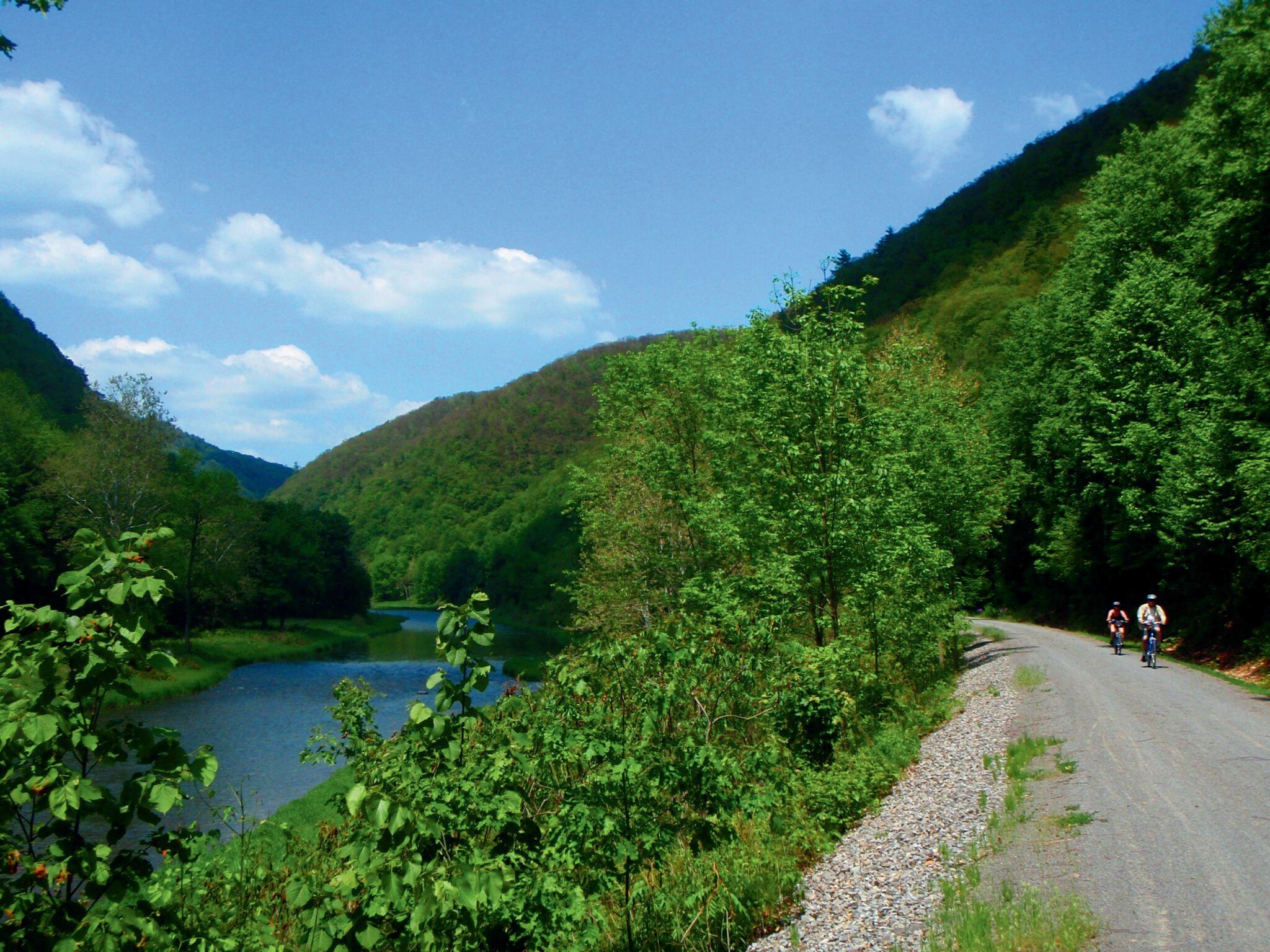
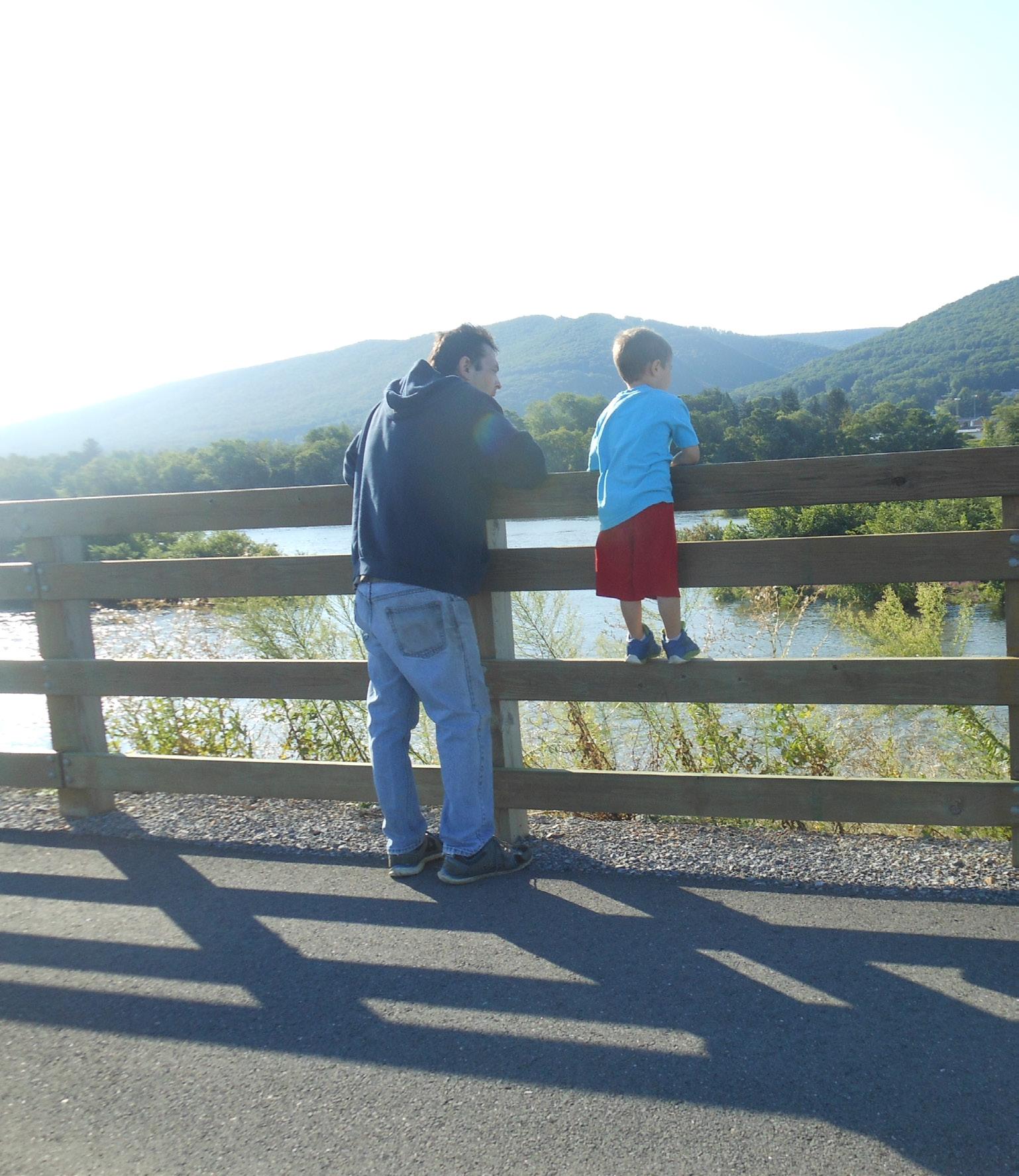
The Pine Creek Rail Trail reaches Wellsboro to connect us with the past.
Carolyn Straniere
Maggie Barnes
Maggie Barnes










mountainhomemag.com


E ditors & P ublish E rs
Teresa Banik Capuzzo
Michael Capuzzo
ssoci A t E E ditor & P ublish E r
Lilace Mellin Guignard
A ssoci A t E P ublish E r
George Bochetto, Esq.
A rt d ir E ctor
Wade Spencer
M A n A ging E ditor
Gayle Morrow
s A l E s r EP r E s E nt A tiv E
Teresa Banik Capuzzo
c ircul A tion d ir E ctor
Michael Banik
A ccounting
Amy Packard
c ov E r d E sign
Wade Spencer
c ontributing W rit E rs
Maggie Barnes, Chris Espenshade, Jimmy Guignard, Carolyn Straniere
c ontributing P hotogr AP h E rs
Chris Espenshade, Jimmy Guignard, Tom Heim, Don Jilson, Peter Kutbay, Linda Stager, Sam VanLoon
d istribution t EAM
Dawn Litzelman, Grapevine Distribution, Shea Maier, Linda Roller
t h E b EA gl E
Nano Cosmo (1996-2014) • Yogi (2004-2018)
ABOUT US: Mountain Home is the award-winning regional magazine of PA and NY with more than 100,000 readers. The magazine has been published monthly, since 2005, by Beagle Media, LLC, 39 Water Street, Wellsboro, Pennsylvania, 16901, online at mountainhomemag.com or at issuu.com/mountainhome. Copyright © 2026 Beagle Media, LLC. All rights reserved. E-mail story ideas to editorial@ mountainhomemag.com, or call (570) 724-3838.
TO ADVERTISE: E-mail info@mountainhomemag.com, or call us at (570) 724-3838.
AWARDS: Mountain Home has won over 100 international and statewide journalism awards from the International Regional Magazine Association and the Pennsylvania NewsMedia Association for excellence in writing, photography, and design.
DISTRIBUTION: Mountain Home is available “Free as the Wind” at hundreds of locations in Tioga, Potter, Bradford, Lycoming, Union, and Clinton counties in PA and Steuben, Chemung, Schuyler, Yates, Seneca, Tioga, and Ontario counties in NY.
SUBSCRIPTIONS: For a one-year subscription (12 issues), send $24.95, payable to Beagle Media LLC, 39 Water Street, Wellsboro, PA 16901 or visit mountainhomemag.com..



presented by and


Your favorite magazine and radio station are teaming up to give away thousands of dollars in prizes for the best the Twin Tiers has to offer. We’ll be adding exciting new prizes all summer before the grand drawing Saturday Sept. 12 at the Deane Center in Wellsboro. The prizes so far:

LAKES ESCAPE In WatkIns Glen
Grand PrIze
Dinner for two on the seneca leGacy, at Seneca harbor Park Pier. a night at the Harbor Hotel on Seneca Lake, 16 n. frankLin St.
sHoPPInG sPree go wiLD at Famous brands
Dinner for two at seneca lodGe 412 n. frankLin St.


HIGHLAND FLING In Wellsboro
Grand PrIze
a night at the hiStoric Penn Wells hoteL, 62 Main St. a tour for two on tony’s trolley, boarD at the Penn weLLS hoteL. Dinner for two at the steak House, 29 Main St.
anD there’LL be More to coMe! Like: Lunch at becks bIstro, 104 Main St. ice creaM at tHe maIn street creamery, 17 Main St.
gift carD gooD for the arcadIa tHeatre, caFé 1905, or the Penn Wells Hotel reStaurant.


No purchase necessary. Just visit mountainhome.substack.com/welcome, enter your email for a free subscription to Mountain Home online, and you’re entered. Already subscribed? You’re already entered! Scan this QR code for instructions on how to refer an unlimited number of friends to sign up and multiply your chances to win.





By Lilace Mellin Guignard
Outdoor writing requires keen observation skills and an understanding of natural systems. Though they often travel, outdoor writers are driven by a deep love of and a familiarity with a place. Pennsylvania, home of one of the early outdoor writers, Nessmuk (George Washington Sears), has the largest and oldest state-level association of outdoor communicators—the Pennsylvania Outdoor Writers Association.
While holding its 75th anniversary conference this May in the Penn Harris Hotel, where the group was first formed, several Mountain Home contributors received Excellence in Craft awards.
Paula Piatt of Sayre won the Military and Veterans Award for her November 2025 story. “Hunting and Healing: Potter County’s LEEK Helps Veterans” is about a wonderful program connecting and supporting veterans through a shared activity. Paula is also active in the New York State Outdoor Writers Association and in early May received second place in the magazine feature category for her October 2025
story “Aura-Awe: Searching the Sky for Elusive Lights,” about helping fellow northern lights seekers use their cell phones to discover the aurora borealis.
I was honored to receive the Pass It On Award sponsored by PA Environment Digest for an essay (too long to publish in Mountain Home) included in the Catamount Press anthology Rivers, Ridges, and Valleys: Essays on Rural Pennsylvania, about arranging for my teenage son to learn how to hunt in Tioga County, and then having him help teach me at age fiftyone. The collection, edited by Jerry Wemple and Anne Dyer Stuart (see Mountain Home December 2025) made the Writers Conference of Northern Appalachia Book of the Year shortlist.
Don Knaus of Wellsboro received second place in the Outdoor Blog Award for the digital version of his Mountain Home story, “Charlie Fox’s Dream: A Legacy Lives on at Mill Cove Environmental Education Center” published in April 2025 on the one-year anniversary of the great man’s passing. Charlie would be well pleased.
Linda Stager of Wellsboro, whose work is often selected for our Back of the Mountain photo feature, won Best Published Magazine Photo Award for “Catch of the Day,” in April 2025. The very hungry heron caught in the act of getting a meal definitely deserved the fish and the recognition. Linda also received two awards for “Getting Kids Excited about Fishing and Conservation,” which was published in Pennsylvania Angler & Boater, January/February 2025. The first was the Wildlife Conservation Partnership Award sponsored by the Pennsylvania Game Commission, and the second was Best Action Hunting, Trapping, or Fishing Photograph Award.
Pennsylvania and New York are great places to be for anyone who uses writing, photography, art, and broadcasting to share about outdoor recreation, education, and conservation, and Mountain Home is lucky to have so many award-winning outdoor communicators in our ecosystem.

By Jimmy Guignard
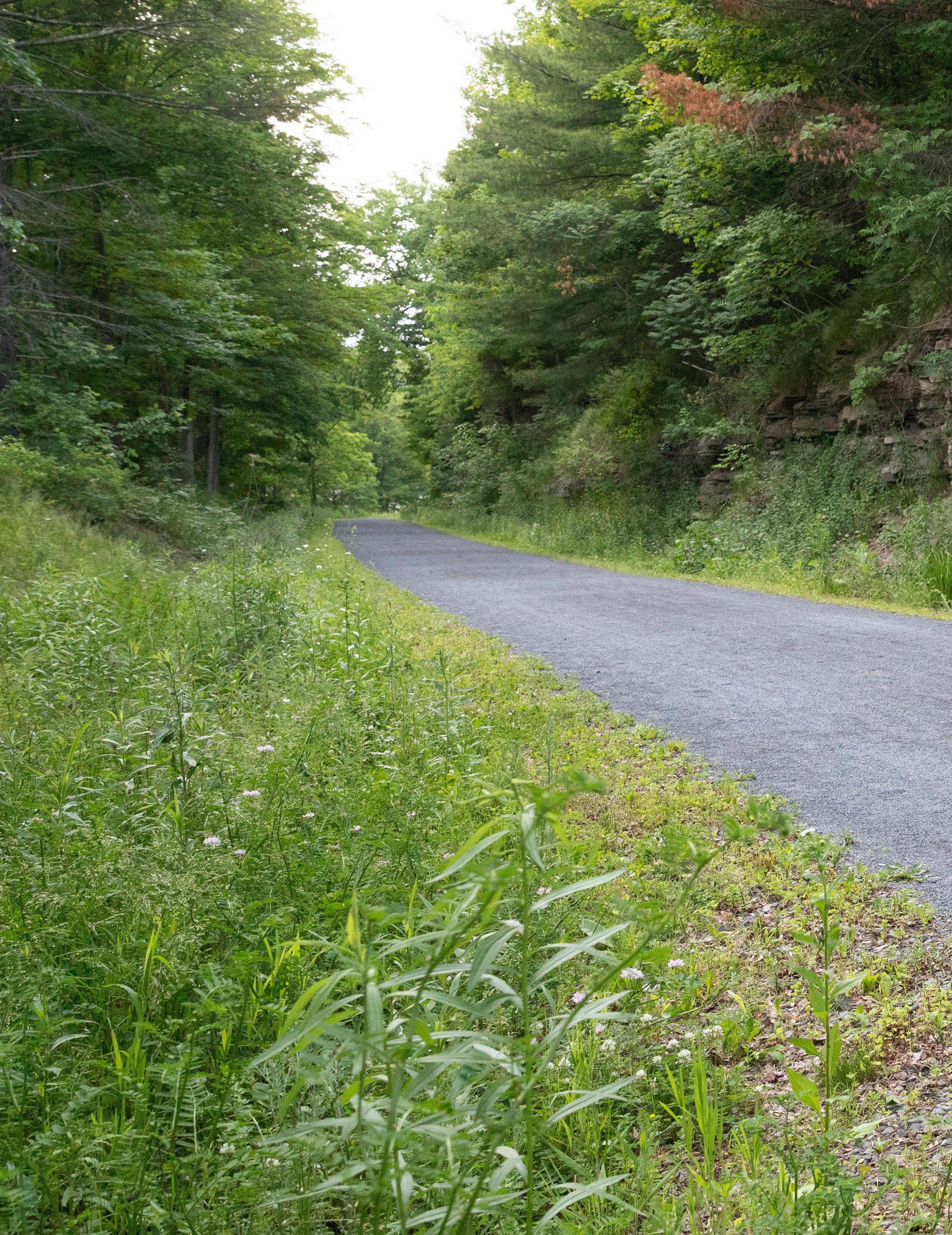
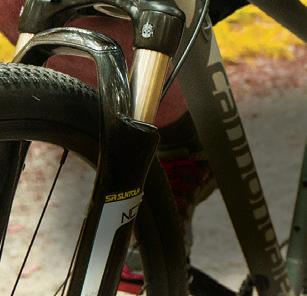
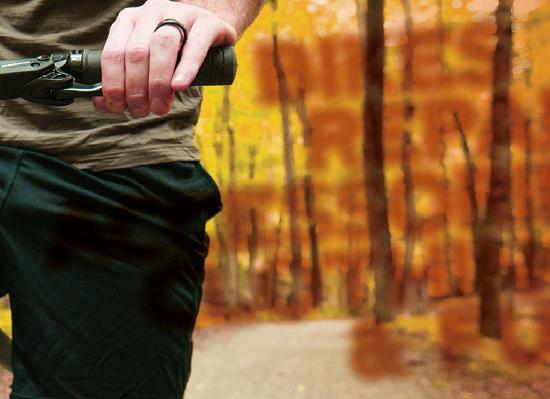
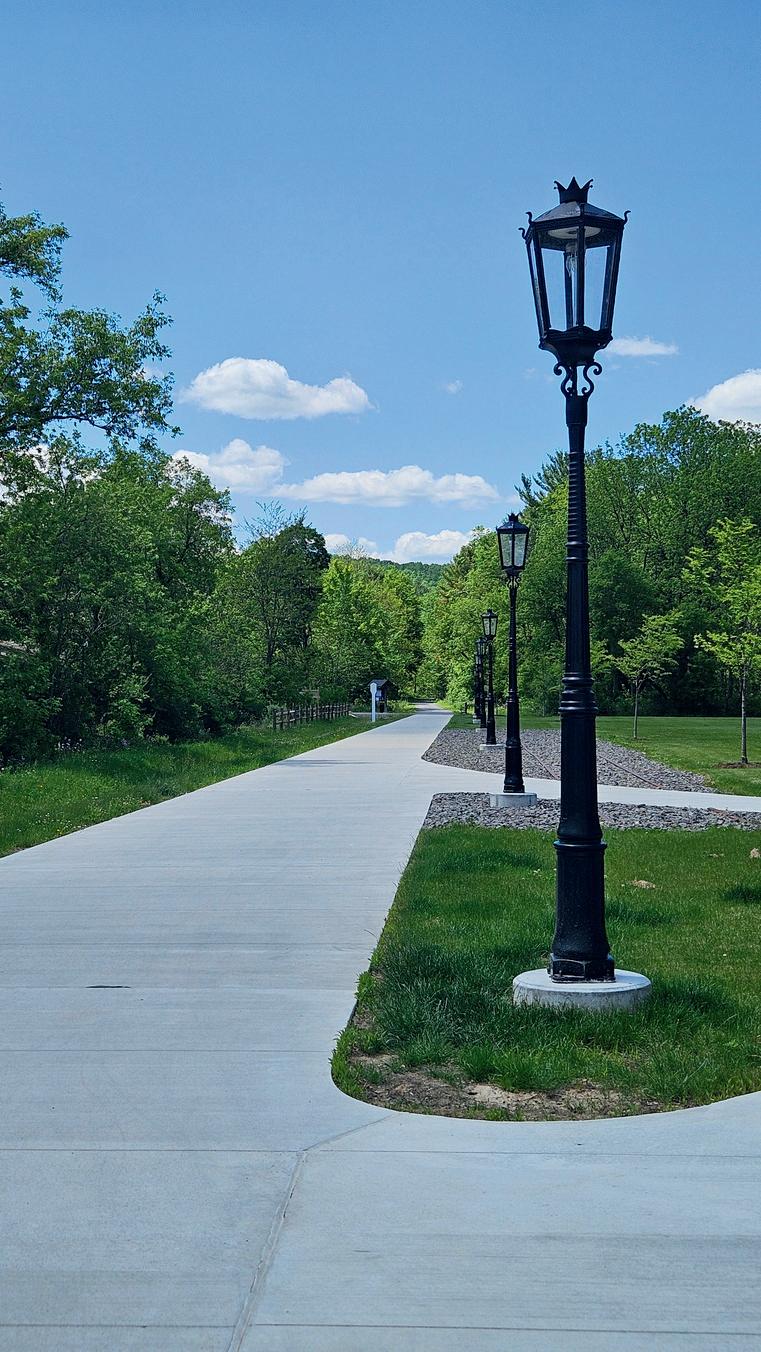
Iturn left out of my Wellsboro driveway and roll down a short hill to Route 6. A right onto 6, then a quick left onto Charleston Street at what was John Mosso’s gas station. I pedal two hundred yards past Fox’s Pizza, McDonald’s, AAA, and StacyKay’s Café before hanging a left onto the Charleston Street Connector Bridge and the Pine Creek Rail Trail Extension proper. I cross the bridge—the Patterson Trailhead and Welcome Center are one hundred yards to my right. Kids ring the bell on the train engine play equipment, which reminds me of the bell chemo patients ring when we finish treatment. I turn left into trees overhanging the trail like a train tunnel. I’m moving forward, and I’m carried back in time.
I finished chemo for abdominal cancer in 2018. A cyclist used to riding 4,000 miles a year, I felt like a bike left in the garage with flat tires and rusty chain.
After chemo, I rode my way back to physical and mental health on the Pine Creek Rail Trail. In those days, I had to load my bike on the car and drive to the Butler Road access or Darling Run. I didn’t have the legs or lungs or gumption for hills, but I wanted— needed—to be outside. To see the mountains and hear the birds and the wind in the trees. Maybe see a bear or a snapping turtle.

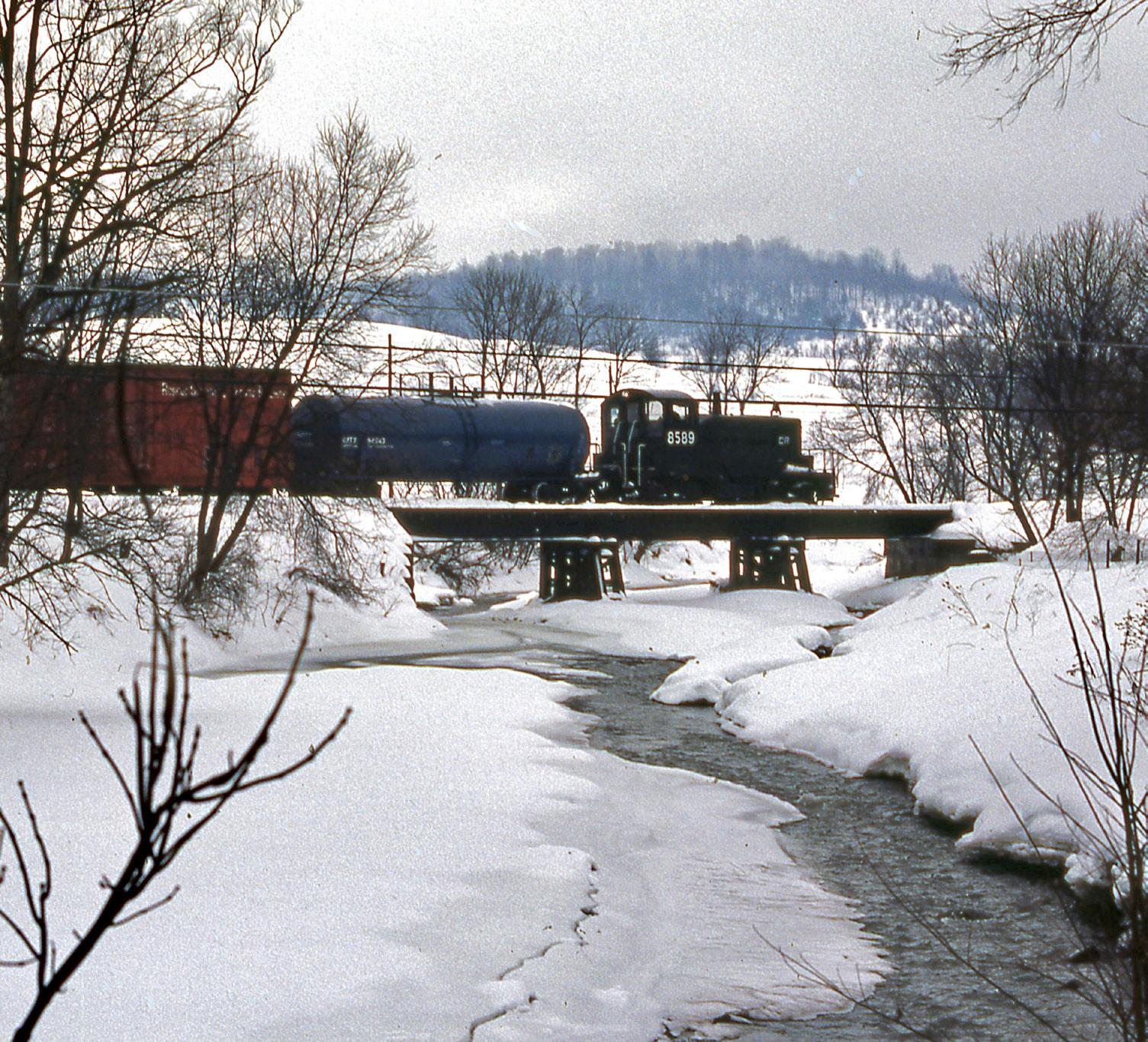
Once trains such as Conrail's WBL1 (Wellsboro Local 1) Engine 858, a model SW1 Locomotive, traveled into Wellsboro over Bridge 12 in Stokesdale. The rails are gone, but markers remain to remind folks of the trains that used to run.
Riding on the rail trail brought me back to me. It reminded me that, even though the trail is static, it’s alive with people and nature and stories. Each of them markers. Some are seen by all who use it—or can be if they know where to look.
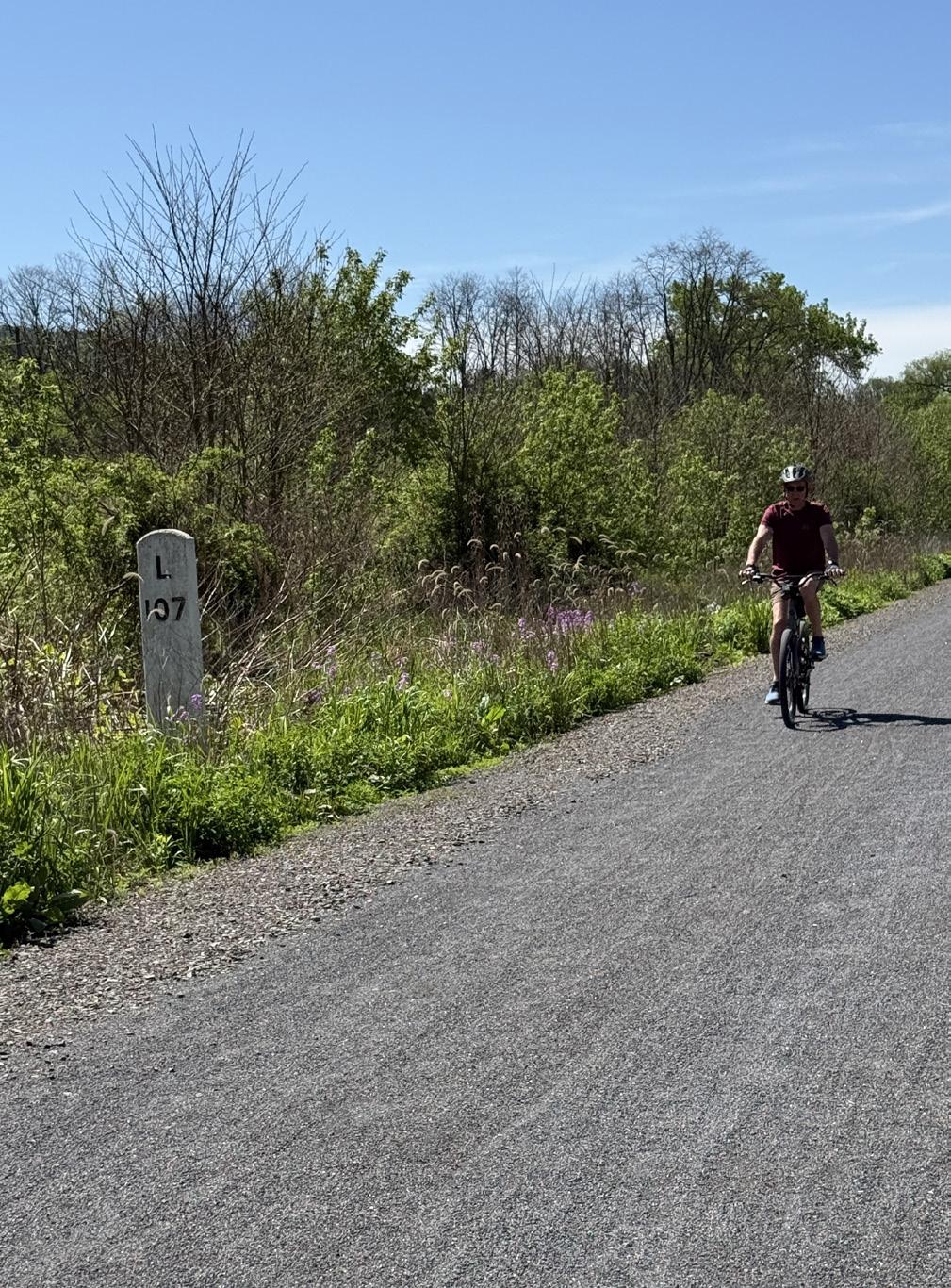
If you ride the Pine Creek Rail Trail, you’ll come across white stone markers shaped like gravestones with “L 107” or something similar carved into them. The markers told train engineers and passengers how far it was to wherever the train pointed (such as 107 miles to Lyons, New York). But there are other “markers” on the rail trail, markers not visible unless you know the story.
In other words, there’s the actual trail, and then there are the trails of people and places that created the PCRTE.
One marker is John Mosso’s garage.
If there’s a Lorax in human form, right down to the mustache, it’s Jim Weaver. The former Tioga County Planning Director has been speaking for the trees and getting people outside for years. Twenty-some years ago Jim found himself in John’s gas station (now former gas station—John sold it earlier this year), scraping a plan for a rail trail extension in the dust on a garage window for then County Commissioner Erick Coolidge. The sketch
connected the northern end of the Pine Creek Rail Trail at the Butler Road access, completed in 2007, to Wellsboro. Jim says Erick looked at him like he was crazy. Then, Jim says, Erick’s face changed. He caught the vision. “That’s a good idea,” he told Jim.
Jim’s sketch began what Pennsylvania Department of Transportation’s Aaron Crist calls “the most complex project PennDOT has ever worked on.” Or does the beginning go back further than that? Where something starts is subjective. Jim’s map is more like one marker among many that built the PCRTE. Another starting point could be the 2,500 feet of Pleistocene glacier that scoured this area before it melted 15,000 years ago and forced Marsh and Pine creeks, which flowed northeast, to flow south.
Maybe that’s too far back? How about the trail Native Americans followed through the Pine Creek gorge before the railroad that came in the late 1800s and helped strip this place of resources? Or when, once the rails and resources were stripped, nature came roaring back? There are few signs as clear as the original railroad markers, but the signs are all over. The rail trail extension might seem like a static hump of gravel, but it was built on history, geography, and the efforts of the people here.
Wellsboro’s Nessmuk understood the industrial mindset. Commenting in Woodcraft and Camping on a tannery built above
a Poplar Spring campsite, Nessmuk says, “Of course, this is progress; but, whether backward or forward, had better be decided sixty years hence.”
Pedaling alongside Marsh Creek, I think Nessmuk would find the rail trail progress. Forward progress.
The last train ran through the Pine Creek gorge in 1988, then Conrail abandoned the line. Trail construction began in 1995; the trail was completed in 2007. The sixty-two mile trail ran adjacent to Pine Creek from the southern terminus at Jersey Shore to Ansonia, then followed Marsh Creek to the northern terminus at the Butler Road access in Delmar Township. The extension opened officially in September 2025 and, with that, closed one of the remaining “trail gaps” in Pennsylvania. Trail gaps are defined by connecting existing trail sections; requiring major infrastructure or rehabilitation; funding of over $1 million; and/or requiring interagency coordination. There are 14,000 miles of trails in the Commonwealth, and the goal is for every Pennsylvanian to live within ten minutes of a trail. The PCRTE adds to the 1,700 plus miles of rail trails and bikeways available to cyclists, hikers, and others in the state. Such trails connect people to their places and to other people.
































Trail continued from page 10
Construction involved federal, state, and local agencies; several different railroad companies; and private landowners and entities, like Wellsboro’s GROW (Growth Resources of Wellsboro). The Tioga County Partnership for Community Health handled the grants. So many organizations, so many people, so many hours. The weight of the effort matches—or perhaps exceeds—the literal weight of the rail trail extension itself.
A mile or so later, I pass an orange pole with a solar-powered light strapped to it about thirty feet off of the east side of the PCRTE. Another sign. Near the bottom, two black bands circle the pole, the upper marking the water height during 1972’s Hurricane Agnes and the lower marking 2004’s Hurricane Ivan. I take a picture, certain that if I lie down on the rail trail, the top band would be almost even with the level of the raised trail.
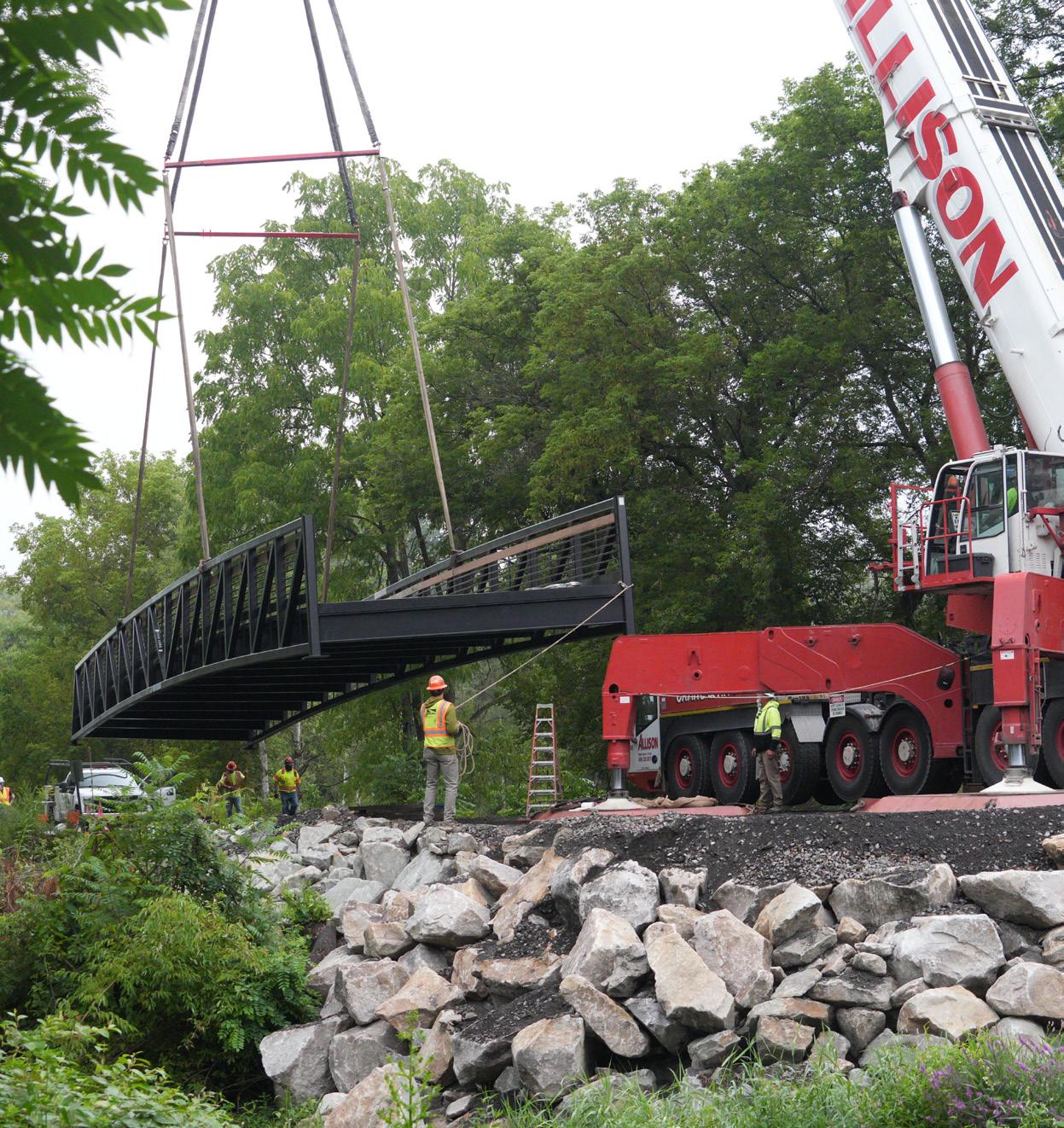
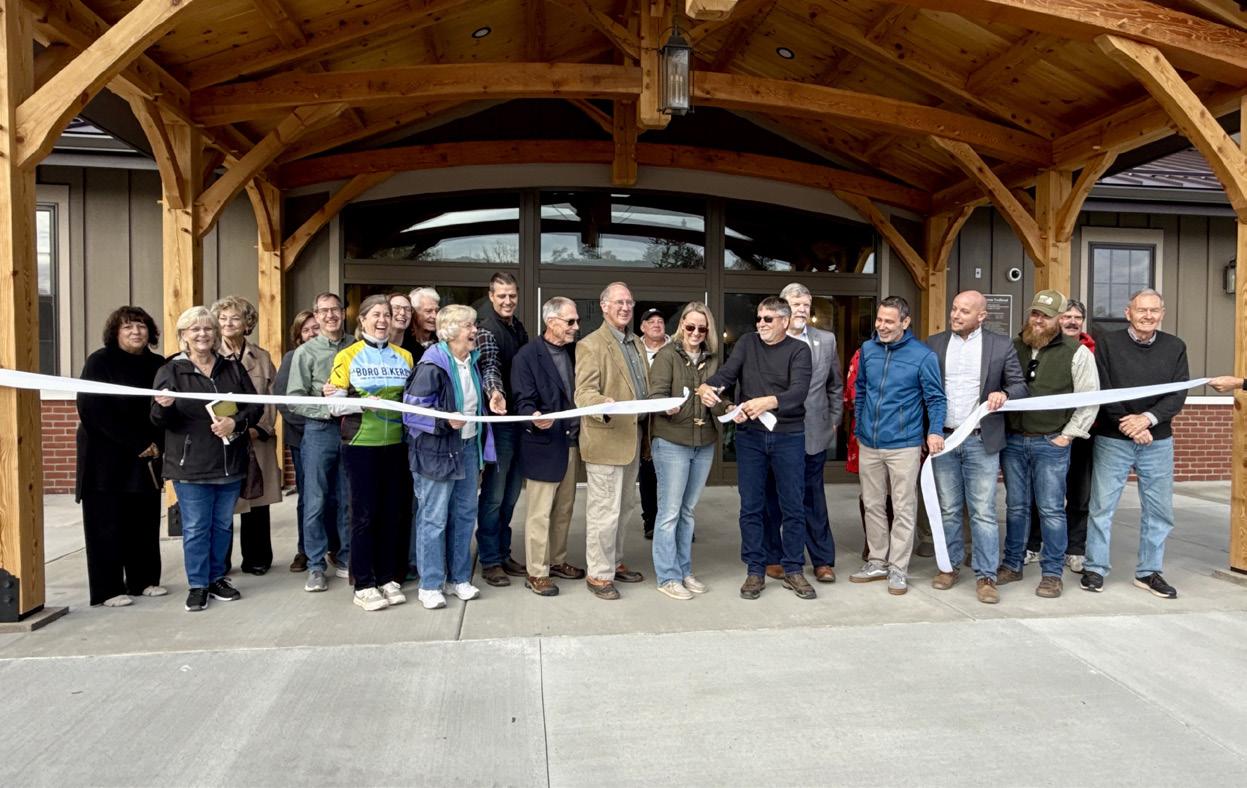
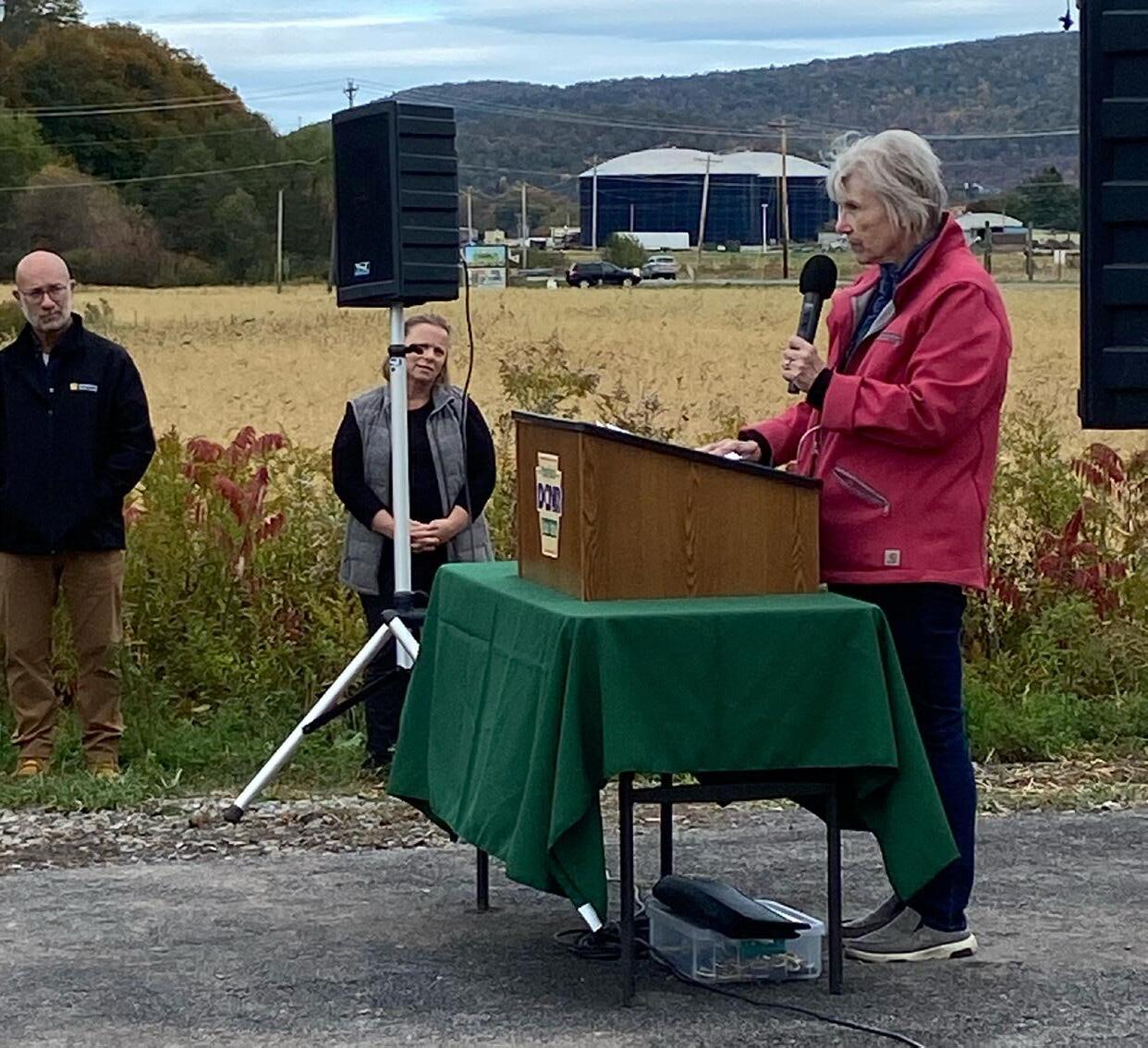
The trail extension involved lots of heavy lifting— literally in the case of installing bridges, which the community came together to celebrate at the ribbon cutting October 17, 2025, at the Patterson Trailhead; before that, the crowd had heard from several speakers, including Linda Stager (bottom), at the Butler Road Trailhead where the extension begins.
The pole signifies a time when residents of Stokesdale, a collection of homes between the borough and the Wellsboro Junction, packed their cars and parked them on Route 6 during floods, in case they needed to skedaddle. Floods were a serious concern, former Stokesdale resident Grant “Skip” Cavanaugh shares, and the railroad didn’t seem interested in doing anything about it. The railroad bed was built, Skip says, with “soft coal cinders,” not ideal for holding back flood water. During Agnes and Ivan, Skip walked the railroad bed monitoring Marsh Creek, and reached out to local officials about controlling the flood waters, but, he says, “nobody was interested and no one had funding.”
Skip shared his lack of success with his Stokesdale neighbors, all of whom recognized somebody needed to do something. Willie Mead, owner of Mead’s Auction House (which you can see from the trail), raised his “old gnarly auctioneer’s finger” and pointed it at Skip: “I nominate you, and we’ll be behind you.” That finger anointed Skip “mayor” and set him off on a letter writing campaign where he wrote to everyone he could think of at the local, state, and federal levels (including two presidents). (See “Still Life with Railroad” by Anne Lugg Alexander, September 2024.)
Skip also showed the problem to anyone he could get onto the railroad bed. Skip talked Joe Shabloski of Gra-Hil Construction into taking Jim Weaver, Pag-Omar Farm owner Oliver Butler, Skip, three county commissioners, and one or two others on a trip in the highrail pickup from Muck Road south to the current Patterson Trailhead. (The high-rail pickup clamped to the tracks.) Skip recalls wind howling and icicles hanging from the railroad cuts as he showed the passengers where the railroad bed was eroding.
Once in Wellsboro, Skip says, most everyone jumped out and left for other things. Joe, Jim, Oliver, and Skip reversed back to Muck Road, where Jim, Oliver, and Skip sat shivering in the car and talking. The northern terminus of the Pine Creek Rail Trail sat a few hundred yards west. Oliver said, “The trail ends right behind us [at the PagOmar Farm Store] and doesn’t go into Wellsboro.”
Bright as a southbound train, the light came on in their heads, and Jim ended up in John Mosso’s gas station with a commissioner. Skip’s letters and persistence led to a grant that helped solve some of the flooding issues and to a firmer foundation for the PCRTE. The trail was getting “built,” one conversation at a time.
Not as concrete as Jim’s map or Skip’s pole, another sign came in the form of air quality. In the 2000s, Tioga County received Congestion Mitigation and Air Quality Program money after it was determined that the county had high levels of ozone. (This still blows my mind. 1880s, ok. 2000s? What?!) The county needed to get cars off the road and, with help, Jim figured out how a trailhead in Wellsboro would reduce the number of cars driving to the Darling Run and Butler Road access points.
The Patterson Trailhead and Welcome Center parking lot holds ninety cars, not to mention allowing people in town to access the trail from their homes and hotels. The Patterson building houses Develop Tioga, another player in the PCRTE construction, and much historical and tourist information about Wellsboro and Tioga County. (Download the Discover Tioga app for more information and rail trail maps.)
The rail trail itself evolved as well. One early version of the trail design called for climbing into private property in Wellsboro across Tramp Hollow, a former camp for homeless from the Depression, Another called for “co-locating” the trail beside the existing railroad.
Once the trains stopped running, the final design simplified, following the existing railbed. The end of the trains was a loss in terms of manufacturing jobs and tourism. As County Commissioner Marc Rice points out, the tourist trains hauled sixty people at a time. Otherwise, the land lay unused. But the PCRTE enables people to recreate all day. Though not averse to hopping a train, no doubt Nessmuk would approve.
Local photographer and writer Linda Stager was the last speaker during the PCRTE grand opening at the Butler Road access. (The ceremony continued later at the Patterson Trailhead.) With thick silver hair and a quick smile, she radiates intensity and belief in all things rail trail. Linda retired in 2013, she says, “a broken person.” While losing 150 pounds, she began exploring the trail on foot and by bike, learning to take photos and write something besides grants.
Her time on the rail trail led to her writing The Pine Creek Rail Trail Guidebook, now out in a second edition to include the PCRTE. Linda said, “this gravel path has so much history underneath it and it is waiting for you to feel it.” Linda knows what she’s talking about. She has ridden and documented every mile of the Pine Creek Rail Trail, and her book reveals much of the history otherwise hidden to trail users. The knowledge deepens our bridge to the past and shows just how much reclaiming this trail saves the character of the place and the people.
Linda says she wants people to “like the trail, then love the trail, then take care of the trail.” She notes that the trail “saved” her, something I can relate to, and she continues to spend many hours on it, witnessing in words and pictures. She adds, “this rail trail extension shows that progress can be quiet, steady, and deeply human.”
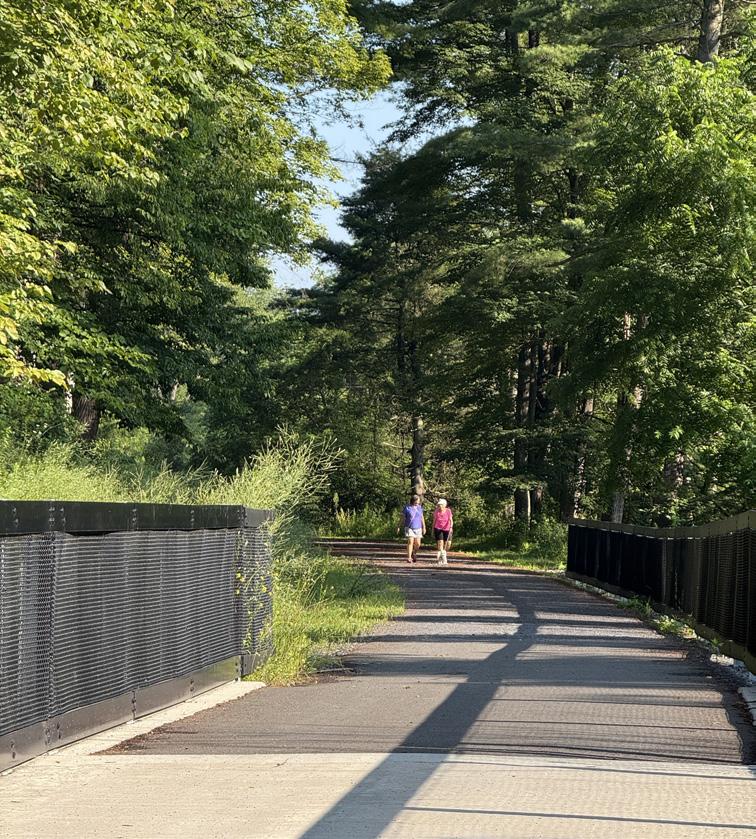
I cross the only new bridge built during the construction, one soon to be named the Mary Worthington Bridge. Mary Worthington was the director of the Wellsboro Area Chamber of Commerce, and worked tirelessly on behalf of Wellsboro and Tioga County. The
Mountain Home is hiring account executives in New York & Pennsylvania to sell advertising, provide valuable content to our readers, and help our clients prosper.
This job has paid 60G-plus. Flexible hours. Family atmosphere. Professional training and support. Mileage. 401K.
Represent the Twin Tiers regional magazine, the premier media brand across our beautiful region, with a readership area larger than Vermont.
100,000 monthly readers of the print magazine.
“Free as the Wind” at 350 locations in NY & PA.
Thousands of subscribers to mountainhome.substack.com substack@mountainhomemag.com (570) 724-3838
Locally, family owned by Beagle Media for 20 years.
200-plus journalism awards from the International Regional Magazine Association and the Pennsylvania NewsMedia Association.
Give us a call, Teresa & Mike


Animal
Animal
Doc Magic Show • Live Music Every Day!
Potter


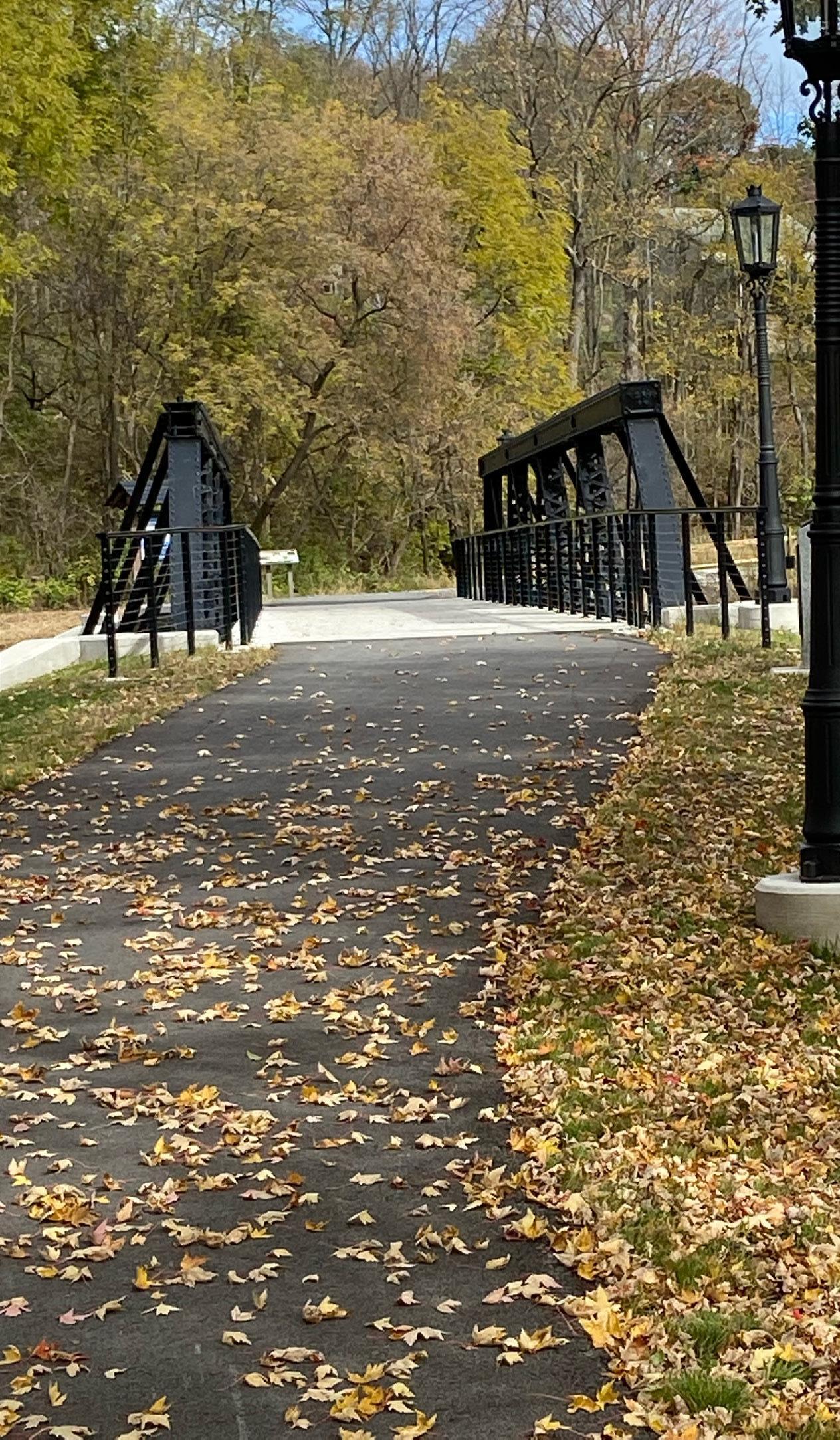
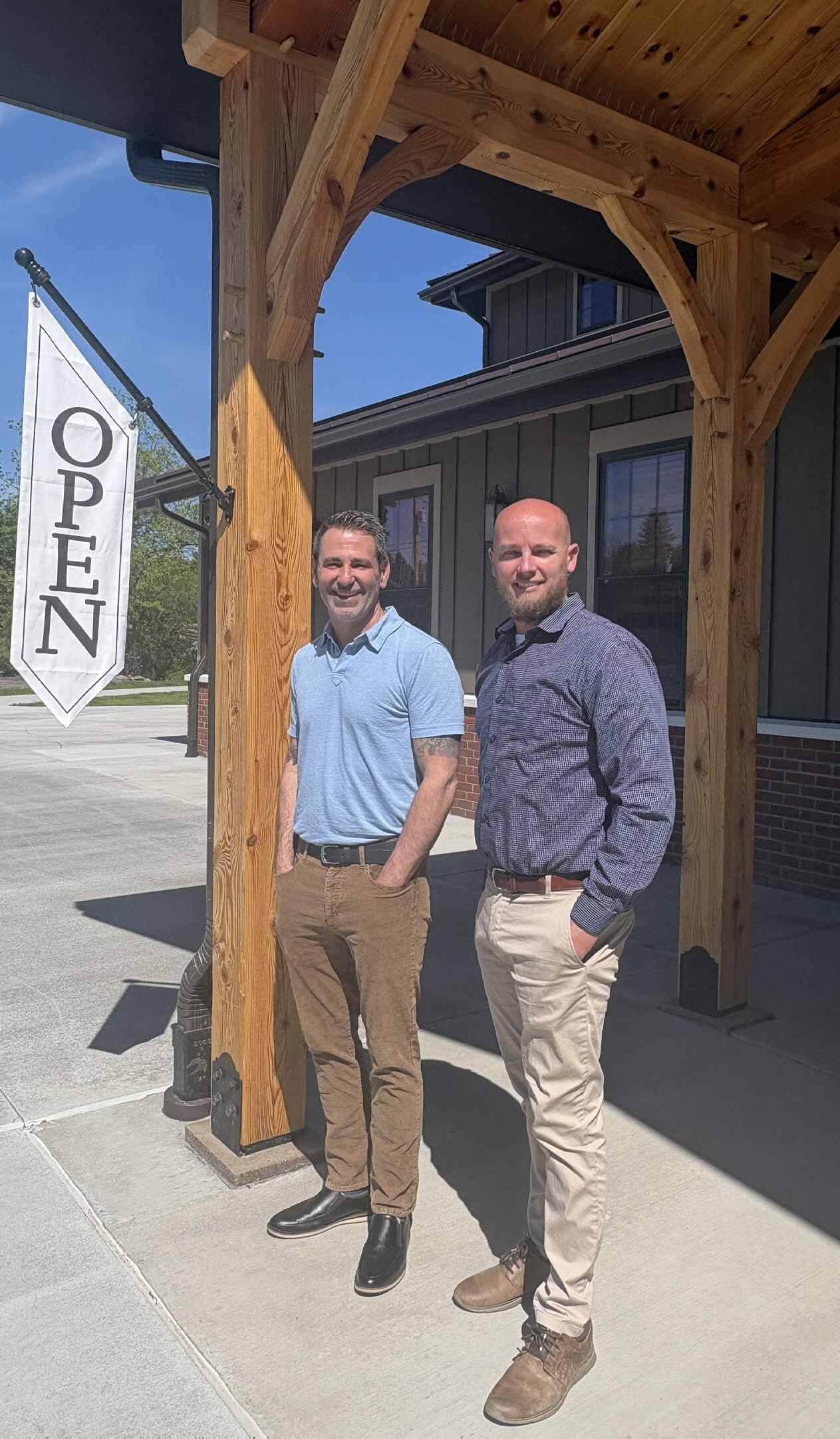
The Warren Pony Truss bridge makes for a picturesque approach to the trail extension beside Pinnacle Towers; two of the three Tioga County commissioners who have worked to make this happen, Shane Nickerson (left) and Marc Rice, pause by the entrance of the Patterson Trailhead and Welcome Center, the official northern terminus for the Pine Creek Rail Trail.
bridge is a span bridge that replaced the old railroad bridge. The old bridge was built with a support under the rails in the middle of Marsh Creek, which led to flood debris being trapped against the support, forcing water to flow against the banks and erode them. The new bridge allows Marsh Creek to flow unimpeded, which helps control flooding.
The Mary Worthington Bridge preserves creek banks. The Charleston Street Connector Bridge, which we crossed a while back, preserves history. And, like the PCRTE, rehabbing that bridge involved many hands.
Built in 1879, the Warren Pony Truss bridge held up trains for the Northern Central Railway in Chester County. A Pony Truss bridge refers to the triangle construction without structural steel overhead. As trains got bigger and faster, the bridge was retired and repurposed for cars, and eventually ended up in Tioga County. The wrought iron bridge matches the Wellsboro old world vibe, of a piece
with being, according to the World Atlas, one of the top twelve Main Streets in Pennsylvania. And it preserves some Chester County history right here.
I joined Marc and County Commissioner Shane Nickerson on the bridge one sunny Thursday. I was hoping for a ride with them, but I could tell from their clothes when they arrived that they had commissioner stuff to do. We walked down to the bridge. Two young women pushing strollers walked by, talking and heading into the train tunnel of leaves.
Marc recalls, “The bridge was in such bad shape when I first saw it, I was ashamed to show my boss.” But former Governor Tom Wolfe and current Governor Josh Shapiro wanted to preserve it, so Shapiro’s administration moved the bridge to the Patterson site. The Tioga County Housing Authority provided the land. The bridge underwent serious structural rehabilitation, finally being painted black to inhibit corrosion and capture the 1880s railroad bridge aesthetic. Now, it
36
KOI
RODEO Monday, August 10th ★ 1 PM
KOI DRAG RACING Monday, August 10th ★ 7 PM
TRUCK/TRACTOR PULL
August 11th
OUTLAW PULLING SERIES Wednesday, August 12th
BULLRIDE MANIA RODEO Thursday, August 13th ★ 7 PM
DEMOLITION DERBY








Hamilton-Gibson Productions’ Artist Director Thomas Putnam (right) joins forces with Endless Mountain Music Festival Artistic Director and Conductor Stephen Gunzenhauser to lead actors and instrumentalists in two performances of Ellis Island: The Dream of America by Peter Boyer Shared Dreams

By Gayle Morrow
Ellis Island. It’s about a mile southwest of Manhattan, and approximately 1,300 feet east of the New Jersey shore. Long before the first Europeans showed up, there were indigenous people who frequented the place, benefitting from its oyster beds and abundance of fish. Early Dutch settlers referred to it as one of three “Oyster Islands.” Its mass was originally around three acres, but it’s grown over the years to twenty-seven via various land reclamation projects—more like land creation, really—using land fill (not the garbage that goes in a landfill) material and ship ballast.
During the 1770s, a man named Samuel Ellis, himself an immigrant, owned the island—thus the name. It passed to members of his family after he died, then to the state of New York, and in 1808 to the federal government. The Feds subsequently built Fort Gibson there, and also used the facilities as a powder magazine (storage for explosives).
In 1891, the federal government assumed from the states, via the Immigration
Act of that same year, the responsibility of overseeing immigration. Given that New York was the most frequented port of entry, Ellis Island became the place where a new immigration inspection and processing station was built. Between 1892 and 1954, about twelve million people came from all over the world through that facility. They all had stories.
Imagine hearing them.
Ellis Island. If only it could talk.
What you will have to do is listen.
Composed between 2001 and 2002, Ellis Island: The Dream of America (check out the short video “Peter Boyer’s “Ellis Island” 20th Anniversary” on YouTube for comments from Peter) has been performed by over 100 orchestras with thousands of musicians, and was featured on PBS’s Great Performances series in 2018. The work is fifteen vignettes, or movements—music interspersed with actors reading stories that Boyer took from the Ellis Island Oral History Project.
“The work is brilliant,” says Maestro Stephen Gunzenhauser (stephengunzenhauser.com), who serves as artistic director and conductor for the EMMF series of concerts. “It’s one of the most performed pieces. It’s a remarkable effort by the composer.”
Stephen has an affinity for the subject matter, noting that his parents were born in Germany, met and married in Bavaria, then
Well, actually, it can. And it will. The Endless Mountain Music Festival, in its twentieth season of bringing world-class music and musicians to the Twin Tiers, is collaborating with Wellsboro-based Hamilton-Gibson Productions for back-to-back performances of Ellis Island: The Dream of America, a Grammy-nominated multimedia work by American composer Peter Boyer. The opening concert is on July 17 at 7 p.m., at Steadman Theatre in Mansfield; the second performance on July 18 at 7 p.m. at the Corning Museum of Glass in Corning. The stories, at least some of them, will be told then.
came to this country. They were accepted, he says, and “became part of America.”
“As I looked at this piece, I looked at my parents,” he contin ues. Their hopes and aspirations mirror those of countless others, some of whom attendees at the two Dream of America will meet—in spirit, if not in the flesh.
“Stephen approached me last summer and said he’d found a work about Ellis Island, and would Hamilton-Gibson be interested in providing the speakers,” says Thomas Putnam, Hamilton-Gibson founder and artistic director, adding he’s “really drawn” to the whole immigrant experience. It’s a busy time of year (check out hamilton gibson.org to find out why), he acknowledges, but “I can do this.”
“When I listened to the thing—the beautiful, beautiful mu sic—the music would have sold me on it,” Thomas says.
Hamilton-Gibson’s role in the EMMF production of land: The Dream of America is the provision of seven actors to voice the immigrants’ stories. They’re from Poland, Greece, Italy, Hun gary, Ireland, and Russia. Thomas’s job early on was to figure out “who do I know who has an affinity for accents?”
“I just started asking people,” he says. To a couple of the pro spective readers, he sent the narrations so they could “see which one speaks to you.”
One of the stories spoke to him—that of Lazarus Salamon, the Jewish Hungarian immigrant. He hadn’t intended to take on one of the parts himself, but… “I’m writing a play about the Holocaust,” Thomas explains, and “my best friend growing up was Jewish…” and, ultimately, “I’m glad I’m doing it.”
“Thomas Putnam is as excited as I am about doing this,” says Stephen.
Rehearsals for the performances, less than a month away at this writing, have not yet been with orchestra and actors in the same place, but are proceeding kind of together and apart.


“They’ve had their scripts for a number of weeks, and have had a few get-togethers,” says Thomas. “The music often informs the tone [of the speaker’s narration], so each person is listening to the music.”
Stephen, meanwhile, is conducting evening rehearsals with the EMMF musicians “so people don’t have to miss work.”
During the performance, the audience will see the speakers, and there will be “the suggestion of a costume,” Thomas says. Part of that particular dilemma has been that many immigrants came to Ellis Island as children, but their remembrances were collected and preserved as adults.
“What age do we present them?” Thomas wonders.
The performance concludes with a reading of “The New Colossus” by Emma Lazarus. Those lines on the Statue of Liberty, who stands about half a mile from Ellis Island, include “…Here at our sea-washed, sunset gates shall stand a mighty woman with a torch… and her name Mother of Exiles.” It’s a poignant reminder, particularly during this anniversary year, of what America stands for, for what many Americans want to believe it stands for.
“I hope they [the audience] are moved by it,” Thomas says.
Stephen is hoping for that and more.
“I want people to leave crying,” he says. “For good and for bad.”

For EMMF ticket information, visit endlessmountain.net. Located in the heart of downtown Elmira, the LECOM Event Center is your destination for unforgettable experiences. From hockey and turf sports to concerts and live entertainment, there’s always something happening.
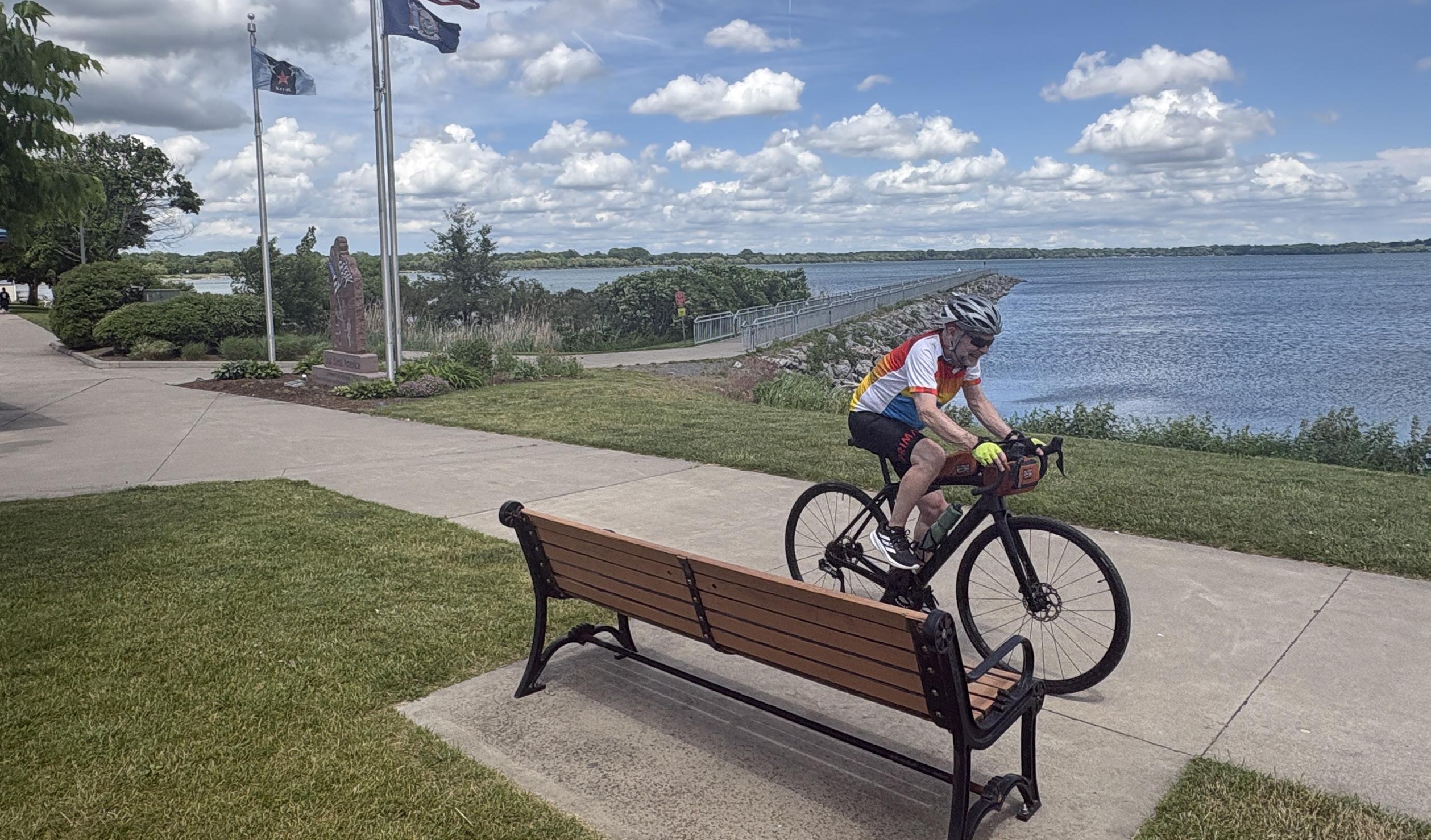
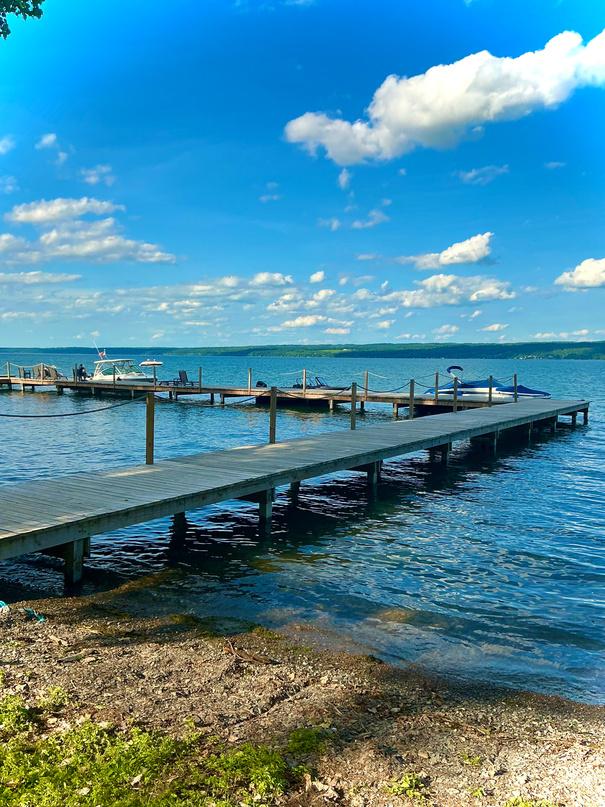
Cyclists enjoy Seneca Lake in Geneva before heading into the woods and marshland along the Cayuga-Seneca Canal Trail, a round trip which provides fifteen miles of peace with the chance of ice cream at the end.
By Lilace Mellin Guignard
Having stopped at the Finger Lakes Welcome Center, 35 Lake Front Drive, more than once for a bathroom break and a coffee, which I’d enjoy on a bench staring at Seneca Lake, I often wondered where the Geneva Lakefront Trail started and how far it went in either direction. All around me were trail users—dog walkers, parents with strollers, runners, and cyclists. Lucky are the Geneva residents who live near such a resource! But were there enough trail miles to warrant an hour’s drive for a bike ride?
A few summers ago, I had paddled the Cayuga-Seneca Canal with a friend all the way to Seneca Falls (see the October 2024 issue of Mountain Home). As we passed through the lock at Waterloo, some friendly cyclists waved down from the bridge. A quick online search brought up the Cayuga-Seneca Canal Trail. It was clear that the trail connected with the Geneva Lakefront Trail. But try as I might, I could not get a consistent, reliable account of the mileage. There was nothing to do but ground truth it. Would it be ten miles? Fifteen? Twenty? I’d just have to be adaptable.
Luckily, my husband, Jimmy, is always up for a cycling adventure. Especially if it involves eating at some of our favorite places. On a sunny Friday, we drove up from Wellsboro and stopped at Lucky Hare Brewing in the marina behind the Harbor Hotel in Watkins Glen. From a table with umbrella right on the edge of the lake, we watched sailboats, kayakers, and ducks as we ate lunch.
To everyone’s astonishment, a critter not on a leash walked through all the people and dogs toward the lake. “An otter!” several called. But it was no otter. It was a mink, and it walked right onto the dock to some unlucky soul’s boat. I wondered if there was a nest. I wondered if the first time the boat is taken out this year, the minks would wait to emerge when they’re far from land.
It rained on our drive from the southern to the northern end of Seneca Lake but was hot and sunny by the time we drove past the amazing mansions in Geneva that border the water. Free parking is available at Long Pier, 47 Lake Front Drive, as are bathrooms. The Geneva Lakefront Park also boasts an
amazing playground and access down to a beach—great for kids. Long Pier Ice Cream and Rentals is right there, too.
There was no sign announcing the Lakefront Trail that I saw, but the wide paved sidewalk didn’t need an introduction. We buckled our helmets and headed east in a slow arc. Soon we were in front of the Welcome Center, which is another free place to park, and has EV chargers. Once we left that behind, the trail was less crowded.
Now, thanks to the New York State Office of Parks, Recreation and Historic Preservation, the Department of Transportation, and the City of Geneva, we rode the extension of the Lakefront Trail in Seneca Lake State Park. Added in 2023, the last remaining unpaved section of the Seneca Lake State Parks Lakefront Trail—2,130 feet long and 27 feet wide—was resurfaced connecting the Geneva Lakefront Trail to the Cayuga-Seneca Canal Trail. The scenery off to the right was brilliant. A light wind made small waves. Gulls swooped. Then an osprey. I barely noticed














anything on my left as we entered the park (only cars pay to enter), but we passed bathrooms and another great playground.
We rode to the marina, and I showed Jimmy where I’d put my boat in to paddle the canal. I looked around for a sign. A nice grounds worker directed us to Maintenance Lane, which has a small sign saying Canal Trail. We had seen these signs earlier, but were too busy looking at the lake to see the one that indicated we should head left at the park office. It feels counter-intuitive to head away from the water, but after turning onto Maintenance Lane the entrance to the Canal Trail appeared. The trail narrowed to a two-bike width and the surface became gravel, dirt, with some boardwalk as we rode up, then down, then up again to cross the railroad track before a bridge took us over the canal. A sign said, “Bridge Out 2 Miles Ahead.” Oh well. We’d cross that bridge when we…or maybe not.
412 N. Franklin St. • Watkins Glen, NY 14891 Open Mon-Sat 9am-8pm • Sun 10am-8pm
412 N. Franklin St. • Watkins Glen, NY 14891
*Subject to change based on NYS regulations. www.famousbrandsoutlet.com 607-535-4952
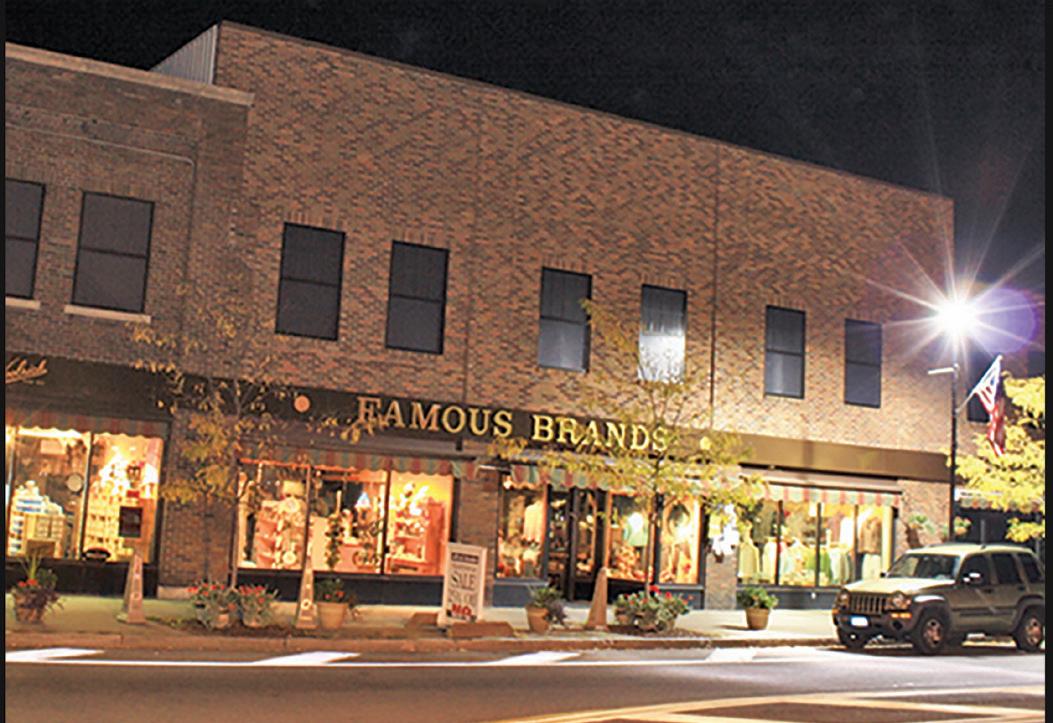
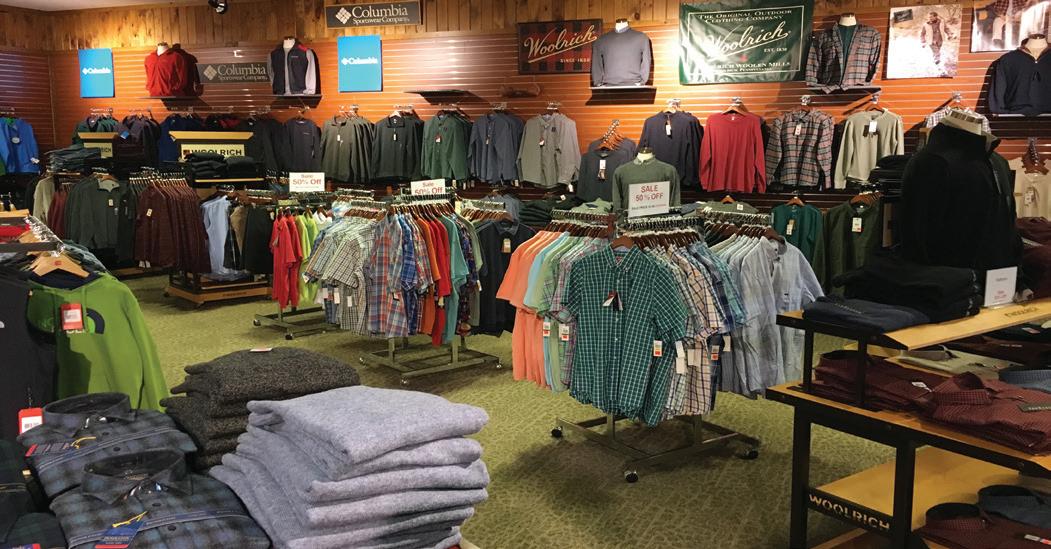
Famous Brands began in 1983, offering “famous brand” clothing and footwear at below retail prices. Since that humble beginning in a tiny storefront, we have grown to 30,000 sq. ft. covering 3 floors and half a city block, becoming a destination store for millions of visitors and locals alike.
Quickly we were swallowed by green. The stone-dust trail was clear but around us was thick marshland. The foliage held back the wind. A hawk—Cooper’s, we think—swooped down over our heads right before we saw the sign for the Bishop Nature Preserve owned by the Finger Lakes Land Trust. Turns out cyclists and walkers can park at the entrance on West River Road and ride the Yellow Trail to connect with the Canal Trail. (The other Preserve trails are for walking only.) On we pedaled. I caught sight of an oriole in the bushes.

Famous Brands began in 1983, offering “famous brand” clothing and footwear at below retail prices. Since that humble beginning in a tiny storefront, we have grown to 30,000 sq. ft. covering 3 floors and half a
Soon we could see the canal on our left. I imagine the personality of the trail changes by season as the leaves fill out and then drop. Farm fields were off to the right, usually behind trees. Peace was everywhere. We passed a whimsical garden of flowers, succulents, random figurines, and found objects displayed creatively along the trail. The bridge was halfway in, and while one side had a hole (marked by a plant growing up through it), it was easily traversed by foot or bicycle traffic. Not too much farther a critter sitting on the trail ahead made me squint. Facing away from us, it looked like a sandy-colored cat. As we approached it stood up and the bushy tail with white tip told a different story. I’d never seen a fox that color, but later confirmed that red foxes do have naturally occurring pale morphs.
The eastern end of the trail spat us out in a parking lot. Those starting from this point, the very end of Huff Street, will have no trouble finding the trail. We rode past to where Lock 4 loomed. It’d be an easy ride into the town of Waterloo for food, but after admiring the lock from the bridge (no boats, alas), we retraced our pedal strokes back. The whole trip for us was about sixteen miles, but we did some extra pedaling in the marina and checking out the Lakefront Park tunnel connector into downtown. According to our GPS, the Canal Trail, starting from Maintenance Lane, was about five miles. (The best canal trail map can be found at gofingerlakes.org.) The Geneva/Seneca Lake State Park Lakefront Trail from Long Pier to the Canal Trail was 2.3. That puts it in the fourteen to fifteen-mile round trip range.
Hot and tired, we changed in the bathrooms and headed back to Watkins Glen to get some of our two-hour drive done before dinner. After a cocktail at J.R. Dill Wine Bar, we crossed the main drag to Graft Wine + Cider Bar, which never disappoints. The entire excursion had been unrushed with a mix of majestic wide-open lake views and intimate paths with more wildlife than people sightings, and even with dinner we were home before dark.
Another gift of summer.










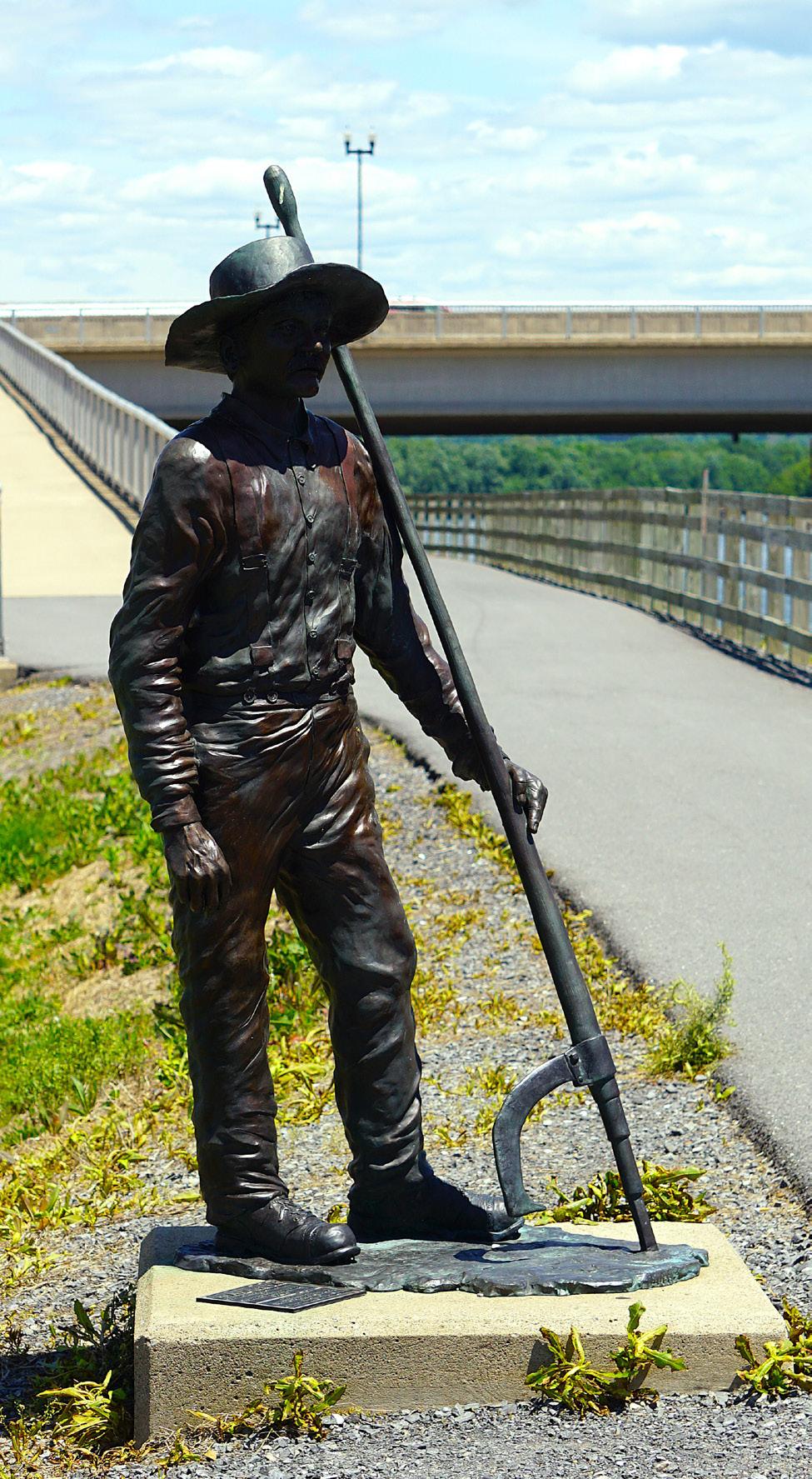
The Wood Hick on the Timber Trail takes a welldeserved rest and watches happy folks go by, sometimes on those new-fangled bicycles.
By Chris Espenshade
Communities along the Susquehanna River and other major rivers often have a love-hate relationship with their levees. Yes, the levee system limits damage from the increasingly common high-water events. But, that flood protection comes with a price as the earthen dikes often isolate the river from the citizens, severing a relationship at the historic core of many boroughs and cities. With the creation of the Susquehanna River Walk and Timber Trail, the communities of Williamsport and South Williamsport have transformed the levees to encourage folks to get back to the river and to educate them on the historic role the Susquehanna played in establishing Williamsport as the Lumber Capital of the World.
The trail is paved with asphalt, making it suitable for all types of bicycles, as well as
wheelchairs. This is a mixed-use trail, with hikers, dog walkers, runners, bikers, e-bikers, and birders sharing the space. The SRWTT also provides fishing access, an activity that tends to be focused near the dam. The topography is basically flat, with most of the trail constructed atop the levees. The bridge crossings are barrierprotected, dedicated bike/pedestrian lanes. The SRWTT is designed with safety in mind, and it is extremely family friendly.
The SRWTT includes a three-mile loop defined by the north levee, the Market Street Bridge, the south levee, and the Maynard Street Bridge. Parking on this loop is available from Exit 27B, aka Hepburn Street. On the north side, an extension runs east to the car park at Water Tower Square (1000 Commerce Park Drive). Similarly, on the south side, an exten-
sion runs east to the parking area at the South Williamsport Dog Park.
The SRWTT provides excellent views of the river and the adjacent communities that owe their existence to the Susquehanna. The Williamsport Dam, which is located in the center of the loop, is recognized as a key birding destination for the area. The two bridges are prime locations for photography opportunities.
The trail users on a recent Sunday afternoon included first-time visitors and folks who routinely enjoy the infrastructure. A family of four said they travel thirty minutes from home a few times a year to walk the trail.
One man on the north side reported he was out there two days a week. He noted that, despite some traffic noise from Route 220, “it is very peaceful.”
A young couple said they had already been on the trail five or six times during the spring. When asked their impression, they replied simply, “beautiful.”
A local grandmother, mother, and daughter were relatively new users. “We love it,” they said. “It is a great place to relax, walk, clear your mind.” The somewhat shy daughter nodded her head vigorously when asked if she liked the trail.
The timber history is presented in a number of informative placards placed along the SRWTT. A bronze statue known as the Wood Hick commemorates the brave, hardworking men who risked their lives to wrangle the logs.
The timber industry in Williamsport began in the early nineteenth century, as huge rafts of logs were floated down the Susquehanna from upstream forests. Each log was marked before floating to indicate its destination among the many mills of Williamsport and South Williamsport. A system of booms corralled the logs, which were sorted into smaller rafts for each mill. Between 1862 and 1898, forty million logs were landed here. These logs were processed, and the finished product, lumber destined for all kinds of projects, was then distributed by rail and canal boat. The
West Branch Canal was completed to Williamsport in 1834.
In the second half of the nineteenth century, Williamsport earned the Lumber Capital of the World moniker. The terms timber and lumber are interchangeable, both meaning the processed boards. Between 1861 and 1891, 5.5 million board feet of lumber were produced in Lycoming County. The lumber barons made money almost faster than they could count it, and Williamsport at one time boasted the most millionaires per capita of any place in the world. The many surviving nineteenth-century era Victorian mansions of the Millionaires Row Historic District stand as testament to the former wealth in Williamsport and South Williamsport.
Today, trail users can complete their outings at any of the many businesses on either side of the river. Ice cream, diverse restaurant offerings, and micro-breweries are all within a five-minute drive of SRWTT. The trail combines the natural beauty of the Susquehanna with the convenience of near-city setting.
The SRWTT is one element of the Susquehanna Greenway, a system of canoe launches, hiking trails, and river towns located along the West Branch of the Susquehanna,

the North Branch of the Susquehanna, and the main trunk of the river below the confluence of the two branches. The Susquehanna Greenway extends from the New York border to the Maryland border. The mission is “linking people to the river’s natural beauty, cultural heritage, and vibrant river towns.” Susquehannagreenway.org includes interactive maps of outdoor recreation infrastructure and outdoor recreation businesses.
The clean, smooth, family-friendly trail offers the chance to experience the nature and history of the Susquehanna up close. The SRWTT is a fitting celebration of the river and its role in local history. It is an excellent outdoor recreation resource for the residents, and the trail is worthy of a day trip for others in the region. And for the attendees of the Little League World Series, the SRWTT offers a peaceful break from the baseball madness.
Chris Espenshade is a professional archaeologist, an outdoor columnist, and a resident of Wellsboro. He is working to add wildlife photographer to his resume.






Halfway between Mansfield and Wellsboro, Chris and Chrissie Hume (left) water an oasis of plants ready to be taken home—while watering and feeding the community at their cafe. They are often assisted by their son Christoper and his wife Casey.
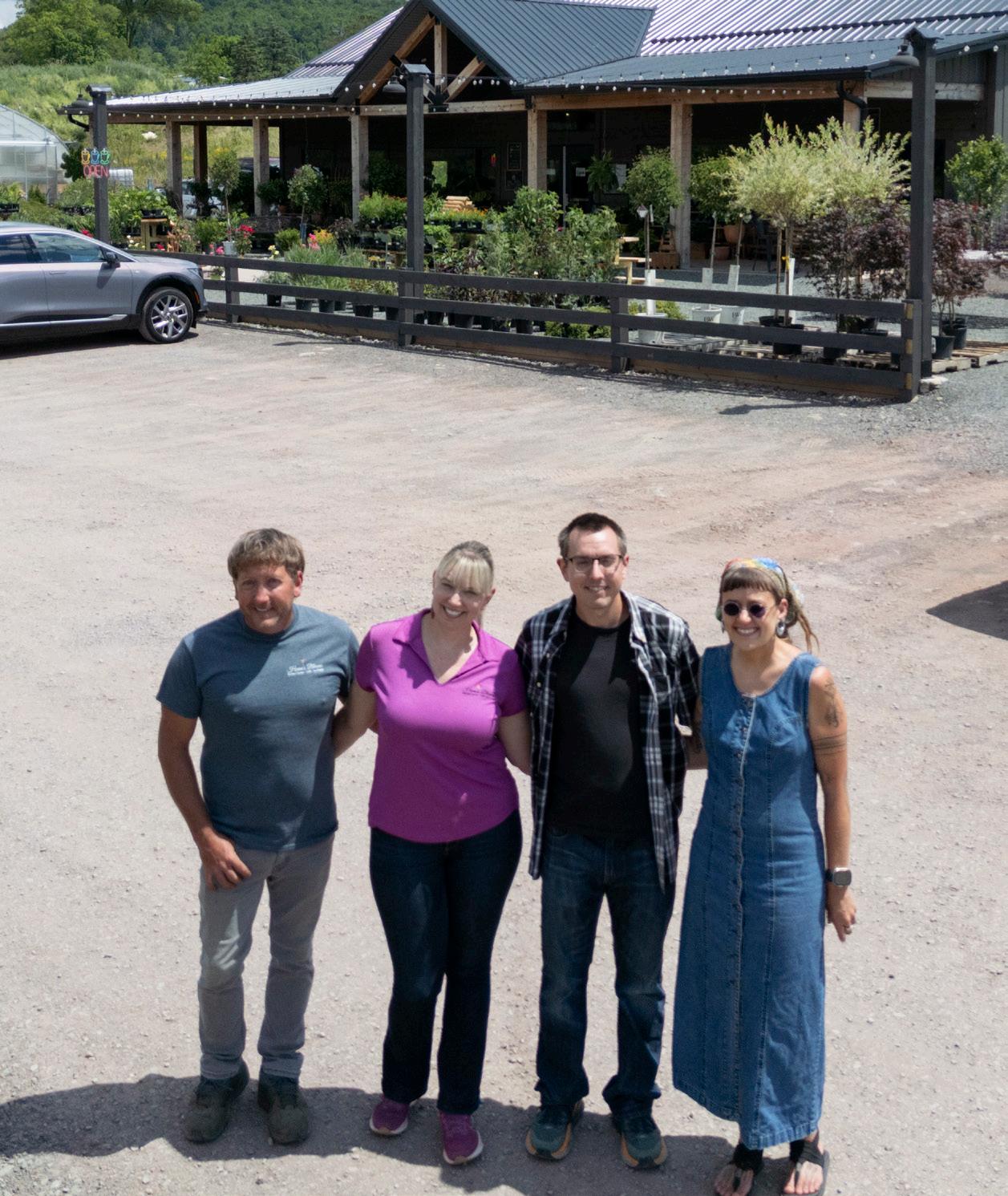
Chrissi Hume
By Carolyn Straniere
What do you get when you cross a garden center and nursery with a café that serves sandwiches, coffee, and ice cream? You get Hume’s Blooms! Conveniently located halfway between Mansfield and Wellsboro at 14282 Route 6, Hume’s Blooms is the vision of owners Chris and Chrissi Hume.
Both natives of Nauvoo, Chris and Chrissi have known each other since they were thirteen years old. They graduated from Liberty High School, got married, and eventually put down roots in Wellsboro. “We love Wellsboro and the surrounding communities,” says Chrissi with a smile. “This area has so much to offer, I don’t know if there’s any place we’d rather be.”
The seeds for landscaping were sown early in Chris’s life as his father, Ford, has been the owner of Hume’s Landscape Service for over forty-five years. At the age of nine, Chris could be found working alongside his dad, sweeping up mulch, or helping with Christmas trees and wreaths. From
there, Chris continued learning every aspect of the business, including landscape design, building stone walls, creating and installing one-of-a-kind patios, and using outdoor lighting for effect and function, all from the elder Hume (who, even though he attended Rutgers for his horticulture course, is mostly self-taught).
“I couldn’t have had a better teacher than my dad,” Chris explains, then continues, “A lot of his extensive knowledge was acquired by talking to others, working closely with plants, and reading a ton of books over the years.”
Because of the landscape business, the Humes kept a supply of plants and trees on hand to use for their various projects. Buried in the back of Chris’s mind were thoughts of a garden center.
“Chris came to me one day with the concept of opening our own nursery and garden center,” Chrissi explains. “I thought it was a great idea and our plans just grew and blossomed from there.”
From the start, they both agreed they wanted their spot to be more than just a place to buy plants. “Chris came up with the idea of having coffee available while customers shopped and looked around,” says Chrissi. They reached out to Thad Compton, owner of Conspiracy Coffee Company in Mansfield, who was happy to partner with them.
They still needed the land for their new venture, and that proved to be a bit of a thorn in their side. The Humes knew what they wanted and had to be patient until the right parcel was found. When the opportunity to purchase eleven acres halfway between Mansfield and Wellsboro presented itself, the couple didn’t hesitate. They purchased the property in May 2023; five months of red tape, securing permits, and paperwork followed.
Chris doesn’t beat around the bush when talking about the undeveloped tract of land. “We had our work cut out for us, that’s for sure,” he says with a sigh. Clearing
and grading the property took upwards of 195 hours with a bulldozer. They had to dig a well—no small feat but totally necessary, as a garden center is dependent on water for its business. The driveway took over 300 truckloads of fill. The greenhouse arrived in pieces, and Ford assisted in the assembling. The main building was constructed by Elvin Hostetter of Wellsboro, while Chris designed the layout of the grounds. Chris and Chrissi’s son, Christopher, and his wife, Casey, who live in Wellsboro, played a big part in getting many of the “unglamorous” behind-the-scenes jobs completed. “They ran electric in the rafters, helped with installing insulation and plumbing. And the beautiful artwork you see was done by Casey,” explains Chrissi. “We’re so grateful for all their help.”
In May of 2024, right before the busy spring buying season, Hume’s Blooms opened its doors. Fruit trees and ornamental shrubs mingled on the front patio while flowering plants and hanging baskets could be found on display in the greenhouse alongside perennials and vegetable plants.
The café and store would take another year before it was ready to welcome guests. It was worth the wait. Inside are a variety of houseplants, as well as all things garden-related adorning the shelves. Homemade pet treats, goat milk soaps and lotions, soy candles, and handcrafted jewelry are products from the many small, local businesses the Humes support.
Besides the array of coffee, lattes, and teas offered (they truly have something for everyone’s tastebuds), Chrissi took her love of cooking—she has a background in banking and food—to create the on-site café.
“We use the freshest ingredients we can. You won’t find anything that’s fried here,” Chrissi proudly shares. Sandwiches and panini on homemade breads, myriad salad options, and soups share the menu with yogurt and fruit parfaits, acai bowls, quiches, and bagel melts, while sweet treats are supplied by local bakers. Hume’s Blooms also entices with their daily food and drink specials, which reflect the seasons. (Try their Apple Blossom Grilled Cheese. You won’t regret it.)
Chris can be found in the garden center most days, taking care of the ever-changing nursery inventory. “We focus on plants native to our growing area,” Chris states, then quickly adds, “Well, native to the East Coast.” One of the services Hume’s Blooms provides is the planting of trees and shrubs upon request. In between, Chris stays busy landscaping, with design and hardscapes his specialty.
What’s on the horizon for Hume’s Blooms? “We’re always looking to add to our business,” Chrissi says. Upcoming plans include an observation bee hive (from Draper’s Super Bee), and a play area.
The Humes invite customers to gather some friends, relax in their comfortable chairs, and stop and smell the roses (and ask about how to grow them) Monday through Friday 7 a.m. to 7 p.m., Saturday 8 a.m. to 7 p.m., and Sunday 9 a.m. to 6 p.m. Follow them on Facebook at Hume’s Blooms or call (272) 462-5042.
Born in the Bronx, Carolyn Straniere grew up in northern New Jersey and has called Wellsboro home for over twenty-eight years. She enjoys spending time with her eleven grandchildren and traveling whenever she can. Carolyn lives with her four-legged wild child, Jersey, and dreams of living on the beach in Italy in her old age.


space where families can enjoy music.


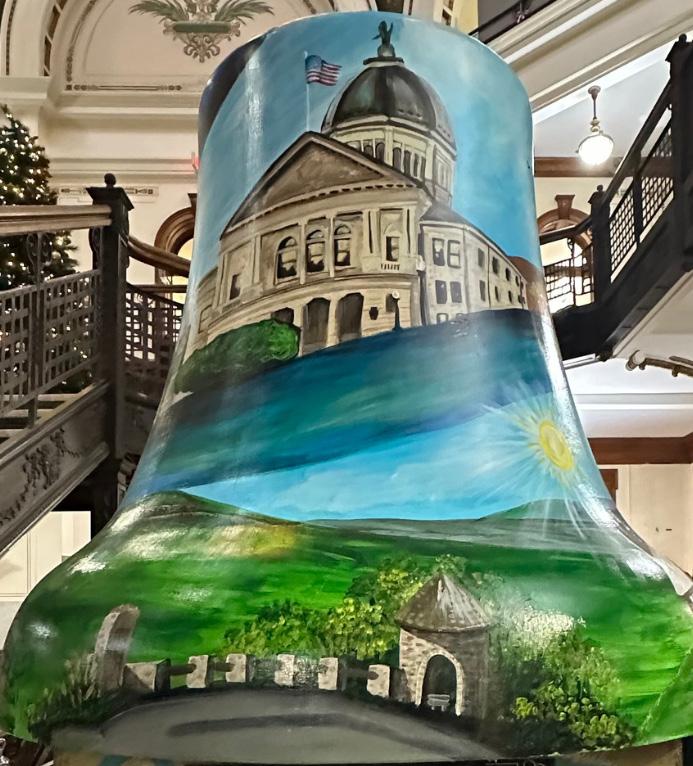
Art of Freedom
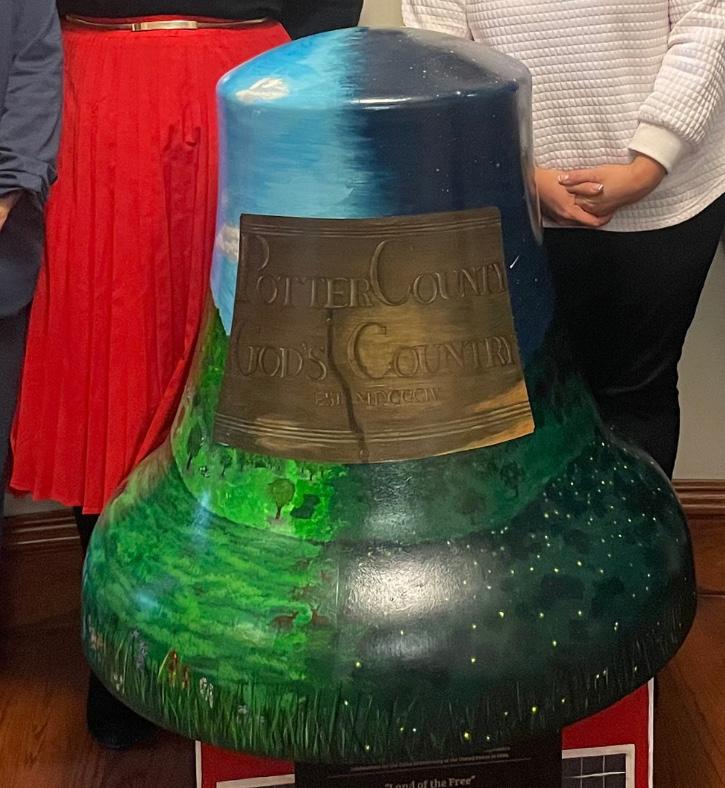
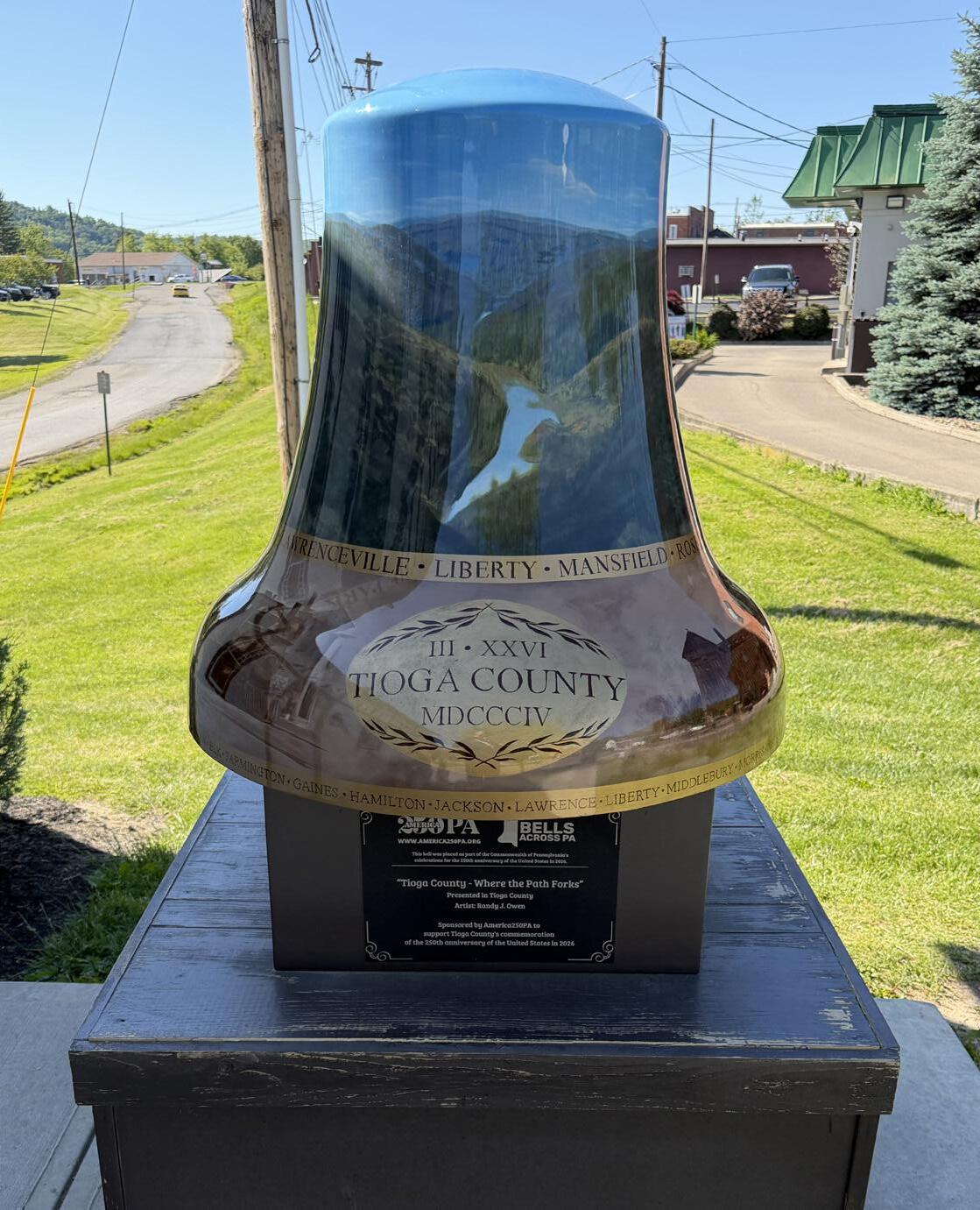
The Towanda Courthouse (left) displays a Bradford County Liberty Bell designed by Shauna Case, and the Tioga County bell designed by Randy Owen is on display outside the Smythe Park Gatehouse in Mansfield.
By Maggie Barnes
When you are the center of liberty in America, the place where the concept of a new nation was hammered out and launched, you have earned a front row seat to that nation’s 250th birthday. Pennsylvania is the marquee state in this year’s America250 celebration, and the evidence is hanging from any light pole and bandstand.
Which puts a bit of pressure on the local volunteer committees who have been planning what their counties will do to mark the occasion.
“It all started here,” says Henry Farley, who is Bradford County’s designated representative to the state. “Pennsylvania is where the whole idea of America began.” The committee’s goal is to produce events that will appeal to a wide range of audiences. They have been working on it for nearly three years.
Among the many facets of America’s rebellion against tyranny, the city of Philadelphia is home to several icons of our birth as a country. So, when you are Pennsylvania
and you want to honor that history, you must have the Liberty Bell.
More than 120 of them! As part of America250, replica bells, crafted from heavy duty fiberglass, were shipped to every county in the Commonwealth, along with an invitation to adorn the bell with whatever that county desired—scenes of the county, its industries, its people—a representation of the county’s population and its place in history.
Counties invited local artists to submit designs, and the Bradford County committee considered a range of different interpretations of what Bradford County is. An art teacher from Wyalusing, Shauna Case, sent in a concept to showcase the county’s natural beauty. A Bradford County native, Shauna included her students in the design process, using the program as a tool to educate kids about their local history.
The bell is three feet tall, three feet wide, and weighs seventy-five pounds, a tad lighter than the original bell’s 2,080 pounds. Shauna used that canvas to high-
light landmarks like the Susquehanna River, which is flowing up the bell, flanked by well known spots like the Wyalusing Rocks Overlook, the Marie Antoinette Overlook, the county courthouse, and the site of the Camptown Races.
Shauna included her family’s farm to represent the generations of farm families who have dedicated their lives to their communities and brought forth bounty from the rich soil and rolling hills. Once the bell was completed, Henry says there was another decision to make—where to place it. The committee wanted it to be somewhere accessible so as many folks as possible could admire it. They settled on the historic Bradford County courthouse, whose elegant design and fresco ceiling have encouraged countless visitors to stop and stare.
“When we were deciding where to place the bell in the courthouse, the guys from the county maintenance department came up with a novel idea,” Henry says. “They had recently felled a tree at Mt. Pis-
















gah County Park, and they got a cross section of the trunk from the park and used it for a base for the bell. It is so cool to walk into the courthouse and see our bell on a tree trunk that was very likely here in Bradford County 250 years ago.”
There is a plaque describing the scenes and what Shauna’s thoughts were during this unique creative project.
Neighboring Tioga County chose a different approach to its bell. Commissioner Sam Van Loon says he was impressed with the scope of the project.
“That’s a monumental undertaking to create, ship, decorate, and display these bells in every county. I think the state committee was wise to allow the counties full control of the designs. It really raised the level of enthusiasm.”






























Tioga chose Randy Owen, a local artist who has a full-time job with Tri-County Rural Electric Cooperative. He worked on the bell over many lunch hours. His depiction is meant to tell the story of Tioga County, featuring landmarks like its courthouse and the Pine Creek Gorge or “Pennsylvania Grand Canyon.” But it also pays homage to the industries that shaped the county, including logging and coal. The townships are all listed, and Sam says there are some “Easter eggs” for residents to find.
When it came time to display the bell, the county took a bold chance.
“I really wanted the bell to be accessible to everyone. I wanted it outside,” says Sam.
So, the artist safeguarded the bell, which is lightweight enough to move around for different events, with a few coats of a protectorate, similar to clear coating for cars, that will keep the rendering intact. As for the location, the committee settled on the historic Gatehouse at Smythe Park in Mansfield. (If you want a peek, the address is 54 South Main Street.)
The Liberty Bell Project is just one aspect of the America250 celebration in Bradford County. The calendar has been filled with events since last year’s Sayre Christmas Parade. Henry says they wanted substance over style.
“One of our committee goals for this year was not to have big parties but to tell our history in ways that would educate our population as creatively as possible. So far, I believe we are doing that.”
Education of young people has been a major part of the effort, demonstrating to kids that the place they live holds an honored spot in the nation’s history—from Sullivan’s March to decorating the graves of 400 Revolutionary War veterans buried here. Henry says the 250th birthday is the ideal time to encourage pride in Bradford County.
“There is so much history in this county. And evidence of it is everywhere. But people don’t see it, or don’t know what it is, so they don’t feel a connection to it. This is our chance to showcase all the important moments that happened here.”
Check out america250pa.org or visitpa.com/2026/bellsacross-pa for locations of all the bells across the Commonwealth.
Maggie Barnes has won several IRMA and Keystone Press awards. She lives in Waverly, New York.


































































By Maggie Barnes
“What the heck…?”
My eyes were still caked with morning dust, but I knew something was wrong. The house felt different, like something had happened that I had not actually witnessed. I shoved my feet in my slippers and went out to the living room. Then it was obvious.
“Someone hit a skunk?” I asked Bob, who was in his usual place on the couch.
“Yep!” He replied with a totally unnecessary level of enthusiasm.
I was about to ask how, as we live on a private road with three other families and the top speed up here is about 17 mph. How did someone manage to…
Then my brain finally entered the chat.
Where’s Rex? Our genuine all-American mutt was always up for morning wiggles and wags. But the house was silent. He was nowhere in sight. I spun back to the hallway and looked out the door. There he was, tied with his longest leash to the stair railing,
looking like the world’s most misunderstood creature.
They had been on their usual morning ramble through our woods when Rex leaped into the foliage. Bob called him off and a moment later a doe sprung out of the woods a little way up the path, so his assumption was Rex had smelled the deer. When Rex crashed back onto the trail, snuffling and snorting and tumbling face first into the ground, Bob knew the truth.
You’ve smelled skunk spray from a distance—it’s unmistakable. But when seventy-three pounds of fresh, concentrated skunk oil invades your home, it’s an olfactory experience that makes your nose turn in its resignation. We went through the drill: peroxide, baking soda, dish soap, suds him up, try to keep him from shaking for five minutes, into the shower for a major rinse, sacrifice a couple of towels. At some point, you do have to let him go, then watch as he dries himself on the bedroom carpet.
We thought we got most of it, but that’s the insidious thing about getting skunked. For a while it is better. We opened every window, shoved Rex out in the sunshine on the deck, and got back to the day. After a trip into town, I walked back into the house and fell back about three feet from the smell.
“Bobby, it reeks in here!”
He nodded. “It’s coming back stronger than before.”
For his part, Rex kept coming to us with a look that said he knew he did something wrong, but had no idea what, and just wanted us to love on him. I was petting him with one finger. It was heartbreaking. We needed advice. I turned to our groomer, Tami, who loves Rex nearly as much as we do and who brings forth from him such good behavior it makes me jealous of her power. I texted, described the morning, and begged for assistance.
Hit him again with the peroxide mixture, she said, then deploy the secret weapon.
“Vagisil.”
I read the word four times but could not comprehend what she meant to say because, clearly, she was not advocating using a feminine product on my stinking dog. Right?
“People swear by it,” she asserted.
No way, I thought. Then Rex pawed at the deck door and trained his soulful brown eyes directly on my heart. He just wanted to be with his humans.
I’d do anything.
At the drugstore, I visited a familiar aisle with an entirely different purpose. Vagisil comes in two formulas and one large size. I had “PH Balance” in one hand and “Odor Block” in the other. Forgive me, Rex, but your PH is on its own. We need serious odor blocking. I loaded three bottles into the basket, added three more large containers of peroxide, and lugged it to the checkout. When I finished thumping the six bottles on the counter, the cashier’s eyebrows leapt into next week. Her jaw sort of shifted around as she fought what must have been a tidal wave of curiosity.
She fixed her face, smiled, and said, “Cleanliness is next to Godliness!”
Good Lord…she must think I’m going to load a pressure washer and attend to my nether region.
“Oh no…this isn’t…I don’t…I mean, it’s not that big…not like my doctor needs a head lamp or anything…it’s just…actually, it’s for my dog.”
Her face turned inside out, and I tried to talk myself out of what I talked myself into.
“He got skunked.”
She landed back to Earth but still picked up the cheerful pink bottle of Vagisil and looked at me again. I shrugged.
“Our groomer recommended it.”
A male voice chirped into my ear, lifting me out of my shoes.
“Our vet swears by it!”
I glanced back at a jovial-looking chap in line behind me who, obviously, had overheard the whole exchange. So now there’re two people in the Valley who don’t think I’m a weirdo.
Rex was distressed about his command performance in the driveway, complete with buckets and more doomed towels. At the appropriate moment, I opened the pink bottle and handed it to Bob, who looked at me skeptically and asked, “How do I…?”
“Just dump it on him and rub it in,” I replied with a confidence I did not feel. “I’ve never done this at this volume.”
There are facts in this world that do not make sense. We call them jumbo shrimp. We drive on a parkway and park in the driveway. It’s faster to go through Canada than Michigan. That half cup of milk becomes half a gallon when you spill it. And a feminine cleansing product that has been around for fifty-two years will make your skunky dog smell better.
It wasn’t gone altogether, but we allowed him back into the house and the whole family watched a movie without our eyes watering.
We’ve got two more bottles of the magic elixir. I know who to borrow from if I need it.
Maggie Barnes has won several IRMA and Keystone Press awards. She lives in Waverly, New York.




By Lilace Mellin Guignard
We do not go to the green woods and crystal waters to rough it, we go to smooth it. We get it rough enough at home… George Washington Sears, aka Nessmuk, in Woodcraft (1884)
Now that the Pine Creek Rail Trail extends right into Wellsboro, the Pine Creek Gorge (which, like George Washington Sears, has a pseudonym: the Pennsylvania Grand Canyon) is more accessible. Nessmuk wrote about planning camping trips for the average American—“the world’s workers”—of his time, “who go, or would like to go, every summer to the woods. And to these I would say, don’t rough it; make it smooth, as restful and pleasurable as you can.” In that spirit, let me share a great way to smooth it overnight on Pine Creek.
For our twenty-sixth anniversary, I devised a way to celebrate that would honor my groom’s love of cycling, my love of camping, and our shared devotion to good food and drink. Now, Jimmy and I could haul all our
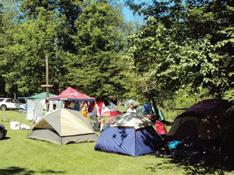
gear and tent camp, but that would be roughing it. We wanted the comfort of a hotel with the view and the fresh air of camping—and glamping at Pettecote Junction Campground at Cedar Run, about mid-trail, offers just that. There is a two-night minimum—be grateful for that, as you are saved from rushing back to the rough world of responsibilities for another twenty-four hours.
We organized our own shuttle (from our house in Wellsboro—two cars down, one car back home to where our bikes waited), I packed a cooler full of beverages and snacks, then loaded our bags of clothes, books, and towels in the car (only bed linens are provided). We got a later start than we wanted, getting us on the trail during the hottest part of the day. It was high seventies, a bit warm in the sun, but it did make me appreciate the headwind. Recently we’d had lots of rain, so I zipped my complainer hole shut.
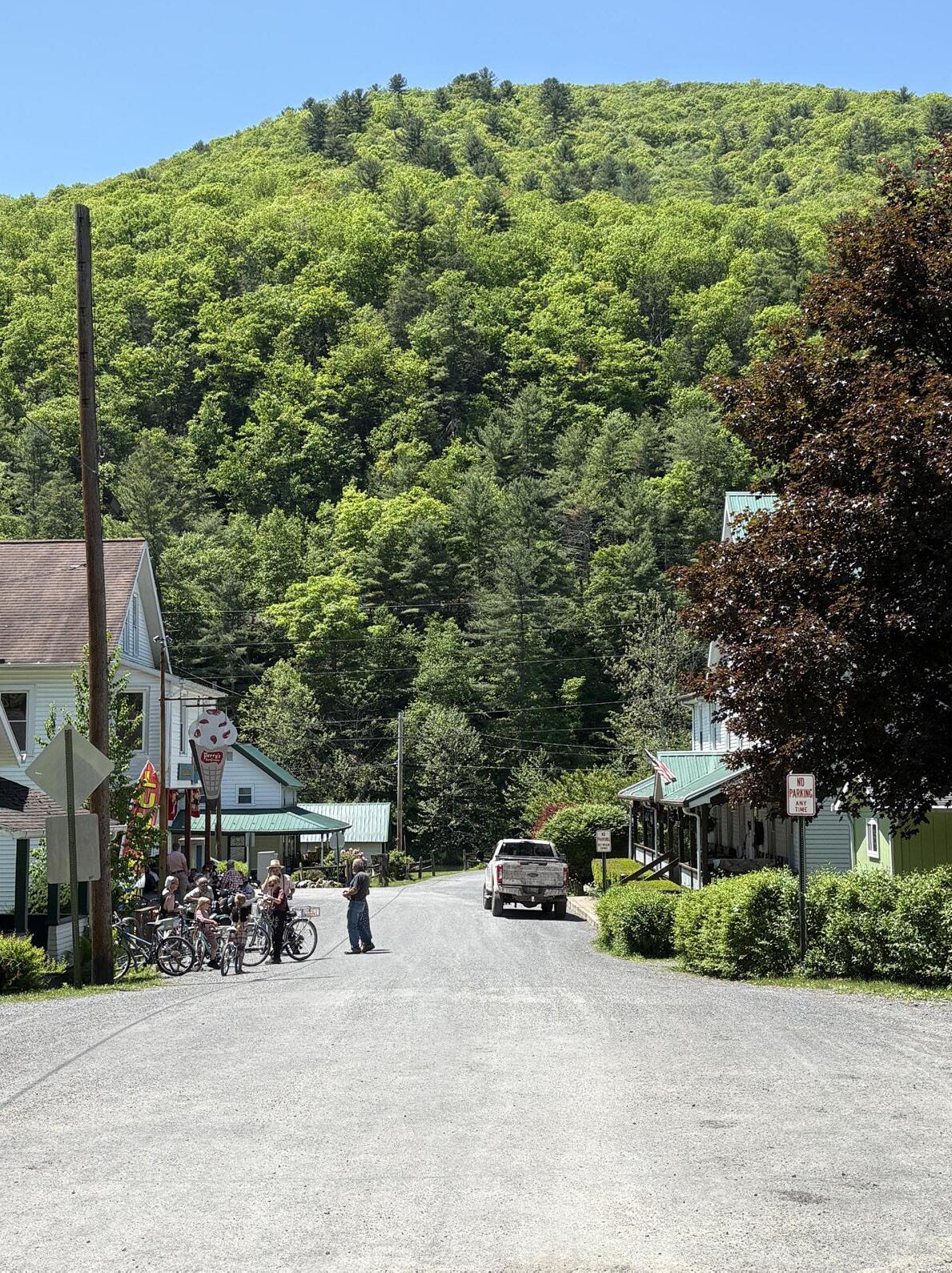
At Blackwell, I detoured up the road to Miller’s General Store for an ice cream bar. One year when our kids were younger, we’d
rented a cabin from the Millers. Reminiscing about that and other past trips, we pedaled the four more miles to the campground.
Jimmy said we’d ridden 32.4 miles and needed to make it an even 33, so we passed the campground entrance and went through the village. Life is slow in Cedar Run. The camp store is the only place that will take cards, so bring cash or check for the store and Cedar Run Inn. Oh, and you must make a reservation at the Inn. Riding through the town (one whole block) to the campground, it’s like you’ve entered another dimension. The lack of cell service feels like a haze lifting from your brain. The campground has unreliable Wi-Fi and warns visitors not to expect to stream videos. They also warn that your RV GPS will not get you there. It’s like the village of Three Pines in the Louise Penny mysteries, but better because it really exists.
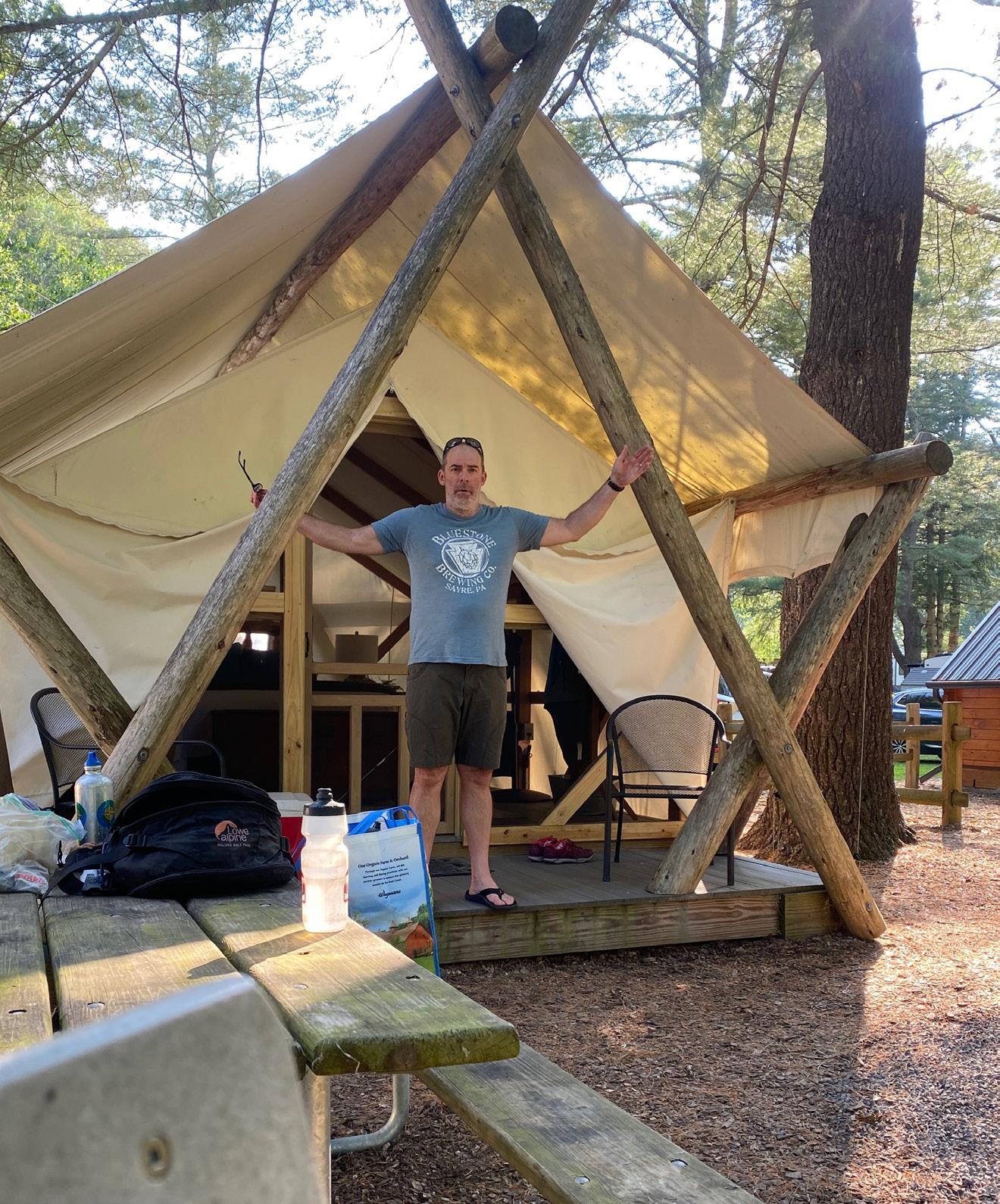
After checking in, I walk around the large canvas safari-style tent sitting on a platform to find in the front a covered deck with two











Smoothing continued from page 32


Kevin Fishburn - Water Feature Specialist (570) 439-4840
Ponds, Water Gardens, Fountains, Pondless Waterfalls

• Custom Moldings to match your project (radius moldings availble)
• Stair Construction including balusters and handrails
• Cabinetry (custom kitchen, vanity, and more
• Custom Doors
• Solid Wood Tops to match your decor
• Log Siding and Clapboard Siding
• Hardwood Lumber for sale Stop in and visit us today!
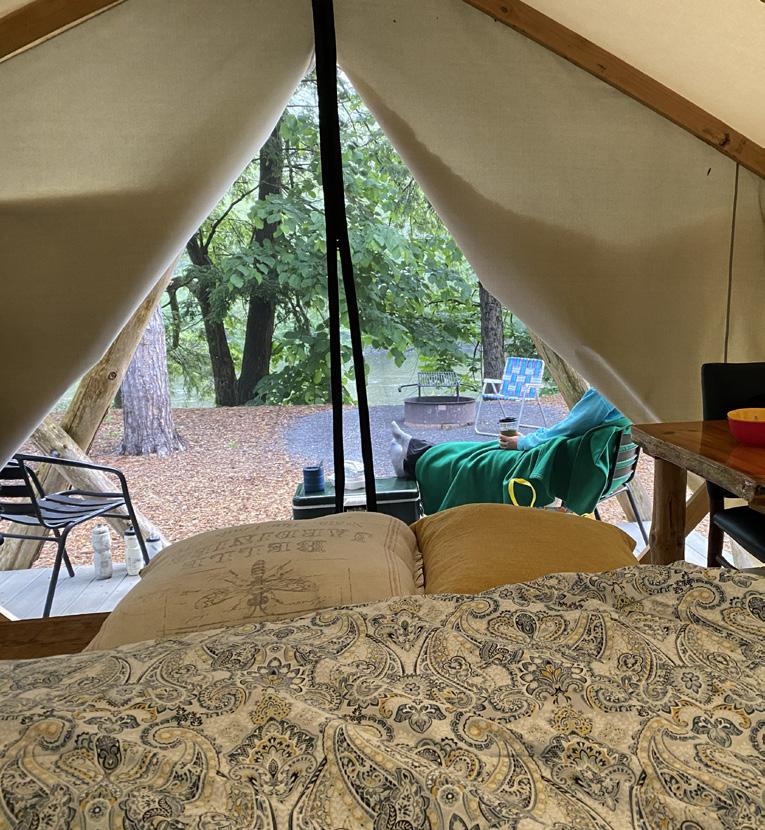
chairs facing the creek. The tents are so well laid out, we could leave the front flaps tied back all night (there’s a bug screen) and not worry about privacy. Inside, a fan and heater provide comfort no matter the season, as does the lush queen size bed with extra pillows and blankets in a trunk. A small table with coffee maker is the extra touch of luxury for this girl used to hiding in her sleeping bag until someone else gets up to make the camp coffee.
We enjoy the showers (three minutes for a quarter, good pressure, and the temperature is adjustable), then opt to eat from our cooler rather than leave our creekside view. Because of our late arrival, the store was closed, but their ice cream and sandwiches are great whether you are pedaling through or staying in the village. Another food option is the Hotel Manor about six miles farther south on the trail in Slate Run. Their large deck and dog-friendly picnic tables on the grass make this a favorite stop of ours (even when not cycling). We spend the evening watching the mergansers ferry bank to bank on the high water as the sun closes its eye for the night.
“Happy toothbrush anniversary!” I crow the next morning, bestowing Jimmy with a new toothbrush from the camp store. He’d forgotten his, so the night before I’d let him use mine. That’s marriage. We’d slept in till 8:25 a.m.—late for us. Quiet hours are 10 p.m. to 8 a.m., and it’s obvious the owners enforce this.
Today we have options about when and how far to ride. Our only scheduled event is a 6 p.m. dinner at the Cedar Run Inn. I make instant oatmeal using the Keurig machine. Then we ride as far as we want, which turns out to be eight miles before turning around at Black Walnut Bottom. (I feel like I’m sitting on two walnuts by then. Jimmy’s bottom is already conditioned. These rides are like rest days for him. Whatever. I can out-paddle him. As in boating.)
Jimmy doesn’t want to eat while sitting in a wet chammy, so we pass on Hotel Manor and instead get the Famous Italian subs at Wolfe’s General Store in Slate Run, which we enjoy back at our tent. I change quickly and am halfway done before Jimmy is back from his shower. An eagle swoops over the water. We read and nap. Across the creek a doe huffs and her fawn wails back. Life is excellent.
Later, we walk the road to Cedar Run Inn, passing people on benches watching eagles and the fishermen. We are clean, but not fancy. The Inn is sentimental and dear, like a favorite grandmother. Being early, we start at the bar where Kevin takes excellent care of us. Our server is Emily, a nurse who is married to the chef, Shaun, whose parents own the place. I order the lobster bisque, then scallops in a cantaloupe and grape sauce. Delicate and divine. Jimmy also gets the bisque but with a very rare Delmonico, accompanied by scallions, mushrooms, and a Madeira wine sauce. He is in heaven. Just as we think we’re too full for dessert, Emily brings out a big scoop of vanilla ice cream with an anniversary candle, and, yes, people clap, and, yes, we blow it out together. Ah, old love!


Since we were walking back to the tent, we decide to rejoin Kevin at the bar, and soon Shaun wanders in to pour himself a gin and tonic. We listen to tales of life in Cedar Run, staring into each other’s eyes, thinking we really have something special here.
I mean twenty-six years of us, obviously, but also the portal to the many special places in Pine Creek Valley that’s now just a few blocks from our house.
By CaPrIOTTI PrOPerties
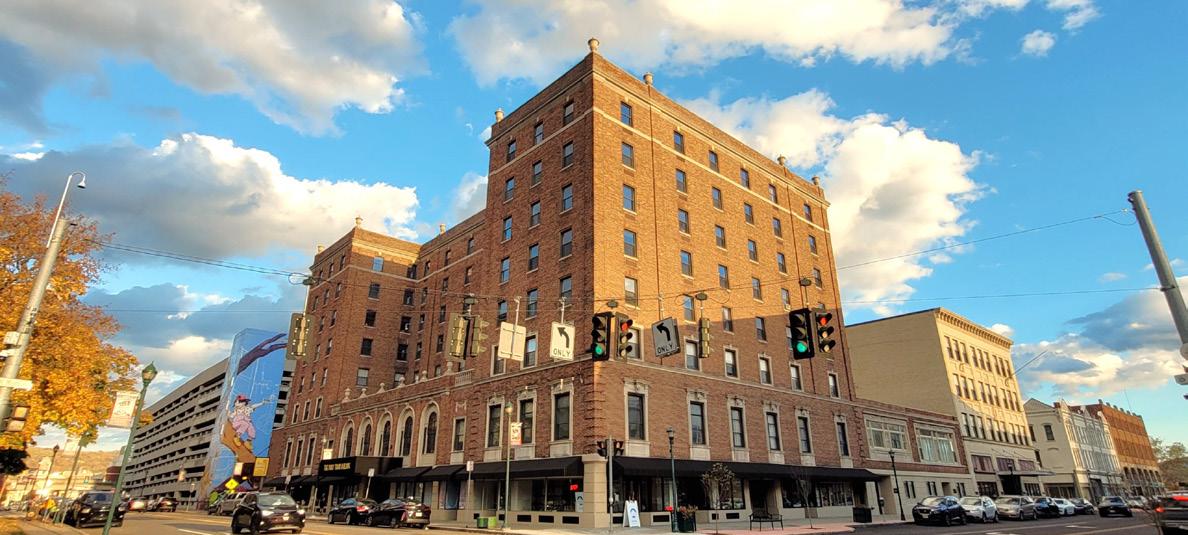
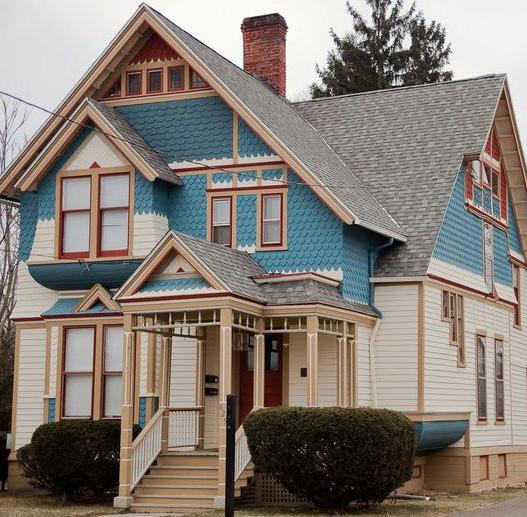
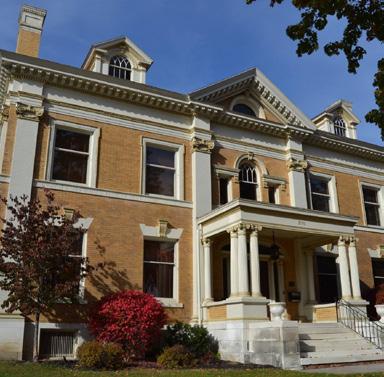
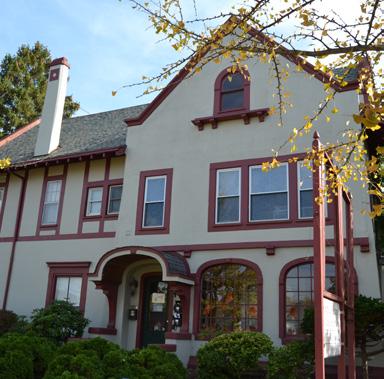
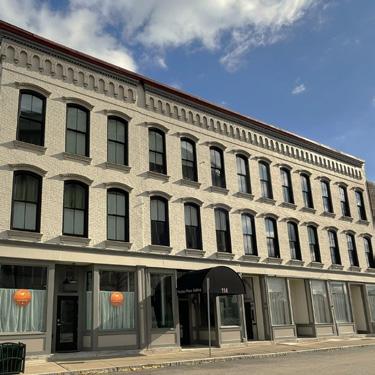
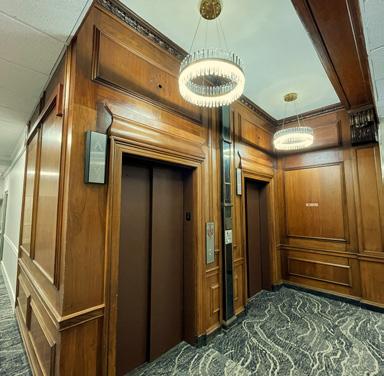



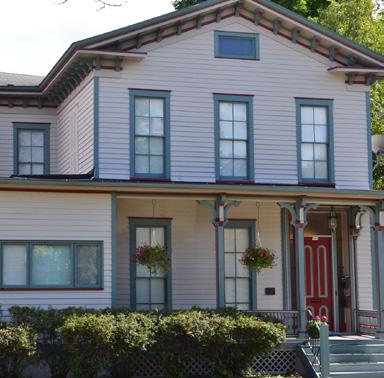
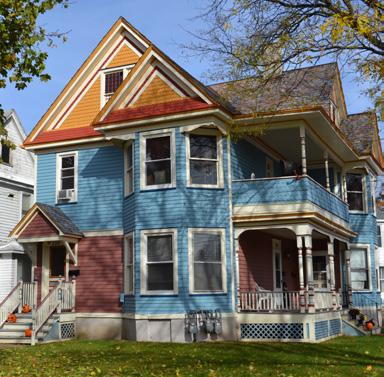
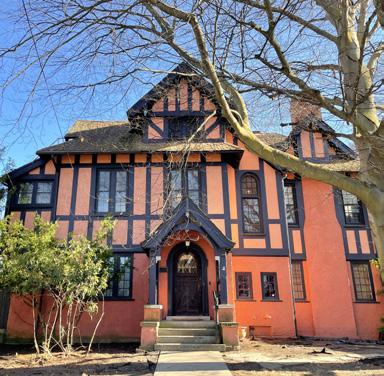
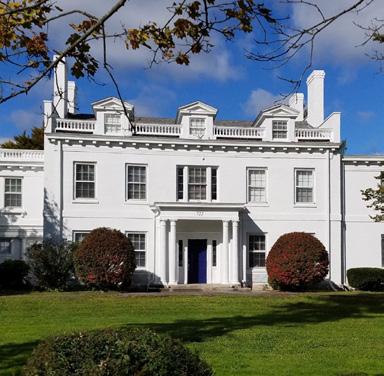






serves as a gateway to town and the rail trail. Marc adds that former US Senator Bob Casey, PA Senator Gene Yaw, and PA Representative Clint Owlett were also big supporters, a sign that the Commonwealth takes rail trails seriously. Marc and Shane agreed that the PCRTE was truly a community project.
There weren’t always agreements. At first, Shane balked at the Patterson Trailhead building, because he couldn’t see how it would benefit the whole county. But there were Act 13 impact fees that were instrumental in providing local matching funds. Develop Tioga had expressed an interest early-on in moving into the building. When Shane heard that, he changed his mind.
The work culminated in the Pine Creek Rail Trail being named the 2026 Trail of the Year by Pennsylvania’s Department of Conservation and Natural Resources. Celebrations will be held on September 25, 2026, in Wellsboro and Mansfield.
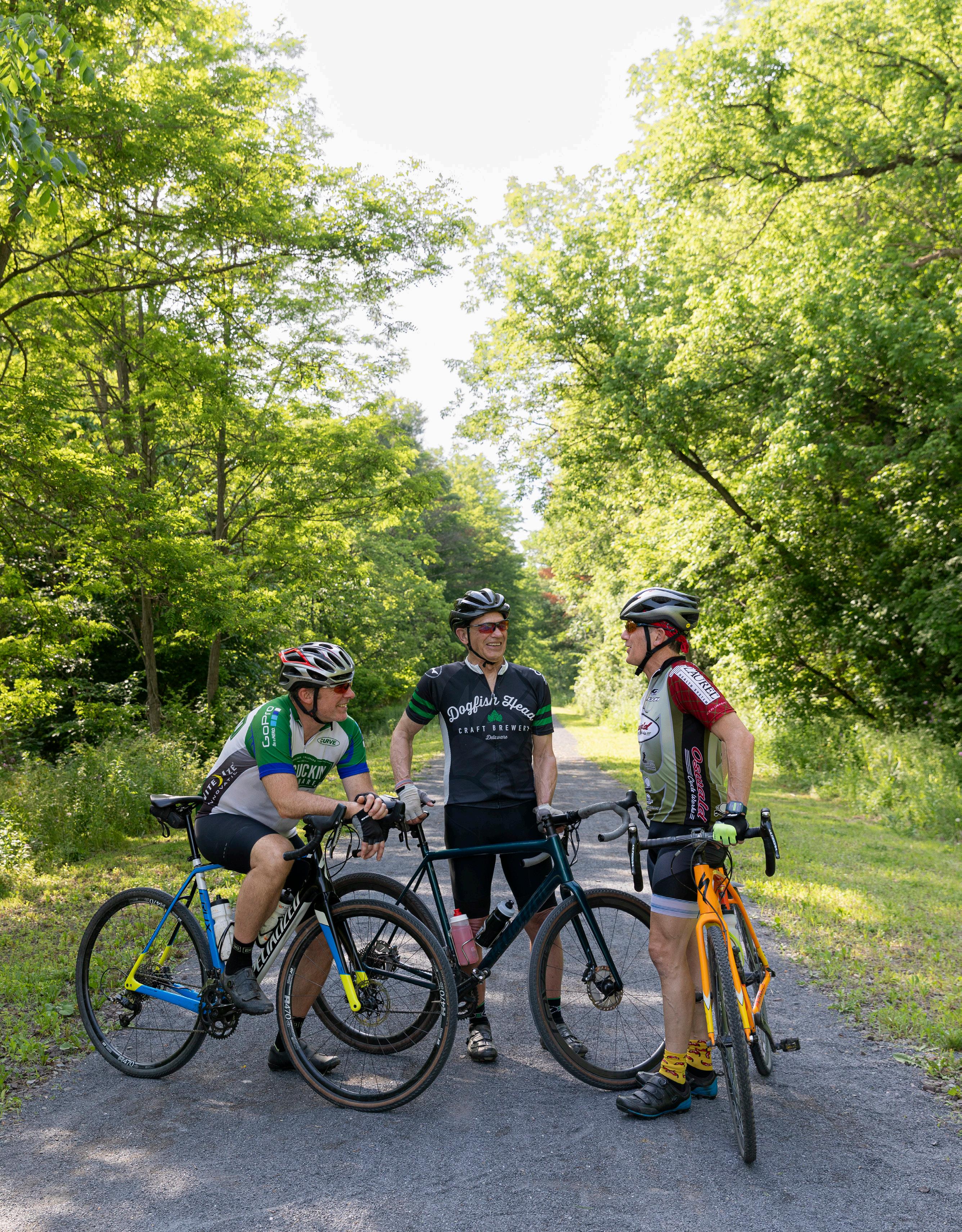
But you can celebrate before that. Curt Schramm, owner of CS Sports in Wellsboro, is thrilled the PCRTE opened. He says cyclists come in after hearing about the Pine Creek Rail Trail while down on the Great Allegheny Passage Trail. His shop is busier with repairs and such, and he expects more people to use the extension because “a lot still don’t know the trail extension is open.” Every cyclist he talks to gives the rail trail “two thumbs up.”

Or raise a glass post-ride at the Wellsboro House, across from the Patterson Trailhead and playground. Owner Chris Kozuhowski knows hydration helps stories flow, and beer brewed in the old train station carries extra mojo. Chris says opening the extension “benefits the community,” and he plans to open a tasting room with a “focus on family.” (Parenting is hard. Have to stay hydrated for that, too!) If beer, wine, or cider is not your thing, maybe raise a glass of rye—what Nessmuk called “the liquid cereal”—to celebrate the trail. Wellsboro House’s beer works, too, if that’s more your thing. (Just not on the trail. That’s illegal.) And remember that you're a hop, skip, and pedal from all that downtown has to offer.
On page one of Woodcraft and Camping, Nessmuk writes: “It is an age of hurry and worry.” He speaks of the 1880s, when Wellsboro and the surrounding region was an industrial powerhouse rapidly becoming a wasteland. But, even though we have trees and clean streams again, the hurry and worry has not subsided. Now, a few steps or pedal strokes on the trail offers a remedy.
I pedal down the trail, past Stokesdale, looking north toward the mountains above Asaph and the former celery fields around Muck Road. I expect to see Linda pop out of the trees at any moment, camera in hand. I think back to that map on the garage window and all the conversations before and after. My own struggles. I can almost hear the murmur of the conversations in the buzz where my tires meet gravel, inviting people outside to escape hurry and worry.
You’re following Nessmuk’s tracks, and those people and machines before and after him. Progress, the way it should be. Forward, but still connected to the past.
orn in North Carolina, Jimmy Guignard teaches at Commonwealth University-Mansfield and tries to keep up with his family. Northcentral Pennsylvania reminds him of the North Carolina mountains, though with more bears and bald eagles and fewer barbecue joints.

















By Peter Kutbay
This picture was taken approximately twenty minutes before the Pennsylvania State Laurel Festival parade began, just after the flag had been raised. This is a yearly effort by Wellsboro Boy Scouts and their leaders, along with Treemaster LLC and their boom trucks, executed as thousands of people watch the pre-parade show. When the sun came out, the wind gently lifted the flag, creating a Wellsboro Laurel Festival sight truly worth America’s 250th birthday!








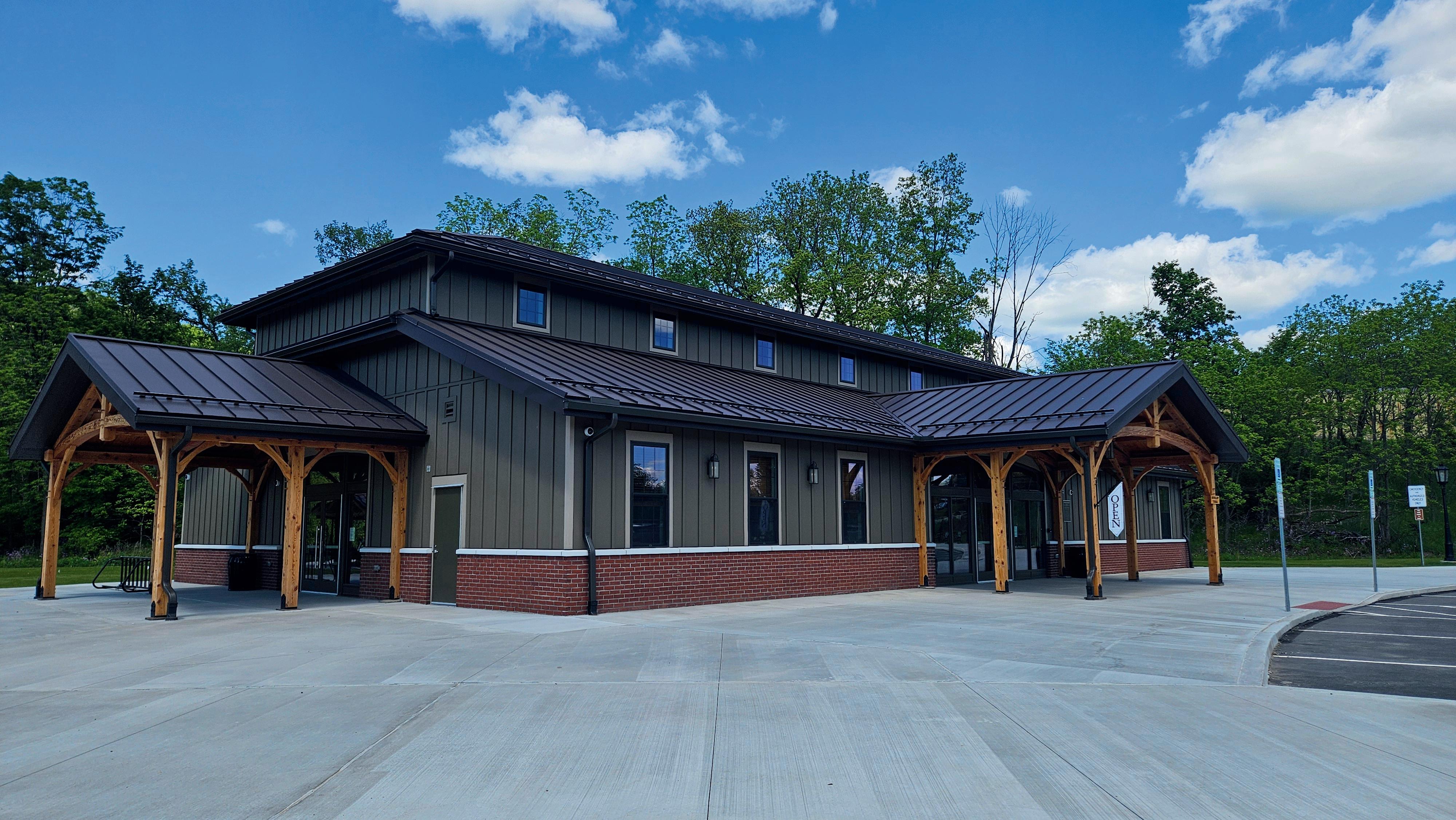
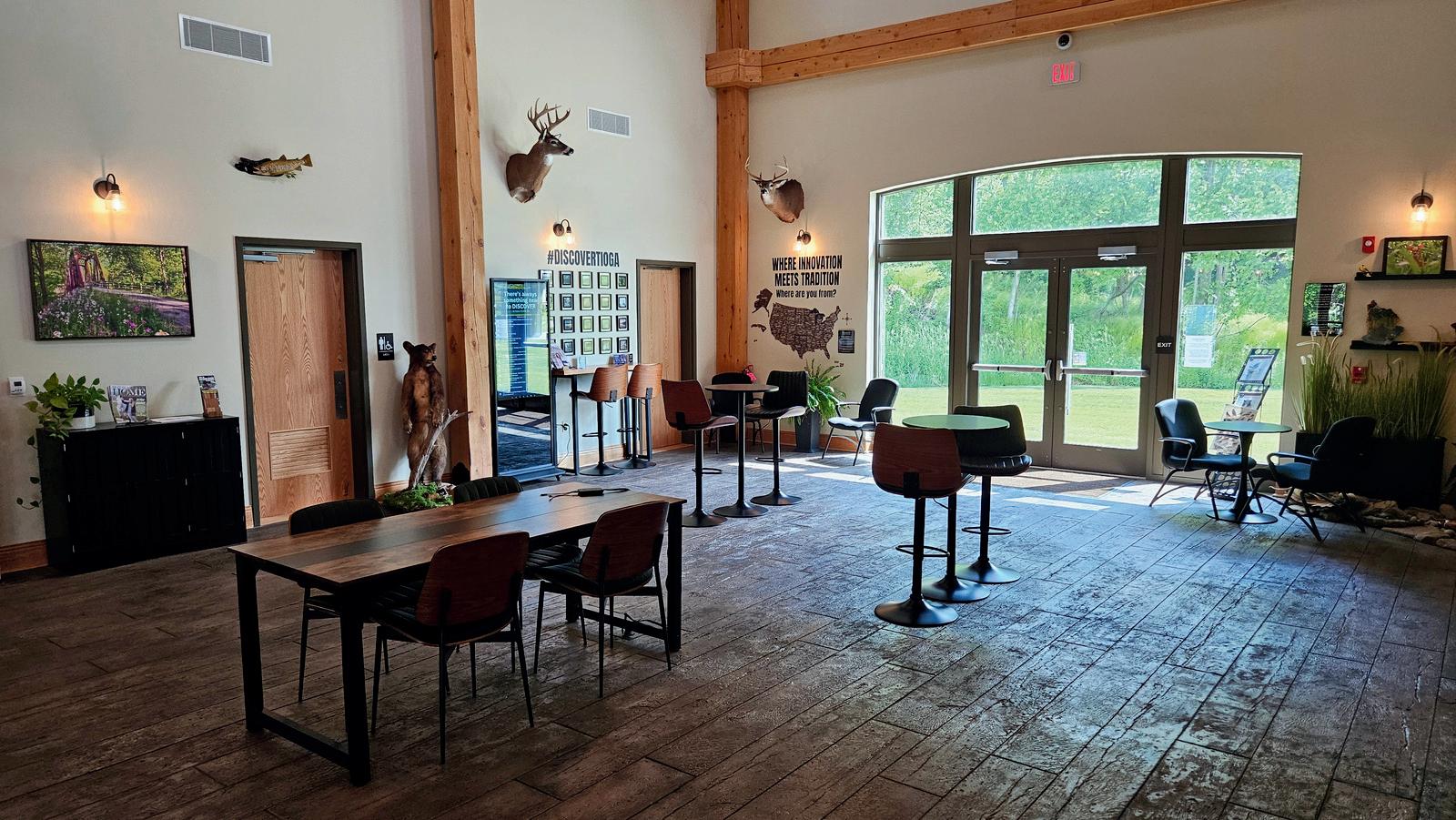
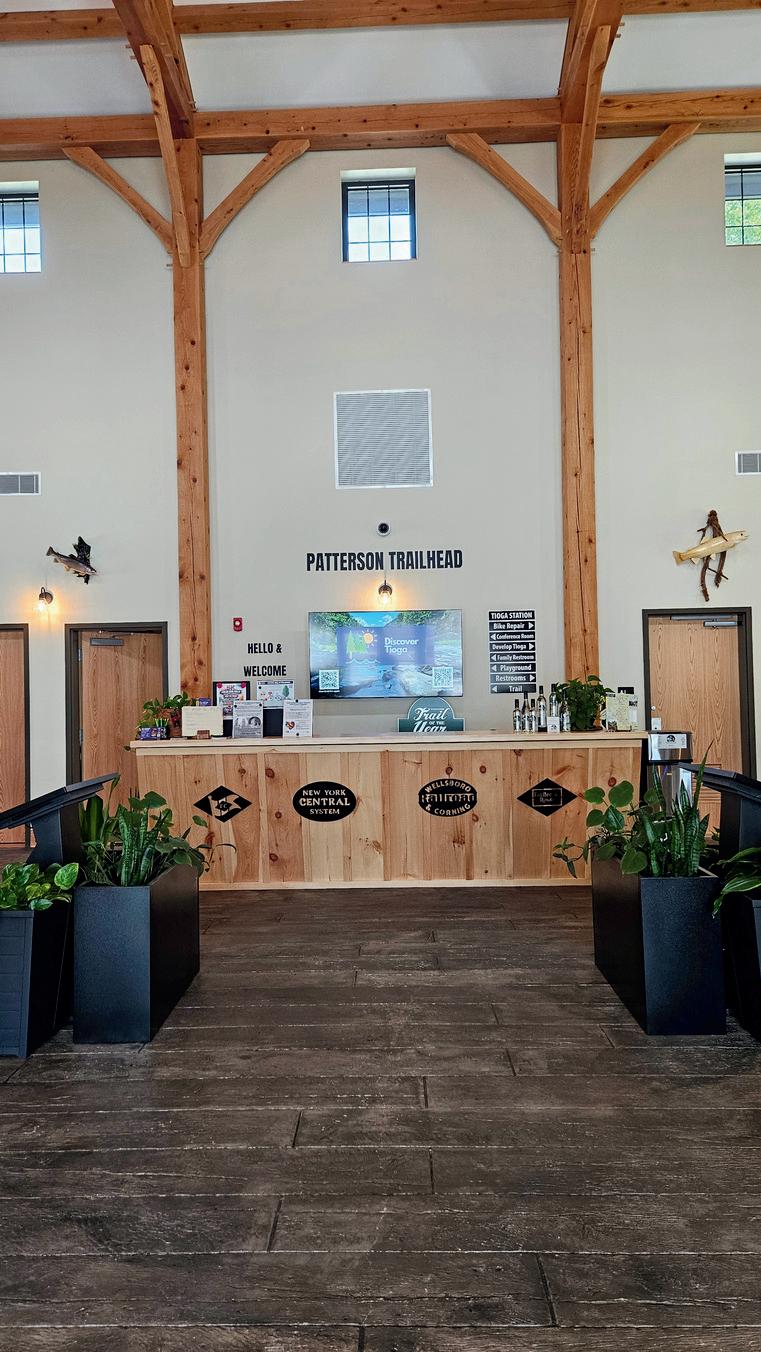
Visitors & Locals
Tioga County community resources, businesses, events, & things to do. Trail maps & guestbook. Volunteer opportunities.
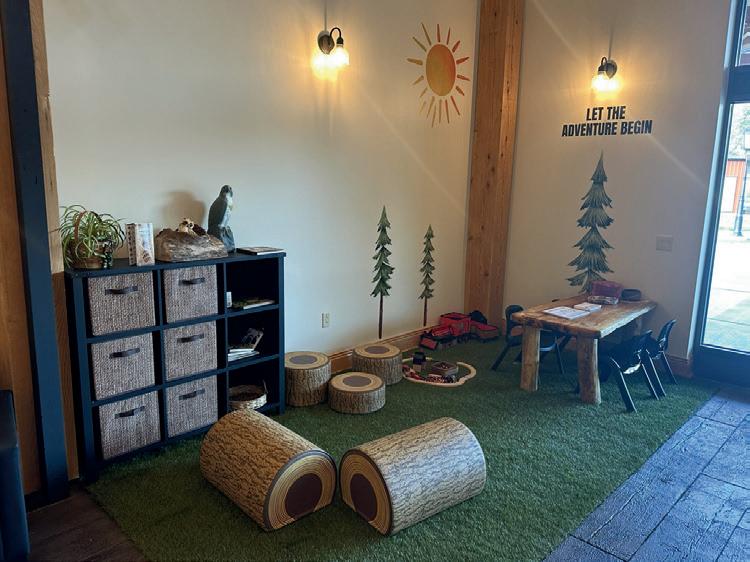
Ample parking, restrooms, water fountain, nature corner, kids’ corner, free wi-fi, remote workstations, conference room, pavallion, picnic tables, & playground.
Rotating Displays
Artists, local icons, community & business history. Trail & railroad history & tribute.