BD 2.10 KD 1.70 RO 2.10 SR 20 DHS 20
gulfbusiness.com / JA N UA RY 2 0 2 6
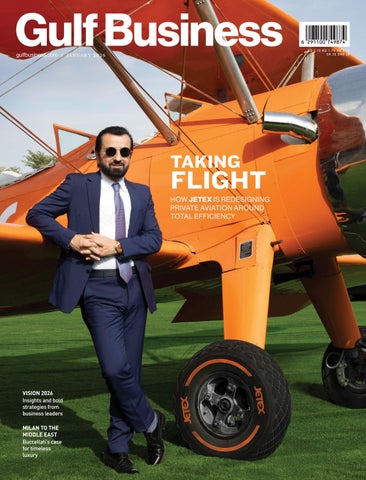
TAKING
FLIGHT HOW JETEX IS REDESIGNING PRIVATE AVIATION AROUND TOTAL EFFICIENCY
VISION 2026 Insights and bold strategies from business leaders MILAN TO THE MIDDLE EAST Buccellati’s case for timeless luxury
LARGEST COLLECTION OF WALL & FLOOR TILES Our wall tiles come in a stunning array of colors, patterns, and textures, allowing you to create a statement wall, a timeless backdrop, or anything in between.
Available size :
600x1200mm, 600x600mm, 400x600mm 300x600mm, 250x400mm Available Finish:
High-gloss, Glossy, Matt, Rustic, Sugar
Address : Plot No. 19, Kyagwwe Block 295, Near The Amazima School, JInja-Kampala Road, Mbiko, Jinja, Uganda. P.O. Box 84 Jinja.
Enquiries : ho@themoderngroup.co Contact : +256 - 750177777
Follow us on :
www.themoderngroup.co
Gulf Business CONTENTS / JANUARY 2026
12
The brief Getty Images
An insight into the news and trends shaping the region with perceptive commentary and analysis
27 Power letters 2026
Mark Mathew
As we kick off the new year, key regional and global business leaders reflect on a transformative 2025 while charting the path ahead
20 Getty Images
Jetex’s next frontier: Ultimate efficiency Jetex founder and CEO Adel Mardini is sharpening the focus on service, redesigning the journey itself by linking jets, air taxis, sustainable fuel and lifestyle assets gulfbusiness.com
January 2026
3
21 - 27 JANUARY 2026 INTERCONTINENTAL, DUBAI FESTIVAL CITY
Stories that redefine our world
Hear from 200+ of the world’s greatest writers, performers and thought leaders. BOOK YOUR TICKETS NOW
55
Supplied
Lifestyle
A cultural bridge Good Earth founder Anita Lal reflects on opening Chahar Bagh in Dubai p.56
Time-honoured legacy Patrick Pruniaux talks about piloting Girard-Perregaux and Ulysse Nardin p.59
Buccellati at its best CEO Nicolas Luchsinger discusses the Italian brand’s enduring heritage p.62
“AI is no longer just a tool – it is the infrastructure for cities that think, services that adapt, and governments that anticipate. In this new era of progress, AI will shape Dubai’s future.” Sheikh Hamdan bin Mohammed bin Rashid Al Maktoum, Crown Prince of Dubai, and UAE Deputy Prime Minister and Minister of Defence
64 Getty Images
The SME Story Insights on how the region’s dynamic SME ecosystem is evolving
Chief commercial officer Anthony Milne Anthony@motivate.ae Group content director Thomas Woodgate Thomas.Woodgate@motivate.ae Publishing director Manish Chopra Manish.Chopra@motivate.ae Group editor Gareth van Zyl Gareth.Vanzyl@motivate.ae Editor Neesha Salian Neesha.Salian@motivate.ae Deputy editor Rajiv Pillai Rajiv.Pillai@motivate.ae Reporter Nida Sohail Nida.Sohail@motivate.ae Senior art director Freddie N Colinares Freddie@motivate.ae
General manager – production S Sunil Kumar Production manager Binu Purandaran Assistant production manager Venita Pinto Digital sales director Mario Saaiby Mario.Saaiby@motivate.ae Sales manager Hitesh Kumar Hitesh.Kumar@motivate.ae
This issues’ Images, vectors and fonts credits: Getty Images / The noun project / Typography
Editor-in-chief Obaid Humaid Al Tayer Managing partner and group editor Ian Fairservice
Cover: Freddie N Colinares
Follow us on social media: Linkedin: Gulf Business Facebook: GulfBusines X: @GulfBusiness Instagram: @GulfBusiness
HEAD OFFICE: Media One Tower, Dubai Media City, PO Box 2331, Dubai, UAE, Tel: +971 4 427 3000, Fax: +971 4 428 2260, motivate@motivate.ae DUBAI MEDIA CITY: SD 2-94, 2nd Floor, Building 2, Dubai, UAE, Tel: +971 4 390 3550, Fax: +971 4 390 4845 ABU DHABI: PO Box 43072, UAE, Tel: +971 2 657 3490, Fax: +971 2 677 0124, motivate-adh@motivate.ae SAUDI ARABIA: Regus Offices No. 455 - 456, 4th Floor, Hamad Tower, King Fahad Road, Al Olaya, Riyadh, KSA, Tel: +966 11 834 3595 / +966 11 834 3596, motivate@motivate.ae LONDON: Acre House, 11/15 William Road, London NW1 3ER, UK, motivateuk@motivate.ae
gulfbusiness.com
January 2026
5
JAN 2026
FROM THE EDITOR’S DESK
THE MESSAGE IS CONSISTENT: THE GCC INTENDS TO SHAPE, NOT SIMPLY ADOPT, THE NEXT WAVE OF GLOBAL INNOVATION.”
page 8), the message is consistent: this market intends to shape, not simply adopt, the next wave of global innovation.
C
ould 2026 prove to be one of the strongest years in decades for the GCC? It is a question that will be answered as the year unfolds, but early indicators suggest the region is entering a period of sustained momentum. On the economic front, the GCC’s real GDP growth is forecast to reach 4.4 per cent in 2026, up from around 4 per cent in 2025 and comfortably ahead of the global average of 2.6 per cent, according to Oxford Economics. More revealing, however, is the composition of that growth. Non-oil sectors now account for more than 70 per cent of the GCC’s GDP, underlining that diversification is no longer a policy, but an operating reality. The UAE sits at the heart of this shift. Central bank forecasts point to non-hydrocarbon growth of nearly 4.8 per cent in 2026, with overall GDP expanding by more than 5 per cent. Trade volumes in the Emirates continue to rise, exports are accelerating, and the country’s role as a logistics, finance and innovation hub is deepening. Technology provides the clearest through-line. From major AI infrastructure developments such as Stargate to the high-profile visit of Elon Musk to Dubai in December (read more in our GCC news roundup on
6
January 2026
That intent is becoming increasingly visible, both on the ground and in the air. The UAE is targeting air-taxi certification later in 2026, with commercial operations expected soon after. Dubai has already mapped air corridors, while autonomous ground transport is set to move beyond pilot phases. Which brings us to proof. Our cover story this month profiles Adel Mardini, founder of private aviation company Jetex. His company has grown from a single location in Dubai into a network spanning 38 locations globally, and is set to reach 75 by the end of next year. As Mardini tells Gulf Business (turn to page 20), Jetex is actively preparing to integrate next-generation mobility, including air taxis, into its ecosystem as part of making the last mile more efficient. It is a clear case study in how ambition, infrastructure and timing converge in this region. These examples of success matter. They point to a simple truth: the future here is not only imagined: it is measured.
Gareth van Zyl, group editor
gulfbusiness.com
REWARDING EXCELLENCE IN BUSINESS TRAVEL AND HOSPITALITY
REGISTRATIONS OPEN
REGISTER HERE
FIND OUT MORE
BusinessTraveller.com BusinessTravellerME
BTMiddleEast
#BTMEAwards
For event sponsorship and general enquiries: chaitali.khimji@motivate.ae | murali@motivate.ae
Beverage partner
Vote processing partner
Presented by
GCC UPDATES
FROM ENERGY TO AI
HOW THE GULF IS POWERING THE NEXT GLOBAL GROWTH WAVE STARTING FROM JANUARY, OUR MONTHLY GCC UPDATES SECTION TRACKS THE ECONOMIC FORCES RESHAPING THE GULF. EACH EDITION DELIVERS INSIGHTS INTO THE REGION’S EVOLVING BUSINESS LANDSCAPE, GIVING READERS A STRATEGIC VIEW OF OPPORTUNITIES, POLICY SHIFTS AND SECTORAL MOMENTUM By Team GB
On a seasonally adjusted basis, real GDP grew 1.4 per cent compared with Q2 of 2025. Quarter-on-quarter, oil activities increased by 3.3 per cent, non-oil activities rose by 0.6 per cent, and government activities grew by 1.1 per cent, the data showed. The latest figures underline continued momentum in the kingdom’s diversification push as non-oil growth remains resilient alongside a rebound in hydrocarbon output. INFLATION FALLS
SAUDI AR ABIA
SAUDI ECONOMY ACCELERATES IN Q3 AS OIL OUTPUT REBOUNDS, INFLATION EASES
S
audi Arabia’s real gross domestic product grew (GDP) 4.8 per cent year on year in Q3 2025, driven by strong expansion in both oil and non-oil sectors. Figures from the General Authority for Statistics (GASTAT) showed oil activities rose by 8.3 per cent from a year earlier, while non-oil activities expanded by 4.3 percent. Government activities increased by 1.4 per cent. 8
January 2026
Saudi Arabia’s annual inflation rate fell moderately to 1.9 per cent in November from 2.2 per cent October 2025, according to government data. Inflation based on the consumer price index has hovered around 2.1 per cent to 2.3 per cent for most of the year, propped up by rising housing prices. Housing rental prices rose 5.4 per cent, while passenger transport prices increased 6.4 per cent, according to Saudi Arabia’s General Authority for Statistics. To tackle the rise in rents, Saudi Arabia’s real estate authority in September laid out new rules that included a five-year suspension of annual rental increases for residential and commercial properties located within Riyadh’s urban boundaries. gulfbusiness.com
Q ATAR
QATAR BETS CHEAP POWER AND SOVEREIGN CAPITAL TO CLOSE AI GAP
Q
atar is leveraging its abundant, low-cost energy and deep sovereign wealth to accelerate its entry into the Gulf’s rapidly intensifying artificial intelligence race, seeking to narrow the gap with regional rivals that have already built early momentum. The launch of Qai, backed by Qatar’s $526bn sovereign wealth fund and a $20bn joint venture with Brookfield, represents Doha’s most ambitious push yet into AI infrastructure. The move aligns Qatar with large-scale investments underway in Saudi Arabia and the UAE, as Gulf states look to diversify beyond hydrocarbons and position themselves as global AI hubs. Cheap electricity is a major draw for hyperscalers such as Google, Microsoft and Meta, whose AI models require vast computing power. However, analysts caution that capital and energy alone are not
enough. Gulf ambitions hinge on navigating complex data-governance regimes, securing advanced chips constrained by US export controls, and attracting scarce global AI talent.
Stephen Beard of Knight Frank said that regulatory alignment, particularly on data privacy, will be decisive for large-scale AI deployment. Meanwhile, demand remains strong. Mohammed Soliman of the Middle East Institute notes that energy-backed infrastructure in Qatar is welcomed by US hyperscalers, given the scale of global compute shortages. Qatar’s advantage lies in low electricity costs that can offset desert cooling challenges. Emirates NBD estimates regional data-centre efficiency lags global averages, but sustained cheap power could allow Qatar to scale rapidly. Still, with fewer than a dozen data centres today and strong competition from Saudi Arabia’s Humain and the UAE’s G42, analysts say Doha faces a steep climb. Beyond capacity, compliance will be critical. Like its neighbours, Qai will need to satisfy stringent US oversight to access advanced processors from Nvidia, underscoring that policy alignment, not funding alone, will determine Qatar’s long-term influence in the AI ecosystem.
KUWAIT
KUWAIT RETURNS TO GLOBAL DEBT MARKETS WITH $11BN BOND ISSUE
gulfbusiness.com
fixed-income news service IFR reported, which allowed pricing to tighten from early guidance. Although there were concerns about Kuwait’s governance, public finances, oil dependence and limited nonoil economy, its low level of outstanding debt was reassuring to investors, said Justin Alexander, director at Khalij Economics and Gulf analyst at GlobalSource Partners. Kuwait has estimated sovereign wealth assets of more than $1tn. It does not disclose exact figures. It passed a new public debt law in March, after the previous one expired years ago. That raised the borrowing ceiling to KD30bn ($98.24bn) from KD10bn previously and allowed for the possibility of longer borrowing terms. The law, like other reforms, had been gridlocked
for years over persistent clashes between appointed governments and Kuwait’s directly elected parliament. The emir dissolved parliament last year for up to four years, paving the way for the government to push through reforms. Despite plans to diversify revenue sources away from hydrocarbons, oil revenue accounted for almost 90 per cent of government revenue in the last fiscal year.
January 2026
Pics: Getty Images
K
uwait, a top oil producer, raised $11.25bn from a three-part bond sale, drawing hefty investor demand for its first US dollar issue since 2017 in a strong return to global debt markets after years of domestic political gridlock. The Gulf state was the latest sovereign from the region to tap the bond market as strong global appetite and attractive borrowing costs allow governments to diversify funding sources to help plug budget deficits and invest in economic diversification strategies. Kuwait sold $3.25bn in a three-year portion at 40 basis points (bps) over US Treasuries, $3bn in a five-year tranche at 40 bps over the same benchmark and $5bn in a 10-year portion at 50 bps. Order books were over $23bn at launch,
9
GCC UPDATES
ABU DHABI
$62TN IN ASSETS, 35,000 ATTENDEES: ABU DHABI FINANCE WEEK MAKES GLOBAL WAVES
Pic: Dubai Media Office
A UAE
UAE’S STRATEGIC LEAP: HOW ENERGY, TECH, AND GLOBAL INVESTMENT ARE REDEFINING THE FUTURE
T
he UAE is steadily transforming ambition into action as it strengthens its role on the global stage across energy, technology, and economic development. This vision was underscored when Sheikh Hamdan bin Mohammed bin Rashid Al Maktoum, Crown Prince of Dubai, Deputy Prime Minister and Minister of Defence of the UAE, and Chairman of The Executive Council of Dubai, met Elon Musk to explore technology partnerships that could accelerate innovation and deliver solutions with worldwide impact. Their discussions reflected the UAE’s commitment to harnessing emerging technologies to support sustainable and inclusive growth. Beyond dialogue, tangible investments are driving progress. Mubadala Investment Company’s EUR300m partnership with Actis in Rezolv Energy marks a significant step in advancing renewable power across Central and Eastern Europe. With large-scale solar and wind projects underway, the investment reinforces the UAE’s strategy to lead the global energy transition. At home, Dubai continues to attract global innovators. TECOM Group’s expansion of the Innovation Hub at Dubai Internet City adds premium office space designed to draw international technology firms and talent. In parallel, ADNOC’s landmark financing agreement for the Hail and Ghasha gas project positions the UAE at the forefront of net-zero energy infrastructure.
10
January 2026
bu Dhabi Finance Week (ADFW) 2025, held under the patronage of Sheikh Khaled bin Mohamed bin Zayed Al Nahyan, concluded as a landmark event cementing Abu Dhabi’s global financial prominence. Organised by ADGM with ADQ as headline partner, ADFW attracted over 35,000 participants from 175 nationalities, featuring 68 events and 394 thematic sessions with 819 speakers. For the first time, total assets represented exceeded $62tn, over half of global GDP, underscoring the city’s growing influence in global finance. Key highlights included 11 global financial institutions establishing a presence in ADGM, major investment commitments like Mubadala and Aldar’s Dhs60bn joint venture, and the launch of the FinTech, Insurance, Digital, and Alternative Assets (FIDA) cluster to drive innovation. ADFW also spotlighted philanthropy, with a $1.9bn pledge to eradicate polio, and groundbreaking regulatory achievements, including Binance’s global license under ADGM’s framework. Sustainability and innovation were emphasised as ERM opened a new office and Halo Investing unveiled “Majarra”, a new capital markets ecosystem. Abu Dhabi was ranked MENA’s top financial hub and 12th globally, reflecting its strategic growth. With 82 MoUs signed and partnerships forged, ADFW 2025 showcased Abu Dhabi as the “Capital of Capital,” connecting global investment, innovation, and policy for a transformative financial future.
gulfbusiness.com
OMAN
FROM HALAL TO HIGH FINANCE: OMAN’S ECONOMIC TRANSFORMATION ACCELERATES
O
man continues to advance key economic, financial and industrial initiatives as part of its broader national development agenda. The National Halal System Task Force recently held its third meeting to assess progress on establishing an integrated
halal framework designed to strengthen the global competitiveness of Omani products and ensure compliance with international standards. Discussions highlighted the rapid expansion of the global halal economy, valued at more than $7tn and projected to reach
$10trn by 2030, spanning sectors such as food, cosmetics, pharmaceuticals, tourism, and Islamic finance. Regulatory oversight will be shared among relevant ministries to ensure effective implementation. In parallel, Oman’s financial sector witnessed significant developments. The Oman Sovereign Sukuk Company announced the 10th issuance of the Local Sovereign Sukuk valued at OMR150m, with an option to increase the size to OMR200m. The seven-year sukuk offers an annual profit rate of 4.15 per cent. Further strengthening financial infrastructure, the Central Bank unveiled a OMR1 polymer commemorative banknote, set to enter circulation in January 2026. On the sustainability front, Oman and Switzerland are exploring a largescale sustainable fuels project at SOHAR Port, potentially powered by 2GW of renewable energy. Additionally, the Oman-India CEPA now grants preferential access to 97.4 per cent of Omani exports to India, reinforcing bilateral trade ties.
BAHR AIN
BAHRAIN HITS GROWTH MILESTONES: STRONG SUKUK DEMAND AND NON-OIL SUCCESS
gulfbusiness.com
by the CBB, the sukuk plays an important role in supporting government financing while adhering to Islamic finance principles. In a move aimed at maintaining
monetary and financial stability, the CBB also announced a 25-basis-point reduction in the overnight deposit interest rate. The rate was lowered from 4.5 per cent to 4.25 per cent, effective December 11, 2025. On the trade front, Bahrain’s nonoil exports continue to show positive performance. According to the Information and eGovernment Authority (iGA), the total value of non-oil exports of national origin reached BD317m ($836m). Overall, these developments reflect Bahrain’s strong economic foundations, proactive financial management, and commitment to fostering innovation and sustainable growth.
January 2026
Pics: Getty Images
B
ahrain continues to demonstrate resilience and growth across its financial and economic sectors, supported by effective monetary policies and a thriving business environment. The Central Bank of Bahrain (CBB) recently announced that its monthly issue of short-term Islamic Ijara Murabaha Sukuk was significantly oversubscribed by 338 per cent, reflecting strong investor confidence. Subscriptions reached BD101.3m for an issue valued at BD30m, with a maturity period of 364 days. The sukuk, which began on December 15, 2025 and matures on December 14, 2026, offers an expected return of 4.86 per cent. Issued
11
The Brief / Outlook
Getty Images/Amnart Jornpibun
COMMENT
Navigating financial trends: Building resilience and readiness for 2026 The past year witnessed resilience replace recovery. In 2026, discipline, digital adoption and sustainability will emerge as the new cornerstones of growth across the region’s financial sector 12
January 2026
gulfbusiness.com
Saad Maniar is the chief executive officer, Baker Tilly (UAE)
L
ooking back at 2025, the financial landscape 04 In an environment of fluctuating costs and across the GCC witnessed a year defined by interest rates, maintaining liquidity and forecastrecalibration one where organisations have ing cash positions remain the backbone of finantransitioned from recovery to readiness. cial resilience. Businesses are now rethinking Businesses have navigated inflationary pressures, how they structure working capital and debt to increasing regulatory changes, and the rapid pace of retain agility. digital transformation with a renewed sense of discipline and foresight. The year rewarded adaptability. 05 The future of finance lies in combining human Those who invested in technology, data transparency, insight with digital intelligence. Upskilling finance and sustainable business practices professionals to interpret and found themselves better positioned lead with data, rather than simply to manage volatility. process it, will be a defining dif“FINANCIAL TEAMS The UAE’s continued commitferentiator in 2026 and beyond. THAT EMBRACE AI IN A ment to economic diversification, coupled with robust fiscal manageFrom my perspective, the most RESPONSIBLE MANNER, ment, safe business environment, successful financial strategies for IS NOT JUST UTILISING IT FOR excellent infrastructure and the the year will be rooted in balance. acceleration of digital government Balancing growth with governREPORTING PURPOSE BUT services also inspired confidence ance, technology with trust, and AS A DECISION-SUPPORT among investors and entrepreneurs efficiency with empathy. The busiSYSTEM AND I BELIEVE THIS from all parts of the world. nesses that will thrive are those We also witnessed a marked shift that look beyond numbers and WILL GIVE THEM A in client priorities, from expansion focus on building enduring value COMPETITIVE ADVANTAGE.” to consolidation, and now, toward for their people, their customers, strategic growth in more responsiand their communities. ble manner. Organisations are now FIVE BEST PRACTICES FOR FINANCIAL asking deeper questions about efficiency, governance, MANAGEMENT IN 2026 and long-term sustainability, rather than just shortterm profitability. In my opinion, the introduction of 01 Scenario-based forecasting enables quick pivots corporate tax also brought discipline to the market. in uncertain markets. Build your plans with options, This discipline, now embedded across the market, crenot assumptions. ates a stronger foundation as we kick off 2026. FINANCIAL TRENDS LIKELY TO SHAPE BUSINESS DECISIONS THIS YEAR
02 Automation without insight is noise. Choose tools that align with business objectives and support smarter decision-making.
01 Artificial intelligence and data analytics are now indispensable tools in forecasting and risk management. Financial teams that embrace AI in a responsible manner, is not just utilising it for reporting purpose but as a decision-support system and I believe this will give them a competitive advantage.
Pic: Supplied
02 The implementation of e-invoicing and enhanced corporate tax requirements in the UAE has signalled the beginning of a new era of transparency. Businesses that embed compliance into their culture rather than treating it as a checklist exercise will find it easier to grow and attract investors. 03 ESG (Environmental, social, and governance) is no longer a reputational topic, it is a financial one. Access to capital, investor confidence, and even consumer trust are increasingly linked to how responsibly a company operates. gulfbusiness.com
03 Financial performance metrics must extend beyond revenue and profits, include sustainability, employee engagement, and innovation outcomes. 04 Internal audits and regular risk assessments should be viewed as enablers of growth, not barriers. FINANCIAL PERFORMANCE METRICS MUST EXTEND BEYOND REVENUE AND PROFITS, INCLUDE SUSTAINABILITY, EMPLOYEE ENGAGEMENT, AND INNOVATION OUTCOMES
05 The pace of change will only accelerate. Encourage finance teams to stay current through professional development and collaboration. As the region continues its evolution toward becoming a global hub of innovation and finance, the UAE stands as a model for vision-driven growth. With clarity of purpose, discipline in execution, and courage to adapt, 2026 offers a promising horizon, one that rewards resilience, foresight, and trust. January 2026
13
The Brief / Islamic Banking COMMENT
never built for today’s scale, security and customercentric expectations. For IFIs to stay competitive, not just compliant, they must embrace innovation and increase agility to anticipate and evolve with change.
Getty Images_Paper Boat Creative
VALUES MEET INNOVATION
Islamic banking: Keeping pace with change Innovative core banking platforms allow IFIs to meet changing expectations and shape global standards
W
ith nearly $4tn in assets and a projected annual growth rate of 14.9 per cent, Islamic finance is not just a subsector of financial services. In the GCC region it is central to economic identity and development. Yet, many Islamic financial institutions (IFIs) still operate on infrastructure designed for an earlier era. These systems were 14
January 2026
Islamic banking is a catalyst for economic transformation, grounded in values that are increasingly relevant in a world demanding trust, transparency, and resilience. Adoption is already widespread in GCC markets. For example, Saudi Arabia alone accounted for 28 per cent of global Islamic banking assets as of 2021. In the UAE, Islamic banking represented 23 per cent of total banking assets in 2023. However, appetite for Shariah-compliant financial services is also growing globally: global Islamic finance assets are projected to reach $7.5tn by 2028, up from $5.5tn in 2024. To remain competitive, IFIs – in the GCC and worldwide – compliance is not enough. Institutions must embrace innovation to provide services that cater for their customers’ values, while also accommodating their other needs. The GCC’s younger demographic provides a good example. More than half of the local population is under twenty-five, digitally fluent, value-driven, and eager for change. In the UAE and Saudi Arabia, 67 per cent of Gen Z consumers prioritise personalised experiences across every channel, and around 70 per cent of consumers are willing to share personal data for better experiences. For IFIs, this is a rare alignment: a young, growing market that demands both authentic values and digital excellence. Meeting the expectations of this generation requires IFIs to co-innovate with technology partners and build solutions that combine digital sophistication with authentic values. THE LIMITS OF LEGACY SYSTEMS
Many IFIs still rely on technology built for another era. Some run on conventional core banking platforms retrofitted for Sharia compliance, while others depend on niche Islamic cores with limited functionality. Both approaches carry costs. Modified conventional systems risk inefficiency and even non-compliance if not designed correctly. Pure-play Islamic platforms keep operations compliant but often lack the flexibility, scalability, and breadth of features needed in a digital banking landscape. As IFIs expand, the gaps become clear. Complexity drives up costs, customer experiences become fragmented, risk oversight is duplicated and harder to integrate, data remains siloed, and enterprise agility is constrained. The outcome is gulfbusiness.com
Siobhan Byron is the EVP, Universal Banking at Finastra
IN THE UAE, ISLAMIC BANKING REPRESENTED 23 PER CENT OF TOTAL BANKING ASSETS IN 2023. HOWEVER, APPETITE FOR SHARIAH-COMPLIANT FINANCIAL SERVICES IS ALSO GROWING GLOBALLY: GLOBAL ISLAMIC FINANCE ASSETS ARE PROJECTED TO REACH $7.5TN BY 2028, UP FROM $5.5TN IN 2024.
NEXT GENERATION CORE BANKING
Reimagining banking for the next decade means moving away from outdated systems and towards a modern, cloud-first, API-enabled core that combines rich, broad, and deep functionality with advanced technology. For IFIs, this must be designed to both comply with the principles of Islamic finance while providing the necessary scalability, agility, and capacity for ongoing innovation. This shift does not need to happen all at once. A symbiosis approach lets IFIs deploy next-generation solutions alongside existing systems, gaining new capabilities immediately while minimizing disruption. Over time, if they choose, they can migrate fully, at a pace that suits their strategy. Additionally, through an augmented core and data strategy, IFIs can use advanced technologies like AI, machine learning, and predictive analytics to act on real-time insights, strengthen risk oversight, and adapt quickly when market conditions change. Operations run smoother, customers experience consistent and hyper-personalised service, and new products can be launched faster. COMPETING ON A LARGER STAGE
the same: higher cost, slower agility, and greater difficulty meeting the expectations of a digitalfirst generation.
Pic: Supplied
KEEPING PACE WITH INDUSTRY CHANGE
The GCC’s regulators are actively shaping a banking environment that fosters innovation, hyper-personalisation, and real-time services. Examples include: The Saudi Central Bank (SAMA) launched a second edition of its Open Banking Framework in 2024, focusing on payment initiation services. The next phase will focus on opening financial services more broadly, including credit, investment, and insurance data sharing. The UAE Central Bank’s Financial Infrastructure Transformation (FIT) programme has encouraged innovations such as cloud adoption, instant payments, stablecoins, and the region’s CBDC (Digital Dirham). Bahrain’s National Digital Economy Strategy is pushing digital transformation in areas such as digital identity, smart contracts, and AI. These policies aim to drive the financial services industry forward, empowering institutions to remain competitive on a global stage while delivering customer-centric services to end-users. However, held back by the limitations of legacy systems, this is a challenging environment for financial institutions who are yet to modernise. gulfbusiness.com
IFIs that invest in scalable, cloud-first, and AI-ready platforms can enter new markets, serve underserved communities, and deliver differentiated services that align with Islamic principles. They can compete head-to-head with global digital banks and fintechs, not by replicating their models, but by combining technological sophistication with the ethical framework that defines Islamic finance. Legacy systems solved yesterday’s problems. Nextgeneration platforms position Islamic finance to capture tomorrow’s opportunities by expanding share in existing markets, entering new Islamic markets, and even introducing Islamic banking to geographies where it has not traditionally been present. With the right technology, IFIs can scale across borders, deliver experiences that rival the best in digital banking, and set the benchmark for values-driven innovation. The institutions that embrace this shift will not just keep pace with change. They will define it.
IN THE UAE AND SAUDI ARABIA, 67 PER CENT OF GEN Z CONSUMERS PRIORITISE PERSONALISED EXPERIENCES ACROSS EVERY CHANNEL, AND AROUND 70 PER CENT OF CONSUMERS ARE WILLING TO SHARE PERSONAL DATA FOR BETTER EXPERIENCES.
January 2026
15
The Brief / Finance COMMENT
per cent quarter-on-quarter this year and a cost-toincome ratio improving to 29.5 per cent, supported by efficiency gains across most major lenders. Asset quality indicators continue to show strength, underpinned by cautious lending practices and proactive provisioning strategies. This balance-sheet strength provides the foundation on which a more structured distressed debt market is beginning to take shape. With healthy capital buffers, regional lenders are increasingly able to absorb cyclical stress, segment portfolios, and consider secondary market options for non-core or impaired assets.
Getty Images_akindo
SAUDI ARABIA: BUILDING A MARKET FOR DISTRESSED ASSETS
Reshaping the distressed debt landscape in the GCC Efforts are increasingly focusing on developing a secondary investment ecosystem for distressed assets
T
he GCC’s financial sector is entering a new phase of maturity; one defined by resilience, transparency, and strategic adaptation. As regional economies diversify and regulators strengthen governance frameworks, lenders and corporates are refining how they manage restructuring, distressed debt, and non-performing loan portfolios. This is particularly evident in Saudi Arabia and the UAE, where evolving legal structures and proactive regulatory oversight are fostering greater market depth, transparency, and investor confidence. In recent years, the Gulf’s banks have demonstrated earnings stability even amid margin pressures and elevated provisioning costs. In the UAE, net loans rose 5 per cent quarter-on-quarter in Q2 2025, while deposits increased 2.8 per cent. This was underpinned by disciplined balance sheet management and one of the lowest cost-to-income ratios in the region at 27.5 per cent. Meanwhile, Saudi banks have maintained steady profitability, with net income rising 3.4 16
January 2026
Saudi Arabia has taken significant steps to strengthen its financial and legal infrastructure, establishing a clear framework for managing restructuring and distressed assets. The kingdom’s financial reforms - from the Bankruptcy Law to the Judicial Enforcement Law and Zakat, Tax and Customs Authority frameworks have created a clearer, more predictable environment for corporate restructuring and insolvency resolution. At the same time, the Bankruptcy Commission and the EISAR platform have provided transparency and a standardised process for managing distressed situations in alignment with Vision 2030’s broader goal of supporting institutional maturity and boosting investor confidence. Going forward, efforts are increasingly focusing on developing a secondary investment ecosystem for distressed assets. This involves enabling regulated trading of NPL portfolios, encouraging participation by specialised asset managers, and introducing valuation and disclosure standards that attract both domestic and foreign investors. As the sector continues to evolve, safeguards will be essential to prevent conflicts of interest, ensure fair market pricing, and maintain confidence in the process. Transparency and governance will underpin the credibility of any secondary NPL market, particularly as international investors seek clarity around risk-weighting, collateral quality, and recovery mechanisms. STRENGTHENING THE CORPORATE RESTRUCTURING FRAMEWORK
In the last decade, there has been a noticeable shift with corporates across the Gulf beginning to view restructuring as a strategic tool rather than a last resort. Rising global interest rates, tighter liquidity, and shifting investment priorities under national diversification plans are prompting businesses to reassess capital structures and operating models. In Saudi Arabia, this is especially evident in sectors tied gulfbusiness.com
Sam Gidoomal is the managing director and head of Middle East Financial Services, Alvarez & Marsal
THE ROLE OF ADVISORY EXPERTISE IN MARKET DEVELOPMENT
to Vision 2030 megaprojects including construction, real estate, and contracting where delayed cash flows or project realignments have placed pressure on balance sheets. The regulatory environment now supports early intervention, with corporates engaging restructuring advisors to optimise debt maturity profiles, reduce costs, and position for renewed growth. In the UAE, similar trends are evident: companies in trade, logistics, and real estate are pursuing refinancing and liability management exercises pre-emptively to navigate margin pressures. This reflects a broader regional maturity, where transparency, professional advice, and proactive creditor engagement are increasingly standard practice rather than exceptions.
As Gulf markets continue to strengthen the frameworks needed for a functioning distressed asset ecosystem, independent expertise will remain vital. Specialist advisors, working alongside regulators and financial institutions, help align international best practices with local regulatory realities, ensuring that new mechanisms are transparent, practical, and suited to regional priorities. In Saudi Arabia, initiatives such as EISAR reflect growing momentum toward building the institutional foundations required to manage distressed assets effectively. Collaboration between public and private stakeholders is deepening market resilience, shifting the regional approach from reactive to forward-planning. Experience from other jurisdictions shows that the most successful systems combine clear regulation, reliable data, and constructive engagement between lenders, investors, and policymakers. Applied in the Gulf context, these lessons can help turn financial distress into a catalyst for stronger balance sheets, improved transparency, and long-term confidence across the financial system.
ENSURING CONFIDENCE FOR INTERNATIONAL INVESTORS
As the Gulf seeks to attract institutional capital into its distressed debt markets, confidence and compliance will be key. International investors, particularly private equity and hedge funds, are watching closely for signs of regulatory clarity, valuation consistency, and enforceable creditor rights. Saudi Arabia’s framework now incorporates licensing provisions for distressed asset trading and rules on fund structuring aligned with local cultural and legal principles. These measures are building trust, but the real catalyst will come from track record: the successful resolution of large, complex restructurings conducted transparently and on commercially fair terms. In parallel, regulators are enhancing data disclosure and prudential reporting. This will enable lenders to more effectively segment and price NPL portfolios, a prerequisite for any liquid secondary market. Alvarez & Marsal’s experience across global markets shows that data quality and standardisation are often the critical differentiators between a nascent and a mature distressed asset market.
gulfbusiness.com
The evolution of the Gulf’s restructuring and distressed asset ecosystem marks a milestone in the region’s financial maturity. For Saudi Arabia and the UAE alike, the task ahead is to build depth and transparency without compromising stability, a balance that depends on sound regulation, disciplined market participation, and sustained investor confidence. The momentum is already evident. Strong capital positions, modernised legal frameworks, and a growing appetite for investment are setting the stage for a well-functioning market in distressed assets. As the region continues to advance, managing distress will not be a response to crisis but a defining feature of a resilient, diversified, and forward-looking financial landscape.
Pic: Supplied
IN THE UAE, NET LOANS ROSE 5 PER CENT QUARTER-ON-QUARTER IN Q2 2025, WHILE DEPOSITS INCREASED 2.8 PER CENT
LOOKING AHEAD: SUSTAINING MARKET RESILIENCE
EXPERIENCE FROM OTHER JURISDICTIONS SHOWS THAT THE MOST SUCCESSFUL SYSTEMS COMBINE CLEAR REGULATION, RELIABLE DATA, AND CONSTRUCTIVE ENGAGEMENT BETWEEN LENDERS, INVESTORS, AND POLICYMAKERS. January 2026
17
FEATURE / INNOVATION
REINVENTING A LEGACY BUSINESS BRITISH AMERICAN TOBACCO IS RESHAPING ITS PRODUCT STRATEGY AND RESEARCH PRIORITIES AROUND NON-COMBUSTIBLE ALTERNATIVES WORDS GARETH VAN ZYL
18
January 2026
Pics: Supplied
A
dvances in scientific research are changing how one of the world’s most closely monitored consumer industries approaches risk, responsibility and longterm sustainability. Over the past decade, public health authorities have increasingly focused on the role of combustion in driving the majority of health risks associated with traditional tobacco use. That distinction has become a reference point in how companies such as British American Tobacco (BAT) reassess product development. According to the World Health Organisation (WHO), the health risks associated with traditional cigarette use stem primarily from the toxic by-products created during combustion. Cigarette smoke contains more than 7,000 chemicals, many of which are harmful or carcinogenic. This evidence has shaped international harm-reduction debates, particularly around whether non-combustible alternatives can reduce exposure for adult consumers who would otherwise continue to smoke. BAT says this scientific understanding underpins its shift towards non-combustible formats, including vapour, heated tobacco and oral nicotine products. Executives describe the strategy as a response to findings emerging from chemistry, toxicology and clinical research. In several developed markets, policymakers and public health bodies have begun to distinguish between combustible and non-combustible categories when designing regulatory frameworks, while still maintaining controls on marketing, access and youth prevention. Sweden frequently features in these discussions. Daily smoking prevalence there has fallen to around 5–6 per cent, the lowest level in the European Union, a trend Swedish public health authorities link to a combination of risk-proportionate regulatory oversight, and the uptake of non-combustible alternatives.
Inside BAT’s Southampton research and development facility, where scientists are central to the company’s long-term transformation
Against this backdrop, BAT — founded in 1902 — has set out an ambition to become a predominantly non-combustible business by 2035. The company has stated a target for more than 50 per cent of group revenue to come from non-combustible products by that date. To examine how that transition is unfolding, Gulf Business visited BAT’s global research and development headquarters in Southampton, UK, where hundreds of scientists and engineers work across product development, regulatory science and long-term research. “This is not about incremental change,” Dr James Murphy, Director of Research and Science at BAT, told Gulf Business. “Science now sits at the centre of how we operate. We have built a substantial evidence base through chemistry, toxicology
and clinical studies, and that work shapes how we engage with regulators and policymakers.” FROM REGULATION TO RESPONSIBILITY
BAT operates across more than 180 markets, each with its own regulatory approach. For Danielle Tower, Group Head of Scientific and Regulatory Affairs, preventing underage use is one of the central concerns as newer product categories expand. “As we transition towards non-combustible products, we have to ensure they are used as intended, by adult consumers only,” Tower said. “Underage access prevention remains one of our top priorities.” To support enforcement at the retail level, BAT is turning to technology to gulfbusiness.com
IN OUR R&D WORK, WE ARE INCREASINGLY EXPLORING PRODUCTS WITH BUILT-IN AGEVERIFICATION AND AUTHENTICATION FEATURES.”
Data sources: Japan Ministry of Health, New Zealand Smokefree, USA (BAT and Omni), UK Office of National Statistics, Sweden’s Public Health Agency
improve age-verification processes. One example is the use of artificial intelligence-based facial age estimation tools, such as Yoti, designed to help retailers apply age restrictions more consistently. “The system determines whether a customer is above or below a defined age threshold,” Tower explained. “A photo is taken and immediately deleted, but from that image the technology can estimate age with a high degree of accuracy.” Tower said independent validation places the system’s accuracy at 99.3 per cent, giving retailers additional confidence in enforcing age-restricted sales. She also noted that similar tools could apply across other regulated categories, subject to regulatory approval.
While incremental, these measures aim to reinforce intended use and reduce misuse over time. Another challenge that continues to test regulatory systems globally is illicit trade. It is estimated that around 1 in every 10 cigarettes consumed worldwide comes from illicit channels, according to the WHO.
This illicit trade costs governments across the globe more than $47bn in lost tax revenues annually, the WHO further states. Tower described it as a clear example of where regulation loses effectiveness if enforcement cannot keep pace. “Illicit products bypass safety standards, undermine legitimate supply chains and erode trust,” she said. “Manufacturers can only do so much. Policymakers and regulators play a critical role in setting rules that are enforceable and properly resourced.” BAT’s evolution reflects a broader shift among global legacy businesses redefining their futures, where longevity increasingly depends on aligning business models with scientific evidence, regulatory credibility, and public trust. This requires sustained investment in research and a shared commitment to reducing harm.
DESIGNING SAFEGUARDS
BAT has extended its focus on responsibility into product design, reflecting a wider shift across regulated industries to embed safeguards directly into systems rather than relying solely on post-market enforcement. “In our R&D work, we are increasingly exploring products with built-in age-verification and authentication features,” Tower said. “Connectivity, device controls and other technologies all form part of that thinking.” gulfbusiness.com
Danielle Tower, group head of scientific and regulatory affairs, addressing a media delegation
January 2026
19
20
January 2026
gulfbusiness.com
COVER STORY
JETEX’S NEXT FRONTIER
ULTIMATE EFFICIENCY AFTER NEARLY TWO DECADES BUILDING A GLOBAL PRIVATE AVIATION BRAND DEFINED BY SCALE AND POLISH, JETEX FOUNDER AND CEO ADEL MARDINI IS NOW FOCUSED ON STREAMLINING THE JOURNEY ITSELF, CONNECTING JETS, AIR TAXIS, SUSTAINABLE FUEL, AND LIFESTYLE ASSETS TO ELIMINATE WASTED TIME WORDS GARETH VAN ZYL | PHOTOS MARK MATHEW
gulfbusiness.com
January 2026
21
COVER STORY
F
or nearly two decades, Adel Mardini has done what few founders in private aviation have managed. He has built Jetex by reshaping the private aviation market, using Dubai’s geographic reach and regulatory openness to scale a premium service across regions. Under his leadership, Jetex has grown from a single location into a network spanning 38 locations globally, set to reach 75 by the end of next year, prized for its sleek environments, meticulous service standards, and brand consistency. That phase of Jetex’s evolution is largely complete. Today, Mardini’s focus has shifted. The emphasis is no longer on how Jetex looks, or even how large it becomes, but on how efficiently the entire system works and where time is still being lost. “People don’t fly private just to be in the air,” Mardini says, speaking at Jetex’s flagship VIP terminal at Dubai’s Al Maktoum International Airport. “They do it to save time. If you land and then lose another hour or two on the ground, the experience breaks.” That observation has become a key principle behind Jetex’s next chapter. After years spent building scale, brand credibility, and global reach, the company is repositioning itself as a connective platform, designed to remove friction from every stage of private travel, from arrival and transfer to fuel, infrastructure, and what comes next.
SOLVING THE LAST MILE The most visible expression of that shift is Jetex’s growing focus on the so-called “last mile”, the point at which private aviation’s promise of time-saving often begins to unravel. For many clients, the contradiction is familiar. A private jet shaves hours off a journey, immigration takes minutes — but then a ground transfer consumes another one or two hours in traffic. For travellers paying a premium to compress time, the inefficiency is hard to ignore. It is this gap that has pushed Jetex to focus increasingly on the eVTOL (electric vertical take-off and landing) sector. Through partnerships with Archer and Joby Aviation, Jetex is positioning itself as an infrastructure and services partner for air taxi operations. This is not a pure technology play, but a practical extension of private aviation. “The vertiport industry is expected to grow into a market worth more than $200bn over the next 10 to 15 years,” Mardini says. “For us, eVTOL is not a novelty. It’s about solving the biggest inefficiency in private travel.” Jetex’s ambition is to integrate eVTOL aircraft directly into its terminal operations, allowing passengers to transition from jet to air taxi with minimal friction. “Connecting the traditional jet with eVTOL aircraft will be a major milestone for us,” Mardini says. “And it’s one we will achieve.” Jetex has already signed agreements with Archer and Joby to support their growth in the UAE, with plans to extend this capability across its global network. Dubai is expected to be among the earliest deployment sites. 22
January 2026
Today, the average Jetex passenger is between 25 and 55, with growing representation from technology, crypto, fashion, entertainment, and creative industries
“Our clients want to complete their journey,” Mardini adds. “They want to land, finish their procedures, and move on immediately. That’s what we’re building.” This emphasis on continuity also explains Jetex’s move beyond the airport itself. In 2026, the company plans to operate its first lifestyle premises, incorporating a café, a hotel, and a private members’ club. Rather than viewing the airport as the endpoint, Jetex increasingly sees it as one node in a broader ecosystem that serves the same clientele beyond aviation alone. “Our clients already trust us with their time, their privacy, and their travel,” Mardini says. “That trust allows us to extend the experience into other parts of their lives.”
GLOBAL FOOTPRINT TO CONNECTED FLOW This focus on efficiency helps explain why Jetex’s next phase of expansion looks different from its last. With the network set to reach 75 locations, spanning the Middle East, Europe, Africa, Asia, and Latin America, the numbers suggest continued rapid growth. “This footprint gives us something very powerful,” Mardini says. “It allows us to deliver the same service, the same experience, everywhere. That consistency is what enables us to connect the entire journey.” gulfbusiness.com
THE FUTURE OF PRIVATE AVIATION IS ABOUT COMPLETING THE JOURNEY, NOT JUST THE FLIGHT.”
Before Covid-19, Jetex’s typical private aviation client was an ultra-high-net-worth individual from traditional sectors such as oil and gas, or a government official, often aged between 50 and 80. Private aviation was largely about access and discretion. Since the pandemic, that profile has shifted markedly. Today, the average Jetex passenger is between 25 and 55, with growing representation from technology, crypto, fashion, entertainment, and creative industries. Many migrated from first and business class on commercial airlines during Covid19 and never returned, drawn by speed, privacy, and control. “These clients are extremely time-sensitive,” Mardini says. “They are globally mobile, digitally fluent, and they expect the experience on the ground to work as seamlessly as it does in the air.”
SCALING WITH SUSTAINABILITY Efficiency is not only about movement. It is also about fuel, infrastructure, and systems working together. gulfbusiness.com
At the recent Dubai Airshow, Jetex supplied sustainable aviation fuel (SAF) and sold out its entire allocated volume. Demand was strong enough that additional supply was requested but unavailable. “We were very happy to bring SAF fuel to the Dubai Airshow,” Mardini says. “The fact that it sold out tells you demand is increasing.” Jetex has been the exclusive ground handler for the Dubai Airshow since 2016, and this marked the second time it introduced SAF at the event. While cost, availability, and certification challenges remain, Mardini believes client pressure is accelerating adoption. “Many of our corporate clients have their own net-zero commitments,” he says. “They expect us to provide fuel options that help them meet those goals.” Geographically, Saudi Arabia represents one of Jetex’s most strategically important growth markets. The company has been appointed exclusive fixed-base operator at Red Sea International Airport, the gateway to one of the kingdom’s most ambitious luxury tourism developments. “That means we’ll be there from the very first flight,” Mardini says. “We’ll be January 2026
23
24
January 2026
gulfbusiness.com
COVER STORY
shaping the experience for every VIP and private passenger who arrives.” Beyond the Red Sea, Jetex is actively evaluating opportunities in Riyadh, Jeddah, and NEOM. Operationally, the Saudi facilities will mirror Jetex’s Dubai flagship, with lounges, concierge services, crew rest areas, and on-site customs clearance. “Our model is to replicate the same feel everywhere,” Mardini says. “If you land in the Red Sea or Riyadh, it must feel like Jetex Dubai.” Elsewhere, Jetex is expanding across Asia, Africa, and Latin America. Markets such as Indonesia, Thailand, and Vietnam remain at an early stage of private aviation development. Southeast Asia’s business jet market is forecast to grow at a compound annual rate of 15.5 per cent between 2025 and 2030, according to Mordor Intelligence. “These markets are fragmented,” Mardini says. “But that fragmentation creates opportunity for a global brand with standards.” Behind Jetex’s polished lounges sits a centralised operating engine. From Dubai, a 24/7 global operations team coordinates flight planning, permits, fuel, catering, and ground handling across the network. “From the moment a client calls, our system kicks in,” Mardini says. “We can arrange services anywhere in the world within hours.” This is supported by proprietary technology that tracks flights, crew schedules, and fuel supply in real time. “Technology doesn’t replace our people,” Mardini says. “It makes them faster and more accurate.”
CONNECTING WHAT COMES NEXT As Jetex accelerates its expansion, the challenge is no longer simply growth, but integration, ensuring complexity disappears entirely from the client’s point of view. “If we can grow and still have our customers feel like we are their personal aviation team, then we’ve succeeded,” Mardini says. The footprint is expanding. The infrastructure is evolving. The experience is being re-engineered. Jetex’s next frontier is efficiency — and the ability to turn time itself into its most valuable offering. gulfbusiness.com
SCALE MATTERS, BUT ONLY IF IT ALLOWS YOU TO REMOVE FRICTION FOR THE CUSTOMER.”
Jetex by the numbers
Founded:
2005
Headquarters:
Dubai
Current locations:
38
Target locations by end-2025:
75
Regions covered:
Middle East, Europe, Africa, Asia, Latin America Core services:
FBO operations, ground handling, fuel, concierge New focus areas:
eVTOL infrastructure, SAF, lifestyle assets
January 2026
25
LAST CHANCE TO VOTE AND REGISTER VOTE HERE
REGISTER HERE
FOR EVENT SPONSORSHIP, TABLE BOOKINGS AND GENERAL ENQUIRIES violeta.popescu@motivate.ae | pamela.bayram@motivate.ae | ali.mohammad@motivate.ae
WhatsOn.ae
Sponsors
Culinary Partner
Beverage Partner
WhatsOnDubai
Printing Partner
#WOAwards
Vote Processing Partner
Structural Partner
Presented By
SPECIAL REPORT
LEADING BUSINESS FIGURES FROM ACROSS THE REGION SHARE THEIR 2026 OUTLOOK, DETAILING THE PRIORITIES, STRATEGIES, AND TRANSFORMATIVE TRENDS EXPECTED TO DEFINE THE YEAR
POWER LETTERS 2026
CURATED BY NEESHA SALIAN
27
POWER LETTERS
CONTINUED SUCCESS IN THE UAE REMAINS A KEY PERFORMANCE INDICATOR FOR US, THOUGH INTERNATIONAL EXPANSION IS ALSO INTEGRAL TO OUR MISSION TO LEAVE NO OPERATOR BEHIND IN THE AI REVOLUTION.”
DENNIS JOL CEO, AIQ
I
28
n 2025, operators sought tangible proof, not promises, of artificial intelligence’s (AI’s) impact on their workflows. AIQ was at the forefront, demonstrating measurable value and real-world deployment. Now, as we enter 2026, digitisation of the energy sector has clearly emerged as a megatrend, and AI is becoming embedded across the entire value chain. I was appointed to my role at AIQ mid-2025, and penning this note reminds me why I was drawn to this opportunity from the very beginning. After two decades in the energy industry, it was clear to me that the widescale deployment of digital innovations represented the next frontier for unlocking growth and efficiency. AIQ offered a unique mandate, which is to build and deploy AI-enabled solutions grounded in actual operational needs, shaped in close collaboration with industry experts. From the control room to the boardroom, the imperative was unmistakable – to empower professionals with technology that reinforces their confidence and elevates the quality of every decision. This mission guided everything we pursued in 2025. At the start of the year, we set three clear intentions. Scale and broaden the solutions that had already been proven; deepen the partnerships that shape technology around real operational needs; and deliver measurable, reliable improvements for the teams we serve. Most importantly, our progress was driven by the experience and talent of our people, who have a unique understanding of the technology, but also the realities of industrial operations. Working in the UAE brings an added sense of purpose. The country’s leadership provides a clear and forward-looking vision, particularly through national AI and energy strategies to which we are proud to contribute. We also benefit from an exceptionally supportive environment for AI development. Initiatives such as the 5GW UAE-US AI Campus and Stargate UAE exemplify how
public–private collaboration is creating an enabling landscape that accelerates progress and rivals the most advanced innovation hubs globally. Within this context, ENERGYai, our first-in-theworld at-scale agentic AI framework, stood out as a major milestone achieved in 2025. Introduced to the world as a bold vision in November 2024, ENERGYai progressed from concept to deployment in less than a year, supported by a team of hundreds. Along the way, it secured a $340m three-year commercial agreement for rollout across upstream operations in the UAE. Continued success in the UAE remains a key performance indicator for us, though international expansion is also integral to our mission to leave no operator behind in the AI revolution. Our collaboration with SKK Migas in Indonesia is just one example of our intent to enter new markets internationally and support AI-led digital transformation of energy operations wherever it makes sense to. We also announced early-stage collaboration and pilots in Colombia and Kazakhstan, and we look forward to sharing developments in these and other geographies in 2026 and beyond. Looking at the year ahead, our purpose remains unwavering – to liberate energy through intelligence, and to fulfill the needs and aspirations of societies around the world. Our solutions are driving positive impact on operations today, and the beauty of AI is that the longer it operates and the more data it ingests, the more accurate its analysis, predictions, and impact become. We will continue building secure and responsible AI for high-stakes industrial environments, fulfilling our mandate to take UAE-built technology to the world, grounded in the belief that AI should be accessible to all. I am proud of our people and of what we achieved in 2025. The focus now is to carry this positive momentum forward with the responsibility this transformational technology warrants.
Special Report
WE’RE ALSO GOING DEEPER INTO CATEGORIES WHERE THE UAE HAS THE POTENTIAL TO LEAD. CAMELAIT’S FIRST INTRODUCTION IN EUROPE IS ANOTHER EXAMPLE.”
HASSAN SAFI GROUP CEO, AL AIN FARMS GROUP
I
n the UAE, food has become strategic. It influences decisions across agriculture, technology, manufacturing, and national resilience. At Al Ain Farms Group, this is evident every day in our farms, factories, laboratories, and partner networks. It’s in these places where the UAE’s long tradition of innovation continues to guide how we develop products that honour our heritage while meeting the needs and ambitions of a growing nation. Much of our work today hinges on innovation that makes everyday nutrition better and more accessible. Just one example from this year is our collaboration with Finnish food tech company FoodIQ, which allows us to produce clean label dairy and plantbased products using less energy and water, while keeping recipes simple and closer to their natural form. It responds to a growing expectation for food that is straightforward in its ingredients and transparent in how it’s made. We’re also going deeper into categories where the UAE has the potential to lead. Camelait’s first introduction in Europe is another example. Made from 100 per cent camel milk sourced here at home, Camelait merges decades of local expertise with the technical strength of our partners in Belgium and Germany. Camel milk is gaining attention globally for its digestibility and nutrient profile, but for us, the achievement is in the science and know-how that allow a UAE-made formulation to meet European expectations without losing its identity. Of course, innovation only works when it stands on reliable foundations. That’s where manufacturing plays a critical role. Across dairy, poultry, juice, and eggs, we’ve been investing in our lines and upgrading how we track and monitor quality. Our integrated farm-to-shelf model delivers freshness within 24 hours, and that standard informs every operational decision we make.
Resilient food systems are assembled locally, through the skills of our teams and the practices that protect the resources we depend on. This ensures innovation can thrive while earning trust over the long term. What ties all this together is partnership, which remains one of our most important tools. We collaborate with local producers, universities, regulators, and international specialists, each contributing unique strengths. But we also work with young people – the next generation of students, early-career scientists, creators, and emerging talent who challenge our assumptions and widen our perspectives. Our recent Eid Al Etihad collaboration with Emirati artist Mariaam Al Obeidli, for example, resulted in limited-edition bottles that became a story of national creativity and pride. Partnerships like these, especially when they elevate local talent, show how food will always connect us to the communities we serve. The unification of Al Ain Farms, Marmum Dairy, Al Ajban Chicken, Al Jazira Poultry’s Golden Eggs, and Saha Arabian Farms has also given us new collective strength. We form a national champion with the diversity and capability needed to serve our local communities while expanding responsibly beyond them. It allows us to advance science-led nutrition and create products anchored in tradition while embracing modern dietary needs. The year 2026 will continue to be about science, manufacturing, and partnerships. We’ll keep investing in R&D while working alongside established experts and the next generation of innovators. We are also actively assessing a number of AI applications to be implemented in 2026, which will further enhance our capabilities across the value chain. In doing so, we aim to continue contributing to the foundations that make UAE-made food trusted at home and welcome abroad.
29
POWER LETTERS
WE UNDERSTAND THAT COLLABORATION IS NOT OPTIONAL BUT NECESSARY, AND WE HAVE BEEN INTENTIONAL IN HOW WE APPROACH PARTNERSHIPS.”
ENGINEER HAMAD AL AMERI MD AND GROUP CEO, ALPHA DHABI HOLDING
I
30
recently had the opportunity to visit the newly opened Zayed National Museum, which serves as a celebration of the UAE’s story of progress as well as an eternal beacon of inspiration about the values of our Founding Father, the Late Sheikh Zayed bin Sultan Al Nahyan. I’m honoured that Alpha Dhabi Holding (ADH) through its subsidiary, Trojan Holding, played a part in bringing this landmark project to life. Visiting the new National Museum prompted me to reflect on the UAE’s remarkable growth journey, and it naturally led me to consider the progress Alpha Dhabi has realised in recent years and especially over the past twelve months. The business we continue to build can best be described as an economic powerhouse, one that sits firmly as a central catalyst of the emirate’s transformation into a global investment hub. We view Abu Dhabi’s ambitions as Alpha Dhabi priorities. The work we do, the sectors we operate in, and the people we have in the engine room of Alpha Dhabi all play a decisive role in the emirate’s present and future. From energy, construction, healthcare, industry, hospitality, and real estate – the industries we lead, strengthen Abu Dhabi’s and the UAE’s economic diversification objectives and they reinforce the nation’s position as a destination for global capital and scalable economic platforms. We understand that collaboration is not optional but necessary, and we have been intentional in how we approach partnerships. 2025 saw strategic moves in terms of acquisitions and exits to focus on core platforms to generate long-term shareholder returns. In parallel, our strong financial performance continues to reflect resilient operational capability and predictable cash flow, supported by a clear commitment to sustainable growth. The year was also marked by the joint venture between Mubadala
and Alpha Dhabi reaching a $1bn portfolio milestone. Looking more holistically, this partnership underscores our growing influence in international capital markets and our ability to forge partnerships aligned with national investment ambitions. Our expansion in premium hospitality assets alongside our record revenue performance further demonstrate confident execution and sustained commercial impact. While Alpha Dhabi looks to grow internationally, we have also had a keen eye on exploring opportunities to transform locally. We continue to view people as our greatest assets and that’s why we place people and culture at the heart of sustainable growth. Part of this involves investing in national talent, capability development and collaborative working environments. This human-centric culture supports performance in the here and now, but beyond that it builds resilience and strength for the future. We have also had a look at mechanisms by which we do business, specifically ways to enhance governance frameworks and improve stakeholder communication. By constantly refining the way we work we’re able to reinforce transparency and trust. This remains important in a dynamic, evolving investment landscape, and we see Alpha Dhabi’s commitment to integrity and partnership as a core value as a diversified investment platform. The year of 2025 was one of continuity as well as positive change and in 2026 we expect much of the same. Our growth trajectory will continue at pace, supported by targeted M&A in priority verticals and accelerated adoption of AI and digital innovation across our portfolio companies. By applying this forward-looking approach and being disciplined in terms of capital allocation, ADH remains focused on sectors and platforms that generate meaningful economic impact and lasting value for stakeholders, the wider market, and for the UAE and all those who call it home.
Special Report
AI-DRIVEN FACILITIES HAVE REDUCED DIAGNOSTIC ERRORS BY 40 PER CENT AND TREATMENT WAIT TIMES BY 50 PER CENT, ATTRACTING OVER 690,000 MEDICAL TOURISTS ANNUALLY.”
ALISHA MOOPEN MD AND GROUP CEO, ASTER DM HEALTHCARE
T
he World Health Organization (WHO) defines health simply yet profoundly: “Health is a state of complete physical, mental and social well-being and not merely the absence of disease or infirmity.” The past few years have transformed healthcare more rapidly than any period in recent history. As we move through the post-pandemic era, innovation is reshaping how care is delivered and how people experience health and wellness. Healthcare leadership today is defined not only by clinical excellence, but by embracing new technologies, taking bold risks, collaborating across sectors, and reimagining what healthcare can be. AI, digital platforms, and telehealth have made access to care faster, smarter, and more personalised, bringing the doctor– patient relationship to the palm of our hand. Breakthroughs in genetics, longevity science, and regenerative medicine are opening possibilities that once felt distant, while patient-centric, value-based care has become the standard we must uphold. Hospitals are evolving from treatment centres into holistic healing environments where patients feel informed, empowered, and supported at every step. Few countries have successfully created a robust digital health ecosystem integrating private and public healthcare providers. Dubai’s NABIDH initiative, for instance, currently holds 9.5 million patient records and connects more than 1,500 healthcare facilities. This enables real-time public health insights, essential for identifying and tackling major population health issues. Telemedicine is no longer a convenience, it is intrinsic to a successful healthcare ecosystem. The GCC telemedicine market is forecast to grow at around 19.1 per cent CAGR between 2025–2033. UAE initiatives like ‘Doctor for Every Citizen’ and ‘SEHA Virtual Clinics’ demonstrate the foundational role of telehealth.
With the UAE National Strategy for Artificial Intelligence 2031 prioritising healthcare, predictive analytics and integrated data hubs are expanding rapidly. The nationwide Emirati Genome Program enables early identification of gene mutations and genetic diseases, paving the way for preventive interventions and personalised treatment. AI-powered diagnostics and predictive analytics are already automating administrative work, centralising medical records, and improving operational efficiency, all while empowering doctors and patients to make better-informed decisions. By Q2 2026, the UAE plans to launch a National Unified Digital Licensing Platform for healthcare professionals, integrating all local and federal regulators. This artificial intelligence (AI)-powered platform will benefit over 200,000 healthcare workers, reducing bureaucracy, increasing mobility, and enabling agile crossemirate care networks. Artificial intelligence-first clinical pathways will help triage patients efficiently, sending stable chronic patients to remote monitoring while focusing in-person resources on acute and complex cases. Continuous monitoring of hypertension, diabetes, or heart failure via IoT devices will push care to patients’ homes, enabling interventions before hospitalisation. Virtual pharmacies and chronic care clinics will allow physicians, pharmacists, and care coordinators to monitor, prescribe, and coach patients remotely. Dubai has set a benchmark in healthcare innovation. With Dhs118bn invested in infrastructure and digital platforms, AI-driven facilities have reduced diagnostic errors by 40 per cent and treatment wait times by 50 per cent, attracting over 690,000 medical tourists annually. Comprehensive insurance coverage and strict regulatory frameworks ensure quality care. Ultimately, the core of healthcare remains the patient and the doctor-patient relationship. As we step into 2026, UAE leads not only because of rapid innovation but because it embodies the philosophy that at the heart of healthcare lies human care, empowered by technology.
31
POWER LETTERS
TARIK ERK REGIONAL HEAD, BINANCE MENAT
A
s we enter 2026, the digital asset industry is entering a decisive phase, one shaped less by rapid growth headlines and more by integration, resilience, and institutional maturity. Crypto is no longer operating on the fringes of finance; it is increasingly embedded within its core infrastructure. Over the past year, shifts in Bitcoin (BTC) ownership have highlighted this transition. By December 2025, Bitcoin held on exchanges fell to a five-year low of approximately 2.94 million BTC, while holdings by publicly listed companies and exchange-traded funds continued to rise, now exceeding 2.5 million BTC combined. This rebalancing toward institutional ownership signals a market increasingly driven by long-term capital rather than short-term speculation. The implications are significant. A higher proportion of institutional holders suggests greater market stability, with improved capacity to absorb volatility and reduced exposure to extreme boom-and-bust cycles. While price fluctuations will remain inherent to crypto markets, the asset class is beginning to resemble more established financial instruments with longer investment horizons. More broadly, digital assets are evolving from speculative vehicles into strategic financial tools. Today, more than 200 public companies hold Bitcoin on their balance sheets, reflecting growing confidence in its role as both a diversification asset and a long-term store of value. At Binance, this evolution was evident throughout 2025. Institutional participation on the platform increased by 14 per cent, alongside a 13 per cent rise in institutional trading volumes year-on-year. These trends underscore the importance of secure, regulated infrastructure in supporting market maturity and building institutional trust. In 2026, this momentum is expected to accelerate. Corporate treasuries are
32
likely to expand beyond Bitcoin and Ethereum into select digital assets, while governments and public institutions deepen their involvement through regulatory frameworks, pilot programmes, and infrastructure initiatives. Regulation will play a defining role in the next stage of market development. Policymakers are moving from observation to active engagement, introducing clearer rules and exploring initiatives such as central bank digital currencies to integrate digital assets into mainstream financial systems. This shift toward regulatory clarity is already translating into tangible progress. In December, Binance received formal authorisation from the Financial Services Regulatory Authority (FSRA) of ADGM, Audi Dhabi’s international financial centre, bringing Binance.com under a comprehensive regulatory framework. This regulatory clarity will increasingly anchor valuations to fundamentals, including real-world utility, sustainable token economics, and compliance, particularly across the altcoinmarket, which has historically been more volatile. Regulated investment products such as ETFs are also expected to expand, offering safer and more accessible entry points for investors. Stablecoins are another area where maturity is becoming evident. Often described as one of crypto’s most practical innovations, they surpassed $300bn in market capitalisation this year, supported by clearer frameworks such as the GENIUS Act in the US. Their role now extends well beyond payments, enabling faster, lower-cost transactions and improving global financial access. Technological progress will continue to underpin these shifts. The convergence of artificial intelligence and blockchain is enabling more secure, efficient, and intelligent financial systems. At Binance, AI is already embedded across the platform, enhancing security, compliance, and user experience, a role that will only grow as the ecosystem evolves. Ultimately, 2026 will mark a transition from narrative-driven momentum to tangible, longterm value creation.
MORE BROADLY, DIGITAL ASSETS ARE EVOLVING FROM SPECULATIVE VEHICLES INTO STRATEGIC FINANCIAL TOOLS.”
Special Report
KARIM-CHRISTIAN HARIRIAN MANAGING DIRECTOR, BMW GROUP MIDDLE EAST
A
s we look back on 2025, it was a year filled with success as we continued to witness sustainable growth across the region. Across every brand, BMW, MINI and BMW Motorrad, we saw a strong continuation of our growth, driven not only by strong products, but by deeper customer engagement, wonderful importer partners, greater resilience and a renewed commitment to the experiences that define our brands. We entered 2025 well-positioned for another chapter of progress and despite global economic and geopolitical uncertainty paired with unpredictable market conditions, the Middle East once again demonstrated remarkable resilience sustaining strong demand across our product range. Much of this success stems from the close collaboration we enjoyed with our importer partners across the region. Together, we continued to shape a new era of luxury retail through the ongoing rollout of our innovative Retail.Next facilities. These spaces reimagine the traditional showroom, offering a warm, lifestyle-led environment that feels more intuitive, more personal and seamlessly connected across sales, aftersales and digital touchpoints. Our new immersive facilities offer a more inviting and contemporary experience, which reflect the evolving expectations of luxury customers in the region. Innovation continued to be the backbone of BMW and in 2025 we marked an important milestone for the brand and our vision for the future of mobility with the launch of the BMW Neue Klasse. With a completely new design language, sixth-generation eDrive technology and a digital experience built around our Panoramic Vision interface, Neue Klasse embodies the essence of modern mobility - sustainable, intuitive and emotionally engaging. The first model, the new BMW iX3, brought this philosophy to life with outstanding range, fast charging capability and a driving experience elevated through our Heart of Joy system. As BMW Group Middle East, we look forward
to bringing the BMW iX3 to our region in 2026, a milestone that will reshape premium electric vehicles for our customers. BMW M also continued to thrive this year, with a rich calendar of customer experiences across the region. We brought the M community together through experiences that celebrated both performance and passion. On the global stage of performance, the region celebrated the recognition of Ahmad Al Harthy as the FIA World Endurance Championship Sports Racer of the Year. Our commitment to creativity and cultural dialogue also remained central to our mission in 2025. At Art Dubai, we were proud to present Andy Warhol’s iconic BMW M1 Art Car to the region for the first time, celebrating 50 years of the BMW Art Car Collection. Meanwhile, collaborations across Riyadh, Dubai and Abu Dhabi reinforced our support for local designers and artists, from Amani Al-Ibrahim’s BMW Lounge at Downtown Design Riyadh to Bricklab’s “Ellipse” pavilion at Dubai Design Week and Abdalla Almulla’s “Contours of Motion” at Abu Dhabi Art. These initiatives reflected our belief that design, innovation and culture are deeply interconnected and that BMW has a meaningful role in championing regional talent. One of the standout highlights of the year was the BMW 7 Series Suhail Edition, limited to just 50 units globally. Inspired by the Suhail star and developed through BMW Individual, the edition features a bespoke two-tone exterior, celestial motifs and handcrafted details that celebrate Arabian heritage. It represents the artistry, craftsmanship and cultural appreciation that resonate strongly with our region and customers. While it is too early to reveal details, what I can say is that the groundwork laid in 2025 positions us for an exciting and ambitious chapter ahead, one defined by innovation, sustainability and an ever-stronger connection with our customers. None of this would be possible without our exceptional teams, our dedicated importer partners and the loyalty of our customers across the Middle East. Every milestone, from sales achievements to cultural collaborations, reflects their belief in our brands and their passion for the experiences we create together. I am deeply grateful for their trust and proud of what we achieved this year.
ONE OF THE STANDOUT HIGHLIGHTS OF THE YEAR WAS THE BMW 7 SERIES SUHAIL EDITION, LIMITED TO JUST 50 UNITS GLOBALLY.”
33
POWER LETTERS
DR TARIQ BIN HENDI BOARD MEMBER, ASTRA TECH AND CEO, BOTIM
T
he global fintech landscape enters 2026 in a period of recalibration. According to FinTech Global, overall deal volumes declined through 2025, with projections showing a nearly 20 per cent drop from the previous year. Yet funding remained stable, driven by fewer but larger investments as capital shifted toward mature platforms with proven models and responsible scale. The average deal size in the first three quarters of 2025 reached $24.5m, underscoring the global move toward selectivity and operational discipline. In contrast, the UAE continued moving in the opposite direction. As of November 2025, fintech startups had secured approximately $982m in funding, reflecting strong investor confidence and sustained market appetite. In H1 2025 alone, fintechs attracted $265.8m, including $215.6m in Q1. Against this backdrop, the UAE advanced its fintech architecture with clarity and purpose. In 2025, the sector progressed with major regulatory and technological initiatives, including the Digital Dirham, the country’s retail central bank digital currency, and expanded open finance frameworks, enabling secure API-based data sharing and service initiation. Updated regulations across digital payments, tokenisation and fintech innovations reinforced the UAE’s position as a market designed for innovation and built for scale. Beyond fintech, the UAE accelerated its technological leadership with the launch of Stargate UAE in May 2025. Developed by G42 in partnership with NVIDIA, OpenAI, Oracle and Cisco, it introduced the first frontier-scale AI infrastructure deployed outside the
US. This milestone signals the country’s intent to build an economy powered by AI at scale. At Astra Tech, these shifts align directly with our strategic direction for botim. With more than 157 million users globally and 8.5 million in the UAE, botim is now positioned as a fintech-first, AI-native ecosystem delivering everyday financial access with maturity and scale. In 2025, we unified remittances, payments, gold investment, salary tools, credit solutions and multi-currency accounts under botim money, consolidating the services users rely on most into one trusted platform. As our ecosystem developed, one priority became clear. The UAE now has world-class fintech and AI infrastructure, yet financial participation still varies across segments. The gap is not technology, it is confidence. Many individuals, particularly within underserved communities, hesitate to use financial tools not due to lack of access but unfamiliarity. In 2026, Astra Tech will continue investing in digital financial literacy, native-language support and simplified product design to ensure every person can manage, save and borrow with clarity and confidence. Technology plays a central role in enabling this progress. In 2025, we redesigned botim’s interface for simplicity and accessibility across all user groups. AI is now embedded across the platform and within internal operations, enabling multilingual execution, personalised insights, enhanced security and more efficient workflows in compliance, service and risk. This reflects our philosophy: simplified by design, powered by intelligence. A defining trend shaping 2026 is the rise of behaviour-led, AI-guided financial experiences within communication platforms. Users increasingly treat communication and financial actions as a single flow. To meet this shift, botim is structuring its financial ecosystem around a simple journey: Meet, Move, Manage, Multiply. Meet is discovery through conversation. Move is seamless money movement. Manage is clarity through AI-driven insights. Multiply is long-term progress through savings, investments and responsible credit. A major shift also took place in 2025. botim transitioned from a communications-led platform with financial features into the UAE’s first fintech-first, AI-native ecosystem for everyday money management. Our next phase focuses on extending our fintech capabilities to broaden access and accelerate financial participation in our main corridors including Philippines, India, Egypt and Pakistan.
IN 2025, WE REDESIGNED BOTIM’S INTERFACE FOR SIMPLICITY AND ACCESSIBILITY ACROSS ALL USER GROUPS.”
34
Special Report
MANUEL BURGOS VICE PRESIDENT AND GENERAL MANAGER, COCA-COLA, MIDDLE EAST
T
he past year has been a transformative year for our operations in the region. The Middle East represents one of the most dynamic growth stories in the world right now, and the energy and optimism here is shaping new ways of working and collaborative partnerships that are increasingly leading the way we do business. In 2025, sustainability and community engagement took centre stage. Aligned with the UAE’s “Year of Community”, the year began with a major shift in how we power the UAE bottling plant in Al Ain. In partnership with Emerge – a joint venture between UAE’s Masdar and France’s EDF Group – our local bottling partner, Coca-Cola Al Ahlia Beverages Company (CCABC) inaugurated a 1.8-megawatt solar power plant. Beyond energy, we continued to invest in community-driven environmental solutions. Through The Coca-Cola Foundation (TCCF), we announced a partnership with Saudi tech startup Lesser App and the Global Environment and Technology Foundation, bringing innovative, tech-enabled solutions to tackle packaging waste. In parallel, TCCF together with agricultural technology company Doktar is currently enabling 200 farmers in Saudi Arabia to more effectively manage water resources and is expected to impact a total of 1,000 farmers. In 2025, we took innovation and consumer centricity to a new level. We launched an exciting new flavour made in the Middle East for the Middle East – Sprite Lemon & Mint in the UAE and Iraq, and Sprite Citrus & Mint in Saudi Arabia - after extensive flavour profile testing with local consumers. The new beverage has been an instant hit, which shows the demand for locally made and tested options. We also brought back Share a Coke, our muchloved global campaign, to Iraq, Saudi Arabia, and the UAE, rolling it out thoughtfully to match local sentiment and market needs -and
connecting with Gen Zs through fun nicknames on cans and bottles. And our limited-edition Saudi National Day can become a true celebration of national pride, designed to resonate authentically with people in the kingdom. The Middle East and the GCC in particular are no longer looking to East or West for inspiration but are increasingly at the heart of global growth and innovation. For us, that means doubling down on what matters most to our consumers and communities in the region. We started 2026 with a major activation. We kicked off the much-loved sixth FIFA World Cup Trophy Tour in Saudi Arabia, giving thousands of fans the opportunity to see the FIFA World Cup Original Trophy ahead of the FIFA World Cup 2026. We’re building on the kingdom’s love for the beautiful game and igniting the passion in the run up to the tournament in US and Mexico next summer, and celebrating the journey to 2034, when Saudi Arabia will host the world’s biggest sporting event. We will keep innovating - in our products and in how we engage with consumers, customers and communities. Our partnerships with our local bottling partners will grow stronger through smarter route-to-market execution and continued data-driven decision-making and the use of AI, helping us capture new opportunities while raising the bar on operational excellence. We always put consumer needs at the forefront, and with the UAE and GCC countries announcing the move to a volumetric tax approach for beverages linked to sugar content; this will be a push for us and other industry players to continue innovating and expanding options to support every consumer demand, including low- and no-sugar options. Looking ahead – I’m excited personally and professionally for what 2026 holds.
THROUGH THE COCA-COLA FOUNDATION , WE ANNOUNCED A PARTNERSHIP WITH SAUDI TECH STARTUP LESSER APP AND THE GLOBAL ENVIRONMENT AND TECHNOLOGY FOUNDATION, BRINGING INNOVATIVE, TECHENABLED SOLUTIONS TO TACKLE PACKAGING WASTE.”
35
POWER LETTERS
BUILDING ON A STRATEGIC INVESTMENT IN G42 IN 2024, MICROSOFT ANNOUNCED A $15.2BN COMMITMENT TO THE UAE BY 2029, MICROSOFT IS ANCHORING CLOUD, AI INFRASTRUCTURE, CYBERSECURITY, AND TALENT DEVELOPMENT IN THE COUNTRY.”
TALAL M AL KAISSI INTERIM CEO, CORE42
E
very major transformation in human history had a backbone. The steam era had railways. The industrial era had electricity. The digital era had the internet. The AI era will run on the intelligence grid. Core42 is building that grid from the UAE to the world. Artificial intelligence is moving from experiment to infrastructure. Intelligence is now manufactured at scale, like steel or oil was manufactured years ago. The UAE has chosen to be a net producer while advancing to deliver equitable access to intelligence globally. In 2024 that choice turned into hardware, concrete, and code with the UAE-US AI Campus and Stargate UAE. These initiatives by the UAE and US give the country the scarcest commodity in AI today: access to trusted, high-performance compute at national scale. G42 is the national AI champion behind this agenda and Core42 is the digital infrastructure engine within that ecosystem. Our role is clear, to design, build, and operate the digital backbone that turns power and silicon into tokens that support national priorities, regional demand, and responsible global deployment. In 2025, Core42 advanced that mandate on several fronts. We strengthened the Core42 AI Cloud into a sovereign platform built for national scale workloads. Enterprises and developers across the UAE can now access advanced compute through self-service, pay as you go models in minutes rather than months. We also made OpenAI’s latest open weight models available globally through the Core42 AI Cloud and Compass API platform. Our heterogeneous AI infrastructure strategy and deployments globally were validated in the toughest possible arenas. Core42’s AMD Instinct MI300X cluster in New York entered the TOP500 rankings in the top 20 worldwide and placed third on the IO500 SC25 list. Two of our supercomputers in Abu Dhabi now rank among the top in the region. These results show that world class
36
AI capability does not have to sit in a single geography or a vendor’s cloud. It can be designed and operated from Abu Dhabi to serve the world. The partnership with Microsoft also moved to a new tier. Building on a strategic investment in G42 in 2024, Microsoft announced a $15.2bn commitment to the UAE by 2029, anchoring cloud, AI infrastructure, cybersecurity, and talent development in the country. Together, we launched the Responsible AI Future Foundation, focused on practical standards, safety, and capacity building for the Middle East and the Global South. Core42 also expanded its international footprint by deploying large scale AI infrastructure and platforms with partners such as Alef Education and iGenius across Europe and beyond. These projects show that the UAE can operate as trusted nodes in the emerging intelligence grid. Several trends shape our outlook for the year ahead. The AI bottleneck is shifting from ideas to infrastructure. Model innovation is advancing rapidly, but without energy, AI accelerators, and trusted sovereign cloud architectures, those models will not scale. Governments are moving from slogans to implementation, seeking global models while retaining control over sensitive data and regulation. As a result, AI-native societies are beginning to emerge across sectors dependent on a stable intelligence grid beneath everything. In 2026, Core42 will scale capacity across the UAE and expand the intelligence grid that G42 operates globally, extend our sovereign cloud platforms and Digital Embassy programme so that governments and enterprises across the UAE and partner countries can unlock proprietary data, deploy advanced models, and meet regulatory obligations without friction. We will continue to turn global partnerships into real capability through expanded alliances and talent pipelines. Core42’s mandate is to provide the digital backbone that makes UAE’s ambition durable. We are building systems that will allow the UAE to export intelligence, not just consume it.
Special Report
DIFC’S GROWING TALENT COMMUNITY OF OVER 48,000 PROFESSIONALS AND ONGOING INVESTMENTS IN INNOVATION IS BUILDING THE FOUNDATIONS FOR THE NEXT ERA OF FINANCE.”
ARIF AMIRI CEO, DIFC AUTHORITY
T
he future of global finance is deeply inclusive, collaborative and connected, fuelled by innovation. The global financial services industry is undergoing significant transformations driven by shifting capital flows, technological innovation and the rise of emerging markets. New opportunities are emerging in high-growth sectors such as fintech, private credit and digital assets. This evolution is not without challenges. Inflationary pressures, protectionism and regulatory fragmentation demand agility and innovation from industry leaders. The future of global finance hinges on its ability to adapt to these changes, embrace inclusivity and leverage technology to create a more interconnected, inclusive and resilient financial ecosystem. The future of wealth is set to be defined by unprecedented growth, mobility and transformation. Wealth is undergoing a shift in two ways: from traditional investment channels to alternative asset classes, and from well-established financial centres to new, emerging markets that hold the promise of wealth preservation and creation, among which Dubai is the most promising. As the global number of millionaires and ultra-high-net-worth individuals steadily rise, private capital is emerging as the new frontier for wealth creation and management. Emerging financial centres are offering investor-friendly reforms and ambitious innovation agendas to become hubs for private wealth and global capital. Dubai has positioned itself as a next-generation financial city that blends the institutional strength of developed markets with the entrepreneurial energy of emerging economies. A key contributor to Dubai’s rise as a leading global financial centre is the Dubai International Financial Centre (DIFC), and its many initiatives aimed at boosting the financial landscape in the emirate. Perhaps among the most pertinent measures is the setting up of a trusted regulatory
and legislative environment, such as an independent common law framework, that contributes to the efficiency of world-class infrastructure and forms the basis of a vibrant ecosystem. From all quarters of the world, financial enterprises, innovators, start-ups, family businesses, and financial service entities including wealth and asset management firms and hedge funds, have launched operations at DIFC, recognising the strength of progressive regulations catering to property, data protection, digital assets, corporate structure, and more, which lend greater flexibility, inclusiveness, and alignment with international standards. Another decisive indicator of economic development and competitiveness is talent flow. DIFC’s growing talent community of over 48,000 professionals and ongoing investments in innovation is building the foundations for the next era of finance. As a launchpad for startups, entrepreneurs, and AI creators, the DIFC Innovation Hub’s strength lies in fostering growth and development of technology and innovation companies, attracting many companies to the centre. As a financial centre with a strategic location, Dubai fosters connectivity to the rest of the world. This has brought many companies to the emirate, further enabled by DIFC initiatives. Through the Centre, enterprises and wealthy individuals can access more than 470 wealth and asset management firms, a diversified FinTech ecosystem, entities innovating in the field of artificial intelligence, and a network of financial institutions including banks, global money managers, and insurance brokers, as well as family offices that are driving growth and scaling operations out of this market. Within the evolving global financial landscape, Dubai’s innovation-friendly, broad and deep financial services ecosystem sets it apart from other financial centres. Dubai is shaping the future of finance and delivering stability, scalability and opportunity for businesses and investors worldwide.
37
POWER LETTERS
FAHAD AL HASSAWI CEO, DU
T
he telecommunications sector has been trapped in outdated thinking for too long. At du, we’ve fundamentally challenged the idea that telecommunications is a mature, low-growth industry destined for commoditisation. While competitors obsess over spectrum auctions and price wars, we’ve been quietly building something entirely different: a digital ecosystem that extends far beyond traditional connectivity. Our is not just about operational efficiency, it’s proof that telecommunications companies can be growth engines in the digital economy. du delivered strong financial performance in the first nine months of 2025, demonstrating resilient growth across all key metrics. The company achieved revenues of Dhs11.6bn, representing an 8.0 per cent year-over-year increase, while net profit grew significantly by 14.6 per cent to Dhs2.18bn. This robust topline growth was driven by service revenues expanding 8.6 per cent to Dhs8.47bn and other revenues increasing 6.5 per cent to Dhs3.15bn, reflecting strong commercial performance across both B2C and B2B segments. Our operational excellence was particularly evident in its profitability metrics, with EBITDA reaching Dhs5,502m (rising 12.5 per cent) and achieving a strong EBITDA margin of 47.3 per cent, an improvement of 1.9 percentage points year-over-year. What I am really proud of is the fact that we’ve achieved this while
OUR PLATFORM’S SUCCESS DIRECTLY SUPPORTS DUBAI’S AMBITIOUS VISION TO MAKE 90 PER CENT OF ALL TRANSACTIONS CASHLESS BY 2026.”
38
simultaneously building du Pay into a platform that processed Dhs1.5bn in transactions in less than two years, launching our AI Park ecosystem, and positioning ourselves as architects of the UAE’s digital future. du is strategically positioning itself as the architect of the UAE’s digital future through comprehensive infrastructure investments and forward-thinking partnerships that align with the nation’s smart city and sustainability ambitions. We are actively building the foundational technology backbone required for tomorrow’s digital economy, including expanding fiber-optic networks, deploying 5G infrastructure, and establishing state-of-the-art data centers that serve as the nerve centers for cloud computing, AI, and IoT applications. Central to du’s vision is the development of sustainable, energy-efficient infrastructure that powers smart cities across the UAE. The company’s AI Park ecosystem and AI supercluster represent significant investments in next-generation computing infrastructure, while its data center strategy focuses on creating resilient, environmentally responsible facilities that can handle the massive data processing requirements. My real passion lies in our expansion into adjacent services. The crown jewel of this strategy is du Pay, our digital financial services subsidiary that has achieved something I’m particularly proud of: surpassing Dhs1.5bn in total transactions in less than two years. The platform is redefining financial inclusion in the UAE, particularly for the expatriate community that comprises the majority of our population. I’ve witnessed first hand how financial technology can democratise access to services. Our platform’s success directly supports Dubai’s ambitious vision to make 90 per cent of all transactions cashless by 2026, a goal that appears increasingly achievable. As 2026 approaches, my strategic vision encompasses three interconnected pillars: strengthening our core connectivity business, scaling high-potential beyond-the-core segments, and maintaining operational excellence that supports both growth and profitability. But the most exciting aspect of our 2026 outlook lies in our adjacency businesses. The ICT segment’s continued scaling, exemplified by our AI supercluster launch, positions us to capture value from the UAE’s digital transformation initiatives. The alignment between board vision, executive strategy, and employee execution creates what I consider our most sustainable competitive advantage. In an industry where technological disruption is constant and competitive pressures intense, this combination has become our defining characteristic. For me, this journey is just beginning.
Special Report
OUR STRATEGIC ACQUISITION OF 60 PER CENT OWNERSHIP OF TECHNICAL LINKS SERVICES COMPANY (TLS) EXEMPLIFIES HOW WE’RE OPTIMISING CAPITAL ALLOCATION WHILE MAINTAINING CONTROL OVER CRITICAL EDGE INFRASTRUCTURE.”
AHMED AL-ANQARI CEO, ETIHAD SALAM TELECOM COMPANY
T
he telecommunications industry stands at an inflection point. Today, success demands that we become ecosystem orchestrators, not just connectivity providers. At Salam, we’ve embraced this fundamental shift by transforming how we work with hyperscalers, moving from a transactional vendor-client relationship to genuine co-creation of value. The numbers speak for themselves: our Saudi National Fiber Network (SNFN) now spans over 17,000 kilometers, incorporating advanced synchronous digital hierarchy (SDH) and dense wavelength division multiplexing (DWDM) technologies that deliver the ultra-low latency AI applications demand. But infrastructure alone isn’t enough. What makes the difference is how we’ve strategically positioned carrier-neutral data centres in Riyadh, Jeddah, and Al Khobar, creating metro-fibre rings that provide the proximity and redundancy essential for latency-sensitive AI workloads. The reality is that AI doesn’t just need bandwidth, it needs intelligence at the edge. Through our partnerships, we’re building a distributed edge computing infrastructure that ensures AI applications can process data where it’s generated while meeting Saudi Arabia’s CST compliance requirements. Our strategic acquisition of 60 per cent ownership of Technical Links Services Company (TLS) exemplifies how we’re optimising capital allocation while maintaining control over critical edge infrastructure. This approach has positioned Saudi Arabia as a regional digital hub where international enterprises can deploy AI applications while benefiting from the kingdom’s 30-50 per cent lower operational costs compared to global averages. The question everyone asks is whether telcos and hyperscalers can become real partners. My answer is unequivocal: yes, but only if we’re willing to fundamentally reimagine the relationship.
Traditional vendor-client dynamics simply don’t work in an AI-driven economy where both parties need to share risk, investment, and longterm revenue. Our partnerships with Oracle prove this transformation is possible. We’ve moved beyond simply “selling gigabytes” to creating integrated solutions that address both performance needs and data sovereignty requirements. The convergence of IoT, 5G and AI has created natural partnership zones where telco infrastructure meets hyperscaler computing power. Edge computing applications requiring ultra-low latency processing play to our inherent strengths, while AI applications requiring local data processing strengthen our position as hyperscalers need local partnerships to meet compliance and performance requirements. Internally, we’ve integrated AI and machine learning throughout our operations, from network optimisation and predictive maintenance to transparent billing systems that eliminate disputes and hidden fees. Our partnerships have transformed customer interactions using AI and cloud-based platforms, while our NCA-compliant cybersecurity frameworks use AI for threat detection, SOC monitoring, and DDoS protection. This internal AI adoption provides us with deep expertise in AI infrastructure requirements, enabling us to better serve enterprise clients deploying their own AI applications. It’s created a virtuous cycle where our operational improvements directly translate to customer value. As we look toward 2026, the opportunities are unprecedented. Smart city solutions require integrated IoT, AI, and blockchain capabilities that combine our connectivity strengths with hyperscaler processing and analytics. Industry 4.0 applications in manufacturing, logistics, and automotive sectors need real-time AI processing at the network edge, creating natural joint solution opportunities. The future belongs to those who can orchestrate ecosystems, not just operate networks.
39
POWER LETTERS
FAISAL ZAIDI PRESIDENT, EXSCAPE
G
aming did not merely grow in 2025; it crossed a threshold, evolving from an entertainment category into a foundational layer of the global digital economy. Despite macroeconomic pressure, the industry proved resilient, with global revenues expected to exceed $190bn in 2025. Mobile continued to dominate, supported by strong premium PC performance and renewed console momentum driven by next-generation hardware. A defining signal in 2025 was the shift from isolated titles to platforms and communities. Players increasingly expect continuity, identity, rewards and social interaction across experiences, reshaping design, distribution and monetisation. Engagement now extends far beyond individual sessions, unfolding across time, formats and social layers. Artificial intelligence has quietly transformed development, compressing production cycles, enabling smarter personalisation and making scalable content creation viable at speed. In parallel, the Middle East has emerged as a strategically important gaming region, with governments and investors treating gaming as core digital infrastructure rather than discretionary entertainment. What became clear in 2025 however, is that while the industry now speaks the language of ecosystems, relatively few platforms have been built as ecosystems by design. Many remain title-first, regionally fragmented or monetisation-led, rather than communitycentric, culturally adaptive and structurally global. This growing gap between how audiences behave and how platforms are architected is where the next phase of industry leadership will be determined. In 2026, the industry enters a phase of consolidation and acceleration. Growth will continue, but advantage will increasingly favour platforms that retain users over time, monetise responsibly and operate with cultural relevance across markets. AI-native design will become standard, while monetisation shifts further toward
40
subscriptions, live events and engagement-driven models. Esports, creators, and community-led formats will continue to blur the lines between playing, watching, and participating. One of the clearest validations of this shift emerged in 2025 through platforms designed natively around these principles. For Exscape the past year marked a defining inflection point. In a remarkably short period, launching initially in just four markets, Exscape surpassed 6 million downloads and reached over 1.2 million monthly active users since its launch in March, placing it amongst the fastest-scaling interactive platforms on record. More importantly, the year validated a core thesis: users want variety, competition, social connection and meaningful rewards within a single, unified environment. Throughout 2025, Exscape expanded its game library, strengthened engagement loops, and laid the foundations of a community-driven ecosystem built for scale rather than short-term virality. As Exscape enters 2026, the focus shifts from proving momentum to amplifying impact. The year ahead will centre on deeper personalisation, integrated brand partnerships, and the rollout of advanced monetisation and reward systems that create sustained long-term value for users and partners alike. At the same time, Exscape will accelerate geographic expansion, building on its strong base in Africa, extending across the Middle East and moving decisively into Asia and Latin America. Exscape represents a new class of interactive platforms, emerging from the structural shift now underway in gaming, designed around sustained engagement, cultural relevance and ecosystem scale rather than isolated titles. With a clear roadmap, disciplined execution and a rapidly growing global user base, Exscape reflects the broader evolution of gaming itself. As gaming continues its evolution into a foundational digital ecosystem, platforms built for persistence, participation and global relevance will define the category’s next leaders - Exscape is already operating within that future.
DESPITE MACROECONOMIC PRESSURE, THE INDUSTRY PROVED RESILIENT, WITH GLOBAL REVENUES EXPECTED TO EXCEED $190BN IN 2025.”
Special Report
SUNNY VARKEY CHAIRMAN AND FOUNDER, GEMS EDUCATION
A
s we enter 2026, we are confronted by the same urgent question across the world: how do we prepare young people for a world that is still forming – a world influenced by rapid shifts in technological and economic realities and profound social transformation? Here in the UAE, we are privileged to be guided by a leadership whose vision places human development at the very centre of national progress. Their unwavering ambition to stay ahead of global change and to build a world-class environment for innovation, talent and opportunity has created a nation where education can thrive as a national force. It is this forward-looking leadership that enables institutions like GEMS Education to contribute meaningfully to the country’s next chapter and to prepare young people for a world still taking shape. For more than 60 years, GEMS Education has held fast to one belief: When you educate a child, you shape a society. Today, that belief has grown into one of the most comprehensive education and talent ecosystems in the world. It is a continuum that stretches from early learning to university pathways, industry partnerships, leadership development, entrepreneurship programmes and community engagement. We recognise that education today must extend far beyond scale or reputation. The true measure of an education system lies not in the size of its network, but in the depth of the experience it offers every student: the values it instils, the
YOUNG PEOPLE MUST BE FLUENT IN LIFELONG LEARNING, PROBLEM SOLVING AND EMOTIONAL AWARENESS.”
opportunities it unlocks, and the future it prepares them to lead. It is about giving every child — regardless of background, nationality or circumstance — the confidence, the mindset and the moral foundation to thrive in a rapidly transforming world. The UAE is witnessing a rapid growth across artificial intelligence, climate technology, advanced manufacturing, medical innovation and sustainable urban development. Young people must be fluent in lifelong learning, problem solving and emotional awareness. Schools created for the needs of yesterday cannot prepare students for the world of tomorrow. Therefore, the goal of 2025 at GEMS was to become a future ready talent engine. The launch of the School of Research and Innovation marked a new chapter. We set out to launch a school designed not only to teach knowledge, but to generate it. Built on inquiry, discovery and deep engagement with industry, it reflects how education must evolve for nations to remain competitive. In 2026, this model will extend across our network. Technology is now embedded intentionally - not as decoration, but as a means for students to research deeply, collaborate widely, create boldly and present confidently. But technology alone is not enough for tomorrow’s leaders. We must invest in ‘teachers as innovators’. At GEMS, we are investing significantly in continuous professional development by equipping our educators with the tools, methods and evidence-based practices needed to guide inquiry-driven classrooms and nurture creative, compassionate thinkers. Respect, integrity, humility and compassion will continue to define strong societies and strong leaders. The labour markets of the future will reward people who combine technical knowledge with emotional and social depth. This is where the mission of GEMS Education finds its greatest purpose. We aim to raise young people who embrace ambition and innovation but also understand that leadership begins with service. The family and community together are the first classroom and the first source of identity. Strong collaboration between homes and schools creates children who thrive academically, emotionally and socially. As the country builds its future workforce, the partnership between families and educators will remain an essential national asset. At GEMS Education, our promise is simple and unwavering. We will continue to build an ecosystem that prepares every learner for the future of work and the future of leadership - a future shaped by innovation, anchored in values and strengthened by families and guided by purpose.
41
POWER LETTERS
ANNUJ GOEL FOUNDER AND CHAIRMAN, GOLDEN LIGHT REAL ESTATE DEVELOPMENTS
A
s 2025 closed, one reality stood out clearly: real estate entered a more demanding phase. Across regions, expectations rose. Buyers became better informed, cities more regulated, and capital more selective. In this environment, intent alone was not enough. What mattered was the ability to translate vision into delivery — consistently and responsibly. For developers, this was not a disruption. It was a long-awaited correction. Having grown up in a family business that built through multiple market cycles, I saw how quickly momentum can fade when discipline is missing. One lesson remained constant: markets don’t fail suddenly; standards erode quietly. The most
dangerous phase for any developer is when success becomes automatic and decisions stop being questioned. The past year reinforced a lesson learned early: longevity is created by restraint, not by excess. The projects that last are those shaped by judgement, not impulse. 2025 was a year of focus. It confirmed that scale without clarity is no longer an advantage. Relevance is. Being busy is no longer the same as being effective. Residential development moved decisively toward quality over quantity, where planning, sustainability and liveability became baseline expectations rather than differentiators. Looking ahead to 2026, leadership in our sector will be defined by choices—by who is willing to build less, but better; by who understands that premium housing today is about experience, efficiency and integration with nature, not superficial markers of luxury. Leadership now lies as much in what we decline to build as in what we choose to pursue. The UAE is uniquely positioned in this transition. Its long-term urban planning, infrastructure-first approach and sustainability agenda set a clear direction for the next decade. This places a higher responsibility on developers operating here—those who are here to contribute to the city’s vision, not merely benefit from its growth. As builders, we shape more than assets. We shape neighbourhoods, habits and the daily lives of residents. That responsibility demands confidence, patience and the willingness to think beyond the immediate cycle. The city’s ambition now demands equal maturity from those who build within it. As we move into 2026, the opportunity is clear. The next phase of growth will belong to those prepared to lead with intent and accept the responsibility that leadership brings.
2025 WAS A YEAR OF FOCUS. IT CONFIRMED THAT SCALE WITHOUT CL ARIT Y IS NO LONGER AN ADVANTAGE. RELEVANCE IS. BEING BUSY IS NO LONGER THE SAME AS BEING EFFECTIVE. RESIDENTIAL DEVELOPMENT MOVED DECISIVELY TOWARD QUALIT Y OVER QUANTIT Y, WHERE PL ANNING, SUSTAINABILIT Y AND LIVEABILIT Y BECAME BASELINE EXPECTATIONS RATHER THAN DIFFERENTIATORS.” 42
Special Report
STEFAN SCHMIED LEADER, IMEA, LIXIL INTERNATIONAL
A
s we move into 2026, the IMEA (India, Middle East and Africa) region stands at an important inflection point. Rapid urbanisation, ambitious national visions, and rising expectations around sustainability are reshaping how cities, infrastructure, and everyday spaces are conceived and delivered. For business leaders, the year ahead will be defined by the ability to act decisively while ensuring that growth is balanced with long-term responsibility. For GROHE, 2026 is about moving from ambition to execution. Sustainability is no longer an aspirational goal or a supporting pillar, it is a core business driver that informs every strategic decision we make. In a region where water scarcity is an increasingly pressing reality, water efficiency will continue to move to the top of the agenda for governments, developers, and operators alike. Responsible water management is no longer optional; it is fundamental to resilience, competitiveness, and future growth. One of our key focus areas for the year ahead is purposeful innovation. The industry is evolving beyond design as a standalone value. Customers now expect solutions that
seamlessly combine performance, aesthetics, sustainability, and wellbeing. Across hospitality, healthcare, luxury residential, and large-scale developments, there is a clear shift toward systems that deliver long-term efficiency without compromising comfort or experience. At GROHE, innovation must always serve a clear purpose, improving daily life while reducing environmental impact. Another defining factor for 2026 is regional adaptability. The IMEA region is diverse, with markets operating at different stages of maturity and within varying regulatory frameworks. A single, uniform approach is no longer effective. Success increasingly depends on the ability to translate global expertise into locally relevant solutions. For GROHE, this means strengthening collaboration across teams and partners to support national priorities, evolving regulations, and long-term sustainability ambitions. Technology will continue to play a central role in shaping the built environment in 2026, particularly in areas such as smart water management, energy efficiency, and hygiene. However, the true value of technology lies in its simplicity. Innovation must be intuitive, reliable, and human-centric. The most impactful solutions are those that integrate seamlessly into daily life, enabling more sustainable behaviour without adding complexity for the user. Leadership, too, is evolving as we look ahead. The pace of change requires leaders to provide clarity, empower teams, and build cultures rooted in accountability and innovation. For me, leadership in 2026 is about creating the conditions for people to succeed while maintaining a clear focus on purpose, collaboration, and long-term impact. I see 2026 as a year where opportunity and responsibility intersect. At GROHE, our ambition is to play an active role in shaping a more resilient and sustainable built environment across the IMEA region. By placing water efficiency, purposeful innovation, and human needs at the heart of our strategy, we aim to contribute to growth that is not only ambitious, but enduring.
ANOTHER DEFINING FACTOR FOR 2026 IS REGIONAL ADAPTABILITY. THE IMEA REGION IS DIVERSE, WITH MARKETS OPERATING AT DIFFERENT STAGES OF MATURITY AND WITHIN VARYING REGULATORY FRAMEWORKS.” 43
POWER LETTERS
BILL O’REGAN GCEO, MODON HOLDING
T
he past year for Modon Holding was defined by growth, progress and purpose. Across every destination and every asset, Modon continued to shape the future of living, gaining momentum across real estate, asset and investment management, events catering and tourism, and hospitality. As a diversified group, our steady achievements reflected dedication and a shared belief in creating experiences for living, leisure and business that continually surpass expectations. Real estate provided a clear demonstration of our success. In H1 2025, we recorded Dhs10bn in real estate sales and have sustained high levels investor interest throughout the months since. New freehold towers on Reem Island and townhouses, villas, and residential plots on Hudayriyat Island sold out within days. Bashayer, our first ultra-premium waterfront community on Hudayriyat, sold out in just one day. The recurring pattern of sell-out launches was a clear signal both of buyer confidence and the growing maturity of Abu Dhabi’s real estate market. In hospitality, we unlocked new potential for hotels and resorts. Bab Al Nojoum became fully Modon-operated, our first in-house hotel brand. With Olympia Resort Abu Dhabi, revealed in October and due to open next year, we introduced a unique active lifestyle hospitality concept for Hudayriyat Island. In the events segment, international locations including ADNEC Centre in Abu Dhabi, and
ExCeL and the Business Design Centre in London, provided the venues and services to stage global events on any scale. Acquiring Arena Events Group grew our global presence to 13 countries and gave Modon new capabilities in temporary events infrastructure. As a flagship example of Modon’s vision for shaping communities that support healthier, more connected lifestyles, we continued Hudayriyat Island’s transformation as Abu Dhabi’s leading leisure and sports destination. In 2025, Surf Abu Dhabi on Hudayriyat became a fixture on the international pro-surfing circuit, where the world’s largest artificial wave pool hosted stages of the World Surf League’s Championship Tour and Longboard Tour. As a venue for events including the World Triathlon Championship Series, UAE Tour cycling, and the popular Beyond the Sunset run, ride, swim and skate evenings, Hudayriyat has become a magnet for large-scale amateur and professional competition. The upcoming velodrome, due to open in 2026, will add to this momentum. Beyond the UAE, international pace matched local growth. In Egypt, we moved forward on the 170.8 million square metre Ras El Hekma megaproject, while at Spain’s La Zagaleta estate, land sales further diversified and strengthened our global real estate platform. In London, our Broadgate joint venture with British Land and GIC to deliver 2 Finsbury Avenue marked our entry into prime UK real estate. In the US, our investment in Wellington Lifestyle Partners marked our first direct investment in an equestrian led development, supporting the long-term development of the iconic Wellington International showgrounds. As we move into 2026, we do so with clarity and purpose. Abu Dhabi’s ongoing urban transformation will open new opportunities in integrated development. Disciplined capital deployment and scalable, recurring income will remain central to long-term value creation. Our teams and partners remain the foundation of everything we deliver. Their commitment is the reason we achieved what we did this year and why we can aim higher in the years ahead. As we look forward, we remain committed to delivering with purpose, serving our communities and bringing cities to life by shaping destinations that redefine how people live, move and connect.
REAL ESTATE PROVIDED A CLEAR DEMONSTRATION OF OUR SUCCESS. IN H1 2025, WE RECORDED DHS10BN IN REAL ESTATE SALES AND HAVE SUSTAINED HIGH LEVELS INVESTOR INTEREST THROUGHOUT THE MONTHS SINCE.”
44
Special Report
AHMED ELSHEIKH PRESIDENT AND GENERAL MANAGER, MENAPAK FOODS, PEPSICO
A
cross the region, the conversation around food is changing. Supply chains are now at the centre of government and business priorities, and farmers, manufacturers, and policymakers are sitting at the same table more often. These are healthy developments, because food security and the economic activity around it all start in the same place. The field. In 2026, PepsiCo will stay focused on that starting point. Our priorities are doubling down on stronger local agriculture, local manufacturing, capabilities, and partnerships that help the region’s food ecosystem progress. These are the fundamentals that guide us every day. Our foods business begins in the soil. We work with local producers to source 100 per cent of the potatoes that go into our snacks. In places like Ha’il and Wadi Dawasir in Saudi Arabia, the fields speak to how far local agriculture has come, thanks to farmers who have grown with us season after season. These partnerships are long-term relationships. We work together through the decisions that influence each harvest, like which seed varieties perform best, how to rotate crops in a way that keeps the soil productive, and how to use water more intelligently. With the Saudi Irrigation Organization, for example, we’ve helped farmers adopt precision irrigation technology. The result? Less water wasted, more stable yields, sharpened skills, and farms that are better prepared. This resilience in the field benefits the whole chain. Farmers gain more predictability, our plants gain more consistent supply, and consumers gain a product that tells a story of local land and local expertise. We’ve also been investing in manufacturing to support that growth. Our regional snacks plant in Dammam, for
instance, acts as an export hub and creates jobs across processing, packaging, logistics, quality, and engineering. More than 80 per cent of the workforce are nationals, with women taking on more technical and leadership roles. For me, this is one of the most encouraging trends. A major milestone next year will be the launch of our regional R&D hub. It will be the largest centre of its kind for PepsiCo in the Gulf. Inside, there will be a culinary lab to test and refine recipes and a full sensory studio where we can invite consumers to try new products and give instant feedback. That proximity is important, especially in a region that is young and evolving. Tastes change quickly, and new trends emerge virtually overnight. Localising our R&D shortens the distance between what people are talking about and what they eventually find on the shelf. The effects of our local R&D efforts are already evident in some of our flavours and experiences. From labneh and mint or yoghurt and herb chips inspired by regional kitchens, to special editions that tap into pop culture moments, the goal is always to make snacks that feel familiar and local, even as they live under global brands. Next year, our focus is to stay connected with our growers, continue developing the capabilities of our plants and our people, use innovation to serve regional needs, and treat every partnership, whether in the field, the factory, the community, or across the public and private sectors, as a long-term commitment. Progress in this sector is grown crop by crop, and we intend to remain a reliable partner for the years still ahead of us.
OUR PRIORITIES ARE DOUBLING DOWN ON STRONGER LOCAL AGRICULTURE, LOCAL MANUFACTURING, CAPABILITIES, AND PARTNERSHIPS THAT HELP THE REGION’S FOOD ECOSYSTEM PROGRESS.”
45
POWER LETTERS
PHILLIP JONES CHIEF TOURISM OFFICER, ROYAL COMMISSION FOR ALULA
H
aving spent nearly three decades in travel, 2025 stands out for learnings that mirror our industry’s constant evolution. I’ve travelled widely to share AlUla with new audiences and to showcase how our organisation has grown from strength to strength and is entering a new phase of progress. The message I’ve emphasised - one that’s timely for our industry - is that growth demands both volume and purpose. To calibrate that balance, we prioritised understanding our audience. A proprietary survey of 26,000 people across priority markets found 71 per cent seek culturally immersive experiences, 70 per cent want history and heritage, 64 pr cent value contemporary and traditional art, and 64 per cent seek wellness inspired by nature. These motivations confirm our trajectory and sharpen our focus: AlUla’s audience is high-value, curious and motivated by meaning. We also see clear momentum across the globe. Cultural tourism accounts for approximately 40 per cent of all tourism activity worldwide, according to UNESCO and UN Tourism. Traveller behaviour mirrors these trends, with four out of 10 tourists choosing their destination based on its cultural offer. Meanwhile, Booking.com’s Travel & Sustainability Report shows 93 per cent of travellers want to make more sustainable travel choices; and experiential luxury continues to gain share in high-end travel.
OUR DESTINATION REMAINS PREMIUM AND LUXURIOUS, BUILT AROUND AUTHENTICITY, CULTURE AND A STRONG COMMITMENT TO SUSTAINABILITY AND COMMUNITY.”
46
Our own research matches these shifts, with rising interest in wellness, adventure, nature, “calmcations” and revitalisation, especially in India and the GCC, where more than 60 per cent cite an emotional reset as central to decisions. With all that we know, our lesson this year was to return to the roots of AlUla and elevate what already makes it singular: an extraordinary natural landscape, 200,000 years of history with 7,000 years of continuous civilisation, and a year-round calendar of immersive events found nowhere else. Our destination remains premium and luxurious, built around authenticity, culture and a strong commitment to sustainability and community. Our light-touch tourism model is low-volume and high-value, targeting two million visitors annually by 2035 while protecting what makes AlUla rare and special. In AlUla, wellness is a defining expression of the destination. Protected environments, Dark Sky Parks and heritage-rich landscapes shape programming that is restorative and real. Investors enter a destination anchored in authenticity and tangible assets: Sharaan National Park and five other protected areas, a 20-kilometre regenerative oasis, and large-scale rewilding and heritage rehabilitation; living proof of comprehensive development that delivers sustainability ROI and community value. This year we move confidently into a more impactful phase of development. Phase 1 delivered over 1,000 hotel keys and created more than 6,000 jobs. Phase 2 opens SAR41bn in private-sector participation, including SAR 6.5bn dedicated to tourism. From the outset, our strategy has aligned with Vision 2030’s ambition to raise tourism’s contribution to GDP from 3 per cent to 10 per cent and create 1.6 million jobs, proving that growth and preservation can reinforce one another. Stewardship sits at the heart of our approach. We are advancing responsible development with measurable impact, protecting biodiversity, conserving heritage, reducing environmental footprints and creating quality local jobs, so that AlUla thrives for generations. We achieve this through partnership. Culture institutions, hospitality brands, environmental organisations, investors and our communities work together to co-create experiences, build capacity and share value. Looking to 2026, our outlook is strong. We are expanding wellness-first programming rooted in nature, enriching culturally immersive experiences and welcoming mission-aligned partners to help us scale responsibly. Above all, we will steward AlUla by listening to our communities, proving impact and serving global travellers who value meaning over mass.
Special Report
JEROME HONG PRESIDENT, SAMSUNG GULF ELECTRONICS
T
he past year marked a landmark one for Samsung in the Gulf, as innovation moved beyond products to become an integral part of everyday life across the region. The pace of change is extraordinary. But progress only matters when innovation delivers real value for people, for businesses, and for society. This belief continues to shape Samsung’s approach in the Gulf. A defining milestone this year was the launch of Samsung’s first triple-fold smartphone, the Galaxy Z TriFold. As one of the world’s most dynamic testbeds for breakthrough technology, the UAE selected as one of only five global markets for its release, which underscores the country’s leadership as a hub for advanced technology. The past year also saw the continued expansion of the Galaxy portfolio, with the introduction of the Galaxy S25 Series, Galaxy Z Fold7 and Galaxy Z Flip7, offering consumers across the region greater choice and enhanced performance. Perhaps the most significant shift, however, was the deep integration of Galaxy AI across our ecosystem. AI evolved into a practical, everyday assistant, supporting tasks from note-taking and organisation to search, communication and multitasking
through natural voice commands. This marks a move from technology that simply responds to technology that anticipates needs and simplifies daily life. Samsung further accelerated innovation in connected living. Through our latest line up of AI-powered display and home appliances, we continued to position SmartThings as the foundational operating system of the home to simplify consumers’ lives. Through Samsung products and partner devices, we continually showcased how SmartThings provides seamless integration to create a hyper-personalised living environment that anticipates needs rather than just reacting to commands. Our focus is clear: leveraging advanced AI to deliver intelligent simplicity, ensuring technology works invisibly in the background to enhance life, not complicate it. Alongside product innovation, Samsung continued to support national priorities across the Gulf. Through initiatives such as Samsung Innovation Campus and Samsung Certified Schools, we invested in skills development, digital literacy and future-ready talent. Aligning long-term technology leadership with sustainable regional growth. Looking ahead to 2026, the direction is clear. The Galaxy Z TriFold offers a glimpse of what’s next, but innovation will continue across devices, platforms and services. Samsung will remain focused on empowering both consumers and enterprises with technology that enhances productivity, creativity and everyday experiences. We will further expand our contribution to national strategies through our education initiatives and continue to democratise access to AI-driven experiences through SmartThings and connected ecosystems. In the Gulf today, innovation is no longer defined by what is possible, but by what is meaningful. At Samsung, our purpose is to ensure technology remains human-centered, accessible and designed to enrich lives in a rapidly evolving world.
AS ONE OF THE WORLD’S MOST DYNAMIC TESTBEDS FOR BREAKTHROUGH TECHNOLOGY, THE UAE SELECTED AS ONE OF ONLY FIVE GLOBAL MARKETS FOR ITS RELEASE, WHICH UNDERSCORES THE COUNTRY’S LEADERSHIP AS A HUB FOR ADVANCED TECHNOLOGY.”
47
POWER LETTERS
AMEL CHADLI PRESIDENT, GULF CLUSTER, SCHNEIDER ELECTRIC
R
eflecting on 2025, the Gulf region’s transition from setting ambitious sustainability targets to achieving tangible milestones is nothing short of incredible. Throughout our work across the cluster this year, we’ve witnessed firsthand how governments, businesses, and innovators are collaborating to reshape our energy future. This transformation is no longer theoretical - it’s happening in real time, and the Gulf is leading the way. The intersection of electrification and digitalisation – which Schneider Electric calls Electricity 4.0 - is fundamentally changing how we design and operate urban infrastructure. This convergence creates extraordinary opportunities, particularly as data center demand accelerates. The numbers also tell a compelling story. Data centres currently account for approximately 1 per cent of global electricity use, but with AI workloads accelerating, usage could reach 3-4 per cent by 2030. Electricity demand for data centres alone is projected to grow fourfold beyond 2040. This requires an estimated $4tn in annual capital investment across data centres, power grids, and energy supplies. Through our EcoStruxure platform, we’re enabling the smart grids and automation systems that will meet this demand sustainably. These digital technologies optimse resource use in real time, reduce waste, and create more livable urban environments. This year, we’ve supported landmark renewable energy projects across the Gulf, such as a first-of-its-kind urban sustainability venture in Oman that focuses on cutting down the carbon footprint of inhabitants by 78 per cent compared to conventional housing. At the same time, we recognise our responsibility in supporting the evolution of the existing energy sector. Our work with major Gulf energy companies deploying AI-driven predictive maintenance and energy optimisation has demonstrated impressive results
48
- reducing operational costs by up to 15 per cent while significantly improving energy efficiency. This proves that sustainability and operational excellence aren’t competing priorities; they’re complementary goals. One of our proudest achievements this year has been launching Schneider Electric’s Global Innovation Hub in Dubai alongside The NEST, our new Dubai office as part of our flagship Impact Buildings Program. Built around four core pillars - sustainability, people-centricity, efficiency, and resilience -The NEST embodies our Electricity 4.0 vision and serves as a living laboratory for nextgeneration building design. The Innovation Hub operates as a collaborative ecosystem where Gulf businesses can access advisory services, digital tools, and expertise to advance their decarbonisation journeys. Aligned with the UAE’s Net Zero 2050 strategy, the hub is helping organisations translate climate pledges into measurable action. The response from the business community has exceeded our expectations, confirming that leaders across sectors are ready to act decisively on sustainability. Despite the emphasis on technology as a great leveller, the fact remains that technology and infrastructure investments will only succeed if we develop the talent to design, operate, and innovate with these systems. We announced an Dhs100m education and upskilling initiative in early 2025 over a five-year period, starting with the UAE, to develop next-generation talent. We are equally passionate about inclusivity and fast-tracking women into prospective careers in science. Our Fem in STEM flagship programme is a structured mentorship initiative that pairs female university students in STEM fields with Schneider Electric’s leaders for around six months across MEA, focusing on skills development, industry exposure, and career guidance. Looking to 2026 and beyond, we’re building momentum across several strategic priorities. We’ll accelerate deployment of AI-powered energy management systems while strengthening cybersecurity for critical infrastructure.
ALIGNED WITH THE UAE’S NET ZERO 2050 STRATEGY, THE HUB IS HELPING ORGANISATIONS TRANSLATE CLIMATE PLEDGES INTO MEASURABLE ACTION.”
Special Report
JOBIN JOEJOE
A KEY MILESTONE AHEAD IS THE LAUNCH OF THE SONY DUBAI MEDIA CENTRE IN MARCH 2026. THIS VIRTUAL PRODUCTION FACILITY IS ENVISIONED AS A HUB WHERE CREATORS CAN LEARN, COLLABORATE AND PRODUCE CONTENT THAT REFLECTS THE REGION’S VOICE.”
MD, SONY MIDDLE EAST AND AFRICA
T
he year 2025 marked a meaningful shift in how people engage with entertainment and technology. The Middle East and Africa region moved beyond consumption. Creation, self-expression and connection became core to how consumers experience content. The home entertainment, audio, imaging and gaming segments saw strong momentum. Consumers moved beyond stand-alone devices, seeking experiences that feel immersive, personal and relevant. As OTT viewing accelerated, screens increasingly became cinematic spaces, driving demand for larger displays and richer sound, supported by the launch of BRAVIA 98 inch and larger screen sizes paired with premium soundbars. Audio products became a way to focus, escape and express, and Sony’s award winning 1000X noise-cancellation headphones and ULT Power Sound series continued to resonate with consumers. In digital imaging, Alpha cameras and lenses evolved into tools for real-world storytelling, enabling a growing creator community to capture and share moments as they envisioned. At Sony, 2025 was all about communities of interest. Through initiatives such as Alpha Femme, Alpha Cinema Line workshops, creator programmes and INZONE gaming competitions, we engaged directly with the region’s creative and competitive talent. Anime and E-sports continued to gain momentum across the region, with large-scale international events such as the Esports World Cup in the kingdom reinforcing its growing cultural and economic significance. Recognising this shift, Sony became a founding partner of the EWC to support and nurture emerging talent. Sony’s DTC (direct to customer) footprint continued to expand, supported by the wider rollout of the
Sony World e-commerce portal across MEA markets. This ensured our latest innovations and products were accessible to consumers in line with global launches, meeting the expectations of tech-savvy and early adopters in the region. In 2026, our priorities are clear, to double down on innovation, community, and localisation. We will expand our premium audio, visual and imaging portfolios, with AI supporting creativity by simplifying workflows and empowering creators from beginners to professionals. A key milestone ahead is the launch of the Sony Dubai Media Centre in March 2026. This virtual production facility is envisioned as a hub where creators can learn, collaborate and produce content that reflects the region’s voice. It underscores our long-term commitment to talent development, localisation and supporting the growth of the creator economy in the region. At Sony, our purpose is to fill the world with emotion through the power of creativity and technology. We are building a connected creativity ecosystem, where devices, platforms and communities work together to empower expression. The journey ahead is about enabling people to move seamlessly from inspiration to creation, and ensuring every story has the space to be seen, heard and felt.
49
POWER LETTERS
EQUATYS WILL BRIDGE SATELLITE AND TERRESTRIAL NETWORKS TO PROVIDE A RELIABLE, SECURE, AND UNIVERSAL LAYER OF CONNECTIVITY FOR EVERYDAY DEVICES.”
SULAIMAN AL ALI CCO, SPACE42
A
t Space42, the past year was one of transformation, as we marked our first anniversary following the merger of Bayanat and Yahsat in October 2024. We have since built upon a combined 66-year legacy of both companies and their subsidiaries, to establish a global presence of our own. As we look ahead, we reflect on a trajectory underpinned by our four strategic pillars. They include serving as the preferred partner for premium geospatial data, leading globally in geospatial intelligence AI platform and services, advancing our position as a global non-terrestrial connectivity leader, and strengthening our role as a trusted provider of secure connectivity. The launch of our Thuraya-4 satellite is one of the most significant achievements of our first year, rooted in our strategy to become a global non-terrestrial network leader. Amongst the largest and most advanced mobile communications satellites in orbit, it highlights our technical capability and is a long-term investment in the future of global connectivity. With Thuraya-4 now fully operational and our 16 new next-generation connectivity products available across international markets, we have strengthened reliability, expanded our geographic reach, and created new commercial pathways across mobility, maritime, enterprise, and government segments. Our momentum continued with the establishment of Equatys, our venture with Viasat, which intends to enable global directto-device connectivity at scale. Equatys will bridge satellite and terrestrial networks to provide a reliable, secure, and universal layer of connectivity for everyday devices. An MoU signed with e& UAE, as one of our initial partners to the initiative, further strengthened our vision. Our commitment to sovereign capability is further reflected in the rapid expansion of Foresight, our constellation of Earth observation satellites. Foresight delivers high-resolution, all-weather,
50
day-and-night imaging and positions us as the preferred partner for premium geospatial data. Integrated with our AI platform GIQ, the constellation transforms raw imagery into decision-grade geospatial intelligence that supports governments, industries, and partners in areas such as disaster response, maritime domain awareness, infrastructure resilience, and urban mobility. This year, we launched four Foresight satellites into orbit, three of which were the first to be integrated and tested in the UAE at our facility in Abu Dhabi. This established national progress in advanced space manufacturing and strengthened the UAE’s contribution to Earth Observation and geospatial intelligence. We also expanded our international presence through Map Africa, one of the most ambitious geospatial initiatives across the world. Developed in partnership with Esri and Microsoft, delivering on our strategy to lead in geospatial intelligence AI platform and services globally, the programme brings together space-based intelligence, AI-enabled mapping, and cloudscale infrastructure to create the most accurate maps of the African continent. Map Africa addresses long-standing barriers to growth: outdated land records, costly and delayed infrastructure deployment, limited visibility across utility networks, and the lack of integrated data to guide national planning. We also launched the UAE’s first sovereign mobility cloud in partnership with Microsoft and Core42 to accelerate the deployment of smart mobility solutions. In addition, we are working with entities such as the Department of Municipalities and Transport Abu Dhabi, Dynamic Map Platform, and General Motors on advanced mapping solutions, and have established a joint venture with Autonomous A2Z to scale the deployment of Level-4 autonomous vehicles. As we enter 2026, our focus is clear: deepen global collaboration, expand the capabilities we have established, and advance technologies that will define the next chapter of growth.
Special Report
ROLA ABU MANNEH CEO, STANDARD CHARTERED UAE, MIDDLE EAST AND PAKISTAN
T
he year 2025 highlighted the Middle East’s growing confidence and maturity as a global financial hub. Even amid a shifting international landscape, the region demonstrated strength, stability and purpose driven by disciplined fiscal policy, dynamic private-sector growth and a clear focus on diversification. Within this broader momentum, the UAE once again proved to be a standout performer. Non-oil sectors delivered strong momentum, supported by trade, manufacturing and technology-led activity. Investment continued to flow into sustainable infrastructure, fintech and advanced industries, reinforcing the country’s position as a bridge connecting Asia, Africa and Europe. The success of these sectors reflected not only sound economic management but also the agility of a market that continues to evolve ahead of global trends. In the financial sector, 2025 was a year of transformation. Institutions maintained solid capital and liquidity while embracing technology at scale. Artificial intelligence, data analytics and cloud-based systems have moved from experimentation to everyday application, improving efficiency and deepening client relationships. These advances have built a stronger, more resilient foundation for growth in 2026 and beyond. This period of progress extended to the region’s wealth ecosystem. Family offices and private investors continued to diversify globally, while next-generation decision-makers placed greater
SUSTAINABILITY WILL ALSO REMAIN AT THE HEART OF THE GROWTH AGENDA.”
emphasis on stewardship and long-term value creation. Supporting the UAE’s ambition to strengthen its position as an international centre for wealth, global institutions such as Standard Chartered further broadened the wealth landscape and increased the UAE’s appeal as a global wealth hub. Key developments during the year included the launch of a dedicated Priority Private Centre in the UAE, enhancements to the Global Indian proposition and the hosting of the Global Families Network Forum, which welcomed to the UAE more than 90 UHNW families from 30 markets across the world. Together, these initiatives contributed to a more sophisticated platform for cross-border wealth planning and reinforced the UAE’s position as a preferred base for globally mobile investors and family offices. Technology will play an even greater role in shaping the financial landscape ahead. Tokenisation and regulated digital-asset markets are moving from concept to reality, enabling the digital representation of real-world assets such as bonds, funds and trade-finance instruments. These innovations promise faster settlement, greater transparency and broader market participation. With the UAE and the wider GCC advancing clear regulatory frameworks, tokenised finance is set to become an integral part of the region’s capital-market infrastructure, enhancing efficiency and connecting capital with opportunity across corridors. Sustainability will also remain at the heart of the growth agenda. The momentum behind the UAE’s Net Zero 2050 commitment and the GCC’s broader transition strategies is translating into tangible investment. Demand for green and sustainability-linked financing continues to expand, supported by enhanced disclosure standards and rising investor interest. The intersection of sustainability and technology, from blockchain-based carbon tracking to tokenised green bonds, is opening new pathways to deliver measurable, inclusive impact. Wealth is also set to remain a defining theme in the year ahead. The continued rise of family offices, increasing affluence and deeper cross-border connectivity will drive demand for holistic advisory, succession planning and multi-jurisdictional investment capabilities, reinforcing the UAE’s role as a destination for internationally mobile wealth. Taken together, these dynamics position the Middle East in general and the UAE specifically for a year of confident progress. The foundations laid over the past decade including diversification, digital acceleration and a sustained commitment to sustainability. are converging to create a more integrated and future-ready financial ecosystem.
51
POWER LETTERS
TOON GYSSELS CEO, TALABAT
I
stepped into the leadership of talabat at a time when our region is entering one of its most exciting chapters. And this next chapter matters. The choices we make as leaders in technology and quick commerce, delivering everyday essentials in minutes, will shape the region’s digital infrastructure for years to come - not just for talabat, but for the wider ecosystem we serve. This region has a momentum unlike anywhere else. According to last year’s numbers, the total addressable market across food and grocery and retail has grown to nearly $140bn. With an addressable population of more than 74 million across the wider region - and rising urbanisation and digital adoption - the next wave of growth will come from deeper engagement and true multi-vertical expansion, especially in grocery, retail, and quick commerce. In short, MENA remains one of the most underpenetrated yet fastestgrowing delivery markets in the world. But the real story isn’t just scale - it’s what fuels it. Behind these numbers are hundreds of small businesses, homegrown entrepreneurs, traditional restaurants and local shops reinventing how they reach customers. When our grocery and retail segment grows 40 per cent while food continues at 20 per cent, it’s not just a trend line; it’s proof that the platform economy is expanding far beyond
its origins. And with our subscription programme tripling adoption versus last year, we’re seeing even deeper engagement and a stronger shift toward loyalty-driven, multi-vertical usage That acceleration is driven by consumer behaviour unique to this region. A unique blend of curiosity, early-adopter instinct, and uncompromising expectations has turned the GCC into one of the world’s most advanced proving grounds for quick commerce. Growing at this pace means people count on us more than ever - not just to bring something to their door, but to show up with reliability every single time. And that responsibility has reshaped who we are. Today, more than half of our EBITDA comes from adtech, which says a lot about how far we’ve come. We’re not just a food delivery app anymore; we’re becoming one of the region’s most trusted technology engines. And the tech behind that shift is being built right here. AI is now woven into almost everything we do, helping restaurants prepare before the rush even starts, guiding riders through the chaos of real city streets, and reducing the small frictions that used to slow down an order. And on the customer side, AI is starting to make the experience feel more personal - helping people discover the food they love, the shops they didn’t know were nearby, or the offers that actually matter to them. It’s subtle, but it’s changing how people use the platform. But technology without purpose is just expensive complexity. And for us, purpose starts with our people - the teams who show up every day to keep this platform running. It also means focusing on the fundamentals that truly move the needle: speed, quality, innovation, and the impact we create across the ecosystem. The Middle East is becoming a place where ambition is the norm. Ideas scale faster. Innovation is shaped by people who challenge the status quo and raise the bar for what’s possible. In moments like this, our responsibility isn’t just to keep pace - it’s to help lead it. At talabat, that means creating the conditions for progress: giving people the tools, the technology, and the confidence to shape what comes next. We test, learn, adapt, and rebuild with intention - not for the sake of disruption, but to deliver real value to the communities we serve.
A UNIQUE BLEND OF CURIOSIT Y, EARLY-ADOPTER INSTINCT, AND UNCOMPROMISING EXPECTATIONS HAS TURNED THE GCC INTO ONE OF THE WORLD’S MOST ADVANCED PROVING GROUNDS FOR QUICK COMMERCE.”
52
Special Report
JAYESH PATEL CEO, WIO BANK
T
he year 2025 was a special one for us at Wio Bank, as it was shaped entirely by the success of our customers. SMEs across the UAE continued to thrive, even in a changing environment. Families sought to improve their lives, build stability, and move closer to their goals - and we saw many of those goals reached. Their success reflected in ours. A community of more than 300,000 people entrusted us with over Dhs50bn in deposits and more than $1bn in assets under administration. Looking at this success and the pace of change around us, I am often asked what it means for our industry as technology reshapes how we live and work. As the CEO of a digital company, the expectation is that I have all the answers. The truth is that no one does. What we do have is a framework: a way of learning, experimenting, and preparing for what comes next. It is how we anticipate customer needs, identify emerging pain points, and build experiences that help people navigate change with more clarity and confidence. This mindset has guided us to design banking that is simple, transparent, and empowering. When we talk about experimenting and learning, we must address the biggest catalyst for change across every industry
today: AI. It is reshaping how organisations operate, how decisions are made, and how customers expect to be served. It may have been a buzzword for years, but this past year has shown real, practical outcomes. While many organisations pursue AI for optics or internal wins, our approach at Wio is different. We use AI not to cut costs, but to serve customers better; using technology and data to deliver support that feels more human. We see AI as a set of specialised tools that give our people superpowers. Customers share common needs, but they also face moments when the right financial decision matters deeply. AI helps us support them with greater clarity. Today, customers using Wio Invest receive AI-generated insights that explain their portfolio performance in plain language. Behind the scenes, AI accelerates chargeback resolution, reduces false positives in compliance checks, and helps teams generate insights far faster than before. Using AI well requires discipline. It begins with clear objectives and strong governance. Not every challenge needs an advanced solution. The goal is to enhance judgment, not replace it. When used thoughtfully, AI creates space for people to think more clearly, solve problems faster, and focus on work that adds real value. I saw this earlier this year when a team member delivered a remarkably structured presentation. Later, I learned she had used ChatGPT to organise her thinking. I was delighted. She combined her insight with the capabilities of AI to produce something better. Technology should elevate people, not remove them from the process. Moving ahead, what matters is how we learn, adapt, and build around the needs of customers. AI will accelerate what is possible, but judgment, creativity, and empathy will guide how we use it. And as we look to 2026, the businesses that thrive will be those that bring together talented people and powerful technology in service of their customers. This has always been our guiding principle at Wio Bank - because the only success that matters is the success of our customers.
WE SEE AI AS A SET OF SPECIALISED TOOLS THAT GIVE OUR PEOPLE SUPERPOWERS. CUSTOMERS SHARE COMMON NEEDS, BUT THEY ALSO FACE MOMENTS WHEN THE RIGHT FINANCIAL DECISION MATTERS DEEPLY. AI HELPS US SUPPORT THEM WITH GREATER CLARITY.”
53
POWER LETTERS
MOHANNAD AL KALASH VP FOR MIDDLE EAST, TURKEY, AFRICA AND PAKISTAN, ZOOM COMMUNICATIONS
A
s we step into 2026, the Middle East, Turkey, Africa, and Pakistan (METAP) region are at an inflection point. Digital transformation is no longer a competitive advantage - it’s an imperative for organisations seeking to succeed in an increasingly connected world. At Zoom, we’re not just spectators of this evolution; we’re actively shaping it through strategic investments, deep partnerships, and localised solutions that address the unique needs of each market we serve. Saudi Arabia’s Vision 2030 has catalysed unprecedented technological progress, and Zoom is committed to being a cornerstone partner in this journey. Our investment strategy in the kingdom promises to reinforce sovereign digital capabilities that serve both public and private sector ambitions. We’re strengthening our local data centre capabilities to ensure that Saudi organisations have access to secure, low-latency communication infrastructure that meets the highest standards of data sovereignty and regulatory compliance. Working alongside Aramco, we’re exploring how advanced communication platforms can accelerate the energy sector’s digital transformation. Our collaborations with Public Investment Fund entities are focused on enabling new economic ventures with enterprise-grade communication tools from day one. In healthcare, we’re partnering with leading institutions to reimagine patient care delivery through telemedicine and virtual health services that extend quality care beyond traditional boundaries. The UAE has long been a regional leader in technological adoption, and our 2026 strategy here capitalises on three critical pillars: enterprise modernisation, education innovation, and customer experience transformation. We’re helping organisations move beyond basic video conferencing to comprehensive AI-powered collaboration ecosystems.
54
Zoom’s AI Companion boosts the efficiency of their workflows, enabling smarter meetings, automated follow-ups, and intelligent content creation that multiplies productivity. In education, we’re partnering with universities and K-12 institutions to create hybrid learning environments that combine the best of physical and digital instruction, preparing students for a globally connected future. Likewise, Zoom’s contact centre solutions help organisations in the UAE deliver seamless, personalised customer experiences across voice, video, and digital channels. Türkiye represents one of the region’s most dynamic markets, bridging Europe and Asia with a vibrant economy and rapidly growing technology sector. We’re investing heavily in empowering our Turkish channel partners with the tools, training, and support they need to deliver sophisticated AI-powered workflow solutions across key verticals. What unites our approach across these markets is a commitment to industry-focused solutions. Our partner ecosystem is designed to deliver the customisation and support that makes technology adoption successful, not just possible. Our healthcare customers across these regions can extend their reach through telemedicine platforms that overcome geographical barriers to quality care. Zoom helps financial services organisations modernise customer interactions and internal collaboration, reducing costs while improving service quality. Telecommunications companies are discovering how Zoom’s APIs and platform capabilities can enhance their own service offerings. Underpinning all our regional initiatives is Zoom’s commitment to AI innovation. Our AI Companion is revolutionisng how people work. Three key objectives underline our efforts in the METAP region in 2026 and beyond: building a world-class partner ecosystem that accelerates innovation and customer value; driving AI adoption responsibly and strategically through technology built on trust, compliance, and local regulations; and empowering governments, enterprises, healthcare systems, and educational institutions through platforms that transform how people connect, learn, and deliver impact.
SAUDI ARABIA’S VISION 2030 HAS CATALYSED UNPRECEDENTED TECHNOLOGICAL PROGRESS, AND ZOOM IS COMMITTED TO BEING A CORNERSTONE PARTNER IN THIS JOURNEY.”
Lifestyle / Auto
immersion, attributes particularly valued during extended travel and social use typical of the festive season. Market response and early user impressions
HONGQI GOLDEN SUNFLOWER GUOYA: THE BEST ULTRA LUXURY CAR OF THE FESTIVE SEASON LAUNCHED ON DECEMBER 1, THE MODEL ARRIVED DURING THE GCC’S FESTIVE SEASON, A TIME TRADITIONALLY ASSOCIATED WITH HEIGHTENED LUXURY CONSUMPTION
H
ongqi’s entry into the Middle East luxury automotive market with its Golden Sunflower GUOYA coincided with one of the most commercially and culturally significant periods in the region’s calendar. Introduced on December 1, the model arrived during the GCC’s festive season, a time traditionally associated with heightened luxury consumption, increased travel and a focus on comfort-led mobility. Within this context, the GUOYA was named Best Ultra Luxury Car of the Festive Season by Gulf Business, reflecting broader market dynamics observed during this period. Festive demand, shifting luxury expectations
The festive period in the GCC typically places distinct demands on ultra-luxury vehicles. Buyers prioritise presence, refinement, and in-cabin experience, alongside performance capable of supporting both urban engagement and extended highway travel. Vehicles introduced or highlighted during this season are often assessed not only on specifications, but on how well they align with lifestyle-driven use cases, social visibility and long-distance comfort. During this period, market attention tends to gravitate towards models that offer a combination of craftsmanship, sensory experience and a clear design identity.
Pic: Supplied
Design and cultural expression as a differentiator
The GUOYA entered this environment with a design philosophy rooted in cultural storytelling and artisanal craftsmanship. Its exterior proportions and detailing draw inspiration from historical Chinese architecture, while the interior incorporates traditional craft techniques such as gulfbusiness.com
lacquerwork, cloisonné enamel, filigree and embroidery. This approach resonated in a regional market where luxury is often evaluated through symbolic meaning and narrative depth, alongside material quality. The vehicle’s design language offered a contrast to established European luxury conventions, contributing to its visibility during the festive period. Giles Taylor, chief designer and vice president of Global Design at China FAW, commented: “Unveiling the GUOYA in the Middle East during the festive season was strategic. This region values luxury not only for its material quality but also for its cultural significance. GUOYA integrates oriental craftsmanship into a global context.” Gulf Business recognised the GUOYA as the ‘Best Ultra Luxury Car of the Festive Season’, as it impressively redefines luxury with its unique oriental aesthetics, top-tier craftsmanship and remarkable market appeal.
During the festive period, early market response and initial user impressions highlighted growing interest in ultra-luxury vehicles that combine sensory comfort, distinctive design identity, and a clearly articulated ownership proposition. Buyers increasingly demonstrated preference for models that extend beyond traditional luxury benchmarks, placing value on experience, craftsmanship, and long-term engagement with the brand. This response was reinforced by the GUOYA’s limited allocation strategy in the Middle East, where the first 30 buyers are offered lifetime ownership benefits under Hongqi’s Serene Assurance programme, including warranty, roadside assistance, inspections, and dedicated customer support. Recognition as an outcome of festive season dynamics
Against this backdrop of festive season usage patterns, market reception, and evolving luxury expectations, the Hongqi GUOYA was recognised by Gulf Business as the Best Ultra Luxury Car of the Festive Season. The acknowledgement reflects the model’s alignment with the attributes increasingly prioritised by GCC luxury buyers during this period.
Performance and sensory experience
Implications for the regional luxury automotive market
Beyond design, the GUOYA’s technical configuration aligned with festive season driving conditions in the Gulf. Powered by Hongqi’s proprietary V8 engine, developed over 67 years of continuous refinement, the vehicle delivers 430 kW of output and 800 N·m of torque, supported by a midmounted HOT-V twin-turbo architecture. The powertrain is complemented by engineering measures focused on noise, vibration, and harshness optimisation, supporting refined performance across both city and highway environments. Inside the cabin, the GUOYA emphasises comfort and sensory engagement. Features such as 24-way front seating, 22-way rear VIP seating, and a 3,240-watt, 32-speaker audio system contribute to an experience oriented around occupant comfort and
The GUOYA’s reception points to broader shifts within the GCC’s ultra-luxury automotive landscape. Buyers are showing increased openness to alternative luxury marques, particularly those offering differentiated design narratives, immersive cabin experiences, and structured long-term ownership propositions. As the region continues to influence global luxury mobility trends, vehicles that successfully integrate cultural expression, technical confidence, and experiential value are likely to play an expanding role in shaping the market. Hongqi’s introduction of the GUOYA during the festive season demonstrates how strategic market timing, coupled with a distinct luxury proposition, can establish relevance in one of the world’s most discerning premium automotive environments. January 2026
55
Pic courtesy: Abha Narain Lambah
The craft connection GOOD EARTH’S ANITA LAL REFLECTS ON OPENING CHAHAR BAGH IN DUBAI, CREATING A LIVING HERITAGE, AND WHY TRUE LUXURY IS BUILT TO ENDURE BY NEESHA SALIAN
F
“
or me, cultural sustainability is as vital as environmental sustainability.” This guiding philosophy, articulated by founder Anita Lal, defines Good Earth’s presence in a city shaped by ambition and glass towers. Here, the brand chooses to speak a quieter language, one woven from clay, cotton, and centuries of Indian craft. Its first flagship store in the Middle East, Chahar Bagh, opened in Dubai in September last year, marking not just a retail expansion but a cultural bridge between regions long connected by trade, history, and a shared reverence for beauty rooted in meaning.
56
January 2026
Founded in 1996 with a simple yet radical idea, to make India’s craft traditions relevant to contemporary living, Good Earth has spent nearly three decades proving that tradition and modernity are not opposing forces, but complementary ones. At the time, Lal recalls, there was little conversation around what Indian luxury could look like if it emerged from within, grounded in culture, craft, and conscience. With Chahar Bagh, that philosophy arrives in Dubai, a city whose audiences increasingly understand luxury not as excess, but as authenticity, craftsmanship, and connection to something larger than oneself.
THE STORY BEHIND THE STORY
Good Earth was born from a deep engagement with kumhaar, India’s traditional potter communities, where skills are passed down through generations. This connection was not observational. Lal began her journey as a potter herself, working directly with kumhaar communities and learning the discipline of clay by hand. That early immersion shaped her understanding of craft not as an aesthetic outcome, but as a lived process, one that demands patience, respect, and continuity. “When you work with clay,” she reflects, “you understand time differently. You understand humility.” gulfbusiness.com
Lifestyle / Home Decor
For Lal, the relationship between earth, maker, and object was never merely aesthetic, it was ancestral. “I wanted to honour the human hand behind every piece,” she says, “and ensure these skills didn’t just survive, but thrived in the modern world.” Preservation, for her, has never meant freezing the past. “It’s about giving craft a future,” Lal explains, “where the same skills find new contexts, new homes, and new admirers.” That philosophy plays out most clearly in everyday life. From reintroducing copper water vessels as contemporary hydration objects, to reimagining incense and frankincense rituals for modern apartments, Good Earth has consistently translated ancient practices into present-day contexts. “Ritual doesn’t disappear,” Lal notes. “It adapts. If it has meaning, it will always find a form.” What began with pottery evolved into a multifaceted lifestyle brand. Today, Good Earth spans stores across India and reaches customers in over 100 countries through its web boutique. Its universe encompasses dining and décor, home textiles, apparel, jewellery, wellness, fragrance, and skincare, all united by a belief that beautiful objects should carry stories, meaning, and responsibility. That philosophy has carried the brand onto the global cultural stage. In 2015, Good Earth supported The Fabric of India exhibition at London’s Victoria and Albert Museum. In 2021, it collaborated with The Metropolitan Museum of Art on The Heirloom Project. This was followed by partnerships with Christie’s as Tastemaker for its Art of the Islamic and Indian World auction, and with the Smithsonian’s National Museum of Asian Art in Washington DC, cementing the brand’s curatorial credibility beyond retail.
as ritual, rooted in India’s long traditions of beauty as balance, healing, and presence. Dubai also introduces regionally curated collections developed specifically for the Middle East. These include Mehrunissa, inspired by Mughal poetry and femininity; Imperial Agra, drawing from architectural motifs and pietra dura detailing; and Eskander, reflecting shared geometries between Indian and Middle Eastern design traditions. Each collection speaks a common visual language while remaining firmly anchored in Indian craftsmanship. “We’re not here to transplant India wholesale,” Lal says. “We’re here to have a dialogue.” Anita Lal
Inside, the store unfolds as a sensory journey. Alongside Good Earth’s full spectrum of dining, décor, textiles, apparel, jewellery, and wellness sits a Living Heritage gallery, a permanent space dedicated to rare crafts seldom seen outside museums. Pietra dura stone inlay (parchin kari), rock crystal carving, Kani shawls, and handwoven textiles are presented in dialogue with contemporary design. “The idea is not nostalgia,” Lal explains. “It’s context. When you see how long something takes to make, your relationship with it changes.” Within Chahar Bagh, Good Earth has also created Zenana, an intimate inner sanctum inspired by the private women’s quarters of historic Indian homes. This quieter space houses jewellery, fragrance, and ITI, the brand’s Ayurvedic skincare line. Here, self-care is framed not as indulgence, but
CULTURAL SUSTAINABILITY
Good Earth’s idea of sustainability extends far beyond materials. “Cultural sustainability is about keeping the legacy of craft alive,” Lal says, “valuing the hands, stories, and traditions that shape our culture,
It’s about creating objects that are made slowly, thoughtfully, and with intention — objects that resist the churn of fast fashion and disposable decor.
A CULTURAL DECLARATION
gulfbusiness.com
Naqashi
Chahar Bagh is not simply a store. Conceptually, it is a statement. Designed by conservation architect Abha Narain Lambah, the flagship draws from Mughal and Persian garden traditions. Arched thresholds, hand-carved stone, vaulted volumes, and a central water element echo the classical four-gardens (chaharbagh) layout, creating a space for pause and reflection rather than transaction. “Architecture carries memory,” Lal notes. “We wanted the building to feel like it belonged to a longer history, not a retail cycle.” January 2026
57
Pic courtesy: Talib Chitawala
Lifestyle / Home Decor
emotionally. A place to slow down, to engage with objects, and to reconnect with stories that stretch across time and geography.
Pic courtesy: Rohit Sabu
CRAFT AS CONNECTION
and ensuring they remain part of contemporary life.” In practice, this means long-term relationships with artisans, fair wages and continuous investment in skill development. It means working with indigenous cottons like kala cotton and malkha, reviving natural indigo fermentation, using recycled metals, and choosing materials such as wood, stone, vetiver, clay, and copper for their longevity rather than trend value. “Our designs don’t sit on shelves,” Lal reflects. “They live in homes. They’re used, loved and allowed to age. When something carries care and story, people instinctively want to protect it.” This philosophy also shapes operational decisions. Good Earth eliminated plastic packaging in 2019, works with recycled 58
January 2026
brass and metals, produces soya-based candles, and relies on small-batch manufacturing to minimise waste. “Sustainability,” Lal notes, “is not about claims. It’s about decisions you repeat every day.” WHY DUBAI
The decision to open in Dubai was deliberate. The UAE and India share centuries of cultural exchange, from textiles and spices to ornamentation and architecture. Dubai’s cosmopolitan population, alongside a discerning Indian diaspora, understands luxury through nuance rather than noise. “It’s a city that honours tradition while embracing the future,” Lal says. “People here are looking for authenticity, not logos. They want beauty that endures.” True to its name, Chahar Bagh has been conceived as an oasis, not just visually, but
Good Earth’s arrival in Dubai reflects a broader shift in global luxury. Consumers are increasingly seeking provenance, ethics, and narrative, moving away from the emptiness of mass production toward objects with soul. “People are hungry for meaning,” Lal observes. “They’re thinking about what they want to live with, what they want to pass on, and what kind of world their choices support.” Education plays a central role in this shift. Through films, exhibitions, and long-term cultural programming, Good Earth invites audiences to understand not just what they buy, but how it is made and why it matters. Transparency, Lal believes, deepens connection and trust. A BEGINNING, NOT AN END
Chahar Bagh marks the beginning of Good Earth’s Middle East journey, not its conclusion. Lal is clear that this is not about replication but belonging. “We want to create something that speaks to this place and this community,” she says, “while staying true to who we are.” As its doors open, Chahar Bagh reveals more than a store. It offers a vision of luxury rooted in purpose, of beauty shaped by human hands, and of craft as a living bridge between cultures and generations. In a city known for superlatives, Good Earth offers something rarer: restraint, depth, and endurance. A reminder that the most lasting luxury doesn’t shout, it speaks softly, and stays. gulfbusiness.com
Pics: Supplied
Lifestyle / Horology
BUILT ON BELIEF NOT HYPE CEO PATRICK PRUNIAUX TALKS ABOUT PILOTING GIRARD-PERREGAUX AND ULYSSE NARDIN, THE ART OF DISRUPTION VERSUS EVOLUTION, AND WHY THE MIDDLE EAST UNDERSTANDS HAUTE HORLOGERIE BETTER THAN MOST BY NEESHA SALIAN
T
here’s a particular kind of confidence that comes from stewarding not one, but two of Swiss watchmaking’s most storied houses. Patrick Pruniaux, CEO of both Girard-Perregaux and Ulysse Nardin, carries it with the ease of someone who knows that true luxury doesn’t shout, it whispers with precision. We meet during Dubai Watch Week 2025, where both maisons have chosen to unveil their latest creations to a region that Pruniaux describes as not just commercially important, but culturally essential. On display is Girard-Perregaux’s Laureato Three Gold Bridges, a masterpiece that merges the brand’s 1867 Three Bridges signature with its 1975 Laureato icon, celebrating the latter’s 50th anniversary. Limited to 50 timepieces (the diamond-set version is not limited), the watch embodies what Pruniaux calls “evolutionary heritage”: 418 hand-polished angles, 362 of them
gulfbusiness.com
Patrick Pruniaux
inward angles, each one a testament to over two centuries of manufacture excellence. The new in-house Calibre GP9620 tourbillon movement is signed personally by the
master watchmaker who assembles it, a quiet gesture that speaks volumes about authenticity in an age of mass production. Across the exhibition space, Ulysse Nardin presents a different vocabulary entirely. Where Girard-Perregaux refines and evolves, Ulysse Nardin disrupts. The Freak, introduced in 2001 and approaching its 25th anniversary, remains watchmaking’s most radical statement, a movement with no dial, no hands, where the entire mechanism itself indicates time. It’s the kind of audacity that defines a certain type of collector: those who don’t just want to tell time, but to challenge how we think about it. That Pruniaux leads both houses is no accident. Few executives in luxury possess both the technical depth and strategic clarity to maintain such distinct identities without dilution. As we settle into conversation, it becomes clear that his philosophy is built on a foundation most brands claim but January 2026
59
Lifestyle / Horology
satellite display. Far from a simple aesthetic tweak, the collaboration required a massive technical overhaul, with over 50 percent of the original Freak movement (more than 150 parts) being modified to accommodate the new integrated UN-241 caliber. The UR-FREAK is more than just a limited run of 100 pieces; it is a strategic statement that proves when “brotherly” rivals trade competition for collaboration, they can redefine the boundaries of contemporary watchmaking. Girard-Perregaux takes what feels like a more evolutionary approach. How is that philosophy reflected in launches like the Laureato Three Gold Bridges?
Girard-Perregaux is a manufacture in the truest sense. It has historically developed movements not only for itself but for the entire industry. Today, pieces like the Laureato evolve that heritage—they reference the past without copying it. The Laureato Three Gold Bridges unites two of our most enduring signatures: the Three Bridges from 1867 and the Laureato from 1975. The focus is on new calibres, refined proportions, and long-term relevance. Every detail has been reconsidered: the 41mm case, the octagonal bezel with its newly defined polished bevel, even the bracelet’s tool-free micro-adjustment system. It’s about perfecting what already exists rather than reinventing for novelty’s sake. few achieve knowing exactly what you stand for and having the discipline to protect it. Here are excerpts from the conversation. You presented both Girard-Perregaux and Ulysse Nardin at Dubai Watch Week. What connects these two maisons beyond shared leadership?
Legitimacy. Both brands belong to a very small group in Swiss watchmaking, they are among the oldest continuously operating maisons, and both sit firmly in haute horlogerie. What connects them is deep mechanical know-how and craftsmanship. What differentiates them is language. Their design codes, creative expression, and philosophy are deliberately very different, and that contrast is something we protect fiercely. Ulysse Nardin has become synonymous with experimentation,
60
January 2026
particularly through the Freak. How does that legacy shape the brand today? Tell us about the UR-FREAK?
The Freak is central to Ulysse Nardin’s modern identity. Introduced in 2001, it challenged every convention: movement architecture, materials, how time is displayed. As we approach its 25th anniversary, it remains a symbol of the brand’s disruptive DNA and its role in shaping contemporary watchmaking. It’s not about being different for the sake of it. It’s about genuine innovation that moves the industry forward. The UR-FREAK represents a landmark moment in independent horology, marking a rare and radical co-creation between Ulysse Nardin and URWERK. We unveiled it at the Dubai Watch Week. This iconic piece merges the rotating carousel gear train of the iconic Ulysse Nardin Freak with URWERK’s signature wandering-hour
How do you practically maintain two such distinct identities under one leadership structure?
By keeping very clear boundaries. Product teams are separate, creative decisions are independent, and identities are never diluted. We may share certain industrial expertise, calibre development, finishing techniques, but design and product vision remain completely distinct. The moment you start blurring those lines, you lose what makes each brand meaningful. Collaboration has become increasingly visible in watchmaking. How do you decide what’s right for your brands?
We are extremely selective. Creativity is not the problem, relevance is. Every project must serve the brand’s purpose and message. We stop far more projects than we release. If a collaboration doesn’t strengthen the narrative or deepen the collector’s connection to the craft, it doesn’t happen. That gulfbusiness.com
discipline is what separates lasting partnerships from opportunistic noise. How important is the Middle East to your overall strategy?
This region is important not only commercially, but culturally. Collectors here are informed, curious, and willing to engage deeply with watchmaking. They understand complications, they appreciate finishing, they ask the right questions. Dubai Watch Week is a perfect example of how meaningful dialogue between brands and collectors can be created. It’s not transactional, it’s about building long-term relationships with people who genuinely care about what we do. Within the GCC, which markets stand out most significantly today?
The UAE is a cornerstone market, sophisticated, diverse, globally connected. Saudi Arabia is developing rapidly with serious collector interest and infrastructure. Kuwait has a strong, discerning collector base that’s been engaged for decades. Overall, the region plays an increasingly influential role within a globally balanced business. We don’t view it as a satellite market, it’s central to our strategy.
Pics: Supplied
Your partnership with Ahmed Seddiqi & Sons has been long-standing. Why
gulfbusiness.com
do relationships like that matter in haute horlogerie?
Because watchmaking is a long-term endeavour. Strong partnerships are built on trust, shared values, and patience. That alignment is essential for independent maisons like ours. Ahmed Seddiqi & Sons understands our craft, respects our vision, and has the expertise to communicate it properly to collectors. You can’t build that overnight, and you can’t replicate it with transactional relationships. How do you balance creative ambition with commercial performance?
Financial performance is a consequence, not a goal in itself. When a product is authentic, mechanically sound, and emotionally engaging, it finds its audience. That creates a healthy business. The mistake many brands make is designing for sales targets rather than for meaning. If you compromise on integrity to hit a number, you might succeed short-term, but you erode everything that makes the brand valuable over time. There’s increasing demand for regional limited editions and customisation. Will we see more of that from your maisons?
Limited editions will continue when they make sense like the Laureato Three Gold
Bridges at 50 pieces. But we are cautious with customisation. Strong brands endure because they stand for something specific. Leadership is also about knowing when to say no. If we create bespoke pieces for every market, we risk diluting the very identity that makes collectors want the watch in the first place. The 418 hand-polished angles on the Laureato Three Gold Bridges, 362 of them inward angles. Why does that level of finishing still matter when most of it can only be seen with a loupe?
Because it matters to us. And because the people who truly understand watchmaking can see it, feel it, sense it. That finishing represents over 234 years of accumulated expertise at the Manufacture. It’s why each Calibre GP9620 is signed by the master watchmaker who assembled it from start to finish. It’s not about showing off, it’s about honouring the craft and the people who’ve dedicated their lives to perfecting it. When you hold the watch, you’re holding that legacy. How do you see the future of high watchmaking evolving?
Transparency and education will matter more. Collectors want to understand how watches are made and why they matter, not just what they cost or how limited they are. We are confident in our craft, and openness strengthens that connection. The brands that will thrive are those that can articulate not just what they make, but why it matters and how it’s made. The Middle East already understands this. The rest of the world is catching up. As our conversation concludes, Pruniaux returns to the exhibition floor, where collectors are examining the Laureato Three Gold Bridges under magnification, tracing the geometry of its three white gold bridges, studying the titanium lyre-shaped tourbillon cage at its base. Closeby, someone is experiencing the UR-FREAK for the first time, watching the entire mechanism rotate to indicate the hour, no hands required — pure mechanical poetry. Two languages, one philosophy: build with integrity, protect what makes you distinct, and trust that those who truly understand will find you. In a region where collectors increasingly seek substance over spectacle, it’s a strategy that doesn’t just work, it endures. January 2026
61
Lifestyle / Jewellery and Objets d’art
BUCCELLATI AND THE ART OF ENDURING LUXURY CEO NICOLAS LUCHSINGER DISCUSSES THE TIMELESS AESTHETIC THAT MAKES BUCCELLATI INSTANTLY RECOGNISABLE, THE ROLE OF THE LATEST DUBAI BOUTIQUE IN ITS EXPANSION STRATEGY, AND THE COMMITMENT TO TRANSMITTING THE HIGHLY SPECIALISED KNOWLEDGE OF ITS ARTISANS TO A NEW GENERATION BY NEESHA SALIAN
Pics: Supplied
B
uccellati occupies a rare space in luxury, where jewellery, silver and objets d’art are treated less as products and more as works of Renaissance revival. Founded in Milan in 1919, the Italian maison is defined by its unmistakable hand-engraving techniques, gossamer-light lacework and sculptural forms that reference centuries-old Italian artistry. Its creations, whether worn or set on the table, carry a sense of quiet opulence that resists trends. As the house grows its presence in the Middle East, a region with a long-standing reverence for craftsmanship, heritage and ceremonial hospitality, the challenge is not scale but stewardship. For CEO Nicolas Luchsinger, global expansion must move in step with the preservation of Buccellati’s artisanal soul, from its Milanese workshops to its newest boutiques. In this interview, Luchsinger reflects on what makes Buccellati instantly recognisable, why the Middle 62
January 2026
jewellery, silver and watches and it is easy to combine all our different lines, and it is this style that makes today our success. What have been some of the brand’s key milestones?
Nicolas Luchsinger
East has become central to its growth story, and how the maison is safeguarding its highly specialised know-how for future generations. How would you describe the brand’s personality and its enduring legacy?
Buccellati is built on its long history, its family component, the Italian Renaissance influences and its craftsmanship. Buccellati is a style which is very recognisable in
As I said Buccellati has a long history but the key milestones for me would be 1951, our first store in New York, which does show the early international development of the maison, 1980 the launch of Macri, one of our bestseller collection named after Mariacristina Buccellati by her father Gianmaria Buccellati using the Rigatto, one of our signature engraving techniques, and of course in 2002, the opening of our first store in Dubai. Your recent boutique opening at the Mall of the Emirates highlights a deepening presence in the UAE. How does the Middle East fit into Buccellati’s global growth strategy and what
gulfbusiness.com
BUCCELLATI’S CUSTODIAN
As a member of the founding family, Buccellati’s global communications director Maria Cristina Buccellati discusses her role as “custodian” of the brand’s centuries-old craftsmanship and its strategy for growth without compromising integrity.
Silver Eagle from the Furry Collection
unique expectations do luxury clients in this region bring?
The Middle East is very important for the development of the brand. There is a clear understanding and recognition of craftsmanship and history in this region and our local clients do appreciate it. But Buccellati is very well-known for its silver objects and art de la table, and that fits as well perfectly with the taste and the demand of the local clientele who loves to entertain at home and for numerous family members, relatives or friends. How has your business model evolved, particularly in relation to digital experiences, brand storytelling and omni-channel retail?
For us the digital experience does exist to help the retail and to attract clients to our store or to promote the maison. It is a great tool to tell the history of the maison, link Buccellati family members with the public with stories and anecdotes, promote product launch, and of course give information on our products and make everybody life easier and more efficient! Sustainability and ethical sourcing are increasingly important in luxury jewellery. What steps is Buccellati taking to ensure responsible materials, and how do you communicate that to discerning clients?
When looking at a piece of Buccellati silver or jewellery, it is impossible not to notice the incredible craftsmanship and attention to details which goes in our work using techniques and know-how which are centuries old. All our pieces are made in Italy. It is our responsibility to make sure that this knowledge is not lost and to transmitted to the next generation by motivating young gulfbusiness.com
artisans to join us and to promote that in specialised schools. How are you tailoring your market entry, brand experience and client engagement in emerging regions such as Asia and the Middle East compared to more mature markets?
Middle East and Asia are far from Italy. We want our clients to understand who we are and what is our history and what makes us so special. We are obviously very careful in our store design and client experience to transmit this experience, but we send as well regularly in our stores artisans to showcase their knowledge and we are lucky in Dubai to have in the team Philippe Buccellati, fourth generation family member who is our best ambassador and can enchant clients with his incredible stories and memories, and he grew up in the business. How do you stay close to the craftsmanship side of the business while overseeing global expansion?
Buccellati offices are in the centre of Milan, and we are very lucky to have in the same building on two floors our high jewellery workshop. Andrea Buccellati, our creative director, has his office next to mine and we are 15 minutes’ walk away from our flagship store on Via Montenapoleone. So, every day I go from marketing meeting to retail development meetings or others, but the heart of the maison and the creation are next to me, and I regularly go as well to our boutique to meet clients. I love spending time in our workshop, and I am always fascinated by the talents of our artisans. We are a small company which is great, so we meet a lot, brainstorm and confirm our strategy together.
How do you see your role in cultivating the brand’s legacy while stepping into new markets and younger generations? Our role is in a certain way as custodian of the brand, the heritage and the quality. We are lucky because all these values are fully respected by the Richemont group, but we do need to transmit it to the world through our ways to represent the brand itself. Craftsmanship and heritage are central to Buccellati’s identity. How do you balance preserving traditional goldsmithing techniques while embracing contemporary trends and younger luxury consumers? We don’t really follow trends, but we remain faithful to our style. Young generations tend to prefer products that can represent the past and the future and ours are timeless because they have their own style. Workmanship instead is a more difficult matter; we never gave up the artisanality and the high quality and sometimes had to struggle to have enough products to fulfill our clients desire. We decided to partner with an Italian school (Scuola Orafa Ambrosiana) to teach our techniques, and now with a lot of young artisans, that I tend to call artists for the intricacy of their work, we have the capacity to produce more but never ever giving up our values. Creativity often comes with risk. In today’s luxury environment, what has been one bold move at Buccellati, whether a new collection, market entry or initiative, that challenged you, and what did you learn from it? Our bold move has been to keep high the standards and continue our own path in terms of style and uniqueness, which we are known for.
January 2026
63
The SME Story / Interview
Scaling purpose-driven solutions Founders of two high-growth startups, Hlthera and Pixonal, share how they are leveraging advanced technology to solve systemic problems in healthcare and data communication BY NEESHA SALIAN
Tell us what inspired you to start this business.
My journey began with a simple belief that healthcare should feel human again. With a background in engineering and digital transformation, I witnessed technology redefine entire industries while healthcare remained distant and impersonal. When my grandmother struggled to access care, I realised the real issue wasn’t technology — it was connection. Healthcare had forgotten how to speak to people. Hlthera was born from that realisation: compassion can achieve what ambition alone never could. It was created to disrupt — to reimagine healthcare into what it was always meant to be: connected, compassionate, and inclusive. We began by redefining its language, because healing begins with words. When those words changed, everything else followed: doctors became healers, hospitals became health centres, and connections became circles.
Pic: Supplied
Take us through your business model and what makes it unique.
Every idea begins with a belief. For us, it was that healthcare could be both intelligent and deeply human. We built Hlthera as a connected ecosystem that grows with every individual, healer, and health centre, creating meaningful interactions that go beyond appointments and data. Through Lounge, people can share, listen, and find belonging. Engage makes consultation effortless, and Harmony Rewards turns every act of wellness into value, making care not just accessible, but rewarding. 64
January 2026
Our model is guided by one principle — growth with purpose. It adapts naturally to the size and needs of each health centre, scaling through connection, not complexity. What makes it unique isn’t the technology behind it, but the philosophy at its core: to make healthcare feel closer, warmer, and more human with every interaction. Shed some light on the tech driving your product.
From the start, we wanted to create technology that doesn’t just process information — it understands it. At the centre of that vision is Xyra, our intelligent AI engine that powers Hlthera’s ecosystem. Powered by advanced AI and contextual learning models, Xyra listens, learns, and responds with intention — guiding every interaction across the platform, from discovery to connection. What makes Hlthera different is how invisible the technology feels. The intelligence within Xyra works quietly in the background, creating an experience that’s seamless, personal, and safe. Every decision is designed to respect privacy, protect individuality, and build trust.
XYRA LISTENS, LEARNS, AND RESPONDS WITH INTENTION — GUIDING EVERY INTERACTION ACROSS THE PLATFORM
Nader Nassar, founder and CEO, Hlthera
Tell us more about your growth plans.
Our goal is to create a connected ecosystem of health centres, healers, and individuals who share one belief — that healthcare should be accessible, inclusive, and deeply human. As we grow, we’re laying the groundwork for international expansion and deeper integrations across healthcare systems, taking Hlthera from a regional platform to a global movement. We’re honoured to be recognised by national initiatives such as the Mohammed Bin Rashid Innovation Fund (MBRIF) under the UAE Ministry of Finance and the Arab Youth Center’s Young Arab Pioneers initiative — acknowledgments that reaffirmed our mission to drive meaningful innovation from the region to the world. gulfbusiness.com
Getty Images | Pic: Supplied
Mohamed Said, founder and CEO, Pixonal
Share your growth plans, market expansion and any recent funding rounds. Tell us about your background and what led you to start this business.
I actually started my career quite early as a designer, despite having an engineering degree. I’ve always been drawn to multidisciplinary design , where creativity meets logic, and that led me to design data reports and tools. Working closely with leadership offices and decision-makers, I noticed something interesting: despite all the investment in data infrastructure, most decisions were still made using screenshots in PowerPoint. It was clear to me that this wasn’t a technology problem, it was a communication problem. That realisation pushed me to pursue a master’s degree in data science, so I could understand both sides of the equation. Today, I lead product development at Pixonal, where our mission is to make data truly accessible and meaningful for everyone. Talk us through your business model and what makes it unique.
We deploy a secure intelligence interface gulfbusiness.com
that unifies data and replaces manual reporting with live narratives and command rooms, cutting the time between question and decision. Our product, Llumen, isn’t another dashboard or BI tool. It’s a completely reimagined experience for interacting with data, one that’s built around context, storytelling, and collaboration rather than charts and filters. Could you shed some light on the innovation driving your product? How has it helped differentiate you in the market?
The real innovation behind what we do lies in how we approach the problem. We design for the human first, and then shape the technology around that person. Design isn’t a layer on top of our work, it’s embedded in every feature, every stack decision, and every small detail. Most data tools are built for engineers. We build for leaders, analysts, and teams who think visually and collaboratively, people who need clarity, not complexity. That’s what truly sets us apart.
We’re proudly bootstrapped, and have generated over $8m in revenue while developing our product in collaboration with top government leadership offices and major consulting firms. Now we’re entering our next phase of growth through partnerships and distribution agreements, bringing Llumen to decision-makers and organisations around the world. What are some key milestones or breakthroughs that have shaped your journey so far?
We’ve been very privileged to receive incredible support from the UAE government, not just through initiatives like MBRIF, Khalifa Fund, Future100, Dubai Future Foundation, and Dubai Founders HQ, but also through the trust of our early government clients who believed in us from the start. Their collaboration helped shape our product into what it is today. Along the way, we’ve been honoured with multiple recognitions , including seven Red Dot Design Awards, one of the world’s most prestigious honours in design. January 2026
65
In Partnership
TDB Group:
Powering Africa’s Next Era of Growth 40 YEARS SUPPORTING AFRICA’S TRADE AND ECONOMIC INTEGRATION Founded to address Africa’s long-standing trade finance and development gaps, Trade Development Bank Group (TDB) was established with a clear mandate: to foster regional integration, enable cross-border trade, and support sustainable economic growth across the continent. As the Group celebrated its 40th anniversary in 2025, this guiding principle continues to support TDB’s growth into a prominent African multilateral development finance organisation with a robust pan-African presence serving 26 member states and operating across Eastern, Southern, Central, and Western Africa, as well as key international financial centers. Admassu Tadesse’s journey reflects that trajectory. Appointed Group President and Managing Director at a defining moment for the institution, he has since overseen a period of strategic transformation, guided TDB’s expansion and strengthening its role as a trusted development finance partner across Africa and global markets. AFRICA’S ECONOMIC FUTURE At a time of heightened geopolitical fragmentation and shifting capital flows, TDB Group has positioned itself at the forefront of efforts to secure Africa’s long-term economic future. “The Group’s mandate today is anchored in mobilising capital in an increasingly multipolar world, fostering sustainable trade, and aligning finance with Africa’s continental priorities, notably regional integration and infrastructure,” explains Admassu Tadesse, Group President and Managing Director of TDB Group. Central to this vision is the belief that Africa is entering a defining moment. TDB Group advocates a new financing paradigm that goes far beyond aid in favour of equity, co-investment, and shared prosperity, guaranteeing that global capital flow into the continent with a long-term impact and a purpose. In this context, Africa is positioned not as a passive recipient of capital, but as an active architect of its own development trajectory. ALTERNATIVE CAPITAL SOURCES As development finance tightens globally, African economies are actively broadening their pool of investment partners. The Arab world has emerged as a key partner in this shift, offering long-term capital and development expertise aligned with the continent’s ambitions. In this regard, the Arab Coordination Group — a consortium of Arab development finance institutions — announced at COP28 a plan to commit around $50bn to African development initiatives by 2030. “This expanding Arab– Africa engagement highlights the growing importance of diversified capital sources in sustaining the continent’s
Mr. Admassu Tadesse, TDB Group President & Managing Director
TDB GROUP HAS PLAYED AN IMPORTANT ROLE IN ADVANCING PARTNERSHIPS ACROSS THE ARAB WORLD AND THE BROADER MIDDLE EAST, ANCHORED BY ITS LONG-STANDING COLLABORATION WITH THE ARAB BANK FOR ECONOMIC DEVELOPMENT IN AFRICA.
growth and advancing shared economic objectives,” Tadesse emphasises. TDB Group has played an important role in advancing partnerships across the Arab world and the broader Middle East, anchored by its long-standing collaboration with the Arab Bank for Economic Development in Africa. Since 2015, BADEA has provided successive lines of credit to TDB Group, complemented by an equity investment in 2018 and participation in the Groups hybrid capital instruments. Together, the two institutions have mobilised over one billion dollars in trade finance, supporting trade flows between Africa and the Arab world. Building on this foundation, TDB Group has also entered cooperation frameworks with other Middle Eastern partners, including a memorandum of understanding with Saudi EXIM Bank to explore co financing and risk sharing structures aimed at strengthening Saudi African trade and investment ties. BUILDING PARTNERSHIPS TO DRIVE AFRICA’S FINANCIAL SELF-RELIANCE Strategic partnerships sit at the core of TDB Group’s approach to financing Africa’s sustainable development agenda. Over the years, the Group has emerged as a key convenor of multilateral and national development banks, export credit agencies, commercial lenders, sovereign wealth funds and institutional investors, structuring innovative solutions that expand access to long-term capital. TDB Group has pioneered instruments ranging from hybrid capital to trade securitisation and guarantee-backed financing, mobilising capital across its member states and beyond. Among these innovations, TDB Group became the first financial institution in Africa to execute a blockchain enabled trade finance transaction, marking a milestone in the application of distributed ledger technology to enhance transparency, efficiency, and security in cross border financing. This development reflects the Groups commitment to leveraging innovation to modernise Africas trade finance ecosystem and unlock new efficiencies for clients and partners. “Over the past decade, we have taken deliberate steps to deepen institutional resilience, broaden our reach, and sharpen our development focus,” says Tadesse. “The Group structure we have today reflects years of reform, innovation, and strategic expansion. With operational entities such as the Trade and Development Fund, TDB Asset Management, and TDB Captive Insurance, we are extending our capacity to serve more clients, more sectors, and more communities.” THE ROAD AHEAD As Africa’s financing needs continue to evolve, TDB Group is focused on scaling its impact through innovation, partnership and disciplined growth. “As we mark four decades of supporting trade and economic integration across Africa, our focus is firmly on the future. Building on this foundation, we aim to deepen our role as a catalyst for trade, investment and regional integration, while mobilising capital that supports long-term resilience and shared prosperity,” Tadesse concludes.
O C E A N O F STO R M S