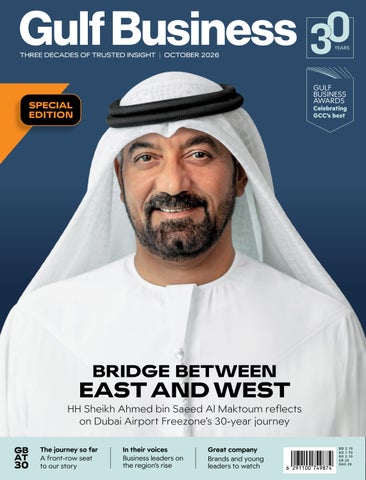
THREE DECADES OF TRUSTED INSIGHT | OCTOBER 2026 THREE DECADES OF TRUSTED INSIGHT | OCTOBER 2026
GULF BUSINESS GULF AWARDS BUSINESS AWARDS Celebrating
SPECIAL SPECIAL EDITION EDITION
Celebrating GCC’s best GCC’s best
BRIDGE BRIDGEBETWEEN BETWEEN
EAST AND WEST EAST AND WEST HH Sheikh Ahmed bin Saeed Al Maktoum reflects
HH Sheikh Ahmed bin Saeed Al Maktoum reflects on Dubai Airport Freezone’s 30-year journey on Dubai Airport Freezone’s 30-year journey
GB GB AT AT 30
30
The journey so far journey so far A The front-row seat front-row toAour story seat to our story
In their voices In theirleaders voices on Business Business the region’sleaders rise on the region’s rise
Great company Greatand company Brands young Brandstoand young leaders watch leaders to watch
BD 2.10 KD 1.70 2.10 R O B2 D .10 SR K 2D 0 1.70 D H SR O2 02 . 1 0 SR 20 DHS 20
“THE “THE MOST MOST SIGNIFICANT SIGNIFICANT SHIFT SHIFT HAS HAS BEEN BEEN THE THE EVOLUTION EVOLUTION OF OF THE THE GULF’S GULF’S ROLE ROLE ININ THE THE GLOBAL GLOBAL ECONOMY.” ECONOMY.” Rola Rola Abu Abu Manneh, Manneh, CEO, CEO, UAE, UAE, Middle Middle East East and and Pakistan, Pakistan, Standard Standard Chartered Chartered To read To read more, more, turnturn to page to page 40 40
“HOSPITALITY IS CONSTANTLY EVOLVING, AND STANDING STILL IS NOT AN OPTION.” Monther Darwish, Founder and Chairman, Palazzo Hospitality
To read more, turn to page 106
“MENA “MENA “MENA ISISNO IS NO NO LONGER LONGER LONGER AA A MARKET MARKET MARKET THAT THAT THAT INVESTORS INVESTORS INVESTORS LOOK LOOK LOOK AT ATAT ONLY ONLY ONLY THROUGH THROUGH THROUGH THE THE THE LENS LENS LENS OF OF OF CYCLICAL CYCLICAL CYCLICAL OPPORTUNITY; OPPORTUNITY; OPPORTUNITY; ITITIT ISISINCREASINGLY IS INCREASINGLY INCREASINGLY AASTRUCTURAL A STRUCTURAL STRUCTURAL ALLOCATION ALLOCATION ALLOCATION STORY.” STORY.” STORY.” Karim Karim Karim Awad, Awad, Awad, GCEO, GCEO, GCEO, EFG EFG EFG Holding Holding Holding
ToTo read read Tomore, read more, more, turn turn toturn to page page to72 page 72 72
“THE AMBITION ISISIS “THE “THE AMBITION AMBITION TO BE ONE WHOSE TO TO BETHE BE THE THE ONE ONE WHOSE WHOSE RECOMMENDATIONS RECOMMENDATIONS RECOMMENDATIONS YOU CAN TRUST, AND YOU YOU CAN CAN TRUST, TRUST, AND AND IFIFWE GET THAT RIGHT IF WE WE GET GET THAT THAT RIGHT RIGHT THE SIZE FOLLOWS.” THE THE SIZE SIZE FOLLOWS.” FOLLOWS.” Brandon Brandon Brandon Dawson, Dawson, Dawson, Co-founder, Co-founder, Co-founder, 10X 10X 10X REVIV REVIV REVIV
ToTo read read Tomore, read more, more, turn turn toturn to page page to67 page 67 67
“REPUTATION “REPUTATION “REPUTATION ISISNO IS NO NO LONGER LONGER LONGER ONLY ONLY ONLY WHAT WHAT WHAT PEOPLE PEOPLE PEOPLE SAY SAY SAY ABOUT ABOUT ABOUT YOU. YOU. YOU. ITITIS IT ISALSO IS ALSO ALSO WHAT WHAT WHAT MACHINES MACHINES MACHINES UNDERSTAND UNDERSTAND UNDERSTAND ABOUT ABOUT ABOUT YOU.” YOU.” YOU.” Sashin Sashin Sashin Govender, Govender, Govender, Founder Founder Founder ofofCredibilityX of CredibilityX CredibilityX ToTo read read Tomore, read more, more, turn turn toturn to page page to112 page 112 112
“CLIENTS IN THESE REGIONS ARE NOT NECESSARILY IMPRESSED BY THE FACT THAT A COMPANY HAS BEEN OPERATING FOR A LONG TIME.” Craig Lund, CEO, Tag Markets
To read more, turn to page 117
AI Leader of the Year AI Leader of the Year Winner: Saeed Nasser Winner: Saeed Nasser Al Ahbabi — Chief Al Ahbabi — Chiefand Shared Services Shared Services Technical Officer,and Technical Officer, ADNOC Distribution ADNOC Distribution
Banking Leader Banking Leader of the Year of the Year Winner: Raheel Ahmed Winner: — GroupRaheel CEO, Ahmed — Group CEO, Rakbank Rakbank
Tourism Leader Tourism Leader of the Year of the Year Winner: Mohamed Winner: Mohamed Abdalla Al Zaabi — Abdalla Al Zaabi Group CEO, Miral— Group CEO, Miral
Hospitality Leader Hospitality of the Year Leader of the Year Winner: Bani Haddad — Winner: FounderBani and Haddad Co-CEO,— Founder and Co-CEO, Aleph Hospitality Aleph Hospitality
Investment Leader Investment of the Year Leader of the Year Winner: Prateek Suri Winner: Prateek Suri — Founder and CEO, — Founder and CEO, MDR Investments MDR Investments
Logistics Leader Logistics of the YearLeader of the Year Winner: Tarek Sultan Winner: TarekAgility Sultan — Chairman, — Chairman, Agility
Resilient Business Resilient Leader ofBusiness the Year Leader of the Year Winner: Mazen Nahawi Winner: Mazen — Founder andNahawi CEO, — Founder CEO, CARMA andand RAIYN CARMA and RAIYN
Sustainability Leader Sustainability of the Year Leader of the Year Winner: Salmeen Winner: — Salmeen Alameri Managing Alameri — Managing Director and CEO, Director and CEO, Agthia Group Agthia Group
Conglomerate Leader Conglomerate Leader of the Year of the Year Winner: Captain Pradeep Winner: Singh —Captain FounderPradeep Singh — Founder and Chairman, and Chairman, Karma Group Karma Group
Financial Leader Financial of the YearLeader of the Year Winner: Naser Taher Winner: NaserMultiBank Taher — Chairman, — Chairman, MultiBank Group Group
CONGRATULATIONS CONGRATULATIONS TO TO OUR OUR BUSINESS BUSINESS LEADER LEADER WINNERS, WINNERS, HONOURED AT THE RITZ-CARLTON, DUBAI, ON SEPTEMBER HONOURED AT THE RITZ-CARLTON, DUBAI, ON SEPTEMBER 23, 23, FOR THEIR REMARKABLE ACHIEVEMENTS FOR THEIR REMARKABLE ACHIEVEMENTS
Transport Leader Transport of the YearLeader of the Year Winner: Engineer Winner: Engineer Mohamed Abdulla Al Ali Mohamed Abdulla Al Ali — CEO, Parkin — CEO, Parkin
Young Entrepreneur in Young Entrepreneur the Middle East 2026in the Middle East 2026 Winner: Ali Al Musalam Winner: Ali Al Musalam — Founder and CEO, — Founder Nava Groupand CEO, Nava Group
Healthcare Leader Healthcare of the Year Leader of the Year Winner: Hein van Eck Winner: van Eck — CEO,Hein Mediclinic — CEO, Mediclinic Middle East Middle East
Excellence in AI Excellenceof in the AI Year Innovation Innovation of the Year Winner: Andreas Winner: Andreas Hassellöf — Founder Hassellöf Founder and CEO, — Ombori and CEO, Ombori
Energy Leader Energy Leader of the Year of the Year Winner: Ali Alshimmari Winner: Ali Alshimmari — Managing Director — Managing Director and CEO, Global South and CEO, Global Utilities (GSU) South Utilities (GSU)
Lifetime Achievement Lifetime Achievement Award Award Dr Azad Winner: Winner: Dr Moopen —Azad Founder Moopen —Aster Founder Chairman Chairman Aster DM Healthcare DM Healthcare
Technology Leader Technology of the Year Leader of the Year Winner: HE Dr Tariq Bin Winner: Dr Tariq Bin Hendi —HE CEO, Botim, Hendi — CEO andCEO, BoardBotim, CEO andAstra BoardTech Member, Member, Astra Tech
Retail Leader Retail Leader of the Year of the Year Winner: Michael Winner: Michael Chalhoub — CEO, Chalhoub CEO, Chalhoub — Group Chalhoub Group
Turn to page 130 for the full list of Turn to page 130 for the full list of winners and highly commended winners and highly commended recipients, plus highlights from an recipients, plus highlights from an evening recognising excellence... evening recognising excellence...
MEET 30 YOUNG FOUNDERS, EXECUTIVES AND INNOVATORS HELPING SHAPE THE GULF’S FUTURE
Abbas Sajwani Founder and CEO | AHS Properties
Abdulrahman Alabid Founder | Qormuz
Abdulrahman Alammar Co-founder | Aya
Abdulrahman Rashed Aljabri CEO | Royal Smart Limousine
Akram Afif Footballer, Qatar and Al-Sadd
Ali Musalam Founder and CEO | NAVA Group
Amna Al Qubaisi Racing driver
Christina Khalife Co-founder | Arable
Dubai Abulhoul Founder and CEO | Fiker Institute
Hala Al Turk Singer and entertainer
Hamda Al Qubaisi Racing driver
Hamza Fakhruddin Managing partner | Sterling Perfumes
Lawrence Ong Co-founder | Arable
Maimuna Rashid Co-founder and CEO | Pupilar
Mashael Al-Shehi Actress, presenter and digital creator
Mohamed Attal Filmmaker, actor and content creator
Mohsin Hani Al Bahrani CEO | MHD ACERE
Munira Alkadi Co-founder | Aya
Niklas Freihofer fintech expert
Noor Naim Founder and CEO | Nafas
Nour Antabli Founder | Nutrili
Omar Baakri Co-founder and CEO | Thiqa Education
Dr Raghad Fahmi Dentist, content creator and entrepreneur
Rashed Belhasa Content creator, entrepreneur and boxer | Money Kicks
Sara Alameri Sustainability advocate and diplomat
Sarisha Ved Founder | F5 Global
Shubham Poddar Founder | Amaani
Youmna “Youmi” Khoury Founder and CEO | Youmi Beauty
Yousef Al-Musaileem Co-founder and former CEO | Tamam
Zain Khan Co-founder and CEO | Zane Developments; Founder, Housess Global Real Estate
To read more, turn to page 49...
30 UNDER 30
10 20 26
CONTENTS 30 YEARS OF CHANGE
P.10
GULF BUSINESS MARKS THREE DECADES OF COVERING THE PEOPLE, IDEAS AND INDUSTRIES THAT HAVE SHAPED THE MIDDLE EAST’S REMARKABLE BUSINESS TRANSFORMATION
g u l f b u s i n e s s .c o m | o c to b e r 2 0 2 6
03
CONTENTS
A GLOBAL HUB
Supplied
AS DUBAI AIRPORT FREEZONE MARKS ITS 30TH ANNIVERSARY, WE LOOK AT HOW IT HAS GROWN ALONGSIDE THE CITY AND THE ROLE IT HAS PLAYED IN ATTRACTING FOREIGN INVESTMENT, ENABLING TRADE AND SUPPORTING DUBAI’S WIDER ECONOMY
P.42
IN THEIR OWN WORDS
THE FUTURE IS BRIGHT
BUSINESS LEADERS REFLECT ON THE GROWTH AND FORCES THAT HAVE MADE THE REGION A MAJOR CENTRE FOR TRADE, INVESTMENT AND INNOVATION
FROM AI AND AVIATION TO ENERGY, WE EXPLORE THE FORCES SET TO RESHAPE THE MIDDLE EAST’S KEY SECTORS IN THE DECADES AHEAD
P.27
P.122
04
THE TRANSFORMATIONS THAT WE’VE SEEN IN THESE 47 YEARS, AND SPECIFICALLY IN THE 30 YEARS SINCE GULF BUSINESS WAS LAUNCHED, ARE COMPLETELY REVOLUTIONARY.” IAN FAIRSERVICE Managing Partner and Group Editorin-Chief, Motivate Media Group
g u l f b u s i n e s s .c o m | o c to b e r 2 0 2 6
Editor-in-chief Obaid Humaid Al Tayer Managing partner and group editor Ian Fairservice Chief commercial officer Anthony Milne Anthony@motivate.ae
Group content director Thomas Woodgate Thomas.Woodgate@motivate.ae
Publishing director Manish Chopra Manish.Chopra@motivate.ae
Gulf Business Awards 2026
Group editor Gareth van Zyl Gareth.Vanzyl@motivate.ae
THE 14TH GULF BUSINESS AWARDS CELEBRATED THE LEADERS, ENTREPRENEURS AND ORGANISATIONS INFLUENCING THE REGION’S BUSINESS LANDSCAPE THROUGH EXCELLENCE, INNOVATION AND IMPACT
Editor Neesha Salian Neesha.Salian@motivate.ae
Deputy editor Rajiv Pillai Rajiv.Pillai@motivate.ae
P.130
Reporter Nida Sohail
MEET THE NEW GENERATION OF ENTREPRENEURS AND CHANGEMAKERS, ALL 30 OR UNDER, MAKING AN EARLY IMPACT ACROSS THE REGION
30 UNDER 30
P.49
THIRTY COMPANIES THAT REFLECT THE EVOLUTION OF BUSINESS IN THE MIDDLE EAST, FROM ESTABLISHED NAMES TO TRANSFORMATIVE NEW PLAYERS
30 COMPANIES TO WATCH
P.74
g u l f b u s i n e s s .c o m | o c to b e r 2 0 2 6
This issue’s image, vector and font credits: Getty Images / AI / The noun project / Typography / Motivate Media Group | Cover image and gatefold images: Supplied
Nida.Sohail@motivate.ae
05
Senior art director Freddie N Colinares Freddie@motivate.ae
General manager – production S Sunil Kumar Production manager Binu Purandaran Assistant production manager Venita Pinto Digital sales director Mario Saaiby Mario.Saaiby@motivate.ae
Sales manager Hitesh Kumar Hitesh.Kumar@motivate.ae FOLLOW US ON SOCIAL MEDIA: LinkedIn: Gulf Business Facebook: GulfBusiness X: @GulfBusiness Instagram: @GulfBusiness
HEAD OFFICE: Media One Tower, Dubai Media City, PO Box 2331, Dubai, UAE, Tel: +971 4 427 3000, Fax: +971 4 428 2260, motivate@motivate.ae DUBAI MEDIA CITY: SD 2-94, 2nd Floor, Building 2, Dubai, UAE, Tel: +971 4 390 3550, Fax: +971 4 390 4845 ABU DHABI: PO Box 43072, UAE, Tel: +971 2 657 3490, Fax: +971 2 677 0124, motivate-adh@motivate.ae SAUDI ARABIA: Regus Offices No. 455 - 456, 4th Floor, Hamad Tower, King Fahad Road, Al Olaya, Riyadh, KSA, Tel: +966 11 834 3595 / +966 11 834 3596, motivate@ motivate.ae LONDON: Acre House, 11/15 William Road, London NW1 3ER, UK, motivateuk@motivate.ae
EDITOR’S NOTE
T
en years ago, we put HH Sheikh Ahmed bin Saeed Al Maktoum on the cover of Gulf Business for our 20th anniversary (pictured below). This month, he returns for our 30th — just as Dubai Airport Freezone (DAFZ) celebrates three decades of its own. In 2016, Sheikh Ahmed spoke to us about Emirates, Dubai and the ambition that connected the city to the world. Today, our cover story brings that journey full circle, tracing DAFZ’s evolution into a global business hub, alongside insights from HE Dr Mohammed Al Zarooni and Amna Lootah (page 42). That shared history runs through this edition. I sat down with Motivate Media Group's Managing Partner and Editor-in-Chief Ian Fairservice (page 8) to revisit the birth of Gulf Business in 1996, the personalities who have shaped its pages and the next chapter of a brand that now reaches far beyond print.
20th
anniversary issue
THIRTY YEARS AND COUNTING
Our 15-page In their voices feature (page 27) brings together more than 20 business leaders, including Sir Tim Clark, Yusuff Ali M A and Dr Raja Easa Al Gurg. Each has a history with Gulf Business, from our covers and interviews to our awards stage. Their reflections connect the region’s defining achievements with the opportunities ahead. Elsewhere in this 140-page special edition, we revisit landmark covers and defining moments, spotlight 30 companies that have emerged over the past three decades, introduce our 30 Under 30 power list and celebrate the winners of the 14th Gulf Business Awards (page 130). You’ll notice a fresh look, too. We redesigned GulfBusiness.com earlier this year; now we’ve refreshed the magazine. The design has changed, but our purpose hasn’t: telling the stories of the people, companies and ideas shaping the Gulf. To everyone who has shared this journey with us, thank you. We have plenty more stories to tell.
TO EVERYONE WHO HAS SHARED THIS JOURNEY WITH US, THANK YOU. WE HAVE PLENTY MORE STORIES TO TELL
emirates chief His Highness sheikh ahmed bin saeed al Maktoum in interview P. 2 0 Comment Can we now call Dubai a cultural hub?
P. 6 6 Arabian Travel Market Why the days of record room rates may be over
P. 6 8 Saxo Bank Steen Jakobsen on how to improve Gulf economies
!GB Cover Final_May16.indd 1
Gareth van Zyl, group editor BD 1.50 KD 1.20 RO 1.50 QR 15 SR 15 DHS 15
# 0 5 . M AY 2 0 1 6
4/28/16 1:47 PM
HH Sheikh Ahmed graces our 20th anniversary cover in 2016. A decade later, he returns for our 30th.
06
g u l f b u s i n e s s .c o m | o c to b e r 2 0 2 6
We’ve seen every “next big thing” since 1996.
2026 – Etihad Rail
2023 – COP28
2016 – Saudi Vision 2030
2010 – Burj Khalifa
2003 – Saudi Joins WTO
1996 – Qatar’s First LNG Export
SCAN TO READ THE ANNIVERSARY ISSUE
gulfbusiness.com GulfBusiness
The first edition appeared in May 1996, famously featuring Prince Alwaleed bin Talal Al Saud on the cover, alongside an interview with former South African president and Nobel Peace Prize laureate FW de Klerk. Thirty years later, I wanted to know how it happened. Our interview also came during an especially busy week. Moments earlier, Fairservice had delivered his annual State of the GCC address ahead of the Gulf Business Awards, which in our 30th anniversary year was shaping up to be one of our biggest yet. Then he sat down with me for almost 40 minutes. My burning questions had been building for some time. How did Gulf Business begin? What was it like to cover the Gulf in 1996? Which encounters stayed with him? And after three decades of enormous economic and technological change, what should this brand now become?
THE BIRTH OF GULF BUSINESS For Fairservice, the decision to launch a business magazine was the natural next step. “We had the entertainment, sports, we had the fashion, women’s lifestyle,” he recalled. “The next most logical step was a business magazine.” To understand that decision requires going back briefly to What’s On. The magazine had grown rapidly after its 1979 launch and, in its early years, covered virtually everything. “We had a legal column, our Legal Eagle. We had a fashion section, we had a business page or business pages. Obviously we had sports, we had dining out,” Fairservice said. “So we were trying to be a jack of all trades.”
THE BIG INTERVIEW
IAN FAIRSERVICE
ON WHY CONTENT IS STILL KING
For nearly five decades, Ian Fairservice has had a front-row seat to the transformation of the Gulf. As Gulf Business marks its 30th anniversary, Gareth van Zyl sits down with the Motivate Media Group Managing Partner and Editor-in-Chief to revisit the birth of the magazine, the remarkable people who have passed through its pages and why relevance remains everything
I
suited up more than usual for this interview. When you are sitting down across from Ian Fairservice — your boss, the founder of the company you work for and one of the Gulf’s longest-serving media figures — you make an effort. I also had a lot that I wanted to ask him. Fairservice arrived in Dubai in January 1978 as a young hotelier and launched What’s On the following year. Nearly five decades later, the business he founded has grown into Motivate Media Group. But this conversation was really about one chapter in that story: Gulf Business. 08
Pics: Motivate Media Group
WORDS: GARETH VAN ZYL
Ian Fairservice with HE Abdul Aziz Al Ghurair, the inaugural Lifetime Achievement winner at the 2012 Gulf Business Awards
g u l f b u s i n e s s .c o m | o c to b e r 2 0 2 6
T H E G U L F B U S I N E S S J O U R N E Y
Over time, Motivate began building specialist publications around those audiences. Business was an obvious opportunity. The plan was to take that existing business coverage, “get some specialists on board” and create what Fairservice called a “specific, serious business magazine”. That became Gulf Business. Allen Armstrong was at the helm, Peter Cooper was recruited as editor and George Behind the mics: Ian Fairservice and Gareth Hopkin served as deputy editor. van Zyl revisit 30 years of Gulf Business Other journalists associated with the title over the years included Brandy subsequently became close friends. Scott and Richard Dean. Then there was Piers Morgan. “We had a very strong team,” “I first met him when I interviewed Fairservice said. him for Gulf Business,” Fairservice said. There was also a powerful reason “He subsequently returned the favour for the magazine to exist. and interviewed me for the BBC.” “There wasn’t another business There were many more. magazine covering the Gulf, so we “We had some great stories and we took it on.” had some great interviews,” he said. “We had a lot of very interesting people that A FRONT-ROW SEAT crossed our paths.” Its arrival proved well timed. Fairservice That access extended deep into the describes 1996 as the “dawn of another Gulf’s business and public life. major period of development” in the “We’ve had access, privileged access,” region. Yet he is also careful to correct the Fairservice said, recalling interviews notion that the Gulf’s growth story began with diplomats, business leaders and in the late 1990s. senior figures from across the region, Emirates was already a decade old. including HH Sheikh Ahmed bin Saeed Hotels were multiplying. The exhibitions Al Maktoum. sector was developing and significant THIRTY YEARS OF CHANGE economic expansion had taken place The world in which Gulf Business now across the UAE. operates is almost unrecognisable “There was a lot of development from the one in which it launched. before the millennium,” he said. Fairservice has seen the media industry But the pace that followed was move from physical typesetting and extraordinary. For Gulf Business, it artworks to desktop publishing, the meant three decades documenting the internet, email, digital news, social companies, entrepreneurs and decisionmedia, influencers, video, podcasts and makers shaping that transformation. now artificial intelligence. Fairservice was often part of that “The transformations that we’ve seen coverage himself. For years, he wrote in these 47 years, and specifically in the the magazine’s back-page Out to Lunch 30 years since Gulf Business was launched, column, sitting down with prominent are completely revolutionary.” figures passing through the region. The Gulf itself has faced its own Some encounters became friendships. shocks along the way: financial crises, He interviewed celebrated wars, SARS, Covid and periods of photographer Lord Lichfield for the geopolitical uncertainty. Fairservice column and later published a book comes back to one quality. Tenacity. with him. Chef Keith Floyd was another “There is something about this region – memorable lunch. and it’s not just the Emirates, I’m talking “Obviously taking Keith Floyd generally about the region,” he said. out to lunch was no imposition,” “There is an acceptance that these things Fairservice joked. The pair
g u l f b u s i n e s s .c o m | o c to b e r 2 0 2 6
will happen and you just have to keep on.” Not everyone makes it through. “Those that stay and those that survive to fight another day tend to be stronger through the experience.” For a 30-year-old media brand, there is a lesson in that too.
WHAT COMES NEXT? Fairservice no longer regards Gulf Business simply as a magazine. “We view each of these things as brands,” he said. “We don’t think about Gulf Business being a magazine because obviously there’s a lot more depth to it than it being just a magazine.” Digital can report a story immediately. Print cannot – and should not try to compete on those terms. Instead, Fairservice sees the magazine as a home for “in-depth interviews, analysis, long storytelling” and, at its best, something more permanent. “A publication of record.” Events have their own role: tackling the defining issues of the moment, “giving people a voice and bringing the right people in front of the right audiences”. Across every platform, the challenge is the same. “It’s all about brands; it’s all about relevance.” Perhaps my favourite answer came towards the end, when I asked what Fairservice wished he had understood as a young businessman. Cash flow. A neighbour, Walter Bailey, then managing director of Ducab, once gave him a lesson he has never forgotten. “Turnover is vanity. Profit is sanity, but cash flow is reality.” I then replied, “Cash is king.” Fairservice paused. Then came the publisher’s addendum. “It’s a bit like now – content is king.” Thirty years into Gulf Business, I’m not sure there could be a more fitting closing line. SCAN TO WATCH Scan the QR code to watch the full conversation with Ian Fairservice on our website. The full interview transcript is also available on GulfBusiness.com.
09
DEFINING MOMENTS
30 YEARS
OF CHANGE THREE DECADES. COUNTLESS STORIES. ONE REMARKABLE REGION. WORDS GARETH VAN ZYL
10
g u l f b u s i n e s s .c o m | o c to b e r 2 0 2 6
Since our first issue in 1996, Gulf Business has had a front-row seat to the defining moments that shaped the Gulf ’s extraordinary rise. From ambitious infrastructure projects and economic reforms to global crises, technological breakthroughs and bold new visions, we’ve chronicled the people, companies and ideas that have transformed the region. Along the way, the Gulf has evolved into one of the world’s leading centres for business, finance, tourism and innovation. The landmark covers featured in these pages capture more than the history of a magazine. They tell the story of a region defined by resilience, ambition and reinvention — one that continues to set the pace for the future. Turn the page to explore defining moments that shaped the Gulf over the past three decades
g u l f b u s i n e s s .c o m | o c to b e r 2 0 2 6
11
FEATURE
1996 –2005
MAY 1996
DECEMBER 1996
A NATION AT 25
THE JOURNEY BEGINS Gulf Business launched at a pivotal moment for the region and the world. The inaugural issue captured a Gulf embracing economic reform, investment and globalisation, with cover stories on Saudi billionaire Prince Alwaleed bin Talal, former US President George H W Bush’s Gulf visit and banking transformation across the GCC. It also examined South Africa’s reintegration into the global economy under President Nelson Mandela, following the country’s first democratic elections in 1994 and the adoption of its new Constitution in 1996, signalling a new era of international trade and investment.
12
g u l f b u s i n e s s .c o m | o c to b e r 2 0 2 6
As the UAE celebrated the 25th anniversary of its formation, the magazine marked the milestone with a special economic survey examining the nation’s remarkable progress since unification in 1971 under the leadership of the late Sheikh Zayed bin Sultan Al Nahyan. The issue explored the country’s expanding banking sector, growing private enterprise and investment climate, reflecting a nation that had transformed from a young federation into one of the Middle East’s fastestgrowing economies. Alongside this, the magazine examined the GCC’s privatisation agenda, emerging opportunities across the region and Russia’s post-Soviet economic awakening.
DEFINING MOMENTS
BUILDING THE FOUNDATIONS
MAY 1997
DECEMBER 1999
OCTOBER 2001
DUBAI’S SKYLINE TAKES SHAPE
THE NEW MILLENNIUM
AFTERMATH OF 9/11
Gulf Business marked its first anniversary with an iconic cover showing the Burj Al Arab rising from the Arabian Gulf while still under construction, long before it became the global symbol of Dubai. Then known as the Chicago Beach Hotel project, the sail-shaped landmark embodied the emirate’s growing ambition to redefine luxury tourism and establish itself as a world-class destination. The issue’s High-Rise Future feature captured a city on the cusp of extraordinary transformation, documenting one of the most recognisable construction projects in modern architectural history.
As the internet revolution gathered pace worldwide, Dubai moved decisively to position itself at the forefront of the digital economy. Gulf Business dedicated its cover to Sheikh Mohammed bin Rashid Al Maktoum’s vision for Dubai Internet City, a bold initiative designed to attract global technology companies and diversify the emirate’s economy beyond oil. At a time when the dotcom boom was reshaping industries, the issue also examined entrepreneurship, defence, retail and regional business trends. More than two decades later, Dubai Internet City remains one of the world’s leading technology hubs and a cornerstone of the emirate’s knowledge economy.
In the immediate aftermath of the September 11 attacks, Gulf Business examined a world entering a period of profound uncertainty. Its stark “Global Crisis” cover asked what the unfolding geopolitical and economic shock would mean for the Middle East, as governments, companies and investors confronted disrupted travel, volatile markets and heightened regional tensions. The attacks reshaped international security, trade and relations between the Arab world and the West, while accelerating political and economic changes across the Gulf. The issue captured a defining moment when global events suddenly placed the region at the centre of an uncertain era.
g u l f b u s i n e s s .c o m | o c to b e r 2 0 2 6
13
NOVEMBER 2002
DUBAI’S $28BN TRANSFORMATION PLAN Gulf Business captured a pivotal moment when Dubai began translating its global ambitions into landmark developments. Its special report examined a planned $28bn boost to business, including the Dubai International Financial Centre, Dubai Marina and a major expansion of Dubai International Airport. Together, these projects signalled the emirate’s determination to become a leading hub for finance, tourism, aviation and international investment. Many of the plans featured were still emerging, yet they would reshape Dubai’s economy and skyline over the following decades. The issue offered an early blueprint for modern Dubai.
FEATURE
2006–2015
JULY 2003
DECEMBER 2004
JULY 2007
FEBRUARY 2008
EMIRATES BETS ON GLOBAL GROWTH
REMEMBERING SHEIKH ZAYED
DUBAI’S BOOM YEARS
THE GLOBAL FINANCIAL CRISIS
As geopolitical uncertainty and the SARS outbreak disrupted global aviation, Gulf Business examined Emirates’ bold decision to invest for the long term rather than retreat. Led by Sheikh Ahmed bin Saeed Al Maktoum, the airline announced a record aircraft order worth about $19bn, signalling its confidence in Dubai’s future as a global aviation hub. At a time when many airlines were scaling back their ambitions, Emirates was laying the foundations for a new era of growth. The strategy would prove transformational. Over the following two decades, Emirates expanded into one of the world’s largest international airlines, helping establish Dubai as a leading travel hub.
The passing of the UAE’s Founding Father, the late Sheikh Zayed bin Sultan Al Nahyan, marked the end of a defining chapter in the nation’s history. The magazine reflected on his extraordinary legacy, celebrating the vision that united the Emirates in 1971 and laid the foundations for decades of economic growth and stability. His leadership transformed a young federation into a prosperous nation, guided by a commitment to unity, progress and the wellbeing of its people. The issue also looked ahead to the leadership of Sheikh Khalifa bin Zayed Al Nahyan, capturing a pivotal moment as the UAE prepared for a new era while building on the values of Sheikh Zayed.
Dubai entered one of the most ambitious periods in its history as Gulf Business explored the rapid expansion reshaping the emirate. Mega-projects, soaring property prices, global acquisitions and landmark developments such as the future Burj Khalifa reflected unprecedented confidence in Dubai’s economic model. The issue highlighted how infrastructure, entrepreneurship and international investment were transforming the city into a global business hub. Although the global financial crisis would arrive little more than a year later, many of the long-term investments made during this period continue to underpin Dubai today.
As financial markets unravelled following the collapse of the US subprime mortgage market, Gulf Business examined what quickly became the world’s worst financial crisis in generations. While economies across Europe and North America entered recession, the magazine explored why the GCC appeared better positioned than many markets, supported by strong oil revenues, liquidity and government spending. Although the crisis would later reshape property markets and investment across the region, it also reinforced the Gulf’s resilience and accelerated reforms that strengthened the region’s long-term economic foundations.
14
g u l f b u s i n e s s .c o m | o c to b e r 2 0 2 6
DEFINING MOMENTS
AMBITION TAKES FLIGHT
DECEMBER 2013
AUGUST 2014
SEPTEMBER 2015
AUGUST 2014
gulfbusiness.com
SEPTEMBER 2015
48 |SMARTER THAN THE REST Cities of today are in a race to be cities of the future 52 |MALL RUN The Dubai retail story is far from done
VOLUME 19 . ISSUE 04
51 |modi’s moment Indian PM’s visit to the UAE gulfbusiness.com
VOLUME 20 . ISSUE 05
55 |jet-setting JetSmarter’s expansion plans 72 |Racing ahead W Motors’ supercar ambitions
56 |DON’T TURN OFF THE TAP The Middle East’s oil production sector is thirsty for investments
!$GB Final Cover August 2014.indd 1
The UAE will boldly go – says project science lead Sarah Amiri
Bahrain BD 1.50 Kuwait KD 1.20 Oman RO 1.50 Qatar QR 15 Saudi Arabia SR 15 UAE DHS 15
MULTINATIONALS LOOK ON AS IRAQ FRACTURES UNDER AN ISIL ONSLAUGHT AND THE KURDISH DESIRE FOR INDEPENDENCE
mission to mars Bahrain BD 1.50 Kuwait KD 1.20 Oman RO 1.50 Qatar QR 15 Saudi Arabia SR 15 UAE DHS 15
PICKING UP THE PIECES
7/24/14 4:51 PM
!$GB Cover_Sep2015_final.indd 1
8/27/15 7:01 PM
DUBAI WINS EXPO 2020
INSTABILITY AND RESILIENCE
REACHING FOR MARS
Dubai’s successful bid to host Expo 2020 marked a defining milestone in its global rise. Gulf Business captured the renewed optimism surrounding the historic victory, including an exclusive interview with Reem Al Hashimy, then UAE Minister of State and managing director of the Expo bid committee. Winning the event triggered a significant wave of investment in infrastructure, transport and tourism, reinforcing Dubai’s position as a global destination for business and innovation. Although the Expo was later postponed because of the Covid-19 pandemic, its enduring legacy continues to shape the UAE’s economy and growing global profile.
As the rapid rise of ISIS plunged Iraq into crisis and redrew the Middle East’s geopolitical landscape, we explored the implications for businesses, investors and multinational corporations operating in the region. At the same time, the issue highlighted the Gulf’s enduring optimism, examining Dubai’s ambitions to become a global smart city, the continued strength of its retail sector and the longterm outlook for energy investment. It also explored how the UAE was positioning itself to attract international capital and talent. It captured a defining moment when regional turmoil stood in stark contrast to the UAE’s unwavering focus on growth.
Gulf Business spotlighted one of the UAE’s boldest national ambitions, featuring project science lead Sarah Al Amiri on its cover shortly after the launch of the country’s ambitious Mars programme. At a time when the idea of an Arab mission to the Red Planet seemed audacious, the magazine explored the vision, technology and scientific expertise driving the initiative, reflecting the UAE’s determination to diversify its economy through innovation and knowledge. The cover in 2015 proved remarkably prescient. Years later, in 2021, the Hope Probe successfully entered Mars’ orbit, making the UAE the first Arab nation to reach the Red Planet.
g u l f b u s i n e s s .c o m | o c to b e r 2 0 2 6
15
THROUGH BOOM, CRISIS AND TRANSFORMATION, GULF BUSINESS CAPTURED THE UAE’S DETERMINATION TO LOOK AHEAD — FROM RESHAPING GLOBAL AVIATION TO REACHING MARS.
FEATURE
2016 –2026
JULY 2017
JUNE 2019 Gulf Business
P. 2 6 Bankruptcy
What does the UAE’s new bankruptcy law mean for businesses?
P. 4 2 Entrepreneurs
We take a look at some of the region's most exciting entrepreneurs
P. 4 4 FinTech focus
How the GCC aims to become a leader in the world of FinTech
GBofficial
GulfBusiness
APRIL 2020
APRIL 2025
GulfBusinessMagazine
G E N E R AT I O N
P. 5 8 Digitisation
Why the Gulf's SMEs must undertake digital transformation
SHAPING THE FUTURE
K S A
BD 1.50 KD 1.20 RO 1.50 SR 15 DHS 15
# 0 7. j u ly 2 0 1 7
Rebuilding the Real estate industRy
A D WA A L D A K H E E L T H E FA C E O F NEW SAUDI ARABIA ENTREPRENEUR STOCK TRADER INVESTOR CEO ACADEMIC AUTHOR PILOT H U M A N I TA R I A N RECORDING ARTIST S O C I A L M E D I A S TA R C H A M P I O N AT H L E T E ROLE MODEL FOUNDER
20 Our Youth Issue explores
Celebrating 21 years of insight and analysis
how the GCC is developing its leaders of tomorrow
44 Jumeirah CEO José Silva
on what the future holds for the luxury hotel chain
48 Advertising legend Jacques
Seguela on why now is the time for Gulf creatives to shine B D 2 .1 0 K D 1 . 7 0 R O 2 .1 0 S R 2 0 D H S 2 0
June 2019
!GB Cover Final_JULY17.indd 1
6/22/17 2:14 PM
01 Cover June 2019.indd 1
5/28/19 3:57 PM
REBUILDING CONFIDENCE
THE RISE OF A NEW SAUDI ARABIA
WORLD CHANGES OVERNIGHT
THE NEW CENTRES OF POWER
Following a challenging period for the UAE’s property sector, Gulf Business examined whether the real estate industry had reached a turning point. The cover story explored how developers were rebuilding for the future, highlighting emerging trends such as 3D-printed buildings, shifting buyer expectations and the growing emphasis on innovation. It also featured an interview with Rizwan Sajan, founder and chairman of Danube Group, reflecting the resilience of one of the region’s most important industries. Looking back, the issue captured an inflection point before the market entered a new phase of growth, underpinned by regulatory reform, and momentum generated by Expo 2020.
As Saudi Arabia accelerated its Vision 2030 transformation under HH Crown Prince Mohammed bin Salman, Gulf Business dedicated its Youth Issue to the kingdom’s emerging generation of entrepreneurs, innovators and business leaders. The cover featured entrepreneur and polymath Adwa AlDakheel, described as “the face of new Saudi Arabia”, reflecting a country undergoing sweeping economic and social reforms, from greater opportunities for women and young people to the growth of the private sector. Her story embodied the entrepreneurial spirit of a generation determined to shape Saudi Arabia’s future. The issue went on to further explore the region’s future business leaders.
As Covid-19 brought the world to a standstill, Gulf Business examined the profound impact of the pandemic on economies, businesses and everyday life, asking how the crisis would reshape the future. With its striking “The New World Order” cover, the issue explored resilience in the face of unprecedented disruption while also looking ahead to the forces that would define the postpandemic era, including digital transformation, cybersecurity, sustainability and the UAE’s continued investment in its space programme. It highlighted how businesses were adapting to new realities, accelerating innovation and rethinking traditional models of growth. It was a turning point in history.
Gulf Business published its flagship Top 100 Most Powerful Arabs list, celebrating the visionaries, policymakers and business leaders reshaping the global economy. The 2025 edition reflected a changing regional power dynamic, naming HH Sheikh Tahnoon bin Zayed Al Nahyan as the new number one, recognising his growing influence across artificial intelligence, sovereign wealth and global finance. The issue also explored the UAE’s emergence as a global AI hub, featured an exclusive interview with Etihad Airways CEO Antonoaldo Neves, and examined investment trends, underscoring the Gulf’s growing role at the centre of the world’s economic transformation.
16
g u l f b u s i n e s s .c o m | o c to b e r 2 0 2 6
DEFINING MOMENTS
INTO THE FUTURE
OCTOBER 2026
THREE DECADES OF TRUSTED INSIGHT | OCTOBER 2026
GULF BUSINESS AWARDS
SPECIAL EDITION
Celebrating GCC’s best
THE NEXT CHAPTER ... FROM RESILIENCE TO REINVENTION. As we look ahead, we explore the trends, technologies and transformations that will shape the Gulf’s next chapter — and the opportunities that lie on the horizon.
BRIDGE BETWEEN
EAST AND WEST
HH Sheikh Ahmed bin Saeed Al Maktoum reflects on Dubai Airport Freezone’s 30-year journey
GB AT
30
The journey so far A front-row seat to our story
In their voices Business leaders on the region’s rise
GB_102026.P01_COVER_ H.H Ahmed bin Saeed Al Maktoum_204 mm.indd 1
Great company Brands and young leaders to watch
30 YEARS OF GULF BUSINESS
BD 2.10 KD 1.70 RO 2.10 SR 20 DHS 20
02/10/2026 4:22 PM
Thirty years after publishing its first issue, Gulf Business marks a milestone with this special anniversary edition, celebrating the leaders, companies and defining moments that have shaped the Gulf since 1996. Featuring exclusive reflections from the business figures who helped build the region, alongside our 30 Companies to Watch and 30 Under 30 lists, the issue looks back on three decades of transformation while exploring the innovations that will define the decades ahead. The celebrations culminate with the 14th Gulf Business Awards, recognising the organisations and leaders writing the next chapter of the Gulf’s success story.
g u l f b u s i n e s s .c o m | o c to b e r 2 0 2 6
Turn to p.122
17
HALL OF FAME
THE PEOPLE WHO SHAPED AN ERA FOR 30 YEARS, GULF BUSINESS HAS CHRONICLED THE LEADERS AND PIONEERS BEHIND THE GULF’S TRANSFORMATION This Hall of Fame celebrates the people who have defined that journey — from lifetime achievement recipients and Gulf Business Awards' winners to the cover stars who captured pivotal moments in the region’s development. It also looks back at the founding team who launched the magazine in 1996 and the memorable figures featured in its early Out to Lunch pages.
1996
18
2026
g u l f b u s i n e s s .c o m | o c to b e r 2 0 2 6
Inside the Hall of Fame P.20–21
LIFETIME ACHIEVEMENT AWARD WINNERS
P.22–23
GULF BUSINESS AWARD WINNERS
P.24 –25
FOUNDING TEAM AND OUT TO LUNCH
P.27– 41
HEAR FROM THE TOP LEADERS
g u l f b u s i n e s s .c o m | o c to b e r 2 0 2 6
19
A STAGE FOR THE REGION’S LEADERS Since 2012, the Gulf Business Awards stage has welcomed many of the people who have helped shape the Gulf’s extraordinary business story. We open our Hall of Fame by revisiting the recipients of its highest honour: the Lifetime Achievement Award WORDS GARETH VAN ZYL
W
hen the inaugural Gulf Business Awards were held in 2012, some of the UAE’s most prominent business leaders gathered to celebrate the individuals and companies driving a rapidly changing economy. HE Abdul Aziz Al Ghurair received the first Lifetime Achievement Award that evening. In the years since, the honour has passed to pioneers of banking, real estate, aviation, education, hospitality, retail, culture and more — figures whose careers have unfolded alongside the remarkable transformation of the region itself. As Gulf Business celebrates its 30th anniversary, we return to the archive to remember the top leaders who have received the award’s highest honour up until 2025 — and the moments and personalities that have made the Gulf Business Awards a fixture on the region’s business calendar.
2012
2015
HE ABDUL AZIZ AL GHURAIR CEO, Mashreq
HE EASA SALEH AL GURG Chairman, Easa Saleh Al Gurg Group
A pioneer of UAE banking whose influence has extended across business, public service and philanthropy for decades.
One of the UAE’s most respected business figures, recognised for a lifetime of contribution to commerce, public service and diplomacy.
2013
2016
KHALAF AL HABTOOR Chairman, Al Habtoor Group
SUNNY VARKEY Founder and Chairman, GEMS Education
A self-made entrepreneur who built Al Habtoor Group into one of the Gulf’s most prominent diversified business groups.
An education pioneer who transformed a family school business into a global network while extending his impact through philanthropy.
2014
2017
MOHAMED ALABBAR Chairman, Emaar
HH SHEIKH AHMED BIN SAEED AL MAKTOUM Chairman and Chief Executive, Emirates Airline and Group
A defining figure in modern Dubai whose leadership at Emaar helped reshape the city’s skyline and international reputation. 20
g u l f b u s i n e s s .c o m | o c to b e r 2 0 2 6
A central figure in Dubai’s extraordinary rise, with an enduring influence across aviation, tourism and the emirate’s wider economy.
H A L L O F FA M E
2018
2022
HE SHEIKHA LUBNA BINT KHALID AL QASIMI President, Zayed University; former UAE minister
ISOBEL ABULHOUL OBE CEO and Trustee, Emirates Literature Foundation; Co-founder, Magrudy’s A lifelong champion of books and literacy whose work has helped transform the UAE’s literary and cultural landscape.
A trailblazing leader whose career broke barriers across government and business, including becoming the UAE’s first female minister.
2023
2020
HUSSAIN SAJWANI Chairman and Founder, DAMAC Group
SIR TIM CLARK President, Emirates Airline
One of the region’s most recognisable entrepreneurs, whose journey with DAMAC became part of Dubai’s remarkable property and business story.
One of global aviation’s most influential leaders, instrumental in developing Emirates from a young airline into an international powerhouse.
2024
2021
MISHAL KANOO Chairman, The Kanoo Group
COLM MCLOUGHLIN Executive Vice Chairman and CEO, Dubai Duty Free
A longstanding Gulf Business contributor, Kanoo received the recognition for his enduring influence on the region’s business landscape and commitment to entrepreneurship.
The driving force behind Dubai Duty Free’s transformation from a start-up operation into one of travel retail’s great success stories.
2025
REMEMBERING COLM
GERALD LAWLESS Former CEO, Jumeirah Group
When Colm McLoughlin arrived in Dubai in 1983 as part of the team tasked with launching Dubai Duty Free, few could have imagined what would follow. Over 41 years, he helped transform the operation into a global travel-retail powerhouse generating more than $2bn in annual sales. Gulf Business recognised that extraordinary contribution with its Lifetime Achievement Award in 2021. McLoughlin passed away in October 2024, aged 81, leaving behind a legacy inseparable from Dubai’s rise as a global aviation and retail hub.
g u l f b u s i n e s s .c o m | o c to b e r 2 0 2 6
A hospitality pioneer whose leadership at Jumeirah helped establish Dubai among the world’s great tourism destinations.
21
H A L L O F FA M E
LEADERS OF THEIR TIME Every era brings its own challenges, opportunities and defining personalities. Since the Gulf Business Awards began in 2012, its annual leadership honours have captured some of the executives making their mark on the region at that particular moment. We look back at the leaders, milestones and memories that have shaped the awards. WORDS GARETH VAN ZYL
THE LEADERS
U
nlike the Lifetime Achievement Award, which celebrates the arc of an entire career, the Gulf Business Awards’ annual leadership honours have always been about the moment. Over the years, they have recognised executives steering major institutions through periods of extraordinary growth, transformation
and disruption — from infrastructure and aviation to banking, healthcare, hospitality and industry. The name of the top accolade has evolved along the way, from CEO of the Year to Business Leader of the Year, while in some editions leadership has been recognised across individual sectors. But the principle has remained much the same: to celebrate the
people making an exceptional impact on the region’s business landscape. As Gulf Business marks its 30th anniversary, we return to the archive to revisit some of the leaders who defined their year — before stepping back to celebrate the people, atmosphere and occasions that have made the Gulf Business Awards what they are today.
2013
2014
2016
2018
2020
HE SAEED MOHAMMED AL TAYER MD and CEO, Dubai Electricity and Water Authority Recognised as Dubai accelerated its infrastructure ambitions, with Al Tayer driving its electricity and water strategy.
SHAYNE NELSON CEO, Emirates NBD The banking veteran took the top honour as Emirates NBD strengthened its position at the heart of the UAE’s rapidly expanding financial sector.
PAUL GRIFFITHS CEO, Dubai Airports Honoured for Dubai aviation as DXB reinforced its position among the world’s leading international passenger hubs.
HE MAYTHA AL HABSI CEO, Emirates Foundation Recognised for leadership centred on empowering young people and helping prepare younger Emiratis for the opportunities ahead.
DAVID HADLEY CEO, Mediclinic Middle East A healthcare leader recognised in an extraordinary year, when the pandemic placed the region’s medical sector firmly under the spotlight.
2021 LEADERSHIP, REDEFINED RATHER THAN NAMING A SINGLE OVERALL BUSINESS LEADER OF THE YEAR, THE 2021 AWARDS RECOGNISED STANDOUT LEADERSHIP ACROSS INDIVIDUAL INDUSTRIES.
Among the winners were Rola Abu Manneh in banking, Hussain Sajwani in real estate, Paddy Padmanathan in energy, Dr Shamsheer Vayalil in healthcare, Issam Kazim in tourism and hospitality and Captain Mohamed Juma Al Shamisi in transport and logistics. Khadija Al Bastaki was also named Businesswoman of the Year.
2022
2024
2025
YOGESH MEHTA CEO, Petrochem Middle East The entrepreneur took the overall honour as Gulf businesses emerged from the pandemic and entered a period of fresh expansion.
MARK KIRBY Head of Hospitality, Emaar Hospitality Group Recognised as the region’s tourism and hospitality sector entered another period of rapid growth and greater investment.
ROLA ABU MANNEH CEO, UAE, Middle East and Pakistan, Standard Chartered One of the region’s leading bankers took the top honour for its consistent financial success.
FROM LEADER TO LIFETIME FOR A SELECT FEW, RECOGNITION AT THE GULF BUSINESS AWARDS HAS SPANNED DIFFERENT CHAPTERS OF THEIR CAREERS GERALD LAWLESS
HE ABDUL AZIZ AL GHURAIR
SIR TIM CLARK
Business Leader of the Year 2012
Lifetime Achievement 2012
Business Leader of the Year 2015 & 2023
Lifetime Achievement 2025
22
Business Leader of the Year 2017
g u l f b u s i n e s s .c o m | o c to b e r 2 0 2 6
Lifetime Achievement 2020
01
AWARDS BY THE NUMBERS
2012
THE BEGINNING The inaugural Gulf Business Awards marked the start of the annual celebration.
13
LIFETIME ACHIEVEMENT HONOUREES Thirteen leaders have received the awards’ highest individual honour.
03
LEADER–LIFETIME CROSSOVERS Three names have appeared in both the annual top-leadership roll call and the Lifetime Achievement Hall of Fame.
03 02 04 05
31
TROPHIES IN 2020 Even during the pandemic, the eighth edition of the awards recognised 31 winners across business and special categories.
350
06
GUESTS IN 2018 Around 350 people attended the 2018 ceremony as the Gulf’s business community gathered in Dubai.
07
08
10TH
EDITION IN 2022 A decade after their launch, the Gulf Business Awards celebrated their 10th edition.
09
01 Ian Fairservice addresses the inaugural Gulf Business Awards in 2012 02 Trophies on display in 2013 03 Mohamed Alabbar greets guests 04 Guests snap selfies in 2016 05 HE Maytha Al Habsi on stage in 2018 06 Tom Urquhart presents at the 2020 awards 07 Entertainment takes centre stage 08 A full house in 2024 09 Guests network in 2025
MORE THAN A TROPHY
THE NEXT CHAPTER
Across more than a decade, the Gulf Business Awards have reflected a business community in constant motion. The sectors have evolved, new categories have emerged and a new generation of entrepreneurs and executives has stepped forward. But year after year, the stage has continued to bring together many of the people and companies driving the Gulf’s transformation. For Gulf Business, the awards have also become another way of doing what the magazine has done for 30 years: documenting the people behind the region’s business story. And that story is still being written.
g u l f b u s i n e s s .c o m | o c to b e r 2 0 2 6
Gulf Business Awards returned in 2026, bringing another set of top leaders to the stage. Turn to page 130 to see the winners
23
The people who started it all
F
rom the founding editors to the journalists who became familiar names across the region, Gulf Business has spent three decades bringing together some of the best talent in business journalism. In May 1996, Gulf Business arrived with an ambitious brief: to tell the stories behind one of the world’s fastest-growing business regions. Its inaugural issue brought together an experienced team of editors, journalists and contributors who would establish the magazine’s reputation for incisive reporting and regional insight. At its heart was Ian Fairservice, the magazine’s founding executive editor and managing partner, who remains Motivate Media Group’s managing partner and group editor-in-chief today. Working alongside him was founding editor Peter Cooper, an experienced British financial journalist who would go on to help establish AME Info, one of the Middle East’s pioneering business news websites, and become a financial commentator and author. Senior editor Allen Armstrong was another influential figure. His welcome note in the inaugural issue set out the magazine’s editorial ambitions, promising readers a fresh Gulf perspective on the business world. Armstrong helped develop numerous Motivate publications during his decade with the company, leaving an enduring legacy before his death in Malta in 2003, aged 62. The original editorial team also featured deputy editor George Hopkin, art editor Warren Jackson and staff writers Susan Macaulay, Brian Scudder and Justin Wood. Together, they produced a magazine that looked beyond the headlines, combining regional business reporting with international perspectives and exclusive interviews. Over the following decades, Gulf Business would become a proving ground for journalists who went on to make their mark across the industry. Richard Dean, who worked at the magazine before becoming one of Dubai’s most recognisable business broadcasters, spent more than two decades presenting Dubai Eye 103.8 FM’s Business Breakfast. Brandy Scott, a former Gulf Business deputy editor, similarly made the transition to broadcasting, also becoming a long-running and well-known voice on Dubai Eye’s Business Breakfast.
MAY 1996 EDITION Scan the QR code to read the very first issue of Gulf Business
24
IN MAY 1996, GULF BUSINESS ARRIVED WITH AN AMBITIOUS BRIEF: TO TELL THE STORIES BEHIND ONE OF THE WORLD’S FASTEST-GROWING BUSINESS REGIONS.
Opening editorial note in the inaugural May 1996 issue of Gulf Business.
g u l f b u s i n e s s .c o m | o c to b e r 2 0 2 6
Bashar Nejdawi: Then a Motorola executive, featured in October 1996
David C. Litt: Then US ambassador to the UAE, featured in July 1996
Out to Lunch: 30 years on
O
ut to Lunch always had the last word. For years, the column occupied the closing pages of Gulf Business, becoming a staple of the magazine with its blend of candid conversation, business insights and colourful personalities. Its first guest, in May 1996, was British lawyer Giles Dixon. US ambassador David C Litt followed in July, with Motorola executive Bashar Nejdawi appearing in October. Three decades later, all three revisit those conversations. Dixon, now a consultant with UK law firm Mills & Co, remembers a very different Dubai. His home near Beach Road came with a swimming pool and a lawn large enough for “(rough) croquet”. “We were living in the early days of Dubai’s commercial expansion,” he recalls. Dixon worked on Emirates Golf Club and took a seat on Emirates airline’s inaugural flight. He remembers a government official marvelling at “how easy it had been to set up a new airline in a fortnight”. Returning to Dubai over the decades, Dixon witnessed “a new skyline on every visit”. For Litt, now an adjunct professor at Duke University, the changes have been equally profound. “What a difference thirty years makes!” he exclaims. “My optimism in this interview about the strength of the UAE-US partnership in 1996 has stood the test of time.” The former ambassador points to growing cooperation in technology, AI and advanced infrastructure. His message remains emphatic: “The US government and American companies are there for the long haul, not short-term transactions.” Nejdawi, meanwhile, offers a fascinating glimpse into the technological revolution. Now chairman of Norwegian technology company Loopefy, the former Motorola executive remembers an industry obsessed with making mobile phones smaller. “At the time, our focus was on miniaturization: reducing bulk, improving battery performance, and making devices smaller,” he recalls. Streaming, gaming and mobile internet were still distant possibilities. “I was fortunate enough to be at the right place and at the right time,” he says of his Motorola years. Today, he credits the Gulf’s early investment in digital telecommunications for laying the foundations for its smart cities and AI ambitions.
Giles Dixon: British lawyer and the first Out to Lunch guest, May 1996.
g u l f b u s i n e s s .c o m | o c to b e r 2 0 2 6
25
IN THEIR VOICES
FOR THREE DECADES, Gulf Business has chronicled the people, companies and ideas reshaping the region. We invited influential voices from across business, government, aviation, finance, retail, hospitality, healthcare and media to reflect on their journeys, their connections with Gulf Business and the
extraordinary transformation they have witnessed. Across the following pages, leaders who have featured on our covers, received Gulf Business Awards or shared their stories with us revisit those defining moments. Each contribution explores their personal connection with the magazine, offering a unique
perspective on the decisions, challenges and breakthroughs that have helped shape the Gulf over the past 30 years. Looking ahead, they also share their visions for the next three decades, from technological innovation and economic diversification to the opportunities that will define the region’s future.
CURATED BY GARETH VAN ZYL AND NEESHA SALIAN
SPECIAL FEATURE
HH SHEIKH AHMED BIN SAEED AL MAKTOUM CHAIRMAN AND CHIEF EXECUTIVE, EMIRATES AIRLINE & GROUP SINCE 1985
Aviation has always been Dubai’s tool for turning geography into opportunity.”
“W
hen I look at where UAE aviation stands today, I see a story still being written. Today, Dubai is one of the world’s most connected aviation hubs and among the world’s most visited cities - thanks to the vision of our leadership. Dubai World Central will be the centrepiece of the next chapter. In building the world’s largest airport, we are laying the infrastructure for Dubai’s next fifty years, an anchor for a broader, more diversified aviation and logistics ecosystem spanning cargo, tourism, trade and travel. Meanwhile, DXB continues to reflect the resilience of global travel demand, and we’ll keep investing in its efficiency and passenger experience. Underpinning all of this is the strength of the Emirates Group and flydubai, giving Dubai a full-spectrum aviation capability few cities can match. Our role is to ensure that growth stays deliberate, sustainable and aligned with Dubai’s D33 strategy and the UAE’s ambitions to grow trade, tourism and connectivity.
28
Looking ahead, our greatest opportunity is to remain the world’s most efficient bridge between East and West, North and South. Aviation has always been Dubai’s tool for turning geography into opportunity and the UAE’s aviation sector will continue leading it, like it always has.”
THE GULF BUSINESS CONNECTION 20th
anniversary issue
2016 — Cover star of Gulf Business’ 20th Anniversary Edition emirates chief His Highness sheikh ahmed bin saeed al Maktoum in interview P. 2 0 Comment Can we now call Dubai a cultural hub? !GB BBG Cover Final_May16.indd 1
P. 6 6 Arabian Travel Market Why the days of record room rates may be over
P. 6 8 Saxo Bank Steen Jakobsen on how to improve Gulf economies
# 0 5 . M AY 2 0 1 6
4/28/16 1:47 PM
g u l f b u s i n e s s .c o m | o c to b e r 2 0 2 6
2017 — Recipient of the Gulf Business Lifetime Achievement Award
IN THEIR VOICES
HE BADR JAFAR
UAE SPECIAL ENVOY FOR BUSINESS AND PHILANTHROPY; CEO, CRESCENT ENTERPRISES
“T
hirty years ago, the UAE was already ambitious, but the scale of what it would become was far from inevitable. When Gulf Business first appeared, launching a publication dedicated to the region’s emerging business community was itself an entrepreneurial act: a bet on the companies, investors and ideas that would shape an economy still undergoing extraordinary transformation. That same entrepreneurial instinct has defined the UAE. Today, more than three quarters of our economy is non-oil. It ranks among the world’s most competitive economies, first globally for economic performance, among the leaders in human development, and at its highest-ever position in the Global Innovation Index. Those rankings tell the story of an economy that has become more sophisticated, not simply larger. This is now a country that operates a fourreactor nuclear energy programme, has reached Mars, commands globally significant pools of sovereign capital, hosts major international financial centres and is building gigawatt-scale artificial-intelligence infrastructure. It is simultaneously investing in advanced manufacturing, clean energy, biotechnology, logistics and the technologies that will shape the next industrial era. I have described the UAE as essentially the most ambitious startup the world has ever seen. Throughout its development, it has embraced entrepreneurs, welcomed talent and ideas from around the world, invested ahead of demand and treated innovation not as a sector, but as a national mindset. That instinct will matter even more in the decades ahead, as AI and other frontier technologies reshape industries, supply chains are redesigned for resilience, and the global economy becomes increasingly multipolar. The UAE is already positioned at the heart of many of these shifts, with the capital, infrastructure, connectivity, policy agility and global talent needed not merely to adapt to change, but to help shape
it. Over the past three decades, the UAE has become a crossroads for the world. Its next chapter will establish it as one of the world’s leading proving grounds for the future. That means originating more technologies and globally competitive businesses here; turning research into intellectual property, capital into productive enterprise, and investments in energy, compute and infrastructure into new industries and capabilities. It means applying AI not simply because we can, but to make healthcare, education, logistics, energy, water and government more productive and accessible. And it means developing and attracting the talent capable of leading increasingly sophisticated industries and contributing to the country’s progress. Above all, it means remaining open. In a more fragmented world, countries capable of connecting different markets, cultures, technologies and sources of capital will become more valuable, not less.”
“When Gulf Business first appeared, launching a publication dedicated to the region’s emerging business community was itself an entrepreneurial act: a bet on the companies, investors and ideas that would shape an economy still undergoing extraordinary transformation.”
THE GULF BUSINESS CONNECTION 2018 — Served on the judging panel for the Gulf Business Awards 2024 to 2026 — He has been ranked consistently among the most powerful and influential Arabs by Gulf Business, coming in at 70th rank this year
g u l f b u s i n e s s .c o m | o c to b e r 2 0 2 6
29
SPECIAL FEATURE
SIR TIM CLARK
“T
he Emirates business model really scaled up over the past 30 years, proving its strength and resilience many times over. Today, we have a network that reaches close to 140 cities to and from Dubai, operated by the world’s largest widebody fleet. The next era of Emirates is now taking shape. We expect the first Boeing 777X to arrive in 2027, while our Airbus A350 fleet continues to grow. To support this fleet growth, Al Maktoum International will be developed in phases over the coming years and will become Emirates’ home from the 2030s. Dubai’s D33 agenda gives us a clear backdrop on how we’re designing our network of the future. If this city intends to become one of the world’s top three destinations for tourism and business, our passenger and cargo network has to grow with it. That means deepening what we do across Africa, Southeast Asia and Latin America, and expanding our existing footprint across Europe and the United States. Dubai’s advantage has always been connectivity, and our job is to keep making it the most connected city in the world.”
Dubai’s advantage has always been connectivity, and our job is to keep making it the most connected city in the world.” THE GULF BUSINESS CONNECTION
PAUL GRIFFITHS CEO, DUBAI AIRPORTS SINCE 2007
“D
ubai’s leadership understood very early that aviation would be an engine of growth, not a by-product of it. It was never treated simply as infrastructure, but as an economic multiplier capable of connecting people, trade, tourism and investment on a global scale. That clarity created close alignment between government, airports, airlines and the wider business community, allowing decisions to be made quickly and with a consistent long-term purpose. Geography helps, but it’s not the story. Vision and delivery are. The opportunity is enormous. The challenge now is growing without adding friction, congestion, and emissions. That means using data, AI and automation to improve flow, building greater resilience into the aviation network and accelerating the production of sustainable aviation fuel. The next decade will be defined not by whether aviation grows, but by how responsibly and effectively we manage that growth. What excites me most is that the region’s ambition continues to expand. In Dubai, the development of Dubai World Central – Al Maktoum International embodies that opportunity. It is not just a bigger airport. It is a different way of moving people and cargo at scale.”
Geography helps, but it’s not the story. Vision and delivery are.”
BANKS
PRESIDENT, EMIRATES AIRLINE
JULY 2015
gulfbusiness.com
2014 — Aviation and Transport Business Leader of the Year 2018 — Aviation and Transport Business Leader of the Year 2020 — Lifetime Achievement Award 2023 — Transport & Logistics Business Leader of the Year and overall Business Leader of the Year
42 |PRICED OUT? Affordable housing catches on 54 |CRYSTAL BALL Predicting the future with big data and IoT
VOLUME 20 . ISSUE 03
58 |FLYING HIGH Flydubai’s ambitious expansion plans
2013 — Aviation CEO of the Year September 2018 — Gulf Business cover star
C O M E F LY WITH ME Paul Griffiths on Dubai’s aviation dominance Pg. 46
!$GB Final Cover June 2015.indd 1
30
g u l f b u s i n e s s .c o m | o c to b e r 2 0 2 6
Bahrain BD 1.50 Kuwait KD 1.20 Oman RO 1.50 Qatar QR 15 Saudi Arabia SR 15 UAE DHS 15
THE GULF BUSINESS CONNECTION
6/25/15 3:55 PM
IN THEIR VOICES DR RAJA EASA AL GURG
CHAIRPERSON AND MANAGING DIRECTOR, EASA SALEH AL GURG GROUP
“W
hen I look back over the past 30 years, I feel fortunate to have witnessed one of the most remarkable periods in the UAE’s development. If there is one defining factor behind that success, it is the vision of our leadership and its commitment to thinking beyond the immediate future. The UAE has never stood still. Every stage of its growth has been accompanied by planning for the next. I have also seen the important role that the private sector has played in supporting this vision. That partnership has been one of the UAE’s greatest strengths. The most important lesson I have learned is that every organisation is ultimately about people. Strategies, financial performance and growth are all important, but it is people who shape an organisation’s culture, values and long-term success. Trust is earned over time through actions rather than words and leaders have a responsibility to set that example every day. I believe the next 30 years will be defined by how we invest in people as much as we invest in infrastructure. Education will be central to that future. Above all, I believe the Gulf has an opportunity to continue building economies that are open, competitive and forward-looking while remaining firmly rooted in their own values and identity.”
The next 30 years will be defined by how we invest in people as much as we invest in infrastructure.”
THE GULF BUSINESS CONNECTION December 2015 — Gulf Business cover star January 2019 — Gulf Business cover star
innovation, sustainability, and the knowledge economy. Most importantly, the future will belong to the young people of this region. If we continue to invest in education, entrepreneurship, and talent, I have no doubt that the next 30 years will be even more extraordinary than the last. As someone who has spent more than five decades in the Gulf, I remain deeply optimistic about what lies ahead. The Gulf’s greatest achievements are still to come.”
YUSUFF ALI M A CHAIRMAN AND MANAGING DIRECTOR, LULU GROUP INTERNATIONAL
“T
he Gulf’s success story has been built on visionary leadership, political stability, and an unwavering commitment to creating an environment where businesses and people can thrive. Over the past three decades, the region has consistently demonstrated its ability to think long-term, investing in infrastructure, connectivity, technology, and, most importantly, human capital. The biggest lesson is that businesses grow when people grow. Every milestone that LuLu Group has achieved has been possible because of the trust of our customers, the dedication of our employees, and the support of the communities and governments across the Gulf. The Gulf has given entrepreneurs like me an opportunity to dream big, and I believe it remains one of the best places in the world to build and scale a business. I believe the next chapter for the Gulf will be defined by
g u l f b u s i n e s s .c o m | o c to b e r 2 0 2 6
The Gulf’s greatest achievements are still to come.”
THE GULF BUSINESS CONNECTION 2013 — Named Retail CEO of the Year at the Gulf Business Awards 31
SPECIAL FEATURE
SHAYNE NELSON SUNNY VARKEY
GROUP CEO, EMIRATES NBD SINCE 2013
FOUNDER AND CHAIRMAN, GEMS EDUCATION
“T
he UAE’s transformation over the past three decades and its emergence as one of the world’s leading financial and business centres has been driven by the vision of its wise leadership, who have consistently anticipated change rather than reacted to it. Through forward-looking policies, world-class infrastructure and a regulatory environment that encourages innovation and investment, the country has created an ecosystem where businesses can grow, talent can thrive and global capital is welcomed. Leading Emirates NBD through immense regional and global socio-economic change has taught us that maintaining solid fundamentals in our core business, alongside disciplined risk management and agility, is essential for sustaining long-term growth and profitability. As we embarked on our digital transformation, we recognised that technology alone was not enough; it required a complete mindset shift. The next 30 years in the Gulf will be defined by three transformative forces: economic diversification, technological leadership, and sustainable growth. The Gulf is positioning itself at the forefront of the AI revolution, reshaping everything from risk management and customer experience to urban infrastructure.”
Our role is not just to grow, but to set the regional benchmark for innovation, customer experience and trust.”
“For 30 years, Gulf Business has been an important voice in the region. Congratulations on this landmark anniversary. I hope you continue to tell stories of the people and ideas shaping what comes next.”
“O
ver the past three decades, I have had the privilege of witnessing one of the most remarkable changes in education anywhere in the world. When my family began building GEMS Education in the UAE, our focus was on expanding access and creating the educational foundations needed by a rapidly growing and diverse population. Today, the UAE and wider Gulf increasingly recognise education not simply as a social priority, but as a foundation for human capital, innovation and economic growth. The region’s leadership has understood that its greatest resource is its people, and that the potential of its young people is limitless. What makes education in the UAE particularly special is the belief that education is about more than academic achievement. It is about developing young people with strong values, confidence, compassion and a sense of responsibility to their families and communities. Looking ahead, artificial intelligence will play an increasingly important role in education. Its greatest opportunity is to make learning more personal and give teachers more time to focus on what matters most. AI will never replace the power of a great teacher. But in the hands of great teachers, it can help unlock the potential of every child.”
SEPTEMBER 2014
gulfbusiness.com
THE GULF BUSINESS CONNECTION 2014 — Gulf Business cover star and CEO of the Year 2023 — Banking & Finance Leader
54 |IT’S TIME Saudi Arabia finally opens up its stock market to the world 60 |AFTER THE MERGER Making sense of the PwC–Booz & Co tie-up
VOLUME 19 . ISSUE 05
PLOTTING A NEW PATH
72 |THE COMEBACK Damas leaves its troubles behind
THE GULF BUSINESS CONNECTION
EXCLUSIVE CEO SHAYNE NELSON WEIGHS IN ON EMIRATES NBD’S AMBITION TO BE THE BANK OF THE MIDDLE EAST
Bahrain BD 1.50 Kuwait KD 1.20 Oman RO 1.50 Qatar QR 15 Saudi Arabia SR 15 UAE DHS 15
PLUS: THE PRIVATE BANKING SPECIAL REPORT 2014 !$GB Final Cover September 2014.indd 1
32
8/26/14 6:08 PM
July 2013 — Gulf Business cover star 2016 — Recipient of the Gulf Business Lifetime Achievement Award
g u l f b u s i n e s s .c o m | o c to b e r 2 0 2 6
IN THEIR VOICES MISHAL KANOO
CHAIRMAN, THE KANOO GROUP
“T
he Gulf region has seen many of what would have been fatal economic jolts to the system and yet has still been able to ride them out. This is a result of a couple of factors: the ruler’s ability to adapt and change with the situation, and the ability of businesses to also look past whatever situation they are presently encountering with an eye on the future. In the early 2000s, the world experienced financial turmoil with the massive correction in the dot-com bubble. But Dubai took the lead by saying we are now opening our lands to foreigners to buy into. This fear that the world was experiencing was countered with an optimism that we — in the Gulf and specifically Dubai — are looking forward to a better future and want others to share in it. Another example is after September 11, 2001, when the whole world was panicking over what was going to happen and the financial world went into meltdown. It was the government of Dubai, through HH Sheikh Ahmed bin Saeed, as the chairman and CEO of Emirates Group, that bravely went to Seattle and placed the first major order for Boeing since the event, signalling Dubai’s belief in a brighter future. The challenge we will face in the region is whether we can create a real union between the countries of the region to facilitate the creation of a bigger market to compete with others around us.”
TAREK SULTAN
“T
Those who are willing to risk, not madly but calculated, will surely come out on top.”
THE GULF BUSINESS CONNECTION Long-time columnist for Gulf Business 2018 — Judge, Gulf Business Awards 2024 — Recipient of the Gulf Business Lifetime Achievement Award 2025 — Judge, Gulf Business Awards
CHAIRMAN, AGILITY GLOBAL
he Gulf has become a major centre of global trade, capital and, increasingly, technology. Over the past three decades, sustained investment in ports, airports, logistics infrastructure and connectivity has transformed the region’s role in the global economy. The greatest opportunity is for the Gulf to build on its position as a global trade hub and become the world’s most integrated, technology-enabled and resilient trade corridor, connecting Asia, Africa and Europe. The current Iran conflict has reinforced the urgency of that investment. Disruption in the Strait of Hormuz has demonstrated the value of alternative routes and additional capacity. The region has already laid important foundations: Saudi Arabia’s East-West Pipeline provides access to the Red Sea; its planned Landbridge railway will connect the Gulf coast with Jeddah; the UAE exports oil through Fujairah and is expanding port capacity on its eastern coast; and Oman’s ports provide direct access to the Indian Ocean. Greater integration across the GCC would allow goods, energy and data to move through multiple routes, making the region both a more competitive trade platform and a more resilient one.”
“Congratulations to Gulf Business on its 30th anniversary. The next 30 years will bring greater complexity and competition, but the region has the vision, talent, capital, infrastructure and execution capability to continue shaping the global economy. Gulf Business will have no shortage of stories to tell.”
THE GULF BUSINESS CONNECTION 2025 — Logistics Leader of the Year, Gulf Business Awards 2026 — Shortlisted for Logistics Leader of the Year
g u l f b u s i n e s s .c o m | o c to b e r 2 0 2 6
33
SPECIAL FEATURE
DR AZAD MOOPEN FOUNDER CHAIRMAN, ASTER DM HEALTHCARE
JAMES HOGAN AO CHAIRMAN, KNIGHTHOOD GLOBAL; FORMER PRESIDENT AND CEO, ETIHAD AVIATION GROUP
“T
he Gulf’s remarkable transformation has been driven by visionary leadership, long-term planning, and an unwavering commitment to diversification. The region recognised early that sustainable prosperity required moving beyond oil to build knowledgebased economies supported by world-class infrastructure, progressive regulation, and openness to global talent and investment. When we started Aster with a single clinic in Dubai in 1987, our vision was simple: to make quality healthcare accessible and affordable. One of the biggest lessons has been that sustainable growth is built on trust. Patients, employees, regulators, and communities must all have confidence in your purpose and values. Another important lesson is that success requires continuous adaptation. The Gulf is entering a new era where technology, healthcare, sustainability, and human capital will shape its future. I believe the region will become a global leader in preventive healthcare, AI, precision medicine, biotechnology, and digital health. Healthcare will increasingly shift from treating illness to predicting and preventing disease. If the past three decades were about building world-class economies, the next three decades will be about building world-class quality of life and I believe the GCC is exceptionally well positioned to achieve that vision.”
If the past three decades were about building world-class economies, the next three decades will be about building world-class quality of life.” Radisson_Rak.pdf
1
19/05/2026
Don’t become the legacy; keep creating and reimagining what travel can be.”
“G
ulf aviation has been defined not by a moment, but by three key underlying factors: vision, location and the blank sheet of paper. Vision speaks for itself. Look at the facts: two emirates and one of the smallest countries in the world have between them created three of the world’s bestregarded and most successful airlines. The idea of being able to take on the world in a capital-intensive and highly regulated industry would have seemed incredible at the turn of the millennium; but look what those airlines have achieved. Location was critical. The Gulf is a natural midpoint for billions of travellers, a bridge between East and West. But there was also a secret weapon in implementing that vision. In the 2000s, the Gulf States used the blank sheet of paper – no legacy aircraft, no legacy systems, no legacy mindsets – to create products and service that surged ahead of what customers, what guests, were used to. The key lesson for the future is to keep a rolling focus on the future. Don’t become the legacy; keep creating and reimagining what travel can be. Looking ahead, however, the industry’s greatest longterm challenge remains decarbonisation. At the same time, artificial intelligence presents one of the industry’s greatest opportunities.”
6:50 PM
EXCLUSIVE: FOUR-PAGE REPORT ON TOP DEALS AND MARKET DATA Vol. 15 Issue 5 September 2010 BD 2.10 KD 1.70 RO 2.10 SR 20 DHS 20
gulfbusiness.com / J U N E 2 0 2 6
A MATURING MARKET
GB REAL ESTATE SUMMIT AND AWARDS 2026
The new shape of MENA VC
THE GULF BUSINESS CONNECTION
BEYOND PASSWORDS
SEE INSIDE FOR ALL THE WINNERS
Identity is the new frontline
Does jail work for debt? Where have all the IPOs gone? The problem with subsidies
JUNE 2026
THE GULF BUSINESS CONNECTION gulfbusiness.com
2018 — Named Healthcare Leader of the Year at the Gulf Business Awards. 2026 — Cover star and Lifetime Achievement Award Winner
34
VISION TO VALUES
DR AZAD MOOPEN, FOUNDER OF ASTER DM HEALTHCARE, ON THE PASSION THAT BUILT A REGIONAL POWERHOUSE
September 2010 — Gulf Business cover star
g u l f b u s i n e s s .c o m | o c to b e r 2 0 2 6
HOGAN’S TEST Etihad CEO on breaking even by 2011
&
10 reasons abu dhabi is turning heads
GB Regional Sept. 2010.indd 1
Bahrain..............BD 1.0 Kuwait............... KD 1.0 Oman................ RO 1.0 Qatar.................. QR 10 Saudi Arabia.......SR 10 UAE.................. DHS 10
8/29/10 9:08:57 AM
IN THEIR VOICES
GERALD LAWLESS
FORMER PRESIDENT AND GROUP CEO, JUMEIRAH GROUP
So many memories — usually involving absolute terror and thinking, ‘How are we going to do this?’”
THE GULF BUSINESS CONNECTION AUGUST 2015
gulfbusiness.com
56 |Top 10 enTrepreneurs Celebrating the cream of the crop 40 |no longer Tax free? How VAT could impact the UAE
VOLUME 20 . ISSUE 04
26 |IndependenT and InspIraTIonal The Middle East’s female business leaders
H oT e l PA rA d i S o Jumeirah Ceo Gerald lawless talks global brands
Bahrain BD 1.50 Kuwait KD 1.20 Oman RO 1.50 Qatar QR 15 Saudi Arabia SR 15 UAE DHS 15
F
rom the construction of Burj Al Arab to the birth of Madinat Jumeirah, Gerald Lawless had a front-row seat to Dubai’s emergence as a global tourism powerhouse. He recalls the ambition, uncertainty and extraordinary speed of those formative years. Few hospitality leaders witnessed Dubai’s transformation quite as closely as Gerald Lawless. He joined Jumeirah in 1997, as Jumeirah Beach Hotel neared completion and Burj Al Arab was taking shape, and would go on to play a central role in the development of some of the city’s most recognisable hospitality landmarks. Looking back, however, Lawless remembers not only the ambition, but the uncertainty that accompanied it. He says there are so many memories — usually involving absolute terror and thinking, ‘How are we going to do this?’ “I remember around June 1997, we were demolishing the old Chicago Beach properties to make way for Wild Wadi, while Jumeirah Beach Hotel was nearing completion. I was standing on the 16th floor with a gentleman from the Ruler’s Office, looking across the area that would eventually become Madinat Jumeirah. I suggested that we should look at that land and consider what could be developed there. The concept began to evolve from there, and eventually I received the call that we were going ahead. “We opened the Mina A’Salam section of Madinat Jumeirah in 2003 and the entire resort was completed in 2004. We had 875 rooms, kilometres of seawater canals, our turtle rehabilitation work and a major conference centre.” This was all done within a matter of three or four years, Lawless says. He adds, “I’m in Ireland at the moment, and I sometimes think we would need another lifetime to achieve something like that here with all the planning permissions involved. But in Dubai it was extraordinary to see what could be achieved. There were deeply personal moments too.”
“One of my most special memories was when Nelson Mandela visited. We had a number of South African colleagues working at the hotel, so we lined them all up inside the Burj Al Arab when he arrived. “He took the time to shake hands with every one of them before going on to stay at the hotel with his wife. That was a very special moment for me because Nelson Mandela was one of my heroes. “I also remember a tourism industry that was still proving itself. Arabian Travel Market, today one of the region’s largest travel exhibitions, once operated from 'a red-and-white marquee tent'. Dubai World Trade Centre attracted similar scepticism. He adds: “People would ask, ‘Why do they need something like this? There aren’t enough meetings.’ Well, look at what it became. For me, one philosophy in particular has endured. His Highness Sheikh Mohammed bin Rashid Al Maktoum, Vice President, Prime Minister and Ruler of Dubai, has said to me many times, ‘Competition is good for you.’ And he was absolutely right. Competition gets everybody moving.”
!$GB Cover final_Aug2015.indd 1
g u l f b u s i n e s s .c o m | o c to b e r 2 0 2 6
7/27/15 1:13 PM
35
2012 — Tourism Business Leader of the Year and overall Gulf Business Business Leader of the Year 2018 — Gulf Business cover star 2025 — Gulf Business Lifetime Achievement Award 2026 — Judge, Gulf Business Awards
SPECIAL FEATURE
ROHAN MEHTA MANAGING DIRECTOR AT PETROCHEM ME
MAJID JAFAR
Trust, integrity and longterm relationships are invaluable, particularly in our industry where partnerships are built over decades.”
CEO, CRESCENT PETROLEUM; VICE-CHAIRMAN, CRESCENT GROUP
“T
he defining moment for the Gulf was its evolution from an exporter of resources to an exporter of confidence. Three decades ago, the region was mainly an energy supplier; today, it stands as a global hub for finance, technology, logistics, innovation, as well as energy. By attracting investors and entrepreneurs, offering regulatory clarity and institutional stability, and developing the region’s human capacity the Gulf has diversified its economies and strengthened their resilience. The Gulf’s greatest opportunity in the coming decades is to be a platform economy positioned uniquely at the crossroads of Asia, Africa, and Europe, and connecting global markets through finance, technology, and talent, in addition to trade and energy. Human capital will be the region’s greatest competitive advantage. Infrastructure can be built in years; developing leaders, scientists, entrepreneurs, and innovators takes generations. The Gulf already has a head start by investing in the capabilities of future generations.”
Infrastructure can be built in years; developing leaders, scientists, entrepreneurs, and innovators takes generations.”
THE GULF BUSINESS CONNECTION
“I
believe the Gulf’s success has been built on visionary leadership, long-term thinking and a willingness to embrace change. The region recognised early that sustainable growth required far more than natural resources. It invested heavily in world-class infrastructure, connectivity, education and policy that foster innovation while attracting global talent and investment. As a second-generation family business, one of the biggest lessons we’ve learned is that while markets, technologies and customer expectations continue to evolve, the fundamentals of good business remain constant. Trust, integrity and long-term relationships are invaluable, particularly in our industry where partnerships are built over decades rather than individual transactions. Another important lesson has been the need to continually evolve. Petrochem Middle East has grown alongside the region by investing in our people, infrastructure and capabilities while remaining focused on delivering value to our customers. I believe the next 30 years will be defined by people. Investing in local talent, championing innovation and creating opportunities for the next generation of business leaders will be just as important as investing in infrastructure.” gulfbusiness.com / M A RC H 2 0 2 6
BD 2.10 KD 1.70 RO 2.10 SR 20 DHS 20
A NTA RCT IC O C E A N
January 2024 — Gulf Business cover star
MARCH 2026
THE GULF BUSINESS CONNECTION March 2026 — Gulf Business cover star
ICONIC MENA COMPANIES
50 businesses shaping the region’s economy
DETAILS IN THE DATA
How new insights are impacting precision medicine
BEYOND SUCCESSION YOGESH AND ROHAN MEHTA ON LEGACY, LEADERSHIP AND PETROCHEM’S NEXT CHAPTER
gulfbusiness.com
1035122_GB_Cover Rough SP.indd 4-6
36
g u l f b u s i n e s s .c o m | o c to b e r 2 0 2 6
GB_032026.P01_COVER_petrochem_MAIN.indd 1
27/02/2026 1:21 PM 27/02/2026 4:12 PM
IN THEIR VOICES
ISOBEL ABULHOUL CEO AND TRUSTEE, EMIRATES LITERATURE FOUNDATION; CO-FOUNDER, MAGRUDY’S
RIZWAN SAJAN FOUNDER AND CHAIRMAN, DANUBE GROUP
“V
isionary leadership has been the biggest driver. The Gulf has consistently invested in infrastructure, innovation, and a businessfriendly environment, creating confidence for investors and entrepreneurs. Combined with stability and the ability to adapt, it has become one of the world’s most attractive places to do business. The biggest lesson is that trust and consistency create long-term success. We’ve grown by listening to our customers, adapting to changing markets, and investing in our people. Every challenge has been an opportunity to learn and evolve. The future will be shaped by innovation, technology, and entrepreneurship. The Gulf is well positioned to lead in these areas, and I believe the next 30 years will offer even greater opportunities for businesses that are willing to innovate and think long term.”
“W
hen I first came to Dubai in 1968, there were no traffic lights, very few paved roads and only a handful of buildings. Yet there was already a sense that this was a place where anything was possible, where opportunities existed on every corner. Over the decades, I have watched that optimism turn into reality. Every time the world changed, the UAE seemed to ask not, ‘How do we protect what we have?’ but, ‘What should we build next?’ For me, the UAE’s greatest achievement is not the skyline. It is its ability to give people confidence that their ideas matter and that, with determination, they can help shape the future. When my husband and I opened our first Magrudy’s bookshop in 1975, neither of us had any experience in retail. We learned from our customers, our staff and, often, from our mistakes. That taught me a lesson I have never forgotten: curiosity is far more valuable than certainty. Looking back, the UAE spent its early decades building roads, ports, airports and institutions. The next 30 years will be about building minds, nurturing imagination and giving future generations the confidence not just to participate in the future, but to define it. The next chapter belongs to people more than technology.”
The biggest lesson is that trust and consistency create long-term success.”
Curiosity is far more valuable than certainty.”
THE GULF BUSINESS CONNECTION
THE GULF BUSINESS CONNECTION
February 2024 — Gulf Business cover star 2024 — Real Estate Business Leader of the Year, Gulf Business Awards
2022 — Recipient of the Gulf Business Lifetime Achievement Award, recognising her contribution to literacy, reading and the written and spoken word
g u l f b u s i n e s s .c o m | o c to b e r 2 0 2 6
37
SPECIAL FEATURE
GUY HUTCHINSON PRESIDENT, MIDDLE EAST & AFRICA, HILTON
SIMA VED FOUNDER AND CHAIRWOMAN, APPAREL GROUP
“T
he defining change has been the Gulf’s evolution into one of the world’s most sophisticated consumer markets, where scale, ambition and innovation increasingly set global benchmarks for retail. Consumers across the region have become highly connected, experience-led and globally aware, while continuing to value relevance, culture and human connection. Apparel Group has grown alongside that transformation. From one store to more than 2,600 stores, 85+ international and homegrown brands and a presence across 14 countries, our journey has been shaped by staying close to the customer and continuously raising the standard of what retail can deliver. For me, AI is about amplifying human potential, making retail faster, smarter and more personal than ever before. As we look towards the next 30 years, I believe the opportunity is even greater. The Gulf is entering an era where we can lead industries, pioneer new business models and create ideas that scale from this region to the world.”
The Gulf is entering an era where we can lead industries, pioneer new business models and create ideas that scale from this region to the world.”
THE GULF BUSINESS CONNECTION
“Congratulations to everyone at Gulf Business on an incredible milestone. Over the past 30 years, you have documented a period of remarkable growth and transformation for this region, as well as the stories behind the businesses, entrepreneurs, and leaders helping shape its future.”
“O
ne of the things that has always impressed me about the Gulf is its ability to combine long-term vision with execution. What is particularly exciting today is that the region is no longer only importing the world’s best hospitality concepts; it is also exporting its own innovations and creating ideas that others around the world are watching closely. Over the past 30 years, our presence in the Gulf has grown more than tenfold, from eight hotels in 1996 to 91 operating hotels today. The challenge will be scaling that growth while preserving the human touch that defines great hospitality. Our industry is entering a new era of technology – AI will continue to transform the guest journey, helping us create more seamless and personalised experiences from booking through to checkout. However, technology cannot replace what truly makes hospitality special – human connection. Guests remember how people made them feel – a warm welcome after a long journey, a thoughtful gesture, or a team member who turned an ordinary stay into a memorable one. Great hospitality has always started with great people, and I don’t see that changing.”
THE GULF BUSINESS CONNECTION 2022 — Hospitality Leader of the Year, Gulf Business Awards, while President and CEO of Rotana
2017 — Businesswoman of the Year, Gulf Business Awards 38
g u l f b u s i n e s s .c o m | o c to b e r 2 0 2 6
IN THEIR VOICES
JOHN HADDEN CEO, ALSHAYA GROUP
RAKI PHILLIPS ACCOR
“W
hat makes the Gulf remarkable is not simply the scale of its ambition, but its ability to turn ambition into reality. Decades of bold vision and leaders who lead by example have built the infrastructure, connectivity and ecosystems behind this transformation. Technology and AI will transform how people discover, book and experience travel, but hospitality will always be a people business. The greatest opportunity is to combine innovation with what this region already does exceptionally well: ambitious thinking, genuine hospitality and the ability to deliver at scale.” In business, as in hospitality, I have always believed that reputation is earned every day and carried with you throughout your journey. Build with purpose, because what we build today is the legacy we leave tomorrow.”
“In business, as in hospitality, I have always believed that reputation is earned every day and carried with you throughout your journey. To Gulf Business, keep telling the stories that move this region forward. To its readers, keep building, challenging what is possible and thinking about the legacy you want to leave behind. What we build today is the legacy we leave tomorrow.”
THE GULF BUSINESS CONNECTION
“O
ne of the defining moments has been the region’s ability to keep moving forward through periods of disruption and change, consistently shown the ability to bounce back stronger, with businesses and governments aligned around a shared vision for the region. Another major transformation has been the evolution of the consumer. Customers across the Gulf are more selective, more informed and more experience driven, and that has changed the way businesses think about brands, store concepts and service. They want the best of both worlds: strong online channels and great physical retail destinations.” What excites me most is the scale of opportunity across the region. Saudi Arabia is especially exciting, with a major focus on The Avenues – Riyadh, one of the region’s largest malls which opens in the first quarter of 2027. We will open around 60 stores, including a three-storey flagship Starbucks, and together with The Avenues – Khobar later in 2027, this will change the face of retail in the region. Of course, we are a people business, and we will continue to focus on our teams - helping them deliver world class service to our customers is what will drive long-term success.”
They want the best of both worlds: strong online channels and great physical retail destinations.” THE GULF BUSINESS CONNECTION
2023 — Tourism Leader of the Year, Gulf Business Awards, while at Ras Al Khaimah Tourism Development Authority
g u l f b u s i n e s s .c o m | o c to b e r 2 0 2 6
2025 — Retail Leader of the Year, Gulf Business Awards 39
SPECIAL FEATURE
ROLA ABU MANNEH
CEO, UAE, MIDDLE EAST AND PAKISTAN, STANDARD CHARTERED more resilient and future leaders better equipped to succeed, that is an achievement worth being proud of. Few regions are as well positioned for the next decade as the Gulf. It sits at the convergence of changing capital flows, evolving trade corridors and a reconfiguration of the global economy. As investment moves towards new growth corridors and supply chains evolve, the Gulf is becoming an increasingly important destination for businesses looking to invest, expand and connect with opportunities across multiple markets. The challenge will be navigating a more complex world. Geopolitical developments, technological disruption and shifting economic relationships will continue to reshape business. Organisations that invest through uncertainty, adapt to structural change and maintain a long-term perspective will be better equipped to capture the opportunities ahead.”
“T
he Gulf’s transformation over the past three decades reflects deliberate choices rather than favourable circumstances. Sustained investment in infrastructure, institutions, talent and regulation has strengthened competitiveness and created an environment that attracts businesses, investors and people from around the world. The most significant shift has been the evolution of the Gulf’s role in the global economy. It is no longer simply participating in global growth, but increasingly helping to enable it. Today, the region is a major hub for international business and investment, connecting Asia, the Middle East, Africa, Europe and the US. Visionary leadership, openness to the world and the ability to adapt have become defining strengths and will continue to shape the Gulf’s next chapter. The achievement I am most proud of is leading teams and organisations through periods of change while continuing to deliver sustainable outcomes. Some of the most important decisions are made during uncertainty, and helping people navigate those moments with clarity and purpose has been one of the defining experiences of my career. It has taught me that leadership is less about having all the answers and more about creating the conditions for people to move forward. That means making sound decisions with the information available, communicating transparently and bringing people together around a shared purpose. Ultimately, what matters is not the absence of challenges, but how people and organisations emerge from them. If difficult periods leave an organisation stronger, a team 40
Leadership is less about having all the answers and more about creating the conditions for people to move forward.”
THE GULF BUSINESS CONNECTION 2021 — Banking Business Leader of the Year 2025 — Banking Business Leader of the Year and overall Gulf Business Leader of the Year
g u l f b u s i n e s s .c o m | o c to b e r 2 0 2 6
IN THEIR VOICES
RICHARD DEAN
FORMER GULF BUSINESS JOURNALIST
Dubai has changed the least. Sure, it’s bigger and better, but the DNA is the same.”
“T
here’s the serious answer and the fun answer. When I joined in November 1998, oil fell to $9 a barrel because of the Asian Financial Crisis. Ouch! Burj Al Arab and Emirates Towers opened around that time, and the prevailing wisdom among outside economists was that Dubai would really struggle to fill them. Kudos to Gulf Business' publisher Ian Fairservice: he was adamant the naysayers were wrong and these would become global Dubai landmarks. History shows he was spot on. Covering these stories for the publication was a privilege. But honestly, I remember the fun bits way more. We worked hard and played harder. Leo Sayer live at a threestar hotel in Bur Dubai remains one of my top five nights out ever. So many people I worked with at Motivate Media Group then are still close mates today. One interview literally changed my life. The feature was called Out to Lunch, typically an interview with a CEO-type over three courses at a Dubai hotel. Somehow I convinced British Airways it would be fun to do it at 33,000 ft in First Class. The guest was Terry Daley, then BA’s regional boss, later with Emirates and Etihad. A phenomenal bloke, and the life/ career advice he gave me on that flight was transformative. His top tip: read The 7 Habits of Highly Effective People by Stephen Covey. I did. Dubai has changed the least. Sure, it’s bigger and better, but the DNA is the same: a bold, ambitious business hub and global tourism hotspot. What’s really changed is that Abu
Dhabi, Qatar and especially Saudi Arabia have found their economic diversification mojo. On balance, I’m convinced that for Dubai the economic pros — a vibrant regional economy — far outweigh the cons of competition. If I’m still around for Gulf Business 50th birthday, we’ll see if I’m right! If there’s one story you can’t take your eyes off when reading GB over the next decade, it’s Saudi Arabia. The social, cultural and economic change is extraordinary. If the kingdom can generate a return on all this investment in the non-oil economy — new cities, the 2034 FIFA World Cup, AI, schools and so on — the economic boost to the region will be huge. But it’s a big ‘if’: the track record on giga-projects so far is mixed.”
THE GULF BUSINESS CONNECTION
g u l f b u s i n e s s .c o m | o c to b e r 2 0 2 6
Dean joined Gulf Business in November 1998, covering banking and finance until 2001. He went on to work for the FT, Reuters and Bloomberg before becoming longstanding host of Dubai Eye 103.8’s Business Breakfast.
41
C O V E R S T O R Y
DAFZ AT 30
FROM AIRPORT FREE ZONE TO A GLOBAL BUSINESS HUB THREE DECADES ON FROM ITS OPENING BESIDE DXB, DUBAI AIRPORT FREEZONE HAS GROWN ITS TRADE PAST DHS479BN. ITS LEADERSHIP IS NOW LOOKING BEYOND THE FREEZONE MODEL TOWARD AN INTEGRATED ECOSYSTEM ALIGNED WITH DUBAI'S D33 ECONOMIC AGENDA
Supplie d
WORDS NEESHA SALIAN
42
g u l f b u s i n e s s .c o m | o c to b e r 2 0 2 6
g u l f b u s i n e s s .c o m | o c to b e r 2 0 2 6
43
W
When Dubai Airport Freezone (DAFZ) opened its doors in 1996, its proposition was clear: locate a trading hub beside Dubai International Airport, provide flexible regulation and deliver fast, investor-focused services. The model was designed around Dubai’s geography, but its ambition was global. Thirty years on, DAFZ’s performance reflects the scale of that ambition. Its trade volume rose from Dhs108.83bn in 2014 to more than Dhs479bn in 2025, while its share of Dubai’s total non-oil trade increased from 8.17 per cent to 15.4 per cent. Its contribution to Dubai’s GDP also rose from Dhs15.44bn in 2014 to Dhs17.43bn in 2023. Yet the anniversary is less about what DAFZ has been than about what it is becoming. His Highness Sheikh Ahmed bin Saeed Al Maktoum, Chairman of the Dubai Integrated Economic Zones Authority (DIEZ), which oversees DAFZ, Dubai Silicon Oasis and Dubai CommerCity, describes the next phase as a move beyond the conventional freezone model and towards an integrated ecosystem aligned with D33. “The next phase calls for a transition to an integrated ecosystem that fosters innovation and sustainability,” HH Sheikh Ahmed says. That shift takes DAFZ beyond the conventional free zone model. The leadership’s vision brings together trade, investment, digital services, innovation, human capital, partnerships and sustainability within a connected economic platform.
THE FOUNDING VISION
The foundations of Dubai’s freezone story, HH Sheikh Ahmed says, can be traced to the late Sheikh Rashid bin Saeed Al Maktoum’s emphasis on openness, infrastructure development and anticipating the future. DAFZ represented a continuation of that approach: a practical response to Dubai’s need to diversify its economy and strengthen its position as an international trading centre. The vision of HH Sheikh Mohammed bin Rashid Al Maktoum, Vice President and Prime Minister of the
UAE and Ruler of Dubai, added a contemporary operational dimension through the continuous development of legislation, services and standards of excellence. At launch, DAFZ’s proposition rested on three pillars: an exceptional location beside Dubai International Airport, flexible regulatory frameworks and investorcentric services. As HH Sheikh Ahmed puts it: “True excellence lies not merely in incentives, but in a seamless customer experience, swift execution, and procedural transparency.” That principle was especially important in the early years. DAFZ had to persuade global companies that a new zone in Dubai could offer a business environment capable of competing with established
DUBAI’S APPROACH IS BUILT ON SPEED, INNOVATION, AND UNLIMITED AMBITION.” His Highness Sheikh Ahmed bin Saeed Al Maktoum, Chairman, DIEZ 44
g u l f b u s i n e s s .c o m | o c to b e r 2 0 2 6
C O V E R S T O R Y
international centres. The challenge was not only to build infrastructure, but also to build trust. The zone’s development was also tested by the 2008 financial crisis and the Covid-19 pandemic. Those shocks exposed the vulnerability of global trade and challenged businesses across sectors. DAFZ responded by investing in talent, upgrading digital infrastructure and offering flexible support to affected companies. For HH Sheikh Ahmed, “Leadership is a continuous journey requiring constant review and a perpetual readiness for the future.”
THE PEOPLE WHO BUILT IT
The three leaders place people at the centre of DAFZ’s development. HH Sheikh Ahmed describes human capital as the foundation of sustainable progress and Emirati talent as central to carrying the legacy forward. “Human capital is the true engine of development, and Emirati talent is the ultimate guarantor of sustainable achievements,” he says.
A MORE INTEGRATED ECONOMIC ERA
The integrated ecosystem described by the leaders brings together trade, innovation, human capital and sustainability. It also connects DAFZ more closely with DIEZ’s wider network, linking investment attraction with talent development and long-term economic value. HH Sheikh Ahmed says Dubai’s competitive edge lies in constant renewal within a framework of stability and trust. The emirate competes through swift decision-making, high-quality legislation and a focus on investor experience, while linking economic growth to human development and quality of life. “DAFZ’s 30-year journey is a national success story that extends beyond geographical borders, setting the pathway for a more integrated economic era with greater impact,” HH Sheikh Ahmed says.
OUR MODEL IS BUILT ON GENUINE, SUSTAINABLE VALUE RATHER THAN QUANTITATIVE GROWTH ALONE.” His Excellency Dr Mohammed Al Zarooni, Executive Chairman, DIEZ
F
or His Excellency Dr Mohammed Al Zarooni, Executive Chairman of DIEZ, who joined DAFZ in 1996, the objective was never to create a conventional business zone. The mandate was to establish an integrated ecosystem that generated genuine economic value and earned companies’ trust from the outset. The task, he says, “required clarity of vision and precision in execution.” FROM AIRPORT ZONE TO GLOBAL PLATFORM DAFZ’s location remains central to its value proposition, but that geography is
g u l f b u s i n e s s .c o m | o c to b e r 2 0 2 6
45
only one part of the story. Its position beside Dubai International Airport is supported by modern infrastructure, advanced facilities, premium services and comprehensive logistics support. HE Dr Al Zarooni describes DAFZ as “the East gateway to global markets and a vital engine of Dubai’s economic growth.” Today, DAFZ hosts more than 3,200 regional and international companies, including over 600 multinational corporations operating regional headquarters from Dubai. Its workforce exceeds 23,000 people from 163 nationalities across hundreds of specialised sectors, giving the zone a diverse business community. The zone also hosts the headquarters of the World Free Zones Organization (WFZO), of which it is a founding and principal supporting member. WFZO brings together more than 1,700 members from 143 countries, reinforcing DAFZ’s position within the international freezones landscape.
FOUR TURNING POINTS
HE Dr Al Zarooni identifies four major turning points in DAFZ’s development. The first was the separation of DAFZ from the Dubai Civil Aviation Authority and its establishment as an independent authority with its own financial and administrative structure under the leadership of HH Sheikh Ahmed. This gave the organisation greater capability to make strategic decisions and respond to market requirements. The second came about a decade after establishment, when DAFZ shifted its focus more decisively towards investors and opened new markets across East Asia and the US. The third was the launch of WFZO in 2014. The fourth came four years ago, when DAFZ, Dubai Silicon Oasis and Dubai CommerCity were integrated under DIEZ. The integration allowed the three entities to operate within a unified ecosystem, creating broader opportunities for collaboration and economic impact.
DIGITAL TRANSFORMATION AS STRATEGY
DAFZ was an early adopter of digital transformation and smart services, including emerging technologies such as blockchain and AI. Digital tools were introduced to improve operational efficiency, speed up processes, enhance the investor experience and raise productivity, rather than as technology upgrades for their own sake. HE Dr Al Zarooni puts the point directly: “Digital transformation is an integrated strategic direction aligned with Dubai Economic Agenda D33.” He adds: “Our model is built on genuine, sustainable value rather than quantitative growth alone.” HE Dr Al Zarooni points to a specific outcome of that commitment: “One hundred per cent Emiratisation has been achieved across DAFZ’s senior leadership positions.” HE Dr Al Zarooni is already looking ahead. “We are looking forward to another 30 years of leadership as we continue to write a global success story driven by national talents,” he says. 46
EMIRATI WOMEN PLAY A PIVOTAL ROLE IN DAFZ’S LEADERSHIP AND ACTIVELY PARTICIPATE IN DECISION-MAKING.” Amna Lootah, Director General of DAFZ
A
mna Lootah, Director General of DAFZ, recalls those beginnings as a period in which DAFZ navigated logistical and legislative challenges while building international investors’ confidence in an untested model. “DAFZ began as a vision built on modest foundations, but from its
g u l f b u s i n e s s .c o m | o c to b e r 2 0 2 6
C O V E R S T O R Y
DAFZ AT 30
BY THE NUMBERS
ESTABLISHED 1996, BESIDE DUBAI INTERNATIONAL AIRPORT (DXB)
TRADE VOLUME DHS108.83BN IN 2014 TO MORE THAN DHS479BN IN 2025
SHARE OF DUBAI NON-OIL TRADE 8.17 PER CENT IN 2014 TO 15.4 PER CENT IN 2025 CONTRIBUTION TO DUBAI’S GDP DHS15.44BN IN 2014 TO DHS17.43BN IN 2023
COMPANIES MORE THAN 3,200 REGIONAL AND INTERNATIONAL COMPANIES
WORKFORCE MORE THAN 23,000 PEOPLE FROM 163 NATIONALITIES
REGIONAL HEADQUARTERS MORE THAN 600 MULTINATIONALS
EMIRATISATION 100 PER CENT OF SENIOR LEADERSHIP POSITIONS
WFZO HEADQUARTERS HOSTED BY DAFZ; MORE THAN 1,700 MEMBERS ACROSS 143 COUNTRIES
earliest days, it was underpinned by a strong belief in the future,” she says. The early strategy was deliberately specialised. With a limited footprint and a location designed for speed, DAFZ focused on high-value, low-volume products such as jewellery, watches, electronics, cosmetics and pharmaceuticals. These categories were suited to air connectivity and proximity to the runway. Lootah says DAFZ’s proposition also rests on an integrated regulatory environment, combining clear legislative frameworks and policy stability with the agility businesses need to respond to changing regional and global markets. Its contribution to Dubai’s non-oil economy is reflected in export, import and re-export activity, as well as the presence of regional headquarters across sectors including aviation, automotive and electronics. Lootah connects that direction to DAFZ’s wider economic role. “DAFZ is an active contributor to the D33 Agenda through its role in economic diversification, investment attraction, and the development of digital services,” she says. Lootah describes HH Sheikh Ahmed’s leadership as based on clarity, discipline and trust in national talent. She also highlights the role of women within the organisation. “Emirati women play a pivotal role in DAFZ’s leadership and actively participate in decision-making,” Lootah says. Lootah says DAFZ “is preparing for new decades of leadership and innovation, with a continued focus on strategic partnerships and excellence.” DAFZ’s 30th anniversary marks a foundation, not a conclusion. The first three decades established the infrastructure, reputation, business community and institutional capabilities. The next phase will test whether those assets can be combined into an ecosystem with greater economic impact and a wider contribution to Dubai’s future.
g u l f b u s i n e s s .c o m | o c to b e r 2 0 2 6
47
THE NEXT GENERATION MEET 30 YOUNG FOUNDERS, EXECUTIVES, ATHLETES AND INNOVATORS HELPING SHAPE THE GULF’S FUTURE
Getty Images
Disclaimer: This list was independently curated by the Gulf Business editorial team and is presented in alphabetical order
UNDER
AMBITIOUS, INVENTIVE AND ALREADY MAKING AN IMPACT, THIS YEAR’S 30 UNDER 30 REFLECTS A GENERATION UNWILLING TO WAIT ITS TURN. ACROSS BUSINESS, TECHNOLOGY, CULTURE AND SPORT, THESE RISING TALENTS ARE BUILDING COMPANIES, CHALLENGING CONVENTIONS AND BRINGING NEW IDEAS TO THE REGION. THEIR JOURNEYS ARE ONLY BEGINNING, BUT THEIR INFLUENCE IS ALREADY BEING FELT.
UNDER
THE NEW FACE OF ULTRA-LUXURY REAL ESTATE ABBAS SAJWANI FOUNDER AND CEO | AHS PROPERTIES
A
bbas Sajwani is the founder and CEO of AHS Properties, one of Dubai’s fastest-growing ultra-luxury real estate developers. He established the company in 2021 with a vision to redefine luxury living through exceptional design, uncompromising quality and some of the world’s most exclusive residences. In just a few years, and under his hands-on leadership, he is closely involved in shaping every project. AHS has built a portfolio of landmark developments recognised internationally for their architecture, craftsmanship and exclusivity, establishing itself as a leading name in the ultra-luxury segment. Sajwani has been named among the world’s youngest real estate billionaires, placing him among the region’s most influential business leaders while still in his twenties. The son of DAMAC founder Hussain Sajwani, he grew up close to the
industry but has moved quickly to build an identity of his own, driven by a belief that true luxury lies in excellence rather than excess. His stated ambition is to help cement Dubai’s standing as a global destination for luxury living and investment.
MODERN DESIGN MEETS SAUDI CULTURAL HERITAGE ABDULRAHMAN ALABID FOUNDER | QORMUZ
F
ew young Saudi entrepreneurs have blended heritage and contemporary design as successfully as Abdulrahman Alabid. Through Qormuz, the cultural lifestyle brand he founded in 2022, Alabid has built a business that draws inspiration from Saudi Arabia’s history while presenting it through a distinctly modern lens. Rather than treating heritage as something confined to museums, he has transformed traditional motifs into premium leather goods, outerwear, fragrances, home accessories and lifestyle products that resonate with a new generation of consumers. A student of Saudi history and culture, Alabid has consistently used storytelling as a cornerstone of the brand. Every collection is rooted in a historical narrative, drawing on regional traditions, architecture or cultural symbols to create products that feel authentic rather than nostalgic. This philosophy has helped Qormuz carve out a distinctive identity within Saudi 50
Arabia’s fast-growing fashion industry, where local brands are increasingly competing alongside international luxury labels. The company’s commercial performance reflects that growing demand. By late 2025, Qormuz had generated approximately $1.7m in revenue, serving more than 3,500 customers across nearly 5,700 orders. Much of that growth was driven by the launch of its Northern Winds collection, inspired by the heritage of northern Saudi Arabia, which strengthened the brand’s reputation for combining craftsmanship with cultural authenticity.
g u l f b u s i n e s s .c o m | o c to b e r 2 0 2 6
SPECIAL FEATURE
SAUDI STARTUP AYA TRANSFORMS MODEST FASHION RETAIL ABDULRAHMAN ALAMMAR AND MUNIRA ALKADI CO-FOUNDERS | AYA
I
n a region where modest fashion has long been driven by seasonal collections and traditional retail cycles, Munira Alkadi and Abdulrahman Alammar are betting on something fundamentally different: data. The Saudi entrepreneurs founded Aya in 2024 with the aim of reimagining how abayas and modest fashion are designed, produced and sold, replacing inventory-heavy forecasting with a demanddriven model that responds to customer preferences in real time. The pair brought complementary entrepreneurial experience to the venture. Alkadi previously co-founded Mamba Academy, while Alammar had launched startups including BakersDough and TechFleck before the two joined forces. Their vision was to solve one of fashion retail’s biggest inefficiencies, overproduction, by testing hundreds of new designs each month, analysing customer engagement and
manufacturing only the products that demonstrate genuine demand. The approach has resonated with both consumers and investors. Since launch, Aya has served more than 100,000 customers across Saudi Arabia and the GCC, positioning itself as one of the kingdom’s fastest-growing fashion technology startups. In April 2026, the company secured a $7m Series A funding round led by RAED Ventures, with participation from Nuwa Capital, Sanabil Investments, Khwarizmi Ventures and Joa Capital. The investment brought Aya’s total funding to approximately $9.8m.
YOUNG CEO DRIVES ROYAL SMART LIMOUSINE’S GROWTH ABDULRAHMAN RASHED ALJABRI CEO | ROYAL SMART LIMOUSINE
W
hen Abdulrahman Rashed Aljabri was appointed chief executive of Royal Smart Limousine at just 24, he inherited more than a successful family business, he inherited the challenge of scaling it in one of the world’s most competitive mobility markets. Over the past few years, he has helped transform the UAE-based company into a fast-growing premium transport provider serving both corporate and leisure travellers across the Emirates. Founded by his father in 2002, Royal Smart Limousine had already established a strong reputation in luxury transportation. Under Aljabri’s leadership, however, the company has accelerated its expansion, strengthening operations in Dubai and Abu Dhabi while broadening its services across tourism, executive mobility and chauffeur-driven transport. His focus has been on combining premium customer service
with operational efficiency, supported by investments in fleet management and technology. The timing has proved favourable. As international tourism rebounded and the UAE strengthened its position as a global business hub, demand for premium transport services increased significantly. Royal Smart Limousine has capitalised on this growth by expanding its fleet, enhancing digital booking capabilities and developing partnerships across the hospitality and tourism sectors. Despite his age, Aljabri has emerged as one of the younger executives leading an established Emirati enterprise.
g u l f b u s i n e s s .c o m | o c to b e r 2 0 2 6
51
UNDER
MORE THAN JUST THE FACE OF QATARI FOOTBALL AKRAM AFIF FOOTBALLER, QATAR AND AL-SADD
O
ne of the most accomplished Qatari footballers of his generation, Akram Afif has twice been crowned AFC Player of the Year, in 2019 and 2023, becoming the first Qatari to win the honour twice. An Aspire Academy graduate who had early spells with clubs in Spain and Belgium, the Al Sadd forward has been central to Qatar’s back-to-back AFC Asian Cup triumphs in 2019 and 2023. At the 2023 tournament, staged in Qatar in early 2024, he was named Most Valuable Player and won the Golden Boot with eight goals, including a hat-trick of penalties in the final against Jordan, the first hat-trick in an AFC Asian Cup final. At club level, Afif finished as the Qatar Stars League’s top scorer in 2023/24 with 26 goals and helped Al Sadd secure a domestic double. His performances for club and country have made him one of the defining figures of Qatar’s modern football era, while
his international experience and ability to deliver in major matches have made him a reference point for the country’s next generation of players.
A NEW GENERATION ON TRACK AMNA AL QUBAISI AND HAMDA AL QUBAISI RACING DRIVERS
A
l Qubaisi sisters have emerged as two of the most visible Emirati women in international motorsport. The sisters have each set firsts for Emirati women in motorsport while using their growing profile to encourage more girls from the region to enter the sport. Daughters of accomplished endurance racer Khaled Al Qubaisi, Amna and Hamda progressed through karting and the traditionally male-dominated single-seater ranks before competing in F1 Academy, joining the Red Bull Academy Programme in 2024. Amna made history at Yas Marina in 2019 when she became the first Emirati woman to win an FIA single-seater race. In 2026, she became the first female driver to compete in Porsche Carrera Cup Asia. Hamda became the first woman to finish on the podium in the Italian F4 Championship in 2021 52
and, earlier in her career, the first Emirati invited to the FIA-backed CIK-FIA Karting Academy Trophy. She has also recorded multiple victories in the F4 UAE Championship. In 2025, the sisters moved into endurance racing together, sharing a Ligier JS P4 with Team Virage in the Ligier European Series and securing podium finishes during the season.
g u l f b u s i n e s s .c o m | o c to b e r 2 0 2 6
SPECIAL FEATURE
ALI MUSALAM FOUNDER AND CEO | NAVA GROUP
HOW ALI MUSALAM IS BUILDING THE FUTURE OF SAUDI HOSPITALITY AFTER YEARS OF STUDYING THE WORLD’S MOST INFLUENTIAL DINING DESTINATIONS, ALI MUSALAM IS CHANNELING A GLOBAL HOSPITALITY PERSPECTIVE INTO DISTINCTLY SAUDI BRANDS, BUILDING NAVA GROUP WITH AMBITIONS THAT EXTEND FAR BEYOND THE RESTAURANT TABLE
F
or Ali Musalam, hospitality was never simply about food. It was about understanding what makes a dining experience memorable, and how exceptional restaurants turn that experience into a lasting brand. Today, as founder and CEO of NAVA Group, Musalam is translating that philosophy into a growing portfolio of Saudi-born hospitality concepts designed to compete on a global stage. His journey began during his years studying in the United States, where he spent his free time exploring restaurants across Los Angeles, Las Vegas, New York, and Chicago. What began as a personal passion soon became an education in hospitality. He became fascinated by the interplay of cuisine, design, service, atmosphere, and customer experience. That curiosity eventually took him around the world, from Japan, South Korea, China, and Thailand to France, Italy, Switzerland, Greece, Singapore, and the UK. At each destination, Musalam studied more than the menu. He observed operational models, kitchen efficiency, branding, interior design, service culture, and the customer journey, gathering insights that would ultimately inform his own approach to building hospitality businesses. With that global perspective, he founded NAVA Group with a clear ambition: to develop distinctive Saudi restaurant brands with the quality, sophistication, and operational discipline to resonate well beyond the kingdom. Today, NAVA Group operates concepts including Rava and Bahriyat, each built around distinctive identities and a commitment to memorable guest experiences. For Musalam, however, growth is not measured simply by the number of restaurants opened. His focus is on creating scalable,
sustainable brands supported by operational excellence, innovation, and talent development, systems designed to enable expansion without compromising quality. As Saudi Arabia accelerates the transformation of its hospitality and tourism sectors under Vision 2030, Musalam sees an opportunity to build something lasting: a leading Middle Eastern hospitality group rooted in Saudi identity yet informed by the world. His philosophy is simple but powerful: hospitality is not merely about serving a meal. It is about creating an experience that stays with the guest long after they leave the table.
WHAT BEGAN AS A PERSONAL PASSION SOON BECAME AN EDUCATION IN HOSPITALITY. HE BECAME FASCINATED BY THE INTERPLAY OF CUISINE, DESIGN, SERVICE, ATMOSPHERE, AND CUSTOMER EXPERIENCE.
g u l f b u s i n e s s .c o m | o c to b e r 2 0 2 6
53
UNDER
SCALING DESERT FARMING INTO THE GLOBAL MARKETS CHRISTINA KHALIFE AND LAWRENCE ONG CO-FOUNDERS | ARABLE
K
halife and Ong are the co-founders of Arable, a Saudi Arabia-based agritech company developing hydroponic farming solutions for arid and desert environments. Founded in 2024, the business is focused on increasing local food production while addressing some of the Gulf’s most persistent agricultural constraints, including heat, water scarcity and challenging growing conditions. Ong serves as the commercial leader of the business, while Khalife brings agricultural and operational expertise. Together, the pair have positioned Arable around controlledenvironment agriculture and hydroponics, where crops can be grown with tightly managed inputs rather than relying solely on conventional open-field farming. Their most important independently verified financial milestone came in January 2025, when Arable closed a $2.55m seed funding round. Wamda
reported that the financing would support the company’s expansion in Saudi Arabia and the development of hydroponic systems designed to strengthen local agricultural production. Ong subsequently said that Arable intended to expand significantly in the kingdom and increase the production of locally grown fruits and vegetables through Saudi-made and Saudi-sourced facilities. The company operates in a sector of strategic importance to Saudi Arabia and the wider GCC. Arable has already moved beyond the concept stage and secured $2.55m in seed backing.
REFRAMING THE GLOBAL CONVERSATION DUBAI ABULHOUL FOUNDER AND CEO | FIKER INSTITUTE
N
amed after the city itself, Dubai Abulhoul is an Emirati author, columnist and Rhodes Scholar who has carved out a distinctive place in international affairs and public debate. In 2021, she founded Fiker Institute, a Dubai-based international-affairs think tank whose research spans global governance, diplomacy, decolonisation, climate security, gender equality and the future of multilateralism. Its mission, in her framing, is to reverse a one-way conversation: “For far too long, the world has always had an opinion about the Middle East; it’s now time for the Middle East to have an opinion about the world.” The institute runs research programmes, fellowships, publications and events, and operates a Politics Library at Alserkal Avenue housing more than 15,000 books on foreign policy, global politics and international development. 54
Abulhoul graduated from NYU Abu Dhabi and earned a master’s in Diplomacy and Global Governance at Oxford as a Rhodes Scholar. She served as a UAE diplomat between 2018 and 2020 and has published a series of six children’s books aimed at Emirati folklore.
g u l f b u s i n e s s .c o m | o c to b e r 2 0 2 6
SPECIAL FEATURE
REINVENTION FROM CHILD STAR TO POPULAR ENTERTAINER HALA AL TURK SINGER AND ENTERTAINER
A
Bahraini singer and entertainer whose career has extended from childhood into adulthood, maintaining a visible presence in Gulf music and entertainment. Born on May 15, 2002, Hala Al Turk first attracted widespread attention after appearing on Arabs Got Talent in 2011. Her early popularity was driven by youthoriented Arabic pop releases that made her one of the Gulf’s most recognisable young performers. As she matured, Al Turk gradually shifted towards a more adult pop identity while retaining the audience that had followed her from childhood. Her career has continued through new music, public appearances and fashion-related activity, demonstrating an ability to remain relevant as both her image and audience evolved. One of her most notable recent recognitions came in April 2025 at The EMIGALA Fashion & Beauty Awards in Dubai, where she received an
Artist in Fashion award. The award reflected the expansion of her public profile beyond recorded music into fashion and broader entertainment. More than a decade after her television breakthrough, Al Turk remains an established performer with cross-category appeal.
MAIMUNA RASHID IS RETHINKING HOW YOUNG TALENT GETS HIRED MAIMUNA RASHID CO-FOUNDER AND CEO | PUPILAR
R
ashid is the co-founder of Pupilar, a UAE-based talent and strategic initiatives company that has evolved from a youth recruitment platform into a broader business focused on talent development, employer engagement and workforce initiatives. She co-founded Pupilar with Aqsa Khalifa in 2019, with the business later becoming operational in the UAE in 2022. Its original proposition centred on skills-first recruitment, challenging conventional hiring models that relied heavily on CVs, academic credentials and personal background information. Under Rashid’s leadership, Pupilar has expanded well beyond its initial recruitment model. The company now works across graduate hiring, employer branding, upskilling, employee engagement, career programmes and strategic initiatives for organisations operating in the UAE.
That expansion has helped position Pupilar as a broader talent and engagement business rather than solely a recruitment platform. It has worked with more than 200 clients, delivered over 50 campaigns and 300 events, and attracted more than 70,000 attendees across its activities. Rashid’s role reflects a wider shift in the UAE’s employment landscape, where businesses are increasingly looking beyond traditional hiring methods.
g u l f b u s i n e s s .c o m | o c to b e r 2 0 2 6
55
UNDER
HAMZA FAKHRUDDIN MANAGING PARTNER | STERLING PERFUMES
HAMZA FAKHRUDDIN: TAKING STERLING PERFUMES ‘ONE PRODUCT, EVERY HOUSEHOLD’ VISION FURTHER STERLING PERFUMES MUST EVOLVE WITH HOW CONSUMERS DISCOVER, EXPERIENCE AND CONNECT WITH BRANDS, WITHOUT LOSING WHAT MAKES THE BRAND DISTINCTIVE
H
amza Fakhruddin is part of a new generation of family-business leaders who have inherited not just a company, but a clearly defined ambition. His role is to take Sterling perfumes’ strong foundations forward, translating an established vision into new markets, categories, channels and consumer experiences while preserving the values that have shaped the business. His father’s generation built Sterling perfumes’ foundations and established its direction. Fakhruddin’s contribution is increasingly about extending that foundation without losing what made it meaningful in the first place. For him, succession is not about replicating the past; it is about understanding the values and principles that built the business, preserving their essence and finding new ways to make them relevant to the next generation. This ambition shapes how he looks at Sterling perfumes’ growth. One Sterling product in every household across the world means continually asking what the business needs to do today to reach more consumers tomorrow, whether through new categories, new markets, stronger distribution, travel retail or deeper consumer engagement. It also informs the way Fakhruddin approaches the consumer. His generation sees marketing as a two-way dialogue rather than a monologue, one that is shaped by conversation, participation and community. In an increasingly fragmented consumer landscape, he places emphasis on authenticity, inclusivity and relevance, recognising that today’s consumers want to see themselves reflected in the brands they engage with. Creators, communities, digital platforms and experiences have transformed how consumers discover and interact with brands. Fakhruddin’s approach has been to embrace these shifts while ensuring that technology and trends remain tools for strengthening Sterling perfumes’ relevance rather than diluting its essence. The ambition therefore extends beyond 56
simply placing products in more markets. It is about building a portfolio that can meet consumers across different moments, needs and categories from fragrance and beauty to personal care and other adjacent consumer segments - while creating stronger connections through experiences, creators and digital storytelling. This is also reflected in Sterling’s expanding international footprint, stronger distribution network and growing presence across global markets and travel retail. Each represents another step towards making Sterling more accessible to more consumers around the world. The vision remains constant: one Sterling product in every household across the world. The way Sterling gets there must continue to evolve, market by market, category by category, consumer by consumer, and ultimately, household by household.
CREATORS, COMMUNITIES, DIGITAL PLATFORMS AND EXPERIENCES HAVE TRANSFORMED HOW CONSUMERS DISCOVER AND INTERACT WITH BRANDS. FAKHRUDDIN’S APPROACH HAS BEEN TO EMBRACE THESE SHIFTS.
g u l f b u s i n e s s .c o m | o c to b e r 2 0 2 6
SPECIAL FEATURE
EMIRATI TALENT BRIDGING ACTING, TELEVISION AND DIGITAL MEDIA MASHAEL AL-SHEHI ACTRESS, PRESENTER AND DIGITAL CREATOR
A
l-Shehi is an Emirati actress, media presenter and a voice artist whose career has developed across television, animation and film. From Fujairah, she has built a public profile through roles that span traditional broadcasting and newer entertainment formats, reflecting the increasingly fluid boundaries between television personalities, actors and digital-era media figures in the UAE. Her works include Souf Taht Harir, also known as Wool Beneath the Silk, as well as Law Anny Aarefo Khatematy. She is also associated with the Emirati animated franchise Mansour, one of the region’s better-known locally produced children’s series. Her voice work on Mansour has given her a presence in animation alongside her television appearances. More recently, Al-Shehi returned to screen acting in Al Forsa Al Akhira, a UAE production released in 2025, adding a contemporary film credit
to her portfolio. Al-Shehi’s career illustrates the breadth available to Emirati entertainers working across multiple formats. Rather than being defined by a single medium, she has developed experience in presenting, acting and voice performance, helping her maintain a recognisable presence within the UAE’s evolving entertainment landscape and wider regional media industry across the region today.
SOCIAL MEDIA MEETS CINEMA THROUGH MOHAMED ATTAL MOHAMED ATTAL FILMMAKER, ACTOR AND CONTENT CREATOR
A
t just 22, Mohamed Attal is redefining what it means to be a digital storyteller in the Arab world. The Syrian filmmaker, actor and content creator has built a reputation for producing cinematic short-form content that blurs the boundaries between traditional filmmaking and social media, demonstrating that compelling storytelling can thrive on platforms measured in seconds rather than hours. Attal’s journey began less than two years ago, but his output has been prolific. He has written, directed and produced more than 35 short films, collectively attracting over 50 million views across digital platforms. Rather than chasing viral trends, he has focused on emotionally driven narratives, using high production values and relatable themes to connect with audiences across the Arab world. His biggest breakthrough came with 5IN1, a collaborative short-film series bringing together nine Arab
influencers in a project that he both wrote and directed. The series generated around 87 million views across Instagram, TikTok and YouTube, highlighting the growing commercial potential of premium short-form entertainment. In an era where attention spans are shrinking, Attal has shown that audiences will still engage with carefully crafted stories when they are presented in formats native to digital platforms. By late 2025, Attal had amassed approximately 858,000 followers on Instagram, nearly half a million followers on TikTok and close to 400,000 YouTube subscribers.
g u l f b u s i n e s s .c o m | o c to b e r 2 0 2 6
57
UNDER
SCALING A REGIONAL FAMILY ENTERPRISE MOHSIN HANI AL BAHRANI CEO | MHD ACERE
T
he eldest grandson of the late Omani business pioneer Mohsin Haider Darwish, Mohsin Hani Al Bahrani leads MHD ACERE, the automotive, construction equipment and renewable energy cluster of the family business founded in 1974. By 2020, he was serving as CEO and has since driven a broad diversification and expansion programme. Under his leadership, MG rose from 15th place in Oman’s passenger-car sales rankings in 2019 to third, according to figures cited by the company. He has also played a key role in bringing brands including McLaren, Jetour, Hongqi, Ineos Grenadier, Jeep, Dodge, RAM, Alfa Romeo, ABB EV chargers, Varta batteries and XCMG into the group’s portfolio. The expansion has extended beyond vehicle sales. MHD ACERE increased its after-sales network from three facilities in 2019 to 11 by
2022, while Al Bahrani also spearheaded MHD Leasing and the HospiCare medical-technology division. A Business Management graduate of Brunel University London, he also holds a Master of Arts in Middle Eastern Studies with distinction from King’s College London.
NOOR STARS IS TURNING DIGITAL INFLUENCE INTO BUSINESS NOOR NAIM (NOOR STARS) FOUNDER AND CEO | NAFAS
N
aim, better known as Noor Stars, is a digital creator, entrepreneur and media personality who has built one of the largest Arabic-language audiences on YouTube. Her rise illustrates how regional creators are converting digital influence into media platforms and consumer businesses. Stars developed her following through a mix of entertainment, challenges, beauty and lifestyle content, personal vlogs and conversations about her experiences. That broad format helped her connect with an audience across the Arab digital-media landscape and establish a recognisable personal brand across the region. As of September 2026, her main YouTube channel had approximately 22.5 million subscribers and more than 3.35 billion lifetime views. The scale places her among the most prominent Arabic-language creators on the platform. Her business interests now extend beyond content creation. 58
Stars is the founder of Nafas, a UAE-made fragrance house that says it blends Arab heritage with contemporary perfumery. The move into fragrance represents a transition from monetising reach primarily through media and partnerships to owning a consumer-facing brand. With a digital audience built over years and an entrepreneurial portfolio, Noor Stars is increasingly positioned not only as an influencer, but as a creator using audience scale to support broader commercial ambitions.
g u l f b u s i n e s s .c o m | o c to b e r 2 0 2 6
SPECIAL FEATURE
NIKLAS FREIHOFER FINTECH EXPERT
HOW NIKLAS FREIHOFER IS TURNING FINANCIAL TECHNOLOGY INTO SCALABLE COMMERCIAL BUSINESSES WITH EXPERIENCE SPANNING FOREX, CFDS, BANKING AND DIGITAL ASSETS, FREIHOFER HAS BUILT HIS CAREER AROUND TURNING FINANCIAL TECHNOLOGY INTO COMMERCIALLY VIABLE, HIGH-GROWTH BUSINESSES
T
he fintech expert has established his career at the intersection of financial services, technology and commercial execution, developing a reputation as a fintech entrepreneur and business operator with more than a decade of experience across forex, CFDs, banking, digital assets and financial technology. His understanding of fintech has been shaped not only by market participation, but by direct involvement in building and scaling financial businesses. Freihofer began his career close to the brokerage industry as a forex introducing broker, gaining first-hand insight into client acquisition, financial-product distribution and the commercial infrastructure supporting modern financial services. His experience subsequently expanded into banking, fintech and digital assets, ultimately leading him toward company ownership and entrepreneurship. A defining feature of Freihofer’s approach is his emphasis on translating financial technology into commercially viable businesses. For him, fintech innovation has limited value without effective execution, strong products, capable teams and systems designed to support scale. This perspective has informed his work across financial companies and shaped his broader philosophy around sustainable growth. One financial company Freihofer has helped build has approached 10,000 new deposits per day and more than $1bn in deposits. Such scale illustrates the operational demands that accompany rapid expansion: technology infrastructure must accommodate increased activity, teams must assume greater responsibility, and customer expectations must be supported by reliable products and processes. Freihofer therefore distinguishes between growth and durability. In his view, increasing customer numbers or revenue is only one measure of a company’s development. The more significant
test is whether the underlying technology, people, systems and management structures can continue performing effectively as complexity increases. Client value is another central element of his fintech perspective. In financial services, technology can improve distribution, efficiency and accessibility, but commercial success ultimately depends on whether products provide meaningful value to the customers using them. Freihofer’s approach therefore connects sales and innovation with longer-term customer relationships rather than viewing acquisition as an end in itself. For Freihofer, fintech is ultimately more than a technology category. It is an operating environment in which financial expertise, technology, data, product development and commercial execution increasingly converge. His career reflects that convergence, with company building and ownership remaining at the centre of his approach to the evolving financial landscape.
A DEFINING FEATURE OF FREIHOFER’S APPROACH IS HIS EMPHASIS ON TRANSLATING FINANCIAL TECHNOLOGY INTO COMMERCIALLY VIABLE BUSINESSES.
g u l f b u s i n e s s .c o m | o c to b e r 2 0 2 6
59
UNDER
NUTRILI BRINGS SCIENCE-BACKED WELLNESS TO GULF CONSUMERS NOUR ANTABLI FOUNDER | NUTRILI
A
trained food scientist with experience developing nutraceuticals across Europe and the US, she founded Dubai-based Nutrili in 2022 with a simple premise: nutritional supplements should be backed by science, but they should also be enjoyable enough for people to incorporate into their daily routines. That philosophy has helped the company stand out in a crowded wellness market increasingly driven by consumers seeking products that combine efficacy with convenience. Antabli personally oversees product development, working with manufacturing partners and laboratories in Europe to formulate supplements ranging from gummy vitamins to marine collagen and probiotics. Rather than competing solely on price or marketing, Nutrili has focused on product quality, clean formulations and distinctive packaging, helping the young company establish a loyal customer base across the Gulf.
Nutrili now distributes products across the UAE and Saudi Arabia while shipping to 15 countries, serving more than 20,000 customers. In 2025, Antabli diversified the business by launching JUST Snacks, a healthy food brand offering high-protein truffles and clean-label spreads. The new venture grew organically from customer demand, after Nutrili’s collagen products inspired consumers to seek healthier snack alternatives. Recent months have marked another phase of expansion.
BUILDING TRUST INTO TUTORING OMAR BAKRI CO-FOUNDER AND CEO | THIQA EDUCATION
O
mar Bakri is trying to bring greater structure and accountability to a private-tutoring market that has traditionally relied heavily on informal, word-ofmouth arrangements. In 2022, he co-founded Thiqa Education with Hamdan Karmustaji in the UAE, building an edtech platform designed to manage the tutoring process rather than simply connect students with tutors. Thiqa recruits and trains tutors, provides ongoing supervision and student placements, and offers families personalised academic support. The company says it has delivered more than 75,000 tutoring hours across the UAE and built a network of more than 300 active tutors. In 2024, Thiqa raised $300,000 from Bahrain’s Hope Ventures, Mashael Fairooz of JEO Capital and angel investor Dr Lamya Mahmood through the entrepreneurship 60
show Beban. It has since been recognised by HolonIQ and represented the UAE at BETT UK, one of the educationtechnology sector’s major international events. Bakri frames the company’s mission around making private tutoring a more professional, organised and rewarding career while widening access to personalised education.
g u l f b u s i n e s s .c o m | o c to b e r 2 0 2 6
SPECIAL FEATURE
DUBAI DENTIST TRANSFORMS EXPERTISE INTO DIGITAL INFLUENCE DR RAGHAD FAHMI DENTIST, CONTENT CREATOR AND ENTREPRENEUR
F
ew creators have managed to combine professional credibility with digital influence as effectively as Dr Raghad Fahmi. The Dubai-based dentist has built one of the Arab world’s largest lifestyle communities, turning educational, beauty and lifestyle content into a digital brand that reaches millions across Instagram, TikTok, Snapchat and YouTube. Fahmi began creating content while studying dentistry, initially documenting student life before expanding into fashion, beauty, travel and everyday lifestyle topics. Her approachable style quickly resonated with younger audiences, helping her grow an online following that today exceeds seven million across platforms. Unlike many influencers, however, Fahmi maintained her commitment to dentistry, eventually qualifying as a licensed practitioner in Dubai while continuing to grow her digital presence.
That dual identity has become her biggest differentiator. Rather than presenting herself solely as an influencer, Fahmi has built a personal brand around authenticity, balancing her professional career with commercial partnerships, educational content and lifestyle storytelling. This has enabled her to collaborate with leading international beauty, luxury and consumer brands while maintaining credibility with audiences who increasingly value expertise alongside entertainment.
FROM MONEY KICKS TO A BROADER ENTERTAINMENT EMPIRE RASHED BELHASA CONTENT CREATOR, ENTREPRENEUR AND BOXER | MONEY KICKS
B
etter known as Money Kicks, Belhasa is an Emirati content creator, entrepreneur and boxer who has built an international audience around luxury lifestyle content, sneakers, supercars and celebrity collaborations. Born in Dubai on January 5, 2002, Belhasa first gained attention as a teenager, using social media to showcase rare footwear, high-end vehicles and encounters with global entertainment and sports personalities. His Money Kicks YouTube channel has grown into one of his most recognisable platforms, attracting about 3.84 million subscribers as of September 2026, alongside more than 195 million views. Belhasa has also pursued opportunities outside digital entertainment. In August 2022, he made his professional boxing debut in Jeddah against Bulgarian fighter Traycho Georgiev on the undercard of the Oleksandr
Usyk-Anthony Joshua heavyweight rematch. Georgiev won by split decision after four rounds. The move into boxing illustrated Belhasa’s willingness to extend his public profile beyond online content. His career now spans digital media, lifestyle branding, entrepreneurship and combat sports, reflecting the increasingly diversified commercial possibilities available to influential creators in the Gulf and internationally.
g u l f b u s i n e s s .c o m | o c to b e r 2 0 2 6
61
UNDER
WHERE DIPLOMACY AND SUSTAINABILITY CONVERGE SARA ALAMERI VICE PRESIDENT | INTERNATIONAL BANKING, FAB
A
lameri is an Emirati sustainability advocate, banking professional and former diplomat whose career spans foreign affairs, climate engagement and financial services. Her background reflects the UAE’s growing emphasis on linking international diplomacy with sustainability and private-sector leadership. Alameri previously served with the UAE Ministry of Foreign Affairs and International Cooperation. Official UNFCCC participant lists identify her as part of the UAE delegation at COP26, where she was listed as an attaché, and at COP27, where she was listed as a diplomat. Public event material from the World ESG Summit also described her work as including supervisory assignments and support for the UAE’s preparations to host COP28. She has also been associated with the Arab Youth Council for Climate Change. Alongside her diplomatic work, Alameri has
developed a public profile around sustainability, awareness and environmental advocacy. Alameri has since moved into the financial sector, working with First Abu Dhabi Bank (FAB). Her career combines government experience, climate-focused engagement and corporate exposure, positioning her within a generation of Emirati professionals working across diplomacy, sustainability and business in the UAE and wider region today.
SUSTAINABILITY FROM THE START SARISHA VED FOUNDER | F5 GLOBAL
S
arisha Ved is proof that entrepreneurship has no minimum age. She founded her sustainable fashion brand F5 Global at just 14, while a student at Dubai International Academy, turning an early interest in fashion, sustainability and social impact into a business of her own. F5 Global produces eco-conscious collections and directs a portion of its proceeds towards educational initiatives for underprivileged children — an expression of her conviction that businesses can grow while contributing meaningfully to the world around them. Growing up in a family of serial entrepreneurs gave her a front-row view of how ideas become companies; her mother, Sima Ganwani Ved, is founder and chairwoman of retail giant Apparel Group and among Sarisha’s strongest influences. But rather than follow an established path, she is intent on defining entrepreneurship on her own terms, treating sustainability 62
not as an add-on to fashion but as central to how the next generation of brands should be built. Widely travelled, she credits exposure to different cultures with shaping both F5’s original idea and her sense of the responsibility businesses have to their communities. An avid golfer and basketball player who plans to study business, she wants F5 Global to help shift how the industry thinks about sustainability — and to show other young people that ambition needn’t wait.
g u l f b u s i n e s s .c o m | o c to b e r 2 0 2 6
SPECIAL FEATURE
HOW SHUBHAM PODDAR IS TURNING ARAB BEAUTY TRADITIONS SHUBHAM PODDAR FOUNDER | AMAANI
P
oddar is an entrepreneur and former venture-capital investor who founded Amaani, a Middle East-based beauty and wellness company developing consumer brands inspired by regional culture, ingredients and rituals. His shift from investor to founder reflects growing confidence in building globally ambitious consumer businesses from the Gulf. Amaani was founded in 2023, according to Peak XV Partners. Its flagship brand, AÏZA, combines Middle Eastern references with contemporary skincare and haircare development, drawing on ingredients and traditions associated with the region while working with international formulation expertise. AÏZA launched online in May 2025. Four months later, Amaani announced a $3m seed funding round led by Peak XV’s Surge programme, formerly Sequoia Capital India and Southeast Asia. Wamda reported that the investment
marked Surge’s first consumer and seed deal in the MENA region. The business also reported an early commercial milestone. Poddar said AÏZA exceeded $2m in annualised run-rate revenue within months of its marketing launch. Before founding Amaani, Poddar worked in venture investing, including with Sequoia Capital India and Southeast Asia.
BUILDING BEAUTY ON HER OWN TERMS YOUMNA “YOUMI” KHOURY FOUNDER AND CEO | YOUMI BEAUTY
Y
oumna Khoury has turned a large social-media following into a growing regional beauty business, while drawing on a personal story shaped by resilience. The Lebanese entrepreneur, who has spoken about spending 12 years of her childhood in an orphanage, founded Youmi Beauty in 2017, initially selling coloured contact lenses online. After pausing the business towards the end of 2019, she spent roughly two years reworking the brand and sourcing products before relaunching it in December 2022. The company subsequently shifted its base from Beirut to Dubai and expanded beyond lenses. The company has since evolved from a single-category online business into a broader beauty platform spanning coloured lenses, lashes, hair extensions, styling tools, haircare and body care. The company works with manufacturers across Italy, South Korea and China and has built a regional customer base across the UAE, Saudi
Arabia, Kuwait, Lebanon and the wider GCC. Its expansion has also moved into more personalised beauty products, including haircare developed and manufactured in Italy. Youmi Beauty works with manufacturers in Italy, South Korea and China, while Khoury has also built a sizeable digital audience around the brand.
g u l f b u s i n e s s .c o m | o c to b e r 2 0 2 6
63
UNDER
SAUDI FINTECH PIONEER RESHAPES DIGITAL CONSUMER FINANCE YOUSEF AL-MUSAILEEM CO-FOUNDER AND FORMER CEO | TAMAM
Y
ousef Al-Musaileem has been at the forefront of Saudi Arabia’s digital lending revolution, helping transform Tamam from an internal fintech venture into one of the Kingdom’s leading Shariah-compliant consumer finance platforms. As a founding team member and later chief executive, he played a central role in building the business at a time when Saudi Arabia was rapidly embracing digital financial services under Vision 2030. Launched by Zain Group in partnership with Saudi partners in 2019, Tamam set out to simplify access to short-term financing through a fully digital customer journey. Al-Musaileem joined the company from its inception, becoming acting CEO in 2021 before taking over permanently in 2022. Under his leadership, the company scaled rapidly, combining artificial intelligence-driven credit assessment with a mobilefirst lending platform designed to improve financial inclusion while complying with Saudi regulations. The numbers reflect
that growth. By late 2024, Tamam’s app had surpassed 3.4 million downloads and the company had disbursed more than $500m in financing, making it one of Saudi Arabia’s most prominent digital micro-finance platforms. The business has also expanded its product offering while strengthening partnerships across the Kingdom’s financial ecosystem, positioning itself as a key player in Saudi’s fastgrowing fintech sector. In 2026, Al-Musaileem left Tamam to co-found Sakhi, a new fintech venture focused on the next generation of digital consumer finance.
EXPANSION FROM BROKERAGE INTO PROPERTY DEVELOPMENT ZAIN KHAN CO-FOUNDER AND CEO | ZANE DEVELOPMENTS; FOUNDER, HOUSESS GLOBAL REAL ESTATE
K
han is a UAE-based real-estate entrepreneur whose career has expanded from brokerage into property development and related ventures. He founded Housess Global Real Estate in 2018, later launching Keylux Vacation Homes Rentals in 2023, co-founding Zane Developments in 2024 and establishing EZY Media Production in 2025. Housess provided the foundation for Khan’s growth in Dubai’s property market. The brokerage has more than 120 active agents and has handled property transactions worth more than $493m since 2021. His move into development through Zane marked a significant strategic shift. The company’s flagship project, Monarch by Zane, is a Grade-A commercial development in Dubai Motor City comprising office and retail space. The RERA-approved 64
project will include more than 150 offices, with handover expected in the first quarter of 2027. Khan’s progression reflects a broader entrepreneurial strategy: moving beyond intermediary services into asset creation while building businesses across property, hospitality and media. That expansion has positioned him as one of the UAE’s younger real-estate entrepreneurs to watch across the region as well.
g u l f b u s i n e s s .c o m | o c to b e r 2 0 2 6
I N T E RV I E W
THE ONE-GUEST RULE
WHY NAVA’S FOUNDER THINKS ONE BAD EXPERIENCE CAN CHANGE EVERYTHING FROM WATCHING HIS FISHERMAN GRANDFATHER SELL FRESH SEAFOOD TO STUDYING RESTAURANT BUSINESSES THROUGH BANKING, ALI MUSALAM’S CAREER HAS SHAPED A SIMPLE BELIEF: HOSPITALITY IS BUILT ONE EXPERIENCE AT A TIME, AND NO UNHAPPY GUEST IS TOO SMALL TO MATTER
F
FROM BANKING TO HOSPITALITY
“It is easy to look at monthly sales, number of branches, reviews, or total covers, but BEHIND EVERY NUMBER is a person who chose to spend their time and money with your brand.”
Musalam entered the industry after working in SME banking, where many of his clients were restaurants and cafés. Looking at their financials and business decisions from the banking side gave him a view of what made some concepts work while others struggled. But becoming an operator changed his perspective. “Banking gave me discipline in analysing numbers, risk, feasibility, and decision-making,” Musalam said. “But becoming an entrepreneur also taught me that there is a big difference between analysing someone else’s business and carrying the responsibility for your own.” His study of restaurants around the world also reinforced another belief: memorable hospitality cannot be reduced to food alone. Service, music, lighting, design, presentation and the atmosphere must work together.
THE ONE-GUEST TEST That thinking becomes most apparent in Musalam’s approach to growth. “It is easy to look at monthly sales, number of branches, reviews, or total covers, but behind every number is a person who chose to spend their time and money with your brand,” he said. More pointedly, he rejects the idea that one unhappy customer can be dismissed because thousands were satisfied. 66
Supplied
or Ali Musalam, the founder and CEO of NAVA Group, hospitality did not begin with spreadsheets, expansion plans or restaurant concepts. It began with fish. Growing up close to his grandfather Ahmed, a fisherman, Musalam watched families in his neighborhood buy seafood directly from him. He sometimes helped deliver the fish to their homes. Those early experiences, he says, taught him a lesson that remains central to his approach: quality starts with the product. Family travel added another layer, exposing him to different cuisines and hospitality cultures. Together, those experiences shaped what Musalam describes as NAVA’s balance between local authenticity and global exposure.
ALI MUSALAM Founder and CEO, NAVA Group
“If one guest has a bad experience, I do not believe we should dismiss it just because thousands of others were happy,” Musalam said. For NAVA, the challenge as it expands is turning that founder-level belief into an organisational habit through training, systems, accountability and guest feedback. The ambition extends beyond expansion. Musalam wants NAVA to help demonstrate that Saudi-born hospitality brands can meet international standards without abandoning the characteristics of the local market. For Musalam, that distinction may ultimately define NAVA’s legacy: not simply how many restaurants it opens, but whether each one earns its place with the guest sitting inside it.
g u l f b u s i n e s s .c o m | o c to b e r 2 0 2 6
T H E B I G P I C T U R E
INSIDE BRANDON DAWSON’S
$40M PUSH Supplied
TO MAKE PRECISION HEALTH MAINSTREAM WORDS NEESHA SALIAN g u l f b u s i n e s s .c o m | o c to b e r 2 0 2 6
67
T H E B I G P I C T U R E
F
THE 10X HEALTH SYSTEM CO-FOUNDER AND HIS PARTNERS ARE INVESTING HEAVILY IN A PRECISION NUTRITION SYSTEM BUILT ON GENETICS, BIOMARKERS AND LIFESTYLE DATA. HE EXPLAINS WHY ABU DHABI IS CENTRAL TO THE STRATEGY, WHERE THE SCIENCE STANDS TODAY AND WHAT IT WILL TAKE TO MOVE PRECISION HEALTH BEYOND PREMIUM WELLNESS
For a decade, Brandon Dawson watched the precision health industry generate increasing amounts of data without necessarily connecting the pieces. Consumers could access genetic testing, blood panels, wearables and supplements, but the information often remained fragmented. A DNA test could identify genetic variants, a blood panel provide a snapshot of biomarkers and a supplement programme offer recommendations, but they did not necessarily form part of a single system. “There was a gap the size of a building, and nobody had filled it,” Dawson says. He is now investing heavily in filling that gap. Dawson, co-founder of 10X Health System, says more than $40m has been invested into the business, which will unveil MYiOX Health in October ahead of a January platform launch. The capital was committed off the balance sheet of Cardone Ventures, which he co-owns with Grant Cardone, Elena Cardone and his wife, Natalie Dawson. The four are business partners on what Dawson describes as a shared mission to change healthcare around the world, carrying the 10X movement beyond business and real estate and into health. “This is the 10X movement applied to healthcare,” Dawson says. “Cardone built it into a global movement across business and real estate, and this is us taking it into health, helping people live fully optimised lives.” “Niche businesses sell products. This one becomes infrastructure,” he says. According to Dawson, genetic testing is conducted through an ISO 9001-certified, state-accredited partner laboratory in Austria. The technology is capable of analysing up to 20 million genetic variations, with laboratory accuracy of 99.97 per cent, he says. Dawson stresses that 20 million represents the technology’s maximum capability and is not the number of genetic variants used to make recommendations. The 20 million and 99.97 per cent figures have also previously been 68
Pic: Supplied
BUILDING THE PLATFORM
disclosed by M42 in announcing its partnership with 10X Health and REVIV Global. The partnership introduced a precision-nutrition model combining genetics, blood biomarkers and nutritional science, giving 10X an entry point into Abu Dhabi's healthcare and genomics ecosystem. Central to that collaboration is Sarah Lomas, founder and CEO of REVIV Global, whose work in clinical governance, preventative healthcare and life sciences has become an important part of 10X Health's expansion strategy. Lomas has championed patient safety and regulatory compliance in intravenous therapy and preventative healthcare. Under her leadership, REVIV Global achieved UK Care Quality Commission compliance and established an international IV Academy to standardise practitioner training. Since 2013, the company has expanded across more than 40 countries, reporting over three million clinical interventions. “Sarah and her team have been innovating the life sciences at REVIV to operate as the human intelligence of MYiOX, which is why we invested in her and her team,” says Dawson. The relationship has also extended beyond Abu Dhabi. Last year, Cardone Ventures announced the UK launch of the patented 10X Precision Nutrition System in partnership with REVIV Global, marking another milestone in the collaboration.
g u l f b u s i n e s s .c o m | o c to b e r 2 0 2 6
not behind us,” he says. “I would rather tell you that than have you find it out.” The company describes its approach as “evidence-informed” and is now working to build controlled evidence through retrospective and observational analyses and formal research projects.
WHY ABU DHABI?
Brandon Dawson, co-founder of 10X Health System with Sarah Lomas, founder and CEO of REVIV Global
PERSONALISED AND PRECISE
Dawson says his team has mapped more than 1,800 relationships between a person’s biology and potential interventions. Dawson says a genetic variant is included in its recommendation system only when its outcome has been independently demonstrated in at least three published studies and when it is actionable through food, supplementation or lifestyle. The resulting programme can include around 50 nutrient and lifestyle requirements, with recommendations checked against a contraindications and interactions database. “This is the difference between personalised and precise,” Dawson says. “Personalised is a better average. Precision is one person.” The system can also score more than 900 foods against an individual’s profile and generate recommendations covering supplements, exercise and, where clinically appropriate, intravenous nutritional therapy. Dawson says the system is covered by two granted US patents, held by 10XREVIV, the joint venture between 10X Health and REVIV Global. However, he is clear about the current limits of the clinical evidence supporting the broader approach. The company says real-world data from multiple countries has shown positive movement in metabolic markers including blood sugar and cholesterol, as well as weight, alongside self-reported improvements in energy, mood and concentration. Dawson acknowledges that these observations are not equivalent to results from a randomised controlled trial. “The controlled evidence is the work in front of us,
For Dawson, the UAE is more than a market for the business. He sees Abu Dhabi’s healthcare and genomics ecosystem as an environment in which precision health could potentially be tested and scaled. He points to the Emirati Genome Programme, which he says has more than 800,000 participants, as one factor behind the decision to establish a presence in Abu Dhabi. M42 is also a partner in the company’s regional strategy. Dawson says M42 has more than 480 facilities across 26 countries and provides the scale needed to explore how precision nutrition could operate within larger healthcare systems. Speed of decisionmaking was another consideration, he says, alongside the region’s burden of metabolic disease. “We chose Abu Dhabi very intentionally, and it was not about capital,” Dawson says. “Capital is available in a lot of places.” The company is also working with M42 on planned clinical research. Dawson says 10X is in the planning stages with M42’s contract research organisation, with two potential studies under consideration. One is a randomised controlled trial examining a multi-nutrient intravenous formulation in people with Type 2 diabetes, with HbA1c as the primary endpoint. The other would examine the Precision Nutrition System itself. The sequencing has not yet been decided, and Dawson says one of the
THE TECHNOLOGY IS CAPABLE OF ANALYSING UP TO
20 MILLION
g u l f b u s i n e s s .c o m | o c to b e r 2 0 2 6
GENETIC VARIATIONS
69
T H E B I G P I C T U R E
two trials is expected to begin before the end of 2026. “If you only publish the trials that agree with you, you are not doing science, you are doing marketing,” he says, adding that findings would be published even if they did not support the original hypothesis. A clinician training programme is also in the final stages of development and is scheduled to launch in November, according to Dawson.
HOW THE SYSTEM WORKS
Customers can purchase genetic and blood testing through the company or upload existing information from a pre-approved list of providers. The system then processes information across nine weighted biodata domains, including blood biomarkers, genetics, physical assessment, wearables, cellular and metabolic data, microbiome, profile and safety, environmental factors and urine. It produces a BEAM Score — short for Biodata Engagement Actionability Matrix — indicating how complete the available biological picture is rather than grading the individual’s health, Dawson says. The system then filters information according to the user’s goal, such as longevity, performance, immunity or weight, before building a programme. Recommendations can cover diet, exercise and supplementation, while clinical interventions can be incorporated where appropriate. Dawson says medical screening is used to identify contraindications, including renal function, medication interactions and genetic sensitivities. “The platform recommends. A qualified practitioner treats,” he says. Where diagnostic biomarkers have been provided, users can retest after three, six and 12 months, allowing recommendations to evolve as their biological data changes.
SETTING LIMITS ON HEALTH CLAIMS
A central challenge for precision health companies is distinguishing wellness and optimisation services from medical diagnosis and treatment. Dawson says every product and modality considered for inclusion within the platform goes through a six-stage validation process covering evidence assessment, biomarker mapping, product and protocol assessment, safety, quality verification and a final decision. Products can be validated, given conditional status, remain pending or be rejected. “A framework that never says no is not a framework, it is a rubber stamp,” he says. Dawson draws a clear line between optimisation and medicine. He says the company does not claim to treat, cure or prevent disease. The company also states that its app and formulas do not constitute medical advice, while higher-risk or specialist interventions require clinician oversight. “Those three lines I do not cross,” Dawson says.
MOVING BEYOND THE ONE-OFF TEST
70
WHO OWNS THE DATA? Pic: Supplied
Dawson says one of the weaknesses of conventional consumer genetic testing is that engagement often ends once a customer receives a report. He says 10X has sold more than 180,000 genetic tests, giving the company insight into how consumers interact with this type of information. MYiOX Health is intended to turn testing into an ongoing process rather than a oneoff assessment. The brand will be unveiled in October at the Abu Dhabi Future Health Summit, with the platform launching in January, Dawson says. Users will receive a unified score across the weighted biodata domains alongside recommendations that can evolve as new information becomes available. A separate Optimisation Score is designed to change as users follow their programmes and, more importantly, as measurable markers change. The company also plans for protocols to work across MYiOX Pro clinics in its network, allowing customers to access services in different markets without starting the process again. “So it is not a test you take,” Dawson says. “It is a system you live inside. Measure, match, move, then measure again.”
Handling genetic and biomarker information also puts data privacy at the centre of the model. Dawson
g u l f b u s i n e s s .c o m | o c to b e r 2 0 2 6
LEADERSHIP TAKEAWAY:
THE INFRASTRUCTURE MINDSET FIVE MOVES FROM BRANDON DAWSON’S PLAYBOOK — APPLIED TO ANY BUSINESS THAT WANTS TO BECOME ESSENTIAL, NOT FASHIONABLE
01
Connect the disconnected. The real value isn't in any single data source. It's in making three broken systems talk to each other. Before scaling a product, find what's broken in the integration layer between existing tools. That's where infrastructure lives. That's also where competitors miss it.
02
Rigor beats marketing. His refusal to overstate the evidence, his willingness to publish negative trial results, and his rejection of products that fail his validation framework cost him in the short term. Over 20 years, it's the difference between a premium product and something a health system trusts with population health. Choose the long game. Most competitors won't.
03
Capital signals conviction. Dawson says when you actually believe something is infrastructure, you don't ask other people to fund it. You fund it yourself and let the results speak. What are you willing to bet your own capital on?
04
Build in the system, not in the boutique. Starting in Beverly Hills would have been faster. Starting inside a national health system in Abu Dhabi was harder and infinitely more strategic. When you're building infrastructure, you don't start in the wealthiest early-adopter market. You start where the need is real and the system can actually integrate you.
05
Be explicit about what you don’t have. "The controlled evidence is the work in front of us, not behind us." Most leaders hide the work in progress. Dawson shares that honesty, consistently applied, is how you earn trust for the hard work ahead.
says customers own their data and that consent for health information is designed to be explicit, informed and granular. Sharing with clinics is handled on a per-clinic basis and can be revoked, he says. The company’s own library receives resolved genetic outputs rather than underlying raw variant data, which remains with the laboratory. Dawson says customers have the right to request permanent deletion of their data and that only anonymised information is used to train the company’s AI models. On sharing information with insurers or employers, Dawson is unequivocal. “The answer is never, not without explicit, specific consent from you. Write that down and hold us to it.”
FROM PREMIUM SERVICE TO INFRASTRUCTURE
Dawson’s longer-term ambition is to move precision health beyond wealthy early adopters and make it accessible to much larger populations. That will require three things, he says: falling costs, stronger published clinical evidence and a shift from predominantly cash-pay services towards adoption by health systems and employers. He expects the cost of biomarker testing to fall over time, while arguing that the evidence supporting precision nutrition will need to be published, replicated and subjected to independent scrutiny. “The evidence has to become undeniable. Not our data, our trials, published, replicated, sitting in the literature and arguing with us as hard as they argue for us,” Dawson says. The third challenge is economic. “Wealthy people buy optimisation. Health systems and employers buy avoided cost,” he says. “That is why we started inside a national system in Abu Dhabi and not in a boutique clinic in Beverly Hills,” Dawson says. For Dawson, the ultimate measure of success is therefore not simply how large 10X becomes. “The ambition is to be the one whose recommendations you can trust, and if we get that right the size follows. Biggest is an outcome. It is not a strategy.”
g u l f b u s i n e s s .c o m | o c to b e r 2 0 2 6
71
EFG Hermes brings MENA to global capital in London AS EFG HERMES OPENED ITS 12TH LONDON INVESTOR CONFERENCE AT EMIRATES STADIUM AND TOPPED THE 2026 EXTEL SURVEY IN THE SAME WEEK IN SEPTEMBER, THE MESSAGE TO INTERNATIONAL INVESTORS IS CONSISTENT: THE MIDDLE EAST IS MOVING FROM A CYCLICAL TRADE TO A STRUCTURAL PLACE IN GLOBAL PORTFOLIOS
E
FG Hermes had two reasons to be in London last month. On September 21, the region’s leading investment bank, an EFG Holding company, opened its 12th Annual London Investor Conference at the Emirates Stadium, running to September 24 under the title At the Home of Champions: MENA’s Market Leaders Meet Global Capital. Days earlier, at the Extel Europe and Emerging EMEA Equities Awards in the same city, it had been ranked the industry’s top firm for corporate access for the second year running. Both point to the same trend: global investors are paying closer attention to the Middle East, and increasingly want direct access to it. The conference put that demand on display. This year’s edition gathered 125 listed companies from seven MENA countries and drew more than 830 guests from around the world, among them over 420 investors representing 181 leading institutions. For four days, through a curated
72
programme of one-on-one and group meetings and thought-leadership sessions, those investors get direct access to the companies, sectors and policy perspectives shaping the region’s outlook, with discussions spanning liquidity and capital allocation, regulation, ESG-driven value creation, macroeconomic resilience and geopolitics. The timing is pointed. The meeting convenes as investors weigh geopolitical uncertainty, shifting rate expectations, evolving capital flows and a renewed focus on market quality and earnings resilience. MENA’s growing pull, EFG Hermes says, is supported by structural reforms, deeper capital markets, strong demographics and
g u l f b u s i n e s s .c o m | o c to b e r 2 0 2 6
Pics: Supplied
KARIM AWAD
GCEO, EFG Holding
Conference, still the largest investment forum dedicated to MENA: its 19th edition hosted 220 companies from 12 countries and 675 institutional investors representing 252 global institutions, a scale that, alongside the London conference, has made it a fixture in the regional investment calendar. For Mohamed Ebeid, co-CEO of EFG Hermes, the ranking is a client verdict rather than a trophy. “Being ranked number one in Corporate Access Conferences for the second consecutive year is a clear vote of confidence from our clients,” he said, adding that as the region “commands a larger share of emerging-market investor attention, access to management teams, policymakers, and sector leaders is critical.” The aim, he said, is to deliver that access
“with substance, consistency, and depth, enabling investors to make better-informed allocation decisions across MENA.” The firm’s conferences, he added, have “become a benchmark for corporate access,” and remain “one of the most effective gateways into MENA equities.” The research side of the business drew its own recognition. Ahmed Hazem Maher, head of energy, transport and industrials, was ranked the top analyst in utilities, second in transportation and runner-up in oil and gas. Ahmed Moataz, head of healthcare and insurance, ranked first in healthcare and pharmaceuticals. Mai Attia, head of real estate and construction, placed third in construction and real estate, while Hatem Alaa, deputy head of research and head of the consumer sector, ranked third in transportation and runnerup in consumer. “This year’s Extel rankings reflect the dedication, talent, and analytical depth of our Research team,” said Ahmed Shams, global head of research at EFG Hermes, noting that recognition “across a broad range of sectors” reinforced the firm’s standing as “a trusted source of strategic insight.” Considered together, these developments capture the shift EFG Hermes has been positioning for. Part of an EFG Holding group with more than 40 years of history and a presence across Egypt, the UAE, Saudi Arabia, Kuwait, Bahrain and Jordan, the bank is betting that its blend of corporate access, research depth and regional reach makes it the natural conduit as MENA claims a larger place in global portfolios. Or, as the conference’s own title put it, the region’s market leaders came to the home of champions to meet global capital, and on the evidence of the turnout, the audience was listening.
g u l f b u s i n e s s .c o m | o c to b e r 2 0 2 6
73
BRAND VIEW
a pipeline of listed companies increasingly relevant to global portfolios. Its leadership frames that as a change of category, not a cyclical upswing. “MENA is no longer a market that investors look at only through the lens of cyclical opportunity; it is increasingly a structural allocation story,” said Karim Awad, group CEO of EFG Holding. Reform agendas, market liberalisation, private-sector growth and stronger corporate fundamentals, he said, “are creating a deeper, more investable story for global capital.” At a moment when investors are reassessing risk and hunting for durable growth, he added, “the region’s leading listed companies are demonstrating the scale, resilience, and ambition required to command greater international attention.” If the conference is the live proof, the Extel survey is the independent scorecard. In the 2026 Extel Emerging EMEA Research Survey, EFG Hermes topped the Corporate Access Conference category for the second consecutive year, while its research division earned several top rankings across key sectors. The win reflects the strength of the firm’s flagship EFG Hermes One-on-One
BUILT FOR WHAT COMES NEXT THIRTY COMPANIES THAT HAVE RISEN OVER GULF BUSINESS' THREE DECADES, SHAPED BY, AND HELPING SHAPE, A FAST-CHANGING REGION
Disclaimer: This list was independently curated by the Gulf Business editorial team and is not presented as a ranking
COMPANIES TO WATCH
Getty Images
FROM AMBITIOUS STARTUPS TO MAJOR REGIONAL BRANDS, THESE BUSINESSES REFLECT THREE DECADES OF REINVENTION ACROSS THE GULF. THEY HAVE TRANSFORMED INDUSTRIES, EMBRACED NEW TECHNOLOGIES AND RESPONDED TO THE CHANGING NEEDS OF CONSUMERS AND ECONOMIES.
COMPANIES TO WATCH
Supplied
ASYAD GROUP TARGETS LARGER GLOBAL TRADE ROLE AS OMAN SCALES ITS INTEGRATED LOGISTICS PLATFORM
ASYAD GROUP
SECTOR: LOGISTICS, SHIPPING, PORTS AND SUPPLY CHAIN • COUNTRY: OMAN
T
he group is building a larger role in global trade as Oman strengthens an integrated logistics platform spanning shipping, ports, free zones, freight forwarding, express and postal services, ship repair and public transport. Established in 2016, the state-owned group was created to consolidate strategic logistics assets and use Oman’s position on major east-west trade routes to support economic diversification. Its model brings a broad range of transport and logistics services under one corporate umbrella, allowing customers to connect maritime, port, warehousing, freight and distribution requirements across a single network. The group delivered stronger bottom-line performance in 2025. Net profit rose to OMR60.64m from OMR52.87m in 2024, while the debt-to-equity ratio improved to 0.99 from 1.01. Operating profit, however, fell to 76
OMR45.59m from OMR55.20m, with Asyad attributing the decline mainly to lower revenue from its shipping segment, IPO-related costs and additional depreciation linked to vessel acquisitions. The group also proposed OMR20m in cash dividends to shareholders. Shipping remains one of Asyad’s most important commercial activities, supported by ports, free zones and freight-forwarding operations. The company’s strategy is based on integrating those businesses rather than managing them as stand-alone assets, creating an end-to-end logistics proposition that can serve domestic and international customers. That model is particularly relevant to Oman’s geography. Ports on the Arabian Sea provide direct access to international shipping lanes, supporting the sultanate’s ambition to strengthen its position as a trade and logistics hub between Asia, Africa and Europe. Asyad has also expanded through acquisitions and investments across its logistics portfolio, while subsidiaries have pursued fleet expansion and capital-market transactions. Its creation marked a significant step in Oman’s wider effort to commercialise and coordinate national logistics assets. With higher net profit, a modestly improved leverage ratio and a diversified operating base, Asyad enters its next phase focused on converting Oman’s geographic advantages and transport infrastructure into recurring international trade and logistics revenue.
g u l f b u s i n e s s .c o m | o c to b e r 2 0 2 6
SPECIAL FEATURE
Supplied
OSN DEEPENS STREAMING PUSH AS ANGHAMI REPORTS $99.3M REVENUE AFTER OSN+ INTEGRATION
OSN
SECTOR: MEDIA, ENTERTAINMENT AND STREAMING • COUNTRY: UAE
T
he Dubai-headquartered media group traces the OSN brand to 2009, when Orbit and Showtime Arabia were combined to create a larger regional pay-TV platform. Rather than a conventional founder-led business, OSN developed through the consolidation of established media operations and has progressively expanded beyond satellite television into on-demand and streaming services. The entity is accelerating its shift from traditional pay television towards a broader digital entertainment model built around streaming, premium content and music as competition for subscribers intensifies across the Middle East and North Africa. A major strategic step came in April 2024, when OSN Group completed the transaction combining OSN+ with Anghami and became the majority shareholder in the Nasdaq-listed music and entertainment streaming company. The deal brought
together video and music services under a wider digital proposition and created new opportunities for bundling, distribution and crossplatform subscriber growth. The financial impact is increasingly visible in Anghami’s consolidated results. For 2025, Anghami reported revenue of $99.3m, up 27 per cent from $78.1m in 2024, supported by subscriber growth across Anghami Plus and OSN+ as well as the first full-year contribution from OSN+ following its consolidation from April 1, 2024. Paid subscribers exceeded 3.5 million across Anghami and OSN+. Those figures should not be read as consolidated results for OSN Group as a whole, which remains privately held. Instead, they provide a measurable view of the scale being created within the combined streaming business. The platform has continued widening distribution. In 2025, Warner Bros. Discovery completed a $57m minority investment in OSN Streaming Limited, while OSN+ expanded partnerships with regional consumer platforms and bundled offerings. Anghami also continued to operate an extensive telecom-partnership network across MENA. For OSN, the strategic challenge is to convert premium content, regional brand recognition and a growing streaming base into sustainable digital economics. Its evolution now depends less on the legacy pay-TV model and increasingly on subscriber growth, partnerships and content investment. Its brand gives OSN a platform to compete as streamers expand in MENA, but execution will depend on balancing content investment with subscriber economics.
g u l f b u s i n e s s .c o m | o c to b e r 2 0 2 6
77
COMPANIES TO WATCH
Supplied
MSHEIREB PROPERTIES DEEPENS DOHA REGENERATION STRATEGY AS MIXED-USE DISTRICT MATURES
MSHEIREB PROPERTIES
SECTOR: REAL ESTATE AND URBAN DEVELOPMENT • COUNTRY: QATAR
T
he brand has become one of Qatar’s most prominent urban-development companies, combining real estate, sustainability, heritage and smart-city technology in the regeneration of central Doha. Established in 2009, the company is best known for Msheireb Downtown Doha, a major mixed-use development designed to revive the historic heart of the Qatari capital while introducing modern commercial, residential, hospitality, retail and cultural assets. The project has become the group’s flagship example of how traditional urban design principles can be combined with advanced infrastructure and contemporary real estate. A major ownership milestone came in June 2025, when Qatar Investment Authority acquired a 49 per cent stake in Msheireb Properties. Qatar 78
Foundation retained a 51 per cent majority holding. The partnership brought Qatar’s sovereign wealth fund directly into the company’s ownership structure and was positioned as a way to accelerate smart, sustainable urban-development projects aligned with Qatar National Vision 2030. Sustainability remains central to the company’s proposition. Msheireb says the district’s design reduces energy consumption by around 30 per cent through measures including street orientation, shading, high-performance façades and district cooling. Its renewable-energy infrastructure includes photovoltaic and solar-thermal installations with about 1.4MW of installed solar capacity. The development has also accumulated a large number of LEED Gold and Platinum certifications. The commercial maturity of the district is increasingly evident in visitor numbers. Msheireb Downtown Doha recorded five million visits between November 2025 and the first week of February 2026, while hotels in the district reported occupancy above 95 per cent across November, December and January. The project represents a different model of Gulf urban development. Rather than building a new district on the outskirts of the city, Msheireb has regenerated an established central neighbourhood, combining public spaces and modern infrastructure with architectural references to Qatar’s heritage.
g u l f b u s i n e s s .c o m | o c to b e r 2 0 2 6
SPECIAL FEATURE
BEIN MEDIA GROUP STRENGTHENS STREAMING STRATEGY AS PREMIUM SPORTS RIGHTS PORTFOLIO EXPANDS beIN MEDIA GROUP
SECTOR: MEDIA, SPORTS BROADCASTING AND ENTERTAINMENT • COUNTRY: QATAR
he media group has developed into one of the world’s most extensive sports-media businesses, with premium broadcasting rights remaining central to its strategy as audiences increasingly move between traditional television and streaming platforms. Headquartered in Doha and established in its current corporate form in 2014, the group operates beIN SPORTS alongside entertainment and digital services across multiple international markets. Its competitive position is built around long-term access to major sports properties, supported by a distribution model that spans satellite channels and over-the-top platforms including TOD by beIN and beIN CONNECT. That rights portfolio continued to expand in 2026. In June, beIN renewed its exclusive Middle East and North Africa rights to Wimbledon across 24 territories through 2030. The agreement gives subscribers access through beIN SPORTS and the group’s streaming platforms, reinforcing a tennis portfolio that includes all four Grand Slam tournaments in MENA. Earlier in the year, beIN secured exclusive multiplatform MENA rights for the Milano Cortina 2026 Olympic Winter Games and the Los Angeles 2028 Olympic Games, as well as the relevant Youth Olympic Games. It also added rights to the FIA World Endurance Championship across 35 territories. In late 2025, the group extended its broadcast partnership with the NBA in the Middle East and North Africa. Technology is becoming increasingly important to how beIN monetises those rights. The company has been investing in digital distribution and nextgeneration broadcast infrastructure as viewers become less tied to conventional satellite television. Streaming gives the group additional ways to package premium sport, but it also increases the importance of platform performance, subscriber retention and product innovation. The economics of premium sports remain demanding. Rights are expensive, piracy continues to pressure legitimate distribution and audiences are increasingly fragmented across platforms.
Supplied
T
beIN therefore has to balance long-term rights commitments with subscription, advertising and digital revenues. Its defining achievement has been the scale of the international sports portfolio built from Doha. The next stage is centred on using technology and direct-to-consumer services to extract greater value from that content while preserving the reach of its established broadcast network. The test is converting rights into durable subscriber value.
THE GROUP’S OLYMPIC RIGHTS INCLUDE MAJOR EVENTS SUCH AS MILANO CORTINA 2026 AND LOS ANGELES 2028, STRENGTHENING ITS POSITION AS A DESTINATION FOR GLOBAL SPORTS CONTENT. THE COMPANY ALSO RENEWED ITS RELATIONSHIP WITH THE NBA ACROSS THE MENA REGION, MAINTAINING ACCESS TO ONE OF THE WORLD’S LARGEST PROFESSIONAL SPORTS PROPERTIES.
g u l f b u s i n e s s .c o m | o c to b e r 2 0 2 6
79
COMPANIES TO WATCH
Getty Images
TALABAT POSTS $2.19BN H1 REVENUE AS MULTI-VERTICAL EXPANSION ACCELERATES
TALABAT
SECTOR: TECHNOLOGY / ONLINE FOOD DELIVERY AND QUICK COMMERCE • COUNTRY: KUWAIT
T
he household name has grown from a Kuwait-based food-ordering website into one of the Middle East and North Africa’s largest on-demand consumer platforms, spanning restaurant delivery, groceries, retail, subscriptions and advertising. Founded in Kuwait in 2004 and now headquartered in Dubai, talabat operates across the UAE, Kuwait, Qatar, Bahrain, Oman, Egypt, Jordan and Iraq. It completed its initial public offering on the Dubai Financial Market in December 2024 and remains part of Delivery Hero. Toon Gyssels, who previously served as talabat’s chief operating officer and interim chief executive, returned as CEO in November 2025. The business entered 2026 with considerable scale. In 2025, gross merchandise value reached $9.4bn and management revenue was $3.9bn. talabat-only net 80
income reached $464m, while the company continued to generate substantial cash flow and returned capital to shareholders through dividends. Momentum carried into the first half of 2026. talabat reported H1 GMV of about $5.6bn, up 15 per cent at constant currency, while revenue increased 19 per cent to $2.19bn. Adjusted EBITDA reached $277m and net income stood at $186m, with adjusted free cash flow of $266m. The comparative figures were presented on a pro-forma basis to incorporate Instashop for like-for-like comparison. In the second quarter alone, GMV reached approximately $2.92bn and revenue rose to $1.14bn. Adjusted EBITDA was $147m and net income was $100m. Active partners increased to around 97,000, while the active rider network expanded to approximately 189,000. Talabat’s investor-relations site confirms Q2 2026 as its latest reported results period. The company is also investing to broaden its role beyond restaurant delivery. A $120m 2026 investment programme is supporting talabat mart, the talabat pro subscription programme and adjacent retail and consumer services. That multi-category strategy is increasingly visible in customer behaviour, with 75 per cent of H1 2026 GMV generated by customers ordering across more than one category. talabat’s next phase is therefore less about being a specialist food-delivery application and more about becoming an everyday digital platform.
g u l f b u s i n e s s .c o m | o c to b e r 2 0 2 6
SPECIAL FEATURE
Supplied
RED SEA GLOBAL SHIFTS FROM DEVELOPMENT TO OPERATIONS AS SAUDI TOURISM ASSETS COME ONLINE
RED SEA GLOBAL
SECTOR: TOURISM, HOSPITALITY AND DESTINATION DEVELOPMENT • COUNTRY: SAUDI ARABIA
O
wned by the Public Investment Fund, the company is one of the kingdom’s central vehicles for building a highervalue international tourism economy. Its portfolio includes The Red Sea and AMAALA, alongside supporting aviation, infrastructure, residential and service businesses. John Pagano serves as group chief executive. Red Sea Global is moving decisively from development into operations as a growing portfolio of tourism assets comes online across Saudi Arabia’s Red Sea coast. The transition is already visible. The Red Sea began welcoming guests in 2023 and had nine luxury hotels operating by late 2025. AMAALA followed in 2026, with Four Seasons Resort and Residences AMAALA at
Triple Bay welcoming the destination’s first guests in June. Six Senses AMAALA subsequently opened, while Equinox Resort AMAALA and Nammos Resort AMAALA began operating in September 2026, expanding the company’s live hospitality portfolio. Capital investment remains substantial. In October 2025, Red Sea Global secured a SAR6.5bn credit facility to support the development of AMAALA. The financing, arranged under the company’s Green Loan Framework, followed an earlier green-finance facility for The Red Sea and demonstrated the scale of funding required to build integrated tourism destinations rather than stand-alone hotels. Sustainability is embedded in the group’s development model. Red Sea Global is targeting a 30 per cent net conservation gain across its destinations by 2040 and has invested in renewable-energy systems, marine conservation and biodiversity programmes. AMAALA is being developed around wellness, marine discovery and lifestyle experiences, with more than 1,600 hotel rooms planned across nine resorts. Red Sea Global is therefore better understood as a vertically integrated destination developer than simply a hotel company. Its next phase will be measured increasingly by operating performance: guest volumes, resort ramp-up, destination spending and the ability to turn large-scale infrastructure investment into sustained tourism and economic activity.
g u l f b u s i n e s s .c o m | o c to b e r 2 0 2 6
81
COMPANIES TO WATCH
Getty Images
ACWA POSTS SAR653M H1 PROFIT AS GLOBAL POWER AND WATER PORTFOLIO EXPANDS
ACWA POWER
SECTOR: POWER GENERATION, RENEWABLE ENERGY AND WATER DESALINATION • COUNTRY: SAUDI ARABIA
T
he company has grown from a Saudi utility developer into one of the kingdom’s most internationally active infrastructure companies, with operations spanning power generation, renewable energy, water desalination, battery storage and green hydrogen. Established in Riyadh in 2004, the company is chaired by Mohammad Abunayyan, while Dr Samir J Serhan became chief executive on March 1, succeeding Marco Arcelli as part of a planned leadership transition. Serhan previously served as ACWA’s president for Saudi Arabia and the Middle East. The group entered 2026 following substantial expansion. Revenue rose to SAR7.41bn in 2025 from SAR6.30bn a year earlier, while gross profit increased to SAR3.76bn. Profit for the year reached SAR2.06bn and profit attributable to shareholders of the parent stood at SAR1.85bn. 82
Its operating scale has also expanded sharply. At the end of 2025, ACWA’s portfolio comprised 108 projects across 15 countries, representing 93GW of gross power-generation capacity and 9.2 million cubic metres per day of desalinated-water capacity. Of the power portfolio, 52.3GW was renewable capacity. The company reported SAR437.5bn in assets under management. During 2025 alone, new projects added 25GW of power capacity and 2.1 million cubic metres per day of desalination capacity to the portfolio. ACWA also brought 13.2GW of power and 1.7 million cubic metres per day of water capacity into operation during the year. Growth moderated in the first half of 2026. Net profit reached SAR653m, compared with SAR909m in H1 2025, as the timing of development activity, capital recycling and financial closes affected earnings. The company said its operating assets continued to generate recurring revenue and cash flow. ACWA’s strategic importance increasingly extends beyond conventional utilities. The company is a major participant in Saudi Arabia’s renewable-energy programme and is developing large-scale green hydrogen and ammonia projects. More than two decades after its formation, ACWA has become a prominent example of Saudi infrastructure expertise being deployed internationally. Its next phase will depend on converting a rapidly expanding development pipeline into operating assets while maintaining returns, execution discipline and balance-sheet efficiency.
g u l f b u s i n e s s .c o m | o c to b e r 2 0 2 6
SPECIAL FEATURE
BUPA ARABIA GROWS PREMIUMS AS SAUDI HEALTHCARE TRANSFORMATION DRIVES INSURANCE DEMAND BUPA ARABIA FOR COOPERATIVE INSURANCE SECTOR: HEALTH INSURANCE • COUNTRY: SAUDI ARABIA
he company has developed into one of Saudi Arabia’s largest health insurers, with its expansion closely linked to the growth of compulsory medical insurance, private-sector employment and the wider transformation of healthcare in the kingdom. The business traces its Saudi operations to a partnership between international healthcare group Bupa and the Nazer Group. Bupa Arabia subsequently became a Saudi joint-stock company and listed on the Saudi Exchange in 2008. Loay Hisham Nazer serves as chairman, while Tal Hisham Nazer is chief executive and an executive director. Its financial scale continued to increase in 2025. Insurance revenue rose 6.6 per cent to SAR19.30bn from SAR18.10bn in 2024, while gross written premiums increased 11.4 per cent to SAR20.49bn. However, net profit attributable to shareholders fell 7.5 per cent to SAR1.08bn as insurance-service profitability was affected by inflationary pressures and higher operating expenditure. Net investment results increased 8.7 per cent to SAR730.7m. Growth strengthened during the first half of 2026. Insurance revenue increased 15.5 per cent year on year to SAR10.54bn, while gross written premiums rose 11.8 per cent to SAR13.45bn. Net profit attributable to shareholders increased 4.1 per cent to SAR694.1m. The net insurance service result reached SAR605.1m, up 4.3 per cent, while net investment results increased 11.2 per cent to SAR412.3m. Bupa Arabia’s development increasingly extends beyond the traditional role of reimbursing medical claims. The company has invested in digital healthcare interactions, member services and healthcare administration as Saudi Arabia seeks greater private-sector participation in healthcare delivery. That shift gives insurers a broader role in managing patient journeys and health outcomes. Digital approvals, preventative-care programmes,
Supplied
T
healthcare data and member engagement can help insurers manage both customer experience and the cost of treatment. Saudi Arabia’s demographic growth, expanding workforce and healthcare reforms continue to provide a substantial addressable market. At the same time, medical inflation creates pressure on underwriting margins, making pricing discipline and healthcare-cost management increasingly important.
INSURANCE REVENUE STOOD AT SAR5.240BN, WHILE NET PROFIT AFTER ZAKAT AND INCOME TAX ATTRIBUTABLE TO SHAREHOLDERS INCREASED 1.9 PER CENT TO SAR387.3M.
g u l f b u s i n e s s .c o m | o c to b e r 2 0 2 6
83
COMPANIES TO WATCH
Supplied
MOBILY LIFTS H1 PROFIT 11.5% AS DIGITAL-SERVICES EXPANSION SUPPORTS GROWTH
ETIHAD ETISALAT COMPANY (MOBILY) SECTOR: TELECOMMUNICATIONS AND DIGITAL SERVICES • COUNTRY: SAUDI ARABIA
F
ounded in 2004, Mobily disrupted a market previously dominated by a single incumbent and has since expanded across mobile services, fixed broadband, enterprise connectivity, wholesale telecommunications and digital infrastructure. Its development increasingly reflects the wider transformation of Gulf telecom operators from connectivity providers into broader technology platforms. Etihad Etisalat, operating under the Mobily brand, has developed from a challenger mobile operator into one of Saudi Arabia’s largest telecommunications and digital-infrastructure companies. The company entered 2026 following strong annual results. Net profit increased to approximately SAR3.47bn in 2025 from SAR3.11bn in 2024, while full-year revenue rose to about SAR19.64bn. Capital expenditure climbed sharply to 84
roughly SAR5.8bn, more than double the previous year, as Mobily invested in network modernisation, spectrum, 5G, data centres and international connectivity. The momentum continued in the first half of 2026. Revenue increased 5.3 per cent year on year to SAR10.12bn from SAR9.61bn, driven by growth across revenue streams and an expanding subscriber base. Net profit rose 11.5 per cent to SAR1.78bn from SAR1.60bn. Profitability improved faster than revenue. Gross profit rose 9.5 per cent to SAR5.67bn, EBITDA increased 9.3 per cent to SAR3.93bn and operating profit advanced 12.9 per cent to SAR1.97bn. The EBITDA margin increased to 38.9 per cent from 37.5 per cent a year earlier. H1 capital expenditure fell to SAR1.29bn from SAR2.70bn after the unusually investment-heavy comparative period. Mobily’s growth strategy is closely tied to Saudi Arabia’s digital transformation. Greater cloud adoption, government digitalisation, 5G demand, data-centre development and major urban projects are increasing requirements for high-capacity networks and enterprise technology. Consumer mobile services remain central to the business, but opportunities increasingly lie in areas such as fibre, cloud connectivity, enterprise solutions and wholesale infrastructure. Having moved beyond its original challenger status, Mobily’s next test is monetisation.
g u l f b u s i n e s s .c o m | o c to b e r 2 0 2 6
SPECIAL FEATURE
Supplied
ROSHN ADVANCES SAUDI COMMUNITY PORTFOLIO UNDER PIF-BACKED DEVELOPMENT MANDATE
ROSHN GROUP
SECTOR: REAL ESTATE DEVELOPMENT AND INTEGRATED COMMUNITIES • COUNTRY: SAUDI ARABIA
T
he group has become one of Saudi Arabia’s most prominent master developers, with a portfolio spanning large residential communities and an expanding range of commercial, retail, hospitality, education, healthcare, sports and entertainment assets. A Public Investment Fund company, ROSHN was established to support Saudi Arabia’s housing, quality-of-life and urban-development objectives under Vision 2030. Rather than operating solely as a homebuilder, the group is developing integrated communities designed around housing, public spaces, services and supporting commercial infrastructure. Leadership changed in September 2026, when veteran real estate executive Naaman Atallah became group chief executive, succeeding acting CEO Sabah Barakat. Atallah brings more than three decades of experience in real estate and
development across the Middle East and North Africa. ROSHN’s largest developments underline the scale of its mandate. SEDRA in Riyadh is planned for more than 30,000 homes across approximately 20 million square metres. ALAROUS in Jeddah is designed for more than 18,000 homes across four million square metres, while ALMANAR in Makkah is planned for more than 33,000 homes over 21 million square metres. ALDANAH in Dhahran comprises 2,576 homes across 1.7 million square metres, while WAREFA in Riyadh is planned for more than 2,000 homes. The group is increasingly using partnerships with private developers and investors to accelerate delivery. At Cityscape Global 2025, ROSHN announced two land-sale agreements at ALAROUS worth a combined SAR332m. The transactions with Miskan and Dyar AlArabiya covered about 68,000 square metres for residential development. ROSHN is also moving into a broader range of destination and infrastructure projects.
ITS MAJOR COMMUNITIES INCLUDE SEDRA IN RIYADH AND ALAROUS IN JEDDAH, ALONGSIDE PROJECTS IN OTHER REGIONS.
g u l f b u s i n e s s .c o m | o c to b e r 2 0 2 6
85
COMPANIES TO WATCH
Getty Images
NOON PUSHES TOWARDS PROFITABILITY AS REGIONAL E-COMMERCE PLATFORM SCALES ITS DIGITAL ECOSYSTEM
NOON
SECTOR: E-COMMERCE AND DIGITAL TECHNOLOGY • COUNTRY: UAE
T
he delivery platform has developed from an online marketplace into a wider Middle Eastern digital-commerce ecosystem spanning retail, groceries, restaurant delivery, rapid commerce, logistics and merchant services. The company was established in 2016 and launched noon.com in 2017. Saudi Arabia’s PIF took a 50 per cent equity stake in the platform at its formation, positioning the business as part of a wider effort to develop regional digital commerce and technology capabilities. PIF continues to describe noon as a technology business aimed at accelerating the Middle East’s digital economy. Its core marketplace serves major regional consumer markets and offers products across categories including electronics, fashion, beauty, 86
homeware, groceries and sports. Over time, however, noon has expanded beyond the conventional e-commerce model. Its ecosystem now includes noon Minutes for rapid delivery, noon Food, noon Grocery and noon One, a subscription programme providing benefits across several noon services. The company describes noon Minutes as its quick-commerce offering, while noon One integrates delivery and membership benefits across the wider platform. Logistics has become an important part of that strategy. Rather than operating only as a marketplace connecting merchants with shoppers, noon has built fulfilment and delivery capabilities that allow sellers to use the company’s infrastructure for inventory handling and order delivery. That model gives noon greater control over the customer experience and creates an additional relationship with third-party merchants. It also allows the company to increase the frequency with which consumers use its platform: groceries, meals and rapid delivery are typically purchased more often than many traditional e-commerce categories. The original headline’s suggestion that noon was “pushing towards profitability” has been removed because the privately held company does not regularly publish audited consolidated financial results that substantiate a current profitability trajectory.
g u l f b u s i n e s s .c o m | o c to b e r 2 0 2 6
SPECIAL FEATURE
Supplied
G42 EXPANDS AI INFRASTRUCTURE FOOTPRINT AS ABU DHABI STRENGTHENS ITS GLOBAL TECHNOLOGY POSITION
G42
SECTOR: ARTIFICIAL INTELLIGENCE AND TECHNOLOGY • COUNTRY: UAE
A
bu Dhabi-based G42 has emerged as one of the UAE’s most strategically important artificial-intelligence companies, with activities spanning AI infrastructure, sovereign cloud computing, data centres, advanced computing and industry-specific technology applications. Born in Abu Dhabi, the group is chaired by Sheikh Tahnoon bin Zayed Al Nahyan and led by group chief executive Peng Xiao. G42 identifies Mubadala, Silver Lake, Microsoft and the Dalio Family Office among its major investors. A major turning point came in April 2024, when Microsoft announced a $1.5bn strategic investment in G42. As part of the partnership, Microsoft vice-chair and president Brad Smith joined G42’s board. The companies also committed to support a $1bn development fund aimed at building AI capabilities and talent. The partnership has since moved deeper into infrastructure.
G42 and Microsoft announced an additional 200MW of data-centre capacity in the UAE through G42 subsidiary Khazna Data Centers, with capacity expected to begin coming online before the end of 2026. International expansion is also accelerating. Core42, G42’s sovereign cloud and AI-infrastructure business, announced a 42MW expansion at Lake Mariner in New York, increasing capacity at the site from 18MW to 60MW. Core42 also operates infrastructure elsewhere in the US and across a wider international network. The most ambitious project is Stargate UAE. G42, OpenAI, Oracle, Nvidia, SoftBank and Cisco are working on a 1GW AI-compute cluster within a planned 5GW UAE-US AI campus in Abu Dhabi. The first 200MW cluster is expected to become operational in 2026. G42 is building the infrastructure, with OpenAI and Oracle set to operate the cluster. G42 has helped develop platforms such as M42 in healthcare, reflecting a strategy that extends from infrastructure into sectorspecific applications.
THE GROUP IS HELPING TO BUILD ARTIFICIAL-INTELLIGENCE INFRASTRUCTURE AND CAPABILITIES THAT SUPPORT THE UAE’S TECHNOLOGY AMBITIONS.
g u l f b u s i n e s s .c o m | o c to b e r 2 0 2 6
87
COMPANIES TO WATCH
Supplied
RIYADH AIR ENTERS COMMERCIAL OPERATIONS AS SAUDI CARRIER ACCELERATES GLOBAL EXPANSION
RIYADH AIR
SECTOR: AVIATION / FULL-SERVICE AIRLINE • COUNTRY: SAUDI ARABIA
T
he Public Investment Fund company was announced in March 2023 and is chaired by PIF governor Yasir Al-Rumayyan. Tony Douglas serves as chief executive. The airline’s long-term target is to connect Riyadh with more than 100 destinations by 2030, positioning aviation as a contributor to tourism, trade and the kingdom’s broader economic-diversification agenda. Riyadh Air has moved from aviation start-up to operating airline in 2026, beginning commercial services and rapidly adding destinations as Saudi Arabia builds a new global aviation platform centred on its capital. After years of preparation, the commercial phase began in June 2026. Riyadh Air launched its first domestic service to Jeddah on June 14, four days after 88
its maiden international commercial flight to London. It then began service to Dubai, Cairo and other markets, while subsequent launches and ticket sales extended its network into destinations including Madrid, Bangkok, Manila and Manchester. In September, the airline opened ticket sales for Milan services scheduled to begin in December. Fleet expansion underpins that network strategy. Riyadh Air says it has commitments for up to 182 aircraft. Its fleet plan includes Boeing 787 Dreamliners, Airbus A321neo-family aircraft and Airbus A350-1000s. In July 2026, the airline announced additional orders for six A350-1000s and 28 Boeing 787s, including the 78710, further increasing future wide-body capacity. The company is also developing cargo as a parallel revenue stream. Riyadh Cargo was launched in January 2026 to use belly-hold capacity across the passenger network and support the capital’s ambitions as a logistics hub. Riyadh Air’s significance extends beyond airline economics. The company has previously said its growth could support about 200,000 direct and indirect jobs and contribute close to $20bn to Saudi Arabia’s non-oil GDP. The key milestone is no longer preparation for launch. It is execution. Riyadh Air now has to scale a young network, induct aircraft, build customer loyalty and maintain service quality while competing with established Gulf and international carriers.
g u l f b u s i n e s s .c o m | o c to b e r 2 0 2 6
SPECIAL FEATURE
Supplied
BAYUT STRENGTHENS DIGITAL PROPERTY MARKETPLACE AS COMPETITION FOR UAE LISTINGS INTENSIFIES
BAYUT
SECTOR: PROPTECH / ONLINE REAL ESTATE MARKETPLACE • COUNTRY: UAE
T
he entity has developed into one of the UAE’s largest digital property platforms and forms a central part of Dubizzle Group, whose businesses span real estate, automotive and general classifieds across regional markets. Launched in 2008, Bayut provides property listings, market information and technology tools for buyers, renters, brokers and developers. Haider Ali Khan joined Bayut as chief executive in 2014 and also leads dubizzle and Dubizzle Group’s MENA operations. One important distinction is necessary when assessing Bayut financially: the publicly disclosed revenue and profitability figures cited around the business relate to Dubizzle Group, not Bayut as a stand-alone company. Ahead of its planned 2025 capital-markets transaction, Dubizzle Group disclosed substantial growth at group level. Adjusted revenue reached approximately $183m in
2024, compared with $104m in 2022. During the first half of 2025, group revenue reached roughly $117m. Bayut remains a core part of the group’s UAE real-estate proposition, where property portals compete for listings, broker relationships and consumer traffic. Technology has become central to its differentiation. Under Khan’s leadership, Bayut has introduced tools including TruCheck for listing verification, TruEstimate for data-led property valuations and BayutGPT for conversational property search. Bayut describes TruEstimate as an AI-powered valuation tool using market information and Dubai Land Department data, while BayutGPT supports property discovery and market-related queries. These products reflect the broader evolution of online property portals. A conventional listings website primarily monetises advertising and leads; a property-technology platform can also provide valuations, transaction data, market intelligence and tools to improve the quality of interactions between consumers and agents. Bayut’s parent group has expanded through acquisitions and investments across classifieds and data businesses, strengthening its reach beyond the original property marketplace. Bayut’s next stage therefore centres on trust, data and technology. As property search becomes increasingly AI-assisted and data-driven, the platform’s ability to verify inventory, provide useful valuation information and maintain strong broker participation will be as important as the absolute number of listings it carries.
g u l f b u s i n e s s .c o m | o c to b e r 2 0 2 6
89
COMPANIES TO WATCH
Supplied
PROPERTY FINDER EXPANDS DATA-LED PROPERTY PLATFORM AS GULF REAL ESTATE MOVES FURTHER ONLINE
PROPERTY FINDER
SECTOR: PROPTECH / ONLINE REAL ESTATE MARKETPLACE • COUNTRY: UAE
T
his platform has grown from a Dubai property-classifieds business into one of the Middle East’s most established property-technology platforms, connecting consumers, brokers and developers across increasingly digital real estate markets. The company’s origins date to 2005, when Michael Lahyani launched Al Bab World as a printed property publication in the UAE. The business moved fully online and was renamed propertyfinder.ae in 2007. Lahyani later bought back the stake held by Australia’s REA Group alongside co-founder Renan Bourdeau. Lahyani continues to lead Property Finder as founder and chief executive. A major financing milestone came in September 2025, when Property Finder secured a $525m investment led by Permira, with participation from Blackstone Growth. Existing investor General 90
Atlantic remained a significant minority shareholder. Property Finder described the transaction as one of the largest technology investment rounds in the region. The capital is supporting a strategy that extends beyond property listings. Property Finder has increasingly invested in data, technology, artificial intelligence and products intended to serve more stages of the property journey. Its evolution has included acquisitions and strategic investments. In October 2025, Property Finder invested in digital real estate investment platform Stake, broadening its exposure to fractional property investment and technology-led property ownership. The company has also worked to improve listing quality and transparency, areas of particular importance in fast-growing property markets where duplicate, outdated or misleading advertisements can weaken consumer trust. Property Finder’s development mirrors a wider change across real estate portals. The sector is shifting from straightforward classified advertising towards data-driven marketplaces that help consumers evaluate prices, communities, properties and, increasingly, transactions. For brokers and developers, portals are also becoming technology and data partners rather than simply advertising channels. The $525m investment therefore represents more than a balancesheet milestone.
g u l f b u s i n e s s .c o m | o c to b e r 2 0 2 6
SPECIAL FEATURE
Supplied
CAREEM SHARPENS SUPER-APP STRATEGY AS REGIONAL TECHNOLOGY PLATFORM PRIORITISES DISCIPLINE
CAREEM
SECTOR: TECHNOLOGY / MOBILITY AND DIGITAL SERVICES • COUNTRY: UAE
T
he platform has developed from a Dubai ride-hailing start-up into one of the Middle East’s most recognised technology platforms, offering services across transport, food delivery, groceries, payments and other everyday consumer categories. The company was founded in 2012 by Mudassir Sheikha and Magnus Olsson, with Abdullah Elyas joining as its third co-founder in 2013. Sheikha remains co-founder and chief executive, while Olsson serves as co-founder and chief product architect. Careem’s defining corporate milestone was its $3.1bn acquisition by Uber. Announced in 2019 and completed in 2020, the transaction represented the largest technology exit in the Middle East at the time and demonstrated that a regionally founded technology business could achieve multibillion-dollar scale. The ownership structure evolved again in 2023,
when e& agreed to invest $400m in the Careem Super App business. The resulting technology platform is jointly owned by e&, Uber, Careem’s co-founders and employees, with Sheikha continuing to lead the business. Uber retained ownership of the ride-hailing business while Careem Technologies focused on the Super App. Careem now describes its ambition as building the region’s “Everything App”. Its services encompass mobility, restaurant delivery, groceries, payments and other consumer functions designed to increase the frequency with which customers interact with the platform. According to Careem, the business has operated in more than 70 cities across 10 countries and has served more than 50 million customers since launch. It says more than 2.5 million Captains have generated earnings through the platform. The multi-service model represents an important evolution in Careem’s economics. Ride-hailing built its customer base and brand, while food, groceries, payments and subscriptions allow the company to generate additional transactions from users already inside its ecosystem. Careem’s wider importance to the Gulf technology sector comes from both its operating scale and its exit history. The Uber transaction became a benchmark for regional entrepreneurs and investors, while the subsequent e& deal demonstrated continued institutional confidence in the Super App strategy. Its next phase depends on disciplined expansion. Multiservice platforms can deepen engagement, but each category has different competitors, margins and operating requirements.
g u l f b u s i n e s s .c o m | o c to b e r 2 0 2 6
91
COMPANIES TO WATCH
Getty Images
MASDAR ACCELERATES GLOBAL RENEWABLES EXPANSION AS ABU DHABI ADVANCES CLEAN-ENERGY
MASDAR
SECTOR: RENEWABLE ENERGY AND CLEAN TECHNOLOGY • COUNTRY: UAE
A
bu Dhabi Future Energy Company, better known as Masdar, has developed from an early UAE clean-energy initiative into one of the world’s largest renewable-energy investors and developers, with a portfolio spanning solar, wind, battery storage, geothermal energy and green hydrogen. Established in 2006, Masdar was created as part of Abu Dhabi’s early strategic investment in clean energy. Dr Sultan Al Jaber serves as chairman, while Mohamed Jameel Al Ramahi has led the company as chief executive since 2016. Masdar is jointly owned by TAQA, ADNOC and Mubadala, following the introduction of its current ownership structure in 2022. The company’s expansion accelerated markedly during 2025. Masdar’s latest sustainability report shows that capacity from projects in operation or under construction increased by around 40 per 92
cent to 45.8GW. A further 20.7GW of secured projects or projects approaching final investment approval took the total portfolio to 66.5GW by the end of the year. Clean electricity generation from operating projects increased 38 per cent to 40.2TWh. That expansion puts Masdar more than halfway towards its target of 100GW of renewable-energy capacity by 2030. The company said in January 2026 that it expects to deploy another $30bn-$35bn in equity and project finance during the remainder of the decade. Its growth has been supported by major international acquisitions, including TERNA ENERGY in Greece, Saeta Yield in Spain and a 50 per cent stake in US renewable-energy producer Terra-Gen. Masdar is also pushing into increasingly complex energy infrastructure. In Abu Dhabi, it is developing a 5.2GW solar project combined with a 19GWh battery-storage system designed to deliver 1GW of continuous renewable power. Financing for the project, valued at more than $6bn, reached financial close in 2026. The company has also become a significant sustainable-finance issuer, using green bonds alongside project finance and shareholder capital to fund expansion. Twenty years after its creation, Masdar has evolved into one of the UAE’s principal international clean-energy platforms. Its next challenge is not simply adding capacity, but converting a rapidly expanding global portfolio into durable operating earnings while maintaining investment discipline across increasingly diverse markets and technologies.
g u l f b u s i n e s s .c o m | o c to b e r 2 0 2 6
SPECIAL FEATURE
DU H1 PROFIT RISES 12.6% TO DHS1.63BN AS DIGITALINFRASTRUCTURE STRATEGY EXPANDS
Getty Images
EMIRATES INTEGRATED TELECOMMUNICATIONS COMPANY (DU) SECTOR: TELECOMMUNICATIONS AND DIGITAL SERVICES • COUNTRY: UAE
E
mirates Integrated Telecommunications Company, operating under the du brand, has developed from the UAE’s second telecommunications operator into a broader digital-infrastructure and technology company spanning mobile and fixed connectivity, enterprise services, data centres and digital platforms. Commercial operations began in 2006, introducing greater competition into the UAE telecommunications market. Malek Al Malek serves as chairman. Over the past two decades, du has progressively expanded beyond conventional connectivity as demand for cloud services, enterprise technology, data capacity and digital infrastructure has increased across the country. The company entered 2026 after delivering record financial results in 2025. Revenue increased 8.7 per cent to Dhs15.9bn, while EBITDA rose 13.4 per cent to Dhs7.34bn. Net profit advanced 16.8 per cent
to Dhs2.91bn, with an EBITDA margin of 46.1 per cent. Momentum continued during the first half of 2026. Revenue increased 5.8 per cent year on year to Dhs8.20bn, while service revenue rose 7.7 per cent to Dhs6.03bn. EBITDA increased 10.5 per cent to Dhs4.03bn, lifting the EBITDA margin to 49.2 per cent. Net profit rose 12.6 per cent to Dhs1.63bn. Operating free cash flow increased 9.7 per cent to almost Dhs3bn, while capital expenditure rose 12.7 per cent to Dhs1.04bn as the company continued investing in network and digital infrastructure. Subscriber growth also continued. By H1 2026, du had around 9.3 million mobile subscribers and approximately 744,000 fixed subscribers. The company is increasingly building businesses around its connectivity infrastructure rather than relying solely on traditional telecom revenues. Data centres, ICT services, enterprise technology and investments through du Ventures are intended to expose the group to higher-growth parts of the UAE’s digital economy. Another capital-markets milestone came in 2026 with du’s inclusion in the MSCI Emerging Markets Index, increasing its visibility among international institutional investors. Connectivity remains the foundation of du’s earnings, but its strategic direction increasingly resembles that of a digital-infrastructure group. The key question for the next phase is how effectively it can turn continued investment in data, cloud and enterprise capabilities into sustained revenue and margin growth.
g u l f b u s i n e s s .c o m | o c to b e r 2 0 2 6
93
COMPANIES TO WATCH
Getty Images
ALDAR POSTS DHS16.8BN H1 REVENUE AS DEVELOPMENT AND INVESTMENT BUSINESSES EXPAND
ALDAR PROPERTIES
SECTOR: REAL ESTATE AND PROPERTY DEVELOPMENT • COUNTRY: UAE
T
he company has evolved from an Abu Dhabi-focused developer into one of the Middle East’s most diversified real estate groups, with activities spanning residential development, commercial property, retail, logistics, hospitality, education and property management. Established in 2004, the company is chaired by Mohamed Khalifa Al Mubarak and led by group chief executive Talal Al Dhiyebi. Over the past several years, Aldar has expanded geographically and across asset classes through both organic development and acquisitions, including SODIC in Egypt and London Square in the UK. The company entered 2026 following record fullyear results. In 2025, group revenue increased 47 per cent to Dhs33.8bn, while EBITDA rose 46 per cent to Dhs11.2bn. Net profit after tax increased 36 per cent to Dhs8.8bn, and property sales reached a record 94
Dhs40.6bn. Growth continued during the first half of 2026. Revenue increased 8 per cent year on year to Dhs16.8bn, gross profit rose 17 per cent to Dhs6.2bn and EBITDA advanced 19 per cent to Dhs6.3bn. Net profit after tax increased 18 per cent to Dhs4.9bn. Group development sales reached Dhs12.1bn, while the development revenue backlog stood at Dhs71.6bn at the end of June. Of that figure, Dhs59.9bn related to UAE projects, providing visibility over revenue recognition during the following two to three years. Aldar’s investment business has become increasingly important to its earnings mix. H1 adjusted EBITDA from Aldar Investment increased 18 per cent to Dhs1.8bn, supported by high occupancy, rental growth and contributions from acquisitions. Its incomeproducing asset portfolio was valued at approximately Dhs56bn. The company also continued enlarging its development pipeline. In July 2026, Abu Dhabi unveiled Marsa Al Saadiyat, a Dhs100bn destination in which Aldar is expected to develop around Dhs60bn of projects.
ITS INSTITUTIONAL BEGINNINGS DATE TO 2004, WHEN LEADING ABU DHABI ENTITIES ESTABLISHED THE COMPANY WITHOUT A SINGLE INDIVIDUAL FOUNDER.
g u l f b u s i n e s s .c o m | o c to b e r 2 0 2 6
SPECIAL FEATURE
Getty Images
DP WORLD REPORTS $24.4BN FY2025 REVENUE AS LEADERSHIP TRANSITION TAKES EFFECT
DP WORLD
SECTOR: PORTS, LOGISTICS AND SUPPLY CHAIN • COUNTRY: UAE
T
he company has transformed from a ports operator into an integrated global logistics group with businesses spanning ports and terminals, freight forwarding, marine services, economic zones, warehousing and end-toend supply-chain solutions. Established in its current form in 2005 and headquartered in Dubai, the company has become one of the UAE’s largest international businesses, operating infrastructure and logistics networks across major global trade corridors. The group delivered record financial results in 2025. Revenue increased 22 per cent to $24.4bn, while adjusted EBITDA rose 18 per cent to $6.4bn, producing a margin of 26.3 per cent. Profit for the year increased 32.2 per cent to $1.96bn, while operating cash flow reached $6.3bn. DP World invested $3.1bn in capital expenditure during the
year as it expanded infrastructure and logistics capacity across markets including India, Africa, South America and Europe. Major projects included London Gateway, Tuna Tekra in India, Ndayane in Senegal and Posorja in Ecuador. Total group gross container throughput increased 5.8 per cent to 93.4 million TEU in 2025, reflecting growth across the ports portfolio. DP World appointed Essa Kazim as chairman and Yuvraj Narayan as group chief executive, in 2026. The leadership transition comes after more than a decade in which DP World has deliberately expanded beyond terminal operations. Investments in freight forwarding, inland logistics, warehousing, marine services and market-access solutions have enabled the group to participate in a much larger share of customers’ supply chains. Rather than simply moving containers through ports, DP World increasingly seeks to control or coordinate cargo from factory origin through inland transport, terminal handling, maritime connections and final-market distribution. That strategy has made the company an important extension of Dubai’s international commercial reach. The challenge for its new leadership is to maintain strong returns while continuing an investment programme that requires significant capital across different geographies. With revenue and throughput at record levels, DP World enters its next phase as a global supply-chain company.
g u l f b u s i n e s s .c o m | o c to b e r 2 0 2 6
95
COMPANIES TO WATCH
Getty Images
AIR ARABIA POSTS DHS374M H1 PROFIT AS SAUDI EXPANSION MARKS NEW GROWTH PHASE
AIR ARABIA
SECTOR: AVIATION / LOW-COST AIRLINE • COUNTRY: UAE
T
he airline has grown from a Sharjahbased start-up into the Middle East and North Africa’s largest low-cost carrier operator, building a multi-hub network that extends across the UAE, Morocco, Egypt and, increasingly, Saudi Arabia. Founded in 2003, Air Arabia pioneered the lowcost airline model in the region. The group is chaired by Sheikh Abdullah bin Mohammad Al Thani, while Adel Al Ali serves as group chief executive and has led its development for more than two decades. Air Arabia entered 2026 following record annual performance. Revenue increased 15 per cent in 2025 to Dhs7.78bn, while net profit after tax rose 11 per cent to Dhs1.62bn. The airline carried 21.8 million passengers during the year and recorded an average seat load factor of 85 per cent. 96
The first half of 2026 was considerably more challenging. Regional conflict and airspace disruption reduced operating capacity, while fuel costs remained elevated. Revenue declined 1 per cent year on year to Dhs3.48bn and net profit fell 51 per cent to Dhs374m. Despite the disruption, the group carried more than 8.7 million passengers during the six-month period and maintained an average seat load factor of 83 per cent, indicating continued underlying demand across its network. A major strategic development followed in September 2026. Saudi Arabia’s General Authority of Civil Aviation awarded an Air Operator Certificate to a consortium led by Air Arabia to establish a new national low-cost carrier based at King Fahd International Airport in Dammam. The consortium also includes Nesma Group and KUN Holding and has majority Saudi ownership. Operations began on September 20, 2026, initially linking Dammam with Riyadh, Jeddah and Madinah. The launch gives Air Arabia another platform from which to deploy its low-cost operating expertise without relying solely on its existing hubs. After more than two decades of expansion, the group’s next phase will increasingly be shaped by how effectively it scales its Saudi operation while preserving the cost structure and operating discipline that have historically underpinned its profitability.
g u l f b u s i n e s s .c o m | o c to b e r 2 0 2 6
SPECIAL FEATURE
Getty Images
ETIHAD BUILDS ON RECORD PROFIT AS ABU DHABI CARRIER MOVES FROM TURNAROUND TO EXPANSION
ETIHAD AIRWAYS
SECTOR: AVIATION / FULL-SERVICE AIRLINE • COUNTRY: UAE
F
ounded in 2003, the Abu Dhabibased national airline is chaired by Mohammed Ali Al Shorafa and led by chief executive Antonoaldo Neves. Under its current leadership, Etihad has sought to rebuild around stronger unit economics and a more focused network after an earlier period of aggressive international investment and restructuring. Etihad Airways has moved decisively from restructuring into expansion, entering a new phase in which profitability, cash generation and disciplined network growth are being pursued alongside rapid increases in fleet capacity. The strategy produced the airline’s strongest annual performance on record in 2025. Total revenue increased 21 per cent to Dhs30.7bn, driven by growth across passenger and cargo operations. Profit after tax rose 47 per cent to Dhs2.6bn,
producing a profit margin of 8.4 per cent, while EBITDA increased 37 per cent to Dhs6.3bn. Operating cash flow reached almost Dhs8bn, up more than 30 per cent year on year. The operational expansion was equally significant. Etihad carried 22.4 million passengers during 2025, up 21 per cent, while passenger load factor improved to 88.3 per cent. Its operating fleet reached 127 aircraft after 29 aircraft were added during the year, the largest fleet in the airline’s history. The network expanded to 110 destinations. Fleet additions included Airbus A321LRs, A350s and Boeing 787s, while additional Airbus A380s returned to service. Cargo also strengthened. Cargo revenue increased 8 per cent to Dhs4.5bn, with volumes rising 9 per cent to more than 700,000 leg tonnes. Expanded capacity and the airline’s partnership with SF Express helped Etihad become the largest cargo operator between mainland China and the Middle East by monthly cargo services. Etihad’s current expansion differs materially from its earlier growth cycle. The airline is adding destinations and aircraft from a stronger earnings and cash-flow base rather than prioritising scale alone. Its next challenge is to preserve that discipline while inducting aircraft and opening routes at pace. The 2025 results suggest the turnaround phase is largely behind it; the focus now is whether Etihad can convert rapid capacity growth into sustained profitability.
g u l f b u s i n e s s .c o m | o c to b e r 2 0 2 6
97
COMPANIES TO WATCH
Getty Images
EMAAR POWERS INTO ITS NEXT GROWTH CHAPTER AFTER RECORD DHS80.4BN PROPERTY SALES
EMAAR PROPERTIES
SECTOR: REAL ESTATE AND PROPERTY DEVELOPMENT • COUNTRY: UAE
T
he entity has grown from a Dubaifocused developer into one of the Middle East’s largest integrated real estate and lifestyle groups, with operations spanning residential development, shopping malls, hospitality, leisure, commercial property and international real estate. Founded in 1997 and led by founder Mohamed Alabbar, Emaar is responsible for some of Dubai’s most recognisable developments, including Burj Khalifa and Downtown Dubai, and has built a substantial portfolio of master-planned communities across the emirate and international markets. The group entered 2026 after delivering its strongest annual financial performance on record. Revenue increased 40 per cent in 2025 to Dhs49.6bn, while EBITDA rose 33 per cent to Dhs25.6bn. 98
Net profit before tax climbed 36 per cent to Dhs25.7bn, while net profit after tax stood at Dhs22.3bn. Property sales reached a record Dhs80.4bn, up 16 per cent. The growth continued during the first half of 2026. Property sales reached Dhs26.6bn, while the revenue backlog increased to Dhs164.9bn by June 30, providing substantial visibility over future revenue recognition. Net profit for the half reached Dhs11.1bn. Emaar’s scale is supported by one of the region’s largest development pipelines. Its 2025 annual report placed the group’s land bank in key markets at approximately 618 million square feet, including about 344 million square feet in the UAE. A major strength of the business is its mix of development earnings and recurring income. Shopping malls, hospitality, entertainment and commercial leasing contributed 32 per cent of group EBITDA in 2025, reducing Emaar’s reliance on residential property sales alone. That diversification has become increasingly important as Emaar scales both its development pipeline and its long-term operating assets. Emaar’s next phase will centre on converting its exceptionally large backlog into completed projects and recognised revenue while preserving margins and delivery quality. Its combination of a sizeable land bank, substantial advance sales and recurring income businesses gives the group a broader earnings base than a pure residential developer and keeps it central to Dubai’s continuing urban expansion.
g u l f b u s i n e s s .c o m | o c to b e r 2 0 2 6
SPECIAL FEATURE
DAMAC BROADENS GROWTH STRATEGY AS LUXURY PROPERTY PLATFORM EXPANDS INTO DIGITAL INFRASTRUCTURE DAMAC PROPERTIES
SECTOR: REAL ESTATE AND TECHNOLOGY • COUNTRY: UAE
he brand has developed from a Dubai luxury-property company into the foundation of a broader privately owned group spanning real estate, hospitality, investment and digital infrastructure. DAMAC Properties was founded in 2002 by Emirati businessman Hussain Sajwani, the same year Dubai expanded freehold property ownership to international investors in designated areas. The company acquired land in Dubai Marina for its first development and subsequently became one of the most recognisable developers to emerge during the formative years of Dubai’s international property market. Over the following two decades, DAMAC expanded through large master-planned communities including DAMAC Hills, DAMAC Hills 2 and DAMAC Lagoons, alongside high-rise residential projects and branded residences. Its current portfolio also includes communities such as DAMAC Islands, DAMAC Riverside and DAMAC Sun City. Brand partnerships have become a defining element of the company’s luxury strategy. DAMAC has worked with global fashion, jewellery, hospitality and lifestyle brands, using international names and design collaborations to differentiate projects in an increasingly competitive premiumproperty market. DAMAC Properties was previously listed on the Dubai Financial Market before returning to private ownership. Since then, the wider DAMAC Group has increasingly diversified beyond conventional property development. One of the most significant areas of expansion is digital infrastructure through EDGNEX Data Centers by DAMAC. The business is developing data-centre projects across international markets as demand for cloud computing and artificial intelligence increases. In Indonesia, EDGNEX announced a $2.3bn AI-focused data-centre project in Jakarta with planned capacity of up to 144MW. Land was acquired in March 2025, with the first phase scheduled to begin operations by the end of 2026. This diversification
Getty Images
T
changes how the wider DAMAC organisation should be described. DAMAC Properties remains fundamentally a real estate developer, while digital infrastructure and other investments sit within the broader DAMAC Group rather than the property company itself. The distinction is important because the original copy risked blending the two entities.
ONE OF THE MOST SIGNIFICANT AREAS OF EXPANSION FOR THE COMPANY IS DIGITAL INFRASTRUCTURE THROUGH EDGNEX DATA CENTERS BY DAMAC.
g u l f b u s i n e s s .c o m | o c to b e r 2 0 2 6
99
COMPANIES TO WATCH
Getty Images
MASER GROUP TARGETS AI, INFRASTRUCTURE AND MEGA VENTURES
MDR INVESTMENTS
SECTOR: TECHNOLOGY AND FINANCE • COUNTRY: AFRICA / MIDDLE EAST / ASIA
F
ounded in 2023, MDR Investments is the investment arm of Maser Group, established to pursue opportunities across technology, infrastructure and capital-intensive industries. Led by founder and CEO Prateek Suri, an entrepreneur with more than two decades of experience in the technology sector and a background in consumer electronics, the firm has developed an investment strategy spanning emerging technologies and large-scale physical infrastructure Its investment mandate covers frontier artificial intelligence (AI), large-capital ventures, roads and infrastructure projects, natural-resource mining, startups and private equity. AI forms a central part of the investment strategy, with MDR exploring frontier technologies including artificial general intelligence and neuromorphic computing, alongside AI applications addressing areas such as healthcare access, education and environmental sustainability. The investment thesis extends well beyond technology. MDR plans to deploy patient capital into mining and infrastructure projects, particularly 100
across Africa, where natural resources, economic development and infrastructure expansion continue to create investment opportunities. That diversification is also reflected in Emarald, a UAE-based building materials venture within the wider Maser Group portfolio and backed by MDR Investments. With an initial focus on the Gulf, Emarald operates across the building and construction materials sector, including waterproofing solutions, structural steel, plywood and other materials. The venture adds another dimension to MDR’s exposure to the physical supply chains supporting construction, real estate and infrastructure development. Shipping and logistics, real estate and road construction also form part of MDR’s investment focus. The firm has expanded its areas of interest to satellite and space-related projects, with potential applications spanning connectivity, climate monitoring, agriculture and orbital infrastructure. The luxury yacht sector represents another area being explored, including manufacturing and design, chartering, brokerage, fractional ownership and related services. Across these sectors, MDR follows a partnership-driven model that combines capital investment with operational and strategic support for founders and businesses. MDR’s investment interests extend across the UAE, African continent, UK, Europe and Asia, reflecting an approach that combines opportunities in established markets with the growth potential of emerging economies. Its founding team brings more than 100 years of collective experience across technology, investing and business development. That experience underpins a broader strategy built around two complementary tracks: backing emerging technologies and entrepreneurial businesses while deploying longerterm capital into infrastructure, mining and other large ventures.
g u l f b u s i n e s s .c o m | o c to b e r 2 0 2 6
SPECIAL FEATURE
10X HEALTH EXPANDS MIDDLE EAST AMBITIONS WITH M42 PARTNERSHIP 10X HEALTH
SECTOR: HEALTHCARE AND WELLNESS • COUNTRY: MIDDLE EAST/ US
Supplied
10X
Health is a US-based precision wellness company co-founded by Brandon Dawson, its chairman and CEO, entrepreneur Grant Cardone, and Natalie Dawson, its chief business officer. The company focuses on personalised testing, preventative wellness and performance optimisation, combining genetic and biomarker data with supplements, clinical services and lifestyle programmes. The company is now moving beyond one-off testing towards a continuous precision-health model. Central to that shift is MYiOX Health, a platform due to launch in October across the UAE and UK, with a global unveiling planned for the Abu Dhabi Future Health Summit. MYiOX is designed to bring together eight biodata domains, including genetics, blood biomarkers, physical assessment, cellular and metabolic data, microbiome, environmental factors and urine, then update recommendations as a user’s data changes. 10X says it has sold more than 180,000 genetic tests. Its system maps more than 1,800 relationships between biology and potential interventions, can score more than 900 foods against an individual profile and is supported by two granted US patent families. Recommendations can span nutrition, supplements, exercise and, where clinically appropriate, intravenous nutritional therapy. The company’s Middle East expansion accelerated in November 2025, when 10X Health and REVIV Global partnered with Abu Dhabi-headquartered M42 to launch 10XREVIV. REVIV Global’s founder and CEO Sarah Lomas has spent more than 10 years investing in and building the precision nutrition platform, with the aim of bringing IV therapy solutions to the world. “Sarah and her team have been innovating the life sciences at REVIV to operate as the human intelligence of MYiOX, which is why we invested in her and her team,” says Dawson. The partnership introduced a precision-nutrition model combining genetics, blood biomarkers and nutritional science, giving 10X an entry point into Abu Dhabi’s healthcare and genomics ecosystem. The relationship has since moved into research and training. Dawson says 10X
and M42 are planning two potential studies, including a randomised controlled trial of a multi-nutrient IV formulation in people with Type 2 diabetes and a separate study of the Precision Nutrition System. One is expected to begin before the end of 2026, while a clinician training programme is scheduled for November. 10X’s business model now spans direct-to-consumer testing, supplements, clinical services, practitioner partnerships and MYiOX Pro clinics. Its longer-term ambition is to move precision health beyond premium wellness and into wider use by health systems and employers, a shift Dawson says will depend on stronger published evidence, lower testing costs and proof of measurable health and economic outcomes at scale.
THE COMPANY IS NOW MOVING BEYOND ONE-OFF TESTING TOWARDS A CONTINUOUS PRECISION-HEALTH MODEL. CENTRAL TO THAT SHIFT IS MYIOX HEALTH, A PLATFORM DUE TO LAUNCH IN OCTOBER ACROSS THE UAE AND UK, WITH A GLOBAL UNVEILING PLANNED FOR THE ABU DHABI FUTURE HEALTH SUMMIT.
g u l f b u s i n e s s .c o m | o c to b e r 2 0 2 6
101
COMPANIES TO WATCH
HOW CREDIBILITYX IS BECOMING THE GO-TO MEDIA AND REPUTATION PARTNER FOR AMBITIOUS FOUNDERS AND BRANDS CREDIBILITYX
SECTOR: BRAND MARKETING • COUNTRY: UAE / INTERNATIONAL
102
Supplied
F
ounded by South African entrepreneur Sashin Govender, Dubai-headquartered CredibilityX is building a business around a growing challenge for companies and public-facing leaders: how to establish credibility in a market where customers, investors and partners increasingly research brands before engaging with them. The company traces its origins to Govender’s own experience building a personal brand from 2012. His work with media and storytelling led to a broader observation about the PR industry: media visibility was valuable not simply for publicity, but for establishing authority, strengthening reputation and creating the public information people use to validate a business or individual. CredibilityX was subsequently built around the idea of making that infrastructure more scalable and accessible. Rather than operating solely as a conventional PR agency, CredibilityX describes itself as a wholesale media buyer and supplier. The company has developed direct relationships and access across more than 1,700 publications spanning business, finance, technology, real estate, luxury, healthcare, lifestyle, entrepreneurship and other sectors. Its network has grown from approximately 800 publications at the beginning of 2026, representing an increase of about 112.5 per cent. The company says it continues to add around 30 publications a month. That infrastructure serves both direct clients and a growing agency ecosystem. CredibilityX currently works with more than 2,500 media agencies, ambassadors, partners and resellers across more than 90 countries, with more than 30 new agencies joining its network each month. The scale of delivery has expanded rapidly. In 2025, CredibilityX published approximately 12,000 PR articles for clients. The company is on track for approximately 18,000 articles in 2026, a projected 50 per cent increase. Across its client portfolios, campaigns generate more than 500 million monthly impressions. The company also reports
approximately 3,900 per cent growth in monthly revenue between 2025 and 2026, around 40 times growth, while detailed revenue and profit figures remain private. Its services now extend beyond traditional PR into founder and executive profiling, company authority campaigns, reputation management, Google search visibility, SEO and AEO strategies, AI and LLM search positioning, content, branding, websites and social media. That expansion reflects a broader shift in how reputation is built. As Google and AI platforms increasingly influence how people discover and evaluate companies and individuals, CredibilityX is developing what it calls digital credibility infrastructure: a combination of media coverage, searchable information, reputation assets and strategic content designed to strengthen a brand’s public footprint.
ITS NETWORK HAS GROWN FROM APPROXIMATELY 800 PUBLICATIONS AT THE BEGINNING OF 2026, REPRESENTING AN INCREASE OF ABOUT 112.5 PER CENT.
g u l f b u s i n e s s .c o m | o c to b e r 2 0 2 6
SPECIAL FEATURE
Supplied
PALAZZO HOSPITALITY TURNS INNOVATION INTO A PLATFORM FOR GLOBAL GROWTH
PALAZZO HOSPITALITY
SECTOR: HOSPITALITY • COUNTRY: UAE
P
alazzo Hospitality is entering a new phase of growth, using commercial innovation, technology and international expansion to build a hospitality business that extends beyond the traditional hotel model. At the centre of the UAE-based group is Palazzo Versace Dubai, its flagship luxury property. But rather than relying primarily on room revenue, Palazzo Hospitality is increasingly treating the hotel as an ecosystem spanning dining, wellness, events, celebrations, gifting and lifestyle experiences, creating multiple opportunities to attract guests and generate revenue. That strategy has already produced measurable results. A summer campaign at Palazzo Versace Dubai generated approximately Dhs1.35m in revenue from more than 5,000 vouchers, while its e-gifting platform sold more than 8,900 vouchers and generated approximately Dhs2.4m over the
summer. Digital performance has also strengthened, with bookings rising approximately 70 per cent year-on-year during the period, alongside a 55 per cent increase in room nights and 65 per cent growth in attributed revenue. Technology is becoming another pillar of the group’s strategy. Palazzo Versace Dubai introduced Laura, an artificial intelligencepowered digital human assistant designed to support guest enquiries and commercial interactions. During its first 10 weeks, Laura handled 5,005 conversations, resolving 87.2 per cent without escalation, while interactions contributed to an identified pipeline valued at $3.27m. Alongside strengthening its Dubai flagship, Palazzo Hospitality is taking its expertise overseas. Ezulwini Palazzo in the Kingdom of Eswatini represents an important step in that expansion, demonstrating the group’s strategy of combining UAE-developed hospitality expertise with the culture and requirements of individual destinations. The next phase is set to accelerate that international push. With more than 10 projects currently in the pipeline, Palazzo Hospitality is targeting expansion across the Middle East, Africa and selected international markets. For the group, growth is increasingly about more than adding properties. Its strategy centres on creating new revenue streams, deploying technology where it delivers measurable value and taking a UAE-born hospitality platform into new markets.
g u l f b u s i n e s s .c o m | o c to b e r 2 0 2 6
103
COMPANIES TO WATCH
Supplied
STERLING PERFUMES’ GROWTH STORY: ONE PRODUCT, EVERY HOUSEHOLD, WORLDWIDE
STERLING PERFUMES
SECTOR: MANUFACTURING AND CONSUMER GOODS • COUNTRY: UAE
F
rom the outset, Sterling Perfumes’ vision has been clear: One Sterling Perfumes product in Every Household. That ambition has shaped the Group’s evolution, influencing how it approaches manufacturing, categories, markets and scale. For Sterling Perfumes, the vision goes beyond placing more products in homes. It is about building a broad, accessible portfolio that can become part of everyday life across different consumer needs and markets. From fragrances and beauty to personal care, home care and other consumer categories, the group continues to expand its capabilities around that objective. Every stage of Sterling Perfumes’s growth has been tied to building the scale, manufacturing depth and market reach needed to support this ambition. That has meant investing in production, strengthening backward integration, diversifying across categories and expanding beyond the UAE.
A YEAR DEFINED BY RESILIENCE Over the past 12 months, Sterling Perfumes has focused on strengthening the foundations of its growth. 104
Despite geopolitical volatility, logistical disruption and pressure on global supply chains, the UAE-based Group has maintained operational stability while continuing to expand. A key factor has been its long-term investment in backward integration, giving the company greater control over its supply chain and manufacturing operations and allowing it to respond more quickly to disruption.
DIVERSIFICATION AND MANUFACTURING DEPTH Sterling Perfumes operates across home care, personal care, beauty, cosmetics, fragrances and perfumes, as well as categories including cotton and home accessories. This breadth reduces reliance on any single category while supporting its ambition to reach consumers across multiple household needs. Its manufacturing platform is designed to support hundreds, and potentially thousands, of stock keeping units within a month or quarter. That gives Sterling Perfumes the ability to respond quickly to changing demand and scale products across several categories and markets.
LOOKING AHEAD Over the next 12 to 24 months, Sterling Perfumes plans to continue expanding manufacturing capacity while strengthening operational resilience. Investment will remain closely aligned with demand, with capacity added where required while maintaining flexibility across its wider manufacturing platform. Rather than relying on a single transformative initiative, Sterling Perfumes’s growth strategy is centred on manufacturing depth, adaptability, diversification and long-term readiness. At the centre of that strategy remains the same ambition: One Sterling Perfumes product in Every Household.
g u l f b u s i n e s s .c o m | o c to b e r 2 0 2 6
SPECIAL FEATURE
TAG MARKETS BUILDS FOR THE LONG TERM AS IT EXPANDS ITS GLOBAL FOREX AND CFD BUSINESS TAG MARKETS SECTOR: FOREX AND CFD BROKERAGE / FINANCIAL SERVICES • COUNTRY: MAURITIUS
Markets has emerged as a fast-growing participant in the online foreign exchange and CFD brokerage industry, building an international client base and a technologyled offering in a market where scale is common and durability is rare. The company operates through T.M. Financials Ltd, an investment dealer licensed by the Financial Services Commission of Mauritius. The brokerage offers trading in foreign exchange, commodities, indices and other financial markets through MetaTrader 5 and other leading platforms. Its offering has increasingly extended beyond conventional market access to include copy-trading tools that allow clients to automatically copy other traders’ positions in their own accounts. Growth has been a defining feature of the company’s early years. Its next phase is defined by something different: the institutional foundations required to sustain that growth across multiple jurisdictions. That shift is reflected in the company’s leadership. Craig Lund was appointed CEO in September 2026, bringing more than 15 years of experience across financial services, regulated digital assets, operations and governance, with senior roles at a global investment bank and at a series of regulated exchange and brokerage businesses. Over that period he has helped bring five regulated brokers and exchanges through licensing and into live operation across several jurisdictions, led teams numbering in the hundreds, and worked within organisations responsible for several billion dollars in trading volume. Lund’s mandate centres on maturing the firm’s regulatory framework and corporate governance. The programme under way includes the strengthening of internal controls and compliance functions, the introduction of independent risk and compliance oversight with clear accountability to the firm’s stakeholders, the establishment of an internal audit and control-testing programme, and the engagement
Supplied
TAG
of external audit as a standing discipline. It extends to the controls that clients experience most directly: the handling of client money, the speed and transparency of withdrawals, the responsiveness of support, and the standards that govern how the firm and its partners communicate with clients. Alongside that, the company is taking a deliberate approach to international expansion, seeking to earn its place in each market it serves by meeting the requirements of that market’s regulator and holding itself to a consistent standard wherever it operates. “A broker earns trust in the moments a client feels, and keeps it by being the kind of firm a regulator can walk into and find exactly what it expected to find,” Lund says. “The next chapter for Tag Markets is defined less by how fast it grows than by how well it runs.” For Tag Markets, the next stage will involve building the operational infrastructure, governance and client-service systems required to support an expanding international footprint. The appointment of Lund signals a greater emphasis on those areas as the company moves beyond its initial growth phase.
“THE NEXT CHAPTER FOR TAG MARKETS IS DEFINED LESS BY HOW FAST IT GROWS THAN BY HOW WELL IT RUNS.”
g u l f b u s i n e s s .c o m | o c to b e r 2 0 2 6
105
BUILDING
PALAZZO HOSPITALITY
FOR ITS NEXT CHAPTER
Pics: Supplied
WORDS RAJIV PILLAI
106
g u l f b u s i n e s s .c o m | o c to b e r 2 0 2 6
T H E B I G P I C T U R E
FROM AI AND NEW REVENUE STREAMS TO INTERNATIONAL EXPANSION, MONTHER DARWISH IS POSITIONING PALAZZO HOSPITALITY FOR ITS NEXT
F
PHASE OF GROWTH
or Monther Darwish, change is less a disruption to hospitality than a permanent feature of the business. The founder and chairman of Palazzo Hospitality and managing director of Palazzo Versace Dubai has spent years operating in an industry where traveller expectations, technology and competition rarely stand still. His response has been to build a hospitality business designed to move with them. “Hospitality is constantly evolving, and standing still is not an option. Our focus has always been on finding opportunity in change, strengthening our core business, creating new revenue streams and continuing to invest in the future.” That philosophy increasingly defines Palazzo Hospitality. Founded by Darwish in 2019, the UAEbased group spans hotel management, development, commercial operations, interior design and brand management. At its centre remains Palazzo Versace Dubai, but its ambitions now extend considerably further, with more than 10 projects in the pipeline as it targets expansion across the Middle East, Africa and selected international markets. The strategy reflects a wider shift in hospitality. Occupancy remains fundamental, but growth increasingly depends on creating multiple reasons for customers to interact with a hotel — whether or not they are staying overnight. At Palazzo Versace Dubai, that means viewing the property as an ecosystem encompassing rooms, restaurants, wellness, events, celebrations, gifting, partnerships and lifestyle experiences.
TURNING EXPERIENCES INTO REVENUE
One example came through Palazzo Versace Dubai’s summer campaign. Rather than relying on significant conventional advertising spend, the hotel activated relationships with media partners, influencers and content creators, supported by PR, while packaging
g u l f b u s i n e s s .c o m | o c to b e r 2 0 2 6
experiences across the property at different price points. Rooms started from Dhs499, selected food and beverage experiences from Dhs499 for two, Giardino breakfast was offered at Dhs125 for two, La Vita at Dhs199 and spa experiences at Dhs399. The campaign sold more than 5,000 vouchers, generating approximately Dhs1.35m in revenue. Beyond immediate sales, the strategy provided customers with different entry points into the hotel, potentially converting a restaurant, spa or leisure visit into a longer-term relationship with the brand. That approach is also evident in e-gifting, which has developed into a direct revenue channel. By packaging rooms, dining, wellness and lifestyle experiences as products that can be purchased before a customer has decided to visit, Palazzo Versace Dubai is effectively adding a retail layer to its hospitality business. During the summer, more than 8,900 vouchers were sold through 107
the platform, generating approximately Dhs2.4m. For Darwish, however, diversification is not simply about adding products. The underlying test is whether innovation produces tangible value. “Innovation for us is not about technology for the sake of technology,” he says. “Whether it is AI, digital performance or a new commercial concept, it has to make the guest journey better, make our teams more effective or create measurable value for the business.”
During Laura’s first 10 weeks, the system handled 5,005 conversations, resolving 87.2 per cent without escalation. Another 641 conversations were transferred for further assistance. More significantly from a commercial perspective, those interactions contributed to an identified pipeline valued at $3.27m. The hotel has since expanded Laura’s role through an outbound calling campaign, testing whether conversational AI can move from responding to enquiries to supporting proactive commercial outreach at scale. For Palazzo Hospitality, the objective is not to automate luxury hospitality at the expense of personal service. Instead, technology can handle high-volume and repetitive interactions, while employees concentrate on areas where human attention provides greater value. Digital marketing is being subjected to a similarly commercial test. During the summer, Palazzo Versace Dubai’s Rooms Search and Performance Max campaigns generated more than 800,000 impressions and 88,000 clicks, translating into 116 confirmed bookings, 352 room nights and more than Dhs274,000 in attributed revenue. Digital bookings increased approximately 70 per cent year on year during the period, while room nights rose 55 per cent and attributed revenue increased 65 per cent. The principle is straightforward: digital visibility matters, but turning that attention into business matters more.
PUTTING AI TO WORK
That philosophy is particularly relevant as artificial intelligence becomes more prominent across hospitality. At Palazzo Versace Dubai, one of the most visible examples is Laura, an AI-powered digital human assistant designed to support guest enquiries while transferring conversations to hotel employees when human intervention is required. 108
g u l f b u s i n e s s .c o m | o c to b e r 2 0 2 6
T H E B I G P I C T U R E
As Palazzo Hospitality grows internationally, our objective is to take the EXPERTISE we have built in the UAE into new markets.”
BEYOND THE HOTEL STAY
Commercial diversification also extends to meetings, events and celebrations. Despite pressure across the hospitality and events landscape during the first half of 2026, Palazzo Versace Dubai’s Events & Catering revenue outperformed the corresponding period a year earlier. The segment illustrates the commercial value of treating a luxury hotel as a destination rather than simply accommodation. A corporate conference can generate room nights and dining revenue, while a wedding can combine accommodation, banqueting and celebrations across multiple areas of the property. Supporting this strategy is Grazie, Palazzo Versace Dubai’s Partner Reward Programme, which recognises corporate partners, event companies and travel management companies generating qualifying direct business across rooms, meeting facilities and event spaces. The wider objective is to bring different audiences into the hotel and give them reasons to return, whether for another event, a restaurant visit, wellness experience or future stay.
TAKING UAE EXPERTISE ABROAD
While Palazzo Versace Dubai remains the flagship, the next stage of Darwish’s strategy increasingly lies beyond the UAE. The clearest expression so far is Ezulwini Palazzo in the Kingdom of Eswatini. The property was officially opened by His Majesty King Mswati III during celebrations marking the King’s birthday and 40 years on the throne. Soon afterwards, Ezulwini Palazzo played a role in the OACPS–EU conference programme held in Eswatini from May 7-14, 2026. For Palazzo Hospitality, the development represents more than geographic expansion. It is also an opportunity to demonstrate whether hospitality expertise built in the UAE can be successfully adapted to a different destination and operating environment. The objective is not to recreate Dubai elsewhere. Instead, the group aims to combine its management standards and commercial expertise with the culture, character and requirements of individual markets.
Darwish says: “Palazzo Versace Dubai gave us a strong foundation, but our ambition has always extended beyond a single property. As Palazzo Hospitality grows internationally, our objective is to take the expertise we have built in the UAE into new markets while creating something that is relevant to each destination.” That philosophy will become increasingly important as the company scales. With more than 10 projects in the pipeline, Palazzo Hospitality is focusing its next phase of growth on the Middle East, Africa and selected international markets.
BUILT FOR THE NEXT PHASE
Darwish’s entrepreneurial career began in the early 2000s and, in 2007, he was recognised by His Highness Sheikh Mohammed bin Rashid Al Maktoum with the Young Business Leader of the Year Award for his business achievements and innovative vision. He became a partner in Palazzo Versace Dubai in 2013 and its managing director in 2017, before establishing Palazzo Hospitality two years later. Today, the group’s growth strategy rests on four broad pillars: resilience through changing market conditions; commercial innovation that creates revenue beyond rooms; technology that improves engagement and conversion; and international expansion adapted to individual destinations. For Darwish, those elements are interconnected. AI has to improve the guest journey or commercial performance. Marketing has to translate attention into revenue. Hotels need to create reasons to visit beyond an overnight stay. And international expansion has to reflect individual destinations rather than impose a single formula. For a company built on the foundation of one of Dubai’s most distinctive luxury properties, the next chapter is therefore about more than adding hotels to a portfolio. It is about taking the commercial and operational expertise developed in the UAE and demonstrating how effectively it can travel.
g u l f b u s i n e s s .c o m | o c to b e r 2 0 2 6
109
Getty Images
The gap between deploying AI and redesigning for it ARTIFICIAL INTELLIGENCE IS MAKING EMPLOYEES FASTER. WHETHER IT MAKES ORGANISATIONS BETTER DEPENDS ON A DECISION MANY LEADERS HAVE YET TO TAKE
T
he most revealing number in artificial intelligence (AI) right now is not about adoption. In McKinsey’s latest State of AI survey, published in August, four in five respondents said AI makes them personally more productive. Only just over a third said their organisation is seeing any impact on earnings, and that share has barely moved in a year. People are working faster. Most companies are not yet performing better.
THE PRODUCTIVITY PARADOX
That gap matters more in the Gulf than almost anywhere else, because expectations here run higher. KPMG’s 2026
110
technology reports found that 76 per cent of Saudi organisations expect AI to deliver measurable returns at enterprise scale within 12 months, the highest confidence of any market surveyed. In the UAE, 96 per cent of organisations believe managing AI agents will become a critical workforce skill within five years. The region has the ambition and the investment. The open question is whether it has the operating model to match. In boardrooms across the region, I see a familiar pattern. An organisation deploys an AI assistant or agent, runs a successful pilot, and then watches the gains flatten once it meets the real business. The technology rarely fails. What stalls is everything around it: approvals that still route through four
g u l f b u s i n e s s .c o m | o c to b e r 2 0 2 6
people, customer data split across systems that don’t talk to each other, and job roles designed for a world where a person handled every step. This is the gap between deploying AI and redesigning for it. Deployment adds a capable tool to an existing process. Redesign asks what that process should look like when much of the routine work no longer needs a person, and what people should do with the time and judgement that frees up. Recent studies and data point the same way: the small group of companies drawing real profit from AI are nearly three times as likely as others to have fundamentally redesigned their workflows.
Pic: Supplied
DEPLOYMENT IS NOT REDESIGN
It helps to be precise about why deployment alone falls short. A general-purpose AI model is highly capable and knows nothing about your organisation. It does not know your customers, your pricing rules or who is allowed to approve what. Without that context it remains an articulate stranger, impressive in conversation and unreliable in operations. Closing that gap means deciding which information is trusted, who owns it, and which decisions an agent may take on its own. Those are leadership choices before they are technical ones. Our own research reaches the same conclusion. In Salesforce’s 2026 Agentic Enterprise study, 94 per cent of business leaders said AI creates more value when it is built into core workflows than when it runs as a separate tool, and organisations that prepared their data before deploying agents saw stronger returns. The same thinking sits behind our expanded partnership with Anthropic, which featured prominently at Dreamforce this September. The premise is simple: pair a
MOHAMMED ALKHOTANI,
GM and SVP, Salesforce Middle East
In the UAE, 96 per cent of organisations believe managing AI agents will become a critical workforce skill within five years.” leading model’s reasoning with the business context it would otherwise lack, from customer history to the rules and approvals that turn a good answer into a correct action. Capability is no longer scarce. Knowing where to apply it is. For leaders in the region, two things follow. The first is to treat redesign as a leadership question. Deciding which decisions stay with people, which move to agents, and how the two hand work to each other is a matter of accountability, and it belongs with the executive team rather than on the IT roadmap. The second is to measure outcomes rather than adoption. The number of employees using an AI tool says very little. The
time taken to resolve a customer issue, the cost to serve, or how long a client waits for an answer says a great deal. None of this takes people out of the picture. It changes what their work is. The Gulf’s young, digitally fluent workforce is a real advantage here, provided organisations invest in the judgement and oversight skills that redesigned roles demand, and give employees a clear stake in the change rather than leaving them to guess at it. The region’s early commitment to AI gave it a head start. Keeping that lead will depend less on how quickly organisations adopt the next tool and more on how willing they are to rebuild the work around it.
g u l f b u s i n e s s .c o m | o c to b e r 2 0 2 6
111
CREDIBILITY
DOESN’T SIT ON THE BALANCE SHEET. BUT IT CAN MOVE THE BOTTOM LINE WORDS NIDA SOHAIL
112
T H E B I G P I C T U R E
IN A MARKET FLOODED WITH ATTENTION, BEING VISIBLE IS ONLY HALF THE BATTLE. THE HARDER, AND POTENTIALLY MORE VALUABLE, TASK IS BECOMING A COMPANY THAT CUSTOMERS CAN VERIFY, INVESTORS CAN UNDERSTAND AND AI SYSTEMS CAN ACCURATELY RECOGNISE BEFORE THE FIRST CONVERSATION EVEN BEGINS
flood social platforms with messages designed to keep their names in front of potential customers. But attention and trust are different economic assets. “A company can run adverts, create content, sponsor events, work with influencers, post daily on social media, and still struggle to turn that visibility into trust,” Govender said. That distinction creates what could be called a second-stage customer journey. A prospect may discover a company through an advertisement or social media post, but discovery frequently triggers another process: verification. The prospect searches the company. They look up the founder. They read reviews. They examine LinkedIn profiles. They search for media coverage. They compare competitors. They may ask an AI platform to explain what the business does and whether it appears credible. At that point, the company’s advertising is no longer operating alone. Its wider public information footprint becomes part of the sales process. This is where a business can have what appears to be a marketing problem when the deeper problem is credibility. Govender describes the scenario as a company generating enquiries but losing prospects during the research stage. The advertising may have done its job by attracting attention. The website may have generated interest. Yet when a potential customer begins looking for independent validation, the evidence may be thin. “There are many companies with strong clients, serious revenue, strong products and capable leadership, but when someone searches them, there is very little media proof, very little founder authority, poor search presence, or an unclear public narrative,” he said. The commercial consequence is uncertainty. And uncertainty costs time.
F
or years, credibility was treated as one of those business assets that everyone agreed was important but few could put a price on. It sat somewhere between reputation, brand equity and corporate image, valuable, certainly, but difficult to measure on a balance sheet. That may be changing. In an economy where customers can research a company in seconds, investors can investigate a founder before a meeting and artificial intelligence can summarise a business before a salesperson ever gets the chance to make a pitch, credibility is becoming less of a vague reputational asset and more of a commercial variable. The economic question is therefore no longer simply whether a company is credible. It is what that credibility changes. Does it reduce the amount of money a company needs to spend acquiring customers? Does it shorten sales cycles? Does it make customers less sensitive to price? Can it give investors greater confidence before negotiations begin? And, perhaps most importantly, can a strong public reputation reduce the friction between someone discovering a business and actually deciding to buy from it? Sashin Govender, founder of CredibilityX, argues that it can. “Credibility is worth the reduction of friction,” Govender said, describing credibility as “the new currency” of business. The argument is straightforward: when customers already believe a company is legitimate, capable and established, the company spends less time proving that it deserves to be taken seriously. Sales conversations can begin further down the trust funnel. Investors may have fewer basic questions. Prospective partners may face less uncertainty. Customers may be more willing to consider a premium price. The difficult part is proving how much of that effect can actually be attributed to credibility.
THE HIDDEN COST OF A WEAK REPUTATION
The modern marketing economy has become exceptionally good at producing attention. Companies can buy search advertising, sponsor events, work with influencers, publish content, appear on podcasts and
Pic: Supplied
FROM ATTENTION TO BELIEF
g u l f b u s i n e s s .c o m | o c to b e r 2 0 2 6
Consider a high-value sale. A prospective customer discovers a company and expresses interest. Instead of moving directly into a 113
The investor’s question may happen in seconds, but the ANSWER IS SHAPED by months or years of public credibility.” commercial discussion, however, the prospect spends days or weeks researching whether the business is legitimate and whether the people behind it can be trusted. The sales team then has to answer questions that might otherwise have been settled before the first meeting. That is where credibility starts to look like an economic asset. A stronger public footprint does not guarantee a sale, but it can potentially remove some of the objections that delay one. A credible media profile can provide third-party validation. A well-documented founder history can establish authority. Consistent company information can reduce confusion. Reviews and customer evidence can provide social proof. The same logic applies to investors and strategic partners. An investor considering a company is not simply evaluating its financials or business model. The investor is also assessing the people behind the company, the quality of its leadership and the risks associated with backing it. Public information becomes one more source of evidence. That does not replace due diligence. But it can influence the environment in which due diligence takes place. “The investor’s question may happen in seconds, but the answer is shaped by months or years of public credibility,” Govender said. This is one reason credibility is difficult to measure through conventional marketing metrics. Its effect may occur before the transaction is recorded in a CRM system. A prospect may arrive at a sales meeting already reassured. An investor may enter a conversation with greater familiarity. A potential partner may already understand the founder’s background. The company may never know precisely which article, interview or search result helped reduce that initial uncertainty. The economic effect is real precisely because it can be invisible.
CAN CREDIBILITY SUPPORT PREMIUM PRICING?
Pricing provides another test. Businesses with weak differentiation often find themselves competing on price because customers have few other signals with which to distinguish one provider from another. In crowded sectors, dozens of companies can make essentially the same claims: experienced, innovative, trusted, customerfocused and market-leading. Credibility can become another form of differentiation. That is particularly relevant in industries where mistakes are expensive. 114
Finance, healthcare, real estate, investment, technology, legal services, luxury and Web3 all involve decisions where customers may be committing significant money, personal information, professional reputation or long-term trust. “In those industries, people are not only buying a product or service. They are placing trust in the company’s judgment, ethics, stability, expertise and long-term reliability,” Govender said. The higher the perceived risk, the more valuable reassurance can become. That does not mean credibility automatically allows a company to charge more. Rather, it can change the basis on which customers evaluate value. A company that has established authority may have less need to compete exclusively on price.
THE LINE BETWEEN PROOF AND APPEARANCE
There is, however, an uncomfortable issue at the heart of the credibility economy: credibility can be communicated, but it cannot simply be manufactured indefinitely. A company can publish articles, build social profiles and generate visibility. But if the underlying business cannot deliver what it promises, the gap between appearance and reality eventually becomes visible. Govender draws a line between building credibility and manufacturing its appearance. “Public relations can absolutely create trust in the sense that it helps people understand why a company is credible,” he said. “But it should not create an illusion of trust.” That distinction matters because communication works best when it makes existing substance easier to discover. A company may have excellent products, strong customers and experienced leadership but almost no public documentation of those achievements. In that case, communication can bring evidence into the public domain. The opposite
POTENTIAL CUSTOMERS AND INVESTORS INCREASINGLY USE AI TOOLS TO SUMMARISE COMPANIES, FOUNDERS AND INDUSTRIES
g u l f b u s i n e s s .c o m | o c to b e r 2 0 2 6
T H E B I G P I C T U R E
understand the emerging AI-search economy. A company can optimise content for machines, but the ultimate commercial decision is still made by a customer, investor or partner. The strongest strategy, therefore, may be one that works in both directions: credible enough for humans to trust and structured enough for machines to understand.
MEASURING THE COMMERCIAL RETURN
is more problematic: creating the impression of authority where the underlying evidence is weak. “Credibility is built when what a company says, what it does, and what the market can verify are aligned,” Govender said. That alignment is increasingly important as consumers become more accustomed to paid promotion. Editorial coverage, press releases and sponsored content may all appear in the same social feeds, but they do not necessarily carry the same weight. A press release announces something. Sponsored content buys visibility. Editorial coverage can provide context and third-party framing. For a company attempting to establish authority, those distinctions matter because visibility itself is no longer particularly scarce. Belief is. The credibility equation becomes even more complicated when the first “reader” of a company’s reputation is an AI system rather than a human. Potential customers and investors increasingly use AI tools to summarise companies, founders and industries. The system does not know what happened inside the boardroom or what a founder privately believes about the future of the business. It works from the information available to it. That makes the public record increasingly important. “Reputation is no longer only what people say about you. It is also what machines understand about you,” Govender said. A weak or inconsistent public footprint can therefore become more than a search-engine problem. It can become an information problem. The answer is not necessarily to optimise a company simply to appear in AI-generated responses. Govender argues that companies should instead build the underlying authority that gives AI systems credible information to interpret. “AI visibility should not replace human credibility. It should support it,” he said. That distinction could prove important as businesses race to
Pic: Supplied
WHEN AI BECOMES THE FIRST READER
The biggest challenge for the credibility economy remains measurement. Traditional advertising offers relatively direct metrics: impressions, clicks, leads and conversions. Public relations has historically relied more heavily on media mentions, audience reach and estimated exposure. Those numbers can show distribution, but they do not necessarily demonstrate economic impact. A more commercially focused measurement framework would ask different questions. Did prospects require fewer meetings before making a decision? Did inbound leads become more qualified? Did customers mention media coverage during sales conversations? Did the company receive more partnership approaches? Did investors arrive with greater familiarity? Did search results become more authoritative? Did the business become less dependent on explaining its legitimacy from scratch? Govender argues that these are more meaningful indicators of credibility’s value. “The real commercial return on credibility is measured by what credibility changes inside the business,” he said. That can include sales-cycle reduction, conversion quality, pricing power, investor confidence, partnership opportunities and reputation protection. The difficulty is that credibility compounds rather than behaves like a single campaign. One article may influence one customer. A sustained body of coverage may reshape how a company is perceived. Over time, the accumulated effect can become much larger than any individual piece of content. That makes credibility resemble an infrastructure investment rather than a one-off marketing expense.
g u l f b u s i n e s s .c o m | o c to b e r 2 0 2 6
115
BRAND VIEW
More than a coffee solution
F
rom hotels and offices to healthcare facilities and industry environments, organisations today are looking for ways to offer premium experiences that fit naturally into their daily operations. Coffee remains one of the most valued touchpoints throughout the day, creating opportunities for connection, productivity and convenience. The We Proudly Serve Starbucks Coffee Programme, exclusively offered through Nestlé Professional, enables organisations across MENA to offer Starbucks beverages in their own environments. Designed specifically for out-ofhome settings, the programme combines globally recognised beverages with flexible solutions and professional support.
DIFFERENT ENVIRONMENTS, FLEXIBLE SOLUTIONS Every environment has unique
116
needs. A hotel lounge operates differently from a healthcare facility or a workplace café. To address this, the programme offers both Served and Self-Serve formats with different business models, allowing organisations to select the model that best fits their space, service style and consumer expectations.
A CURATED STARBUCKS EXPERIENCE
The programme offers a menu of Starbucks beverages, including Cappuccino, Latte, Flat White, White Chocolate Mocha and Starbucks Frappuccino blended beverages. Crafted using 100 per cent Arabica coffee beans and supported by seasonal campaigns and beverage innovation, the programme helps organisations deliver a familiar and trusted coffee experience throughout the year.
The recent introduction of Starbucks brewed coffee solutions has expanded the programme further, creating new opportunities to serve premium coffee across breakfast occasions, meetings, conferences, events and other high-volume environments. By extending premium coffee experiences beyond traditional café settings, brewed coffee enables businesses to create more moments for people to enjoy quality coffee throughout the day. Supporting the programme is a comprehensive package of equipment, training, servicing and quality checks provided by Nestlé Professional. This helps businesses maintain a consistent coffee experience while simplifying day-to-day operations. By combining globally recognised Starbucks beverages with flexible service formats and professional support, the We Proudly Serve Starbucks Coffee Programme enables organisations to deliver premium coffee experiences that adapt seamlessly to different environments and evolving needs.
g u l f b u s i n e s s .c o m | o c to b e r 2 0 2 6
Pics: Supplied
EXPANDING COFFEE OCCASIONS
HERE’S HOW THE ‘WE PROUDLY SERVE STARBUCKS COFFEE PROGRAMME’ ADAPTS TO DIFFERENT BUSINESS ENVIRONMENTS
T H E B I G P I C T U R E
FORGET ‘WHAT SHOULD I TRADE?’
THE NEW QUESTION IS ‘WHO SHOULD I TRUST?’
Supplied
WORDS NIDA SOHAIL
g u l f b u s i n e s s .c o m | o c to b e r 2 0 2 6
117
T H E B I G P I C T U R E
TAG MARKETS’ RAPID EXPANSION OFFERS A WINDOW INTO A BIGGER SHIFT IN RETAIL TRADING: THE RISE OF PLATFORMS WHERE PSYCHOLOGY,
T
TECHNOLOGY AND TRUST INCREASINGLY MATTER AS MUCH AS THE TRADE ITSELF
There is an uncomfortable paradox emerging in the world of retail trading. A person may spend hours hesitating over whether to buy or sell a currency pair, second-guessing an entry point or worrying about getting a trade wrong. Yet that same person can be perfectly comfortable selecting a trader they have never met and allowing that trader’s strategy to be replicated automatically in their own account. The question is no longer simply: What should I trade? Increasingly, it is: Whom should I trust? That shift is helping fuel the rise of copy trading, a model that is gaining attention across an increasingly digital financial ecosystem. For a global trading industry shaped by international capital, ambitious entrepreneurs and a growing appetite for technology-driven financial services, the phenomenon offers an intriguing glimpse into how people are changing their relationship with markets. TAG Markets, an international forex and CFD brokerage that began in Colombia in 2023, is one company riding that shift. The brokerage says it has grown into one of the world’s 10 fastest-growing forex brokerages, with more than $1bn in client deposits and a pace of growth that it says is approaching 10,000 new deposits a day. But the numbers, impressive as they are, tell only part of the story. The more interesting story is what happens when technology changes the psychological burden of making a financial decision.
FROM COLOMBIA TO THE WORLD
When TAG Markets was conceived in 2023, the company was entering an industry that was hardly short of competitors. “There was not a shortage of brokers. The market was already crowded,” Craig Lund, CEO of TAG Markets, said. The opportunity, he argues, was elsewhere. “A large number of brokerages were offering access 118
to the same markets through similar platforms, similar account structures and, in many cases, similar third-party or white-label infrastructure,” Lund said. The company’s thesis was that the next phase of competition would be less about simply offering access to forex and CFDs and more about improving what happens around the trade itself. Onboarding, funding, account management, copy trading, education and partner infrastructure were all areas where the company believed technology could remove friction. “What began in Colombia in August 2023 has since developed into an international brokerage serving clients across multiple markets,” Lund said. The underlying idea, he added, was not to create another brokerage offering the same basic service. “It was created around the idea that a brokerage could remain fundamentally focused on forex and CFD trading while improving the technology, products and systems surrounding the client journey,” he said. That approach led to products including CopyX, its copy-trading platform, alongside its own infrastructure for introducing brokers. The distinction is important because copy trading is not really about eliminating decision-making. It changes where the decision is made.
WHEN THE TRADER BECOMES THE PRODUCT
For a conventional trader, the sequence is familiar. Analyse the market. Choose an instrument. Decide whether to enter. Determine the position size.
g u l f b u s i n e s s .c o m | o c to b e r 2 0 2 6
Manage the trade. Decide when to exit. Every step requires a judgement call. Copy trading rearranges that equation. Instead of attempting to make every decision independently, a client can evaluate another trader’s strategy and decide whether to follow it. “Technology can make copy trading faster, simpler, and more transparent, but it cannot make the decision for the client,” Lund said. That distinction gets to the heart of the psychology behind the trend. The person using copy trading has not stopped making a financial decision. They have made a different one. They are choosing a person, a strategy and a level of risk rather than choosing an individual trade. “Trust in financial markets is rarely built from one number,” Lund said. “People look at track record, behaviour over time, drawdowns, consistency, communication, and how comfortable they feel with the level of risk being taken.”
That makes the trader being followed almost as important as the technology facilitating the trade. And it introduces a question that is deeply human: why can trusting someone else sometimes feel easier than trusting ourselves? Part of the answer may be the burden of responsibility. When people trade independently, every loss can feel personal. A losing trade can become a referendum on their judgement. Following another strategy can create psychological distance from that pressure. But that distance should not be confused with reduced financial risk. “A client is still participating in financial markets,” Lund said. “What changes is the way that person chooses to participate.”
“TECHNOLOGY CAN MAKE COPY TRADING FASTER, SIMPLER, AND MORE TRANSPARENT, BUT IT CANNOT MAKE THE DECISION FOR THE CLIENT.”
Pic: Supplied
THE BUSINESS OF TRUST
For a platform such as CopyX, technology is therefore only half the proposition. The other half is trust. “When someone chooses a trader to follow, they are effectively saying, ‘I am comfortable allowing this person’s decisions to influence what happens inside my account,’” Lund said. That is a remarkably significant transaction between two people who may never meet.
g u l f b u s i n e s s .c o m | o c to b e r 2 0 2 6
119
When someone chooses a trader to follow, they are effectively saying, ‘I am comfortable allowing this person’s decisions TO INFLUENCE what happens inside my account.’” The follower may know little about the trader personally. Instead, trust has to be constructed digitally through performance histories, strategy information, risk indicators, behaviour and consistency. This is where copy trading begins to resemble a broader trend across financial services. Consumers routinely delegate decisions to specialists. Investors use fund managers. Wealthy clients employ advisers. Businesses outsource functions they do not want to handle themselves. Copy trading applies a related idea to retail trading: you do not necessarily need to become the expert if you can identify someone whose strategy you are prepared to follow. But unlike traditional delegation, copy trading can make the relationship unusually immediate. The follower can see a strategy, select it and potentially have its trades replicated in their own account. That convenience is part of the attraction. So is education. “Education can come from observing how another trader approaches the market,” Lund said. The follower can potentially learn not only from outcomes but from patterns of behaviour, risk-taking and market participation. Yet TAG Markets says it is careful not to frame copy trading as a shortcut around risk. “The technology removes friction from the process, but it does not remove the need for judgement,” Lund said.
MORE CAPITAL, MORE CONSEQUENCES
The same tension appears in the company’s other products. TAG Markets has developed account structures such as Amplify around giving traders greater flexibility and access to capital. But greater exposure creates a corresponding question: how much risk does the user actually understand? “The boundary is information, suitability, and control,” Lund said. A larger account does not automatically translate into a better result. Greater exposure can make relatively small market movements more consequential, particularly where leverage is involved. That creates a 120
delicate balancing act for financial platforms. Experienced traders may want flexibility. Less experienced traders may see a larger account primarily as an opportunity without fully appreciating how quickly losses can develop. “Our responsibility is to make the structure clear enough that the client understands both sides of that equation,” Lund said. For TAG Markets, that means making account conditions, drawdown limits and exposure parameters visible rather than burying them behind the appeal of a larger headline account. The company’s position is that empowerment comes from giving users choices while making the trade-offs attached to those choices equally clear. That philosophy also helps explain its investment in education.
THE RISE OF THE DIGITALLY NATIVE TRADER
The focus on MENA, Asia and Africa is not accidental. Lund argues that these markets can offer fertile ground for digital financial services because consumers are often quick to adopt technology that solves an obvious problem.
“OUR RESPONSIBILITY IS TO MAKE THE STRUCTURE CLEAR ENOUGH THAT THE CLIENT UNDERSTANDS BOTH SIDES OF THAT EQUATION.”
g u l f b u s i n e s s .c o m | o c to b e r 2 0 2 6
T H E B I G P I C T U R E
Supplied
EDUCATION AS A BUSINESS STRATEGY AND A RESPONSIBILITY
“In many parts of MENA, Asia, and Africa, consumers are comfortable using their phones for payments, banking, investing, communication, and commerce,” he said. That expectation can carry over into financial markets. Users accustomed to instant digital payments and appbased services may be less willing to tolerate complicated onboarding, fragmented platforms or opaque account structures. Global financial centres and increasingly connected markets sit naturally within that story. Cities such as Dubai have built international identities around finance, entrepreneurship, technology and crossborder business. They are also meeting points for capital and increasingly digital-first consumers from across MENA, Asia and Africa. For brokerages, that creates an audience that may be less interested in how long a financial company has existed and more interested in whether its technology works. “Clients in these regions are not necessarily impressed by the fact that a company has been operating for a long time,” Lund said. “They are more interested in whether the platform works well, whether the technology is easy to use, whether funding and withdrawals are efficient, whether support is accessible, and whether the products make sense for the way they want to participate in the market.” That is a significant change in the competitive landscape.
That is why TAG Markets says it has invested in free educational resources, including video courses, practical articles and live trading sessions. “Forex and CFD trading involve real risk,” Lund said. “Giving someone access to a platform without giving them the tools to understand volatility, leverage, drawdown, position sizing, and market behaviour is not enough.” It is a commercially interesting position. Education can help a brokerage differentiate itself. But it can also serve as a test of whether a financial platform is willing to make its products understandable rather than simply attractive. “The objective is not to tell people what to trade,” Lund said. “It is to help them understand the environment they are participating in so they can make more informed decisions for themselves.” That philosophy circles back to the original paradox. Copy trading does not remove responsibility. Nor does technology eliminate uncertainty. Instead, both are changing the shape of the decision. The trader who once asked, “What should I do?” may now ask, “Whose decisions am I prepared to follow?” That is a subtle but consequential shift.
THE STRANGER BEHIND THE STRATEGY
Ultimately, the most interesting part of the emerging copy-trading culture may have little to do with algorithms. It is about human behaviour. People have always looked for shortcuts through complexity. They seek specialists, imitate successful behaviour and rely on signals when they lack confidence in their own judgement. “The more clearly a trader understands the product, the stronger the relationship can become,” Lund said. And in a financial landscape where capital, technology and ambition increasingly intersect, that may become one of the defining questions of the next era of retail trading: not whether people are willing to participate in global markets, but who they are willing to trust when they do.
g u l f b u s i n e s s .c o m | o c to b e r 2 0 2 6
121
THE NEXT 30 AS GULF BUSINESS LOOKS BEYOND ITS FIRST THREE DECADES, WE EXAMINE HOW AI, ENERGY AND AVIATION COULD SHAPE THE GULF’S NEXT ERA OF GROWTH
Thirty years ago, the region was already looking ahead. Aviation was expanding rapidly, while energy remained the foundation of its economic strength. Today, another transformation is under way. AI is moving into the core of business, oil and gas is becoming more efficient and lower-emission, and aviation continues to evolve alongside the region’s ambitions.
Getty Images
Turn the page to explore the forces shaping the Gulf ’s next 30 years
FEATURE | THE OPERATING LAYER
THE AGE OF
AMPLIFIED INTELLIGENCE
AI has already changed how the Gulf works. The question that will define the next decade is whether it changes how the Gulf is organised. For Gulf Business at 30, five of the people building the region’s artificial intelligence — from OpenAI, Microsoft, Presight, Core42 and the Technology Innovation Institute — on the shift from tool to infrastructure
WORDS NEESHA SALIAN
A
sk the people building the Gulf’s artificial intelligence what the next decade holds and nobody mentions better chatbots. They talk about something bigger: AI moving out of the pilot project and into the core of how companies, and whole economies, run. Goldman Sachs reckons generative AI could add about 7 per cent to global GDP, some $7tn, over a decade. “The biggest breakthrough of the next decade will be when AI moves from something we use to something that works alongside us,” says Sherif Tawfik, chief business officer at Core42 — technology “reasoning, acting and increasingly executing on our behalf.” Already, he says, “we are moving from copilots that answer questions to agents that can understand an outcome, build a plan and get work done.” For Amr Kamel, general manager for the UAE at Microsoft, it won’t arrive as a product at all. “The biggest AI breakthrough of the next decade will not be a single model, product, or capability,” he says. “It will be the widespread diffusion of AI into how organisations work, how services are delivered, and how people create value”, built on “human-agent teams where people set direction and AI agents expand their capacity.” Dr Adel Alsharji, chief operating officer of Abu Dhabi-listed Presight, calls it “the next frontier of agentic AI”, the shift that turns AI “from a productivity tool into an operating layer for organisations.” It will, he says, “dramatically increase the value density per person, per unit of time”: “One individual orchestrating multiple specialised agents could increasingly perform work that requires a team or even a department today.” Companies flatten. What is left, says Dr Hakim Hacid, chief researcher at the Technology Innovation Institute’s AI and Digital Science Research Center, is the point, not the consolation prize: AI “will free people to focus on what remains uniquely human: 124
g u l f b u s i n e s s .c o m | o c to b e r 2 0 2 6
creativity, innovation, critical thinking, and judgment.” Where the capability bites first is discovery. Rod Solaimani, who leads policy and partnerships for MENA and Central Asia at OpenAI, picks “the acceleration of scientific discovery powered by AI” as the real breakthrough, driven by “a major leap in AI capability as we move towards superintelligence.” The models, though, are no longer the hard part: “The primary challenge for companies is no longer raw model power, but rather practical integration.” In the lab, AI becomes an expert “co-scientist”; in medicine, agents that “run complex tasks continuously” let health systems “redesign how they function.” Hacid sees the pattern spreading — not least into education, a corner the others barely touch, where “intelligent systems can tailor learning to individual abilities, needs, and pace, extending access to underserved populations.” What turns a tool into a transformation is what sits underneath it. “The real transformation happens when we combine those agents with massive compute,
GENERATIVE AI COULD ADD ABOUT 7 PER CENT TO GLOBAL GDP,
SOME $7TN OVER A DECADE
The biggest breakthrough of the next decade will be when AI MOVES from something we use to something that works alongside us.”
trust.” Hacid adds the human cost of getting talent wrong: automation “may replace some jobs while creating new ones, making reskilling and lifelong learning essential.” And there is a number on the stakes. PwC’s 2025 Value in Motion analysis puts the potential lift to global output at up to 15 percentage points over
Getty Images
trusted data and secure, sovereign infrastructure,” says Tawfik. “We are creating factories for intelligence that can be deployed across every industry.” That, he argues, makes the contest national: “Compute, data and AI will become strategic critical infrastructure, much like energy and telecommunications are today.” Alsharji frames the regional edge the same way, the winners will pair capability with “sovereign data, deep domain expertise and customerspecific applications.” A region with energy, capital and sovereign data to spare can answer that, provided it clears the bar all of them return to: trust. Solaimani doesn’t hedge on it: the future “requires treating safety, cybersecurity and alignment as one connected system,” alongside “data privacy, zero-data-retention and data sovereignty.” Kamel widens the test — diffusion “will only translate into meaningful impact if three things advance together: technology, talent, and
g u l f b u s i n e s s .c o m | o c to b e r 2 0 2 6
125
the decade but conditional on trust. Where cooperation is lower, PwC’s scenarios have that dividend falling to 8 per cent; in the worst case, to 1 per cent. Between them, the five describe the same decade from different seats. For Alsharji it will be defined “not simply by better AI, but by a fundamental redesign of how human and machine intelligence work together.” Kamel wants it judged “not by what AI is able to generate, but by how effectively we use AI to expand human agency.” Hacid puts the choice plainly: “The real question is no longer whether AI will transform the future, but how prepared we are to shape that future with it.” Tawfik gets the last word: “Ultimately, the breakthrough is not artificial intelligence. It is amplified human intelligence.” Thirty years into Gulf Business, the region has stopped asking whether to use AI. The question now is what it builds on top.
POWERING
THE MIDDLE EAST’S ENERGY FUTURE As the Middle East balances rising energy demand with ambitious sustainability targets, Amjad Alqaqaa, VP MEA at John Crane, explains why engineering reliability will be critical to improving efficiency, reducing downtime and cutting emissions across the region’s energy infrastructure
At the same time, operators are required to maximise the performance of existing assets while improving efficiency and progressing sustainability objectives. Managing these priorities requires a proactive approach to asset management, where reliability is considered at every stage of an asset’s lifecycle.
T
he Middle East plays a central role in global energy supply, with countries including the UAE, Saudi Arabia, Kuwait, and Iraq among the world’s top 10 oil producers and three of the top 20 gas producers. In 2024, the region provided around 30 per cent of global oil production and 17 per cent of global natural gas production. Ensuring the reliability and performance of the infrastructure supporting these operations is therefore critical to maintaining efficient and consistent energy supply for domestic and global markets. OPERATIONAL CHALLENGES Oil and gas operators across the Middle East manage complex energy infrastructure, where maintaining consistent performance is key to supporting production and long-term operational goals. With facilities relying on critical equipment such as pumps, compressors and other rotating assets, unexpected equipment failures can create significant operational and financial impacts. 126
UNPLANNED DOWNTIME The performance of critical equipment plays a major role in maintaining efficient and reliable oil and gas operations. When failures occur unexpectedly,
NEARLY 120 MILLION TONNES OF METHANE EMISSIONS WERE ATTRIBUTED TO FOSSIL FUEL OPERATIONS IN 2023
g u l f b u s i n e s s .c o m | o c to b e r 2 0 2 6
FEATURE | OIL AND GAS
HOW ENGINEERING RELIABILITY ENABLES SUSTAINABILITY As the Middle East advances towards its sustainability and
net zero ambitions, improving the environmental performance of existing energy infrastructure has become a key priority for operators seeking to balance energy security with emissions reduction goals. Regional strategies, such as the UAE Energy Strategy 2050 and Saudi Vision 2030, are placing greater emphasis on improving energy efficiency, reducing emissions from the industrial and energy sectors, and supporting the transition towards lower-carbon energy systems. According to the International Energy Agency, nearly 120 million tonnes of methane emissions were attributed to fossil fuel operations in 2023, reinforcing the growing importance of technologies that help industry improve efficiency, reduce product loss and minimise environmental impact across oil and gas, power generation, chemical processing, mining and emerging energy transition applications. By ensuring equipment performs as intended throughout its lifecycle, reliability-focused solutions can support operators in reducing their environmental footprint while maintaining the infrastructure needed to meet ongoing energy demand. Across energy and process industries, particularly in LNG, refining, and petrochemical operations, the replacement of
conventional sealing systems with dry gas seals can reduce fugitive emissions by up to 98 per cent, while also improving operational efficiency. In one Middle East pipeline application, a wet-to-dry gas seal retrofit combined with rotor dynamics analysis reduced emissions by 98 per cent, cut turbine gas consumption by 2 per cent, and eliminated process gas contamination. Globally, engineering solutions have demonstrated significant water-saving and sustainability results. At an LNG facility in the US, sealing technology helped reduce seal water consumption by 99.8 per cent, lowering daily water usage from approximately 2,000 gallons to three to four gallons. Advanced dry gas seals have also enabled a 40 per cent reduction in emissions at a major Australian LNG facility, while maintaining continuous uptime with zero failures since installation. So far, this has resulted in more than 100 million tonnes of carbon dioxide prevented from entering the atmosphere. FOUNDATION FOR FUTURE-READY ENERGY INFRASTRUCTURE Building resilient oil and gas infrastructure will require a deeper focus on how existing systems perform, adapt and evolve. As the Middle East continues to strengthen its position in global energy markets while advancing sustainability ambitions, engineering reliability will become increasingly important in supporting infrastructure that is efficient, dependable and prepared for future demands. The operators that embed reliability into their longterm strategies will be better positioned to navigate changing requirements, maximise the value of critical assets and support the transition towards more sustainable energy systems.
Getty Images
operators can face operational disruption and increased costs associated with unplanned maintenance and recovery efforts. According to a study by Kimberlite Research, offshore oil and gas organisations experience an average of 27 days of unplanned downtime annually, with financial losses reaching approximately $3m per year on average. The same research indicates that even a 1 per cent downtime rate, equivalent to 3.65 days annually, can cost more than $5m per year. Preventing unplanned downtime starts with understanding the condition and performance of critical assets. By establishing accurate asset information, structured maintenance data and continuous equipment monitoring, operators gain greater visibility into equipment health, enabling more informed maintenance planning and supporting a shift from reactive to predictive maintenance. Rather than waiting for equipment to fail, predictive maintenance uses this foundation to detect abnormalities earlier, allowing maintenance to be planned before failures affect production, helping improve uptime and strengthen long-term asset reliability. This approach is already being applied in regional energy operations. At a gas storage facility in Saudi Arabia, a complete maintenance data foundation was developed for more than 58,000 validated assets ahead of commissioning. The structured asset hierarchy, maintenance plans, spare parts lists, failure modes, and operating procedures provided the facility with the information needed to support reliable operations from day one, ensuring uptime, reducing costs, and driving operational excellence.
In one Middle East pipeline application, a wet-to-dry gas seal retrofit combined with rotor dynamics analysis REDUCED emissions by 98 per cent g u l f b u s i n e s s .c o m | o c to b e r 2 0 2 6
127
FEATURE | TRANSFORMATION
THE EVOLUTION
OF AVIATION, TOURISM, FINANCE AND REAL ESTATE WORDS RAJIV PILL AI
AVIATION
TOURISM
CONNECTING THE GULF TO THE WORLD
FROM STOPOVER TO DESTINATION
N
o sector has done more to reshape the Gulf’s international standing than aviation. Airlines including Emirates, Qatar Airways and Etihad Airways transformed the region into one of the world’s most important transit hubs, linking Europe, Asia and Africa through world-class airports and long-haul networks. That connectivity has become a powerful economic engine. According to the International Air Transport Association (IATA), aviation and aviation-related tourism contribute $92bn to the UAE economy and support almost one million jobs, underlining the sector’s importance to trade, tourism and investment. Antonoaldo Neves, chief executive officer of Etihad Airways, says the airline’s evolution reflects Abu Dhabi’s broader ambitions. “Abu Dhabi and Etihad’s growth and transformation reflect the ambition and long-term vision of the emirate. Aviation has been integral to Abu Dhabi’s growth, connecting the city to the world while supporting trade, tourism and economic diversification. With Abu Dhabi growing rapidly as a destination and business centre, Etihad has an important role to play - bringing more people to the capital, connecting more markets through our home, and supporting the emirate’s ambitions for the decades ahead.” Despite disruptions, the Middle East has remained a strong performing region, thanks to investment in infrastructure.
T
he Gulf’s tourism story has closely followed the success of its airlines. What began as an extension of aviation connectivity has evolved into a thriving visitor economy built on luxury hospitality, culture, entertainment, sporting events and increasingly diverse experiences. According to GCC-Stat, international tourism revenues across the GCC reached $120.2bn in 2024, while visitor arrivals climbed to 72.2 million, underscoring the sector’s growing contribution to economic diversification. Mohak Nahta, founder and CEO of Atlys, believes aviation laid the foundations for tourism’s success. He says: “The biggest catalyst has been geography. The Gulf is well placed, sitting between Europe, Asia and Africa. Building long-haul aviation hubs made sense for connecting other people’s journeys, long before it was ever a tourism strategy. Once that connectivity existed, the region became easy to reach, and tourism grew on infrastructure built for a different reason entirely.” Looking ahead, Nahta believes the opportunity lies in encouraging travellers to stay longer rather than simply attracting more visitors. “The region has already proven it can host the world. The harder, more valuable work now is giving travellers reasons to stay longer and return.”
“The next decade’s opportunity is depth, not scale. The region has already proven it can host the world.”
128
g u l f b u s i n e s s .c o m | o c to b e r 2 0 2 6
OVER THE PAST THREE DECADES, FOUR SECTORS HAVE COME TO DEFINE THE GULF’S ECONOMIC TRANSFORMATION. AVIATION CONNECTED THE REGION TO THE WORLD, TOURISM TURNED IT INTO A DESTINATION, FINANCE ATTRACTED GLOBAL CAPITAL, AND REAL ESTATE CREATED INTERNATIONALLY INVESTABLE CITIES. TOGETHER, THEY HAVE HELPED SHIFT THE GCC FROM AN OIL-LED ECONOMY TO ONE DRIVEN INCREASINGLY BY CONNECTIVITY, SERVICES AND INVESTMENT
FINANCE
REAL ESTATE
BUILDING GLOBAL FINANCIAL CENTRES
FROM CONSTRUCTION TO INVESTMENT
T
R
he Gulf’s financial sector has also undergone a fundamental transformation. Financial centres such as the Dubai International Financial Centre (DIFC) and Abu Dhabi Global Market (ADGM) now compete with established global hubs, attracting banks, asset managers, fintech firms, hedge funds and family offices. That momentum has continued into 2026. DIFC surpassed 10,000 active registered companies during the first half of the year, while ADGM continued to report strong growth in assets under management and financial services licences as international firms expanded their regional presence. Vijay Valecha, chief investment officer at Century Financial, believes the Gulf’s greatest financial milestone has been its emergence as a global financial centre. “The Gulf financial sector has shown immense growth over the years. The most significant milestone has been the prominence of the region as a global financial hub. This is driven by strong leadership, proactive monetary policies, advanced regulatory frameworks, and innovative digital solutions.” Valecha points to the UAE banking sector’s Dhs5.4tn asset base in 2025, alongside strong growth in lending, deposits and insurance, as evidence of the sector’s resilience. He believes continued innovation will ensure the Gulf remains a prominent force.
eal estate has perhaps undergone the most visible evolution of all. What was once measured by the delivery of landmark developments has matured into a market increasingly attracting institutional investors seeking long-term returns. Maroun Deeb, head of project & development services for Middle East & Africa, JLL, believes the defining shift has been structural rather than physical. “The defining transformation in Gulf real estate is the shift from building projects to building markets. Previously, success meant the physical delivery of a high-rise or mall. Today, success is about regulatory clarity, transparency, and consistent returns, as capital flows to systems it trusts. Regulatory modernisation, freehold expansion, and disciplined master planning have successfully transitioned the Gulf from a construction story into a true institutional asset class.” Deeb says the next phase will be defined by institutional-grade governance, ESG standards and execution discipline as global investors increasingly demand the same transparency and performance they expect in mature markets. That optimism is shared by Anthony Spary, senior director, Leasing at CBRE Middle East, who believes the region’s commercial property market is only beginning to realise its potential. He says: “Ambition has always been at the forefront of the market.
Together, these four sectors tell the story of the Gulf’s wider transformation. Aviation connected the region to the world, tourism gave travellers reasons to stay, finance attracted international capital, and real estate created globally investable cities. Collectively, they have redefined the Gulf’s economic identity — and will remain central to its next chapter of growth.
g u l f b u s i n e s s .c o m | o c to b e r 2 0 2 6
129
T
he Gulf Business Awards 2026 celebrated the region’s leading companies and business leaders on September 23, 2026 at The Ritz-Carlton, Dubai, JBR, bringing together senior executives, entrepreneurs and decision-makers from across the Gulf. Held as Gulf Business marks its 30th anniversary, the 14th edition of the awards recognised achievement across sectors ranging from artificial intelligence (AI) and banking to tourism, healthcare, energy, technology, logistics and sustainability. Among the evening’s highest honours, Dr Azad Moopen, chairman and founder of Aster DM Healthcare, received the Lifetime Achievement Award, recognising his contribution to the region’s healthcare sector. Alshaya Group was named Gulf Business Company of the Year, while Raheel Ahmed, group CEO of Rakbank, received the Gulf Business Leader of the Year award. The ceremony opened with a welcome address from Ian Fairservice, Managing Partner and Editor-in-Chief, Motivate Media Group, followed by an address by HE Abdulla Ahmed Al Saleh, Undersecretary of the UAE Ministry of Economy and Tourism, who highlighted the
130
g u l f b u s i n e s s .c o m | o c to b e r 2 0 2 6
OUR GUEST OF HONOUR HE Abdulla Al Saleh, Undersecretary of the UAE Ministry of Economy and Tourism
WINNERS REVEALED IN DUBAI
Pics: Motivate Media Group
DR AZAD MOOPEN, ALSHAYA GROUP AND RAKBANK’S RAHEEL AHMED TOOK THE TOP HONOURS AS GULF BUSINESS CELEBRATED THE REGION’S LEADING COMPANIES AND EXECUTIVES
The awards celebrated leaders and businesses driving the Gulf ’s next growth phase.” transformation of the UAE economy and the increasingly important role being played by businesses, entrepreneurs and emerging industries. He said the UAE was entering “a new phase of growth – one defined by competitiveness, innovation, and diversification”,
with national strategies focused on advanced industries, digital transformation and strengthening the country’s position as a global hub for business, investment and talent. Al Saleh also pointed to the private sector as a central pillar of the country’s future-
g u l f b u s i n e s s .c o m | o c to b e r 2 0 2 6
economy ambitions, highlighting the contribution of entrepreneurs, SMEs and business leaders to innovation, employment and international expansion. Turning to the awards, he said the achievements of the finalists reflected the “strength, ambition, and resilience” of the Gulf’s business community, adding that collaboration between government, industry and the private sector would be critical to building a prosperous and sustainable future. Across the company categories, winners included Inception42 for AI, Habib Bank AG Zurich for banking, Miral for tourism, Radisson Hotel Group for hospitality, GE Aerospace for transport, Mediclinic Middle East for healthcare, GE Vernova for energy, stc Bahrain for technology, EFG Holding for investment and VinFast Middle East for sustainability. The awards also recognised companies with Highly Commended honours, including AIQ, Rakbank, Marjan, Palazzo Hospitality, Jashanmal Group, Car Fare Rent A Car, The Brain & Performance Centre, IPT Energy, Crowe MAK Technology, CFI Financial Group, Transcorp, FIVE Holdings, Capstone Real Estate and GoSolr. The recognition complemented the main awards as the evening celebrated businesses demonstrating notable performance and impact across their respective sectors. The Gulf Business Awards 2026 concluded with the presentation of its top honours, bringing together the companies and leaders helping shape the next phase of economic growth across the Gulf.
131
Business Leader Awards
AI LEADER OF THE YEAR Winner: Saeed Nasser Al Ahbabi — Chief Shared Services & Technical Officer, ADNOC Distribution
TECHNOLOGY LEADER OF THE YEAR Winner: HE Dr Tariq Bin Hendi — CEO, Botim, CEO & Board Member, Astra Tech. Subhan Ahmad, VP of Growth and Marketing, Astra Tech, receives the award on his behalf.
TOURISM LEADER OF THE YEAR Winner: Mohamed Abdalla Al Zaabi — Group CEO, Miral
LOGISTICS LEADER OF THE YEAR Winner: Tarek Sultan — Chairman, Agility. Ramzi Zarouni, GM at Agility, collects the award on his behalf.
RETAIL LEADER OF THE YEAR Winner: Michael Chalhoub — CEO, Chalhoub Group. Selim Abouzeid, SVP of Property Development at Chalhoub Group, receives the award on his behalf.
BANKING LEADER OF THE YEAR Winner: Raheel Ahmed — Group CEO, Rakbank
HEALTHCARE LEADER OF THE YEAR Winner: Hein van Eck — CEO, Mediclinic Middle East
132
HOSPITALITY LEADER OF THE YEAR Winner: Bani Haddad — Founder and Co-CEO, Aleph Hospitality
TRANSPORT LEADER OF THE YEAR Winner: Engineer Mohamed Abdulla Al Ali — CEO, Parkin
ENERGY LEADER OF THE YEAR Winner: Ali Alshimmari — Managing Director & CEO, Global South Utilities (GSU)
INVESTMENT LEADER OF THE YEAR Winner: Prateek Suri — Founder and CEO, MDR Investments
RESILIENT BUSINESS LEADER OF THE YEAR Winner: Mazen Nahawi — Founder and CEO, CARMA and RAIYN. Paula Jacobson, Global Director, People and Culture, CARMA, receives the award on his behalf.
g u l f b u s i n e s s .c o m | o c to b e r 2 0 2 6
SUSTAINABILITY LEADER OF THE YEAR Winner: Salmeen Alameri, MD and CEO, Agthia Group. Mohammed Khalfan Al Ali, Government Affairs Director, Agthia Group, receives the award on his behalf.
CONGLOMERATE LEADER OF THE YEAR Winner: Captain Pradeep Singh — Founder and and Chairman, Karma Group
Editor’s Choice and Special Awards
BEST GLOBAL LAUNCH Maison Origine Paris x Emirates Inflight Duty Free — 2 trophies
FINANCIAL LEADER OF THE YEAR Naser Taher — Chairman, MultiBank Group
Sponsors
EXCELLENCE IN AI INNOVATION OF THE YEAR Andreas Hassellöf, Founder and CEO — Ombori
EXCELLENCE IN CFD BROKERAGE Tag Markets
Beverage partner
Vote processing partner
g u l f b u s i n e s s .c o m | o c to b e r 2 0 2 6
EXCELLENCE IN BUSINESS MARKETING CredibilityX
PR partner
133
Presented by
LIFETIME ACHIEVEMENT AWARD Winner: Dr Azad Moopen — Chairman and Founder, Aster DM Healthcare. Alisha Moopen, MD and Group CEO of Aster DM Healthcare, accepts the award on her father’s behalf.
YOUNG ENTREPRENEUR IN THE MIDDLE EAST 2026 Ali Musalam — Nava Group
Business Company Awards
AI COMPANY OF THE YEAR Winner: Inception42
BANKING COMPANY OF THE YEAR Winner: Habib Bank AG Zurich
BANKING COMPANY OF THE YEAR Highly Commended: Rakbank
134
g u l f b u s i n e s s .c o m | o c to b e r 2 0 2 6
AI COMPANY OF THE YEAR Highly Commended: AIQ
TOURISM COMPANY OF THE YEAR Highly Commended: Marjan
TOURISM COMPANY OF THE YEAR Winner: Miral
HOSPITALITY COMPANY OF THE YEAR Winner: Radisson Hotel Group
HOSPITALITY COMPANY OF THE YEAR Highly Commended: Palazzo Hospitality
RETAIL COMPANY OF THE YEAR Winner: Alshaya Group
RETAIL COMPANY OF THE YEAR Highly Commended: Jashanmal Group
TRANSPORT COMPANY OF THE YEAR Winner: GE Aerospace
TRANSPORT COMPANY OF THE YEAR Highly Commended: Car Fare Rent A Car (Car Fare Group)
HEALTHCARE COMPANY OF THE YEAR Winner: Mediclinic Middle East
g u l f b u s i n e s s .c o m | o c to b e r 2 0 2 6
HEALTHCARE COMPANY OF THE YEAR Highly Commended: The Brain & Performance Centre
135
ENERGY COMPANY OF THE YEAR Winner: GE Vernova
ENERGY COMPANY OF THE YEAR Highly Commended: IPT Energy
TECHNOLOGY COMPANY OF THE YEAR Winner: stc Bahrain
TECHNOLOGY COMPANY OF THE YEAR Highly Commended: Crowe MAK Technology
INVESTMENT COMPANY OF THE YEAR Winner: EFG Holding
LOGISTICS COMPANY OF THE YEAR Winner: Arenco Automotive (Thrifty and Dollar Car Rental)
INVESTMENT COMPANY OF THE YEAR Highly Commended: CFI Financial Group
LOGISTICS COMPANY OF THE YEAR Highly Commended: Transcorp
RESILIENT COMPANY OF THE YEAR Winner: TalentOne
136
RESILIENT COMPANY OF THE YEAR Highly Commended: FIVE Holdings
g u l f b u s i n e s s .c o m | o c to b e r 2 0 2 6
RESILIENT COMPANY OF THE YEAR Highly Commended: Capstone Real Estate
SUSTAINABILITY COMPANY OF THE YEAR Winner: VinFast Middle East
GULF BUSINESS COMPANY OF THE YEAR Alshaya Group
SUSTAINABILITY COMPANY OF THE YEAR Highly Commended: GoSolr
GULF BUSINESS LEADER OF THE YEAR Raheel Ahmed — Group CEO, Rakbank
At the awards...
A special picture wall of the brand's history.
Around 400 guests joined us on the evening.
g u l f b u s i n e s s .c o m | o c to b e r 2 0 2 6
137
At the awards...
Top: HE Abdulla Ahmed Mohammed Al Saleh, Undersecretary of the UAE Ministry of Economy and Tourism, delivers the guest of honour address. Below: Live entertainment takes centre stage during the dinner break as guests network and enjoy the festivities.
138
g u l f b u s i n e s s .c o m | o c to b e r 2 0 2 6
CELEBRATING 30 YEARS OF EXCELLENCE | 1996-2026
Thrifty and Dollar proudly congratulate Gulf Business on your 30th Anniversary milestone! We are honored to have been part of your journey from the very first page, as a featured advertiser in the landmark MAY 1996 ISSUE. Since that historic beginning, we›ve shared a commitment to quality and innovation. Here›s to 30 years of inspiring leadership, insightful journalism, and an enduring partnership.
MISSION TO EARTHPHASE
Only available in selected Swatch stores