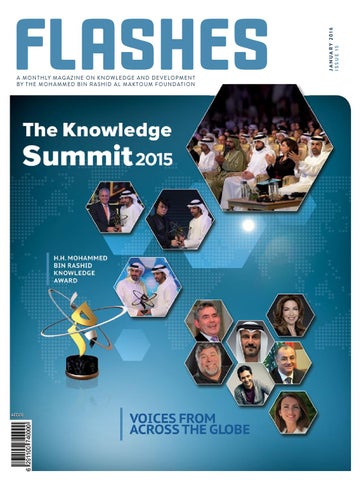
JANUARY 2016 ISSUE 15
A M o n t h ly M a g a z i n e o n K n o w l e d g e a n d D e v e lo p m e n t b y t h e M o h amm e d B i n R a s h i d A l M ak to u m F o u n d at i o n
AED20
EXPLORE
A
l i f e
D E V O T E D
C A N C E R
I N
TH E
22 flashes / JANUARY 2016
T O
C A R E
R E G I O N
H R H P r i nce s s G h i da Ta l a l
Call for action and collaboration at the regional level by HRH Princess Ghida Talal, who heads Jordan’s top medical centre The King Hussein Cancer Centre provides an integrated space for patient care, research and education. With cutting-edge facilities, the KHCC in Jordan has become the main medical hub in the Middle East for comprehensive cancer treatment and care. Addressing the session on Scientific Research, Innovation and Development at the Knowledge Summit 2015, Her Royal Highness Princess Ghida Talal, Chairperson of the Board of Trustees of the King Hussein Cancer Foundation and Centre (KHCF/ KHCC), spoke from her heart about her own experience in 1992 as a young www.mbrf.ae
bride of six months, whose husband was undergoing chemotherapy for Hodgkin’s lymphoma. They were at the Memorial Sloan Kettering Cancer Centre in New York. And she realised they were the lucky few who were not only able to access such a facility, but also could afford the high costs involved in treating cancer. ‘A vow to myself’ “And this is when it hit me. It hit me that my husband had a chance to live because we were at one of the most advanced cancer centres in the world. My husband and I had the access to JANUARY 2016 / flashes 23
EXPLORE
the latest treatment and, of course, to the best research,” said Princess Ghida. “We were, what I called, the privileged few. This is when I made a vow. I made a vow that if and when we were able to come back to our country, Jordan, I would devote my life to the fight against cancer and I would establish a cancer centre of excellence to not only treat Jordanians, but patients from all over the Arab world.” “As you all know, cancer has no barriers. It invades every home. Who amongst us can claim that cancer has not affected them one way or another,” she asked. A few years later, His Majesty King Abdullah appointed her as the head of the centre taking care of cancer patients, which had only two doctors. “There was no concept whatsoever of a standalone cancer centre in the Arab world. And till today the King Hussein Cancer Centre remains the most prominent, comprehensive cancer centre in the region. The first thing that I did was to change the name of the centre. I called it the King Hussein Cancer Centre in honour of our beloved late King who fought so hard, and with so much dignity and courage, to fight this disease. But King Hussein did much more than that. He broke all taboos concerning cancer in Jordan. He spoke about his illness openly. He was on every television screen all over the world and he even removed his traditional head dress to show every cancer patient everywhere that it was not shameful to have cancer,” said Princess Ghida. “After that we had to move swiftly. I insisted
on putting the word cancer in the name of our centre because I believed strongly that in order to defeat our enemy, you have to know it. And then I had to go immediately to the United States and I met with the leaders of cancer care to see if they would support us. I met officials of the National Institutes of Health (NIH), the premier medical research agency in the US, and with St Jude Children’s Research Hospital, San Jose, California. They were incredibly supportive and they sent a Director to help us establish the King Hussein Cancer Centre,” she said. Now 14 years later, from two doctors when they started, Princess Ghida said the strength has grown to over 220 highly trained oncologists treating over 30,000 active cancer patients from all over the Arab world, including Syria, Yemen, Palestine and Iraq, countries where the health sytems were decimated. “Our priority was treatment. To deliver the highest quality and the safest treatment available. Because everything else was secondary. What is the use of treating a cancer patient half-way? We all know that it does not work with cancer. We accumulated accreditations. We became the first cancer centre in the developing world and the sixth in the world to receive such an accreditation. Also, we developed strong partnerships with the National Cancer Institute, with St Jude and also the MD Anderson Cancer Centre in Texas.”
KHCC has over 290 published papers, many of them in very highly prestigious journals
Focus on research “The King Hussein Cancer Center has over 290
The King Hussein Cancer Centre will be the biggest in the Middle East
24 flashes / JANUARY 2016
H R H P r i nce s s G h i da Ta l a l
published papers, many of them in very highly prestigious journals such as the Journal of Clinical Oncology,” Princess Ghida said. “We are also engaged in international phase two and phase three trials, including numerous research projects. One of them is a major collaboration with MD Anderson and it involves the BRCA1 gene breast cancer tests. We have now solidly entered the research stage at the King Hussein Cancer Centre. “And how could we not have entered the research arena? First of all, we are living in the age of personalised medicine. The one-size-fitsall formula simply does not work anymore. It has really shown its limitations. As Arabs, we have to conduct our own research and testing, as our gene pool is different and the risk factors are different. The responses to particular treatments are different. And this is why we don’t have any choice, but do our own testing.” And as a result of these experiences, the King Hussein Cancer Centre has introduced sophisticated molecular testing to start targeted therapy to particular patients for different cases of cancer. “And we found out to our horror that the BRCA1 gene mutations in breast cancer was much, much higher than we expected. So all this points to the fact again about how important it is to conduct our own research. Even if we have access to all the research in the West, we still remain different and our patients are unique.” Princess Ghida made an urgent call for action and collaboration at the regional level. “There must be a pan-Arab cooperation in cancer treatment and research by pooling the services of the leading specialised centres. We will then have enough number of patients needed to conduct field trials and research. We also need to establish a cancer fund.” “We can start this today,” Princess Ghida said, addressing the Knowledge Summit 2015 participants. “At next year’s Knowledge Summit, we can officially launch it.” Taking part in the panel discussion, Princess Ghida, referred to the issue of brain drain. She said that “in spite of having the intelligence and the financial resources, it is difficult to retain and attract the best talent.” Academic environment She said the solution to this was to create a proper academic environment. “The only reason the KHCC was able to have 220 highly trained doctors from the earlier dismal low of two was the opportunity for research and publication. It was difficult
for such specialists to work in the prevalent conditions in our hospitals. Besides work, there had to be that extra feeling of wanting to serve your own society. It is still very hard to convince our doctors, who are settled with their families in the West, to leave the comfort of their well-salaried jobs.” Princess Ghida rued the lack of pan-Gulf collaboration and research efforts. “In basic research, we have a long way to go,” she said. “We need to start from the basics. We need to start publishing as well as actively participate in joint research efforts. We also need to establish strong global partnerships. It may take decades. But it is okay. We need to start and we are starting,” she added on an optimistic note.
www.mbrf.ae
Top: (L-R) Princess Ghida Talal of Jordan, Sir Richard Branson and Tania Bryer attend the launch of ‘CNBC Meets Sir Richard Branson’. Above: KHCC has introduced sophisticated molecular testing to start targeted therapy to particular patients for different cases of cancer.
JANUARY 2016 / flashes 25