campaignme.com
A M OT I VAT E P U B L I C AT I O N
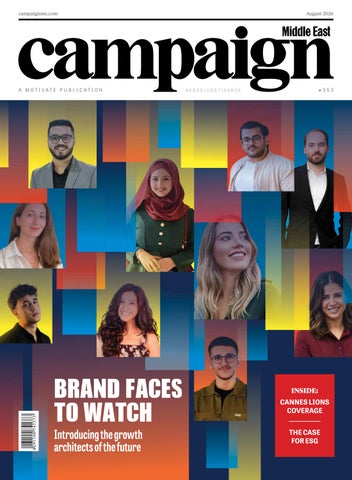
BRAND FACES TO WATCH
Introducing the growth architects of the future
August 2026
#353
AED25/USD7/SAR25
INSIDE: CANNES LIONS COVERAGE THE CASE FOR ESG
ENTRIES OPEN FOR THE FOLLOWING CATEGORIES STANDARD DEADLINE: 17 SEPTEMBER 2026 AGENCY CATEGORIES NEW: Best Gaming & Esports Agency NEW: Best Influencer Marketing Agency NEW: Best Sports Marketing Agency Best Creative Agency Best Digital Agency
Best Events, Experiential and Engagement Agency Holding Company of the Year Best Integrated Marketing Agency Best Media Agency
PEOPLE & TEAMS
NEW: Best Agency Producer
Best Creative Leader Best CSR Initiative Best New Business Development Leader Best Strategic Planning Leader Best Place to Work in 2026 Best Talent Management Individual
NEW: Best Media Planning Leader NEW: Independent Agency Head of the Year Best Account Person Best Arabic Copywriter
Best Performance Marketing Agency Best PR / Communications Agency Best Production House Best Social Media Agency Best Startup / New Agency
Best Corporate Communications & Marketing Team Head of Agency with streams for Creative, Digital, PR, Media & Integrated Marketing Network Head of the Year Outstanding Woman In Advertising or Media
INDEPENDENT AGENCY CATEGORIES NEW: Best Independent Digital Agency Best Independent Creative Agency
Best Independent Media Agency RETURNING FOR 2026: Independent Agency of the Year
GEOGRAPHIC
NEW: Best Agency – UAE: Independents
NEW: Best Agency – Saudi Arabia: Independents
NEW: Best Agency – UAE: Holding Company / Networks
NEW: Best Agency – Saudi Arabia: Holding Companies / Networks
NOMINATE HERE
NEW: Best Agency – Wider Middle East (Qatar, Oman, Bahrain, Kuwait, Jordan, Lebanon and Iraq) Best Agency – Egypt FIND OUT MORE
WWW.AOYAWARDSME.COM Sponsorship opportunities: nadeem@motivate.ae | tarun.gangwani@motivate.ae Entry enquiries: melissa.clarke@haymarket.com
PARTNERS
STRATEGIC PARTNER
BROUGHT TO YOU BY
August 2026
IN THIS ISSUE
03
EDITOR’S LETTER
12 THE NEED OF THE HOUR: A LION’S HEART A deep dive into the stern suggestions, dynamic debates and standards set at Cannes Lions 2026.
W Mobily’s Hani S. Al Sulaimani shares how strong brands are built through clear storytelling, consistent experiences and earned trust.
41 BRAND FACES TO WATCH 2026 Highlighting the best young brand-side talent, aged 30 and younger, working within marketing, communications, digital and social media roles.
08 INDUSTRY FORUM
Are back-to-school campaigns relying too heavily on discounts and product-led messaging rather than connecting emotionally with audiences?
11 AGILITY BEATS SIZE
Digitect’s Faisal Aleisawi on revolutionising integrated marketing.
ANUP OOMMEN
“THE HIGHEST STANDARD IS HUMAN.’’
39 SAUDI FOCUS
04 NEWS & WORK
hat was Cannes Lions like this year? Editor That question was posed to Campaign Middle East about four times per week since the ‘Oscars of the advertising industry’ concluded on 26 June. An honest response: It was a good reflection of the global brand and marketing industry – fragmented, but not directionless, with conversations varying in levels of depth and maturity. Several global and regional leaders spoke to Campaign Middle East about the pressures pulling them in different directions. They spoke about balancing future growth with current efficiencies, tech-informed decisions with human judgement, and creative ambition with commercial accountability. They also reflected on leadership changes across global brands and regional agencies, the tension between long-term purpose and short-term performance, and the need to treat creators as true partners rather than peripheral amplification channels. The strongest conversations asked whether the work we celebrate can also build businesses and solve challenges within communities. Some conversations were inspiring and “carried the fire” from one to another, while others were mundane – moderators reading out questions from cue cards and leaders reading out responses from iPads. But beneath it all was a genuine call to return to the centre of gravity – people. The underlying theme that rose to the surface was not centred on machines, platforms or performance; it was that marketing still begins and ends with people. C-suite executives also laid down a challenge for creatives: to ensure creativity contributes to cash flow and drives profitability. Effectiveness can no longer be an after-the-fact explanation at the dinner table; it must be baked into the recipe from the start. However, this does not mean making colder work. In fact, it calls for brands and agencies to listen carefully to offline and online chatter, bring genuine creators into the strategy and planning meetings, develop deeper empathy and build stronger relationships based on trust and transparency with people and partners – all to create work with more feeling, more craft and more nerve. Cannes Lions 2026 was a reminder that humour can open doors, that serious ideas handled with care can strengthen profit and loss (P&L) statements, and that stories travel further when they resonate with people enough to be retold. The lesson for the year ahead is simple: combine rigour with warmth, ambition with humility, and speed and volume with craft and care. The highest standard is human.
20 EARNED MEDIA HAS 40 MATTER OF FACT Cicero & Bernay reveals NEVER BEEN HARDER the latest news, views HAVAS Red Middle East’s Dana Tahir explains why PR and trends making matters now more than ever. waves across the global communications sector.
21 CREATIVE CITIZENSHIP
17 THE BEAUTY OF THOUGHT LEADERSHIP – WHEN DONE RIGHT
47 APPOINTMENTS
FP7 McCANN MENAT’s Tarek Miknas discusses the need for bravery, integrity and generosity.
Key movements including new roles and promotions in the region.
36 ESG FEATURE: FROM PROMISE TO PROOF
Mishaps in the world of communications.
50 THE SPIN
Motivate Media Group Head Office: 34th Floor, Media One Tower, Dubai Media City, Dubai, UAE. Tel: +971 4 427 3000, Fax: +971 4 428 2266. Email: motivate@ motivate.ae Dubai Media City: SD 2-94, 2nd Floor, Building 2, Dubai, UAE. Tel: +971 4 390 3550, Fax: +971 4 390 4845 Abu Dhabi: Motivate Advertising, Marketing & Publishing, PO Box 43072, Abu Dhabi, UAE. Tel: +971 2 677 2005, Fax: +97126573401, Email: motivate-adh@motivate.ae Saudi Arabia: Regus Offices No. 455 - 456, 4th Floor, Hamad Tower, King Fahad Road, Al Olaya, Riyadh, KSA. Tel: +966 11 834 3595 / +966 11 834 3596. Email: motivate@motivate.ae London: Motivate Publishing Ltd, Acre House, 11/15 William Road, London NW1 3ER. Email: motivateuk@motivate.ae www.motivatemedia.com EDITORIAL: Motivate Media Group Editor-in-Chief Obaid Humaid Al Tayer | Managing Partner and Group Editor Ian Fairservice Group Content Director Thomas Woodgate | Campaign Middle East Editor Anup Oommen | Senior Reporter Ishwari Khatu Reporter Shantelle Nagarajan | Junior Reporter Hiba Faisal DESIGN: Senior Designer Thokchom Remy ADVERTISING ENQUIRIES: Chief Commercial Officer Anthony Milne | Publishing Director Nadeem Quraishi (nadeem@ motivate.ae) | Sales Manager Tarun Gangwani (tarun.gangwani@motivate.ae) | Senior Sales Executive Saif Hemdan (saifeldin. hemdan@motivate.ae) PRODUCTION: General Manager S. Sunil Kumar | Production Manager Binu Purandaran | Assistant Production Manager Venita Pinto HAYMARKET MEDIA GROUP: Chairman Kevin Costello | Managing Director Jane Macken The publishers regret that they cannot accept liability for errors or omissions contained in this publication, however caused. The opinions and views contained in this publication are not necessarily those of the publishers. Readers are advised to seek specialist advice before acting on information contained in this publication which is provided for general use and may not be appropriate for the readers’ particular circumstances. The ownership of trademarks is acknowledged. No part of this publication or any part of the contents thereof may be reproduced, stored in a retrieval system or transmitted in any form without the permission of the publishers in writing. An exemption is hereby granted for extracts used for the purpose of fair review. Campaign Middle East includes material reproduced from the UK Edition (and other editions) of Campaign, which is the copyright of Haymarket. Campaign is a trademark of Haymarket and is used under licence. The views and opinions expressed within this magazine are not necessarily those of Haymarket Magazines Limited or those of its contributors.
04
August 2026
RAIYN launches to unite four MENA communications firms under one network
Leaders of Brazen MENA, CARMA, Cicero & Bernay, Salient Communication Group and SOCIALEYEZ
RAIYN, a new trust-led communications network bringing together four of the region’s specialist communications firms under a single structure, has launched in Dubai. Unveiled at the Museum of the Future by CARMA’s Founder and CEO Mazen Nahawi, the network combines Brazen MENA, Cicero & Bernay, Salient Communication Group and SOCIALEYEZ in what it
describes as an integrated model designed to help organisations strengthen reputation, improve decision-making and deliver measurable business outcomes. RAIYN was built to solve the problem of fragmented advice and disconnected specialist services by integrating the services under one umbrella. The network brings together strategic advisory, creative,
digital and intelligence capabilities under one structure. The network aims to offer clients a team of owner-operators who integrate insights, strategy, creativity and in-depth sector expertise with measurement that proves value. “The people of this region, nationals and expats, are best suited to speak on its behalf. That is the belief on which RAIYN is built. We have
brought together the best practitioners in the region, combining creativity, sector expertise, AI mastery and cultural depth,” said Nahawi. Nahawi is joined by four principals representing the founding agencies: Ahmad Itani, Founder and Chief Advisor at Cicero & Bernay; Louise Jacobson, Managing Partner at Brazen MENA; Sean Trainor, Chief Executive at Salient Communication Group; and Tarek Esper, Managing Director at SOCIALEYEZ. “Communications needs a new dawn,” said Nahawi. “We have brought together the best practitioners in the region, combining creativity, sector expertise, AI mastery and cultural depth,” he added. Collectively, the network brings together more than 700 professionals across strategic communications, creative, digital and intelligence disciplines. It operates within News Group International (NGI), which also owns media intelligence company CARMA. Through CARMA’s intelligence capabilities, RAIYN says it will embed real-time analysis and foresight into communications strategy and measurement, helping organisations navigate complexity and identify opportunities.
Think Human expands into Egypt Dubai-based integrated communications consultancy Think Human has expanded into Egypt with the launch of a new office in Cairo, marking the latest step in the agency’s regional growth strategy. Based at SODIC EDNC in Cairo, the office will serve as the agency’s hub for the Egyptian market, offering its integrated communications services including strategy, creative, media planning and buying, events and activations and influencer management. “Egypt has always been one of the region’s most important creative and cultural markets, with exceptional talent and a deep understanding of consumers,” said Ahmed El Sherbini, CEO of Think Human. The agency said it has already begun working with clients in Egypt across key sectors including retail, real estate, hospitality, and pharmaceuticals.
Use the QR code to view this work on Campaign’s website.
ANNAHAR THE DISPLACED EDITION On World Refugee Day, Annahar, Lebanon’s oldest newspaper, partnered with the United Nations High Commissioner for Refugees (UNHCR) to launch “The Displaced Edition”. By disrupting the newspaper’s structure and moving pages around, the edition transformed the act of reading into a reflection of a nation experiencing severe displacement. Even the front page wasn’t on the front. Readers did not only learn about displacement; they experienced it, page by page. Impact BBDO oversaw the creative execution behind the work.
August 2026
05
MMS partners with TikTok as official advertising reseller
Images from the LOREALISTAR launch event in Dubai.
L’Oréal Middle East launches creator loyalty platform LOREALISTAR L’Oréal Middle East has launched its multi-brand creator loyalty platform LOREALISTAR in the GCC. The programme is designed to build authentic, long-term relationships between the L’Oréal Groupe’s brands and the region’s digital creator community. Open to creators with as few as 1,000 followers, the platform rewards creators’ passion for its brands with exclusive access, upskilling and
visibility. LOREALISTAR aims to tap into a highly engaged, youth-driven digital landscape, especially relevant to the GCC with its social media penetration rate at more than 90 per cent. The platform also aims to create a centralised, community-driven experience with the group’s creator partners – transcending the relationship beyond transactional, to one that’s more meaningfully
Use the QR code to view this work on Campaign’s website.
rewarding. Through the platform, creators can connect with brands across the L’Oréal portfolio and access: exclusive brand experiences, products and events; professional development and upskilling tailored to the evolving creator landscape; visibility and amplification on L’Oréal brand channels; and networking opportunities within a growing community of creators and brand teams.
MBC Media Solutions (MMS) has partnered with TikTok as the social media platform’s official advertising reseller in Saudi Arabia. The company will extend direct access to the platform’s inventory and full suite of advertising solutions to Saudi brands and agencies. According to MMS, the partnership also reinforces its commitment to providing advertisers, agencies, and brands across the Kingdom with direct access to TikTok’s advertising solutions and audience ecosystem. The partnership will deliver enhanced local support, faster campaign execution and strategic expertise, enabling advertisers to maximise engagement and business impact on the short-form social video platform. As part of the deal, MMS will provide advertisers with access to TikTok’s full suite of advertising products, including branded content solutions, creator-led campaigns, performance marketing tools and short-form video advertising formats. Through the partnership, TikTok aims to strengthen its commercial presence in the Kingdom while reinforcing MMS’ position as one of the major media and advertising partners in the region.
Use the QR code to view this work on Campaign’s website.
DORCO SLEEK FLEX YOUR EDGE
MCDONALD’S KSA JUJUTSU KAISEN COLLAB
DORCO SLEEK and DJ Bliss collaborated to launch its very own anthem – Flex Your Edge. The track was crafted to live where the audience does: on playlists, across social feeds, in gyms, and in the daily rituals that define modern grooming. The campaign aimed to introduce DORCO SLEEK and educate consumers on its key product benefits, differentiate the brand from established competitors in the grooming category and position DORCO as a lifestyle brand rather than just about a razor. Within the first four weeks of launch, the campaign generated more than 2 million impressions and more than 800,000 engagements across its integrated media channels.
This nationwide campaign marked the brand’s collaboration with global anime phenomenon Jujutsu Kaisen as one of the most culturally driven campaigns in the Kingdom’s quick-service restaurant sector to date. Timed to coincide with the global release of the anime’s latest season, the 42-day campaign has gone on to generate more than 146.9 million impressions and reach 26.1 million unique people across TikTok, YouTube, programmatic video and X, with organic engagement extending beyond Saudi Arabia into international fan communities. The collaboration was facilitated by Crunchyroll, a global anime streaming platform.
Agency Cheil MEA Production house Mevia Productions
Agency Them Again
06
August 2026
Advertising Business Group to flag policy-violating Google Ads in MENA
The Advertising Business Group (ABG), a nonprofit, self-regulatory industry association in the Middle East, has joined Google’s Priority Flagger Program (PFP), becoming one of a select group of industry bodies globally with access to a dedicated reporting channel that flags Google Ads which may breach the platform’s advertising and abuse policies. Through the programme, ABG will be able to report potentially policy-violating or harmful
ads directly to Google for review. Once a report is submitted, Google assesses the flagged content, communicates the outcome to ABG and, where necessary, allows the organisation to provide additional feedback or appeal the decision. The move extends Google’s network of Priority Flagger partners into the Middle East, following similar collaborations with advertising and self-regulatory bodies in the UK, Turkey, Cyprus
Use the QR code to view this work on Campaign’s website.
and the US. According to ABG, the partnership is intended to strengthen efforts to promote responsible advertising and improve trust in the region’s digital advertising ecosystem by providing a direct route for reporting ads that may not comply with Google’s policies. “Being a Priority Flagger in our region is a recognition of the role ABG plays in championing responsible, brand-safe advertising across the UAE and GCC,” said Eleni Kitra, CEO and Executive Director of ABG. “This collaboration with Google gives our industry a direct, trusted channel to help protect consumers and uphold the standards our members are committed to, and it strengthens ABG’s position as the region’s central platform for advancing ethical and future-ready marketing,” she added. The initiative is part of Google’s broader Priority Flagger Program, which works with recognised organisations to identify potentially harmful advertising more efficiently while supporting enforcement of the company’s advertising policies. ABG has also partnered with Publicis Groupe Middle East to introduce the MENA Retail Media Task Force, a brand-first industry initiative. As one of the fastest-growing segments of the global advertising industry, retail media is transforming how brands connect with consumers by leveraging first-party data, commerce insights and retailer-owned channels across the customer journey. Through educational forums, working groups, roundtables and practical industry guidance, the Task Force will support knowledge sharing, encourage greater collaboration and help advance best practices across the ecosystem.
Use the QR code to view this work on Campaign’s website.
ORANGE EGYPT WE’LL SHOUT LOUDER
VISA THE NEW GAME PLAN
Rather than relying on predictable football clichés and promises of glory, this campaign from Orange Egypt rang in the FIFA World Cup 2026 spirit with an authentic fan truth: cautious optimism. Inspired by the expanded 48-team tournament, the campaign celebrated a realistic opportunity for Egypt to make history, encouraging belief built on progress rather than guaranteed victory. The creative expression of that strategy turned into a 360-degree campaign spanning TV, digital and social media, built on a central tension: while the outside world doubts, the players believe.
Building on the insight that spontaneous, unplanned moments are often the best memories from a trip, this cross-border campaign celebrates the kind of travel that happens beyond the itinerary. The campaign positions Visa’s payment technology network as a reliable travel companion, bringing tourists confidence and flexibility. Travellers are empowered to lean into the unexpected, moving one step closer to where they want to be. Through a series of social media posts, out-of-home assets and digital banners, the campaign is Visa’s reassurance that travellers can stay flexible, be spontaneous and keep moving.
Agency Tarek Nour Advertising
Agency Serviceplan Middle East
08
August 2026
INDUSTRY FORUM:
Are back-to-school (BTS) campaigns relying too heavily on discounts and product-led messaging rather than connecting emotionally with audiences?
Aalishaan Mahboob
Associate Business Director – Innovation & Growth, Publicis Groupe Middle East
NO Mohamad Al Azzawe
Senior MENA Regional Marketing Director & Head of Consumer Market Insights, Samsung Electronics MENA
YES
BTS campaigns often prioritise discounts and product-led messaging to drive immediate sales, overshadowing emotional connections. While this is effective for short-term results, they fail to build lasting brand loyalty or resonate with audiences on a deeper level. Emotional storytelling, such as student aspirations or the excitement of a new school year, can create stronger engagement and differentiate brands in a competitive market. Balancing promotional offers with meaningful narratives is key to capturing both attention and hearts. Simple messages that talk to students and resonate with them can go a long way compared with a price discount.
We’re blaming the wrong thing. Discounts aren’t the enemy; forgettable storytelling is. BTS isn’t just a retail season; it’s one of life’s rare annual resets. It’s where children shape confidence, identity and belonging, while parents invest in possibility, not just products. Price may drive the purchase, but stories define what that purchase means. The strongest brands don’t choose between commercial impact and emotional connection; they make each amplify the other. We should stop treating BTS as a transaction and start treating it as a transformation. That’s when a campaign sells more than a backpack; it earns a lasting place in someone’s story.
Mitin Chakraborty
Head of Marketing, Babyshop – Landmark Group
YES
They naturally lean more heavily on product-led communication, and rightly so. Product messaging and discounting get lumped together, but they’re not the same thing. This is one of the few retail moments where families are making highly considered purchases that need to stand up to everyday use and last the entire academic year. Parents are balancing durability, comfort, quality, safety and value, while shopping for more than one child. Details like fabric quality, fit, washability, ergonomics and food-safe materials aren’t just product features; they give parents confidence in their purchase decisions.
August 2026
Ramsey Naja
Anne Tulloch
Co-Founder and CCO, Das Kapital
Divisional Marketing Director – Wellness, Alshaya Group
NO
NO Lama Accary Bibi Managing Director, Means Design
YES
Discounts have become almost expected during the BTS season, but many campaigns stop there. Brands that leave a lasting impression are the ones that remember they are speaking to people, not just shoppers. For parents, it’s about preparing their children for a new chapter. For students, it’s about confidence, identity and fresh beginnings. Those are the stories worth telling. In a crowded market, emotional relevance is what gives a campaign longevity, while discounts alone are forgotten once the season is over.
The strongest campaigns strike the right balance between emotional storytelling and product-led messaging. While promotions and value remain important in a highly competitive retail environment, emotionally resonant campaigns are increasingly what cut through the clutter and brands are leaning into this. They create memorable brand moments, generate earned media value (EMV), encourage social sharing, and build longer-term brand affinity, which is very important going into Q4, rather than simply driving a short-term sale.
Yasser Hamdy Business Director, Memac Ogilvy
YES
Discounts have their place, but they’ve become the default response to BTS. The bigger opportunity is to recognise it as one of the few moments in the year when behaviour shifts at scale. People’s routines, habits and priorities all change and that creates openings for brands beyond retail. The campaigns that stand out aren’t the most emotional. They’re the ones that understand how the season changes people’s lives, then find an honest role within that shift.
Taqwa Mohamed Sayed
Global Brand Manager, Puck
YES
YES
Danielle Bedin Strategy Director, We Are Social
YES
Too many brands view BTS as a transactional game, pushing discounts simply because spending is mandatory. This ignores the real emotional weight mums carry: shifting gears after weeks of fun, battling chaotic mornings to get kids out the door and feeling judged by social trends for camera-ready lunches. Real connection requires meeting moms where they are. In our work for Switz, we soft-pedal product pushing to acknowledge evolving parenthood.
Eagerly awaited by parents, anticipated with foreboding for any self-respecting pupil, BTS is the seasonal equivalent of Marmite. But when you add to it eroded economies and the realisation that the school budget is double the forecast, any discount would be welcome. This depends on two things: that you show consideration to the pupils’ depression by eschewing the usual excitement and that you have done your own homework: turning up with an ‘unbeatable deal’ when you’ve neglected your brand all year means it is you who should go back to school, not the children.
Donia Ezzeldin
Brand Manager, Pocari Sweat (GCC)
BTS is one of the biggest retail moments of the year, so it’s understandable why many brands lead with discounts and product messaging to drive immediate sales. However, when every campaign looks the same, price alone is rarely enough to create a lasting impact. The brands that stand out are those that tap into the emotions behind the season, parents wanting the best start for their children and students looking forward to a new chapter with confidence and excitement. Promotional offers should support the story, not become the story.
09
Rehan Ahmad,
Head of Creative, KEKO
YES
Most brands do, whereas they should be more focused on sponsorships for kids, offering a lot of freebies and activities for free under the idea of ‘Learn & Enjoy.’ Now, brands use this as a tool to promote their business. They don’t aim to give something back to kids or society. When brands invest in meaningful campaigns, they aim give back to society and children to build stronger brand bonds.
They have traditionally relied on promotions and product messaging because the season is driven by shopping. Those will always have a role to play, but they are no longer enough to build a meaningful connection with families. Parents are not just preparing shopping lists alone. They are helping their children transition from the freedom of summer back into structure. The future lies less in character partnerships and promotional mechanics, and more in genuine, insight led support that helps families navigate this transition with confidence.
PARTNER CONTENT
August 2026
Agility beats size Faisal Aleisawi, Managing Director of Digitect, discusses how the distinct agency goes beyond creating campaigns to solving problems for clients through strategic thinking, salient storytelling and selecting shared KPIs over separate scorecards.
H
ow has Digitect evolved over the past few years into an integrated marketing agency serving modern, multi-channel audiences? What key challenges in the market does it solve for brands?
Digitect is a six-year-old agency, yet we’ve built a team of more than 180 talents, many with years of deep expertise across the industry, the region, and particularly in Saudi Arabia. This balance of youth and experience is why we’re now one of the fastest-growing agencies in the region. We are a leading 360-degree agency, with a strong track record across government, semi-government and private sector clients. We’ve created a creative hub in Cairo, and we’re entering the UAE market later this year. Our UK partnership with BBD Perfect Storm adds an international perspective to our local depth. We solve the challenge of fragmentation by functioning as a single, integrated, AI-transforming agency that replaces scattered vendors.
If the industry experienced Digitect only through its work and outcomes driven for clients – not through its website – what would they find that defines and differentiates Digitect in this market?
toward one strategic idea and one set of shared KPIs, not separate scorecards. Being an agile agency means we can restructure a team around a client’s problem rather than forcing the problem into existing departments. And as AI gets woven across the agency, it’s connecting these disciplines even faster, real integration, not just a service listed on a slide.
For brands chasing attention but demanding ROI in bottom-line movement, how do you help clients build long-term brand salience while also driving short-term lower-funnel outcomes for their business?
We refuse to treat brand and performance as a trade-off. Every campaign is briefed against both a salience goal and a bottom-line metric from the start, so creative teams aren’t just chasing attention and media teams aren’t just chasing clicks in isolation. Storytelling earns the attention; the same idea is then engineered with performanceready variants for lower-funnel conversion. Being an agile, integrated agency means we can shift weight between the two quickly as results come in, rather than locking a client into one approach for an entire campaign cycle.
“The lesson I keep coming back to: adaptability, not scale, is what carries a business through crisis.”
They’d find an agile agency that solves problems, not one that just produces campaigns. They’d find genuine creativity paired with strategic thinking; storytelling that isn’t decoration but sits at the heart of how we solve a client’s business challenge. They’d find work built on a strong track record across government, semi-government and private sectors. And finally, they’d find an agency actively transforming itself through AI; not adopting it as a simple tool, but rebuilding how the whole organisation thinks, creates and delivers.
Do you think brands and agencies entering Saudi Arabia need to spend more time and effort understanding the importance of local cultural intelligence and lived experiences? What does getting it right actually look like?
Absolutely, and it’s where most entrants stumble. Saudi Arabia isn’t one audience; nuances vary from city to city, generation to generation, and only real lived experience on the ground can capture that. Getting it right looks like local creatives and strategists leading the idea from day one, not reviewing a translation. It looks like a dialect that sounds like how people actually speak, casting and settings that reflect real Saudi life, and a story that couldn’t simply be swapped in from another market with Arabic subtitles added on top.
Many organisations still operate in silos – creative, media, digital, PR, experiential. How do you ensure integration isn’t just an organisational offering but strategic and operational? Integration starts at the brief, not the organisation chart. Every project is briefed once, with creative, media, digital, PR, and experiential teams in the room together from day one, working
What’s one marketing trend everyone is talking about that you believe is overhyped, and one that’s still underestimated?
Overhyped: AI as a buzzword rather than a real capability, most agencies talk about it without actually changing how they work. We’ve gone further, transforming the whole agency around AI rather than bolting it onto one team. Underestimated: storytelling itself. In the rush toward new platforms and formats, the fundamentals of a genuinely well-told story get treated as old news, yet it’s still what makes people stop, feel something, and remember a brand long after the format they saw it in is forgotten.
What’s the most important leadership lesson to share after managing a marketing business through several periods of crises and rapid change?
Agility beats size every time. Becoming one of the fastest-growing, leading agencies in this market happened because we adapted quickly rather than waiting for certainty, whether that meant restructuring a team overnight or transforming the whole agency around AI. Strong doesn’t mean rigid; it means staying close enough to your people and your clients that you can move the moment conditions shift. The lesson I keep coming back to: adaptability, not scale, is what carries a business through crisis.
11
12
August 2026
COVER FEATURE
THE NEED OF THE HOUR:
A LION’S HEART
Conviction, craft, creators, commercial responsibility and all things beautifully human take pride of place within conversations at Cannes Lions 2026. Here’s an in-depth look at the dynamic debates, stern suggestions and standards set for the year ahead. By Anup Oommen
COVER FEATURE
August 2026
Leandro Barreto
I
n the weeks leading up to the Cannes Lions International Festival of Creativity 2026, expectations within the Middle East brand and marketing industry were muted. Marketing and media spend was dipping. Fresh requests for proposals (RFPs) and new business wins were scarce. Post-acquisition restructuring efforts and senior leadership changes became the talk of the town. Cost-cutting measures followed as the financial fallout of geopolitical upheavals was felt. Artificial intelligence (AI) and agentic AI tools added complexity to the cutbacks. Concerns around redundancies, salary cuts and business continuity were voiced in hushed tones in breakout areas. What ensued wasn’t unexpected: fewer sneakers from the region touched down at the Nice airport en route to Cannes. Fewer entries from the region were submitted to
the annual awards programme compared with previous years. And practically everyone assumed AI would remain the shiny object dominating discussions on open stages and in closed rooms. However, this set the scene for something truly special. The region racked up 20 Lions, posting a healthier entry-to-win ratio than previous years. Rather than a focus on Lions, the call to action at Cannes was for leaders to develop a Lion’s heart – to be brave, courageous and face their fears. The regional industry did not turn up at Cannes Lions looking for the next slogan; it turned up to feel a pulse, break out of echo chambers, reason with global counterparts and fuel the love for creative advertising. It found that the thrumming engine of the brand and marketing industry is not fuelled by hype, but by everything inherently human. Conversations shifted from technology to trust, from output to originality and outcomes, from individual greatness to collective growth, and from competition to collaboration, co-creation and culture. Although platform plays and AI tools weaselled their way into keynotes, panels and conversations over coffee, they were rarely the answer. The leaders who set the tone this year did not dismiss technology; they simply refused to let it become an excuse for dullness, mediocrity or creative laziness. The most persuasive voices at Cannes reminded leaders that while the industry is constantly being transformed by technology, its heart remains irrefutably human. Across the Palais, the Croisette, the beaches, the yachts and the late-evening conversations along the French Riviera, the same question kept returning in different forms: how do brands earn a place in people’s lives in a world where everything feels automated, targeted, forced or overly curated? The response from global and regional leaders was to make the commercial case for heartwarming, humorous and inspiring human-led creativity – the kind of work that brings people to tears, provokes anger, elicits a laugh or shocks audiences to stunned silence. This is the kind of work that listens to creators, communities and collective
13
minorities before it speaks – often involving them at the earliest stages of the conversation before the storyboard is finalised and the shoot date is set. This is the kind of work that not only informs and inspires audiences, but also spurs action and drives brand and business outcomes. This is also the kind of work that convinces C-suite leaders and key decision-makers to move from a fixation on cost to value, achieving short-term success while still investing in creative marketing for long-term outcomes. In conversation with Campaign Middle East, Simon Cook, Chief Executive of LIONS, defended creative investment not only as inspiration, but as a growth driver. “One of the key messages coming out of Cannes Lions 2026 is the need for continued investment in creative marketing that matters,” Cook said. “So, throughout the content, and throughout everything we’re doing during the week, the objective is to give people the data, the insights, the intelligence and the ammunition to connect daily creative marketing with the broader growth agenda.”
Eddy Cue
HEGARTY’S WARNING: GET PEOPLE TO LIKE ADVERTISING AGAIN Veteran advertising executive Sir John Hegarty delivered one of the festival’s sharpest warnings. His opening question – “Are we all f***ed?” – drew laughter, but the argument that followed was serious. Hegarty explained that the industry has drifted too far towards targeting and too far away from making work people welcome. His diagnosis was that advertising has become better at locating people than inspiring them. The language was witty, but the criticism was pointed. If people feel followed rather than entertained, persuaded or moved, the industry should not be surprised when they look for ways to avoid it. “We’ve perfected the art of stalking rather than inspiring,” Hegarty said. “And in most countries stalking is illegal. Actually, if you’re a brand stalking people, then you should be very, very careful.” The warning continued with a harder commercial truth. Hegarty argued that
14
August 2026
COVER FEATURE
say something, and show and tell, but it is another thing to feel, live and experience a brand that cares,” he said. His final point was about putting technology in its place: data, AI and digital channels can sharpen timing and scale, but they cannot replace instinct, trust or taste.
Mark Ritson (left), Founder, MiniMBA, and Byron Sharp, Professor of Marketing Science and Director at The Ehrenberg-Bass Institute, share the stage during a fireside chat on Five Marketing Truths We Can Actually Agree On.
people are not avoiding all forms of media or entertainment. They are avoiding the work that gives them little in return for their attention. “People are paying good money to avoid advertising,” Hegarty said. “In reality, we are making a worse product. There’s no question about that. All research points to it. People are disillusioned with advertising, they don’t like it.” He then drew a contrast with the entertainment people actively choose. It was one of the simplest lessons of the week, and perhaps one of the most uncomfortable: if audiences are spending time elsewhere, it is because those experiences give them something worth their time, effort and attention. “They’re not turning off Netflix. They’re not turning off the World Cup,” Hegarty said. “They’re turning off the things they don’t love. And sadly, they’ve fallen out of love with us.” For Hegarty, the solution begins by putting creativity back at the centre of organisations. Not as a department waiting to be briefed, but as a way of thinking that shapes companies from the top. “Creativity needs to be the heart of advertising, not on the fringe,” Hegarty said. “If you want to run a creative company, then creative people have got to be at the top of it.” CREATIVITY, CONSISTENCY AND CARE Marcel Marcondes, Marcondes Global Chief Marketing Officer of AB InBev, InBev was named the 2026 Creative Marketer of the Year at Cannes Lions. Rather than using the moment as a lap of honour, Marcondes offered a reminder that creative reputation is only valuable when it is connected to growth, discipline and consumer relevance. His message was simple: brands need ambition, but ambition without selfawareness can quickly turn into theatre. Marcondes cautioned marketers and agency leaders to avoid mistaking scale, awards or industry applause for genuine progress.
He also spoke about the need to remain commercially relevant. Instead of waxing lyrical about creativity as a decorative layer, Marcondes positioned creativity as a practical instrument that helps brands address real needs and unlock growth. He reminded a packed room within the Lumière Theatre that Cannes Lions may celebrate craft, but the best craft has a job to do. “We are here to solve business and consumer problems to drive growth, and creativity is a great enabler for that,” Marcondes said. To an industry that often chases novelty, Marcondes also made the case for memory. The strongest brands, he suggested, are not built by constantly starting over or relying too heavily on a trend, moment or a one-off campaign, but by giving people recognisable signals over time. “Consistency compounds over time,” Marcondes said. “For the long-term it is gold.” That same long-term view shaped his comments on experiences and technology. While traditional advertising still matters, Marcondes argued that people form deeper connections when they can participate in a brand’s world rather than only watching it from afar. “Go beyond ads, create experiences,” Marcondes advised. “It is one thing to
Oprah Winfrey
FROM VOLUME TO VALUE Leandro Barreto, Chief Marketing Officer of Unilever Beauty & WellBeing, shared some of the festival’s most inspiring messages during a fireside chat titled ‘Who Carries the Fire?’. Barreto explored a simple but uncomfortable idea: brands are no longer built by what they say, but by how others perceive them and carry them forward. He raised an important question: what does it take to create ideas that endure, spread and stay alive? “Long before platforms and algorithms, we gathered around the fire and told stories. The stories that lasted are not the stories that were told once; they were the ones that travelled – from one person to another, from one person to many. And thousands of years later this one aspect has not changed: meaning still moves through what people choose to pass on,” Barreto said. The problem statement that he defined was not that marketers lack tools, channels or production capability; it was that they may have become too good at producing things that do not matter enough to move. Barreto’s argument cut through the language of optimisation. Brands can create more assets, formats and variants than ever before, but that does not mean people will give those assets a life beyond paid distribution. “Somewhere along the way, value has been replaced by volume,” Barreto said. He pushed the point further by questioning the industry’s production machinery. Efficiency, he suggested, can become dangerous when it serves weak ideas at greater speed. “We have built large machines to help us serve content at scale, but we do not always have enough discipline to challenge whether the work deserves to move,” Barreto said. The solution, he explained, lies in thinking less about what brands want to transmit and more about what people might willingly accept and contribute to. He explained how that shift changes the role of marketers from message controllers to meaning builders. In his view, marketers need to ask whether the work has enough meaning to travel without constant media support. Barreto also offered one of the festival’s most quoted metaphors: poetry and plumbing. “Poetry represents consumer intimacy, cultural relevance and creative courage,” Barreto said. “Without poetry,
COVER FEATURE
nothing matters. Plumbing, on the other hand, is all about the tools, systems, and technology that allow a story to scale. Without plumbing, a great idea stays entirely local. To create value, we need both the poetry and the plumbing.” STORYTELLING THAT SPARKS THE RIGHT SENTIMENT At Cannes Lions 2026, The Lion of St Mark was awarded to Susan Credle, whose four-decade career helped shape some of modern advertising’s most recognisable work, from the M&M’s characters to Allstate Insurance’s Mayhem and McDonald’s Happy Meal literacy campaigns. Her reflections during a compelling fireside chat included a callback to one of advertising’s oldest functions: making people care – through emotion, not instruction. Credle’s message was particularly relevant in a year full of conversations about scale and systems. She reminded the industry that serious objectives do not always require a heavy-handed tone. The work that changes behaviour does so because it brings lightness, warmth or wonder to the problem, she suggested. “Advertising must be a beautiful blend of creativity with the structure of outcomes and business,” Credle said. “A lot of times we want to save the world and we think that may need a serious approach, but that’s not always true. I was listening to a podcast on which they said, ‘Do you know the one piece that has made the world care about oceans the most over the past few years? It’s the movie Finding Nemo.’ I found that
Susan Credle
beautiful, because sometimes we get so serious while solving problems, but I’d like us to go back to storytelling and creating joy and touching people’s lives emotionally.” That notion was echoed by Eddy Cue, Senior Vice President of Services at Apple, who was named Entertainment Person of the Year. Cue spoke about Apple TV as a place designed around creative quality rather than volume – an important distinction in an entertainment economy often measured by output. “We’ve never strived to be the most. We strive to be the best,” Cue said. “When we started Apple TV nearly seven
years ago, we said, let’s build the place that allows the best storytellers in the world to do their best work.” Cue focused less on the new magic of platform and algorithmic strategy and more on the old magic of persuasive narratives. At a festival that witnessed increased attendance by brand-side marketers and adtech players, his words were a useful reminder that the most powerful stories travel because they cross intangible, emotional boundaries and make a mark when they land. “Stories can make you laugh, cry, think or evoke many other emotions,” Cue said. “They connect us – across language, across culture and across everything. That’s what we’re all about at Apple, so stay tuned for more. We’re just getting started.”
“ADVERTISING MUST BE A BEAUTIFUL BLEND OF CREATIVITY WITH THE STRUCTURE OF OUTCOMES AND BUSINESS.” CHOOSING INTENTION INTENTIONALLY Oprah Winfrey, American host and television producer, accepted the 2026 LionHeart Award, which is Cannes Lions’ highest honour for individuals using their platform for positive social impact. In a festival full of discussions about platforms, performance and personal influence, Winfrey brought the conversation back to intent. Her reflections on brand were particularly striking because she rejected the polished, manufactured version of the term. A brand is not an image projected outwards, but a reflection of something deeper, she explained. In an age when content can be produced at scale, that distinction matters. “When I first started out, I resisted ever being called a brand,” Winfrey said. “I didn’t want to be a brand.” Her understanding of the term changed over time, but not in the direction of performance or packaging. Winfrey framed trust as something rooted in personal truth and consistency. “I have accepted that I am a brand,” Winfrey said. “And I accept that my heart is my brand.” She described the operating discipline behind The Oprah Winfrey Show. Every programme, she explained, has been
August 2026
anchored in a clear reason for existing. “We’re no longer going to do any show unless I’m in alignment with your intention,” Winfrey recalled telling her team. Listening was the other half of her method. Winfrey described audience understanding not as an abstract research function, but as a human practice. The point, she explained, is to get close enough to people, communities and each story to understand what is needed, not merely what is trending or what they’re consuming. “I wanted to sit down and talk to people,” Winfrey said. “I wanted to see where they came from. I wanted to see why they came to the show. I wanted to see what they were getting out of the show.” The lessons were clear: data can reveal behaviour, but listening reveals meaning. A brand has influence only when it chooses intention deliberately so that people feel seen, heard and served. CREATORS ARE NOT RENTED REACH The creator economy was one of the loudest recurring themes of Cannes Lions 2026, but the more mature conversations moved beyond the vanity metrics of follower counts, raw impressions and likes. The more interesting question was how brands can work with creators without flattening their voice, irritating their communities or treating them as media inventory. Barreto was clear that creator relationships need to be treated with more respect. Creators are not simply another distribution mechanism; they are interpreters of what their communities value. If the work does not matter to them, payment alone will not make it culturally meaningful. “The industry tends to treat creators like inventory. It reduces them to a distribution channel,” Barreto said. “But they don’t carry things because you pay them. They carry them because it means something to them, because they care, because their community cares.” He offered an alternative route where creators and communities are closer to the centre of demand creation. “At Unilever, we have decided to stop asking what our brands want to say and start asking what others want to talk about our brands,” Barreto said. “It’s a shift from ‘what do we want to say?’ to ‘what do others want to carry?’.” Comedy content creator Adam W brought a creator’s perspective to the discussion. His argument was that the best partnerships are not built by forcing a message into someone else’s format, but by creating enough trust for the brand and creator to shape the work together. He said, “We’ve begun to see a lot more brand-creator partnerships become long-term, which is not only good for creators and for brands, but also for the audiences that we are communicating to.” He added, “It should never feel like a brand paid you to promote something. It should always be a two-way street; a
15
16
COVER FEATURE
August 2026
collaboration where brands allow creators to go back and forth with them before coming to a conclusion about how to deliver the best creative video that will not only perform well but will also build positive brand sentiment in each community.” The same theme appeared in the keynote session delivered by Joon Silverstein, Chief Marketing Officer of COACH, and Julia Holtback Yeter, Art Director at Forsman & Bodenfors, on the Rotonde Stage inside the Palais des Festivals. Their argument was that younger audiences are not waiting for brands to define culture for them. They are already shaping it. “Brand building isn’t about creating messages that people remember,” Silverstein said. “It’s about creating experiences that people make their own. Brands don’t win by coming up with their own story; they win by trusting their audiences to help write it. We didn’t see success by asking people to engage with campaigns. Instead, we chose to show up in places where they were already happy.” At the UK Advertising Association’s gathering at Empower Café, K-pop singer and songwriter Andrew Choi – best known as the singing voice for the character Jinu in the Oscar-winning Netflix animation KPop Demon Hunters – spoke to Campaign Middle East about the evolving relationship between creators and brands. Choi’s point was that creators often bring people together around shared interests and emotional investment, which gives brands a different kind of value if they approach the relationship thoughtfully. “I think creators are the ones that are actually building communities,” Choi said. “It’s extremely important to build such communities because it’s people that bring value to the products. Brand leaders are beginning to recognise this and are navigating more consciously towards creators because of this.” Priyanka Chopra Jonas, actor, producer and entrepreneur, shared a word of caution during a fireside chat at the Debussy Theatre in Cannes. She said that brands, like public figures, have to keep earning attention rather than assuming it will remain. She warned against the entitlement that comes from heading up a globally renowned brand. “Audiences can leave at any moment, and reach does not guarantee care. The most important thing is to not take your audiences for granted,” Chopra Jonas said.
Joon Silverstein
Priyanka Chopra Jonas
“Don’t take the love and attention that they give you for granted.” That comment landed heavily in a marketing environment still tempted by the illusion of reach. Scale can put a brand in front of people, but it cannot make them care. She also challenged the industry’s long-standing obsession with flawlessness. The old model relied on distance, polish and mystique. The current one rewards proximity, consistency and proof. For brands, that means creator partnerships cannot be treated as borrowed credibility. They need to be rooted in actual fit. The lesson for marketers was clear: audiences can tell when a partnership to promote a product has been purchased but not lived by the brand or the creator. Visibility may deliver the first glance, but conviction and care carry the message further. PULLING OFF THE COMFORT BLANKETS If some sessions at Cannes Lions celebrated the romance of creativity, others stripped away some of marketing’s favourite illusions. Mark Ritson, Founder of MiniMBA, and Byron Sharp, Professor of Marketing Science and Director at the EhrenbergBass Institute, used their session – Five Marketing Truths We Can Actually Agree On – to make the case for mental availability, distinctive brand assets and consistency, while calling out the “nonsense” of brand purpose. Their critique of purpose was deliberately blunt. Ritson argued that purpose works for only a handful of businesses and becomes theatre when stretched across ordinary categories. “Nobody cares about your toothpaste and how it feels about racial inequality – they don’t even think about that concept,” Ritson said. “If you’re picking your favourite charity and then spending your client’s or shareholders’ money on it, that’s immoral. You’re not supposed to do that.” The more important conversation, they said, was building share of voice within a category and staying top of mind. Ritson said, “If your brand comes to mind in buying situations, and if you’re mentally available, 70-80 per cent of your job has been done – partly because you’re in the game, and partly because
consumers are lazy. Once they’ve got your brand in their head, they start to make arguments inside their brains and justify why they made that decision.” His point was not that brand values do not matter, but that brands often overestimate how much people choose everyday products based on moral positions. This led to a discussion on distinctiveness within the market, and a debate on what it means to be distinctive. Ritson and Sharp explained that being distinctive is not quite the same as differentiation. “Distinctiveness feeds mental availability,” Ritson said. Sharp said, “The big story there, though, is just how shockingly low distinctiveness is. We did a lot of pricing research over a decade, and one of the things we looked at was differentiated brands. We, as marketers, saw differentiation in everything – different flavours, pack sizes etc. But stick them in experiments with consumers and they just didn’t see anything distinctive between the brands. The only one that stood out was organic and gluten-free.” He added, “If you need complicated market research to torture data into finding your differentiation, you haven’t got any.” The session closed with the leaders sharing a warning on campaign duration and a call for consistency. In a landscape where marketers often want to relaunch, reposition, rebrand and refresh too quickly, both leaders argued that brands need patience. “You have to leave your cakes in the oven for longer,” Ritson said. Sharp agreed, saying, “Advertisers massively overestimate how many people have seen their ads. The truth is hardly anyone has seen them or has been moved by them if they only ran it for 30 days.” Cannes Lions 2026 was special. It felt less like sailors chasing the next treasure trove and more like an industry checking its compass. The lessons were simple yet sensible. The work still needs judgement, restraint, imagination and a reason for people to welcome it into their lives. Brands cannot keep treating audiences as targets on a dashboard. Creators are not borrowed megaphones. People want to feel that the work understands the rooms they are already in, the communities they already trust and the stories they already carry. The Festival of Creativity threw down the gauntlet for the brand and creative marketing industry: to make work with enough humanity, usefulness and conviction that people do not just see it, but feel it is worth remembering. The road ahead is not easy. It will demand sharper commercial thinking, stronger creative discipline, more patient brand-building and, above all, a Lion’s heart to go against the grain.
August 2026
C-Suite Round Table at Cannes:
17
The beauty of thought leadership
when done right
Several brand-side marketers and senior agency leaders explain why thought leadership must hold licence, be grounded in human tension, and be held accountable to moving the needle even in the age of AI. By Anup Oommen
T
hought leadership seems to have become one of the industry’s biggest go-to reputation plays. But does it live up to its purpose of provoking thought and action? Is it becoming synonymous with generic content marketing in a world where every senior leader has a point of view, every brand wants authority and every platform has become a publishing channel? In an era when leaders are trying to establish credibility, build visibility, demonstrate trust, highlight expertise and inspire change from a place of licence and authority, how can thought leadership stand out from the noise of opinions in a crowded room? In a world where people are increasingly leaning into artificial intelligence (AI) tools for insight, inspiration and to inspect the quality of their content delivery, what guardrails are necessary to differentiate between ‘goosebumpinducing’ thought leadership and the AI slop that’s populating social media feeds? How can you give people reading thought leadership something that is actually worth their time? Several brand-side marketers and senior agency leaders gathered to answer these questions, among others, at a round table discussion hosted by Campaign Middle East in partnership with Bloomberg Media at Campaign House at Cannes, France, during the week of the Cannes Lions International Festival of Creativity 2026. Contributing to this discussion, moderated by Campaign Middle East Editor Anup Oommen, were: Khaled AlShehhi, Executive Director of Marketing and Communications, UAE Government Media Office, Passant El Ghannam, Chief Marketing Officer – Middle East and Africa, Kraft Heinz, Muhannad Kadi, Chief Marketing Officer, King Faisal Specialist Hospital & Research Centre, Mashal Shahbik, Executive Director – Marketing and Events, Qatar Foundation; Akanksha Goel, Founder and Board Advisor, We Are Social, Ghassan Kassabji, CEO, Impact BBDO Dubai, and CGO, Impact BBDO MENA,
Diego Florez, AI Creative Director, Core42, Jason Murison, Creative Lead, DAMAC Properties, Amit Nayak, Managing Director – MEA, Bloomberg Media, and Phil Robinson, Head of Data Science & Insights - EMEA, Bloomberg Media. At the outset, the leaders discussed what separates a real point of view from corporate wallpaper. The answer, the leaders said, came down to credibility, usefulness, accountability and human judgement. The room also largely accepted that AI can accelerate research, sharpen structure and make communication more accessible. Yet, the strongest contributions circled back to one simple truth: tools can help carry the load, but they cannot own the belief. THE STARTING POINT: VALUE AND LICENCE The first challenge is purpose and perception. Too much executive content is judged by visibility rather than by whether it has changed anything for the reader. The stronger test is whether it pushes someone to reconsider, question or act. Passant El Ghannam, Chief Marketing Officer – MEA, Kraft Heinz, argued that impact does not always need to appear as a hard conversion. Sometimes, the value lies in shifting someone’s lens, even slightly. “If a piece of thought leadership influenced someone, if it makes you think or offers a different perspective, then I think that’s good content,” she said. That raises the bar. If the work is only useful to the person publishing it, then it is closer to self-promotion than leadership. Real value begins when the audience walks away with something they can use. Amit Nayak, Managing Director – MEA, Bloomberg Media, said the market is moving from mere recognition towards usefulness, referencing a Bloomberg Media report that is soon to be published. Nayak raised key questions, asking: “How do you create value for those engaging with the thought leadership? So, what does the data
The round table discussion was held at Campaign House in Cannes, France, during the week of the Cannes Lions 2026.
Diego Florez, AI Creative Director, Core42
Mashal Shahbik, Executive Director – Marketing and Events, Qatar Foundation
18
August 2026
Leaders pose for a photograph before the discussion begins.
Akanksha Goel, Founder and Board Advisor, We Are Social
Amit Nayak, Managing Director – MEA, Bloomberg Media
Phil Robinson, Head of Data Science & Insights – EMEA, Bloomberg Media
Jason Murison, Creative Lead, DAMAC Properties
show? How can you add credibility that makes it something that’s useful for them, so that they engage with it more deeply?” Several participants returned to the same point: authority cannot be borrowed. Thought leadership must be owned by those who have the licence or authority to speak on the topic. Especially in categories such as government, investment, healthcare and business, the person speaking matters as much as the idea itself. Khaled AlShehhi, Executive Director of Marketing and Communications, UAE Government Media Office, explained, “Thought leadership that can convince me, influence me, change my mind or unlock an incredible idea must first come from a credible sort of licence, someone who has the authority to share their thoughts from expertise and industry leadership.” This is where the industry needs more discipline. Leaders at the round table agreed that the strongest pieces usually come from people who have earned the right to speak because they have lived the issue, worked through the problem or carried the consequence of the decision. ACCOUNTABILITY SEPARATES LEADERSHIP FROM NOISE One of the most interesting provocations during the discussion came from the idea that true thought leadership requires a claim that can be tested. If there is no risk, no position and no possibility of being proved wrong, the piece may be polished, but it is not brave. Akanksha Goel, Founder and Board Advisor, We Are Social, compared thought leadership with the role of a doctor, where responsibility matters as much as knowledge. “The reason you need a doctor is because someone needs to take accountability for what’s happening to you. Someone needs to own what decisions you have been influenced into,” Goel said. This principle applies directly to public points of view.Goel added, “For thought leadership to drive action, we need to start looking at thought leadership not as a piece of content, but as positions that people can stake a claim to. Only if it can be falsified does it become leadership.” That is an important distinction. A trend report, opinion column or leadership post should not be a decorative object. It should put a flag in the ground. If nobody can challenge it, it probably has not gone far enough. AI CAN ASSIST, BUT IT CANNOT OWN THE TENSION Leaders were pragmatic about the role of AI in thought leadership. There was little love lost for slow, manual processes. Most participants accepted that AI can help with research, structure, translation, drafting and internal efficiency. Diego Florez, AI Creative Director, Core42, described how internal AI systems can help employees turn complex topics into clearer material.
“There are tools and agents that can help everybody with thought leadership, ensuring that it’s aligned with what people should be talking about, that it’s filtered, and that it’s legally compliant,” Florez said. Yet the question is not whether AI can produce coherent thought leadership; it is whether the end result still feels connected to audiences and their beliefs. Ghassan Kassabji, CEO, Impact BBDO Dubai, and CGO, Impact BBDO MENA, drew that line clearly. “AI helps us a lot with data analysis and scaffolding. But it should never own a point of view. AI has made content free to access and produce, but has made conviction a scarcity,” Kassabji said. Jason Murison, Creative Lead, DAMAC Properties, made a similar point from a creative perspective. He explained how AI can map the landscape, but the human role is to find the missing angle. “AI is a good tool to use in thought leadership, when it comes to finding out what everybody is talking about and what is trending, but only we as humans can decide what we need to talk about, especially when no one is saying what needs to be said,” Murison said. Phil Robinson, Head of Data Science and Insights - EMEA, Bloomberg Media, referenced findings from the Bloomberg Media report, which stated how AI is stronger at scanning the present
“YOU HAVE TO CALL OUT THE TENSION THAT PEOPLE FEEL, BUT NO ONE HAS CALLED OUT.” than imagining the future. “AI is scanning what’s available, but it’s not defining what’s next,” Robinson said. Where AI struggles is where thought leadership often begins: in lived experience, tension and emotional truth. A strong idea often names something people feel but have not yet articulated. That is why vulnerability can make executive content more memorable than polish. Goel said the pieces that resonate most are often the ones where the writer risks being more open. “You have to name the tension or you have to call out the tension that people feel, but no one else has called out,” Goel said. Mashal Shahbik, Executive Director – Marketing and Events, Qatar Foundation, argued that movements do not begin with tools, but with people who understand other people. “I believe that leadership is about changing and shifting mindset on culture, and AI would never be able to do that to an extent that it can inspire a movement within culture,” Shahbik said. For Shahbik, the emotional layer is not optional. She added, “You need someone to feel for people; someone to have empathy. That’s where thought leadership stems from. AI is great at spotting
August 2026
patterns or even predicting certain outcomes, but it is not able to actually feel the emotion that thought leadership generates.” GUARDRAILS, NOT PARALYSIS Leaders did not suggest freezing AI out of the process. Instead, the stronger argument was for clearer boundaries, better supervision and more conscious use of AI tools. Lean into AI for help, but not at the cost of quietly erasing authorship. Muhannad Kadi, Chief Marketing Officer, King Faisal Specialist Hospital & Research Centre, made an excellent point that the industry is still at the initial stages of its AI journey and, as such, should not pretend to know where the limits lie. “I think it’s a bit early to draw the line, because we are still in the process of exploring AI capabilities,” Kadi said. Murison suggested that the focus should be less on prohibition and more on safety and responsibility. “I don’t think it’s about drawing a line necessarily; I think it’s about setting proper guardrails,” Murison said. Kadi used a simple analogy to describe the relationship between people and AI. “AI has not arrived to replace the leaders creating thought leadership. If thought leadership is the plane, then leaders are the pilots, and AI is merely a co-pilot,” Kadi said. On the other hand, leaders also pointed to the dangers of over-reliance on AI – especially when it places ownership of the strategy in the hands of people who don’t have the licence or authorship to speak on a topic. As AI makes production easier, the risk is not only sameness; the risk is also misinformation. If everyone uses similar tools, trained on similar sources, to produce similar structures, the market may end up with a sea of neatly written emptiness that unwary people may act on out of context and at the wrong time. Florez also warned that younger generations may skip the difficult craft stage altogether. He said, “The thing that worries me most, as I’m working with new generations, is the risk we run of losing originality due to an increasing dependence on AI.” Florez also warned that a fixation on speed could strip away the reflection needed for meaningful work. He asks, “If nobody stops to analyse and question the AI response, but considers it as a single source of truth, are we communicating what we need to communicate?” El Ghannam offered a practical test for authenticity. AI assistance is acceptable if the result still sounds like the person behind it. “If the thought leadership piece still feels like me, and is written in my tone, with my words, in the way I talk in real life – and everyone knows I wouldn’t use big words even to communicate a complex argument – then it’s okay,” El Ghannam said. AlShehhi explained how AI tools are especially relevant in a region where many senior leaders work across languages and cultures. “The most important thing, I think, in whatever we write is whether it
communicates what is on our mind,” AlShehhi said. “The voice does not need to be grammatically perfect to be powerful. It needs to be recognisable, honest, insightful and grounded.” Murison, who began his career as a copywriter, added that substance matters more than the polished surface. For an industry that often overvalues polish, one of the round table’s most refreshing takeaways was that perfect prose is not the main test. A piece can be rough around the edges and still matter if it carries a strong insight, a lived story or a credible point of view written by those with licence to do so. CONSISTENCY IS BUILT THROUGH CURIOSITY For leaders who publish regularly, the task is not simply to produce more; it is to keep finding what genuinely deserves attention. That requires curiosity, discipline and the willingness to evolve. Nayak described this as a continuous process of improving the way stories are built for audiences. “I think it’s a journey, because I don’t think there’s a fixed way,” Nayak said. Explaining that stronger work often combines evidence with a more human frame, he said, “That could be with adding a layer of data that makes it more credible, but then also humanising the story, which is how you move people and change perception.” For Kassabji, the starting point is personal inspiration rather than a publishing quota. “I write about things that inspire me,” Kassabji revealed, breaking the mindset of maintaining a content calendar. The strongest pieces often begin with a spark, not a slot. The conversation also opened a more hopeful possibility. If used well, AI could not only help edit or organise existing material, but also help publishers identify overlooked people with valuable lived experience who have not had access to the usual platforms. Goel suggested that AI could widen the pool of contributors rather than simply speed up production for the already visible. “Maybe one of the things that AI can help publishers with is get better at finding that right thought,” Goel said. She added that this could help surface people who have depth but not exposure. “What about someone who’s been in the industry 20 years ago, has got the lived experience, but doesn’t have the exposure? AI now helps us get smarter with the content,” Goel said. Leaders also pointed to a more constructive way to think about the role of AI in thought leadership – not as a machine that replaces judgement, but as a radar that helps find signals humans may have missed. Thought leadership, when done well, is not a volume game. It is closer to a lighthouse than a loudspeaker; its value lies in helping others navigate stormy seas rather than comparing who has the more powerful light on the shore. The round table’s clearest message was that thought leadership must bring licence, authority, humanity, tension, usefulness and accountability to the table. The tools may change, but the essence remains deeply human.
Ghassan Kassabji, CEO, Impact BBDO Dubai, and CGO, Impact BBDO MENA
Centre, Anup Oommen, Editor, Campaign Middle East
The conversations circled back to one simple truth: Tech tools can help carry the load, but they cannot own the belief.
Khaled AlShehhi, Executive Director of Marketing and Communications, UAE Government Media Office
Passant El Ghannam, Chief Marketing Officer – Middle East and Africa, Kraft Heinz
19
20
August 2026
Earned media has
never been harder Dana Tahir, the first Arab woman to be chosen as Jury President in Cannes Lions history, explains why PR matters now more than ever.
W
e grew up on stories. Stories told around dinner tables, passed down through generations and remembered because they made us laugh, think or feel something. That innate human connection to storytelling remains at the heart of what we do. For decades, public relations (PR) has been the discipline of earning attention, trust and a place in culture. But this year’s Cannes Lions reminded me of one thing: earned media has never been harder. People avoid marketing. We skip ads, scroll past content and close notifications that pop up on our screens. And yet, we’ll still send a friend a link with a simple message: “You’ve got to see this.”
That’s why the guiding questions in our jury room this year were: Would anyone genuinely care about this if it wasn’t paid for? Would they choose to talk about it? Would they share it because it mattered? The campaigns that rose to the top in the PR category at Cannes Lions were those that participated in culture rather than interrupting it. They solved real problems, created genuine conversations and delivered outcomes that extended far beyond communications. As our discussions evolved, four clear shifts emerged. 1. BRANDS ARE BECOMING CUSTODIANS OF CULTURE The strongest work protected and strengthened culture instead of borrowing from it. Rather than attaching themselves to causes, brands embedded themselves in communities and gave traditions and overlooked voices a bigger stage. Audiences can tell the difference between purpose as a campaign and purpose as commitment. 2. HUMOUR BECAME ONE OF THE INDUSTRY’S SMARTEST STRATEGIC TOOLS Some of the year’s most effective campaigns tackled incredibly serious issues, but they did so with wit. Humour lowered barriers and made difficult conversations easier to engage with. It reminded us that we don’t always have to sound serious to be taken seriously. 3. PR IS MOVING BEYOND HEADLINES; IT’S CHANGING SYSTEMS Perhaps the biggest evolution we witnessed was the ambition of the work. The strongest campaigns didn’t stop at raising awareness. Instead, they influenced policy, changed corporate behaviour and challenged institutions to act. The question is no longer whether a campaign started a conversation; it’s whether anything actually changed because of it. 4. CREATIVE BRAVERY IS BECOMING A BUSINESS ADVANTAGE One of the most encouraging shifts wasn’t just in the work itself, but in the
confidence behind it. Brands are increasingly willing to step outside traditional playbooks, engage with culture in authentic ways and embrace calculated risk as a competitive strategy. The brands creating the greatest business impact weren’t playing it safe; they were trusting great ideas to earn their place. For years, PR has been viewed as the discipline that came after the idea – the amplification layer. Today, the strongest ideas are conceived with earned media in mind from the very beginning. That’s a significant shift, and one that reflects PR’s growing strategic influence across the creative process. THE NEXT FRONTIER: SHAPING WHAT MACHINES KNOW Looking ahead, another challenge is already emerging. As artificial intelligence (AI) becomes a primary way in which people discover information, earned media will matter even more. Large language models increasingly rely on credible third-party sources to understand brands, so authoritative journalism and specialist publications carry more weight than ever. We’re no longer only shaping what people think; we’re increasingly shaping what machines know. But beyond all the conversations we’ve had in the jury room about creativity, effectiveness and results, we kept coming back to one thing: people. Not audiences, but people. The work that stayed with us respected people enough to give them something worth talking about, sharing and remembering, because in a world increasingly shaped by algorithms, the most powerful media channel is still another human being. And perhaps that’s what PR has always been about: creating stories people choose to tell each other.
By Dana Tahir, CEO, HAVAS Red Middle East
August 2026
E
very culture is the sum of its everyday behaviours. The courage we show. The integrity we demonstrate. The generosity we extend. Rarely remarkable in isolation. Unmistakable in accumulation. They become our reputation. Eventually, they become our legacy. Cannes celebrates creativity. But what stayed with me this year wasn’t only the work that won. It was the journey of how the work competed in what we’ve come to know as our Oscars. I’ll explain. Let’s get out of our industry for the moment. Some of the most inspiring stories of winning have very little to do with winning itself. Take Japan. Since the nation’s FIFA World Cup debut in 1998, its fans have become known for staying behind after matches to clean the stadium. They don’t do it because they’re asked to. They do it because it reflects who they are. Over time, that simple act has become as admired as anything achieved on the pitch. It represents something far greater than football. It represents the character and values of a nation. As an industry, how should we, in our region, behave when nobody is looking? For me, the first answer is integrity. The second is generosity. While serving on the Creative Business Transformation jury at Cannes Lions this year, our Gold Lion winner stood out for exactly that reason. Mars’ Protect the Peanut initiative tackled a challenge far bigger than confectionery. Faced with the threat climate change poses to peanut farming, Mars used AI and genomics to identify more resilient peanut varieties—and then made those discoveries openly available to farmers, researchers and even competitors. The greatest threat wasn’t competing brands. It was the future of the crop itself. By sharing knowledge instead of protecting it, Mars strengthened the entire ecosystem. History is full of similar examples. The Human Genome Project decoded
Creative
humanity’s genetic blueprint and chose to make it publicly available rather than patent it, unlocking decades of medical breakthroughs. Tesla opened its electric vehicle patents in 2014, recognising that its greatest competitor wasn’t another EV manufacturer, but the internal combustion engine. Growing the category ultimately strengthened the company. Mars shared agricultural intelligence. Scientists shared genetic data. Tesla shared patents. Each understood the same principle: sometimes the smartest way to win is to make the pie bigger. The strongest leaders don’t simply compete within industries. They strengthen the industries themselves. Imagine what our region could become if we approached creativity the same way, sharing knowledge, celebrating each other’s success and raising standards together instead of guarding them. The third value is bravery. The Grand Prix in Creative Business Transformation embodied it beautifully. The idea succeeded not just because it was creative, but because it reimagined the relationship between business success and shared prosperity. It connected couples preparing for marriage directly with local rice farmers through a digital platform, transforming what had traditionally been a symbolic wedding purchase into a sustainable economic engine for rural communities. Rather than extracting value from the system, it redistributed it. Every celebration became an investment in the people who made the product possible. The lesson isn’t that businesses should become charities; it’s that the bravest businesses redesign systems so that their own success creates success for others. That, increasingly, is what worldclass creativity looks like. Representing the voice of the Middle East is both a privilege and a responsibility. We should carry ourselves with the confidence our region deserves. We should celebrate one another more
“HOW SHOULD WE BEHAVE WHEN NOBODY IS LOOKING? FOR ME, THE FIRST ANSWER IS INTEGRITY. THE SECOND IS GENEROSITY. THE THIRD IS BRAVERY.” generously, compete more honourably and create more bravely. We should build an industry that accelerates everyone, not just ourselves. Because people rarely remember who won every award. They remember how leaders behaved. Winning a metal is finite. Building a legacy founded on bravery, integrity and generosity is not. That is the voice of the Middle East the world deserves to hear.
By Tarek Miknas, CEO, FP7 McCANN MENAT
FP7 McCANN MENAT’s Tarek Miknas discusses why winning a metal is finite, but building a legacy is not.
citizenship
21
22
August 2026
Based on a
W
hile standing backstage once with Juan Señor, the charming multilingual master of ceremonies at Cannes Lions every year, I told him that he has what is arguably the most recognisable voice in the industry – one that has brought incredible amounts of happiness to thousands of people, including me and my team. His is the voice that announces the big wins on award nights, the voice that announces a new future for the many who follow its prompt, and the voice that has every bit of human story-making at the heart of it. Juan, if you’re reading this, you should float your voice out on artificial intelligence (AI) tools so thousands of creatives can use it as a lullaby or something equally soothing on a daily basis. There’s been a lot of commentary on what Cannes Lions is really about. The work? The talks? The ever-sprawling tech giant booths? The awards? The rosé quips? Maybe it’s a little bit about all of that, but overwhelmingly it’s about the stories that are found here, the romance of it all, the joy, the tragic disappointments and the connections between people. You can find an equal measure of greed and charity, a fine balance between celebration and critique, a healthy mix of those with multiple wristbands and those without. This is the same festival where a team will fly national flags to write human stories of belonging, and a couple will tell their own story on the red carpet the way they like: in the middle of the night by getting it on. It’s the same with the work. Most of the big winners have simple human storytelling at their core. Regardless of the kind of
technology used to create the work, it’s what the work leaves us with that matters most. Whether it’s flat-earthers finding the edge of the world, or how IKEA products fit into our everchanging lives, or even the story of how a colourful logo was painfully constructed by hand: all true stories. Many years ago, one of my favourite Cannes Lions stories was told by Robert Redford on stage, who mentioned that while hitchhiking through the south of France, he was dropped off in Cannes and ended up spending the night under the Carlton pier on the beach. While freezing there, he heard above him the sounds of champagne glasses and rich people partying. Many years later, when he had long forgotten this story, he returned for a film festival at Cannes. He stayed at the Carlton and spotted the same pier below – except he was now above the pier. Redford mentioned this
“WHAT HUMAN STORY WILL YOU FIND AT CANNES LIONS?” saga to emphasise what the festival was about: human storytelling. This story strangely mirrored my own, but without the first night spent on the beach. That was a year when we had won nothing – not even a shortlist – only to come back and win multiple Golds and,
true stor storyy The Cannes Lions experience is about nothing but human stories, says IMPACT BBDO’s Ali Rez.
eventually, a Grand Prix. We celebrated at the Carlton, now finding ourselves above the pier. True story. For all the talk about technology and AI being a great tool, the real value of Cannes Lions is found in all the humanity that surrounds it – on a scale bigger than any tent on the beach at Cannes. Oprah Winfrey shared a profound proclamation this year: “My heart is my brand.” Susan Credle, while receiving her Lion of St. Mark award, asked: “What did you make besides money?” Leandro Barreto, Global Chief Marketing Officer of Unilever, raised the question: “Who carries the fire?” They all touched upon the one question that every Cannes Lions festival brings with it: What human story will you find here?
By Ali Rez, Chief Creative Officer, Impact BBDO
August 2026
A
s a child, I would only eat if there was an ad playing on the television. So my mother recorded them onto a VCR, just so a distracted girl would sit still long enough to finish her plate. Those thirty-second films were my first babysitters. And, though none of us knew it then, also my first teachers. So you can imagine the impact it had on me, all these years later, to be flown to Cannes to judge them. Everyone assumed the week was glamour. The South of France. The Croisette. The red carpet. They asked what I’d wear. Let me set this straight. There is hardly any glamour in judging. But there is a whole lot of grit. You spend your days sweaty, feet swollen, overstimulated and a little overwhelmed. Hours in a small dark room: lights low, phones away, elbows touching the juror beside you. Lunch is timed to the minute. And I negotiated exactly when ours landed, just to squeeze a Brian Cox talk inside it. But I wouldn’t trade a second of it. Because none of that is the point. The point is the work. And to sit on the Creative Effectiveness Lions jury is equal parts privilege and responsibility. I’ve long believed, with the stubbornness of someone who’s spent a career watching it work, that creativity is what unlocks brand and business growth. Not a cost line. A multiplier. Placed well, it manufactures an advantage a competitor can’t easily copy or buy. And right now, when everyone can feel the squeeze, when creativity is the first budget cut and the last one credited, defending its effectiveness felt less like a privilege and more like a responsibility. To make the case that when things get tough, creativity is exactly what a business should reach for, not what it sheds. Real effectiveness (not the theatre of it, the post-rationalised or favourably arranged version) is what separates commercial creativity from art. It’s the whole reason our industry exists. Which is why I’ll admit a mildly blasphemous wish: that one day, this category disappears. Not because it stops mattering. But because it matters so much it stops being a category at all. And effectiveness becomes the price of entry for judging creativity everywhere, in every Lion. A multiplier, after all, only counts if it multiplies something. And somewhere along the way, we fell so in love with the leap that we stopped watching where it landed. Checking where it landed is the whole job of that room. And I walked into it braced for a fight. Put marketing, business, creative and strategy leaders in one room and ask them to argue the worth of
creativity. What would you expect? Debate, it turns out, is the lifeblood of that room. You don’t fast-track consensus. You earn it. Case by case. And earn it we did. Just not in the feral way I’d braced for. We debated the things that actually matter. Did the creativity solve what it set out to? Was it the unlocker of effectiveness, or merely the garnish on it? Did it move real people, past the walls of our own advertising buildings? And did it leave something behind that outlives the work itself? And every so often, we’d disappear down a rabbit hole nobody saw coming.
23
Equal parts hippie and capitalist, because the growth I believe in is the kind that takes everyone with it. The brand, yes. But also the people, and the world it sells to. Not CSR, but CSV. Creating shared value. Which brings me back to that little girl in small-town India, raised by creativity, never knowing it would become her life’s work. So, of course, she grew up to defend it. Not as decoration, not as a cost, but as the rare thing that can grow a business and better a world in a single move.
By Aakriti Goel, Head of Strategy and Insights, LEO UAE
The case for CSV LEO UAE’s Aakriti Goel talks about the need to ‘create shared value’ – CSV – the kind that benefits not just the brand, but also the people and the world it sells to.
Is this acquisition or retention? And doesn’t Byron Sharp teach us the best acquisition work is retention work anyway? But it wasn’t all work. The detours mattered just as much. Chats about life, politics, black cats, and the French youth’s aversion to the French kiss. The tangents that pulled us out of the entries and into each other’s worlds. Over the days, we swayed like a Japanese building in an earthquake: hard from side to side, never once breaking, because the foundation held. Not every room was as level as ours, I hear. I was grateful for ours. We reached our top contenders unanimously. Creativity that delivered on every dimension of effectiveness: the long and the short, the attitudinal, the behavioural, the commercial. And then it did the rarer thing. It moved society. Not as a gimmick. Not even as corporate social responsibility (CSR). But real, sustained impact, where business growth and social good weren’t a trade-off but a loop: each one compounding the other. Perhaps it resonated because of the weight we’re all quietly carrying these days. The blatant injustices. The angry, warming Earth. The loss of humanity our children stand to inherit. And that is exactly the creativity I want to make more of. To champion. To reward.
24
August 2026
A cut above the rest The Middle East delivered strong results despite fewer overall submissions at Cannes Lions 2026, securing a total of 20 Lions including six Silver and 14 Bronze Lions across a range of categories. Here are the campaigns behind this year’s wins.
RECIPE FOR CHANGE Agency: FP7 McCANN MENAT Client: Puck / Arla Foods Lions: Silver (Media); Bronze x 3 (Media, Creative Strategy, Glass: The Lion for Change)
THE BIRDWATCHER Agency: FP7 McCANN MENAT Client: Spoor Lions: Silver x 1 (Digital Craft); Bronze x 2 (Digital Craft, Design)
August 2026
SPOTS FOR SHOPS Agency: FP7 McCANN MENAT Client: Parkin Lions: Silver (Media); Bronze (Media)
LET IT FLY Agency: Publicis KSA / Saatchi & Saatchi Middle East Client: Saudia Airlines Lions: Silver (Outdoor); Bronze (Direct)
THE UNBURIED CASKET Agency: Edelman South Africa / Edelman Middle East Client: Women for Change Lions: Silver (Glass: The Lion for Change); Bronze (PR)
THE RING: THE LEGACY CONTINUES Agency: BigTime Creative Shop Client: The Ring Lions: Silver (Film Craft)
25
26
August 2026
IS THAT A PINNTORP? / AFFORDABLE MASTERPIECES Agency: Memac Ogilvy Client: IKEA AlSulaiman Lions: Bronze (Print & Publishing)
MISSING LETTERS OF WORTH / SIT AL BAIT Agency: FP7 McCANN MENAT Client: L’Oréal Paris Lions: Bronze (PR)
OM BADR Agency: TBWA\RAAD Client: KFC Lions: Bronze (Social & Creator)
LAWS UNDER ATTACK Agency: TBWA\RAAD Client: International Committee of the Red Cross (ICRC) Lions: Bronze (Media)
THE COOLEST IHRAM Agency: Landor Dubai Client: Saudia Airlines Lions: Bronze (PR)
UNTAUGHT HISTORY EDITION Agency: IMPACT BBDO Client: Annahar Lions: Bronze (Media)
August 2026
27
The roar of the best From Creative Brand to Titanium, here are the campaigns crowned the very best at Cannes Lions Festival of Creativity 2026, each picking up a Grand Prix across categories.
AUDIO & RADIO
Hyundai ‘Coquí Alarmed’ by BBDO Puerto Rico
CREATIVE BUSINESS TRANSFORMATION
Wikifarmer ‘The Wedding Rice’ by McCann Athens
BRAND EXPERIENCE & ACTIVATION
Columbia Sportswear ‘Expedition Impossible’ by adam&eve\TBWA
CREATIVE BRAND
Anheuser-Busch InBev ‘Creativity at Scale’ by AB InBev
28
August 2026
CREATIVE B2B
CREATIVE COMMERCE
SKF ‘The Faroe Islands Space Program’ by NORD
CREATIVE DATA
Wisła Kraków Football Club ‘Lucky Fan Index’ by VML
CREATIVE EFFECTIVENESS
AXA France ‘Three Words’ by Publicis Conseil
BCP ‘SOS POS’ by Circus Grey
CREATIVE STRATEGY
Heineken ‘The Pub That Refused to Die’ by LePub
DESIGN
Apple ‘Apple TV Rebrand’ by TBWA\Media Arts Lab
DIGITAL CRAFT
Google ‘Project Genie’ by Google
August 2026
DIRECT
ENTERTAINMENT
UVA App ‘Uva Uva Bombón’ by De La Cruz Ogilvy
ENTERTAINMENT LIONS FOR GAMING
Clash Royale ‘Copycats Welcome’ by David
Adidas ‘Original Forever’ by Johannes Leonardo
ENTERTAINMENT LIONS FOR SPORT
Club Deportivo Municipal ‘The Thousand Sponsors of Muni’ by McCann Lima
ENTERTAINMENT LIONS FOR MUSIC
Rosalía ‘Rosalía ft. Björk, Yves Tumor – Berghain’ by Canada
FILM
Claude ‘Can I get a six-pack quickly?’ and ‘How can I communicate better with my mom?’ by Mother
Adidas ‘Original Forever’ by Johannes Leonardo, New York
FILM CRAFT
Coinbase ‘Your Way Out’ by Isle of Any
29
30
August 2026
GLASS: THE LION FOR CHANGE
GRAND PRIX FOR GOOD
Idomed & Instituto YDUQS ‘Nigrum Corpus’ by Artplan
HEALTH & WELLNESS
Comando Con Venezuela ‘600K Network’ by Rainbow Lobster
INDUSTRY CRAFT
De’ Longhi ‘Tiny Coffee Shops’ by LOLA
The Ordinary ‘The Periodic Fable’ by Smuggler
INNOVATION
Adidas ‘Supernova Adaptive’ by TBWA\Canada
LIONS HEALTH GRAND PRIX FOR GOOD
Caritas ‘Vehicle of Hope’ by Differ
LUXURY
Moncler ‘Warmer Together’ by Wesayhi
August 2026
MEDIA
OUTDOOR
Uber Eats ‘Build Your Own Super Bowl Commercial’ by Special
PHARMA
Mercado Livre ‘Field Barcode’ by GUT
PR
Novartis ‘Relax Your Tight End’ by Fallon
PRINT & PUBLISHING
Heinz Ketchup ‘Look Familiar?’ by Rethink
SUSTAINABLE DEVELOPMENT GOALS
Too Good ‘Paid Sick Leave for Cows’ by The Partnership Agency
KitKat ‘The KitKat Heist’ by Burson
SOCIAL & CREATOR
Heineken ‘Could Have Been a Heineken’ by LePub
TITANIUM
Suncorp Insurance ‘Haven’ by Leo Australia
31
LAST CHANCE TO NOMINATE NOMINATE HERE
FIND OUT MORE
FOR EVENT SPONSORSHIP, TABLE BOOKINGS AND GENERAL ENQUIRIES manish.chopra@motivate.ae | mario.saaiby@motivate.ae | hitesh.kumar@motivate.ae
GulfBusiness.com
Beverage partner
GulfBusiness
Vote processing partner
#GulfBusinessAwards
Presented by
August 2026
33
Campaign Cannes MENA Mixer In partnership with
C
ampaign Middle East hosted the second edition of its Cannes MENA Mixer, in partnership with Bloomberg Media, at Bobo Bistro in Cannes, France, against the backdrop of the 73rd Cannes Lions International Festival of Creativity. The event hosted more than 100 of the region’s marketing and agency leaders for an evening of networking, food, fun and informal catch-ups. Off the back of the roaring success of the inaugural event last year, this year’s edition delivered on the demand for a place where regional leaders can meet up with each other, discuss perspectives, and share experiences from various parts of the Festival. Commenting on the event, Amit Nayak, Managing Director – Middle East and Africa, Bloomberg Media, said, “Bringing together so many leaders from across the region at one of our industry’s most influential global events created a real opportunity to strengthen relationships, exchange ideas and celebrate the incredible momentum we’re seeing across the Middle East and Africa.”
1
2
3
1. Attendees spill to the street in front of Bobo Bistroat the buzzing Campaign Cannes MENA Mixer. 2. Ali Rez, Chief Creative Officer, IMPACT BBDO 3. From left: Faisal Aleisawi, MD, Digitect; Ian Fairservice, Managing Partner and Group Editor-in-Chief of Motivate Media Group; and Eddy Rizk, CEO, Big Kahuna Films. 4. From left: Amit Nayak, Managing Director – MEA, Bloomberg Media; Preetesh Sewraj, CEO, The Loeries; Amy Bather, Trade Marketing & Events Lead EMEA, Bloomberg Media. 5. From left: Federico Fanti, Chief Creative Officer, FP7McCann MENAT; Alex Pineda, Chief Creative Officer, Horizon Holding; Diego Florez, AI Creative Director, Core42. 6. Ian Fairservice (L) with Joe Nicolas, CEO, UM MENAT (M) and Tarek Ali Ahmed, MD, FP7McCann Dubai (R). 7. Reem Abdalla, Head of Marketing and Communications, Parkin
7
6
4
5
August 2026 PARTNER CONTENT
How BEEAH became a brand synonymous with sustainability and the future From the brand’s origins in waste management to its growing impact across healthcare and real estate, BEEAH’s Chief Brand & Strategy Officer, Firas Wahbeh, tells the story of one of the region's most ambitious evolutions.
W
as waste management always the end goal or a starting point for something bigger?
When I was brought on in 2014, BEEAH had already established itself as a leading provider of waste management services in the UAE. In just seven years, the company had set up a state-of-the-art integrated complex for waste recycling and recovery, housing advanced facilities that diverted multiple waste streams away from the landfill. As Sharjah’s economy grew, BEEAH took on the role of an environmental partner, transforming construction debris, mixed household waste, hazardous medical waste, and industrial scrap into real economic value. Soon, our green waste trucks and city cleaning crews became a familiar sight in the neighbourhoods of Sharjah and the northern emirates. By this time, its aggressive innovation in the waste sector had driven Sharjah’s landfill diversion rate from nearly 0 per cent to a landmark 67 per cent. While the company aspired towards zero-waste solutions, it was also clear that its technological prowess was the start of a bigger story ... BEEAH was on the cusp of diversifying into new sectors, yet its biggest stakeholder – the ordinary resident – could not be convinced overnight. With clean energy projects, education initiatives, and digital ventures on the roadmap, our reason for being had naturally evolved to ensuring a sustainable quality of life for everyone – communities, cities, businesses, and governments. My challenge, then, was to take a brand exclusively known for waste management beyond waste.
How did BEEAH build a future-facing brand across multiple sectors?
An expanding business portfolio meant an increasing urgency to tell the world of a diversified BEEAH. We had to bend the conventional narrative around environmental services and rethink our library of brand assets that was entrenched in visuals of waste operations. In 2017, our communications strategy took a turn. We invested heavily in capturing our mission and vision through video storytelling and building a presence on social media. In parallel, a range of PR initiatives helped reinforce a mature BEEAH narrative, one that reflected its broader purpose of creating a sustainable future. What may have seemed like lofty messaging was actually backed by concrete plans in the pipeline. One of our major upcoming projects at the time was the iconic Zaha Hadid-designed
Post-campaign reports on brand assessment showed that BEEAH’s perception as a waste management company had nearly halved from 45% in 2024 to 27% in 2025. This was not the result of a single campaign but the outcome of a strategic transformation journey that began in 2017. Our work is far from done, but we are moving in the right direction.
BEEAH Headquarters – a smart, sustainable office of the future set to be the first AI-integrated building in the region. It was the physical embodiment of BEEAH’s future-forward aspirations. Renders of wind-swept dune structures helped visualise our next era but so did subsequent project announcements. From 2023 on, our commitment to quality of life deepened with flagship developments such as the Jawaher Boston Medical District and Khalid Bin Sultan City. BEEAH was now a diversified group that was empowering future generations and shaping the hospitals and cities of tomorrow. Could we have easily convinced customers by creating standalone brands for each sector? Maybe. But we were not looking to fragment BEEAH’s decade-long legacy in waste management – our beginnings were our strength. So, we ran our Next Era brand campaign to introduce a unified BEEAH that was evolving across five sectors critical to the future. Launched in 2025, the multi-channel campaign was designed to strategically shift brand perception as we officially entered real estate and healthcare. With cutting-edge visuals, indisputable proof points, and a bold callout to shaping Beyond Tomorrow, the campaign was a successful and decisive statement of our evolution. Post-campaign reports on brand assessment showed that BEEAH’s perception as a waste management company had nearly halved from 45% in 2024 to 27% in 2025. This was not the result of a single campaign but the outcome of a strategic transformation journey that began in 2017. Our work is far from done, but we are moving in the right direction.
What lessons can brands derive from BEEAH’s transformation journey?
Over the years, we have learned time and again that staying true to your positioning and owning your story are the two most important commitments you can make during periods of growth. Fortunately for us at BEEAH, a sustainable quality of life has been the one single truth we communicated from the outset, whether as city cleaners emerging out of Sharjah or as regional pioneers in sustainability and innovation. Ultimately, businesses undergoing brand transformation will find success where the leadership vision is clear. Our Group CEO and Vice Chairman, Khaled Al Huraimel, has been both the architect of our evolution and its most compelling ambassador, articulating a vision that has redefined how audiences see BEEAH today and imagine its future.
35
36
August 2026
Walid Fakih
I
f you were to ask any marketer in the region if environmental, social, and governance (ESG) goals still matter, you would probably get a polite version of the same answer that has been regurgitated for years on end: Yes, of course. Today’s regional landscape – geopolitical instability, oversaturated feeds, national frameworks, tightened budgets – has made one thing clear: the region has stopped forgiving governance that can’t prove itself. The question boardrooms are now asking has evolved from whether ESG matters to whether their governance can survive the scrutiny. In 2026, consumers ignore purpose statements. They grow sceptical of language that promises everything and proves little. Regulators watch more closely. Therefore, the ‘G’ in ESG has never been more important. Senior business and marketing leaders tell Campaign Middle East why businesses must move towards practices that provide long-lasting discipline, allowing commercial success to thrive especially when the going gets tough. “In tighter markets, ESG initiatives that are vague, expensive, or disconnected from business outcomes will naturally face pressure,” says Neel Pandya, Founder of climate-tech platform ClimatyAI. “But that does not mean ESG should move to the back burner. It means it needs to become more accountable,” he says. When brands hold themselves accountable, the region’s marketing conversation can do more good work than any purpose deck could. It is the difference between governance as a slide in a sustainability report or a budget review. “The biggest mistake companies make is treating ESG as a separate initiative rather than as part of their business strategy,” says José Miranda, Marketing and Communications Director – Americas, Europe, MENA at electric vehicle manufacturer BYD. He proposes that governance must be recalibrated to hold its ground commercially, credibly and without becoming performative. This approach enables businesses to stay sustainable for the long haul, both environmentally and commercially.
“At BYD, ESG is embedded in who we are. Our name stands for ‘Build Your Dreams’, and our mission is clear: to leverage technological innovation to help reduce the Earth’s temperature by 1°C,” Miranda explains. “Sustainability is not a marketing campaign; it drives our products, innovation and long-term growth. When ESG creates better products, improves people’s lives and strengthens trust, it stops being a cost and becomes a competitive advantage. The best ESG is the one customers experience every day,” he says. Leaders agree that governance as an operating infrastructure, instead of a communications output, is how brands in the region can find measurable success within their ESG frameworks. Real consumer trust arrives when brands incorporate their mission statements into every stage of decision-making, from product to media buying. “ESG contributes to commercial resilience when it moves from being a communications narrative to an operating principle,” says Pandya. “In marketing, technology has made it possible to optimise for both performance and sustainability, without forcing brands to choose one over the other.” “Resilience comes from building a business that people trust over the long term,” says Walid Fakih, CEO, McDonald’s UAE. “ESG plays an important role in that, but only when it is embedded into the way a business operates rather than treated as a separate initiative. From my perspective, it’s about creating strong foundations. When you invest in your people, uphold high operational standards and hold yourself accountable, you’re not just supporting ESG goals; you’re strengthening the business itself.” GOVERNANCE THAT SURVIVES THE CUT While marketers and business leaders stand firmly behind the significance of governance, the harsh reality remains that most ESG programmes have not been designed to survive pressure. They were designed to be visible during periods of confidence – annual reports, campaign taglines on billboards, awards submissions (the list can go on) – but struggle to find a leg to stand on when finance teams come calling about where the return is.
From promise
That structural weakness is easily exposed, especially in times when commercial resilience has become the primary lens through which every line item is judged. “Some standalone ESG programmes are undoubtedly facing greater scrutiny as budgets tighten, but initiatives that demonstrably improve business performance are becoming more important, not less,” says Andy Powell, Co-Founder and CEO of sustainable digital media agency Conscious Media. Fakih puts it plainly: “If ESG becomes something that’s easy to cut, it probably wasn’t embedded into the business in the first place.” It is a quiet, but damning diagnosis of how ESG has typically been built – as an add-on with a comms budget attached, rather than a function with its own commercial logic. When instability hits, and marketing spend is scrutinised, anything positioned as discretionary can be treated as discretionary. Separate initiatives get separate budgets, and separate budgets are the first casualty of a downturn. To avoid this outcome, ESG must pivot to being owned at a commercial level.
José Miranda
According to Powell, the conversation must shift from ‘Is this sustainable?’ to ‘Does this create measurable value?’ “Success should be evaluated through both commercial and environmental metrics, demonstrating that responsible choices can also improve efficiency, campaign effectiveness and return on investment,” he says. “When ESG contributes to better outcomes rather than requiring trade-offs, it becomes significantly more resilient during periods of economic pressure.” To prove its value, Nour Jarrar, Sales Manager – Sustainability & Digital Solutions at media, adtech and sustainability agency The Vantage, suggests treating it the same way any marketer or brand leader would prove a media decision: through performance. “When we show a brand that responsible, higher-quality inventory reduces its cost-peracquisition by 40 per cent or lifts view-through rates, the conversation stops being about virtue and starts being about efficiency. Your media can align to your brand’s values, while being a contributor to campaign performance,” says Jarrar. When the value of sustainable practices is questioned, businesses are quick to rely on the standard metrics of reach and sentiment rather than reduced risk or protected revenue.
TO PROOF Marketers and business leaders outline to Campaign Middle East why governance is the hardest working word in ‘ESG’. By Shantelle Nagarajan
August 2026
Andy Powell
Marketers and business leaders propose closing that ownership gap. FROM NARRATIVE TO INFRASTRUCTURE The consensus among regional leaders is strikingly consistent. When governance moves from being a campaign tagline to being a brand pillar, business thrives. Here is where the function of marketing is of utmost importance. It can marry into a brand’s ecosystem to play a much bigger role than communication and, when done right, can connect business strategy with consumer expectations. “ESG should not begin with an advertising campaign; it should begin with product design, customer experience and business decisions,” says Miranda. “Our responsibility is not to make companies appear responsible, but to explain, with transparency, how innovation creates real value for society. The strongest brand stories are not invented in agencies; they are built inside organisations. When sustainability becomes part of the customer experience, marketing simply helps people understand what the company is already doing.” Powell offers a recent real-world scenario to show how internal responsibilities can be amplified. For a global premium hotel group, Conscious Media replaced programmatic video delivery with a more efficient private marketplace (PMP) model. He explains that this delivered attention levels more than three times the Lumen benchmark and doubled On Device purchase intent benchmarks, while avoiding the production of an extra 209kg of carbon dioxide emissions. “That’s the future of ESG, using smarter technology to achieve better commercial outcomes while reducing environmental impact, rather than asking brands to compromise on either,” says Powell. In the quick service restaurant (QSR) category, Fakih provides a similar success story through McDonald’s partnership with Neutral Fuels. “For the past 15 years, we’ve converted 100 per cent of our used cooking oil into biodiesel, enabling our logistics fleet to travel more than 28 million kilometres while helping save 26 million kilograms of emissions. It’s a long-term investment that demonstrates how responsible business practices and operational resilience can go hand in hand,” he says. When ESG commitments are closely connected to a business’s purpose, it creates lasting value for its Nour Jarrar
people, customers and communities. “These priorities don’t change when conditions become more challenging. If anything, they become even more important because they are fundamental to building trust and long-term resilience,” says Fakih. “Our focus is on responding to genuine community needs in ways that are authentic to who we are as a business and create lasting value for the communities we serve.” Leaders concede that while every brand has its own version of corporate responsibility goals, the universal formula of successfully bringing them to the forefront is integrating media planning to allow responsibility to become measurable in real time. “Every impression is a choice about which businesses you fund, which content you endorse, which communities you reach. Treat that as pure comms, and you get a campaign; treat it as behaviour, and it starts to shape supplier standards, partnership choices, even the product story,” says Jarrar. “The shift is from talking about values to buying in line with them. When your media plan reflects what you stand for, the marketing becomes the proof, and guess what? Your audience trusts the brand more too.” Pandya explains that if ESG can show where money is being lost, where risk is being reduced, and where trust is being strengthened, it becomes a business case rather than a cost centre. “With the development of AI-led planning and carbon intelligence platforms, ESG can now be embedded directly into campaign planning, buying, optimisation, and reporting. This allows marketers to assess both performance and environmental impact before and during a campaign,” he says. “When sustainability becomes part of the decision-making infrastructure, it stops being a message added at the end and becomes part of how the brand actually operates,” he adds. The proof is in the pudding. Governance stops being fragile the moment it stops living in the communications department. When governance is embedded in media buying, product design, supply chains and partner selection, it achieves commercial proof that defends itself when budgets tighten. WINNING REGIONAL TRUST Leaders agree that proof over narrative is how businesses succeed. The compass to the road ahead for sustainable media and marketing points towards winning consumer trust in a brand’s ESG practices through consistency, transparency and accountability. This is especially crucial for the region, as geopolitical instability has made longhorizon commitments commercially riskier to defend than they were three years ago, forcing every ESG line item to justify itself against nearer-term outcomes. With a mix of instability, scrutiny and fatigue, prior models of governance-as-narrative are risky and structurally unsafe. A purpose statement that isn’t backed operationally fails to
37
function as a neutral asset sitting quietly in a sustainability report. Furthermore, brands that run the risk of treating trust like a campaign metric may falter in their attempt to ‘communicate their way to credibility’. “For me, credibility comes from being transparent about the impact you’re making and being able to support your commitments with measurable outcomes,” says Fakih. “Facts will always be more powerful than promises because they allow people to form their own opinions.” “That is why brands should communicate less about intentions and more about measurable results,” adds Miranda. “Transparency is more powerful than perfection. Companies should be honest about both their achievements and the challenges they still face. Credibility is built through consistency over time, not through a single campaign,” he says.
Neel Pandya
Jarrar says, “Trust is the outcome of showing up responsibly and consistently over time: planning, buying and measuring media in ways that align with your values, reflect your audience’s world, and respect the platforms and publishers that shape culture.” Supporting this sentiment, Pandya says: “Marketers should move away from broad claims and focus on what has actually been measured, reduced, improved, or independently verified. In media, this means reporting campaign-level emissions, explaining the methodology, and showing how decisions were changed as a result of the data. It is also important to be honest about what remains a work in progress.” “Trust is not built through perfect statements; it is built through proof, consistency, and accountability,” he adds. “The future of ESG communication will belong to brands that can show the infrastructure behind the claim.” Powell advises marketers to communicate specific actions, independently validated results and transparent methodologies, while acknowledging that ESG is an ongoing process rather than a destination. “The most credible stories are often the least dramatic: adopting better technologies, improving operational efficiency and sharing both commercial and environmental outcomes. Trust is earned through proof, consistency and accountability, not marketing language,” he says. Leaders agree that governance, when done right, actively produces efficiency, reduces risk and nurtures consumer trust that businesses can depend on regardless of the economic climate. A successful ESG framework is one that is built to prove itself.
38
August 2026
SAUDI FOCUS
The authenticity blueprint WPP Media’s Mark Hamilton shares lessons from Cannes for the Kingdom’s global brands.
F
resh from the vibrant conversations at the Cannes Lions Festival, it’s clear that the world of brand communication is navigating a profound shift. The dominant themes that echoed from the Palais to the Fringe were the rise of AI, the critical need for trust, the power of creators and the unifying force of sport. These are not just global trends. They are powerful lessons that directly reinforce the blueprint for building authentic, world-class brands from Saudi Arabia. Through my work with the Kingdom’s most ambitious enterprises, I’ve seen how these global lessons are a practical guide to transforming national vision into global brand affinity. Here is a blueprint for brand building, validated by the key trends shaping our industry. First is the bedrock of cultural authenticity, a principle that has become more critical than ever in the age of artificial intelligence (AI). The festival confirmed that as rampant AI-generated content becomes the norm, trust has become the new competitive edge. Authenticity is now a scarce currency. For a brand to earn the trust that determines whether it is surfaced by an algorithm or chosen by a consumer, it must be grounded in something real. In a world of digital perfection, rooting your brand in the Kingdom’s unique, evolving cultural identity is no longer a soft option; it is a hard-edged strategic imperative for building a resilient brand. This leads directly to the power of community participation, which now must be understood through the lens of the creator economy. Cannes made it clear: creators are no longer an afterthought; they are central
to modern campaigns. The most successful brands are those that empower their communities and local creative talent to co-author their narrative. For the Kingdom’s brands, this means engaging the nation’s artists, innovators and storytellers. By making them a core part of your strategy, you are not just buying influence; you are fostering a genuine ecosystem that builds and projects authenticity from the ground up. Third, a brand must demonstrate contemporary relevance. This means embracing the future with confidence. AI was everywhere at Cannes, with the conversation shifting from abstract possibility to grounded, practical application. For the Kingdom’s brands, being relevant means strategically using new technologies for everything from content generation to hyperpersonalisation and audience engagement. It’s about signalling to the world that your brand is not just participating in the future but is actively building it. Finally, the blueprint requires deep audience insight, and there was no better example of this at Cannes than the theme of sport. Described as the ‘last bastion of appointment viewing’ and a ‘cultural operating system,’ sport demonstrates the power of tapping into a universal passion point. The lesson for brand builders is to go beyond simple sponsorship and instead focus on creating genuine participation and building communities. Understanding your audience means connecting with them through the cultural platforms they care about most, creating an always-on
By Mark Hamilton, Global Client Director, MENA at WPP Media
‘‘Cannes made it clear: creators are no longer an afterthought; they are central to modern campaigns.” engagement that builds true fandom and loyalty. The lessons from the global stage are clear. The powerful advancements in AI, the resulting hunger for trust, the undeniable influence of creators and the unifying passion for platforms such as sport do not contradict the principles of authentic brand building. In fact, they amplify the importance of brand building. For the Kingdom’s next generation of global brands, the path to building lasting value lies in embracing these trends through a blueprint grounded in authenticity, community and relevance.
August 2026
F
or a country of more than 30 million people, Saudi Arabia has lacked a live events industry for far too long. If we wanted to attend a concert, an exhibition or a conference a few decades ago, we would hop on a plane. Today, the reality is different. From music to sports, culture to entertainment, we have built an industry that is producing a wide variety of events. And yet, I feel there’s something missing. I’ve spent the last few years working on events across the country – for companies, government entities, multi-city programmes and, more recently, building something from the ground up with TCG Con Arabia. The best events have their own special sauce: a story or experience that hooks the audience and keeps them coming back for more. This matters more than ever, especially given how fast the industry has grown and how many events are now on the calendar. The reality for many visitors is this: when they walk into an event, everything looks good on the surface. The stage is set up. The screens are massive. The schedule is packed. The sponsors are present. But, when they walk through the event, something feels flat. Visitors come in, look around, take a walk and capture photographs of the event for social media. Once that’s done, the question is: “What’s next?” That question should not exist in a well-designed event, built around its audience, their expectations and their interests. The issue is that most events are built like projects. We tend to secure a venue, bring in production, lock sponsors, finalise logistics and then, somewhere near the end, the experience is bolted on. But experiential marketing doesn’t work like that. It’s not a layer; it’s the foundation. Every event needs to be built around the visitors and what they want to see. This doesn’t just include the event itself, but the run-up and what happens after the doors have closed. An example of this in action was TCG Con Arabia, which we organised in February 2026. TCG Con Arabia was the largest gathering of trading card collectors and enthusiasts in Saudi Arabia, bringing together collectors, traders, players and creators under one roof. We had to ask ourselves what visitors would want to see, what they would want to do and why they would want to
spend time at the event. In effect, we had to study our audience and put ourselves in their place. We quickly realised that people don’t care about how much effort goes into building something; they care about what they can do with it. While the fancy screens, the branding and the music make for a spectacle, what visitors really want is an experience that reflects their passions. That’s where a lot of event organisers fall short. The same can be said of other stakeholders, as well. Take sponsors, for example: they are one of the biggest missed opportunities. Most of them show up, put up their logo and perhaps a booth – and that’s it. But a sponsor shouldn’t just exist in the space; it should add to the experience. Globally, brands are expected to entertain, engage and even compete for attention within the event itself. Here, they’re often just present. Another issue is flow: events can have a great set-up, but if people don’t know where to go next, the entire experience breaks down. Once that happens, it’s very hard to recover. People disengage quickly and leave. I’ve seen this even in well-funded, well-produced events. Everything looks impressive, but there’s no journey or build-up to the next experience. There’s no reason for anyone to stay for more than an hour. And then they move on to the next event and repeat the same cycle.
39
By Hani S. Al Sulaimani, Vice President of Marketing and Communications, Mobily
Saudi Arabia has everything it needs to lead globally in this space. The ambition is present, the budgets exist and the audience is more than ready. There is a pent-up hunger for live experiences in the Kingdom unlike anywhere else. The local event industry needs to shift how it thinks, and it needs to measure success differently. It needs to move from, ‘did we execute well?’ to ‘did people enjoy this?’ At the end of the day, people won’t remember how big an event was, but they will remember whether it was worth their time. If the answer is positive, we will see them again. If it’s negative, well, we can guess what will, or won’t, happen.
SAUDI FOCUS
How Saudi Arabia
is raising the bar for brand credibility
Hani S. Al Sulaimani, Vice President of Marketing and Communications at Mobily, explores why strong brands in Saudi Arabia are no longer built through messaging alone, but through clear storytelling, consistent experiences and earned trust.
After the applause “Does being awarded for our best creative work help the bottom line?” It's the question finance directors want answered when the awards budget comes up. And creativity, it turns out, has a stronger case than it usually gets credit for.
The big picture
The 60:40 return on creativity (ROC) rule
Brought to you by Campaign Middle East and C&B
August 2026
4 min
read Matter of fact
Myth #1
Myth #2
Myth #3
‘Awards have no real business value.’
‘Having more awards doesn’t reward investors.’
‘Winning ads don’t really outperform the market.’
67%
74%
3.5x
of companies that win the most awards post above-average revenue growth.
of frequently awarded brands record above-average enterprise value.
how far the Cannes Advertiser of the Year outperformed the S&P 500.
47%
8x
of a campaign's sales lift comes from creative quality, not the award, according to Nielsen.
2.7% separates the best-awarded campaigns from the weakest, when they balance brand and activation over six months.
more profit and 4.7 per cent market-cap growth follow a Cannes Lions win, outperforming market averages.
How it was built to work Brand-building (60%)
Fame + emotion
Market share (compounds)
How the money now flows Activation (40%)
Short-term spikes
Decay after award season
Research shows the fastest-growing brands allocate about 60 per cent of their marketing investment to long-term brand-building and 40 per cent to short-term activation.
$
Brands doing it right
The Mouldy Burger (Burger King)
Unloved (Intermarché)
- Used imagery of mouldy burgers to establish Burger King’s ingredient freshness. - Won numerous awards including the Cannes Lions Grand Prix. - Generated $40m in earned media value and boosted positive brand sentiment.
- Ran an ad on healthier eating, employing story-driven animations. - One of the rare ads to win a Lion and top the year’s consumer score with 5.9 stars. - Went viral worldwide, pulling hundreds of millions of views.
Bottom line
The engine powering the top campaigns is emotion, not recognition. When brands chase the feeling, the trophy tends to follow.
Be Empowered by facts
August 2026
41
AIMEN ZAMAN, 28
Assistant Marketing Manager, Coca-Cola Arena – UAE Nominated by Priya Patel, Head of Communications, Coca-Cola Arena: Aimen Zaman is an Assistant Marketing Manager with a strong ability to turn cultural insight into effective music marketing campaigns. She blends creativity with data-driven thinking to build impactful strategies across digital platforms. Aimen has contributed to campaigns that grow artist reach and engagement through social media, content and collaborations. She is known for her fast execution, fresh ideas and strong understanding of audience behaviour. Aimen stands out as a rising leader shaping modern marketing and is a strong candidate for Brand Faces to Watch 2026.
AAINA PAHWA, 28
Content & Social Lead, Personal Care Arabia, Unilever – UAE Nominated by Karl Nehmeh, Marketing Lead, Lipton Ice Tea KSA: I highly recommend Aaina for her outstanding leadership in driving a social-first agenda. She consistently challenged traditional creative and media approaches, leading Unilever’s sponsorship activation at the FIFA World Cup 2026 through a creator ecosystem of more than 300 influencers. She pioneered the integration of gaming into personal care marketing in the Middle East with AXE, setting a benchmark for innovation. Aaina’s energy, passion and entrepreneurial mindset enabled her to move with exceptional speed, navigate complexity, and consistently deliver strong business impact.
CELINE SALIBI, 29
Social Content Manager, Level Shoes – UAE Nominated by Sally Matthews, Director of Creative, Level Shoes: She has played a key role in bringing a fresh social strategy to Level Shoes and evolving the brand’s voice. With community at the heart of our approach, she has further strengthened the brand’s social presence and established herself as a talent to watch.
AARON MIRANDA, 30
Multimedia Designer (Creative Traffic Management), Wio Bank PJSC – UAE Nominated by Sawsan Sultan, Head of Creative, Wio Bank PJSC: In just over a year at Wio, Aaron has become one of the most influential creative talents within the marketing team, helping define how the brand looks, feels and sounds across multiple campaigns. Aaron combines technical skill with originality, curiosity and an unusually high level of ownership. In an industry where speed often compromises quality, Aaron consistently delivers both.
AYA AL ASSAF, 30
Director – Growth & Data, Jetex – UAE Nominated by Adel Mardini, CEO, Jetex: Aya has consistently shown a strong work ethic, an analytical mindset and a natural ability to solve challenges. During her time at Jetex, I’ve trusted her with increasingly complex responsibilities, and she has always delivered results. In a short period, she progressed from a digital marketing role to Director of Growth & Data, proving her ability to learn the business quickly and take on greater responsibility.
42
August 2026
DARINA ZOTOVA, 26
ELYANAH DSOUZA, 24
International PR Lead, Udora – UAE Nominated by Slava Bogdan, CEO & Founder, Udora: Darina’s journey at Udora started as a global PR manager. Over the past three years, she has not only raised the bar for communications within the business but has also become a key leader deeply embedded across it. She is a dedicated, proactive leader who always looks beyond her direct responsibilities, bringing fresh ideas to every company initiative across multiple functions. This demonstrates her ability to drive real impact for the business. Seeing her strong growth and potential, I have no doubt about her future success and believe this nomination is a fair recognition of her achievements.
Social Media Executive, Dubai World Trade Centre – UAE
DIANA SAFARYAN, 30
Performance Marketing Manager, e& Money – UAE Nominated by Zainah Yassin, Senior Partnerships Manager, Vamp: Having worked alongside Diana on many initiatives, I have seen firsthand her ability to combine data-driven performance marketing with broader brand-building strategies. She has played an important role in scaling e& money’s growth across the region, contributing to more than 4 million app downloads and delivering integrated campaigns that achieved a cumulative reach of more than 12 million per quarter. Diana’s impact, innovative thinking and commercial acumen make her a standout marketer and a deserving Brand Face to Watch 2026.
Nominated by Lyka Velez, Senior Social Media Manager, Majid Al Futtaim: Elyanah is one of those people you know will go very far. She combines determination, intelligence and class in a way that makes success inevitable. She consistently impressed me with her logic and leadership when managing multiple agencies, content creation and coordinating the moving parts of the world’s biggest exhibitions, attended by thousands of visitors. She confidently interviewed some of the world’s most renowned chefs despite not having done it before. A true face to watch.
FAYZAN SHAIKH, 28
Senior Marketing Executive, Al Ghurair – Al Ghurair Mobility – UAE
FARAH FARHAT, 29
Marketing Manager, Middle East, Pepperstone – UAE Nominated by Joseph El Bcherrawy, Client Leadership Director, Mindshare Advertising LLC: Farah is a force of nature at Pepperstone. She seamlessly blends creative storytelling with strategic execution, elevating the brand’s market presence through innovative, boundary-pushing campaigns. Farah’s passion, sharp market insights, and exceptional leadership skills make her a standout marketer in the region. She doesn’t just deliver results; she shapes the future of the brand. Farah is a stellar talent who is highly deserving of being named one of the Brand Faces to Watch for 2026.
Nominated by Jaimesha Patel, CEO, Creo Global: I have had the pleasure of working closely with Fayzan and have consistently been impressed by his strategic thinking, professionalism, and commitment to excellence. He combines a strong understanding of brand and customer needs with a results-driven mindset, ensuring every initiative delivers meaningful impact. Fayzan is collaborative, forwardthinking, and always willing to challenge convention in pursuit of better outcomes. He is undoubtedly one of the emerging marketing leaders to watch in the region.
FRAN RAYMUNDO, 23
Senior Graphic Designer, GMG – UAE Nominated by Nazneen Khambatta, Manager – Culture & Engagement, GMG: As a young designer, Fran has a rare, raw talent for creating clean, modern visuals and bringing them to life with genuine creativity and skill. She has an innate eye for taking a concept and building visual narratives that connect across audiences. Fran collaborates easily; she’s curious, open to ideas, and supportive throughout our team’s creative processes. She constantly invests in her craft with real intention, and that dedication is reflected in her work.
DANNA TAKRITI, 27
Social Media Specialist, Qatar Financial Centre – Qatar Nominated by Ahmad Al-Khanji, Head of Comms, Qatar Financial Centre: She creates clear, consistent and helpful content.
August 2026
43
HANYI SIM, 25
Media Marketing Specialist, Huawei Technologies Co., Ltd. – UAE Nominated by Joshua Mathias, Head of Digital & Media, Huawei Consumer Business Group: Hanyi has strong expertise in digital strategy and execution, consistently delivering highperforming campaigns. Her attention to both big-picture thinking and detail ensures strong results. She applies sharp analytical skills to interpret performance data and turn insights into clear optimisations that improve outcomes. A collaborative, forward-thinking team player, Hanyi consistently raises the standard of execution and is a standout talent within the team.
FRISO MATSER, 28
Cluster Marketing Manager at Marriott International, Four Points by Sheraton – UAE Nominated by Ella Chahwan, Cluster Director of Marketing & Public Relations, Four Points by Sheraton: Friso is a passionate and driven marketing professional who consistently demonstrates creativity, ownership, and a strong understanding of brand storytelling. Managing marketing initiatives across a cluster of three hotels, he has shown the ability to balance strategic thinking with flawless execution. His key contribution to the successful conversion from Delta Hotels by Marriott to Sheraton The Walk, Dubai, highlights his adaptability, commitment, and ability to navigate major brand milestones. Friso’s positive mindset, curiosity, and dedication make him a strong emerging talent.
HASHINI DEWENDRA, 26 Marketing Executive, EatX – UAE
Nominated by Francisca Dutschke, PR Manager, EatX: Hashini is a real example and inspiration for marketers out there. She works seven days a week with a smile on her face and genuine gratitude in everything she does. She brings consistency, creativity, and calm execution to every campaign, no matter how fast-paced the environment is. Any team, brand, or place would be stronger with a Hashini on it.
JASURBEK SODIKOV, 26
Creative Lead, Audi Al Nabooda Automobiles LLC – UAE Nominated by Rana Eyamie, National Marketing Manager, Audi, Al Nabooda Automobiles LLC: I am pleased to nominate Jasurbek Sodikov, Creative Lead at Audi Al Nabooda Automobiles, for Brand Faces to Watch 2026. Jas has consistently demonstrated leadership beyond his years, combining creative excellence with a proactive mindset and strong business understanding. Having transitioned from advertising to the brand side, he has played a key role in elevating creative standards across the business while continuously bringing fresh thinking and innovation to our work. I am confident he represents the next generation of marketing and creative leadership in the region.
KARIM SOBH, 20 JESS HOMAN, 29
Senior PR Manager, Tahaluf – Saudi Arabia Nominated by Ken Baber, Senior Sales Manager, Tahaluf: At Tahaluf, she established the strategic media function for Cityscape Global and Global Health Exhibition from the ground up, creating a best-in-class programme for executive profiling, international media engagement that has become central to how senior leadership, government partners and sponsors are positioned on the global stage. Through trusted relationships with international media, such as Bloomberg, The Telegraph, Forbes, China Central Television (CCTV) and the NYSE, Jess has secured high-value earned media opportunities that amplify KSA events and transformation.
Jeep Middle East Brand Marketing & Communications Executive, Stellantis Middle East – UAE Nominated by Yara Maroun, Head of Jeep Middle East Marketing & Communications, Stellantis Middle East: Karim may be at the very start of his career, but he already stands out as a rare talent. Since joining, he has consistently gone above and beyond his role, proactively delivering high-impact automotive campaigns and social content that he often conceptualises and crafts himself. His initiative, creativity, and drive make him a true young talent to watch.
44
August 2026
MALAKA SHOUKAIR, 30
Regional Communications Manager, Samsung Electronics MENA – UAE
LEANN PINHEIRO, 25
Marketing Specialist, Bayut & dubizzle – UAE Nominated by Remya Menon, Director of Marketing & Communications, Bayut & dubizzle: Leann is one of the smartest and most agile members of the team, bringing together analytical thinking, strategic instinct and impactful marketing. Her approach is rooted in strong fundamentals, but what sets her apart is her ability to question the norm, challenge assumptions and push for work that is more effective. Leann actively uses data to guide decisions, strengthen messaging and improve outcomes, making her a standout marketing talent.
Nominated by Karl Mapstone, Co-Founder & Head of Middle East, Vamp: Having worked with Malaka over the past year, I have been consistently impressed by her ability to combine strategic thinking, creativity and strong stakeholder management to deliver impactful marketing initiatives. She has established herself as a key driver of Samsung’s social and creator marketing efforts, helping strengthen the brand’s connection with consumers through innovative storytelling and culturally relevant content. Malaka brings a rare combination of professionalism, ambition and leadership.
LULWAH ALZAMIL, 25
Digital Marketing Analyst, Qiddiya Investment Company – Saudi Arabia
LAKSHYA KANNAN, 28
Frontline Marketing Manager, Middle East, The Coca-Cola Company – UAE Nominated by Tarun Sabhlok, Senior Marketing Director, EME, The Coca-Cola Company: I’ve worked closely with Lakshya for nearly three years, and she is undoubtedly one of the most promising young marketers I’ve encountered. Since joining Coca-Cola from Kellogg’s, she has consistently demonstrated exceptional ownership, curiosity, and leadership beyond her years. What sets her apart is her ability to connect strategy, creativity, and execution to deliver meaningful business and brand impact.
Nominated by Ghada Althukair, Marketing Manager, Qiddiya Investment Company: She has demonstrated a strong commitment to her work, approaching every challenge with ambition and a positive attitude. She is eager to learn, seeks opportunities to develop her skills, and is never afraid to push boundaries. Her drive, determination, and pursuit of excellence make her highly deserving of this nomination.
MOHAMMAD ALHUWAISHEL, 29
Assistant Manager of Domestic & Regional PR and Social Media, Saudi Tourism Authority – Saudi Arabia Nominated by Elizabeth Isayan, Senior Manager – Content, Publicis Groupe: Mohammad has been a great partner to work with. He combines strategic thinking with a genuine openness to collaboration, consistently pushing for work that delivers both creativity and measurable impact. His ability to inspire those around him, make confident decisions, and champion meaningful initiatives sets him apart as a leader. Having witnessed his approach firsthand, I believe he is well deserving of the recognition.
MOHAMMED SUHAIL, 27
Head of Digital Marketing, Dabur International – UAE Nominated by Nishant MSN, Head of Marketing, Dabur International: He is a dynamic young man who punches above his weight and age, leading digital across 25 countries with commercial maturity you rarely see at 27. He drives creative excellence with sharp planning. He rebuilt our creator marketing approach, launched Dabur’s first AI-powered campaigns and drove investment from 14 per cent to 45 per cent – not because he was asked to, but because he moved first. He is my right-hand man who brings the marketing vision to life.
August 2026
45
NOUR ALSHTIWI, 29
MUNTAHA SHAIKH, 26
Marketing Communication Manager, Sony MEA – UAE
Senior Executive – Corporate Communications, Dubai Holding Real Estate (DHRE) – UAE
Nominated by Laura Gleadhill, General Manager, Keyade, A WPP Media Brand: Nour is a true collaborator, working closely with us as her agency partner and ensuring we have the information and context needed to make the right strategic decisions. She approaches every challenge with a solutions-focused mindset and a genuine commitment to partnership.
Nominated by Brett David Stephenson, Head of Department – Executive Director, Marketing, Dubai Holding Real Estate (DHRE): In 25 years of marketing leadership, I have rarely seen someone this early in their career carry this weight. At 26, Muntaha is helping elevate the entire corporate communications function at DHRE, guiding reputation strategy for major assets such as Meraas, Nakheel and Palm Jebel Ali.
MOHAMMED SIDDIQ MOHIUDDIN, 26
CEO’s Executive Officer and Senior Marketing Officer, Emirates Classification Society (TASNEEF) – UAE
NANCY MOHAMED, 24
Corporate Marketing and Branding Officer, SEHA – Abu Dhabi Healthcare Services – UAE Nominated by Eisa Aldhaheri, Corporate Marketing and Communications Manager, SEHA – Abu Dhabi Healthcare Services: As our department’s first Gen Z employee, Nancy brought a fresh perspective that reshaped how we approach communications and marketing. Highly adaptable and collaborative, she quickly became a trusted voice, working seamlessly across design, digital, media, and PR teams. She co-led SEHA’s inaugural Pink October Marathon, secured strategic Eid partnerships, and introduced social media content that strengthened audience connection.
Nominated by Ahmed Aljneibi, Head of Marketing, Emirates Classification Society (TASNEEF): Mohammed Siddiq is a marketing and communications professional driven by a deep passion for the industry and a real hunger to learn. He brings sharp knowledge of branding, content and modern campaigns, paired with creativity, discipline and a strong work ethic. He understands how communication shapes a brand’s image and reputation, and applies that thinking to everything he touches. Curious, dependable and forward-looking, he stays close to industry trends, embraces new tools and ideas, and continually raises the standard of the work around him.
MUHAMMED NABEEL, 25 Art Director, Justlife – UAE
Nominated by Cem Mirkelam, Head of Design (Product & Marketing), Justlife: I’m proud to nominate him as one of the Brand Faces to Watch. He is a highly creative Art Director with a sharp eye for ideas, design and storytelling. At Justlife, he has become a key creative force across brand, marketing, social and product-related communication. He is also the key person leading AI on the creative side, always curious, generous with what he learns, calm under pressure, and constantly pushing the team to work smarter and think bigger.
POOJA SHAJI, 26 Marketing Manager, Deliveroo – UAE
Nominated by Alisar Al Dahouk, Senior Marketing Manager, Deliveroo: Pooja is one of those rare people who combines talent, drive and genuine warmth. She is hardworking, passionate about what she does and always willing to go the extra mile to ensure great outcomes for the team and the business. She takes ownership of her work, pays attention to the details that matter, and can always be relied upon to deliver. Even in high-stakes or challenging situations, she brings a sense of perspective and positivity that helps those around her stay focused. An absolute joy to work with.
46
August 2026
SHAYAAN HABIB, 28
Social Media Manager, Rove Hotels – UAE Nominated by Jack Rogers, Associate Creative Director, We Are Social: Shayaan is a dream client and a true partner in every sense. He’s just as enthusiastic about the work as the agency is, and is always down to champion even the more “out there” ideas that push creative boundaries. His contributions always push the work further, and his drive to constantly create exciting, original and ambitious ideas for Rove Hotels is evident in everything he does.
ROSHNI CARDOZA, 24
Marketing & Events Coordinator, Esyasoft – UAE
SARA FAWZY, 29
Nominated by Yassamin Homayouni, Senior MarComms Specialist, Esyasoft: Roshni is a pleasure to work with and brings a positive, solutions-focused approach to every project. She is creative, easy to collaborate with, and often thinks ahead, finding solutions to challenges before they arise. What stands out most is her strong work ethic, willingness to take on new challenges, and readiness to support others whenever needed.
Nominated by Kenneth Monis, Senior Manager, Dubai Holding Real Estate: Sara Fawzy is a marketer redefining modern brand leadership through strategic rigour, creative intelligence and exceptional execution. Across both agency and client-side, she has led high-impact campaigns, built high-performing teams and delivered meaningful business growth. Beyond her results, Sara is known for her empathy, calm leadership and ability to build trust quickly, bringing people together around a shared vision. Her emotional intelligence, resilience and sharp instinct make her a standout talent and a true Face to Watch.
Assistant Manager, Dubai Holding Real Estate – UAE
TANIA BHURGRI, 29
YAHYA OBEID, 29
Brand Manager – Fabric Care Middle East, Procter & Gamble (P&G) – UAE Nominated by Arushi Malhotra, Brand & Commercial Director – Fabric Care, Procter & Gamble (P&G): In an industry where many execute and few truly influence, Tania stands out. I’ve had the privilege of working with her on P&G’s fabric care business where she has consistently demonstrated the rare ability to connect consumer insight (meeting more than 200 consumers), creativity and commercial outcomes. Her contribution to business growth, digital innovation and cross-functional leadership makes her one of the most exciting young marketers in the region. I strongly recommend her as a Campaign Middle East Brand Face to Watch 2026.
VAIBHAVI TEWARI, 25 Marketing Coordinator, Landmark Group – Oman
Nominated by Archana Anil, Marketing Head, Landmark Group: Vaibhavi has consistently demonstrated creativity, initiative and a strong understanding of brand building beyond her years of experience. Managing campaigns across multiple retail brands, she ensures every customer touchpoint aligns with brand objectives. From influencer collaborations and activations to innovative engagement ideas, she continuously seeks opportunities to create meaningful customer experiences. Her curiosity, accountability, and willingness to learn make her a rising marketing professional with significant potential and a deserving candidate for Brand Faces to Watch.
Head of Digital Marketing – Retail, Al Futtaim – UAE
WISSAL BOUHADDOU, 28
Brand Communications Manager, Ellington Properties – UAE Nominated by Srishti Soni, Senior Account Director, Ruder Finn Atteline: Wissal represents the next generation of communications leaders in the region. In a relatively short period, she has become a trusted go-to, helping to shape how the brand shows up, is talked about and is experienced in the market. She combines strong creative instincts with a clear understanding of the business, and is always pushing herself to learn, adapt and do better.
Nominated by Laura Gleadhill, General Manager, Keyade, A WPP Media Brand: What stands out about Yahya is his constant drive to evolve. He has a genuine curiosity for emerging technologies, new ways of working, and the future of marketing, and he is never content with doing things simply because they have always been done that way. He combines a strong understanding of performance marketing with a willingness to experiment, learn, and adapt, helping to keep both his teams and brands ahead of the curve. His forward-thinking mindset and appetite for innovation make him a deserving Brand Face to Watch.
August 2026
47
Appointments Abu Dhabi-based marketing and media agency 9Yards Communications has appointed OMAR SARIEDDINE as Chief Executive Officer. He moves up to the role from his position as the Deputy CEO, which he held since December 2024, and now is taking over the leadership role in its full capacity. As CEO, Sarieddine will have full operational ownership and direction over the agency, with key and immediate responsibilities including the ongoing regional and international expansion efforts. The agency has also appointed TALA ABU TAHA as Chief Growth Officer to lead the agency’s department across its global network. She brings more than 25 years of experience across public relations, public affairs, strategic communications, and business growth. In her new role, Abu Taha will lead the company’s regional and international growth efforts by supporting the growth trajectory of its offices in London, Cairo, and New York, in addition to strengthening strategic partnerships with clients. Production company Animotion Media Group has appointed FARIS SIBAI as Chief Commercial Officer. His responsibilities will include leading the company’s
WE HAVE YOU COVERED
commercial strategy across revenue development, strategic partnerships, sponsorship, brand solutions, licensing, distribution and long-term growth initiatives. His focus will be on building scalable commercial models around original IP, branded entertainment and modern storytelling ecosystems. United Entertainment Group (UEG), the culture and entertainment marketing agency within DJE Holdings, has appointed SAWSAN ABDILLAHI as SVP, Creator Partnerships for the Middle East and North Africa (MENA). Based in Abu Dhabi, Abdillahi will lead UEG’s creator partnerships offering across the region, helping brands build culturally relevant connections with audiences through creators, entertainment, and talent-led storytelling. ByAtlas has launched its MENA operation with two leadership appointments. VIVEK KAPOOR joins the performance marketing platform as Managing Partner. Throughout his career, he has worked closely with leading platforms including TikTok, LinkedIn and Snapchat, enabling organisations to unlock new growth opportunities through technology and media. Alongside Kapoor, JAMES JARRETT has been appointed as the platform’s Managing Director. Jarrett brings more than 17 years of experience across strategy, planning,
CampaignME.com/jobs
performance marketing and commercial leadership. He has overseen more than GBP 75m in annual media investment and built strategic partnerships with Google, Meta, TikTok, Snapchat and Pinterest. During his career, he has contributed to award-winning work recognised across integrated media, digital and search disciplines. SOCIALEYEZ has strengthened its leadership team as it continues its growth trajectory with two senior appointments. NADIA ALKEN joins as Creative Director, where she will focus on strengthening client relationships, ensuring creative excellence across accounts and driving sustainable growth through innovative and effective creative solutions. Alongside Alken, ALAA DEMACHKIE also joins the agency as Creative Director, with a focus on new business development, leading creative pitches and identifying opportunities that support the agency’s continued expansion. Through strategic storytelling, innovative thinking and a strong understanding of market trends, he will help drive SOCIALEYEZ’s competitive positioning.
48
August 2026
Use the QR code to view this work on Campaign’s website.
Use the QR code to view this work on Campaign’s website.
adidas … “Everything about this was captivating ... ” (SA)
Al Haboob ... “Absurd, funny, and uniquely local ...” (AL)
Use the QR code to view this work on Campaign’s website.
Umniah by Beyon ... “The perfect recipe for a great World Cup tone ... ” (SA)
Use the QR code to view this work on Campaign’s website.
Use the QR code to view this work on Campaign’s website.
Property Finder ... “Speaks to what actually makes a place home ...” (AL)
Pepsico Lay’s ... “Creatively, it feels generic ...” (SA)
August 2026
49
Private View SERGE ASAAD,
AL LOTTER
Co-Founder & Creative Director, Bigsea
Head of Creative, Equiti Group
ADIDAS (1): It’s hard for adidas to miss the mark. They hit the spot with this one, yet again. On par with some of the most iconic global films they’ve produced, this one really inspires a generation to come using well-crafted visual language and style. Everything about this was captivating, and it’s good to see the Arab world take a few risks and not over-polish celebrities and reality.
ADIDAS (1): Focusing on raw street football over shiny celebrity endorsements gives this real soul. My only wish is that the edit pushed the visual rhythm even further to match that energy.
AL HABOOB (2): Clever. There wouldn’t have been a nicer way to try and get involved with the World Cup hype, from a brand perspective. Didn’t try too hard, kept it real, and allowed for Pogba and the racing camel to play along the lines of absurdity. UMNIAH BY BEYON (3): The streets of Jordan come alive in this film: check. The song is grand and climactic: check. Football heritage is centre-stage: check. The perfect recipe for a great World Cup tone that erupts with energy, though it sometimes falls into familiar national-anthem-film territory. For a team’s first time on the international stage, this is exactly what they need. PROPERTY FINDER (4): The insight, and execution in AI are both equally impressive as they are interesting to watch. I think it is slightly too elevated and ‘brand-film-ish’. The real insight is incredibly human: friends in one apartment, different accents, different food, everyone supporting opposing teams, arguing and celebrating together. That truth could have produced something edgier, funnier and much more distinct. In hindsight, considering the probable budget, and AI limitations, the execution could not have been better. PEPSICO LAY’S (5): Lay’s is an icon when it comes to the world of football. I don’t remember the last time there was a major footballing event, without a memorable Lay’s commercial. This one probably works for driving entries, but creatively it feels generic. The inclusion of Saudi football stars does carry its own weight and is generally viewed as more than enough. I’d like to see a bit more creative usage out of celebrities in the region.
AL HABOOB (2): Using a racing camel as a football pundit is absurd, funny, and uniquely local. In a sea of predictable tournament ads, this kind of bold humor immediately cuts through. UMNIAH BY BEYON (3): Reviving an iconic voice to bridge generations is a solid hook. Nostalgia can easily feel lazy, but here it lands with real warmth and makes the buildup feel personal.
adidas
Title: Backyard Legends Agency: BETC Riyadh Production house: Crafters Space
Al Haboob
Title: The World Cup Winner Agency: M+C Saatchi Sport & Entertainment Middle East
Umniah by Beyon
Title: The Journey of Legends Agency: Adpro& Group Production house: Moonstone Productions
PROPERTY FINDER (4): I love framing real estate around local hospitality during a World Cup rather than showing luxury listings. It feels genuine, emotional, and speaks to what actually makes a place home. PEPSICO LAY’S (5): Translating a global campaign to Saudi Arabia requires local nuance. The humor lands naturally, keeping the product central to matchday culture without feeling like an awkward copy-paste.
Property Finder
Title: Where The World Comes Home
Pepsico Lay’s
Title: No Lay’s No Game Agencies: BBDO, OMD, House of Comms
50
August 2026
The Spin 1
5
7
3
8
4
1. French can be a wonderfully precise language. It can also be remarkably unforgiving when a single letter goes missing as this Montreal signboard can attest. This campaign ended up promoting something a lot more private than the public spaces it had in mind. 2. Pizza offers are always welcome in The Spin’s book, and this one brings us particular joy. Mathematicians
2
6
may wish to sit this one out. Fellow pizza lovers, on the other hand, probably won’t complain.
4. The dairy industry has clearly been keeping secrets from us. We had no idea tomatoes had been admitted to the club.
3. Most brands dream of reaching the point where they no longer need a logo. This food delivery platform may have been a little optimistic. For a brief moment, The Spin was convinced it was a bank thanking its customers for overdrafts.
5. Archaeologists spend years – and plenty of funding – digging for dinosaur fossils. Apparently they should’ve started in the kitchen instead. 6. Dubai isn’t exactly known for doing things by halves, but a 250ml milk bottle with a
13-digit price tag still feels ambitious. That’s less a grocery purchase and more a financial decision. Safe to say this wasn’t included in anyone’s weekly shopping budget. 7. Few holidays have come and gone quite so quickly. A congratulatory email had some recipients reaching for a trip through the skies, before a follow-up brought them back down to earth. Those suitcases barely had time to leave the wardrobe. 8. Time flies. Apparently, it also stretches, according to this store sign. The Spin would love to know where they found those extra hours.