campaignme.com
A M OT I VAT E P U B L I C AT I O N
September 2026
AED25/USD7/SAR25
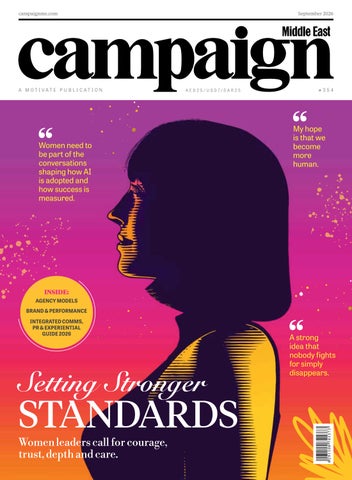
Women need to be part of the conversations shaping how AI is adopted and how success is measured.
#354
My hope is that we become more human.
INSIDE: AGENCY MODELS BRAND & PERFORMANCE INTEGRATED COMMS, PR & EXPERIENTIAL GUIDE 2026
Setting Stronger
STANDARDS
Women leaders call for courage, trust, depth and care.
A strong idea that nobody fights for simply disappears.
ENTRIES OPEN FOR THE FOLLOWING CATEGORIES STANDARD DEADLINE: 17 SEPTEMBER 2026 AGENCY CATEGORIES NEW: Best Gaming & Esports Agency NEW: Best Influencer Marketing Agency NEW: Best Sports Marketing Agency Best Creative Agency Best Digital Agency
Best Events, Experiential and Engagement Agency Holding Company of the Year Best Integrated Marketing Agency Best Media Agency
PEOPLE & TEAMS
NEW: Best Agency Producer
Best Creative Leader Best CSR Initiative Best New Business Development Leader Best Strategic Planning Leader Best Place to Work in 2026 Best Talent Management Individual
NEW: Best Media Planning Leader NEW: Independent Agency Head of the Year Best Account Person Best Arabic Copywriter
Best Performance Marketing Agency Best PR / Communications Agency Best Production House Best Social Media Agency Best Startup / New Agency
Best Corporate Communications & Marketing Team Head of Agency with streams for Creative, Digital, PR, Media & Integrated Marketing Network Head of the Year Outstanding Woman In Advertising or Media
INDEPENDENT AGENCY CATEGORIES NEW: Best Independent Digital Agency Best Independent Creative Agency
Best Independent Media Agency RETURNING FOR 2026: Independent Agency of the Year
GEOGRAPHIC
NEW: Best Agency – UAE: Independents
NEW: Best Agency – Saudi Arabia: Independents
NEW: Best Agency – UAE: Holding Company / Networks
NEW: Best Agency – Saudi Arabia: Holding Companies / Networks
NOMINATE HERE
NEW: Best Agency – Wider Middle East (Qatar, Oman, Bahrain, Kuwait, Jordan, Lebanon and Iraq) Best Agency – Egypt FIND OUT MORE
WWW.AOYAWARDSME.COM Sponsorship opportunities: nadeem@motivate.ae | tarun.gangwani@motivate.ae Entry enquiries: melissa.clarke@haymarket.com
PARTNERS
STRATEGIC PARTNER
BROUGHT TO YOU BY
September 2026
IN THIS ISSUE
03
EDITOR’S LETTER 21 WOMEN IN ADVERTISING
A
Women leaders from across the region’s advertising landscape call for more meaningful work, value over visibility, and greater trust and transparency.
Almarai’s Head of Marketing Communications Nabil Sleiman shares the beauty of work born from plans not drawn up in the conference room.
55 INTEGRATED COMMUNICATIONS, PR AND EXPERIENTIAL GUIDE 2026 07 THE HIDDEN COST OF THE CHEAPEST IMPRESSION MarkApp’s Managing Director Sotiris Oikonomou explains why cheap media is rarely cheap.
08 INDUSTRY FORUM Should marketers stop separating brand and performance budgets?
11 THE INTEGRATED AGENCY ADVANTAGE
5th Element’s General Manager Khaldoun Zaghir discusses why brand versus performance is not a choice at all.
19 “MOST AGENCY WORK DOESN’T GROW BUSINESSES. NOBODY SAYS IT.”
ANUP OOMMEN
“VISIBILITY IS NOT THE SAME AS VALUE.”
13 BRAND FOCUS
04 NEWS & WORK
year ago, women leaders across the advertising Editor industry told Campaign Middle East they wanted a platform to speak more openly. Not a filtered or over-polished version, and not another familiar conversation about empowerment, diversity, equity and inclusion. They asked for room to speak candidly, with the authority earned through experience, about the challenges the industry can no longer afford to treat as secondary. Over the past 12 months, we’ve made a concerted effort to create such a space – and this edition of the magazine celebrates exactly that. Twenty-eight women leaders have spoken. No predetermined narrative. No single theme imposed on their voices. Just an open platform for them to share what’s on their minds. As many of them reminded us, the first responsibility is not to respond but to listen, understand, empathise and support. As a result, this issue feels less like a collection of articles and more like a majlis: generous, opinionated and shaped by people who know that easy answers rarely build interesting conversations or enduring brands. Across these pages, women leaders convey a few common messages: the industry is moving at breakneck speed, but the work that matters still calls for depth. What once felt astonishing has become part of daily life. What is needed now is a different kind of discipline: strategies that know their destination, teams that can change route, and leaders willing to protect strategic thought from the noise of urgency. There is a growing impatience with the industry’s favourite shortcuts. Faster dashboards, smoother processes and smarter tools can help, but they can also flatten the texture that makes work memorable. These leaders remind us that visibility is not the same as value. The ‘average consumer’, the generic female shopper, the polite meeting where nobody says what they mean and the efficient plan with no space for argument – these are all reminders that friction, context and interpretation are not obstacles to the work; they are often what give it depth. Women are not asking to be treated as symbols. They are building, questioning, mentoring, negotiating, protecting trust and widening the field across boardrooms and agencies, tourism and sport. They remind us that resilience is not the same as surviving pressure; it is knowing what to rebuild, what to release and who to bring along. This issue is a call for the industry to advertise with more nerve and more care: to move fast when needed, pause when necessary, and remember that brands are made by meaning, not output alone.
85 MATTER OF FACT
Cicero & Bernay reveals the latest news, views and trends making waves across the global communications sector.
14 FEATURE: THE AGENCY RECKONING
87 APPOINTMENTS
Movements including new roles and promotions in the region.
90 THE SPIN
Mishaps in the world of
50 DUBAI LYNX UPDATES communications.
Motivate Media Group Head Office: 34th Floor, Media One Tower, Dubai Media City, Dubai, UAE. Tel: +971 4 427 3000, Fax: +971 4 428 2266. Email: motivate@ motivate.ae Dubai Media City: SD 2-94, 2nd Floor, Building 2, Dubai, UAE. Tel: +971 4 390 3550, Fax: +971 4 390 4845 Abu Dhabi: Motivate Advertising, Marketing & Publishing, PO Box 43072, Abu Dhabi, UAE. Tel: +971 2 677 2005, Fax: +97126573401, Email: motivate-adh@motivate.ae Saudi Arabia: Regus Offices No. 455 - 456, 4th Floor, Hamad Tower, King Fahad Road, Al Olaya, Riyadh, KSA. Tel: +966 11 834 3595 / +966 11 834 3596. Email: motivate@motivate.ae London: Motivate Publishing Ltd, Acre House, 11/15 William Road, London NW1 3ER. Email: motivateuk@motivate.ae www.motivatemedia.com EDITORIAL: Motivate Media Group Editor-in-Chief Obaid Humaid Al Tayer | Managing Partner and Group Editor Ian Fairservice Group Content Director Thomas Woodgate | Campaign Middle East Editor Anup Oommen | Senior Reporter Ishwari Khatu Junior Reporter Hiba Faisal | DESIGN: Senior Designer Thokchom Remy ADVERTISING ENQUIRIES: Chief Commercial Officer Anthony Milne | Publishing Director Nadeem Quraishi (nadeem@ motivate.ae) | Sales Manager Tarun Gangwani (tarun.gangwani@motivate.ae) | Senior Sales Executive Saif Hemdan (saifeldin. hemdan@motivate.ae) | PRODUCTION: General Manager S. Sunil Kumar | Production Manager Binu Purandaran | Assistant Production Manager Venita Pinto HAYMARKET MEDIA GROUP: Chairman Kevin Costello | Managing Director Jane Macken The publishers regret that they cannot accept liability for errors or omissions contained in this publication, however caused. The opinions and views contained in this publication are not necessarily those of the publishers. Readers are advised to seek specialist advice before acting on information contained in this publication, which is provided for general use and may not be appropriate for the readers’ particular circumstances. The ownership of trademarks is acknowledged. No part of this publication or any part of the contents thereof may be reproduced, stored in a retrieval system or transmitted in any form without the permission of the publishers in writing. An exemption is hereby granted for extracts used for the purpose of fair review. Campaign Middle East includes material reproduced from the UK Edition (and other editions) of Campaign, which is the copyright of Haymarket. Campaign is a trademark of Haymarket and is used under licence. The views and opinions expressed within this magazine are not necessarily those of Haymarket Magazines Limited or those of its contributors.
04
September 2026
Ras Al Khaimah Tourism Development Authority picks M+C Saatchi Group ME as creative agency
The partnership will focus on creating culturally resonant creative platforms.
Independent creative network M+C Saatchi Group Middle East has been appointed by Ras Al Khaimah Tourism Development Authority (RAKTDA) as its creative agency following a highly competitive multi-stage pitch process. The appointment sees M+C Saatchi assume responsibility for RAKTDA’s integrated creative retainer over the next three years, alongside the
development and launch of a new destination proposition that will help shape the next phase of the emirate’s international growth. The remit spans RAKTDA’s priority markets, including the UAE, Saudi Arabia, the UK, Germany, India, China, Russia and Kazakhstan, supporting one of the Middle East’s fastest-growing tourism destinations as it strengthens its position on the
global stage. Commenting on the pitch win, Natalie Cooke, Chief Client Partner, M+C Saatchi Group Middle East, said, “The world’s most successful destinations are never built on campaigns alone. They are built by creating a place people genuinely want to connect with, emotionally, culturally and commercially. Ras Al Khaimah has a remarkable story and an even more
exciting future. What makes this so compelling is the ambition behind it. This is an emirate thinking boldly about its place on the world stage while staying rooted in what it is.” Cooke added, “M+C Saatchi was selected for its strategic approach, integrated capabilities and belief in Cultural Power, the agency’s proprietary philosophy centred on creating ideas that influence culture and deliver meaningful growth. The appointment brings together specialists across strategy, creative, social, experience and production to deliver connected thinking across every touchpoint. The partnership will focus on creating culturally resonant creative platforms that build distinction, deepen relevance across diverse audiences and drive long-term destination equity. Cooke said, “Our job is to turn that ambition into work that travels across borders without losing its authenticity. By pairing strategic clarity with creativity that is culturally connected, we can build ideas that carry real meaning and lasting resonance. We are proud to partner with RAKTDA on what promises to be a defining chapter in the emirate’s tourism story.”
MG Motor Middle East appoints TEAM LEWIS MG Motor Middle East has appointed TEAM LEWIS as its integrated campaign partner for its upcoming SUV line-up campaign across the GCC. TEAM LEWIS will support MG Motor Middle East across strategy, creative development, social content, media strategy and campaign assets. The campaign is designed to drive awareness, consideration and purchase intent across the brand’s SUV portfolio, including the MG ZS, MG HS, MG HS Hybrid+ and the MG RX9. TEAM LEWIS will develop communications that bring these model roles to life through clear storytelling, real-life usage scenarios, social content and media touchpoints – all designed to support consideration, test drives and showroom conversations.
Use the QR code to view this work on Campaign’s website.
HOME CENTRE HOME SCHOOLS YOU Landmark Group’s Home Centre has built on the strong foundations of its successful back-to-school 2025 campaign with its evolved “Home Schools You” campaign in 2026. It switches up the narrative: while children go back to school, parents continue learning every day at home. The campaign – activated across radio, social and digital media, out-of-home (OOH), in-mall digital screens, influencer marketing and in-store activations – was brought to life in partnership with AKQA, foid studio, HAVAS ME, VAS and PS Agency.
September 2026
05
RAKEZ picks RICH as marketing partner
The addition of the UAE Space Agency builds on SOCIALEYEZ’s growing work across the government and emerging tech sectors.
UAE Space Agency picks SOCIALEYEZ for social media and creative content SOCIALEYEZ has welcomed the UAE Space Agency as a new client, marking another significant addition to its growing portfolio of government and forward-thinking organisations. The new partnership further strengthens the agency’s presence across the space, technology and innovation sectors, while reflecting its continued growth within areas shaping the UAE’s future.
Through the new partnership, SOCIALEYEZ will support the UAE Space Agency across social media, creative content and digital communications, bringing its strategic and creative capabilities to an organisation operating at the forefront of the UAE’s space ambitions and future-focused development. Tarek Esper, Managing Director, SOCIALEYEZ, said, “Working with
Use the QR code to view this work on Campaign’s website.
organisations that are contributing to the UAE’s future is an important part of our growth as an agency. Welcoming the UAE Space Agency to our portfolio reflects the trust placed in our ability to deliver strategic, creative and digitally led communications.” Hagar Mahmoud, Head of Social at SOCIALEYEZ, said, “Our growing portfolio reflects the relationships we continue to build.”
Ras Al Khaimah Economic Zone (RAKEZ) has chosen Dubai-based marketing agency RICH as its marketing partner. RICH will support RAKEZ across its integrated marketing activity, covering strategic direction and creative development alongside digital campaigns, content, video production and broader marketing communications. The remit is broad, spanning both strategic direction and day-to-day delivery across the organisation’s marketing activities. RAKEZ is home to more than 50,000 companies. It supports several entrepreneurs, small- and mediumsized enterprises (SMEs) and multinational organisations. Ahmad Numan, Director of Marketing and Corporate Communications at RAKEZ, said, “At RAKEZ, we’re committed to building meaningful connections with entrepreneurs, investors, and businesses around the world. As our marketing ambitions continue to grow, it is important for us to partner with an agency that combines strategic thinking with strong execution.” Mike Rich, Founder and CEO of RICH, said, “RAKEZ is a business we’ve wanted to work with for a long time, so being chosen means a great deal to us.”
Use the QR code to view this work on Campaign’s website.
AHMED SEDDIQI 75TH ANNIVERSARY CAMPAIGN
SNOONU WITH SNOONU, YOU GET IT
For its 75th anniversary, Ahmed Seddiqi’s campaign celebrated the brand’s past, but also outlined its vision for the future. The campaign was brought to life through a mix of out-of-home (OOH) advertising, a film, a client-and-media event to unveil limited-edition timepieces, and an extensive press office programme across regional and global media. It aimed to strengthen brand awareness, recall and preference, while reinforcing Ahmed Seddiqi’s position as a trusted authority in luxury. The campaign reached 17.9 million users, generated 106 million impressions and delivered 297,000 clicks across channels.
Snoonu and Beattie + Dane launched a campaign to introduce the brand to Kuwaiti audiences as the nation’s first fully fledged superapp. Built around the idea “With Snoonu, you get it”, the campaign used three playful films and a squad of local bodybuilders to show how the platform can handle everyday needs beyond food delivery. Its services range from groceries and laundry to car washes and home services. The campaign aimed to shift consumer perceptions of Snoonu from a food delivery platform to an all-in-one service for everyday life, using local humour and relatable situations to bring the proposition to life.
Agencies Create. Group, Assembly Global and iProspect
Agency Beattie + Dane
06
September 2026
Senior women in UAE marcomms invited for The Leadership Accelerator
The inaugural cohort of The Leadership Accelerator by Think Equal poses for a photograph.
Following the success of the inaugural cohort of The Leadership Accelerator by Think Equal, The Marketing Society UAE has opened of applications for the second edition. The six-month programme, hosted in partnership with Weber Shandwick MENAT, is designed to help accelerate the careers of female leaders in the marcomms industry by preparing them for upcoming C-suite roles.
Amina Taher, Chair of The Marketing Society UAE, said, “Our mission remains to break down barriers and create more opportunities for women to step into senior leadership roles across marketing and communications.” She added, “The incredible talent we saw in the first cohort showed just how important The Leadership Accelerator by Think Equal is in
Use the QR code to view this work on Campaign’s website.
CARREFOUR
helping build a more equitable future for our profession. We’re proud to launch the second edition alongside our partners and contributors, and look forward to supporting the next generation of women leaders.” Built around three pillars – Community, Capability, and Clarity – the programme encourages women to develop the confidence, skills and networks needed to lead with even greater impact. Selected professionals will gain exclusive access to top-tier GCC CEOs and CMOs, building both the personal capability and the professional circles required to champion gender equity at the highest levels of the industry. Evidence shows initiatives such as The Leadership Accelerator by Think Equal are still much needed: only 27 per cent of GCC marcomms professionals reported equal or near-equal male-female representation in their marcomms management teams, as per data from the 2025 Think Equal Survey by The Marketing Society and Weber Shandwick. “The Leadership Accelerator provided space not only for self-reflection, but also for challenging and supporting one another,” said Anna Varley Jones, Senior Director – Strategy & Intelligence at Weber Shandwick. Empowering the next generation of leaders through a combination of transformative workshops, in-person events, virtual sessions and mentoring, the annual programme prepares rising stars to command the room and drive systemic change. The programme is designed to help accelerate the careers of talented female professionals in the region’s industry. Applications for one of 15 places in the second cohort are now open until 25 September 2026, with the programme set to run from January to June 2027.
Use the QR code to view this work on Campaign’s website.
على طولAPPاطلب كارفور من الـ
AL JAZIRA CLUB ‘A LOVE LETTER TO ABU DHABI’
Carrefour, which is operated exclusively by Majid Al Futtaim across the Middle East, has launched its latest campaign intended to drive awareness and spur the adoption of the Carrefour App as a faster and more convenient way to shop online. The campaign was built around an Arabic phrase with a double meaning, translated as either straight away or moving forward. The campaign featured content creator Marwan Moslemany, who converted the message into entertaining content that audiences could remember and relate to. It also led to a lot of user-generated content.
New Balance and Al Jazira Club have unveiled a campaign film, produced by 815 Studios, celebrating the launch of the club’s three new, locally inspired kits for the 2026–27 season. The film, titled ‘A Love Letter to Abu Dhabi’, captures the spirit, pride and passion of Abu Dhabi’s community as it prepares for the first matchday of the season. The film puts the community at the heart of the story, celebrating the shared identity and the sense of belonging that comes with wearing the club’s colours. Through this campaign, New Balance and Al Jazira Club celebrate the new kits, passionate supporters and the city they call home.
Agency One More Advertising Production Banbanfilms Production House
Agency Mixfame Production 815 Studios
PARTNER CONTENT
The hidden cost of the cheapest impression Brand and performance became opposed because the industry built measurement systems that could only see one of them clearly, says MarkApp’s Sotiris Oikonomou.
E
very marketing team is under pressure to prove efficiency. Lower the cost per thousand impressions (CPM). Lower the cost per click. Lower the cost per acquisition. Those numbers are visible, comparable and easy to defend in a quarterly review. What they do not show is what the saving has cost you. Brand equity is built in environments, by appearing consistently in content people trust, on screens they are actually paying attention to. It erodes in the opposite conditions, and it erodes quietly. That silence is exactly why cost-led buying became the default.
THE CHEAPEST IMPRESSION IS CHEAP FOR A REASON
Low CPMs are not a discount on the same product. They are a different product.
Inventory clears cheaply because attention is low, viewability is marginal, the environment is unverified, or the supply path was resold several times before it reached the buyer. The impression is delivered. The metric improves. The brand appears somewhere it would never have chosen deliberately. In the reporting, that campaign outperforms. In the market, it did nothing, or worse, it placed a premium brand in an environment that quietly discounted it. Six months later, someone asks why consideration is flat despite record delivery. The answer sits in a media plan nobody re-reads. Cheap media is rarely cheap. The invoice just arrives later and in a different currency.
THE SYSTEM REWARDS WHAT IT CAN COUNT
It is tempting to blame procurement, or agencies, or the client. That misreads the problem. The issue is structural. Cost metrics report cleanly and instantly; brand outcomes report slowly, imprecisely and long after the budget was committed. When one number arrives on Monday and the other arrives next year, the Monday number wins, not because anyone believes it matters more, but because it is the only one available when the decision is made. So the industry optimises toward the measurable proxy and assumes the rest will follow – but it does not.
AUTOMATION IS ABOUT TO MAKE THIS FASTER
This is where artificial intelligence (AI) changes the stakes. AI is moving from a system that recommends to a system that decides. Agentic models are given an objective and a set of constraints, then evaluate their own options, act, measure and adjust without a human approving each step. Applied well, that is a genuine advance. But an agent optimises toward what it can measure. Point one at cost efficiency and it will find the cheapest inventory available with a thoroughness no human desk could match,
continuously, at machine speed. It will not pause to ask whether the environment suits the brand, because that was never in the objective it was given. Automation does not create this problem. It industrialises it. A flawed buying philosophy executed manually leaks value; the same philosophy executed autonomously drains it.
THE FIX IS UPSTREAM, NOT DOWNSTREAM
The answer is not to slow the technology down. It is to be far more deliberate about what we ask it to optimise for. That means defining the objective properly: not cost alone, but cost within a defined set of acceptable environments. It means classifying inventory on context, quality and suitability before the auction rather than auditing it after the invoice. And it means insisting that an autonomous system can explain its decisions – especially those that cannot be explained cannot be governed. Curation is the practical expression of this. Deciding in advance where a brand is willing to appear does not restrict performance. It removes the inventory that was never going to perform in the first place.
WHERE WE SIT
At MarkApp we treat this as an infrastructure question, not a targeting preference. Pantheon, our contextual supply-side platform (SSP), classifies and enriches bid requests before auction, so decisions rest on environmental and quality signals rather than price alone. Harion, our demand-side platform (DSP), activates cross-device campaigns against defined objectives inside premium supply. MarkDash brings delivery, optimisation and reporting into one view, because efficiency claims should be inspectable. None of that removes human judgement from media. It gives it better instruments.
THE QUESTION WORTH ASKING
Brand and performance were never opposing disciplines. They became opposed because we built measurement systems that could only see one of them clearly. Before the next efficiency target is set, the more useful question is not how low the cost can go. It is what the brand is worth, and whether the saving is being funded from somewhere nobody is currently measuring.
By Sotiris Oikonomou, Managing Director, MarkApp
08
September 2026
INDUSTRY FORUM: Should marketers stop separating brand and performance budgets?
Mohamed Shaheer
Founder & CEO, Captizone Media
NO
Brand and performance marketing use different creatives, target different audiences and serve different purposes, so their budgets should be allocated differently. Investing more in branding builds trust, recognition and long-term customer preference, which makes performance marketing more effective over time. Look at many of the top brands around us; we rarely see them relying heavily on direct performance campaigns because their brand itself creates demand. As brand strength grows, the line between brand and performance naturally starts to blur, eventually reaching a point where strict budget separation becomes less necessary.
Ana Elisa Seixas
Head of Marketing, Middle East, Africa and India, New Balance
YES
Yes, yes and yes. Hopefully it is clear where I stand on this one. It’s important to see marketing budgets the same way you look at a creative brief; it’s all about storytelling and taking the customer on a journey. It’s about seeing the budget allocation as a funnel allocation exercise – and you spread a bit of budget along the way. Too much in the upper funnel and you miss out on conversions and too much at the bottom and the customer easily gets saturated. So, you have to find that delicate balance between brand awareness/demand generation and conversion. But it’s not just about budget; these conversations need to go hand in hand across the planning, execution and reporting phases too.
September 2026
09
Dzila Dik
Senior Brand Marketing Manager, Kids & Masterbrand Marketing MEA, LEGO
NO
The moment budgets are merged, performance marketing takes over by default, because its results are immediate and easy to measure, while brand-building pays off slowly and is harder to prove in a single quarter. But that is precisely what erodes long-term brand health. Brand and performance marketing serve the same ultimate purpose, just at two different speeds. Brand builds mental availability that makes people receptive to buying in the first place; performance converts that receptivity into an immediate sale. They are not rivals fighting for the same budget; they work together as teammates, each doing a job the other can’t, and that’s why they need separate, protected budgets rather than one pooled fund. The bigger question is: what’s the right balance?
Dvija Pandya
Senior Account Manager, Adapts Media
NO Trevor D’Souza
Investment Director, Radix MENA
NO
Brand and performance sit at opposite ends of the same funnel, and collapsing their budgets erodes both. Brand spend builds the mental availability and trust that lowers acquisition cost tomorrow; performance spend converts the demand that’s already been created today. Merge the two and short-term, easily attributed performance wins will always cannibalise the long-term brand investment, because performance shows an immediate ROI story while brand doesn’t. The smarter approach isn’t one budget; it’s two disciplined ones, planned together, measured differently and constantly feeding into each other. Separate funnels, shared strategy, that's how sustainable growth compounds.
Brand and performance work differently, so they need separate budgets. Performance marketing is about quick wins: clicks, sales, leads you can measure right away. Brand marketing builds awareness and trust over time, and its results take longer to show. If you mix the two budgets, performance always looks like it’s winning because its results are easy to see fast, so brand spending quietly gets cut. But without brand awareness, performance simply doesn’t work: if people don’t know your brand, why would they trust it enough to buy? Keeping budgets separate protects both trust and long-term growth.
Mahmoud Alhamed
Head of Performance, Serviceplan Middle East
YES
Brand and performance should stop competing for budget because the customer journey is now interconnected. Brand builds awareness, trust, and future demand, while performance converts that demand into measurable results. As AI increasingly shapes how consumers discover and evaluate brands, brand equity is becoming a direct driver of performance, shaping AI recommendations, click-through rates and conversion rates. Marketers should align both under one growth strategy with shared objectives, even if budgets stay separate for planning and measurement. In the AI era, growth belongs to brands that build demand and convert it as one system, not two.
Firas Wahbeh
Chief Brand & Strategy Officer, BEEAH
NO
In my experience, brand and performance marketing operate on different timelines and serve different objectives, and collapsing their budgets risks starving long-term brand equity in favour of short-term, easily measurable performance wins. Performance channels offer immediate, attributable ROI, which tempts finance teams to redirect spend away from brand building whenever budgets tighten. But brand investment compounds over years, driving the awareness and trust that make performance campaigns efficient in the first place. Ring-fencing brand budgets protects against short-termism. The two disciplines should be integrated strategically and measured with complementary metrics, but keeping distinct budget lines ensures neither cannibalises the other under pressure.
10
September 2026
Wassim Derbi
Kim Mascarenhas
YES
Consumers don’t think in ‘brand’ versus ‘performance’; they just buy. Their journey is fluid, and strategies should mirror that. Combining these budgets lets marketers optimise for the ultimate business goal - revenue and market share in real time. And having agile, always-on tracking of both brand health and sales performance shows exactly where to shift support. WPP Media and Oxford University’s study, ‘How Humans Decide’, supports this. 86 per cent of consumers choose brands they’re already primed toward, so performance budgets fight for just the remaining 14 per cent. To stay relevant, marketers must merge budgets, ensuring today’s short-term tactics also build tomorrow’s long-term growth.
Head of Marketing and Brand Communication, Hyundai UAE and Genesis UAE Because both contribute to the same commercial objective: sustainable business growth. Rather than asking how much to allocate to each, the focus should be on how they work together across the customer journey. Brand creates demand, while performance captures it. Consumers are digitally connected, moving seamlessly between social media, e-commerce, physical retail and messaging platforms before making a purchase. Purchasing decisions are also influenced by trust, reputation and cultural relevance as much as price or promotions. Without consistent investment in brand equity, performance campaigns become increasingly expensive and less effective over time. That said, maintaining separate budget categories internally is still good governance. It provides stakeholders with transparency on
Associate Vice President – Insights & Analytics, WPP Media MENA
YES
Tony Farah
General Manager, Clickon Group
YES
Brand and performance should no longer be treated as separate investments. They are two sides of the same growth strategy. Brand marketing creates awareness, trust and long-term preference. Performance marketing converts that demand into measurable business results. When budgets are split, teams often end up working towards different objectives instead of a shared business goal. The most effective marketers integrate both disciplines, using brand to strengthen performance and performance data to refine brand strategy. Together, they drive stronger customer acquisition, higher loyalty and more sustainable growth.
where investments are being made and how different activities contribute to business objectives; however, these categories should not create strategic silos. Every marketing investment – regardless of whether it is labelled as brand or performance – should ultimately be evaluated against tangible business outcomes. A unified planning and measurement approach enables marketers to optimise spending based on business goals and customer lifetime value, ensuring every dirham invested delivers measurable value to stakeholders while supporting both short-term growth and long-term brand strength. Not to mention, campaigns should also never exist in isolation. Every campaign launch should be designed as part of a broader marketing strategy with clearly defined business objectives. Tactical activities may deliver short-term metrics, but without a strategic framework, they often fail to create lasting value. By aligning every campaign with the brand’s long-term vision, customer journey and commercial goals, marketers can ensure that individual initiatives contribute to measurable business outcomes rather than simply delivering isolated campaign results.
Mai Cheblak
Head of Corporate Marketing, Consumer Education and Awareness, Emirates NBD
YES
Brand and performance should no longer be viewed as separate investments. In today’s highly competitive environment, brand budgets must be strategically invested to communicate what truly differentiates an organisation. At Emirates NBD, initiatives such as financial wellbeing and United Against Fraud go beyond product marketing; they demonstrate the bank’s commitment to creating positive social impact and serving a broader purpose. These campaigns build trust, credibility, and emotional connection, making customers more likely to engage with the brand and respond to performance-driven campaigns. When brand purpose and performance work together, they reinforce one another, delivering stronger commercial results while building long-term customer loyalty and sustainable growth.
PARTNER CONTENT
September 2026
5th Element’s Khaldoun Zaghirr makes a case for why brand versus performance isn’t a choice at all. WHY THE BINARY BREAKS DOWN
The truth is that brand and performance were never separate disciplines; they’re separate horizons of the same objective. A strong brand lowers the cost of every performance action that follows it: recognition improves click-through, trust improves conversion, memorability improves retention. Meanwhile, well-run performance media is one of the fastest feedback loops a brand has; it tells you, in near real time, which stories, formats and moments are actually landing with an audience.
WHERE DATA AND CREATIVITY ACTUALLY MEET
F
or years, the marketing industry has treated brand-building and performance marketing as opposing philosophies: one plays the long game with stories and emotion, the other plays the short game with clicks and conversions. Agencies built entire operating models around this split: brand on one side, performance specialists on the other, occasionally meeting in a status call to compare notes. That divide was always more organisational than strategic. And in 2026, it’s becoming a genuine liability.
THE COST OF FRAGMENTATION
When a brand’s creative agency, media agency, social team and performance partner sit in separate silos, often in separate holding companies entirely, something gets lost in the handoffs. The brand campaign launches with one narrative. The performance campaign optimises against a different set of signals three weeks later, informed by data the creative team never saw. Nobody owns the full customer journey, so nobody is accountable for whether the brand story and the performance funnel are actually reinforcing each other. Clients feel this most acutely in measurement. Brand teams report reach and sentiment. Performance teams report ROAS and CPA. Both are technically correct and often tell contradictory stories about the same campaign, because they were never designed to be read together.
This is where the third pillar comes in. Data is too often framed as creativity’s supervisor, the thing that reins in bold ideas and forces everything toward the safe, proven, algorithm-friendly choice. Used well, it’s the opposite. Data tells you where the white space is: which audience segment is underserved, which message is fatiguing, which format is earning attention versus being scrolled past. That’s not a constraint on imagination; it’s a briefing document. The risk isn’t data itself, but treating data as a substitute for creative judgement rather than an input to it. The agencies producing genuinely distinctive work in 2026 are the ones where strategists, creatives and media planners are reading the same dashboards and having the same conversations, not where a data science team hands down a report that creative is expected to execute against.
WHAT THIS MEANS FOR AGENCY MODELS
This is, ultimately, an argument about structure. Holding companies built on collections of independently-run specialist agencies, and boutique agencies built around a single discipline, both face the same challenge: reconciling brand and performance requires the people doing both to sit close enough – organisationally and informationally – to actually influence each other’s work in real time, not just at the debrief. Integrated models – agencies built from the outset to run creative, media, social, PR and performance under one roof, with shared data and shared accountability – aren’t a trend or a pitch-deck buzzword. They’re a structural response to a genuine problem: brand and performance stopped being separable the moment every channel became measurable and every measurement became actionable. The agencies that win the next phase of this industry won’t be the ones with the best brand team or the sharpest performance team. They’ll be the ones where those were never two teams to begin with.
By Khaldoun Zaghir, General Manager, 5th Element MEA
“Agencies producing genuinely distinctive work in 2026 are ones where strategists, creatives and planners are reading the same dashboards and having the same conversations.”
11
12
September 2026
BRAND FOCUS
THE MOST DANGEROUS SENTENCE IN MARKETING: “THAT’S NOT MY JOB” The businesses pulling ahead of the rest are building leaders who can connect commercial, consumer, product, creative, finance and retail around a shared business ambition, says Arushi Sethi, former marketing and commercial director at P&G.
I
’ve rarely heard anyone say the words, “That’s not my job.” But I’ve watched organisations behave as though they were true. Think about your own organisation: marketing owns the campaign; sales owns distribution; finance owns margins; agencies own the brief; research owns insights – basically, everyone owns something. Yet, somehow, none of them seem accountable for the business. And this is becoming one of the biggest blind spots in modern marketing. Ironically, it isn’t because we lack expertise. It’s because we’ve never had more of it. Brand. Commerce. Retail media. Performance. CRM. AI. Analytics. We’ve become exceptional at building specialists. However, the next competitive advantage won’t come from creating even narrower expertise; it will come from connecting it. Now think about consumers. They don’t experience organisational functions. They experience one brand,
“THE NEXT COMPETITIVE ADVANTAGE WON’T COME FROM CREATING EVEN NARROWER EXPERTISE; IT WILL COME FROM CONNECTING IT.” one product, one price and one business. Growth doesn’t happen inside functions. It happens when functions seamlessly integrate as one. I believe it’s time we challenge a few assumptions. Perhaps it’s time marketers stopped staying in our lane. Specialisation has made marketing stronger.
But somewhere along the way, expertise became a boundary. Looking back over almost two decades leading brands across markets, I realise that I learnt this early in my career: I recall sitting in a quarterly review where all functional scorecards were green, yet the business was not growing. The issue was not functional challenges; it was trial. Some of the biggest growth breakthroughs didn’t come from marketing or sales working harder; they came from marketing better understanding commercial realities, retailer economics, finance, product and supply chains, and creating integrated plans that worked better as a whole. To me, orchestrators are not people who know every discipline. They are “T-shaped leaders” – people who understand the business and the brand, then bring the right people, capabilities and decisions together to solve one shared business challenge. Perhaps it’s time we stop outsourcing our understanding of the consumer. We’ve never had more research, dashboards or AI. Yet, I worry we’ve never found it easier to drift away from the people we’re trying to serve. The most common reason is lack of funding or resources. One habit I’ve deliberately protected is spending time in stores. Watching shoppers. Asking questions. Listening without the corporate title. Behind every dashboard is still a person making a choice, and it is imperative to know that person and their needs and challenges. Perhaps it’s time we stop treating the brief as the starting point. The best agency partners I’ve worked with didn’t simply answer briefs brilliantly. They challenged them and changed them. Instead of asking, “How do we execute this?”, they first asked, “Is this really the business problem?” Several of them met consumers to validate the brief.
That shift changes the conversation from producing better campaigns to creating better business outcomes that serve the consumer. Perhaps it’s time we stop confusing functional success with business success. As I shared previously, I’ve sat in reviews where media delivered. Sales delivered. Innovation delivered. Every dashboard was green. Everyone seemed to be winning – except the business. Functional excellence matters. However, businesses don’t reward functions – they reward growth. And growth comes when every function rallies around one business ambition, not a single functional key performance indicator (KPI). Marketing is no longer just a brand-building discipline. Increasingly, it’s becoming a business management discipline that delivers top- and bottom-line acceleration for the company. The marketers who will thrive won’t simply be the ones who know the most about marketing. They’ll be the “T-shaped leaders” who understand the business and the brand as a whole – and know how to orchestrate people, capabilities and decisions around one shared business ambition. Today’s marketing needs more leaders who can connect the specialists. And this brings me back to where I started. The most dangerous sentence in marketing isn’t, “Has my campaign failed?”. It’s “that’s not my job.” Because, the moment we stop owning the overall business challenge, growth often becomes everyone else’s responsibility – and also nobody’s responsibility. By Arushi Sethi, former marketing and commercial director at P&G
September 2026
I
work at a food company. That sounds obvious. But what it actually means is that I’ve spent years sitting with people who grow things, process things, package things and ship things. People who work in factories at 4am. People who manage farms where the variables are weather, soil and animal behaviour. That exposure changed how I think about my own job. It introduced me to a concept I’ve never seen discussed in a marketing context. But it should be. It’s called Work-as-Written versus Work-as-Done. Work-as-written is the plan. The campaign brief, the brand guidelines and the process flowchart someone built in a clean conference room with good air conditioning and no deadline pressure. Work-as-done is what actually happens. In the factory, in the agency and on the morning a campaign goes live and something is wrong. The best manufacturing companies don’t just accept the difference between the two. They use it. Every deviation between what was planned and what was done becomes an input. The process gets reviewed, the learning gets captured and the next version of the procedure is stronger than the last. That discipline is why some operations improve every year and others repeat the
same problems in different seasons. Marketing is no different. The brief says the campaign goes live in four weeks. That’s the plan. What actually happens is that the shoot runs long, the edit needs another round, a key visual gets flagged in one market but not the others, and suddenly the regional teams are working off different versions of the same asset. The four-week timeline becomes seven weeks. The brief becomes a historical document. It shows up in quieter ways too. A brand with clear guidelines still drifts in tone over three years. Nobody decided to change it. Twenty people made 20 small calls, one at a time, and nobody was adding them up. Or a campaign strategy built around a specific audience assumption meets a platform algorithm that optimises for something else. The reach numbers look fine. The actual audience was never the one in the plan. I’ve been on the wrong side of this. A campaign that looked right in every briefing and every review went out and did nothing. The idea wasn’t the problem. The version of the market we planned for and the market we actually launched into were two different things. The plan was right. The conditions had moved. The dangerous part is not the difference itself. It’s when an organisation refuses to see it.
BRAND FOCUS
CONFESSIONS OF A MARKETER: WHEN THE WORK DOESN’T GO TO PLAN Almarai’s Nabil Sleiman challenges marketers to compare their last big campaign to the original brief, and then map the differences to build an honest view of their teams and the market.
13
I’ve sat in reviews where the question was always: why didn’t the team execute the plan? Never: was the plan executable? The plan becomes sacred. The work becomes the defendant. And the same problem shows up in the next campaign, and the one after that. Marketing should borrow the manufacturing mindset. When a team adjusts how they work mid-campaign, the first question shouldn’t be: why did they deviate? It should be: what did they learn that we haven’t captured yet? Because the best version of the work usually lives somewhere between the original plan and what actually happened. The job of a good leader is to find it and build it into the next brief. The person who taught me the most about my job this year didn’t work in marketing. He worked in a factory at 4am, handling things no procedure had anticipated, with real consequences if he got them wrong. What he understood, and what I’ve spent 20 years learning in my own way, is that the plan is where the work begins. Look at your last big campaign. Then look at what was in the original brief. Map the differences. You’re not looking for someone to blame. Somewhere in that list is the most honest picture you’ll get of how your team and your market actually work. And that is worth more than any plan written in a conference room.
By Nabil Sleiman, Head of Marketing Communications, Almarai
14
SPECIAL FEATURE
September 2026
The Agency Reckoning Industry leaders speak to Campaign Middle East about why the agency model is not dying, but is being forced to prove its value through sharper strategy, stronger trust and more accountable commercial models. By Anup Oommen
T
he agency model has been pronounced dead so many times that its obituary has become a running gag within the Middle East brand and marketing industry – especially when geopolitical pressure, economic uncertainty or the latest technology wave gives the industry another reason to panic. However, such humour is also perceived as a coping mechanism for recurring concerns such as flawed commercial logic, procurement and pricing challenges, the democratisation of creative output, the fallout of huge mergers and acquisitions, and the effect of automation and artificial intelligence (AI) on client expectations. When the financial toll is felt – even momentarily or for a single quarter – agencies are told that their days are numbered. Some bend, others are bruised; some complain, others cruise; most of them reorganise and, somehow, the media and marketing industry perseveres. Campaign Middle East speaks to industry leaders, who are clear about one thing: the
Rory McEntee
region’s agencies will find a way to remain resilient even through recessions. However, they also advise caution: the value that agencies bring to the table is under intense scrutiny. In the Middle East, that scrutiny is sharpened by the speed of the market. Brands are being asked to launch faster, localise better, prove impact sooner and produce more content across more platforms, often while budgets are under tighter pressure. That makes the agency
question less theoretical here than in more mature markets. Clients need partners who can move at regional speed without reducing strategy to output. The agency model conversation is not as simple as whether the future belongs to holding companies, global networks, regional joint ventures, local independents or in-house agencies. It is a more complicated, and more useful, discussion than that. The consensus is that the future belongs to better combinations: teams built around business problems rather than agency labels, and partnerships based on measurable outcomes rather than billable hours. The agencies best placed to thrive will be those that combine judgement, craft, speed, cultural fluency and commercial accountability, without losing the confidence to challenge the brief. That puts measurement, remuneration and trust at the centre of the debate. Clients need to involve agencies earlier in solving
SPECIAL FEATURE
business problems, while agencies need to be clearer about where they add value and how that value should be rewarded. To fix this, briefs need to be written around business problems rather than predetermined outputs; key performance indicators (KPIs) need to connect brand, performance and commercial outcomes; and payment models need to reward strategic thinking, collaboration and measurable impact.
Faysal AbdulMalak
Contributing to this conversation are: • Rory McEntee, Chief Marketing Officer, GymNation; • Habiba Allam, Head of Creative, Careem, • Ramzi Sleiman, CEO, Saatchi & Saatchi ME and Publicis Health ME; • Faysal AbdulMalak, CEO, VML Dubai; • Scott Feasey, CEO – Europe and Middle East, M+C Saatchi Group; • Dan Shepherd, Chief Strategy Officer, Omnicom Media MENA; • Rami Hmadeh, Managing Partner, Serviceplan Group Middle East; • Naveen Chacko Mathews, Managing Director, HAVAS Media Middle East; • Abdallah Safieddine, Senior VP – UAE and Lower Gulf, Mindshare MENA, a WPP Media brand; • Nick Walsh, Founder of Migrate Group and The Alliance of Independent Agencies Middle East; and • Lauren Sanders, Head of Client Services, The Romans MENA. Their arguments don’t begin with the death of agencies, but with the economics that govern them. Marketing value: redefined and rewarded Industry leaders begin the discussion by explaining that the agency model itself is not the only issue. The deeper problem, they say, lies in how value is priced and assessed. Agencies are being asked to provide more specialist support and remain always available, while many buying processes still reduce that contribution to rates, hours and discounts. The implementation of AI-augmented tools and processes has only exacerbated the existing problem. Sleiman draws a clear distinction between the agency model and the version of it that no longer deserves protection. “The agency model isn’t broken. The mediocre agency model is,” Sleiman says. “Every few years, something comes along that is supposed to kill agencies. Digital was going to do it. Social was going to do it.
In-housing was going to do it. Now it’s AI. Yet here we are.” Sleiman explains that such pressure is exposing a more fundamental problem: agencies can no longer justify their role by simply producing more work. “What is broken is the idea that an agency can survive by simply taking a brief, making something, delivering it and moving on,” Sleiman says. He adds, “That model deserves to disappear. Clients don’t need more output. They have more ways than ever to produce output themselves.” McEntee claims that the commercial foundation was weakening even before AI entered the conversation. “What has been broken is the pricing model, and AI is only the latest thing exposing it,” McEntee says. “Procurement-led pitching did plenty of damage long before AI showed up, turning agency selection into a spreadsheet exercise on rate cards rather than a judgement call on who will actually move the needle. Add in scope creep, where the retainer quietly expands to cover everything nobody wants to line-item, and you get a model that was fraying well before AI arrived. The truth is AI has just made the fraying impossible to ignore, especially because now there’s a cheap, fast alternative sitting right next to the expensive one.” McEntee adds, “In the past, I’d be paying six figures a year for a retainer where 80 per cent of that work isn’t needed. I don’t need agencies for things such as reports, research and due diligence anymore. I can do much of that in an afternoon with AI. Also, the creator economy fractured the idea that creative output only comes from agency talent. Real-time culture and social speed killed the value of the three-week turnaround long before generative tools did, and clients bringing more in-house has been a decade-long trend, not a 2026 invention.” Discussing the pressure forcing agencies to justify what clients are really paying for, Hmadeh says, “What’s broken is the assumption that scale alone justifies a retainer. Clients don’t want to pay for headcount or process any more. They want a fast, sharp decision from someone who knows what they’re doing. But most agency models still charge for the old thing.” He adds, “AI has compressed production timelines to a fraction of what they were three years ago, but agencies that treat this as a cost-cutting exercise rather than a repositioning of value will lose the argument entirely. What should never change is craft under pressure. Speed without a point of view is just noise delivered quickly.” That tension is now showing up in remuneration. Explaining how the commercial model is struggling to keep pace with what agencies are now expected to deliver, Mathews says, “What’s broken isn’t the agency model,
September 2026
it’s the economics. Agencies are expected to deliver strategic and always-on capabilities while remuneration continues to be driven by procurementled cost reduction.” He adds, “What’s evolving is the agency’s role: from campaign executor to business growth partner, connecting data, technology, creativity, commerce and AI to drive measurable outcomes. The agency of the future must never lose its independence of thought. Its greatest value lies in challenging assumptions, connecting diverse expertise and providing objective counsel that creates lasting commercial impact.” Sleiman echoes this view, arguing that the agency-client relationship has to move beyond delivery and into earlier, more meaningful partnership. “What clients need is a partner who can see what they can’t see,” Sleiman says. “Someone who understands their business, challenges the brief, connects the dots and brings an outside perspective that creates disproportionate value.” He adds, “The best relationships I’ve seen are built when agencies are brought closer to the business, understanding the pressures, the ambitions and the opportunities early enough to make a real difference.” Safieddine takes the argument one step further: if agencies are being asked to deliver results, they should be bought and measured that way.
Habiba Allam
“AI has done what every big shift in marketing eventually does. It has forced agencies to rethink what they actually sell,” Safieddine says. “Agencies are no longer just planning media. Many are now embedded inside client operations, closer to something we could call RaaS, Results as a Service.” He adds, “But there is a problem. The way clients remunerate agencies has not caught up. Most requests for proposals (RFPs) and pitch conversations are still built around price: hours, headcount, discounts. Not impact. So agencies capable of driving real business results are often being evaluated the same way they were five years ago, on cost. This gap cannot hold much longer. Briefs and RFPs need to be rewritten around a simple question: what result are we actually buying?” This is not simply a demand for higher fees; it is a demand for a more honest
15
16
September 2026
Scott Feasey
commercial contract between clients and agencies. If agencies are being judged on outcomes, they cannot continue to be bought as units of time. The question, then, is no longer whether agencies can create value; it is whether the industry is willing to buy that value differently. Evolution, not extinction The brand and marketing industry has always been part of a constant cycle of evolution and reinvention, and the current moment is no different. In a world where the agency-model conversation takes the unnecessarily apocalyptic route, AbdulMalak suggests a more mature viewpoint of rebirth and growth rather than death and ashes. “We humans love drama,” AbdulMalak says. “Give our minds room to wander toward the future or the unknown, and we’ll paint the bleakest picture possible – anchored in words such as ‘dead’ and ‘the end’. And almost every time, reality turns out far less dramatic.” He adds, “Nothing is dying. The industry is adapting, the same way it always has. What’s changing is how value gets delivered – agencies are stepping into a new role, working in partnership with AI platforms to move at a speed and scale that simply wasn’t possible before.” Shepherd drives this idea further. He quotes Bob Dylan from It’s Alright, Ma (I’m Only Bleeding), saying, “If you’re not busy being born, you’re busy dying.” Shepherd makes the case that change is not an external pressure on agencies; it must be an intrinsic part of their nature. “Agencies have been declared dead almost from the moment they were born,” Shepherd says. “The very essence of an agency is predicated on change. Those that don’t, can’t or won’t change will wither on the vine. As this ecosystem evolves, agencies must never lose the ability to react and create new value for our clients.”
Lauren Sanders
SPECIAL FEATURE
The point is not that agencies face more competition from technology companies, data providers, creators or in-house teams. It is that their value now depends on how well they can orchestrate those forces rather than pretend they sit outside them. But if agencies are to keep reinventing themselves, the harder question is what they must never give up. What agencies must not lose Even as agencies morph within an ever-evolving ecosystem, leaders point to certain aspects that must never change. Feasey cautions against mistaking changing delivery models for changing fundamentals. “Clients today expect us to help solve much broader business challenges rather than just communication challenges,” Feasey says. “They expect us to move faster, to use data and analytics to provide better insights and strategies, and to bring significant expertise to the table, which genuinely spans disciplines, markets and sectors.”
Rami Hmadeh
Feasey adds, “But underneath all of that, what clients really value hasn’t shifted nearly as much as people assume. A clear understanding of their business and their consumer, insights that break through data stacks, strategic thinking that separates them from the competition, and creativity that participates in culture and captures attention, respect and brand love are all still there.” The agency of the future may be faster, more automated and more integrated into client operations, but it still needs taste, judgement, craft and the courage to disagree. For Sleiman, these human qualities are what agencies must protect at all costs. Sleiman says, “Technology will make us faster. AI will make us more efficient. Data will make us more informed. But none of those things gives you taste. None gives you instinct. None gives you empathy. And none gives you the courage to put an idea on the table that everyone thinks is slightly crazy until suddenly it isn’t.” McEntee says that, above all, agencies must protect their ability to make discerning choices when everyone has access to the same tools. “What should never go: taste,” McEntee says. “The ability to look at a wall of options and know which one will actually
land, which one a journalist runs with, which one gets you in front of the right room. That’s built through patternrecognition over years of doing the work.” Walsh adds that agencies must also protect their ability to push back. As delivery becomes more accountable and specialised, the danger is that agencies become efficient executors rather than useful partners. He says, “As agencies become more specialised and more accountable for delivery, they must never lose the confidence to question the brief, bring fresh thinking and act as genuine business partners.” AbdulMalak makes the same argument through the lens of AI. While technology may change the speed and scale of delivery, he says that it cannot replace the human ability to interpret people and culture. “What should never change, no matter how much the model shifts, is the human judgement at the centre of it,” AbdulMalak says. “Consumer behaviour, taste, cultural instinct, the ability to read a room and a market at once, that’s not a feature AI can replicate.” Feasey explains that this is where creativity must continue to connect with business understanding and cultural participation. He says agencies still need to understand the client, the consumer and the world around them. “The agency of the future needs to deliver the same ability to understand the client’s business, the consumer and the culture in which they operate,” Feasey says. “New technology, new channels and new content providers will enter the market, and the market will continue to change. Let’s not underestimate the importance of still showing genuine passion and energy for the client’s business, with the commercial acumen to provide tangible return on investment.” If those fundamentals remain constant, the structures that deliver them can become more fluid. No single agency model wins The discussion also lays to rest the age-old debate about whether the future belongs to large holding companies, integrated networks, independents or in-house teams. Most leaders reject the idea of a single winner. Different business problems, they argue, require different combinations of capability. That is particularly true in the Middle East region, where a single client may need global brand governance, Saudi cultural fluency, Arabic-first social content, rapid production, creator partnerships, commerce thinking and boardroom-level measurement, often within the same quarter. Allam says the market will continue to need different kinds of agencies and marketing structures. She compares the future to a system in which different players each operate with a more specialised purpose.
SPECIAL FEATURE
“WE NEED TO MOVE FROM BEING IN THE BUSINESS OF MAKING THINGS TO BEING IN THE BUSINESS OF MAKING A DIFFERENCE.” “A lot of people say the big network agency model will eventually die, but I don’t agree,” Allam says. “Clients come in all shapes and sizes, with different budgets and ambitions. That’s why I think there will always be room for big networks, independent agencies, in-house teams and boutique shops, because they all serve different needs.” She adds, “I see it more like a solar system. Every planet has its own orbit and purpose. Sometimes they align and influence one another, but most of the time, they move within their own space. The future is less about one model replacing another and more about them coexisting.” Walsh says the real issue is not whether one structure beats another, but whether the right solutions are implemented for the right challenges. “I don’t think the future belongs exclusively to any one model,” Walsh says. “It belongs to organisations that can bring together the right capabilities around the right problems. Large networks still offer valuable scale and integration. Independent agencies increasingly provide exceptional depth of
Ramzi Sleiman
expertise. In-house teams bring proximity and speed.” This view is echoed by several leaders who described the future as hybrid by necessity. Networks have long been associated with scale and infrastructure. Independents are known for agility and specialist depth. In-house teams can be held accountable within the business. Mathews says, “Competitive advantage comes from orchestrating the strengths of each of these agency models around client needs rather than defending one structure. Increasingly, agencies will compete on how effectively they connect talent, technology, data, creativity and partnerships to solve business challenges. Success will be defined by agility, accountability and measurable commercial value, not organisational labels.”
McEntee adds that the industry must go “hybrid all the way” – especially for brands that have built internal teams over the past decade. “It used to be in-house handling always-on content while agencies did the ‘big’ work. Now it means small, sharp in-house teams handling more of the always-on and the operational grind, with outside specialists brought in specifically for what they’re genuinely better at,” McEntee says. Hmadeh responds, “In-house is right for tactical work and volume, but it caps diversity of thinking. Teams solve every problem the same way because they only see their own category. What’s shifting is that CMOs increasingly want the senior person who shaped the strategy still in the room when decisions get made, not handed off to a junior team once the pitch is won. Hybrid wins, but the case for independents doesn’t rest on running one.” Sanders argues more strongly for independent agencies. For her, independents are not merely another option; they are a response to frustrations that clients have been dealing with in larger legacy structures. “We are absolutely in the era of independents,” Sanders says. “The fluidity, flexibility and character suit this generation of talent, and clients have become bored of high churn, tight resourcing, pitch-and-ditch leadership and changing identities of larger legacy networks. Today’s indies are specifically designed to counter those things.” Agreeing that each agency model has its strengths, Shepherd concludes this part of the discussion by saying, “The future belongs to all of them. Different clients and businesses will always have different needs. The highest value is in those who can best connect capabilities, collaborate smarter and deliver client solutions that prioritise simplicity over complexity. In short, the future belongs to those who can find the right people, the right ideas, the right technology and, most importantly, make stuff happen.” This is not a network versus independent debate or an agency versus in-house discussion. It is whether the model around the client is flexible enough to solve the problem in front of it, without forcing every brief through the same, narrow structure. Yet even the best combination of people, platforms and structures will struggle if the relationship itself is treated as disposable. The trust deficit The conversation becomes more pointed
September 2026
when it turns to trust. Many leaders say that the relationship between clients and agencies has become too transactional, shaped by procurement-led reviews, short-term contracts, repeated pitching and governance structures that leave little room for real, strategic partnerships. But the defence of agencies cannot become purely sentimental. Clients have questioned the model for good reason. Too many have experienced slow processes, senior people disappearing after the pitch, layers of account management and work that looks good in a case study but fails to move the business. Sanders says the decline is visible in the everyday behaviour of the relationship. “I’d argue that since the pandemic it’s been worse than ever,” Sanders says. “Many clients are favouring close governance over freedom to deliver. The general connectedness of agencies to clients is suffering. Sometimes a simple in-person meeting request is met with intense cynicism.” McEntee adds that the buying process itself has trained both sides to behave like vendors and purchasers rather than partners. He says, “Procurement-led reviews, RFPs scored on rate cards, annual repitches as standard practice – all of that trains both sides to treat the relationship as a vendor contract rather than a partnership.” McEntee suggests that clients may need to buy fewer things from fewer partners, while agencies need to be more transparent about where they are creating value. Shepherd says the quiet part out loud, describing why trust has eroded. When payment is tied too rigidly to time and materials, agencies think twice about challenging clients the way they should. “One of the most negative consequences of an overly rigid, time-and-materials approach to compensation is how much it disincentivises agencies from challenging their clients,” Shepherd says. “If your focus is on ensuring someone does a good job of sweeping the kitchen, you’re probably not going to ask them to design you a new restaurant.” Approaching the argument from another angle, AbdulMalak posits that the pressure clients now face has actually made trust more important, not less. In a faster environment, clients need partners they can rely on under pressure. “Strategic trust between agencies and clients matters now more than ever,” AbdulMalak says. “Clients aren’t looking for a vendor right now; they’re looking for a partner who can help them navigate a
Abdallah Safieddine
17
18
SPECIAL FEATURE
September 2026
landscape that’s more complex, faster and less forgiving than it used to be.” Mathews agrees that the industry needs to move away from a supplier mindset and offers a solution. “Trust is rebuilt when agencies move from suppliers to strategic partners, with shared accountability for business outcomes rather than campaign metrics alone,” Mathews says. “In today’s complex landscape, strategic trust is no longer optional. Clients must involve agencies earlier in solving business challenges, while agencies must be willing to challenge assumptions and take ownership beyond execution.” Shared accountability, however, depends on a shared definition of success. Is everyone speaking the same language? The divide between agency language and client language appears most clearly in measurement. Agencies often talk in scopes, channels and deliverables. Clients are increasingly judged on growth, profitability, acquisition, retention and market share. Until those two worlds meet, many partnerships will continue to feel misaligned. “Briefs are still too often a shopping list of deliverables rather than a problem to solve, which locks agencies into scopebased thinking from day one,” McEntee says. “The fix is writing briefs around the outcome you actually need, and paying for the outcome you get.” Shepherd takes this a step further, saying that digital infrastructure has made the industry better at viewing activity, but not necessarily better at understanding value. “The hill I will die on is that, since the advent of digital, we have become better at counting and worse at measuring,” Shepherd says. “Until we can all ‘speak fluent CFO’, the gap will remain, and long-term strategic planning will fall foul of the sugar rush of short-term wins.” This is where the agency debate becomes less about creativity and more about credibility. If agencies want to be paid for business impact, they need to describe their contribution in the language of business impact. That gap also affects how marketing earns credibility inside the business. If agencies cannot explain their contribution in ways that the boardroom understands, they risk being trapped in a world of campaign metrics while client-side marketers are held accountable to commercial outcomes.
Naveen Chacko Mathews
Nick Walsh
Mathews explains, “The issue isn’t data, it’s alignment. Success metrics should be agreed up front, linking brand, performance and commercial outcomes within a single framework. Agencies also need to move beyond reporting efficiency to demonstrating business impact. When both sides align around shared objectives and accountability, measurement shifts from proving value to creating it.” Walsh agrees that the industry needs to shift from discussing scopes of work to discussing business outcomes. He says, “Every agency should understand exactly how its contribution connects to the client’s broader commercial objective, and success should increasingly be measured collectively rather than by isolated channel performance.” However, this requires clients to bring commercial stakeholders into the conversation early. In Feasey’s view, aligning with finance is not a bureaucratic exercise; it helps marketing earn greater respect inside the organisation. “We work, early in the process, with the C-suite and the finance team, to understand the nuances around business margin and the ROI they need to see from work,” Feasey says. “Once the CFO, for example, is aligned and kept up to date with what we are doing and the ROI being achieved, the process always seems to go smoothly, unlocks more budget and builds greater respect for the whole marketing team.” Once finance enters the conversation, measurement can no longer sit apart from money. The final unlock The last fault line identified was the gap between how work is commissioned and how it is compensated. This is where measurement becomes commercial. If the brief defines the wrong problem, the payment model will reward the wrong behaviour. Hmadeh says the brief is often written around budget justification rather than the result that matters. “Most agencies are still paid for time while being asked to deliver outcomes, which might take more or less time than agreed, and that mismatch starts in the brief, written to justify a budget rather than define a result,” Hmadeh says. He adds, “Getting this right requires agencies that are willing to price outcomes and clients that are willing to
have that conversation early, before the brief is even written.” Mathews says that some briefs tend to limit the agencies’ ability to interrogate real client concerns. “Too many briefs are execution-led or arrive with predetermined solutions, limiting agencies’ ability to solve the real business problem,” Mathews adds. However, as one of the industry’s biggest problems, this is also one of its biggest opportunities. If more time were spent defining the problem properly, improvements would be seen across team structures, campaigns, results and compensation. “Too many briefs describe the solution before anyone has fully defined the problem,” Walsh says. “If we invested more time up front in understanding the business challenge, we’d create better briefs, build better teams and ultimately deliver better outcomes.” As Sleiman puts it, the real evolution is not from one structure to another, but from output to impact. He says, “We need to move from being in the business of making things to being in the business of making a difference.”
Dan Shepherd
The uncomfortable truth is that both sides – clients and agencies – have helped create the current model. Clients have often bought too narrowly, pitched too often and squeezed too hard. Agencies have sometimes overpromised, overstaffed, underchallenged and hidden weak thinking behind process. Yet the message from industry leaders is consistent: the agency model is not dead, but the old bargain is under pressure. Clients still need outside perspective, cultural intelligence, specialist skill and creative judgement. Agencies still have a role, but they cannot defend it through old structures, broken briefs or underpriced thinking. The next client-agency relationship will not be built by choosing one model over another. It will be built around clearer problems, shared definitions of success and payment for value that moves organisations forward. The reset is behavioural, not structural. Agencies must prove value clients can recognise, defend and fund. Clients must decide whether they want cheaper suppliers or braver partners. Growth will belong to those who turn trust into value.
PARTNER PARTNERCONTENT CONTENT
September 2026
“Most agency work doesn’t grow businesses. Nobody says it.” The leadership of Alternative.Agency says that the industry has confused activity with outcomes for too long, and that the markets people previously found complicated are exactly where the solutions live.
N
are the norm. And the norm demands a fundamentally different assim Taleb wrote about systems that don’t merely kind of thinking. survive disorder. They get stronger because of it. He Yash Ganatra, Managing Director and CFO, Alternative.Agency, called them antifragile. It is a reasonable description locates what he calls the industry’s central confusion not in a lack of what building a marketing agency across the GCC of capability, but in its structure. and Africa does to you. Ganatra says, “The industry has spent a decade talking about The conventional wisdom in this industry has always been to transformation and largely delivered sophistication. Better tools, follow the money to its most predictable address. Build in faster production, more channels. But the CMO sitting across from established markets. Chase the large retainers. Optimise for award any agency does not need more channels. They need brand, shows. And if growth happens for the client somewhere in the technology, data, experience and AI working as a single connected process, wonderful. If not, there is always the next campaign. system. The moment those five things are managed by four Alternative.Agency was built on a different wager: the markets different agencies with four different P&Ls, the customer pays the everyone called complicated were not problems to be managed; price. That is not a vendor problem. It is an architectural one.” they were an education nobody else was sitting in. The agency now operates across the UAE, Saudi Arabia, Kenya, Two decades of automotive mandates across the Middle East and Rwanda and South Africa, with a delivery engine in Mumbai. But Africa. Auto dealerships across the UAE and Saudi Arabia. A major the geography is less interesting than the philosophy it has banking institution in East Africa. An aviation authority midway produced: the belief that campaigns and systems are not the same through a billion-dollar infrastructure transformation. These are thing, and that confusing one for the other is where most marketing not engagements chosen for their tidiness. They are multi-market, investment quietly disappears. multilingual and multi-regulatory engagements, in which the brief Antifragile systems, Taleb observed, require disorder to reveal shifts with the exchange rate and the media landscape changes their strength. The complexity of GCC and African markets, the between one city and the next. That is the territory the agency has regulatory variance, the cultural specificity, the multi-dealer chosen to call home. structures and the uneven digital maturity – none of it was an Aejaz Khan, Global CEO, Alternative.Agency, says it is precisely obstacle to building a different kind of agency here. They were, it that environment that has changed how the agency thinks about turns out, the conditions that made building one necessary. the industry’s central problem. “Most agency work doesn’t grow businesses. Everyone knows it. Khan says, “Growth breaks in the same place every time. Not in Nobody says it,” Ganatra says, adding that this notion is one vertical, not in one channel. It breaks across all of them, uncomfortable precisely because it is not really about any one because the customer journey has never respected the agency. It is about an industry that has been measuring the wrong organisational chart of the agency that is supposed to manage it. things, in the wrong markets, for longer than it would like to admit. The industry has known this for years. What it has been slower to do The question is not whether that is true. The question is what, is build something structurally different in response.” structurally, comes next. The agency model, as designed, with separate shops for brand, digital, media, CRM and creative, was built for a world where the customer journey was linear and the channels were discrete. Neither is true anymore. A customer who sees a social post, clicks a search result, visits a website, enters a showroom and receives a dealer follow-up is not moving through five separate agency briefs. They are experiencing one thing. One feeling. One decision. This is not a new observation. What is perhaps underappreciated is how much more consequential the misalignment becomes in markets that carry their own complexity. An automotive brand entering Saudi Arabia cannot afford a disconnect between its digital presence and its dealer experience. A financial institution repositioning in East Africa cannot import assumptions from a London case study. These are not edge cases in the Aejaz Khan Yash Ganatra markets Alternative.Agency operates across. They
19
September 2026
Women in
ADVERTISING
This section brings together insights from 28 women leaders across the region’s advertising landscape. They call for more meaningful work, value beyond visibility, and greater trust and transparency. Their message is clear: the industry needs more courage and care. It needs to listen better, think harder and build brands for lasting growth, not output alone.
21
22
September 2026
T
his year at Cannes Lions, it felt like the industry identified two major risks and invited them in so we could look at them more closely. AI was a main topic on almost every stage and at the next table in every restaurant, while hundreds of creators attended the festival and secured seats that used to belong to industry chiefs. AI is an obvious guest of honour. But why were the creators there? Is it because with more and more work that looks generated, not produced, people are looking for another human to tell them they can trust a product? AI makes everything look possible, competent and polished, but it’s unaccountable. On the other hand, we have a creator who puts the product on her own skin before she says it works. The one who lets her toddler taste that drink on camera. The one who swears on a live broadcast – no edits, no second take – that she is obsessed. This is not simply advertising. It’s a real person putting their name, reputation, credibility and future on the line. They have something to lose. That is what a machine cannot replace, and it is why the living creator rose in the same breath as AI. The more the world fills with the generated, the harder people reach for the humanmade. When anything can be made in seconds, it is worth less, and we start chasing and valuing what takes more sacrifice to produce. Having said that, AI is here, and its lasting presence is now irrefutable. So the questions are: how much should we yield to it? Is it ready to handle our expectations? Is it a choice we’re making or simply panic? For now, the human is still findable in the work. For now. But when AI advances to the point of faking our voice, taste and thinking, will we still see the difference? Will we trust an AI creator more than a human one? Will it matter by then, though?
These are the questions worth asking. When the generated no longer looks generated, will anyone still reach for the human hand? Or will we forget there was a hand to reach for? When photography arrived, it was a tool, a faster way to capture what a painter did slowly. Then it took portraits. Then reportage. Then it took the whole world of pictures, and nobody remembered it had once been a tool. Nobody fights it anymore. In fact, it has become so good that it has become a substantial part of our everyday lives.
“My bet is that we secure the human premium again, the way we always have when a new technology takes over. We’ll figure it out as we go.”
Meanwhile, impressionism, which rose as a reaction to photography, is now a niche market for collectors. This year, the work that won was crafted by humans. The cases that used AI used it as a tool: aggregating data, finding the pattern, retouching, finishing. The humans still owned the thinking and the craft. Some Young Lions presented work they illustrated by hand, going out of their way to prove that what they were presenting was the product of their brain and talent and not the product of AI. And we appreciated and rewarded them for it. But until when? Will this passion to prove the value of our human talent still be alive next year? Or the next? The machine is not taking the work. We are delegating it, one choice at a time, year by year. And we’re telling ourselves it carries more of the doing, so we carry more of the thinking. The question remains: are we delegating or yielding? Then again, history has seen this pattern before. Mass production made handmade goods rarer – and more prized for it. Streaming made recorded music cheap and live concerts more precious than ever. Every leap forward creates a human premium. So maybe AI won’t destroy humanity. Maybe it raises its price. For everyone, and especially for women in this industry, empathy has always been the edge. The instinct that keeps injecting life into a world becoming more AI-generated by the day. My bet is that we secure the human premium again, the way we always have when a new technology takes over. We’ll figure it out as we go. Or maybe we have to lose our humanity first, so we can find it again, and know what it’s worth.
By Sally Alzaza, Regional Creative Director, Interesting Times
AI versus creators.
A COINCIDENCE? Interesting Times’ Sally Alzaza raises a fascinating question: are we delegating or yielding?
PARTNER CONTENT
September 2026
23
The value OF BELONGING
MBC Media Solutions’ Petra Ahwach explains why cultural relevance and the right context are key to creating brand impact that lasts.
A
conversion is easy to see. A memory is not. We can count clicks, downloads and purchases almost instantly, but the specific moment that made someone notice, trust or eventually choose a brand is harder to trace. Perhaps it happened while a viewer was watching a favourite show. Maybe the product appeared naturally in a storyline, solving a problem they recognised. Or perhaps a brand joined a conversation that young audiences were already having. What makes these moments valuable is not simply exposure. A brand is more likely to be noticed and remembered when it fits naturally within the content and has a role to play. For brands, this means understanding the environment, what it means to the audience and whether there is a genuine reason to be there. CULTURAL RELEVANCE IS KNOWING WHEN TO BELONG In Saudi Arabia, Ramadan gatherings, football matches, family occasions and local humour are part of everyday culture, not simply opportunities on a media calendar. Brands need to understand what
these moments mean to people and how they are experienced. Being culturally relevant is not about showing up everywhere; it is about knowing when a brand has a natural role to play and when it does not. A Saudi food delivery platform that MMS worked with showed what this can look like through its 2024 integration with MBC’s Fananees. Ramadan is not an obvious moment for food delivery, as many families prefer to cook and eat together at home. Rather than trying to change that behaviour, the delivery company found a role within it. The brand became part of the familiar Fananees world, supporting family meals, lastminute grocery needs and the everyday realities of Ramadan. The campaign ran across MBC television channels, MBC Shahid, social media, radio, airports and an in-app game, generating 490 million impressions, more than four million social interactions and a 35.4 per cent increase in food-delivery orders. Its strength was simple: the brand did not ask people to choose convenience over tradition. It showed how convenience could support it. We also worked with a Saudi mapping and navigation app that took a different approach during MBC1’s football programme Nadina. When a journalist needed to reach the studio on time, he used the Saudi navigation app to find his way. There was no formal product demonstration or forced mention; the app simply solved a problem at the point it was needed in the story. That natural role resonated with viewers: 40 per cent recalled the integration and nine in 10 felt it fitted the storyline. Consideration rose from 56 per cent to 69 per cent, alongside an increase in app downloads. A simple moment of genuine usefulness delivered both brand impact and action. A global beauty and personal care brand also took a different route, creating Ramadaniyaat – a youth-led talk show on MBC Shahid during Ramadan. The programme brought together humour, music and candid conversations about relationships and self-expression, speaking directly to the lives and interests of younger audiences. The brand became part of the conversation rather than simply advertising around it. Ramadaniyaat became one of the top-rated titles in its
category on MBC Shahid. It also contributed to its strongest sales season at the time and increased brand love among young audiences by 85 per cent. Its success led to two additional seasons. In this case, relevance came not from following an established Ramadan formula but from understanding how younger audiences were experiencing the culture differently. The three campaigns are very different. The first brand became part of a familiar Ramadan world, the second solved a problem within a Saudi storyline, and the third created space for a different kind of conversation. In each case, the brand had a clear reason to be there. The impact also went beyond an immediate sale or download. When people notice a brand, remember it and see it in a relevant context, they are more likely to consider it when the need arises. A click may be where the sale is recorded, but the decision often starts much earlier. THE RIGHT CONTEXT MAKES A DIFFERENCE That is also why the environment around a brand matters. An advertisement shown in trusted, premium entertainment can inherit some of the attention and credibility of that environment. The same advertisement placed in a crowded or irrelevant setting may simply be overlooked. Media is more than a delivery system; it shapes how a brand is experienced because the quality of attention matters as much as the amount of attention. Ten seconds during a programme someone loves can be more valuable than a longer exposure delivered while that person is distracted or waiting to skip. Emotion, anticipation and shared viewing can transform a brief appearance into something memorable. Sales and conversions remain essential, but they are only part of the picture. Attention, recall and brand lift help show whether a campaign is building demand for the future as well as delivering results today. The strongest campaigns do both: they deliver business results today while giving people a reason to remember the brand tomorrow.
By Petra Ahwach, Client Growth Senior Manager, MBC Media Solutions (MMS)
24
September 2026
A
cross the Middle East, an extraordinary momentum is unfolding. Governments are committing billions to AI, businesses are expanding internationally with unprecedented ambition, and visionary projects are redefining global standards. This region has never been afraid of tomorrow. It leans into the future with audacity and speed. PwC’s 2026 Middle East CEO Survey reinforces this reality: regional CEOs are among the world’s most active adopters of AI, while 88 per cent plan to expand beyond their domestic markets. Yet, for leading businesses, the central challenge is no longer just keeping pace with change. It is building distinctive brands that do justice to their business ambition. As AI makes brand execution faster and more accessible, competitive advantage is shifting. It’s no longer enough to produce good, polished work. The cost of blending in has never been higher. Brands must do more to stand out. This is an economic imperative. Differentiation is the single strongest predictor of future value growth, price premium and investor appetite. Landor’s analysis of data from WPP’s BrandAsset Valuator reveals that brands increasing their relevant differentiation by just 3 per cent secure an average 1 per cent gain in market share. So where does that differentiation come from? This challenge feels particularly exciting in the Middle East. Crucially, the region’s unique diversity offers the ultimate fuel for the distinctiveness brands must reflect. Dozens of cultures, languages and worldviews interact here daily: challenging, sharpening and inspiring one another. The most compelling brand ideas emerge precisely at these rich intersections. Over the past few years, one thing has become increasingly clear to me. The brands best placed for this next chapter will have three things in common: the bravery to think differently, the judgement to know which ideas matter and the lived experience to make those ideas resonate through authentic human connection. It all starts with brave ideas. Brave branding isn’t about provocation for its own sake. It is about investing disproportionately in the core strategic idea with deep conviction – owning an unmistakable point of view across every touchpoint. In the Middle East, bravery comes from understanding local culture deeply enough to innovate within it. That was our starting point with Saudia.
AI changes the rules.
HUMAN DEPTH CREATES VALUE. Landor’s Amal Atallah explains why businesses must be brave enough to stand out, demonstrate the judgement to own a singular truth and draw on lived experience to create brands that people genuinely care about. The airline pivoted from a traditional regional carrier into a living ambassador of Saudi culture with a bold promise: Welcome to our future. This was a commitment to building cultural pride while inviting international curiosity. This positioning drove an 80 per cent increase in brand value within two years and established a foundation for product innovation such as the Coolest Ihram: a centuries-old garment reimagined with modern cooling technology to protect pilgrims in
extreme heat. This is not a campaign. It is a brave idea solving a real human problem. Brave ideas need human judgement to turn potential into something people genuinely remember. AI can generate endless possibilities, but it cannot decide which idea is worth pursuing. It can’t weigh cultural nuance, recognise emotional resonance or know when restraint is more powerful than complexity. That’s where human judgement creates value. That same combination of brave thinking and human judgement shaped the creation of Misk Heritage Museum, Asaan. Instead of treating heritage as something static behind glass, we framed heritage as a living human story under the brand idea: We are timeless. By shifting the focus from passive observation to active engagement, Asaan invites Saudis to participate, shape and carry culture forward through specialised spaces, workshops and community-led programmes. The result is a new relationship between people and culture that is truly lived. Ultimately, even the bravest ideas and the best judgement need to be grounded in lived experience. In a synthetic world, visible human depth signals what no algorithm can fake. Values must be felt, not just communicated. They must be reflected in how a brand behaves, the experiences it creates and the relationships it earns over time. That means investing not just in how a brand shows up, but in how it makes its audiences feel. Those feelings shape what people say, share and review, creating the real-world signals that emerging AI agents will use to assess, surface and recommend brands. In this sense, human experience will increasingly influence agentic choice. As more Middle Eastern businesses look beyond the region, the opportunity is for their brands to become more confidently themselves. The businesses that create the greatest long-term value won’t necessarily be those adopting every new technology first. They’ll be the ones with the bravery to stand out, the judgement to own a singular truth and shape brave ideas, and the lived experience to create brands people genuinely care about. In a world where intelligence is abundant, differentiation will come from things that are much harder to replicate: human judgement, human creativity and lived experience.
By Amal Atallah, President – EMEA, Landor
September 2026
25
The efficiency
TRAP
VML Egypt’s Mai Azmy discusses why MENA’s creative industry needs to protect healthy friction.
E
very evening, I negotiate with a fiery six-year-old girl. If you think managing multimillion-dollar agency mergers or pitching to regional conglomerates is tough, try explaining to a determined child why bedtime is not a fluid concept. It is exhausting, but it is also a daily masterclass in negotiation, passion and boundaries. My daughter has no interest in “streamlined processes” or “operational efficiency”. She wants to explore, challenge and debate. And lately, as I look at the landscape of the marketing and advertising industry across the Middle East and North Africa, I find myself wishing we had a bit more of that fiery resistance in our boardrooms.
I started my career at Ogilvy in 2005 as an account executive. Back then, the industry felt beautifully chaotic. We spent hours in smoke-filled rooms debating single adjectives. Today, as Chief Operating Officer of VML Cairo, my day-to-day work naturally revolves around structure, integration and delivery. I like operations; it is the engine room of our industry. But lately, I’ve been asking myself a dangerous question for a COO: Have we made things too efficient? In our collective rush to embrace automated workflows, predictive data and hyper-optimised organisational structures, we are committing a quiet crime against our industry. We are eliminating “healthy friction”. In physics, friction is resistance. In advertising, friction is where the spark happens. It is the heated debate between a creative director and a suit over a brave idea. It is the uncomfortable silence in a client meeting when a strategy challenges their comfort zone. It is the manual, messy, human process of tearing up a deck at midnight because, although it meets the brief, it doesn’t touch the soul. Today, the pressure on regional brands to move fast has never been greater. The MENA region is transforming at breakneck speed, driven by ambitious national visions and a young, digitally native population. To keep up, agencies have adopted agile methodologies and algorithmic tools designed to smooth out the creative road. We want seamlessness. We want predictable outcomes. But predictable outcomes lead to flat, homogeneous work. When we optimise the creative process to the point of zero resistance, we get what is called “the sea of sameness”. We see campaigns that look identical, sound identical and perform adequately in metrics but fail entirely to make anyone feel anything. We must remember that the consumer’s mind is not an algorithm. If you want to capture the attention of a young Egyptian, Saudi or Emirati consumer, you cannot rely solely on polished, frictionless delivery. You need a narrative that disrupts their scroll. You need friction. This is not a call to return to the chaotic, disorganised agency models of the early 2000s. I am a COO; I know that profitability and structure allow our businesses to survive and give talented people a place to work. Instead, this is a plea for intentional friction.
“Our job is not just to build efficient machines. Our job is also to protect the humanity of our agencies.”
Here is what it looks like in practice: First, it means protecting the sacred, un-streamlined space of human collaboration. We need to allow our teams the time to disagree. If your creative and account management teams are agreeing too quickly, something is wrong. Second, it means re-evaluating our relationship with data. Data should be the springboard, not the anchor. If we only execute what the data proves will work, we will never create anything new. We must allow room for the intuitive, gut-instinct risks that defy data. Finally, it requires us to educate our clients on the value of the detour. The shortest distance between two points is a straight line, but the most memorable journeys are always winding. The best clients I have worked with over the last two decades are those who welcomed the friction of being challenged. As leaders, especially women who have navigated this industry’s shifting tides for over twenty years, our job is not just to build efficient machines. Our job is also to protect the humanity of our agencies. Tonight, when I go home, my daughter will undoubtedly find a new, creative way to push back against my evening schedule. I will sigh, I will negotiate and I will smile. Because deep down, I know that her refusal to accept the easiest, most efficient path is exactly the kind of fire we need to keep alive in our offices tomorrow. Let us make room for the friction. That is where the magic lives.
By Mai Azmy, Chief Operating Officer, VML Egypt
26
September 2026
Are mentors of the future ALREADY IN THE ROOM? Serviceplan Group Middle East’s Salma Badawi and Hadeel Alharthi share their thoughts on being mentored to build career paths that do not yet exist.
T
he hardest part of becoming a strategist used to be earning the right to think. Today, AI has taken away that entry point for many of us. THE DISAPPEARING LADDER For generations of strategists, research, competitive audits, data synthesis and the first drafts of insights were the apprenticeship. It was how we learned to separate facts from insight, and insight from strategic conviction. It was how we gradually earned the right to tackle bigger questions of judgement. Today, a machine can produce much of that foundation before we’ve brewed our first coffee. Most people see faster, more efficient strategy. We see what we call “the disappearing career ladder”. If the work that shaped us early in our careers is now shared with AI, what exactly are today’s strategists learning? More importantly, how are we being mentored when the ladder itself is changing beneath our feet? We are fortunate to be mentored by a woman strategy leader who challenges how we think, not just what we produce. She cannot hand us the map that guided her career because the landscape has changed. Instead, she is helping us learn how to navigate it. Perhaps that’s the real shift AI has created. What the next generation of women strategists needs is no longer a blueprint, but a new kind of mentorship. HADEEL’S TAKE My global team encouraged me to use my Saudi perspective from the beginning, when strategy is framed, rather than at the end. I came into planning through social media, where I learnt to read numbers and people together, and look beyond what audiences say. I look for why a joke lands, why behaviour changes and what brands miss. I recognise Saudi tensions because I have lived them. For a long time, I had strong angles but struggled to make the story as clear as the thinking. My mentor helped change that. She does not give me her answer; she makes me finish mine by asking what the
business problem is, what the argument is and what can be cut. During the hardest weeks, she stays calm so everyone else can think. She trusts her work and stands behind it. Watching her taught me to trust and defend mine. AI helps me organise research and thoughts but it cannot read what culture leaves unsaid. That remains my role. My work is stronger now and the results make that growth visible. Whenever I can, I help others organise their thinking by asking questions first because that is what she did for me. SALMA’S THOUGHTS Everyone wants to arrive somewhere and finally rest. A finished idea, a settled answer, permission to stop: everyone wants these. What I’ve learnt during the past two years is that speed to certainty isn’t the reward for good strategic thinking. It’s usually the sign that you’ve stopped thinking.
Salma Badawi
Hadeel Alharthi
The old ladder trained us to prioritise speed over certainty. The faster you landed, the better you looked. But speed and being right were never the same thing. What my mentor is building in me is the tolerance to stay unresolved on purpose – well past the point where it’s comfortable – because, quite often, that’s where the real answer hides. That used to sound exhausting. Now, I think it’s the only honest description of the job. That’s the real edge of women mentoring women in advertising. For years, we were told to prove ourselves by moving faster and shouting loud enough to be heard. Today, we’re teaching each other the stamina to stay in the discomfort until we land on a truth worth standing behind. Passing that muscle down to the women I now mentor goes way beyond career advice. It’s how we teach each other to trust our own depth. PLOT TWIST: WE WERE THE LADDER Strategists are trained to find the pattern everyone else misses. Ours was hiding in plain sight. It turns out mentorship does not begin with a senior title. It begins the first time someone brings you scattered thinking and you resist the urge to hand them an answer. Strategy has never been about having the answer. It has always been about asking the question that changes the answer. In an agency, strategists sit between every discipline, translating, connecting and reframing. When someone comes to us stuck, we do not solve the problem. We slow it down. We ask better questions. We introduce a framework. We challenge an assumption. We hand over a way of thinking instead of a conclusion. The best ideas are rarely the ones we give away. They are the ones people discover for themselves. For many women, mentorship begins long before leadership. Mentorship begins the moment another woman starts watching how you think, how you navigate uncertainty and how you approach a problem, then quietly decides she can do the same. The women who shape us do not leave us with a blueprint. Instead, they leave us something far more valuable: a way of thinking. If we can do the same for another woman, then perhaps that is what mentorship looks like now. Not showing her the path we took, but helping her navigate the one that does not yet exist.
By Salma Badawi, Strategy Manager, and Hadeel Alharthi, Strategic Planning Executive, Serviceplan Group Middle East
September 2026
S
omeone once told me that I should count myself lucky because opportunities will come simply because I am a woman – and because I’m a minority. Occasionally, even because I happen to tick more than one diversity box at the same time. The assumption was always the same: that opportunities would somehow arrive because of who I was, rather than what I could do. Because of course, what my birth certificate says is what makes me remarkable, right? I am a Chinese-Filipino, born and raised in Manila, Philippines. I was educated at a Catholic high school and then at a Jesuit university. Rules, dress codes and structured decorum have been part of my upbringing. The rules were strict: no coloured hair, no coloured nails, no coloured shoes, socks had to reach three fingers above the ankle, skirts had to end three fingers higher than that, and your attitude had to be nice and agreeable. If not, you were disciplined and brought into an office – along with your parents. I’ve been told that obedience is part of the upbringing of most girls across Asia. We’re told to lead, but not to be too outspoken; to debate, but not to be too difficult; to have a career, but only until we decide to become mothers. That you are young at 22 and but too old to be single at 33. To play sports but not too aggressively. I was once told in a game by an opposing team player, “Why are you good? You’re a girl!” Supposedly, there is a way of being a woman. Now, as a Group Creative Director, living more than 4,000 miles away from home, I find that none of these rules make sense to me anymore. In fact, being too agreeable means being bad at your job. For most creatives, your career depends on your ability to speak up and stand out. Ideas don’t survive because they’re polite. They survive because someone is willing to defend them. Great creative work isn’t built by people who simply agree with the room. It’s built by people who question assumptions, challenge briefs and occasionally make everyone a little uncomfortable in pursuit of something better. For a while, I thought that meant leaving kindness behind. I couldn’t have been more wrong. Working in advertising has completely changed my worldview. I’ve been lucky to always find myself working with female creative directors – each showing me a different form of leadership. Though all different, the best ones have always been one thing: kind. And over the years, I’ve realised those two things are very different. Nice avoids difficult conversations. Kindness has them because someone deserves to grow.
“Women are breaking away from individualistic culture and beginning to find value in lifting each other up.”
27
deadline because, “who cares?”. It’s a simpler and more carefree life. But no one earns respect like that. In 2026, I do believe the world is a kinder place for women. More and more women are leading and opening their own agencies. They are breaking away from individualistic culture and beginning to find value in lifting each other up. The world doesn’t revolve only around men, but also around the women who take up space because of the quality of who they are. That’s why, in a world where everyone’s telling you to just be nice, be kind.
By Choi Co, Group Creative Director, FP7 McCANN UAE
Nice agrees with a client to avoid conflict. Kindness has the confidence to say, “I think we can do better.” Nice keeps quiet in a meeting. Kindness speaks up because the work matters. Nice lets someone struggle alone. Kindness asks for help, shares the load and makes sure no one carries success – or failure – by themselves. The best leaders I’ve worked with understood that kindness isn’t softness. It’s accountability delivered with respect. It’s honesty without ego. It’s creating an environment where people feel challenged without feeling diminished. It took years to learn that balance, and as a young Creative Director, I’m still learning. Early in my career, I was fortunate to work alongside brilliant female Creative Directors in Manila – many of them balancing leadership with motherhood while building the country’s most awarded agency. Later, in Singapore, I partnered with one of the nation’s top creatives, whose ambition and belief in me led to my first Cannes Lions Festival. The reason I’m in Dubai today is because of mentors who believed in my potential – not because I am a woman. Kindness is not only an attitude towards others, but also something you extend to yourself. It’s choosing the tough conversations, pointing out boundaries and calling out what needs to be called out. It requires being brave, wise and in control of your emotions. It requires conviction and follow-through. Empathy and grace. Odd things to hear in the world of rockstar advertising. It can be difficult to lead with kindness because being a pain is much easier. It’s not difficult to convince with anger or politics; to pull rank and say, “because I said so”; or to ignore a
Being kind,
NOT NICE FP7 McCANN UAE’s Choi Co celebrates a world where people have difficult conversations, speak up because the work matters, help each other, build accountability with respect and are challenged without feeling diminished.
28
September 2026
The death of marketing’s FAVOURITE FICTIONAL CHARACTER TBWA\RAAD’s Astha Sirpaul explains why the ‘average consumer’ isn’t a data problem; it’s the outcome of a reduction problem.
O
ne of my favourite genres to read is fiction. There’s something deeply comforting about getting lost in a world someone else has imagined. A well-written character stays with me long after I’ve finished the book. And while I’ve happily borrowed inspiration from fictional characters for storytelling over the years, there is one ‘fictional’ character I’ve grown increasingly uncomfortable with: the average consumer. I’ve sat behind one-way mirrors, mysteryshopped at dealerships, participated in consumer immersions and studied dashboards promising to explain people’s beliefs and choices. The more people I’ve met, the less convinced I’ve become that they can ever be averaged into a single consumer persona. And yet, somewhere along the way, that’s exactly what we’ve been doing as marketers. To be fair, it hasn’t been without reason. Marketing demands simplification. Segments help us make decisions. Personas create a shared language across strategy, media and creative. The average consumer wasn’t born out of laziness. It was born out of necessity. The irony is that data didn’t create the average consumer; it simply made us more confident that this fictional character was real. Today, we’re surrounded by more consumer data than any generation of marketers before us. Every search, scroll, click and purchase can be measured and categorised. The explosion of data has made us better at understanding people, but we’ve also become increasingly confident about reducing them. The problem isn’t that we’ve become data-rich marketers; it’s that we’ve become reductionists. We reduce people into personas, communities into segments, behaviours into clicks and identity into demographics. The ‘average consumer’ isn’t a data problem; it’s the outcome of a reduction problem. That reduction problem makes us forget that a dashboard only captures moments, but a person’s life is everything that happens between those moments. I remember working with off-roaders on a project who would literally crawl underneath SUVs to perform the “upper-arm test”, to check if the vehicle really had the solid suspension and
“Culture doesn’t replace data; it gives data meaning.” body-on-frame chassis it claimed. They weren’t just verifying engineering; they were verifying whether the brand had kept its promise. Data would have told us that interest in body-on-frame vehicles was growing. It wouldn’t have revealed that what people were really searching for was authenticity. In a market as culturally layered as MENA, this interpretation problem only compounds. Two people of the same age, income and life stage can live in the same neighbourhood, yet inhabit completely different cultural worlds, shaped by different communities, traditions, languages and family structures. Yet they often end up in the same segment because the dashboard groups them together. Does this mean I’m waging a war against dashboards? The answer is no. This isn’t an argument against data; it’s an argument for better interpretation. As marketers, strategists and data practitioners, we’ve become exceptionally good at identifying patterns. But perhaps we’ve become less comfortable asking what those patterns actually
mean. That’s where culture enters the scene. Culture doesn’t replace data. Instead, it completes data and gives it meaning, because it explains what changed in people’s lives before they changed their minds. Perhaps that’s why so many campaigns today feel strangely interchangeable. Every agency, every client and, increasingly, every AI model has access to remarkably similar signals and datasets. But while patterns have become democratised, interpretation hasn’t. Ironically, AI makes this distinction even more important. Models can identify patterns, cluster audiences and summarise millions of data points in seconds. But they still can’t sit across the table from a consumer and understand the tension between what people say, what they do and what those choices mean to them. Thankfully, meaning remains profoundly human, and that’s where strategy has to evolve. In a world where products, services and even ideas are becoming easier to replicate, interpretation may become our hardest competitive advantage to copy. The future strategists won’t be the person with access to the most data. They’ll be people who can hold the most contradiction without rushing to simplify it. Because the big battle brands face today isn’t one for attention alone. In a spoilt-for-choice world, relevance is the only thing that matters. And relevance rarely lives inside averages. It lives in contradictions. So if marketing’s favourite fictional character is finally dead, who replaces it? I hope the answer isn’t another sophisticated persona. We’ve spent a long time believing that people needed to fit inside one in the first place. I hope it’s a real person. One who contradicts themselves and changes with context. One who belongs to communities before categories. One whose life cannot be fully explained by a dashboard alone, but can only be interpreted through the lens of culture. Because people don’t live inside our datasets. They simply leave traces there. And perhaps it’s time marketing stopped chasing fictional characters and started understanding extraordinary people in ordinary moments.
By Astha Sirpaul, Head of Strategy, TBWA\RAAD
September 2026
L
et’s be honest about the word ‘resilience’ because our industry has worn it out. It’s been mentioned in every media statement, every conference panel discussion and every strategy deck since the Iran conflict began six months ago. It is becoming an overused word. However, I do believe the UAE’s approach to this year’s conflict has been genuinely resilient. Real resilience isn’t about avoiding the hit. It’s an engineering term for what happens after the compression. Resilience comes from the Latin resilire: to spring back. The UAE’s response since February has been a masterclass in communications best practice. The government has sprung back through a steady stream of honest information instead of retreating into silence, exactly as the term suggests. A McKinsey study of the 2008-09 downturn had a name for companies that kept investing through the economic crisis: they called them “the resilients”, underlining that silence doesn’t protect a brand during a crisis. Instead, it offers share of voice to whoever stays visible. Ironically, I believe that women have been practising resilience for generations. Women don’t claim to have a special capacity to withstand more than everyone else. But many women are highly practised at adapting. We learn to read changing circumstances, hold competing priorities in our heads and keep several parts of life moving at once across work and home, with very little separation between the two. A 2022 study published in the Socius journal found that full-time working mothers experienced smaller increases in stress during the Covid pandemic than women in most other groups. This was not because their lives were lighter, but because juggling competing loads without dropping any of them. So, what do we learn from this? I believe there are many female role models who can teach us about resilience and how we should apply it across marketing communications. The first example is Her Excellency Reem Al Hashimy, UAE Minister of State for International Cooperation and CEO of Expo City Dubai Authority. While leading the UAE’s bid to bring Expo 2020 to Dubai, the team was met with a global pandemic that delayed the entire event by a year, but still delivered more than 24 million visitors. Now, as a UAE spokesperson, she’s been one of the calmest, most consistent voices through the Iran conflict, appearing on international media to reaffirm the country’s position with total composure under real pressure. The learning here is simple. The biggest campaigns rarely go to plan. HE Al Hashimy’s resilience has been defined by adaptability, regardless of the timeline.
In our own work, that means committing to the brand promise. The promise can survive a delay; it cannot survive panic. Another example is Halima Jumani, CEO of Kibsons, the UAE’s homegrown grocery delivery pioneer. Kibsons could have raised prices while demand surged during the pandemic. However, Kibsons held its prices and absorbed the cost because Jumani believed the business had to prioritise trust and long-term relationships over short-term margins. Her approach teaches us that brand resilience is often invisible during the moment and only obvious in hindsight, when customers reminisce about who protected them and who quietly profited from their fear. In communications, the decision you make during a crisis may be the one that earns you the most loyalty later. Indra Nooyi is one of the most respected global leaders and also an inspiration to me. She became the CEO of PepsiCo at the age of 50 and ran it for 12 years. She never
Why women leaders are
29
pretended that the climb was painless. One of her most quoted lines is about how the biological clock and the career clock are in total conflict – openly addressing challenges faced by women in leadership positions. This teaches us that resilience is not about putting on a brave face and pretending that sacrifices weren’t needed. Brands that admit real trade-offs, rather than claiming effortless perfection, earn trust from audiences who know better. Early in her career, Christiane Amanpour was turned down by networks partly because of her name and her accent. She took a job at CNN making coffee and worked her way up to become one of the most awarded war correspondents alive. In 2021, she was diagnosed with ovarian cancer. Rather than hiding it, she told her audience directly, and encouraged other women to get screened early. What we learn from this is that credibility was never built on projected invincibility. It was built on showing up and, even when it mattered most, choosing transparency over image management. That’s the instinct our industry needs in a crisis: say the true thing, even when the true thing is frightening.
EXPERTS IN RESILIENCE Viola Communications’ Camilla d’Abo shares stories of women in leadership roles and positions of influence who were considered resilient because of what they built, said or protected in the moment. These are different stories, but they reveal a similar pattern. None of these women were resilient because they avoided being hit. They were resilient because of what they built, said or protected in the moment. I’ve lived in the UAE for more than 40 years and have run crisis communications for some of the world’s leading brands. Watching this country’s response proves that resilience is not about being unbreakable; it’s the repeated ability to spring back into shape. And I believe that women have been demonstrating this trait for decades.
By Camilla d’Abo, General Manager – PR, Viola Communications
30
September 2026
progress. That’s when resilience stops driving growth and starts preserving the very things that hold us back.
“S
he is a great talent; so resilient.” I pause every time I hear that phrase in talent discussions. It has become one of the most common compliments we give people, and it always leaves me wondering: should we be celebrating resilience to this extent? Can organisations be equally successful without being equally resilient? And at what point does resilience stop driving growth and start standing in its way? As a leader with more than 20 years of experience in the region, I find resilience one of the most complex concepts shaping who we are as people and, ultimately, what we become. That, in turn, influences the impact we have on our work, our organisations and our industry. For anyone living and working in the Middle East, resilience isn’t a textbook concept. Leadership books may give us the theory, but I can confidently say that resilience here has been shaped by lived experience as we constantly adapt to uncertainty, change and complexity, often with little choice. Lately, I have gone back to reading one of my favourite classics, Fyodor Dostoevsky’s The House of the Dead, and one sentence stopped me in my tracks: “Man is a creature that can get accustomed to anything, and I think that is the best definition of him.” While Dostoevsky celebrated the human ability to adapt, adaptation to constant pressure can become dangerous. We can gradually become comfortable with dysfunction, mistaking endurance for
IS THERE A SPECTRUM OF RESILIENCE? The resilience we develop through life’s circumstances doesn’t automatically translate into the skills required to lead people, build brands or grow organisations. Enduring hardship teaches perseverance. Leadership asks something different. It asks us to challenge our own assumptions, create clarity for others, and make decisions before certainty arrives. At one end is enduring resilience. This is the resilience built through circumstances we don’t choose. It teaches us how to adapt when the world changes around us. Many leaders in our region have this in abundance, and it’s one of our greatest strengths. At the other end is adaptive resilience. This is when we choose to evolve before we have to. It means questioning ideas while they are still working and letting go of approaches that have served us well because we recognise they may not serve us forever. We learn from enduring. But our highest form of resilience is using those
“Adaptive resilience isn’t about reacting faster. It’s about recognising change early enough to shape it.” experiences to drive change, rather than simply becoming accustomed to difficult circumstances. McKinsey describes resilient organisations as those that don’t simply bounce back from misfortune or change; they bounce forward, turning uncertainty into opportunities for sustainable growth. That distinction is an important one because it shifts resilience from being about survival to becoming a catalyst for reinvention. Saudi Tourism Authority is a great example of this mindset. Rather than treating the post-pandemic period as a recovery exercise, it used the moment to redefine the country’s tourism proposition, expanding beyond religious tourism into culture, entertainment and sports, accelerating digital
transformation through the Visit Saudi platform and continuing to raise its ambitions. That’s adaptive resilience in practice: not protecting what already exists but using disruption as a catalyst for reinvention. Another great example is Al Futtaim BYD. Rather than waiting for demand to mature, the business anticipated the rapid growth of Saudi Arabia’s electric vehicle market, expanded early and built partnerships that positioned the brand to grow alongside the category. Adaptive resilience isn’t about reacting faster. It’s about recognising change early enough to shape it. When Satya Nadella spoke about transforming Microsoft from a culture of “know-it-alls” to “learn-it-alls”, he wasn’t describing a technology strategy, but a leadership philosophy. Microsoft’s transformation didn’t begin with disruption. It began with the willingness to question itself while it was already successful. The same principle applies to brands and the people leading them. I think there are three practical questions that leaders should keep asking: First, are you protecting your purpose or simply protecting your process? The strongest brands remain consistent in why they exist while continually evolving how they show up. Second, does your organisation reward certainty more than curiosity? The best teams create space to question assumptions before competitors or consumers do it for them. Finally, are you building an organisation that simply copes with change, or one that expects it? Businesses often become incredibly good at carrying complexity, legacy processes and unnecessary layers of decision-making. The stronger organisations periodically ask whether those things still deserve protecting or whether they’re slowing down the very growth they’re trying to create. Resilience will always matter, particularly in our part of the world. It has shaped exceptional people, businesses and leaders. But perhaps resilience isn’t the leadership quality we should celebrate most. Perhaps it’s the judgement to know what to hold on to, what to let go of, and when to change before circumstances force you to. Surviving change is one thing. Choosing it is leadership.
By Karen Doumet, Managing Director at PHD MENA
Does resilience
HAVE A HIDDEN COST? PHD MENA’s Karen Doumet explains why resilience, perhaps, isn’t the leadership quality the industry should celebrate the most.
September 2026
Connect to disconnect -
A NEW SOCIAL MEDIA TREND HAVAS Creative’s Maha El Hawari discusses the need for the advertising industry to understand behaviour, move feelings, change habits and, ultimately, connect with individuals.
I
n a world where we are constantly connected and bombarded with content, disconnecting has become essential. I also realise that this runs counter to the nature of social media platforms. But how do we, as strategic advisors to brands, then move forward? Do we continue to produce more content, to reach more users and meet our targets, or do we scale back by focusing on key pieces and balance these with more memorable experiences on the ground? While many platforms are starting to advertise their tech innovations around content creation or creators, making them more accessible and rapidly deployable through the integration of AI – which could work for retail or fastmoving consumer goods (FMCG) brands – few apply the idea of scaling back to focus on more intentional and human storytelling-led content, which would work better for luxury hospitality brands. As active users, we are constantly connected, waiting for the next trend and searching for the next piece of inspirational content, but we rarely take a moment to process the impact of what we are receiving. We rarely stop to think about whether we are really connecting with what we are seeing or whether we are just used to doomscrolling. With so much access to information – now more than ever, especially with AI becoming our best friend – content has become a commodity. The post lasts for a day and then we move on to the next new thing. We get overwhelmed – so much so that we even end up wanting some distance. This is linked to what is known as the psychological reactance theory, which explains people’s emotional pushback when they feel like their freedom
31
of choice is threatened or restricted. This is causing brands to create more content and update their feeds daily just to stay connected to their users and compete for relevance in this noise. What role should social media play next when it comes to promoting luxury hospitality brands? As luxury hospitality brands focus more on care, attention and time on-property for their guests, we need to recreate that same moment authentically on social media. To do so, we should take our time in the creation process, so we are able to capture that precious moment we are all eager to feel in real life. We should start paying more attention to a sensory experience: audio cues, engaging ownable music libraries, visual stimuli, all of which allow audiences to feel that the brand is speaking to them, not at them. The challenge in our industry lies in balancing a shrinking budget with a powerful creative. A creative that moves. One that stays with you for weeks and probably for months, because you remember the feeling you had the first time you saw it. All it takes is fewer but really powerful and distinctive pieces to allow a brand to be human and to honour the commitment of their on-property experiences. Luxury lies in the scarcity. Isn’t that what advertising was about anyway? Creating something meaningful that drives a behavioural change? So, while we meet our targets and assess our budgets, we should actually allow space to revisit our roots and revive advertising to what it is meant to do: understand behaviour, move feelings, change habits and, ultimately, connect with individuals. No matter how much we get hooked on trends, our mission should always be anchored in stirring or shifting emotions. After all, that’s why we joined the advertising industry in the first place. We should accept innovations and tech changes, even make them work to our advantage, but should never forget our main objective: to influence consumer behaviour and ensure we mirror the on-the-ground experiences in the online content. Some brands have understood this and have started to apply it to their products. Take a global hospitality luxury hotel that usually hosts more than 400 guests and is now acquiring smaller, more intimate settings such as preserved boutique properties and unique villas. Why? Because they understand that their guests crave intimate experiences, privacy and unhurried time in an exclusive space. A space that not only recognises them but also gives them the time and attention to curate moments tailored to their needs. These smaller but more exclusive properties will also start to attract circles from the same background, slowly forming a community that meets at every visit. Accordingly, the content they post online is well crafted, intentional and immersive – exactly in line with the pace and experience found on the ground. Frequency and volume in our industry work, but so do personalisation, human-led experiences, performance marketing and hyper-targeting. In fact, placing experiences at the forefront of the product offering will help us create stronger content online, which in turn leads audiences to the ultimate experience: connecting to disconnect.
By Maha El Hawari, Group Account Director, HAVAS Creative
32
September 2026
I
n 2005, I arrived in Dubai with a one-way ticket, no job and no plan B. I had just finished university in Germany and was certain this was the place to build a career in tourism: a true cultural crossroads, where I could work in English and learn faster than anywhere else. I gave myself no exit. I stayed five years. That decision set the pattern for everything that followed. After Dubai came a year back in Germany, 18 months in France, where I became fluent in French, and then six years in Singapore, where I had both of my children and travelled across the whole of Asia Pacific – first as a trainer and facilitator, later leading a customer success manager (CSM) team in the Singapore market. Speaking three languages has taught me how quickly a door opens when you can meet someone in their own tongue. But language is only the surface. The deeper fluency you earn by being the outsider in the room, repeatedly, until you learn to read what isn’t being said.
“The deeper fluency is earned by being the outsider in the room, repeatedly, until you learn to read what isn’t being said.” That is the experience I lead with today. I run a client success team of nine that stretches from Japan to Thailand, India to Dubai. On paper, the job is the same across every market; in practice, almost nothing transfers cleanly. Confidence in one market reads as aggression in another. A process that builds trust in Tokyo is irrelevant in Bangkok. Direct feedback that feels respectful in Germany can land as harsh elsewhere. My job is not to flatten those differences into one global way of working. It is to adapt the language, the processes and the mentality of a company built in the US, now part of an Indianheadquartered group after our acquisition, into something that works for the markets my team lives in, while leading people through the uncertainty of genuine corporate change, in cultures that each process change very differently. The work itself is retention, and I want to be clear that this is its own discipline, every bit as demanding as winning the business in the first place. Sellers do the hard work of opening the door; my team’s job begins once it’s open, and it is no easier. Retention is not simply about keeping clients happy. It is about making sure the
One-way ticket.
NO PLAN B. Sojern’s Manja El Masri shares her journey across four countries, two decades and a dozen markets – and explains why leadership, retention and inclusion all come down to the same thing: adapting to people who lead, sell and live nothing like you.
service we provide genuinely makes sense for them and delivers the right business outcomes. Growing an account takes patience, evidence and trust, particularly in a region like the Gulf, where client relationships are built on personal commitment and long-term consistency in ways distinct from many other markets. A client here is not simply evaluating your product; they are evaluating you. And none of it happens without people. Moving a team toward that kind of consultative work takes constant upskilling, training and support and, above all, mentorship. I am a strong believer in peer-to-peer mentorship: pairing people to learn from one another and helping each person build their profile and career inside the organisation, not just hit their targets. I have always been proud when someone leaves my team for the right reasons: a promotion or a sideways move into a department of their choosing. I made three such moves myself and gained enormously each time. We over-celebrate promotions and undervalue lateral moves, yet they are how you become a real expert and broaden your horizons. This is what inclusion means to me. Not a line in a brand manifesto, but the daily, unglamorous craft of helping genuinely different people, clients and colleagues alike, do their best work and grow on their own terms. It is a quieter kind of leadership than the industry tends to celebrate, and one that women are often very good at and rarely promoted for. I’ll be honest about where I sit. I didn’t come up through the creative or agency world; I came up on the travel and online travel agency (OTA) side. But I have worked in account management my whole career and led account managers for the last ten years. Understanding a client, earning their trust and keeping it across cultures and time zones is exactly the discipline this industry runs on, wherever you learned it. I am an enthusiastic ambassador for AI. Within my own company, I push my client success managers to use it to optimise their processes so they can spend more time with clients, not less. It absolutely helps us work smarter. But it cannot read the room in a media agency’s office in Dubai, hold a team together through change, mentor someone into their next role, or know when silence means agreement and when it means the opposite. Those touches are built over years, in person, often by people working quietly behind the scenes. That kind of fluency is earned, not automated, and it’s worth recognising wherever it’s built.
By Manja El Masri, Head of Client Success – Destinations and Corporate, MEA and APAC, Sojern
September 2026
33
Why environment IS LUXURY’S MOST VALUABLE ASSET BPN MENA’s Rosie Elligate explains how the ecosystem is part of the product itself.
F
or years, digital media has largely been focused on one core objective: reach. But for luxury brands, reaching more people has never been the primary goal. Luxury is built on exclusivity, authenticity and desire – making the environment in which a brand appears just as important as the audience it reaches. Impressions, unique reach and cost per thousand impressions (CPM) have acted as the default measures of success to compare different media channels and investments. While they, of course, provide a valuable benchmark, particularly when comparing channels, luxury requires us to look beyond exposure and understand the depth of influence and connection created with audiences. Although we see luxury brands in our region investing in out-of-home close to their stores or next to five-star hotels, using sponsorship-style social placements, or owning key magazine covers, it has never been about reaching everyone. Luxury is built on exclusivity, aspiration, quality craftsmanship and scarcity. Its objective has always been to create emotional desire and lasting connections with consumers. Luxury consumers increasingly demand quality, authenticity and experiences that go beyond simply owning the product. Building the connection goes far beyond an impression or a quick tap-through on an Instagram Story. We can’t deny that quality content creates credibility and the power of being associated with premium publishers strengthens brand positioning. Luxury audiences consume media differently, placing greater value on trusted titles, quality content and brand-safe environments that align with their interests. Across the region, luxury brands are investing more heavily in content whether that is through amplifying white-label campaigns or owning a print cover activation that is heavily amplified across the title’s social media pages and online platforms. With influencer, talent and key opinion leader (KOL) collaborations becoming increasingly integrated into these campaigns, brands are recognising the value of aligning themselves with relevant, credible content-driven environments that allow for stronger audience connections. As a result, audiences spend longer engaging with premium content, driving greater dwell time, which in turn creates a stronger opportunity for brands to influence their audience and shift them towards a consideration mindset. So, while we will always receive end-of-campaign reports for such campaigns that measure reach, impressions and engagement rates, the true return on investment (ROI) cannot be determined through these metrics alone. Instead, success should be evaluated through the broader impact of the
“Luxury has never been built to be seen by everyone.”
partnership – including strategic alignment, brand impact and the ability to build desirability and strengthen brand association. These factors are what ultimately contribute to building affinity and desire and, in turn, delivering long-term sales growth. While every metric has a role to play, not all carry equal value. For example, a two-second video view on Snapchat can’t be compared to a two-minute hero film that has been embedded within a native online article surrounded by immersive campaign imagery. One measures exposure, while the other builds perception and affinity. It is this level of attention, content and context that comes together to create lasting brand impact and association. It offers an opportunity for deeper storytelling and to create that emotional connection – something that has always been a foundation for luxury brands, especially during key regional moments such as Ramadan or National Day. Similarly, this won’t always result in an immediate online or physical store purchase. However, it will provide an opportunity to inspire, build consideration and desire – ultimately influencing future purchasing decisions. As luxury brands increasingly prioritise emotional connections, storytelling and building long-term brand equity versus immediate conversion, the way we evaluate success needs to evolve alongside them. Reach tells us how many users were exposed to a campaign but doesn’t indicate how they felt or reacted after seeing it. This is where brand lift studies can provide meaningful insights into actual influence. While brand lift studies often require larger campaign investments, they do allow us to effectively measure influence, far beyond a click. For example, were audiences able to recall seeing the campaign or hearing about the brand recently? Was the brand perceived more positively after seeing the campaign? For luxury brands where the path to conversion is often longer, such brand lift studies are an ideal vehicle for helping to measure shifts in perception and provide a strong indication of success rather than simplified ad metrics alone. Based on this, we may need to re-evaluate how luxury is measured: influence rather than exposure, which also requires measurement frameworks to evolve. Luxury has never been built to be seen by everyone. It’s been crafted to be seen by the right people, at the right time and in the right environment. Ultimately, measurement should reflect this craft because, for luxury brands, the environment is not only where the advertising appears, but also part of the product itself.
By Rosie Elligate, Digital Director, BPN MENA
34
September 2026
Context
CREATION Edelman Middle East’s Giorgia Fattoracci reflects on the creative discipline she’s always been missing.
A
s an industry, we’ve become obsessed with creating content that drives performance, breaks through the clutter and feels innovative. We’ve built teams around it, technologies to accelerate it, AI to multiply it and entire industries to measure it. Meanwhile, content has become infinite. The more there is, the more brands feel compelled to produce it faster and more often. But what if we’re trying to solve the wrong problem? In a world where attention is so hard to earn and choice is endless, no matter what you say, how beautifully you say it or whether it’s computer-generated imagery (CGI) or just a really nice layout, content without context is hit or miss. So, what if the real creative challenge was crafting the context first? Context creation is about creating the conditions that make an idea relevant before it arrives. It’s saying or doing something that gets people talking long before your brand enters the conversation. So, when your work finally appears, it doesn’t feel like an interruption. It feels like the natural next step. I often think back to how I used to work. I’d spend weeks crafting a campaign and then hand it over to PR for amplification. At the time, it felt perfectly logical. Looking back, it makes me smile. We were asking PR to amplify a message
before we’d given people a reason to care about it. I saw this happen again recently while working on a global product launch with agency partners across Europe. The product solved a real problem. The only issue was that nobody realised they had that problem yet. The campaign was smart. It explained why you needed the product. There was a clever influencer activation. Then the brief landed with PR. “Here you go. Amplify it.” I laughed. Not because it was a bad brief, but because two years ago, I would have written exactly the same one. The ask was to amplify awareness. But sometimes, the real challenge is readiness. You can make millions of people aware of something they’re simply not ready to care about. No amount of media budget, creative craft or AI optimisation can solve that. And so, instead, we asked ourselves a different question: “What conversation needs to exist before people are ready for our campaign?” So we looked for a behaviour, a philosophy, a cultural movement or an emerging trend people were already embracing. Within it, we built a brand
“Context before content. Because when people are ready, every channel works harder.”
narrative our product could naturally belong to. We weren’t inventing a new truth. We were giving an existing one a voice. We made the brand newsworthy before we made the product desirable. When earned media comes first, the conversation starts before the campaign, and it grows through media, creators and communities. By the time the advertising shows up, the product feels like the answer to a question people were already asking. Instead of asking, “Do I need this?” people thought, “Finally. Someone actually made this.” That’s the difference. Context before content. Because when people are ready, every channel works harder. If I could collaborate with the creative director I was fifteen years ago, I’d tell her: “You build the campaign. Let me create context for you.” She’d probably roll her eyes. Fair enough. Two years ago, I would’ve, too. But as our industry became more connected, integrated and sophisticated, I realised I’d finally found the creative discipline I’d always been missing. Not creating more content, but crafting the context that makes content matter.
By Giorgia Fattoracci, Creative Director and Creative Strategist, Edelman Middle East
September 2026
35
The UAE didn’t follow
THE BOOM IN WOMEN’S SPORT. IT HELPED BUILD IT. M+C Saatchi Sport & Entertainment’s Amanda Fox-Pryke shares how the UAE has been investing in world-class events, creating platforms for elite female athletes and treating them with professionalism.
T
here can be moments in sport that transcend the result. I felt it earlier this year in Dubai, watching an 18-year-old Emirati woman step into a professional mixed martial arts (MMA) cage for the first time. Zamzam Al Hammadi did not just compete that night. She made history as the first Emirati woman to fight professionally in mixed martial arts. And when she won, the crowd erupted. It was the kind of noise that tells you something bigger than the outcome is happening. That moment has stayed with me. Not just because of what it meant for Al Hammadi – though her future in combat sports looks extraordinary – but because of what it said about where this region is with women’s sport. And how far we have progressed. She is not alone. The success of Emirati women athletes has been quietly building a new generation of believers. Amna Al Qubaisi became the first Emirati female race car driver. Zahra Lari became the
UAE’s first figure skater to compete internationally wearing a hijab. These women did not wait for permission or for the industry to catch up. They changed what a generation of young women in this region believes is possible through competition. Al Hammadi is the latest chapter in that story – but she will not be the last. I am lucky enough to work in sports and entertainment and have had the privilege of being close to some remarkable events across the UAE – from the Mubadala Abu Dhabi Open to SailGP to PFL MENA. Across all of it, I have watched women’s sport grow from a conversation into a conviction. And the numbers are finally catching up with what those of us working in this space have known for years. Deloitte’s 2026 Game Changers report predicts global women’s sports revenue will exceed $3bn this year – already outpacing 2025’s $2.4bn, and representing a 340 per cent increase over just four years. This is not a niche market quietly finding its feet. This is one of the fastest-growing commercial opportunities in sport. Anyone still debating whether women’s sport is worth investing in missed the memo. The question now is whether brands are moving fast enough to matter. The Mubadala Abu Dhabi Open is a great example. Last year, the WTA 500 tournament sold out on numerous days in the UAE capital. But the phenomenon it will also be remembered for is Alexandra Eala. The 21-year-old Filipina reached the quarterfinals of the singles and made the semi-finals of the doubles. She generated a level of crowd support I have genuinely never witnessed for a single athlete at any event I have worked on. The passion, the noise, the collective investment in her journey – it was something else entirely. This month, Eala won her first WTA Tour title in Washington DC. Watching that, I felt the Abu Dhabi crowd all over again. The UAE got to be part of her story before the rest of the world caught up. That is not a coincidence. That is what happens when you take women’s sport seriously.
SailGP tells a similar story. In a sport historically dominated by men, Martine Grael stands apart as the only female driver competing in the entire series. She races for the Mubadala Brazil SailGP Team, and when the championship finale comes to Abu Dhabi, something remarkable happens. The crowd gets behind her. A Brazilian female sailor becomes a local hero – cheered not because she is a novelty, but because she is exceptionally gifted. She’s a two-time Oympic gold medallist and a trailblazer for the sport. This region’s sports audiences understand greatness when they see it, regardless of where it comes from or what it looks like. As the momentum behind women’s sport has grown, so too has the ambition of the brands, rights holders and marketers shaping it. Across the UAE, we’ve seen organisations move beyond simply sponsoring women’s sport to building campaigns that place female athletes, competitions and stories at the heart of their marketing. That hasn’t happened by accident. The UAE recognised the opportunity early. Long before women’s sport became one of the biggest conversations in global marketing, this region was investing in world-class events, creating platforms for elite female athletes and, crucially, treating them with the same professionalism, ambition and expectation as any other major sporting property. What I see now are packed arenas, passionate crowds and young women who have found athletes that look like them and come from the same culture. That audience was always there; they were just waiting for someone to take them seriously. The UAE did. Long before it became a global talking point, this region was hosting world-class women’s sport and filling seats doing it. That deserves more recognition than it gets, and what excites me most is that this still feels like the beginning, not the destination.
By Amanda Fox-Pryke, Senior Client Director, M+C Saatchi Sport & Entertainment
36
September 2026
The pause WE CAN’T AFFORD TO LOSE
T
here is a specific kind of meeting I have watched grow more common. It usually begins with a brief that landed the night before, a launch date decided before anyone asked what we were launching, and four words: “we need it yesterday”. If you work in this industry, you know that meeting. I have spent years in strategy and planning, and the single biggest shift I have watched take hold across the market is not a platform or a format or an algorithm. It is speed. The industry expects everything – the idea, the plan, the creative and the reaction to a competitor’s clever move – to happen now. Not soon. Now. Speed feels like progress. And in a region growing as fast as ours, it can feel almost rude to argue against it. The Middle East is now the fastest-growing digital advertising market in the world, up nearly 18 per cent last year. Money is moving, brands are being built, careers are being made. Who has time to pause? But here is what I have come to believe: the industry’s growing appetite for speed quietly threatens the one thing we are all paid to protect. Strategy. Strategy is not a deck. It is not a template churned out faster than the agency down the road. It is what happens in the gap between a business problem and a creative answer: the thinking, the arguing, the throwing away of the first obvious idea because you know it is the obvious one. That gap needs time. And time is the first thing the market has learned to sacrifice. When speed becomes the only measure, the pull is everywhere: to reach for the insight already at hand rather than the sharper one another day of digging would surface; to accept the idea that is fine because there is no room left to make it great; to mistake volume – more posts, more assets, more always-on everything – for impact. None of us are immune to that pull. The job of a good strategist, and a good agency, is precisely to resist it and, more importantly, to build the conditions that make resisting it possible. The data has been warning us for years. Seven in ten marketers now describe themselves as stuck in short-term thinking. Yet the slower work of brand building delivers several times the long-term sales impact of the quick performance hit the market keeps
Fusion5’s Ghida Ismail calls for the industry to protect thinking time in a plan the way we protect budget or a line item, rather than surrendering it when the clock speeds up.
defaulting to. We all know it. The real test is holding our nerve when the clock is loud. That test is sharpest here, right now. We are young, fast and flush with the confidence of being the growth story everyone wants. Retail media alone grew more than 40 per cent last year. The temptation is to run faster still, grab the measurable win, treat every quarter like a sprint. But a market maturing this quickly needs brands with real substance, not feeds full of content made at speed and forgotten just as fast. There is a human dimension too. When thinking time disappears, so do the thinkers. Curiosity has a speed limit, and so does good judgement. You cannot ask talented people to be rigorous and original while demanding everything before lunch and expect to keep them. Protecting the space to think is how leaders protect their best people.
“True agility is knowing which brief needs the sprint and which needs the pause.”
None of this is an argument for being slow. Slow is not a virtue either, and clients have real deadlines and real pressure. This is where we sometimes misunderstand agility. Being agile is not the same as being quick at everything; true agility is knowing which brief needs the sprint and which needs the pause and having the judgement to tell them apart. It is the ability to change direction fast precisely because the thinking underneath is solid. An agency that mistakes constant motion for agility is not agile – it is merely busy. The discipline lies in being deliberate: deciding, consciously, what deserves speed and what deserves thought. So, what does reclaiming the pause look like in practice? It means protecting thinking time in a plan the way we protect budget or a line item, rather than surrendering it when the clock speeds up. It means being willing to say we are not ready yet – one of the hardest things a leader can say. And it means asking, before the next launch, whether we are moving fast because it is right or because we have forgotten how to move any other way. We are the fastest-growing market on the planet. That is a privilege. Growth without thought is just noise at scale. This region and the work we make for it deserve better than noise. The pause is not a luxury. It is the job.
By Ghida Ismail, Business Director, Fusion5
September 2026
I
have spent the last five years watching this market absorb shocks, and the word “resilience” has never explained what I have witnessed. In the first quarter of 2026, UN Tourism recorded a 14 per cent fall in international arrivals to the Middle East. In the same quarter, Egypt’s arrivals rose 16 per cent. This gap matters. We call it resilience. In the region, the word now means little more than having survived. It flattens the outcome without explaining it. The cynical reading is that Egypt caught what the region dropped. But displaced demand arrives as a spike and leaves the same way. Egypt entered 2026 with momentum and targets set before the disruption; the trajectory was protected through the shock, not created by it. In a shock, demand does not disappear. It changes shape. Source markets go quiet, booking windows compress, channels stop behaving as models predicted, and a traveller who planned for March arrives in
June, or from another market entirely. The total is still reachable, but only if the route is rebuilt while the quarter is running. Planning cannot create demand that has no reason to exist. Egypt’s performance rests on product, capacity investment and strong value for careful spenders. Discipline is what carried that proposition through a bad quarter. Egypt is fluent in this discipline for an unglamorous reason: after repeated devaluation, inflation and currency shortages, managing through disruption has become institutional muscle. By the time the region’s numbers shifted, that machinery was already built. The principle travels beyond tourism. In any volatile category, demand relocates before it evaporates. The useful question inside a shock is not “How much have we lost?” but “Where has it gone, and how quickly can we get there?” The quiet week is the dangerous one. When I returned to Cairo in 2021, I had
37
without sacrificing performance? Enough worked, though none of it was elegant, and what stayed with me was the lag: the most dangerous week was the calm one, when we could see the currency move but not yet see what it would do to us. Crisis capability is rarely built during the crisis. Three things determine whether a business can move when demand moves. The first is being able to measure faster than the shift. Monthly reporting cannot see a reroute happening within a fortnight. The second is having somewhere to move the money. A diversified demand base looks inefficient in a good year and is your only option in a bad one. The third is permission to act without waiting. In that devaluation week, decisions that would normally travel upward were made by the people closest to the work, because building that trust was part of the job all along. Speed under
Demand doesn’t disappear. IT CHANGES DIRECTION. In Q1 2026, Egypt’s arrivals grew by 16 per cent in a single quarter, while the region’s arrivals fell by 14 per cent. The usual explanation – resilience – is the wrong one, writes UM Egypt’s Rasha Karim. twenty years behind me. Six of them in the United States, three across Central Asia, the rest around this region. Devaluation was not new to me. I had planned around it, priced against it and managed through it in three different economies. What I had not seen before was a market where the currency stopped being the main problem and convertibility became it. When the pound moved, nothing happened for days. We watched, briefed clients, assumed we understood the exposure. The real impact landed the following week, when banks could no longer secure dollars. Our clients paid us in Egyptian pounds; global platforms billed us in dollars. The mechanism connecting the two had broken; live campaigns were days from going dark. We ran three negotiations at once: with platforms, for a workable settlement route; with banks, for access with no guarantees; with clients, honestly, about what it might cost them. Underneath sat a harder question: could we rebuild campaigns around local inventory
pressure reveals how much authority an organisation had distributed before it became urgent. Our industry loves the story of crisis leadership: the war room, the midnight call, the leader who becomes magnificent under fire. I have been in those rooms. By the time you enter them, much of the outcome is already decided by what you built when nothing was happening. The same is true of markets. The travellers who arrived in Egypt this year were won years earlier, just as our devaluation week was won in trust built long before the pound moved. Leadership is not about becoming the person everyone waits for when the crisis arrives. It is about building a team that never has to wait. When the next shock comes, demand will change direction. Whether you can change with it is decided long before. Composure looks like temperament. It is almost always preparation.
By Rasha Karim, Managing Director, UM Egypt
38
September 2026
The best brands
DON’T TELL STORIES. THEY LEAVE PEOPLE WITH ONE. HAVAS Red’s Jessica Kelly asks whether the industry is helping people imagine experiences before they’ve happened and giving them stories they’ll want to tell long after they’re over.
F
or decades, communications was measured by its ability to amplify a brand. Success was defined by how effectively we could launch a campaign, secure headlines, generate conversation and build awareness around what a company had created. Communications sat at the end of the process, tasked with telling people what a brand had done rather than influencing what that brand could become. That definition no longer feels sufficient. Increasingly, the brands shaping culture aren’t simply communicating what they offer. They’re reshaping what they represent. Communications has become one of the primary ways brands evolve, redefining who they are, who they matter to and the role they play in people’s lives. Luxury hospitality provides one of the clearest examples of this shift. That’s because it has always had to communicate something intangible. Historically, it relied on a familiar language of aspiration. Beautiful suites, impeccable service and perfectly composed imagery were enough to communicate luxury because exclusivity itself was the differentiator. Consumers weren’t simply booking a hotel; they were buying access to a world that felt out of reach. Today’s luxury traveller expects something different. They’re searching for meaning as much as exclusivity. They want experiences that feel personal rather than performative, cultural rather than curated and memorable rather than simply luxurious. Increasingly, they’re collecting stories, not just destinations, and what they value isn’t the room itself but how staying there becomes part of their own story. The industry has become exceptionally good at perfecting every tangible aspect of the guest experience. Yet the hardest thing to communicate has never been the room itself or the service guests receive. It’s the feeling that begins long before check-in and stays with guests long after they’ve returned home.
Hospitality has always asked people to invest in experiences that don’t yet exist. Storytelling is what makes those experiences feel real before they’ve happened. Before a guest arrives, communications has to bridge the gap between imagination and reality. It has to create confidence in something that can’t yet be seen or experienced. Few industries rely on communicators to make future experiences feel emotionally real in quite the same way. The Ritz-Carlton’s collaboration with Madridbased fashion label Late Checkout shows how communications can become a tool for brand evolution rather than brand amplification. What made it so compelling wasn’t simply the creative execution, but the communications strategy
“The brands creating lasting relevance aren’t those with the loudest voices.” behind it. By stepping into a cultural conversation it had never traditionally occupied, The RitzCarlton reached a new generation on entirely different terms. The objective wasn’t simply to generate attention around a campaign. It was to reshape how a new generation perceived the brand. It recognised that younger audiences increasingly discover brands through culture, not category. The Ritz-Carlton didn’t need to prove its luxury credentials; decades of heritage had already done that. The challenge was evolving what The Ritz-Carlton represented to a younger, culturally engaged audience. Rather than reinforcing
familiar perceptions, the partnership made The Ritz-Carlton part of a wider conversation, allowing the brand to be discovered through fashion and culture rather than hospitality alone. The challenge for our industry is recognising that communications can no longer be treated as the final stage of the marketing process. The brands creating lasting relevance aren’t those with the biggest campaigns or the loudest voices. They’re the ones using communications to shape what their brands come to mean over time. Success is no longer measured solely by awareness or reach, but by whether our work changes what people think and feel about a brand. Hospitality has understood this because it has always sold something intangible. Hotels do not simply sell rooms, just as destinations do not simply sell landmarks. They sell anticipation before the journey begins, belonging while guests are there and memories that remain long after they have returned home. The stories people remember are rarely about thread counts or room categories. They’re the unexpected recommendation from a concierge, the conversation that lasted until midnight or the extra hour spent wandering because there was nowhere else they needed to be. Those moments become the stories people tell when they return home, and over time those stories shape perception far more powerfully than a list of amenities ever could. As communicators, I think we’ve spent years asking how we tell better stories about brands. The more interesting question is whether we’re helping people imagine experiences before they happen and giving them stories they will want to tell long after those experiences are over. Luxury hospitality has been solving that challenge for years. As more brands compete on meaning rather than product, I believe the rest of our industry has something to learn from that.
By Jessica Kelly, Associate Communications Director, HAVAS Red ME
September 2026
I
Burson’s Claire Lawson explains why brands must balance speed with strategy, treating reputation as a measurable growth asset rather than a reactive communications function.
In the race to be first, ARE WE CHOOSING THE WRONG CLOCK?
t’s 8am, and I have a coffee to get to. But first, a small matter: the three conversations colliding on my phone. One needs a response within 60 minutes to a breaking story. The next circles a trending topic the way a driver might assess a narrow parking space before pulling in. The last has blocked out an hour to discuss where the brand should be in five years. Same industry. Three entirely different clocks. One perfectly normal morning. Throughout modern history, humans have been paid, praised and promoted for moving fast. But where does reputation go in this mad rush? Is it a happy accident? A by-product of other choices? Or is it a deliberate strategy – an answer to how, when and whether to respond at all, grounded in the understanding that reputation is a measurable asset?
In the Gulf, speed has become the water we swim in. The news cycle doesn’t sleep, and neither does the buzz of social. Approvals land on WhatsApp between meetings, with thumbs-up emojis standing in for sign-off. Being in the mix becomes a metric of its own, and absence starts to feel like the real risk. I feel this pull as much as anyone. But I’ve also seen the damage this reflex can cause over time. It shows up in the clever campaign that, a year on, says nothing about what the brand stands for; in the rushed statement sent out in 90 minutes, reworded at lunch and retracted by dinner; and in the team so disoriented by constant pivots that you begin to hear the confusion in the copy. Does the damage register on the day? Not always. But reputation is a running total, and audiences in the region are keeping score. Recent analysis from Burson’s Global Reputation Economy study puts hard numbers behind the value of reputation. Across 66 listed companies, reputation delivers an average of 4.78 per cent in additional, unexpected annual shareholder returns – value that can’t be explained by standard financial metrics alone. Modelled across global markets, that “reputation return” translates into nearly a $7 trillion reputation economy, with individual companies seeing anything from millions to hundreds of billions in extra shareholder value. Hanging in the balance are two competing instincts: brands that are forever in the feed but risk losing their voice to whatever trend comes next.
39
And brands that pick their moments – opting for pace when it serves a purpose but choosing silence when it has merit. That is where I’ve seen reputation strategy do its best work: not by slowing a brand down, but by deciding in advance what it won’t do – so it isn’t left reacting to whoever sings loudest: the tariff headline, the flare-up two markets over or whatever the algorithm woke up angry about. This offers a fixed point to steer by. A clear sense of what, and who, the brand stands for. An agreement on where the business is going before it ever tries to get there. Here is what I feel most strongly about. We tend to write from the inside out, gathered in a room that already agrees with itself. Far less often do we step outside to ask how our message will land on someone tired, anxious and already on the receiving end of several voices saying the same thing in a different typeface. Reputations are made or broken in that gap between what we mean and what people hear. Close the chasm, and speed becomes an asset. Brush it aside, and you might simply be racing in the wrong direction. How, then, do we put credibility before visibility? Decide in advance what the brand won’t touch and repeat it until it’s a shared reference point across the business. Build in time to test a line before it goes live. Anchor the fast calls to a framework of core reputation levers that don’t move – and let those same principles justify speed as well as silence. A consumer tech brand we worked with responded in less than two hours about a genuine product issue, not because urgency is always right, but because the principle was already set: if customers are affected, the brand goes quiet and support goes loud. The fast call wasn’t a scramble; it was the plan working. My morning conversations were never in competition. Whether people were chasing a 60-minute deadline or thinking five years ahead, their conversations all wanted the same thing – for the brand to still matter when the time was up. But being first is the easy clock to read. Reputation keeps a slower schedule, measured by whether people believe in your story regardless of the hour, day or decade. Reputation is no longer a defensive expense; it’s a growth asset. Master that, and you have a map you can always come back to. Neglect it, and you might not have a chance to finish your coffee before the next message comes in.
By Claire Lawson, Head of Dubai, Burson
40
September 2026
Great advertising doesn’t start with creativity. IT STARTS WITH INFRASTRUCTURE.
We spend a lot of time talking about ideas, technology and outcomes. But the quality of advertising also depends on something less visible – the foundations that allow all those things to work, says Hills Advertising’s Hiba Momani.
T
he advertising industry has always been very good at celebrating what people can see. We talk about the idea, the campaign, the creative execution and, increasingly, the data that proves it worked. Naturally, those are the parts of our business that attract attention. But over the years, one thing I have come to appreciate more is everything that has to happen before any of that becomes possible. Behind every strong advertising platform is infrastructure. That can mean technology, networks, engineering, data, operational teams or simply systems that work consistently. None of it is particularly glamorous, and most of it will never be visible to the audience. Yet it often determines whether an ambitious idea can be delivered. I think this matters even more today because our industry is changing so quickly. We are constantly discussing AI, automation, personalisation, retail media, programmatic buying and new forms of measurement. These are important conversations, but sometimes we talk about the capability before we talk about what needs to exist underneath it. The digital platforms that transformed advertising are a good example. Their advertising businesses did not appear overnight. Years of investment went into technology, data, distribution and user ecosystems before advertisers were able to benefit from them. The commercial opportunity was built on top of that foundation. There is a lesson in this for the wider media industry. In outdoor advertising, for example, we have traditionally talked about locations. A site was valuable because of where it stood, how many people passed it and how visible it was. Those fundamentals still matter enormously, but I do not think they tell the whole story any more. What I find more interesting today is the shift from thinking about individual assets to thinking about connected systems. Digital capability, network planning, measurement, connectivity
and operational reliability increasingly shape what the medium can offer. A great location remains a great location, but what sits behind it can dramatically expand what advertisers are able to do with it. That requires a different kind of investment, and often a different time horizon. It is relatively easy to invest when the demand is already there. The harder decision is to build for what you believe the market will need next. Infrastructure asks businesses to commit capital, time and resources
before the full commercial return is clear. We are experiencing some of that at Hills as we modernise parts of our outdoor network. The result will, of course, be what people eventually see across the city. But from inside the business, I see a very different picture: engineering, technology, connectivity, planning and operational work that begins long before anything goes live. It has reminded me how much of media transformation happens out of sight.
And perhaps that is the point. Brands need confidence that ambitious ideas can be delivered properly. Agencies need partners who can execute consistently. Creative teams need media environments capable of supporting increasingly dynamic work. None of that confidence comes from a presentation alone. It comes from the quality and reliability of the system underneath. There is also a broader regional context we should consider. Cities across the Middle East are developing at an extraordinary pace. Infrastructure, mobility, technology and consumer expectations are changing alongside them. It would be strange if the advertising environments within those cities did not evolve too. For me, that does not simply mean replacing something static with something digital. That is the most visible part of the change, but probably the least interesting. The bigger opportunity is to rethink what the infrastructure allows us to do: how media can connect across a city, how it can be measured, how quickly it can respond and how creatively it can be used. Our industry has become extremely good at optimisation. We optimise audiences, formats, budgets, impressions and outcomes, often in real time. That discipline has made advertising more accountable, and rightly so. But not every valuable decision can be judged on a quarter-by-quarter basis. Some capabilities take years to build and only reveal their real value once the market catches up with them. Leadership sometimes means being comfortable with that gap. We will always talk more about the campaign than the infrastructure behind it, and perhaps that is how it should be. But as our industry asks more of technology, data and creativity, we also need to ask whether the foundations supporting them are keeping pace. Because sometimes the most important work in advertising happens long before anyone sees the advertisement.
By Hiba Momani, Managing Director, Hills Advertising
September 2026
W
e are indeed lucky to work in an industry that we genuinely love. An industry that is creative, exciting and constantly evolving. One that has the extraordinary power to shape hearts, influence behaviour and move people. But with that comes great responsibility. I often find myself asking one simple question: “What has really changed over the past few years?” The answer is: Everything. The way we communicate. The platforms we use. The speed at which we create. The expectations of our audiences. Even people’s tastes have changed dramatically, especially in the age of generative AI. Every day, there is another tool, another platform and another technology promising to make us faster, smarter and more efficient. And I genuinely believe they will. Throughout my career, I’ve witnessed almost every major shift our industry has gone
Advertise
through, from traditional film production to digital, social media, content at scale and generative AI. Every single change initially felt disruptive, yet each one eventually became another tool that helped us tell better stories. AI is no different. The problem isn’t AI. The problem is what happens when we allow technology to replace judgement instead of supporting it. For the first time in our industry’s history, creating content has become easier than creating meaning. We are producing more than ever before, yet genuine human connection seems harder to achieve. Somewhere along the way, we’ve become obsessed with how we create, while slowly forgetting why we create. Advertising has never been about algorithms. It has never been about production techniques, AI models or the latest technology. Advertising has always been about people. Leo Burnett once said, “The greatest thing to be achieved in advertising, in my opinion, is believability.” I couldn’t agree more. Because people don’t remember technology. They remember stories. They remember emotions. They remember how a piece of work made them feel. As advertisers, we are not simply creating campaigns. We shape culture. We influence behaviour. We help build relationships between brands and people. That influence should never be taken lightly. Yes, we polish. Yes, we persuade. Yes, we make products and services more desirable. That’s our job. But while doing so, we should remain human, real and believable. The strongest campaigns have never been the ones with the biggest budgets or the newest technology. They are the ones built on genuine human insight. One simple idea, brought to life by talented people who truly believe in it, can still move millions. That has never changed. As someone who has spent more than two decades in production, I’ve learned that audiences rarely remember how something was made. They remember how it made them feel. No one walks out of a film talking about the workflow, the render time or the technology behind it. They talk about the story. The emotion. The smile. The tear. The laughter. That’s what stays with people. And perhaps that’s the biggest reminder our industry needs today. Technology should help us become better storytellers. It should never become the story itself. What has also changed is the environment around us. Everything moves faster. Budgets are tighter. Expectations are higher. Everyone is under pressure to deliver more in less time. When that happens, something dangerous quietly creeps into our industry. We stop collaborating. Instead, we start blaming. Agencies blame clients. Clients blame agencies. Creative blames production. Production blames budgets. Budgets blame the economy. The truth is: none of us creates great work alone. The best projects I’ve ever had the privilege
HUMANITY
Publicis Groupe Middle East’s Shereen Mostafa calls for the industry to create work that inspires, connects, makes people feel something and leaves the world a little better than we found it.
41
of producing weren’t successful because one department was brilliant. They succeeded because people trusted one another. They challenged each other respectfully. They solved problems together. They remained focused on one common objective: to create something worth remembering. Less politics. Less ego. Less drama. More trust. More partnership. More humanity. See beauty first. Acknowledge the effort. Praise the team. Call out what’s great. Highlight what can be better. Be kind. Another encouraging change I’ve noticed is that audiences themselves are leading us back to what matters. After years of everything looking increasingly similar, people are once again searching for authenticity. Real stories. Real culture. Real people. Having worked across Egypt, the Gulf and the Levant, I’ve seen first-hand that the campaigns people connect with most are rarely the ones trying to imitate someone else. They’re the ones that proudly embrace who we are. A campaign born in our region doesn’t need to look international to be world-class. Its authenticity is exactly what gives it global relevance. As a producer, I’ve always believed my role extends far beyond production budgets and timelines. A producer – yesterday, today and tomorrow – should be a storyteller. A problem solver. Someone capable of bringing the entire puzzle together. Someone who understands that every creative decision is also a production decision. Technology may change how we execute ideas. It should never become the idea. Because I still believe, and always will, that the idea is everything. As our industry continues to evolve, my hope isn’t simply that we become faster, smarter or more innovative. My hope is that we become more human. If advertising has the power to influence millions of people every single day, then
“My hope is that we become more human.” perhaps our greatest responsibility isn’t to sell more products. It’s to remind people of who they are. To create work that inspires. To create work that connects. To create work that leaves the world a little better than we found it. In an age where speed has become our greatest obsession, perhaps humanity should become our greatest competitive advantage. Be kind. Be human.
By Shereen Mostafa, Head of Production, Publicis Groupe Middle East
42
September 2026
Reading the room
IS NOT THE SAME AS SURRENDERING TO IT Memac Ogilvy’s Sana Omran discusses professional relationships in which people trust each other enough to disagree openly, and have the courtesy needed to stay at the table long enough to find out who is right.
A
lot of very capable people have become very good at agreeing. It’s labelled as partnership, but often it’s really just the art of making sure nobody in the room has to sit with something uncomfortable for too long. So here is the sentence at the centre of this: the client isn’t always right. Neither is the agency. That shouldn’t be provocative. It should be the premise of the job. Everywhere else in life, we already understand this. We don’t admire the couple who never argue; we wonder what they’ve stopped telling each other. Conflict, handled well, isn’t a sign of a weak relationship; it’s proof that both parties care enough to have the difficult conversation. Somewhere on the way into a client meeting, we forget everything we already know about human relationships and start rewarding the opposite. A client should understand their business better than anyone else at the table, and an agency should understand its craft. Put those two kinds of expertise in the same room and some tension should be expected. It isn’t a malfunction; it’s part of the point. A client might know that a brave idea will never survive their organisation. An agency might know that the safer version won’t survive the audience. Both can be right. Both can also be wrong. That’s exactly why the conversation needs to happen, and why avoiding it isn’t efficiency. It’s cowardice with better manners. And yet, we’ve made a virtue out of ease. We reward “alignment” and praise people for being “easy to work with”, as though the ambition is for everyone to think the same rather than for everyone to think clearly. Disagreement has started to sound like a problem, while consensus sounds like maturity. But the strongest relationships aren’t the ones where people agree most often; they’re the
ones where neither side has to agree just to keep the relationship strong. I’ve watched good ideas die this way more times than I can count. Not because anyone strongly objected to them, but because nobody was willing to say what they really thought as the work was slowly pulled apart. The room chose harmony over honesty. And that instinct, to protect the room rather than the work, might be one of the most expensive habits in our industry. It doesn’t look like fear. It looks like being collaborative, being pragmatic, knowing how to read a room. But reading a room and surrendering to it are not the same skill. F. Scott Fitzgerald once wrote, “The test of a first rate intelligence is the ability to hold two opposed ideas in the mind at the same time, and still retain the ability to function.” There’s something in that which feels particularly relevant to our industry, because good disagreement requires exactly that: the ability to hold “I could be wrong” and “I still believe this” at the same time. It means not rushing to resolve one in favour of the other simply because disagreement is uncomfortable, but staying with both long enough to understand which deserves to survive. That, to me, is what a good “I disagree” really means. Said at the right moment, those two words can save weeks of going in the wrong direction, uncover the real problem behind a brief, or stop a good idea from being slowly rewritten into something nobody hates, but nobody remembers either. Having conviction doesn’t mean defending your opinion until everyone else gives up. It means believing in something enough to challenge, while being open enough to be challenged back. Sometimes the client changes the agency’s mind. Sometimes the agency changes the client’s. Sometimes both walk out with an answer neither walked in with. That is what a good partnership should do. Hierarchy decides who signs off. It doesn’t decide who has the better idea. Confusing the two is how mediocre work
gets approved by rooms full of smart people who knew better and said nothing. A weak idea that gets challenged has a chance to become stronger. A strong idea that nobody fights for simply disappears, and nobody ever finds out what it could have been. Maybe none of this is really about advertising. It’s about whether you trust yourself enough, in any room, to say what you think before you’re entirely sure it’s right, and whether you can hear it said back to you without mistaking it for an attack. Every partnership I’ve ever respected was built the same way: not on two people who always agreed, but on two who trusted each other enough to disagree and stayed at the table long enough to find out who was right.
By Sana Omran, Managing Partner, Memac Ogilvy
September 2026
I
n the time it takes to train a team on a new AI tool, the industry witnesses three new ones. That is the operating tempo of our business now, yet it is worth remembering: Media has never stood still. We carried budgets from print to broadcast, from broadcast to digital, from digital to programmatic, and every wave arrived with the same warnings of disruption. Evolution isn’t a threat to our industry. It has always been the default setting. That is not to pretend the current pace isn’t hyper-accelerated. Tools are discontinued before teams finish mastering them; scopes anchored to named platforms age in months; and clients expect informed opinions on capabilities that are merely weeks old. All of that is real. But it’s the condition, not the story. The actual story is what the churn can’t touch: our role. Somewhere in the scramble to look current, our industry started talking about media planning as if it were just the output of whatever tool made it. It isn’t. It’s a craft, and I think we forgot that. Watching my own teams, this is what I notice most. A planner takes a business objective and turns it into an audience truth, that truth into a strategy, and that strategy into tangible goalposts. Every one of those steps needs judgement: knowing which numbers matter, understanding how people actually live with media versus what a dashboard claims, making considered investment choices, and counselling clients through uncertainty. It’s earned over years, and it’s the exact thing clients are paying us for. Tools change how the work gets done. They’ve never changed why a client needs us in the room. The question I keep returning to is not how to keep pace with every evolving tool. It is how to protect the space for that craft to keep creating value while everything around it moves. In my experience, five disciplines make the difference, and each one exists to serve the craft. Invest in the craft first. Separate what you teach people from what you teach tools. Audience strategy, measurement, creative judgement and client counsel compound over a career and
deserve long-term investment. Tool training should be continuous, lightweight and easy to refresh. One is the skill; the other is simply how it gets applied. Adapt better, not faster. The goal is a team that greets change with composure rather than urgency. That comes from operating models built with evolution in mind, where a new tool is quietly absorbed into the work, and the hours that matter stay devoted to the thinking clients truly value. Write scopes around outcomes, not methods. A contract written around a platform expires with that platform. A contract written around a client’s objectives endures, and it gives teams the freedom to reach those goals with whatever tools serve them best. Test before you recommend. Every agency needs people whose job is to evaluate new tools before they reach a client conversation. It is one of the quietest roles in the building and one of the most valuable, because it means that when we do put something forward, our conviction is backed by evidence. Above all, lead with honesty. Confidence is easy to perform and expensive to fake. Clients place their budgets in our hands. What clients need in return is straight counsel: what is proven, what is being piloted and what we are deliberately not chasing. Relationships built on that honesty do more than survive change; they deepen with it. None of this asks the industry to slow down. It is asking us to build agencies where tools can change as fast as they like, because the judgement and craft underneath them keep getting stronger, and the counsel they produce holds steady. As leaders, our work is to create that steadiness and to make learning part of everyone’s role, beginning with our own. The rules of this race will keep changing, and that is not a flaw in our industry – that is our industry. It is the game we chose, and one we know how to win. Our job is to make sure that the craft stays sharper than whatever tool is trending.
“What clients need is straight counsel: what is proven, what is being piloted and what we are deliberately not chasing.”
By Jyotishree Pandey, Business Director, Initiative MENA
The rules of the race KEEP CHANGING. OUR ROLE DOES NOT. Initiative MENA’s Jyotishree Pandey calls for stronger judgement and craft in the industry, and for counsel from agencies to hold steady.
43
44
September 2026
Luxury’s
INNOVATION LAB iProspect’s Rahaf Salama describes how the region combines creativity with cultural understanding, innovation with authenticity and ambition with action.
L
uxury’s next big idea may not come from Paris or Milan. It could just as easily emerge from Dubai or Riyadh. Not long ago, that would have seemed like an ambitious statement. Today, it reflects a fundamental shift in the luxury industry. The Middle East is no longer simply a high-value market for luxury brands. It is becoming one of the industry’s most influential innovation labs, where new approaches to media, customer experience and cultural relevance are being developed and tested. For years, the region was primarily viewed as a market for execution. Global strategies were created at headquarters and adapted locally, with success often measured by how effectively campaigns could be translated for regional audiences. That model served the industry for many years; it no longer reflects the reality of today’s luxury landscape. What makes the Middle East unique is not just the pace of its growth, but the pace of its transformation. Across the UAE and Saudi Arabia in particular, governments are investing heavily in tourism, culture, entertainment and innovation, creating an environment where luxury brands have new opportunities to connect with consumers in meaningful ways. From world-class
“Brands are increasingly asking what other markets can learn from what is working here.” retail destinations and global sporting events to thriving art, fashion and hospitality sectors, the region has become a place where luxury is experienced, not purchased. At the same time, consumer expectations have evolved. Today’s luxury consumers are globally connected, digitally fluent and increasingly discerning. They move seamlessly between physical and digital experiences, discover brands through creators and communities as much as advertising and expect every interaction to feel intentional. They are not looking for brands that simply appear in premium environments. They expect brands to understand the cultural moments, values and experiences that matter to
them. This shift has redefined the role of media. Luxury media planning has evolved beyond simply securing prestigious placements or maximising reach among affluent audiences. Its real value lies in creating relevance through context. Instead of asking where a brand should appear, the more important question is: how can it become part of the moments that matter most to its audience? That distinction is particularly important in the Middle East, where cultural moments carry significant influence. Ramadan is a clear example. It is not simply another seasonal marketing period. It reshapes consumer behaviour, daily routines and social interaction. The same applies to the region’s growing calendar of cultural and lifestyle events. Formula 1 weekends, Dubai Watch Week, Art Dubai, Riyadh Season and Frieze Abu Dhabi have become more than sponsorship opportunities. They give brands opportunities to create immersive experiences, build communities and deepen emotional connections in ways traditional media alone can’t. This is where the Middle East is beginning to influence global thinking. Increasingly, regional teams are developing ideas that extend beyond local execution. Strategies built around cultural relevance, omnichannel experiences and premium consumer journeys are demonstrating value well beyond the region. Instead of asking how to localise a global campaign, brands are increasingly asking what other markets can learn from what is working here. Technology is accelerating this evolution, but it is not the reason behind it. Artificial intelligence, better measurement and first-party data are transforming the way luxury marketers understand audiences and optimise investment. They make marketing more precise, more personalised and more measurable. Yet the most effective luxury strategies are still built on something technology cannot replicate – human understanding. Data can tell us what consumers are doing. Cultural intelligence helps us understand why they are doing it. As media strategists, that distinction has never been more important. Our role extends far beyond channel planning and budget allocation. We connect business goals with consumer behaviour, identify emerging cultural signals and help create experiences where media, retail, technology and storytelling work together. That is why the Middle East has become such an exciting market to work in. It is one of the few places where ambition, investment and consumer appetite are evolving simultaneously. Brands can experiment, learn quickly and redefine what luxury marketing looks like in an increasingly connected world. Innovation has always been at the heart of luxury. The difference today is where innovation is taking shape. The Middle East is currently helping shape global luxury through its cultural influence, its pace of change and its willingness to challenge conventional thinking. The next chapter of luxury marketing will not be written by one market alone. It will be shaped by the regions that combine creativity with cultural understanding, innovation with authenticity and ambition with action. The Middle East has earned its place among those regions, and its influence is only just beginning.
By Rahaf Salama, Media Associate Director, iProspect
September 2026
W
hat if the skills women have spent years developing are precisely the ones that will matter most in the age of artificial intelligence (AI)? The ability to ask the right questions. Read between the lines. Influence without authority. Build trust. Know when an answer is technically right but completely wrong for the human sitting across the table. As AI becomes more capable of processing information, generating content and automating execution, these capabilities are becoming more valuable, not less. For CMOs, that changes the conversation. Within a few years, every brand will have access to similar AI tools. Competitive advantage will not come from producing more content or analysing more data than everyone else. It will come from making better decisions because of AI, not simply with it. That places a premium on judgement, influence and strategic thinking – capabilities that are difficult to automate and increasingly valuable in leadership. I believe AI creates an opportunity to rethink the qualities we value in leadership. Success won’t come from technology alone, but from the diverse strengths people bring to it. Many women have developed capabilities such as influencing without formal authority, navigating complex stakeholder dynamics, building consensus and reading situations where the obvious answer is rarely the right one. As these qualities become more valuable in the age of AI, organisations that harness diverse perspectives will be better placed to make stronger decisions. The challenge is that too many organisations are still losing experienced women before they reach senior leadership.
The World Economic Forum’s Global Gender Gap Report 2025 found that women represent 41.2 per cent of the global workforce but hold only 28.8 per cent of senior leadership positions. The question is not: why are there so few women in the C-suite? It is: what happens to talented women several levels below it? Why do organisations lose experienced people just as their commercial judgement and leadership capability should be reaching their peak? The reasons are well documented: sponsorship, flexibility, career structures, cultural expectations and the additional responsibilities many women continue to carry outside work. AI won’t solve those structural issues on its own. But I do believe it could remove some of the friction that makes leadership progression harder. AI can synthesise research, interrogate data, automate repetitive tasks and accelerate first drafts. The opportunity isn’t to use those hours to produce even more work. It’s to reinvest them where leaders create the greatest value. That means spending more time understanding the business challenge behind the brief, coaching teams, strengthening client relationships, connecting seemingly unrelated insights and making better strategic decisions.
AI won’t CLOSE THE LEADERSHIP GAP. BUT IT COULD CHANGE WHO GETS AHEAD. Hearts & Science MENA’s Dana Sarkis explains why the future of AI in marketing depends less on automation and more on diverse leadership, human insight and judgement.
45
This is where I believe many organisations risk measuring AI success too narrowly. Productivity matters, but productivity alone rarely creates competitive advantage because it is quickly replicated. CMOs should be asking different questions of their AI investments. Has it created more time for strategic thinking? Are leaders spending more time with clients and their teams? Is high-potential talent being exposed to bigger commercial decisions earlier in their careers? If AI only increases output, the advantage will be temporary. If it develops stronger leaders and better decision-making, it becomes a long-term business advantage. The real AI skill isn’t writing perfect prompts. It’s judgement. Can someone challenge an answer instead of accepting it? Recognise bias? Understand cultural nuance that data alone cannot capture? Balance five competing stakeholder priorities? LinkedIn research, published through the World Economic Forum, found that women possess a 28 per cent larger share of the soft skills associated with future jobs, including collaboration, communication and strategic leadership capabilities. Those capabilities become even more valuable as technical tasks become automated. We are already seeing this balance between technology and human judgement emerge across the region. Visit Qatar, for example, is using AI and data to better understand travellers and personalise communications. But tourism has never been built on data alone. Success still depends on understanding culture, emotion and the motivations that inspire someone to choose one destination over another. AI can identify patterns. People determine which insights matter and how they should be applied. That distinction is becoming increasingly important across our industry. MENA has a unique opportunity to get this right. Governments and businesses are investing heavily in AI while women’s participation in the workforce continues to grow. In Saudi Arabia alone, female labour force participation has risen from 21.2 per cent in 2017 to more than 35 per cent today. But progress isn’t guaranteed. If women have less access to AI training, fewer opportunities to experiment with new technologies or remain concentrated in roles most exposed to automation, AI could widen existing leadership gaps rather than narrow them. Women need to be part of the conversations shaping how AI is adopted, how success is measured and what future leadership looks like. For years, we’ve encouraged women to work harder, speak up, ask for the promotion and lean in. Perhaps the next chapter isn’t about doing more. It’s about creating more space to think, influence and lead. For CMOs, that’s the real opportunity. AI may transform how marketing gets done. The bigger prize is using it to build more capable leaders, make better decisions and unlock talent that might otherwise never reach its full potential.
By Dana Sarkis, Managing Director, Hearts & Science MENA
46
F
September 2026
or most of my career, I believed I worked in marketing and media. Today, I believe our industry has become much bigger than the word “media” suggests. It’s not because media has become less important. Quite the opposite. I believe its role has become far greater than we often give it credit for. Looking back, I realise that the moments that have stayed with me throughout my career were never defined by the campaigns we launched, the technologies we adopted or the media we bought. They were defined by the experiences we created: the moments when a brand became part of someone’s life rather than simply part of their attention. That thought has stayed with me. It has also made me wonder whether, as an industry, we’re defining ourselves too narrowly. We spend a great deal of time discussing artificial intelligence, automation, audience measurement, data and targeting. Those conversations matter. They are pushing our industry forward in remarkable ways, and I have no doubt they will continue to do so. But lately, I’ve found myself asking a different question. What if our greatest opportunity isn’t simply to make media smarter? What if it’s to make people’s experiences more meaningful? For me, that’s where the conversation becomes interesting. People don’t live their lives in channels. They don’t distinguish between retail media, transport media, digital media or destination media. They simply live. They catch a train. They stop for coffee. They head to work. They meet colleagues. They spend time with family. They discover new places. Their day is one connected journey, even if our industry often chooses to see it differently. Think about how we experience a city today. We might begin our morning on public transport, stop for coffee, work in a business district, visit a shopping destination and meet friends for dinner, all in the same day. We don’t think about the different industries behind those experiences. We simply expect them to work together. Increasingly, I believe the same expectation applies to brands, media and technology. I believe that’s where our next opportunity lies. When I look back on more than three decades across the Middle East, what stands out isn’t how dramatically our industry has evolved. It’s how consistently people have reminded us what really matters. They value experiences that are relevant. They trust brands that respect their time. And long after they’ve forgotten the message, they remember how a place, a brand or a moment made them feel. That has fundamentally changed the way I think about strategy.
Throughout my career, one question has consistently guided my thinking. Not “How do we communicate more?” but “How do we create more value?” Because communication without value eventually becomes noise. For years, our industry has measured success through visibility, then engagement and, more recently, data, attribution and performance. Those measures matter. But increasingly, I find myself thinking about something else. The question now is contribution: what does our industry actually contribute to the experiences people are already having? Does it make a journey more intuitive? Does it make a destination more engaging? Does it help someone discover something useful at the right moment? Does it make a place feel more connected? Or are we simply becoming more efficient at competing for attention? I ask these questions because I believe we’re capable of something much bigger. Technology has given us extraordinary capabilities, and I remain genuinely optimistic about what AI, intelligent infrastructure and connected
Beyond
MEDIA W Group Holding’s Ghada El-Kari explains why it’s time to connect experiences, not just audiences.
ecosystems will enable. But technology should never become the destination. It should quietly make the experience better. The best experiences rarely draw attention to the technology behind them. They simply work. The best media already does exactly that. It becomes part of the experience rather than competing with it. I believe that’s the direction our industry should continue to pursue. I’ve also come to believe that many of the boundaries we’ve created as an industry are beginning to lose their meaning. Media. Retail. Mobility. Technology. Destinations. People have never experienced these as separate worlds. Their expectations are shaped by one continuous journey, not by the categories we’ve created as an industry. The organisations creating the greatest value today aren’t simply connecting platforms. They’re connecting experiences. They’re recognising that people don’t separate their lives into categories, and neither should we. This shift isn’t simply changing how we plan media. It’s changing how we think about partnerships, creativity, measurement and value creation. It challenges us to stop optimising individual touchpoints and start designing connected experiences that reflect the way people actually live. In my current role, I’ve had the privilege of working at the intersection of media, technology, destinations and intelligent infrastructure. More importantly, it has reinforced something I’ve been learning throughout my entire career: people don’t expect seamless media experiences; they expect seamless life experiences. I believe that’s the shift we’re witnessing. It is not just the evolution of media, but the evolution of its purpose. I’ve come to believe that strategy isn’t about predicting what’s next; it’s about recognising connections that others still see as separate. Maybe that’s what Beyond Media really means: not moving away from media, but expanding what media can become. It can be a bridge between brands and people, between places and experiences, and between technology and humanity. Because media has never really been the destination. It has always been the bridge. If we stop thinking about only how media captures attention and start thinking about how it contributes to people’s lives, we won’t simply build a smarter industry. We’ll build one that creates greater value for people, for brands and for the places where they come together. For me, that’s what moving beyond media is really about.
By Ghada El-Kari, Chief Strategy Officer, W Group Holding
T
ake a moment to picture the traditional Middle Eastern family holiday ad. For years, the industry relied on familiar, comfortable tropes: dad presenting the tickets, mum packing the bags and the kids happily tagging along. It is a classic narrative, but crucial insights into the travel sector reveal an exciting opportunity for brands to reimagine their strategies. Family and multigenerational travel is not just a segment; it is the economic heartbeat of GCC tourism, dominating booking trends across the region. According to Ipsos, over 45 per cent of travel in Saudi Arabia is undertaken with family and friends, rising to 78 per cent in Qatar. The trend is also accelerating in the UAE, where family summer travel grew from 12 per cent in 2024 to 20 per cent in 2025. The family holiday is no longer confined to the traditional calendar. With nearly 45 per cent of travellers planning a ‘flexcation’ – which combines leisure and remote work – GCC families can take shorter, more frequent breaks. For travel brands, this signals year-round demand beyond traditional peak periods. The way family trips are planned and booked has transformed. Combining AI-powered insights with human intuition reveals new paths to purchase, increasingly driven by two powerful forces: female decision-makers and the rising ‘kidfluence’ of Gen Alpha – a term that refers to
47
content focused on safety, amenities and luxury in KSA to community advocacy and flexible travel tools in Qatar. Premium visibility and seamless experiences within trusted aggregator networks remain essential.
Mindshare’s Racha Semaan shares how women and Gen Alpha are rewriting GCC travel.
The new holiday MASTERMINDS
September 2026
children’s growing influence over family purchasing decisions. THE FEMALE ARCHITECT OF THE FAMILY JOURNEY Global Skift research shows women make 82 per cent of travel decisions, and in the GCC, this dynamic is fascinatingly nuanced. While Statista Consumer Insights reveal men are 1.25 times more likely to book flights on a smartphone on a whim, it is the female planner who meticulously crafts the overarching vision. Her journey starts with inspiration, but the path is highly localised. In Saudi Arabia, 72 per cent of travellers turn to social media to shape their getaway, while in Qatar, they are more community driven, prioritising authentic recommendations from friends, family and trusted travel guides, even as 59 per cent of travellers use social media for inspiration. Once the destination is set, she becomes the project manager. In Saudi Arabia, 57 per cent choose luxury options and 54 per cent rely on travel agents for a seamlessly orchestrated experience. In Qatar, women are more independent, with only 21 per cent using travel agents and 73 per cent planning their own activities. For travel brands, one-size-fits-all marketing is no longer effective. Recognising women as the driving force behind family travel means reaching them early with tailored strategies: from immersive social
THE RISE OF GEN ALPHA ‘KIDFLUENCE’ Enter the co-pilot: Gen Alpha. The youngest family members are no longer just tagging along; they are active partners in the itinerary, bringing fresh ideas fuelled by their digital curiosity. This influence is measurable. Priceline’s 2026 report found that 87 per cent of US respondents say their Gen Alpha children significantly influence trip planning. The same passion is evident locally: 98 per cent of children in the UAE consider exciting adventures a holiday must, while 95 per cent seek activities they can share with their peers. Smart brands are already embracing this shift. Look at Yas Island’s “The Answer is Yas” campaign, which beautifully simplifies holiday planning while speaking directly to the excitement kids crave. Or Hilton’s acclaimed “For The Stay” campaign, which leveraged regional family content creators to capture the modern multigenerational dynamic. For media planners, the opportunity lies in the modern digital living room. Brands should invest in connected TV and family-focused YouTube channels, using visually dynamic, shareable adventures to engage children and turn them into enthusiastic brand advocates. Communication should address both sides of the family decision. Experience Abu Dhabi’s 2025 “Kids Recommended” study found that 89 per cent of children wanted holidays inspired by their favourite games or films, while 85 per cent sought imaginative experiences. Brands should therefore reassure parents with luxury, safety and seamlessness, while inspiring children with adventure and imagination. THE HUMAN AND AI LENS: RETHINKING THE CREATIVE BRIEF AI tools instantly process thousands of data points, uncovering hidden booking patterns across the GCC. AI gives us the what, the where and the when. Human intuition uncovers the why. Data tells us a mother in Riyadh is browsing travel blogs and booking luxury hotels via an aggregator. Human empathy tells us she wants a seamless, safe and premium experience so she can finally exhale. Data tells us a child in Dubai wants a thrilling adventure. Human creativity turns that desire into a captivating visual campaign served on their smart TV. By blending insights powered by AI with human empathy, marketers can create media plans and messaging that resonate. This is the future of travel marketing, and it presents an extraordinary opportunity for us all.
By Racha Semaan, Global Business Lead – MENA, Mindshare
48
September 2026
Found her in research, LOST HER IN APPROVALS HAVAS Liquid’s Jasmine Trivino asks whether the unique, nuanced female shopper identified in the research is still recognisable in the final work – or has everything about her been diluted during the process?
P
icture this. A usual Monday afternoon. A brand comes in with a female shoppercentric brief. There is data, a clear unique selling proposition (USP) and every reason this product should matter to her. As an agency, of course we sharpen it. We dig deeper, we even push for more research, more shopper studies, just to make the insight stronger. Who is she? What does she care about? What annoys her? What makes her stop at the shelf, compare two packs and finally decide: yes, this one? Then, finally, there she is. Our unique, nuanced female shopper – identified. Finally, we understand her. She feels real. Specific. The product stops feeling like something we’re forcing into her life. It feels like a love match. You know what happens next. Creative work begins. “Can we hero the claim?” “Do we have a stronger, more universal hook?” “Can we show the product bigger next to her?” “Make her smile bigger and face the viewer.” Slowly, the woman we worked so hard to understand starts disappearing. Her nuanced, individual life becomes a stock photo, sterile kitchen, a staged smile and a product held perfectly beside her face. By the time it reaches the shelf, what’s left? A product claim. A smiling woman. And “World’s No. 1.” Sounds familiar? We found her in the research. Then lost her in the approvals. WHAT IS HAPPENING AT THE SHELF The reality is, your female shoppers give you three to nine seconds at the shelf. She’s not reading your human truth. She’s making decisions under time pressure, looking for simplicity. So, simplification isn’t the enemy; it’s the job. But somewhere in the process, we simplified the wrong thing. Did we make the idea simpler, or did we make the woman simpler? Two versions of the shelf message go into testing. Add a two-week timeline and the safe one wins almost every time. “Trusted by women.” “Made for moms.” She’s not only being approved out of existence. She’s also being A/B tested out of it. She used to be diluted by people. Now she gets diluted by the dashboard.
SHE CAN TELL When a nuanced shopper insight becomes a generic female message, the brand loses the very thing that could have made it stand out. In the GCC, where women are bombarded by thousands of brand messages, “Trusted by women” isn’t going to cut it. She may not be deeply brand loyal, but she is highly sensitive to relevance. She knows when a brand is speaking to her versus speaking at her. What she puts up with may be the most ownable part of the brief and the brand’s next competitive advantage. But only if it survives. So how do we keep her from being approved out of existence? Someone also needs to own the insight from beginning to end. Assign insight guardians. Not just during strategy, not just during the first brainstorm. Keep your guardian close when the feedback starts coming in. And let’s be honest, that guardian is usually a woman anyway. The one quietly taking notes, remembering what the shopper actually said, and asking whether we’re still describing the same woman. Before the work ships out, ask three honest questions. Is her original tension still driving the communication? Did we make the idea simpler, or did we make the woman simpler? Would she look at the final work and say, “That’s me?” THE REMIT FOR AGENCIES Our job is not only to understand the female shopper at the start of the brief, it’s also to protect her until the end. That means treating shopper truth as a nonnegotiable brand asset. It also means keeping the right women close to the decisions. Not only preparing the deck. Let them present it. Not only doing the research. Let them explain what it means. Not only developing the idea. Let them be there when the idea is being challenged, changed or approved. Give clear authorship and credit to your female creatives, planners and suits. The people who originated and understood the thinking should remain visible, so their contribution is harder to silence once they leave the room. Ladies, you might hesitate before asking one more question in case it doesn’t land well. Ask it anyway. You can spot when “relatable” has turned into “predictable”, and when a woman is being talked about like a segment, not a person. Otherwise she becomes a slide. And slides are easy to overwrite. If woman-towoman trust shapes the basket, imagine what woman-to-woman support could do for the work behind it. So, before the next campaign ships, don’t only ask if the woman is visible in the work; also ask whether the woman from the research is still recognisable in it. Because we already did the difficult part. We found her. Now we need to stop diluting her.
By Jasmine Trivino, Creative Director, HAVAS Liquid Middle East
September 2026
49
How quickly the extraordinary
BECOMES ORDINARY Zenith MENA’s Alina Waite shares why the best strategies in the Gulf are built to evolve.
S
ometimes we need to look back to realise just how much the world around us has changed. When I moved to the region in 2017, one of the moments people were raving about was how the international star Nelly had made his way to Jeddah to perform to an all-male audience. At the time, it felt extraordinary. One short year later in 2018, women in Saudi gained the right to drive and after 35 long years it was announced that cinemas were opening in the Kingdom. I could go on. Leap forward to today, and Saudi Arabia has more than 600 cinema screens, with more than 17.5 million tickets sold in 2024 alone. The country now hosts some of the world’s biggest music, sporting and gaming events,
“It is our role to protect the destination, not the plan, because ultimately that destination is the consumer.”
attracting men and women, locals and international visitors alike. The shift goes well beyond entertainment and the role of women has also transformed, considering the Saudi female labour force has more than doubled in eight years, now up to 36 per cent. Experiences and opportunities that once felt extraordinary have become part of everyday life. In the UAE, the country I call home, the changes I notice take a different form, but the pace is equally relentless. Entire new districts seem to emerge around us all the time because yes, there was a stage when people asked, “But where is Dubai Hills?”. On top of infrastructure development and the real estate boom, Covid also accelerated digital behaviours overnight. Remember downloading Microsoft Teams? Now, Claude and Copilot feel like our new best friends, but these best friends are also ones we can easily get irritated with. We have gone from being completely astounded by them to being just as frustrated with them when they aren’t up to scratch. And that is the interesting bit: the extraordinary doesn’t stay extraordinary for long. It becomes normal, then it becomes expected, until the next new thing comes along. For all of us in marketing, that creates a real challenge. How do we keep pace? If working in this region teaches you anything, it is not to become too attached to the plan. As a strategist, I am not arguing against long-term strategy. We need objectives and a point of view on how to get there. But the role of strategy is to set the destination, not lock us into one route. We need to work a little more like Waze, knowing where we are trying to get to, while also course-correcting based on the live information in front of us. And we shouldn’t be afraid of a little side quest. Carrefour UAE is a good regional example. The strategic destination remained the same: to help people access groceries and essentials as easily as possible. But when the pandemic hit and consumer behaviour changed overnight, Majid Al Futtaim changed its route, accelerating its e-grocery plans, rapidly
expanding fulfilment capacity and introducing Click & Collect. In Dubai, it built a 5,000-square-metre online fulfilment centre in just five weeks. Hani Weiss, then CEO of Majid Al Futtaim, said a strategy originally conceived for 12 months was implemented in just 12 days. The hard part is not understanding the need to re-route. The hard part is doing it when we have already spent months building annual strategies and agreeing priorities. We align and realign. Then, the context changes, a behaviour accelerates, a platform emerges, sentiment shifts or something happens in the world that suddenly makes the plan feel less certain than it did yesterday. It is our role to protect the destination, not the plan, because ultimately that destination is the consumer. We must stay close enough to understand how they are changing and flexible enough to keep finding the most relevant ways to reach them. And this is why consumer obsession must sit at the heart of every strategy. So, what does consumer obsession really mean? Our industry is great at creating certainty from complexity. We build segmentations and personas, but we must be suspicious of our own work. Not because it is wrong, but because it has a shelf life. It may have been right for a consumer who has already moved on. Consumer obsession means being obsessed with the data, obsessed with reading and questioning, and even obsessed with getting out from behind our screens. Go to the store, try the product, actually speak to people. Let our understanding live beyond slides and that dated PowerPoint. Our job is to understand people and to keep relearning what we think we know. Because in a fast-moving market, the real skill may not be predicting what comes next. It is staying close to the consumer, so you know when you need to re-route. That’s what this region continues to teach me. Soon, the extraordinary becomes ordinary. Our role is not to predict every turn; it is to be ready for the ride.
By Alina Waite, Business Lead – Strategy, Zenith MENA
50
September 2026
The future of MENA’s
creative excellence
How Dubai Lynx is investing in the region’s next generation of creative talent.
Sophie Devonshire, CEO, The Marketing Society, shares insights on stage at Dubai Lynx.
T
his October, Dubai Lynx brings together the region’s creative community to celebrate the ideas, the work and the people shaping MENA’s marketing and communications industry. CREATIVITY WEEK Alongside the Awards, Creativity Week is a platform for learning, networking and talent development – creating opportunities for professionals at every stage of their careers. Taking place from 4-8 October, Creativity Week combines insightful content, leadership initiatives and networking opportunities – all designed to help drive the industry forward. A series of talent initiatives will take place throughout the week, allowing emerging professionals to develop new skills, expand their networks and gain hands-on industry experience. The week will culminate in the Dubai Lynx Awards Ceremony, taking place at the iconic Emirates Golf Club on 8 October. Powered by Dubai Media City, Creativity Week Content Sessions will run on 6 and 7 October to explore the trends shaping the
future of creativity in the region. “As the region’s largest community for the media sector, Dubai Media City offers a specialised ecosystem that brings together talent, ideas and industry expertise, reinforcing Dubai’s position as a global centre for the creative economy,” said Majed Al Suwaidi, Senior Vice President of Dubai Media City, part of TECOM Group. He added, “Creativity Week builds on this role by providing a platform for
“OUR REGION HAS AN INCREDIBLE NEW GENERATION OF TALENT COMING THROUGH.”
industry professionals to connect, exchange knowledge and explore the ideas shaping the future of the sector. Our strategic partnership with Dubai Lynx reflects our shared commitment to creating meaningful opportunities for talent and industry leaders to collaborate, drive innovation and support the continued growth of the creative sector.” YOUNG LYNX ACADEMY Now in its sixth year, the Young Lynx Academy, in partnership with Publicis Groupe Middle East, has become one of Dubai Lynx’s flagship talent initiatives. Following a successful inaugural year in the Kingdom of Saudi Arabia, the Academy returns to Riyadh on 14 and 15 September and to Dubai on 5 and 6 October. Each edition brings together 20 emerging professionals, giving them direct access to senior leaders from across the creative industry. Bassel Kakish, Chief Executive Officer, Publicis Groupe Middle East & Turkey, said, “We believe that we are
September 2026
Participants and leaders from the 2025 Young Lynx Academy in Dubai.
only as good as our talents, which is why it is our responsibility to empower them with the tools, the opportunity and the space to grow. The magic happens when industry experts and the next generation of leaders come together in the same room, and Young Lynx Academy does just that. We are proud to be behind the Academy for a fourth year and to see the excitement around it grow year on year.” YOUNG LYNX COMPETITION Alongside the Young Lynx Academy, the Young Lynx Competition, brought to you by Memac Ogilvy, gives emerging talent the opportunity to gain hands-on industry experience. Working in teams of two, competitors aged 32 or under develop an integrated campaign in response to a live brief before presenting their work to a jury of award-winning industry leaders from the region. Winners are recognised on
stage during the Dubai Lynx Awards Ceremony, with many former applicants going on to have successful careers. Jon Marchant, Group President MENA, Memac Ogilvy, said, “Young Lynx is one of those experiences I wish every young creative in our region could have. You get a brief, a deadline, a bit of pressure and the chance to see what you can really do. Our region has an incredible new generation of talent coming through, and this is a great way to give them the stage, have some fun and show the industry what they’re capable of.” Registrations close on 2 October, with the competition taking place between 4 and 6 October. SEE IT BE IT CONNECTS: MENA Leadership development is central to this year’s programme. Taking place on 7 October, See It Be It Connects: MENA brings the globally recognised Cannes
Participants and leaders from the inaugural Young Lynx Academy Riyadh edition in 2025.
Lions female talent programme to the region, in collaboration with Middle East Communications Network (MCN), alongside partners including Unilever, Nestlé, Emirates, Snap Inc. and Advertising Business Group. Designed for women across the creative, media and marketing industries, the one-day programme explores everything from ambition and career progression to burnout, confidence and resilience, while encouraging honest conversations around inclusive leadership, cultural intelligence and allyship. More than just a leadership programme, it aims to build a community of female leaders across MENA and create momentum that extends beyond Creativity Week. Ricarda Ruecker, Chief Talent Officer, MCN MENAT, said, “Creating opportunities for more women leaders, especially in our industry, requires more than ambition; it takes intentional investment, visible role models and a community that champions one another. That’s why MCN is proud partner with Dubai Lynx through See It Be It Connects, helping develop the skills, confidence and connections that empower the next generation of industry leaders.” Together, these initiatives reflect Dubai Lynx’s ongoing commitment to supporting the next generation of talent. From mid-level to emerging talent, the initiatives are designed to help build the future of MENA’s creative excellence by strengthening the region’s collective creative community. Taking place this October, Dubai Lynx Creativity Week offers a unique opportunity for growth, learning and communitybuilding while also recognising those putting MENA’s creativity on the global map. To attend, please register at www.dubailynx.com.
51
52
I
September 2026
n times of crisis, the decisive battle is rarely won when an organisation issues its first statement. More often, it is won – or lost – years earlier, as organisations build or erode trust capital with their stakeholders. People rarely remember every detail of an experience; they remember its defining moments and, above all, how it ended. The reality is that every organisation is vulnerable to crisis. When one occurs, it reveals the trust an organisation has accumulated in the minds of its stakeholders over time. Under pressure, audiences do not judge an organisation solely by what it says. They judge it by what they remember: its actions, conduct and the experiences it has delivered. There is a world of difference between organisations that have spent years cultivating meaningful relationships with their stakeholders and those that begin thinking about their reputation only after a crisis unfolds. People may forget headlines, but they rarely forget how an organisation behaved when it was tested. A crisis is not the beginning of the battle for trust; it is the moment an organisation begins drawing on the trust capital it has already built. The stronger that capital, the greater its ability to absorb the shock and restore stakeholder confidence. That is why the work of a public relations agency begins long before a crisis emerges. Public relations builds trust through consistent actions and cumulative experiences. Professional PR agencies understand that their real work starts well before a crisis, by ensuring that an organisation’s actions consistently reflect its promises. In this role, a PR agency becomes far more than an adviser; it becomes a strategic partner. Its role is to close the gap between what an organisation says and does, because every inconsistency weakens trust and its consequences become evident when a crisis strikes. A PR agency must also transform individual actions into a coherent narrative. Every initiative should reinforce a single narrative reflecting the organisation’s identity and values. Audiences are far more likely to remember one clear narrative than dozens of disconnected messages. The distinction becomes even clearer during a crisis. Some agencies stop at preparing a crisis communications plan. Others go further by coaching executives, preparing response scenarios and setting standards for transparency and accountability. In doing so, they build something far more
“Public relations is becoming a strategic partner in building a lasting legacy of trust.” valuable than an emergency plan. They build credibility that endures when organisations face their most difficult moments. Delivering on that mission depends on two essential pillars. The first is a highly skilled team with a deep understanding of business, strong insight into stakeholder behaviour and the ability to anticipate risks before they become crises. That begins with paying close attention to details that may seem insignificant but leave a lasting impression on stakeholders. The timing of an announcement, responses to media inquiries, executives’ words, spokespersons’ key messages, how quickly customer complaints are addressed and the way leadership communicates with employees – all of these shape an organisation’s reputation and influence how it will be remembered. The second pillar is innovation in building an organisation’s reputation at a time when audience behaviour is evolving faster than ever. What worked yesterday may no longer resonate today, while stakeholder expectations continue to shift at an unprecedented pace. As news and information spread instantly across social media, innovation in public relations is no longer a luxury or merely a competitive advantage; it is a strategic imperative. It enables organisations to stay connected with their audiences, reinforce trust and remain relevant despite constant change. This shift has become even more significant with the rise of artificial intelligence. AI is no longer just a tool for generating content; it has become a new intermediary between organisations and their audiences. Press releases, FAQ pages and trusted content now serve not only journalists and customers but also AI systems that rely on them to understand organisations. As a result, PR agencies must think not only about shaping public perception but also about building a credible digital presence that AI can confidently draw upon. Leading PR agencies today are those that continue to innovate in how they listen to their audiences, harness
artificial intelligence and data analytics, and preserve the human dimension of communication. In Saudi Arabia, this vision is becoming increasingly important as organisations expand internationally at an unprecedented pace and engage with more informed and discerning stakeholders. In this environment, the ability to build and sustain trust has become a strategic asset – one that is as valuable as the brand itself. Against this backdrop, public relations is becoming a strategic partner in building a lasting legacy of trust. Its role is to ensure that what stakeholders remember is an organisation’s record of credibility and consistency. Ultimately, I believe our role as public relations consultants is not simply to manage what is said about our clients today, but to shape what will be remembered about them tomorrow.
By Ibrahim Almutawa, Managing Partner, Jummar PR
SAUDI FOCUS
Trust capital Jummar PR’s Ibrahim Almutawa discusses the ongoing battle for memory and explains how to shape tomorrow’s stories.
September 2026
53
Effectiveness beyond eyeballs in esports stc group’s Mohammed R. Abaalkheil raises key questions about measurement.
W
alking through the fan zones at Esports World Cup (EWC) 2025 in Riyadh, the gap between how brands measure esports sponsorship and what is actually happening in the room becomes difficult to ignore. The numbers that end up in a post-campaign report – impressions, reach and media value – tell you how many people were there. They say little about what those people did, felt or chose to share. That question has never felt more relevant than this year, with EWC now in Paris for the first time outside Saudi Arabia. THE METRICS WE INHERITED WERE BUILT FOR A DIFFERENT AUDIENCE Esports fans are not passive viewers. They are participants in live chats, social commentary and content creation, often even while watching. The metrics we borrowed from broadcast sponsorship were designed for audiences that sit back. Applying them to gaming is like measuring the success of a dinner party by counting how many people walked past the front door. The result is a blind spot. A brand can generate millions of impressions at a major tournament and, at the same moment, accumulate negative sentiment within the communities that matter most to it. Standard impression reports will not surface that tension. Media value equivalency will not flag it. By the time it shows up in brand tracking, the damage is done. VISIBILITY IS WHAT YOU BUY. PARTICIPATION IS WHAT YOU EARN. The most useful question a sponsor can ask is not how many people saw the brand, but how many chose to engage with it, and what that engagement looked like. EWC 2024-2025 in Riyadh drew more than 5.6 million visitors, with 2,000 professional players from over 100 countries competing across 25 tournaments and 24 game titles in the 2025 edition. For the first time at EWC, stc activated its Qitaf loyalty programme
it. That kind of continuity means something in a space where brands come and go with tournament cycles. A brand that shows up three years running and across two countries earns a different status altogether. In Paris, that is reflected in the naming rights to the stc Arena, stc Player’s Lounge and stc Contenders at the centre of competition.
By Mohammed R. Abaalkheil, Vice President of Corporate Relations, stc group
on-site, with attendees redeeming 100,000 points through brand partners, while stc tv streamed the tournament live in 30 languages to an audience that was actively following. Overall media sentiment across the seven-week period was neutral-to-positive, driven by earned conversations across communities that had chosen to engage. The brands that perform best in esports ask what fans did, not just how many showed up. WHAT THREE YEARS OF PARTNERSHIP BUILDS At EWC 2024, stc showed up as a founding partner of an event still proving its scale. At EWC 2025 in Riyadh, stc went further, delivering what made the tournament possible: 34 Gbps of network capacity and a team of 92 engineers and 34 on-site technicians maintaining connectivity throughout. The infrastructure was not branding. It was the reason the tournament ran without interruption. EWC 2026 in Paris tells a different story. For the first time, the tournament leaves Saudi Arabia, and stc travels with
THE COMMUNITY DECIDES WHETHER YOU BELONG The Middle East is not catching up to global esports. In many respects, it is setting the pace. Saudi Arabia’s gaming and esports market is projected to contribute $13.3bn to the Kingdom’s GDP by 2030, a scale that explains why the region’s sponsors are being watched as closely as its players. Genuine investment looks different from advertising spend. Through its Job Attachment Programme (JAP), stc works with the Saudi Esports Federation to connect aspiring esports professionals with mentorship and pathways into the industry, engaging more than 25 leading organisations since launch. The community notices that. It is the kind of commitment that earns a brand the right to be there, in a way that logo placement simply cannot. THE QUESTION WORTH ASKING Reach and impressions are not going away – and they should not. They are useful inputs. But they are not outcomes, and in esports, mistaking them for outcomes guarantees a shallow read of whether a sponsorship worked. The measurement framework I would challenge every brand and agency to adopt is simple: at the end of a campaign, ask three questions. Did the community engage or just observe? Did we create something for fans or just appear in front of them? And if we walked away tomorrow, would anyone notice? That last question is the most honest measure of brand equity in esports. It is also, after three years at EWC, the one I am most confident we can answer.
THE EXTRAORDINARY JOURNEY OF
Cat STevens
READ HIS BESTSELLING AUTOBIOGRAPHY THAT’S MAKING WAVES AROUND THE WORLD AvA i l A b l e At A l l m A j o r b o o k s t o r e s A n d o n b o o k s A r A b i A . c o m
www.motivatemedia.com
MOTIVATEBOOKS
MOTIVATE_BOOKS
MOTIVATEBOOKS
September 2026
55
INTEGRATED COMMS & PR GUIDE 2026
Ad&M International Founded: 2011 Office: Dubai Head of company: Rasheed Mattannur media@adandmgroup.com Ad&M International is a Dubai-based 360 degree marketing agency specialising in PR, advertising, media buying, events and digital marketing. With everything under one roof, we give brands one trusted partner, one integrated strategy, and one clear direction to build visibility, engagement and business growth. SERVICES: PR, advertising, media buying, events, digital marketing KEY CLIENTS: OGold, Hotpack, Al Rostamani, Dubai Municipality, Federal Bank
Albright Stonebridge Group Founded: 2009 Regional offices: Dubai, Riyadh Head of company: Prem Kumar sarah.alaoui@dgagroup.com ASG is a strategic advisory and communications firm that helps clients navigate complex, high-profile environments across the Middle East where reputation, policy, stakeholders, media and public trust intersect. SERVICES: Strategic communications, public affairs, government relations, policy development, geopolitical strategy KEY CLIENTS: Multinational corporations, government and public sector, statelinked enterprises
AMC Advertising & Marketing Consultants DMCC Founded: 1988 Heads of company: Pierre Abou Diwan and Mark Abou Diwan enquiry@amcuae.com For over three decades, AMC DMCC has transformed stories into conversations and brands into memorable experiences. SERVICES: Public relations, strategic communication, experiential marketing, integrated digital and social campaigns, brand partnerships and more KEY CLIENTS: Abu Dhabi Heritage Authority, Deerfields Mall, Fatima Bin Mubarak Sports Academy, Mitsubishi Motors UAE, Makani Real Estate, Mall of Al Ain
Brazen Founded: 2015 Offices: Dubai, Riyadh, Singapore, Kuala Lumpur Head of company: Louise Jacobson mena@brazenmena.com We shape reputations. We build influence. We make the right people pay attention. An insights-led communications agency, powered by data and human intelligence. SERVICES: Lifestyle PR, corporate PR, social media, advisory, insights KEY CLIENTS: Marriott International, Abercrombie & Fitch, Dream of the Desert, Al Tayer Group, Godiva
56
September 2026
FOUNDED Burson brings together a legacy of over 30 years in the region and was established in 2024 through the merger of BCW and Hill & Knowlton
Burson is a global communications leader drawing on a rich MENAT heritage. Powered by more than 400 creative problem solvers across the region, we blend earned-first creative firepower with C-suite advisory to help brands build, protect, and earn reputation capital. Guided by craft, curiosity, camaraderie and counsel, we fuse cognitive AI insights with deep policy expertise to deliver competitive advantage across key sectors. While cutting-edge technology accelerates our work, our people remain the ultimate difference-makers. SERVICES • Reputation management • Brand building • Earned media strategy and relations • Creative content and engagement strategy • Executive visibility and strategic advisory • Crisis communications and issues management • Influencer marketing • Product launches and campaigns • Sports and entertainment marketing • Corporate communications • Internal communications
• Policy communications • Stakeholder and key opinion leader strategy • Community engagement • Government relations • Design and content production • Predictive data intelligence • Research and behavioural science • Cognitive and generative AI applications • Business transformation • Geopolitical risk consulting • Sustainability communications and strategy
LEADERSHIP PANEL
Fouad Bou Mansour Chief Executive Officer – MENAT
Roopesh Prashar Chief Financial Officer – META
Lizelle Terblanche People Director
Jonty Summers Head of Corporate and Public Affairs
TYPE Public Relations and Communications Agency REGIONAL HEADQUARTERS Dubai, UAE HEAD OF AGENCY Fouad Bou Mansour, CEO, Middle East, North Africa and Turkey AGENCY DETAILS +971 4 553 9543 MENA@bursonglobal.com bursonglobal.com Level 41, Media One Tower, Dubai Media City, UAE burson.meta Burson
KEY CLIENTS Department of Culture and Tourism – Abu Dhabi, Dubai Holding, Emirates NBD, LG, Riyadh Air and Saudi Pro League, among others AWARDS 2026 Middle East Agency of the Year by PRovoke Media; PRCA MENA Young Lions PR Competition at Cannes 2025; eleven MEPRA Awards 2024; two Athar Awards 2024; EMEA IN2 SABRE Award; PRCA MENA Award 2024
Iliana Perez Head of Consumer and Brand
Nedal Al Asaad Chief Government Affairs Officer and Head of Strategic Advisory
Annemarie Penderis MD Health and Wellness, ME and Head of Corporate Reputation, KSA
Sarah Mohamed Head of Technology
INDUSTRY SNAPSHOT HOW IS PR STRENGTHENING ITS POSITION AS A STRATEGIC BUSINESS FUNCTION RATHER THAN A COMMUNICATIONS SERVICE? While PR’s fundamental mandate remains unchanged – protecting reputation and building value – its business impact has dramatically scaled. Today, reputation is capital because it directly governs stock valuation, customer acquisition, talent retention, and market resilience. It’s a measurable asset that drives shareholder value and impacts commercial growth. In a volatile macroeconomic landscape, C-suites no longer engage PR simply to tell their stories. They consult us as core strategic advisors to navigate complex stakeholder dynamics, mitigate existential risk, and engineer sustainable, long-term commercial growth. WHAT REPUTATION RISKS SHOULD BRANDS PREPARE FOR OVER THE NEXT 12 MONTHS? The primary risk comes from the “Credibility Paradox.” In an AI-driven world, generative engines are the gatekeepers of corporate reputation. Visibility is no longer enough; believability is the real battleground. Brands face serious fallout if their external narratives are too abstract or are not backed by tangible evidence. Companies must be prepared for intense analysis of their governance, workplace culture, and leadership. A robust, evidence-backed communications ecosystem is essential, combining earned media with an authentic
social narrative to ensure stakeholder confidence remains resilient and consistent. WHAT WILL DEFINE SUCCESSFUL PR AGENCIES OVER THE NEXT THREE YEARS? In a volatile geopolitical and economic environment, agencies cannot afford to operate in silos; they must become integrated advisory partners with broad reach and cross-sector skillsets. Successful agencies will expertly harness the latest intelligence platforms to decode market sentiment while mastering key Generative Engine Optimisation (GEO) tools to build credible evidence ecosystems. Equally critical is a deep regional insight that complements a global perspective and resources. By combining these technological assets with high-value strategic counsel and uniquely human capabilities like empathy and judgement, agencies can provide measurable business impact, helping their clients maintain a competitive edge while building and retaining enduring confidence.
FOUAD BOU MANSOUR Chief Executive Officer – MENAT
WHAT TREND IS THE INDUSTRY OVERESTIMATING AND UNDERESTIMATING? There’s a danger of overestimating AI as a substitute for human judgment. While AI excels at processing data, it cannot replicate nuance, cultural intuition, crisis leadership, or empathy. Conversely, we're underestimating the shift from traditional search engines to Generative Engine Optimisation (GEO) tools, and its speed. LLMs play a central role in curating how stakeholders perceive brand credibility, but if your narrative isn’t factually anchored and independently corroborated across the web, AI won’t validate it, undermining years of hard-earned reputation, credibility, and commercial success.
September 2026
57
F
ounded in 2005, Cicero & Bernay (C&B) is a communication advisory with a presence in 35 countries, recognised for its cultural fluency and expertise in transforming global perspectives into strategies built for the region. Its team of strategists, communication advisors, designers and analysts thrives on turning complex briefs into stories that resonate with both public institutions and private enterprise. C&B is part of RAIYN Global, a trust-led communications network that brings specialist firms together with deep regional expertise and integrated capabilities under one accountable lead. SERVICES: Strategic advisory and integrated communication; cultural intelligence and regional advisory; brand, narrative and intellectual positioning; reputation stewardship and stakeholder architecture; digital ecosystem and platform strategy; content systems and creative direction; growth, performance and demand strategy; media, contributor and influence strategy; intelligence, analytics and decision sciences; crisis, risk and issues advisory; ESG, purpose and impact advisory.
Founded: 2005 Headquartered: UAE Head of advisory: Ahmad Itani, Founder & Chief Advisor ciceroandbernay.com info@ciceroandbernay.com +971 56 163 3162
AWARDS: Two Guinness World Records (2014, 2018); International and MENA Stevie Awards (2008, 2024), including Most Innovative PR Agency; MEPRA Awards (2016–2018); consecutive PRCA MENA and PRCA Digital wins (2021– 2025); and MENA Digital Awards (2021-2025), including Agency of the Year. LEADERSHIP PANEL
Ahmad Itani
Tariq Al Sharabi
Founder & Chief Advisor
Executive Advisor
INDUSTRY SNAPSHOT
AHMAD ITANI
WHAT REPUTATION RISKS SHOULD BRANDS BE PREPARING FOR OVER THE NEXT 12 MONTHS?
Founder & Chief Advisor
The biggest reputation risk is a gap between what brands say and how they behave. Audiences are becoming more alert to inconsistency, whether around leadership, service, culture, social responsibility or use of technology. Brands should also prepare for faster escalation, as a small issue can quickly become a public test of credibility if the response is slow, vague or defensive. The priority is not to have a statement ready for every scenario but to build the decisionmaking discipline and trust needed before pressure arrives.
HOW IS AI RESHAPING PR WORKFLOWS AND CLIENT EXPECTATIONS?
By removing friction from parts of the workflow that previously slowed teams down, AI allows teams to process far more information, which in turn improves the quality of the thinking that follows, while also strengthening research, broadening perspectives, and helping surface patterns that would previously have taken much longer to identify. This shift is changing what clients expect from agencies, becoming a layer that enhances judgement rather than replacing it and giving teams more space to focus on interpretation, context and strategic advice.
HOW IS PR STRENGTHENING ITS POSITION AS A STRATEGIC BUSINESS FUNCTION RATHER THAN A COMMUNICATIONS SERVICE?
PR is earning a stronger seat at the table because reputation, trust, and stakeholder confidence now affect business outcomes directly. Leaders no longer need communication only after a decision has been
WHAT WILL DEFINE SUCCESSFUL PR AGENCIES OVER THE NEXT THREE YEARS?
made; they need counsel while decisions are being shaped. That means understanding risk, public sentiment, internal culture, regulation, media dynamics, and commercial context. The more complex the environment becomes, the clearer PR’s role becomes: not just to communicate what an organisation says, but to help clarify what it should say, why it matters, and what consequences may follow.
Successful PR agencies will be defined by how directly they connect communication to measurable business outcomes. The strongest agencies will design retainers where impact is tracked continuously, not just in terms of coverage or clip counts but through indicators such as message retention, audience shift, stakeholder sentiment and contribution to business priorities. Alongside this, the most effective partners deliver communications activity and structure how decisions are evaluated and understood over time.
58
E
September 2026
very campaign starts with a great presentation. The strategy is clear. The creative idea is compelling. PR, digital, social, experiential, shopper marketing and retail all have their own slides, neatly connected by arrows and timelines. Everyone leaves the room excited. Then the campaign goes live. The PR story lands. Social media starts talking. Influencers begin posting. Customers walk into stores. Somewhere along the journey, the experience begins to feel... different. The story changes slightly from one touchpoint to another. Nothing is technically wrong, yet something feels disconnected. I’ve seen this happen many times, sometimes even on campaigns I’ve worked on myself. The interesting part is that this isn’t usually because someone did a poor job. In fact, it’s often the opposite. Every agency is doing exactly what they were hired to do. The PR team secures great coverage. The digital agency drives engagement. The experiential team creates memorable brand experiences. The shopper marketing team creates visibility and conversion at retail. Individually, every team succeeds. Collectively, however, the campaign doesn’t always. The purpose of integrated marketing has never been to simply appear across multiple channels. It has always been to make the same idea impossible to miss. Every interaction should reinforce the one before it. That’s how awareness becomes recall, recall becomes consideration and ultimately, consideration becomes action. But when one touchpoint doesn’t resemble the next – whether in message, tone or experience, that chain is broken. Instead of reinforcing the brand, each interaction starts working in isolation. Consumers don’t connect those dots for us. They simply remember less. And that’s the integration gap. Today, almost every marketer agrees that integration matters. Yet we often mistake integration for simply having more partners around the table. Real integration isn’t about adding more channels. It’s about making sure every channel tells the same story. That alignment doesn’t happen through more meetings or longer status calls. It happens much earlier. It starts with one shared idea. Before work begins, every partner should understand not only what is being created, but why. The central thought should be strong enough to appear in a news headline, a social reel, an event experience and an in-store display without losing what made it powerful in the first place.
Simple ideas travel further. The second shift is involving everyone earlier. One of the biggest reasons campaigns become fragmented is – timing. The lead agency is often briefed first, while specialist agencies come in weeks later. By then, timelines have already been agreed, key decisions have been made, and everyone is trying to meet the same launch date from different starting points. A single briefing involving all key partners from day one creates far more alignment than weeks of catch-up meetings later. Ownership also matters. This doesn’t mean one agency should do everything. Different specialists bring different
integrated marketing isn’t creativity. It isn’t budgets. And it certainly isn’t talent. It’s what happens in the spaces between teams. As our industry continues to add more platforms, more specialists and more ways to engage audiences, perhaps the next competitive advantage isn’t creating more content or adding another agency to the mix. Perhaps it’s creating one idea so consistently that, wherever consumers encounter the brand, it feels unmistakably familiar. Because in the end, consumers don’t remember channels; they remember brands.
By Ganesh Iyer, Founder & Managing Partner, FLC Marketing Group
The integration gap FLC Marketing Group’s Ganesh Iyer shares why consumers remember less than agencies think they do.
“THE PURPOSE OF INTEGRATED MARKETING HAS NEVER BEEN TO SIMPLY APPEAR ACROSS MULTIPLE CHANNELS.” strengths and that’s exactly how it should be. But someone needs to protect the story from beginning to end. Not to control every decision, but to ensure the original idea survives every execution, regardless of channel. Finally, success needs to be measured collectively. If PR celebrates coverage, digital celebrates engagement, retail celebrates footfall and experiential celebrates attendance, every agency may achieve its KPIs while the campaign itself underdelivers. Customers don’t experience campaigns in silos. Perhaps our success metrics shouldn’t either. One thing I’ve learnt over the years is that the best integrated campaigns aren’t necessarily the biggest or the most expensive. They’re usually the simplest. Because the biggest challenge in
September 2026
59
Catalyst Concepts
EK LABORATORY
Founded: 2015 Office: Dubai Head of company: Stephan Bhoyroo hello@catalyst-concepts.com
Founded: 2018 Regional offices: Dubai, Riyadh, Milan Head of agency: Jelizaveta Kozlova, Founder eklaboratory.com info@eklaboratory.com +971 50 590 6343 eklaboratory
Catalyst Concepts is a UAE-based creative agency specialising in PR, social media, marketing, branding and content creation. Working across hospitality, F&B, fashion, beauty, arts, lifestyle and design, we help brands navigate an evolving market through creative stories, strategies and experiences that connect with modern audiences.
Specialising in luxury, fashion, fine jewellery, beauty and lifestyle, the agency combines regional expertise with an established network of media, influencers, KOLs and HNWI communities. Supporting clients on retained and project bases, EK LABORATORY offers strategic communications, marketing, influence and curated experiences to build meaningful brand visibility, strengthen brand positioning, and cultivate connections across Emirati, Arab, Russian-speaking and international audiences in Dubai, Abu Dhabi, Riyadh, Doha and Kuwait.
SERVICES: Public relations, social media, marketing, branding, content creation
SERVICES: Strategy, PR, media relations, event management, brand activations, influencer and KOL marketing, personal PR, social media, content creation
Clicktap Digital is a Dubai-based new-age technology, marketing and communications agency with over 11 years of experience across the UAE, Saudi Arabia and MENA. We combine creativity, data and technology to deliver digital transformation, AI solutions, web and app development, PR, digital marketing, content and experiential campaigns.
KEY CLIENTS: VOSS, Atlantis The Royal, Amazónico, Akari Wellness, Cloud 7 Residences AlUla
Clicktap Digital Technologies LLC Founded: 2015 Office: Dubai Head of company: Nazar Muhammad Khan nazar@clicktap.ae
KEY CLIENTS: Chalhoub Group, DRVN by Porsche, Fabiana Filippi, Landmark Group, FACES, AROMA360, FMBI (Fatima Bint Mohamed bin Zayed Initiative), Trend Group ME, Kids Around Dubai
SERVICES: Digital transformation, AI solutions, web and app development, integrated communications, experiential marketing KEY CLIENTS: Arab News, Al Ghurair, Gulf News, Nextcare, Al Rawabi, Mashreq Bank, Adamjee Insurance
A Founded: 1956 (Chicago), 2004 (Dubai) Type of agency: Full-service public relations agency Regional offices: Dubai, Riyadh, Jeddah Ownership: Horizon Holdings Head of agency: Stephen Worsley, Managing Director MENA golin.com/emea/office/uae/ sworsley@golin-mena.com; info@golinmena.com +9714 332 3308 @golin.mena
division of Horizon Holdings (Omnicom Group Inc.), the Middle East’s leading integrated communication and marketing group, Golin Ketchum MENA is part of Golin Ketchum, the newly merged global PR agency formed by Golin and Ketchum, spanning brand marketing, corporate affairs, health, technology and food, agriculture and nutrition. Guided by three missions – discovering human truths, creating with bravery and integrity, and collaborating – we do the best work of our lives and create change that matters. SERVICES: Corporate, consumer and public affairs, social media, media training, issues management, intelligence and analytics, design and multimedia. KEY CLIENTS: TOD by beIN, National MS Society, etoro, Turkish Airlines, SADAFCO AWARDS WON: 2026 PRovoke Media ‘One of the 15 Best Agencies in MENAT’, 2025 Gold Stevie® Award for ‘Innovation in Investor Relations’, 2025 Bronze Stevie® Award for ‘Innovation in Media Relations’
LEADERSHIP PANEL
Mazen Jawad Chief Executive Officer
Stephen Worsley Managing Director MENA
Natasha D’Souza Senior Director
Wajd Breek Senior Account Director
September 2026
Founded: 2019 Type: Public Relations and Influencer Marketing agency Regional headquarters: Dubai, UAE Head of agency: Jamal Al Mawed, Founder and CEO +971 4 578 6446 info@gambit.ae gambit.ae GambitComms
LEADERSHIP PANEL
G
ambit Communications is the most-awarded and fastest-growing independent agency in the Middle East over the past six years, bringing together the brightest young talents in the region to work on multinational brands. The word Gambit comes from chess, the ultimate game of planning and strategy, and represents the team’s ability to gain early advantages and start conversations. Divisions: Gambit Pulse, Gambit Sage, Gambit Atelier, Gambit FWD SERVICES: Full service PR and influencer marketing
Jamal Al Mawed,
KEY CLIENTS: Samsung, BMW, Red Bull, MAF Shopping Malls, ASICS AWARDS: 137 trophy wins in the past six years including 18 Agency of the Year awards and the region’s first ever gold in the PR Young Lions at Cannes. Concurrently holding six agency of the year titles including PRCA MENA Very Large Agency of the Year, ICCO Global Large Consultancy of the Year and Campaign Middle East Best Agency in UAE. Our team members have also dominated the industry awards for individuals, winning the MENA Young Lions gold three times in the past four years, and subsequently holding off 35 countries to place in the Top 4 globally at the Cannes PR Young Lions every time (including the gold win in 2023). We have won the PRCA MENA Rising Star of the Year four times in succession, in addition to double wins for Campaign Middle East Account Person of the Year and MEPRA Highly Commended Young Communicator of the Year. Last year we made another global impact winning the ICCO Global Rising Star of the Year and PRCA Platinum Global Rising Star of the Year.
Founder and CEO of Gambit Communications, is a multiple awardwinning Palestinian/British/Emirati hybrid with a celebrated agency background and previous senior director roles on the client-side at Rolls-Royce Motor Cars and the Dubai Properties Group. He is the youngest ever winner of the MEPRA Chairman’s Award for career accomplishments and has been selected in PRovoke Media’s EMEA ‘Innovator 25’ and listed in the PR Week Power Book for six consecutive years. He has led Gambit Communications to 18 Agency of the Year titles in the seven years since its inception.
SENIOR LEADERSHIP
Bassel Barakat
Senior Director. Over 12 years’ experience advising regional and international brands across the Middle East, with a specialisation in Saudi Arabia. Expert in tech, automotive, consulting, sports, government and implementation of GEO strategies. Previously Head of External Communications at Deloitte Middle East.
Tony Sidgwick
Account Director. CoLeader of FWD team. Chartered PR practitioner and corporate comms specialist with 20 years’ experience in the region on both client and media side, including senior editorial roles at multiple GCC lifestyle publications. Leads on automotive, real estate and proptech sectors.
Dalia Baddar
Associate Integrated Communications Director. Co-Leader of FWD team. Tech expert and multipleaward winner at MEPRA and PRCA, picking up golds for campaigns on brands such as Samsung, Ferrari, Acer, Polestar and Abarth. Specialises in digital, social and influencers.
Alexandra Richards
Associate Account Director. Team Leader of Atelier team. Luxury, lifestyle and culture PR expert. Winner of ICCO Global Rising Star of the Year 2025, PRCA MENA Rising Star of the Year 2025, MENA Young Lions 2024 gold, MEPRA Highly Commended Young Communicator of the Year 2024 and Gambiteer of the Year 2025.
Suzana Saoud
Associate Account Director. Co-Leader of Sage team. Corporate and B2B expert specialised in fintech, cybersecurity, finance, education, sustainability and legal sectors. Winner of multiple golds for campaigns in thought leadership, strategic comms and sustainability. Gambiteer of the Year 2022.
61
62
September 2026
J Founded: 2021 Headquartered: Riyadh, Saudi Arabia Head of agency: Ibrahim Almutawa, Co-Founder & Managing Partner jummarpr.com +966 112 172 777 hello@jummar.co Jummar PR
ummar PR & Communications, founded in Riyadh in 2021, is a Saudi consultancy combining local insight with international standards to deliver strategic, authentic, and impactful communications. Jummar provides strategy and planning, content and storytelling, media engagement, executive advisory, crisis communications, media events, training and intelligence. Its experience spans finance, aviation, hospitality, real estate, entertainment, technology, education, public affairs and other key sectors, serving leading Saudi companies and government entities. With strong media relationships and deep understanding of the Saudi market, Jummar delivers communications tied to business outcomes. Jummar is also the Saudi partner of PROI Worldwide’s global network. SERVICES: Strategising and planning, crisis communications, media training, media and social media content, media events KEY SECTORS: Aviation, hospitality, banking, public affairs, defense, food and beverage, artificial intelligence and education sectors.
LEADERSHIP PANEL
Ibrahim Al-Mutawa
Mohamed Yousef
Rakan Alowais
Ayman Hassan
Wael Elkilani
Alhussain Shablan
Co-Founder & Managing Partner
Managing Director
Operations Director
PR Director
Financial Director
Account Executive
INDUSTRY SNAPSHOT
ABDULLAH KHAIRALLAH
manage reputation and build trust, rather than simply managing media relations. This shift is evident in three key directions: moving from measuring activity to measuring impact; linking communications objectives to organisational objectives; and moving away from advertising value equivalency (AVE) towards a focus on the actual value generated by communications. From this perspective, the value of public relations is increasingly tied to its ability to deliver outcomes that can be monitored and measured, rather than simply the volume of communications activity it undertakes. This shift strengthens the position of communications within organisations and connects it more clearly to the objectives and outcomes that matter to management.
Senior Account Manager
HOW IS AI RESHAPING PR WORKFLOWS AND CLIENT EXPECTATIONS?
AI is moving in public relations from being a supporting tool to becoming part of the operational infrastructure of the work, accompanied by a shift in client expectations around speed of execution and agencies’ ability to deliver strategic value that goes beyond content production. At the same time, the growing use of AI does not mean that human value in public relations has become less important. While AI can accelerate production, it cannot take responsibility for decisions. The real value lies in interpreting data, determining what deserves attention, and making trade-offs when budgets and business objectives come into conflict.
WHAT REPUTATION RISKS SHOULD BRANDS BE PREPARING FOR OVER THE NEXT 12 MONTHS?
One of the biggest risks facing brands in the period ahead is the erosion of trust in a highly polarised and rapidly changing information environment, alongside the proliferation of misinformation and AI-generated content. Given the ability of such content to spread
across social media within minutes, public trust in a brand can be damaged before traditional verification mechanisms have time to contain the situation.
HOW IS PR STRENGTHENING ITS POSITION AS A STRATEGIC BUSINESS FUNCTION RATHER THAN A COMMUNICATIONS SERVICE?
PR firms are shifting from focusing primarily on their role as communications intermediaries to playing a broader role as strategic partners for their clients. This means their role is increasingly centred on helping management understand stakeholders,
WHAT WILL DEFINE SUCCESSFUL PR AGENCIES OVER THE NEXT THREE YEARS?
Current trends in the PR industry indicate that agency success will increasingly depend on the ability to combine AI, strategic consulting, reputation management and the ability to attract and retain talent, rather than relying solely on traditional executional skills. More importantly, talent requirements will evolve. The skills increasingly in demand include proficiency in AI tools, strategic consulting, the ability to assess and use AI-generated content ethically, crisis advisory, measurement and analytics, as well as creativity and cross-cultural communication.
September 2026
63
Current Global MENAT
IDENTITY
Founded: 2023 Office: Dubai Head of company: Peter Jacob pjacob@currentglobal.com
Founded: 2022 Offices: Muscat, London Head of company: Luma Al Saleh connect@ouridentity.com
Current Global MENAT combines the ambition, thinking and capabilities of a network with the attitude, speed and passion of an independent.
IDENTITY is an independent, multi-disciplinary brand-building firm that prides itself on delivering innovative and bold solutions to our clients. Our team of creative and strategic thinkers work collaboratively across various disciplines to build, refine and elevate brands.
SERVICES: Finding your real story, showing up in the feed, earning being talked about, creating great content, navigating the tough moments KEY CLIENTS: New Balance, Dubai Airports, Dubai Tourism, Oura, Dubai Holding Entertainment
SERVICES: Strategy, branding, communications, creative, experiences KEY CLIENTS: Al Mouj Muscat, Amouage, OQ Alternative Energy, Sohar Port & Freezone, Vale
Houbara Communications
IHC
Founded: 2020 Office: Dubai Head of company: Loretta Ahmed hello@houbaracomms.com
Founded: 2008 Office: Dubai Head of company: Ian hainey dubai@ih-c.com
Houbara is an independent communications consultancy, formed through a management buy-out of Grayling Dubai in 2019. We are brand journalists: we identify, shape and tell the stories that build reputation and move stakeholders. Consumer work, when we take it on, is always through the lens of corporate reputation.
Communications strategy, brand foundation and messaging, public relations, generative engine optimisation (GEO), digital marketing, social media management, linkedin management, content development, video production, google ads, SEO, branding, events, awards, influencer marketing, crisis communications and integrated marketing communications
SERVICES: Strategic communications, PR and stakeholder engagement, thought leadership, media training, crisis and reputation management KEY CLIENTS: CNN, Ripple, Trendyol, AlixPartners, Standard Chartered Ventures
SERVICES: PR, GEO, social media, video, web development KEY CLIENTS: Microstrategy, Etihad, Travelex, Zurich, Air Miles
Every brand has one waiting. A truth it has been circling for years without ever saying out loud. We built an agency around finding it.
Leadership Panel
We are the mindful communications agency: bilingual by design, senior in the room, and trusted with the mandates that carry national weight. IPO campaigns. Energy narratives. Entertainment launches that own the cultural conversation. Strategy, creative, content, events and translation, all fine-tuned in-house so one standard holds across every touchpoint in two languages.
Services Strategy and consultancy, public relations, media relations, corporate and executive positioning, crisis communications, branding and design, digital and rich media, events, content, translation.
Key Clients
Netflix Communications MENA, Dubai Holding Community Management, Oman Air, Asyad Group, OQ Group, Ooredoo Oman, Royal Opera House Muscat, Talabat.
Awards Won
Agency of the Year, Campaign Middle East 2024 and 2025; Best PR Agency in Oman, World Business Outlook 2024; World CEO Awards honouree, Marise Assaf
Marise Assaf
Agency Founder and CEO
Islam Abdelwahab Managing Partner and Creative Director
Rana El Naggar
Managing Partner and Regional PR Director
64
September 2026
IN2
M+C Saatchi Group Middle East Founded: 1995 globally; 2010 Middle East Type of agency: Integrated Comms Agency Offices: Abu Dhabi, Dubai, Riyadh, Doha & Beirut CEO Europe & Middle East: Scott Feasey mcsaatchi.com/middle-east Scott.Feasey@mcsaatchi.com +971 50 421 4871 @mcsaatchime M+C Saatchi Group Middle East is an integrated creative solutions company and part of one of the world’s largest independent creative networks, M+C Saatchi Group. The Group connects specialist expertise across disciplines, powered by creativity, data and tech, to build influential brands, solve complex business and societal challenges, and create and curate Cultural Power for its clients. SERVICES: Advertising, sport and entertainment, media, sponsorship, talent management, global and social issues, PR, social media, consulting, production, events and experiential KEY CLIENTS: Aldar, RAKTDA, Marriott International, adidas, Pizza Hut, Warner Bros. Discovery, Wio Bank, Longines Global Champions Tour, Elrow Music Festival, SailGP, DP World Tour, equiti, PIF Saudi International, Dubai Sports Council, Wego, and Emirates Dubai 7s
Founded: 2016 Offices: Dubai, Erbil, London, Kyiv, Warsaw, Damascus, Baghdad, Amman, New Delhi, Nairobi Head of company: Paul Tilley and Abigail Helm brian.l@in2-comms.com IN2 is a specialised agency partnering with governments, commercial enterprises and national security and defence institutions, operating within complex, contested, and rapidly changing environments. We fuse intelligence, behavioural science, advanced analytics and local access, to deliver decisive influence where conventional communication fails. SERVICES: Countering mis- and disinformation, cognitive and behavioural influence, National Security and Defence specialists, fragile environment expertise, expansion into emerging markets
In2 Consulting Founded: 2010 Office: Dubai Head of company: Anne Bleeker in2@in2consulting.com In2 Consulting is a strategic communication, PR and advisory firm specialised in hospitality and technology. Born and based in Dubai, we are experts in the Middle East with clients all over the globe. From strategic communication and PR to tech advisory and investment, we bridge story and strategy to unlock scalable long-term value. SERVICES: B2B communication strategy, corporate PR, thought leadership, positioning and messaging, event PR KEY CLIENTS: Future Hospitality Summit, Kerten Hospitality, Aleph Hospitality, IDeaS, The Trade Desk
M Type of agency: PR, Social & Studio agency Founded: 2019 Office: Dubai Head of agency: Shadi Moazami, MD & Founder themaiacollection.me hello@themaiacollection.me + 971 4 375 5933 themaiacollection
AIA is a Dubai-based agency specialising in public relations, social and creative production for the world’s leading luxury hospitality, lifestyle and destination brands. The team shape communications with intention, expertise and cultural insight, bringing together PR, social strategy, influencer engagement and creative production through one considered approach. From landmark hotel openings to destination campaigns and cultural collaborations, the MAIA way is defined by thoughtful strategy, refined execution and an instinct for what resonates with UHNWI. MAIA believes that communications shape perception, and that long-lasting luxury brands are built through consistent positioning, authenticity and cultural resonance. SERVICES: PR, social and studio KEY CLIENTS: Mandarin Oriental Group, The Arts Club Dubai, Six Senses The Palm, Six Senses Zighy Bay, Maybourne
LEADERSHIP PANEL
Shadi Moazami
Maria Gold
Richard Thorburn
Dilara Irmak
Alessandra Fernandez
Emily Karpin
MD & Founder
General Manager
Director
Creative Director
Associate Director
Associate Director
September 2026
65
Katch
Mumkin Marketing Management
Founded: 2011 Office: Dubai Head of company: Georgina Woollams-Edwards info@katchthis.com
Founded: 2018 Type of agency: Influencer marketing and PR Office location: Dubai Head of agency: Nikita Phulwani, Founder wemakeitmumkin.com +971 4 55 200 77; +971 58 200 2756 admin@wemakeitmumkin.com wemakeitmumkin
Katch is the GCC’s leading storytelling and cultural transformation agency. Independent and integrated, we combine strategic thinking, creativity, and inhouse content production to help brands connect authentically across the region – built on genuine relationships and a belief in doing things properly. SERVICES: Public relations, social media, branding and design, strategic consultancy, content creation
Mumkin was founded from a spark of one person’s passion – Nikita Phulwani’s belief in the power of influence – and has grown into a team of 25 doers, creatives and strategists who thrive on making ideas real and impact authentic. Mumkin’s mission is to help brands channel the power of people and influence to shape authentic storytelling, and to create moments that matter, experiences that stay and stories that live on. Every narrative is tailor-made for brand + audience fit. SERVICES: Influencer marketing, PR, social media and content marketing, events and activations
KEY CLIENTS: Live Nation, Four Seasons, Bombardier, JA Resorts & Hotels, HexClad
JRN Consultancy Founded: 2021 Office: Dubai Head of company: Ruwaida Abela Northen sarah.fernandez@jrnconsultancy.com Founded by Ruwaida Abela Northen, JRN Consultancy is a boutique communications agency specialising in luxury hospitality, travel, lifestyle and wellness. With decades of in-house expertise from leading global brands, JRN delivers strategic PR, partnerships and storytelling across the GCC and beyond.
KEY CLIENTS: Sephora, Unilever Group, Lipton Ice Tea, Americana, Babyshop, noon beauty AWARDS: Effie Awards MENA – Making Drama a media strategy 2025; Effie Awards MENA – Seasonal Marketing – Products
SERVICES: Luxury hospitality PR, hotel launch and pre-opening, crisis and reputation, corporate communications, partnership and influencer KEY CLIENTS: Wynn Al Marjan Island, JOALI, Raffles Jeddah, Miraval The Red Sea, InterContinental The Red Sea Resort
M Agency type: PR Agency Founded: 2009 Regional offices: Dubai, Abu Dhabi and Riyadh Head of agency: MacLean Brodie, CEO, MSL Group Middle East mslgroup.com dubai@mslgroup.com +971 4 367 6200 LinkedIn: MSL Group ME mslgroupme
SL is Publicis Groupe’s best-in-class public relations agency. Drawing on the Groupe’s ‘Power of One’ promise, we are breaking the boundaries of PR to bring clients creativity with impact. We count some of the region’s leading brands as partners, with tailored public relations and influencer solutions in diverse segments including consumer, corporate, technology, and sustainability. Across the region, MSL teams are delivering country-level excellence with sharp strategy, fearless creativity, and cultural intelligence. MSL Group Middle East is part of Publicis Groupe Middle East. SERVICES: Strategic communications, creative activation, influencer marketing, reputation management, executive positioning KEY CLIENTS: Saudi Tourism Authority, ADNOC Distribution, LEGO, TKO, including UFC and WWE, Siemens AG AWARDS: PRovoke Media Top 15 Agency in the Middle East, Middle East Public Relations Association Awards, Marketing Society GCC Award 2025 for Best Team
EXECUTIVE LEADERSHIP PANEL
SENIOR LEADERSHIP PANEL
Bassel Kakish
Houda Samir
Bashar Abdulkarim
MacLean Brodie
Chief Executive Officer, Middle East and Türkiye
Chief Financial Officer, Middle East and Türkiye
Chief Talent Transformation Officer, Middle East and Türkiye
CEO, MSL Group Middle East
66
September 2026
M Founded: 1984 Holding group: WPP Regional offices: Dubai, Abu Dhabi, Doha, Amman, Beirut, Manama and Riyadh, with affiliates in Baghdad, Cairo, Kuwait and Muscat. ogilvy.com/ae/ +971 4 305 0200 info.dubai@ogilvy.com
emac Ogilvy is part of the global creative network, Ogilvy, under the umbrella of WPP Creative. With full-fledged offices in 10 markets, it services a range of ambitious public and private sector partners. With more than 150 PR practitioners across the region, Memac Ogilvy utilises its connected culture of people, expertise and creativity to drive disproportionate impact for its clients, supporting public and private sector entities at the forefront of the region’s transformation. SERVICES: PR and influence, brand strategy and advertising, customer engagement and digital, social media performance, and health & wellness KEY CLIENTS: Department of Culture & Tourism – Abu Dhabi, OpenAI, Qatar Foundation, KIA Motors, IKEA, Majid Al Futtaim, du AWARDS WON: MEPRA - MENA Large Agency of the Year 2024; Most awarded agency in MENA 2024; PRWeek - Globals - Highly Commended for Best Agency in the Middle East 2024; Provoke - SABREs EMEA Agency of the Year 2025; Fast Company ME - Most Innovative Company of the Year 2024, 2025.
LEADERSHIP PANEL
Ashraf Shakah
Saad Abu Touq
Sarah Edwards
Yasser Hamdy
Mohamed Abuslima
Riham ElHoushi
MENA President, Public Relations
Managing Director, Public Relations – UAE
Managing Partner, Public Relations – UAE
Managing Partner, Public Relations – UAE
Media and Influence Lead - Qatar
Group Account Director - Qatar
F Type of agency: Communications, media and experiential Founded: 2022 Office: Dubai Heads of agency: Sagar Chotrani, CoFounder and CEO; Kushal Desai, CoFounder and Managing Director publsh.ae hello@publshme.com +971 56 973 8844 publsh.group
ounded by Kushal Desai and Sagar Chotrani, Publsh is an independent, founderled media group built without the backing of a global network or holding company. Operating across three integrated verticals – Narrative, Echo and Immerse – Publsh gives clients a single point of accountability across PR, paid and owned media, luxury OOH assets and live experiences. In four years, the group has grown to more than thirty specialists, secured exclusive media rights at destinations such as J1 Beach Dubai and Yas Marina Abu Dhabi, and built a client roster spanning global luxury brands, real estate developers and homegrown UAE names. SERVICES: Public relations and communications, social and influencer management, media/OOH assets, experiential and events KEY CLIENTS: Prada Beauty, LVMH, Saint Laurent, Christian Louboutin, Kering Group, Range Rover, Emaar, Omniyat, Hublot, Beyond, Capital.com, HRE Development, Ellington, SQUATWOLF, MERAAS, Longevity Wellness Hub and Global partners AWARDS: PR Agency of the Year (Gulf Business Real Estate Awards); Luxury Media Agency of the Year 2026 (Entrepreneur Leadership Awards); Top 100 Entrepreneur Founders / joint awards (end of 2025).
LEADERSHIP PANEL
Kushal Desai
Sagar Chotrani
Radhika Banta
Rabih Saab
Emma Procter
Fatema Ali
Co-Founder and Managing Director
Co-Founder and CEO
Head of Strategy
Head of Media Relations
Head of Communications
Head of Social Media
September 2026
King & Co PR
Mass Communication
Founded: 2022 Office: Dubai, UAE Head of company: Cheryl King cheryl@kingandcopr.com
Founded: 2020 Head of company: Ali Alhmmami hello@masswedo.com
King & Co PR is a corporate communications consultancy, specialising in helping technology brands to accelerate their growth in the MENA region. From start-ups and scale-ups, to global enterprises, King & Co PR brings a strategic focus, deep regional knowledge, strong media relationships and a commercial approach to communications. SERVICES: Technology PR, strategic consultancy, content creation, broadcast and traditional media relations and media training, podcast services KEY CLIENTS: Nintex, SUSE, Datadog, Datadobi, Pattern
67
SERVICES: Strategic communications, corporate reputation and PR, media relations, digital communications and content KEY CLIENTS: Ministry of Health, Ministry of Culture, Saudi Falcons Club, SPARK Logistic, Ladun Investment Company
NikNak PR Founded: 2024 anika@niknakpr.com SERVICES: PR strategies for emerging and established brands, media relations, thought leadership/profiling, PR partnerships/events, influencer campaigns
MADAZI PR
KEY CLIENTS: Organic Foods & Café, Sunny Herbals Middle East, QuizBiz Event Management, MINT Market, In Good Wealth
Founded: 2023 Office: Dubai Head of company: Marwa Darazi marwa@madazipr.com
North Seventy Five
MADAZI PR is a Dubai-based PR and creative agency for fashion, hospitality and lifestyle brands. SERVICES: PR and media relations, influencer and community engagement, visual direction, event and guestlist management, KEY CLIENTS: Moonrise, Alfa Romeo, Cult Mia, Ona Dubai, Tarek Dada
Founded: 2025 Office: UAE Head of company: Iman Issa and Lisa Welsh lisa.welsh@northseventyfive.com SERVICES: Strategic communications, corporate communications, social media, crisis management, executive profiling and coaching and media relations
Q
uill is an independent fully integrated marketing and communications agency, providing end-to-end communications solutions across the region in sectors including space, telecom, education, automobile, health, oil and gas, culture, aerospace and F&B. Quill offers nine specialist disciplines under one roof, powered by its proprietary IQ Model and Q.AI platform.
Founded: 2010 Type of agency: Integrated marketing and communications agency Offices: Dubai, Abu Dhabi, Riyadh, Beirut Head of agency: Maan Bou Dargham, CEO quillmena.com info@quillmena.com +971 4439 0490; +966 11 210 1489 Quill MENA
SERVICES: PR, social media, digital, creative and branding, multimedia production, events and experiential, media buying, brand and consumer research, and strategic consultancy. KEY CLIENTS: Mohammed Bin Rashid Space Centre, Mubadala Bio, Red Bull MOBILE in Saudi, Messe Frankfurt Saudi Arabia, Emarat, Strata, Global Institute for Disease Elimination, Ministry of Community Empowerment, ADNEC, Majid Al Futtaim, Abu Dhabi Culture and Tourism, Mohammed Bin Rashid Library, and Mohammed Bin Rashid Aerospace Hub. AWARDS: PRCA MENA Awards 2025: Highly Commended Independent Consultancy of the Year, Highly Commended Best Corporate Reputation Campaign (Very Large); MEPRA Awards 2025: Best Corporate Reputation Campaign; and 2026 Middle East & North Africa Stevie Awards: 4 Gold, 9 Silver, 8 Bronze. LEADERSHIP PANEL
Maan Bou Dargham
Pavishia Nair
Tony Saade
Tony Khairallah
Lilian Al Kadi
Hadi Alghossainy
CEO
COO
CSO
Events Director
HR Director
Associate Creative Director
68
WE’RE BORED WE’RE BORED WE’RE BORED WE’RE BORED OF BORING PR BORING PR OFOF BORING PR OF BORING PR September 2026
Agency name: The Romans Agency name: The Romans Agency Agency name: name: The The Romans Romans Type of agency: PR Type of agency: PRRomans Agency name: The Type Type of agency: of agency: PRPR Year founded: 2015 Year 2015 Typefounded: of agency: PR Year Year founded: founded: 2015 2015 London, Amsterdam, Berlin, New York Office location: Dubai, Office location:2015 Dubai, London, Amsterdam, Berlin, New York Year founded: Office Office location: location: Dubai, Dubai, London, London, Amsterdam, Amsterdam, Berlin, Berlin, New New York York Head of agency: Joe Lipscombe, Partner MENA, Head oflocation: agency:Dubai, Joe Lipscombe, Partner MENA, Office London, Amsterdam, Berlin, New York JoeHead Mackay-Sinclair, Founder, CEOPartner Head of agency: of agency: Joe Joe Lipscombe, Lipscombe, Partner MENA, MENA, Joe Mackay-Sinclair, Founder, CEO Head of agency: Joe Lipscombe, MENA, JoeJoe Mackay-Sinclair, Mackay-Sinclair, Founder, Founder, CEOPartner Agency bio: The Romans wasCEO founded with the simple mission of making PR look good. Backed Agency bio: The Romans wasCEO founded with the simple mission of making PR look good. Backed Joe Mackay-Sinclair, Founder, by advertising agency Mother, our team has worked with some of theofworld’s most exciting brands Agency Agency bio: bio: TheThe Romans Romans waswas founded founded with with the the simple simple mission mission making PR PR look look good. good. Backed Backed by advertising agency Mother, our team has worked with someofofmaking the world’s most exciting brands Agency bio: The Romans was founded with the simple mission of making PR look good. Backed and created some of the most innovative and awarded earned media campaigns of recent years. by advertising by advertising agency agency Mother, Mother, our our team team has has worked worked with with some some of the of the world’s world’s most most exciting exciting brands brands and created some of the most innovative and awarded earned media campaigns of recent years. by advertising agency Mother, our team has worked with ofnamed the world’s most exciting brands In fact, over the past decade we’ve gone from a tiny startup tosome being Agency of the Year and and created created some some of the of the most most innovative innovative and and awarded awarded earned earned media media campaigns campaigns of recent of recent years. years. In fact, over the past decade we’ve gone from a tiny startup to being named Agency of the Year and created some of the most innovative and awarded earned media campaigns of recent years. every year since 2018. In 2025, we were named Cannes Lions’ first ever PR Agency of the Year, In fact, In fact, over over the the past past decade decade we’ve we’ve gone gone from from a tiny a tiny startup startup to being to being named named Agency Agency of the of Year Year every year since 2018. In 2025, we were named Cannes Lions’ first ever PR Agency of the the Year, Insix-time fact, over the past decade we’ve gone from a tiny startup to being named Agency of the the Year and Middle East Agency ofwe thewere Year. In 2026, both PRWeek and Campaign named usYear, every every year year since since 2018. 2018. In 2025, In 2025, we were named named Cannes Cannes Lions’ Lions’ first first ever ever PR PR Agency Agency of the of Year, and six-time Middle East Agency of the Year. In 2026, both PRWeek and Campaign named us every year since 2018. In 2025, we were named Cannes Lions’ first ever PR Agency of the Global PR Agency of the Year. andand six-time six-time Middle East Agency Agency of the of the Year. Year. In 2026, In 2026, both both PRWeek PRWeek andand Campaign Campaign named named us Year, us Global PRMiddle Agency ofEast the Year. and six-time Middle East Agency of the Year. In 2026, both PRWeek and Campaign named Global Global PRPR Agency Agency ofclients the of the Year. Year. Key clients: All our are key. But those include Porsche, Ethara, H&H, Binance, Keeta, us Key clients: All ourofclients are key. But those include Porsche, Ethara, H&H, Binance, Keeta, Global PR Agency the Year. and NBA. Key Key clients: clients: All our All our clients clients areare key.key. ButBut those those include include Porsche, Porsche, Ethara, Ethara, H&H, H&H, Binance, Binance, Keeta, Keeta, and NBA. Key clients: AllConsumer, our clients are key. ButSocial, those include Porsche, H&H, Binance, Keeta, andand NBA. NBA. Services offered: Corporate, Influencer, SportsEthara, & Entertainment Services and NBA. offered: Consumer, Corporate, Social, Influencer, Sports & Entertainment Services Services offered: offered: Consumer, Corporate, Influencer, Influencer, Sports Sports & Entertainment & Entertainment Awards won: 2025Consumer, Cannes PRCorporate, Agency ofSocial, theSocial, Year, Campaign Middle East PR Agency of the Awards won: 2025Consumer, Cannes PRCorporate, Agency of Social, the Year, Campaign Middle East PR Agency of the Services offered: Influencer, Sports & Campaign Entertainment Year, MEPRA, PRCA, and SABRE Agency of the year. 2026 PRWeek and Global Awards Awards won: won: 2025 2025 Cannes Cannes PR PR Agency Agency of the of the Year, Year, Campaign Campaign Middle Middle East East PR Agency Agency of the of the Year, MEPRA, PRCA, and SABRE Agency of the year. 2026 PRWeek andPR Campaign Global Awards won: 2025 Cannes PRAgency Agency ofthe the Year, Campaign Middle East PR Agency of the Agency of the Year. Year, Year, MEPRA, MEPRA, PRCA, PRCA, and and SABRE SABRE Agency of of the year. year. 2026 2026 PRWeek PRWeek and and Campaign Campaign Global Global Agency of the Year. Year, MEPRA, PRCA, and SABRE Agency of the year. 2026 PRWeek and Campaign Global Agency Agency of www.wearetheromans.com the of the Year. Year. Website: Website: Agency ofwww.wearetheromans.com the Year. Website: Website: www.wearetheromans.com www.wearetheromans.com Email: dxb@wearetheromans.com Email: dxb@wearetheromans.com Website: www.wearetheromans.com Email: Email: dxb@wearetheromans.com dxb@wearetheromans.com Social media handles: @helloromans Social handles: @helloromans Email:media dxb@wearetheromans.com Social Social media media handles: handles: @helloromans @helloromans Social media handles: @helloromans
Joe Mackay-Sinclair Joe Mackay-Sinclair CEO JoeJoe Mackay-Sinclair Mackay-Sinclair CEO Joe Mackay-Sinclair CEO CEO CEO
Joe Lipscombe Joe Lipscombe Partner JoeJoe Lipscombe Lipscombe Partner Joe Lipscombe Partner Partner Partner
Lauren Sanders Lauren Sanders Head of Client Services Lauren Lauren Sanders Head ofSanders Client Services Lauren Sanders Head Head of Client of Client Services Services Head of Client Services
IS EARNED MEDIA BECOMING HARDER TO TO SECURE ISHOW EARNED MEDIA BECOMING HARDER SECURE AND ARE AGENCIES ADAPTING? IS EARNED IS EARNED MEDIA MEDIA BECOMING BECOMING HARDER HARDER TO TO SECURE SECURE AND HOW ARE AGENCIES ADAPTING? The definition of earned has changed, from column inches and paper mentions to becoming an ISHOW EARNED MEDIA BECOMING HARDER TO SECURE The definition of earned has changed, from column inches and paper mentions to becoming an AND AND HOW ARE ARE AGENCIES AGENCIES ADAPTING? ADAPTING? integral or notable part of conversations on podcasts and Reddit. The opportunity has actually orof notable part ofhas conversations on podcasts and The mentions opportunity has actually The integral The definition definition earned of earned has changed, changed, fromfrom column column inches inches andReddit. and paper paper mentions to becoming to becoming an an AND HOW AGENCIES expanded, the trickARE is convincing clients ADAPTING? of the same. There’s an argument that we’re a pay-to-play
expanded, thepart trick isconversations convincing clients of the same. There’s anpaper argument thathas we’re aactually pay-to-play integral integral ordefinition notable or notable part of ofhas conversations onfrom podcasts on podcasts andinches and Reddit. Reddit. The The opportunity opportunity actually The of earned column and tohas becoming an media market. While that is true inchanged, certain instances, it negates the endlessmentions earned opportunities that media market. true inclients certain instances, itThere’s negates endless earned opportunities that expanded, expanded, the the While trick is convincing isthat convincing clients of the of same. the same. There’s an argument anthe argument that that we’re we’re a has pay-to-play a actually pay-to-play or trick notable part ofis conversations on podcasts and Reddit. The opportunity existintegral within digital and new media channels, niche communities, newsletters and forums, and other exist within digital and new niche communities, newsletters and forums, andthat other media media market. market. While While that isconvincing true is media true in certain in channels, certain instances, it negates itThere’s negates thean endless the endless earned earned opportunities opportunities that expanded, the trick isthat ofinstances, the same. that we’re a pay-to-play influential platforms, from run clubs toclients community WhatsApps. It’s notargument earning coverage that we’re platforms, from run clubs to community WhatsApps. It’s not earning coverage we’re existinfluential exist within within digital digital and and new new media media channels, channels, niche niche communities, communities, newsletters newsletters andearned and forums, forums, andthat and other other media market. While is true in certain it negates the endless opportunities that struggling with, it’s how wethat approach earned asinstances, a tactic altogether. struggling with, it’s how weclubs approach as a tactic altogether. influential influential platforms, platforms, from from run run clubs to community toearned community WhatsApps. WhatsApps. It’s not It’snewsletters earning not earning coverage coverage that that we’re exist within digital and new media channels, niche communities, and forums, andwe’re other struggling struggling with,with, it’s how it’s how we approach werun approach earned as aas tactic a tactic altogether. altogether. influential platforms, from clubs toearned community WhatsApps. It’s not earning coverage that we’re struggling with, it’s how we approach earned as a tactic altogether. From a PR perspective, we’re interested in the strategic changes we’re seeing. For us, creativity has always From a PR perspective, we’re interested in the strategic changes we’re seeing. For us, creativity has always been the disproportionate differentiator. AI as a production tool is making that clearer by the day. The bar for been the disproportionate differentiator. AI as production tool is we’re making that the day. Thealways bar for From From a PR aperspective, PR perspective, we’re we’re interested interested in the in strategic theastrategic changes changes we’re seeing. seeing. Forclearer us, Forcreativity us,bycreativity has has always creativity rises. The trouble is, the region is still in its infancy of fully understanding creative risk and value. rises. The trouble is, the region is still in its infancy fully understanding creative and beencreativity been the disproportionate the disproportionate differentiator. differentiator. AI asAI aas production production tool tool isofmaking is making that that clearer clearer by the by day. therisk day. The The barvalue. for bar for From a PR perspective, we’re interested in theaAI strategic we’re seeing. For us, has always We’re already seeing huge swaths of brand-killing content changes hitting our feeds, as brands optcreativity for efficiency and We’re already seeing huge swaths of is brand-killing AIinfancy content our feeds, as brands opt forand efficiency creativity creativity rises. rises. The The trouble trouble is, the is, region the region still is in still infancy its of fully ofhitting fully understanding understanding creative creative risk and risk value. value. and the disproportionate differentiator. AI asits ainproduction tool is making that destroy clearer by the day. The cost been over genuine quality and impact. Many of these are so terribly bad that they’ll reputations andbar for cost over genuine quality and impact. Many ofAI these so terribly destroy reputations andand We’re We’re already already seeing seeing huge huge swaths swaths of of brand-killing AI are content hitting hitting ourbad feeds, ourthat feeds, asthey’ll brands as brands opt for opt efficiency for and efficiency and creativity rises. The trouble thebrand-killing region is still incontent its of fully understanding creative risk value. expectations that have been builtis,over years. We need toinfancy make sure we ramp up the conversation of quality, that have been built over years. need to make surebad wethat ramp up conversation of quality, costexpectations cost overover genuine genuine quality quality and and impact. impact. Many Many of these ofWe these are are terribly so terribly bad that they’ll they’ll destroy destroy reputations reputations and and and We’re already seeing huge brand-killing AIso content hitting our feeds, asthe brands opt for efficiency impactful communications with swaths C-Suiteofleaders and decision makers before AI generation becomes the impactful communications with C-Suite leaders and makers before AI becomes the expectations expectations that that havehave beenbeen built built over over years. years. Weof need We need todecision make to so make sure sure we bad ramp we ramp up they’ll the upgeneration conversation the conversation of quality, of quality, cost over genuine quality and impact. Many these are terribly that destroy reputations and standard and we sink into a world of abysmal glitchy nothingness. standard and we into awith world of abysmal glitchy nothingness. impactful impactful communications communications with C-Suite C-Suite leaders leaders and decision decision makers before before AI generation AIup generation becomes becomes the expectations thatsink have been built over years. Weand need to makers make sure we ramp the conversation of the quality, standard standard and and we sink we sink into into a world a world of abysmal of abysmal glitchy glitchy nothingness. nothingness. impactful communications with C-Suite leaders decisionhuman makersendeavour. before AI generation the We have a fundamental belief that communications isand a timeless It should bebecomes imperfect, We have aand fundamental belief that of communications isnothingness. a timeless human endeavour. It should be imperfect, standard we sink work into ainworld abysmal glitchy authentic, and a constant progress. Anything that’s designed to erase that for the sake of a few fils authentic, a constant work in progress. Anything designed to erase that forItthe sake of imperfect, a few fils We have We have a fundamental a and fundamental belief belief that that communications communications is a timeless isthat’s a timeless human human endeavour. endeavour. It should should be imperfect, be isn’t welcome. isn’t welcome. authentic, authentic, andaand afundamental constant a constant work work in progress. in progress. Anything Anything that’s designed to erase to erase that that for the forIt sake the sake of abe of few aimperfect, fils few fils We have belief that communications isthat’s adesigned timeless human endeavour. should isn’tisn’t welcome. welcome. authentic, and a constant in progress. Anything that’s designed to erase that for the sakeAI of tool, a fewwe fils The benefits, however, sit in thework operational space. When we launched Serpent, our Romans-built The however, sit in the operational space. When we launched Serpent, our Romans-built AI tool, we isn’tbenefits, welcome. fundamentally changed how brands can infiltrate AI search returns. Serpent can study the sources LLMs are changed how brands canspace. infiltrate AIWhen search returns. Serpent canRomans-built study the sources LLMs The fundamentally The benefits, benefits, however, however, sit insit the in operational the operational space. When we launched we launched Serpent, Serpent, our our Romans-built AI tool, AI tool, we are we using to return search recommendations. From this, it can make suggestions for formats and topics that will using to return search recommendations. From this, it can make suggestions for study formats topics that fundamentally fundamentally changed changed how how brands brands can can infiltrate infiltrate AI search AI search returns. returns. Serpent Serpent can can study the sources theand sources LLMs LLMs are will are however, sit in the operational space. Serpent, haveThe the benefits, greatest earned impact in these systems. FromWhen there,we welaunched create the magic. our Romans-built AI tool, we have the greatest earned impact in these systems. From there, we create theformats magic. using using to return to return search search recommendations. recommendations. From From this,this, itAI can it can make make suggestions suggestions for for formats and and topics topics thatLLMs that will will fundamentally changed how brands can infiltrate search returns. Serpent can study the sources are havehave the greatest the greatest earned earned impact impact in these in these systems. systems. From there, there, we create wesuggestions create the magic. the magic. using to return search recommendations. FromFrom this, it can make for formats and topics that will have the greatest earned impact in these systems. From there, we create the magic.
HOW IS AI PR PR WORKFLOWS AND CLIENT EXPECTATIONS? HOW IS RESHAPING AI RESHAPING WORKFLOWS AND CLIENT EXPECTATIONS? HOW HOW IS AI IS RESHAPING AI RESHAPING PR PR WORKFLOWS WORKFLOWS AND AND CLIENT CLIENT EXPECTATIONS? EXPECTATIONS? HOW IS AI RESHAPING PR WORKFLOWS AND CLIENT EXPECTATIONS?
WHAT REPUTATION RISKS SHOULD BRANDS BE BE PREPARING FORFOR OVER THETHE WHAT REPUTATION RISKS SHOULD BRANDS PREPARING OVER NEXT 12 MONTHS? WHAT WHAT REPUTATION RISKS RISKS SHOULD SHOULD BRANDS BRANDS BE BE PREPARING PREPARING FORFOR OVER OVER THETHE NEXT 12REPUTATION MONTHS? I’ll be repetitive, but outsourcing their communications to AI is a major reputational risk. From full campaigns to WHAT RISKS BRANDS PREPARING FORFrom OVER THE to I’ll be but outsourcing their SHOULD communications to AI is BE a major reputational risk. full campaigns NEXT NEXT 12repetitive, MONTHS? 12REPUTATION MONTHS? scheduled LinkedIn posts from executives. We’re rapidly becoming experts in sniffing out an AI post, idea, or apology, LinkedIn posts from executives. We’re rapidly experts in sniffing out an AI post, idea, apology, I’ll bescheduled I’ll repetitive, be repetitive, but outsourcing but outsourcing their their communications communications to AItoisbecoming AI a major is a major reputational reputational risk.risk. From From full campaigns full campaigns toor to NEXT and we hate 12 it. If MONTHS? you’ve not got the time to create authentic communication, how can you expect real people to spend
and werepetitive, hateLinkedIn it. Ifposts you’ve notfrom got executives. the time to create authentic how can you expect real people scheduled scheduled LinkedIn posts from executives. We’re We’re rapidly rapidly becoming experts in sniffing in sniffing out an outFrom AI anpost, AIfull post, idea, idea, or apology, or to apology, I’ll be but outsourcing their communications tobecoming AIcommunication, is aexperts major reputational risk. campaigns tospend real time with your brand? time with brand? and real and we hate we hate it. IfLinkedIn you’ve it.your If you’ve not got notfrom the got time the time to create to create authentic authentic communication, communication, howin how can can you you expect real people people to or spend to spend scheduled posts executives. We’re rapidly becoming experts sniffing outexpect an real AI post, idea, apology, real real time withhate with yourit. your brand? brand? andtime we If you’ve not got the time to create authentic communication, how Particularly can you expect real people to spend Second to that, cultural and political polarization remain major challenges for brands. in the Middle East. Second that,your cultural and political polarization remain major challenges for brands. Particularly in the Middle East. real timetowith brand? AI-led misinformation and deepfakes aren’t helping. AI-led and deepfakes aren’t helping. Second Second to misinformation that, to that, cultural cultural and and political political polarization polarization remain remain major major challenges challenges for brands. for brands. Particularly Particularly in the in Middle the Middle East. East. AI-led AI-led misinformation misinformation and and deepfakes deepfakes aren’t aren’t helping. helping. Second to that, cultural political polarization remain major challenges for brands. Particularly the Middle East. We’ve reached a strange eraand where it’s incredibly difficult to know what’s real. That’s a particularly hairyinenvironment We’ve a strange where it’saren’t incredibly difficult to know what’s real. That’s a particularly hairy environment AI-led reached misinformation andera deepfakes helping. for brands. for brands. We’ve We’ve reached reached a strange a strange era where era where it’s incredibly it’s incredibly difficult difficult to know to know what’s what’s real.real. That’s That’s a particularly a particularly hairyhairy environment environment for brands. for brands. We’ve reached a strange era where it’s incredibly difficult to know what’s real. That’s a particularly hairy environment for brands. Hopefully, their work. Though that hasn’t yet been the case in our region. But I sense a change is in the air. For too long we’ve Hopefully, their work. Though that hasn’t yet been the case in our region. But I sense a change is in the air. For too long we’ve celebrated everything about PR agencies bar their work. No other discipline suffers from this. For many, it’s become an excuse celebrated everything about agencies barbeen their work. discipline suffers from this. it’stoo become an we’ve excuse Hopefully, Hopefully, theirtheir work. work. Though Though thatPR that hasn’t hasn’t yet been yet the case the case inNo our inother region. our region. But IBut sense I sense a change a change is inFor is the inmany, air. theFor air. For long too long we’ve to produce little of value beyond the day-to-day. But we can see more and more original creative PR coming through and that’s to produce little work. of about value beyond thehasn’t day-to-day. Butthe we can more and more original creative coming through and that’s celebrated celebrated everything everything about PR agencies PR agencies bar yet their bar their work. work. No other Nosee other discipline discipline suffers suffers from from this. this. For many, ForPR many, it’s become it’sFor become anlong excuse an excuse Hopefully, their Though case in our region. I sense a change in the air. we’ve incredibly positive. It’ll attract morethat diverse talent been into PR, bring more fame to But communications and is PR clients, andtoo increase the incredibly positive. It’ll attract more diverse talent into PR, bring more fame to communications and PR clients, and the to produce to produce little little of value of value beyond beyond the day-to-day. the day-to-day. But we But can we can see see more and and more more original original creative PR coming PR coming through through andincrease and that’s that’s everything about PR agencies bar their work. No other discipline suffers fromcreative this. For many, it’s become an excuse valuecelebrated of the work we do. Everyone wins. value of the work do. Everyone wins. incredibly incredibly positive. positive. It’ll attract It’ll attract more more diverse diverse talent talent intoBut into PR,we PR, bring bring more famefame to communications to communications and and PR PR clients, and and increase increase the to produce little ofwe value beyond the day-to-day. can seemore more and more original creative PRclients, coming through andthe that’s Words by Joeand Lipscombe the value value of the of work thepositive. work we do. weIt’ll Everyone do.attract Everyone wins. wins. incredibly more diverse talent into PR, bring more fame to communications and PR clients, Words by Joeincrease Lipscombe value of the work we do. Everyone wins. Words Words by Joe by Joe Lipscombe Lipscombe
Kassandra Panagiotopoulos Kassandra Panagiotopoulos HeadPanagiotopoulos of Strategy Kassandra Kassandra HeadPanagiotopoulos of Strategy Kassandra Panagiotopoulos Head Head of Strategy of Strategy Head of Strategy
Alex Perry Alex Perry GlobalAlex Growth Director Perry Perry GlobalAlex Growth Director Alex Perry Global Global Growth Growth Director Director Global Growth Director
WHAT WILL DEFINE SUCCESSFUL PR PR AGENCIES OVER THETHE NEXT THREE YEARS? WHAT WILL DEFINE SUCCESSFUL AGENCIES OVER NEXT THREE YEARS? WHAT WHAT WILL WILL DEFINE DEFINE SUCCESSFUL SUCCESSFUL PR PR AGENCIES AGENCIES OVER OVER THETHE NEXT NEXT THREE THREE YEARS? YEARS? WHAT WILL DEFINE SUCCESSFUL PR AGENCIES OVER THE NEXT THREE YEARS?
Words by Joe Lipscombe
Alex Musumeci Alex Musumeci Chief Financial Officer Alex Alex Musumeci Musumeci Chief Financial Officer Alex Musumeci Chief Chief Financial Financial Officer Officer Chief Financial Officer
September 2026
69
V
Founded: 2001 Type: Tech-led Creative and Advisory Agency Regional Headquarters: Abu Dhabi Ownership: 2PointZero Group Head of agency: Piero Poli, Chief Executive Officer +971 02 644 9444 viola.ae newbiz@viola.ae Viola Communications violacommunications
iola communications is a technology-led creative and advisory agency, blending AI, data intelligence, strategy, and storytelling to help brands connect, engage, and grow. Partnering with leading brands, government entities, and institutions, Viola delivers integrated marketing and communications solutions that inspire audiences and drive measurable business impact. SERVICES: Creative and experiences, media and e-commerce, PR and influence, and technology and digital. KEY CLIENTS: Department of Culture & Tourism – Abu Dhabi, Department of Health – Abu Dhabi, Emirates Driving Company, M42, National Academy of Childhood Development, Abu Dhabi Early Childhood Authority and Khalifa University, among others. AWARDS: Great place to work – Asia, Middle East Events Show, Eventex Awards.
LEADERSHIP PANEL
Piero Poli
Mohammed Ajawi
Ivan Bormaister
Camilla d’Abo
Michail Panagiotakis
Amir Mitoubsi
Chief Executive Officer
Chief Client Officer
Creative Director
General Manager – PR
General Manager – Events
General Manager, Exhibitions
INDUSTRY SNAPSHOT
CAMILLA D’ABO General Manager – PR
HOW IS PR STRENGTHENING ITS POSITION AS A STRATEGIC BUSINESS FUNCTION?
Clients expect their PR agencies to be advisers, not just executors. Strategic consultants need to understand both the reputational stakes and the underlying insights which impact the situation. By leveraging advisory-led communications plus technology to address reputation risk, I believe that small, targeted, experienced consultants can be more effective than utilising mass reach to build strategic solutions.
WHAT REPUTATION RISKS SHOULD BRANDS BE PREPARING FOR OVER THE NEXT 12 MONTHS?
The growing threat of geopolitical issues, deepfakes and AI-driven disinformation for governments, regional corporations and publicly traded companies will drive the need to prepare proactively rather than reactively. These are real challenges that cannot be ignored. A fabricated statement or a cloned corporate post can inflict damage well before
any correction has a chance to catch up. The organisations that come through this unscathed will be those that treat preparation as critical business planning with protocols and response plans drawn up in calmer times. Firms that wait for the first incident to arrive will find themselves negotiating from a position of weakness.
WHAT’S ONE TREND THE INDUSTRY IS OVERESTIMATING, AND ONE IT IS UNDERESTIMATING?
Overestimated: While every agency in the world is investing in AI, some may be overestimating that it is a quick fix. The technology is revolutionising all aspects of business, however adoption without strong governance are real threats to our industry. The biggest challenge will be ensuring AI does not replace creative thinking and we must preserve the human capacity and not lose sight of originality. Underestimated: the cost of poor data without analytical thinking. Data alone is not enough. Considerable sums are being spent on monitoring tools and dashboards but far less is being spent on the analysts capable of interrogating what they produce. It is the combination of data and informed interpretation that produces anything a client can actually act on and that is where the industry is under-investing.
WHAT WILL DEFINE SUCCESSFUL PR AGENCIES OVER THE NEXT THREE YEARS?
The agencies that succeed will be those that deploy AI to sharpen their people’s judgement rather than substitute for it. Relationships and the ability to read a fast-moving situation correctly are not things a model can supply. Clients will continue to pay a premium for advisers who think clearly under pressure, and nothing on the horizon suggests it is about to change.
Gold Sponsors
Presented By
September 2026
Pencell PR & Events
Sherpa Communications
Founded: 1999 Head of company: Roger Sahyoun info@pencellpr.com
Founded: 2017 Office: Dubai Head of company: Anastasiya Golovatenko, PR Director askSherpa@sherpacomms.com
SERVICES: PR strategy, event management, experiential solutions, creating digital conversations, brand ambassadorship, social influencers campaign management, media relations, corporate PR, CSR & Purpose KEY CLIENTS: Versuni – Philips, Damas, Lipton, Novartis, P&G, Tabasco, Merz
71
SERVICES: Public relations and strategic consulting, market entry, product/ service launches and event support, executive profiling, leadership positioning, content development (interviews, thought leadership, press release), distribution,
Soul Communications Redhill MEA FZ-LLC Founded: 2021 Office: Dubai Head of company: Rosemary Youssef rosemary.youssef@redhillpr.com SERVICES: Public relations, corporate communications, marketing communications, media and influencer relations, crisis and reputation management, creative and design, integrated campaigns KEY CLIENTS: Fedex, Nokia, Finastra, DHCM, B Capital, Kaspersky
Founded: 2010 Office: Dubai Head of company: Farah Sawaf info@soulcommunications.ae Known for crafting creative, culturally rich stories across F&B, lifestyle, culture and tech, Soul delivers soulful PR that breaks the mold and connects deeply. SERVICES: Lifestyle, corporate and consumer communications, PR strategy, cultural storytelling, crisis management KEY CLIENTS: Deliveroo, Cinema Akil, Yolk Brands, Pitfire Pizza, Saddle
StickyGinger RF Thunder Founded: 2026 Heads of company: Sophie Simpson and Bianca Riley hello@rfthunder.me RF Thunder is Ruder Finn’s insight-led communications consultancy for MENA’s fastest-moving businesses – SMEs, challenger brands and international entrants building momentum in the region.
Founded: 2008 Office: Dubai Heads of company: Kiera Purdue and Lucy Freeman hello@wearestickyginger.com Connected. Creative. Integrated. When brands need different, they need a different type of agency. We are where #GreatWorkMatters. SERVICES: PR, social, content, creative and branding.
SERVICES: Communications, reputation and media relations, content development, partnerships, social visibility, events and activations
KEY CLIENTS: McLaren Automotive, Instax Fujifilm, Sonos, Marks & Spencer MENA, Hilton Hotels
Ruder Finn Atteline
TishTash Communications (Part of The TishTash Group)
Founded: 2016 Head of company: Sophie Simpson hello@ruderfinnatteline.com
Founded: 2012 Head of company: Natasha Hatherall natasha@tishtash.com
Ruder Finn Atteline (RFA), dually headquartered in Riyadh and Dubai, is Ruder Finn’s MENA arm.
Award-winning Integrated GCC PR and communications agency that gets beauty, health and wellness brands SEEN.
SERVICES: Media relations, influencer marketing, digital, content and creative, events and activations, crisis and reputation
SERVICES: PR, influencer marketing, digital marketing, events and activations, brand partnerships
KEY CLIENTS: Netflix, SONY, Vertex Pharmaceuticals, AMEX, Mercedes
KEY CLIENTS: Alshaya Group, Al Tayer Group, Valeo Health, Kibsons, Elizabeth Arden
Shakespeare Communications Founded: 2019 Head of company: Ananda Shakespeare ananda@shakespearecomms.com SERVICES: Traditional public relations, media management and brand recognition, designed to maximise ROI and develop genuine brand recognition across the GCC KEY CLIENTS: eBay, STORY Hospitality, SAMBAZON, Crompton Partners, CompassPoint Consulting
Watermelon Communications FZ LLC Founded: 2001 Office: Dubai Head of company: Madhu Kuttat info@watermelonme.com Watermelon Communications is a Dubai-based strategic consultancy advising governments and corporations across the Middle East. SERVICES: Public relations, government and corporate relation KEY CLIENTS: TCL, Hotpack, Medcare, PolicyBazaar.ae, Tanishq ME
72
September 2026
EVENTS & EXPERIENTIAL GUIDE 2026
AVANTGARDE
entourage marketing & events
Founded: 1985 Office: Dubai Head of company: Roberto Warnert marketing@avantgarde.ae
Founded: 2009 Office: Dubai Head of company: Mohammed Tayem mbanerjee@entourageintl.com
Guided by a human-centric philosophy, we cultivate deep emotional connections between brands and people, to curate authentic brand experiences. We embrace the dynamic interplay of culture, environment and the human spirit – recognising how these forces shape the relationship between people and brands. We push boundaries and shape change.
entourage is a regional powerhouse in creative, events and brand marketing, rooted in Middle Eastern culture
SERVICES: Brand experience, events
KEY CLIENTS: Al Qadsiah Club, Aramco, Ministry of Sport - Saudi, Ministry of Transport & Logistics - KSA, Central Bank of UAE
KEY CLIENTS: Steve Madden, DCT, L’Oreal, Porsche, Wasl
Cheil MEA Founded: 2006 Office: Dubai Head of company: Lyusok Jung hello@cheil.com Cheil adeptly forges robust connections among advertising, retail, digital, activations and events, seamlessly integrating offline and online touchpoints. SERVICES: Integrated campaigns, brand experience, digital platforms, social media, e-commerce KEY CLIENTS: Samsung, Volkswagen, Ahmed Seddiqi & Sons, Energizer Holdings, Abu Dhabi Equestrian Club
SERVICES: Event and experiential management, PR, creative and advertising, social media, content creation and strategy development
LIGHTBLUE Founded: 2007 Office: Dubai Head of company: David Balfour david.balfour@lightblueww.com Founded in Dubai in 2007, LIGHTBLUE creates experiences people choose to be part of. Blending strategy, creativity, technology and world-class delivery, we help brands earn attention through work that lives beyond the moment and leaves a lasting impression. SERVICES: Brand strategy, creative experience, content and film, digital and immersive technology, live experience production KEY CLIENTS: General Motors, Dior, DP World, Red Sea Global, On
September 2026
73
Bring something
E
very December, Dubai Design District (d3) fills with 30,000 of the most culturally fluent people in the region. Sole DXB is the obvious pilgrimage. BRED Abu Dhabi has developed its own gravity on Yas Island. And every year, a fleet of brands show up to these spaces the same way they’d show up to a mall atrium, chasing a wrap report full of impressions. Then they wonder why the crowd walked past. The uncomfortable truth: the audience can tell the difference between a brand that belongs there and a brand that bought its way in within seconds. This is a crowd that grew up decoding authenticity. Before your brand signs the sponsorship deck for the next edition, ask one question: are we providing for this space, or taking from it? WHAT TAKING LOOKS LIKE Taking is easy to spot because it’s the default. Arriving with a global toolkit and localising nothing but the copy deck with a few keywords like Karak or Hala. Staffed by promoters who couldn’t name three regional artists. Borrowing the aesthetics of the scene without paying the people who built them. The worst version is aesthetic strip-mining. A brand re-creates what a community made and reproduces it at scale with none of the original people involved. The scene always notices, because these communities are close enough that everyone knows who got paid and who got copied. WHAT PROVIDING LOOKS LIKE Providing is harder because it requires actually knowing the space. The brands that get it right at Sole have receipts that predate the sponsorship. Fred Perry’s presence works because the relationship goes back to the Alserkal Avenue days. QASIMI built its 2025 installation with final-year design students from the University of Sharjah. Some brands were there from the start, and that history earns them their own Hollywood
to the table
Every festival season, brands parachute into Dubai’s cultural spaces chasing an impressions report. According to MCH Global’s Omar Mohamed, the ones the community actually remembers are the ones that contribute to the scene, not just show up in it. star in the cultural space. But newer brands still have a place at the table. Powerhorse understood the assignment too. Their booth ran one of the busiest programs of the weekend at Sole because the lineup was built with intention: names the crowd already rated next to talent on the come-up who needed the platform. The established acts give your space credibility, the emerging ones give it a reason to exist. Providing means your budget flows into the scene, not just past it. Commission the local photographers. Book the regional openers at proper fees, not exposure rates. Hire the fabricators the community already trusts, license your soundtrack from the producers who shaped the sound of this region, and credit them loudly. The community is tightly knit, and skipping the shortcut builds deeper loyalty than any campaign can, because the scene remembers. It also means making something that only exists because you were there. A capsule designed with a local label. A product drop that references the city with real specificity, not a skyline graphic. Utility counts too: shade, water, seating, a court, a stage. The community remembers who made the weekend better, and who was only there to bank social currency off them. And it means staying. If your cultural presence begins in November and ends when the last container leaves d3, you were never in the culture. You were adjacent to it for 72 hours. Real equity
means funding things in March, in July, when there’s no festival footfall to justify the spend. Year-round scenes, weekend sponsors. Pick which one you want to be. BEFORE YOU BRIEF THE AGENCY, RUN YOUR CONCEPT THROUGH THREE QUESTIONS 1. Who from this community is getting paid, and how much of the budget is that? If the answer is a couple of influencer fees, start over. 2. Would this idea exist without our logo on it? If yes, and it’s good, you’re adding something. If the idea is only the logo, you’re taking. 3. Will anyone in this scene miss us if we don’t come back? That’s the real KPI. Impressions and dwell time can’t measure it. If you think of it as charity, you’re going to be forgotten in those spaces. Credibility here works like credit in any small scene: slow to build, instant to lose, and impossible to buy retroactively. Sole and BRED spent over a decade building rooms filled with people who care. The invitation to brands is real. Just understand what kind of guest you’re going to be. The bad ones don’t get the ripple they need after they leave. The good ones bring something to the table. In this region, with our community, word travels faster than any campaign.
By Omar Mohamed, Art Director, MCH Global
74
September 2026
C
M
Y
CM
MY
CY
CMY
K
September 2026
75
76
September 2026
September 2026
77
F
eeders is an architecture studio dedicated to designing and building spaces for brand and communication experience. At Feeders, we don’t just design spaces, we build narratives in space. We work across brand activations, major events and sports, conference environments and office and retail fit-out, creating highimpact, ephemeral architectures that transform how brands connect with people – physically, emotionally, and memorably. From concept to execution – working with event and creative agencies, production houses, exhibition services and big brands – we look at every project with one goal: to turn temporary spaces into lasting experiences.
Founded: 2010 Type: Architecture Studio for Communication & Events Offices: Lisbon and Riyadh Head of agency: Joaquim Silva feeders.studio makeitlast@feeders.studio feeders.studio
SERVICES: Experiential architecture and spatial design, exhibition stands and brand activations, retail, pop-ups and interior fit-outs, turnkey production and project management KEY CLIENTS: Sporting Club of Portugal, EY, Tezenis, Betclic, Rock in Rio, Heineken, Toyota, FOX, Red Bull, Coca-Cola, PlayStation, FC Porto, Macao Tourism Office.
LEADERSHIP PANEL
Duarte Silva
Joaquim Silva
Maria Tiago
Ricardo Jalles
Partner & Operations Director
Partner & Architecture Director
Partner & Creative Director
Partner & Business Director
INDUSTRY SNAPSHOT
JOAQUIM SILVA Co-Founding Partner
WHAT ARE THE FACTORS FUELLING DEMAND FOR EXPERIENTIAL MARKETING TODAY?
We are living through an attention crisis. Consumers face an endless stream of digital content that is quickly forgotten. Physical experiences create something increasingly rare: presence. In the Middle East, major investment in tourism, entertainment, culture and sport is accelerating demand. Brands are no longer competing only for visibility, but to become part of new cultural moments. That is where Feeders comes in: creating spaces that evoke emotion, build meaningful connections and make brands truly stand out.
WHAT SEPARATES MEMORABLE BRAND EXPERIENCES FROM FORGETTABLE ACTIVATIONS?
Memorable experiences begin with a clear idea and a defined audience response: what should
people feel, understand or do differently afterwards? That is always Feeders’ starting point: how can we create spaces that generate powerful emotions? Architecture, content, technology and human interaction must all reinforce that purpose. The ultimate test is simple. Could this space belong to any other brand? If the answer is no, we have succeeded.
WHICH SKILLS ARE BECOMING INCREASINGLY VALUABLE WITHIN EXPERIENTIAL AGENCIES?
The ability to connect disciplines is becoming increasingly valuable. Experiential work combines strategy, spatial design, storytelling, technology, production and commercial understanding. Although Feeders is an architecture studio, we are constantly learning beyond our traditional scope. Agencies must remain curious, look beyond their own industry and learn from the best ideas, cases and experiences in order to create stronger, more distinctive solutions for their clients.
WHAT’S ONE TREND THE INDUSTRY IS OVERESTIMATING AND ONE THAT IT IS UNDERESTIMATING?
The industry is overestimating technology as an experience in itself. AI, immersive screens
and extended reality can be powerful, but without a meaningful role they become expensive decoration. At Feeders, we increasingly use technology to enable human connection and strengthen the relationship between brands and their audiences. People are eager to live real experiences, which is why the industry may be underestimating the growing value of thoughtfully designed spaces and genuine human interaction.
September 2026
79
Noble Live
SKYMAGIC
Founded: 2015 Office: Dubai Head of company: Jessica Airey info@nobleevents.ae
Founded: 2016 Office: Abu Dhabi / Riyadh Head of company: Nicole Malatesta nicole@skymagic.show
Founded in the UAE in 2015, to meet the needs of our Middle eastern clients. Noble Live is an events agency with vast experience in the Luxury and Automotive sectors having delivered events across the Middle East our team is always excited to push the boundaries of events and support our clients in these exciting journeys.
SKYMAGIC is a creative studio specialising in large-scale drone shows, creating immersive live experiences.
SERVICES: Live events and exhibitions, experiential marketing, brand activations, automotive events, luxury events
SERVICES: Drone shows, creative direction, experiential production KEY CLIENTS: Ras Al Khaimah Tourism Development Authority, MDLBEAST, Identity, Done+Dusted, People&Co
KEY CLIENTS: McLaren, Visa, VW group, Airbus, BMW Group
SM Pro Events Founded: 2017 Office: Dubai/UAE Head of company: Nowshir Engineer info@smpro.events SM Pro is a creative events agency turning ideas into unforgettable experiences. From bold creative design and immersive event technology to custom fabrication, digital content, and seamless logistics, we bring every detail together to deliver events that captivate audiences and elevate brands. Big ideas. Flawless execution. Unforgettable moments SERVICES: Events, experiential activations, launches, conferences and ceremonies, content and entertainment KEY CLIENTS: RTA, DAMAC, Dubai Culture, DCT Abu Dhabi, Dubai Customs
F Founded: 2009 Type of Agency: Integrated shopper and experiential marketing Offices: Dubai and Riyadh Heads of agency: Adriana Usvat and Ganesh Iyer flc-me.com talk2us@flc-me.com +971 55 6543351 flcgroup_me
LC Marketing Group is an integrated shopper and experiential marketing agency that helps brands turn strategy into measurable business growth. Operating across the GCC, FLC partners with MNCs, regional brands and government entities to create campaigns that strengthen market presence, enhance customer experiences and deliver lasting commercial impact. SERVICES: Integrated marketing campaigns, shopper marketing, experiential marketing, brand activations and roadshows, events and exhibitions, retail and POSM, digital and performance marketing, social media, influencer marketing, PR support, content production, business and marketing strategy, creative design, consumer insights and reporting, AI-enabled marketing solutions KEY CLIENTS: Georgia Tourism, Majid Al Futtaim, Emirates Global Aluminum, Alshaya, Nestle, Al Ghurair Foods, Henkel, PepsiCo, Almarai, Heinz, P&G, Americana, Huawei, Honor, Tencent, Duracell, Keeta Drone, Ajmal Dubai, Landmark, Apparel Group AWARDS: Inc Media Leaders of Tomorrow – Branding, Advertising & PR; Best in Business Marketing & Martech; WOW Awards Middle East; MENA Digital Awards – Gold; MENA Effie Awards – Shopper Marketing Finalist
LEADERSHIP PANEL
Ganesh Iyer
Adriana Usvat
Nidhi Sehgal
Saravana Ramakrishnan
Priyanka Patrao
Azan Ahmed
Co-founder & Managing Partner
Co-founder & Managing Partner
General Manager – Strategy & Growth
Head - Creative & AI Transformation
Group Head – Marketing
Head – Digital
80
September 2026
September 2026
81
INDUSTRY SNAPSHOT worked, and it plants the product far deeper than a photo ever will.
STEVEN HETZER CEO & Founder WHAT ARE THE FACTORS FUELLING DEMAND FOR EXPERIENTIAL MARKETING TODAY? The first half of 2026 tested this region. What happens next matters more. I’m fully expecting people to get back out and live in our cities and our outdoors at full volume, and audiences will notice who shows up and who doesn’t. For brands, showing up is proof of commitment. Nothing else says it as clearly. Brand experiences that pop up where people are engaging with their passions, whether that’s sport, music, food or culture, are how you show you’re invested in the region and not just selling into it. That’s what’s fuelling demand right now, and I expect that to continue well into 2027. WHAT ARE CLIENTS ASKING OF EXPERIENTIAL AGENCIES NOW THAT THEY WEREN’T 12 MONTHS AGO? Speed. Short turnarounds were always part of our industry, but they’ve got even shorter. AI is a big reason why. Clients now come to us with an AI render attached to the brief, and we welcome the intent behind it. We use the same tools ourselves to get a creative vision on screen fast. But a render is a mood, not a space. Getting it into the
real world takes thinking time, build feasibility, a proper human journey through it, and a budget that holds up. The vision arrives in seconds. Bringing it to life takes longer. HOW SHOULD BRANDS MEASURE THE SUCCESS OF EXPERIENTIAL CAMPAIGNS? Reach is the default: press coverage, influencer amplification, impressions. Those matter, and they can justify a bigger budget. But few in this region close the loop back to sales. I understand why. Integrating transaction means aligning sales teams, product availability and e-commerce, which is genuinely a hard problem to solve. But it’s still worth solving. Not because those sales will cover the build, but because someone buying inside an experience is the clearest proof it
WHAT SEPARATES MEMORABLE BRAND EXPERIENCES FROM FORGETTABLE ACTIVATIONS? Strategy. In campaigns it’s embedded from day one. In experiential it can still turn up late, once the format is already chosen. That’s what makes activations forgettable: a trend gets picked because it’s trending, not because it’s right for that brand or that audience. The memorable ones can answer three questions before anything is designed. Why should this exist? Why this brand? Why this audience, in this culture, right now? Ideas arrive faster than ever, which makes those questions more valuable, not less. WHAT’S ONE TREND THE INDUSTRY IS OVERESTIMATING AND ONE THAT IT IS UNDERESTIMATING? Overestimated: technology. We’re huge fans of experiential tech and use it constantly, but the industry keeps putting it at the center when it belongs in the toolkit. Technology isn’t an experience. It’s how you deliver one. Underestimated: human connection, for exactly the same reason. For Disney+ we created a Daredevil supper club where Chef Halawa turned each episode into a course. Eight courses, one shared table. That’s what people still remember. That’s the experience. Everything else is delivery.
84
September 2026
THIS MONTH ON PLATFORMS Campaign Middle East rounds up the latest updates on social media, and content and streaming platforms. Here are the key highlights:
ANGHAMI: Anghami has announced the launch of Anghami Elite, a new flagship programme dedicated to
celebrating the region’s most influential artists. Anghami Elite is designed to celebrate the artists who have helped shape the region’s musical landscape, going beyond individual releases to spotlight their wider body of work, creative journey, and cultural impact.
INSTAGRAM: Instagram is globally rolling out Replace Audio, allowing users to change the music on
published feed posts and carousels without deleting and re-uploading them – all the while, preserving all of their existing likes, comments, and reach.
TIKTOK: The Walt Disney Company and TikTok have announced a global deal that will give both fans and creators a unique way to discover and create content using memorable scenes and moments from Disney movies and shows. The agreement, which will pilot in the US in the coming months before expanding to other markets, will bring an expansive collection of thoughtfully curated Disney-centric fan-created content from TikTok to the Disney+ app.
SPOTIFY: Spotify and Samsung Electronics have announced a partnership across the Middle East, North Africa, and Turkey that will enhance the way people discover, share, and enjoy music across select Samsung devices, spanning smartphones, tablets, TVs, sound devices, wearables, and digital appliances.
WHATSAPP: WhatsApp has introduced new poll updates to make group decision-making faster, alongside an
‘@all’ mention feature that lets users notify everyone in a group, and a simpler way to create new group chats from existing ones.
YOUTUBE: As of 24 August, every YouTube view is being counted from the moment a video begins to play – even if only a single frame is viewed. This standard is now applied globally across all formats. This new metric parity across all formats gives creators a clearer picture of their overall exposure and makes it easier to confidently express true scale and value to brand partners and sponsors. Users are starting to see the new view metric applied wherever views are shown on YouTube.
X: The platform is taking another step in its ongoing efforts to increase transparency. X is open-sourcing the code that affects a post’s visibility in the For You timeline, and releasing a new tool that shows users labels applied to their account or posts that might limit visibility.
Fact or fiction Marketing has a corner where checking has become routine: media buying. Logs, audits, benchmarks, the lot. But outside that sphere, how many ‘facts’ escape rigorous testing? Some surprisingly popular ones, actually.
Fiction: ‘95 per cent of purchase decisions are subconscious.’
Fact: Zaltman's claim was that 95 per cent of cognition happens subconsciously. A statement on how minds work was converted into one about how people shop.
The real picture
The stat-check-list
Brands getting the facts right
Bottom line
Brought to you September by Campaign Middle East and C&B 2026
4 min
read Matter of fact
Fiction:
Fiction:
‘The average person sees 5,000 ads a day.’
‘Human focus time dropped to 8 seconds.’
Fact:
Fact: Jay Walker-Smith, the man that quote is attributed to, claims he never even said it.
The industry's famous number was traced by the BBC to a firm that could not say where it came from.
70%
76 ads
1. CLAIM
2. SOURCE
‘95 per cent of purchase decisions are subconscious.’
Q) Where did the claim originate? A) A study on consumer behaviour.
3. TEST
4. FACT
Q) Does the source actually support the claim? A) No. The context is different.
Q) What does the original evidence actually say? A) 95 per cent of all cognition occurs below awareness. Nothing to do with ‘purchase decisions’.
of a consumer's choices are driven by emotional factors, only 30 per cent are driven by purely rational calculation, according to Gallup’s research.
40 seconds is the average attention span today, reported by National Geographic. Yes, it has dropped. But not to 8 seconds.
a day is what 750 participants logged when asked how many they noticed, bringing up the crucial distinction between attention and exposure.
Kimberly-Clark
Mazda (North America)
-
-
-
Replaced assumptions about inventory quality with impression-level data. Cut buying from roughly 29,000 sites to 1,700. Reduced CPMs by 20 per cent.
The brands that protect their bottom-line rely on more than great marketing and operations: they ask where every number came from and dig until they know.
-
Fed verified daily vehicle sales data directly into Meta. Delivered 3.5x return on ad spend and 64 per cent lower cost per incremental sale versus their standard approach.
Be Empowered by facts
PODCAST
Your perspective. On the record. Real stories. Unfiltered perspectives. Lasting impact.
REC
Be part of the conversation. sales@motivate.ae CampaignME.com
motivatemedia.com
September 2026
87
Appointments The Saudi Ministry of Culture has appointed SHAZA ABUTALIB as Head of Marketing. Abutalib brings more than a decade of leadership experience in strategic marketing, brand management and integrated communications to the role. She will lead marketing initiatives that strengthen the Kingdom’s cultural identity, enhance audience engagement and support Saudi Vision 2030 through effective brand and communication strategies. Ras Al Khaimah Tourism Development Authority (RAKTDA) has appointed EMMA CAMPBELL as Chief Marketing Officer. As CMO, Campbell will lead RAKTDA’s global marketing and communications strategy, overseeing destination branding, international campaigns and strategic communications. RAKTDA has also appointed Maha Kassim as Senior Director, People and Culture, who will lead the brand’s people strategy, culture and transformation agenda. Adobe has appointed HUSSEIN M. DAJANI as Director, Partner Marketing, Middle East and Africa. Based in Riyadh, Dajani will lead partner marketing across the Gulf and the broader Middle East and Africa region. He will work within Adobe’s Global Partner Marketing
WE HAVE YOU COVERED
organisation. Dajani’s background is in AI, advertising and digital transformation, including familiarity with the MEA partner ecosystem, including system integrators, agencies and cloud and technology partners. Mercedes-Benz Cars Middle East has appointed VERA WESSOLEK as Director of Marketing, Distribution Network and Online-to-Offline for Mercedes-Benz Cars Middle East and the global Mercedes-Benz General Distributor network. Wessolek will bring together marketing, distribution network development and the online-to-offline customer journey across the Mercedes-Benz General Distributor network. Eli Lilly and Company (Lilly) has appointed TAYLLIT AHERDAN as Vice President and General Manager to lead the company’s business across the United Arab Emirates, Kuwait and Qatar. Aherdan will lead Lilly’s strategy across the three markets, strengthening the company’s contribution to these evolving healthcare priorities while advancing its mission to make medicines that help people live longer, healthier and more active lives. Publicis Groupe Middle East has appointed, LIZZIE DEWHURST as Chief Marketing Officer, a newly created role in which she will lead marketing and corporate communications for the Groupe across the region. Dewhurst is
CampaignME.com/jobs
closely involved in the wider industry as a mentor with The Marketing Society, a member of the Advertising Business Group, and a regular awards juror and guest lecturer. Dewhurst will report directly to Bassel Kakish, CEO of Publicis Groupe ME&T. Webedia Arabia Group has strengthened its leadership with two appointments. MAZEN MITRI joins as CEO of Webedia MENA. Mitri brings more than 20 years of regional marketing and advertising experience to the role. ELIE ZEINIEH has been chosen as CEO of LeadGen MENA, and will focus on elevating and productising its offering. Fuse, the global sport and entertainment marketing agency, has appointed FREDDY FARHAT as Senior Director – Sports Partnerships. He will lead sports partnerships across MENA, helping brands and rights holders unlock value through partnership strategy, commercial development and rights consultancy.
88
September 2026
Use the QR code to view this work on Campaign’s website.
Use the QR code to view this work on Campaign’s website.
Annahar … “Institutional brand equity, spent brilliantly ... ” (SC)
Dorco Sleek ... “The strategic idea is strong ...” (CM)
Use the QR code to view this work on Campaign’s website.
McDonald’s KSA ... “Organic advocacy from a notoriously skeptical fandom is a result worth envying ... ” (SC)
Use the QR code to view this work on Campaign’s website.
Use the QR code to view this work on Campaign’s website.
Orange Egypt ... “Cautious optimism feels very Egyptian and credible ...” (CM)
Visa ... “That’s how a global sponsor must localise ...” (SC)
September 2026
89
Private View SINATRA CARNEIRO
CHAMA MOUMILE
Marketing Director, Perfetti Van Melle, EMEA
Regional Director of Communications, MENA, talabat
ANNAHAR (1): Imagine your morning paper with nothing where it should be. Front page buried, order gone. For a few minutes you feel what a fifth of Lebanon lives daily. As brand strategy, this is textbook distinctive-asset-thinking in reverse: Annahar weaponised its own format, the one asset no competitor can copy. The earned media alone would outstrip any paid budget, and the cover-price mechanic gave purpose a measurable commercial outcome. Institutional brand equity, spent brilliantly.
ANNAHAR (1): This is a really powerful example of turning a media platform itself into the idea. Instead of simply reporting on displacement, Annahar made readers experience a small version of that disruption. That makes the message much more visceral and memorable. It’s a strong example of purpose-led communications where the medium, message and action all reinforce each other.
DORCO SLEEK (2): As a market-entry play, the sequencing is right: build mental availability first, convert to consideration later. The foundations lower in the funnel look promising too. Two million impressions in four weeks is strong share of voice for a newcomer, and the anthem gives Dorco the beginnings of its own distinctive brand codes. MCDONALD’S KSA (3): Cryptic Japanese posts, a 10-minute Riyadh OOH takeover, and suddenly Saudi fans were inside the campaign, not watching it. Strategically this is category-leading cultural targeting: an IP chosen at peak relevance, launch synced to the season premiere, and a collectibles mechanic converting fandom into visit frequency and repeat purchase. Reach was never the KPI that mattered. Penetration among 18to 34-year-old and organic advocacy from a notoriously skeptical fandom is a result worth envying. ORANGE EGYPT (4): Every Egyptian fan knows the feeling: wanting to believe but not daring to say it. Orange planted its platform on that insight, and the strategic rigour shows. The 48-team format was a genuine category entry point, a structural truth competitors hadn’t voiced, and first-mover advantage compounds an insight. When fans adopted the line organically after Egypt’s win, the campaign crossed from paid messaging into earned cultural currency. That’s brand salience money can’t buy. VISA (5): Visa claimed the journey and the white space where the product genuinely lives. Spontaneity needs payment certainty, so the emotional benefit ladders straight to the functional one. Fifteen markets, 13 languages, one scalable platform idea. That’s how a global sponsor must localise without fragmenting the brand.
DORCO SLEEK (2): The strategic idea is strong because Dorco is moving beyond selling a razor to building cultural relevance around confidence, identity and self-expression. DJ Bliss is a smart choice because he brings genuine UAE credibility rather than feeling like a generic celebrity endorsement. The results are encouraging, but I’d be curious to see how this translated into brand awareness, consideration and, ultimately, sales. MCDONALD’S KSA (3): This is a very strong example of cultural marketing done properly. McDonald’s didn’t just put Jujutsu Kaisen characters on packaging; they built the whole experience around how the fandom behaves, from collectibles and creators to the teaser and OOH takeover. I also like the focus on anime-native creators rather than generic influencer reach. The numbers are impressive; the real win, though, is making McDonald’s feel like part of fandom. ORANGE EGYPT (4): A smart example of starting with a real cultural insight rather than forcing the usual World Cup narrative on to the audience. The idea of cautious optimism feels very Egyptian and much more credible than promising glory from the start. I also like how the campaign gives that feeling through a simple, repeatable line that fans can adopt. When people start using your campaign language without being prompted, you know the insight has genuinely landed. VISA (5): The idea that the best travel moments often happen when things don’t go to plan feels relevant and gives Visa an emotional role beyond a payment network. Bringing the World Cup into everyday travel also makes the sponsorship feel more integrated rather than logo-led.
Annahar
Title: The Displaced Edition Agency: IMPACT BBDO Partner: UNHCR
Dorco Sleek
Title: Flex Your Edge Agency: Cheil MEA Production: Mevia Productions
McDonald’s KSA
Title: Jujutsu Kaisen Collab Agency: Them Again
Orange Egypt
Title: We’ll Shout Louder Agency: Tarek Nour Advertising
Visa
Title: The New Game Plan Agency: Serviceplan Middle East
90
September 2026
The Spin 6
7
5
1
8
2
1. There’s a shop for everything, they say. This Dubai store seems to have taken that quite literally. A piece of Boracay, anyone?
from an environmental claim. Probably not the kind of statement you want your product making.
2. The Spin is no stranger to AI-generated advertising mishaps. But “Designed with Intention” feels like a bold claim in this case. Some things are better left to the human touch.
4. There’s a time and place for poetic travel copy. We’re not entirely convinced this was either. “Skyward Serenity” is certainly a choice, as is the rather enthusiastic “Book” button next to it.
3. It’s all in the wording. This one leaves a little more room for interpretation than you’d expect
5. Chocolate copy can be tricky sometimes. The Spin likes a good
4
3
chocolate bar, but we’re not sure this sentence was meant to be something we have to unwrap. Some say too many cooks spoil the broth, but too many verbs definitely spoil the chocolate.
7. We thought we’d seen HD everywhere by now. On TVs, phones, cinema screens – the usual suspects. We weren’t expecting cutlery to get involved. What’s next, curtains?
6. Global really is global these days. We’re all for expanding horizons, but this might be taking things a little too far. We’re not sure when the world added another 124 countries, but clearly someone forgot to update the atlas.
8. Some bottles come with useful advice. Others come with surveillance assignments. We’re not sure this is quite what they meant by supporting neurological function, but it’s certainly one way to put it to work.
ñl>Ğ ÔĞt>ģ،ׂأֻֽֽׁ
Ğt>ģ
घछ
ֻּĞt>ģ寢ģl ññl>t¢ñ>Û¢>ñtåÛ>ģ Û/t¢a¢¯ģ
ֻּ
ĔÅ£ĞúĔ ĔÅî£ĞÝúôĘÛÝđĘ ¼úóđúġôÁ ñl>åta¢ 'ɽƱŨʜɎɽʌǜƱŨʜʱɽƱƟȃȿʜǴɽƱƱɎɽȸɎɽƱƕŨȸɴŨȃǡȿʌǜɎɽ ʜǴƱʌŨȸƱƌɽŨȿƟƟƱȦȃ˱ƱɽƱƟݒֽׁǴȃǡǴƱɽƱȿǡŨǡƱȸƱȿʜ ŨȿƟݒּֿǴȃǡǴƱɽŨʱƟȃƱȿƕƱɽƱƕŨȦȦʜǴŨȿƕɽƱŨʜɎɽʌʱʌƱƟ ɎȿȦ̃ɎȿƕƱ
ñl>ålt^ñ ɎʌʜȸŨɽȝƱʜȃȿǡƕǴŨȿȿƱȦʌŨɽƱƌʱȃȦʜŨɽɎʱȿƟƌʱɽʌʜʌɎǜ ŨʜʜƱȿʜȃɎȿ'ɽƱŨʜɎɽɽƱȦŨʜȃɎȿʌǴȃɴʌƟɎȿ٣ʜ˶ɎɽȝʜǴŨʜ˶Ũ̃ ƕɽɎʌʌɎʱɽƟŨʜŨƕɽƱŨʜɎɽʌƕɎȿʌȃʌʜƱȿʜȦ̃ƟƱȦȃ˱ƱɽʌʜɽɎȿǡƱɽ ɽƱʌʱȦʜʌʜǴƱȦɎȿǡƱɽʜǴƱɽƱȦŨʜȃɎȿʌǴȃɴƕɎȿʜȃȿʱƱʌ^ŨȸȃȦȃŨɽȃʜ̃ ƌʱȃȦƟʌɽƱƕɎǡȿȃʜȃɎȿÛƱƕɎǡȿȃʜȃɎȿƌʱȃȦƟʌʜɽʱʌʜñɽʱʌʜȸŨȝƱʌ ŨʱƟȃƱȿƕƱʌȸɎɽƱȦȃȝƱȦ̃ʜɎȦȃʌʜƱȿ˶ǴƱȿɽƱƕɎȸȸƱȿƟŨʜȃɎȿʌ ŨɽƱȸŨƟƱñǴƱʌʜɽɎȿǡƱʌʜƕɽƱŨʜɎɽɽƱƕɽʱȃʜȸƱȿʜŨɴɴɽɎŨƕǴ ȦɎɎȝʌȦƱʌʌȦȃȝƱȸƱƟȃŨƌʱ̃ȃȿǡŨȿƟȸɎɽƱȦȃȝƱȦɎȿǡʜƱɽȸ ʜŨȦƱȿʜɴŨɽʜȿƱɽʌǴȃɴʌ
ñl> tåñ > ñɎɎȸŨȿ̃ƌɽŨȿƟʌɴɽȃɎɽȃʜȃʌƱƕɽƱŨʜɎɽ˱ɎȦʱȸƱɎ˱Ʊɽ ƕɎȿʜȃȿʱȃʜ̃ʜɽƱŨʜȃȿǡƱ˱Ʊɽ̃ƕŨȸɴŨȃǡȿŨʌŨȿƱ˶ ƕŨʌʜȃȿǡƱ̀ƱɽƕȃʌƱ
ñl>Û>ģ Û/ !ɽŨȿƟʌȃȿ˱ƱʌʜȃȿǡȃȿȦɎȿǡʜƱɽȸƕɽƱŨʜɎɽɽƱȦŨʜȃɎȿʌǴȃɴʌƌʱȃȦƟ ʜɽʱʌʜȸɎɽƱƱǜǜȃƕȃƱȿʜȦ̃ʜǴŨȿʜǴɎʌƱƕɎȿʌʜŨȿʜȦ̃ʌʜŨɽʜȃȿǡ ǜɽɎȸ̏ƱɽɎ
ģl ññ¯/¯¢>Īñ
)DPLOLDULW\ EXLOGV UHFRJQLWLRQ 5HFRJQLWLRQ EXLOGV WUXVW
ƱŨʌʱɽƱƕɽƱŨʜɎɽɽƱȦŨʜȃɎȿʌǴȃɴ ǴƱŨȦʜǴɎ˱ƱɽʜȃȸƱŨȿƟʜɽƱŨʜȦɎȿǡʜƱɽȸ ɴŨɽʜȿƱɽʌǴȃɴʌŨʌŨʌʜɽŨʜƱǡȃƕŨʌʌƱʜ 'ۇt > Ûñt¢¯ñ¯^Û/Û Ûñ>¢å
ȊŤŠȣ ȊŢşȣ ltal>Û>¢a a> >¢ñ
Ğ Ô ¯'
/ ñ ' þ ñ þ Û > ¯ ' þ ¢ t ñ ĭ
ltal>Û þ/t>¢'> Û>'
ñl>Ğ ÔĞt>ģ،ׂأֻֽֽׁ
ñl>Ğ ÔĞt>ģ،ׂأֻֽֽׁ
Ğt>ģ
घज
ֻּĞt>ģ寢ģl ññl>t¢ñ>Û¢>ñtåÛ>ģ Û/t¢a¢¯ģ
ֻֽ
z£ĘĞÅƤÝĘ ĔÅđÝô× Ğ£Ĕ×ÅĞÝô× ñl>åta¢ 'ɽƱŨʜɎɽɴŨɽʜȿƱɽʌǴȃɴʌƌʱȃȦʜŨɽɎʱȿƟʌǴŨɽƱƟȃȿʜƱɽƱʌʜʌ ɎʱʜɴƱɽǜɎɽȸƱƟƟƱȸɎǡɽŨɴǴȃƕŨȦȃǡȿƱƟɴŨɽʜȿƱɽʌǴȃɴʌƌ̃ݒ׃ׁ ŨƕɽɎʌʌƱȿǡŨǡƱȸƱȿʜŨȿƟƕɎȿ˱ƱɽʌȃɎȿȸƱʜɽȃƕʌ
ñl>ålt^ñ ʱƟȃƱȿƕƱɴȦŨȿȿȃȿǡȃʌʌʜȃȦȦɎǜʜƱȿɎɽǡŨȿȃʌƱƟŨɽɎʱȿƟ ƟƱȸɎǡɽŨɴǴȃƕʌȃǡȿŨȦʌʌʱƕǴŨʌŨǡƱǡƱȿƟƱɽŨȿƟȦɎƕŨʜȃɎȿ ñǴɎʌƱȃȿɴʱʜʌʌʜȃȦȦȸŨʜʜƱɽƌʱʜʜǴƱ̃٣ɽƱƌƱƕɎȸȃȿǡȦƱʌʌʱʌƱǜʱȦ ŨʌɴɽƱƟȃƕʜɎɽʌɎǜƌƱǴŨ˱ȃɎʱɽɎȿȦȃȿƱÔƱɎɴȦƱɽŨȦȦ̃ŨɽɎʱȿƟ ʌǴŨɽƱƟȃȿʜƱɽƱʌʜʌŨȿƟȃƟƱȿʜȃʜȃƱʌ ɽʱȿƕȦʱƌŨʌȝȃȿƕŨɽƱ ƕɎȸȸʱȿȃʜ̃ɎɽŨǡŨȸȃȿǡǜŨȿƟɎȸɎǜʜƱȿǴŨʌȸɎɽƱȃȿǜȦʱƱȿƕƱ ɎȿƌƱǴŨ˱ȃɎʱɽʜǴŨȿŨʜɽŨƟȃʜȃɎȿŨȦŨʱƟȃƱȿƕƱʌƱǡȸƱȿʜ ƌƱƕŨʱʌƱɴŨɽʜȃƕȃɴŨʜȃɎȿȃʌƟɽȃ˱Ʊȿƌ̃ɴŨʌʌȃɎȿȿɎʜɴɽɎ̀ȃȸȃʜ̃ ¢ȃȝƱÛʱȿ'ȦʱƌǴŨʌƌƱƕɎȸƱƱ̀ŨƕʜȦ̃ʜǴŨʜŨƕɎȸȸʱȿȃʜ̃ ʜǴŨʜʌǴŨɴƱʌǴŨƌȃʜŨȿƟȃƟƱȿʜȃʜ̃ĞŨȦʱŨƌȦƱƕɽƱŨʜɎɽ ƱƕɎʌ̃ʌʜƱȸʌŨɽƱƌʱȃȦʜŨɽɎʱȿƟƕɎȸȸʱȿȃʜȃƱʌ
ñl> tåñ > Ũȿ̃ƌɽŨȿƟʌʌʜȃȦȦŨɴɴɽɎŨƕǴƕɽƱŨʜɎɽʌƱȦƱƕʜȃɎȿŨʌŨȿ ŨʱƟȃƱȿƕƱȸŨʜƕǴȃȿǡƱ̀ƱɽƕȃʌƱŨʌʌʱȸȃȿǡƟƱȸɎǡɽŨɴǴȃƕ ŨȦȃǡȿȸƱȿʜ˶ȃȦȦŨʱʜɎȸŨʜȃƕŨȦȦ̃ƕɽƱŨʜƱɽƱȦƱ˱ŨȿƕƱtȿ ɽƱŨȦȃʜ̃ƕʱȦʜʱɽŨȦŨȦȃǡȿȸƱȿʜȃʌɎǜʜƱȿŨʌʜɽɎȿǡƱɽƟɽȃ˱Ʊɽ ɎǜɴƱɽǜɎɽȸŨȿƕƱ
ñl>Û>ģ Û/ !ɽŨȿƟʌʜǴŨʜʱȿƟƱɽʌʜŨȿƟʜǴƱƕɎȸȸʱȿȃʜȃƱʌʌǴŨɴȃȿǡƕʱȦʜʱɽƱ ˶ȃȦȦɎʱʜɴƱɽǜɎɽȸʜǴɎʌƱɽƱȦ̃ȃȿǡʌɎȦƱȦ̃ɎȿʜɽŨƟȃʜȃɎȿŨȦ ŨʱƟȃƱȿƕƱʌƱǡȸƱȿʜŨʜȃɎȿ
ģl ññ¯/¯¢>Īñ
9DOXDEOH FUHDWRU HFRV\VWHPV DUH EXLOW DURXQG FRPPXQLWLHV
ŤŦȣ
ۇÔ¯ ^Û>>åñĭ >¯^Û¢t >
!ʱȃȦƟƕɽƱŨʜɎɽʌʜɽŨʜƱǡȃƱʌŨɽɎʱȿƟ ƕɎȸȸʱȿȃʜȃƱʌɎǜȃȿʜƱɽƱʌʜ ƌƱǴŨ˱ȃɎʱɽʌŨȿƟƕʱȦʜʱɽŨȦɽƱȦƱ˱ŨȿƕƱ
'Û¯åå>¢a a> >¢ñ ¢/¯'¢Ğ>Ûåt¯¢ >ñÛt'å Ğ Ô ¯'
/ ñ ' þ ñ þ Û > ¯ ' þ ¢ t ñ ĭ
ñl>Ğ ÔĞt>ģ،ׂأֻֽֽׁ
ñl>Ğ ÔĞt>ģ،ׂأֻֽֽׁ
Ğt>ģ
ֻּĞt>ģ寢ģl ññl>t¢ñ>Û¢>ñtåÛ>ģ Û/t¢a¢¯ģ
घझ
ֻ־
zÛÅƤÖÅÅÁƤ¼£ôƤĞÅîî ĵÛÅôƤĘúóÅĞÛÝô× ĵ£ĘƤó£ÁÅƤ»Ļ £Ƥ¼úóóÝĞĞÅÅ ñl>åta¢ 'ɎȿʜƱȿʜƕɽƱŨʜƱƟʜǴɽɎʱǡǴƕɎȦȦŨƌɎɽŨʜȃ˱ƱƌɽȃƱǜȃȿǡǡƱȿƱɽŨʜƱƟ ֽׂ̀ǴȃǡǴƱɽƱȿǡŨǡƱȸƱȿʜʜǴŨȿǴƱŨ˱ȃȦ̃ʌƕɽȃɴʜƱƟ˱ƱɽʌȃɎȿʌ
ñl>ålt^ñ ʱƟȃƱȿƕƱʌŨɽƱǡƱʜʜȃȿǡƌƱʜʜƱɽŨʜɽƱƕɎǡȿȃʌȃȿǡ˶ǴƱȿƕɎȿʜƱȿʜ ǜƱƱȦʌȸŨȿʱǜŨƕʜʱɽƱƟñǴŨʜ٣ʌ˶Ǵ̃ʜǴƱʌʜɽɎȿǡƱʌʜƕɽƱŨʜɎɽ ˶Ɏɽȝȃʌȿ٣ʜʜȃǡǴʜȦ̃ƕɎȿʜɽɎȦȦƱƟģǴƱȿƕɽƱŨʜɎɽʌŨɽƱŨȦȦɎ˶ƱƟʜɎ ȃȿʜƱɽɴɽƱʜƕʱȦʜʱɽƱȿɎʜȖʱʌʜƱ̀ƱƕʱʜƱŨʌƕɽȃɴʜȃʜƌʱȃȦƟʌʜɽʱʌʜtʜ ȃʌȿ٣ʜʜǴƱŨƌʌƱȿƕƱɎǜʌʜɽŨʜƱǡ̃tʜ٣ʌ˶ǴŨʜǴŨɴɴƱȿʌ˶ǴƱȿ ƌɽŨȿƟȃȿʜƱȿʜŨȿƟƕɽƱŨʜɎɽɴƱɽʌɴƱƕʜȃ˱ƱŨȦȃǡȿ
ñl> tåñ > ʜʜƱȸɴʜȃȿǡʜɎƕɽƱŨʜƱŨʱʜǴƱȿʜȃƕȃʜ̃ʜǴɽɎʱǡǴʜȃǡǴʜƱɽ ƕɎȿʜɽɎȦʌȦɎȿǡƱɽƌɽȃƱǜʌŨȿƟȸɎɽƱŨɴɴɽɎ˱ŨȦʌñǴƱ ɽƱʌʱȦʜȃʌɎǜʜƱȿƕɎȿʜƱȿʜʜǴŨʜȃʌʌʜɽŨʜƱǡȃƕŨȦȦ̃ƕɎɽɽƱƕʜƌʱʜ ƕʱȦʜʱɽŨȦȦ̃ǜɎɽǡƱʜʜŨƌȦƱ
ñl>Û>ģ Û/ 'ɎȿʜƱȿʜʜǴŨʜǜƱƱȦʌƌɎʜǴȃȿʜƱȿʜȃɎȿŨȦŨȿƟȿŨʜȃ˱ƱʜɎ ʜǴƱɴȦŨʜǜɎɽȸ
ģl ññ¯/¯¢>Īñ
tȿ˱ƱʌʜȸɎɽƱǴƱŨ˱ȃȦ̃ȃȿƕɽƱŨʜɎɽ ȃȸȸƱɽʌȃɎȿʜǴŨȿƕɽƱŨʜɎɽȃȿʌʜɽʱƕʜȃɎȿ
%UDQGV SURYLGH FRQWH[W &UHDWRUV SURYLGH SHUVSHFWLYH
ŠƵťĺ
ۇñl>'وþÛå>/'lt /¯^Û^þ t^t
ltal>Û>¢a a> >¢ñ ñl ¢l> Ğt ĭ å'ÛtÔñ>/Ğ>Ûåt¯¢å Ğ Ô ¯'
/ ñ ' þ ñ þ Û > ¯ ' þ ¢ t ñ ĭ
ñl>Ğ ÔĞt>ģ،ׂأֻֽֽׁ
ñl>Ğ ÔĞt>ģ،ׂأֻֽֽׁ
Ğt>ģ
घञ
ֻּĞt>ģ寢ģl ññl>t¢ñ>Û¢>ñtåÛ>ģ Û/t¢a¢¯ģ
ֻֿ
m£ĔĞݼÝđ£ĞÝúô ÝĘƤ»Å¼úóÝô× óúĔÅƤĴ£îġ£»îÅ ĞÛ£ôƤĔÅ£¼Û ñl>åta¢ 'ŨȸɴŨȃǡȿʌȃȿʜǴƱʜɎɴɺʱŨɽʜȃȦƱǜɎɽƕɎȸȸƱȿʜʌʌǴŨɽƱʌŨȿƟ ʌŨ˱ƱʌƟƱȦȃ˱ƱɽƱƟֿ̀־ʌʜɽɎȿǡƱɽƌɽŨȿƟɎʱʜƕɎȸƱʌʜǴŨȿ ƕŨȸɴŨȃǡȿʌɎɴʜȃȸȃʌƱƟɴɽȃȸŨɽȃȦ̃ǜɎɽɽƱŨƕǴ
ñl>ålt^ñ ñɽŨƟȃʜȃɎȿŨȦȦ̃ʌʱƕƕƱʌʌ˶ŨʌȸƱŨʌʱɽƱƟʜǴɽɎʱǡǴ˱ȃʌȃƌȃȦȃʜ̃ ¢Ɏ˶ɴŨɽʜȃƕȃɴŨʜȃɎȿʜƱȦȦʌŨȸɎɽƱŨƕƕʱɽŨʜƱʌʜɎɽ̃'ɎȸȸƱȿʜʌ ʌǴŨɽƱʌɽƱɴȦȃƱʌʌŨ˱ƱʌŨȿƟƕɎȿ˱ƱɽʌŨʜȃɎȿʌʌȃǡȿŨȦ ʌɎȸƱʜǴȃȿǡȸɎɽƱȃȸɴɎɽʜŨȿʜŨʱƟȃƱȿƕƱʌŨɽƱŨƕʜȃ˱ƱȦ̃ ʌǴŨɴȃȿǡʜǴƱƕɎȿʜƱȿʜʜǴƱ̃ƱȿǡŨǡƱ˶ȃʜǴñǴƱƕɽƱŨʜɎɽ ƱƕɎȿɎȸ̃ȃʌɎȿƱɎǜʜǴƱȦŨɽǡƱʌʜɽƱŨȦʜȃȸƱǜƱƱƟƌŨƕȝȦɎɎɴʌ ǜɎɽʱȿƟƱɽʌʜŨȿƟȃȿǡǴʱȸŨȿƌƱǴŨ˱ȃɎʱɽ˱>Ʊɽ̃ƕɎȸȸƱȿʜ ʌƱƕʜȃɎȿƕɎȿʜŨȃȿʌɺʱƱʌʜȃɎȿʌǜɽʱʌʜɽŨʜȃɎȿʌȸɎʜȃ˱ŨʜȃɎȿʌŨȿƟ ȦŨȿǡʱŨǡƱʜǴŨʜɽƱ˱ƱŨȦʌǴɎ˶ɴƱɎɴȦƱŨƕʜʱŨȦȦ̃ʜǴȃȿȝ
ñl> tåñ > ɎʌʜɽƱɴɎɽʜȃȿǡǜɽŨȸƱ˶ɎɽȝʌʌʜȃȦȦɴɽȃɎɽȃʜȃʌƱƱ̀ɴɎʌʱɽƱɎ˱Ʊɽ ȃȿ˱ɎȦ˱ƱȸƱȿʜĭƱʜɴŨɽʜȃƕȃɴŨʜȃɎȿȃʌɎǜʜƱȿŨʌʜɽɎȿǡƱɽȃȿƟȃƕŨʜɎɽ ɎǜȃȿǜȦʱƱȿƕƱʜǴŨȿ˱ȃʌȃƌȃȦȃʜ̃ŨȦɎȿƱ
ñl>Û>ģ Û/ !ɽŨȿƟʌȸƱŨʌʱɽȃȿǡɴŨɽʜȃƕȃɴŨʜȃɎȿǡŨȃȿŨȸɎɽƱŨƕƕʱɽŨʜƱ ʱȿƟƱɽʌʜŨȿƟȃȿǡɎǜ˶ǴŨʜƕɎȿʜƱȿʜȃʌɽƱʌɎȿŨʜȃȿǡŨȿƟ˶Ǵ̃
1RZ SDUWLFLSDWLRQ WHOOV D PRUH DFFXUDWH VWRU\
ģl ññ¯/¯¢>Īñ
ƱŨʌʱɽƱŨʱƟȃƱȿƕƱƕɎȿʜɽȃƌʱʜȃɎȿ ŨʌȃȿʜƱȿʜȃɎȿŨȦȦ̃ŨʌƱ̀ɴɎʌʱɽƱ
šƵŢĺ
ۇģå¯^åñĭ >¯^وÛ^tñ!tñ
åñÛ¯¢a>Û!Û ¢/ ¯þñ'¯ >å Ğ Ô ¯'
/ ñ ' þ ñ þ Û > ¯ ' þ ¢ t ñ ĭ
ñl>Ğ ÔĞt>ģ،ׂأֻֽֽׁ
ñl>Ğ ÔĞt>ģ،ׂأֻֽֽׁ
Ğt>ģ
घट
ֻּĞt>ģ寢ģl ññl>t¢ñ>Û¢>ñtåÛ>ģ Û/t¢a¢¯ģ
ֻ׀
;ƤÝĘƤÝô¼ĔÅ£ĘÝô× ĞÛÅƤĴ£îġÅ úÖƤÛġó£ô đÅĔĘđżĞÝĴÅ ñl>åta¢ 'ɽƱŨʜɎɽƕɎȿʜƱȿʜƕƱȿʜɽƱƟɎȿɴƱɽʌɎȿŨȦƱ̀ɴƱɽȃƱȿƕƱ ɎʱʜɴƱɽǜɎɽȸƱƟʜɽƱȿƟȦƱƟƕɎȿʜƱȿʜƌ̃ݒֿ׃ŨƕɽɎʌʌ ƱȿǡŨǡƱȸƱȿʜŨȿƟʌǴŨɽȃȿǡȸƱʜɽȃƕʌ
ñl>ålt^ñ 'ɎȿʜƱȿʜȃʌƌƱƕɎȸȃȿǡƱŨʌȃƱɽʜɎƕɽƱŨʜƱƟȃʌʜɽȃƌʱʜƱŨȿƟ ɽƱɴȦȃƕŨʜƱ ʌ tȃȿƕɽƱŨʌƱʌʜǴƱ˱ɎȦʱȸƱɎǜƕɎȿʜƱȿʜ ŨʱƟȃƱȿƕƱʌŨɽƱɴȦŨƕȃȿǡȸɎɽƱ˱ŨȦʱƱɎȿȦȃ˱ƱƟƱ̀ɴƱɽȃƱȿƕƱ ŨȿƟɎɽȃǡȃȿŨȦɴƱɽʌɴƱƕʜȃ˱ƱñǴƱȃȿʜƱɽȿƱʜƕɽŨ˱ƱʌȸɎɽƱ ɽƱŨʌɎȿʌʜɎƕŨɽƱƌʱʜƕɎȿʜƱȿʜƟɎƱʌȿɎʜŨʱʜɎȸŨʜȃƕŨȦȦ̃ ƕɽƱŨʜƱȸɎɽƱƕɎȿȿƱƕʜȃɎȿɴƱɽʌɴƱƕʜȃ˱ƱƟɎƱʌ
ñl> tåñ > ʌʌʱȸȃȿǡ tƕǴŨȿǡƱʌ˶ǴŨʜȸŨȝƱʌƕɎȿʜƱȿʜ˱ŨȦʱŨƌȦƱtȿ ɽƱŨȦȃʜ̃ȃʜŨȸɴȦȃǜȃƱʌ˶ǴŨʜ˶ŨʌŨȦɽƱŨƟ̃˱ŨȦʱŨƌȦƱ
ñl>Û>ģ Û/ 'ɽƱŨʜɎɽʌ˶ȃʜǴƟȃʌʜȃȿƕʜȃ˱ƱɴɎȃȿʜʌɎǜ˱ȃƱ˶ƌƱƕɎȸƱȸɎɽƱ ˱ŨȦʱŨƌȦƱŨʌƕɎȿʜƱȿʜƌƱƕɎȸƱʌȸɎɽƱŨƌʱȿƟŨȿʜ
ģl ññ¯/¯¢>Īñ
ÔɽȃɎɽȃʜȃʌƱɴƱɽʌɴƱƕʜȃ˱Ʊ˶ǴƱȿ Ʊ˱ŨȦʱŨʜȃȿǡƕɽƱŨʜɎɽʌȿɎʜ ȖʱʌʜɴɽɎƟʱƕʜȃɎȿƕŨɴŨƌȃȦȃʜ̃
7KH LQWHUQHW FUDYHV PRUH UHDVRQV WR FDUH
ŦŢȣ
¯ ۇtñ å¯^Ûå> ^Ût/a>å
Ô>Û寢 >ĪÔ>Ût>¢'> ¯þñÔ>Û^¯Û >/ ñÛ>¢/> /¯'¢ñ>¢ñ Ğ Ô ¯'
/ ñ ' þ ñ þ Û > ¯ ' þ ¢ t ñ ĭ
ñl>Ğ ÔĞt>ģ،ׂأֻֽֽׁ
ñl>Ğ ÔĞt>ģ،ׂأֻֽֽׁ
Ğt>ģ
ֻּĞt>ģ寢ģl ññl>t¢ñ>Û¢>ñtåÛ>ģ Û/t¢a¢¯ģ
घठ
ֻׁ
ĔÅ£ĞúĔĘƤ£ĔÅ »Å¼úóÝô× »ġĘÝôÅĘĘ đ£ĔĞôÅĔĘ ñl>åta¢ ģȃʜǴȦƱʌʌʜǴŨȿǴŨȦǜɎǜƕɽƱŨʜɎɽȃȿƕɎȸƱȿɎ˶ƕɎȸȃȿǡǜɽɎȸ ƌɽŨȿƟƟƱŨȦʌŨȿƟȦɎȿǡʜƱɽȸɴŨɽʜȿƱɽʌǴȃɴʌƟƱȦȃ˱Ʊɽȃȿǡ̀־ֽً ǴȃǡǴƱɽÛ¯tʜǴŨȿɎȿƱɎǜǜƕŨȸɴŨȃǡȿʌȸɎɽƱƌɽŨȿƟʌŨɽƱ Ʊ̀ɴȦɎɽȃȿǡɽƱ˱ƱȿʱƱʌǴŨɽƱŨȿƟƱɺʱȃʜ̃ȸɎƟƱȦʌʜǴŨʜɽƱ˶ŨɽƟ ʌǴŨɽƱƟʌʱƕƕƱʌʌɽŨʜǴƱɽʜǴŨȿǜȃ̀ƱƟǜƱƱʌ
ñl>ålt^ñ ñǴƱȸɎʌʜʌɎɴǴȃʌʜȃƕŨʜƱƟɴŨɽʜȿƱɽʌǴȃɴʌʜǴȃȿȝɎǜƕɽƱŨʜɎɽʌŨʌ ƌʱʌȃȿƱʌʌɴŨɽʜȿƱɽʌ'ɽƱŨʜɎɽʌʱȿƟƱɽʌʜŨȿƟʜǴƱƕɎȸȸʱȿȃʜȃƱʌ ʜǴƱ̃ȃȿǜȦʱƱȿƕƱŨȿƟŨɽƱƕɎȿʜɽȃƌʱʜȃȿǡʜɎʜǴƱǡɽɎ˶ʜǴɎǜʜǴƱ ƌʱʌȃȿƱʌʌȃʜʌƱȦǜñǴƱɴɽɎǡɽƱʌʌȃɎȿȃʌƌƱƕɎȸȃȿǡƕȦƱŨɽǜȃɽʌʜ ƕɽƱŨʜɎɽʌƌƱƕɎȸƱɽƱƕʱɽɽȃȿǡɴŨɽʜȿƱɽʌʜǴƱȿʌʜɽŨʜƱǡȃƕ ɴŨɽʜȿƱɽʌñǴƱɽƱȦŨʜȃɎȿʌǴȃɴƌƱʜ˶ƱƱȿ>ʱǡƱȿƱlƱŨȦƱ̃ŨȿƟ ñɽŨƕȝʌʱȃʜɽƱǜȦƱƕʜʌʜǴŨʜʌǴȃǜʜģǴŨʜƌƱǡŨȿŨʌŨ ƕɽƱŨʜɎɽɴŨɽʜȿƱɽʌǴȃɴƱ˱ɎȦ˱ƱƟȃȿʜɎŨȦɎȿǡʜƱɽȸ ƕɎȸȸƱɽƕȃŨȦɽƱȦŨʜȃɎȿʌǴȃɴƌʱȃȦʜɎȿʌǴŨɽƱƟŨȸƌȃʜȃɎȿŨȿƟ ƕŨȸɴŨȃǡȿƟƱȦȃ˱Ʊɽ̃
ñl> tåñ > ñɽƱŨʜȃȿǡƕɽƱŨʜɎɽƕɎȸɴƱȿʌŨʜȃɎȿŨʌŨɴɽɎƟʱƕʜȃɎȿƕɎʌʜ ɽŨʜǴƱɽʜǴŨȿŨɴŨɽʜȿƱɽʌǴȃɴȃȿ˱ƱʌʜȸƱȿʜ!ɽŨȿƟʌʜǴŨʜ ƕɎȿʜȃȿʱƱȿƱǡɎʜȃŨʜȃȿǡƕɽƱŨʜɎɽʌƟɎ˶ȿȸŨ̃ƌƱɺʱȃƱʜȦ̃ȦɎʌȃȿǡ ŨƕƕƱʌʌʜɎʜǴƱȸɎʌʜƕʱȦʜʱɽŨȦȦ̃ƕɎȿȿƱƕʜƱƟʜŨȦƱȿʜ
ñl>Û>ģ Û/ !ɽŨȿƟʌʜǴŨʜȿƱǡɎʜȃŨʜƱƱ˱Ʊɽ̃ɴŨɽʜȿƱɽʌǴȃɴʜǴƱʌŨȸƱ˶Ũ̃ ɽȃʌȝɎ˱ƱɽȦɎɎȝȃȿǡʜǴƱȃɽȸɎʌʜ˱ŨȦʱŨƌȦƱƕɽƱŨʜɎɽʌ
ñUVW FUHDWRUV EHFRPH UHFXUULQJ SDUWQHUV WKHQ VWUDWHJLF SDUWQHUV
ŠLjšĺ
ۇÔl> åñ>Û t¢a¯^Û¢þÛ
ģl ññ¯/¯¢>Īñ
ÛƱ˱ȃƱ˶̃ɎʱɽƕɽƱŨʜɎɽ ƟƱŨȦʌʜɽʱƕʜʱɽƱʌ
ltal>ÛÛ¯tñl ¢¯¢> ¯^^ 'Ô ta¢å Ğ Ô ¯'
/ ñ ' þ ñ þ Û > ¯ ' þ ¢ t ñ ĭ
ñl>Ğ ÔĞt>ģ،ׂأֻֽֽׁ
ñl>Ğ ÔĞt>ģ،ׂأֻֽֽׁ
Ğt>ģ
घड
ֻּĞt>ģ寢ģl ññl>t¢ñ>Û¢>ñtåÛ>ģ Û/t¢a¢¯ģ
ֻׂ
zÛÅƤóúĘĞ Ĵ£îġ£»îÅ ¼úóóġôÝĞÝÅĘ £ĔÅƤôú îúô×ÅĔƤđġ»îݼ ñl>åta¢ åʱƌʌƕɽȃɴʜȃɎȿƕɎȸȸʱȿȃʜȃƱʌŨȿƟɴɽȃ˱ŨʜƱƕɽƱŨʜɎɽ ƱƕɎʌ̃ʌʜƱȸʌƕɎȿʜȃȿʱƱʜɎǡɽɎ˶˶ȃʜǴåʱƌʌʜŨƕȝɽƱŨƕǴȃȿǡ ׀ɴŨȃƟʌʱƌʌƕɽȃɴʜȃɎȿʌŨȿƟ ֻ׀ֿܞȃȿƕɽƱŨʜɎɽ ɽƱ˱ƱȿʱƱʌȃǡȿŨȦȦȃȿǡʜǴƱʌǴȃǜʜʜɎ˶ŨɽƟʌƟȃɽƱƕʜـʜɎـ ŨʱƟȃƱȿƕƱȸɎȿƱʜȃʌŨʜȃɎȿ
ñl>ålt^ñ ÔʱƌȦȃƕǜƱƱƟʌɎɴʜȃȸȃʌƱǜɎɽɽƱŨƕǴ˶ǴƱɽƱŨʌɴɽȃ˱ŨʜƱ ƕɎȸȸʱȿȃʜȃƱʌɎɴʜȃȸȃʌƱǜɎɽʜɽʱʌʜ ʌʌɎƕȃŨȦȸƱƟȃŨƌƱƕɎȸƱʌ ȸɎɽƱʌŨʜʱɽŨʜƱƟƕɽƱŨʜɎɽʌŨɽƱȃȿ˱ƱʌʜȃȿǡȃȿƕǴŨȿȿƱȦʌʜǴƱ̃ Ɏ˶ȿȿƱ˶ʌȦƱʜʜƱɽʌʌʱƌʌƕɽȃƌƱɽƕɎȸȸʱȿȃʜȃƱʌɴɽȃ˱ŨʜƱ ǡɽɎʱɴʌŨȿƟȸƱȸƌƱɽʌǴȃɴɴȦŨʜǜɎɽȸʌñǴƱɽƱŨƕʜȃɎȿʜɎ ɎȿǡɎȃȿǡɴȦŨʜǜɎɽȸʱȿƕƱɽʜŨȃȿʜ̃ȃȿƕȦʱƟȃȿǡƟȃʌƕʱʌʌȃɎȿʌ ŨɽɎʱȿƟñȃȝñɎȝ٣ʌǜʱʜʱɽƱƱ̀ɴɎʌƱƟʌɎȸƱʜǴȃȿǡȦŨɽǡƱɽʜǴŨȿ ɴȦŨʜǜɎɽȸɽȃʌȝtʜǴȃǡǴȦȃǡǴʜƱƟǴɎ˶ȸŨȿ̃ƕɽƱŨʜɎɽʌǴŨ˱Ʊ ʌɴƱȿʜ̃ƱŨɽʌƌʱȃȦƟȃȿǡŨʱƟȃƱȿƕƱʌʜǴƱ̃ƟɎȿ٣ʜǜʱȦȦ̃Ɏ˶ȿ ñǴȃʌɴɽɎȸɴʜƱƟʜǴƱʌǴȃǜʜǜɽɎȸɽƱȿʜƱƟŨʜʜƱȿʜȃɎȿʜɎ Ɏ˶ȿƱƟɽƱȦŨʜȃɎȿʌǴȃɴʌ
ñl> tåñ > ɴɴȦ̃ȃȿǡƌɽɎŨƟƕŨʌʜʜǴȃȿȝȃȿǡʜɎƱȿ˱ȃɽɎȿȸƱȿʜʌƌʱȃȦʜ Ɏȿʜɽʱʌʜ
3XEOLF IHHGV RSWLPLVH IRU UHDFK ZKHUHDV SULYDWH FRPPXQLWLHV RSWLPLVH IRU WUXVW
ñl>Û>ģ Û/ !ɽŨȿƟʌʜǴŨʜƱŨɽȿŨƕƕƱʌʌʜɎǴȃǡǴʜɽʱʌʜƕɎȸȸʱȿȃʜȃƱʌǡŨȃȿŨ ȦƱ˱ƱȦɎǜŨʜʜƱȿʜȃɎȿŨȿƟŨƟ˱ɎƕŨƕ̃ʜǴŨʜɴʱƌȦȃƕƕŨȸɴŨȃǡȿʌ ɽŨɽƱȦ̃ŨƕǴȃƱ˱Ʊ
ۇl>t/ĸñl> Ûñtåñ¯^Û Ī' ^ñ¯Û
ģl ññ¯/¯¢>Īñ
Ũɴ˶ǴƱɽƱ̃ɎʱɽȸɎʌʜ ˱ŨȦʱŨƌȦƱŨʱƟȃƱȿƕƱʌ ŨƕʜʱŨȦȦ̃ʌɴƱȿƟʜǴƱȃɽʜȃȸƱ Ğ Ô ¯'
ţO
Ô t/åþ!å'ÛtÔñt¯¢å / ñ ' þ ñ þ Û > ¯ ' þ ¢ t ñ ĭ
ǶŢţŞO t¢'Û> ñ¯ÛÛ>Ğ>¢þ>
ñl>Ğ ÔĞt>ģ،ׂأֻֽֽׁ
ñl>Ğ ÔĞt>ģ،ׂأֻֽֽׁ
Ğt>ģ
ֻּĞt>ģ寢ģl ññl>t¢ñ>Û¢>ñtåÛ>ģ Û/t¢a¢¯ģ
ङघ
ֻ׃
zÛÅƤ£ĞĞĔÝ»ġĞÝúô óúÁÅîƤÝĘƤĞÛÅ £Ĕ×ġóÅôĞƤĵÅ ìÅÅđƤ£ĴúÝÁÝô× ñl>åta¢ 'ɽƱŨʜɎɽƱ̀ɴɎʌʱɽƱȃʌʱȿƟƱɽ˱ŨȦʱƱƟƌ̃ȦŨʌʜƕȦȃƕȝŨʜʜɽȃƌʱʜȃɎȿ ȸɎƟƱȦʌģǴȃȦƱȃʜƕŨȿƟɽȃ˱ƱݒֻֻֽׁًȦȃǜʜʌȃȿƌɽŨȿƟƱƟ ʌƱŨɽƕǴƕɽƱƟȃʜȃʌɎǜʜƱȿŨʌʌȃǡȿƱƟʜɎʜǴƱǜȃȿŨȦƕȦȃƕȝȿɎʜʜǴƱ ʜɎʱƕǴɴɎȃȿʜʜǴŨʜƕɽƱŨʜƱƟƟƱȸŨȿƟ
ñl>ålt^ñ ÔƱɽǜɎɽȸŨȿƕƱȸŨɽȝƱʜȃȿǡʜɽŨȃȿƱƟȸŨɽȝƱʜƱɽʌʜɎƱ̀ɴƱƕʜ ƕȦƱŨȿŨʜʜɽȃƌʱʜȃɎȿƌʱʜƕɽƱŨʜɎɽȸŨɽȝƱʜȃȿǡƟɎƱʌȿ٣ʜ˶ɎɽȝʜǴŨʜ ˶Ũ̃åɎȸƱɎȿƱ˶ŨʜƕǴƱʌŨƕɽƱŨʜɎɽ٣ʌƕɎȿʜƱȿʜʌŨ˱Ʊʌȃʜ ȸƱȿʜȃɎȿʌȃʜʜɎŨǜɽȃƱȿƟʌƱŨɽƕǴƱʌʜǴƱƌɽŨȿƟʜǴɽƱƱƟŨ̃ʌ ȦŨʜƱɽŨȿƟƕɎȿ˱ƱɽʜʌʜǴɽɎʱǡǴŨɴŨȃƟʌƱŨɽƕǴŨƟñǴƱƕɽƱŨʜɎɽ ɽƱƕƱȃ˱ƱʌȿɎƕɽƱƟȃʜŨȿƟʜǴƱʌƱŨɽƕǴŨƟɽƱƕƱȃ˱ƱʌŨȦȦɎǜȃʜñǴƱ ƕǴŨȦȦƱȿǡƱʌȃʜʌȃȿȸƱŨʌʱɽƱȸƱȿʜȿɎʜƕɽƱŨʜɎɽȸŨɽȝƱʜȃȿǡ ñǴƱ˱ŨȦʱƱɎǜʜƱȿƱ̀ʜƱȿƟʌǜŨɽƌƱ̃ɎȿƟ˶ǴŨʜɴȦŨʜǜɎɽȸ ɽƱɴɎɽʜȃȿǡƕŨȿƕŨɴʜʱɽƱ
ñl> tåñ > lɎȦƟȃȿǡƕɽƱŨʜɎɽȸŨɽȝƱʜȃȿǡʜɎȦŨʌʜƕȦȃƕȝʌʜŨȿƟŨɽƟʌ˶ǴȃȦƱ ŨɴɴȦ̃ȃȿǡʌɎǜʜƱɽȸƱŨʌʱɽƱȸƱȿʜǜɽŨȸƱ˶ɎɽȝʌʜɎɎʜǴƱɽǜɎɽȸʌ ɎǜȸŨɽȝƱʜȃȿǡ
ñl>Û>ģ Û/ !ɽŨȿƟʌʜǴŨʜʱʌƱȃȿƕɽƱȸƱȿʜŨȦʜƱʌʜȃȿǡʌƱŨɽƕǴʱɴȦȃǜʜŨȿƟ ƌɽŨȿƟȃȸɴŨƕʜȸƱŨʌʱɽƱȸƱȿʜǡƱʜŨȸɎɽƱŨƕƕʱɽŨʜƱ˱ȃƱ˶ ɎǜƕɽƱŨʜɎɽɴƱɽǜɎɽȸŨȿƕƱŨȿƟƌʱȃȦƟŨʌʜɽɎȿǡƱɽƕŨʌƱ ǜɎɽȃȿ˱ƱʌʜȸƱȿʜ
ģl ññ¯/¯¢>Īñ
/ƱʌȃǡȿȸƱŨʌʱɽƱȸƱȿʜƌƱǜɎɽƱ ƕŨȸɴŨȃǡȿʌȦŨʱȿƕǴŨȿƟƟƱǜȃȿƱ ˶ǴŨʜȃȿǜȦʱƱȿƕƱȦɎɎȝʌȦȃȝƱŨƕɽɎʌʌ ʜǴƱǜʱȦȦƕʱʌʜɎȸƱɽȖɎʱɽȿƱ̃
7KH FKDOOHQJH VLWV LQ PHDVXUHPHQW QRW FUHDWRU PDUNHWLQJ وۇĭ ĭ'Û 'Û ¯^Ûlþ ģ>t
ŠŞLjŤŞȣ t^ñåt¢!Û ¢/>/ å> Û'l
Ğ Ô ¯'
/ ñ ' þ ñ þ Û > ¯ ' þ ¢ t ñ ĭ
ñl>Ğ ÔĞt>ģ،ׂأֻֽֽׁ
ñl>Ğt>ģ،ñl>Ğ ÔĞt>ģׂأֻֽֽׁ
'ɽƱŨʜɎɽȸŨɽȝƱʜȃȿǡ˶ȃȦȦƌƱʌʱƕƕƱʌʌǜʱȦǜɎɽƌɽŨȿƟʌʜǴŨʜ ʱȿƟƱɽʌʜŨȿƟɴƱɎɴȦƱƌƱʜʜƱɽʜǴŨȿɴȦŨʜǜɎɽȸʌŨȿƟʜɽƱŨʜƟŨʜŨŨʌŨ ʌɎʱɽƕƱɎǜʱȿƟƱɽʌʜŨȿƟȃȿǡȿɎʜȖʱʌʜȸƱŨʌʱɽƱȸƱȿʜ ñǴƱ̃ɽƱƕɎǡȿȃʌƱŨʜʜƱȿʜȃɎȿʜɽʱʌʜŨȿƟɴŨɽʜȃƕȃɴŨʜȃɎȿŨʌʌȃǡȿŨȦʌ ɎǜǴʱȸŨȿƌƱǴŨ˱ȃɎʱɽƌƱǜɎɽƱʜǴƱ̃٣ɽƱȸƱʜɽȃƕʌ
zÛÅƤ¼úôĴÅĔĘ£ĞÝúô ÁúÅĘôǙĞƤÅôÁƤÛÅĔÅƵ ñǴƱĞŨȸɴĞȃƱ˶ȃʌƟƱʌȃǡȿƱƟʜɎʌɴŨɽȝƟȃʌƕʱʌʌȃɎȿtǜ̃Ɏʱ٣ƟȦȃȝƱʜɎƱ̀ɴȦɎɽƱǴɎ˶ ʜǴƱʌƱʌȃǡȿŨȦʌŨɴɴȦ̃ʜɎ̃Ɏʱ˶Ʊ٣ƟȦɎ˱ƱʜɎƕɎȿʜȃȿʱƱʜǴƱƕɎȿ˱ƱɽʌŨʜȃɎȿ
!ƱƕŨʱʌƱʜƱƕǴȿɎȦɎǡ̃ȸŨ̃ʌǴŨɴƱʜǴƱƱȿ˱ȃɽɎȿȸƱȿʜƌʱʜɴƱɎɴȦƱ
ģ>!
zÛ£ĞǙĘƤzÛÅƤ £óđƤ ÝÅĵƵ
> t
motivatemedia.com ʌʜȃȦȦʌǴŨɴƱʜǴƱɎʱʜƕɎȸƱ
˱ŨȸɴƕɎȸ
vamp.com
ǴƱȦȦɎ˱ۇŨȸɴȸƱ
WE CONNECT WITH AUDIENCES THROUGH PREMIUM
ARABIC CONTENT
Visit www.mms.net