campaignme.com
A M OT I VAT E P U B L I C AT I O N
November 2026
#356
AED25/USD7/SAR25
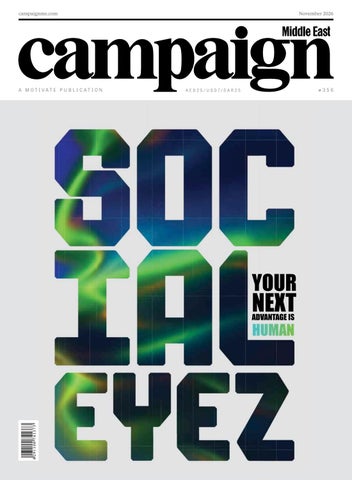
YOUR YOUR NEXT
NEXT
ADVANTAGE IS ADVANTAGE IS
campaignme.com
A M OT I VAT E P U B L I C AT I O N
November 2026
AED25/USD7/SAR25
Reliving the ideas that sparked debate, the work that won acclaim and the people who made a mark at Dubai Lynx.
#356
DATE: December 10, 2026 VENUE: The Plaza, JLT, Uptown Dubai
SHORTLIST ANNOUNCED VIEW HERE
MEET THE JUDGES
WWW.AOYAWARDSME.COM Table bookings and sponsorship opportunities: nadeem@motivate.ae | tarun.gangwani@motivate.ae PARTNERS
STRATEGIC PARTNERS
BROUGHT TO YOU BY
November 2026
03
EDITOR’S LETTER 36 2026 DUBAI LYNX CREATIVITY WEEK AND AWARDS CEREMONY
C
KFC’s Bassem Abdul Rahim explains how AI is giving creative storytellers more time to create ideas worth scaling.
18 STRATEGY’S NEXT ACT: LESS THEATRE, MORE CONSEQUENCE
Senior strategy leaders call for a sharper balance between speed and rigour, measurement and meaning, and technology and human judgement.
11 THE QUIET SHIFT
54 MATTER OF FACT
07 PARTNERSHIPS THAT PROVE THEIR WORTH
5th Element’s Muneef Khan explains why the future belongs to those who understand change.
08 INDUSTRY FORUM
12 WHAT DOES A WASHING MACHINE 55 APPOINTMENTS Take a look at all the key HAVE TO DO WITH including CREATIVITY, TRUST AND movements new roles and HUMAN CONNECTION? promotions in the region.
GALA’s Olga Turovskaya explains why independent measurement, specialist expertise and local understanding are key to agency growth.
Do brands punish agencies for challenging the brief, even when they claim to want brave thinking?
Cicero & Bernay reveals the latest news, views and trends making waves across the global communications sector.
ANUP OOMMEN
“THE MOMENT TO RESPOND WITH COURAGE.”
15 BRAND FOCUS
04 NEWS & WORK
ongratulations to all the winners at the 2026 Dubai Editor Lynx Awards Ceremony. This year, 144 trophies were handed out, including 21 Grands Prix, 24 Gold Lynx, 35 Silver Lynx and 64 Bronze Lynx. These wins represent much more than effective campaigns; they also symbolise late nights, brave conversations, seemingly impossible deadlines, rejected routes, protected ideas, client trust, team belief and the emotional labour of people who cared enough to push the work further. They honour insights, intelligence, purpose, passion, creativity, craft and the collective experience and effort it takes to make something worthy of recognition in one of the world’s most competitive markets. May these memorable moments be more than just markers of what has been achieved; may they fuel the next bold idea, drive the next difficult decision and turn objectives into tangible outcomes. While Campaign Middle East’s coverage of the 2026 Dubai Lynx Awards Ceremony captures the celebrations, this issue also goes further. It highlights the strategy that often lives in the quieter moments before the applause: in the uncomfortable question, the sharper brief, the cultural insight and the idea that deserved the difficult debates. The truth is that we now have more data, more dashboards, more automation and more ways to move quickly. Yet the central question is older and harder: are we making better strategic decisions, or are we only making them faster? In these pages, strategy is not presented as a polished deck; it is the discipline that should enter the room before choices harden. It should ask what problem is really being solved, what value is being created, and what consequence the work will have beyond the meeting. Speed can be thrilling on an open road, but without judgement and accountability, it is easy to miss a crucial turn. This is why the industry experts in this issue look beyond the engines of change, and focus instead on the drivers and navigators. What is heartening is that they are not rejecting technology, data or innovation. The ask is more demanding: use the tools, count what matters and move with urgency, but keep the human hand on the wheel. Clients are calling for strategists who can protect curiosity, culture, context, clarity and care, while remaining accountable for the consequences of their choices. This is the moment to respond with courage.
44 CREATIVITY CAPTURED
16 ROTANA SIGNS 58 THE SPIN Mishaps in the world LAUNCHES AUDIENCE MEASUREMENT FOR OOH of communications.
Motivate Media Group Head Office: 34th Floor, Media One Tower, Dubai Media City, Dubai, UAE. Tel: +971 4 427 3000, Fax: +971 4 428 2266. Email: motivate@motivate.ae Dubai Media City: SD 2-94, 2nd Floor, Building 2, Dubai, UAE. Tel: +971 4 390 3550, Fax: +971 4 390 4845 Abu Dhabi: Motivate Advertising, Marketing & Publishing, PO Box 43072, Abu Dhabi, UAE. Tel: +971 2 677 2005, Fax: +97126573401, Email: motivate-adh@motivate.ae Saudi Arabia: Regus Offices No. 455 - 456, 4th Floor, Hamad Tower, King Fahad Road, Al Olaya, Riyadh, KSA. Tel: +966 11 834 3595 / +966 11 834 3596. Email: motivate@motivate.ae London: Motivate Publishing Ltd, Acre House, 11/15 William Road, London NW1 3ER. Email: motivateuk@motivate.ae www.motivatemedia.com EDITORIAL: Motivate Media Group Editor-in-Chief Obaid Humaid Al Tayer | Managing Partner and Group Editor Ian Fairservice Group Content Director Thomas Woodgate | Campaign Middle East Editor Anup Oommen | Senior Reporter Ishwari Khatu Senior Reporter Waad Elmagboul | Reporter Hiba Faisal | DESIGN: Senior Designer Thokchom Remy ADVERTISING ENQUIRIES: Chief Commercial Officer Anthony Milne | Publishing Director Nadeem Quraishi (nadeem@motivate.ae) Sales Manager Tarun Gangwani (tarun.gangwani@motivate.ae) | Senior Sales Executive Saif Hemdan (saifeldin.hemdan@motivate.ae) | PRODUCTION: General Manager S. Sunil Kumar | Production Manager Binu Purandaran | Assistant Production Manager Venita Pinto HAYMARKET MEDIA GROUP: Chairman Kevin Costello | Managing Director Jane Macken The publishers regret that they cannot accept liability for errors or omissions contained in this publication, however caused. The opinions and views contained in this publication are not necessarily those of the publishers. Readers are advised to seek specialist advice before acting on information contained in this publication, which is provided for general use and may not be appropriate for the readers’ particular circumstances. The ownership of trademarks is acknowledged. No part of this publication or any part of the contents thereof may be reproduced, stored in a retrieval system or transmitted in any form without the permission of the publishers in writing. An exemption is hereby granted for extracts used for the purpose of fair review. Campaign Middle East includes material reproduced from the UK Edition (and other editions) of Campaign, which is the copyright of Haymarket. Campaign is a trademark of Haymarket and is used under licence. The views and opinions expressed within this magazine are not necessarily those of Haymarket Magazines Limited or those of its contributors.
04
November 2026
Publicis Groupe Middle East expands into healthcare with Publicis Health Middle East
From left, Ramzi Sleiman, CEO of Saatchi & Saatchi Gulf and Publicis Health Middle East; Noyala Rajakumar, Head of Publicis Health Middle East; Karen Kamel, Business Lead, Publicis Health Middle East; and Bassel Kakish, Chief Executive Officer, Publicis Groupe Middle East and Turkey.
Publicis Groupe Middle East is expanding its healthcare offering across the region with the launch of Publicis Health Middle East. Led by Ramzi Sleiman, Chief Executive Officer of Saatchi & Saatchi Gulf and Publicis Health Middle East; Noyala Rajakumar, Head of Publicis Health Middle East; and Karen Kamel, Business Lead, Publicis Health Middle East,
it brings together expertise to help organisations turn health ambition into measurable impact. With a mission to Make Health Happen, the capability works alongside multiple stakeholders across the health ecosystem to translate innovation, policy and evolving consumer needs into meaningful engagement, behaviour change and progress towards
longevity across the Middle East. The new offering strengthens Publicis Groupe Middle East’s Power of One model by integrating dedicated medical, creative and regional health expertise with data, media, technology and influence. This gives clients a single, trusted partner to lead their healthcare transformation with confidence and at scale.
Bassel Kakish, Chief Executive Officer, Publicis Groupe Middle East and Turkey, said, “Publicis Health Middle East marks an important step for the Groupe in the healthcare sector, reflecting both the scale of opportunity across the region and our continued investment in specialised capabilities. With healthcare transformation accelerating across the region, now is the right time for a more connected model that can deliver impact across the ecosystem.” Ramzi Sleiman, CEO of Saatchi & Saatchi Gulf and Publicis Health Middle East, said, “Today, one person’s wellbeing increasingly becomes the responsibility of the many, and it takes expertise of all kinds to build a healthier society. Our clients understand this better than most. They are transforming at a pace that is redefining the category entirely, and that transformation deserves to be met with equal ambition and expertise.” Sleiman added, “Publicis Health Middle East brings together global healthcare expertise and deep regional market understanding in a model designed for the realities of healthcare today.”
Etisalat brings back its name four years after rebrand Etisalat has unveiled a refreshed visual identity for its 50th anniversary, bringing back its original name four years after the introduction of e&. Announced in an Abu Dhabi Securities Exchange filing on October 6, the identity will appear across the group’s communications, connecting its heritage with its strategy for the AI era. Group Chief Financial Officer Karim Bennis said the name reflects the company’s history and ambitions. The move follows its 2022 rebrand, introduced as the business expanded beyond telecommunications into technology and digital services. The company said its strategy brings together connectivity, digital capabilities and infrastructure to connect people, support businesses and enable intelligent systems.
Use the QR code to view this work on Campaign’s website.
SAUDIA “SUMMER DESTINATIONS” Saudia promoted its summer destinations through in-game advertising, creator content and interactive digital formats. Created with Publicis Communications KSA, media agency Zenith KSA, EA Sports and adtech partner Criteo, the campaign combined EA SPORTS FC 26 placements with TikTok storytelling and travel search activity. Messaging was tailored to different traveller groups, connecting gaming and social discovery with destination inspiration.
November 2026
05
Dubai Municipality launches outdoor ad guidelines
From left, Liz Rutgersson, who leads Stagwell Media globally, and Ravi Rao, who heads its MENA operations.
Stagwell launches new global media agency called Stagwell Media Global marketing and communications group Stagwell has launched Stagwell Media, a global agency built on Assembly’s performance marketing capabilities and supported by the group’s agentic technology platform, Machine OS. Liz Rutgersson will lead Stagwell Media as CEO, with a global and US remit, while Ravi Rao will serve as CEO of Stagwell Media MENA.
The agency will be operate across more than 50 markets, serving clients including Lenovo, DP World, Mastercard and P&G. Stagwell aims to address changes in how brands reach audiences, including the influence of agentic systems on discovery, activation and recommendations. Rao said MENA clients need a partner that can navigate market complexity while supporting their
Use the QR code to view this work on Campaign’s website.
growth. The regional offering will combine local expertise with Stagwell’s global capabilities and technology. This technology offering includes The Media Machine, Stagwell Search+ and Stagwell Curate, alongside solutions from The Marketing Cloud. Stagwell Media will also work with sister companies, including Crispin, GALE, Goodstuff, Locaria and Stagwell-owned media.
Dubai Municipality has launched the Advertising Content Regulation Guidelines for the Emirate of Dubai, establishing unified standards for outdoor advertising content and design. The guidelines give brands, advertising agencies and designers a reference for developing creative work from the earliest stages, with requirements intended to improve advertising quality and preserve the city’s visual and cultural identity. They complement the existing regulatory framework for outdoor advertising by addressing content and creative execution, taking into account advances in digital technology and artificial intelligence, alongside the growing range of advertising formats and platforms.The standards cover written content, images, logos, animations, promotional displays, interactive elements and the use of landmarks and symbols. They address clarity, design quality, consumer protection, public safety and respect for local cultural values. The guidance applies to advertising agencies, brands, businesses, government and semi-government entities, as well as out-of-home service providers.
Use the QR code to view this work on Campaign’s website.
IKEA ALSULAIMAN “OVERTHINKING, SORTED.”
ALMARAI “L’USINE TASBEERA”
IKEA Alsulaiman’s “Overthinking, Sorted.” campaign presented bedroom storage as a way to reduce mental clutter and create calmer everyday spaces within homes. Taken across Saudi Arabia and Bahrain, it drew on the mental load of everyday life, showing how an organised bedroom can help people switch off. The rollout spanned digital, social media, in-store and CRM channels, with influencers sharing practical organising ideas and storage selections. The “Overthinking, sorted.” campaign demonstrated how a practical product category can be elevated through an emotional and culturally relevant insight.
Almarai’s 30-second “L’Usine Tasbeera” film brings together everyday Saudi moments, from quiet snacking alone to gatherings with friends. Each flavour of its products appears in a distinct setting, spanning summer and winter, indoor and outdoor occasions. Directed by Faraj Aoun, the film uses split screens, quick cuts and contrasting visual treatments to give each scene its own mood while maintaining a connected narrative. Close-up shots highlight the snack’s texture and seasoning, positioning Tasbeera as part of different routines and social occasions. A different visual treatment for each scene keeps the audience’s eyes moving and the content engaging.
Creative agency McCANN MENA Media agency Initiative MENA
Creative agency The Full Stop Production house Film Pudding
06
November 2026
Dubai Media expands global TV reach to 450,000 hotel rooms
Mohamed Al Mulla, CEO of Dubai Media Incorporated
Dubai Media Incorporated has signed an international distribution agreement that will give its television channels access to approximately 450,000 hotel rooms across 12,000 hotels worldwide. Signed at the MIPCOM 2026 media event in France, the agreement is with an international distributor specialising in hotel television
networks. The distributor was not named in the announcement. The deal will bring Emirati content to travellers beyond the broadcaster’s traditional markets, while diversifying the platforms through which audiences access its channels. Mohamed Al Mulla, CEO of Dubai Media Incorporated, said, “At Dubai Media Incorporated, we continue to work on developing
Use the QR code to view this work on Campaign’s website.
a media model that is more capable of reaching audiences around the world, and taking advantage of the opportunities offered by modern technologies to enhance the efficiency of our operations and improve the quality of our content.” He added: “International distribution partnerships represent an important step in expanding the presence of our channels and conveying Dubai’s message and its media and cultural identity to new segments of the global audience.” Alongside the agreement, Dubai Media’s delegation met global technology companies to assess artificial intelligence tools for production and distribution. These covered content development, visual production, editing, translation, dubbing and media asset management, alongside adapting programming for television and digital platforms. Al Mulla said: “Artificial intelligence has become one of the main drivers of transformation in the media industry, and we look forward to leveraging its potential in developing production processes, enhancing innovation, and raising operational efficiency, in line with Dubai’s drive to lead in adopting future technologies.” Salem Baluyouha, Executive Director of the Media Content Sector at Dubai Media Incorporated, said participation at MIPCOM focused on distribution opportunities and technologies that could support content operations. The organisation will now study solutions to improve production workflows and support teams in adopting new technologies, while also retaining human oversight of creativity and editorial decisions.
Use the QR code to view this work on Campaign’s website.
LENSKART “SCORE YOUR FRAME”
THE WADI “RETURN WITHIN”
Lenskart turned Arab youth’s Snapscore – a score measured based on activity on the platform – into eyewear rewards with “Score Your Frame”, a month-long campaign across the UAE and Saudi Arabia. Participants received reward tiers, including Rookie, Eye-Con and Legend, based on their scores, linking online status with in-store trial. The rollout combined influencer content, PR, paid media and owned channels with website, app and retail activity. According to the brand, more than 30,000 people participated, with close to half redeeming their rewards.
Cosmo Developments’ “Return Within” campaign for THE WADI turned recordings of water, sand, rocks and wind from across the UAE into a sonic identity. The team spent 2,000 hours transforming these natural sounds into music, without synthetic audio, connecting the residential development’s identity with the landscapes that inspired it. Social teasers led into a launch event featuring sensory activations. The PR rollout secured 16.6 million estimated impressions. On social media, the campaign achieved an average of 986,000 views and a total reach of 75,000.
Concept, production and execution Lenskart Middle East marketing team
Agencies Inhouse Agency, YouExperience, Shadow Photography and Credo Communications
PARTNER PARTNERCONTENT CONTENT
November 2026
Partnerships that prove their worth GALA’s Olga Turovskaya explains why independent measurement, specialist expertise and local understanding are key to agency growth.
W
hat turns a platform relationship into a business advantage? Olga Turovskaya, Head of Partnerships at Global Agency Leadership Awards (GALA), discusses accountability, emerging markets and what agencies need to compete internationally in this exclusive interview with Campaign Middle East.
WHAT SEPARATES A TRANSACTIONAL AGENCY-PLATFORM RELATIONSHIP FROM A PARTNERSHIP THAT BUILDS BRANDS AND BUSINESSES?
Industry sources report digital ad spend in the Middle East and North Africa grew 17.8 per cent in 2025, the fastest growth of any region. Much of that money flows through social and commerce platforms, where it is easy to take the numbers at face value. PwC put it simply in its latest outlook: clients need credible measurement and a clear link between spend and business results. A real partnership is when the platform’s metrics and the client’s profit-and-loss statement (P&L) tell the same story, and someone independently checks that they do. Ideally, that someone is the agency. GALA was built around this idea. We don’t reward media volume. Our categories recognise measurable growth. Last year in Bangkok, much of the conversation was about moving beyond vanity metrics.
WHAT DO AGENCIES IN GALA’S FAST-GROWING MARKETS DO DIFFERENTLY FROM THOSE IN MATURE MARKETS?
First, these agencies are digital-first and mobile-first by default. Turkey is now Europe’s sixth-largest digital ad market, and in 2024 almost 80 per cent of Turkish digital spend was already mobile. Second, commerce comes before media. In Qatar, for instance, the super app Snoonu now sells advertising and market intelligence alongside delivery, turning shopping traffic into a media channel. Agencies there build marketplace and retail-media teams before they build TV ones. Third, the platform mix is local. In Uzbekistan, Telegram channels and local marketplaces sit right next to the global platforms in every media plan. A Western playbook doesn’t simply transfer. In many of these markets, agencies have learned to talk about real business returns. Our community stretches from Latin America to China, and when you put these people in one room, you stop thinking locally.
WHAT WILL RESHAPE AGENCIES OVER THE NEXT 12 TO 24 MONTHS, AND WHERE MUST THEY ADAPT FASTEST?
The first is agentic AI. In June alone, several major ad-tech companies, including Magnite, launched tools that let AI agents plan and buy media. Execution is being automated quickly. That doesn’t make agencies less important. It frees them for strategy, creativity and client relationships.
The second is accountability, and this is where agencies need to adapt fastest. Alphabet, Meta and Amazon now take almost 58 per cent of global ad spend outside China, according to WPP Media, and each reports its own results. Clients increasingly ask: what did this actually change for my business? The agencies that can answer independently, with real incrementality rather than platform dashboards, will be the ones clients keep. The third is the disappearing line between TV and digital. In MENA, broadcaster video on demand is forecast to grow 38 per cent this year. Television is becoming addressable and measurable, and that is exactly where marketing can be both powerful and seamless: no scars, just results.
WHY SOUTH AFRICA FOR GALA 2026, AND WHAT DOES THIS SIGNAL ABOUT AFRICA’S ADVERTISING, MEDIA AND AD-TECH POTENTIAL?
First Turkey, then Qatar, then Thailand, and now South Africa. GALA has always followed growth. PwC expects South Africa’s internet advertising market to reach $3.1bn by 2030, the largest in Africa. PwC also names Kenya the world’s fastest-growing internet advertising market. Africa is not one market, and even countries don’t tell the full story. Growth often happens city by city. Guests get a leadership conference, a gala night and a day to explore Cape Town and meet the local industry. We deliberately look for locations that are interesting and a little unexpected, so that our partners discover new countries and new markets along the way. This year we want our community to see Africa with their own eyes.
FOR A MIDDLE EASTERN INDEPENDENT AGENCY EXPANDING BEYOND ITS HOME MARKET, WHAT COMES FIRST: TALENT, TECHNOLOGY, PARTNERSHIPS, POSITIONING OR PROOF?
Positioning comes first, because “everything for everyone” doesn’t travel. A sharp specialisation does. The big networks are consolidating: after the IPG merger, Omnicom has retired legendary names like DDB and FCB and is cutting thousands of roles. That leaves clients looking for partners with real depth in something specific. Meanwhile, the fastest-growing areas, such as commerce media in MENA, are exactly where specialists can outpace generalists. Then you prove it. When you enter a new market, your local reputation doesn’t automatically come with you. What opens doors is a case with real numbers: what you did, for whom, and what changed in the client’s business. Saudi Arabia alone accounts for almost half of the region’s digital ad spend, and there you’ll be competing with agencies that already have a track record on the ground. That’s why GALA exists: to show results from growth markets to peers from more than 30 countries.
07
08
November 2026
INDUSTRY FORUM:
Do brands punish agencies for challenging the brief, even when they claim to want brave thinking?
Shyam Sunder
Vice President, TBO.COM
NO
Why would they, if they have explicitly encouraged the agency partner to push the envelope? “Punish” is a strong word and I am sincerely hoping this is not normal even when not asked to. But much of this debate depends on the character of the brand custodian, right? If he or she is strong and confident, thrives on challenging the norm and does not see the agency as a threat, then given the agency is good, good work should happen. I have been privileged to work with some of the finest agencies and have always encouraged them to break the conventions of the category, push the envelope and be brave, which has resulted in great work and outcomes. I sincerely believe that creativity can be a true differentiator for brands to stand out of the clutter and grow. In today’s world, where machines are democratising work, going beyond the brief can be a brand’s superpower.
Reham Eldidi
Head of Corporate Communications, Stellantis Middle East
NO
Brands don’t punish challenge. They punish challenge that ignores reality. The best clients want to be pushed. A sharper question or a better route is worth more than a polished answer to the wrong brief. But challenge only lands when it’s informed. Agencies that push back without understanding our constraints, whether regulatory limits, multi-market sign-off or global brand guardrails, come across as difficult rather than brave. Challenge the brief, but do your homework first. Understand what we can’t change, then show us what we can. That’s the agency we call back.
November 2026
09
Maha Hussein
Senior Social Media Manager, Netizency
MAYBE
There can be a moment of friction when an agency pushes back on a brief but the strongest client relationships are built on exactly those conversations. An agency’s role goes beyond executing a brief; it’s about acting as an always-on strategic consultant and an extension of the brand team. Challenging a brief should come from genuine care for the brand and the ambition to elevate the work. When that thinking translates into meaningful market impact, industry recognition or even awards, it strengthens the relationship. Ultimately, brave thinking builds trust when it comes from shared ownership, not confrontation.
Syed Kaiwan Hashmi Managing Director, Amber Communications
NO
I don’t believe brands punish agencies for challenging the brief. In fact, I believe the best clients expect it. Brands engage agencies for their expertise, perspective and ability to see opportunities that might not be obvious internally. If we’re simply agreeing with everything presented to us, what value are we bringing to the table? However, there’s a difference between challenging a brief and challenging it for the sake of appearing creative. A strong agency understands the business, respects commercial realities and brings solutions, not just opinions. Ultimately, clients don’t need another agency that says yes. They need one that knows when to say no, and why.
Rami Salame
Group Account Director, Hashtag
NO
In my nearly two decades of experience, every intelligent brand I’ve worked with has always welcomed a challenge to the brief. But it’s on one condition: The evidence must be strong. A brief gives us the client’s business challenges and their perspective on how to solve them. As a client partner, it’s our duty to provide our own point of view, coming from our expertise and the data we have access to. We’re not here to simply execute a brief, but rather to provide impactful solutions. So, challenging the brief is a choice we must occasionally make for the brand’s benefit.
Suzanne Samaan
Director of PR and Communications, Means Design
NO
Challenging a brief is not the same as rejecting it. It is about asking the right questions, exploring different perspectives and identifying opportunities that may not have been considered from the beginning. For agencies, this is an important part of bringing strategic value to the relationship, rather than simply delivering against a set of requirements. Equally, brands bring their own business knowledge, commercial priorities and understanding of their audiences. The real value comes when both sides are open to exchanging ideas and challenging assumptions constructively. This is how a brief can evolve into work that delivers stronger results for everyone.
Yasmina Raydan
Strategy Director, IMPACT BBDO
YES
Sometimes clients have the fuller picture, with business context or constraints that make rejecting a challenge reasonable. But, increasingly, agencies are expected to respond to briefs rather than interrogate them. Over time, that can dilute the identity of the work and weaken the creative thinking that agencies are there to provide. There is, of course, a fine line between being creatively ambitious and being delusional. The strongest relationships are built when clients trust their agencies to understand that line, challenge with purpose, and remain grounded in reality. Brave work needs both perspectives, honest debate and mutual respect to succeed.
10
November 2026
Aya Hammad
Sam Buckett
PR and Digital Manager – Brands, Skydance
Managing Director – Sports and Entertainment, The Romans MENA
NO
NO
A brand-agency relationship is one that should be set as a partnership, where the agency feels like an extension of the brand’s team. So when a brief is challenged, that is a great indicator of both the trust established between the two parties and their shared ambition to elevate the brand and do whatever is best suited.
Rawan Mahmoud
Account Director, Memac Ogilvy
Like Mike Tyson once said, everyone has a plan until they get punched in the face. Sometimes we all need a little honest feedback, though, don’t we? As agencies, we are uniquely placed to provide insightful critiques that brands wouldn’t get elsewhere. At The Romans, we are lucky to work with brave clients. That’s why they come to us. If we think the brief is misguided, we’ll let you know. Not to pick holes but to create the best opportunity to do brilliant work.
NO
Jana Al Jilani
Senior Account Manager, Gambit Pulse
NO
Our job as consultants is to understand how flexible the bureaucracy within an organisation is before challenging. When you know your clients, you understand the environment they operate in. Where there’s agility, brands tend to appreciate a team that helps them ask the right questions instead of blindly tackling a brief. Where a brief has been through a long internal sign-off, adding hurdles isn’t helpful. Challenging well isn’t punished; challenging without context is.
Clients come to us with a brief because they trust us to solve a challenge. What we can do is shape our own interpretation of it, figure out how to get there, and deliver our approach with cultural relevance, intention, empathy and understanding of our audience. That’s why packaging matters. The exact same campaign pitched two ways can either get celebrated or rejected. If we can’t convince the brand to genuinely buy into the solution, take it as an early warning sign that the target audience might not either. This is where our craft lives.
Morgan Merle
Creative Director, MCH Global
YES
Most clients do want brave work, but when it’s time to sign off, safe usually wins. It happens quietly. The idea lands well in the room, and a week later we’re back to the original brief. I understand why. The person we work with answers to their own bosses, and in this region everything moves fast. Agencies play a part too. Sometimes, we’re just protecting our own taste. The best work I’ve been part of started with the client and agency writing the brief together. Agree on the ambition early, and the brave idea is much easier to see through.
PARTNER PARTNERCONTENT CONTENT
November 2026
The quiet shift: why the future belongs to those who understand change 5th Element’s Muneef Khan says that sustainable business success depends on understanding changing human expectations, building trust and combining technological innovation with cultural awareness.
T
he greatest threat to a successful business is not always failure. Sometimes, it is the comfort of success itself. When performance is strong, strategies are delivering results, and established business models continue to generate growth, there is little reason to question what is working. Yet beneath this apparent stability, something significant may already be changing: the expectations, aspirations and values of the people businesses exist to serve. And often, these changes happen quietly, long before they become visible in market reports or financial results. We live in an age of extraordinary technological capability. Artificial intelligence (AI) can anticipate behaviour, and data analytics can reveal emerging patterns. Businesses have access to more information than ever before. Yet one of the most important questions in business remains remarkably difficult to answer: Do we truly understand the people whose futures we are trying to shape?
A new definition of relevance
Across industries and societies, expectations are evolving. Generation Z is bringing these changes into sharper focus, challenging conventional ideas about work, loyalty, communication and engagement. Authenticity matters more than appearances. Flexibility is increasingly valued over rigid conventions. Purpose is becoming as important as performance. But this is not only a generational shift; it also reflects a broader transformation in how people define value, success and belonging. Consumers want to feel understood, not merely targeted. Employees want to contribute, not simply comply. Communities expect businesses to recognise their responsibilities beyond commercial success. Being visible may attract attention. Being meaningful earns a place in people’s futures.
Culture is the competitive advantage
Strategy determines where an organisation intends to go. Culture determines whether its people can take it there. The organisations that thrive will be those where curiosity is encouraged, different perspectives are respected, and people feel empowered to challenge established thinking. This does not mean replacing experience with enthusiasm or structure with unrestricted flexibility. It means creating environments where ambition, accountability and individuality coexist. Leadership must evolve from simply directing performance to creating the conditions in which people can contribute meaningfully.
Technology knows what we do. Understanding explains why. Artificial intelligence and data analytics are transforming how
businesses anticipate needs and personalise experiences. But knowing what someone chooses is not the same as understanding why that choice matters. This distinction is especially important in the Middle East, where rapid innovation intersects with strong cultural identities, diverse communities and ambitious economic transformation. True localisation goes beyond translating campaigns or adapting global strategies. It requires understanding the values, aspirations and cultural contexts that influence decisions. Technology can identify patterns. Human understanding gives those patterns meaning. The businesses that succeed will combine technological intelligence with cultural awareness, rather than treating one as a substitute for the other.
Trust is the foundation
In a world of unlimited information and alternatives, trust has become one of the most valuable assets an organisation can build. It cannot be manufactured through marketing or inherited through reputation. It is earned when actions consistently reflect commitments. Employees seek integrity and openness from leadership. Customers seek consistency and genuine understanding from brands. Trust is not simply a consequence of success; it is what makes success sustainable.
The leadership challenge
At 5th Element, I believe meaningful progress begins with understanding the human impact of transformation. The challenge is not only to adopt technology faster, build stronger strategies or pursue greater efficiency; it is also to ensure that progress creates genuine value for the people and communities it touches. This requires curiosity, humility and the courage to question assumptions that once delivered success. Because no organisation can remain relevant by assuming that yesterday’s understanding will be sufficient for tomorrow.
The future is already changing
The future rarely announces itself. It begins quietly, in changing expectations, unfamiliar questions, shifting priorities and new definitions of what truly matters. By the time these changes become obvious in market reports, the most important opportunities may already have passed. The responsibility of leadership is not merely to respond to change, but to recognise its meaning before the world catches up. The future will not belong to those who predict change most accurately. It will belong to those who understand its meaning most deeply. “The greatest disruption is not the change we fail to predict; it is the change we fail to understand.” By Muneef Khan, CEO, 5th Element
11
PARTNER CONTENT
12
November 2026
What does a washing machine have to do with creativity, human connection and trust? Bloomberg Media Studios’ Zahra Jamshed discusses how time-saving innovations, from home appliances to AI, have changed what we do with our time – and why protecting it matters for creativity.
I
t’s the 1950s, and a colourful, bold magazine ad by a home appliance company is promising its readers a free day off. “Hooray! It’s washday! My day off!” boasts the Simpsons ad. A decade earlier, a different quarter-page ad by Bendix promised its machine could save you “precious hours of your life.” Another, by Maytag, simply says: “Look, No Work!” The message here is simple: one transformational piece of technology would save users hours, if not even days, of labourintensive work. Less time washing, more time living, thinking, creating. Precious hours have been saved. Seventy years later, nobody thinks about the hours the washing machine gave us back. Laundry is simply part of any other day in the week. It is necessary, and it takes the time it takes. You put on a load before work, fold it once you’re home, put it away and the cycle repeats. Because something interesting happens when technology saves us time: we adapt. As washing becomes easier, expectations change too. Another load of laundry. The dishes. An e-mail. Another e-mail. A quick reply to the message that came in while you were replying to the first one. The time gets saved. Then, somehow, it gets filled. It’s an analogy that feels increasingly more relevant today, albeit the technology looks a bit different. This time, it’s AI. And perhaps the most interesting question isn’t how much time AI can save us. It’s what we choose to protect that time for. CREATIVITY IN THE FACE OF AI EFFICIENCY For those of us in the creative field, this innovation unlocks a new challenge – striking the balance between efficiency and creativity in a way that does not compromise our most important skillset: authenticity. Anyone who has experimented with AI as a creative partner will recognise some variation of this experience: You start with an idea. You bounce it back and forth, like a brainstorming session but without any colleagues. It agrees, it builds, it gives you 10 options. You don’t like them, so you ask for ten more. Be punchier. Smarter. Less corporate. More human.
You keep going, and a task that should have taken hours is complete in minutes. But somehow you still feel uninspired, disconnected, inauthentic. Because getting somewhere fast is not the same as getting somewhere interesting. Creativity is not always efficient. It can look like hours-long brainstorming sessions with colleagues, taking the longer route home or staring out the window when you really should be working. Some of our most creative time can look suspiciously like doing nothing – which makes it increasingly difficult to protect in a world that increasingly rewards productivity. The World Economic Forum’s 2025 Future of Jobs Report identified creative thinking as one of the most important skills for employers today, with some ranking it higher than technological literacy, AI and big data. This same report highlights the importance of understanding human emotion as a sought-after and valuable skillset: empathy, social influence and human interaction. And the desire for these skillsets doesn’t appear to be going anywhere fast. Creative thinking is projected to grow in importance by 2030, and skills rooted in human interaction, including empathy and active listening, currently show no substitution potential at all. The takeaway is clear: AI may be changing the tools we use, but creativity, empathy and human judgement are becoming more important, not less. TRUST ME, I’M A HUMAN From campaigns to creative briefs, our role is to be storytellers and creative thinkers, and for any message to land it has to feel authentic. AI allows marketers to produce, personalise and localise content at extraordinary scale. But knowing more about an audience doesn’t necessarily mean understanding them better. Data can help tailor a message. Understanding why it matters to someone requires context, empathy, cultural understanding and judgement. There is a very real human audience on the other side of each video, article, social post or key performance indicator (KPI). And lucky for us, we’re human too. Human emotion is still what earns attention. At Bloomberg Media,
“Trust is built through things that are harder to manufacture: judgement, experience, empathy, taste and human connection.”
PARTNER CONTENT
May 2026
The work for Saudi Tourism in Aseer is an example of where authentic storytelling was integral to the story. The very human experience of the subject – returning home after years to experience her tradition and culture – resonates on a deeper level with the human audience we are trying to connect with.
our research into what earns audience attention points to something simple: people respond to content that gives them something recognisably human – experience, evidence, relevance or usefulness. Bloomberg Media recently conducted a study, The New Standard for Thought Leadership, exploring what makes content genuinely resonate with audiences. The findings showed that videos with personal stories see 11 per cent higher engagement and 15 per cent higher completion. Using data or proof points to add a layer of credibility – or proven experience – boosted dwell time by 21 per cent and engagement by 7 per cent. And catering to your audience with an added layer of utility (solving real-world challenges or speaking to lived experiences) doubled dwell time. As AI makes it easier to produce more content, those signals become more important, not less. It can help us find the words, organise information and get somewhere faster. But trust is built through things that are harder to manufacture: judgement, experience, empathy, taste and human connection. AI might be able to scour the internet, refine complex data points and summarise extensive research
into a single-page report in a matter of seconds – but what can you make of it? Human judgement and taste, which involve the extra step of curating this data to pull relevant insights and build on fresh ideas that push the envelope, resonate and inspire trust. This remains a distinctly human experience. Attention can be captured. Research can be refined. But trust still has to be earned. So, what does the washing machine have to do with creativity, human connection and trust? The washing machine is just one decades-old example of new technology promising us hours back for our lives. There are many more in between, and AI is just the latest version of that promise. But we have autonomy over what we do with our time. Do we optimise it for efficiency or allow ourselves to get lost in creativity? One thing is clear: if you want to reach the human on the other side of the page, it may be worth taking the extra time for the slower and occasionally frustrating process of working out what we want to say before we ask technology to help us say it. You might be surprised by what you think of when you give yourself the time to think.
By Zahra Jamshed, Executive Producer, Bloomberg Media Studios
Authenticity was key to the storytelling for Visit Rwanda. Each on-screen guest is a real guide who has dedicated their lives to tourism in the country. Throughout the video guests break the fourth wall, speaking directly to the viewer on the other side and sharing their real world experience.
13
14
November 2026
BRAND FOCUS
L
ike a lot of people this year, I was completely spellbound by the movie Obsession. The plot kept me on the edge of my seat. The jump scares threw me off my seat. I enjoyed the experience thoroughly. As with any good movie, it kept me thinking long after it was over, and that is when I started thinking of what I am obsessed about. One of the first work-related things that came to mind was data. And the more I thought about it over the next few days, I realised that it was the same toxic obsession portrayed in the movie. Over the past few years, I have spoken on many different retail media panels and have attended even more, and almost all the conversations end in a similar way. Someone asks, “How can brands get more access to data?” and then we spend 20 minutes discussing access, measurement, which team should be paying what and why. What strikes me is how often we industry professionals treat these data partnerships the way Bear, the protagonist of the movie, treated the wish-granting willow: as a shortcut to be loved by the shoppers we have not taken time to understand. Before I move further, I want to make it clear that this is not a complaint about the data, the technology and the partnerships we have now. Retail media networks have matured rapidly, enabling a hyper-growth phase for both brands and retailers. New tools and technologies such as clean rooms make attribution of digital spends much more transparent. Five years ago, we as marketing professionals would have given anything for this sort of information, access and technology. Once teams gain access to retail media data and networks, their first internal discussions often focus on where the budget will come from, which key performance indicators (KPIs) must be met and other operational considerations. I have seen these discussions span the entire planning phase, and meanwhile the question of what the data is trying to tell us gets lost. Consider two brands with similar access. Brand A behaves like Bear in the movie, blindly wishing for an end outcome without thinking much. From the brand’s perspective, this means signing all available data partnership agreements, building impressive dashboards, and using the new signals to blindly target all shoppers with a generic creative. The return on investment (ROI) of the campaign will probably look excellent, but if you dig deeper, you will see that
HALLOWEEN SPECIAL:
HOW A HORROR FILM MADE ME RETHINK RETAIL MEDIA Beiersdorf’s Aditya Deb says that retail media success comes from putting shopper understanding ahead of data access and KPIs, using insights to drive meaningful brand growth rather than generic targeting.
the real, tangible outcomes, such as the brand’s penetration within the category, have barely moved. The shoppers on the receiving end probably find all that attention unsettling rather than flattering. Brand B, however, starts with a question rather than a data partnership contract. Its team wants to understand how a specific segment of its target audience interacts with the skincare category during Ramadan. Working through clean room data with the retailer, they notice that quick commerce purchases shift heavily to the hours after Iftar, that baskets increasingly mix personal care with Eid gifting, and that many of these buyers are new to the category. The brand moves its investment into those late evening hours, builds gifting bundles with the retailer, and shifts its creative messaging from skin benefits to thoughtful gifting. By the end of the season, nearly half of the brand’s buyers on that platform were new to the brand and new to the category, which is the kind of growth no amount of generic targeting could have delivered. Both the brands were obsessed with something. One with its own numbers and the second with the shopper behind them. I have come to realise that the second kind is the right kind of obsession: the Shopper Obsession mindset. With this mindset, every data conversation starts with a specific shopper, a specific occasion and a question one cannot answer yet. Before signing the next partnership, it is worth asking which shopper decision this data can influence. If nobody can answer that question, all other discussions about the partnership are premature. More data will keep arriving in this region, whether we are ready or not, and that is good news. But data on its own will not make a shopper love a brand that has not bothered to understand them. I have realised that Bear’s problem was never how badly he wanted Nikki; it was that he pointed all that obsession at the outcome rather than at her. Brands, today, have more data than ever before and face the same choice, and the Shopper Obsession mindset helps by simply pointing in the right direction. Using every signal available, we must understand the shopper rather than blindly chasing KPIs because that never ends well. If you don’t believe me, just ask Bear. By Aditya Deb, Performance Marketing Manager – MEA, Beiersdorf
November 2026
E
very creative in this region has the same recurring nightmare. You pitch a gorgeous idea on Monday. By Friday, it has already survived four rounds of feedback, three “can we make the logo bigger” asks, one Arabic translation that turned it into a puzzle and a resizing marathon across 37 formats. By the time the idea launches, Ramadan is over and your idea has aged like laban left in a Dubai car in the middle of peak summer in August.
ENTER AI. CUE THE PANIC. Half of the marketing industry is 100 per cent convinced the machines are coming after their jobs. The other half is quietly using ChatGPT to write their out-of-office replies. The truth is less dramatic and far more hopeful: AI isn’t here to replace the storyteller. It’s here to replace everything that was preventing the storyteller from telling stories. Now that is refreshing. Think of it this way: AI is not the Monsieur Master Chef. It’s the world’s fastest sous-chef. It chops the onions, never cries and never asks for Friday off. But it cannot tell you whether the dish needs more of this or that or more soul. That part is still yours to keep and cherish. THE PROOF IS ALREADY ON OUR SCREENS; WE HAVE WITNESSED IT According to Google, Almarai wanted to push 15 products during the busiest and most crowded season of the year: Ramadan. Its agency manually designed 25 base ads with fixed elements such as music, the logo and the products, then fed them into Google’s Ads Creative Studio, which automatically produced more than 1,200 creatives in a time- and cost-efficient way. And the variations and placements of the ads weren’t generic. A dairy cream ad was built to appear ahead of “Ramez Galal’s” Ramadan prank show, with a line comparing the mixing to Ramez mixing up his guests, while a laban ad was shown before sports content promising to calm your nerves when your team sends your blood pressure soaring. The result? The brand reached 29.4 million people across MENA, with 56.8 per cent watching the ads to the very end. Here’s the important bit. No algorithm woke up one morning and thought, “Ramez joke”. A human did. AI simply did the part that would otherwise have required an army of junior designers, 90 litres of karak and the quiet collapse of several souls. Campaign Middle East has reflected on some of the region’s most celebrated work
15
“‘AVERAGE’ HAS NEVER MADE ANYONE STAND OUT AMID THE CLUTTER.” and how AI was used as a prop for a very human punchline. In 2024, IMPACT BBDO designed a campaign for the well-known Lebanese newspaper, Annahar: introducing the world’s first AI designed to perform presidential duties for Lebanon, filling a gap of more than two years without a president, and it took home a Grand Prix at Dubai Lynx. The machine didn’t write that satire. People with a sharp sense of irony and a deep sense of frustration did. WHAT AI STILL CAN’T DO AI cannot be human, read the emotional room, touch a nerve or bring a tear to someone’s eye. Generative AI engines are prediction systems. They are trained on massive global datasets that, by definition, optimise for the average. And ‘average’ has never made anyone stand out amid the clutter. So, let’s be clear on what the chores are. AI gets the resizing, the versioning, the first-draft translations, the rough storyboards and the 12 headline tests before lunch. Humans own the
insight, understand the tension and find the deep truth that makes a consumer stop scrolling and feel something. So, think of AI as a friend handing a valuable gift back to the creative industry: more hours to think about ideas bold enough to deserve adaptation. So no, the robot isn’t coming for your job. It’s coming after your wasted time, specifically the part that has nothing to do with ideas. Let it. Then go and do the thing only you can do: Tell a story worth making 1,200 versions of.
By Bassem Abdul Rahim, Senior Director – Marketing, KFC
BRAND FOCUS
RELAX, THE ROBOT DOESN’T WANT YOUR JOB; IT WANTS YOU TO ADD VALUE TO LIFE KFC’s Bassem Abdul Rahim says artificial intelligence (AI) will not replace creative storytellers, but can remove repetitive production work and give them more time to create ideas worth scaling.
PARTNER CONTENT
16
November 2026
Rotana Signs launches CESPvalidated audience measurement across its Saudi out-of-home network with SEIKI Since June 2026, audience measurement has been introduced across twelve Saudi cities, covering more than 15 million people.
R
otana Signs has partnered with SEIKI, the mobility intelligence and audience measurement company, to measure the audience of its out-of-home networks across Saudi Arabia. Since June 2026, a substantial number of faces in Jeddah, Makkah, Madinah, Dammam, Dhahran, Al Khobar and other cities have been integrated and measured, covering a population of 15 million. Rotana Signs now has improved insight as to who sees their formats, what share of the local population had an opportunity to be exposed, and which locations best match their target audiences.
environments with SEIKI’s international expertise in audience measurement and mobility analysis. SEIKI: INTERNATIONAL EXPERTISE, CESP-VALIDATED METHODOLOGY SEIKI provides an API and SaaS platform used in more than 40 markets across Europe, the Middle East, Africa, North America and Asia. It delivers mobility intelligence and audience measurement to media owners, public bodies, territorial organisations, agencies and brands. SEIKI’s methodology has been audited and validated by France’s CESP (Centre d’Étude des Supports de Publicité), the independent body that evaluates audience measurement systems. Its track record includes several French luxury groups, for whom SEIKI measures premium billboard campaigns: audience composition, exposure and campaign performance. For Orange, SEIKI measures the operator’s out-of-home networks in six countries, giving its teams the analytics to optimise media investment and targeting. In an industry that has long struggled to agree on a common measurement currency, SEIKI’s adoption in more than 40 markets and its CESP-validated methodology provide a consistent, credible basis for evaluating out-of-home media. Rotana Signs now brings these internationally validated practices to its network, giving clients clearer insight into their media investments.
“As technology, mobility patterns and advertiser expectations continue to evolve, so too will the tools, data and capabilities supporting the Rotana Signs network.”
A CHANGING MARKET DEMANDS SMARTER MEASUREMENT Saudi Arabia’s rapid urban development, expanding infrastructure and changing mobility patterns have reshaped and continue to reshape the out-of-home (OOH) advertising landscape. Coupled with an increasingly complex media ecosystem and growing variety of channels, advertisers no longer judge a location on observation and experience alone. They want to know who their campaigns reach, what percentage of the local population had an opportunity to see their ad, and which locations matter most to their target consumers. Recognising this shift, Rotana Signs searched worldwide for a measurement partner that meets high industry standards, anticipates market challenges, and can provide a sound approach. Understanding the obstacles and how critical the measurement discussion has become, Rotana Signs by no means wanted to settle for a sub-par system. It required a partner that could provide a multi-layered dataset which narrowed the gap between observation and ground truth, a system that is continuously updated to keep the mobility model valid and most importantly, a recognised methodology validated by an independent body. Its intended partner had to be agile and capable of meeting the fast-growing expectations and requirements of the Saudi market. As such, Rotana Signs selected SEIKI. The partnership combines Rotana Signs’ knowledge of local advertising
FROM ADVERTISING LOCATIONS TO BALANCED NETWORKS With SEIKI’s measurement, Rotana Signs now builds balanced Digital OOH networks. Beyond the strength of each location, the company measures how its assets work together to extend reach, build frequency and cover a city. Through extensive analysis and scenario planning, Rotana Signs has redesigned its network distribution around measurement efficiency. It assesses each location’s contribution, audience overlap, and the balance between reaching new people and repeating exposure. This applies across its growing portfolio of Digital Megacoms, Digital Bridges, Maxi and Prestige Billboards and other formats in Jeddah, Makkah, Dammam, Dhahran, Al Khobar and various other cities it operates in. The same analysis guides expansion. Rotana Signs evaluates every new site against its existing inventory to measure how it
PARTNER CONTENT
November 2026
Thierry Jadot
Georges Yazbeck
strengthens coverage and complements established networks. SEIKI also gives Rotana Signs the demographic profile of the audience reached by each network. Some locations deliver a higher concentration of affluent consumers; others reach a broader mix of age groups and socioeconomic segments.
building the capabilities to make smarter decisions and develop more advanced advertising solutions for our clients.” Thierry Jadot, Chairman of SEIKI, added, “Saudi Arabia is one of the world’s most dynamic markets, and its transformation is creating an extraordinary opportunity to rethink how out-of-home media is planned and valued. Our ambition with Rotana Signs is not simply to measure audiences, but to turn mobility data into a new intelligence for the industry, helping brands understand where people move, who they reach and how to build more relevant and effective campaigns. Together, we are laying the foundations for a new generation of data-driven OOH in the Kingdom.”
A NEW DIRECTION FOR OOH MEDIA PLANNING The partnership changes how campaigns on Rotana Signs’ network are planned, evaluated and optimised. Looking to the future, it establishes the fundamental foundation for programmatic out-of-home planning and buying, with advanced segmentation, location recommendations and performance analysis. For media agencies in the Kingdom, across the region and internationally, the adoption of SEIKI measurement and its integration into programmatic platforms will provide a clearer basis for planning campaigns in the region’s largest market and make OOH buying more accessible and efficient. A SHARED VISION Georges Yazbeck, Chief Commercial Officer of Rotana Signs, said, “Saudi Arabia’s OOH industry is entering a new phase where data and audience understanding are essential to effective media planning. Our partnership with SEIKI lets us go beyond offering advertising locations and build tailored networks around each brand’s target audience and objectives. It is also the foundation of our digital transformation: by integrating audience measurement into our planning, we are
AN EVOLVING JOURNEY For Rotana Signs, the introduction of audience measurement is not a final destination, but part of a wider and ongoing transformation of how out-of-home media is planned, understood and delivered. As technology, mobility patterns and advertiser expectations continue to evolve, so too will the tools, data and capabilities supporting the Rotana Signs network. Measurement provides an important foundation today, while creating the opportunity to integrate new technologies, deeper audience intelligence and increasingly sophisticated planning solutions in the future. It is a journey that will remain fluid and continuously evolve, ensuring that Rotana Signs’ offering develops alongside the market it serves.
17
18
November 2026
SPECIAL FEATURE
...
Strategy’s next act:
less theatre, more consequence As artificial intelligence, dashboards and short-term growth pressures reshape marketing, senior strategy leaders call for a sharper balance between speed and rigour, measurement and meaning, and technology and human judgement. By Anup Oommen
SPECIAL FEATURE
T
he strategist’s desk has become a crowded place. On one side sits a desktop screen with multiple open tabs, including growth targets, obscure sub-community threads, social media trend trackers, quarterly objectives, a half-written thought leadership article and a pitch deck titled Brand_Strategy_v9_FINAL_ revised_EDITED. On the other side lies a spread of Post-it notes with deadline reminders, codes meant to solve deck emergencies, frantic scribbles transcribed from phone calls, selfpreservation notes such as “Uber Eats code: STRAT20”, and inspirational quotes on judgement, cultural depth and choices to be made: “a cup of coffee before the 8am meeting with bossman”. Every so often, strategists look at this desk and are faced with an existential crisis. But when they do, they realise the question is no
November 2026
longer whether strategy matters; it is whether strategy is still being given the conditions to do its job properly. And that opens a Pandora’s box of questions: Is strategy shaping decisions early enough, or merely dressing them up later? Is it helping brands grow in ways that endure, or simply helping teams defend what must be measured this week? Is AI expanding strategic imagination, or tempting the industry into faster, flatter thinking? The emerging question is not whether strategy still matters. It is whether strategy is being allowed to operate with enough influence, evidence, imagination and accountability to matter. As Campaign Middle East speaks to senior strategy leaders across agencies, networks, media and out-of-home, a pattern emerges. Nobody wants a return to slow, ornate decks or strategy as intellectual theatre. The call is more practical: move faster when speed helps, measure more intelligently, and protect the human judgement that turns information into direction. Contributing to this conversation are: Tahaab Rais, Group Chief Strategy Officer and Film Director, Publicis Groupe MENAT; Dan Shepherd, Chief Strategy Officer, Omnicom Media MENA; Catherine Bannister, Chief Strategy Officer, TBWA\RAAD; Alejandro Fischer, Chief Strategy Officer, HAVAS Middle East; Sebastian Roland, Group Head of Strategy, IMPACT BBDO; Mario Morby, Chief Strategy Officer – MENA, Memac Ogilvy; Mario Soufia, Senior VP, Strategy, Growth & Marketing – MENA, WPP Media MENA; Alex Jena, Chief Strategy Officer, dentsu MENAT; and Ghada El Kari, Chief Strategy Officer, W Group Holding. In the Middle East, these tensions are especially visible. Brands are operating in markets defined by rapid population growth, national transformation agendas, intense retail competition, accelerated digital adoption and increasingly sophisticated consumers. The demand for speed is real. So is the risk of confusing velocity with direction. The industry is standing at a T-junction, where straight is no longer an option. The choice between the right and left is not between brand and performance, people and platforms, speed and rigour, or AI and instinct. Instead, it is between those who can hold these tensions together and those who risk picking one over another. THE DANGER: BECOMING EFFICIENT AT BEING FORGETTABLE The first strategic gap to bridge lies between what can be proved quickly and what can build meaning over time. Many
19
Tahaab Rais
marketers and agency leaders are under pressure to show results immediately. The financial constraints are tangible and have very real consequences on marketing spend. Gartner’s 2025 CMO Spend Survey found that marketing budgets averaged 7.7 per cent of company revenue, unchanged from 2024. Meanwhile, 59 per cent of surveyed CMOs said they lacked sufficient budget to execute their strategy. Alex Jena, Chief Strategy Officer, dentsu MENAT, explains that the issue is one of belief in what cannot be instantly quantified. If strategy becomes too obedient to the dashboard, brands risk losing their identity. Jena says, “The real tension is having the faith to invest in what we can’t immediately measure, especially under economic short-termism and 100-day planning cycles. When we optimise solely to delight a dashboard, brands drift into an algorithmic sea of sameness. Fail to fix this, and we kill
Dan Shepherd
distinctiveness. Brands become commodities, renting attention rather than building something worth paying more for.” Another risk, leaders warn, is that the industry starts optimising for evidence rather than importance. Tahaab Rais, Group Chief Strategy Officer and Film Director, Publicis Groupe MENAT, says, “The industry is increasingly optimising what we can prove, rather than building that which is revelatory, which is something people feel and remember. I understand why. Clients are under enormous pressure to deliver growth now.” Rais adds, “Agencies are under pressure to demonstrate impact now. So, everyone naturally moves towards what is measurable, defensible and
20
SPECIAL FEATURE
November 2026
Catherine Bannister
immediate. But brands are not built only in spreadsheets.” He explains that the problem is not accountability itself. It is the separation of accountability from creative imagination. “Great strategy, therefore, has to reconnect commercial accountability with revelatory creative genius,” Rais adds. “If we fail, we will become very efficient at producing work nobody remembers. We will know exactly what everything delivered, while slowly forgetting what made anybody care.” That same concern appears in the media and targeting conversation. The industry has gained the ability to reach people with increasing precision, but precision is not the same as resonance. A message can arrive at the right moment and still say nothing worth remembering. Dan Shepherd, Chief Strategy Officer, Omnicom Media MENA, says, “One of the key tenets of the marketing science book How Brands Grow [by Byron Sharp] is that media targeting is broad [all category users], with a creative message that is focused on a much smaller target [one specific person within that category with a unique human insight]. I worry this has completely flipped, and we’re now targeting groups of one in media with messages that are so generic and universal that even Chris Martin would think twice before using one for a Coldplay song. If we don’t correct that balance, we’ll get better at reaching exactly the right people, while becoming more forgettable when we get there.”
When the world becomes more complicated, the temptation is often to add more layers. But strategy leaders argue that the greater need is to return to the basic questions with sharper discipline. Complexity does not remove the need for fundamentals; it makes them more important. Sebastian Roland, Group Head of Strategy, IMPACT BBDO, says, “Things have become complicated. There’s a lot going on. In an age of complexity, we’ve seemingly forgotten the value of clarity. The foundational stuff still matters enormously: Who are we? What are we selling? Who is it for? Why should they care? How do people buy it?” Roland adds, “Without that clarity, we’ll still produce work. Some of it will probably be pretty good. But increasingly, we’ll settle for good enough. And I think ‘good enough’ might be the biggest scourge of marketing today.” The pressure to act quickly also affects how problems are framed. Leaders point out that the first solution or the first answer to a problem often feels attractive because it is tidy, not because it is right. The beauty of the craft lies in resisting the neatness of the easy solution long enough to understand what the brand needs. Catherine Bannister, Chief Strategy Officer, TBWA\RAAD, says, “The biggest tension is between the pressure to move quickly and the need to think deeply. Planners are good at finding a way through; sometimes the first answer comes easily. But is it the right answer – or just the quickest one? We need to go beyond that first thought: understand the problem more fully, test our assumptions and bring greater rigour to the work.” Bannister warns that without that depth, “we risk mistaking a neat solution for a meaningful one – and producing work that answers the brief but fails to move the brand forward.”
This raises questions not only about the role of the strategist, but also about how much of that role they are allowed to perform. Strategists brought in after the decision has been made are not shaping direction; they are writing the caption beneath the photograph. The function can only add value if it is allowed to influence the choice, not merely explain it. Alejandro Fischer, Chief Strategy Officer, HAVAS Middle East, asks, “Is strategy genuinely allowed to influence decisions, or is it still too often brought in to make those decisions look more considered after the fact? At its best, strategy should influence marketing decisions and, ideally, business decisions too.” However, this requires room for challenge and exploration, even when organisations are moving quickly. “If strategy comes in after the decision has effectively been made, just to rationalise a creative idea or a media recommendation, then it becomes window dressing,” he says. “That is the tension we need to resolve. Not whether strategy has a seat at the table, but whether it is allowed to change what happens at the table.” AI IS NOT THE STRATEGY; REIMAGINING THE WORK IS At the heart of the current strategy debate lies a key question: Is AI being used to expand thinking or to shrink ambition? Mario Morby, Chief Strategy Officer – MENA, Memac Ogilvy, says, “Agencies have always lived at the chaotic edge of what’s past and what’s next, but this feels different. AI has triggered an existential lack of belief. Not because it has replaced us, but because it makes it dangerously easy to question what we bring to the table. When machines produce plausible strategy in seconds, we undervalue the messier, imaginative human flavour of creativity.” The answer is not to doubt the power of human strategic input or question everything around it, but to use technology in service of it. Morby adds, “Radiohead went from OK Computer in 1997 to Kid A in 2000 by changing the tools, not doubting the band. They imagined someplace new, then used technology to get there.
Alejandro Fischer
SPECIAL FEATURE
Sebastian Roland
Imagination is our advantage; value it and we remain irreplaceable.” The operational implications are just as important. If AI is simply added to existing structures, the industry may get marginally faster without becoming meaningfully better. McKinsey’s March 2025 global survey report illustrates the distinction between adoption and organisational change. While 71 per cent of respondents said their organisations regularly used generative AI in at least one business function, only 21 per cent of the respondents within these organisations that use generative AI reported fundamental redesign of at least some workflows. Mario Soufia, Senior VP, Strategy, Growth and Marketing – MENA, WPP Media MENA, says, “Most of the industry is still bolting AI onto old workflows and calling it transformation. That’s not enough. If we don’t rebuild how we work, we’ll do less than we could, and worse, we’ll fail our people.” He adds, “Growing them is our responsibility, not a perk. They need the skills, the confidence and the room to grow alongside the technology, not behind it.” For media owners and businesses with physical infrastructure, the tension is not only about technology, talent and tools; it is also about changing the commercial model before the old one loses relevance. Ghada El Kari, Chief Strategy Officer, W Group Holding (Hypermedia & AiOO), says, “The biggest tension is between monetising what exists today and investing in what the industry needs
tomorrow. Growth can no longer depend simply on expanding inventory or increasing reach. The opportunity lies in transforming existing infrastructure into intelligent, connected and measurable ecosystems. That requires rethinking commercial models, investing in technology and building capabilities before the returns become obvious.” This is the strategist’s dilemma in one line: how to make today’s machine perform while building tomorrow’s engine. It is a difficult ask because the return on transformation is rarely instant. But waiting until the model breaks is not strategy; it is maintenance with a deadline. SPEED IS USEFUL WHEN IT REMOVES DRAG, NOT THOUGHT Speed is not the villain in this discussion. Most leaders accept that the industry must move faster. The distinction is between speed that cuts waste and speed that cuts thinking. That distinction matters when capacity is already stretched. Microsoft’s 2025 Work Trend Index found that 53 per cent of leaders said productivity must increase, while 80 per cent of employees and leaders surveyed said they lacked sufficient time or energy to do their work. Rais says, “Speed is an advantage when it removes bureaucracy, not thought. I don’t believe slowness equals depth. The best strategists often move faster and are revelatory on-the-go because experience has taught them
“THE NON-NEGOTIABLE IS THE INSIGHT. YOU CAN GET THERE QUICKLY, BUT YOU STILL NEED TO HAVE SOMETHING MEANINGFUL TO SAY.”
November 2026
what to ignore, what to interrogate and where the real problem usually hides.” Rais adds, “AI is making answers abundant. That means speed itself becomes less impressive. The advantage is discernment. Move fast through the process. Never move fast past the problem.” Shepherd also rejects the idea that speed and rigour are natural enemies. What matters is whether the work is anchored in a real observation rather than dressed in decorative analysis. Shepherd says, “Speed is essential and needn’t be an impediment to rigour – as long as everyone is clear on the ask. A quick idea – as long as it’s based on a clear insight, however roughly arrived at – trumps a beautiful, painstakingly crafted deck crammed full of data but with vanilla findings all day long.” He adds, “The non-negotiable is the insight. You can get there quickly, but you still need to have something meaningful to say.” The minimum standard, then, is not the number of slides, hours of research or complexity of the charts. It is whether the team has tested the assumptions beneath the work. Without that, speed becomes motion without direction. Bannister says, “Speed isn’t dangerous in itself; unchecked assumptions are. Under pressure, it’s easy to treat something as true simply because it feels familiar or ‘the way it is’. The minimum level of rigour is to test what we think we know: make sure the input reflects truth and reality, not just assumption.” Soufia draws the line at judgement, saying, “Speed wins when the work is raw data: analysing, clustering, spotting patterns. But rigour’s minimum is simple: never outsource the decision. A machine can give you the answer fast. Only a strategist can tell you whether it’s the right one.” Fischer adds that speed can help teams reach the valuable part of the process earlier, but it should not lower the standard of thinking. He says, “If a human insight, a reframe or a breakthrough comes quickly, that should give you more time for craft, exploration, planning and more robust execution. Speed should help us get to the thinking faster; it shouldn’t reduce the standard of thinking.” DASHBOARDS REVEAL PATTERNS; PEOPLE REVEAL MEANING The industry now has access to consumer insight dashboards, social listening tools, synthetic audiences, agentic AI personas and digital twins. These tools can help strategy teams identify patterns at scale. But pattern recognition is not the same as human understanding. Fischer explains that agentic personas and synthetic audiences are useful for generating hypotheses and interrogating large amounts of information, but they should not be confused with truth. He says, “These tools are very good at finding patterns in what is already visible.
21
22
November 2026
They are less good at surfacing the thing that has not yet become a pattern. They can help us know where to look but, at some point, we still need to get out into the real world and see if any of it is true.” Rais says, “We have never had more information about people and, strangely, we may be spending less time actually knowing them. I love the new tools. They reveal patterns, language, behaviour and cultural signals at extraordinary scale. But the danger of synthetic audiences isn’t simply that they are synthetic; it is that they can give us synthetic confidence.” He adds, “Data records behaviour. Humanity reveals meaning. AI can show us where to look. But we still have to go and look.” Broader workplace research offers a warning about unchecked reliance. A 2025 study by the University of Melbourne and KPMG found that, among employees using AI, 66 per cent reported relying on its output without evaluating its accuracy, while 56 per cent reported making mistakes in their work because of AI. Shepherd frames these tools as validation mechanisms, not replacements for lived human texture. “Data on a screen can be flat. The real nuggets that can ignite an idea are often to be found in the cracks. Good strategists need sensitive cultural antennae, a reliable gut and a fully functioning BS detector. This will never change.”
SPECIAL FEATURE
Mario Morby
Soufia draws a useful distinction between different types of tools. “Social listening is more trustworthy but incomplete. Synthetic audiences are less trustworthy, but useful for plugging gaps. Neither replaces time with real people. Behind every data point is someone with a story, a worry, a habit they can’t explain.” Roland sums it up, saying, “Technology should accelerate our curiosity, not replace it.” WHAT IF THE STRATEGY FUNCTION WERE REBUILT TODAY? When asked how they would design the strategy function from scratch, leaders do not describe a bigger department filled with deck-makers. They describe a more integrated, accountable, flexible
function that stays closer to business problems and outcomes. Rais says, “I would redesign agencies, not just strategy, around consequence, not deliverables. For strategy, for instance, we’ve been evolving into a department whose job doesn’t start with or end at the brief.” He adds, “If you recommend the strategy, you should care whether the work expresses it and whether the business moves. Strategy should not be judged by the quality of the deck. It should be judged by what becomes disproportionately possible and advantageous because of its existence.” Shepherd also points to accountability as the central redesign. If agencies want to be taken seriously as growth partners, the strategic function cannot stop at the input stage. He says, “The fundamental change would be in accountability. Being responsible for the output, not just the input, shows clients we’re serious about transforming their businesses.” Jena describes a more fluid model, where strategy adapts to new types of client questions and new interfaces between brand, culture and technology. Jena says, “Client briefs now flex wildly between LLM citation, entering fandom and agentic user experience (UX) readiness. Strategy must be flexible too. This requires talent, tools and instinct. Talent: Hybrid thinkers balancing business context and cultural marketing with venn diagrams and vibe coding. Tools versus instinct: spar with AI to crunch data, but remember: you can’t AI a voice in the room. Instinct and conviction still win pitches.” The capability challenge extends beyond agencies. In the World Economic Forum’s Future of Jobs Report 2025, employers expected 39 per cent of workers’ existing skills to be transformed or become outdated by 2030, while 63 per cent identified skills gaps as a major barrier to business transformation. Bannister builds on this notion, stating that the answer is a team that combines breadth with deeper specialisms. Bannister says, “I’d build a T-shaped team: strategists with a broad grasp of the discipline and deeper expertise in one or two areas, such as creative strategy or brand positioning. That blend can be hard to build across a department, so I’d be deliberate about bringing different strengths together – and make accountability, initiative and proactivity non-negotiable.” She adds, “Tools and process should support those people, not define the work.” Specialist strategists still matter. Someone must protect the standard of thinking. But strategy can no longer live in one corner of the agency. Fischer says, “I would probably try to get away from strategy being seen as a
SPECIAL FEATURE
separate function or specialisation. I think strategy should sit much more clearly inside the core job of account people, planners, creatives, media teams and leadership.” He adds, “We still need strategists. I’m obviously not arguing myself out of a job. But I think their role should increasingly be about raising the strategic standard across the organisation, rather than owning strategy on behalf of everyone else.” Roland explains that everyone across the industry also needs to be aligned on how clients make money and how they grow, compete and make crucial decisions. The biggest opportunities are not always only in the campaigns or communications but also sit much earlier – in the business problem itself. Roland says, “If I were designing a new type of strategist, I’d keep the same curiosity about the world and love of creative thinking, but layer on a much deeper understanding of business. Because, increasingly, the problems worth solving are upstream, at the heart of a company’s growth strategy. Combine that with a belief that creativity can change the fortunes of a business, and you’ve got something approaching a superpower.” Soufia, meanwhile, argues for ruthless practicality. A strategy that cannot guide action is not a strategy; it is documentation. He says, “I’d simplify everything. No vanity, no impressive mock-ups that stay in the meeting room. Strategy is only worth something if it can be executed. If a strategy can’t tell a team what to do on Monday morning, it’s just another forgotten slide in a forgotten folder.” El Kari takes the redesign further into organisational structure. For her, transformation cannot happen if functions operate separately and at different speeds. She says, “I would remove the traditional boundaries between strategy, marketing, commercial, technology and operations. Transformation cannot succeed when each function moves at a different pace or towards a different objective. I would measure strategy differently: not by the number of initiatives launched, but by what fundamentally changes in how a business creates value, generates revenue and scales.”
Mario Soufia
November 2026
MEASUREMENT NEEDS A LONGER MEMORY Over the past few years, effectiveness has been increasingly discussed through attribution, return on investment (ROI), incrementality and efficiency. These measures matter, but they can become a narrow lens if they are treated as the whole picture. While leaders are not arguing against performance, they are arguing against letting the easiest metric become the loudest voice.
Bannister approaches the measurement discussion through the door of long-term stewardship. In her view, the question is not only whether today’s activity delivered what it was meant to, but also whether future owners of the brand will feel its durability downstream. Bannister says, “Twenty years from now, what will the people who own and run this brand think of the decisions we made today? Will they feel we moved it beyond the day-to-day? That’s why brands need to invest in long-term evaluation, including brand
“IF A STRATEGY CAN’T TELL A TEAM WHAT TO DO ON MONDAY MORNING, IT’S JUST ANOTHER FORGOTTEN SLIDE IN A FORGOTTEN FOLDER.”
Alex Jena
Rais says, “More data should have made us wiser. Sometimes it has simply made us more comfortable measuring what is easiest. Clicks matter. Conversion matters. Incrementality matters. Commercial accountability matters. But businesses can become incredibly efficient at becoming less important.” He adds, “Performance helps us capture demand that exists today. Brand building helps create the conditions for demand tomorrow. One should not be used to invalidate the other.” Shepherd offers a musical analogy to make the same point. Counting has its place, but it is not the same as composition. He says, “There was an old beat-up street poet who used to perform in the pubs of Deptford in Southeast London when I was at college. One of his ditties that has always stuck with me was: ‘All music is counting, but if you’re just counting, it’s not music.’” Shepherd adds, “Just because you can measure something doesn’t mean you should. I have immense sympathy, though, for clients who often find themselves KPI’d against these very metrics. So, it’s our job to protect the client’s business and work with them to find smart ways to balance the long and short of it. The danger is when what’s easiest to count starts dictating what we choose to value.”
health tracking (BHT) and valuations from Brand Finance. Short-term results matter, but they should build towards something lasting. Otherwise, what’s the point?” Morby also challenges the industry to connect brand metrics more directly to business outcomes. He says, “The irony is that brand is easier to defend. Most clients invest in brand equity studies, and we’ll often claim a few points of rising brand power with the same bombast as Aston Villa parading their European trophy around Birmingham. However, we rarely talk with confidence about what happens to sales, margin or pricing power. We celebrate equity while skirting harder commercial questions.” Most leaders broadly reject the idea that brand and commercial performance sit on opposite sides of the room. Instead, they clarify the role of each investment and advise measuring its effectiveness on the right timeline. Fischer says, “The more measurable marketing becomes, the easier it is to give more weight to the things we can see quickly and defend easily. Attribution, conversions, CPA, ROI and incrementality – all those things matter, and they should absolutely influence decisions. But the things that are easiest to measure are not necessarily the things creating the most value.” He adds, “I don’t think the answer is to choose between performance and brand, or short term and long term. It is to be clearer about the job each investment is doing and the timeframe over which we expect to see the impact.” A more useful measurement model would separate three jobs: immediate conversion, medium-term demand creation and long-term brand value. The mistake is not measuring performance; the mistake is asking every investment to prove itself on the same timeline. Roland adds that agencies must improve the commercial case for brand building. Clever phrases are not enough; the argument must stand up in business conversations.
23
24
November 2026
Roland says, “I think this one is on us as agency-side strategists. Historically, we’ve made poor arguments for brand. We need arguments that a chief financial officer (CFO) can not only be convinced by but get excited about.” He adds, “If we want businesses to take long-term brand building seriously, we need to get much better at proving its commercial value.” Soufia brings the issue back to how agencies are judged. Different kinds of work should be assessed by their corresponding yardsticks. Soufia says, “You can’t escape performance metrics. Even when you’re building a brand with upper-funnel work, you’ll still look at the impact on sales, won’t you? The real issue is how clients judge agencies.” He adds, “Don’t judge upper-funnel work on bottom-funnel results, or vice versa. Every brand needs something different. Good strategy tells you what to do and does it right, with or without a KPI that makes you feel safe.” WHAT TO STOP, START AND PROTECT If there is one thing several leaders want to stop, it is strategy as a polished explanation without consequence. Explaining the world is useful only if it changes what the brand does. Rais says, “I would stop strategy becoming a profession of sophisticated explainers. We are very good at explaining culture, consumers, categories and trends. But strategy isn’t the explanation. Strategy is the decision that becomes possible because of the explanation.” He adds, “I want strategy to create possibility, not documentation. Because the person who asks the question nobody else thought to ask can change everything.” Soufia adds, “Stop making vanity strategies that look brilliant on paper and collapse in execution. Start
SPECIAL FEATURE
Ghada El Kari
building strategies that don’t lean on a big creative idea or a single channel to make an impact.” Shepherd calls for strategy to be involved early enough to make a real difference, not brought in as decoration after the house has already been built. He says, “There can still be a tendency to bring strategists in at the end of the process to sprinkle a bit of ‘magic’. Strategy is better when it works as an architect, designing the outcome, not an interior designer brought in to toss some scatter cushions about. So, stop bringing in strategists too late, start engaging earlier and protect their right to fail and iterate.” Bannister asks the industry to safeguard the leap that sits at the heart of strategy. She explains that it is not only the creative department that connects distant dots. She says, “Machines, however good, can augment what strategists do, but they can’t replace the lateral thinking that connects the dots in an unexpected way. That leap is sometimes seen as the territory of creative, when it belongs in strategy too. We should value it, encourage it and seek out people who can make it. And we need to bring clients with us, leaving those allimportant breadcrumbs that make the leap feel not just bold but believable.” Fischer also chooses to protect the energy of strategic conversation itself.
The best thinking, he says, often comes from the friction between disciplines, not from isolated planning moments. Fischer says, “I would protect the fun of it. The debate, the disagreement, the back and forth between strategy, creative, media, data, account teams and clients. That is often where the best work comes from.” He adds, “The best strategy cultures are the ones where people across disciplines feel responsible for noticing things, questioning them, testing them and bringing something interesting into the room.” El Kari brings the conversation back to transformation. The impediment, in her view, is not always the platform or the infrastructure. It is often the unwillingness of people and organisations to behave differently. El Kari says, “I would stop treating transformation as a technology challenge and start addressing its biggest barrier: mindset. We can invest in intelligent infrastructure, AI, automation and new platforms, but real transformation happens when people are willing to embrace change.” Roland’s final prescription is shorter, but no less pointed: “Protect curiosity. Start solving bigger problems. Stop making simple things complicated.” For marketers, the implications are clear: Bring strategy in before decisions harden. Use AI to accelerate questions; don’t outsource judgement. Measure short-term and long-term effects on different timelines. Demand commercial accountability, but don’t let the easiest metric become the only definition of value. Above all, protect the space where sharp questions, uncomfortable truths and better choices can emerge. The pattern that emerges does not show a strategy function in decline. It shows one being forced to mature quickly. Strategy must sit closer to business, become more commercially accountable, use technology more intelligently and protect the human truths that make brands matter. It must move at speed without becoming shallow, use AI without hiding behind it, and measure outcomes without reducing value to whatever is easiest to defend. Strategy can no longer be the map alone. It must be the compass, the route, the weather check and, when needed, the voice in the room that says the destination is wrong. The tools will keep changing, dashboards will get sharper and pressure will not ease. But if strategists protect curiosity, judgement, clarity and consequence, the discipline will not just survive the next era of marketing. It will help define it.
PARTNER PARTNERCONTENT CONTENT
November 2026 VOL
25
IN CONVERSATION · BAGHDAD · CAIRO · DUBAI
LISTEN FIRST. THEN MAKE IT LOUD. Slang Advertising began in Baghdad as a small team with one rule . Co-founder Abdallah Tayel on building an agency that sounds like the people it talks to. EL
ABDALLAH TAY
cial Officer
ief Commer Co-Founder & Ch g sin Slang Adverti
LISTEN FIRST
LOCAL VOICE
VOL 01
GLOBAL NOISE
VOL 03
MAKE IT LOUD VOL 05
Slang’s line is “make it loud”, yet you talk a lot about listening. Why?
Which work are you proudest of, and why?
What has building the team taught you?
Because the loud part is the easy part. Anyone can buy volume. What you can’t buy is knowing what people actually find funny, what they argue about over dinner, what makes them roll their eyes at an ad. In Iraq that changes from city to city and month to month. So before we write anything, we spend time in the comments, the cafés and the group chats. By the time we make noise, we already know the tune.
Our World Cup film for Qi and Mastercard. Iraq had just qualified for its first World Cup in forty years, and we wanted to celebrate with the fans rather than talk at them. People shared it as if it were their own, and the comments are still my favourite review. The other is Into Babylon with PUBG Mobile, a short film about Iraq’s history, made for gamers. It took Babylon to an audience that usually meets history in a textbook.
That people grow fastest when you get out of their way. For many of our people, Slang is their first agency job. Farida joined as a designer and now leads a creative team. Jaafar started as an editor and now runs our production. We built our own platform, Maestro, so that briefs, approvals and timelines live in one place and people can spend their day on the actual work.
VOL 02
VOL 04
VOL 06
How did the agency start, and how did it grow?
How does a global brand like Huawei sound local?
What would you tell a brand thinking about Iraq?
Small. A few of us in Baghdad, mostly working on gaming and creator projects. Clients kept coming back with bigger briefs, and every brief pulled a new skill into the room: film, influencer marketing, performance, research, events. Within about a year we had studios in Dubai and Cairo. Not to leave Baghdad, but to put more hands behind Iraqi ideas.
The brand brings the scale and we bring the accent. With Huawei we built the work around Zidane Iqbal, a footballer young Iraqis genuinely look up to, and wrote every line the way his fans actually talk. The product stayed global and the conversation became local. That’s most of our job: keep the meaning, change the accent.
Come curious. This is a young, funny, very online audience that notices everything. Listen properly and people will meet you more than halfway. After that, make it as loud as you like.
Anyone can buy volume. Nobody can buy being understood . ABDALLAH TAYEL
VOL MAX
LOCAL VOICE. GLOBAL NOISE.
CONTACT@EGI.IQ
26
November 2026
Fast enough to be wrong dentsu Creative MENAT’s Chantal Harmouche explains that agencies will need sharper judgement to know not only what can be made, but also whether it should be made.
O
ne of the most useful things I asked a fresh graduate to do this year wasn’t strategic at all. I asked her to send the rest of the team the list of accounts she follows. They needed to fix their algorithms, and hers was already right. She was one of several young Saudi hires who joined us this year. I knew they would strengthen the team. I didn’t expect them to change the work as quickly as they did. They joined the team working on a consumer brand’s social account whose content calendar had mostly been built by a strong regional team serving the market from the outside. Good work, done the way most localisation is: find what’s working elsewhere, then make it feel Saudi. They didn’t need to do that. Their feeds were already showing them what people here were watching, quoting and sharing. They knew the creators without researching them. They knew when the reference was already dead. Ideas started from here, instead of being adapted. Content that used to take three or four rounds of feedback started landing in less than half that. You can teach someone about the market. It’s much harder to teach them the background noise of living in it. I say that as someone who moved here to lead a team and is still learning. The easy mistake is turning people like her into human trend reports, consulted on references and never trusted with ideas. That’s tokenism with better branding. She now sits on the content creation team, ideating across brands. But if the newest person in the room has some of the sharpest cultural instincts, agencies have another job: making sure she can shape strategy one day and not just spot trends today. AI makes that job harder. The tasks it absorbs first – adaptations, first drafts and versioning – are the ones juniors used to learn on. So, on our team, the teaching runs both ways. The new hires tell everyone what people here are talking about. More experienced team
members teach them how to turn insight into strategy, look beyond their own feeds and defend an idea in front of a client. That instinct matters even more now that AI lets us move this fast. Like most agencies, we’re building tools that write in Najdi and Hijazi, and they’re getting good. AI also makes work possible that simply couldn’t have existed before.
“SOMETIMES THE MOST TRUSTWORTHY THING A BRAND CAN DO IS NOT POST.” Recently, we made a set of AI-generated films for a client around a major football moment, starring one of the most recognisable players in the world. Talent approval landed at the last second, mid-tournament. There was no time to shoot. With AI, there didn’t need to be. Then someone asked whether we should really go live. Here in Saudi, sentiment around the player had turned negative after an earlier match, and it wasn’t going away. We ran social listening to turn the instinct into evidence. Elsewhere, the conversation had moved on. In Saudi, it hadn’t. Together with the client, we decided not to launch. The work was good. It was wrong for this market at that moment. AI can make us fast enough to be wrong. When execution becomes almost instant, strategy can’t stop at the brief. It must stay with the work until someone decides to publish it. Spotting what culture is talking about keeps getting easier. Deciding whether a brand should join the conversation at all keeps getting harder. Instinct raises
the question. Evidence gets the client to the answer. Technology can now personalise a campaign for every market, dialect and audience. It can’t tell you which market shouldn’t get one. Sometimes the most trustworthy thing a brand can do is not post. We made those football films fast, and they were good. Speed got them made. Judgement kept them off the feed.
By Chantal Harmouche, Deputy General Manager, dentsu Creative MENAT
November 2026
I
wasn’t going to write about artificial intelligence (AI). Partly because enough people already are, and partly because I’m more interested in what makes good strategy than in whatever tool we happen to be using to get there. But leaving it out of a piece about strategy would be slightly dishonest. If I described how my team works today and minimised the role AI plays in it, I would be describing a version of agency life that no longer exists. The reality for most agencies is more markets, more platforms, more data and less time. So asking strategists not to use AI to get to solutions faster feels a little like asking for faster horses. We use it constantly. To get through research. Explore hypotheses. Look at a problem from 10 directions instead of two. Understand areas outside our expertise. Challenge something we think we know. I don’t see much virtue in spending four hours doing something a machine can help us do in twenty minutes. The more interesting question is what we do with the other three hours and 40 minutes. Because getting to an answer faster does not necessarily mean getting to a better answer. And it does not mean getting to a more interesting brand. At HAVAS, we’ve been looking at this through The Science of Desire research. One finding has stayed with me: 84 per cent of brands sit in a middle ground of indifference. People know them. They may buy them. They just aren’t particularly wanted. That distinction has commercial consequences. Brands that build stronger desire also show greater pricing power and sustained growth. AI can absolutely make marketing for an indifferent brand more efficient. I’m less convinced efficiency alone gets you out of indifference. I was talking recently about predictions around the decline of cinema, particularly among younger audiences. They were not irrational. Streaming gives us almost infinite choice at home. TikTok, YouTube and gaming compete for attention. It is easy to conclude
“AS OPTIMISATION GETS EASIER, COMPETENCE GETS CHEAPER. DESIRE DOESN’T.”
27
that Gen Z should lose interest in the cinema. Except that isn’t quite what happened. Gen Z’s frequency of cinema attendance increased by 25 per cent over the previous 12 months, according to Cinema United. And then you look at films such as Backrooms and Obsession. What interests me is where their filmmakers came from. Kane Parsons began his Backrooms web series on YouTube as a teenager. Curry Barker similarly built his audience and much of his creative language online before making Obsession.
I wasn’t going to
write about AI, but …
HAVAS Middle East’s Alejandro Fischer argues that AI should give strategists more time to develop the human insights and original thinking that make brands desirable. Their references developed outside the traditional film industry. Some of the people making cinema interesting to a new generation learned how to make films somewhere other than cinema. That is difficult to predict when we look backwards. Culture works like this all the time. The interesting thing can come from the behaviour that looks too small to matter, the niche that becomes mainstream, or the person whose influences come from outside the category. Which is exactly why AI is so useful to strategy. AI is extremely good at drawing the lines. It can show us how a category behaves, where competitors cluster, what consumers have historically responded to and which patterns keep repeating. Once you can see the lines clearly, you can make a deliberate decision about where to paint outside them. It also helps with the synapses that exist between disciplines.
Clients rarely arrive with problems helpfully labelled as media, creative, customer relationship management (CRM), commerce, public relations (PR) or customer experience (CX). They arrive with business problems, and none of us can be an expert in everything. Bringing those inputs together can feel like being handed a 5,000-piece jigsaw puzzle of a Mark Rothko painting. You know the pieces belong together. You are just not sure which piece of red goes next to which other piece of red. AI does not solve the puzzle. But it can help organise the pieces, help us ask better questions, and connect things that normally sit apart. If AI lets us do three days of desk research in three hours and our response is simply to do more desk research, we have misunderstood the opportunity. Use that time to talk to someone. Go to the store. Sit with the consumer. Debate with the creative team. Test the hypothesis that might fail. Follow the strange piece of data nobody can explain. Spend longer making something simpler. As optimisation gets easier, competence gets cheaper. Desire doesn’t. I am optimistic about what AI can do for strategy. It can buy us time, connect expertise and help us understand patterns faster. But understanding the lines was never the whole job. Sometimes the interesting bit is deciding where to paint outside them.
By Alejandro Fischer, Chief Strategy Officer, HAVAS Middle East
28
November 2026
Strategic gravity:
the engine of integrated culture A
well-known tension sits at the heart of modern agency culture. You walk into the office and find media, public relations (PR), events, social and creative all under one roof. On the surface, it looks like you have end-to-end capability. But as soon as the client brief arrives, those capabilities tend to fragment into separate workstreams, each with its own success criteria and agenda. They share the same lobby, just not the same engine. The result is an agency culture that generates massive output but delivers no real, connected outcomes. Each department might report impressive results, yet the client could still be struggling to generate qualified leads or convert customers. The real measure of integration isn’t how well departments work together. It’s how much more value they create together than they could independently. To break down internal walls, you need more than cross-functional meetings. You need strategic gravity. STRATEGY AS THE NORTH STAR: A CULTURE OF CONSISTENCY The strategist’s job is not to be involved in every deliverable or have their name on every deck. The real impact is making strategy the North Star. It establishes strategy as a discipline that creates a culture of consistency across the agency. Integrated strategy is not the preserve of one department. It’s a mindset. It is the central gravitational point that pulls all the capabilities in around one single, powerful human and cultural insight from day one. When strategy acts as the guiding North Star, it serves three purposes: Strategy turns data into creativity from day one: It uses analytics and an understanding of human behaviour to inform the brief and inspire creative ideas from the outset. Strategy enforces consistency across all channels: It pulls PR, social, media and experiential marketing out of their silos and into one coherent, growth-driven narrative.
Viola Communications’ Mongi Bhouri argues that strategy must unite creative, media, PR and other disciplines around a shared human insight and measurable business outcomes, rather than leave them operating in silos.
Strategy brings commercial discipline to every role: It helps everyone in the organisation operate with business outcomes in mind. Culture doesn’t wait for the calendar to tell it when it’s time. It happens in the gaps between key dates. INFUSING STRATEGY ACROSS EVERY DISCIPLINE True integration isn’t about one department owning the strategy. It’s about every discipline bringing a strategic mindset to the table. The media buyer, the social manager, the PR person and the events producer don’t just execute the strategy; they live it. We’re in an age when AI tools and automation are the default. AI can generate a brief or process large amounts of data in seconds. Algorithmic efficiency can never replace human empathy, cultural understanding, or creative instinct. The real shift in agency structures is to rework workflows around what AI can do today rather than simply adding technology at every touchpoint. Putting human understanding ahead of AI shortcuts and agility ahead of process, enables cross-functional teams to respond to cultural shifts as they happen. Destroy the handoff culture: Strategy is not a baton passed down the assembly line. It is a shared table where all capabilities are present from the outset so we can align on the North Star together. Infuse strategy into every role: Every role needs to be strategic. Whether they are social media managers or PR directors, everyone should understand how their work
contributes to commercial outcomes such as conversion, retention and revenue. Elevate the human over AI, agility over process: Use AI for efficiency, but rely on humans for intuition, empathy and speed to catch cultural shifts before it’s too late. In an integrated culture, it makes absolutely no difference which function came up with the lead idea. All that matters is whether the core strategic insight is strong enough to bring the whole organisation along. At Viola, we want to get involved when the brief is still a problem to solve, before it becomes a list of channels to fill. As a tech-led creative advisory, we bring data, cultural understanding and the right disciplines into that first conversation. Strategy gives them a common direction and stays involved as the work takes shape. That way, a client can bring us the whole challenge and trust us to carry it through, without having to stitch the pieces together themselves. THE STRATEGIC ADVANTAGE When strategy serves as the agency’s true centre of gravity, we stop managing isolated capabilities under one roof and start orchestrating unified workstreams around a single North Star. That is the fundamental difference between an agency that just produces work and one that delivers transformative, sustainable business growth. Integration is more than an agency operating model; it is an engine for growth.
By Mongi Bhouri, Integrated Strategy Director, Viola Communications
November 2026
T
here’s a new colleague in almost every agency. They’re incredibly fast, available 24/7, seemingly know everything, never complain about amendments and can turn around a first draft before you’ve finished writing the brief. Artificial intelligence (AI) has quickly become embedded into agency life, and, for the most part, that’s a good thing. Research takes minutes instead of hours. Teams can explore ideas, visualise concepts and automate repetitive tasks faster than ever. But the question is no longer whether agencies are using AI. It’s what AI is doing to how we work, think and create. THE EFFICIENCY PARADOX AI’s most obvious benefit is speed. Adobe found that 88 per cent of creative professionals believe generative AI helps them produce content faster, while 87 per cent say it improves quality. Strategists can accelerate research. Creatives can explore multiple directions. Project managers can structure scattered information in seconds. But there’s another side to this efficiency. In Adobe’s research, 76 per cent of marketers said timelines had shortened, while almost half of creative teams struggled to keep up with demand. This is the efficiency paradox. AI makes us faster, but once everyone becomes faster, faster becomes normal. If something previously took two days but now takes two hours, eventually two hours becomes the expectation. The time saved isn’t necessarily returned to thinking. Instead, we produce more, faster. The question isn’t how much time AI saves us, but what we do with the time it gives back. FROM PROMPTING TO THINKING There’s another shift happening inside agencies. We’re getting very good at prompting. But prompting shouldn’t replace forming an opinion. There’s a difference between asking AI to challenge an idea and asking it to have the idea for you. McKinsey found that nine in 10 surveyed employees believed generative AI could positively affect their work experience, including supporting critical thinking and creativity. So, the danger isn’t using AI to think. It’s allowing AI to remove the need to think. Used intentionally, it’s a brilliant sparring partner, challenging assumptions and identifying overlooked perspectives. But there should still be an idea before AI enters the conversation. Otherwise, we risk becoming excellent prompt engineers and increasingly average independent thinkers. THE HOMOGENISATION PROBLEM This leads to another important question: If we’re all using the same tools to research, brainstorm and generate ideas, do
“HUMAN BEHAVIOUR IS MESSY, CONTEXTUAL AND EMOTIONAL. IT CANNOT SIMPLY BE REDUCED TO A PROMPT.”
29
we eventually start arriving at the same answers? Ask AI for consumer trends, activation ideas or a moodboard, and it delivers. The problem is that everyone else can ask it the same thing. There’s an irony in an industry obsessed with originality becoming dependent on technology synthesising what already exists. This makes human inputs more valuable. The conversations you overheard. The cultural behaviours you noticed. The strange reference saved in a creative’s camera roll. The consumer insight contradicting the research. These aren’t necessarily things a prompt can produce. AI can give us information, but human experience gives us perspective. The strongest work will come from combining AI’s ability to process information with the human ability to interpret it. THE AI EXPECTATION GAP Another interesting change isn’t happening inside agencies. It’s happening in briefs. Clients are using AI too, increasingly providing generated visuals as creative references. This helps communicate ambition, but it doesn’t reduce the cost of delivering it. This is the AI expectation gap. An AI image doesn’t know if the experience costs AED 50,000 or AED 5m to produce. It doesn’t consider structural engineering, fabrication timelines, venue restrictions, health and safety, or material availability. It just knows that it looks good. This creates a strange new challenge for experiential agencies. Clients are increasingly arriving with fully rendered expectations before feasibility, budgets or production constraints have been discussed. An image that took thirty seconds to generate can take months to make real. ARTIFICIAL TOOLS, HUMAN EXPERIENCES None of this argues against AI. Its benefits are undeniable: accelerating research, removing repetitive work and expanding creative possibilities. But there’s a contradiction at the heart of experiential. We’re using increasingly artificial tools to create fundamentally human experiences. Our product is still the moment someone enters a space, the conversation they have and the collective energy of a crowd. Human behaviour is messy, contextual and emotional. It cannot simply be reduced to a prompt. Perhaps the healthiest relationship with AI is treating it like that capable colleague. Give it repetitive jobs. Ask questions. Explore possibilities. Challenge its answers. But don’t let it do all the thinking. The opportunity isn’t to make agencies less human, but to give humans more time to be human.
By Iqra Bukhari, Senior Strategist, MCH Global
AI is everyone’s new colleague.
But who’s doing the thinking? MCH Global’s Iqra Bukhari says that the real competitive advantage may lie in protecting human judgement, cultural insight and creative thinking – things tech cannot replace.
30
November 2026
Accept all In a Tokyo meeting room, Fusion5’s David Shields learned that silence could mean no. He says that this is a lesson the industry needs, now that it’s mistaking clicks for consent.
E
arly in my time in Tokyo, I wanted to win awards. For an audiobook brand, my team and I dreamt up ideas like turning commuter trains into ‘library trains’: tap a banner, hear a short story for the journey, then pick up a free trial. I was leading the account. I walked the team through the thinking, asked whether everyone was comfortable, and the room nodded. We took it to the client. Nothing got approved. What I’d missed became clear afterwards, and I’ll come back to it. But that meeting room turned out to be a scale model of our industry. Customers nod at brands every day, and most agencies read those nods the way I read my team’s: as permission to press on. Think about how you behave online. A cookie banner appears and you click ‘Accept all’, because the alternative is a maze of toggles. A brand you don’t remember meeting emails you every Thursday. Every one of those clicks looks like a ‘yes’. Most of them are a shrug. Researchers have a name for the shrug: resignation. Joseph Turow of the Annenberg School for Communication at the University
of Pennsylvania defines it as the moment a person “believes an undesirable outcome is inevitable and feels powerless to stop it”. Anyone in Dubai who’s had a property agent call three times before lunch knows it. On a dashboard, resignation looks exactly like consent. An ‘Accept all’ gets logged as an opt-in. An email nobody opens but nobody unsubscribes from counts as a retained contact. The dashboard turns green, while the customer concludes that this brand knows their browsing history and nothing else about them. They won’t write in. They’ll wait until somebody better comes along, and the dashboard will call it churn. In the UAE, ‘local’ means Emirati families and dozens of resident communities, each with its own way of telling you ‘no’ that sounds, to an outsider, like nothing at all. adidas showed what listening first looks like in 2022 when it built the Superstar Ravi with Satwa’s Ravi Restaurant in partnership with Sweetwater MEA. The founding family had priority input on the design, staff appeared instead of models, and the launch happened at the restaurant itself. According to adidas, it sold out within hours. It was as bold as my library trains. The difference was whose idea of bold it was. With customers saying so little, you’d think agencies would be leaning in to listen. Instead, we’ve built rooms with a shrug of their own. Walk into almost any agency in this region and count the passports. Then watch how the work gets made: the same tools, templates and frameworks. We hire a choir, then hand everyone the same sheet music. Nobody can copy a planner’s childhood in Cairo or the years a colleague spent cleaning bathrooms on a cruise liner. Yet in Monday’s briefing, nobody asks about those experiences, and colleagues rarely volunteer them. The meeting ends on time, and everyone nods. Which brings me back to Tokyo, and the part I left out. After the client
turned the work down, my team finally shared their reservations. They’d known all along that the ideas would jar with how trust is built in that market: slowly, over years, through usefulness and credibility. They hadn’t said so because I was leading the account, and I’d walked in saying “let’s go”. In Japan, consensus is often built before the formal meeting through a process known as nemawashi. I’d skipped that part. Their nods had been my team’s version of clicking ‘Accept all’. Vernā Myers once said diversity is being invited to the party, and inclusion is being asked to dance. I’d go a step further: let them choose the music. Adidas did that with Ravi.
“THE NEXT TIME A MEETING GOES QUIET, QUESTION THE NODS, AND ASK THE QUIETEST PERSON FIRST.” I didn’t, in Tokyo. So, seek out reservations in one-to-one conversations before the plan is finalised. Teams that work this way start to hear their customers too. Try it this week. The next time a meeting goes quiet, question the nods, and ask the quietest person first. Then find the metric on your dashboard that counts resignation as consent and ask what it would say if your customers could speak. Your customers have been clicking ‘Accept all’ for years. The question is how many people in your last meeting did the same.
By David Shields, Head of Strategy, Fusion5
PARTNER PARTNERCONTENT CONTENT
Any agency can say it’s ready for the future. What matters is whether it’s investing in the people who will help clients navigate whatever comes next. The expectations placed on brands are changing as quickly as the tools available to meet them. Audiences move between platforms, conversations travel across markets, and producing more content doesn’t necessarily make that content more relevant. The real difference lies in the people behind it: their ability to interpret change, recognise what matters and make decisions that give ideas purpose.
At SOCIALEYEZ, we’ve spent more than 15 years investing in those people. We make way for young talent to learn from experienced minds, develop their skills and take on meaningful responsibilities. Our goal isn’t simply to bring new voices into the room. It’s to give them the experience and confidence to challenge thinking, guide teams and shape the relationships brands depend on.
AI is opening new possibilities across the
In a region where culture, language and
experiment and explore ideas in ways that once
next, relevance takes more than translation. It
creative landscape, helping teams research,
felt beyond reach. Young talent can test their thinking more freely, while experienced
professionals can challenge assumptions and
push their craft further. But technology doesn’t decide which direction an idea should take or
whether it will connect with the people it’s meant to reach. Those decisions still belong to the
But investing in people today also means expanding what they can do tomorrow.
takes people who understand local nuances, listen to communities and recognise what makes
communication meaningful to different audiences. That’s where fresh perspectives and regional experience come together, bringing different strengths to the same creative process.
people using it.
At SOCIALEYEZ, we’re investing in developing these capabilities across our teams, combining
emerging technologies with the experience and judgement needed to turn possibilities into meaningful results.
This understanding shapes how we approach
strategy, personalisation and localisation. It helps
our teams ask better questions, challenge familiar answers and create communications that feel
relevant, personal and true to their audiences. In turn, it helps brands establish the understanding
Our introduction of five mission-led Pods in
2025, working alongside Strategy and Creative,
That doesn’t happen through training alone. It happens when someone is encouraged to think beyond a brief, receives feedback that makes their work stronger, or earns the trust to take the lead. We’ve seen colleagues grow within SOCIALEYEZ into senior roles, carrying that knowledge forward and creating opportunities for others. It’s a cycle of learning and leadership that helps us build the agency our clients will need tomorrow.
expectations can change from one market to the
included an emphasis on developing skills in AI, data and storytelling. It’s another way we’re
investing in the potential of our people and what they can achieve for clients.
and trust that lasting relationships are built on.
That’s what a future-ready partnership should offer: not just the latest tools, but the talent,
judgement and experience to put them to work. Because whatever the future brings, it will take
people with the skills, curiosity and confidence to lead through it.
Because access to technology is one thing. Knowing how to turn it into impactful work is another. And what really matters starts with understanding people.
We’re always investing in what’s next. So your brand can lead it.
32
November 2026
Maybe we don’t have a talent problem.
Maybe we have a courage problem. Team Red Dot’s Ali Rais says that the industry’s talent challenge may be less about finding creative people and more about creating the conditions for brave work.
I
have a confession to make. I function largely on borrowed knowledge. Then again, I think most of us in this industry do. Strategists don’t create the data they interrogate. We look at what already exists and try to find the tension, opportunity or human truth hiding inside it. Creatives don’t invent human behaviour either. They observe it, connect things that perhaps haven’t been connected before, and find a new expression for something that was already there. We borrow, absorb and reinterpret. And, if we’re good at what we do, we make something new from it. So, I’m going to borrow some knowledge for this article too, from George Lois. Lois was one of advertising’s great provocateurs, and his book, Damn Good Advice ( for People with Talent!), has always stayed with me. One thought in particular feels increasingly relevant today: “You can be cautious, or you can be creative (but there’s no such thing as a cautious creative)”. Which makes me wonder whether we’ve diagnosed the wrong problem in our industry. We spend a lot of time talking about talent. How to attract it, how to retain it, how to build better creative and strategic teams. But perhaps the more interesting question is what happens once we have it. Do we give talented people room to be talented? Because, somewhere between the first thought and the final piece of work, good ideas have a remarkable ability to become reasonable ones. They get refined, discussed, tested, aligned and occasionally overthought. They simply become safer. And safe work isn’t necessarily bad work. That’s what makes it so easy to settle for. But there’s often nothing particularly memorable about it either. We work in a region with an extraordinary appetite for ambition. Cities, airlines, tourism
destinations, technology ecosystems, cultural institutions and entirely new industries have been built here with a willingness to think beyond what already exists. Look around us and there is very little evidence of a region interested in playing small. Our industry should carry some of that same restlessness. But restlessness requires a certain discomfort. It means questioning the accepted answer and refusing to confuse familiarity with correctness. It means breaking habit.
“ACCESS TO INFORMATION HAS NEVER BEEN THE SAME THING AS HAVING AN IDEA.” And habit is the easiest thing to fall back on. It tells us what a bank should sound like, what a luxury brand should look like, how a government campaign should behave, what Ramadan communication should feel like, what Gen Z apparently wants and what an influencer campaign is supposed to look like. But when we stop questioning these assumptions, we stop looking for the best answer and start reaching for the most familiar one. We also have more information available to us today than any generation of this industry before us. That should make the work better. I’m not convinced it automatically does. Access to information has never been the same thing as having an idea. A strategist can have every data point and still miss the insight.
A creative can have a thousand references and still produce something derivative. The difficult part remains what it always was: seeing something others haven’t seen, making a choice about it and then doing something worth noticing. Perhaps this is where courage becomes interesting: not as some grand act of creative rebellion, but as the act of questioning an answer that feels too familiar, and staying with an idea that makes the room slightly uncomfortable instead of immediately reaching for the safer version. It is having the conviction to do something before someone can point to a case study proving that it works. This isn’t a creative department problem or a client problem. It is an industry habit. Great work is rarely the product of one fearless creative genius fighting everyone else in the room. It happens when enough people around an idea recognise what makes it good and resist the temptation to make it more familiar. That becomes even more important as our tools become more powerful. AI can already give us routes, references, headlines, audience summaries, territories and first drafts. It will get considerably better at all of them. Knowing what is worth pursuing will matter much more. This presents an enormous opportunity. The region has its own contradictions, languages, humour, communities and pace of change. There are ideas waiting to be made that wouldn’t make sense anywhere else. But we’ll only find them if we stop looking over our shoulder for reassurance about what everyone else is doing. Maybe the talent conversation worth having is whether we have created an industry brave enough to get the best out of its talent.
By Ali Rais, Head of Strategic Growth, Team Red Dot
November 2026
T
he shopper journey has always been an obsession for performance marketers. What are the exact steps someone takes when considering a purchase? Where do we need to reach them? Which touchpoint ultimately influences the sale? The problem is that I’m increasingly convinced we’re asking the wrong question. We’ve spent years saying that “the funnel is no longer linear” and, more recently, “the funnel no longer exists”, while continuing to map media against that same funnel. Awareness at the top. Consideration in the middle. Conversion at the bottom. We acknowledge that consumers don’t behave this way, then build increasingly elaborate frameworks that pretend they do. The growth of retail media, marketplaces and social commerce makes this even harder. A customer might discover a product on TikTok, search for it on Google, see it again on a retailer’s website, visit a physical store and eventually purchase through an app. Another customer buying the same product might take a completely different route. Perhaps we should stop trying to map every step and focus instead on the question that matters: what did our marketing investment influence or change? When you strip it back, many of the debates we have in marketing are the same question wearing a different hat. How much should we spend on short-term sales versus long-term brand building? What role should each channel play? How do we prove incremental impact? Ultimately, what we want to know is: where should we put our next marketing dollar, and what evidence do we have that it changed an outcome? Retail media gives us more tools to answer that question, particularly for brands that do not own their point of sale. Direct-toconsumer (DTC) businesses have long had access to an abundance of transaction data through their own websites and apps. For brands selling through retailers, connecting media exposure more closely with actual shopping behaviour can close an important gap. But more data does not automatically mean better measurement. Knowing that somebody saw an ad and subsequently purchased does not prove the advertising caused the purchase. They may have bought anyway. And the retailers’ first-party data is not necessarily the advertisers’ first-party data. What brands can access varies significantly across retail media networks. Some provide aggregated reporting, while others offer privacy-safe environments for deeper analysis. The ability to distinguish new from existing customers, connect online and offline sales or create meaningful test groups is far from universal. That means measurement capability should be part of the media-buying decision itself.
33
Stop trying
to map the evolving shopper journey. Start measuring what changes it. Keyade Middle East’s Laura Gleadhill explains that marketers should stop chasing the perfect shopper-journey map and start measuring which investments change customer behaviour.
Start with a commercial question, not a channel. Are we trying to acquire new customers, generate trials, increase purchase frequency or grow basket value? Then decide what would prove it. If the objective is incremental sales, we need to understand what would have happened without the advertising. That might mean holding back a group of customers, comparing similar stores or testing different geographic areas. The methodology will vary depending on the data available, but the principle is simple: don’t just measure what happened after the advertising; measure what happened because of it. And align your measurement approach before the activity runs. This becomes particularly important when comparing channels. Every platform and retail media network has its own attribution model and view of the customer. If three platforms claim credit for the same sale, we haven’t suddenly created three customers. Performance marketers have known this for a long time but haven’t necessarily found a suitable source of truth to give a reliable answer. Generally, multiple approaches – including attribution, marketing mix modelling (MMM) and incrementality testing – need to be combined to get closer to understanding the true relationship between touchpoints. This should also change the relationship between brands and retailers. Alongside inventory, audiences and cost, brands should ask what purchase outcomes can be measured, what data can be accessed, whether incrementality can be tested and whether online and offline sales data can be connected. Privacy will rightly limit what can be shared, but those limitations should be understood before the campaign launches, not when the report arrives. Measurement should be part of campaign design, not simply the report produced afterwards. And then we need to act on it. If one channel creates more incremental customers, move budget. If another looks efficient on attributed return on ad spend (ROAS) but is largely capturing demand that already existed, question the investment. Then test again. The objective is not to build the perfect attribution model or finally draw the definitive shopper journey. It is to build a learning system: ask the questions that matter for the business, form a hypothesis, design a test, measure what changed, adjust the investment and repeat. The shopper journey will keep changing. Our job is not to predict every step of it. It is to get progressively better at proving which of our interventions made a difference.
By Laura Gleadhill, Vice President, Keyade Middle East, a WPP Media brand
34
November 2026
connection. These signals are present in almost every bid request; they are privacysafe and scalable. Localisation is the same idea applied geographically. It is not simply translating creative. It is matching message, tone and timing to the local moment. Loyalty is where I think the industry is still behind. We tend to treat loyalty as a customer relationship management (CRM) problem, something that begins after a customer has been identified and captured. But loyalty starts earlier, with repeated, relevant and unobtrusive presence. A brand that appears consistently in environments its audience already trusts, at relevant moments, can build familiarity without making people feel followed. Being followed erodes trust; being present in the right place builds it.
Context is the new
loyalty engine
MarkApp Media’s Giannis Spyropoulos explains that brands will build stronger loyalty by understanding context and moments, not by chasing identity signals.
F
or more than a decade, I have watched this industry chase the individual. First came cookies, then device graphs, then hashed emails, each promising a cleaner view of the person behind the screen, and each promising personalisation. Yet, as someone who spends his days in the plumbing of programmatic, between supply and demand, I have seen how often that promise breaks. Identifiers go missing. Matches are wrong. Households share devices. The person we think we are talking to is frequently someone else. Contextual marketing does not suffer from this problem because it never asked who the person is. It asks a better question: what is this person doing right now?
That distinction matters more in the Middle East than in most regions. Audiences are mobile-first, multilingual and highly sensitive to the moment. Attention shifts around Ramadan, national days, football matches and shopping peaks in ways no static audience segment captures. A user in Riyadh streaming a match on a connected TV is in a different mindset than the same user scrolling a news app at midnight. The identity is identical. The context is not, and context is what drives response. Personalisation, properly understood, is relevance, not surveillance. Contextual signals deliver relevance at the moment of exposure: the content category, the app, the language, the format, the time of day, the device and even the quality of the
“LOYALTY STARTS EARLIER, WITH REPEATED, RELEVANT AND UNOBTRUSIVE PRESENCE.” From the operational side, here is what I have learned about making contextual work in practice. First, signal quality beats signal volume. A clean, accurately labelled content category is worth more than dozens of weak audience attributes. Inventory that provides complete and accurate metadata deserves a premium, and buyers should ask for it. Second, measure context, not just clicks. Look at performance by environment, time of day and content type, then feed that back into bidding. The best insight often hides in the difference between two placements that look identical on paper. Third, keep creative flexible. Context only pays off if the message can change with it. A single asset shown everywhere wastes the targeting. Modular creative, adapted by language, market and moment, is where relevance becomes visible to the user. Fourth, do not treat contextual targeting as a fallback. Many buyers still reach for it only when identity data runs out. That framing undersells it. In fragmented environments such as connected TV (CTV) and in-app inventory, context is often the more reliable signal from the outset. The next phase of personalisation will not be won by whoever knows the most about an individual. It will be won by whoever understands the moment best, and respects the audience enough not to follow them around. Brands that grasp this will earn something no identity graph can provide: attention that is given, not extracted.
By Giannis Spyropoulos, COO, MarkApp Media
November 2026
W
hile reviewing month-onmonth growth with a marketer, I noticed he was pleased with the recovery numbers. Acquisition was up and cost per customer was slightly down. So, I had to ask the uncomfortable question: how many of these “new” customers were with you a year ago? Marketing budgets across the region are tightening. Marketing is expected to prove its contribution to growth every quarter, build an incrementality story, and protect recovery, all at once. Under that pressure, one question rarely makes it into the planning room: who owns loyalty, and why is media still being asked to carry it? So, what’s the best advice a marketer can give to a company? It’s often the thing that’s hardest to hear. That conversation is long overdue in this region. THE ARITHMETIC CFOS ALREADY BELIEVE IN Let’s break it down. When operators talk about how many new customers they have gained, they usually give us only the net numbers. They report neither gross additions nor churn. Across the region’s largest disclosures – stc, du and Zain – none publish a churn rate. The gap matters, because net additions equal gross additions minus churn. What the churn line hides is the reacquisition the growth report never shows. The arithmetic is simple enough to run on public figures. UAE telco operator du added 788,000 net mobile customers in 2025 on a base of 9.7 million, with mobile service revenue of AED 7.1bn. Hold the base and net adds constant, and the only missing input is churn. At a churn rate in the mid-twenties – ordinary for a prepaid-heavy GCC base – more than a fifth of the year’s gross activations are reacquired customers, bought back at full cost, which means the share rises with churn and falls as the base stabilises. MEDIA CANNOT OWN LOYALTY Media stimulates demand, reinforces memory, and amplifies satisfaction or frustration. It cannot repair broken journeys, offset operational inconsistency, or manufacture trust where delivery fails. Yet across MENA, media routinely absorbs 20 per cent to 30 per cent of total marketing investment and, in some businesses, carries the full weight of both growth and retention. That expectation is both convenient and wrong.
35
The Growth Edit: Media is carrying a job it was never built for Loyalty is an organisational responsibility, yet media keeps absorbing the cost of customer loss, says Rasha Rteil.
Loyalty shows up in repeat behaviour, reduced churn, and sustained lifetime value. If lifetime value (LTV) is the honest measure of loyalty, then return on ad spend (ROAS) as a media-only ratio has outlived its usefulness. Measurement must widen to what makes customers stay: identity resolution, service quality, fulfilment reliability, and experience consistency across every touchpoint.
single most important part of the purchase experience in both markets and that authorised dealers hold around 70 per cent of service on new vehicles – a share that erodes within a few years of ownership. Where four in five customers are ready to leave, the loyalty battle turns on the brand and its ecosystem. Better media will not settle it.
WHY LOYALTY CANNOT SIT SOLELY WITH THE CMO Loyalty is funded by marketing and delivered everywhere else: onboarding, service, fulfilment, and operations. When those systems misalign, brands compensate with more incentives, then absorb silent churn. In the region’s most contested markets, loyalty is a CCO- and COO-level responsibility as much as a CMO one, because it sets acquisition costs and decides growth durability. It needs what media has always enjoyed: its own growth target, its own ring-fenced investment line, and its own seat in the planning cycle, set with the same rigour the media plan gets. The discipline is to need media less, one budget cycle at a time. Measure the leakage first, separating genuinely new customers from reacquired ones in every performance report. Fund the base before the chase. Then hold media accountable for what it genuinely does – reach, memory, demand stimulation – and measure it on incremental customers, while protecting brand investment. The upside compounds: on disclosed regional average revenue per user (ARPU), a few points of retention lift the value of a customer by a third or more, the kind of growth acquisition spend never buys.
CULTURE FIRST, THEN TECHNOLOGY Technology makes a customer-first culture executable. The organisations that compound growth in 2027 will govern loyalty through one enterprise scorecard covering retention, lifetime value, cost to serve, experience reliability, base growth and incremental growth – all jointly owned by the CMO, CCO and COO.
MENA TELCOS HAVE ALREADY PROVED THE POINT McKinsey estimates that analyticsled customer value management can raise operator revenue by up to 10 per cent and customer satisfaction and engagement by 20 per cent to 30 per cent, by redirecting blanket acquisition offers into base management. Only around 5 per cent of operators are capturing that potential. In the GCC, where penetration is past saturation and growth is wallet share, the operators that master base management will fund their growth at a fraction of their competitors’ media cost. AUTOMOTIVE IS THE STARKER CASE Deloitte’s 2026 Middle East Automotive Consumer Study found 82 per cent of UAE consumers and 79 per cent in Saudi Arabia open to changing brands. The same study found that trust in the salesperson remains the
THE UNCOMFORTABLE QUESTIONS Before funding acquisition in 2027 while retention leaks, these are the questions to put to the business, its partners and its stakeholders. How much of this year’s new customer line is reacquisition? Does loyalty carry a growth target of its own, and who owns it? When a customer walks away, whose number does it hit? What share of media spend drives incremental customers, and what share defends a baseline that would have arrived anyway? Few brands have the crossfunctional alignment, measurement architecture or operational discipline to answer them through action. That gap is where growth leaks. That is where the work begins.
By Rasha Rteil, Executive Growth Advisor
36
November 2026
Triumph, talks and talent tell the tale of DUBAI LYNX
Dubai Lynx Creativity Week brought regional and international industry leaders together for discussions on creativity, culture and innovation, culminating in the Dubai Lynx Awards ceremony.
D
ubai Lynx Creativity Week, in strategic partnership with Dubai Media City, hosted more than 50 speakers and more than 600 attendees from across the advertising, media and creative landscape for in-depth conversations about marketing innovation, creativity, cultural relevance and talent development on 6 and 7 October. The Creativity Week concluded with the prestigious 2026 Dubai Lynx Awards Ceremony at Emirates Golf Club, where 21 Grands Prix were awarded across 14 campaigns, among a total of 144 awards on the night. FP7 McCANN Dubai’s Recipe for Change campaign for Arla Foods claimed four Grands Prix across Brand Experience & Activation, Creative Commerce, Creative Strategy and PR. Saatchi & Saatchi Middle East’s Ruby Blooms for Nana won
SPONSOR
three Grands Prix, while Breastmilk Money for Herconomy, by Serviceplan Germany, and Let It Fly for Saudia, by Publicis KSA and Saatchi & Saatchi Middle East, secured two Grands Prix each. The awards also marked a first for Kuwait, with Shareet Studios’ WABA Ramadhan for WABA securing the country’s first-ever Grand Prix in Film Craft. Ian Fairservice, Vice Chairman of Dubai Lynx, said, “This year’s winners reflect the ambition, confidence and talent across the region. From work rooted in local culture to campaigns with wider global relevance, they demonstrate the influence MENA continues to have on the creative industry.” The following pages highlight key moments from Dubai Lynx Creativity Week, as well as award-winning campaigns and the people behind the work.
STRATEGIC PARTNER
IN ASSOCIATION WITH
November 2026
GRAND PRIX WINNERS
FP7 McCANN Dubai lifts the Grand Prix in the Creative Commerce category for their Recipe for Change campaign.
BRAND EXPERIENCE & ACTIVATION, CREATIVE COMMERCE, CREATIVE STRATEGY, PR Title: Recipe for Change Client: Arla Foods Agency: FP7 McCANN Dubai Other awards: Silver Lynx x 4 (Creative Strategy, Direct x 2, Glass); Bronze Lynx x 2 (Creative Commerce, Brand Experience & Activation)
Jury President Josefina Casellas awards Saatchi & Saatchi Middle East the Industry Craft Grand Prix.
HEALTHCARE, INDUSTRY CRAFT, PRINT & PUBLISHING Title: Ruby Blooms Client: Nana Agency: Saatchi & Saatchi Middle East Other awards: Gold Lynx x 2 (Brand Experience & Activation, Glass); Silver Lynx x 3 (Design, Direct, Healthcare); Bronze Lynx x 3 (Creative Strategy, Design, PR)
37
38
November 2026
GRAND PRIX WINNERS
Glass – The Award for Change was handed to Serviceplan Germany by Jury President Josefina Casella.
DIRECT, GLASS: THE AWARD FOR CHANGE Title: Breastmilk Money Client: Herconomy Agency: Serviceplan Germany, Munich Other awards: Gold Lynx x 2 (Creative Strategy, Direct)
Publicis KSA celebrates the Media Grand Prix win.
MEDIA, OUTDOOR Title: Let It Fly Client: Saudia Agencies: Publicis KSA, Riyadh / Saatchi & Saatchi Middle East, Dubai Other awards: Silver Lynx x 3 (Creative Commerce, Brand Experience & Activation, Design); Bronze Lynx x 3 (Creative Strategy, Design, Media)
November 2026
GRAND PRIX WINNERS
Amol Ghate, CEO MENAT, Kantar, presents the Creative Effectiveness Grand Prix to Saatchi & Saatchi Middle East.
Landor, Dubai, picks up the Design Grand Prix for its work on The Coolest Ihram.
DESIGN
CREATIVE EFFECTIVENESS
Title: The Coolest Ihram Client: Saudia Agency: Landor, Dubai Other awards: Bronze Lynx x 1 (Design)
Title: Lunar Treats Client: Oreo Agency: Saatchi & Saatchi Middle East Other awards: Bronze Lynx x 1 (Creative Effectiveness)
Jury President Marco Venturelli awards the Audio & Radio Grand Prix to VML Riyadh.
AUDIO & RADIO Title: Speak My Language Client: stc Agency: VML, Riyadh Other awards: Silver Lynx x 2 (Audio & Radio, Entertainment)
39
40
November 2026
GRAND PRIX WINNERS
The Entertainment Grand Prix is awarded to Publicis Middle East, Dubai.
Jury President Zia Mandviwalla awards VML, Riyadh, the Digital Craft Grand Prix.
ENTERTAINMENT
DIGITAL CRAFT
Title: Rescue Squad Client: Jeep Agency: Publicis Middle East, Dubai Other awards: Gold Lynx (Media); Silver Lynx (Social & Creator); Bronze Lynx (Social & Creator)
Title: Seat With a View Client: flynas Agency: VML, Riyadh Other awards: Gold Lynx x 2 (Social & Creator )
BigTime Creative Shop Riyadh lifts the Film Grand Prix.
FILM Title: City of Fury Client: The Ring Agency: BigTime Creative Shop, Riyadh Other awards: Gold Lynx (Film); Bronze Lynx x 3 (Entertainment, Film Craft x 2)
November 2026
GRAND PRIX WINNERS
Shareet Studios, Kuwait City, lift the first Grand Prix for Kuwait in the Film Craft category.
FILM CRAFT Title: WABA Ramadhan Client: WABA Agency: Shareet Studios, Kuwait City Other awards: Bronze Lynx x 1 (Film Craft)
Saatchi & Saatchi Middle East is awarded the Grand Prix for Integrated.
INTEGRATED Title: The Leave of Absence Client: ItsHerWay Agency: Saatchi & Saatchi ME, Dubai Other awards: Gold Lynx x 2 (Healthcare, Media); Bronze Lynx x 2 (Creative Strategy, Glass)
VML Riyadh returns to the stage to receive the Grand Prix for Good.
GRAND PRIX FOR GOOD Title: The Eweeha Protest | Mirror Client: KAFA Agency: VML, Riyadh Other awards: Gold Lynx x 2 (Audio & Radio, Film); Bronze Lynx x 2 (Film Craft, Social & Creator)
Nadeem Quraishi, Publishing Director of Campaign Middle East, presents the Social & Creator Grand Prix to VML, Riyadh.
SOCIAL & CREATOR Title: Never Cover Your Mouth Client: Mentos Agency: VML, Riyadh
41
42
November 2026
Elda Choucair, CEO, Omnicom Media MENA, is honoured with the Advertising Person of the Year Award by Ian Fairservice, Vice Chairman, Dubai Lynx.
The Saatchi & Saatchi team celebrates being crowned Network of the Year at Dubai Lynx Awards 2026.
Zenith wins the Media Network of the Year award.
Saudi-based agency BigTime Creative Shop claims the Independent Agency of the Year award.
Pride of the night
From the agencies, brands and networks making their mark, these are the names that earned a little extra applause on awards night.
The UAE Government Media Office is honoured with the Advertiser of the Year trophy.
The Saatchi & Saatchi Middle East team gathers on stage after clinching the MENA Agency of the Year title at Dubai Lynx Awards 2026.
Truffle Films, Saudi Arabia, was awarded the Dubai Lynx Golden Palm, with the trophy handed to them by Simon Cook, CEO, LIONS.
November 2026
43
How good ideas
travel further Dubai Lynx Jury Presidents explain why the work that stands out combines human insight, cultural understanding and strong craft to create meaningful, lasting impact. By Anup Oommen
W
hat makes a piece of creative work worthy of a Grand Prix? Is it the big idea, the execution, the results or the way it makes people feel? At Dubai Lynx 2026, the Jury Presidents’ feedback points to a combination of all four. The strongest work understands people, gives brands a credible role in their lives and turns creative thinking into something that matters beyond the campaign itself. Shannon Watkins, Jury President for Creative Strategy, shares precisely what made Recipe for Change for Puck, Arla Foods, by FP7 McCANN MENAT stand out. The campaign won four Grands Prix, the highest by any single campaign at Dubai Lynx 2026. Watkins says, “Recipe for Change rose to the top because the impact felt meaningful, measurable and built to last. It started with a deeply human and culturally relevant tension, gave the brand a credible role in addressing it, and then translated that into real change. The idea drove the outcome and created value beyond the campaign itself. That combination of humanity, creativity and sustained impact made it Grand Prix worthy.” This is a useful reminder for marketers: Garnering attention and meeting campaign key performance indicators (KPIs) are one thing; creating value that lasts is another. CULTURE NEEDS UNDERSTANDING Cultural relevance is another recurring theme. The best work does not simply borrow from a cultural moment; it understands what that moment means to its audience. For instance, the Creative Effectiveness jury also commended OREO’s Lunar Treats – a Ramadan campaign by Saatchi & Saatchi Middle East that won a Grand Prix – for its strategic clarity and natural connection to the occasion. The lesson is simple: cultural intelligence works best when it leads to a
distinctive idea that feels right for both the audience and the brand. That understanding can shape not only campaigns but also products. Josefina Casellas, Jury President for Design, praises The Coolest Ihram – a Saudia campaign brought to life by Landor – for rethinking an existing product around people’s needs while respecting cultural, religious and practical considerations. The wider takeaway is that creativity need not begin with an advertisement. Sometimes, the biggest opportunity lies in rethinking the product or experience itself. MAKE THE MEDIUM MATTER Innovation does not always require a new platform or the latest technology. Sometimes, it means using a familiar medium in an unexpected way. In Digital Craft, Jury President Yasuharu Sasaki recognises Seat with a View – a flynas campaign by VML Riyadh that claimed one Grand Prix and two Golds – for turning the experience of enjoying a view on a low-cost airline into something passengers could choose and share. Similarly, Saudia’s Let It Fly by Publicis KSA and Saatchi & Saatchi Middle East won two Grands Prix for turning a sticker into extra baggage allowance, encouraging travellers to support Saudi Arabia’s local crafts and tourism while turning ordinary luggage into moving advertising. Both examples demonstrate how a medium can become part of the idea, rather than simply carrying it. Judy John, Jury President for Audio and Radio, makes a similar point about the potential of an
“CULTURAL REFERENCES MUST MEAN SOMETHING, PURPOSE MUST LEAD TO ACTION, AND EXECUTION MUST SERVE THE CENTRAL IDEA.”
established medium while honouring stc’s Speak My Language campaign by VML Riyadh with a Grand Prix. John says, “Audio is one of our oldest mediums, but its power still comes from something deeply human: giving people a voice. Our Grand Prix used sound with purpose, not as an executional layer, but as the heart of the idea. It showed how audio can create access, visibility and connection in a way no other medium can, while reminding us how much untapped innovation still exists in this space.” The message for brands is that innovation is not about using a medium because it is new. It is about understanding what that medium can uniquely contribute. CRAFT STILL COUNTS None of this diminishes the importance of execution. Strong craft makes an idea distinctive, compelling and memorable. John, who was also the Jury President for Film, highlights the strength of storytelling across traditional filmmaking, animation, CGI and AI, noting that the Grand Prix – City of Fury for The Ring by BigTime Creative Shop – brought the idea and execution together so completely that craft became inseparable from the idea. The key takeaways are clear: originality alone is not enough. Cultural references must mean something, purpose must lead to action, and execution must serve the central idea. For marketers, the takeaway from Dubai Lynx is straightforward. As the industry embraces new technologies, channels and ways of working, the challenge is not simply to produce more or move faster. It is to make the work count. The best ideas don’t just benefit brands and their businesses; they also benefit people’s lives, use creativity to solve real problems and deliver value that extends beyond the moment of exposure.
44
November 2026
Creativity captured From standout ideas and inspiring conversations to winning work and celebrations, relive some of the most memorable moments from Dubai Lynx Creativity Week and Dubai Lynx Awards 2026.
Ali Alsuwaid from the American University of Ras Al Khaimah is awarded the Gold in the Student Film Competition.
Creativity Week Content Sessions brought together more than 50 speakers and 600 attendees in Dubai.
Jon Marchant, Group President MENA, Memac Ogilvy, awards Ananya Talwar and Alaa Yasseen of VML the Gold in the Young Lynx Competition, powered by Memac Ogilvy.
Leaders from Serviceplan Group Middle East, Meta, Costa Coffee and LIONS on a panel at Creativity Week Content Sessions.
Ian Fairservice, Vice Chairman, Dubai Lynx, speaks at the 2026 Dubai Lynx Awards Ceremony.
Dubai Lynx Awards 2026 at Emirates Golf Club celebrated MENA’s best creative work for 2026.
November 2026
Rami Hmadeh, Managing Partner, Serviceplan Group Middle East, shares his expert take on opportunities and challenges faced by CMOs.
45
Marketing leaders from Aster DM Healthcare, Ajmal Perfumes, Al Ghurair and Lippincott Middle East share the stage during Dubai Lynx Creativity Week Content Sessions.
Ashfak Muhammed of Middlesex University picks up the Gold award for the Student Integrated Competition.
Attendees at the 2026 Dubai Lynx Awards Ceremony.
Ramzi Sleiman, CEO of Saatchi & Saatchi and Publicis Health ME, awards the winning team for the Young Lynx Academy – Dubai edition, powered by Publicis Groupe Middle East.
Simon Cook, CEO, LIONS, speaks during the Dubai Lynx Awards ceremony.
Festival Director Kamille Marchant hands over the trophy for University of The Year to the team from the American University of Ras Al Khaimah.
Arafa Ahmed, CMO of KFC Middle East, shares the stage with Olaf van Gerwen, Founder & Creative Director of Chuck Studios.
Attendees at the welcome reception ahead of the 2026 Dubai Lynx Awards Ceremony.
46
November 2026
T
he next generation of talent was firmly in the spotlight at Dubai Lynx Creativity Week, as young professionals from across the region put their skills and creative thinking to the test through the Young Lynx Academies. In partnership with Publicis Groupe Middle East, the Dubai and Riyadh editions both selected 20 young professionals from the region for a bespoke mentorship programme designed to support, challenge and elevate emerging talent. Hosted over two days, the programmes featured inspiring workshops with industry leaders, exclusive insights from global brands, and the chance for emerging talent to push their strategic and creative boundaries through a 24-hour hack competition. Angela Bak, Director – Corporate Communications, Publicis Groupe Middle East, said, “The Young Lynx Academy continues to demonstrate the value of bringing emerging talent closer to leaders, experiences and perspectives that can accelerate their development. The future of our industry will be shaped by the talent we develop today, and that comes with a responsibility to invest in the experiences and connections that help people realise their potential.” YOUNG LYNX ACADEMY DUBAI EDITION The Dubai edition, hosted in in5 Tech, brought together a stellar line-up of speakers from leading brands and agencies, including Saatchi & Saatchi Middle East, TikTok, GBS MENA, Motivate Media Group, and Nestlé. Through candid career stories, industry insight and actionable advice, the cohort gained valuable insights aimed at helping them succeed in the industry. Putting that knowledge into practice, teams spent 24 hours creating bold campaigns designed to help people turn
healthy intentions into lasting action. Working on a brief set by the brief partner, the Healthy Living Unit (HLU), Department of Health, Abu Dhabi, the winning team was revealed to be: Ahmed Raslan, Head of Content and Production, BETC; Crystal Anne Antony, Marketing Specialist, Al Khayyat Investments; Gazala Parker, Senior Account Executive, Gambit Communications; Palak Mehta, Marketing Specialist, Independent; and Tricia Marie R. Tuico, Brand Designer, Expo City Dubai. YOUNG LYNX ACADEMY RIYADH EDITION Following a successful inaugural year, the Young Lynx Academy returned to Riyadh for another impressive edition hosted at the Adobe office. With speakers from leading brands and agencies such as Leo Gulf, Diriyah Biennale Foundation and JAX District and Publicis Groupe Middle East, the cohort gained expert insight and guidance tailored to supporting their career development. Alongside curated sessions with industry trailblazers, the cohort was challenged to create a distinct campaign that stood out in one of the region’s most crowded communication moments of the year – Ramadan. The brief set by Almarai challenged the teams to find a meaningful role the brand could play in people’s experience of Ramadan by tapping into an overlooked behaviour, ritual or cultural truth. Following the 24-hour competition, the winning team was revealed to be: Lina AlDosari, Creative Copywriter, Serviceplan Middle East; Maryam Fathalla, Brand Manager, Binzomah Cosmetics; Mohammed Al-Ali, Founder & CEO, Madar Casting; and Tamara Fahoum, Senior Communication Executive, The Fullstop.
The UAE’s brightest young talent participate in the Young Lynx Academy – Dubai edition.
Young creative and marketing talent from Saudi Arabia participate in the Riyadh edition of the Young Lynx Academy.
The energy, ambition and creativity showcased at both editions reflect the region’s rise as a global creative powerhouse. As MENA’s creative industry continues to grow, nurturing the next generation of talent is essential to sustaining that momentum. By challenging young professionals and giving them the opportunity to learn directly from industry leaders, the Young Lynx Academies equip MENA’s rising creative talent with the tools, guidance and connections needed to shape their careers – and to further propel the region’s creative and marketing industry forward.
Young Lynx Academy:
Building MENA’s next generation of creative talent The Young Lynx Academies in Dubai and Riyadh combined mentorship, industry insights and a 24-hour creative challenge to equip emerging talent with the skills and connections to shape the region’s creative future.
November 2026
Shaping
tomorrow’s creative leaders
T
HE YOUNG LYNX COMPETITION Talent development was a key cornerstone of Dubai Lynx Creativity Week, with the week offering dedicated opportunities for emerging professionals to develop new skills, expand their networks and gain hands-on industry experience. Powered by Memac Ogilvy, the 2026 Young Lynx Competition challenged 25 teams with a real-world brief from talabat, centred on the company’s long-term sustainability commitment. With three days to develop an integrated campaign, teams were tasked with exploring how talabat can introduce EV charging stations to community spaces in a way that felt human, social-first and culturally relevant. In teams of two, they created compelling creative solutions before presenting them to a panel of award-winning industry leaders. Announced at the Dubai Lynx Awards Ceremony, the 2026 winners were revealed to be: GOLD ‘Shade, Delivered’ Ananya Talwar, Senior Graphic Designer & Alaa Yasseen, Senior Copywriter VML SILVER ‘Who’s in Charge?’ Mohammed ElAmin, Creative Designer & Yazan Jamal, Senior Account Executive Burson BRONZE ‘We Grow Together’ Amina Hussein Khan, Senior Digital Designer & Elita Godinho, Senior Digital Designer Cheil MEA
Jon Marchant, Group President MENA, Memac Ogilvy, said, “It’s been an absolute privilege playing a small part in this year’s Young Lynx Competition. Seeing the very brightest young minds in our region and industry battle it out in what was a record-attendance year was truly inspiring.” Marchant added, “There’s something really exciting about watching young talent approach a brief without all the habits and assumptions we pick up along the way in this industry. They questioned everything, took risks and found inspiration in the unlikeliest of places. And that’s what makes Young Lynx so valuable. It gives emerging talent the opportunity to put their thinking to the test, trust their instincts and show us what they’re capable of. The quality of work we saw was a reminder that great creativity has very little to do with years of experience, and everything to do with curiosity, courage and having something interesting to say. Looking at the talent coming through, I think we have every reason to be excited.” SEE IT BE IT CONNECTS: MENA Dubai Lynx Creativity Week saw See It Be It (SIBI) return to the region with See It Be It Connects: MENA. Held in collaboration with Middle East Communications Network (MCN), the See It Be It Connects (SIBI Connects) leadership experience welcomed more than 70 women from across the region’s creative and marketing industry for a day of learning, networking and communitybuilding. Inspired by the Cannes Lions talent programme for women, the initiative is designed to provide participants with the tools, mentorship and platform to break barriers and lead with confidence. Ricarda Ruecker, Chief Talent Officer, MCN MENAT, said, “What made SIBI Connects so special was how real it felt. From the speakers on stage to the participants in the room, people showed up as their authentic selves. There was an incredible openness in the conversations, with individuals generously sharing not only their successes, but also their challenges, doubts, and lessons learned. Nobody was afraid to be vulnerable, and
Participants of the 2026 Young Lynx Competition, powered by Memac Ogilvy.
47
that created a level of trust and connection that was truly inspiring.” Ruecker added, “The mentoring conversations were particularly meaningful, and the feedback I have read exceeded all expectations. Events like this remind us why creating spaces for honest dialogue and genuine connection matters so much, especially as we continue to address gender imbalance in our industry. At MCN, we are deeply committed to this agenda and proud of our partnership with Dubai Lynx bringing SIBI Connects back to the region. We’ll be back next year, continuing these important conversations and helping drive meaningful change.” Featuring speakers from leading brands and agencies, the curated programme offered candid insight into the realities of being a woman in leadership. By acknowledging ongoing challenges and celebrating tangible progress, the sessions offered attendees both validation and practical guidance for their own career journeys. Among the programme’s many highlights was the session featuring alumni from the flagship programme: Natasha Maasri, Co-Founder, READ THE ROOM CREATIVE; Prajakta More, Creative Director, Saatchi & Saatchi Health; Kyra Mathews, Creative Director, Saatchi & Saatchi Health; and Arwa Al Jundi, Associate Creative Director, Edelman. Their stories showed how SIBI had reshaped their careers, inspired those in the room and demonstrated the transformative impact that dedicated programmes like this can have. Alongside immersive masterclasses and leadership sessions, the day also featured a curated group mentoring session with leaders from Snap Inc, New Balance, Luma AI, Weber Shandwick MENAT, McCANN MENA and more. The session provided attendees with personalised guidance and career insights, helping foster a regional community focused on championing one another and driving progress. The Young Lynx Competition and See It Be It Connects: MENA showcase the impact dedicated talent initiatives can have. By challenging young professionals and empowering women in leadership roles, these initiatives provide talent with the tools, insights and connections to further drive the region forward as a creative powerhouse.
Rania Masri, CEO, The Giving Movement, shares her creative process and how she ensures her content cuts through the noise at a session for See It Be It Connects – MENA, in collaboration with MCN.
48
November 2026
DUBAI LYNX CREATIVITY WEEK
reveals an
industry at an inflection point More than 600 visitors attended the event to hear from experts on tourism, brand distinctiveness, AI and leadership, with creativity emerging as a key driver of innovation and business growth.
T
he Dubai Lynx Creativity Week Content Sessions, in strategic partnership with Dubai Media City, welcomed more than 600 visitors for interesting insights into the trends and challenges currently shaping MENA’s creative and marketing landscape. Over two days, the programme brought together more than 50 regional and global leaders to debate everything from tourism and talent development to marketing innovation and artificial intelligence (AI). BEYOND THE HEADLINE MOMENT Tourism provided a fitting starting point for a conversation about the relationship between attention and lasting value. In a session titled The Confidence Economy: Winning Travellers in a Changing World, Paul Griffiths, CEO, Dubai Airports; Hoor Al Khaja, Senior Vice President, International Operations, DCTCM; John Bevan, CEO, dnata Travel Group; and Joe Nicolas, CEO, UM MENAT, joined moderator Paul Clifford, Co-Founder, Context Studio, to explore how destinations can sustain demand in an unpredictable world. For a region established as a major global tourism destination, the challenge extends beyond attracting visitors for a headline event. The bigger question is turning that initial interest into a lasting relationship – events put a place on the map, but long-term value depends on what visitors experience at the destination, and what makes them return. Cultural authenticity plays a key role in this. As destinations compete for attention, their stories must go beyond polished campaigns to balance global appeal with authentic local character that makes them worth visiting. THE BUSINESS OF BEING DISTINCTIVE That relationship between distinctiveness and effectiveness was brought to life in the session titled Beyond Finger Lickin’: Designing a Culinary Identity for KFC. Arafa Ahmed, CMO, KFC Middle East, and Olaf van Gerwen, Founder and Creative Director, Chuck Studios, unpacked the thinking behind their
The 2026 Advertising Person of the Year, Elda Choucair, CEO, Omnicom Media MENA, echoed this sentiment in her session. In an industry continually changing, Choucair argued that the enduring challenge is to protect the conditions in which good creative thinking can happen. Keeping creativity central to the process leads to work that drives real results. Chuck Studios’ Olaf van Gerwen delivers a keynote at Dubai Lynx Creativity Week 2026.
Boneless Bounce campaign and the development of a culinary identity for the brand. In a crowded marketplace, brands are constantly looking for ways to stand out. Distinctive visual assets, memorable sounds, and recognisable brand codes all play a role. However, food brands have another asset to draw on: the product itself. As KFC’s Boneless Bounce campaign demonstrated, the way the food looks, moves and is presented can become part of a brand’s distinctive identity. The session explored how a simple product truth can be developed into a creative platform that connects product, emotion, and brand meaning. It was a reminder that sometimes the opportunity lies in looking more closely at what is already there and finding a more compelling way to bring it to life. WHEN THE BRIEF IS ONLY THE BEGINNING Rony Skaf of TBWA\RAAD tackled AI head-on in his session titled AI: Copy. Paste. Die! The session captured a concern that goes beyond the novelty of generative technology: if everyone has access to similar tools, what will distinguish one brand’s work from another’s? AI can make it easier to produce content at scale, but greater production capacity does not automatically translate into greater originality. When speed and volume are prioritised, brands risk producing more work without necessarily giving audiences a stronger reason to pay attention. The challenge is to understand where technology can add value without allowing it to become a substitute for the thinking that makes creative work effective.
LEADING WITH IMPACT Effective leadership emerged as a central theme across the two days. Some speakers turned the lens on themselves. Dana Tahir, CEO, HAVAS Red Middle East, and stand-up comedian Noha Bashir spoke candidly about how their missteps have shaped how they lead. Their stories offered a reminder that failure can be a source of learning and a catalyst for growth. Other sessions explored elements that make a great leader, such as an openness to listen. In a panel moderated by Thea Skelton, Senior VP, Festivals, LIONS, Serviceplan’s Natalie Shardan, Meta’s Moon Baz and Costa Coffee’s Beverley D’Cruz unpacked how having different perspectives, voices and experiences in the room fuels effective creative work. In an industry reliant on understanding the nuances of an audience, the spaces that support open collaboration tend to lead to creative ideas, strategies and decisions that resonate, build trust and drive impact. Across the two days, regional and global leaders took to the stage to unveil the transformative power of creativity to influence society, shape culture and drive business growth. With the industry at an inflection point, their insights centered on one key theme – keeping creativity at the core of innovation, growth and leadership is vital.
50
November 2026
screens. The wider market adds context; McKinsey reported that Saudi Arabia’s modern-trade grocery sales grew by around 5 per cent annually between 2021 and 2023, yet market growth does not guarantee that every retailer or store format will benefit equally. Across the region, new store openings were a major driver of modern trade growth, while average productivity per store remained broadly steady. A growing market can still leave individual business models under pressure.
By Mohamed Abukashawa, SME Growth Advisor
Beyond discount retail:
what CMOs should observe in Saudi Arabia’s grocery market
SME growth advisor Mohamed Abukashawa explains why Saudi grocery retailers must compete for specific shopping occasions.
F
or years, the supermarket offered a straightforward promise: bring the household shopping list under one roof, combine price with choice, and give customers a reason to return every week. In Saudi Arabia, this model helped establish the hypermarket as a central part of grocery retail. That promise is now under pressure. Consumers are dividing their purchases across formats and channels, choosing different retailers for different needs. Yet many observers attribute the shift primarily to the spread of discount retail. This may mistake a visible competitive response for the underlying transformation: discount retailers may be benefiting from changing consumer priorities rather than driving the change themselves. To understand what is reshaping Saudi grocery retail, marketers must look beyond where consumers shop to how and why they define value. The closure of Al Sadhan’s 28 branches brought this question into focus. By mid-June 2026, videos of closed supermarkets in Riyadh were circulating online, and on 30 June, Badr Al Sadhan discussed the development on the Arabic podcast Misyan, describing a shift from meeting customer needs under one roof to meeting them across
The consumer no longer needs one retailer for everything The traditional hypermarket combined competitive prices, a broad assortment, fresh food and the convenience of completing a substantial weekly shop in one destination; today, consumers have more ways to separate those needs. PwC’s Voice of the Consumer 2025 reported that 54 per cent of Saudi consumers shop across different retailers to manage spending, while 47 per cent identified the cost of living as a concern. On-demand grocery delivery is also changing shopping behaviour, with 48 per cent of Saudi respondents using these platforms compared with 28 per cent globally. Saudi Arabia recorded 118 million delivery orders in the first quarter of 2026, a 49 per cent increase year-on-year. These figures suggest a more fragmented shopping journey; one purchase may be driven by price, another by freshness, and another by proximity or speed. Retailers are increasingly competing for a specific need or shopping occasion rather than the entire household basket. McKinsey’s research reinforces this direction. Saudi online grocery sales grew by approximately 25 per cent annually between 2021 and 2023, while food-to-go sales grew by 36 per cent annually between 2021 and 2023, both faster than overall grocery growth during the periods studied. Price sensitivity does not eliminate the desire for premium products. In a four-country survey that included Saudi Arabia, McKinsey found that the share of low-income shoppers intending to buy premium food rose from 14 per cent to 23 per cent, even as many planned to save. Consumers can economise on everyday essentials while spending more on selected products. For marketers, understanding the shopping occasion is as important as identifying the target customer; a household may buy fresh food from one retailer, packaged essentials from another and use a delivery app when convenience takes priority. Loyalty can vary by category and circumstance. Porter’s Five Forces helps explain the shift: as shoppers gain more
alternatives and can switch more easily, competition intensifies across formats and channels. When the promise and the operating model diverge A promotion designed to increase the size of a weekly shopping basket may have limited relevance to a delivery order driven by immediate availability. Likewise, a premium positioning will struggle if customers see too little value to justify the price. Marketing must connect the customer promise to the occasion, assortment, pricing and service that deliver it, and test whether purchasing behaviour supports the proposition being promoted. Al Othaim Markets shows why retail performance also needs a careful reading of operational evidence; in the second quarter of 2026, the company reported a net loss of SAR 107.13m, compared with a profit of SAR 41.14m a year earlier. Revenue declined by 1.02 per cent while inventory provisions rose to SAR 107m from SAR 22m. The company attributed the provisions largely to disruption associated with its enterprise resource planning (ERP) implementation. That explanation must remain distinct from consumer behaviour, yet the results show why demand must be read alongside the operational conditions that determine availability, inventory performance and profitability. Competing for occasions, not simply matching prices Saudi retailers are responding with different formats and propositions: Panda operates Panda Hyper and Panda Supermarket, while Al Othaim has introduced its Express format. Farm Superstores emphasises fresh food, ready meals and convenience, while Majny Al Thimar focuses on organic products, local producers and familyrun home businesses. Their success depends on whether the proposition gives customers a meaningful reason to choose one format over its alternatives and whether the business can deliver it consistently. The hypermarket retains advantages in assortment depth, fresh categories, promotional scale and the ability to complete a substantial shop in one visit. Its future depends on understanding where those strengths remain distinctive and where customers have found more relevant alternatives. Saudi retail’s next phase will be shaped by how well retailers understand the occasions they want to own, the value customers seek in those moments and the commercial model required to deliver it. For CMOs, the task is to look beyond the rise of discount retail to the deeper redistribution of value across the grocery market.
51
November 2026
ﻋﻴﻦ ﻋﻠﻰ اﻟﻤﻤﻠﻜﺔ اﻟﻌﺮﺑﻴﺔ اﻟﺴﻌﻮدﻳﺔ
ﻋﺎﻣﺎن ﺑﻼ إﻋﻼن ﻣﺪﻓﻮع :ﺣﻴﻦ ﻳﺒﺪأ اﻟﺘﺴﻮﻳﻖ ﻣﻦ ﺗﺼﻤﻴﻢ اﻟﻤﻨﺘﺞ
ﻳﺮى اﻟﻤﺼﻤﻢ واﻟﻤﺪﻳﺮ اﻹﺑﺪاﻋﻲ أﺣﻤﺪ ﺑﻦ ﺑﻮﺑﺢ أن وﺿﻮح ﻓﻜﺮة اﻟﻤﻨﺘﺞ وارﺗﺒﺎﻃﻬﺎ ﺑﺘﺠﺎرب اﻟﺠﻤﻬﻮر ﻳﻤﻜﻦ أن ﻳﺴﻬﻤﺎ ﻓﻲ اﻧﺘﺸﺎره ،ﻣﻊ إدراك ﺣﺪود اﻟﻮﺻﻮل اﻟﻌﻀﻮي ودور اﻹﻋﻼن اﻟﻤﺪﻓﻮع.
ﻣﺮ ّ
ﻋﺎﻣﺎن ﻋﻠﻰ ﺗﺄﺳﻴﺲ ﻣﺘﺠﺮﻧﺎ ﻗﺒﻞ أن ﻧﻨﺘﺒﻪ إﻟﻰ أﻧﻨﺎ ﻟﻢ ﻧﺴﺘﺨﺪم اﻹﻋﻼن اﻟﻤﺪﻓﻮع ﺑﻌﺪ .ﺧﻼل ﻫﺬه اﻟﻔﺘﺮة ،وﺻﻞ »اﻟﻤﻖ« إﻟﻰ ﻣﺠﻤﻮﻋﺔ إم ﺑﻲ ﺳﻲ ) (MBCوأراﻣﻜﻮ ،ووﺻﻠﺖ ﻣﻨﺘﺠﺎﺗﻨﺎ إﻟﻰ آﻻف اﻟﻌﻤﻼء. ﺗﻘﺒﻞ ﻛﻨﺎ ﻧﺮﻳﺪ اﺧﺘﺒﺎر اﻟﺴﻮق ﻋﻠﻰ ﻣﻬﻞ ،وﻓﻬﻢ ﻣﺪى ّ اﻟﻨﺎس ﻷﻓﻜﺎرﻧﺎ ،ﻓﻴﻤﺎ ﻛﺎن اﻟﻤﻨﺘﺞ ﻳﺆدي ﺟﺰءاً ﻣﻦ اﻟﻌﻤﻞ اﻟﺘﺴﻮﻳﻘﻲ اﻗﺘﺼﺮ ﻋﺮض اﻟﻤﻨﺘﺠﺎت ﻋﻠﻰ ﺣﺴﺎﺑﻲ اﻟﺸﺨﺼﻲ وﺣﺴﺎب اﻟﻤﺘﺠﺮ .وﻗﺪ ﺗﻄﻠّ ﺐ ﻫﺬا اﻟﺤﻀﻮر اﻟﺘﺴﻮﻳﻘﻲ وﻗﺘﺎً وﺟﻬﺪاً ،ﻛﻤﺎ ﺳﺎﻋﺪ وﺟﻮد ﺟﻤﻬﻮر ﻳﺘﺎﺑﻊ أﻓﻜﺎري ﻓﻲ اﻟﺘﻌﺮﻳﻒ ﺑﺎﻟﻤﻨﺘﺠﺎت .وﻣﻦ اﻟﻤﻬﻢ ﺗﻮﺿﻴﺢ ذﻟﻚ ﻟﻔﻬﻢ ﻛﻴﻒ وﺻﻠﺖ اﻟﻤﻨﺘﺠﺎت إﻟﻰ ﺟﻤﻬﻮرﻫﺎ ﻣﻦ دون إﻋﻼﻧﺎت ﻣﺪﻓﻮﻋﺔ. ﻓﻜﺮة ﻳﺴﻬﻞ ﻓﻬﻤﻬﺎ وﻣﺸﺎرﻛﺘﻬﺎ ﺻﻤﻤﺘﻪ ﻋﻠﻰ ﻫﻴﺌﺔ ﺛﻼﺛﺔ ﻓﻨﺎﺟﻴﻦ ﻗﻬﻮة »اﻟﻤﻖ« ﻛﻮب ّ ﻣﺘﺪاﺧﻠﺔ ﺗﺸﻜّ ﻞ ﻗﻄﻌﺔ واﺣﺪة .اﺳﺘﻮﺣﻴﺖ ﻓﻜﺮﺗﻪ ﻣﻦ اﻟﻄﺮﻳﻘﺔ اﻟﻤﺄﻟﻮﻓﺔ ﻟﺤﻤﻞ اﻟﻔﻨﺎﺟﻴﻦ أﺛﻨﺎء اﻟﻀﻴﺎﻓﺔ ،وأردت ﺗﺤﻮﻳﻞ ﻫﺬا اﻟﻤﺸﻬﺪ إﻟﻰ ﻛﻮب ﻧﺴﺘﺨﺪﻣﻪ ﻳﻮﻣﻴﺎً .ﻳﺠﻤﻊ اﻟﺘﺼﻤﻴﻢ ﺑﻴﻦ ﺻﻮرة ﻣﺄﻟﻮﻓﺔ ﻓﻲ اﻟﺬاﻛﺮة واﺳﺘﺨﺪام ﺟﺪﻳﺪ ،وأﻋﺘﻘﺪ أن ﻫﺬا ﻣﺎ ﻳﻤﻨﺢ اﻟﻨﺎس ﺳﺒﺒﺎً ﻟﻠﺘﻮﻗﻒ ﻋﻨﺪه واﻟﺴﺆال ﻋﻨﻪ. ﺑﺎﻟﻨﺴﺒﺔ ﻟﻲ ،ﺗﻜﻤﻦ ﻗﻴﻤﺔ اﻟﻔﻜﺮة أﻳﻀﺎً ﻓﻲ ﺳﻬﻮﻟﺔ ﺷﺮﺣﻬﺎ .ﻳﺴﺘﻄﻴﻊ ﺷﺨﺺ أن ﻳﻘﻮل ﻟﺼﺪﻳﻘﻪ إﻧﻪ رأى ﻛﻮﺑﺎً ﻋﻠﻰ ﺷﻜﻞ ﻓﻨﺎﺟﻴﻦ ﻣﺘﺪاﺧﻠﺔ ،ﻓﻴﻔﻬﻢ اﻵﺧﺮ ﻣﺎ ﻳﻤﻴﺰه .وﺗﺴﺎﻋﺪ ﺳﻬﻮﻟﺔ وﺻﻒ اﻟﻤﻨﺘﺞ ﻋﻠﻰ اﻧﺘﻘﺎل ّ ﻓﻜﺮﺗﻪ ﻣﻦ ﺷﺨﺺ إﻟﻰ آﺧﺮ ،ﺣﺘﻰ ﻓﻲ ﻏﻴﺎب اﻟﻤﺼﻤﻢ أو ﺻﺎﺣﺐ اﻟﻤﺘﺠﺮ ﻟﺸﺮﺣﻬﺎ. وﻗﺪ اﺷﺘﺮت ﻣﺠﻤﻮﻋﺔ إم ﺑﻲ ﺳﻲ ) (MBCوأراﻣﻜﻮ ﻛﻤﻴﺎت ﻣﻦ »اﻟﻤﻖ« ﻟﺘﻘﺪﻳﻤﻬﺎ ﻫﺪاﻳﺎ ﺧﺎﺻﺔ ،ﻛﻤﺎ ﺗﻨﺎوﻟﺖ اﻟﻤﺠﻤﻮﻋﺔ اﻟﻤﻨﺘﺞ إﻋﻼﻣﻴﺎً ﺑﻌﺪﻣﺎ أﺻﺒﺢ ﺿﻤﻦ ﻫﺪاﻳﺎﻫﺎ .ﻟﺬا ﻓﺈن وﺻﻮل اﻟﻤﻨﺘﺞ إﻟﻰ اﻟﺠﻬﺘﻴﻦ ﺗﻤﺜّ ﻞ ﻓﻲ ﻃﻠﺒﺎت ﺷﺮاء ،أﻋﻘﺒﺘﻬﺎ ﺗﻐﻄﻴﺔ إﻋﻼﻣﻴﺔ ﻓﻲ ﺣﺎﻟﺔ ﻣﺠﻤﻮﻋﺔ إم ﺑﻲ ﺳﻲ ) .(MBCوﻫﺬا ﺗﻤﻴﻴﺰ ﻣﻬﻢ ﻟﻔﻬﻢ ﻃﺒﻴﻌﺔ اﻟﺘﺠﺮﺑﺔ واﻟﻘﻨﻮات اﻟﺘﻲ أﺳﻬﻤﺖ ﻓﻲ ﻓﺘﺤﻞ ﻓﻴﻬﺎ ّ اﻧﺘﺸﺎر اﻟﻤﻨﺘﺞ .أﻣﺎ »اﻟﺴﺎﻋﺔ اﻟﺴﻌﻮدﻳﺔ«، ﻋﻼﻣﺎت ﻫﻨﺪﺳﻴﺔ ﻣﺴﺘﻮﺣﺎة ﻣﻦ اﻟﺴﻴﻔﻴﻦ واﻟﻨﺨﻠﺔ ﻣﺤﻞ اﻷرﻗﺎم اﻟﻤﻌﺘﺎدة .وﺗﺘﺰاﻳﺪ ﺗﻔﺎﺻﻴﻞ اﻟﻌﻼﻣﺎت ﻣﻊ ّ ﺗﻘﺪم اﻟﺴﺎﻋﺎت ﺣﺘﻰ ﻳﻜﺘﻤﻞ اﻟﺸﻜﻞ ﻋﻨﺪ اﻟﺴﺎﻋﺔ اﻟﺜﺎﻧﻴﺔ ّ ﻋﺸﺮة .أردت أن ﺗﻜﻮن اﻟﻬﻮﻳﺔ ﺟﺰءاً ﻣﻦ ﻃﺮﻳﻘﺔ ﻗﺮاءة اﻟﻮﻗﺖ ﻧﻔﺴﻬﺎ ،وأن ﻳﻜﺘﺸﻒ اﻟﻤﺴﺘﺨﺪم اﻟﻔﻜﺮة ﻛﻠﻤﺎ
ﻧﻈﺮ إﻟﻰ ﺳﺎﻋﺘﻪ .ﻓﺎﻟﺮﻣﺰ ﻳﺆدي وﻇﻴﻔﺔ داﺧﻞ اﻟﺘﺼﻤﻴﻢ، وﻳﻤﻨﺢ اﻟﺴﺎﻋﺔ ﺣﻜﺎﻳﺔ ﻳﻤﻜﻦ ﻣﺸﺎرﻛﺘﻬﺎ. ﻇﻬﺮت اﻟﺴﺎﻋﺔ ﻓﻲ ﺑﺮﻧﺎﻣﺞ »ﺳﻴﺪﺗﻲ« ﻋﻠﻰ ﻗﻨﺎة روﺗﺎﻧﺎ ﺧﻠﻴﺠﻴﺔ ،وﻓﻲ إذاﻋﺔ ﺟﺪة وﺻﺤﻴﻔﺘَ ﻲ »ﻋﺮب ﻧﻴﻮز« و »اﻟﺮﻳﺎض« ،وﻛﺎن ﺑﻌﺾ ﻫﺬا اﻟﻈﻬﻮر ﻗﺒﻞ ﺗﺼﻨﻴﻌﻬﺎ .واﻟﻴﻮم ،أﺻﺒﺤﺖ اﻟﺴﺎﻋﺔ ﻣﻨﺘﺠﺎً ﺳﻮﻳﺴﺮي اﻟﺼﻨﻊ ،وﺑﺪأ ﺑﻴﻌﻬﺎ .وﻗﺪ ﻟﻔﺘﺖ ﻫﺬه اﻟﺘﺠﺮﺑﺔ اﻧﺘﺒﺎﻫﻲ إﻟﻰ أن اﻟﻔﻜﺮة ﻗﺪ ﺗﺤﻈﻰ ﺑﺎﻫﺘﻤﺎم إﻋﻼﻣﻲ ﻗﺒﻞ أن ﺗﺘﺤﻮل إﻟﻰ ﻣﻨﺘﺞ ﺟﺎﻫﺰ ،إذا اﻧﻄﻮت ﻋﻠﻰ ﻣﺎ ﻳﺴﺘﺤﻖ اﻟﺤﺪﻳﺚ ﻋﻨﻪ. ﻻﺑﺪ ﻟﻜﻦ اﻻﻫﺘﻤﺎم ﺑﺎﻟﻔﻜﺮة ﻳﻈﻞ ﺑﺪاﻳﺔ .ﻓﻘﺪ ﻛﺎن ّ ﻣﻦ أن ﺗﺘﺤﻮل اﻟﺴﺎﻋﺔ إﻟﻰ ﻗﻄﻌﺔ ﻳﻤﻜﻦ ﺷﺮاؤﻫﺎ واﺳﺘﺨﺪاﻣﻬﺎ .واﻻﻧﺘﻘﺎل ﻣﻦ اﻟﺼﻮرة إﻟﻰ اﻟﻤﻨﺘﺞ ﻣﺴﺆوﻟﻴﺔ؛ إذ ﺳﻴﺤﻜﻢ اﻟﻌﻤﻴﻞ ﻓﻲ اﻟﻨﻬﺎﻳﺔ ﻋﻠﻰ اﻟﻤﻨﺘﺞ اﻟﺬي ﻳﺼﻠﻪ ،ﻣﻦ ﺣﻴﺚ ﺟﻮدﺗﻪ وﺗﺠﺮﺑﺔ اﺳﺘﺨﺪاﻣﻪ. وﺗﺒﻘﻰ ﻗﻴﻤﺔ اﻟﻔﻜﺮة ﻣﺮﺗﺒﻄﺔ ﺑﻘﺪرﺗﻨﺎ ﻋﻠﻰ ﺗﻨﻔﻴﺬﻫﺎ. إﺷﺮاك اﻟﺘﺴﻮﻳﻖ ﻓﻲ ﺗﻄﻮﻳﺮ اﻟﻤﻨﺘﺞ ﻟﻠﻤﺴﻮق ﻫﻮ اﻟﻤﺸﺎرﻛﺔ ﻣﺒﻜﺮاً أرى أن اﻟﺪرس اﻷول ّ ﻓﻲ ﺗﻄﻮﻳﺮ اﻟﻤﻨﺘﺞ .ﻓﻘﺒﻞ اﻟﺘﺨﻄﻴﻂ ﻟﻺﻋﻼن ،ﻳﻤﻜﻨﻪ اﻟﺠﻠﻮس ﻣﻊ اﻟﻤﺼﻤﻢ وﻣﻨﺎﻗﺸﺔ اﻟﻌﻨﺼﺮ اﻟﺬي ﺳﻴﻠﻔﺖ اﻧﺘﺒﺎه اﻟﺠﻤﻬﻮر ،وﺳﺒﺐ وﺟﻮده ﻓﻲ اﻟﺘﺼﻤﻴﻢ .وﻗﺪ ﺗﻘﻮد ﻫﺬه اﻷﺳﺌﻠﺔ إﻟﻰ ﺗﺤﺴﻴﻦ اﻟﻤﻨﺘﺞ ﻧﻔﺴﻪ ،وﺗﻤﻨﺢ اﻟﻔﺮﻳﻖ ﻓﻜﺮة واﺿﺤﺔ ﻳﺒﻨﻲ ﻋﻠﻴﻬﺎ رﺳﺎﺋﻠﻪ اﻟﺘﺴﻮﻳﻘﻴﺔ ﻋﻨﺪ اﻹﻃﻼق. أﻣﺎ اﻟﺪرس اﻟﺜﺎﻧﻲ ،ﻓﻬﻮ اﺧﺘﺒﺎر وﺿﻮح اﻟﻔﻜﺮة .ﻳﻤﻜﻦ ﻋﺮض اﻟﻨﻤﻮذج ﻋﻠﻰ ﻣﺠﻤﻮﻋﺔ ﺻﻐﻴﺮة ﻣﻦ اﻟﺠﻤﻬﻮر اﻟﻤﺴﺘﻬﺪف ،ﺛﻢ اﻻﺳﺘﻤﺎع إﻟﻰ وﺻﻒ أﻓﺮادﻫﺎ ﻟﻪ ﺑﻜﻠﻤﺎﺗﻬﻢ. ﻣﺎ اﻟﺬي ﻻﺣﻈﻮه؟ وﻣﺎ اﻟﺬي ﻟﻢ ﻳﻔﻬﻤﻮه؟ إذا ﻣﻄﻮل ،ﻓﻘﺪ ﺗﺤﺘﺎج اﻟﻔﻜﺮة اﺣﺘﺎج ﻛﻞ ﺷﺨﺺ إﻟﻰ ﺷﺮح ّ أو ﻃﺮﻳﻘﺔ ﻋﺮﺿﻬﺎ إﻟﻰ ﺗﻌﺪﻳﻞ .وﻳﻤﻜﻦ إﺟﺮاء ﻫﺬا اﻻﺧﺘﺒﺎر ﻗﺒﻞ اﻻﻟﺘﺰام ﺑﺈﻧﺘﺎج ﻛﻤﻴﺎت ﻛﺒﻴﺮة. ﻛﺬﻟﻚ ،ﻣﻦ اﻟﻤﻔﻴﺪ اﻟﺘﻤﻴﻴﺰ ﺑﻴﻦ اﻹﻋﺠﺎب واﻟﺮﻏﺒﺔ ﻓﻲ اﻟﺸﺮاء .ﻓﻘﺪ ُﻳﻌﺠﺐ اﻟﻨﺎس ﺑﺼﻮرة ﻣﻨﺘﺞ وﻳﺸﺎرﻛﻮﻧﻬﺎ، ﺛﻢ ﻳﺘﺮددون ﻓﻲ ﺷﺮاﺋﻪ ﻋﻨﺪﻣﺎ ﻳﻌﺮﻓﻮن ﺳﻌﺮه أو ﻃﺮﻳﻘﺔ اﺳﺘﺨﺪاﻣﻪ .ﻟﺬﻟﻚ ،ﻳﺤﺘﺎج اﻟﻔﺮﻳﻖ إﻟﻰ ﻣﺘﺎﺑﻌﺔ اﻷﺳﺌﻠﺔ اﻟﺘﻲ ﺗﺴﺒﻖ اﻟﺸﺮاء ،واﻟﻌﻮاﻣﻞ اﻟﺘﻲ ﺗﺤﻮل دون إﺗﻤﺎﻣﻪ .وﺗﺴﺎﻋﺪ ﻫﺬه اﻟﻤﻼﺣﻈﺎت ﻓﻲ ﺗﻄﻮﻳﺮ اﻟﻤﻨﺘﺞ وﻃﺮﻳﻘﺔ ﺗﻘﺪﻳﻤﻪ .وﻣﻦ اﻟﻤﻔﻴﺪ أﻳﻀﺎً ﺳﺆال ﺗﻌﺮﻓﻪ إﻟﻰ اﻟﻤﻨﺘﺞ ،ﻟﻤﻌﺮﻓﺔ اﻟﻤﺸﺘﺮي ﻋﻦ ﻛﻴﻔﻴﺔ ّ
أﺣﻤﺪ ﺑﻦ ﺑﻮﺑﺢ ،ﻣﺼﻤﻢ و ﻣﺪﻳﺮ إﺑﺪاﻋﻲ
اﻟﻘﻨﻮات اﻟﺘﻲ أﺳﻬﻤﺖ ﻓﻌﻠﻴﺎً ﻓﻲ ﺗﻌﺮﻳﻔﻪ ﺑﻪ. وﻋﻨﺪ اﻹﻃﻼق ،ﻳﻤﻜﻦ أن ﻳﺒﺪأ اﻟﻤﺤﺘﻮى ﺑﺸﺮح ﻣﺼﺪر اﻟﻔﻜﺮة وﻋﺮض اﻟﻤﻨﺘﺞ أﺛﻨﺎء اﻻﺳﺘﺨﺪام .ﻓﻔﻲ ﺣﺎﻟﺔ »اﻟﻤﻖ«، ﻣﺜﻼ ،ﻳﻤﻜﻦ ﺗﻮﺿﻴﺢ ﻋﻼﻗﺔ ﺷﻜﻠﻪ ﺑﻔﻨﺎﺟﻴﻦ اﻟﻘﻬﻮة وﻃﺮﻳﻘﺔ ً ﺗﻜﻮن اﻹﻣﺴﺎك ﺑﻪ .وﻓﻲ ﺣﺎﻟﺔ اﻟﺴﺎﻋﺔ ،ﻳﻤﻜﻦ إﻇﻬﺎر ﻛﻴﻔﻴﺔ ّ اﻟﻌﻼﻣﺎت .وﺗﺴﺎﻋﺪ ﻫﺬه اﻟﺘﻔﺎﺻﻴﻞ اﻟﻤﺸﺎﻫﺪ ﻋﻠﻰ ﻓﻬﻢ ﻣﺎ ﻳﺮاه ،وﺗﻤﻨﺤﻪ ﻣﻌﻠﻮﻣﺎت ﻳﺴﺘﻄﻴﻊ ﻧﻘﻠﻬﺎ إﻟﻰ ﻏﻴﺮه. أﻳﻦ ﻳﺤﺘﺎج اﻟﺘﺼﻤﻴﻢ إﻟﻰ دﻋﻢ؟ ﻻ أرى ﻓﻲ ﺗﺠﺮﺑﺘﻨﺎ وﺻﻔﺔ ﺗﺼﻠﺢ ﻟﻜﻞ ﻣﺘﺠﺮ .ﻓﻮﺟﻮد ﺟﻤﻬﻮر ﻳﺘﺎﺑﻊ ﺻﺎﺣﺐ اﻟﻤﺸﺮوع ﻗﺒﻞ إﻃﻼق ﻣﻨﺘﺠﺎﺗﻪ ﻳﺆﺛﺮ ﻓﻲ اﻧﺘﺸﺎرﻫﺎ ،وﻛﺬﻟﻚ ﻃﺒﻴﻌﺔ اﻟﻤﻨﺘﺠﺎت ﻧﻔﺴﻬﺎ .ﺑﻌﺾ اﻟﻤﻨﺘﺠﺎت ﻳﺤﺘﺎج إﻟﻰ ﺷﺮح وﺗﺠﺮﺑﺔ ،وﻗﺪ ﻳﺼﻌﺐ اﻛﺘﺸﺎف ﻓﺎﺋﺪﺗﻪ ﻣﻦ ﺧﻼل ﺻﻮرة .ﻛﻤﺎ أن ﺣﺠﻢ اﻟﻮﺻﻮل ﻋﺒﺮ اﻟﺤﺴﺎﺑﺎت واﻟﺘﻐﻄﻴﺎت اﻹﻋﻼﻣﻴﺔ ﻳﺘﻔﺎوت ،وﻳﺼﻌﺐ اﻻﻋﺘﻤﺎد ﻋﻠﻴﻪ وﺣﺪه ﻟﺘﺤﻘﻴﻖ ﻧﻤﻮ ﻣﻨﺘﻈﻢ. ﻫﻨﺎ ﻳﺼﺒﺢ اﻹﻋﻼن اﻟﻤﺪﻓﻮع ﻣﻔﻴﺪاً ﻟﻠﻮﺻﻮل إﻟﻰ ﺟﻤﻬﻮر ﺟﺪﻳﺪ ،أو دﻋﻢ إﻃﻼق ﻣﻨﺘﺞ ،أو ﺗﻮﺿﻴﺢ ﻓﺎﺋﺪة ﻟﻢ ﺗﺘﻀﺢ وأﻓﻀﻞ اﻟﺒﺪء ﺑﺎﺧﺘﺒﺎر ﻣﺤﺪود ،وﻣﻘﺎرﻧﺔ ّ ﻟﻠﺠﻤﻬﻮر ﺑﻤﺎ ﻳﻜﻔﻲ. ﺗﻜﻠﻔﺔ اﻹﻋﻼن ﻟﻜﻞ ﻃﻠﺐ ﺷﺮاء ﺑﺎﻟﺮﺑﺢ اﻟﺬي ﻳﺤﻘﻘﻪ اﻟﻄﻠﺐ. أﺣﻤﺪ ﺑﻦ ﺑﻮﺑﺢ؛ ﻣﺼﻤﻢ و ﻣﺪﻳﺮ إﺑﺪاﻋﻲ
52
November 2026
PROVOCATIONS
MAKING A LIVING, MAKING MEANING Publicis Groupe MENA’s Jennifer Fischer shares a reminder about one of the best jobs in the world. By Jennifer Fischer, Chief Innovation and Growth Officer, Publicis Groupe MENA
I honestly believe one of the most important levers of happiness is feeling small. Realising that we are specks of dust in a very big universe, and that the world does not revolve around us. That perspective is freeing. It gives you permission to see that most of the things we obsess over don’t matter that much in the bigger picture. And our industry could probably use a healthy dose of it. It tones down the ego. But perspective works both ways. It’s good to zoom out far enough to feel small. But you should also notice up close in your life what you’ve been taking for granted. When I do that with what we do for a living, the feeling I land on is gratitude. Why is that? Because we get to make a living making meaning. And that, I think, is pretty cool. MEANING-MAKING IS A HUMAN THING One of the things that makes humans human is that we make meaning. It’s what we do, all the time, almost without noticing. We turn sounds into meaning. That’s language. We turn colours and shapes into meaning. That’s a flag, and with it a whole idea of country and belonging. We take a piece of paper, agree that it has value, and call it money. We build entire shared worlds out of fictions and stories that we hold together as a collective. We even turn pain into meaning. Think about a tough experience you’ve just been through. We don’t leave it there. We learn from it. We say it shaped us. That’s how we learn to be resilient. It’s how we learn to love, and how we learn to lose. At our core, humans are meaning-makers. BRANDS ARE ONE OF OUR MOST POWERFUL MEANING-MAKING INVENTIONS Those of us working in advertising, content, PR, influence or marketing sit inside one of the biggest meaning-making engines there are: brands. Great brands are engines of positive meaning. They give us a way into the feelings we want more of in our lives: connection, creativity, joy, discovery, independence and so much more. They let us project ourselves into who we’d like to be and how we’d like to feel. This means those of us in this space get to make a living asking questions like these: what would feel meaningful to a family during Ramadan? How do we connect with a young mother who
“Machines can generate the symbols. But making them matter is still something truly, ultimately human.” cares about her child’s future? How can we help people be a little more creative? There are definitely worse questions to spend your days on. And then we get to turn the answers into small pieces of meaning, connect them to a brand, and help people unlock a moment or an experience. That has real value. When we get it right, it drives business. It unlocks growth. And it unlocks emotions too: love, trust, loyalty. These are the kinds of lifelong relationships people build with brands they know they can count on. So yes, the tools are changing. AI will change how we make the work, how quickly we make it and probably much more. But meaning doesn’t live in the tools. It lives in people: in what we bring to the work, and in what the work makes others feel. Machines can generate the symbols. But making them matter is still something truly, ultimately human. And we get to bring our creativity and our unique perspectives to that, every single day. And while we are not saving lives, it is worth remembering that when we get caught up in urgency and deadlines, or when we make a mistake, nobody dies on the operating table. People working in sectors like healthcare or defence carry consequences far heavier than ours. Our worst day is usually a campaign that doesn’t land. So, we get to contribute something genuine to people’s lives, with far less at stake than many other professions. That’s a privilege too. We are still specks of dust in a very big universe. But we are specks of dust who get to make a living making meaning. And I think the right response to that is gratitude. That is something truly wonderful.
November 2026
THIS MONTH ON PLATFORMS Campaign Middle East rounds up the latest updates on social media, and content and streaming platforms from October 2026. Here are the key highlights:
META: Facebook has introduced a feature called Your Algorithm, which gives users more control over the
content they see in their Feeds and Reels. Users can tell the platform which topics they want to see more, or less of, with recommendations adapting to their preferences. The feature gives audiences a more direct role in shaping their content discovery experience.
WHATSAPP: Introducing guest calling, WhatsApp has allowed even people without a WhatsApp account to join
calls through a shared link in their browser. Calls are end-to-end encrypted and can support up to 32 participants, with hosts required to approve guests before they join. The update could make it easier for businesses and customers to connect without requiring everyone to have an account.
SNAPCHAT: The platform has announced its Commerce Power Pack, which is a set of performance updates
designed to help advertisers prepare for the upcoming shopping season and improve campaign results. The updates focus on two areas: turning product discovery into action and optimising campaigns around advertisers’ business goals. As part of the rollout, Snapchat is also introducing Dynamic Product Ads (DPA) for Sponsored Snaps, bringing catalogue-based product ads directly into the chat.
YOUTUBE: YouTube has launched its Shopping Affiliate programme in the UAE, Saudi Arabia and Egypt, giving
eligible creators a new revenue stream and offering brands another route to reach consumers through creator content. Creators can tag products in videos, Shorts and livestreams, earning commissions when viewers make qualifying purchases through those recommendations. For brands and retailers, the programme connects product discovery within creator content with checkout on a merchant’s website.
CANVA: Through ProSuite, Canva is bringing the Affinity, Cavalry, Flourish and Leonardo offerings into a connected creative ecosystem. The suite combines tools for design, animation, data visualisation and digital art, giving creative professionals more options across the production process. Canva has also partnered with Mattel to launch 230 customisable templates inspired by brands such as Barbie, Hot Wheels, Polly Pocket and Masters of the Universe. The collection includes designs for social posts, invitations and other creative projects.
PINTEREST: The platform has launched Beauty Guides, a feature designed to turn beauty inspiration into
practical steps. Users can explore hair and nail Pins through guides featuring details such as colours, styles, salon instructions and relevant products. The feature has been initially launched for iOS users in the US, with expansion to other markets in the works.
LINKEDIN: LinkedIn has unveiled new features to help professionals build connections and give creators more
ways to grow and earn. These include a dedicated Network feed, personalised digital business cards and private profile notes for Premium subscribers. A new creator dashboard will bring content management and growth tools together, while In-Stream Ads and paid Advice Sessions offer additional earning opportunities. Availability varies by feature and market.
53
Everyone hired
the same
Brought to you by Campaign Middle East and C&B
November 2026
read Matter of fact 4 min
media planner Alphabet, Amazon and Meta
Myth:
The big picture
82%
The control panel
‘AI can create the ads just as well.’
‘If AI runs the ads, strategy doesn't matter.’
now collect more than half of all ad money spent outside China, and their AI increasingly decides who sees each ad and what it costs. The advantage has moved to what you feed the machine.
‘AI can now run marketing end to end.’
Fact:
Fact: 26 per cent higher ad returns when brands feed Google their own sales data.
of executives think Gen Z and millennials like AI ads. Only 45 per cent actually do.
Myth:
Myth:
Fact:
17 per cent more long-term impact for human-made ads than AI-assisted ads on the same brief.
38%
75 per cent of the world's top brands require human oversight of AI output.
of CMOs cite a lack of AI talent as their top barrier to efficiency.
3x
the chance of a brand standing out when its ads use signature assets.
Your customer data Default: finds whoever converts cheapest What a sale is worth
Better results, with the same AI planner
Default: chases the most sales Your creative Default: builds ads from generic assets
L'Oréal
Brands doing it right
Bottom line
-
-
Taught the AI what a sale is worth first, using value-based bidding, then tested Google's AI Max in Chile with Publicis Groupe before rolling it out worldwide. Click-through rate came in 67 per cent higher than its regular keyword ads, and cost per conversion fell 31 per cent. Conversion rate doubled, and return on ad spend rose 20 per cent.
The brands moving ahead are giving the platforms better material: their own customer data, a real value on every sale, and creatives only they could make. Same machine, same auction. The only part your competitor can’t copy is what you put in. Put more in.
eXtra -
-
The Saudi electronics retailer mapped its own funnel for its summer Mega Sale with agency Keyade, giving each Google campaign one job: Demand Gen to build interest; Search to catch ready buyers; and Performance Max to win new app customers. Net revenue during the sale grew 1.5 times year-on-year. App transactions rose almost 1.6 times and app revenue nearly 1.8 times on the previous year’s sale.
Be empowered by facts
November 2026
55
Appointments KHALED ALSHEHHI has been appointed Secretary General of Ras Al Khaimah’s Executive Council. He joins from the UAE Government Media Office, where he served as Executive Director of Marketing and Communications. His new remit covers government strategy, public policy, performance and institutional transformation, leading the council’s General Secretariat. WPP has appointed TYLER TURNBULL as CEO of WPP Creative, effective early 2027, succeeding Jon Cook. He joins from McCANN, where he is Global CEO, following 12 years at FCB. Turnbull will lead WPP’s integrated creative offering, connecting its agencies with the group’s media, data, production, commerce and technology capabilities. RAK Ceramics has appointed LEONARDO DE MURO as Group Chief Marketing Officer, effective October 1. Previously Corporate Vice President of International Business Development, he brings more than 30 years of ceramics and building materials experience. He will oversee global brand positioning, marketing strategy and innovation while continuing to support international business growth.
WE HAVE YOU COVERED
Samsung Electronics MENA has appointed DOUÂA JAZOULI as Head of Communications and Brand Marketing. She will lead regional communications and PR strategy, overseeing brand positioning and consumer engagement across MENA. Jazouli brings more than 12 years of experience across the Middle East, North Africa and North America, spanning automotive, travel, technology and corporate communications. Mondelēz International has appointed OTHMANE NADIFI as Managing Director of its Gulf business. He previously led the company’s Morocco business for six years and brings more than two decades of FMCG experience. His remit includes commercial execution, portfolio innovation and talent development, following earlier roles at Procter & Gamble, PepsiCo and Reckitt Benckiser. FAST has appointed ASAD UR REHMAN as Partner, Ventures & Growth, leading its new group-level Ventures practice. His remit covers commercial growth, acquisitions, venture incubation and market expansion. He brings more than two decades of leadership experience, including roles at Unilever, WPP/GroupM and HUM Network, and continues to lead So&So Partnerships.
CampaignME.com/jobs
Blueshield Advertising Media (BSA) has promoted TONI IBRAHIM from Chief Sales Officer to Deputy Chief Executive Officer. He brings 17 years of outdoor advertising experience. Ibrahim will support the company’s strategic direction, business development and growth in the UAE outdoor advertising market. The Romans has appointed SAM BUCKETT as Managing Director of its newly launched MENA Sports & Entertainment division. He joins from Burson in Saudi Arabia, where he led its sports and entertainment offering. Buckett will build the regional client portfolio, develop partnerships and expand the agency’s work across sports, entertainment and talent. FreeWheel has appointed HAMID DAVARI as Commercial Director, MENA, to lead its regional expansion. He joins from OSN, where he was Senior Director and Head of Advertising, bringing more than 20 years of TV and streaming experience. His remit includes helping broadcasters, streaming platforms and agencies adopt FreeWheel’s premium video advertising technology.
56
November 2026
Use the QR code to view this work on Campaign’s website.
Use the QR code to view this work on Campaign’s website.
DP World … “I like that it trusts us to fill in the blanks ... ” (AS)
RAKBANK ... “The idea ... is reflected in the actual customer experience ... ” (NN)
Use the QR code to view this work on Campaign’s website.
Saudi Tourism Authority ... “It’s cheeky, simple and makes its point before anyone has time to overexplain it ... ” (AS)
Use the QR code to view this work on Campaign’s website.
Use the QR code to view this work on Campaign’s website.
Optical Club ... “I like the self-awareness of this campaign ...” (NN)
Al-Futtaim Lexus ...“The packaging feels a bit familiar...” (AS)
November 2026
57
Private View AUNINDO SEN
NICOLAS NATH
Executive Creative Director, Publicis Middle East
Vice President – Marketing (Brand and Strategy), ADNOC Distribution
DP WORLD (1): Getting anyone to watch a safety film is half the battle. Getting them to remember it is the other half. This does a good job of both. The empty warehouse is unsettling, and letting sound do the heavy lifting is a nice choice. I like that it trusts us to fill in the blanks. A good reminder that “I’ve done this a thousand times” isn’t much of a safety policy.
DP WORLD (1): Safety campaigns often struggle to cut through because the message is familiar before the film even starts. DP World cleverly turns that exact problem into the idea. The empty warehouse and use of sound build tension effectively. My only criticism is that it felt drawn out and I lost interest towards the end.
RAKBANK (2): It gets your attention and makes its point. So far, so good. But digital convenience with a human touch feels like something most financial institutions would happily put their logo under. I understand the appeal; I just wish there was something new to say. SAUDI TOURISM AUTHORITY (3): This one is an interesting one. A nice bit of opportunism, and a brave thing for a tourism authority to sign off. It’s cheeky, simple and makes its point before anyone has time to overexplain it. Some marks for spotting the opening. The rest of the marks for actually going through with it. THE OPTICAL CLUB (4): An agency pitching increasingly ridiculous ideas to a deadpan client. I may have attended this meeting. It’s a familiar setup, and there are some nice laughs in it, with the joke having a proper job to do. Cute, funny and easy to like. I smiled, and got the message and would watch it again. AL-FUTTAIM LEXUS (5): I suppose I like the subject more than the treatment. Mariya’s story has the uncertainty, detours and charisma that make her journey very interesting. Allowing more of that personality to come through would have made it stronger. Instead, the packaging feels a bit familiar. Or perhaps it’s just the high standards set by last year’s brilliant campaign.
RAKBANK (2): I like that this campaign starts with a very real customer truth: we want banking to be fast, simple and digital, but there are moments when we still want to speak to a person. “The Best of Both Worlds” captures that tension in a simple and relatable way. What makes it stronger for me is that the idea goes beyond communications and is reflected in the actual customer experience. SAUDI TOURISM AUTHORITY (3): The boldness and simplicity of this idea immediately grabbed my attention. Turning the “Tourists Go Home” message into an invitation to visit Saudi is clever and memorable. Where I think it could have gone further is in showing the other side of that story: the genuine warmth and hospitality of Saudi people. Rather than stopping at “Visit Saudi”, I would have loved to see that contrast brought to life, giving people a more emotional reason to visit. THE OPTICAL CLUB (4): I like the self-awareness of this campaign. National Day is an incredibly crowded period for brands, with everyone trying to go bigger and louder, so choosing to poke fun at that feels refreshing. The humour is simple and the idea connects naturally back to the brand. My only question is whether the product and brand remain distinctive enough within the humour. AL-FUTTAIM LEXUS (5): What stood out to me is the authenticity of the storytelling. Using a real person and her journey makes the message relatable, and the idea that progress isn’t always a straight path connects naturally with Lexus. I would have introduced the Emirati Women’s Day context almost immediately, rather than several seconds in. An upfront hook would have helped audiences understand what the film is about.
DP World
Title: “Make the Safe Choice” Agencies: Edelman and Boomtown Productions
RAKBANK
Title: “The Best of Both Worlds” Agencies: Koto, Assembly MENA, Netizency, Gambit Communications and Vertex CGI
Saudi Tourism Authority Title: “Tourists Go Visit Saudi” Agencies: SRMG Labs and The Producer
Optical Club
Title: “Always Proud. Always for the Nation.” Agencies: Freedom, Pause Films
Al-Futtaim Lexus
Title: “Create Your Own Path” Agencies: Memac Ogilvy and Gambit Communications
58
November 2026
The Spin
8
5
7
4
1
6
3
1. The White House shared a post on superintelligence recently, signed by the President of the “Unites States”. We know the White House has a lot on its plate at the moment, but if we’re going to entrust the future to superintelligence, we’d quite like it to know what the correct letters are. 2. The Dutch flag pillow is €9.99. The French flag pillow is €15.99. Both are square, the same size and feature the same three colours. Apparently, turning those colours around comes at a
2
premium. The Spin would like to know why the Dutch can’t just be spun into the French one. 3. We’re always happy to learn something new, especially while digging into a delicious meal. But a dining experience that also offers lessons in funerals and cremation planning? We’re not sure that’s quite what we had in mind when we signed up for dinner. 4. The Spin is all for technology making translation easier, but the Arabic text on this marina
club sign leaves room for improvement. The mistake? It’s a bit like advertising a “Cht-ya” instead of a “Yacht”. Not quite smooth sailing. 5. This retailer seems to have been feeling particularly generous, advertising a laptop for AED 2,699 after a 97 per cent discount from AED 99,999. If you want to make an offer look impressive, why not go the whole nine yards and call it a 99.99 per cent discount? 6. If soda grew on trees, we’d imagine someone would have figured out how to bottle it by now. The ad on this truck definitely bottles it with the headline “If Soda On Grew
Trees”. We’re still trying to work out what happened to that sentence. Perhaps the words sprouted in the wrong order. 7. This is an interesting one – even for a designer with a lazy eye. The Spin caught the obvious error on ‘ENTERENCE’, while our Art Director pointed out the other flaw: the arrow and the stick-figure illustration heading in opposite directions. 8. And just when we thought we’d seen it all, along comes a “Koren BBQ” sandwich. Either it was so good that someone ate the ‘A’, or someone decided the sandwich should have all the sizzle without the A-grade spelling on the menu.
R ST I EG AT C N RT PA ER
HEADLINE SPONSOR
GOLD SPONSORS
TAKING YOUR BRAND GLOBAL_ PARTNER WITH TALON TO EXPAND YOUR INTERNATIONAL OUT OF HOME CAPABILITIES
SCAN ME_
SCAN ME_
MENA HQ IN DUBAI | OFFICES WORLDWIDE talonooh.com/mena
November 2026
INTRODUCTION
T
here is something quietly comfortable and heartwarming about out-of-home advertising. It is a familiar landmark on the journey home after a long day at work. It is a screen that makes someone smile while waiting for the metro. It offers an emotional welcome back home at the airport after a long holiday. It is a billboard that sparks a conversation about a future home. And quite often, value is created through the silence, the permanence or the unskippable. Brands build recognition and trust, and they gain space in people’s minds through these ordinary encounters. These are small moments, but they help explain why outdoor ads still matter. However, too much of anything good can turn sour. The out-of-home industry has become very good at making advertising spaces easier to buy. There is not only more inventory, but also more formats and more flexible ways to purchase. In this issue, industry leaders advise restraint. An additional screen in the gym or a new banner on a bridge may introduce a brand to specific segments of people. It could also make an existing setting harder to enjoy, crowd public spaces, dilute attention and put pressure on advertising rates. Experts explain that technology can support creative judgement, but it cannot replace it. A faster booking does not make an unsuitable location right. Bringing creative and buying teams together earlier could help us consider how the message and its surroundings work together. Architecture can contribute to the idea, rather than simply provide somewhere to display it. Evidence also helps us understand whether those choices worked. Did people remember the brand? Did they feel differently about it? Did anything follow? While our contributors differ on how best to answer these questions, they agree on the need for independent scrutiny and clear explanations of research limitations, alongside patience for effects that take longer to emerge. Responsibility matters just as much after the booking. Someone needs to check delivery, flag discrepancies and resolve them while the campaign is live. Protecting the conditions behind the price takes people who understand the promise. Connected networks also invite us to plan around people’s days, not separate buying categories. A journey to work and a shopping trip may involve the same person in different circumstances. Automated OOH purchasing could genuinely help compete for budgets traditionally allocated elsewhere, provided its role is considered alongside other channels from the beginning of the planning process. It’s time to be ambitious about the work, demanding about the evidence and considerate towards the people encountering it. We have the tools to do better. Now we need the judgement and courage to make OOH advertising something clients value and cities welcome.
ANUP OOMMEN Editor
Anup.Oommen@motivate.ae
Main Cover designed by Thokchom Remy
Motivate Media Group Head Office: 34th Floor, Media One Tower, Dubai Media City, Dubai, UAE. Tel: +971 4 427 3000, Fax: +971 4 428 2266. Email: motivate@motivate.ae Dubai Media City: SD 2-94, 2nd Floor, Building 2, Dubai, UAE. Tel: +971 4 390 3550, Fax: +971 4 390 4845 Abu Dhabi: Motivate Advertising, Marketing & Publishing, PO Box 43072, Abu Dhabi, UAE. Tel: +971 2 677 2005, Fax: +971 2 657 3401, Email: motivate-adh@motivate.ae Saudi Arabia: Regus Offices No. 455 - 456, 4th Floor, Hamad Tower, King Fahad Road, Al Olaya, Riyadh, KSA. Tel: +966 11 834 3595 / +966 11 834 3596. Email: motivate@ motivate.ae London: Motivate Publishing Ltd, Acre House, 11/15 William Road, London NW1 3ER. Email: motivateuk@motivate.ae www.motivatemedia.com EDITORIAL: Motivate Media Group Editor-in-Chief Obaid Humaid Al Tayer | Managing Partner and Group Editor Ian Fairservice Group Content Director Thomas Woodgate | Campaign Middle East Editor Anup Oommen | Senior Reporter Ishwari Khatu | Senior Reporter Waad Elmagboul Reporter Hiba Faisal | DESIGN: Senior Designer Thokchom Remy ADVERTISING ENQUIRIES: Chief Commercial Officer Anthony Milne | Publishing Director Nadeem Quraishi (nadeem@motivate.ae) | Sales Manager Tarun Gangwani (tarun.gangwani@motivate.ae) | Senior Sales Executive Saif Hemdan (saifeldin.hemdan@motivate.ae) PRODUCTION: General Manager S. Sunil Kumar | Production Manager Binu Purandaran | Assistant Production Manager Venita Pinto HAYMARKET MEDIA GROUP: Chairman Kevin Costello | Managing Director Jane Macken The publishers regret that they cannot accept liability for errors or omissions contained in this publication, however caused. The opinions and views contained in this publication are not necessarily those of the publishers. Readers are advised to seek specialist advice before acting on information contained in this publication, which is provided for general use and may not be appropriate for the readers’ particular circumstances. The ownership of trademarks is acknowledged. No part of this publication or any part of the contents thereof may be reproduced, stored in a retrieval system or transmitted in any form without the permission of the publishers in writing. An exemption is hereby granted for extracts used for the purpose of fair review. Campaign Middle East includes material reproduced from the UK Edition (and other editions) of Campaign, which is the copyright of Haymarket. Campaign is a trademark of Haymarket and is used under licence. The views and opinions expressed within this magazine are not necessarily those of Haymarket Magazines Limited or those of its contributors.
GOT A VIEW?
campaignme.com
@campaignME
Campaign ME
campaignme@motivate.ae
5
PARTNER CONTENT
06
November 2026
Making every OOH asset count
Mansoor Al Sabahi, CEO of Mada Media, shares how better data, digital infrastructure and measurement standards can strengthen Dubai’s out-of-home market and establish it as a benchmark for supporting economic growth and city beautification.
D
ubai’s OOH sector is already outperforming global benchmarks, according to a recent report released by Ken Research that offers a market analysis of the OOH and DOOH market. From Mada Media’s perspective, what makes Dubai such a strong OOH market, and what needs to happen next for the sector to sustain that growth? Dubai’s strength as an OOH market is a reflection of the emirate’s broader success. It is one of the world’s most dynamic business and tourism destinations, supported by world-class infrastructure, a highly connected urban environment and a clear long-term vision for growth and development. These foundations create exceptional opportunities for brands to engage audiences at scale and with impact. The next phase is already underway through the establishment of Mada Media to organise, develop and manage the OOH sector. Our priority is to unlock the sector’s full potential by creating a more transparent, competitive and investment-ready market that supports innovation, accelerates asset development, expands the adoption of programmatic digital out-of-home (prDOOH) advertising and opens new opportunities for growth and investment. We see digitalisation and emerging technologies as key enablers of this transformation, helping create greater value for advertisers, operators, investors and the wider economy. Equally important is ensuring that the sector contributes to Dubai’s broader ambitions. By strengthening transparency, predictability and market confidence, we are creating the
conditions to attract sustained local, regional and international investment, create new business opportunities and support long-term sector growth. At the same time, we want OOH to play a greater role in enhancing Dubai’s visual identity and city beautification. Our ambition is to build a future-ready sector that supports economic growth, urban excellence and Dubai’s long-term development agenda, including the Dubai Economic Agenda D33 and the Dubai 2040 Urban Master Plan. Mada Media believes strongly in positioning Dubai at the forefront of digital OOH regionally and internationally. What does a truly world-class digital OOH ecosystem look like, and how will it change the way brands plan, buy and measure outdoor media? A world-class DOOH ecosystem is not defined by the number of screens, but by the quality of the data, technology and standards that support better decision-making. For brands, this means access to trusted market intelligence, reliable audience insights and stronger measurement capabilities. Trusted data creates transparency, transparency builds confidence, and confidence drives investment and growth across the sector. Mada Media is supporting this evolution through responsible digital transformation. We have achieved our 2026 target by converting 222 major advertising hoardings into digital assets while encouraging private-sector investment and innovation across the market. However, digitalisation is not the objective in itself; it is an enabler of a smarter, more competitive and more valuable OOH sector.
PARTNER CONTENT
November 2026
Looking ahead, the next stage of growth will depend on creating a unified and trusted source of sector data, supported by consistent measurement standards and wider adoption of digital and data-driven solutions. This will strengthen advertiser confidence, create new investment opportunities and make OOH easier to plan, buy and measure. Mada Media has previously highlighted the importance of a unified OOH data source and a dedicated data hub for the sector. For marketers who are increasingly under pressure to prove effectiveness, what kind of data should the OOH industry be providing beyond location, reach, frequency and visibility? Location, reach and frequency tell marketers where a campaign ran and how many people may have seen it. The next step is understanding who those audiences were through demographic insights and what actions or outcomes resulted from that exposure. That starts with richer audience data: who passes an asset, at what times, how long the asset remains in view and how they move across the city. It continues with context, such as time of day, traffic or weather, so brands can match the message to the moment. Most importantly, marketers need outcome measurement that links OOH exposure to real results, from store visits to online searches and sales, and allows OOH to be compared fairly with other channels. For this data to be useful, it has to be consistent and trusted. That is why a unified sector data hub matters. Today, different operators measure in different ways, which makes it hard for advertisers to compare and plan. A shared source, built on common standards and independently verified, gives the whole market one version of the truth. Built responsibly and with full respect for privacy, this will help OOH earn a greater share of marketing budgets, based on proven performance rather than assumed visibility. One of the tensions in OOH is balancing commercial growth with urban harmony, public safety, sustainability and Dubai’s visual identity. How does Mada Media balance expanding advertising assets while protecting the aesthetics and experience of the city, and preventing clutter or oversupply? For Mada Media, commercial growth and the city’s beautification must advance together. OOH advertising is part of the urban landscape, shaping how residents and visitors experience Dubai. From our perspective, economic growth, city beautification and urban excellence are not competing priorities; they are mutually reinforcing objectives. Our vision is to develop an innovative and sustainable OOH sector that contributes to Dubai’s economic ambitions while enhancing its visual identity and urban landscape. Our approach is guided by a simple principle: the right asset in the right location. The objective is not to increase the number of assets, but to maximise the value they create for businesses, investors and the city. This means encouraging innovation, digital transformation and investment while ensuring every asset contributes positively to Dubai’s urban landscape. Ultimately, our role is to create a more transparent and sustainable OOH ecosystem that supports Dubai’s longterm urban development plans and economic agendas and strengthens its global competitiveness. Our goal is to establish the emirate as a benchmark for how out-of-home advertising can contribute to both economic growth and city beautification. As Dubai expands into new strategic districts, how can OOH help brands move beyond the city’s traditional high-demand locations and unlock value in emerging urban areas? As Dubai continues to develop new communities, business
districts and transport networks, new opportunities are emerging beyond traditional advertising locations. Success will depend on understanding how these new areas are used and planning around that. The expansion of Dubai’s transport network is also creating new opportunities for long-term brand engagement. Alongside the upcoming Dubai Metro Blue Line, Mada Media is expanding naming rights opportunities across strategic public assets, enabling brands to build lasting associations with infrastructure that plays an integral role in people’s daily lives. This means that brands can reach new audiences early, as communities take shape, rather than competing for the same high-demand locations. By attracting investment, encouraging innovation and introducing new advertising formats, we aim to make these areas attractive to advertisers from the outset. Ultimately, emerging districts and infrastructure projects represent an opportunity to create lasting value for brands, communities and Dubai. How do you see AI, automation and real-time data reshaping OOH in Dubai, not only as a media channel, but as part of the wider smart-city and brand experience ecosystem? Artificial intelligence, automation and real-time data are reshaping every industry and resetting expectations for future growth. As computational power and digital capabilities continue to advance, OOH is becoming smarter, more measurable and more accountable. From advertisers’ perspectives, this means deeper audience insights, clearer ROI measurement and stronger campaign accountability, while enabling content to respond in real time to live events and audience behaviour. Together, these capabilities help OOH attract a greater share of advertising investment by combining digital precision with the scale, visibility and impact of the physical world. At Mada Media, our focus is on building the infrastructure that enables this transformation through trusted data, responsible digitalisation and a more transparent market. Used well, technology should create value for advertisers while also contributing positively to the city and its residents. As Dubai advances its smart-city ambitions, we see real-time data, AI and automation playing a growing role in how the city connects with residents and visitors through digital screens that can share timely public information alongside advertising. What is your key parting message for media owners, suppliers and OOH specialists in Dubai? My message is simple: the future of OOH will be defined not by the number of assets we place, but by the value we create from each asset, by the value we create for advertisers through greater effectiveness and accountability, the value we create for businesses through investment and growth, and the value we create for the city through beautification, stronger visual identity and a better urban experience. Every location is both an opportunity and a responsibility. OOH growth should contribute to Dubai’s economic growth, the city’s beautification and public safety, in harmony with the surrounding urban landscape. Our role at Mada Media is to create the conditions for that success by fostering innovation, expanding business opportunities, attracting investment and supporting a diverse and competitive market in which businesses of all sizes, including SMEs, can grow and contribute.
“Our approach is guided by a simple principle: the right asset in the right location. The objective is not to increase the number of assets, but to maximise the value they create for businesses, investors and the city.”
07
08
November 2026
SPECIAL FEATURE
Keeping an eye on
...
OOH growth
with the other O eye firmly on
value
As out-of-home (OOH) advertising becomes more connected and easier to trade, industry leaders discuss what must change – and what must be protected – to sustain advertiser confidence, justify premium pricing and keep expansion on a sound footing. By Anup Oommen
utdoor advertising in the region is in the midst of an interesting growth phase: new capabilities being added to an old, credible promise. A medium that has historically been considered non-intrusive, relevant, brand-safe, effective, native to the natural landscape of the city and part of a shared cultural currency is now digitising with pace, and at scale, to respond more quickly, accommodate more advertisers and support increasingly sophisticated buying decisions. But this is not progress for the sake of it: a larger digital asset or more inventory does not automatically guarantee higher value, more impact or a stronger advertising channel. As screens multiply and transactions become easier, the question is whether the industry can improve how outdoor is bought and assessed without weakening the qualities that made it worth buying in the first place. Several out-of-home (OOH) industry leaders share their concerns
in conversation with Campaign Middle East. They discuss challenges such as the condition of individual Elie Bachaalani installations, the way campaigns are scheduled, the suitability of creative work and the evidence used to justify spending. Static and digital formats have different jobs to do. So do landmark structures and distributed networks. The challenge is to make those distinctions clearer, rather than flattening every opportunity into a comparable quantity of screen time. Measurement sits at the centre of this discussion, although the responses reveal different views of how far the region has progressed. Some leaders argue that an established independent system already acts as a foundation, requiring only consistent adoption. Others emphasise fragmented practices, the need for collective oversight and agreement on basic
SPECIAL FEATURE
trading definitions. There is also an important distinction between demonstrating outdoor’s contribution to commercial results and judging the entire medium through measures better suited to online advertising. Accountability Sami Al Mufleh matters, but so does choosing an appropriate yardstick. The industry experts also debate expansion and premium pricing. More choice can help exceptional assets stand apart, but they warn that supply could grow faster than audiences and advertiser spending, putting pressure on rates. The industry’s next chapter will depend on preserving a premium and trusted experience for the public, making the evidence intelligible to buyers and ensuring that higher prices rest on something more substantial than a sales label. Contributing to this exclusive conversation are: Elie Bachaalani, Chief Investment Officer, Omnicom Media MENA; Abdallah Adra, Senior Vice President, Investment and Trading, WPP Media MENA; Georges Naaman, Head of Planning and Buying, HAVAS Media Middle East; Manal Naboulsi, LVMH business lead, Publicis Media Luxe; Sami Al Mufleh, Founder and CEO, Hills Advertising; Ahmed Emam, Group Chief Commercial Officer, Multiply Media Group; Fawzi Tueni, Chief Operations Officer, Arabian Outdoor; Maud Moawad, Head of OOH Audience Measurement – MENA, Ipsos; Chadi Farhat, Managing Director – MENA, Talon OOH; Rabieh Adnan, Managing Director, Contour Media; Muneef Khan, CEO, 5th Element; and Mukhles Odeh, General Manager, Pyxis. PROTECTING THE PROMISE BEYOND THE SCREEN The conversation begins with the need for a crucial distinction between a new capability and a new purpose. Digitisation gives outdoor more options, but it does not remove the reasons an advertiser might choose a fixed installation over a rotating display. Sami Al Mufleh, Founder and CEO, Hills Advertising, says, “Static delivers permanence, ownership and sustained brand presence, while digital brings flexibility, dynamism and greater responsiveness.” Al Mufleh adds, “Both are essential, depending on the advertiser’s objectives.” This difference also carries an obligation to fund well-built assets in strong positions and deliver campaigns dependably, whichever format is involved. The relationship with the public also needs to survive the transition.
November 2026
Ahmed Emam, Group Chief Commercial Officer, Multiply Media Group, explains that repeated encounters during ordinary daily activities can help advertisers become memorable over time. This is something campaign assessment should acknowledge alongside more immediate effects. “OOH’s greatest strength is its ability to connect with audiences in real life, becoming a natural part of their daily routines without interrupting their journeys,” Emam says. “This is what makes our medium distinctive.” Manal Naboulsi, LVMH business lead, Publicis Media Luxe, extends that responsibility beyond the advertiser to the people encountering the installation. She argues that digital development should complement Manal Naboulsi the surrounding buildings and public spaces, rather than make them more intrusive. “We need firm standards on advertising density, rotation, brightness and contextual suitability, with human accountability over automated decisions,” Naboulsi says. That responsibility also extends to the terms of a booking: advertisers need confidence that the setting and delivery will meet what was agreed. Abdallah Adra, Senior Vice President – Investment and Trading, WPP Media MENA, says, “Competing brands should never run back-to-back. Category exclusivity should be honoured where it has been agreed. Every placement should be delivered exactly as planned.” Adra treats decisions about which advertising to accept as inseparable from the responsibility to deliver it properly. He calls for work conceived for the format, appropriate production standards, sensitivity to regional cultural expectations, careful handling of audience information and technically sound displays. These are not extras to be reconsidered when buying becomes automated; they are part of what the advertiser is purchasing. FASTER BUYING NEEDS STRONGER GUARDRAILS The appeal of automation is straightforward: it can remove friction from planning and purchasing. Elie Bachaalani, Chief Investment Officer, Omnicom Media MENA, explains that the distinction is between improving how outdoor works and changing what advertisers value it for. “Digital innovation, automation and programmatic capabilities are all positive developments, but they should enhance the medium rather than redefine it,” Bachaalani says. “If we start
09
evaluating OOH solely through the lens of impressions, we risk reducing a highly influential brand building channel to just another digital format.” That distinction has practical consequences for how automated inventory is priced and sold. Georges Naaman, Head of Planning and Buying, HAVAS Media Middle East, says, “Flooding digital networks with cheap, high-frequency, low-quality programmatic impressions would turn iconic placements into just another display channel driven by a race to the bottom on CPM [cost per thousand impressions].” Naaman expects automated purchasing to become standard as buying platforms become more closely connected to digital displays. Chadi Farhat, Managing Director – MENA, Talon OOH, places a different emphasis on programmatic’s commercial importance. Farhat says, “Data is transforming how we plan outdoor, but we need to be honest about where its value sits. Programmatic still accounts for a small fraction of [digital-out-of-home] DOOH revenue globally, and that is unlikely to change dramatically, because OOH isn’t a medium you buy one impression at a time.” Responsibility also must lie in building checks into the process, so that the ambition of the work and the standing of the setting are not sacrificed to transaction volume. Naaman adds that the worth of a major roadside, airport or Georges Naaman shopping destination should depend on the calibre of the encounter, not simply the number of exposures available. Additionally, a more efficient transaction must also leave a clear trail behind it. Brands also need to understand what was scheduled, what appeared and the circumstances in which their target audiences encounter it. Muneef Khan, CEO, 5th Element, says, “Advertisers should expect clear data on reach and frequency.” For digital displays, Khan calls for confirmation that booked adverts ran, alongside reporting on each advertiser’s proportion of exposure, surrounding destinations, time spent nearby and traffic conditions. He also points to lessons from established markets: publicly explained methods, independent checking, controlled advertising loads and safeguards around location and mobile information. Khan cites the UK’s Route and the US’s Geopath as examples of industry-wide audience measurement, while arguing
10
November 2026
SPECIAL FEATURE
that anonymised data and clear privacy rules are essential to maintaining confidence. The underlying lesson is that removing manual steps must not remove scrutiny. A COMMON FOUNDATION – AND SHARED RESPONSIBILITY The measurement debate raises concerns about adoption and oversight as much as research technology. Leaders differ over whether the immediate priority is wider use of an established service or stronger arrangements for making its results acceptable across the market. “The task now is not to create a new standard, Abdallah Adra but to commit to the one we have,” Adra says. “That commitment has to be collective.” Adra argues that existing independent research already provides a basis for trading. Naaman points to Streach/Ipsos in Saudi Arabia and the UAE as evidence that a common approach can work across static and digital advertising. Bachaalani believes that the credibility of a shared framework depends on how widely media owners adopt it. “A measurement framework is only as credible as its level of participation,” he explains. “When some media owners adopt common standards and others do not, advertisers are forced to compare different methodologies, reducing trust in the data and making consistent evaluation far more difficult.” The task is therefore not simply to establish a framework, but to make it a consistent basis for commercial decisions. Adra and Naaman also point to the need to extend the existing foundation into other markets. Wider adoption, however, is not quite the same as collective ownership of the rules. Maud Moawad, Head of OOH Audience Measurement – MENA, Ipsos, explains that the region has used Streach’s transparent methodology for six years and now needs a governance structure representing those who buy advertising as well as those who sell it. “When the numbers come from a single side (demand or supply) there will always be doubt,” Moawad says. “A JIC, owned and governed jointly by the demand and supply sides, gives everyone one independent, audited version of the truth.” Under Moawad’s proposal, the joint industry committee (JIC) could convene the governing body, potentially with regulatory support. Costs would be shared across the buying and selling sides, while independent auditing, accreditation and checks on research suppliers would underpin its work. However, for ideas such as this to work, the mechanics of collaboration matter as much as the principle. A process that merely places competing proprietary approaches beside one another will struggle to give advertisers a dependable basis for comparison. Placing
emphasis on three things, Fawzi Tueni, Chief Operations Officer, Arabian Outdoor, calls for “a neutral convener, shared definitions, and a willingness from all sides to put the market’s interest ahead of individual methodologies.” Tueni adds that the initiative currently under way in Dubai to establish audience assessment Fawzi Tueni standards is the right step forward, but argues that industry stakeholders must agree on what constitutes an audience, an impression and confirmed delivery. Pointing to differing approaches across individual businesses, Khan brings the discussion down to the terms of a booking. He calls for common rules around the duration of advertising rotations and individual messages, the calculation of a buyer’s allocation, site evaluation and confirmation of transmission. Khan suggests an organisation in which no participant can dominate decisions, with published methods subject to external scrutiny and strong representation across the advertising market. Its assessment should reflect how people encounter outdoor advertising collectively, rather than adopt the conventions of individual online exposure. For operators, the structural change is therefore also a practical investment issue. Reporting that can be read consistently across suppliers reduces the uncertainty surrounding a purchase. Rabieh Adnan, Managing Director of Contour Media, says, “A shared standard for audience measurement and reporting would strengthen confidence, giving advertisers transparent, comparable evidence to support their investment decisions.” These positions are complementary, but are not identical. Adra and Naaman
“A SHARED STANDARD FOR AUDIENCE MEASUREMENT AND REPORTING WOULD STRENGTHEN CONFIDENCE.” emphasise using what is already available; Bachaalani stresses the credibility that comes from broad participation; Moawad focuses on governance; and Tueni, Khan and Adnan underline the agreements that would make a shared framework work consistently in the market. Naboulsi also calls for advertisers, agencies, operators and research partners to finance independent oversight, including rules for identifying audiences, removing duplicate counts and checking delivery. But she distinguishes establishing credible figures from deciding whether a campaign has achieved its objective. “For luxury, that includes whether a placement builds desirability and strengthens brand stature over time,” Naboulsi says. “Reducing every asset to cost per thousand rewards cheap volume and risks undervaluing the landmark environments that make OOH strategically distinctive.” MEASURING THE ENCOUNTER, NOT JUST COUNTING THE DISPLAY Even with shared rules, the industry must decide which questions its evidence should answer. A measure of the audience passing an OOH structure does not necessarily establish the audience available to every advert within its rotation. “To protect the value of OOH, the industry must follow the currency: how
SPECIAL FEATURE
many people a campaign reached, and how many impressions it delivered,” Moawad says. She calls for a consistent approach across indoor, place-based, rail and metro environments, alongside audience estimates for individual advertising plays rather than the display as a whole. This could help different formats be assessed fairly and allow outdoor to enter budget discussions on a comparable footing with television, radio and digital. Yet comparability should not become an excuse to squeeze outdoor into an unsuitable template. Moawad objects to assessing outdoor through measures associated with online advertising, including clickthrough rates, viewability and footfall attribution. In her view, these approaches can understate the medium’s contribution. Meanwhile, other leaders make the case for linking exposure to subsequent behaviour. Their argument is that outdoor can retain its distinctive characteristics while offering more evidence of what happens after someone sees a campaign. Mukhles Odeh, General Manager, Pyxis, says, “Engage by ADNOC shows the direction: it unites station and in-store screens, digital channels and loyalty data, so campaigns are judged on what customers did next, not just who saw them.” “Advertisers want to see sales, footfall and brand impact, not just impressions,” Khan adds. “Markets that link OOH to real outcomes keep earning bigger budgets.” There is a tension between these positions. Moawad questions the suitability of footfall attribution, while Khan includes store visits among the results advertisers want to understand. Odeh favours Muneef Khan evidence of subsequent customer activity. Their responses open up the debate about how such findings should relate to the audience figures used to plan and trade campaigns. A common audience baseline and additional studies of effectiveness could serve different purposes, provided those purposes remain clear. Beyond basic audience delivery, Adra and Naaman also call for a better understanding of how long people are exposed, the setting, the relevance of the work and its relationship with business performance. In fact, Naaman takes this a step further, asking for assurance around audience-data quality.
“Advertisers don’t need bigger numbers,” Odeh says. “They need numbers they can understand, compare and confidently invest against.” This statement is important: billboards, taxi displays and retail environments offer different kinds of contact, and a privacy-conscious framework should recognise that. The broader warning is against defining progress by the number of connected devices. Emam’s argument places a limit on an exclusively immediate assessment: repeated exposure can influence whether people recognise and subsequently consider an advertiser. The value of data also extends beyond how OOH inventory is bought. Farhat’s emphasis is on the choices made before a booking: evidence about consumer behaviour can help advertisers decide where and when to appear. Farhat says, “The real power of data is upstream: travel and booking patterns, movement data, search trends and social listening, shaping which markets, cities and moments a brand should own.” He adds, “What we must protect is OOH’s public, shared nature. Data should sharpen the strategy, not turn the street into a banner ad.” PREMIUM IS A PROPOSITION TO PROVE The most evident difference in industry outlook surfaces in the argument around higher-priced assets and the premium OOH proposition. Tueni warns that a crowded market can make placements appear interchangeable. Adra argues that greater choice can instead make exceptional installations stand out. “Growth in inventory does not dilute premium OOH. It defines it,” Adra says. “As new networks enter the market, advertisers have more choice than ever, and that choice brings the distinction between the ordinary and the exceptional into sharper focus.” He separates the broad coverage and adaptability of networks from the reputation-building role of landmark sites. As such, the pressure does not necessarily fall on every expensive asset, but on those whose asking price exceeds their perceived value or contribution. Continued upkeep, selective advertiser associations and agreed exclusivity help sustain the distinction. Other leaders put greater emphasis on how the installation fits its surroundings and the audience an advertiser wants to engage. For Emam, luxury positioning requires a deliberate relationship between the product being sold, the people encountering it and the experience of the setting.
November 2026
“A luxury location should be perceived not just seen; it complements rather than clutters,” Emam says. “As inventory grows, the industry must remain disciplined about what qualifies as luxury. Scale alone does not justify premium pricing.” Naboulsi takes this Ahmed Emam argument into the purchase agreement. For luxury advertisers, she wants the booking to secure prominence, access to the intended customers, fewer distractions from other advertising and a high standard of production. “Those conditions should be contractual, including digital share of time and surrounding clutter,” she says. “Media owners cannot keep expanding supply while expecting scarcity pricing. Premium must be protected through how inventory is managed.” There is also a longer investment horizon to consider. Al Mufleh connects the development of Dubai’s outdoor estate with an obligation to build installations suited to the city’s ambition, rather than pursuing the fastest possible payback. “The real measure of premium OOH is not how much space we create, but the lasting impact that space delivers,” Al Mufleh says. However, this does not necessarily mean higher value exclusively for monumental structures. Odeh notes that a regularly visited consumer destination can offer repeated contact and more time with an audience, while a roadside placement offers a different opportunity. The practical task is to explain those differences before presenting a price. Leaders emphasise the importance of giving the advertiser an experience that remains dependable after the Mukhles Odeh sale, while also raising the question about whether a placement contributes a form of value which the rest of the plan does not. “Premium value comes from visibility, audience relevance, quality surroundings, and reliable delivery,” Adnan says. “We should defend it through demonstrable impact, consistent maintenance, and an environment that protects the advertiser’s investment.” “A premium asset is one that earns its place: it reaches a clearly defined audience, sits in the right context, extends coverage rather than repeating it, and can prove what it delivers,” Tueni says. While a prestigious address or a location pin on a map is a great starting point, it does not complete the definition of a premium OOH asset. The need of the hour is to go further: spend on upkeep, technology and assessment, alongside openness about performance. The people reached, the quality of their exposure and the intelligence available about the setting must carry more weight as the market develops.
11
12
November 2026
EXPANSION NEEDS ROOM TO BREATHE The distinction between adding capacity and creating demand becomes especially important as static sites convert to digital. More advertising slots can broaden access to the medium, but they can also change its economics before advertiser spending catches up. “On one side, the conversion from static to digital is multiplying available inventory by at least four times, while it remains unclear whether market demand will grow at the same rate,” Moawad says. “That is a significant risk for media owners and it could push the entry price of OOH lower.” Moawad also points to a growing UAE market, Maud Moawad which extends far beyond roadside advertising and, increasingly, into malls, supermarkets, gyms and pharmacies. She identifies an opportunity in that expansion: more inventory can support automated, impression-based transactions. Yet, she also shares a word of caution – not against development, but against assuming that an increase in sellable capacity necessarily produces a matching increase in value. Naboulsi examines the same expansion from the purchaser’s perspective: when more bookings share a location, an individual advertiser may receive less of the prominence that originally justified choosing it. “Before 2027, the industry needs to confront the economics of that trade-off: how many advertisers share an asset, how much meaningful exposure each receives, and whether pricing reflects it,” she says. Beyond the allocation of an individual display, Tueni and Adnan call for closer coordination of development across
SPECIAL FEATURE
the market. New structures need to contribute something additional rather than divide the same advertising budgets and compete for the same passing attention. “The priority is to make sure that growth stays healthy. New inventory should add something distinct, align with genuine demand and be supported by credible data,” Tueni says. “Better coordination between authorities, developers and operators is essential to prevent clutter, protect sightlines and ensure expansion creates lasting value for advertisers and the industry,” Rabieh Adnan Adnan says. Bachaalani connects that discipline to the medium’s commercial value: more inventory must be accompanied by clear standards of quality and evidence of effectiveness. “The future of OOH will not be defined by the number of screens in the market,” he says. “It will be defined by the industry’s ability to protect pricing power, demonstrate effectiveness, and preserve the premium nature of the medium.” The supply question also has a creative counterpart: additional advertising opportunities offer little advantage if the material displayed fails to engage passersby. Farhat points to a creative gap that needs to be bridged, saying, “Screens across the region are multiplying faster than the quality of work running on them. Too much new digital inventory carries resized social or TV assets, which wastes the medium and teaches audiences to look past it. As 2027 budgets face sharper scrutiny, the
quickest way to prove OOH’s value is work people notice, talk about and search for.” Farhat also advises advertisers to commission executions for the conditions in which they will be encountered, rather Chadi Farhat than transfer material from other channels unchanged. More elaborate production, in his view, is worthwhile only when it advances the campaign’s purpose. Another key takeaway is that even the arrangement of installations affects whether an individual placement can be seen clearly and whether the broader environment remains useful to advertisers. Development decisions and campaign performance are therefore more closely connected than separate commercial negotiations might suggest. Leaders suggest that expansion alone will not make outdoor a stronger investment. Buyers need to understand what each placement offers, how its price is justified and whether the booking has been fulfilled. There is no single prescription for achieving this. Experts differ over automated buying and the role of attribution, while placing varying emphasis on existing research, collective oversight and everyday trading rules. Yet, what connects their arguments is the need to make additional capacity worth buying. That depends on disciplined development, advertising suited to its setting and evidence that helps buyers judge the opportunity. The industry’s strongest case will come from giving advertisers clear reasons to choose each opportunity – and then delivering on those reasons consistently.
14
November 2026
A global OOH campaign needs
more than a media list Billups’ David Hawkins delves into why international out-of-home requires more than access to inventory, with local market knowledge and delivery verification key to making campaigns accountable.
A
s brands shape their 2027 plans, international out-of-home raises two questions worth settling early: who guides the decisions, and who is accountable for delivery. Access to inventory is where an international partner starts, not where the work is. The work is deciding which opportunities justify the investment, explaining why, and checking the campaign runs as agreed. International out-of-home is a fractured market. Every country has its own suppliers, formats, trading conventions and rules. Local knowledge is what turns that fragmentation into something a client can read: one set of recommendations, in one language, with the same logic applied in every market and the judgement behind it visible before a budget is committed. Consider an airline reaching business travellers across three European hubs. Airport advertising may suit all three, but the passenger journey differs: which terminals serve the relevant routes, where people pause, how long a screen stays in view. Local assessment might support investment in two and a different approach
in the third. A recognisable location still has to earn its place, and the assessment should extend beyond any single supplier’s inventory, to local permits, content rules and installation requirements. Programmatic buying belongs within it: its use should follow from the brief and carry the same clarity about delivery evidence. What happens after the booking matters just as much. Any campaign can meet challenges during delivery: a site substituted, a posting rescheduled, digital delivery below the agreed share of voice. What a good partner provides is consistency and a solution-driven approach, so the right verification is already in place. Verification needs an owner before the campaign goes live. Agree who checks installations and delivery records against the booking, how discrepancies are reported and who resolves them. A global team on the ground gives that process practical support. Return to that airline. Live, it spans multiple formats, audiences and times of day, with a programmatic layer adjusting delivery as it runs. Complexity on that scale is where verification has to be regular rather than retrospective: reporting checked against the plan throughout,
so delivery is confirmed against the KPIs it was bought to hit and anything that drifts is corrected while it is still live. Accountability means keeping the client informed as the plan develops and delivers: how the campaign is tracking, what has changed, and what is being done about it. Evidence deserves the same discipline, because figures that look alike need not measure the same thing. Establish early what supports the recommendation and what outcomes can reasonably be assessed. A common template cannot make incompatible measures comparable. Before committing a budget, three questions are worth asking. Who brings the local judgement behind each recommendation? How will delivery be checked, and how will you hear about it? Who takes responsibility when something changes mid-campaign? A global media list shows where a campaign could appear. An international partner should explain why it belongs there, and ensure the media of choice remains accountable.
By David Hawkins, Managing Director – UAE, billups
November 2026
15
The Footprint Is Just the Beginning By Philip Matta, CEO, Hypermedia This has been one of Hypermedia’s most significant years. We’ve secured partnerships that will shape our next stage of growth, expanding our presence across premium roadside locations, retail destinations and communities throughout the UAE. In a competitive market, the confidence our partners place in us means a great deal.
Centre Al Zahia. The new curved digital bridges at Mall of the Emirates occupy a prominent position along Sheikh Zayed Road, at the heart of Dubai’s commercial and lifestyle activity. Their distinctive architecture and location create a new landmark media presence at one of the city’s most recognisable destinations.
These partnerships reflect a clear direction for the business. We are building a network that connects brands with audiences across different environments and moments of their day. Each new location has a role to play, and every investment should strengthen what we can offer advertisers. The opportunity lies in bringing these assets together and making the entire network work more effectively.
Each of these environments offers something different. Understanding their individual characteristics allows us to build campaigns around the locations and moments that matter most to advertisers.
EVERY DESTINATION HAS A PURPOSE
Sheikh Zayed Road holds a special place in Dubai’s advertising landscape. It connects major business districts, communities and destinations, making it one of the UAE’s most recognisable corridors. Strengthening our presence along this route has been an important part of Hypermedia’s investment in premium roadside media.
Look at how the UAE is evolving. Cities are expanding, communities are growing and the way people move, shop and spend their time is changing. Our recent partnerships reflect those changes. Marina Mall Abu Dhabi strengthens our premium retail presence in the capital. Al-Futtaim’s Dubai Festival City Mall, Festival Plaza and communities bring together residential, shopping and leisure environments. Avenue Mall adds to our presence in Nad Al Sheba, while Union Properties’ Motor City gives us access to an established community with its own identity and audience. Our partnership with Majid Al Futtaim is another significant milestone, introducing landmark digital bridges at Mall of the Emirates and City
SHEIKH ZAYED ROAD: EXTENDING ‘THE Z GALLERY’ MEDIA COLLECTION
Our portfolio now includes 35 bridges along Sheikh Zayed Road, comprising 18 digital and 17 static structures. Within ‘The Z Gallery’ media collection, The Artists Network has established a distinctive identity through its bridge experiences, giving brands a prominent canvas across Dubai’s skyline. Our latest partnership with Mada Media introduces 21 digital unipoles, featuring 42 advertising faces across a 30-kilometre stretch of the
PARTNER CONTENT
Jebel Ali corridor. The new assets extend The Artists Network through The Frames, creating a continuous gallery experience along Sheikh Zayed Road. The concept brings together the creative expression of brands and the formats that present them, with each contributing to the character of the collection. For Hypermedia, this expansion adds considerable depth to our roadside presence. The combination of bridges and unipoles allows brands to establish visibility at different points along the corridor, including journeys towards Abu Dhabi and back into Dubai. I see ‘The Z Gallery’ media collection as an important evolution in how we approach premium roadside environments. It brings a recognisable identity to our infrastructure and creates opportunities for brands to become part of the visual experience of the city. ONE NETWORK. EVERY MOMENT OF THE DAY We talk a lot about the consumer journey. I think it’s time we started planning campaigns around how people actually move through their day. A commuter, a shopper and a resident may be the same person at different moments. Yet these environments are still often planned as separate media opportunities. Our presence across public transport, roads, communities, petrol stations, malls, hypermarkets and premium destinations gives advertisers the flexibility to reach audiences in different contexts. A campaign can establish visibility on major roads, reinforce recognition within a community and become more relevant closer to purchase. The creative, timing and message can evolve with the environment. Dubai Metro remains an important part of that network. Since 2020, our partnership has transformed the media environment across 53 stations through digitisation and intelligent media solutions. This year, we have also continued to build on the success of Signature – Naming Rights, giving brands the opportunity to own a recognised landmark in Dubai. When a brand becomes part of a station’s official name, it enters the language people use to navigate the city and establishes a lasting connection with its identity. For agencies, this connected footprint creates opportunities to think differently about campaign planning. Which environments are most relevant to the objective? How should creative adapt? How can we build a more consistent brand experience across the day? These are the conversations I want us to have more often. WE HAVE TRANSFORMED THE INFRASTRUCTURE. ARE WE TRANSFORMING THE WAY WE BUY IT? Hypermedia invested in digitisation long before it became an industry priority. Today, more than 4,000 of our digital screens are prepared for programmatic activation, following years of investment in infrastructure and technology. Through audiencetargeting technology, automation and pDOOH, we can offer advertisers greater flexibility, relevance and measurability. Yet many campaigns are still planned and bought with the same mindset as traditional OOH.
We have the technology to do things differently, and I believe the industry needs to make better use of it. That starts with agencies and brands approaching the brief differently. Creative should be developed with audiences, environments and moments in mind. Media planning, creative and measurement should be connected from the outset. And perhaps the more commercially important question is this: why should pDOOH compete only for traditional OOH budgets when it can also deliver against objectives traditionally assigned to digital media? Advertisers should consider pDOOH within their wider digital investment decisions, alongside channels where flexibility, relevance and measurable performance already influence budgets. Traditional OOH continues to deliver scale, physical presence and brand impact. Programmatic introduces additional capabilities that deserve a broader commercial conversation. We have invested in making the infrastructure ready. Now brands and agencies have an opportunity to make greater use of it. The campaign objective must remain the starting point, supported by relevant creative and transparent measurement. I believe the next phase of growth will depend as much on changing industry behaviour as it does on advancing technology. WINNING THE PARTNERSHIP IS ONLY THE BEGINNING There is another side to Hypermedia’s growth that matters just as much to me: the people who deliver on our commitments. Some of our partnerships go back to 1999. That kind of trust is earned through consistency, accountability and delivering year after year. Every new agreement raises expectations, and our teams have a responsibility to understand the environment, the commercial objectives and what it means to represent both Hypermedia and our partners. As CEO, I want us to keep improving the locations and relationships we already have while building new ones. Growth should never come at the expense of service or execution. As technology becomes more central to our business, we also need people who understand its capabilities and can turn them into solutions that make commercial sense. WHAT COMES NEXT When I look at Hypermedia today, I see how far we have come and how much more there is still to do. The partnerships we have secured, the infrastructure we have developed and the experience we have built give us a strong foundation for the next stage. We keep a close eye on global industry trends, learn from other markets and adapt what is relevant to our business. Equally important is listening to our partners and understanding what brands and agencies need as their expectations evolve. My priority is to keep strengthening the business we have built, invest in the people behind it and ensure that every new opportunity creates lasting value.
Z GALLERY IS EXPANDING.
INTRODUCING THE FRAMES. THE NEXT CHAPTER OF Z GALLERY.
Extending the vision of The Artists digital media networks, The Frames brings 21 digital unipoles to Sheikh Zayed Road, giving brands a prominent stage along the journey between Dubai and Abu Dhabi.
FROM DUBAI TO ABU DHABI. AND BACK.
21
17
4
DIGITAL UNIPOLES
ABU DHABI BOUND
DUBAI BOUND
FRAME YOUR BRAND. AMPLIFY YOUR IMPACT. 5,376 m² of digital brand visibility.
Subsidiary of
Visit hypermedia.ae
EMIRATESWOMAN.COM @emirateswoman
November 2026
19
OOH DIRECTORY 2027 AdMazd
Essalan Digital Space Dive
Founded: 2015 HQ: Cairo Head of company: Assem Memon info@admazad.com
Founded: 2018 HQ: Dubai Head of company: Tasslim Shaikh hello@digitalspacedive.com
AdMazad is a tech-driven out-of-home (OOH) advertising and analytics platform. We track and measure OOH campaign performance across Greater Cairo, Alexandria, and nationwide. With actionable insights, we help brands and agencies optimize strategies with digital-grade precision.
Essalan™ Digital Space Dive is a Dubai-based award winning outdoor advertising company specializing in outdoor advertising (OOH), digital out-of-home (DOOH), and media buying across the UAE.
Alliance Media
IDOOH Advertising Billboards Contracting Co. L.L.C
Founded: 1997 HQ: Dubai Head of company: Greg Benatar info@alliancemedia.com Alliance Media is the international leader in billboard and airport advertising, operating across Africa, the Middle East, Europe, the USA, and Australia. With 25,000+ premium OOH sites in 49+ markets, clients buy direct from the media owner — no middlemen, sharper pricing, faster answers.
PROPERTIES: Outdoor advertising, media buying and planning
Founded: 2024 HQ: Dubai Head of company: Ilya Bulygin ghassan.kalash@idooh.ae IDOOH operates a premium static network of large-format billboards across Dubai, giving brands the space and visibility to make a lasting impression. PROPERTIES: Large format static hoardings
November 2026
21
AlArabia alarabia_ooh
Founded: 1983 Ownership/holding group: Engineer Holding Group – MBC Holding Group – Public; Al Arabia Digital OOH, UAE Registered Company Office locations: Riyadh & Dubai Number of staff: 400+ al-arabia.com +966 92 003 3343; +971 4 362 8123; (800) 25272242 Cservice@al-arabia.com
F
ounded in 1983 and publicly listed in 2021, AlArabia is a leading outdoor advertising company across the Middle East and North Africa. With innovative, high-quality solutions across diverse platforms, AlArabia serves a wide portfolio of clients and continues expanding regionally and internationally, driving excellence and innovation in alignment with Vision 2030. PROPERTIES: Riyadh: Digital faces – 360 Mezah Pro, 34 Mezah Max, 80 Mezah Lights Plus, 100 Skyline, 7 Mezah X, 125 Mezah Light, 1 Super Giant, 4 Arch, 20 Mezah Tower, 2 Digital Gateway KFB, 63 KKIA Roadside Screens. Static faces – 864 Static Mupi, 22 Static Mezahpole, 206 Static Megacom. Jeddah: Digital assets – 6 LEDs, 5 Faces building facade, 16 Faces Super Mega Tower, 350 faces Megacom, 350 faces Mupi. Static assets: 10 Hoardings. Dubai: Digital assets – 12 Mezah Max, 109 Mezah Pro, 14 Skyline Bridge, and 45 Mezah Lights. Static assets: 85 Mezah Tagline, 5 Bridge Banners, 35 Megacom, 45 Mezah Lights. LEADERSHIP PANEL
Mansour AlObaikan
Hadi Balaa
Roaa AlRifaie
Fai Bin Masoud
CEO
Head of Business Partnership Department
Marketing and Innovation Director
Business Development Director
INDUSTRY SNAPSHOT
CEO
informed decision-making and stronger campaign outcomes, ultimately creating greater value for brands.
WHAT ARE THE KEY SHIFTS SHAPING THE OOH ADVERTISING INDUSTRY GLOBALLY AND ACROSS THE REGION?
WHAT ROLE DO ALARABIA’S OOH ASSETS PLAY IN ENHANCING THE URBAN LANDSCAPE AND ENRICHING THE EVERYDAY CITY EXPERIENCE?
MANSOUR ALOBAIKAN
The OOH industry has undergone significant transformation in recent years, driven by technological advancement and the shift toward digital screens supported by AI, alongside the growing use of augmented reality to create more interactive visual experiences. OOH is no longer limited to displaying static content. It has become more flexible and dynamic, allowing brands to deliver evolving content that better responds to audience expectations and market needs. As a result, the objective is no longer simply reach and visibility, but also greater relevance, measurable impact, and stronger integration between advertising and the environment in which it appears.
HOW ARE AI AND DATA ANALYTICS CONTRIBUTING TO THE PLANNING, DELIVERY, AND MEASUREMENT OF OOH CAMPAIGNS?
These technologies are making OOH smarter and more efficient. Data analytics can support a better understanding of audiences and help identify the most relevant locations, while AI and digital platforms can enhance campaign planning, content development, delivery, and measurement. At AlArabia, we believe that using technology effectively enables more
We believe the role of OOH extends beyond advertising. Thoughtfully designed media assets that integrate with their surroundings can contribute to the urban landscape and enhance the visual identity of a city. Rather than simply functioning as advertising platforms, these assets can become distinctive visual landmarks that combine creative communication with thoughtful design, making them part of the everyday experience.
HOW DO LARGE-SCALE OOH FORMATS SUCH AS THE ARCH AND SUPER GIANT CREATE ADDED VALUE FOR THE CITY?
Large-scale formats create value beyond their advertising function. Through distinctive design and integration with the surrounding environment, they can contribute to the city’s visual identity. Some of these formats draw inspiration from Riyadh’s architectural identity, creating a balance between technological innovation and the character of the city. At the same time, they provide brands with exceptional creative canvases, enabling high-impact content while contributing to the creation of memorable visual landmarks.
HOW DOES THE SCALE OF ALARABIA’S NETWORK HELP BRANDS CONNECT WITH THEIR TARGET AUDIENCES?
AlArabia’s extensive network gives brands greater opportunities to reach diverse audience segments across strategic locations in the Kingdom and beyond. This scale enables more integrated and far-reaching campaigns, strengthening brand presence and creating more opportunities to connect with target audiences through a diverse range of locations and media formats.
HOW CAN EMERGING TECHNOLOGIES BE USED IN OOH WHILE KEEPING CREATIVITY AT THE HEART OF AUDIENCE ENGAGEMENT? The strongest campaigns begin with a clear creative idea, with technology then used to amplify it and expand its possibilities. This creates the right balance between tech innovation and effective communication.
PARTNER CONTENT
November 2026
F
23
Arabian Outdoor’s Fawzi Tueni explains why the OOH medium risks trading value for volume, if inventory continues to grow faster than audiences can absorb it. What loses value is inventory added without that logic: sites that duplicate existing coverage and offer advertisers nothing they cannot already buy. Premium, in this environment, is defined by effectiveness — by audience quality, context, visibility, dwell time and the ability to prove results. Before adding or buying a site, media owners and advertisers should use audience movement data to estimate how many additional people it would reach beyond the existing network or campaign, separating new reach from repeat exposure. Visibility should be assessed at street level, checking sightlines, obstructions, viewing angles and likely viewing time; for digital screens, the assessment should also account for how often and how long the advertiser’s message appears. Effectiveness should then be tested against a defined objective, using comparable locations or periods with and without the additional placement, where feasible, to assess whether it improves recall, store visits or sales beyond the existing plan.
or decades, out-of-home (OOH) advertising has rested on a simple equation: more sites meant more reach, and more reach meant more opportunity. But as skylines, highways and public spaces fill with new structures and screens, a harder question is emerging: what happens when supply grows faster than the audience’s capacity to notice it? The growth of OOH in recent years has been remarkable, driven by digital transformation, rapid urban development and advertisers’ appetite for real-world channels. That growth deserves to be celebrated, yet growth in inventory is different from growth in value. Beyond a certain point, every additional structure competes for the same audience, the same attention and the same budgets, and the market begins to give back what it has gained. WHEN SUPPLY OUTPACES ATTENTION A market’s saturation point is not set by the number of structures on its skyline. It is set by how much its audiences can notice, absorb and remember. Human attention is finite, and so is the traffic along any corridor. When new inventory is added to roads and junctions that are already well served, it does not create new audiences; it divides the existing ones. The relationship between supply and impact is therefore not linear. Past a certain threshold, additional placements pile up exposure without purpose, adding noise rather than the structured frequency that drives recall. More, in other words, can quietly become less. THE PRICE OF ABUNDANCE The effects of oversupply go well beyond visual clutter. Abundance creates the perception that inventory is interchangeable. When every location appears available, exclusivity fades, differentiation weakens and pricing comes under pressure. Conversations shift from audience and impact to discounts and volume. That pressure has consequences for everyone. Media owners have less room to invest in the quality, maintenance, technology and measurement that advertisers rightly expect. Advertisers find their messages competing in ever
“Past a certain threshold, additional placements pile up exposure without purpose, adding noise rather than the structured frequency that drives recall.” more crowded environments. And our cities risk losing some of the visual quality that makes them so attractive in the first place. No single party creates this dynamic; it is a natural by-product of a fast-growing market. But it is one the whole industry has an interest in managing. WHERE VALUE MOVES In an oversupplied market, value migrates to what remains distinctive: inventory planned around real audience movement, positioned where it extends coverage rather than repeating it, and able to deliver consistent, structured frequency over time. That depends on planning, not quantity.
GROWING WITH INTENT Clutter also raises the bar for creative. In a crowded landscape, a strong idea is no longer a differentiator; it is the price of entry. Work built for its context and for the street is what cuts through when supply is abundant and attention is not. The answer is not to stop growing, but to grow with intent. The healthiest markets are those where new supply keeps pace with genuine audience and advertiser demand, and where every new asset adds something distinct. That balance is a shared responsibility across planners, regulators, media owners and agencies, and the frameworks now taking shape in the region give the industry the tools to strike it. The move towards consistent, industry-wide audience measurement is a particularly encouraging step, allowing every site to be valued on what it truly delivers. The future of OOH will not be decided by how many structures stand along our roads. It will be decided by how much each one is worth. In a world overflowing with media, the rarest commodity is not inventory. It is attention, and every site should have to earn it. By Fawzi Tueni, Chief Operations Officer, Arabian Outdoor, part of Choueiri Group
24
November 2026
IMEDIA 247
Multi Platform Network (MPN)
Founded: 2023 HQ: Jumeirah Lakes Tower Head of company: Rafiq Abu Hijleh dhara@media247.ae
Founded: 2018 HQ: Dubai Holding company: ARN/Dubai Holding hello@mpn.ae
IMedia 247 is an outdoor advertising company based in Dubai with years of experience in the UAE’s OOH media scene with unique architectural designs of its structures. We use our local knowledge and creative planning to help brands reach the right people in the best locations.
PROPERTIES: Sheikh Zayed Road (hoardings) – H1, H2, H3, H4, Sheikh Zayed Road (unipoles) – SZR1, SZR2, Umm Suqeim Road (hoardings) – USQ South 1, USQ South 2, USQ South 3, USQ South 4, USQ South, Umm Suqeim Road/Dubai Science Park – DSP1 unipole, Umm Suqeim Road/Dubai Hills – Dubai Hills hoarding, Al Khail Road (hoarding) – Business Bay Hoarding, Mohammed Bin Zayed & Al Ain Road (hoarding) – Liwan hoarding, Mohammed Bin Zayed (unipole) – Majan unipole, Al Naseem Street/Media One – DMC1 unipole, Al Sufouh Road, Palm Jumeirah – DMC2 unipole
PROPERTIES: Hoardings, DOOH, unipole, glass graphics, wall backlits
Pikasso Founded: 1986 HQ: Beirut + 10 local offices Number of staff: 300 hughette.nassar@pikasso.com Pikasso is the number one OOH company in the Levant and a leader in North and West Africa, with a presence in Italy and Armenia. Operating across all OOH & DOOH segments (Billboards, Street Furniture, Mall Media, In-Store Retail Media), we deliver audience engagement in prime locations and creative opportunities through tech and innovation. PROPERTIES: Large-format digital screens: Italy, Lebanon, Jordan, Iraq, Morocco, Algeria and Ivory Coast. Classic large formats: 11 capitals and 80 main cities and towns across 11 countries. Billboard advertising: 434 cities and towns in 10 countries. Mall media: 75 mall concessions in 7 countries. In-store retail media: Lebanon, Iraq, Jordan, Morocco, Algeria, Senegal and Mali.
E
Founded: 1995 Holding group: Choueiri Group Ftueni.aouae@choueirigroup.com
stablished in 1995, Arabian Outdoor UAE is a leading out-of-home media company and a member of Choueiri Group, one of the region’s foremost media and advertising organisations. For over three decades, Arabian Outdoor has played a pivotal role in shaping the UAE’s OOH landscape, enabling brands to engage audiences through strategically positioned, high-visibility advertising assets. The company manages a comprehensive portfolio of premium outdoor advertising formats, including lampposts, Megacoms, Unipoles, bridge banners, an extensive MUPI network, and digital displays across key destinations. Through a combination of scale, strategic locations, and innovative media solutions, Arabian Outdoor delivers effective and measurable brand exposure tailored to diverse marketing objectives. Guided by a commitment to excellence, innovation, and audience-centric communication, Arabian Outdoor continues to provide advertisers with impactful OOH opportunities across Dubai, Abu Dhabi, Sharjah, and Ras Al Khaimah helping brands strengthen visibility, relevance, and consumer engagement in an increasingly dynamic media environment. PROPERTIES: Dubai: MUPI: 1,600 faces; Digital Megacom; Static Unipoles: 14 faces; Digital Unipoles: 12 faces; Canal Digital: 4 towers; Static Bridges: 14 faces; Digital Bridges: 6 bridges; Lampposts: 1,668 faces. Abu Dhabi: MUPI: 794 faces; Static Megacom: 212 faces; Static Unipoles: 52 faces. Sharjah: Lampposts: 216 faces. Ras Al Khaimah: Hoardings. LEADERSHIP PANEL
Pierre Choueiri
Fawzi Tueni
CEO
COO
November 2026
25
01
Where does DOOH genuinely add value over traditional OOH buying today, and where is the industry still struggling to make the case for it?
For me, the real value is flexibility. A brand can change its message during a campaign, adapt it to the location, or communicate something relevant at a particular time of day. That is useful when you have several offers, a launch happening in stages, or different audiences to speak to. But digital still has to earn its place in the plan. A well-positioned static hoarding can give a brand incredible presence and ownership. Sometimes that is exactly what the client needs. Where we struggle is explaining the digital buy clearly. Clients want to know how often their ad will appear, what share of the loop they have, and what the audience figures actually mean. We need to make those answers easier to understand and compare. If we are asking someone to pay more for flexibility or targeting, we should be able to explain what that adds to their campaign.
02
Rabieh Adnan Managing Partner
What are the biggest challenges facing OOH in the region today?
One of the biggest challenges is balancing the cost of operating good locations with the pressure on client budgets. Advertisers want stronger value, more flexibility, and clearer evidence of delivery, while media owners have significant commitments behind every site. Another challenge, which we have experienced directly, is how quickly the environment around a location can change. Roadworks, construction, access changes, or an obstruction can affect visibility. You may have a campaign booked months ahead, but the conditions on the ground can change during that period. That requires better coordination with stakeholders and a quick, honest response to clients. Measurement is also a big part of the conversation. We need greater consistency in how audiences and impressions are reported. Clients should feel confident comparing proposals without having to work out whether everyone is measuring the same thing. Ultimately, the relationship matters. When something goes wrong, clients remember how you handled it. Being available, explaining the situation, and finding a practical solution are essential.
03
What are you seeing in terms of creative innovation in OOH — from dynamic and location-specific creative to 3D, interactive formats and other executions?
The most encouraging change is that more conversations are starting with what we can do creatively with a location. That gives us much more room to develop an idea around the space and the people passing through it. I am particularly interested in location-specific creative. Even a simple adjustment can make an ad feel more relevant: a different message near a store, content suited to a waterfront setting, or a morning message for people heading to train. It does not always need a complicated execution to work. There is also a lot of interest in 3D and special builds. They can be memorable when the idea suits the brand and the site. But viewing angles, production quality, and approvals all matter. A concept that looks impressive in a presentation still has to work for someone seeing it from the road. Interactive formats have their place too, especially where people can stop and participate. The environment should guide the execution. Above all, the message needs to be understood quickly. You can have beautiful technology and still lose the audience if the creative is too busy.
04
Looking ahead 12–18 months, which OOH trends or developments do you expect to have the biggest impact on the market?
I expect audience-led planning to become much more important. Clients will increasingly ask who a location reaches, when it reaches them, and how it supports their wider campaign. That will put more responsibility on us to make recommendations with a clear rationale. Programmatic DOOH should also become a more practical part of the buying conversation. I think its growth will depend on making it straightforward for agencies and clients to use, with clear inventory, delivery, and reporting. In the UAE, however, creative content still needs to go through censorship and approval processes, which limits the scope for fully automated, real-time deployment. I expect programmatic to develop within those requirements, with approved creatives planned in advance. Creatively, I expect more campaigns to be developed specifically for outdoor from the beginning. There is a lot of potential in matching the message to the location and connecting a physical execution with the rest of the campaign. I also believe the quality of the environment will carry more weight. Visibility, maintenance, access, and the surrounding experience all influence the value of a site. As the market grows, consistently delivering those basics will be just as important as introducing new formats.
05
Where are you seeing the biggest shifts in OOH spend today by category, geography, format, or campaign objective — and what is driving them?
In our client conversations, the biggest shift is towards more selective buying. Clients want to understand why a particular location belongs in their campaign. Proximity to a store, relevance to an audience, or presence along a specific journey can be more persuasive than simply offering a large network. Real estate and automotive remain important categories in our work, alongside retail, tourism, and entertainment. Their requirements can be quite different. A property launch may need a strong, sustained presence, while a retail campaign may be more focused on a promotion or reaching people close to a store. Geographically, there is growing interest in opportunities beyond the most familiar Dubai locations. Abu Dhabi and the Northern Emirates deserve consideration based on the audience and objective. Digital is attracting interest because it allows messages and timings to change. At the same time, premium static locations remain valuable for brands that want a clear sense of ownership. The biggest change in the brief is the demand for a more specific purpose. Awareness still matters, but clients also want OOH to support a launch, reinforce a retail presence, or reach a relevant community. That is a good challenge for us: every location we recommend should have a reason to be there.
PARTNER PARTNERCONTENT CONTENT
November 2026
What a premium promise should look like A premium site should be distinctive, reliably delivered and backed by evidence. Multiply Media Group’s James Bicknell explains why that standard matters.
P
remium out-of-home is defined by its environment: the location, the design of the structure and the setting in which a campaign is seen. Advertisers commit to it before a campaign runs, which makes it a promise, and a promise deserves a clear standard. That standard matters more now. Measurement is maturing, planning is becoming more connected and advertisers want clearer evidence of what their investment achieves. Premium has to be something we can explain, deliver and demonstrate. We believe a premium promise has three parts: a distinctive product, reliable delivery and evidence of what it achieved. A distinctive product The Triple Crown in Dubai and The Triple Crown at Al Qana in Abu Dhabi are both landmark assets, but they offer different settings and different audiences. The same is true of The Knightsbridge and Chiswick Towers in London. They are not interchangeable screens. Location, scale, design and surroundings are part of what the advertiser is buying. The test is simple. If a description could apply to any site in a city, it does not describe a premium asset. Media owners should be able to explain what a place makes possible, and what it does not. Design is part of this. A structure built to belong to its surroundings changes how a campaign is perceived. A campaign does not appear in a blank space. The strongest creative ideas recognise the potential of the location, using its structure, scale and surroundings to shape how the campaign is experienced in real life. Reliable delivery Premium sets an expectation of prominence and quality. Meeting it depends on installation, maintenance, scheduling and care for the structure and its surroundings. These are part of the product, not separate from it. Delivery is also where trust is built. Advertisers rarely see the work behind a campaign, so consistency matters: the same standard of prominence and care from the first booking to the last.
“A structure built to belong to its surroundings changes how a campaign is perceived. A campaign does not appear in a blank space.” Evidence Advertisers want to know what their investment changed. A premium claim that cannot be evidenced remains a claim. BackLite Media, one of our operating companies, worked with Nielsen to measure the impact of a luxury campaign displayed on The Dubai Gateway. The study recorded 80 per cent campaign recall within seven days, 95 per cent intent to act and a 68 per cent uplift in purchase intent among exposed audiences. Beyond these figures, the research suggests that placement in premium, high-visibility environments can influence how consumers perceive a brand. Participants in the study associated a brand’s presence on The Dubai Gateway with legitimacy, exclusivity and confidence, showing how premium out-of-home can contribute to brand perception and purchase intent. For advertisers, this provides a stronger basis for evaluating premium media, moving beyond reach and impressions to understand its influence on audiences. The premium philosophy At Multiply Media Group, we apply a consistent philosophy across the markets we operate in: combining context, design-led solutions and location to create premium out-of-home media. The Triple Crown in Dubai and at Al Qana in Abu Dhabi, The Knightsbridge and Chiswick Towers in London each offer a distinctive setting, scale and audience. Those qualities define their value and shape how a campaign is experienced. For us, the premium promise is about delivering those qualities consistently: distinctive products, reliable delivery and measurable evidence of campaign effectiveness. That is what a premium promise should look like. By James Bicknell, Group CEO, Multiply Media Group
27
November 2026
29
30
November 2026
November 2026
31
E
LAN Media is the leading Qatari media company and is committed to driving innovation and excellence in advertising by offering a mix of media channels, such as digital out-of-home, static out-of-home, cinema, online and radio advertising.
Founded: 2004 Ownership/holding group: ELAN Holding QPSC, owned by Qatar Development Bank Regional headquarters: Doha, Qatar Number of staff: 125 elanmedia.qa +974 4428 2830; +971 4428 9430 elanmediadubai@elan.qa Elan Qatar elan_group
WHAT WE OFFER: Format: Static out-of-home: Static outdoor assets in Qatar, including Lusail City. MUPIs, Seniors, Unipoles, Scaffoldings, Flag Poles, Bus Shelters, Bridge Banners, and Wall Wraps with a total number of more than 2,128 faces. Digital out-of-home assets: Advanced Digital networks in the region is located in Mall of Qatar, Doha Festival City, Msheireb Downtown Doha, Place Vendome, Salwa Road, Al Waab area, Lusail and key Woqod Petrol Stations with a total of 419 screens. Cinema: Novo Cinemas in Qatar with 104 screens. Radio: Qatari stations, Habaieb Radio 93.7 FM and Mazaji Radio 94.6 FM. Signature locations: Doha Festival City, Mall of Qatar, Place Vendôme, The Halo at Msheireb Downtown Doha, and The Skyline on Doha Corniche. Tech and data: Programmatic DOOH, proprietary audience measurement through InMotion, and dynamic creative capabilities with Broadsign. The inventory is connected to six leading DSPs, providing access to local and international programmatic demand. ELAN has also implemented a wide variety of AI empowered solutions to better service our partners and clients, such as Elan AI Studio, which creates customised proposals for all clients.
LEADERSHIP PANEL
Ibrahim Mohamed Hassan Managing Director
Bill Fordyce
Khalid Abu Saada
Joe Kmeid
Sameeh Kanaan
Lara Nakhle
Chief Operating Officer – ELAN Media
Media Sales Director
Media Sales Director
Media Sales Director
Media Sales Director
INDUSTRY SNAPSHOT
IBRAHIM MOHAMED HASSAN Managing Director
WHERE ARE YOU SEEING THE BIGGEST SHIFTS IN OOH SPEND TODAY?
Qatar is back! The biggest shift we are seeing in Qatar is the renewed confidence in the market following the recent regional conflict. There was understandably some caution in advertising spend in particular from international brands, but the market is rebounding and brands are recognising that this is a market where they need to be present and visible. We are seeing particular momentum in digital OOH, where clients value the ability to react quickly, change creative and build campaigns across multiple environments. Our growing digital network, together with InMotion Audience Measurement, allows brands to reach consumers across roadside, malls and key audience touchpoints. For major regional and international advertisers, Qatar needs to be part of the plan. We also see more and more clients move to our mall network which is unsurpassed in Qatar, and include Place Vendome, Mall of Qatar, Villaggio and Doha Festival City.
WHAT ARE THE BIGGEST CHALLENGES FACING OOH IN THE REGION TODAY?
One of the biggest challenges has been market uncertainty following the recent regional conflict, which naturally caused some advertisers to pause or reassess spending. The encouraging point for Qatar is how quickly confidence is returning. Our Qatari clients are back and bullish on Q4 and 2027, with a full set of world class events. The opportunity now is to encourage advertisers not to remain on the sidelines for too long. Qatar has a sophisticated consumer market, high net worth residents, significant infrastructure and high-quality OOH environments with large audiences (like Msheireb and Lusail), and brands need to maintain a presence here. The other challenge is continuing to raise standards across the industry, particularly around measurement, digital capabilities and quality of assets. As the leading operator in Qatar, we need to make OOH easier to buy, more transparent and increasingly accountable for the full market.
WHAT WILL HAVE THE BIGGEST IMPACT OVER THE NEXT 12–18 MONTHS?
I’m extremely positive about the next 12–18 months for OOH in Qatar. The market is rebounding strongly, confidence is returning, and Qatar remains a market where major regional and international brands simply need
to be present. At ELAN, we are continuing to invest and expand our digital network across premium roadside and mall environments, while strengthening our capabilities through audience measurement, InMotion and more dynamic, data-led campaigns. Qatar already has world-class infrastructure and premium advertising environments. As advertiser confidence and investment return, I believe the combination of Qatar’s growth and ELAN’s expanding capabilities will make this one of the most exciting OOH markets in the region.
Connecting brands with people in the places they live, work, visit and move through.
November 2026
33
E
levision is an OOH media and technology company connecting brands with people in the places they live, work, visit and move through. Operating premium media networks across residential communities, commercial environments, lifestyle destinations and skyports, Elevision delivers effective, measurable and context-rich advertising. WHAT WE OFFER: Formats: Billboard (hoarding), lifestyle destination large-format digital screens, commercial and residential media elevator and lobby digital screens, skyport branding, transit lounge digital screens, activation stands. Signature locations: Media networks – Residential (Emaar, Nakheel, Meraas, Meydan, Damac), commercial tower (Media City, Business Bay, JLT), business district and lifestyle destination (DIFC, Dubai Design District, One Central), skyport (UAE Air Taxi). Tech and data: Programmatic buying, audience and location insights, audience measurement, audience and location-based targeting, campaign analytics and reporting, dynamic and condition-triggered creative.
Founded: 2011 Regional headquarters: Dubai, UAE Number of staff: 33 elevision.com +971 4 360 8089 marketing@elevision.com LinkedIn: Elevision Instagram: elevisionmedia
STANDOUT CAMPAIGN: During Dubai Design Week, Elevision’s d3 Front Row screens amplified Jaeger-LeCoultre’s Reverso Stories through a takeover across d3’s pedestrian zone, extending the presence of the exhibition and 1931 Café into the surrounding streets and reinforcing the brand throughout the visitor journey, while placing Reverso’s craftsmanship and design heritage in a setting where creativity, fashion, architecture, culture and luxury converge to elevate the brand’s storytelling and brand experience.
LEADERSHIP PANEL
Niall Sallam
Eamon Sallam
Husam Abuhoush
Rami Aboul Hosn
Roxy Kairuz
Chief Executive Officer
Chief Operating Officer
Chief Financial Officer
Director of Business Development and Partnerships
Content Director
INDUSTRY SNAPSHOT
NIALL SALLAM
than spectacle. 3D and anamorphic executions have their place on large format. In an elevator, though, a viewer spends up to four minutes a day with the screen, and is back again tomorrow. That makes creative work more like a series than a single spot, building a story across a campaign rather than repeating one message until it wears out. Brands are also stepping inside the content people value, from wellbeing to art and culture, rather than interrupting it. Discipline still matters: a twelve-second spot has to stop the viewer, make its point and land a clear call to action.
Founder & CEO, Elevision HOW ARE DATA AND AUDIENCE INSIGHTS CHANGING THE WAY BRANDS PLAN OOH CAMPAIGNS, FROM LOCATION SELECTION TO TARGETING AND OPTIMISATION?
Location is no longer the only proxy for audience. Elevator media was traditionally planned by neighbourhood: choose the circuits that match your catchment and buy. That still works, but we now layer mobile audience intelligence on top to identify which residential buildings over-index for a profile, whether high-net-worth individuals, young professionals or families, then group them into audience networks a brand can scale by budget or reach. The plan is built around who the brand wants to reach, not where it assumes they live.
WHERE DOES PDOOH GENUINELY ADD VALUE OVER TRADITIONAL OOH BUYING TODAY, AND WHERE IS THE INDUSTRY STILL STRUGGLING TO MAKE THE CASE FOR IT?
Programmatic adds the most value where flexibility matters: shorter flights, audiencebased buying, daypart weighting, and OOH sitting inside the same platforms brands already use for digital. It brings out-of-home into plans that might never have included it. Where the industry still struggles is making the
LOOKING AHEAD 12–18 MONTHS, WHICH OOH TRENDS OR DEVELOPMENTS DO YOU EXPECT TO HAVE THE BIGGEST IMPACT ON THE MARKET? case beyond convenience. Too often pDOOH is treated as low-cost remnant reach, which undersells premium environments. Closing that gap needs better audience data, consistent impression measurement across operators, and full transparency on where and when every play ran.
WHAT ARE YOU SEEING IN TERMS OF CREATIVE INNOVATION IN OOH – FROM DYNAMIC AND LOCATION-SPECIFIC CREATIVE TO 3D, INTERACTIVE FORMATS AND OTHER EXECUTIONS?
The innovation that works is relevance rather
Three things will shape the next 18 months. First, programmatic will move from test budgets to a standard part of the OOH plan, which rewards networks with clean data and reliable measurement. Second, advertisers will keep pushing for attribution, so OOH that proves its contribution to footfall, search and sales will win share. Third, the definition of out-of-home is widening. Residential communities, workplaces and new mobility infrastructure, such as the Skyport network serving Dubai’s air taxis, are becoming media environments in their own right. Operators who treat those places with care, and add real value for the people in them, will earn the most attention.
34
November 2026
A
t Footprint Advertising Solutions, we believe in the power of ideas. Our comprehensive marketing agency is based in Dubai, but we work with clients near and far in order to help them transform the way they do business. Every great client alliance starts with a strategy. When we partner with clients for full-service creative solutions, we devise a plan to capture audience attention and ensure long-term success. We were born out of a desire to provide brands with the quality creative services they need in order to stay ahead. We believe in creating inspired solutions that are uniquely appropriate for each client we work with. We have been building, brightening and promoting company brands since 2017, and our team has the necessary skills and experience to benefit our clients. Our approach involves developing custom-made integrated solutions that define the right messaging at the right time to help businesses engage with the right audience.
Founded: 2017 Regional headquarters: Dubai, UAE Ownership/holding group: Golden Anchor Investments Number of staff: 12 footprintooh.com sales@footprintooh.com +971 4 288 7000
PROPERTIES: 8 unipoles, 1 building glass wrap, 2 bridge banners, 5 hoardings LEADERSHIP PANEL
Monique Croucamp
Lulu Saqer
Aquif Merchant
Head Of Retail Activations
Sr. Director Of Outdoor Sales
Events And Activations Manager
Abdullah Rashad Head Of Accounts
INDUSTRY SNAPSHOT
KASHIF MERCHANT Founder and Managing Partner
WHAT NEW FORMATS IN OOH HAVE CAUGHT THE MOST ADVERTISER INTEREST RECENTLY?
Advertisers today are moving beyond evaluating OOH formats solely by their size or location. There’s growing interest in highimpact structures and visually striking designs that capture attention. Additionally, innovations in digital and interactive displays – such as 3D anamorphic screens, motionintegrated facades, and dynamic LED installations – are drawing strong advertiser interest for their ability to create memorable, immersive brand experiences.
HOW ARE BRANDS BALANCING STATIC OOH WITH DIGITAL OOH AND PROGRAMMATIC?
Brands are increasingly taking a data-driven approach when balancing static and digital OOH. The choice often depends on the location’s dwell time and audience engagement potential. In environments with longer dwell times – such as shopping districts, airports, and transit hubs – advertisers are leaning toward digital screens that allow for dynamic, timesensitive, and even programmatic creative rotations. These formats offer measurable engagement, flexibility in messaging, and the ability to optimise in real time. Conversely, in high-traffic corridors or highways where audiences have limited viewing time, static formats continue to dominate. Their large-scale visibility ensures stronger brand recall and impact with a single, bold creative. Many brands now integrate both
formats within the same campaign – using static for broad awareness and digital for contextual, data-triggered engagement.
HAS SUSTAINABILITY BECOME A REAL CONSIDERATION IN OOH PRODUCTION AND DEPLOYMENT?
Sustainability is gaining traction in OOH, but its adoption still varies significantly by region. In many markets, including ours, there’s still a long way to go before sustainable practices become an industry standard rather than an exception. At our company, we’ve made sustainability a core commitment – being one of the few, if not the only, zero-to-landfill suppliers and actively working toward net-zero operations. While these efforts set an important benchmark, broader change will only come when more suppliers integrate responsible production methods and when clients begin prioritising partners who demonstrate genuine sustainability credentials.
ONE THING YOU WOULD CHANGE ABOUT THE OOH INDUSTRY TODAY?
It would be the lack of creativity and risktaking in campaign execution. Too many campaigns feel monotonous and formulaic, relying on safe visuals rather than bold ideas that truly captivate audiences. When you look at cities like Mumbai, London, or São Paulo, their OOH campaigns often push creative boundaries – they’re immersive, interactive, and unforgettable. One of my favourite examples was a Sephora campaign that used a 3D execution, where the visual transformed as you drove past it. It was a perfect example of how innovation and storytelling can turn a billboard into an experience. I’d love to see
more of that level of creativity in our region – campaigns that not only deliver impressions but leave a lasting impression.
HOW IS OOH BEING INTEGRATED WITH OTHER CHANNELS TO CREATE MORE CONNECTED BRAND EXPERIENCES?
Location-based tracking and audience intelligence are making it possible for advertisers to retarget consumers across multiple platforms after an OOH exposure – bridging the gap between offline and online engagement. While we’re still in the early stages, this convergence is enabling more measurable campaigns, allowing brands to not only build awareness but also drive direct actions. As technology evolves, we can expect deeper integration – where programmatic OOH, mobile data, and social amplification work together to deliver real-time relevance, personalised messaging, and clearer ROI attribution.
November 2026
35
LEADERSHIP PANEL
Founded: 1999 Holding group: W Group Holding, a subsidiary of W Ventures Holding Number of staff: 102 Offices: UAE: Dubai, Abu Dhabi Lebanon: Downtown Beirut hypermedia.ae info@hypermedia.ae +971 800 4600
A
s creators of impact, Hypermedia empowers brands with intelligent DOOH and retail media experiences. Our extensive OOH network across the UAE integrates cutting-edge, technology-driven media with strategically positioned prime locations. Leveraging advanced real-time AI-powered pDOOH, we deliver tailored solutions that maximise engagement and effectiveness for advertisers.
Philip Matta
Roy Matta
Gerard Rustom
Nassim Habib
CEO
CRO of W Group Holding
COO
VP of Sales
Daniel Khalil
Hicham Dergham
Samara Abou Saada
Dylan Temple-Heald
Head of Direct Sales
Head of Agency Sales
Partnerships Director
Head of Programmatic (pDOOH)
PROPERTIES: Public Transport: Dubai Metro: 53 Stations, Signature – Naming Rights. Palm Jumeirah Monorail. Outdoor: Z Gallery: SZR Iconic Arts, LED and Static Bridges, LED Unipoles, Static Illuminated Hoardings, Verticals, Pillars, Hoardings, Building Facades. Z Others: Illuminated Piers, Lampposts, Digital Bridges, AUH: Marina Mall Entrance, Yas Mall Digital Unipoles. Malls: 51 Malls: Abu Dhabi Mall, Al Futtaim Festival City & Festival Plaza, Al Ghurair Mall, Al Hamra Mall, Avenue Mall, Bawabat al Sharq, Burjuman Mall, Dalma Mall, Deerfields Townsquare, Dubai Holding Pavilions, Garden Plaza, Jimi Mall, MAF Malls, Marina Mall, Mushrif Mall, Palm Jumeirah Mall, Reem Mall, The Mall – WTC, Wafi Mall. Stores: 268 Hypermarkets: Abu Dhabi Coop, Carrefour, LULU, Union Coop. Petrol Stations: 82 ENOC Stations. Destinations: Al Futtaim Communities, Expo City Dubai, Modon: Hudayriyat Island, Dubai Holding: Palm Jumeirah, Union Properties: Motor City. Retail Media. Programmatic DOOH (Real Time Audience). Holographic Technology.
INDUSTRY SNAPSHOT
HABIB WEHBI Chairman and Group CEO at W Group Holding (Hypermedia & AiOO)
HOW DO YOU SEE OOH’S ROLE EVOLVING WITHIN THE BROADER MEDIA ECOSYSTEM?
OOH is moving beyond its traditional role as a mass-reach medium to become a more intelligent, integrated and accountable part of the media ecosystem. The opportunity is no longer defined by physical visibility alone, but by how effectively we connect audiences, environments and technology. As media consumption evolves, OOH has an opportunity to strengthen its position within the wider marketing mix. The companies that recognise this shift and invest ahead of it will shape the industry’s next chapter.
HOW ARE DATA AND AUDIENCE INTELLIGENCE RESHAPING THE FUTURE OF OOH? We have always invested with a long-term
view of how cities, infrastructure and consumer behaviour will evolve. Today, audience intelligence adds an entirely new dimension to that investment. Through AiOO and our wider technology ecosystem, we are transforming physical media infrastructure into intelligent, measurable platforms. For us, technology is not an additional layer to the business; it is becoming fundamental to how the business operates, creates value and scales.
HOW IS THE WAY ADVERTISERS MEASURE OOH EFFECTIVENESS CHANGING, AND WHAT GAPS STILL NEED TO BE ADDRESSED? Advertisers increasingly want to understand what exposure contributes to brand strength, store visits and sales. That makes accountability central to OOH’s future. Our responsibility is to provide evidence that supports investment decisions. Greater consistency in measurement, transparent
methodologies and stronger evidence of incremental impact remain priorities. We must distinguish between reaching an audience and influencing an outcome. Confidence grows when results can be explained and trusted.
LOOKING AHEAD 12–18 MONTHS, WHICH DEVELOPMENTS WILL HAVE THE GREATEST IMPACT ON THE OOH INDUSTRY?
I believe the next phase will be defined by the convergence of media infrastructure, audience intelligence and automation. AI will accelerate that transformation, but the real opportunity goes beyond technology adoption. It is about rethinking traditional business models and creating intelligent media ecosystems that can scale across markets. At W Group Holding, our investments reflect that direction; strengthening our infrastructure, advancing our technology capabilities and taking the expertise developed in Dubai into new markets. The ambition is to shape what comes next, rather than simply respond to change.
38
November 2026
MOST BILLBOARDS WAIT FOR THE TRAFFIC.
OURS ARE THE TRAFFIC. Our trams, buses and taxis take your brand wherever the city is going. And when we do stand still, it's on a bridge where the city slows down long enough to look up.
3 STATION BRIDGES: DIGITAL & STATIC
Our tram station bridges span Al Sufouh Road around Dubai Marina, JBR and Palm Jumeirah, the stretch where Dubai lives, works and spends its weekends. Choose digital or static, run one bridge, or take all three and own the corridor.
9+
Trams
11+
Stations
2004 6 Founded
Countries
52
November 2026
Cities in Europe
39
6
Emirates in the UAE
Holding Group: Independent Offices: Dubai (UAE), Croatia, Bosnia & Herzegovina, Montenegro, Slovenia, & Serbia Staff: 245 Founded in 2004 by CEO Vedran Pušić, Info Media Group puts brands where cities move: on trams, buses, trolleybuses and taxis in 52 cities across Europe and six emirates in the UAE, and on the bridges above the roads people drive.
ABOVE THE ROAD
Landmark digital and static bridges, including our tram station series:
The Galleria
The Gateway Series
Dubai Marina Mall
The Vanguard
Mina Seyahi
Palm Jumeirah
ON THE ROAD
Full wraps and mega sides on the Dubai Tram, buses in Sharjah and Ras Al Khaimah, and taxis in Dubai, Abu Dhabi, Sharjah and Ras Al Khaimah.
INSIDE THE RIDE
Interior branding that stays with passengers for the whole trip, not just the few seconds it takes to drive past a hoarding.
Book a single site, or own an entire corridor, from the bridge overhead to the seat on board.
LEADERSHIP PANEL
Safwat Abdulkhalek General Manager
Diana Talaat Sales Director
800 - 7412
Youssef Hariz Sales Director
Fuhad Kattuparuthi Sales Manager
Kareem Deaibes Sales Manager
contact@infomediagroup.ae www.infomediagroup.ae
November 2026
41
42
November 2026
Multiply Media Group _mmgglobal
M
ultiply Media Group (MMG) is an out-of-home media powerhouse driving performance and innovation across the sector. Headquartered in the UAE, with offices in the UK and Saudi Arabia, MMG unites the most impactful OOH networks under one future-focused entity. Part of 2PointZero Group, MMG is committed to delivering long-term value.
Founded: 2025 Ownership/holding group: 2PointZero Group PJSC Regional headquarters: Dubai, UAE Number of staff: 150+ mmg.global/ +971 4 446 7540 info@mmg.global
PROPERTIES: Dubai: The Outdoor Collection: 16 unipoles, Sheikh Zayed Road; The Landmark Series: 4 digital billboards, Sheikh Zayed Road; The Helix Network: 4 digital billboards, Sheikh Zayed Road; The Link: 29 static bridge banners; unipoles: 10; hoardings: 31; wall backlits: 2; DOOH: 4; glass graphic: 5; lamppost networks: 9; transit: 5,600. Abu Dhabi: The Landmark Series: 3 digital billboards, Al Khaleej Al Arabi Street; destinations/malls: Al Qana and The Galleria Al Maryah Island; The Link Network: 22 digital / 39 static bridge banners; digital totems: 33; The Skyline, Al Hosn: 1 digital screen; The Marina Wall, Al Bateen: 1 digital screen; The Pointe, Al Reem Island: 2 digital screens; bus wraps: 500+; lampposts: 2000+ faces; The Static Hoarding: 1 face, Al Reem Island
LEADERSHIP PANEL
Jawad Hassan
James Bicknell
Ahmed Emam
Elie Hajjar
Nouman Usmani
Chairman and Managing Director
Group Chief Executive Officer
Group Chief Commercial Officer
Group Chief Operating Officer
Group Chief Financial Officer
INDUSTRY SNAPSHOT
JAMES BICKNELL Group CEO, Multiply Media Group HOW IS OOH’S ROLE WITHIN THE BROADER MEDIA MIX CHANGING AS BRANDS LOOK TO CONNECT OFFLINE EXPOSURE WITH DIGITAL CHANNELS AND CONSUMER JOURNEYS?
Premium OOH sets the context for what follows. Unlike a skippable online ad, a billboard in a premium location is experienced in real life. That makes OOH a natural anchor for the consumer journey, with digital channels extending and converting the attention it creates. For brands, the practical implication is to plan the two together, as one connected ecosystem, starting from the business objective.
HOW IS THE WAY ADVERTISERS MEASURE OOH EFFECTIVENESS CHANGING, AND WHAT GAPS IN MEASUREMENT STILL NEED TO BE ADDRESSED? Advertisers increasingly want to understand what their investment changed. Research conducted by BackLite Media, one of our operating companies, with Nielsen found that a luxury campaign on The Dubai Gateway achieved 80 per cent recall within seven days and a 68 per cent uplift in purchase intent. This shows the value of looking beyond reach. The next step is greater consistency in how studies measure impact across channels. MMG is
committed to structured, data-led measurement and will keep building on this evidence base.WHAT ARE YOU SEEING IN
TERMS OF CREATIVE INNOVATION IN OOH, FROM DYNAMIC AND LOCATION-SPECIFIC CREATIVE TO 3D, INTERACTIVE FORMATS AND OTHER EXECUTIONS?
The strongest creative responds to where it appears. In our research, for example, participants named the gold lattice frame of The Dubai Gateway as a defining element of how the campaign was perceived. That is a useful reminder that design-led out-of-home platforms are part of the creative. Innovation is about the whole environment, not only the content on the screen.
HOW ARE DATA AND AUDIENCE INSIGHTS CHANGING THE WAY BRANDS PLAN OOH CAMPAIGNS, FROM LOCATION SELECTION TO TARGETING AND OPTIMISATION? Data has made planning more precise, but it has not replaced judgement. It helps us decide where and when a campaign should run. The environment still determines how the message is received. For us, premium means the combination of context, design-led solutions and location, and together they shape how a brand is perceived. Data should sharpen those choices. It should not stand in for them.
LOOKING AHEAD 12–18 MONTHS, WHICH OOH TRENDS OR DEVELOPMENTS DO YOU EXPECT TO HAVE THE BIGGEST IMPACT ON THE MARKET?
Four developments stand out. AI will play a growing role in planning, forecasting and pricing, helping make out-of-home more precise and responsive. Measurement will mature, giving advertisers clearer evidence to compare. Planning will become more connected across channels and will start earlier in the process. Environment quality is also likely to become a more explicit buying criterion, as advertisers look for proof of what their investment achieves. AI and data will support each of these developments, but the environment remains the foundation. Premium environments are where attention is earned, and where measurement can prove it.
Founded: 2014 Owner: Wissam Traboulsi Founded: 2014 Dubai Headquarters: Owner: Wissam Traboulsi Number of staff : 20+
Headquarters: www.bsa.ae Dubai Number of staff : 20+ Info@bsa.ae www.bsa.ae 00971 4 575 6548 Info@bsa.ae BSA is headed by Wissam in the UAE market, across various media. BSA has specialized in 00971 4 575 6548 outdoor advertising and out-of-home media placement for more than 10 years. Theiscompany claims to be operator of outdoor in out-of-home BSA headed by Wissam inthe thelargest UAE market, across variousmedia media. BSA has specialized in locations in the UAE. outdoor advertising and out-of-home media placement for more than 10 years.
The company claims to be the largest operator of outdoor media in out-of-home PROPERTIES: locations in the UAE. Dubai: 10+ hoardings on SZR; 10+ hoardings on KHAIL; Hoardings on Hessa and Dubailand MBZ, Jamayeel Street, Nad El Sheba, MBZ UAQ & MBZ RAK. PROPERTIES:
Dubai: 10+ hoardings on SZR; 10+ hoardings on KHAIL; Hoardings on Hessa and Dubailand MBZ, Jamayeel Street, Nad El Sheba, MBZ UAQ & MBZ RAK.
Where are you seeing the biggest shifts in OOH spend today by category, geography, format or campaign objective – and what is driving them? Where are you seeing the biggest shifts in OOH spend today by In the UAE,geography, the biggest format OOH shifts are driven by Dubai’s continued urban category, or campaign objective – and what is development, driving them?tourism growth, and increasing competition for brand visibility. There is growing demand for premium highway locations, digital and high-impact campaigns, from real estate, retail, Inscreens, the UAE, the biggest OOH shifts areparticularly driven by Dubai’s continued urban automotive, and F&B brands. While digital OOH is gaining momentum, development, tourism growth, and increasing competition for brand static large-format billboards along Sheikh Zayed Road,highway Al Khail Road, and digital other visibility. There is growing demand for premium locations, major traffic remain highly valuable for sustained and screens, and corridors high-impact campaigns, particularly from realexposure estate, retail, brand dominance. Advertisers are increasingly seeking strategic placements automotive, and F&B brands. While digital OOH is gaining momentum, static that deliver both mass reach and measurable impact. large-format billboards along Sheikh Zayed Road, Al Khail Road, and other major traffic corridors remain highly valuable for sustained exposure and brand dominance. Advertisers are increasingly seeking strategic placements Looking ahead 12–18 months, which OOH trends or developments do that deliver both mass reach and measurable impact. you expect to have the biggest impact on the market?
Toni ibrahim Deputy CEO
Toni ibrahim Deputy CEO
Over the next 12–18 months, I expect digital OOH expansion, data-driven Looking ahead 12–18 which OOH or developments do campaign planning, andmonths, increased demand fortrends premium advertising you expect have biggest impact on themarket. market? locations to to have thethe biggest impact on the UAE Dubai’s continued
growth in tourism, real estate, and retail will create new opportunities for Over the nextHowever, 12–18 months, I expect digital OOH data-driven advertisers. premium static billboards willexpansion, remain highly relevant campaign planning, and increased demand for premium advertising for long-term brand visibility, with success increasingly depending on locations the biggest impact onand the measurable UAE market.campaign Dubai’s continued strategic to sitehave selection, creative impact, value. growth in tourism, real estate, and retail will create new opportunities for advertisers. However, premium static billboards will remain highly relevant for long-term brand visibility, with success increasingly depending on
November 2026
43
PlayDooh is a premium Digital Out-of-Home media platform redefining how brands connect with audiences in hospitality environments. Founded: 2021 Regional headquarters: Dubai, UAE Number of Staff: 8 playdooh.ae info@playdooh.ae +971 4 553 4092
PROPERTIES PlayDooh operates an extensive network of locations across the UAE, strategically positioned within luxury and upscale hotels to connect brands with high-value audiences in premium hospitality environments.
Combining strategically positioned digital screens, intelligent technology and data-driven audience insights, PlayDooh creates meaningful brand experiences that go beyond traditional advertising. With a focus on innovation, transparency and measurable impact, our vision is to transform everyday spaces into meaningful brand moments through the continued evolution of digital out-of-home media.
ABU DHABI
DUBAI
80 200 Hotels
Digital Totems
NORTHERN EMIRATES
40 100 Hotels
Digital Totems
5
Hotels
15
Digital Totems
LEADERSHIP PANEL
Sufyan Siddiqui | Managing Director
Zoheb Siddiqui | Head Of Innovation
Jelvin John | Commercial Manager
Q. As DOOH continues to evolve in the UAE, how do you see the industry's future, and what role is PlayDooh playing in shaping that transformation?
Q. How is PlayDooh using technology and audience intelligence to make DOOH more measurable, transparent and effective for advertisers?
Q. With advertisers increasingly focused on audience quality and measurable returns, how is PlayDooh helping brands maximise the value of their DOOH investments?
The DOOH industry is entering a new era, where success is no longer defined solely by screen counts and locations, but by audience relevance, intelligence and measurable value. I believe the future belongs to media owners who understand not just where audiences are, but how they engage with their surroundings. At PlayDooh, we recognised the untapped potential of premium hospitality environments, transforming these spaces into meaningful opportunities for brand engagement. Hotels are dynamic destinations for business, dining, entertainment and lifestyle experiences, connecting brands with audiences beyond traditional outdoor advertising. Our strategy combines these environments with technology, first-party audience intelligence and transparent measurement. As the industry evolves, our ambition goes beyond expanding our footprint. We aim to shape a smarter, more accountable DOOH ecosystem that delivers genuine value for brands and audiences alike.
Across PlayDooh’s growing UAE hotel network, technology helps advertisers understand, reach and measure valuable audiences with confidence. We combine audience measurement, advanced content management and our PDooh+ analytics platform to reveal the full picture of hotel visitation, from overnight guests to people visiting for meetings, dining and leisure. These insights help brands plan more relevant campaigns. Once campaigns go live, our reporting dashboard provides daily visibility into actual ad playouts, estimated impressions and visitation trends. This transparency helps advertisers track delivery while allowing us to identify and address issues early. We’re also introducing AI and automation to improve monitoring, reporting and operational efficiency, while expanding programmatic access to our premium hotel inventory. Our goal is simple: make hotel advertising smarter to plan, more accountable to deliver and easier to measure.
Advertisers today are looking beyond traditional reach, prioritising relevant audiences, premium environments and measurable value. At PlayDooh, we develop tailored media solutions that connect brands with affluent residents, international travellers, business executives and lifestyle-driven consumers. Through citywide campaigns, curated premium circuits and customised networks, we align advertising opportunities with specific brand objectives and audience profiles. Our approach combines premium hospitality placements with verified impressions, audience insights and transparent reporting, ensuring greater confidence in media investments. Beyond selling advertising space, we focus on building lasting partnerships through flexibility, trust and consistent delivery, helping brands maximise campaign effectiveness and create meaningful audience connections.
O U T - O F - H O M E
A D V E R T I S I N G
Where Innovation Meets Impact
POWERING VISIBILITY
ELEVATING BRANDS
BIGGER REACH STRONGER BRANDS BRIGHTER CITIES
A N
E M I R A T I
C O M P A N Y
E S T A B L I S H E D
I N
O U T D O O R
A D V E R T I S I N G
S O L U T I O N S
2023
ABOUT
POWER MEDIA
POWER MEDIA is a young EMIRATI outdoor advertising company established in 2023, driven by a commitment to design excellence, quality, innovation, and long-term partnerships. We specialize in securing prime advertising locations and delivering high-impact media solutions that create measurable value for advertisers and property partners alike.
ADEL AL AMIRI
DANNY TRABOULSI
Today, our portfolio commands a strong presence across Dubai’s major roads, featuring premium large-format hoardings, bridge banners, and Digital Out-of-Home (DOOH) advertising. Through strategic locations, compelling visibility,and a forward-thinking approach, we help brands maximize exposure, strengthen market presence, and connect with audiences where it matters most.
General Manager
Chief Executive Officer
OUR ADVERTISING PORTFOLIO
13
2
1
HOARDINGS ACROSS DUBAI & RAK
PREMIUM BRIDGE BANNERS ON K H A I LROAD ROAD AL KHALI
ICONIC DIGITAL UNIPOLE IN DIFC
KEY LOCATIONS ACROSS DUBAI & RAK SHEIKH ZAYED ROAD DIFC ROAD A L K H AA ILLI R O A D HESSA ROAD DUBAI - AL AIN ROAD HOARDING IN RAK
ABU DHABI
POWER MEDIA EXPANDS INTO
Power Media is proud to announce its strategic expansion into Abu Dhabi, marking an important milestone in the company’s continued growth and commitment to strengthening its presence across the UAE. As part of this expansion, Power Media is set to introduce a portfolio of premium outdoor advertising assets, including lamppost, large-format hoardings, digital unipoles, and MUPIs. This strategic move will extend Power Media’s reach into Abu Dhabi’s key roads, commercial districts, and high-traffic locations, creating new opportunities for brands to enhance their visibility and connect with audiences through impactful outdoor and digital out-of-home (DOOH) advertising solutions.
L
Building on its growing presence in Dubai, Power Media remains committed to securing prime locations, delivering innovative media solutions, and establishing long-term partnerships with advertisers and property stakeholders.
DUBAI & ABU DHABI UNITED ARAB EMIRATES
www.power-media.ae info@power-media.ae +971 4 220 9514
POWERING VISIBILITY. ELEVATING BRANDS.
November 2026
47
48
November 2026
M
otivate Val Morgan Cinema Advertising, a joint venture company between Motivate Media Group and Val Morgan Cinema Network, represents advertising sales across leading cinema exhibitors in the United Arab Emirates, Saudi Arabia, Oman, Qatar, Bahrain, Kuwait, Lebanon and Egypt. Delivering on- and off-screen advertising and activations, the company offers brands a powerful, immersive platform to engage audiences. CinePlan, a planning dashboard linked to box office data, lets advertisers buy by impressions, audience and language. With an expansive network spanning 1,100+ screens across 110+ locations, Motivate Val Morgan’s coverage includes both metropolitan and regional markets, representing premier cinema partners such as Cinemacity, Cinépolis Cinemas, Muvi Cinemas, Noir Cinema, Reel Cinemas, Royal Cinemas, Scene Cinemas and VOX Cinemas.
Founded: 1999 Ownership: Motivate Media Group and Val Morgan Cinema Network HQ: Dubai, UAE Number of staff: 27 motivatevalmorgan.com valmorgan@motivate.ae +971 4 390 3550
KEY INDUSTRY ADVERTISERS: Telecommunications, gov. departments, airlines, automobiles & services, banking, finance, insurance, healthcare, medical, hospitals, cosmetics, perfumes, hygiene, watches & jewellery, F&B, fashion & clothing, restaurants, cafés. AWARDS: Most awarded cinema advertising partner in the world at Dubai Lynx, Effie, The One Show, Cristal and Cannes Lions.
LEADERSHIP PANEL
Ian Fairservice
Avinash Udeshi
Ahmed Ramadan
Devanand Kerkar
Sahal Valliyot
CEO
COO
Regional Sales Director
Senior Regional Finance Manager
Deputy Manager – Marketing and PR
P Founded: 2022 Office location: Dubai Number of staff: 24 publsh.ae +971 56 973 8844 hello@publsh.ae
ublsh is an integrated media group operating at the intersection of communications, media and experiences. Built around three core disciplines, Publsh helps brands shape their narratives, amplify their presence, and create lasting impact. Through Narrative, Publsh builds brand reputation and influence through strategic communications, thought leadership, content, and storytelling. Echo connects brands with high-value audiences through premium out-of-home (OOH) media, sponsorships, strategic partnerships, and impactful brand visibility. Immerse transforms brand stories into meaningful connections through curated events, activations, and immersive experiences. Bringing strategy, creativity and execution together, Publsh delivers integrated, end-to-end campaigns. Its exclusive portfolio includes commercial rights for branding, sponsorships, and activations at Yas Marina, Abu Dhabi, during Race Weekend, alongside the exclusive management of OOH media and brand activations at J1 Beach, one of Dubai’s most prestigious beachfront lifestyle destinations. KEY CLIENTS: Publsh has worked with leading global and regional brands, including LVMH, Lamborghini, HSBC, Emaar, Messika, Omniyat, Prada, Hublot, Range Rover, and Standard Chartered, Saint Laurent, and Capital, among others. PROPERTIES: 12 Immersive digital screens with 17 faces as one network on J1 Beach, Dubai, Network of OOH ( digital screens and static branding ) along with activation zones at Yas Marina Abu Dhabi during the Race Weekend, Building wrap with 2 faces on SZR & Hessa Street. LEADERSHIP PANEL
Sagar Chotrani
Kushal Desai
CEO
Managing Director
November 2026
49
50
November 2026
Why DOOH deserves the same
D
igital screens now line the region’s highways, malls, airports and metro stations. WPP Media expected digital to account for close to 39 per cent of OOH revenue in MENA in 2025. Most of that inventory, however, is still bought the way static billboards always have been: through direct deals and fixed packages. Many brands still see digital out-ofhome as an awareness channel, booked once and left to run. Yet data, real-time triggers and programmatic buying now allow DOOH to act as a tactical support to improve brand consideration and conversion as well, and to work alongside other channels. Brand lift studies are starting to show it. When skincare brand Aveeno extended one of its TikTok creatives onto digital screens, with messaging adapted to the weather, consideration rose by 26 points among people who recalled the ad. In MENA, programmatic is mostly used today by regional brands advertising outside their home market, such as tourism boards, airlines and hospitality brands looking to reach travellers abroad. On Displayce’s media platform, 93 per cent of the programmatic DOOH budgets placed by advertisers in the region in 2025 were activated outside MENA.
“START WITH ONE CAMPAIGN, A CLEAR OBJECTIVE AND A SIMPLE WAY TO MEASURE RESULTS.” Booking screens with each media owner, country by country, is complex and time-consuming. Programmatic lets them activate all of these media owners at scale from a single platform: one campaign placed through a platform this year reached 13 media owners across three supply-side platforms and four continents, bought as a single unified plan. TIMING HAS BECOME PART OF THE PLAN The past few months in the Middle East have shown how much control matters. Programmatic lets agencies and brands adapt messaging based on real-time signals and triggers, shift budgets as they go, and decide when to activate or pause a campaign as the situation evolves. The
strategic attention as other media channels Displayce’s Melissa Desfontaines explains why brands should apply the same data-led planning and optimisation to outdoor campaigns as they do to other digital channels.
same flexibility helps them make the most of the moments that matter to their audience. During Ramadan, a food delivery brand can concentrate its message in the hour before iftar, when families are planning their evening meal. THE COST QUESTION DESERVES A CLOSER LOOK The objection I hear most often is that programmatic DOOH costs more than direct buying. That comparison usually looks only at media price and ignores how the budget is deployed. With programmatic, data lets advertisers buy at a much finer level, by screen, hour and audience context, so spend goes to the locations and moments most relevant to their target audience. Campaigns can then be optimised in flight based on performance, and dates can shift to follow the brand’s plans. TRAVEL SHOWS WHAT DATA CAN DO Advertisers in the region are increasingly interested in using data, whether first-party or third-party, to decide where, when and how they communicate. Travel brands, the most active vertical I see this year, show what this looks like in practice. Flight data is a good example of what this makes possible. A campaign can activate around travellers arriving or departing on a specific airline and gate, then follow them through each stage of the journey: the road to the airport, departure, arrival, baggage claims, and the drive or metro ride to their hotel or home. Combined with the right locations and timings, these signals help advertisers focus on where their audience is most likely to be and tell one consistent story across the trip. APPLY THE SAME DISCIPLINE AS OTHER CHANNELS Brands and agencies in MENA already plan display, video and CTV with data: they define audiences, tailor creative, optimise delivery and measure outcomes. Programmatic
DOOH lets them take the same approach with outdoor, either as a standalone channel or as part of a full-funnel plan. The first step can be modest. Start with one campaign, a clear objective and a simple way to measure results. That is enough to see what works in each market, and the findings can then shape the next brief. The screens are already in place across the region’s cities. As more advertisers use them this way, outdoor will play a bigger role in MENA. The brands and agencies that move first will help set the standards the market follows.
By Melissa Desfontaines, Head of Sales MENA, Displayce
OUT OF HOME 2027 13 NOV | 8 AM | THE WESTIN DUBAI MINA SEYAHI This year’s agenda moves beyond the now-familiar conversations around digital screens, reach and frequency to focus on the larger questions shaping the sector: trust, infrastructure, value, standards, investment, governance and long-term relevance.
TICKETS ON SALE BOOK HERE
Headline Partner
FIND OUT MORE
Gold Sponsors
Presented By
EXPONENTIAL POTENTIAL
www.mmg.global
R ST I EG AT C N RT PA ER
UAE AND KSA OOH LOCATION MAP 2026-2027 GOLD SPONSORS HEADLINE SPONSOR
96 51
51
52 52
51
80
JBR
86
51 83 98/84 51
73
86
DUBAI OOH MAP
Dubai Marina
51
83 83 83 83 83 85/84 85/84 85 85/84 85/84 52 52 80 80 80 70 08 85/84 52 86 83 83 83 64 52 83 15 12 12 85/84 12 85 86 85/84 09 13 09 51 51 51 51 51 51
83 98/84
51 51
52 52
51
51
51
51
51
51
DUBAI MARINA ZOOM IN
Palm Jumeirah 16
24 24 24 24
25 25 25
26 94 51 51 16 51 51 51 25 25 25 51 51 51 64
64
25
25 25
91
95
25
25
35
25
25
12 25
25 25
75
20
25
16/19 25
35
87
01
78
78
37 26
37 23 24
63
26
26
36
24
23
23
63
26 51 51 51 51
16/19
01 51 51
51 51
51
Dubai South
61
51
01
51 51 51
51
51
HILL S ADVERTISING 45
MEDIA 24/7 04. Lampposts - Sheikh Zayed Road, Deira 05. LED unipole, LED megacom 06. LED Tower 07. Al Khail LED unipole 08. Unipoles from Garhoud Area, City Walk Area & Sheikh Zayed Road 09. Hoardings along Sheikh Zayed Road, Al Khail Road and City Walk Area 10. Wall banner along SZR and Bur Dubai Area 11. Building graphics RTA Taxis - City and Airport
IMEDIA24/7 12. Hoardings 13. DOOH 14. Unipole, Glass graphics 15. Wall backlit
HYPERMEDIA Public Transportation: 16. Dubai Metro: Naming Rights, Metro Stations, Palm Jumeirah Monorail Outdoor 17. LED & Static Bridges: The Artists, Tableau & MOE Bridges (SZR) Digi Tableau: Discover Gardens 18. Mega Curved Digital 19. Iconic Art: Dubai Metro Station Wrap 20. Hoardings 21. The Portrait (Sidra tower light box) 22. Sculptures Dubai Metro EEP 23. Graffiti Dubai Metro Pillars 24. Piers, Lamppost, VerticalLightbox (Backlit lightbox) 25. Digital Unipoles/Megacoms/ Mupis/ Totems: Dubai Festival City, EXPO City, Palm Jumeirah, SZR, Motor City Malls & Stores 26. Digital, Static & Promospace
Malls: Al Ghurair Centre, Avenue Mall, BurJuman, Circle Mall, City Centre Deira, City Centre Mirdif, City Centre Shindagha, Dragon Mart 1 & 2, Dubai Retail Pavilions, Festival City Mall, Festival Plaza, Ibn Battuta Mall, Mall of the Emirates, Palm Jumeirah Mall, Wafi Mall Hypermarkets: Carrefour, LULU, Union Coop, ENOC Petrol Stations
BSA 27. Hoardings: SZR , Khail, Hessa, Jamayeel Street, Nad Al Sheba 28. Digital Unipole: MBZ, Hessa
PUBLSH 29. J1 Beach: 12 premium digital unipoles/screens including The Canvas; The Jewel, The Sentinels, The Icon, The Crown; 30. Barsha Heights building wrap
31. Glass wraps 32. Wall banners 33. Unipoles 34. Hoardings
61
35 94
80
25 80
80
36
26
36
51
FOOTPRINT
76
62 61
36
51
26
01. Static bridges 02. Digital bridges 03. Lampposts
76
66
80
AR ABIAN OUTDOOR UAE
Dubai World Central Airport
80
51
61
36
36
01
51
51
51
51
51
51
80 80
36
25 51 51
51
80
26
37
96
90
42 42
01
26
51
51
80 51
35 36
94
51
01
1
09
JVC 51
61
01
16
96
37
20 51
39
23
Expo
80
96
26
26
61
64
80
80
Mall o Emir
26
24
64
80
36
27
16/19
64
37
37
28 23
37 36 7 78 82 82 63 01 17 17 2 16/19 37
02
48 50 49 37 17 23
16 96
80
80
21 22 63 17 23 27 17 01 17 23 16/19 16 16/19 02 33 11 14 94 51 80 04 33 94 51 51 91 37 30 78 94 26 78 78 80 66 37 26 51 51 80 04 94 78 37 35 89 36 80 27 80 80 36 26 01 80 37 37 78 36 80 36 36 36 36 37 37 26 06 26 36 62 36 36 80 27 37 80 37 36 78
36 78 36 78
34
63
26
52 01 26
80 36
02
80
80
75 75
The Outlet Village
80
16 17
62
52
80
36
Barsha Heights
33
26 80
24 23 80
80
33 94
80
16
20
12
Ibn Battuta mall
26
80
06
94
01
25
23
20
35
17
75
Dubai Parks & Resorts
25
79
26
75 75
62 25
26
02 01 16/19
23
16/19
25 25
17
23
35
37
80
95
abi
88
16/19
27
Dh
23
02
02
01 16/19 02
74
36
91
25
23
80 80 35
JBR
80 36
16 36
01 17
25
22
95
35
17
25
bu
09
95
09 35 23 16/19 17
Dubai Marina 22
79
17
To A
26
63
22
25
01
36
94 36
25 51
92 92
80
01 09
94
74
35
16
25 51
41
64
94
25 51
35. Lampposts - Sheikh Zayed Road, Ibn Battuta, Dubai Parks & Resorts, Dubai Marina, Al Khail Road, Garhoud, Hessa, Business Bay and Marakesh, Umm Suqeim-Madinat Jumeirah Algeria st., Tripoli St, Al Khawaneej Rd. Rabat St, Sharjah E311 36. Mupi boards covering all Dubai 37. LED screen megacom 38. 4 digital Dubai Canal Towers 39. Mupi digital - JGE 40. Unipoles - Sheikh Mohammed Bin Zayed Road 41. SMBZ, Ittihad Rd, Sh. Rashid Rd, Airport Rd, Maktoum Rd. bridges 42. Sheikh Mohammed Bin Zayed Road/ Umm Suqiem LED bridges 43. Al Khail/ Umm Suqeim LED bridges 44. Al Khail Road LED screen unipoles
JCDECAUX 45. Dubai Airports: Exclusive airport advertising rights at Dubai International (DXB) and Dubai World Central (DWC) 46. Jumeirah Beach Road: Only OOH media owner with lampposts covering the 15km stretch
FLICK 47. Hoardings
61
ELEVISION 48. Air Taxi stations 49. Digital screens 50. Building wrap/ branding 51. Residential elevator screens 52. Commercial elevator screens 53. Large format LED 54. Hoardings
61
65. Rooftop: Sheikh Fatima Park, Al Seef 66. Unipoles: Umm Suqeim, Al Khawaneej, Sharjah Megacoms 67. Lampposts: Al Khail
MEDIA MIX BACKLITE MEDIA 55. The Oryx 56. The Helix Network 57. The Triple Crown 58. The Dubai Gateway 59. The Dubai Jawhara 60. Static unipoles
68. Jumeirah Canals Billboards 69. City Walk static assets 70. JBR static assets 71. MBZ hoarding 72. Maktoum bridge digital unipole 73. JBR Beacon 74. Luxury buggies – West Palm, Marina Walk, JBR Walk, Downtown, Creek Harbour, Downtown
CONTOUR MEDIA 63. Hoardings: Sanama, Abu Dhabi, Hessa, Al Khail road, Garn El Sabka, Marina, SZR, Al Khamila, Umm Suqeim, MBZ road, DIFC, Sharjah Etihad 64. LED screens: JBR–The Walk,Al Khawaneej Walk, The Outlet Village, Blue Waters, City Walk, Box Park, Giga
81. U 82. H
INF
AL ARABIA
83. D L 84. Il tr 85. T Ic 86. T 87. B s w S in (+
76. Skyline Network - Digital Bridge (23) MBZ Rd, Umm Suqeim, Al Khail, Khaled Bin Waleed, Sheikh Rashid, Beirut St, Al Khail DIFC 77. Lamppost (110) Umm Suqeim, Al Wasl, Al Safa, Casablanca, DIFC 78. Digital Mupi (50 Screens) across Dubai 79. Mezah Max 80. Mezah Pro
88. B D S 89. H 90. H
PYXIS 61. ADNOC digital screens 62. EMARAT digital screens
MU NE
VIOLA MEDIA 75. Static bridge banner
DO
52
37
09
27
09 60
01
02
01
01
11
47 60
47 95
58
47 60
100
09
53
53
52 52
53
52
53
DIFC
53
05
53 52
53 100
53
53
05
Burj Khalifa
52
52
38
Dubai Canal
53
97
98
93
53
53
31
60
12
09
52
27
01
27
02
65
27
09
58
02
38 01
60
96
27
02
27
59
56
88
01
The World Islands
60
60
09
27
60
56
53
52 52
100
Dubai Mall
53
53
THE GOLDEN BOULEVARD ZOOM IN
62 80
29
J1 Beach 46
80
62
46
37
62
36
64
36
78
36 26
26
20
78
94 36
26
78
80 36 78
26
36 62
26 36
20 36
10 88
36 16 16 36
36
16 36
63
80
37
80 16
62 36
36
36
36 36
80
63 37
76 76
36 26
26
80
16
78
26
36
36 32 36
61
36
36
62 36 94 62 36
87
26
36
26 26
26
61
36 36
36
36
87 87
36
87 36 36 36 26 80 26 78 80 87 01 62 87 04 62 77 77 77 61 36 75 78 46 87 36 36 64 26 62 80 36 26 16 36 36 36 61 69 08 36 23 26 36 01 23 36 36 36 09 77 77 61 26 75 61 80 37 78 36 26 51 77 61 08 36 51 61 80 51 37 36 16 13 46 26 36 23 77 26 87 14 17 35 62 36 51 23 36 16/19 16/19 23 16 99 36 36 77 77 64 19 16 4 87 78 51 36 51 36 08 08 78 36 23 16/19 80 17 16 16 62 88 80 36 40 78 78 41 1 94 36 80 62 17 78 78 36 80 51 36 78 80 35 08 51 35 36 23 51 36 1 78 51 7 36 36 0 60 36 78 51 72 78 22 26 1 63 80 78 94 36 51 23 16/19 26 78 16/19 36 94 60 60 36 62 62 77 36 77 80 26 78 96 17 26 60 60 60 56 78 19 02 10 62 16 38 38 36 33 80 80 17 51 23 16/19 36 77 62 51 37 36 26 09 22 36 77 36 77 77 23 16/19 36 80 80 36 09 36 74 23 12 78 36 56 78 16/19 94 62 78 36 77 35 36 36 55 60 26 36 36 04 37 08 80 20 35 17 01 23 49 36 77 23 35 80 53 36 27 35 78 16/19 8 94 36 61 37 62 09 23 26 61 94 88 36 33 62 77 26 51 52 50 48 35 88 09 33 60 22 61 36 77 77 77 80 77 77 77 77 36 1 35 16 5 77 4 61 65 61 7 94 52 87 27 26 61 37 36 82 08 54 12 78 36 62 26 82 13 77 36 0 5 1 26 52 78 4 2 7 57 57 57 13 35 94 08 51 23 1 40 52 51 94 36 54 23 23 0 51 61 51 94 16 36 36 17 61 02 36 62 17 94 51 16/19 01 51 36 01 51 27 62 26 16/19 35 16 36 52 96 26 80 51 02 54 61 40 36 08 79 52 79 97 37 36 52 79 33 36 07 52 51 91 6 78 87 79 79 79 26 27 09 52 52 75 40 76 27 36 61 52 61 04 51 16 36 61 96 16 77 79 95 36 63 16 80 09 09 63 35 36 36 52 51 36 02 36 80 23 77 79 35 20 26 01 91 94 2 36 0 91 82 80 35 94 01 01 01 80 96 41 80 36 6 02 94 52 36 35 26 16 26 62 36 35 91 62 63 41 01 94 80 01 27 52 44 63 53 27 36 36 01 35 36 16 27 16 01 52 1 44 0 76 96 53 62 48 35 44 53 16 62 01 25 01 76 66 40 49 40 26 96 62 50 03 01 36 51 51 02 61 63 23 77 16 25 51 51 27 26 26 94 61 16 51 01 95 96 96 35 76 51 45 76 67 44 44 44 74 25 23 95 26 27 12 76 51 28 35 12 76 96 96 91 36 51 78 16 95 35 51 51 12 41 96 26 51 51 27 01 75 26 41 51 51 35 77 80 36 51 51 51 01 51 08 63 51 51 51 13 97 26 61 62 61 51 51 80 51 62 80 98 26 62 51 40 51 40 80 13 96 51 80 66 80 80 80 26 62 51 09 26 87 01 40 77 02 80 66 78 26 80 51 40 78 96 76 67 01 51 40 76 75 62 09 40 80 62 36 80 98 64 61 40 36 94 76 75 36 96 26 62 1 09 0 77 80 37 62 76 26 66 35 94 61 27 26 40 96 80 40 77 36 61 36 97 01 97 61 01 61 77 61 26 67 95 36 01 77 26 36 35 5 9 35 26 26 80
94
68
68
78
Deira
18
Burj Al Arab
Dubai Museum
75 75 17
75
41
41
DIFC
Burj Khalifa Dubai Mall
Wafi
95
75
01
75
Dubai Canal
of the rates
09 09 09
20
Al Qouz
91
D3
09
Al Khail Rd
43 43
75 75
63
Dubai International Airport
Ras Al Khor
82
82
82
95
12
Meydan Racecourse
Mirdiff
95
42 42
82
63
82
82
Dubai Science Park
94
01
26
61
01
61
61
81 63
63
26
97 26
26 62
94
26
80
82
80
Dragon Mart 1 & 2
71
26
51 26 51
U LT I P L AT F O R M ETWORK
51 51
51
51
Unipoles Hoardings
51
51
51
26
26
51
51
94
51 51
94
L
E
G
E
N
D
FOMEDIA
Dubai Tram and Tram Station: The Legacy (Naming rights - 11 stations) luminated and static wall branding in rain and in station The Frame ( station wrapping) and The con (tram wrapping) The Panorama (LED bridge screen) Buses and Taxis: The Stop (+20 bus shelter in Sharjah); The Fleet (Bus wrapping) – Full coverage (AUH, DXB, SHJ, RAK); The Screenline (+120 bus ndoor smart screen); The Journey +4000 Dubai National Taxi)
OU BLE DARE
Billboards: Ibn Batutta, Wellington, Dubai Canal, Dubai Mall, Oud Metha. Sheikh Rashid Road Hessa Street Wall Banner Hessa JVC LED Banner
61
POWER MEDIA
26 27
91. Hoardings 92. Bridges 93. Digital unipoles
P L AY D O O H
Air Taxi
Unipoles/ Megacoms
Lampposts
Mupis/ Totems
In-mall media /Destinations
Luxury buggies
Hoardings/ Scaffold
Digital screens
Metro pillars
Tram/ Metro stations
94. 200 digital totems across 80 hotel locations
Building/ Wall wraps
Bridges
Shelters/ Bus/Taxi
Wall backlit banner/LED
Roof top screens
PHI 95. Hoardings 96. Digtal screen network 97. Static unipole 98. Bridge banner 99. Wall LED banner 100. Dubai Mall Luxury Circuit
Airports
26 27
04 07 04 06
07
King Khalid International Airport
04
Al Fursan
04 07 04 05 03 03
04
RIYADH OOH MAP
07
05 04 05
07
04
Al Rimal
04 04
09
03
Ash Sharq
04
04 09 09
04
0 05 5
0 05 5
04
05 05
03
05 05 03
01
09
05 05
03 03 03 9 04 0 03 11 01 03 03 01 05 05 05 11 01 03 5 01 0 05 03 04 1 1 03 01 01 03 04 03 01 04 12 01 05 01 05 01 03 05 03 10 03 03 04 03 04 03 02 09 01 03 03 03 05 03 02 03 05 08 03 01 04 03 03 04 04 01 03 08 02 02 01 04 03 01 03 03 03 01 05 03 03 03 01 01
03 03 13 01 09 01 01 01
05 05 03 5 0 01 03 01 05 01 03 05 05
02
03
Al Hamra 03
05
05 05
05
01
03
03
03
0 05 5
17
Hittin
02 05 05
09 03
08
15
05
03
03 01 03
03
09
03
03
Arches
01
05 05
01
05
05 05 05 05
08
01
03 03
02
03
Ar Rabwah
16
04
01
04
04
05 05 05
11
Al Safarat
Ar Rawdah 02 05
15
03
05 05
03
09
Al Yarmuk
04 04
02 09
03
05 05
03 03
05
14
05 05
Qurtubah
03
03
14
08
05
03
03 03 03 03
03
Al Munsiyah
04
Al Yasmin Al Malqa
04 04 04
01
03
03
04
05 05
Unipoles/ Megacoms
Al Malaz
As Sulay
05 05 03
Lampposts
03 04
03 03 03 03
As Suwaidi
04
03
Manfuhah
04
03
02
Ash Shifa Alawali
03 03 03 03 03
04 04
Al Aziziyah
L E G E
PHI
01. Digital mupis 02. LED 03. Megacom – Megacom, Mezah, Mezah Pro 04. Unipoles – Mezah Pole, Mezah Max, KKIA Mezah Pole, Mezah Pro Plus 05. Bridges 06. Scaffolds 07. Indoor terminals 08. Super giants 09. Arches 10. Building facade
11. King Fahd hoardings 12. Al Takhassousi hoarding 13. Riyadh Park hoarding 14. Solitaire hoardings 15. Esplanade Mall hoardings 16. Faisaliah Mall hoarding 17. Al-Diriyah hoarding
Hoardings/ Scaffold
N D
AL ARABIA
Bridges
In-mall media
LED
Mupis
Digital screens
JEDDAH OOH MAP King Abdulaziz International Airport
Al Murjan 03 03 01
05
03
04
06
Bryman
Al Marwah 03
Al Bawadi
Al-Safa 01
01 01
01
02
Unipoles/ Megacoms 03
03 03
03
03
02
03
L An Naseem 02
01
E G E N
AL ARABIA 01. LED 02. Building facades 03. Hoardings 04. AlTanfeethi
JCDECAUX
Lampposts
Bridges
Hoardings/ Scaffold
D In-mall media
LED
05. Jeddah International Airport 06. Jeddah Private Aviation Terminal
Flags
19
04
04
15. Residential elevator screens -151 Screens 16. Commercial elevator screens - 33 Screens
ELEVISION
09. Digital totems and digital screen 10. Digital rooftop banner 11. Lampposts 12. Bridges 13. Hoardings 14. Digital bridge banners
VIOLA MEDIA
JCDECAUX
08. Abu Dhabi International Airport
05. Malls & Stores Digital, Static & Promospace Malls: Abu Dhabi Mall, Bawabat Al Sharq, Deerfields, Townsquare, Garden Plaza, Jimi Mall, Mushrif Mall,Reem Mall, The Mall – WTC, Dalma Mall, Yas Mall. Hypermarkets: Carrefour, LULU, Abu Dhabi Coop & Spar, ENOC Petrol Stations
04 04 04 04
04
19
19
05
11 03
15
03 19
05
01
11
19 11
19
19
11
19
01
19
03
19
14
19
12
03
11
21. 100 digital totems across 40 hotel locations
P L AY D O O H
20. Hoarding
IMEDIA24/7
19. ADNOC LED Screens
PYXIS
18. Hoardings: Airport Road, Al Falah Street, Al Shahama 2
CONTOUR MEDIA
19
12
11
19
14
11
11
01
19
19
03 19
09
16
12
16
E
19
19
19
05
19
Airports
Building/ Wall wraps
In-mall media
15
19
E
19 21
03
Bridges
Roof top screens
Hoardings/ Scaffold
19
19
Elevator screens
LED
Digital screens
D
19
15
14
15
03
12 12 19 03 05
03
03
11
05
03
19
03
03
03 03
12/14
Mupis/ Totems
N
03
21
Lampposts
G
12
03
05 11 05
03
16
21
Saadiyat Island
01
03 19 03 03
16
12
Al Reem 15 Island 16
Unipoles/ Megacoms
L
03
19
19
19
11
19
11 16
03
11 09 05
13
Al Mushrif
18
19
03
21
14
09
11
06
09
05
18
09
05
11
11
Al Nahyan
18 03
Abu Dhabi
20
03
09
09 21 05
11
17. Al Bateen Private Jet Terminal
04
04
09
15 16
19
05
09 03
09
06. Destination: Al Qana In-Mall: The Galleria Al Maryah Island 07. The Triple Crown – Abu Dhabi
04
19
10
05
03
15
05 11 09 11 05 05 03 03 14 05 05 05 05 03
16
01
FLICK
21
09 01
Beach 09
05
03
09
11
01
05
Al Zahiyah
01
Zayed Port
BACKLITE MEDIA
19
05
HYPERMEDIA
21
09
09
Al Khalidiah
21
01
21
11 21 11 09 03
Al Salam street
11
11 11 03 Corniche 09 03 05 09
05
03 04
Al Hosn
04. Outdoor Unipoles/Megacoms: Marina Mall, Hudayriyat Island, Yas Mall Mupis: Hudayriyat Island Hoardings: Marina Mall Link Bridge: The Mall–WTC
01. Megacoms 02. Unipoles 03. Mupis
ARABIAN OUTDOOR ADVERTISING
21
04
05
Marina Mall
01
ABU DHABI OOH MAP
04
11
19
17 17 19
03 01
12/14
01
15
03
19
12/14
01
19 03
14
19
19
14
12
01
19
19
21
19
07
11
19
19
19
07
05
03
03
19
12
19
03
05
11
19
19
21
19
01
03
19
11
11
19
01
01
01
01 05
01
01
12
12 01
16
03
21
01 19
01
02
01
01
16
16
12
Dalma Mall 05
Mussafah
19
19
19 07
06
01
02
11
05
01
11
01
11 19
19
16
01
05
19
03
01
16
11
01 12
16
12
16
19
19
19
16
16
11
05
19
16
19
12
19
05
19
03
Cre
19
19
01
aha Al R
Khalifa City
03
05
Mohammed Bin Zayed City
19
16
11
01
19
19
Yas – Saadiyat highway
19
19
11
ek
19
19
19
19
01
19
01
02
03
11
01
01
05
05
01
03
05
02
05
01
05
19
05
02
21
08
11
12 04
19
Masdar City
03
12
02
12
01
02
01
02
01
01
12
05
05
05
01
05
05
t 02 tou n a Al Gh Shahama To 01