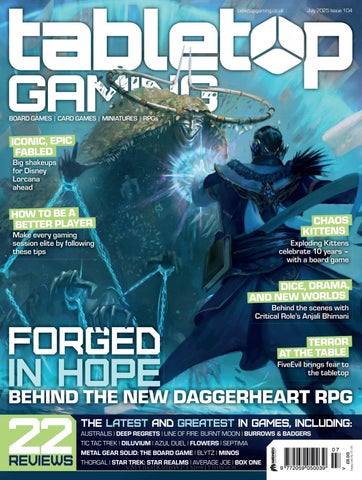
DAGGERHEART
idea of evasion, you didn't get hit. The player has an opportunity to describe a really cool moment:'
BUILD OUR OWN ADVENTUR
If there's little lore to the world, and players are responsible for building the map of the world, you can see how easy it is to build an adventure tailored to your preferred flavour. Again, it returns to the idea of toolboxes, whereby Daggerheart offers touches of advice and opportunity through its core text. They call these campaign frames, which were actually a result of feedback from the open beta. "Originally, we were working with locations which were building out a specific place, a very specific lore that people could choose to run the game with. And later, Spenser kind of had this 'aha' moment:' Rowan explains. "We were trying to find what's the best way in for this game where we weren't setting up a canon world. Daggerheart does not exist in a specific place by default. We're encouraging the players to bring their own ideas to the world and build their maps together:' Spenser adds.
12
July 2025
"Can we give them a place to start? Does that help us to get started? What we found is that it was helpful. But really, what those places were doing was giving players an idea of the kind of game they were going to be playing. And so we talked a lot about genre engines and specifically sub-genre or sub sub-genre engines. Really niching down into saying, what is this campaign about? We found that going a little bit broader, but a little more wide-reaching, in the tool set that we gave them, allows us to give them a starting place, give them a region to be able to play in, and also provide the like framework of what that sub-genre play is:' The example is given that you might want to play a political fantasy, but you could consider both Game of Thrones, and Avatar: The Last Airbender to be political fantasy. They're very different, but there is a core genre that runs between them. Being provided with places and concepts rather than dictating exactly how the game plays means players and GMs can build the tone and feel around the game they want to play. "Witherwild [one such location] is more of what I think of as the classic high fantasy
adventure. And so, I made the choice that the gods were available for people to interact with because I consider that to be kind of a hallmark of high fantasy, that the powers that be are a little bit more accessible. It's a subgenre that makes you feel heroic:' Rowan explains. "And then when we were working on Motherboard, which is our post-post-apocalyptic campaign frame, one of the mechanics is that all magic is tech. So when you sit down for session zero, the GM asks players, how are you reskinning your magical abilities as technology? And then knowing that that was one of our pillars of design for Motherboard, I kind of reverse-engineered it -a world that is both El
DAGGER HEART technologically advanced and also because it's post-apocalyptic, people no longer understand fully how the technology works. It becomes arcane. And then Colossus of the Drylands, which is our weird West-:• "It's Shadows of the Colossus meets Red Dead Redemption;• Spenser explains with a laugh. "We have gunslinging, we have all of the dry deserts, we have kind of a gold brush proxy, all of these little bits and bobs that tell people where they are and what they can build upon;' Rowan says.
MEC A ICS
Daggerheart is a whole new system, meaning we couldn't detail everything you need to know to be able to play in so few pages - the core book is over 400 pages long! - but we were keen to find out a little more about how it plays. The core dice mechanic is that of Duality Dice - much like Dagger and Heart, you roll two Dl2's (12 sided dice), and give your total number (with any modifiers) to the GM to ascertain if you succeeded or failed the check. However, one dice is considered the fear dice, and one is the hope dice, and you'll tell the GM which one rolled higher. "So you would tell the GM, I rolled a 15 with fear or I rolled 15 with hope. This creates a true access resolution system that essentially says 'yes and; 'yes but; 'no but; and 'no and'. We're creating that narrative space from the play:' Spenser explained. 'Yes, and' is a fundamental rule of improvisational comedy, an area that we see a lot in actual play, that's often so sought after by the everyday player hoping to experience Critical Role, or Dimension 20 moments in their home game. Offering these opportunities again contributes to letting players take the story in fun, unexpected directions. But what does rolling with fear or hope mean? "When you roll with hope, you [as the player] gain hope as a currency, and you can spend hope to be able to do cool abilities. This is a heroic roleplaying game, so the idea is that these hopes and fears, like ups and downs, these are things that impact your character from a genre standpoint:' These hope points are also shareable with your fellow players, giving the opportunity for more shared storytelling and productive collaboration. "Hope is in some ways asking you to collaborate with the rest of the table and invites people into moments that they might not otherwise have been in. I think that in having this meta currency, [it's] hopefully encouraging people to do these bigger, better
14
July 2025
moves that they might not otherwise do. "If you roll with fear, it impacts you. If you roll a success, but with fear, then you get what you want, but it comes at a price of some kind. And the GM gains a fear, and they can spend that fear to be able to make scary, interesting, narratively exciting things happen during play. That's not their only way of doing that, but it's a currency that allows them to augment play further by spending fear to do so:' Spenser explains. "So, you go to strike out at somebody with your sword, and you roll a failure with fear. You don't succeed. Play passes back to me as a GM. Say in return, that knight that you were trying to raise your sword against, instead strikes out at you. I would roll my die and be able to see if it hits, and then I could spend fear, shifting the spotlight over to an archer in the tree and they're going to let go of an arrow and shoot that towards your character right as this is happening:' The description of shifting the spotlight is a term reminiscent of theatre or film, but is really useful to understand the style of storytelling at play here. "That currency creates this ebb and flow between the players, where they're spending hope to do cool things, and I'm spending fear to do cool things as the GM. But by creating that two-axis system, we also allow for a spread of narrative possibilities where nobody knows what's going to happen until the dice are rolled:' "I also love that you can spend hope to assist other players in the same way fear allows the GM to shift the spotlight as part of its mechanics" Rowan adds. There are whole new ways to play - in combat for example, the more attacks you