The UK’s Number ONE read for all waterways users
104 PAGES MEET THE CARPENTERS
P9
TALK
TOWPATH TO
Issue 136, February 2017
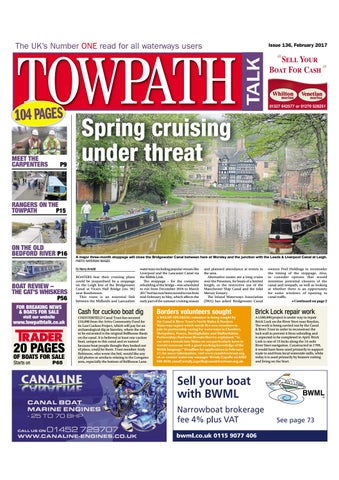
Spring cruising under threat
RANGERS ON THE TOWPATH P15
ON THE OLD BEDFORD RIVER P16
A major three-month stoppage will close the Bridgewater Canal between here at Worsley and the junction with the Leeds & Liverpool Canal at Leigh. PHOTO: WATERWAY IMAGES By Harry Arnold
BOAT REVIEW – THE CAT’S WHISKERS P56
FOR BREAKING NEWS & BOATS FOR SALE visit our website
www.towpathtalk.co.uk
20 PAGES OF BOATS FOR SALE Starts on
P65
BOATERS fear their cruising plans could be jeopardised by a stoppage on the Leigh line of the Bridgewater Canal at Vicars Hall Bridge (no. 56) near Boothstown. This route is an essential link between the Midlands and Lancashire
waterways including popular venues like Liverpool and the Lancaster Canal via the Ribble Link. The stoppage – for the complete rebuilding of the bridge – was scheduled to run from December 2016 to March 2017 buthasnow been movedto runfrom mid-February to May, which affects the early part of the summer cruising season
Cash for cuckoo boat dig
CHESTERFIELD Canal Trust has secured £10,000 from the Aviva Community Fund for its Last Cuckoo Project, which will pay for an archaeological dig at Staveley, where the site to be excavated is the original Bellhouse Basin on the canal. It is believed at least one cuckoo boat, unique to this canal and so named because boat people thought they looked out of place, could be there. Trust member Andy Robinson, who wrote the bid, would like any old photos or artefacts relating to the Lowgates area, especially the bottom of Bellhouse Lane.
and planned attendance at events in the area. Alternative routes are a long cruise over the Pennines, for boats of a limited length, or the restrictive use of the Manchester Ship Canal and the tidal Mersey Estuary. The Inland Waterways Association (IWA) has asked Bridgewater Canal
Borders volunteers sought
A WELSH-SPEAKING volunteer is being sought by the Canal & River Trust’s North Wales & Borders Waterway region which needs five new members to join its partnership caring for waterways in Cheshire, Shropshire, Powys, Denbighshire and Staffordshire. Partnership chairman Brenda Harvey explained: “As our area extends into Wales we are particularly keen to recruit someone with a good working knowledge of the Welsh language.” Deadline for applications is February 17; for more information, visit www.canalrivertrust.org. uk or contact waterway manager Wendy Capelle on 0303 040 4040, email wendy.capelle@canalrivertrust.org.uk.
owners Peel Holdings to reconsider the timing of the stoppage. Also, to consider options that would minimise potential closures of the canal and towpath, as well as looking at whether there is an opportunity for some windows of opening to canal traffic. • Continued on page 2
Brick Lock repair work
A £500,000 project is under way to repair Brick Lock on the River Stort near Roydon. The work is being carried out by the Canal & River Trust in order to reconstruct the lock wall to prevent it from subsiding and is expected to be completed in April. Brick Lock is one of 15 locks along the 14-mile River Stort navigation. Constructed in 1769, it would have been used primarily to support trade to and from local waterside mills, while today it is used primarily by boaters visiting and living on the Stort.
16 NEWS FOCUS
www.towpathtalk.co.uk
Navigating the Old Bedford River Words and photography by MIKE DAINES AND JOHN REVELL
John Revell reverses Olive Emily into and through the Salters Lode sluice gate to join the Old Bedford River.
A sight rarely seen these days! NB Olive Emily pictured on the Old Bedford River as part of a campaign to maintain the river as a navigable asset to the East Anglian waterways system. FOR the second successive year skipper John Revell on his narrowboat Olive Emily, based at Fox’s Marina in March, Cambridgeshire, entered the Old Bedford River via the tidal River Great Ouse at Salters Lode. This is not as simple as it sounds. It has to be done ‘on the level’ and the Old Bedford and the narrow tidal channel which leads to it are in poor condition. As a result few boats have been willing or able to do this in recent years. “I attempted the same journey in November 2015 and managed about a mile before being forced
Just enough depth for a swan to swim! The section of Old Bedford River that is silted and clogged with masses of cott weed.
to turn round through lack of water and a massive amount of cott weed which completely clogged up the propeller,” explained John.
Propellor clogging cott weed. “For last year’s attempt I emailed the Environment Agency well in advance on October 7, 2016, advising them that I proposed to navigate the Old Bedford during the period Thursday to Saturday, November 3-5. I further explained that if possible we would aim to cruise all the way to Welches Dam and asked for confirmation that the Welney guillotine gate, through which we would have to pass, be left in the raised (navigable) position. I never received a reply from EA.” Olive Emily successfully entered the Old Bedford at 7.45am on Saturday, November
Olive Emily’s volunteer crew man the poles to extract her from the silt.
Olive Emily returns along the narrow tidal channel to the tidal River Great Ouse prior to locking back into the calm waters of the Middle Level at the end of the trip.
5. This was not straightforward but the Middle Level lock keeper and an EA staff member were very helpful and with a volunteer crew including David Venn, chairman of Inland Waterways Association Peterborough branch, Chris Howes, Ivan Cane and Mike Daines, headed off towards Welches Dam. Quite good progress was made at first and soon Olive Emily passed the one-mile progress marker from the previous year. After another mile or so there was evidence of dredging on the west bank with the spoil piled up along the bank and the digger visible in the far distance. It was this dredging that had quite obviously enabled progress up to and beyond the one-mile limit of the previous year. Further ahead were the overhead electrical power lines that cross the river around three miles in from Salters Lode. A previous attempt by John in July 2008, to reach Welches Dam accompanied by Lois and Roy Parker in their cruiser Marie 2, had failed because this section hadn’t been dredged for years. “That’s where we will probably hit trouble,” remarked John. True to the prediction, as Olive Emily approached the power lines the river took on a glazed and milky look and we became engulfed in a mass of cott weed with the water level dropping to a silted muddy depth of just one foot. It immediately became obvious that she couldn’t proceed any further and once again would reluctantly have to abandon her goal and turn around. With much prodigious poling by the crew Olive Emily was slowly extracted
Skipper John Revell negotiates NB Olive Emily back out through the tidal doors ‘on the level’ from the Old Bedford River.
from the glue and turned back into deeper water to make her return to Salters Lode. She had again been defeated by the same problems as the previous year – insufficient depth of water, lack of dredging and masses of cott weed.
Impassable
“It really is a sad state of affairs,” reflected John. “Our objective was to reach Welches Dam lock which was stanked off by the Environment Agency in 2006. This lock has remained closed and impassable for 10 years despite the efforts of the IWA locally and nationally, the East Anglian Waterways Association and the Project Hereward team. “The ‘temporary’ piling which was installed by the EA in 2006 covers most of the entrance to the lock so it is very effective at stopping boats but rather less effective at stopping leaks which was claimed to be the reason for the piling in the first place”. Two developments occurred between John’s email to the Environment Agency on October 7 and his passage on November 5. Firstly, he discovered late on November 3 that the Welney guillotine gate was in the down (unnavigable) position. This came as a surprise as he had been assured that it would remain in the up (navigable) position unless there was a change in river conditions. The weather in East Anglia had been dry for some time so the closure of the Welney gate was puzzling. More importantly, the water level in the Old Bedford had been dropped by a foot in the week after he had notified EA of the dates of his proposed
passage. This was even more puzzling to John and he’s been unable to find out why this was done and by whom. “EA is a multi-functional organisation so any part of it might have authorised this action. It might have been done by flood control, it might have been fishing, it might have been engineering, it might have been navigation, it might have been environment. Who knows?” Whatever the reason, this made the tidal passage into the Old Bedford at Salters Lode unnecessarily difficult and muddy. It meant that the depth of water in the Old Bedford was shallow throughout. It also meant that an attempt to enter the Old Bedford the previous day (November 4) had been unsuccessful and had to be abandoned. The general lack of depth became an insuperable problem when Olive Emily met the stretch of very shallow undredged water, deep mud and glutinous cott weed close to the overhead electrical pylons crossing the river. Everyone knows that special precautions must be taken when working near them but this situation arises routinely on other rivers and canals and is easily overcome. Indeed the same pylons cross the nearby navigable New Bedford river, Well Creek at Nordelph and the Great Ouse at Littleport. “The Old Bedford is not a dead-end waterway leading to nowhere but part of a l o ng - e st ab l i s h e d rou t e connecting the Middle Level and the rest of the canal and river system. It needs to be restored to full navigation,” John said.
A view rarely seen over the last 10 years. Looking over the prow of a narrowboat navigating the Old Bedford River towards Welney and Welches Dam lock. “It would make an interesting cruising ring. It has been navigable since 1637, well before the main canal era started, it is a statutory navigation and it needs to be maintained. Although the Old Bedford remains officially open it will remain off limits for all but the most determined boater until it is deep enough and dredged properly.” He continued: “The Canal & River Trust has built on the long experience of British Waterways in managing rivers so that they remain navigable most of the time but are closed when flood conditions require. Just think of the Rivers Soar, Trent, Severn, Avon, Weaver or the river sections of the Trent & Mersey or the Caldon or the Calder & Hebble to name just a few. “Would the current lamentable state of affairs in this part of the Fens be tolerated elsewhere on the system? Would this have been allowed to go on for so long if CRT managed it? Would it not be better if responsibility for navigation matters on waterways that are currently managed by EA be transferred to CRT?”
Olive Emily approaching the Old Bedford sluice, March 2010. Note the depth of water! Inset: The water mark on the guillotine door is clearly marked and was a good two feet lower.
www.towpathtalk.co.uk
insider
BUSINESS NEWS 55
Boat review Reviews What’s on
Million pound investment at Racecourse Marina TINGDENE Marinas Ltd’s £1 million investment in new pontoons and shoreside facilities at Racecourse Marina on the River Thames in Windsor is ready on schedule. The project has upgraded the facilities and increased capacity by 50% to 262 berths. Operations director Steve Arber said: “It’s gone exactly as planned and we experienced excellent service from our contractors on this project – Walcon Marine, Land & Water, Rolec and Riverworks. “Our marina in the heart of the Thames at Windsor is now state-of-the-art. “Racecourse is completely geared as a one-stop shop for our berth-holders, who can start to relax as soon as they arrive on our newly resurfaced entrance road. Most importantly, the customer feedback has been excellent.” Diane Moreton, who has been a berth-holder at Racecourse
New pontoon berths. Marina for 10 years, said: “The changes are fantastic. They have been delivered step by step and the new pontoons are so much better, as is the dedicated new berth-holders’ car park.” She also praised marina manager Neill Walker and his team. Steve Arber added: “When you can provide that extra element of service for a customer, something that’s not in the tariff or the brochure, it means a lot
to them. That’s exactly the sort of thing we like to do when it is possible. “This latest phase of investment has enhanced the appeal of already popular facilities, such as GOGOS waterfront restaurant and cocktail bar and our boat sales and boatyard facilities. “We’re now looking forward to a great 2017 with our growing number of berth-holders here at Racecourse Marina.”
An aerial view of Racecourse Marina that has now been fully redeveloped with 262 state-of-the-art pontoon berths and matching shoreside facilities. PHOTOS SUPPLIED
Moorings available during athletics events BRITISH Waterways Marinas Ltd (BWML) is looking forward to welcoming visitors and boating groups to its Limehouse Marina, to experience the World ParaAthletics Championships and IAAF World Championships that come to the London’s Queen Elizabeth Olympic Park next summer. Visitor moorings are available at the marina, which is strategically located just a few miles south of the Olympic Park, and boasts new visitor facilities.
Clubs and associations looking to hold a rally at the marina are especially welcome. From July 14 to August 13, the world’s top athletes return to the iconic stadium. London 2017 is also the first time that the IAAF World Championships and the World ParaAthletics Championships will be held in the same summer, in the same city, with 245 events over 20 days of sporting drama, involving 3300 athletes from around the globe.
over the reins to a new floaty boaty couple and support them in taking this novel and beautiful venture on to new destinations. “If you love the outdoors and dream of working independently as your own boss, this might be for you.” For further information contact 07806 818973, email hello@ floatbyboat.co.uk or visit www. floatbyboat.co.uk
Holidays Food & Drink Technical
P62 P63 P64
Customer service award for Church Minshull Aqueduct Marina CHURCH Minshull Aqueduct Marina has won South Cheshire Chamber’s Excellence in Customer Service Award 2016, presented at a recent ceremony at Crewe Hall. The judging process included completion of an application, attending an interview and giving the judges a thorough tour of the business operations. The marina had been shortlisted as one of three finalists alongside Barebones Marketing and Construction Links. Marina director Robert Parton said: “We were absolutely delighted with the result which acknowledges the hard work of all staff.” Bernie McCrae, Aqueduct Marina’s marketing and communications co-ordinator added: “We really pride ourselves on looking after our customers and hope that this award will help people to recognise the quality of our services, while improving our reputation and brand image.” The awards ceremony was attended by more than 200 VIPs, entrepreneurs and civic dignitaries. Four staff members, Bernie McCrae, Sarah Rayner, accountant, Julie Beedham, receptionist and Holly Critchley, Galley Cafe manager, represented Aqueduct Marina. Jason Pickford, head of advice at Jones Sheridan, said: “Aqueduct Marina is always looking to make improvements from customer feedback and interacts very well with customers through
Holly Critchley, Bernie McCrae, Sarah Rayner and Julie Beedham receiving the award from Jason Pickford and Martin Sheridan of Jones Sheridan. PHOTO SUPPLIED its website, Facebook, Twitter and Trip Adviser accounts as well as providing regular events and entertainment for customers. “Over the past year Aqueduct Marina has increased its online engagement utilising social media, Survey Monkey and other platforms to create interaction with customers. It takes an interest in feedback and provides ongoing platforms for customer comments. “It further interacts with customers through its company newsletter and looks forward to improving its service with the introduction of a fresh website in the new year.”
Latham marina closes after 36 years By Colin Wareing
JUST before Christmas 2016, Latham Marina to the west of Burscough on the Leeds & Liverpool Canal near the Crabtree Lane swing bridge, closed its doors for the last time. The business had been run by Tony and Sandra Murphy for the last 36 years from a static caravan and a secondhand shipping container that had been set up on land at the bottom end of the car park for the Slipway pub that is on the opposite side of the road. This car park had originally been one of the Leeds & Liverpool Canal Company’s manure wharves where night soil was unloaded from barges that had transported it out of Liverpool to be spread on the local farm fields.
Bill Williams established ‘Lathome Marine’ in 1972 in the former provender store next to the house that was later to become today’s Slipway pub. From this base Bill carried out boat repairs, and ran a small hire fleet along with sales of pleasure cruisers. He also built the slipway that the pub takes its name from and is still in use today to launch and retrieve smaller boats. Tony worked for Bill from 1978 until he took over the business in 1980, moving into the pub car park six months later. Tony and Sandra had provided a service of boat maintenance, spares and repairs, and using Sandra’s sewing skills made and fitted boat canopies. Unfortunately during last winter, the car park became flooded after heavy rains which entered the caravan and the container so Sandra and Tony
The closed sign at Latham Marina. PHOTO: COLIN WAREING, COLIN AND CAROLE’S CREATIONS
took it as sign that it was time to take retirement. Over the past 12 months they have gradually sorted out and disposed of stocks of spares and the like that build up in any business that has a long history and have now gone off to relax!
Flying high at Mercia Marina WITH winter upon us, boater and South Derbyshire resident Richard Triggs has brought some muchneeded warmth by revealing a rare shot he took of Mercia Marina during the summer months. The image, taken from a drone at 150ft above Europe’s largest inland marina, reveals the scale
of the marina community, which at near-full capacity hosts more than 600 boats and welcomed an estimated 800,000 visitors in 2016. Richard, a keen photographer since joining the Merchant Navy in 1963, has also captured possibly the last view of the marina before building work starts on a new £3 million
NEW OWNERS SOUGHT FOR HOTELBOAT VENTURE AFTER four years of exploring the inland waterways, Kev Argent and Tor Johnson of Float by Boat have decided to call it a day and sell their 69ft hotelboat Spirited Away. They are seeking someone to take over the business which was featured on Channel 4’s Four in a Bed series in 2015 and will be repeated when the current series finishes. Tor said: “We’re ready to hand
P56 P57 P58
Mercia Marina from above. PHOTO: RICHARD TRIGGS
office, restaurant and retail development adjacent to the existing Boardwalk development – the largest building in the centre of Richard’s photograph. Planning permission for the new three-storey Piazza development at the Findern Lane marina, near Willington, has been granted by South Derbyshire District
Council, and construction work begins this new year. And there are potentially more unusual creations to come from Richard in the future. He said: “Having just completed an online course in aerial videography, my next project is to produce an interactive immersive virtual tour of the marina.”
56 BOAT REVIEW
www.towpathtalk.co.uk
SPEC SHEET Style/model: Semi-trad, with Aqua semi-cruiser stern, reverse layout. Length: 60ft Beam: Standard Engine: Beta 43 Power system: Victron 3000W inverter plus solar panels Line out: Oak Floor: Engineered oak Lighting: LED throughout Heating: Radiators heated by Webasto unit and Refleks diesel stove. Upholstery: All by Aqua NB, includes Roman and Venetian blinds and porthole bungs. Cost: £150,000 (2017 price, depending on bespoke specification)
The cat’s whiskers
Owners Jill and Richard Nunn.
From the pages of children’s books to the canal network, Tabitha Twitchit now graces a new narrowboat. Harry Arnold catches up with her on the Macclesfield Canal. FANS of Beatrix Potter’s tales will know that Tabitha Twitchit is the shopkeeper cat and long-suffering mother of three unruly kittens. The Lakeland author’s stories have inspired a number of boat names – there are a few Jemima Puddle-Ducks on the waterways. This Tabitha Twitchit is not however the anthropomorphic resident of Hill Top Farm but a 60ft narrowboat built by Aqua Narrowboats to the specific liveaboard requirement of Jill and Richard Nunn. The boat is the result of a 10-year plan for future living culminating in April 2015 when Richard retired from 30 years’ service as a fire officer. They love the UK and its waterways – especially their history – following such past experiences as cycling the towpath of the Leeds & Liverpool Canal and hiring a number of boats on the Midlands waterways. All this was not only enjoyable, but a research project looking at the style of boats and the skills and services of boatbuilders from which they chose Aqua Narrowboats (Aqua NB). Aqua NB are based at Mercia Marina on the Trent & Mersey Canal where they not only build boats but undertake repairs and other services, run a dry dock but also operate hire boats; which
are built by them and incorporate much of the quality standard specifications seen in their bespoke designed boats constructed for private customers. We have also been on one of these and other craft built for private owners. They use steel shells from the longestablished Colecraft company with a stern design of their own which they designate as ‘Aqua semi-cruiser’. It has twin gas lockers and there is a bow and two side lockers in the cockpit layout at the fore-end. All steelwork is sand-blasted to remove millscale and spray-painted in two-pack epoxy. Ballast is in blue brick, which has less water absorption, and spray foam insulation is used throughout. The exterior design incorporates a cratch, with cover, double-glazed windows and two sets of half sidedoors located by the dinette are of the saloon. Front and rear doors are of the stable design and fully Yale locked. Extra ventilation and daylight is provided by three strategically placed roof-mounted pigeon boxes, traditionally styled but built in steel with brass ports. Livery is simple elegant blue lined panelling with the name and a cartoon Tabitha as the only decoration.
Looking forward into the very practical open plan galley, dining area and saloon.
The master cabin in which the bed opens out to the full width.
Comfortable loosechair seating, stove and fittings at the forward end of the main saloon.
Masses of storage
Interior layout is what is now termed ‘reverse’, apparently as the galley is entered from the stern; although I often think reverse of what, as new boats have been built to this layout since the 1960s. Stern doors take you into a beautifully appointed galley with engineered oak flooring (used throughout), and granite work surfaces; incorporating cooker, integrated fridge and washer dryer, with a composite sink to match the surfaces. There is masses of storage including one of these space-saving ‘magic’ fold-out units. The galley plan has its main corridor swinging to the right so that in the openplan design the first section of the saloon is a matching width adjacent dinette which converts into a double bed. Jill RIGHT: A handy stowage cupboard for daily cruising gear, folding down into a chart table.
The roomy steering position of the Aqua-designed semi-cruiser stern. PHOTOS: WATERWAY IMAGES
Solar panel array on the cabin roof.
Hand basin and toilet arrangement in the bathroom.
and Richard told me that they welcome friends and family to stay but, in the nicest possible way, they don’t want them to linger too long in their home. In the style of modern liveaboard boats, the majority of the saloon is kept as a wide and flexible area with a simple but attractive inbuilt media unit on the right and a Refleks diesel-powered stove in the corner. Two loose armchairs are the main feature of this space. Twin heavy oak doors with white opaque glass panels – for a light and airy feel – separate the bathroom from the saloon and main bedroom. Granite surfaces are used again for the bathroom units with a pedestal-mounted oval hand basin on the left with a macerator toilet, draining to a stainless steel tank, on the right. The main bathroom feature is a large quadrant-shaped shower unit. The main feature of the master bedroom is a king-size crossbed, extending for sleeping by a simple flap over the access corridor. There are large wardrobes and the bedhead is particularly attractive with arched wall cupboard, shaped around the port hole
The large quadrant shower in the bathroom.
above the bed. Cubby holes on either side of the bed have glass shelves. These have LED lights, particularly illustrating that this type of lighting is used throughout, with cleverly positioned individual units at certain points. Returning to the stern, under the artificial teak decking is a Beta 43 diesel engine with 3.5kW Travel Power and deluxe control panel and hospital silencer exhaust. Heating is by stainless steel radiators driven by a Webasto unit with frost stat. Electrics are controlled by a Victron 3000/120 combi with battery monitor and generation is assisted by four, cabin top mounted, flexible solar panels (130W each) connected to a MPPT controller for maximum output. Shore power sockets are located at bow and stern. Tabitha Twitchit is a very impressive example of top-of-the-range canal boat building skills in both its design and execution, demonstrating how the aspirations of owners can be fulfilled in practice by a company dedicated to satisfying the waterway boating ambitions of its clients.
Clean and practical installation of the Beta 43 diesel engine.
82 BROKERAGE
www.towpathtalk.co.uk
www.towpathtalk.co.uk
BROKERAGE 83
ON SCOTTISH WATERS with Hugh Dougherty 97
www.towpathtalk.co.uk
Mark’s a brick! Hugh Dougherty meets the cop whose investigations into historic bricks have unearthed a canal connection.
MEET Mark Cranston, a 54-year-old police sergeant from Jedburgh in the Scottish Borders, who started collecting historic bricks in 2011. He won a Scottish Heritage Angels Award in 2016 for his work sourcing, recording and preserving historic bricks which would otherwise have remained the unsung heroes of the industrial revolution. Now, he says, there’s a canal
Just some of Mark’s 2000 bricks, many of which were made in canalside brickworks.
connection, and he’s looking to readers to help him find out more. “Bricks fascinate me,” said Mark. “There were once around 1000 brickworks in Scotland alone, and the majority of them were to be found near coal mines as the clay used in brickmaking was also common near coal mines. My earliest brick dates from 1849 when the railway era was just getting under way, but, before that, we know that the Forth & Clyde and Union Canals both had several brickworks on their banks and that the bricks made there were transported by canal barge.” Although most stonework used on Scottish canals is masonry, bricks can be found in historic canalside buildings, and they also played their part in repairs and extensions. Their use is also more common on English and Welsh canals. “The fact is that most customers of the brickworks preferred their bricks to be transported by canals as they were more likely to remain intact, whereas
railway trucks were rough shunted and it was several years before the railways succeeded in transporting bricks without breakage,” Mark said.
Export trade
Part of Mark’s collection of 2000 items includes firebricks, the specialised and scientifically made bricks which were used in furnaces at iron and steelworks, many of which were built beside canals, while firebricks were also used in steam locomotive boilers and in some early marine boilers. Now Mark would like to hear from readers who’ve come across early or historic bricks in canal use. “I’m learning all the time about bricks and their use during and after the industrial revolution,” he said. “Every brick tells a story about where it was made, who owned the company, who worked there and for how long. The number of bricks made at any one time also tells you how healthy the economy was, while some brickworks were owned by canal companies and vice versa. “I’d like to know more about bricks and their use on historic canals, and
Mark Cranston: bricks have a tale to tell. PHOTOS: HUGH DOUGHERTY I’d be interested to hear from anyone that finds bricks, or has spotted a pile of bricks on their canal travels. “I’m especially interested in bricks made in Scotland which were used in England, Wales and Ireland, as there was a healthy export trade.” Mark has also heard from brick fans across the world who have come across Scottish bricks used in what were the
Baird’s Brae links canal to busy commuter route THE Forth & Clyde Canal towpath has been linked more effectively to a busy Glasgow cyclist, runner and pedestrian commuter route thanks to a new path and junction being laid at the top of Baird’s Brae at Applecross Basin. Scottish Canals engineers have laid out two surfaced and defined paths to deter cyclists from cutting across grass at the top of the brae and potentially damaging a historic industrial site, which has already been excavated, beside the canal. And work on the new paths revealed the original course of the canal at the basin, while care has been taken to preserve one of the city’s last streets laid in granite setts, with two sets of flagstones, laid to the width of cart wheels, which were used to help horses and carts accessing the canalside warehouses and factories have a smoother journey. Such horseways were once common on docksides and routes leading to the canal, but Baird’s Brae is one of a few still extant. A Scottish Canals spokesman said: “We have provided the paths to help commuters, many of whom go on to use the canal towpath to complete their journeys, be able to travel to and from Maryhill Road more easily. The top of Baird’s Brae leads to a historic site beside the canal and the new arrangements ensure that the heritage and industrial archaeology of the site are preserved, too, while the historic setts remain in place.”
FOUR NEW BOARD MEMBERS FOR TRUST
Path to the present and the past: The top of Baird’s Brae with the preserved horseway and the new paths leading to Applecross Basin.
THE Scottish Waterways Trust has appointed four new trustees to its board, which now scores 50/50 on gender equality after the appointment of three women and one man who join the original appointees. New to the board are Bernadette Monaghan, chief executive of Volunteer Glasgow; Claire Ford, Quality Scotland chief executive; Dave Gorman, the University of Edinburgh’s director of social responsibility and sustainability, and accountancy expert Faith Simpson. The four new arrivals bring years of experience in the voluntary, academic and business sectors with them, and have vowed to help the trust continue its canal-based work with some of the most disadvantaged communities in Scotland. Scottish Waterways Trust chief executive Karen Moore said: “We welcome four dedicated and skilled trustees and are delighted to have achieved a gender-balanced board. I believe that diversity within board membership is vital as boards make better decisions when a range of voices can be heard and we will continue to work for further diversity.” Trust chairman Ross Martin said: “I welcome Bernadette, Claire, Dave and Faith, who bring a wealth of experience and knowledge to the trust’s board. “They share our commitment to creating brighter futures for some of Scotland’s most disadvantaged communities and safeguarding the country’s vibrant waterways heritage and biodiversity.”
PHOTO: HUGH DOUGHERTY
Kelvin Aqueduct’s engineering heritage honoured THE engineering heritage and excellence of the 400ft-long Kelvin Aqueduct on the Forth & Clyde Canal has been honoured by the Institution of Civil Engineers, Glasgow and West of Scotland, whose chairman,
The Kelvin Aqueduct from below.
Graham Edmond, recently joined Chis O’Connell, Scottish Canals heritage officer, to unveil commemorative plaques on the structure. Graham, who is also head of construction at Transport Scotland, said:
“This is a superbly engineered structure which has stood the test of time. It is right that we recognise the work done by the engineers who designed and built it in 1790 and that we work to ensure that it remains in use for generations to come.” Chris commented: “It is right we celebrate the engineering heritage of a structure like this and marvel at the boldness of those who built it. We are delighted to work jointly with ICE Glasgow and West of Scotland to mark the importance of such heritage which is in everyday use, over 200 years after it was built.” Two plaques, one on the towpath, and one under the aqueduct, where it carries the canal across the River Kelvin, have been provided on the second occasion in which ICE Glasgow and West of Scotland have recognised engineering heritage on a Scottish Canal, the Crinan having been similarly recognised by plaques in 2015. The all-masonry Kelvin Aqueduct was designed by Richard Whitworth as the longest canal aqueduct in Britain when
British Empire colonies, and says that the more you look at bricks, the more you learn. “I’d love to hear from Towpath Talk readers, and they can contact me at markcranston1962@gmail.com, while anyone interested in what I’ve discovered and preserved already is very welcome to visit my website, scottishbrickhistory.co.uk,” Mark said.
Graham Edmond (left) and Chris O’Connell unveil the plaque on the aqueduct. PHOTOS: HUGH DOUGHERTY it was built, and it attracted tourists who marvelled at its boldness. Today, it still carries the canal across the Kelvin and is the junction for a number of cycling and walking paths which meet below.
98 TOWPATH TREASURES
www.towpathtalk.co.uk
Museum of London Docklands
How Britain traded with the world
Words: PHILLIPPA GREENWOOD Images: MARTINE O’CALLAGHAN CANARY Wharf dazzles the London skyline with Cesar Pelli’s tower, better known as One Canada Square, which was once confidently the tallest building in Britain until the Shard muscled in. One Canada Square has its own attraction but, only a short walk away, the cooing of designer shopping is replaced by the
The bridge across North Quay.
Warehouses line the waterside.
intense drama of London’s Docklands heritage. Here, the important history of every era of the city is housed in the Docklands Museum that sits quietly on the waterside. The tranquil exterior of this museum is a decoy to the giddy experience housed inside. The River Thames and the oceans
beyond have always raged with an island’s defence strategies, but as much as the water is an invader’s route, it is also the trade route that once helped build the British Empire. By the late 1700s the River Thames was overcrowded with merchants’ ships arriving from around the world. As they moored on the river to allow small boats (called ‘lighters’) to ferry their cargoes to the shore, the Thames became jammed with chaos – tall masts waved over the water and boats butted starboard to portside. Rogues didn’t miss the opportunity of feeding the lucrative black market business from the precarious system of
The plaque commemorating the laying of the first stone for the warehouses.
goods being loaded and unloaded from ship to shore. West India merchants were so furious about their losses that they demanded a secure dock was built. The engineers William Jessop, John Rennie and Ralph Walker took up the baton, and London Docklands became the largest structure of its kind in the world at that time. A world trade route was opened up by the relationship between the canals and the Docklands. Cargoes from ships were transferred into canal boats to be distributed along the Regent’s Canal and the Grand Union Canal at Paddington to be carried further inland to the Midlands. Coal, timber, cocoa, exotic fruits, tea and other cargo arrived in the Docklands, and warehouses along the quayside stored goods safely away from those opportunist scoundrels of the black market. Only two of the original warehouses have survived and the museum is housed in one of them. Exhibitions over several floors tell London’s story eloquently, without sparing any emotion between the lightest joy to the darkest shame. London was the fourth biggest slave trading port in the world after Rio de Janeiro, Bahia and
A sign listing some of the goods transported here. Liverpool. The vile truth of ships arriving with ‘cargoes’ of slaves is told in images and words that are uncomfortable to ingest, and even more uncomfortable to ignore. The round table at which William Wilberforce and others sat to discuss the abolition of slavery is a touching exhibit and a showpiece of hope. Each floor of the museum takes the visitor back to a different time. One of the highlights is a fascinating model of the first London Bridge depicted from around 1440. Another fascinating feature is the dark alleyways of a lifelike ‘Sailortown’ where multi-sensory effects immerse the visitor in a cobblestoned grotto with drunken sailors, pirates and merry rum-slinging characters. From Roman settlers to Britain’s latest prime minister, the museum tells a local story embedded with global connections. Fires, strikes, hangings and murders, overcrowding, the politics of power and war fill a museum that is classy, informative, entertaining – and free! In the 1960s, when it was no longer needed for its original purpose, Docklands closed and the area seemed destined to fester like an East End Untouchable, but when the area was rejuvenated, a deliberate twist of fate transformed the Museum of London Docklands into a must-see attraction.
101
www.towpathtalk.co.uk
TALKBACK
Your chance to write to us on any Towpath topic: Towpath Talk, PO Box 43, Horncastle, Lincs LN9 6LZ editorial@towpathtalk.co.uk
More about the Tow
‘Rosie’ points the way I ENCLOSE a photo of our lookalike ‘Rosie’ narrowboat wind vane. It was made by Brian Greaves as he passed by on his blacksmith boat in October 2015. The figures were added and painted by ourselves. It
is now on top of our flagpole alongside our canalside cottage on the Macclesfield Canal at Bridge 90. (The Pink House. Teapot Hall). Roy and Audrey Brooks By email
Oxford bridges built after Brindley’s death ON THE front page (News, Issue 135 January), it says that the Oxford Canal lift bridges were built by James Brindley. This is most unlikely as he died in 1772 and the southernmost stretch of the canal from Banbury to
Oxford was not started until many years later in 1786. Furthermore I am unaware that he used this type of lift bridge on any of his other canals. Mike Beare By email
TOWPATH TALKBACK
I NOTED the article on page 8 (Networking, Issue 135, January) about the transfer of the mud hopper Tow to the Herefordshire & Gloucestershire Canal at Over Basin. In the late 1960s, the boat was operated by the Birmingham & Midland Canal Carrying Co, (now Birmingham Boat Services) on whatever jobs they had at the time – usually around Birmingham. In 1969, with a lad from the school at which I was a teacher, I was visiting the IWA National Rally being held in Birmingham around what is now known as Old Turn Junction. In the early afternoon, I was approached by Graham Wigley of B&MCCC to help in getting the Tow from the bottom of Camp Hill Locks
back to Gas Street. He gave us a long rope and a couple of windlasses and somehow transported us over. It took us about four hours, with a jammed gate on the Ashted Flight. We had to stop at the top of Farmers Bridge flight – at the same spot as the pic in Towpath Talk – there were so many boats at the rally, we couldn’t tow the Tow any further! Incidentally, unless it’s a replacement, the Tow was built as a river class butty in about 1960 – one of the last batches of boats built for carrying with the British Waterways fleet. Nice to see that the Tow is still going and still working! Keith Eley By email
Forum helps to find stolen boats TWO stolen boats were recently recovered thanks the prompt action by readers of the online Canalworld forum. In the case of one, travelling on the Staffordshire & Worcestershire Canal, vigilant Canal & River Trust staff were alerted when they saw the boat without a customary boat index number and licence details. Eyes were immediately peeled around the system and the boat was recovered.
A second boat took longer to find with 1800 posts of possible sightings and suggestions, some members getting on their bikes to search lengths of the canal. The forum at canalworld.net has more than 21,000 members and several thousand may be online at any one time. It is supported by voluntary contributions of time by the site owner, technician and a team of moderators.
with Harry Arnold
Fortuitous meeting at Fort Augustus
ON A recent Caledonian Canal cruise aboard a Caley Cruisers hire boat we met at Fort Augustus one of my all-time favourite vessels – the steam Puffer VIC 32. To be pedantic she is not a true Clyde Puffer but the result of the Admiralty needing in a hurry a handy small supply ship in the Second World War: so it built more than 100 ‘Victualling Inshore Ships’ (VICs) based on the practical Scots design. VIC 32 was built in 1943 at Dunston’s Shipyard in Yorkshire. The boat was acquired by Nick and Rachel Walker – whom I’ve known since when they had narrowboats on the English canals – who then headed north in 1978 to Crinan and started the current popular holidays aboard her. In 2002 they gifted her to the Puffer Preservation Trust; a charitable organisation which ensures the obtaining of grants to keep her running. There is also a Friends of VIC 32 if you want to support them. Nick and Rachel are still very much involved but every time I have met the boat, including this time, they haven’t been aboard. I also have a personal connection with the VICs. My father was killed after D-Day and is buried in Normandy but my stepfather Tom also served in the Second World War, as a sergeant in the Royal Army Service Corps (RASC) but in the Water Transport section. Part of what was nicknamed ‘The Army’s Navy’. He went out in the invasion of North Africa and served in the Mediterranean theatre, not coming home until demob in 1945. With the invasion fleet was quite a number of VICs, apparently carried as deck cargo, and part of his service was as a mate aboard one of these. One of the jobs he told me about was running arms and supplies from Italy to the Commandos and partisans on the Greek islands. He generally only talked of the good times and the funny incidents but he was wounded in the leg, but not seriously enough to be sent home. When I first showed him a photo of VIC 32 he gave me a complete technical rundown on the boat. To my everlasting regret, one of
POET’S CORNER Selections from the lonely hearts column of Towpath Talk – if only it had one! Lock keeper’s daughter in need of adventure, raring to go, Would-Like-To-Meet young handsome bargee with long-distance cargo. [box no. 531] Small, frail, leisure-bargeman, good at cooking, cleaning and putting up shelves, seeks muscular woman for everything else. [box no. 532] Feisty redhead, bored in Blackburn, seeks prince travelling through. If you're fit and you're charming I'm waiting for YOU. How far are you going? I can go that far too. [box no. 533] Rainbow-barge eco-warrior seeks canal-hiking peace-babe to share time exploring the waterways. We could pole together, through the blackness of tunnels – Eco-woman, please join me, we'll ride on the gunnels. and punt on through rushes, keep fit, save fuel, save the planet. [box no. 534] Nervous Bath gentleman seeks like-minded lady for annual barge holidays – Bath to Bradford-on-Avon, and back. just a few miles, no flying, no motorways – a week in the country, without traffic or telly. I go every year, so I do know the way (but, in case of mishaps, bring wellies). [box no. 535] Petite blonde divorcee seeks strong man to rescue her, stranded in Shropshire in large luxury barge-yacht. Be my First Mate... maybe more... if you rise to the challenge of this flight of seventeen locks. [box no. 536] Big burly bargee seeks bold buxom barge-girl who has good sense of boatlore, is plenty of fun, clever at knots, knows the captain is right, can handle a tiller and... whatever she likes. I promise I won't be Attila the Hun. [box no. 537] Slim bubbly brunette seeks position as barge-mate: athletic enough to jump back on to boats without falling in and skilful with bollards and ropes, knots, splices and whipping. Hoping to find an agreeable captain with twinkling eyes, then – who knows – maybe more. Can cope with the oil, the chugging, the grime, but not close-up unshaven. With stubble there'll be no chance of rapport. [box no. 538]
VIC 32, with a local Scots TV team aboard, leaving Fort Augustus. PHOTO: WATERWAY IMAGES the photographs he brought back, which has disappeared, was one of four VICs moored abreast in Sorrento harbour. Fortunately I still have the Blue Ensign – defaced with the RASC insignia – that flew from his VIC and he brought back home.
Many of you will have seen Nick and Rachel aboard VIC 32 in the last programme of Tim and Pru’s TV series Great Canal Journeys during their passage along the Crinan Canal. Great holiday on a brilliant boat, if you don’t mind the smuts from the smoke.
Romantic old Shire seeks fine Belgian mare, has towrope to share, toting tourists in Tiverton. My chestnut beauty, we'll wear coloured ribbons, pose for photos, feast on oats ...and I'll weave water lilies through your blonde flaxen mane... At day's end... share my hay, be my stable-mate. But - if you get homesick for Belgium I'm willing to relocate. [box no. 539] Ship's cat taking refuge in lockside pub, seeks barge with plenty of rats and no dog.
[box no. 540) Ruth Butler
102 THE LAST WORD
www.towpathtalk.co.uk
TOWPATH TITTER
CRACKER’S CHAT
More towpath ramblings straight from the horse’s mouth h “Disabled riding, Middlewich to Harecastle, plus ghostly goings-on” AS REGULAR readers will know, even though I’m at my winter quarters, I’m never idle (mentally or physically). Currently, I’m proudly involved with providing alternative transport for my present hostess. She’s now a wheelchair user who used to ride, until an accident put an end to her equine activities. As you can see from the photo, we’re both as pleased as punch to be helping each other. She's once more enjoying horse riding, and I’m proud and honoured to be able to assist. A few ‘chats’ ago, we were also blessed with a brilliant account from an ‘old boatman’ who regaled us with a story about his adventures on the cut. I’m delighted to say that, due to popular demand, he's back with the next instalment. So without further ado, let’s dive in: “Working my single motor boat loaded with 20 tons of feldspar you left me, at the end of episode one, at the chip shop near Kings Lock in Middlewich on the Shroppie (Shropshire Union Canal). Early next morning I would be away and up the next few single locks and be enjoying swinging my boat around the deep water turns in the long Rookery pound that ends at Wheelock. Cracker: Nice stable here that is still usable today! Now the fun begins, the locks are in twos side by side (this route was once so busy, that the locks to the summit were duplicated) sadly not all of them were usable by 1960. I remember a dinnerplate-sized disc of red or green paint indicated the ones you could use. These next 26 locks climb to Kidsgrove and the Harecastle Tunnel, it’s only a few miles, and always on the left you can see Mow Cop castle on the skyline. I have heard people call it heartbreak hill, which is nonsense as, even singlehanded, it was an easy steady day.
At each lock you left the motor ticking over in head gear, it pushed its way in slowly and you lifted a few inches of top paddle to stop and hold it against the cill while you closed the bottom gates. Having drawn the rest of the top paddles you could sit and watch the boat rise, your time your own to rest and think, maybe picking out the rotten wood to the balance beam with your windlass. Yes, we all did that, bad boatmen! Some poem from school about time to stand and stare comes to mind. As you neared the tunnel the water got redder in colour, staining the lock sides. This particular day, I lost time filling an empty pound and realised I wouldn’t get to the mouth of the tunnel by 5pm when it officially closed. So maybe time matters after all, especially if you have a date in Stoke and it’s Saturday night. Way back in 1914 an electric tug was put in the tunnel to draw both horse and motor boats through, but by the 1960s this had gone to be replaced by a man at either end with a phone to operate a one-way system. I reached the Kidsgrove end of Harecastle Tunnel about 6pm, the staff had indeed left for the night, but it was a summer evening and I had date in Stoke, well Longport actually. I could do that if…! I stood, listened and I couldn’t hear or see any northbound boats, so I decided to risk it. I had heard from other boatmen that you could get through after hours. Still it was not my favourite place as it was not an easy nor fast journey with a loaded boat, and maybe the following story was also a premonition!
Ghost of Harecastle Tunnel
One fine day in 1990 a line of boats was waiting to enter the north end of Harecastle Tunnel. The last boat heading north came out of the tunnel, and the tunnel keeper said it was okay for us to go in. “No, no, no,” shouted the steerer of the emerging boat, “there's an old working boat following us, we can still see his headlamp.” So we all waited, but no more boats came out.
CONTINUING our light-hearted look at life on the cut with this contribution snapped by Ivan Cane at the New Junction swing bridges.
I hadn’t realised when you pushed the open button, there was a little person inside who then turned a wheel! This unusual meeting was seen by Maggie Emery on the Staffordshire & Worcestershire Canal.
Not sure who is the most surprised. Sticking with the animal theme – this was snapped by Janet Richardson at Elland Bridge.
Once more into the saddle, dear friend. PHOTO SUPPLIED The tunnel keeper looked, and couldn’t see anything, so he phoned the south end keeper who confirmed that there were no other boats heading north, so we all started untying our ropes and got ready to enter the tunnel. Suddenly the leading cruiser came backwards out of the tunnel again. “He was right,” he said, “there really is a boat coming this way.” We all waited, and again the tunnel keeper phoned through to the south end, but again no other boat appeared. The leading cruiser went into the tunnel for a second time, only to come flying out again at full throttle backwards. The steerer was as white as a sheet, and trembling from head to toe. “Here it comes, it almost ran us down that time,” he cried, and stopped
to watch as we were all proved wrong. Except that we weren’t proved wrong, and nothing came out of the tunnel. “Let me have a look,” said the tunnel keeper. “I'll come into the tunnel with you,” and stepped on to the cruiser. Suddenly the steel barrier swung across, right through the cruiser’s window. Six strong men were assembled, but their combined strength couldn't shift the barrier. “That's enough,” said the cruiser owner “I'm not going into the tunnel.” Silently and smoothly, all by itself, the barrier swung back from the window and placed itself back against the wall. The cruiser went back the way he had come, and we all set off into the tunnel. The ghost boat with its light had vanished without a trace. We all went through the tunnel, and saw nothing. Perhaps you think I am making this up, but I swear that every word is true. I’ll never forget the absolute certainty in the voice of the steerer heading north, and the terrified look on the face of the cruiser owner. Just why the Kidsgrove Boggart didn’t want the cruiser in his tunnel will forever be a mystery, but I for one will never, ever again say that I don’t believe in ghosts.” Did he make it through? Did he reach Longport in time? The ‘old boatman’ obviously lived to tell the tale, but you’ll have to wait until next month’s issue to find out how! Those of you who can remember Dick Barton, will know all about waiting for the next thrilling instalment. Until next time, may your bucket be full of carrots.
Cracker
The north portal of Harecastle Tunnel in the 1970s showing the red stained water which was the result of a discharge from the mines but has since been remedied by the National Coal Board. PHOTO: WATERWAY IMAGES
● If you would like to comment on any of Cracker’s remarks, please get in touch on 07841 429980, via email at hello@ bywatercruises.co.uk or on Twitter @bywater_holiday or follow him on Facebook under BoatHorseCracker. www.bywatercruises.com
Hurry up! My drink’s getting cold. And Harry Arnold spotted the bird at Moira.
A word in your ear. Cockatoos like fish and chips too. If you have a suitable photo or anecdote we can share with our readers, please send it to Towpath Talk, PO Box 43, Horncastle, Lincs LN9 6JR or email: editorial@towpathtalk.co.uk
And don’t forget you can also follow us on Twitter @towpathtalk and on Facebook