Z
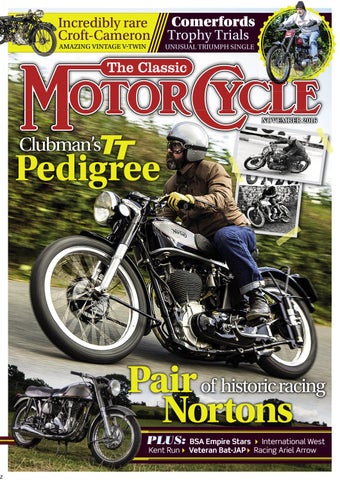
Incredibly rare Croft-Cameron AMAZING VINTAGE VTWIN
Comerfords Trophy Trials
UNUSUAL TRIUMPH SINGLE
NOVEMBER 2016
C ub a sTT Clubman’s
Pedigree gre
Pair of historicracing Nortons PLUS: P
BSA Empire Stars International West Kent Run Veteran Bat-JAP Racing Ariel Arrow
58
CONTENTS ISSUE | NOVEMBER 2016 Archive photograph .......................................... 6 News ................................................................... 8 Letters ............................................................. 14 International Nortons.................................... 18 Bat-JAP V-twin................................................ 26 BSA Empire Stars ........................................... 34 Subscribe and save ........................................ 40 Comerfords Triumph Trophy........................ 42 Ariel Arrow racer ............................................ 48 West Kent Run ................................................ 54 Croft-Cameron Super Eight (spotlight)........ 58 Chinon GP....................................................... 64 Closer look – Arbuthnot Trophy.................... 66 Mike Dunn interview .................................... 72 Men who mattered – Brian Verrall ............... 74 Roy Poynting column .................................... 76 Jerry Thurston column................................... 78 Social history of motorcycling ...................... 80
42
80
Martin Squires’ sketchbook.......................... 84 You were asking.............................................. 86 Restoration guide – Anzani two-strokes...... 90 Technical feature – New Imperial rebuild... 92 Classic components – Glacier bushes .......... 98 Next month ...................................................112 Classic camera.............................................. 114 POST: The Classic MotorCycle, PO Box 99, Horncastle, Lincolnshire LN9 6LZ EMAIL: jrobinson@mortons.co.uk
THE CLASSIC MOTORCYCLE | NOVEMBER 2016
5
International | Nortons Internati
A tale of
Two Inters This pair of International Nortons both have a 1950s Clubman TT history and share an engine, but they are from different ‘generations’.
S
Words: JAMES ROBINSON Photography: GARY CHAPMAN/MORTONS ARCHIVE tood alongside one another, what is most obviously apparent about this pair of International Nortons, built just two tw w years apart, is the differences, rather than the similarities. But actually they have more in common than they don’t – but that’s the power of packaging, for want of a better phrase, with the Featherbed-framed machine seeming not two tw w but 10 years the younger.
It’s also not as if this pair of machines were envisaged for different tasks – in fact, both were ordered and purchased for the Clubman’s TT, the pinnacle of production racing during the 1950s, the silver-andblack ‘Garden Gate’ version first competing in 1951, the ‘Featherbed’ framed polychromatic grey machine in 1953. In another link between the two, the man who rode the Garden Gate in the 1951 TT (Isle of Man butcher Bob Mawson) was also in the 1953 race, riding a
CROSSED Eighty years ago BSA hit the sporting singles market with a ‘onetwo’ – first, the charismatic Empire Star, and then a complete redesign and a range of high-quality, precedent-setting sporting singles.
M
Words and photography: STEVE WILSON
y young friend Ed Batty tyy is impulsive – but in a cautious way. This chimes with his somewhat contradictory character. He rode a BSA Bantam to school in the 1990s, graduated to an M21, but was then lured into Japanese alphabet soup-land, riding fast and hard on a Suzuki GSXR – to his work in Oxford in the sober world of financial services. For years, Ed has been toying with a return to classic motorcycling, regularly running past me a stream of WLA Harleys and prewar BSAs, and equally regularly missing or rejecting each of them. A 1936 BSA Q8 Empire Star sounded more of the same. The vendor was four hours away in the North East, and
trying to rush Ed into parting, sight unseen, with £6250 – a good price for what in photos looked like a smartly restored machine. But sight unseen? We agreed Ed should walk away – and then later that day, after seeing more photos, he emailed; “ ‘My’ bike arrives Tuesday!” BSA factory records confirmed the numbers – this was a 1936 Empire Star, which had been despatched on July 19, 1936, to Whitby. From the photos I could see that the tank, with its hand-change, which while still featuring that year on Small Heath’s side-valves and lesser breeds, was wrong for the top-of-the-range ‘Star’ model, with its four-speed footchange and Empire Star tank badge. We speculated that either
Right: Handsome twinport Q8 Empire Star 500c single, though tank is not original. From July 1936, one of the last before 1937 season’s Val Page redesign. Below: Cutting-edge 1936 Q8 would have had foot-change for four-speed box, plus fashionable high-level ‘upswept’ exhausts, though low level were an option.
Leader O N
T H E
T R A C K
The Ariel Arrow, derived from the earlier Leader, could be made into a useful race-track weapon, as this one proves.
T
Words and photography: TIM BRITTON
hough the press of the day, inextricably linked to the industry, painted a slightly more positive picture of Ariel Leader sales, it soon became evident the ‘stripped-down’ Arrow was intended to use up unsold Leader stock. With a price tag of almost £45 less than the Leader, the Arrow was bargain-basement motorcycling – but a good motorcycle. Aimed at the more sporting rider, this appeal was helped even further when Hermann Meier, a noted two-stroke tuning engineer, built a racing version for Mike O’Rourke to use in the 250cc TT in 1960. The result was incredible – against specialist racing machines, the roadster-based Ariel managed a superb seventh place. Around the same time, a young lad called Terry Mitchell was beginning his motorcycling on an
48
THE CLASSIC MOTORCYCLE | NOVEMBER 2016
Above: The welldeveloped Ariel racer.
Ariel Arrow – registered VBU150 – purchased by his father for him. Terry was allowed out on the bike straightaway, though his dad had some ideas about what the Arrow should be. Terry recalls, smiling: “Dad felt the Leader and Arrow concepts were good but Ariel hadn’t quite got it right… And it would be an easy-ish job to tweak things to make it right.” In the end, it was an ongoing development which led to Terry running an Arrow and Leader based company called Arrow Tech from the family garage business. Arrow Tech developed lots of upgrades, improvements and such things on its way to becoming the ‘go to’ place for enthusiasts of the two-stroke twins. What Mr Mitchell Senior did to the Arrow was to look at the competition first, namely Honda’s CB72, and make the Ariel match it. This involved
1
2
3
Chinon is on A new addition to the European classic motorcycling calendar? The Tours Commemorative MotoGP in Chinon at the end of June makes its case.
T
Words and photography: MICHAEL DAVIS
he Tours Commemorative GP at Chinon? Well, to cut a long story short, it’s all down to trams! The old city centre circuit at Tours was fine – until the lines of a new tramway twice bisected it. Even that wouldn’t have been a problem if the city fathers had agreed, for just one day a year, to truncate the line to allow the circuit to operate unimpeded. But no. It was decreed that on the arrival of each tram, racing must cease, barriers be placed across the track and everyone be patient until the tram had passed. After two years of that, and with no sign of compromise from the authorities, the organisers had had enough and moved the whole event 50 kilometres south-west to the ancient town of Chinon.
64
THE CLASSIC MOTORCYCLE | NOVEMBER 2016
1: The 1951 BSA special of Fabrice Ouvrard takes the racing line around the place Jeanne d’Arc hairpin bend. 2: DD and Annick Bourhis making haste along the rue du 11 Novembre 1918 straight on their favoured mount, the 1929 Alcyon 350 Sport sidecar combination. 3: The ‘leader of the pack’, Christophe Pasquier, waits on his 1935 Norton Model 18 to lead the competitors on to the circuit for the first morning session.
Tours’ loss is Chinon’s gain. The new venue offers a longer, wider 1.2km street circuit, going out along the banks of the River Vienne and returning through the streets of the new town, below the medieval castle, once home to the English King Henry II. Under the shade of the riverside plane trees, a more spacious paddock allows the competing historic and classic motorcycles to be better displayed, as well as creating space for club, marque and trade stands. But the acid test is what do the people think – and that is ‘ça va bien’! The new circuit and location evidently is popular with riders as well. With over 80 entrants, that more than doubled the number at Tours last year. And for the first time, the event attracted prewar machines – largely thanks to the Bourhis and the Boucq families respectively bringing examples from their private
Tribute trial
The loss of Sir Robert Arbuthnot, a well known and popular Rear Admiral who went down with his ship in the First World War, led to the conception of a popular Naval motorcycle trial. Considering the uncertainties of Royal Navy life, it is surprising the trial got off the ground. Words: RICHARD ROSENTHAL Photography: MORTONS ARCHIVE
R
ear Admiral Sir Robert Arbuthnot, 4th Baronet, KCB, MVO was born in Alderminster, Warwickshire, during 1864. He joined the Royal Navy as a 14-year-old cadet on the training ship Britannia in 1877. Arbuthnot progressed through the ranks with purpose – Lieutenant 1885, Captain 1902, Commodore (second class) 1910 and Rear Admiral, 1912. Although an exemplary career, some questioned his methods, with Admiral John Jellicoe, then commanding the grand fleet, stating ‘…his ideals are too high and he can’t leave people alone.’ But Jellicoe added: “I have the highest opinion of him.” While commanding the 1st Battlecruiser (Cruiser) Squadron at the Battle of Jutland, May 31, 1916, Arbuthnot’s flagship HMS Defence (Minotaur-class armoured cruiser, launched 1907) took a direct hit, resulting in a rapid series of magazine explosions. Within minutes of the first hit, Defence had completely exploded, with loss of all hands, including Arbuthnot.
66
THE CLASSIC MOTORCYCLE | NOVEMBER 2016
Above: The first trial. This may well be Major W P Arbuthnot, Sir Robert’s cousin, as it would appear to be a Royal Enfield.
In addition to excelling at rugby, boxing and other sports, Arbuthnot was a keen car and motorcycle competitor, first coming to note driving a Sunbeam car at the 1904 Bexhill Speed Trials. A member of the MCC (Motor Cycling Club) he competed in long distance events and riding a Triumph he finished third at 38.22mph in the single cylinder class of the 1908 IoM TT. Held on the St John’s Course, the class was won by Jack Marshall (Triumph) from Charlie Collier (Matchless). A keen disciplinarian who spent hours daily – on deck or land – honing both physical and spiritual fitness, Arbuthnot went on to lecture his subordinates on Christian values and encouraged the attendance of regular church services. Such was his devotion to these matters, his superiors, while admiring his values, would on occasions publicly question his single-minded devotion. He took his views a step further, lecturing from 1910 at ACU, MCC and other motorcycling, car or sporting dinners regarding the imminent dangers of
A social history of motorcycling | Factory customs and one-off specials (1970 to 1976)
ASocialHistoryofMotorcycling
EPISODE
ELEVEN
Factory customs and one-off specials (1970 to 1976) In this series of extracts from his forthcoming book, Mike Lewis looks at the growth and evolution of social motorcycling in Britain and the USA. Words: MIKE LEWIS Photographs: MORTONS ARCHIVE
T
he first half of 1970 saw British motorcycle exports to the USA reach record levels. Yet of potentially greater social significance was veteran American racer Dick Mann’s victory in the prestigious Daytona 200 event in March, since Mann rode a four-cylinder Honda CR750 and the old adage ‘win on Sunday, sell on Monday’ proved particularly true, with sales of Honda CB750 roadsters exceeding half a million during the decade that followed. Having dominated the Isle of Man TT races during most of the 1960s, Honda now spearheaded a rise by Japanese manufacturers to overall market dominance and this raised standards of performance, reliability, comfort, visual appeal and versatility to new levels. Thus, the first decade of the Superbike era saw a steady widening of the social base for motorcycle riders, which helped to sustain a sales boom on both sides of the Atlantic. For example, the new category of lightweight dualpurpose machines prompted Motor Cycle journalist, John Ebbrell, to champion trail riding in the UK, which led to formation of the Trail Riders Fellowship (TRF) in 1970. Allied to this general expansion was a roadster customising craze, fuelled by a rapidly growing market for alternative parts and accessories. The American print media had been quick to reflect this trend and in June 1970 even the satirical MAD magazine put choppers on its front cover. All aspects of the lifestyle were chronicled 12 months later in Easyriders magazine, aimed at ‘the swinging biker’ produced by Paisano Publications in California. In its third issue, editor Louis ‘Lou’ Kimzey began organising mass resistance to restrictive legislation through a new National Custom Cycle Association, which in February 1972 became ABATE (A Brotherhood Against Totalitarian Enactments). Easyriders’ centrefold paintings by David ‘Dave’ Mann soon became popular pin-ups, while the artist’s relationship with the society that he depicted eventually led to comparisons with Norman Rockwell, but in one sense Mann went further since besides depicting everyday motorcycling scenes
80
THE CLASSIC MOTORCYCLE | NOVEMBER 2016
Dick Mann on the CR750 Honda at Daytona in 1970. He won. DAVE FRIEDMAN PHOTO/DON EMDE COLLECTION
British TV star Dick Emery on an early CB750 Honda.
You were asking | Expert advice
You were asking Your queries resolved with Richard Rosenthal
Machine iden ntification I wonder if you would be able to identify the motorcycle in this picture of my great-grandfather, John Carlyle. The lady accompanying him is my great-greatgrandmother; John Carlyle’s mother. Tim McGarva, via email. Thanks for the super photograph, Tim. The machine is a 3½hp 498cc P&M, manufactured by Phelon and Moore Ltd of Cleckheaton, Yorkshire. It is likely to be a 1919 example, as it’s finished to what appears civilian trim and (unlike many makers) P&M didn’t, as a rule, overhaul ex-First Word War military examples to civilian specification after the war, as they considered there was far more profit in building new motorcycles. Fascinated by engineering, Joah Carver Phelon became interested in motorcycle development during the late 1890s, but didn’t like the approach of many who were motorising cycles with tiny, and sometimes not so tiny, engines. Phelon knew it was better to design a complete machine including the rolling chassis, leading to him to patent his design in 1900 – a motorcycle with the engine replacing the headstock downtube as a major, stressed member. At the time, Joah was in partnership with Harry Raynor (Phelon & Raynor, Heaton Street, Cleckheaton) manufacturing specialist dies and tooling for the wire drawing industry. Although able to build the odd prototype and models in tiny numbers, the partners knew they couldn’t manufacture motorcycles in volume. The Phelon design was licensed to Humber c1902 with the patents remaining with the Cleckheaton works. In turn, Humber paid Phelon and Raynor a fee for each machine
Tim McGarva’s great grandfather John Carlyle and great, great-grandmother, with a c1919 P&M.
86
THE CLASSIC MOTORCYCLE | NOVEMBER 2016
The handsome TT Panther, this one dated as 1928. The engine was still used as a stressed-frame member, as per Joah Phelon’s original idea.
built and the Yorkshire engineers were allowed to build up to 12 machines per year (one per month). Tragically, Harry Raynor was killed in a car accident in 1903, leaving Phelon without a partner, but he was soon joined in business by Richard Moore, whose brother owned a Phelon and Raynor motorcycle. In 1904, the small business was registered as Phelon and Moore. The pair continued to develop the distinctive machine, which became the P&M. Work included a two-speed transmission system comprising two primary drives with either engaged by the rider, using a selective clutch patented by Moore. Humber also licensed this design from P&M, which was incorporated into their machine until they suspended motorcycle production in 1905 when the patent licence agreement expired. Humber then concentrated on cars, but in November 1908 announced an all-new motorcycle. Over the next years, P&M not only began building machines in larger numbers, but also progressed their designs, including mechanical side inlet valve in place of the earlier overhead automatic inlet valve, magneto ignition in place of battery and trembler coil, and an advanced, robust leading link front fork, again of their own design. While P&M enjoyed successes in pre- and post-First World War reliability trials, one perhaps doesn’t think of this Yorkshire maker as a racing factory. But here they enjoyed some success too. Bernard M Marians, a then P&M director, riding a 2½hp model, finished second in the 10-lap handicap MCC Club Championship for the Harry Smith Cup on the Brooklands
Outer Circuit on June 8, 1911. True, Marians started 19 minutes 30 seconds ahead of the scratchmen, but he was racing a 260cc machine against the winner Arthur Moorehouse’s 994cc Indian and Sid Tessier’s 580cc BAT-JAP. Before the First World War, Mr P Shaw regularly turned out at Brooklands on a 3½hp P&M and after the war, Ealing club man Mr P Cunningham enjoyed a win and several finishes with his model. At Brooklands during Easter Saturday 1925 well-known road racer Cecil Ashby turned out on an ohv 499cc P&M, which was in effect the forerunner of the TT model. Developments of this model were raced in the IoM and on short circuits. Rather like we often overlook the racing achievements of P&M, we also overlook their military involvement during the First World War. Mention despatch rider motorcycles of the First World War and we instantly think of the 30,000 Triumph Model Hs and 25,000 Douglas 2¾hp and 4hp models supplied to the British and Allied forces, but P&M was by volume the third largest supplier of motorcycles for the British and Allied forces, with many going to the RFC (Royal Flying Corps). Following trials during test manoeuvres in 1913, the War Office contracted the Cleckheaton maker to supply solo and sidecar machines to the recently formed RFC. Sources imply 3883 examples in both solo and sidecar trim were in active service with the British forces in 1918. After the war P&M restarted civilian production with this same 3½hp model; the machine Mr Carlyle and his mother are posing alongside. My thanks to VMCC P&M marque specialist David Earnshaw for dating the subject machine.
Technical feature | New Imperial Model 30 rebuild
Those rotten jobs During every motorcycle rebuild, we encounter low points. Now’s the time with the New Imperial rebuild to face up to these tasks, which have been left in the vain hope that by some miracle they will have resolved themselves… Words and photography: RICHARD ROSENTHAL
1
Over the past year I’d lifted various new old stock Lucas switches from son Peter’s stock (I’ll put back what I don’t need – honest, guv!) and had bought further items or found them in my odds and sods boxes. Thus collected here are ignition switch and light, older style ammeter and a pile of light switches. From this collection it became apparent why the bulb holder was taped to the headlight reflector – it mounts to the light switch, as here.
T
o date, the New Imperial Model 30’s dry build has sailed along. But the eagle-eyed will notice a few omissions, including a total lack of lights, no rear stand, and even the gear change gate is missing. Really, I’d like to either rebuild the wheels or engine next and leave the omissions, as they’ll consume lots of time and try one’s patience for seemingly little gain. Problems included both red rear and clear numberplate lenses missing from the back light, a complete mess, and lack of parts, for the front light (including mounting cups, switch gear components) while the combined headlight and parking light build
92
THE CLASSIC MOTORCYCLE | NOVEMBER 2016
holder was ‘fully floating’ – that is, attached to nothing except lengths of ageing sticky tape. The rear stand had been bought from a friend who made it as a prototype and he said it will need much ‘manipulating’ to fit. Then the gear change gate was mangled, seemingly beyond redemption. While it borders on cruelty to fit pillion footrests to such a small, light machine, in their day many of these willing lightweights were worked hard, carrying much luggage along with hefty riders and pillion passengers. Marks on the frame suggest the accessory items pillion footrests had graced the Model 30 for much of its active life, so, really, they ought to return. But they needed a single coach bolt making – the easy part – and,
somehow, two identical mounting brackets had vanished. They must have been present when I took the machine over as the pillion footrests were loosely mounted, but they were nowhere to be found, yet the rest of the kit was in its designated plastic box, with lid! It would take only a couple of hours to make the brackets, and patterns were available as the kit needs four and still had two. But it seemed like wasting time to me and, really, the little motorcycle didn’t need pillion footrests, but, hmm. Finally, the decision was made and a length of appropriate black steel strip purchased from our local stock holder. Oh well, the job might interest some of you readers so, despite my reluctance, onwards we go...