Fly me away
RARE HAWKER BLACKBURNE
FEBRUARY 2017
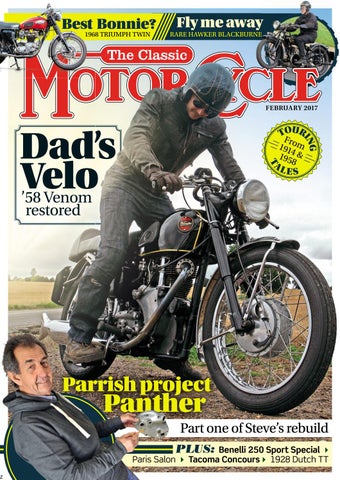
Dad’’s Velo o ’58 Venom
TOUR
G IN
Fr 191 om 1954 & 8
AL
T
Z
Best Bonnie? 19688 TRIUMPH TWIN
ES
restored
Parrish project
Panther
Part one o of Steve’s rebuild
PLUS:
Bene elli 250 Sport Special Paris Salon Tacoma Concours 1928 Dutch TT
30
CONTENTS ISSUE | FEBRUARY 2017
44
80
Archive photograph .......................................... 6 News ................................................................... 8 Letters ............................................................. 14 Velocette Venom............................................. 18 Subscribe and save ........................................ 24 Paris Salon ...................................................... 26 Tilkin special .................................................. 28 Benelli/Motobi Sports Special ...................... 30 Hawker Touring Model.................................. 36 NEC show........................................................ 42 Triumph Bonneville....................................... 44 BSA B33 to Istanbul........................................ 52 Glass plates – 1928 Dutch TT ........................ 59 Tacoma concours ........................................... 64 Closer look – Triumph two-strokes .............. 66 Roy Poynting column .....................................71 Ashish Josh & Rajesh Jejurikar interview .... 72 Men who mattered – Owen Greenwood ...... 74 Jerry Thurston column................................... 78 Steve Parrish Panther project ....................... 80 Martin Squires’ sketchbook.......................... 84 You were asking.............................................. 86 Resto guide – Royal Enfield ‘big twins’ ........ 90 Technical feature – Two-stroke decoke........ 92 Classic components ....................................... 98 Diary..............................................................110 Jack Thompson Trial .................................... 111 Next month ...................................................112 Classic camera.............................................. 114 POST: The Classic MotorCycle, PO Box 99, Horncastle, Lincolnshire LN9 6JR EMAIL: jrobinson@mortons.co.uk
THE CLASSIC MOTORCYCLE | FEBRUARY 2017
5
Camping trip
D
etailed in the June 24, 1914, edition of The Motor Cycle, here we see Ralph BankesJones (signed as ‘RBJ’ in the original article) as he makes dinner alongside his trusty P&M, during the summer which preceded the start of the Great War, which began on July 28, 1914. Bankes-Jones was clearly an experienced motorcyclist, and he seems to have had ties with the P&M concern; he was part of the maker’s team at various trials in the immediate prewar period. In the article (entitled ‘Camping in Devon and Cornwall’) RBJ talks about his preparations – explaining that pre-tour the P&M already had 10,000 miles under its wheels, it had been rebored and the piston was ‘tight’ prior to commencement and duly ‘nipped up’ three times in the first 50 miles, as the rider
6
THE CLASSIC MOTORCYCLE | FEBRUARY 2017
Owing to the location and isolation, it was headed west, into a gale, traversing the route one of the few which escaped Cromwell’s covered by the London-Exeter trial. The first night he camped at Honiton Clyst, men and retained (retains) many of its original features. From the church, Bankesjust outside Exeter. All camping equipment Jones visited Hartland Quay and the nearby was carried on the P&M, with three ply lighthouse. Apparently the gale was so strong boards attached to the carrier stays, acting as it was impossible to stand upright… backing for the pannier bags, on either side. Next, it was on to Boscastle, a visit to the Another bag was held on the carrier, with six amazing Tintagel Castle, then Wadebridge straps holding it all in place. The tent poles and finally on to Newquay. were fastened to the footrest and chain stay. By now, RBJ was riding through (yet Next morning, in heavy showers, RBJ “pressed on” through Crediton and Winkleigh, another) gale. He rode back up to Bude. Next day it was down to Plymouth then to Bude, right on the coast. He intended some unspecified problem (“I couldn’t get to camp on the cliffs but the weather was my engine to fire” – perhaps the endless inclement, blowing the P&M over at one rain?) and Bankes-Jones talks about being point. He headed inland and set up camp in the shelter of a thick hedge. The next day was “miserably wet”. He also narrowly avoided being trampled by cows, struggling to find wet too, so was spent in Bude. anywhere to pitch his tent. The day after that it was still raining, After a couple of days being “stumped” in so clad in oilskins, our rider headed for Plymouth, Monday he was back on track, Morwenstow, and its interesting church.
18
THE CLASSIC MOTORCYCLE | FEBRUARY 2017
Velocette | Venom Velocett
It’sa
family affair Bought by Philip Ingold in 1968, this 1958 Velocette Venom has been restored by Philip’s son Simon as a fitting memorial to his late father. Words and photography: JAMES ADAM BOLTON
O
n what most likely would have been a chilly winter’s day, February 17, 1968, a young man named Philip Ingold walked along Acton High Street, West London, and went ng new and used car and motorcycle into the sprawlin emporium that was Whitby’s of Acton. Being a 17-yeear-old apprentice at the nearby Hoover factory on the Perivale Road, Philip knew he wanted to buy a motorcycle, and it couldn’t be any motorcycle, bu ut one an aspiring engineer could appreciate. He then handed over the balance of £38 and 10 shillings to the salesman, Mr Hanney, having alreeady left a £1 deposit, and then left, riding onee used 1958 Velocette Venom. To Philip, thee big single was perfect – 500cc, a bit quirky, an nd definitely more exceptional than the comm mon BSAs and others he’d regularly see at loccal haunt the Ace Café. Like any other motorcyccle-mad teenager, and especially as an apprenticce engineer, Philip felt compelled to modify hiis bike and make it his, and this he did in his subsequent many years of ownership and enjoymentt of the Velocette. Sadly, Ph hilip Ingold died in 2004 from the complicatio ons of the MS he’d been diagnosed with in 1988,, so he can’t tell us in person about the Venom that was so precious to him. But from the day he bougght it, the Venom has been the backdrop to a 500-year-old story of family life, tragedy, persistence, lovee and patience – and wonderfully so. It continues to take centre stage, as it remains in the Ingold familly, with Philip’s son Simon Ingold. An engineer like hiss father, Simon tells me the story (and understandablyy not without some emotion seeing as from a young agge he grew up so aware of his father’s difficult illness) of how the Velocette has managed to remain in thee same family for so long, and how important it is to o him. “My father was brought up in Northolt, Middlesex, and having a brother who owned a Vincent Rapid de, he always wanted his own bike, and
THE CLASSIC MOTORCYCLE | FEBRUARY 2017
19
special
Very
sport
The Italian makers had a completely different approach to lightweights to that of the British, with the difference more than just skin-deep.
I
Words: PHIL TURNER Photographs: GARY CHAPMAN
have a bit of a penchant for lightweights, so when Gordon Hallett opened his garage door I made a beeline for his 1972 Benelli/Motobi 250cc Sport Special. Perched on his bike lift, it sat a foot or so above the other machines in his collection, its metallic green paint standing out against a sea of red – pretty much all of Gordon’s other bikes are red. Even without its eye-catching colour and elevated position, it would be hard to ignore the Sport Special; the minimalist and racy lines, the purposeful single-cylinder motor, and the whippet-like dimensions marking it out as something quite special.
30
THE CLASSIC MOTORCYCLE | FEBRUARY 2017
Above: Gordon Hallett owns mostly red motorcycles so he fancied something of a different colour! Right: Kick-start is on the left-hand side – but be wary, it can bite…
It always intrigues me just how differently we British looked at the lower capacities compared to our continental cousins. To us, most machines under 250cc were designed simply to get us from A to B – no lurid colours or exciting styling, no need for aspirations towards performance or handling, just the minimum required to get the job done thank you. In Italy, it couldn’t have been more of a different approach – it really didn’t matter if a bike was small, it could still excite and be desirable, it could be painted in bright colours, it could be loud and fast, and have a name like Super Sport or Turismo Veloce. Why should the bigger boys have all the fun?
1
Classics at the show
Motorcycle Live, at the NEC, runs for nine days. Though ‘moderns’ are the focus, there is always plenty of classic interest.
W
Words and photographs: JAMES ROBINSON
ith sprawling show halls and all the major manufacturers in attendance, Birmingham’s annual industry showpiece, Motorcycle Live, attracted healthy crowds over its opening period. More and more manufactures seem to pay heed to either their own motorcycling past, or at least draw on inspiration from history. Triumph was displaying its new ‘Bobber’ – clearly taking many of its cues from late 1940s and early 1950s Brando-era Triumphs, though, interestingly, Norton seems to have gone the other way, unveiling its new, state-of-the-art 1200cc superbike. The likes of Ducati, Moto Guzzi and BMW are very aware of the past – Ducati, in particular with its Scrambler range, had a large ‘classic’ presence. Watsonian-Squire was another company that was making play of its history, with the ex-Eric Oliver GP
42
THE CLASSIC MOTORCYCLE | FEBRUARY 2017
title-winning sidecar outfit and the one-off own-made Watsonian V-twin forming the centre-piece of the company’s display, surrounded by its modern outfits. The Paton on which John McGuinness won this year’s Classic Senior TT was there too, as was a replica of the dustbin-faired Gilera Bob McIntyre used to win the 1957 Senior TT, the race in which the Scot became the first man to lap at upwards of 100mph. McGuinness’s best lap in winning the 2016 Classic race was 113.342mph. From just across the road to the NEC, the National Motorcycle Museum brought a selection of machines, including the topically-named Trump, though this one was a V-twin engined ex-Brooklands racer rather than a president-elect, while the museum’s restoration duo of Wes and Kyle Wall were busy building a rigid-framed, tele-forked End AJS in the museum’s workshop area.
1: Wes Wall in the background, with the National Motorcycle Museum’s AJS on the bench. The big single will be a future raffle prize. 2: In 2013 Eric Patterson took the top honours in several classes at Bonneville on this Brough Superior, averaging 124.98mph. 3: New Norton V-fours always had a crowd around them. 4: The new Brough Superior SS100. The resurrected maker had several models on display. 5: Seeley 7R on the Carole Nash stand was attracting attention. 6: Suffolk-based Krazy Horse had this Knucklehead Harley-Davidson at the show. It was for sale, with a £35,000 price tag.
B Y
M O T O R C Y C L E
T O
ISTANBUL In July and August 1958, a couple of 27-year-olds with a thirst for travel set off for Turkey, on a four-year-old BSA single. Words and photographs: ROBERT DANCY
52
THE CLASSIC MOTORCYCLE | FEBRUARY 2017
Glass pl plates | 1928 Dutch TT
The Dutch TT
There were four classes in the 1928 Dutch Tourist Trophy – 175cc, 250cc, 350cc and 500cc. In each class there was a British winner.
H Magnus (DKW) in the 175cc race, leading Les Crabtree (Excelsior) through Laaghalerveen.
Photographs: MORTONS ARCHIVE
plenty in American cars – the Press noted that British eld on June 23, 1928, a Saturday – cars were a novelty in Holland, Americans the norm. the Dutch TT/GP always did and The blue riband Senior event provided a win for still does take place on a Saturday Walker, though Tommy Spann on his pushrod AJS was – there were wins for Graham the early leader. Wilmot Evans pushed his Triumph Walker (500cc Rudge), Stanley to the front next (as Spann and Walker pitted) but Woods (350cc Norton), and the Excelsior-riding at the end of the 16 laps the winner Crabtree brother, Syd and Les, who won the Straight was Walker, at 75.96mph, with Spann 250cc and 175cc races. second, just 1.4 secs behind. Third Run over the Drenthe circuit, on military from the went to Tom, on the Belgian Sarolea. land near Assen, the circuit was 17.3km plate There was high drama in the 350cc (10.7miles) long, dead flat and possessed of To view the rest of race when Charlie Hough (AJS) and only six corners, joined up by flat-out, dead the pictures in this Matinelli (Motosacoche) became straight sections. But this was precisely what set and to order tangled up and both crashed out. Both make the circuit hazardous – after a long spell prints please visit escaped without serious injury, even at 90mph, it proved difficult to judge just how www.mortons though Hough managed to snap a fast (or slow) to take the corners. archive.com hi sapling in half with his body. But it Hours before the allotted start time – at was especially galling for the Swiss 10am the three smaller classes were set off rider on the overhead-camshaft together, then the 500cc class in a massed MAG-engined machine, as he was a start too – crowds flocked to the lap ahead of the AJS man, as Matinelli sun-drenched circuit, thousands of them on kept pace with Stanley Woods, on the pedal cycles, lots on British motorcycles and
THE CLASSIC MOTORCYCLE | FEBRUARY 2017
59
1
Triiumph h’s
forgotten two-strokes
Triumph histories devote pages to lusty belt-drive veteran singles, the First World War DR favourite Model H, Turner’s twins, Cubs, Terriers and more. But often Triumph’s two-strokes are at best given a couple paragraphs, or ignored. Time to let them speak.
N
Words: RICHARD ROSENTHAL Photography: MORTONS ARCHIVE
o brief magazine feature can cover in detail a subject as wide as the Triumph two-stroke models. No exception, this article focuses only on the models that reached the factory production lines, albeit in small numbers in some cases. Despite being almost totally overlooked by many, these models were sound and some rivals would have been happy to have included them in their catalogues – Junior, 2hp, Junior Lightweight, Lightweight, LW and ‘Baby’. The Baby (nickname) Triumph story is incomplete without mentioning Charles Hathaway. Often overlooked or forgotten, Charles was almost as influential in early Triumph development as company founder Siegfried Bettmann and engineer Mauritz Schulte. Works manager for much of his time with Triumph, Hathaway was a capable engineer and able motorcycle designer. He first gained attention when he worked with Schulte to design and see the first ‘all’ Triumph motorcycle, with own-made engine, into production. Although this machine was less than perfect initially and famously wore its cylinder barrel and piston rings rapidly, as reported by Ixion in period, the pair had the
66
THE CLASSIC MOTORCYCLE | FEBRUARY 2017
1: The light weight of the new Triumph two-strokes is demonstrated in January 1914.
good sense to seek advice from metallurgists. Within months it was not only the motorcycle to beat in terms of robust reliability, but also one of the most copied machines in motorcycle history. Hathaway was also responsible for Triumph’s famed horizontally sprung rocking action front fork. In theory, any design that alters a machine’s wheelbase will significantly diminish h andling – but veteran Triumphs and the Model H corner well and again the design is durable. From a personal view I dislike the concept, but I know it works well, so when riding an early Triumph, for me its eyes on the road, never at the forks, and just enjoy the ride without worrying about fork action… During 1913, and possibly slightly before, Hathaway was beavering away on the design of an entirely new Triumph. Actually, not all of it was new, as the rocking action fork design would have been familiar to Triumph four-stroke owners, as was the superlative, distinctive Triumph finish applied to the new tiddler. Rumours emanated from Coventry, with claimed sightings of a new small Triumph and the 2HP was unveiled at the year’s Olympia Show. As displayed, it wasn’t quite ready for marketing
Interview | Ashish Josh & Rajesh Jejurikar
A brief chat with...
…THE MEN BEHIND THE NEW BSA The iconic British marque will soon be back on the road thanks to the vision of its new Indian owners.
I
Words: PHILLIP TOOTH Photographs: PHILLIP TOOTH, MORTONS ARCHIVE
ndian industrial conglomerate Mahindra Group has bought BSA Company Limited for £3.4 million and will re-launch the iconic marque with a range of premium and niche market motorcycles that will hit the road in early 2019.
Where will the new BSA range be built? Rajesh Jejurikar, president of Mahindra’s agricultural and two-wheeler business, says: “Although we could build BSA motorcycles in India, we will make them in Europe. We want BSA to be a stand alone brand, with backing from Mahindra.”
Who is Mahindra? And that’s quite some backing. With annual revenue of $17.8 billion, Mahindra operates in more than 100 countries, and besides making trucks, buses, aeroplanes and lightweight motorcycles, it is the largest tractor manufacturer in the world. In the last five years the company has acquired a controlling interest in Peugeot Motorcycles, Italian design house Pininfarina and Korean car maker SsangYong. Mahindra will also begin making Jawa motorcycles in India. And who did they buy BSA from? Mahindra bought BSA Company from BSA-Regal. Headed up by CEO David Bennett, Southampton-
Heading up BSA is Ashish Josh (left), here with BSA-Regal’s David Bennett.
CAUGHTTHE BUG People restore things for all sorts of reasons, as the first part of this renovation series proves. Words: TIM BRITTON Photographs: TIM BRITTON/STEVE PARRISH
Where it all
80
began… The
Pant
ared at St her as it appe
THE CLASSIC MOTORCYCLE | FEBRUARY 2017
t lo eve’s. Doesn’
ok too bad…
Panther | M100 outfit
How Steve Parrish is best remembered. On the RG Heron Suzuki, here at Mallory in 1977.
THE CLASSIC MOTORCYCLE | FEBRUARY 2017
81
You were asking | Expert advice
You were asking Your queries resolved with Richard Rosenthal
Majestic Motors Often asked at shows and jumbles is why did certain machines survive, while others are lost and what aided the survivors?
The premises of Majestic Motors, in the early/mid 1980s.
offered petrol, sundries sales, light servicing The survival of veteran, vintage and classic and vehicle recovery, using ancient ex-army motorcycles is often a matter of luck. Perhaps vehicles. They also acquired old vehicles, the last owner to use the machine in period with a special interest in motorcycles. But stored it in a shed, barn or garage. On occasions, owners abandoned their machines rather than restore or even collect in volume, at their last residence, maybe later losing their the brothers were intermediaries. A hand-crafted sign bearing ‘open’, lives in conflict or had simply moved on and accompanied in fine weather by a varying forgotten their Rudge, Calcott, Triumph… Yet others were taken in part exchange by dealers display of old motorcycles along the forecourt edge, announced the brothers and, having little monetary value at the were open for business. Sadly, petrol sales time, were confined to cellars, out of the way buildings or under tarpaulins in the back yard. dwindled as a raft of new outlets sprung up around Cambridge and as the brothers, Decades later, the abandoned machines who shared a flat above the garage, aged, were discovered to be scrapped during site Majestic Motors faded away. But not before clearance or redevelopment, or with luck I’d hung around their premises in the late they were salvaged. Often, the salvager 1960s/early 1970s and, as I discovered acquired them for preservation as they recently, so too my good friend and TCM were, rather than restore or fettle them reader Alan Underwood. into running condition, and at a later date Playing cricket in the next village, I they would be sold on for a small profit. discovered Majestic Motors and spotting Exactly this happened to my long-term OEC the old machines ‘in the brother’s collection’ Blackburne and the Campion-JAP my son I often stopped for fuel with my battered VW has. Profits often weren’t huge as exampled by the 550cc OEC costing £45 in 1972 and 15 Beetle. Although there was enough cash for petrol and its Speedwell conversion, there years earlier the ‘ripe for restoration’ 1910 was precious little left for non essential 499cc Campion changed hands for £5. bodywork! But with a few quid to hand, I While some regard this trade as plucked up courage to ask if any of the profiteering, others, including me, consider motorcycles were for sale. Ted or perhaps the service offered by these intermediaries vital to the survival of many of our machines Bob (I never knew which was which!) said: “Not to you lad, they’re part of t’ collection.” regardless of the size of profit made. Which Seeing my teenage face drop, Ted or Bob brings us onto the two bachelor brothers thrust a cup of tea in my hand and asked who once ran Majestic Motors, at Orwell me to keep calling. I did, then with more near Cambridge. Located on the A603 cash in hand, bought the OEC from a private Cambridge to Sandy road, Majestic Motors
vendor at Luton. They were thrilled to see my purchase, which was more encouraging than the underwhelming response given by mum and dad. Later, realising I was no John Snow or Geoff Arnold, cricket was abandoned and I moved away. And that was that until recently Alan Underwood mentioned the TT Triumph he’d restored, assisted by his late wife Val, almost four decades ago. Driving through Orwell later in the 1970s, Alan spotted Majestic Motors, or rather the collection displayed on the forecourt. Through cups of tea and a few gallons of petrol, my friends got to know Ted and Bob and, after an interval, Alan bought the twovalve TT Triumph in a protracted deal. In little more than a few months it was restored to the Underwoods’ show-winning standard. Almost as a postscript to this tale, unbeknown to me, Ted, Bob, Alan or Val, a certain sporting vintage Sunbeam which now resides in our garage was lurking behind 30plus tons of traction engine parts in a barn less than 200 yards from Majestic Motors. Its first owner died in 1966, the single passed to friend Hoppy, who was unable to collect it until 1978, by when enough of the steam spares had been moved to liberate it. The fact the Sunbeam wasn’t collected by the scrap dealers when the non-repairable items were weighed in, was, well, fortunate. Another two machines saved into preservation.
Ted (or is it Bob?) on a c1930 AJS ‘grass tracker.’ The Triumph Alan Under wood bought is in the background.
The brothers, plus another, with a side -valve BSA single. One of the ex-army recovery trucks is behind.
86
THE CLASSIC MOTORCYCLE | FEBRUARY 2017
This two-stroke Excelsior had quite a lot of local history.
Thanks to Alan for the photographs and the memories.