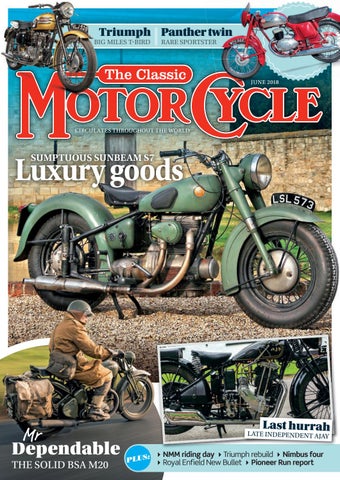
Triumph Panther ttwin
BIG MILES TBIRD
RARE SPORTSTE ER
JUNE 2018
CIRCULATES THROUGHOUT THE WORLD
Luxury goods SUMPTUOUS SUNBEAM S7
Last hurrah
Dependable THE SOLID BSA M20
LATE INDEPENDENT AJAY
: PLUS
NMM riding day Triumph rebuild Nimbus four Royal Enfield New Bullet Pioneer Run report
Editor’s welcome It’s sometimes a bit difficult to explain to people why we enjoy riding old motorcycles – and why we consider some to be much nicer or ‘better’ to ride that others when, surely, anything modern should trump our oldies every time? It’s because the riding experience is so different, which, I think, is why over time I’ve found that I enjoy riding the older machines particularly, because it makes the experience even more alien. But then as soon as you get used to one thing, say hand-change, you want to try the next challenge, with, perhaps, a lever throttle. After that comes belt drives, dummy belt rims, single speeds, and no clutches and so it goes on. I, though, seem to have reached my personal ‘happy place’ in that I enjoy hand-change, lever-throttle early to mid-1920s machines, preferably with some form of braking, arguably best of all. But then something happens and it all changes again. Jumping on a 1960s big single (I borrowed dad’s 1966 MSS Sunday before last) made me think, why I am I missing out on this, it’s brilliant – and easy – and comfortable; so then I start thinking, perhaps this is what my motorcycling life is missing. I’ve always loved the looks of certain things, say café racers, but, again, have never greatly enjoyed riding them, or least never felt totally comfortable on them. There are a number of reasons for this, among them that having been a glasses wearer for many years (I now wear contact lenses when riding) I always found I’d have to tip my head back to see through my lenses, giving myself a stiff neck, though really I’ve just always felt more at home on a sit-up-and-beg handlebar set-up, probably as early riding experiences were either on off-roaders while my first roadster was a 1973 TS125 Suzuki. It’s that riding position that feels most natural to me. Other things add to making a pleasurable riding experience – or not. Great big fat handlebar grips are something I’ve always disliked for example and while talking of handlebars, up tipped bars (‘donkey ears’ I call them) are another of my pet hates. They look wrong and aren’t comfortable either. It all comes down to personal preference of course, which is back to where we started. We prefer riding old motorcycles, and some more than others, just, well, ‘because’. If I have to explain it I realise I can’t (not succinctly anyway) but if you’re reading this, chances are you already understand. It’s just because we do.
E NOW SUBSCRIB Y FOR ONL
£20 PAGE 22
24 31
JAMES ROBINSON Editor
Contributors James Adam Bolton, Tim Britton, Rachael Clegg, Jonathan Hill, Roy Poynting, Richard Rosenthal, Martin Squires, Jerry Thurston, Alan Turner, Phil Turner, Andy Westlake, Steve Wilson. THE CLASSIC MOTOR CYCLE (USPS:710-470) is published monthly by Mortons Media Group Ltd., PO Box 99, Horncastle, Lincolnshire LN9 6LZ UK. USA subscriptions are $63 per year from Motorsport Publications LLC, 7164 Cty Rd N #441, Bancroft WI 54921. Periodical Postage is paid at Bancroft, WI and additional entries. Postmaster: Send address changes to THE CLASSIC MOTOR CYCLE, c/o Motorsport Publications LLC, 7164 Cty Rd N #441, Bancroft WI 54921. 715-572-4595 chris@classicbikebooks.com
44
CONTENTS ISSUE | JUNE 2018 Archive photograph ................................................6 News......................................................................... 8 Pioneer Run ..........................................................14 Letters ................................................................... 18 Subscribe and save.............................................. 22 Sunbeam S7 ..........................................................24 AJS R8 ..................................................................... 31 Triumph Thunderbird ........................................ 36 BSA M20 ................................................................44 Nimbus Four........................................................ 50 Panther 45 .............................................................55 NMM riding day .................................................. 60 Closer look – Kaye Don and Ambassador....... 66 Rex Caunt interview............................................ 72 Men who mattered – Eric Oliver.........................74 Triumph 5TA rebuild .......................................... 76 Roy Poynting column ......................................... 80 Jerry Thurston column ....................................... 82 Sketchbook travels ...............................................84
36 60
You were asking ................................................... 86 Restoration guide – Royal Enfield New Bullet . 90 Tech feature – Undamped telescopic forks...... 92 Diary................................................................... 110 Next month ....................................................... 112 Classic camera.................................................. 114 POST: The Classic MotorCycle, PO Box 99, Horncastle, Lincolnshire LN9 6LZ EMAIL: jrobinson@mortons.co.uk
SUUBSCRIBE TODAY!
FROM ONLY £20
» Every issue willwill be be sent hothot offoff thethe press andand delivered straight to your house » Every issue sent press delivered straight to your house » You’ll never miss an an action-packed issue or supplement again » You’ll never miss action-packed issue or supplement again THE CLASSIC MOTORCYCLE | JUNE 2018
5
Coop’s super Spit Fans gaze at John ‘Mooneyes’ Cooper’s race-winning A65. Photograph: MORTONS ARCHIVE
T
he 1966 Earls Court show and the BSA twin which John Cooper used to win the 1966 Hutchinson 100 Production machine race is the centre of attention, lit up and on what looks like a revolving platform. A few study it intently, while another showgoer uses the ‘enclosure’ as a handy resting place. The 1966 running was the first time the Hutchinson 100 was held at Brands Hatch in August, with the riders racing the circuit in the opposite direction to the usual way round. This was the 34th running of the Hutchinson 100, which was considered England’s ‘oldest and greatest’ road race, having originally been staged at Brooklands in 1925. It was organised by the British Motor Cycle Racing Club
6
THE CLASSIC MOTORCYCLE | JUNE 2018
(BMCRC aka ‘Bemsee’) with the highlight of the meeting being the presentation of the Mellano Trophy – which, although one might have reasonably assumed was given to John Cooper for his performance on the BSA A65 owing to its prominent display at the show, it wasn’t. It went to Hugh Anderson, the New Zealand works Suzuki star. The trophy went to the rider whose winning speed was closest to the lap record in his class, which was Hugh on the twostroke 125cc Suzuki. The production race was expected to be a battle between John Cooper, on well known sponsor Tom Kirby’s BSA, and Percy Tait, the Triumph tester and works rider. But it was Mick Andrew on his privately entered Bonneville who kept the bigger names
occupied, with Andrew and Tait sharing the fastest lap, although Cooper won out and claimed the £15 first prize. Cooper won another £50 for clinching the 500cc championship race that day, riding his Manx Norton – so it was worth the journey from his Leicestershire base. It was a better result than Cooper and the Spitfire had during June’s 500 Mile race where he was paired with fellow top level racer Bill Ivy. The dream team surely went into the race as favourites but unfortunately ‘Little Bill’ dumped the Beesa at the two-hour mark, putting the Tom Kirby BSA out of the running for the £500 top prize, with another £100 for a class win – a costly crash. Looking at the Kirby Beesa, it’s a Mk.II
Classic archive a
Spitfire, with twin carbs and 190mm front brake, but not fitted with the Spit’s instantly recognisable fabulous, handsome, big glass fibre petrol tank, instead sporting a smaller one. The rearsets, ace bars and full fairing must have all come from BSA’s ‘factory kit’ of extras, to be eligible for production racing. The Spitfire was the hottest twin in the BSA range, which by definition made it the sportiest number in the line-up. Powered by the 654cc twin cylinder A65 engine, launched in 1963 in cooking form, the roadgoing Spitfire (there was a Spitfire Hornet earlier as well as an A10-derived Spitfire) was to go through several ‘marks’ in unit form, starting with the Mk.II introduced in 1966. It had twin Amal GP carburettors and
a 10:1 compression ratio. The Mk.III came in 1967, with a switch to a pair of Amal Concentrics, then there was the Mk.IV in 1968, using the BSA/Triumph twin leading shoe front brake. The Spitfire disappeared from the range in 1969. There was a fairly dizzying array of variations on the A65 theme – in 1966, for example, there was the Thunderbolt (single carb), Lightning and desert-sled Hornet, as well as the Spitfire Mk.II. But that was nothing compared to what there had been in 1965: A65 Star, A65 Police, A65 Rocket, A65 Hornet and A65 Lightning Clubman, all variations on the same theme, envisaged to suit the taste of a variety of riders. The A65 (and its 500cc little brother, the A50) were mainstays of BSA’s range
through the 1960s, though never seemed to quite garner the affection afforded to their predecessors, the 500cc A7 and 650cc A10. There were developments, rather than redesign during the 1960s, with the redesign happening for 1971, as the new oil-in-frame set-up was adopted, as well as new forks and hubs. The final development of the model was 1972 A70L, a long stroke of 750cc built in limited numbers to homologate it for US dirt-track racing. A few of the 750cc engines found their way into sidecar racing, where the unit BSA twin had enjoyed plenty of success during the 1960s, with Terry Vinicombe’s Tom Kirby-backed racer particularly memorable, though other notable exponents included Chris End Vincent and Peter Brown.
THE CLASSIC MOTORCYCLE | JUNE 2018
7
&
News Events
News&Events
Walton brothers one-two in DJ Rally Walton brothers Gavin and Kevin, from the East Rand, proved the dominant force in the 2018 DJ regularity rally for classic motorcycles. They took the first two places out of an original entry of 103 in this annual event in South Africa which takes competitors on a two-day route from Durban to Johannesburg. This was the third time that Gavin Walton has won the DJ, with previous wins in 2009 and 2017. Gavin’s total error at the various timed checkpoints on the 673km (418 miles) route totalled 256 points. He rode his reliable 1936 500cc side-valve AJS. Kevin Walton (1931 500cc BSA) had a total penalty of 460. Third place was filled by threetime DJ winner Martin Davis (1930 500cc Sunbeam) while Allan Cunninghame (1936 500cc Velocette) was fourth, ahead of 26-year-old Martin Kaiser (1935 500cc Sunbeam), who was the youngest finisher. There were 72 finishers this year, with 11 retirements and 18 non-starters. Oldest finisher was 82-year-old Neville Smith (1936 350cc Ariel Red Hunter), who placed 18th, while the highest placed woman was Dorian
Making it two DJ rallies in a row was Gavin Walton on his trusty 1936 500cc AJS Model 9.
Radue, a regular competitor from Australia, who took 12th place on a 1935 250cc Rudge. Deon Malherbe (1934 500cc
Sunbeam) was the highest placed first-time entrant in the 2018 DJ, in 25th. Tony LyonsLewis (1928 500cc Norton)
Somerton classic trial
2018 Bamburgh Run almost upon us
Organised by the Marston Sunbeam Club & Register and the VMCC, this year’s Bamburgh Run, for Flat Tank and Girder Fork machines, is to be held on June 10 at Etal Village Hall, Northumberland. There are two routes of 80 and 60 miles. A special feature this year is the entry of three Sunbeam bullnose Model 90s, to celebrate the last flat tank Senior TT win 90 years ago, in 1928, by the legendary Charlie Dodson. Entry forms from thebamburghrun@hotmail.com or Mike 07919 666 818.
8
THE CLASSIC MOTORCYCLE | JUNE 2018
received the award for the most DJ Runs completed, with the 2018 event being his 36th finish. Roger Houghton.
Tom Norman leaving the Black Bull at Etal on his 1921 P&M in a previous year’s event. ANDREW KITCHEN
There are three routes for the Somerton classic Motor Cycle Club’s annual British Bike twoday Charity Trial on June 9/10 this year. Raising funds for CLIC Sargent, the event will be held at Priddy on the Mendip Hills, the routes being of varying difficulty and classes. Regulations from www. somertonclassicmotorcycleclub. co.uk or send an SAE to Brian Ayres, 8 Churchway Close, Curry Rivel, Langport, Somerset TA10 0ED, or call 01458 250925. There is free camping on site.
In celebration of speedway
NEWS IN BRIEF VMCC FESTIVAL OF 1000 BIKES The VMCC’s big bash is this year on July 7/8, at Mallory Park. Enquiries to 01283 540557 or www.vmcc.net
DEE, ATKINSON & HARRISON DATE The next Classic Cars and Motorcycles sale at Sledmere House, in Yorkshire, is on July 7. Details via andrews@ dahauctions.com or 013777253151
Tony Kalisz was pleased to secure his copy of Barry Thomas’s biography.
It is generally accepted that February 19, 1928, is the date when the inaugural meeting of oval track racing in this country took place, behind the hotel at High Beech in Epping Forest. The big ‘sell’ was the new Australian import (‘Dirt Track Racing’) enabled spectators to see an entire event from one vantage point. Now, 90 years since that first meeting, speedway has a lot of history. For many years the anniversary was celebrated at High Beech, but the regular venue more recently has been the Museum of Speedway, within Paradise Wildlife Park, Broxbourne, a zoo run by Peter Sampson, a former West Ham speedway rider. The day is unashamed nostalgia. It brings together many former riders to meet old team-mates and rivals, enthusiasts get the opportunity to meet and talk with heroes. This year there were bikes everywhere, powered by JAP, Jawa and Weslake, while examples from Rudge and Douglas were to be spotted too. As well as displays of memorabilia, a number of current speedway clubs also supported the event. Every hour, on the hour,
An attraction helping to publicise the popular Isle of Wight speedway – a superb trio of early JAP-powered bikes, their histories a ‘work in progress’.
CAMBRIDGE SHOW On Sunday, June 24, Cambridge Classic and Vintage Motorcycle Show takes place at Cambridge Sea Cadets HQ, 42 Cheddars Lane, Cambridge, CB5 8LD 11am-4pm. Tel. 01223 843802.
DATE MIXUP
Apparently celebrating its birthday – a 1928 Dirt Track Rudge.
the fire-up area saw various bikes persuaded into life. Each time there was a press of onlookers keen to experience that distinctive aroma of methanol (‘dope’) and castor oil, the essence, in every sense of the word, of the speedway tradition. Many famous faces were plucked from the crowd for interview and during the day the 2018 President of the World Speedway Riders’ Association was announced. This year, it is Kelvin Tatum MBE, nowadays a TV speedway commentator and voice of authority after
New lower age limit for APMC The Association of Pioneer Motorcyclists (APMC) has lowered the joining age, meaning that anyone interested can apply to join as an associate member or, if they have held a licence to ride a motorcycle for at least 40 years, as a companion member. An upgrade to full member
ASI MOTOSHOW The fabulous ASI Motoshow, in Parma, Italy, is this year on May 11-13. Details at www.asifed.it
status can be made if they have held a motorcycle riding licence for at least 50 years. Membership application forms are available from the APMC Stand at most classic shows or by post from secretary Bob Badland, 124 Winsford Avenue, Allesley Park, Coventry. CV5 9JB.
an impressively successful international racing career. An even more illustrious rider was celebrated with the opening of an Ivan Mauger tribute section of the museum. The celebration also saw a couple of book launches. The irrepressible Bert Harkins was busy signing his biography, ‘My Crazy Speedway World.’ Long-time Hackney Hawk rider Barry ‘Thommo’ Thomas was unconvinced his biography ‘ThommoHawk’ would sell many copies and was suitably amazed when his entire stock vanished in less than an hour.
A production error meant the wrong date (1947 instead of 1948) appeared in the ‘strap line’ of last month’s Closer Look feature, with the mistake repeated on the contents page. Apologies for any confusion caused.
ABD USA ABD is an American company which offers a service inspecting, bidding and transporting motorcycles at auction. See www.abdusainc.com to find out what it’s all about.
Festival of Jurby T-shirt Over the past three years, Wemoto has raised over £48,000 for the Manx Grand Prix Supporters’ Club through the sale of its Festival of Jurby T-shirt. As 2018 marks the 40th anniversary of Mike Hailwood’s comeback to mainstream motorcycle racing and remarkable win at the Formula 1 TT, this year's offering celebrates his achievement. The shirts cost just £10 from www.wemoto.com or 01273 597072 plus, in limited numbers, at this year's festival.
THE CLASSIC MOTORCYCLE | JUNE 2018
9
&
New Events News
Commandos in the spotlight ELK Promotions ended last year’s season with a celebration of 100 years of Norton. The same marque heralded the new season, at Ardingly on March 25, but this time the spotlight was reserved for the Commando, half a century after its introduction. A colourful line-up of various examples turned back the years. Amongst show regulars and the occasional entries there are always some new restorations, or some that have not been exhibited at Ardingly before. One of these was Richard Barrington’s Kerry Capitano Gran Prix Sports moped. With rebadged Minarelli engines and the usual Italian flair in styling, the Capitano should have been the Ferrari of mopeds. Regrettably, it was let down by poor build quality. Richard said his example appears to be one of just four known survivors in this country.
This 1914 Rover 3½hp was rescued from a garage where it had been stored, according to the last tax disc, since 1972.
Richard Barrington and his Kerry Capitano Gran Prix Sports moped.
had ridden in on Frank’s latest project, a Velocette Viper. Nearby, a white-overalled team from Brooklands had brought a selection of bikes from the museum. Ardingly regular Michael Touhey’s latest effort was a very rare Harding Tricycle, powered by a 32cc Cyclemaster engine.
According to Michael, the ungainly looks actually belie its road manners. Ron Wanmer’s 1947 AA patrol sidecar outfit was assembled following a country-wide search for the correct parts, among them the BSA M20 500cc bike. The AA eventually specified the 600cc M21. Alan Turner.
Another unusual two-stroke was Terry Buckingham’s Scott Swift Special. An eyecatching, cleverly-engineered combination of old and new. The cycle parts were from an RGV250 Suzuki, but power came courtesy of a 500cc Scott Swift water-cooled twin. Frank Kay, with wife Joan,
Join the Rose of the Shires Run Grasstrack dates for your diary
All sorts of early machinery is expected at the Rose of the Shires Run.
On June 10, join the Northamptonshire motorcycling fraternity in celebrating the fantastic efforts of Albert Catt in 1911, at the SMCC ‘Rose of the Shires Run.’ Over 105 years ago, Albert took his 3½hp Triumph for a ride of 2200 miles in six days, averaging 400 miles per day and 23mph. The run, over carefully chosen roads, consists of a morning run, lunch stop and afternoon run totalling 50 miles. It starts and finishes at the Stoke Bruerne Navigation Pub, NN127SY. Entry form is at: sunbeam-mcc.co.uk/events/event/rose-of-the-shires-run/
With some organisational changes, the Vintage MCC Grasstrack and Speedway Section is hoping to see more riders supporting its 2018 programme. Scheduled are: Chalfont, Bucks, May 27; Ugley, Essex, June 17 (to be confirmed); Festival of 1000 Bikes, Mallory Park, Leics, July 8; Southend, Essex, August 5 or 12; Oxford, August 26; Dauntsey, Wilts, Grass Sprint, October 7. The date for the Ivor Thomas speedway meeting is still to be finalised, but it will take place at Iwade, Kent and will include classes for grasstrack machines around the 250m speedway circuit. Newcomers are more than welcome, as well as those returning to the fold. The only
Range of products on offer at Whengparts Whengparts offer a range of weather vanes, key racks, helmet holders and signs, laser cut from steel or aluminium. This BSA Bantam key rack (right) is particularly eyecatching.
10
Custom parts can be cut too; any flat shape can be produced or replicated. Whengparts also produces a range of clothing under its Kustom Shack brand and can provide embroidered or
THE CLASSIC MOTORCYCLE | JUNE 2018
printed apparel for clubs, teams and events. Lots of lines are available at whengparts.com; mostly custom-made so if you can’t see what you’re looking for, drop them a line.
Southampton Saints versus Oxford Cheetahs – a snapshot of some of the action at last year’s Ivor Thomas meeting.
major requirement is to have ACU-approved riding gear. Club and ACU Day Licences are available. Spectators are also welcome at events and with a 40+ race programme an afternoon’s entertainment in pleasant country surroundings is guaranteed. Alan Turner.
Book Review Playing with the Boys Olga Kevelos – Motorcycle Sportswoman – an extraordinary 20th century life in words and photographs Author: Colin Turbett Published by: Beinn Nuis Publishing, c/o Colin Turbettt, Ranoch, Shishkine, Isle of Arran, North Ayrshire KA27 8EP Email: ctur282388@aol.com Softback, 295 x 210mm; 160pp with over 250 photographs. ISBN 978-1-5272-0795-0 £20 £4 UK p&p Olga Kevelos (1923-2009) was one of the most versatile and successful female motorcycle competitors of the Post Second World War period, riding successfully in centre and national one-day trials, competing many times in the Scottish Six Days Trial and winning gold, silver and bronze medals in the International Six Days Trial. She even did the occasional scramble and road race, was a member of the successful Honda Maudes Trophy team and raced a Manx Norton-engined Formula 3 car for Rex McCandless – this was just part of her extraordinary life. The oldest child of a middle-class Birmingham family – her father was Greek and her mother English – Olga volunteered on the outbreak of the Second World War as narrow boat crew on the Grand Union canal, as part of the forgotten wartime heroines who transported coal and materials to and from the Midlands. Postwar, she went on a cycle tour across Europe before returning to run her father’s Cherry Orchard Restaurant in Birmingham where she met many trade personalities, journalists and riders. An attractive and vivacious brunette, she was certainly aware of her own sexuality and surrounded herself with legions of men who, it was said, would do anything for her. Birmingham dealer and racing competitor Frank Cope, who sold her one of the first
Norton 500T trials machines in 1949, was probably one of them, as was Len Vale-Onslow, another Birmingham dealer whose competition machine was used by Olga. AMC’s competition manager Hugh Viney was also an admirer along with Rex McCandless, Geoff Duke and Murray Walker. Throughout her career, Olga competed on James, AJS, Norton, Francis-Barnett, Parilla, CZ, BSA, Triumph, Greeves, Valon, DOT, Suzuki and Butler machines, retiring in 1970 to become a highly respected ACU Midlands Centre delegate. On selling the family restaurant, Olga joined her brother Ray and sister-in-law to become co-licensee of the Three Tuns pub at Kings Sutton, where she became involved in village life, organising and competing in the pub quiz scene. Being widely read and with an excellent general knowledge, she participated in TV’s ‘Mastermind’ quiz show. ‘Playing with the Boys’ is an excellent book based on photographs and research undertaken by the author, that cannot substitute for the autobiography that Olga herself never wrote, but is as full as the available sources of information would allow. It dispels some of the myths about Olga and it also candidly reflects the life of a woman who ploughed her own furrow and was beholden to no one. Book reviewed by Jonathan Hill.
THE CLASSIC MOTORCYCLE | JUNE 2018
11
&
News Events
Easter extravaganza
THE WAY WE WERE IN
JUNE
1918
The BSA Owners’ Club display managed a line-up of prewar Small Heath examples.
East Kent has a lively classic transport scene, but with restorers not always keen to travel miles west, the Ashford Cattle Market site offers a relatively local chance for an opportunity in the limelight. Weather warnings of a biblical deluge for Easter Monday, April 2, proved widely off the mark. With the show bikes spread around various areas, a sprinkling of trade stalls and the popular jumble, it was difficult to have a good look at everything before it was time for the prizegiving. This saw a couple of Triumph twins graced with well-deserved awards. Early Thunderbirds are not that common and Lee Shorter’s 1950 example is nicely original. The super-clean 1962 TR6SS Trophy of D Jell showed how much things had moved on at Meriden in the intervening years. The Competition/Special class saw recognition for Basil Smith who exhibits his bike with the Bantam Club, demonstrating how an Ariel Arrow engine just fits into place in Bantam cycle parts. Making a debut at the show
Indecision. Bit of light recommissioning? Weighing up a virtually complete 1926 BSA side-valve, said to be one owner from new.
was Dave Spain’s Metisse B44 BSA, put together from bits that had apparently laid around for four decades. ‘If it looks right, it must be right’ goes the dictum. It sold Metisse back in the day and the bike still looks superbly functional. Another unusual restoration that had also spent many years dismantled was a 1966 Raleigh RM6 Runabout. Most British moped manufacturers soon wilted in the face of Japanese offerings and survival rates of such models are very poor. Steve Clarke’s efforts were recognised with an award in the ‘Lightweight’ class. Alan Turner.
Hondas top the price board
H&H Classics’ auction at the National Motorcycle Museum on March 4, 2018 saw the company set two new world record prices. Of 170 lots the two outstanding prices were the £57,000 paid for John Lennon’s 1969 Honda Z50A ‘Monkeybike’ and the £161,000 paid for a pre-production Honda CB750, one of four built of which only two survive. Mostly hand-made in Japan in 1968, it came to the UK in 1969, and was registered by Honda UK and was used by them in the UK launch of the new CB750 model. This bike’s every single part is different from a production model. H&H’s website is www.handh.co.uk
12
THE CLASSIC MOTORCYCLE | JUNE 2018
During a lecture to the American Electro-Chemical Society, electrical engineer L B Cherry claimed it was possible to manufacture synthetic petrol from natural gases including hydrogen or methane and a hydrocarbon,
1943
It had been well publicised that following the Middle East and Tunisian campaigns, some officials and Allied forces ranks had openly commented that Axis motorcycles were better and more suited to purpose than British military models. And servicemen who had acquired German and Italian models extolled their virtues. Allied industry, forces and press responded, stating it was not simply a case of identifying who makes the best motorcycles, but rather; ‘Are those supplied to the Allies fit for purpose?’ Thus, were Axis machines better for convoy, dispatch and general duties than current Allied motorcycles, rather than is one faster, lighter, more attractive etc than another. A further consideration was cost. Many German and Italian motorcycles supplied to Axis forces were expensive models before the war; in
1968
Stuart Graham and six times world champion Jim Redman were offered works 350cc and 500cc MV Agustas respectively for the TT. It quickly became apparent the offer was made too late for the ACU to be able
1993
Winners at the year’s IoM TT races included Nick Jefferies (750cc Honda) in the Formula 1 TT from likemounted Phil McCallen, with positions reversed for the Senior TT. Dave Molyneux
such as paraffin. The gas and hydrocarbon mix were subjected to high frequency, high potential electric current which reorganises their molecules to make a petrol-like fuel.
fact, too expensive for most civilians to afford. True, some of the models supplied to the Allies were of dated design and weren’t specifically military designs, rather adapted civilian models. But it was worth remembering that until Dunkirk the General Staff accorded no importance to military motorcycles other than for carrying messages. As a result, many motorcycle factories were given over to general engineering for the war effort, then after Dunkirk the War Office suddenly demanded thousands of motorcycles, which the British factories supplied. Certainly it was now time to review the Allied military motorcycle situation but, so far as The Motor Cycle staff were concerned, they reasoned the British industry did an excellent job of supplying ‘fit for purpose’ machines at modest costs.
to accept their entries, so both machines were offered to John Hartle, who’d lodged his entries earlier and just needed to change his machines, acceptable action under ACU rules.
crewed by Karl Ellison (600cc Yamaha) won both sidecar races and Joey Dunlop (Honda) added another win to his growing tally in the 125cc Ultra-Lightweight TT. Richard Rosenthal.