M
Drream machine 19330s VFOUR MATCHLESS
FREE!
Pacy Panther
MODEL 95 REDWING
APRIL 2017
32-PAGE GOLD STAR SPECIAL SUPPLEMENT
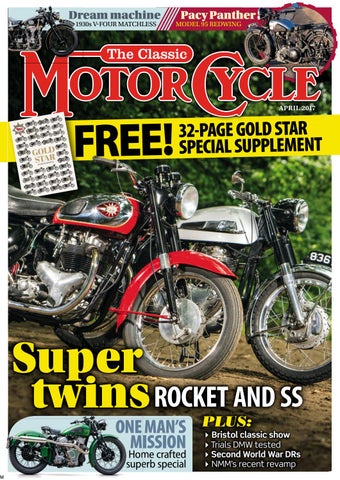
Super twins ROCKET AND SS ONE MAN’S MISSION Hom me crafted supeerb special
PLUS:
Bristol classic show Trials DMW tested Second World War DRs NMM’s recent revamp
Editor’s welcome
E NOW SUBSCRIB Y FOR ONL
£20
This month has involved a bit of extra work, as we put together the Gold Star supplement, provided free with this issue. Lots of people helped out, so thanks to everyone involved, particularly all at the National Motorcycle Museum for putting the BSAs at our disposal. We hope you enjoy the fruits of those labours. It was really interesting to do, as I confess my Goldie knowledge was little more than surface-deep, and as with these subjects that inspire lifelong passions (see the likes of Dave Flintoft and Phil Pearson, plus our own Mr Rosenthal, and his son, Peter) the enthusiasm is often, to me, not only inspiring, but infectious too. Predictably I came away from collating it scheming ways to buy a Gold Star, trying to decide which model I’d go for, and why, looking through adverts, daydreaming and so on... It’s all part of the fun, I realise, and an essential part of what has always been the preserve of the enthusiast – basically, there’s the element of the dreamer (or the reminiscer) in all of us. I do have that tendency to become enthused by pretty much any motorcycle, especially if it’s something I’m not too familiar with. Witness the Matchless Silver Hawk, again appearing in this issue and something I wasn’t, basically, clued up on. Quite apart from never being able to quite remember which was the four and which was the twin (I’ve learned, now, the way to remember is to visualise the cambox which has ‘Matchless Silver Hawk’ on it; the twin, the Arrow, doesn’t have a cambox) I’d never really felt the urge or desire to investigate further. Looking over the one in this issue, while we photographed it, and then setting-to and writing the feature, meant a lot of research, and, subsequently, also learning. That’s what I find fascinating, being able to dig that bit deeper and see what is under the surface. Often, one comes away impressed – the Gold Star and its ongoing, never-ending development, the clear and bright (and forward) thinking of the Silver Hawk – and then there’s Frank Cope (see page 76). What a brilliant character he was; starting racing at 52 and embodying all that ‘can do’ spirit many of us would like to have, but, sadly, seldom actually have. But these motorcycles and these characters (see Torrens, too) all adds to make up this rich tapestry that is the picture of classic motorcycling.
PAGE 26
18
JAMES ROBINSON Editor
48 Contrib butors
James Adam Bo olton, Jonathan Hill, Roy Poynting, Richard Rosenth hal, Martin Squires, Jerry Thurston, Phillip Tooth, Ala an Turner, Phil Turner, Steve Wilson. THE CLASSIC MOTOR CY YCLE (USPS:710-470) is published monthly by Mortons Media Group Ltd., PO Box 99, Horncasstle, Lincolnshire LN9 6LZ UK . USA subscriptions are $63 per year from Motorsport Publications LLC, 7164 Cty Rd N #441, Bancroft WI 54921. Periodical Postage is paid at Bancroft, WI and additional entries. Postmaster: Send address changes to THE CLASSIC MOTOR CYCLE, c/o Motorsport P Publications LLC, 7164 Cty Rd N #441, Bancroft WI 54921. 715-572-4595 chris@classicbikebooks.ccom
60
CONTENTS ISSUE | APRIL 2017 Archive photograph .......................................... 6 News ................................................................... 8 Letters ............................................................. 14 BSA A10 Super Rocket/Norton 650SS........... 18 Subscribe and save ........................................ 26 Bristol show .................................................... 28 ‘Velocette’ V2MAC special ............................. 32 NMM revamp ................................................. 40 Second World War dispatch riders ............... 42 Panther Model 95 ........................................... 48 DMW trials ..................................................... 54 Matchless Silver Hawk................................... 60 Closer look – 1922-26 Ulster GP .................... 68 Richard Bourne interview............................. 74 Men who mattered – Frank Cope ................. 76 Roy Poynting column .................................... 78 Jerry Thurston column................................... 80 Steve Parrish Panther project part three ..... 82 Sketchbook travels ......................................... 86 You were asking.............................................. 88
54
76
Restoration guide – MV Agusta singles........ 92 Technical feature – retoothing sprockets .... 94 Classic components .................................... 100 Next month ................................................... 111 Diary..............................................................112 Classic camera.............................................. 114 POST: The Classic MotorCycle, PO Box 99, Horncastle, Lincolnshire LN9 6LZ EMAIL: jrobinson@mortons.co.uk
SUBSCRIBE TODAY! FROM ONLY £20 SEE P26 FOR DETAILS
» Every issue will be sent hot off the press and delivered straight to your door » You’ll never miss an action-packed issue or supplement again THE CLASSIC MOTORCYCLE | APRIL 2017
5
&
Neews Events
New ws&Events
Display your classic at Stafford
The private entries always come under appreciative scrutiny at Stafford. Yours could be one of those in the hall this April.
If you’ve got a classic bike you think the world should know about and fellow enthusiasts would appreciate, now’s your chance to get it on display. The 37th Carole Nash International Classic MotorCycle show at Stafford is the biggest of
the season, and organisers are keen to hear from more owners of quality, restored classics for the private entry category so they can be shown off in all their glory for the thousands of showgoers to savour. The event takes place over
the weekend of April 22/23, with Aussie Superbike star Troy Bayliss the guest of honour. The call for private entries reiterates the desire to have top-class machines lined up – they’re the first thing visitors see when they come into
the show hall. So how do you apply? Call the show’s office on 01507 529430 and request a private entry form... it’s as easy as that. Each private entry receives a free weekend pass (Friday until Sunday) plus a vehicle pass too.
Win a Thruxton R and Ajay The National Motorcycle Museum still has tickets on offer for its winter raffle draw. Museum director James Hewing said: “We have an amazing first prize for our current winter raffle, a brandnew Triumph Thruxton R 1200cc, (retail value £13,800), with factory fitted Track Racer Kit, which will be registered new to the lucky winner in April 2017.”
8
Second prize is a lovely 1954 AJS Model 18 (a ‘matching numbers’ tele-rigid) and third prize is a luxury weekend break for two at www. windmillvillagehotel.co.uk The draw will take place on Sunday, April 23, 2017, at the Stafford show. Tickets are £2 each and may be obtained via the museum on 01675 444123 or www.thenmm.co.uk
THE CLASSIC MOTORCYCLE | APRIL 2017
First prize is this Thruxton R, second an AJS Model 18. Yes please, on both counts!
Two kind? of a
On paper it’s often hard to separate the British 650cc twins of the late 1950s/early 1960s, but on the road they can be very different animals.
Words: PHIL TURNER Photographs: GARY CHAPMAN
BSA/Norton | Super Rocket/650SS BSA/No
T
he B1107 in Norfolk wouldn’t have been my first choice of road for my first ever outing on two of the finest examples of the British 650cc twin – narrow, bumpy, busy – but the rasp from the exhausts of Mathhew Hilton's Super Rocket echoing off the Thetford Forest pines that stood either side of us, goaded me to keep pace. I started to wish I could hear what the Norton 650SS (also Matthew's) I was on sounded like from behind...
It didn’t take long for my mind to start wandering and wondering how many other Brittwin pilots I was following in the wheel tracks of, and how many of them had earned their café-racer stripes on these bends. There’s a fair chance some of those would’ve been earned on the Rocket and SS. Although both enjoyed only a brief time in their respective range spotlights – the 650SS quickly overshadowed by the Atlas, the BSA by the Rocket Gold Star – it can still be argued that both represented a high point in the development of the British 650cc twin; doubtless they were both much more affordable for the budding road-racers of the early 1960s, compared to their poster boy, headline-grabbing siblings too.
West country joys The Bristol show once more lived up to its reputation as a friendly, fun, feature-filled event, with some show-stopping machines up for delectation.
F
Words and photographs: JAMES ROBINSON
or a few minutes, I stood by the information desk at the Carole Nash Bristol Classic MotorCycle Show. A man approached the desk: “Where’s the Lawrence Brough, please?” he enquired, and received the requested directions. A short time later, the scenario was repeated. And again. And again. Apparently, it went on all weekend. The draw and glamour of Lawrence of Arabia endures, it seems. So there was little doubting the motorcycle which was, for many, the highlight of the show. It was Brough Superior SS100, registration number UL 656, the penultimate (of seven) example of the Nottingham made V-twin owned by the famous soldier and statesman. Incidentally, UL 656 was actually the registration number used erroneously on the SS100 that Lawrence, as depicted by Peter O’Toole, is riding in the 1962 film Lawrence of Arabia when he is killed in a motorcycle accident – in fact, Lawrence was actually riding GW 2275 when he met his demise. That doesn’t diminish UL 656 though. A 1929 SS100 Alpine Grand Sports, it was the first spring-frame
28
THE CLASSIC MOTORCYCLE | APRIL 2017
Above: Wow! The ex-Lawrence of Arabia SS100 in all its imposing, splendid glory. Wonderful to see, and its attendance was certainly popular. 1: Terry Brock with his second Honda CB160. “They go really well,” he said, grinning. 2: Dick and Mike Davis with the Best in Show New Imperial 6A Super Racer. Top prize awarded, well deserved. 3: There’s always something to see on the AJS and Matchless OC stand… This is the ‘Clockwork Orange’ Matchless Roy Bellett is riding to Poland.
Brough Superior Lawrence owned and it was the machine he traded in for his last Brough (GW 2275). Last year, was the first time UL 656 had been on the road for around 60 years – much of which was spent under the workbench in Cyril Hockin’s shed. Cyril, who acquired the Brough Superior in the early 1960s, passed away about 10 years ago, with the Brough’s ownership moving to son Tony, who resolved to have the machine back on the road. This has been achieved, though rather than being restored the SS100 has been sympathetically recommissioned; indeed, I heard a comment of: “I expected it to be all glitzy and shiny” made, though it wasn’t said as an insult, more an appreciation and in admiration of the work done and how it’s been undertaken. Much of the labour was by marque specialist Tony Cripps, who managed to come up with various missing parts too, including the tail-pipe section of each of the twin exhaust pipes. The Brough has been ridden by owner Tony Hockin, while Tony’s son Marc (also at the show) has had a brief attempt in the saddle, too. Tony reports he’s pleased with how the big JAP powered
Bristol ol | Classi Classic show
1
2
3 4 V-twin goes, as well as praising its stability, so hopefully it’ll be seen out and about on the roads in the future, too. At the show, the machine was displayed on the Taw and Torridge Classic Bike Club stand, drawing many spectators to the club’s display. Though the Lawrence SS100 was an obvious highlight, there were plenty of other spectacular machines too, among them the Best in Showwinning 1924 New Imperial 6A Super Racer, displayed on the New Imp Owners Association stand. Perched on wheel stands, the spectacular dog-eared JAP-powered sportster was the work of father and son duo Dick and Mike Davis, though Mike was quick to point out: “It was a joint effort – though dad’s done a lot more of it than me.” They explained how the kit came, basically as a frame, forks and bottom end of the engine, four years ago. It took a ‘couple of years’ to find a suitable cylinder head, while Dick made innumerable bits, too, including the rockers, the gearchange gate and mechanism, all the unions for the pipes, as well as all the nuts and bolts. Mike explained that it is actually him who’s into New Imperials, starting with an eBay impulse, but seven years ago. When the rare Super Racer came up, the younger didn’t have the money to buy it, so persuaded the elder to fund it. He went on: “It’d been butchered terribly. It’s been a lot of hard graft for dad, getting it just right. Dad does it simply for the love of doing it.” Mike explained they work as a team, with Mike undertaking a lot of the research and preparation work. What they’ve ended up with is spectacular – and unusual.
4: The blue finish of this special meant it caught the eye. It’s made up of a BSA M20 rolling chassis which was abandoned on the beach at Dunkirk, into which a two-port OHV JAP engine, originally in a Frenchmade Terrot, has been installed. 5: Rick Howell’s purposeful trail machine started life as a roadgoing 1970 BSA B175 Bantam, and has evolved to what it now is. It (and Rick) recently won a gold medal on the Exeter trial.
5
THE CLASSIC MOTORCYCLE | APRIL 2017
29
32
THE CLASSIC MOTORCYCLE | APRIL 2017
V2Mac | SSpecial
Special brew Steve Boakes has built an attractive V-twin, using his skills and a collection of parts acquired over the years.
T
he green V-twin special had caught my eye on a couple of occasions at local meets and it always stopped me in my tracks as it didn’t conform, and I like things that don’t conform. “Looks fantastic. But what the hell is it?” had been my first impression to myself. At first sight, the bike, with springer front end and V twin motor had, to me, seemed like some kind of prewar Harley EL ‘Knuck’, until I spotted the Velocette badge on the fuel tank. Then, via our local MoT man in the know Dave ‘Tiddler’ Rogers, I manage to track owner and builder Steve Boakes down to his home workshop somewhere in the Chilterns. The green V-twin is sitting there among Steve’s machinery and tools for metal and woodworking, bikes old and new, and the wooden frame of a classic car. We pull out the green bike to have a proper look, and Steve explains what it is, and how it came about. Any readers and concours restorers sensitive to a man building his home-brew special out of a 50-year collection of old parts might want to turn the page now… “I call it my V2Mac. A member of the local vintage motorcycle crowd referred to it as just a BSA with a few Velocette parts thrown at it. If it only were that simple!” laughs Steve. Turns out that Steve’s desire to build something from scratch back in 2005 actually started out as something completely different. “Believe it or not, this project started out as being a model steam engine, but quickly I realised I was losing interest when I started having thoughts about when it was finished, if that day ever came, the best it would ever do was to sit on a bench top and go ‘chuff-chuff’. Don’t get me wrong, I’ve nothing but admiration for the individuals that produce some brilliant work, but I really felt I needed to produce something more in line with my lifelong interest – motorcycles.” Steve is clear that he didn’t want to start just
Words and photographs: JAMES ADAM BOLTON another restoration, so he took the toughest path possible, and decided he would build his own engine. “I already had a couple of dead Velocette Alloy MAC engines so it was a no brainer as to what to use as donor parts. I decided I would use Velocette MAC cylinders with oversized liners, and MAC heads. Much of the initial work centred on deciding which of the Velo parts could be used, which would be used and what I would have to fabricate. Not really anticipating I would actually be able to use it, the initial build was primarily done with second-hand parts apart from pistons, and bearings.” Steve explains he was able to transfer his obviously many skills from a lifetime of work, and the building of other specials. “A large proportion of my woodworking entailed setting and operating machines, so I merely transferred my skills to engineering machinery. “Not being from an engineering background but woodworking, I’m quite used to reading architectural drawings but not fully conversant with engineering drawings, and my ability to put my ideas on paper are somewhat limited – I plucked this idea out of my head, and most of my fabricating and machining has been from my head or rough sketches.” The splendid motor is of course the heart of the V2Mac, and its crankcases and timing chest are machined from solid billet aluminium, “...at a total cost of £380 and many hours of my time”, adds Steve. “I ended up going down this route following disappointing conversations with several foundries, a lack of interest in prototype work and silly suggestions of prices. Shame, because I was quite looking forward to trying my hand at pattern making.” Steve’s machining commenced with the crankcases on the lathe to create the basic shape, so producing the internal recess for the flywheels that gave him a reference to work from. The remaining machining was carried out on the milling machine and rotary table. “Once I had the internal diameter I was able to make some templates that enabled me to relocate the centre with good repeatability, thereby enabling me to remove the crankcases from the machines and readily relocate when required. The main bearing housings were line bored on the mill. The timing case was totally machined on the mill, again referring to the crank centre using the template.”
THE CLASSIC MOTORCYCLE | APRIL 2017
33
DOG ROGER*
*D.R.”, or Dispatch Rider, in the phonetic alphabet of the Second World War. A two-part look at the role of Britain’s service motorcyclists, both men and women, in the harsh days of the Second World War. Words: STEVE WILSON Photographs: MORTONS ARCHIVE
42
THE CLASSIC MOTORCYCLE | APRIL 2017
Second World rld War | D Dispatch riders
Below left: Gas attacks were a real fear for DRs. Here, a group of Matchless G3 riders don their gasmasks. Below right: In 1940, riders undergo training. These are actually military policemen, on a mix of Nortons and BSAs.
I
f the First World War saw the dawn of mechanised warfare, the Second World War, with its blitzkriegs, massive tank battles on the Russian steppes, and vast seaborne invasions culminating in D-Day, brought its full fruition. Motorcycles played their part. Their primary First World War function as machines for messengers had been mainly usurped by improved wireless communications. But the troops’ portable radios were always unreliable, especially, as at Arnhem, in wooded terrain, and radio telephone (R/T) lines were vulnerable to shelling and bombing. So along with convoy duties for motorcycle outriders, there were often still dispatches to be delivered in war zones. On the home front, as well as all of the above, there was the unobtrusive but massive traffic resulting from the ultra code-breaking operation. Bletchley Park took delivery of 3000 messages a day, chiefly from listening-stations such as RAF Chicksands Priory, near Bedford; and its vital, top-secret decrypted ‘product’ was too valuable to commit to the air-waves, and mainly had to be delivered to the decisionmakers in London and elsewhere by motorcycle.
Under instruction
By the summer of 1940, the War Office had contacted motorcycle sport organisers, and Motor Cycling’s editor Graham Walker had been running ads, to recruit experts from the ranks of road racers, trials riders, the motorcycle press and enthusiasts, to serve as instructors for the Motorcycle Wing of the Driving and Maintenance School. This was first located at Arundel, then moved north to Harrogate; Portinscale, near Keswick; and Yorkshire’s Wentworth Hall, outside Sheffield.
With recruits like Jack Williams, ‘Crasher’ White, Freddie Frith, Allan Jefferies and Harry Louis, later editor of The Motor Cycle, they took advantage of Scott Trial terrain for off-road instruction. As well as tarmac convoy discipline, with distance between machines kept at no more than 20ft, they developed combat techniques like ‘riding to ground’ (i.e. laying the moving bike down rapidly to take cover if fired upon, with the rider ‘getting down in the gutter’); and crossing wire fences by parking parallel to them, then lifting and toppling the machine to roll over the wire – not quite Steve McQueen, but no mean feat if you were on your own with a 350lb motorcycle. Volunteers were trained as instructors for both riding and maintenance, before dispersing to units to train riders, while sometimes also returning to the D and M School to instruct future instructors. These recruits were all NCOs, and Harry Louis recalled that happily “…the regular army officers who looked after administration recognised that we motorcyclists had something to offer. They never attempted to make us ‘proper’ soldiers”. Elsewhere this was not always the case. A future log reader at Bletchley, James Thirsk, recalled an earlier period when he was training with the Field Security Personnel (FSP) of the Army’s Intelligence Corps at Winchester. The CO, nicknamed ‘Bluenose’, used strict Grenadier Guards NCOs as drill instructors, and insisted that all soldiers should buy and apply the dark-green blanco he favoured for their webbing. All FSP soldiers were required to be trained motorcyclists as well as pistol shots, but as Thirsk wrote, “the chief difficulty for most (recruits) was mastery of motorcycling”, with pistol-shooting running it a close second!
THE CLASSIC MOTORCYCLE | APRIL 2017
43
48
THE CLASSIC MOTORCYCLE | APRIL 2017
Panther | Model 95 Redwing
Sporting p g sparkle Panther wanted a range-topper for its pre-Second World War line-up, and came up with this half-litre contender. Words and photographs: PHILLIP TOOTH
F
inances must have been tight in 1937 for Phelon & Moore Ltd of Cleckh kheaton, h Yorkshire, because the makers of Panther motorcycles couldn’t afford a stand at the biggest event of the year – the Earls Court Show in London – even if they wanted to. What Wh h is more, the range had been slashed to only four models for the 1938 season: the 250cc Model 20 and 350cc Model 30 Red Panthers, and the 350cc Model 85 and 600cc Model 100 Redwing Panthers. Sold exclusively through London agent Pride and Clarke, the three-speed Red Panthers were as cheap as chips but they were solid, dependable motorcycles. The four-speed Model 85 Redwing was a tuned version of the Model 30 with highly polished twin exh xhaust h ports. Its engine would rev freely to deliver a top speed of 75mph and acceleration that could surprise owners of more expensive bikes. While the Model 100 used the famous Sloper engine which doubled as a front downtube for the frame, the lightw tweights had a conventional diamond frame with a single front downtube. As a nod to classic Panther sty tyling, the cylinder of the smaller bikes was inclined forward.
THE CLASSIC MOTORCYCLE | APRIL 2017
49