MARITIME’S
ONE & ONLY
Unique livery unveiled for GB Railfreight Type 5 No. 66727
RETRO
FREIGHT
Full history of the former Rugby Cement operations
Essential reading for today’s rail enthusiast
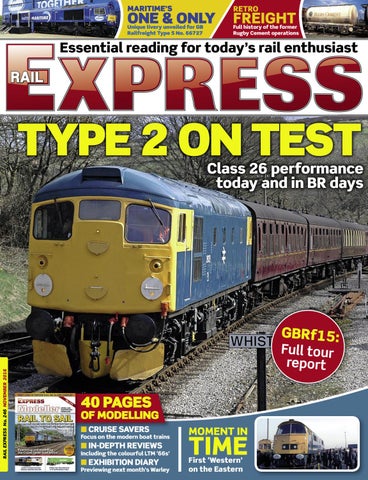
TYPE 2 ON TEST
Class 26 performance today and in BR days
RAIL EXPRESS No. 246 NOVEMBER 2016
GBRf15:
Full tour report
40 PAGES
OF MODELLING ■ CRUISE SAVERS
Focus on the modern boat trains
■ IN-DEPTH REVIEWS
Including the colourful LTM ‘66s’
■ EXHIBITION DIARY
Previewing next month’s Warley
MOMENT IN
TIME First ‘Western’ on the Eastern
CONTENTS
Issue No. 246 November 2016
RAILHEAD TRAINS START WORK: Autumn sees the return of the RHTT sets around the country, keeping the lines as clear as possible of fallen leaves and mulch. October 5 saw the start of the 3W02 diagram around Kent from Tonbridge, with the first working being ‘top and tailed’ by electro-diesel No. 73965 and Type 5 No. 66718 (see page M22 for details on a new ‘OO’ gauge model of the latter). The photographer notes that when the set returned in the evening, it was already covered in a layer of grime. Mark Bugler 8
HEADLINE NEWS Government unveils new freight strategy; Severn Tunnel closed; Power car gets InterCity Swallow livery; CAF and Alstom move closer to new UK facilities; Dozen Class 20s to gather for diamond jubilee; First Class 800 IEP reaches Devon; Outline details released for Thameslink 2018 timetable; First ScotRail Class 385 arrives; Derailments at Watford and Welwyn; CrossCountry franchise extended to 2019; East Anglia winner outbid rivals by £600 million.
16
GBRf15: 19 LOCOS IN FOUR DAYS GB Railfreight celebrated its 15th anniversary with a four-day railtour that raised more than £125,000 for charity in the process.
22
RETRO FREIGHT: RUGBY CEMENT
71
Single power car HSTs; ‘Teddy Bears’ as Lickey bankers?; Class 318 anniversary.
72
SECOND CHANCE TO SEE: CLASS 26 The BRCW Type 2s have always been gutsy performers, but how does No. 26028 compare today to that while still in BR service?
30
73
MODELLING
The Cruise Saver workings were a fascinating but short-lived return for boat trains, and we present an in-depth guide to the operations and how to model them. There is also news of a Class 92 in ‘N’ and Oxford Rail’s ‘OO’ Mk.3s, while reviews include London Transport Museum’s ‘66s’.
LU WORLD LT Museum looks to run postponed trips in 2017; Historic signal cabin saved for future use.
74
FROM ONLY
£21.50 NEVER MISS AN ISSUE... SUBSCRIBE TODAY – PAGE 20
RAILTOURS ‘Western’ shines on run to Penzance; Main line return for ‘Whistler’; Charter train diary.
76
PRESERVATION North British ‘84’ moves to Bo’ness; ‘CIG’ likely to be scrapped; Isle of Wight gala success; First gala dates confirmed for 2017.
80
POWER BY THE HOUR Seasonal return for DRS ‘20s’; GBRf to hire ‘47s’.
82
POWERSCENE Notable workings listed class by class.
MOMENT IN TIME: YORK ‘WESTERN’ The day 40 years ago when a diesel-hydraulic first hauled a passenger train out of King’s Cross.
TIME TRAVELLER Looking back to past November news.
A full history of the former operations that sent wagonload cement around the country.
26
EXPRESS MAILBAG AND REVIEWS
91
SHUNTER SPOT DB Cargo puts entire shunter fleet up for sale.
92
UNITARY AUTHORITY A full round-up of DMU and EMU news.
94
COACH COMPARTMENT Ex-Pullman car becomes Royal Scotsman spa.
95
WAGONS ROLL GBRf invests in Middleton Towers sand flow.
96
IRISH ANGLE Teething troubles for Grand Hibernian.
Preserved Class 26 No. 26038 is put under the spotlight this month as we compare its performance in heritage use today with that while still under BR ownership in Scotland. On April 26, 2013 – the day before it was named Tom Clift after its former owner who had sadly passed – the loco is pictured arriving at Oxenhope on the Keighley & Worth Valley Railway.
TOUR REVIEW
Four days,
19 locos and £125,000
raised for charity GBRF’s mammoth multi-loco tour celebrating its 15th anniversary visited all points of the compass from Swanage to Inverness and Great Yarmouth to Liverpool.
The trip began on September 8 as Class 20s Nos. 20118+20132 hauled the tour out of Victoria to Fratton via Brixton, Wimbledon, Epsom and Dorking – believed to be the first of the type to haul a passenger train out of the London terminus. Electro-diesels Nos. 73128+73213 were at the rear for the leg from Fratton to the Swanage Railway.
AN ambitious railtour on September 8-11, organised by GB Railfreight to celebrate 15 years of operations, travelled over 2200 miles behind 19 locos from nine different classes. The four-day charter, which had been over a year in planning, raised more than £125,000 for three charities.
trips in the 1980s – although back then, with more locos on the network, such tours were much easier to plan. A large number of positioning movements had to be arranged for the GBRf tour, including sending a pair of Class 20s and the Colas Class 47 to Edinburgh and back for Day 3.
The British Heart Foundation, the Ripple Project and Woking Homes are all set to benefit from the proceeds of the tour, which was the brainchild of three GBRf employees, Dale Williams, Paul Taylor and Richard Owen. Such a large array of power was reminiscent of the ‘Skirl of the Pipes’
SOMETHING FOR EVERYONE
With so many locos on offer, the train offered something to appeal to most haulage fans, and the ability to book individual days or the entire trip gave tour participants the flexibility to travel on whatever legs they wanted. There were highlights on each day.
Nos. 20118+20132 were at the head of the train again for the run back to London via Eastleigh, Salisbury and Westbury – the '20s' pictured awaiting departure from the heritage line’s Swanage terminus in full late-summer sun. Paul Bickerdyke
16 RAIL EXPRESS November 2016
PERFORMANCE
A second chance to see…
‘MacRat’ 26038
Neville Hill visits the North Yorkshire Moors Railway to see how the performance of BRCW Type 2 No. 26038 compares to its former British Railways days in Scotland. EVEN in the busiest days of British Railways, it would have been unusual to see a ‘60A’ Inverness shed-plate anywhere near Pickering, North Yorkshire, and considerable imagination is necessary even to formulate the likely circumstances that would lead to such an event. But here in August bank holiday week 2016 was a Scottish Class 26 ‘MacRat’ at the head of a sevencoach train – an opportunity that some of us remember having to travel as far as Kyle of Lochalsh to enjoy. The Birmingham RC&W’s 1160hp
26 RAIL EXPRESS November 2016
Type 2 diesels were constructed from 1958 with the ultimate destiny of dislodging steam traction from the Highlands, which it was proving disproportionately expensive to fuel and maintain on a heavily-subsidised railway that could easily fall prey to closure. Often working in multiple with another class member, or with the similar Type 2s that were to become Class 24s, the ‘26s’ were soon appreciated by train crews in the Highlands, perhaps as much for the way the warm cabs mitigated the hardships
of winter railroading over summits such as Slochd and Druimuachdar – the latter being the highest point on a mainline railway in Britain. Between Pickering and Grosmont the line is similar in many respects to the Highland Main Line. It is unquestionably less hostile, but features Scottish-style sustained gradients of 1-in-49, heather-clad autumnal hillsides, and incised forested valleys nonetheless. The North Yorkshire Moors Railway’s (NYMR) peak summer ‘gold’ timetable
requires intensive working and strict operational discipline to be successful. Now that five trains work through the extra six miles from Grosmont to Whitby, there are both Northern and Network Rail neighbours to consider as well. The ‘gold’ timetable requires four locomotive diagrams, increasing to five on Pullman Diner days, so the demand this places on the operational steam fleet results in two round trips from Pickering to Grosmont being designated for diesel haulage.
FIRST LOOK AT OXFORD RAIL MK.3s AND CARFLAT
No .1 51 DIESEL AND ELECTRIC ERA MODELLING O G
RAIL TO SAIL
Examining and modelling the Cruise Saver boat trains
London Transport Museum releases colourful Class 66s
YOUR
40 PAGES
OF MODELLIN G
START
HERE!
Modern day TEAs delivered in ‘N’ by Revolution Trains
Left: Modellers of the corporate and Sectorisation BR eras will doubtless be pleased with the news that Oxford Rail’s Mk.3 coaches will first appear in BR blue/grey and InterCity. With a mixed set in tow, No. 87003 hurries south near Abington on June 22, 1985, with the 09.10 Glasgow Central-Euston. Rail Photoprints/John Chalcraft Below: Love it or hate it, there is no denying that No. 66718 Sir Peter Hendy CBE attracts attention wherever it goes. On April 19 this year, the GBRf machine could be found atop the 6D12/17.33 Luton Crescent Road-Wellingborough when passing Irchester. In tow is a mixed rake of JNA and JXA box wagons. Dave Smith Front cover: During 2011-12, DRS operated a semi-regular boat train service to and from Southampton Docks under the Cruise Saver Express banner. On June 19, 2011, Nos. 47810 Peter Bath MBE and 47501 Craftsman thunder north at Bradwell with the 1Z52/10.30 Southampton Western Docks-Edinburgh Waverley. Andrew Chambers
Editor’s comment
Simon Bendall 6
Newsdesk: Latest developments
26
Exhibition diary
Oxford Rail makes the headlines this month with the first look at its Mk.3 coaches. Meanwhile, Revolution Trains has announced the Class 92 in ‘N’ gauge while a 4mm PGA is planned by newcomer Cavalex Models.
November is looming on the horizon so it must soon be time for the Warley National Model Railway Exhibition. As ever, there is a good turnout of D&E exhibits and traders, these being profiled here.
13
Modeller’s Guide: Boat trains
30
Reviews: Revolution TEA in ‘N’
22
Reviews: LT Museum Class 66s
31
Newsdesk: Revolution 4mm TEA
24
Pictorial: Maritime Class 66
32
Reviews: Latest modelling books
The 2010-12 period saw a renaissance in dedicated boat trains to Southampton Docks. Most operated under the Cruise Saver banner with both DB Schenker and DRS motive power, as detailed in this guide.
The London Transport Museum has released two further limited editions in the form of the GB Railfreight Class 66s liveried in support of it, these employing digital printing for the complex finish.
The latest Class 66 to receive a colourful livery is No. 66727, which is now finished in Maritime Transport blue. Unveiled at Birch Coppice, Rail Express Modeller was on hand to take some detail photos.
Rail Express Modeller editor
The first crowd-funded model to successfully make it to release has now arrived, this being the ‘N’ gauge version of the modern TEA bogie tankers, as produced by Revolution Trains in conjunction with Rapido.
With the 2mm model delivered, Revolution and Rapido are now making good progress with the ‘OO’ gauge version of the TEA. The first sample is illustrated in detail ahead of the ordering deadline.
Three new modelling books have been released by the prolific Crowood Press, including a guide to recreating traditional ports and waterways. There is also a look at an innovative new compressor.
T
HIS issue amply illustrates the growing influence of the smaller manufacturers on the D&E modelling market. While the big names continue to suffer various delays in releasing models, the newcomers have quietly got on with the task, albeit helped by having a much smaller range to focus on. This issue alone sees Revolution Trains deliver its highly impressive 2mm scale TEA tankers with a first look at its big sister, while Oxford Rail is progressing well with its much-anticipated Mk.3 coaches. Warley will also finally see Realtrack unveil its next DMU model in a well-advanced state, while more small firms continue to emerge, such as Cavalex Models and its proposed PGA hopper. There have never been so many manufacturers working to bring ready-to-run D&E models to the market.
EXPRESS RATING A breakdown of our Express rating system
good
poor
excellent
average
outstanding
Editor: Simon Bendall REMeditor@mortons.co.uk Contributing writer & modelmaker: Alex Carpenter Publisher: Tim Hartley Designer: Tim Pipes Reprographics: Jonathan Schofield, Paul Fincham Advertising: Fiona Leak Tel: 01507 529573, fleak@mortons.co.uk Customer services, back issues and subscriptions: Telephone: 01507 529529 (24hr answerphone) Fax: 01507 525263 Email: railexpress@mortons.co.uk
Like us on facebook facebook.com/RailExpressMag Follow us on twitter@railexpress Visit our website railexpress.co.uk
MODELLER’S GUIDE
The Manchester skyline dominates the background as Nos. 47802 Pride of Cumbria and 47841 traverse Ordsall Lane Junction with the 1Z60/10.30 Southampton Eastern Docks-Glasgow Central on September 18, 2011. The formation is entirely typical of the Cruise Saver trains under DRS operation and is led by luggage-carrying Mk.2f BSO No. 9537 with Mk.2a BFK No. 17056 next to it. The rest of the train is largely Riviera Trains’ ‘Great Briton’ set with Mk.2f FOs Nos. 3397, 3384, 3356, 3426, 3364 and 3390 in order with a solitary Anglia-liveried example, No. 3417, between the last two. Buffet facilities are provided by dark blue RBRs Nos. 1699 and 1683. Terry Eyres
Modern-day boat trains
Under British Rail, boat trains were once a regular sight on the network, even into the early 1990s. However, with privatisation, such special workings dwindled away to almost nothing, especially to the principal cruise ship port of Southampton. This changed during 2010-12 with the introduction of new services, most under the Cruise Saver banner, with both DB Schenker and Direct Rail Services involved, as Simon Bendall explains. THE catalyst for what would become a semi-regular boat train operation to Southampton Docks occurred on December 11, 2008, when Direct Rail Services worked the first passenger train into the city’s Western Docks for some 15 years. Operated in conjunction with
Cunard and Associated British Ports, the working was intended as a trial to see if the running of boat trains from the north of the country directly to the cruise ship terminal was a viable proposition. It was envisaged that this would not only give passengers a better overall travel experience
but also reduce the congestion that occurred as several thousand passengers and crew arrived by road to board the super liners. The trial originated from Manchester Piccadilly with stops in Birmingham and Oxford before delivering 276 passengers to a With an appropriate headboard in place, the inaugural Cruise Saver Express passes Lower Basildon on December 11, 2008. Powered by No. 47802 Pride of Cumbria, the 1Z78/07.09 Manchester Piccadilly to Southampton Western Docks was formed of unbranded DRS Mk.3s Nos. 11044, 11013, 11054, 11046, 11019 and 11030 followed by Mk.1 buffet No. 1657, InterCity-liveried Mk.2e BSO No. 9496 and Northern Belle BG No. 92904. Largely out of sight at the rear is fellow Type 4 No. 47832 Solway Princess. Tony Callaghan
Supplement No. 151
temporary red-carpeted platform at the Mayflower Terminal, right alongside the Queen Victoria. Power was provided by DRS’ Nos. 47802 and 47832 in ‘top and tail’ formation, complete with a ‘Cruise Saver Travel Express’ headboard. Passenger accommodation consisted of six of DRS’ Mk.3a First Open (FO) coaches, running in plain blue following the removal of the ill-fated Stobart Pullman vinyls just a few months earlier, as was the accompanying Mk.1 buffet No. 1657. The formation was completed by InterCity-liveried Mk.2e Brake Standard Open (BSO) No. 9496 on hire from West Coast and Northern Belle’s Mk.1 Full Brake (BG) No. 92904, the latter acting as a luggage van.
Not smooth sailing
Following the three-week cruise, the passengers were returned north by the same formation on January 2, 2009, with all the parties declaring
❯
November 2016 RAIL EXPRESS Modeller M13
RAILTOURS
Gary Boyd-Hope
Flawless Penzance run makes D1015 worthy of renown THE Diesel Traction Group’s ever-popular ‘Western’ No. D1015 Western Champion put in another faultless performance on September 17, when it worked Pathfinder Tours’ ‘Cornishman’ to Penzance. Running in the guise of scrapped classmate No. D1071 Western Renown, and with a trailing load of some 455 tonnes (13 coaches), the hydraulic made a smart departure from Tame Bridge Parkway at 05.07, heading south eastwards through Perry Barr and curving to the south west through Proof House Junction and into Birmingham New Street bang on time at 05.21. The three minutes allowed at New Street turned into four before No. D1015 got underway again via Kidderminster and Worcester, but by
Cheltenham the ‘Western’ was running perfectly to time, and Bristol Temple Meads was reached at the booked time of 08.00. Back on home turf, No. D1015 drew out of platform 8 at 08.05 and, after 40 minutes of even time running, started to eat into the timetable. Wellington bank was flattened, passing Whiteball three minutes early, Exeter St David’s five up and Newton Abbot an impressive eight minutes ahead of schedule. The train had been due to reach Plymouth at 10.20, but the ‘Western’ rolled it in at 10.12. A 25-minute layover had been allowed for here, but the passengers got a little over half an hour when the train got underway again at 10.45, gaining a few minutes by Saltash and
Liskeard, but dropping back to ‘time’ at Truro, finally bringing the train to a stop at Penzance as booked at 12.50.
AHEAD OF THE GAME
If the morning’s run had been good, the afternoon’s homeward trip was in another league. An on time (16.25) departure from Penzance was followed by a fairly uneventful run back to Plymouth, losing a handful of minutes up to Par, but clawing them back by the time it reached Saltash. A nine-minute passing stop had been allowed for at Newton Abbot, but No. D1015’s arrival at 19.11 instead of 19.19 saw the train cleared to pass through instead, instantly gaining 16 minutes against booked time. This figure steadily rose to 22 minutes at Dawlish,
28 minutes by Tiverton Parkway and a huge 40 minutes by the time the train reached Temple Meads at 20.33. The ‘Western’ had not been due to depart again until 21.19, but it was pathed to leave at 20.54, even before it had been due to arrive! Subsequently it retained a 25 minute lead over the timetable, dropping to 15 minutes at Yate, but climbing to 31 at Cam & Dursley. This half an hour advance was held, give or take a couple of minutes, through Cheltenham, Droitwich Spa and back into New Street. Just as at Bristol, the ‘Western’ took the train out of New Street before its booked arrival time, leaving at 23.48 and finally reaching its start point at 00.03, a very satisfying 16 minutes early. E
Looking great on home ground, the DTG’s No. D1015 Western Champion, masquerading as scrapped classmate No. D1071 Western Renown, passes Powderham, Devon, on September 17, with Pathfinder’s 05.07 Tame Bridge Parkway to Penzance. Ron Westwater
Double ‘Javelins’ for Sussex seaside remembrance tour UK Railtours’ annual Royal British Legion charity special will once again be taking place in its customary slot on the day before Remembrance Sunday, this year seeing a pair of SouthEastern Class 395s making an exploration of the Sussex coast. The ‘Regency Javelin’ starts on November 12 at St Pancras International with a provisional departure time of 08.20. The route out of the city is via High Speed 1, running via Ebbsfleet, Gravesend, Strood, along the Medway
74 RAIL EXPRESS November 2016
Valley route and west towards Paddock Wood, Tonbridge and Redhill. At Redhill, the ‘Javelins’ reverse to head due south past Gatwick Airport to Three Bridges, then proceed along the Mid-Sussex route through Horsham, Billingshurst and Arundel to the seaside town of Littlehampton. The plan is to have 20 minutes here before heading back up the branch to Arundel Junction, then east along the coastal route through Worthing and Shoreham-by-Sea to Hove and Preston Park.
At Preston Park, the Class 395s will reverse again before dropping down into Brighton. A short photocall later and the charity special gets underway again, continuing eastwards through Lewes and Polegate to Eastbourne and another reversal. This time it is only a short hop along the coast through Pevensey Bay and Bexhill to Hastings; the last seaside resort of the day. The special begins its return to St Pancras from here, following a roundabout route through Battle,
Tunbridge Wells, Tonbridge and Sevenoaks, then over the line past Bat & Ball to Otford and Swanley. Chislehurst, the Lee Spur, Dartford and Gravesend follow before reaching Rochester where the train reverses for the last time before making the final run to St Pancras via Gravesend, Ebbsfleet and HS1 again, arriving at 18.00. Tickets are priced at £59.50 for adults and £49.50 for juniors. All profits from the tour will be donated to the Royal British Legion Poppy Appeal.
TRACTION & ROLLING STOCK
West Coast Railways’ Class 47 No. 47826 was on hire to Colas Rail on September 25, seen at the head of the 6K35/08.00 Larkfield Junction (Glasgow) to Carlisle Yard near Abington with a long-welded rail train in tow and ‘Tug’ No. 60085 at the rear. The Class 47 was on hire to Colas Rail after its ‘Grid’ No. 56105 failed near Lambrigg (Cumbria) two days earlier while working a Cardiff to Carlisle train of newly refurbished timber wagons. Jack Prentice
DRS ‘Bodysnatcher’ No. 57303 passes Muston, between Bottesford and Grantham, working three blue/grey Mk.2s Nos. 5961, 6024 and 9504 as the 5Z30/10.00 Burton Wetmore Sidings to Norwich Crown Point on September 30 – the coaches being destined for use on the local loco-hauled services to Great Yarmouth and Lowestoft. Bill Atkinson
November 2016 RAIL EXPRESS 85
IRISH ANGLE
William Watson & Alan McFerran
Teething troubles for ‘Grand Hibernian’ The inaugural run of Belmond’s latest luxury train was hit by loco and stock problems on its journey around Ireland.
THE first run of Belmond’s new luxury train, the ‘Grand Hibernian’, was beset by a number of problems. Dedicated locomotive No. 216 was still considered to be unreliable for the high-profile inaugural journey, and so the role was instead given to ex-works Intercity-liveried No. 226.
On launch day August 30, No. 226 and the train of 10 Mk.3s left Dublin Heuston at 14.20 for Cork (see last month’s front cover and Headline News). At 20.30, the tour train departed Cork and ran to Thurles to enable the locomotive to run round, and then returned as far as the down
loop at Charleville, where the train was stabled until the following morning. The requirement for the train to make the 86-mile round trip from Charleville to Thurles and return was because of signalling limitations. The next day, August 31, the tour train ran from Charleville to
COMMISSIONING RUNS THE testing, commissioning and associated preparations for the operation of the luxury train saw some interesting locomotive and stock movements during the period under review. On August 18, two return test trips between Connolly and Dundalk for the 10-coach train featured haulage by No. 216 on the first one and No. 215 on the second. No 216 then transferred the stock from Connolly to Inchicore. On August 23, a dry run of the tour itinerary commenced with No. 216 working a 14.20 Heuston to Cork leg, which conveyed invited guests. However, this locomotive was failed at Charleville and replaced by Cork standby loco No. 233, with No. 216 placed in a siding. No. 233’s duties at Cork were taken over by No. 222, which ran light from Inchicore later the same day, and ‘Common User’-liveried No. 233 assumed
96 RAIL EXPRESS November 2016
No. 216’s role. After repairs, No. 216 ran light engine to Inchicore on August 25. No. 233 worked the dry run tour until August 27 when, after it had hauled the stock empty from Inchicore to Connolly, it was replaced by No. 216. This locomotive had received more attention at Inchicore to rectify faults and had been extensively road tested. It hauled the train as far as Dundalk, where it was stabled overnight. However, it was decided to return No. 216 to Dublin light engine as the locomotive required yet further attention. So classmate No. 233 ran light from Dublin and hauled the trial train from Dundalk to Belfast York Road on August 28, arriving at 14.45. The train ran wrong line between Newry and Portadown because of engineering work at Poyntzpass. No. 233 and its train departed York
Road for Connolly at 15.25 and, after arrival there, the stock was transferred to Inchicore by GM No. 078.
GAUGE TESTING
While the generator vehicles of the four ‘Enterprise’ De Dietrich push-pull trains are also Mk.3s, it was necessary for the Belmond train to be gauge tested on the Cross-Border route, as the consist includes passenger coaches that have stepboards at exterior doors. No. 216 was noted on August 29 working two test trips with the tour train from Inchicore (departing at 12.15 and 19.55) to Portarlington (departing at 13.25 and 21.05). Further tests with No. 216 were carried out on September 1, when the locomotive and a seven coach Mk.4 push-pull set (DBG 4003) ran from Inchicore to Portarlington and return.
Cork, and thence to Killarney and returned to Charleville. After another overnight stay there, the train ran via Portarlington to Galway. Athlone and Westport were subsequently visited, with Roscommon used for overnight stabling. The train then ran from Roscommon (depart 06.45) to Dublin Heuston on September 3.
DEDICATED LOCO
In the meantime, No. 216 had received further attention and worked a number of test runs. It was decided that the dedicated locomotive was now capable of being assigned for tour duties, so it was booked to haul the train to Belfast from Connolly later the same day. Before its return to front rank duties, No. 216 acted as pilot locomotive for the tour train during the reversal at Heuston. It then ran light engine a section behind the tour train from the station approaches at Islandbridge Junction to Connolly, where it replaced No. 226. Door problems on the stock en route saw the train stopped between Skerries and Balbriggan for around 85 minutes as repairs were carried out. Regular traffic was able to continue around the tour train, as the area is signalled for bi-directional running.