THE ART OF
PHOTOGRAPHY How one group is pushing the boundaries of modern traction imagery
SHUNTER
LOCATIONS
Where to find every surviving Class 08/09
Essential reading for today’s rail enthusiast
LASTWhat OFfuture THE MANY for this historic EMU?
RAIL EXPRESS No. 247 DECEMBER 2016
■ Scottish
internal sleeper planned
48 PAGES
OF MODELLING ■ PROTOTYPE HST
How to model the iconic train
■ NSE IN FOCUS
Re-creating the 1980s image
■ NEWS & REVIEWS
The T latest in modern traction
NYMR buys
‘24’
as main line ‘50’ changes hands
HEADLINE NEWS
Like us on facebook facebook.com/RailExpressMag
Downturns leads DB Cargo to cut jobs The decline in coal and steel traffic has led to redundancies at Britiain’s biggest rail freight operator DB Cargo. By ‘Industry Witness’ THE collapse in demand for carrying coal to electricity generating power stations, combined with the weak output from steel producers, has resulted in a 30% cutback in DB Cargo’s UK workforce of 2943 people as the company looks to lose 893 jobs. The reduction in drivers is particularly severe with 1116 people being required to apply for 725 posts, which will have new locations and revised terms and conditions of employment. 245 ground staff out of 530 will also be cut, and 88 out of 211 technical and clerical staff. 122 out of 398 management posts will also go. There is a danger that the strategy will leave the company short of drivers. Older drivers will retire rather than relocate, while others will find employment with alternative passenger and freight operating companies, where recruits will be welcomed that do not have to be trained from scratch. Many will see this as a case of a
distant corporate management making misjudgments because it does not have detailed knowledge of a specific employment market. DB Cargo is the successor to EWS, which was acquired by Deutsche Bahn – the German national operator – in 2009.
SIMILAR EXPERIENCE
Something similar occurred when the Doncaster Customer Services Delivery Centre was established by EWS, when many experienced staff – particularly linguists – declined to move. It was not long before the centre earned the nickname ‘can’t see, don’t care’ within the industry. Clearly the decline in traffic means fewer resources are needed, but despite this DB Cargo retains a significant role. It is the largest supplier of operations to support infrastructure work, providing up to 10,000 trains annually for track renewals with 2000 specialist wagons. Past work has included requirements for major rail projects including HS1, Manchester Metrolink and the Chiltern route upgrade,
and it will not be long before HS2 construction starts. Other activity includes a nationwide derailment and wheelskate recovery service for customers including Network Rail, train operating companies and depot facility operators. But, more recently, price increases have led to a lower market share. The core trainload freight business inherited from British Rail and EWS has retained a market leading position, with DB Cargo operating the largest fleet of locomotives, hoppers, open-box wagons and other specialist wagons in the UK, providing a capability to move bulk products over long and short distances. However, its low share of the growing intermodal market has made the company more vulnerable to the decline in bulk markets.
MISSED OPPORTUNITIES
The company has failed to inject any momentum into the international market, despite establishing the Eurohub at Barking. This is the only rail facility connected to HS1 and the UK
rail network, and is a terminal equipped for the unloading, storage, preparation and distribution of motor vehicles. The recent challenges in the passenger charter market have meant that DB Cargo is a welcome participant, as up to now it has offered national geographic coverage and retains the contract to operate the Royal train. The company promotes this sector by offering unrivalled expertise in the passenger resource hire market, with a locomotive fleet that includes 30 Class 67 diesel and 25 Class 90 electric locomotives, although many are stored unserviceable. Whether the cutback will allow a continuing presence in the charter market remains to be seen. There has been no suggestion of a cutback at rival GB Railfreight, which has a smaller exposure to the market for conveying bulk products and currently employs 650 staff. Ownership of this company is changing, as Eurotunnel has agreed a sale to Hector Rail, which is Sweden’s largest private rail freight company, providing services across Scandinavia and Germany (see separate story). E
Eurostar cuts services and fleet as revenue falls THE number of international services operated by Eurostar is to be reduced by 8%, with a subsequent reduction of 80 jobs. As a result, a number of the Class 373 ‘Three Capitals’ trainsets built by Alstom and introduced in 1992 are to be scrapped. The measures are a response to falling passenger numbers and income that fell by 10% in the second quarter of 2016. Another factor is the introduction from late 2015 of the Class 374 Siemensbuilt Velaro e320 trainsets, which have a greater number of seats than the earlier Class 373 formations. The comparison is 206 First and 544 Standard for the original trains, and 222 Business Premier (the term First is not used) and 672 Standard in the e320s – a net gain of 144 seats. There are other benefits too, with the Class 374 trains being capable of operating at 200mph rather than 186mph. It has also been suggested that the older units are expensive to maintain, given the design of their electrical equipment to run using both 25kV AC overhead and 750V DC third-rail current collection. At the time of writing, 11 out of 17 new sets ordered are in service, and these will also be used on the additional route between St Pancras and Amsterdam from 2017.
FLEET REFURB
Refurbishment of the original trains that are to remain in use will continue, with the third trainset due to be returned to service shortly. However, the future size of this fleet is as yet undecided until a
8 RAIL EXPRESS December 2016
study of the future shape of the business is completed. The business is now controlled by SNCF, the French national railway, following the sale by the UK Government in 2015 of London & Continental Railways’ 40% share to financial institutions. The Belgium national railway SNCB retains a 5% stake. St Pancras International, and the mainly disused Waterloo
EUROSTAR GOES FOR SCRAP:
Controversial to some, as being just over 20 years old, the first Class 373 Eurostar set has been sent for scrap at EMR Kingsbury, near Tamworth in Staffordshire. Having lain unused at Temple Mills for some weeks, Nos. 3005+3006 departed behind GBRf's No. 66704 as the 6X73/23.40 St Pancras International to Kingsbury late on October 26, travelling via Peterborough, Leicester and Tamworth High Level and arriving the following morning. The set is pictured being shunted into the EMR yard on the afternoon of the 27th as No. 66130 reverses loaded oil tanks from Lindsey Oil Refinery into the Kingsbury terminal. Chris Beaumont
International, continue in the ownership of the government-owned L&CR. The Eurostar job losses will be throughout the organisation, including at Temple Mills maintenance depot, the Eurostar call centre, on board and station staff, and the London-based headquarters. ■ Growth in national network services have also slowed in the second quarter
of 2016. Passenger numbers grew by 1.5%, which is considerably below the average of 4% over the last five years. Major engineering work that has restricted services at London Bridge, Glasgow Queen Street, and brought about the closure of the Gospel Oak to Barking line are judged to be reasons for this, combined with the reduced service operated by Southern during the period.
PRESERVATION
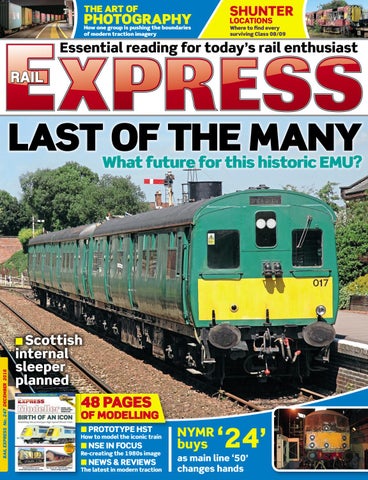
What future for the
last
‘306’?
Christopher Westcott reports on the sole surviving Class 306 unit No. 306017, which is owned by the National Railway Museum but currently on loan to the East Anglian Railway Museum at Chappel & Wakes Colne in Essex.
A
VISIT to the East Anglian Railway Museum in early August reacquainted me with preserved EMU No. 306017, the sole survivor of the class. I had last seen it at the Old Oak Depot Open Day way back in August 2000, when it had looked smart in green livery with small yellow cab warning panels. Back then, one car had been accessible and I remember being impressed by the art deco decorative light shades and veneered wood that adorned the car. However, 16 years on and having been stored in the open for some time, the unit now has significant external weathering. Its green paintwork was peeling,
revealing layers of British Rail blue, British Railways green and even small exposed areas of corroding steel. Additionally the roof appeared to be in poor condition, suggesting that internal damage could have taken place. During my August visit to the Essex museum, there was no opportunity to inspect whether water had managed to get inside the passenger compartments of the unit – although
there was access to the cab of driving car No. 65617.
THE SURVIVOR
No. 306017 is the last-surviving member of the once 92-strong, 1949-built fleet (see boxout), and is unusual in unit preservation in that all three cars have been saved rather than just one or two. It was rumoured that staff at Ilford depot sent three alternative withdrawn coaches for scrap to ensure that the historic LNERdesigned unit survived intact. However, this is only half the story. The story goes there was a scheme to save classmate No. 306034 instead. However, No. 306017 had been the last entire unit to be overhauled at Wolverton works in 1980 – just a year before the fleet was finally
replaced by new Class 315 units. No. 306017 had also formed the middle unit of the very first Class 306 train to enter passenger service in 1949. After withdrawal, the unit remained at Ilford and became a pet project. Being looked after by apprentices in ‘B’ Shop under the guidance of supervisor Bill Lever, it was simply repainted green in 1986. When Bill retired in early 1992, the three-car unit was discarded into the yard at Ilford. Following privatisation in the mid-1990s, Great Eastern franchisee First Group took pity on the ‘306’ and returned it to operational condition. Much ‘blame’ for this falls on two people; Pete Martin and a school leaver on work experience called Jay Thompson (who is now head of safety management at Abellio Greater Anglia), who wanted to know more about the ‘green train’. Additionally another member of Ilford depot’s staff, Paul Trowbridge, painted the roofs while on nights in 1997.
PRESERVED USE
Since being originally saved in 1981, the unit has been
Pete Martin, who has been involved with No. 306017 in both BR days and preservation, poses in front of the unit at the East Anglian Railway Museum on September 19. All pictures by Christopher Westcott unless stated
16 RAIL EXPRESS December 2016
PHOTO SPECIAL
STEVENTON SUNSET: This is railway photography to the point of abstraction, as the setting sun glints on the rails of the Great Western Main line at Steventon, west of Didcot in Oxfordshire, on March 21, 2012. Stephen Dance
CUMBRIAN WATERS: Another glint shot sees TransPennine Express DMU
No. 185108 about to cross Arnside viaduct, Cumbria, with the 1U82/20.08 Barrow to Manchester Airport on July 16, 2013. The shot is taken from Storth, just to the north-east of Arnside. Robert France
26 RAIL EXPRESS December 2016
BACHMANN UNVEILS WICKHAM’S TROLLEY
No
.1 52
DIESEL AND ELECTRIC ERA MODELLING O G
BIRTH OF AN ICON
Modelling the prototype High Speed Diesel Train
YOUR
48 PAGES
OF MODELLIN
START
G
HERE!
Vacuum-braked vans in British Rail departmental service
The rise of red – Network SouthEast station design recalled
D&E FILES
Vacuum-braked departmental vans Until the early 1990s, most ancillary railway equipment was transported by train. The various departmental wagon fleets still included a number of increasingly elderly and largely vacuum-braked vans eking out their final years as either stores or tool vans. David Ratcliffe illustrates and describes some of these survivors.
The wide door openings of the 12ton Fish Vans made them a popular choice for use as tool vans. As a result, a number survived well into the 1990s in various roles, including ZQV No. DW87674, which is seen awaiting disposal at Crewe Gresty Lane in August 1998. All photographs by the author unless stated
Until it received an allocation of 30 surplus VCA air-braked vans in 1983, the Mechanical & Electrical Engineers used a fleet of 12t Vanfits to move locomotive and wagon spares around the rail network. No. ADB763016, a ZDV formerly based at Exeter Wagon Shop, is seen awaiting cutting up at Woodham’s scrapyard at Barry Docks in February 1987. Hywel Thomas
M28 RAIL EXPRESS Modeller December 2016
Henry Pooley & Sons Ltd was the contractor responsible for calibrating railway weighbridges and had several vans allocated for its use. This included ZVV No. DB765936, which was recorded at Longport Freight Depot in August 1996. The plywood-sided van was lettered ‘H. Pooley & Sons Ltd. Weighing machine contractors to British Rail’ and also carried the instruction ‘TOPS No. 42168 Return to Crewe’, this being the location code for the Civil Engineers’ sidings at Crewe Gresty Lane.
Supplement No. 152
RAILTOURS
Gary Boyd-Hope
ROG takes 'Tractors' on rare outing EUROPHOENIX-LIVERIED Type 3 duo Nos. 37800 and 37884 took centre stage on October 23, when they worked the Rail Operations Group’s round-robin ‘Thrash Bash’ tour from Derby to Worcester Shrub Hill. It was an opportunity for the grey pair to take a break from their usual fodder of moving EMUs and other stock around the country. A rather civilised 09.00 departure found the ‘37s’ and their 10-coach train, made up of ex-Anglia and blue/grey stock, heading out towards Trent South Junction via Long Eaton. The timetable was followed closely for the jog along the Midland Main Line to Leicester, although four minutes had been lost by the time the train passed the Brush Works at Loughborough. By the time the ‘Tractors’ and blue-liveried No. 47815, which was on the rear, left Leicester they were only a minute down, although a crawl to Knighton South Junction resulted in another four minutes being lost. Hinckley was passed on time and a minute gained during the three-minute layover at Nuneaton, but the 10.50 arrival at Birmingham New Street was two minutes late. This set the pattern for the next stage of the journey, taking the ‘Tractors’ through the Black Country to Stourbridge and Kidderminster and on to their first encounter of the day with Worcester. This was only a passing visit through Foregate Street, but the ‘37s’ were running to time and both Ledbury and Hereford were left bang on time. Soon the ‘Thrash Bash’ had crossed into Wales but was also running behind time; nine minutes having been lost by Abergavenny, which was still the case by the time they reached Newport’s Maindee North Junction at 13.47. However the Type 3s were in good voice, and by Severn Tunnel Junction had clawed back seven minutes, passing at 14.19.
‘Growling’ into Birmingham New Street on October 23, Europhoenix Type 3s Nos. 37800+37884 head the outward leg of the Rail Operations Group’s ‘Thrash Bash’ tour from Derby to Worcester Shrub Hill via South Wales. Stewart Higham
The northward leg back to Worcester saw continued good running; a six-minute pathing stop at Gloucester being avoided that put the train five minutes up against the timetable. This dropped back to ‘as booked’ through Cheltenham and Ashchurch, with the train rolling in to Shrub Hill on time at 15.37.
LICKEY ASCENT
After a 50-minute servicing break at Hereford Sidings, the ‘37s’ were ready
to roll again, getting away threeminutes late at 17.12. At Droitwich Spa they veered off towards Bromsgrove and levelled the Lickey Incline, but the deficit was up to seven minutes at Kings Norton. The remainder of the run to Birmingham was between three and four minutes down, but the late arrival into New Street resulted in the booked two-minute stop being extended to seven. By the time the ‘37s’ got underway again they were
eight minutes late, which increased to 11 through Water Orton and into Nuneaton. Leicester was reached at 19.48 (10mins down) and departed at 19.51, the locos passing ROG’s home base before racing back through Loughborough and into Derby at 20.21. This was against a booked time of 20.14, but none of the delays throughout the day could be attributed to the Type 3s and their performance throughout was superb. E
DB ‘Sheds’ for Merseyside freight exploration PATHFINDER Tours is looking to start 2017 with an exploration of nonpassenger lines on either side of the Rivers Mersey and Weaver on January 14. Set to be worked by a pair of DB Cargo Class 66s in ‘top and tail’ formation, the ‘Mersey Weaver II’ will set out from Westbury at 06.00 and make pick-ups at Bath Spa, Bristol Parkway, Cheltenham Spa, Birmingham New Street, Stafford and Crewe. From Crewe the tour gets down to the business at hand; the itinerary allowing for four crossings of the two rivers along with six reversals. The requested route takes the excursion from Crewe out to Weaver Junction, Walton Old Junction, Bank Quay Down Slow, Earlstown Down & Up and Liverpool Curve where a reversal will be made. Then onward to the Dallam Royal Mail Terminal via the Up
86 RAIL EXPRESS December 2016
Slow/Up Goods, Acton Grange Junction, Halton Up Goods Loop and West Cheshire Junction to the Elton Encirc Terminal for another reversal. The ‘Sheds’ will then go via Helsby, Frodsham Chord, Runcorn, Ditton East Junction, Down Ditton Slow, Speke Junction Down Goods and Garston Freightliner Holding Siding for the third reversal of the day. Another will follow at Halewood West Junction before continuing on to Wavertree Junction, Edge Hill and the Down Wapping Siding for reversal number five. The route then goes back to Edge Hill and through Speke Junction to Fiddlers Ferry Junction, Arpley Junction, Latchford Sidings (for the final reversal), Arpley, Acton Grange Junction, Hartford and back to Crewe at around 18.20. The train will then return via all joining stations to Westbury for a 22.30 arrival.
PORT VIEW: DB Cargo ‘Shed’ No. 66030 approaches the end of the line at Kingston Coal Terminal, within the boundaries of ABP’s King George Dock in Hull, with UK Railtours’ ‘Humber Vogue' on October 29. Classmate No. 66168 was at the other end of the tour, which also visited Drax Power Station under tight security both onboard and off the train. Some of the coal terminal’s few remaining stockpiles can be seen ahead of the loco, and beyond that is the gas-fired Saltend Power Station, while part of BP’s chemical plant is to the left. Paul Bickerdyke
PRESERVATION
David Russell
NYMR buys Class 24 from TJ Thomsons The veteran Type 2 has been purchased from the scrapman 40 years after being loaned to the railway. FOLLOWING an unexpected offer from the loco’s owner, TJ Thomson & Son Ltd, the North Yorkshire Moors Railway has purchased Class 24 No. D5032 (24032) Helen Turner from the firm. The Stockton-based scrap dealer had originally acquired the loco for cutting up after withdrawal by British Rail in 1976, but it was placed on loan to the NYMR less than a month after arrival and has remained a resident ever since. The Sulzer Type 2 is regarded as being a saviour of the North Yorkshire Moors Railway, as it is probable that without its arrival in 1976, the line would not have been able to operate any trains. The hot summer that year had caused a number of lineside fires, resulting in a ban on steam operations, and leading to a Class 08 and then a Class 101 being hired from BR. Negotiations to borrow the Class 24, which had arrived at Stockton from Bescot under its own power, were successful – although the hire also had to be sanctioned by British Rail, who insisted its ‘double arrows’ logos were removed as well as ‘24’ from the loco’s number. After complying with these conditions, the loco was duly
IN BRIEF ‘TC’ TO BE STORED AT KENT & EAST SUSSEX
FOLLOWING the completion of its restoration at St Leonards, 4-TC DTSO No. 76275 is to be moved to Rolvenden Carriage Shed for undercover storage pending the completion of the three other vehicles from Butterley that will make up the 4-TC unit, which will be based at the Swanage Railway.
CLASS 37 SOLD
AS expected, Tyseley resident No. 37263 has been sold by the 37263 Locomotive Group. It has been bought by four individuals and is due to move to a new home at the Telford Steam Railway, where restoration will continue, in early 2017. The loco, which was sold by EWS in 2003 and initially based at the Dean Forest Railway, has yet to operate in preservation. Another Class 37 which has still to haul a train in preservation, No. 37009, moved under its own power at Ruddington on October 23.
Mk.1 CK GOES FOR SCRAP
DURING October, Mk.1 CK No. 7212 was moved from Wentloog Industrial Estate in Cardiff to EMR at Kingsbury for scrapping. Initial plans for it to go to Sims Metals at Newport were thwarted owing to the site being closed, resulting in it being sent to Studley and then on to the EMR site.
88 RAIL EXPRESS December 2016
Left: Now owned by the NYMR, No. D5032 is pictured inside the shed at Grosmont on September 26, where it is undergoing an extensive overhaul. Murray Brown
dispatched to Grosmont a few weeks later. Initially loaned for one year, this was continually extended and the loco was named Helen Turner after the daughter of one of T J Thomson’s
directors in 1982. It had covered a six-figure mileage on the NYMR when it was stopped for overhaul in 1999.
TPWS TO BE FITTED
No. D5032 is now undergoing a major
overhaul at Grosmont, and although no timescale has been set for completion of repairs, it is planned that when it does return to use, it will be fitted with TPWS equipment and certified for use on Network Rail tracks to Whitby and Battersby. This will provide the NYMR with a back-up for Class 25 No. D7628 (25278), which may need to be stopped for attention at some point in the future. When No. D5032 does venture out to Whitby or Battersby, it will be the first occasion that a Class 24 has operated on the main line since Derby RTC’s No. 97201 Experiment (formerly No. 24061) was retired from service in 1987. By strange coincidence, this loco is now also based at the NYMR, and is awaiting overhaul. ■ The expenditure associated with the purchase of No. D5032 was unexpected and not budgeted for, and the NYMR is keen to receive any donations towards the cost. These can be made by visiting www.nymr.co.uk. E
Class 26 suffers major failure THE Llangollen Diesel Group’s Class 26 No. D5310 has had to be taken out of service after a failure at the Spa Valley Railway during the line’s beer festival on October 22 A motor overload relay suffered serious damage, and it is likely the loco has suffered a generator flashover. An electrical fire was stopped from spreading thanks to action by the loco’s crew. The beer festival event was the last
booked appearance for No. D5310 prior to its planned return north, the Sulzer Type 2 having been visiting the Spa Valley since August. It returned to the Llangollen Railway on October 25, where it will undergo a detailed inspection.
26007 DERAILED
Another Class 26 which was involved in an incident during October was No. 26007. Following an appearance at the
Nene Valley Railway’s gala on October 14-16, the loco departed in a convoy on October 20, but came off the track on all wheels at Fletton Junction. Class 46 No. D182 in the convoy was also derailed. An investigation into the cause is taking place, and the two locos, along with No. 47765 which was also in the convoy, have been moved to Peterborough for inspection prior to returning to their respective homes.
‘DELTIC’ TRANSFORMED:
Having carried the identity of No. 55007 Pinza for the past year, No. 55022 Royal Scots Grey gained the identity of another scrapped ‘racehorse’, No. 55018 Ballymoss, during the Nene Valley Railway diesel gala. The loco returned to the North Yorkshire Moors Railway on October 18. Before renumbering, the ‘Deltic’ is pictured on the NVR at Orton Mere on October 14, while working brake van trips with Nos. S55550 and B953940 along the Fletton branch. Colin Pottle
RHTT PICTORIAL
THIS autumn’s ‘leaf buster’ Railhead Treatment Trains are seeing a wider variety of traction in action than ever before – with Classes 20, 37, 56, 66, 67, 68 and 73 being used around the country, as well as Multi-Purpose Vehicles. On the Cambrian Line in Mid-Wales, only ETRMS-fitted locos can be used – which on October 14, the first night of RHTT operations on the route this year - saw Network Rail’s No. 97302 rostered solo . It is pictured under the new footbridge at Machynlleth after arriving with the 3S71/21.20 from Shrewsbury Coleham. When running in ‘top and tail’ mode, the train stops short of the station for the crew to change ends. Richard W Jones
AFTER the Cambrian leg, the Shrewsbury Coleham RHTT diagram takes in North Wales, with Colas providing the traction this year to visit Wrexham, Bidston, Crewe and Holyhead. ‘Grids’ Nos. 56087 and 56113 are pictured ‘top and tailing’ the train between the A55 and the sea at Old Colwyn, heading for Holyhead on October 15. Greg Mape
94 RAIL EXPRESS December 2016
TRACTION & ROLLING STOCK
David Rapson
Powerscene Our authoritative class-by-class review of newsworthy locomotive workings.
CLASS 20
HAVING taken an engineering train from York to Doncaster on October 10, DRS Type 1s Nos. 20308+20312 returned with a rake of MRA wagons forming the 6Z51/12.10 Doncaster Down DecoyYork Works. The reinstated DRS Class 20s were busily engaged on RHTT work in Yorkshire during the latter part of the month, although No. 20305 (hauled by
96 RAIL EXPRESS December 2016
No. 68011) arrived back at Crewe on October 28 for repairs, with No. 20302 having teamed up with No. 20312 by October 24. No. 20302 had only been released from Barrow Hill seven days earlier, when No. 37716 hauled it to York to join its classmates. Elsewhere, Nos. 20118 and 20132 ‘top and tailed’ the 3W50/09.30 Tonbridge West Yard-Slade Green via Orpington and Crayford on October 19,
moving a RHTT set for wheel lathe attention and returning it to Tonbridge next day. Movements of London Underground ‘S’ Stock have been thin on the ground of late, although Nos. 20096+20107 and Nos. 20314+20905 passed Burtonupon-Trent on October 18 with LUL sets Nos. 21065/66 forming the 7X10/02.20 Amersham-Derby Litchurch Lane, and repeated the journey on October 25 with
sets Nos. 21063/64. In between, the quartet of EE Type 1s took LUL sets Nos. 21319/20 south as the 7X09/12.38 Old Dalby-West Ruislip on October 19. October 28 found Nos. 20905 and 20314 running light from Derby to Barrow Hill, the former being in need of wheelset attention having suffered wheel flats.
CLASS 33
‘CROMPTON’ No. 33207 and stablemate
With Jeffrey’s Mount dominating the background, Colas ‘Tug’ No. 60096 heads south past Low Borrowbridge, Cumbria, with the 11.59 Carlisle to Chirk loaded log train on April 20, 2016. STEVE SIENKIEWICZ
2017 CALENDAR