COMMANDO REBUILD
ISSUE 168 APRIL 2018 £3.60
BMW K1
MUNRO’S VELO
DUZMO!
Running, Riding & Rebuilding RealClassic Motorcycles
WHAT LIES WITHIN
50 BMW K1......................................................... 6
BUYER’S EYE ............................................... 60
Back in the 1980s, long before Hinckley made triples fashionable again, the future appeared to be exclusively four-cylinder shaped. So BMW built the world’s slipperiest four-cylinder superbike – and then willingly restricted it to 100 horsepower. Ace Tester Miles attempts to resolve the K1’s personality conflicts…
Thinking of buying a British classic bike? We wondered how far £5000 goes these days. Will our budget buy you a Bonneville or should you set your sights on a Bantam? Rowena Hoseason investigates…
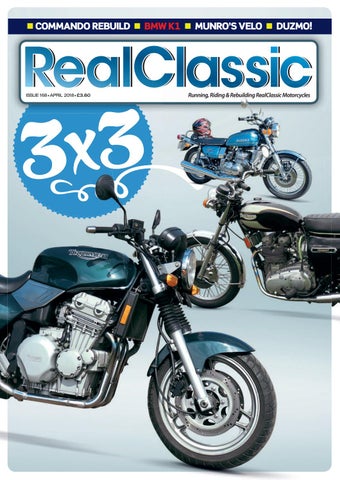
THREE x THREE ........................................... 26
They may be superficially similar, but surely three triples built in different decades don’t share many characteristics apart from their cubic capacity? Actually, says Martyn Roberts, they’re not so different under the skin… BSA A65 TRACKER ...................................... 40
Odgie’s dirt bike project is finally complete – which means it’s time to take it to the track. Was all the weight-saving worth it? Can a BSA 650 twin hold its own against modern competitors which are 50 years younger? DUZMO! ...................................................... 50
The earlier years of motorcycling contain attempts by many engineers to improve the breed. Alan Cathcart makes something of John Wallace’s dream: the Duzmo…
REALCLASSIC 168; PUBLISHED IN APRIL 2018
RC REGULARS THE CONTENTS PAGE .................................... 3
The first page in the magazine is also the last one to be written. This makes no sense…
MUNRO’S VELO........................................... 70
Burt Munro is best remembered for his 1920 Munro Special, aka The World’s Fastest Indian, but he also had another claim to fame. Stuart Francis reveals The World’s Fastest Velocette…
WE’VE GOT MAIL! ........................................ 14
TESTING TIMES ........................................... 86
Is it time for sandals and sunglasses yet?
Write more! Then write more than that! We always enjoy reading what you have to say EVENTS ........................................................ 78
The government has recently extended the pre-1960 MoT exemption to cover all motorcycles over 40 years old. Martin Gelder looks at why they’ve done this, what it all means, and wonders if the front brake on his BSA will start working now...
READERS’FREE ADS .................................... 80
The increasingly curious selection of bikes on offer continues to be … curious PUB TALK ................................................... 110
Along the A5: Watling Street, Telford’s Holyhead route, and a road to the last Welsh Dragon…
COMMANDO RESURRECTION .................... 94
Norton’s Isolastic twin is one of the greatest British bikes. Peter Hatfield looks at it closely – and rebuilds one for us. He imported it first, too…
TALES FROM THE SHED ............................. 116
Frank’s been selling bikes. So many that he plainly needed a new one. So he went to an auction, and…
FETTLING THE AMC GEARBOX ................. 100
Great bikes all benefit from great gearboxes, and the Norton / AMC 4-speeder is one of the best of British. Martin Peacock shows us how to make one at least as good as new HEAD GASKETS ........................................ 106
Royal Enfield twins have a reputation for blowing their head gaskets. No one told Robert Murdoch… who discovered that his Super Meteor had been cleverly customised to solve the problem…
SUBSCRIBE
TURNTO
You won’t find RealClassic on the shelves in UK newsagents. If you want to enjoy regular RC reading then take out a subscription and join us in the RealClassic Club.That way, each issue costs just £2.50. Bargain!
P122
TODAY & SAVE
WHO’S DONE WHAT REALCLASSIC breezed, blustered and blizzarded into print this month with Rowena Hoseason and Frank Westworth (aka The Cosmic Bike Co Ltd) surviving snowdrifts in the process. The top production team at Horncastle (including Mike Baumber, Libby Fincham and Kelvin Clements) did all the hard work, of course Heaps more RealClassic reading is available throughout the month at www.Real-Classic.co.uk TRADE ADVERTISERS for the magazine or website should call Helen Martin on 01507 529574, email hrmartin@mortons.co.uk EDITORIAL ENQUIRIES should be sent to Frank@RealClassic.net or to PO Box 66, Bude EX23 9ZX. Please include an SAE if you want something returned or a personal reply SUBSCRIPTION INFO is on pg122. Call 01507 529529 to subscribe or renew or buy back issues SUBS QUERIES, late deliveries, or changes of address should be directed to 01507 529529, or email subscriptions@realclassic.net ALL MATERIAL in RealClassic is copyright its authors, so please contact us before reproducing anything. RealClassic is printed by William Gibbons & Sons of Wolverhampton. Our ISSN is 1742-2345. THIS MONTH we’ve been reading BLUE LIGHT YOKOHAMA (murder in Japan); THE ONES YOU DO (murder in Louisiana); THE WOMAN IN THE WOODS (murder in New England) and SIX STRINGS (Frank’s new quick thriller, no less, featuring… murder somewhere mysterious!), and THE BUTCHERS OF BERLIN (you can probably work that out…) MEANWHILE AT THE MOVIES… we really rated RED SPARROW (a Russian spy story: how timely), FROM PARIS WITH LOVE (John Travolta is strangely convincing as a CIA assassin) and THELMA (weird Scandi semi-supernatural stuff ), but thought BLACK PANTHER and THE SHAPE OF WATER were both over-rated. Big yay to Frances McDormand for her well-earned Oscar, however
FROM THE FRONT
O
ne of the very many perks of a magazine editor’s job is that I get to read all the stories first. And you may be surprised to learn that I have no system for choosing which I read first – usually the word processor lists them alphabetically, so that’s the order in which they get read. So Three Threes was a long way down the list. But it was well worth the wait. Martyn Roberts’ views of his bikes are as fascinating as owners’ views so often are. Read it and you’ll see what I mean. Initially, I scratched my head and wondered whether it was legitimate to compare a T150 Trident and an early Hinckley equivalent? Then … the Suzuki? And of course it is: comparisons are entirely legitimate if anyone wants to make them, all the more so when they’re based on an actual owner’s view of his own actual bikes, as in this case. Another well-known perk of a journalist’s job is the opportunity to ride lots and lots of different bikes, not least because it permits endless opportunity to gaze into the faraway and muse a little, pondering whether the author’s view mirrors my own or contradicts them (which often happens, in fact). In this case, I’ve ridden lots of Suzuki triples, but never owned one; I’ve ridden more T150 Tridents than GT750s and have owned several, and the first Hinckley Triumph I rode was a 750 Trident, exactly like Martyn’s. That first ride was memorable. Back in the very early 1990s, just as the new Triumph works was getting up to full speed, I had just taken delivery of my new Norton Commander and was of course delighted with it. My very own brand new British bike, and technically fascinating, too. A colleague – actually Julian Ryder, noted racebike commentator and decently rapid rider himself – asked whether I’d be interested in joining him in a comparison test (yes, they’ve always been popular) between a Trident 750 and a Kawasaki Zephyr 750. We rode the bikes up from London to his office in Cheshire, swapping every time we filled up. It’s not a great distance in a straight line and is an easy ride … except we somehow
managed to include the Cotswolds, a wide swathe of the Peak District and discussed whether to do some of Wales as well. They’re both that kind of bike. We also used a remarkable amount of fuel, which might suggest to some that we pressed on a little – however, I am personally convinced that we stuck like glue to all speed restrictions but as it was a hot day the sun evaporated the fuel while we pottered gently along admiring the view like the responsible citizens were of course are. Only faintly remarkably, my memories of the conclusions are still accessible. And I have a couple of pics somewhere, taken at stops. Sadly, we both preferred riding the Kawasaki. The two fat laddies (as we both were at the time) found the riding position of the Zephyr more comfortable, and I preferred the way I could throw it around more easily than the more stable Triumph. Very personal conclusions, of course. But back to Martyn’s excellent story. Times change. After reading it I dived into the world of Bikes For Sale and found myself pondering a 750 Trident – the Hinckley model. Because … well … they make so much sense. Can a bike make more sense when it’s a quarter century old than it did when it was new? Discuss… Ride safely Frank Westworth Frank@realclassic.net
RealClassic is published monthly by MMG Ltd, PO Box 99, Horncastle, LN9 6LZ, UK. USA SUBSCRIPTIONS are $58 per year from Motorsport Publications LLC, 7164 Cty Rd N #441, Bancroft WI. 54921. Postmaster: Send USA address changes to RealClassic, Motorsport Publications LLC, 715-572-4595 chris@classicbikebooks.com
CONTACT US! BY POST: BY EMAIL: TP@RealClassic.net ONLINE: www.Real-Classic.co.uk
THE NEXT ISSUE
RC169 WILL BE PUBLISHED ON MAY 7th, AND SHOULD REACH UK SUBSCRIBERS BY MAY 11th
BMW K1
Back in the 1980s, long before Hinckley made triples fashionable again, the future appeared to be exclusively four-cylinder shaped. So BMW built the world’s slipperiest four-cylinder superbike – and then willingly restricted it to 100 horsepower. Ace Tester Miles attempts to resolve the K1’s personality conflicts… Photos by Paul Miles, Chris Spaett, RC RChive
F
or BMW, a brand synonymous with air-cooled boxer twin engines, the 1980s presented a major problem. Their venerable twins had powered them to commercial success for decades, selling the concept of a high-end ‘complete motorcycle’ to a sophisticated and wealthy clientele. This was easy in the 1960s and early 70s when the competition was often an air-cooled twin itself but, as the latter decade drew to a close, it seemed obvious that the future didn’t include a pair of sticky-out cylinders. The opposition had caught up with clever four-cylinder engines and were offering their own vision of the future. BMW’s domination of the sports-tourer niche was under threat. Bikes like Kawasaki’s GTR1000 and Honda’s Gold Wings made the Bavarian pushrod twins look and feel antiquated, so a new design was needed to power BMW into the 80s and beyond. Wary of being seen to copy the Honda flatfour concept, the factory settled on a liquidcooled four-cylinder engine with electronic fuel injection replacing the carburettors, thus satisfying impending emissions regulations in California. The twist was of course how the engine lay in the frame. Rather than across the beam, like the Japanese, the BMW motor was laid on its side and longitudinally. This novel concept served two purposes. It made the shaft drive so beloved of traditional BMW customers even easier to engineer, while also lowering the centre of gravity, significantly improving the handling of what was to become a more complex and heavy motorcycle than the outgoing twins. It’s worth remembering that BMW already had a lot of experience of building liquid-cooled four-cylinder engines with fuel injection; they’d been using them to power their cars for the previous twenty years.
APRIL 2018 I 7
all that swoopy In case you wondered, underneath rcycle moto d dere onsi rly-c cleve a plastic lies
The 1982 model range featured this bold new motorcycle. The 987cc K100 represented the future of BMW Motorrad. The twins were soon to become history and the new bike had to not only appeal to potential new customers, but keep the existing BMW riders, a historically loyal group, happy. Rumours abounded that the engine was built to withstand 200bhp demands and had a life expectancy of 250,000 miles, subliminally reassuring the traditional customers with what they needed to hear before trusting this new-fangled machine. Produced in several variants, the successful K100 (referred to fondly as ‘the flying brick’) steadily evolved over the next six years into a fast, competent motorcycle, but BMW still struggled to shake their slightly dull image in the marketplace. The competition also made
some very powerful and fast motorcycles, invariably at a lower price point than the Bavarian fours. In the wider world, however, things were gradually changing in the Germans’ favour, with the introduction of the voluntary horsepower limit. Sensationalist headlines reported on this new genre of ultrapowerful motorcycles capable of hitherto unimaginable speeds, speculating on the untimely death of a generation enticed by these ‘evil death dispensers’. Sensing that something needed to be done lest legislation enforced change, the major factories agreed to a nominal 100bhp limit. For the Japanese this meant restricting the power of their current machines, but for BMW it allowed them to increase the 90 horse K100 to, for the first time, a full 100bhp. This potential levelling of the playing fields meant that if everybody played by the rules, the K100 could be considered once again as a superbike.
Above: There was even bijou luggage, in case the rider needed more than a Gold AmEx card for the touring thing Left: The BMW’s approach to its aero was well in advance of anything else on the market
Now free from playing second fiddle to the ever more powerful competition, the designers and engineers really went to work on the bike. The motor was upgraded from 8 to 16 valves, a first on a BMW motorcycle, with higher compression pistons, lighter conrods and a new crankshaft weighing 1.3kg less than the K100. The rear suspension was treated to the latest Paralever design. The factory even specified an entirely new, Bosch-designed antilock braking system. But where BMW really broke the mould was in the styling of the new flagship. In their efforts to raise the profile among the younger buyers, BMW needed the new bike to shake up the established order. The existing range already satisfied the needs of the long-distance rider, allowing the new motorcycle to provide the shock and awe the range needed. Unveiled in 1988, the new K1 duly sent jaws dropping wherever it went. A seven-piece, all enveloping fairing ensured that no motorcycle before or since has ever look quite like the
Room inside the sideboxes was restricted. Observe how we’ve used photos of two different bikes. Twice the value at RealClassic…
More old bikes online: Real-Classic.co.uk
BMW K1
Above: The detailing is typical BMW; very high quality materials and components, laid out intelligently and logically. The ABS unit has been used as a styling feature, too, they say
BMW K1 FACT PACK
Right: No BMW motorcycle – before or since – has looked like the K1. This is of course a good thing
flagship four. Developed from the earlier ‘racer’ concept, the fairing, along with the enormous streamlining effect provided by the front mudguard, reduced the coefficient of drag to a world record of 0.34, making the K1 both fast and economical, always a great trick to pull off. Nearly thirty years on, the K1 still manages to shock. A jarring mass of angles, the bright metallic blue paintwork, further offset with yellow accents including wheels, Paralever, seat and (in case you’d yet to recognise what it was) ‘K1’ writ extremely large on the fairing. The massive, louvered front mudguard covers almost half of the wheel and a removable tail section allows air to slide from the rider’s back
and off the machine in the least turbulent way possible. Hidden within the vast fairing and tail section are four lockable compartments, enough to carry a rider’s essentials for a weekend away. The by-now familiar, multicoloured BMW controls, plus an array of car-style switches and gauges built into the fairing, complement the informative and ohso 1980s instrument panel. In typical BMW fashion there is a lot of information available to the rider, including a clock and gear position indicator, plus warning lights for sidestand, ABS, hazards, choke and low fuel; it’s like a two-wheeled car.
Built
1989 to 1993
Engine
Liquid-cooled dohc 16-valve longitudinal four-cylinder four-stroke
Bore / stroke
67 x 70mm
Capacity
987cc
Compression
11:1
Power
100bhp @ 8000rpm
Torque
100Nm @ 6750rpm
Fuelling
Bosch fuel injection
Transmission
Five-speed shaft drive
Front brake
2x 305mm discs, 4-piston calipers
Rear brake
285mm disc
Front tyre
120/70
Rear tyre
160/60
Dry weight
234kg
Seat height
30.7 inches
Wheelbases
1565mm
Top speed
143mph
Price new
£9450
Price now
£4500
Left: Handlebar minor controls are typically idiosyncratic, but easy to learn and to operate while wearing big gloves Right: This promo shot reveals how the airflow was intended to work
APRIL 2018 I 9
Ace Tester Miles demonstrates the considerable comfort of the mighty BMW K1
The K1 is a long and heavy bike, typical of the era at 234kg dry and, with a decidedly unsporting 22ft turning circle, tight manoeuvring is best planned well ahead. Comfortable, though, with a superbly ergonomic riding position and no sign of wrist hurting clip-ons to be found anywhere; this is a BMW, after all. Early test reports suggested cramped legroom, but this example was fitted with aftermarket adaptors moving the rests forward and down by a couple of inches. Rolling it from the easy-touse centrestand, and eventually working out which button to press, the big four fires up with minimal fuss. A reassuringly BMW-like clunk greets first gear engagement, but with a featherweight clutch there’s little drama – and we’re off!
The K1 glides along, with the now commonplace Paralever rear suspension eliminating the pitchy nature of less evolved shaft drives. Italian Brembo brakes pin the blue behemoth as well as anything of the period and the whole package feels beautifully integrated. This low mileage example is in superb, original, unrestored condition, with no evidence of the panel flexing or cracking that’s reported in some cases. Every switch or warning light worked perfectly and the weighty and complex ABS, often removed when found to be defective, seemed in perfect working condition. It was like riding a new bike, not something nearly three decades old. The futuristic Bavarian is also one of the most stable motorcycles I’ve ever had the
pleasure of riding, even a brisk crosswind failed to fluster this blue and yellow colossus. The riding position and even the awareness of its slippery nature encourages a tucked in riding position and I could easily understand why the K1 is often referred to as the Tron bike. Best suited to main roads, of course, this bahnstormer (sorry, I couldn’t resist) is a perfect all-day sporting ride, with nothing too extreme to spoil the fun. The K1 rider laughs at the poor fellows struggling with their race replicas, their lack of centrestands and paucity of switches to play with. BMW man lunches at the roadside, having opened one of the cubbyholes revealing a perfectly made sandwich and alcohol-free beer. There’s even room for a slice of cake and a monogrammed tablecloth.
Below: And of course the BMW toolkit is one of the very best available
Left: It is truly rare for a front mudguard to stand out as a glorious piece of motorcycle design. However, BMW managed it. Stand up, K1 front guard! Above: The engine was also a decently radical notion when it appeared. A DOHC in-line four … just not like any of the others on the market. Supremely logical of course
10 I APRIL 2018
More old bikes online: Real-Classic.co.uk
BMW K1 Cockpit design and equipment are second to none. Clear clocks – and many of them – entertain and maybe inform the rider
With a claimed 155mph top speed (and, being BMW, you can bet that’s correct) the K1 was among the fastest bikes in the world. A simple and cheap EPROM swap liberates up to 30 more ponies and stories abound of the 175mph brick. An extremely rare, yet memorable sight on our roads, you’d be unlikely to miss it in a crowded bike park, either. Why so rare? At the time it cost an astonishing £9450, making it one of the world’s most expensive motorcycles. In addition, its divisive styling and seemingly complex specification gave the undecided potential buyer every opportunity to pass. Sales remained slow, although production continued, with a muted black option joining the line-up in 1990. Honda’s seismic-shift in sports motorcycling with the release of the ultra-lightweight Fireblade in 1993 spelled
the end of the steel framed, heavy sportstourer as a range topper, with production finally ceasing that year; just 6921 units having being sold. Ironically, the very thing that buyers disliked most about the K1, the styling, makes it stand out today and the BMW presents an intriguing opportunity for the classic enthusiast. Genuinely fast, stunningly comfortable and very capable, time has been kind to the K1. As a collectable machine it ticks all the important boxes – rare, exotic, interesting. But, being a BMW, it’s also reliable and has great spares backup. Still undervalued by the market, a nice example could be in your garage for less than the price of a BSA Thunderbolt. The difference is that the BMW both looks and goes like a flash from the sky.
WHAT THE PAPERS SAY RIDING THE K1 is a real eye-opener. Gone is most of the vibration present in the standard K100. Also gone is any lethargy in power delivery. In the seat of the pants category, the K1 has plenty of urge anywhere in the wide powerband. The engine, combined with a stable, confidenceinspiring frame and good suspension, makes the K1 fun to ride fast. American Motorcyclist THE K1 POSSESSES a mid-range power punch that seems as strong and smooth as that of a CBR1000. From 2000rpm up, the bike pulls strongly, but when the tacho needle hits 4500rpm, the bike leaps forward, pulling hard until just before redline. The K1 won’t win an all-out top-speed run, but should still be capable of pulling a respectable 150 miles per hour. Cycle World COMFORT OVER GREAT distances is not helped by the fact that BMW has not cured the vibration problem throughout the rev range. The footpegs are particularly bad at transmitting vibes to the rider, while the new handlebars seem to do a better job of keeping them at bay. Motorcycle Review THIS IS THE FIRST BMW that I can actually flick into a corner and come out hard enough to drift the rear tire… The seat is great, and the fairing does an excellent job leaving only my head in the wind, and without any nasty buffering. MotorCyclist magazine THE K1’S WIDE handlebars are good for manoeuvrability at low speed but are stymied by a poor full lock. This is a bike that requires a two-point turn when turning around in a normal width road. Motorcycle Review I COULD FEEL EVERY pulsation as the system rapidly applied the brakes… It felt as though I was furiously pumping the brakes, except that the system was doing it much faster and much more accurately than I could. American Motorcyclist IT WAS PLEASANTLY SMOOTHER than its 8-valve K-series cousins at low revs and just as easy to ride in traffic because it has lost nothing in low-down power. In fact the sports bike actually has more… so there is no need to be constantly changing gear as on some rival super sports bikes. Motorcycle Review THE STYLING OF the bike promises superbike performance and the K1 delivers – to a degree. But it doesn’t offer the overall performance of a good Japanese 750 sportsbike that costs half as much. American Motorcyclist
APRIL 2018 I 11