BENELLI TORNADO
ISSUE 162 OCTOBER 2017 £3 3.60
TRIUMPH TRIDENT
BSA WD M20
JES!
Running, Riding & Rebuilding RealClassic Motorcycles
WHAT LIES WITHIN
34 MATCHLESS MODEL X ..................................6
TRIUMPH T150 TRIDENT ............................50
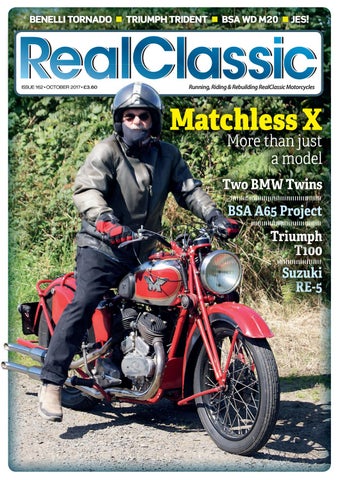
The Matchless X has been revived after many years of repose, but what’s it like to ride? Frank Westworth hits the roads of Cornwall in pursuit of the answer
If at first you don’t succeed… wait forty years and then enlist the aid of an expert. After an initial series of upgrades in the 1970s weren’t entirely successful, the owner of this 750 Triumph triple tried again. Rowena Hoseason reports
SUZUKI RE-5................................................26
One upon a time, rotary motors were going to revolutionise the two-wheeled world. Frank Melling recalls why Suzuki’s attempt was less than successful BSA M20......................................................34
If Britain hadn’t needed thousands of solid, straightforward motorcycles for military service in WW2, then the sidevalve M20 would most likely have evaporated into history. Instead, their wartime ubiquity means that many still survive and thrive. Stuart Urquhart rediscovers the art of going nowhere slowly… MZ ES250 ....................................................44
The stalwart two-stroke stinkwheel has converted another rider to the delights of old bikes. Henry Gregson reports on this way to enjoy classic biking on a budget
REALCLASSIC 162; PUBLISHED IN OCTOBER 2017
RC REGULARS THE CONTENTS PAGE ................................ 3
Just look at what’s in this issue! Is it even possible to be more varied? WE’VE GOT MAIL! .................................... 14
BENELLI TORNADO.....................................58
Lots of remarkable, entertaining and amusing thoughts from lots of people
This incarnation of the Italian parallel twin is called the 650S. Does that ‘S’ stand for ‘storm’ or ‘squall’, ponders Paul Miles…
EVENTS .................................................... 80
BMW R65 vs R850 .......................................66
Autumn arrives and brings lots of opportunities to gather in draughty halls and stare at shiny bikes and piles of … rust
Two entry-level BMW boxer twins from two different generations. One classic rider. Dave Simmons decides which Beemer he likes best… TRIUMPH T100............................................74
READERS’ FREE ADS ................................ 90
All of us have owned one. You know, the bike that you should never have sold. The one you wish you still had. Mike Estall recalls his Best Bike Ever…
The customary eclectic mix of machinery scattered around the country. Are there bargains? Treasures? PUB TALK ............................................... 108
BSA TRACKER PROJECT ..............................90
PUB popped down to Popham for their Motorcycle Megameet. In the workshop her efforts expose some of the repercussions of grinding/lapping in of tapers…
This month, Odgie gets to grips with the rear end of his A65-based dirt-track scrambler, which turns out to be a lot like making an omelette. Folks who don’t like breaking eggs should probably skip this bit…
TALES FROM THE SHED ......................... 114
JES REBUILD .............................................100
Although no rebuild ever truly ends in The Shed, Frank’s found time for contemplation…
When it comes to ancient engines, some of the most important fettling techniques have been long forgotten. Paul Tebbett reinvents various wheels to return his hundred year old JES to the road
SUBSCRIBE
TURNTO
You won’t find RealClassic on the shelves in UK newsagents. If you want to enjoy regular RC reading then take out a subscription and join us in the RealClassic Club.That way, each issue costs just £2.50. Bargain!
P122
TODAY & SAVE
WHO’S DONE WHAT REALCLASSIC fired on the first kick this issue, booted up by Rowena Hoseason and Frank Westworth of The Cosmic Bike Co Ltd, and Mike Baumber, Kelvin Clements and rest of the Mortons production team at Horncastle Heaps more bike features are posted throughout the month at www.Real-Classic.co.uk TRADE ADVERTISERS for the magazine or website should call Helen Martin on 01507 529574, email hrmartin@mortons.co.uk EDITORIAL ENQUIRIES should be sent to Frank@RealClassic.net or to PO Box 66, Bude EX23 9ZX. Please include an SAE if you want something returned or a personal reply SUBSCRIPTION INFO is on pg122. Call 01507 529529 to subscribe or renew or buy back issues SUBS QUERIES, late deliveries, or changes of address should be directed to 01507 529529, or email subscriptions@realclassic.net ALL MATERIAL in RealClassic is copyright its authors, so please contact us before reproducing anything. RealClassic is printed by William Gibbons & Sons of Wolverhampton. Our ISSN is 1742-2345. THIS MONTH we’ve been reading THE GIRL IN THE ICE (gritty Nordic noir, not some silly domestic drama, despite the title); WORLD GONE BY (Dennis Lehane does gruff gangsters in WW2); THE ICE STAR (Arctic action-adventure); VALERIAN (the collected sci-fi series); I’M TRAVELLING ALONE (another murdered Scandi child) and A CLIMATE OF FEAR (the idiosyncratic Commissaire Adamsberg returns to face… the French revolution??) MEANWHILE AT THE MOVIES we endured LAND OF MINE (war is hell, part 428); romped through VALERIAN, THE HITMAN’S BODYGUARD, AMERICAN ASSASSIN and LOGAN LUCKY; wrapped up LUCIFER (which actually got quite good in Season 2), and kicked off more mayhem with PREACHER (which started Season 2 in strangely downbeat style). And was it just us, or was the recent Montalbano series a bit… mundane? RealClassic is published monthly by MMG Ltd, PO Box 99, Horncastle, LN9 6LZ, UK. USA SUBSCRIPTIONS are $58 per year from Motorsport Publications LLC, 7164 Cty Rd N #441, Bancroft WI. 54921. Postmaster: Send USA address changes to RealClassic, Motorsport Publications LLC, 715-572-4595 chris@ classicbikebooks.com
FROM THE FRONT
A
reasonably common topic of conversation among old bike buffs is to reflect ruefully on bikes we’ve sold but which we wish we’d kept. Everyone seems to have one – or more than one. Do you? If so … do you ever ask yourself why that is? Also: would you buy another as close to your original as you can get? If so, why? And if not, why not? There isn’t the space here to ponder Reasons For Selling, but when I read Mike Estall’s tale of his Tiger further on inside this issue I found myself smiling a little. Mike’s talking about a Triumph, and I’ve run a few of those down the years, including one or two all-alloy T100s like that in his entertaining tale. Do I regret selling them? No, not really. In fact … I actually regret selling very few of the bikes which have departed The Shed down the years. There’s always been a reason for doing so, usually that old familiar financial pressure, but often a simple urge to ride something else, to try something else, to move on a little. Where I fear I may differ from a lot of other riders is that not only do I tend to idealise the dear departed (motorcycles, that is) but I also have a depressing tendency to acquire another, just like the other, to see whether it lives up to my memories of the original. Usually… usually, they do not. There’s a simple explanation for this. One of my earliest great bikes was a G12 Matchless, a 1961 650 of no particular wonderfulness – which however somehow confirmed me as an ‘AMC Man’ because of the great rides we did together. There were some utterly memorable trips: we rode between the Clyde coast where I worked for a summer, and the family home in Somerset several times, and broke down only rarely. It was great. Of course eventually I blew it up and sold the remains, replacing it with several other bikes, although a lot of them were AMC twins. There’s a G12 Matchless in The Shed at the moment, in fact. A 1965 CSR which has been there for almost a decade and which gets a romp every so often. It’s really fun to ride.
CONTACT US! BY POST: BY EMAIL: TP@RealClassic.net ONLINE: www.Real-Classic.co.uk
Does it match up to the 1961 original? No. Of course it doesn’t. Which brings me to that simple explanation. In 1971 when I rode my first G12 I was 18. The world was a wild world, brash and bold, and so was I. The bike was part of the unfolding of exploration which was so common among my peers back then, and is likewise among today’s youth as well, I’d imagine. Does riding a bike similar to one from long ago replicate that glorious learning experience? No, of course not. Do I regret selling that G12, or indeed any of the other AMC twins which have come and gone down the years? Any of the Nortons, BSAs, Triumphs and so on which have done likewise? No, of course not. But revisiting the past is always a perfectly valid reason for buying another bike, isn’t it! Ride safely Frank Westworth Frank@realclassic.net
THE NEXT ISSUE
RC163 WILL BE PUBLISHED ON NOVEMBER 6th, AND SHOULD REACH UK SUBSCRIBERS BY NOVEMBER 10th
Distinguished Gentleman’s Ride The Matchless X has been revived after many years of repose, but what’s it like to ride? Frank Westworth hits the roads of Cornwall in pursuit of the answer Photos by Rowena Hoseason
6 I OCTOBER 2017
More old bikes online: Real-Classic.co.uk
1940 MATCHLESS MODEL X
S
tarting is the thing. Well… it certainly is for this rider. A minor cruelty of life is that although a bike’s engine need not weaken with age, the same cannot be said for the rider’s kicking leg. When I acquired this truly handsome machine, way back when, I had little trouble kicking it over. In fact I had little trouble kicking anything over, from mighty high-compression singles to cans of oil in The Shed. Nowadays, things are different. When I first went to look at the X with a view to purchase, I kicked at it for a long time, marvelling at how well the decompressor worked and at the fact that it simply would not start. I bought it
anyway, as I’d always wanted one and it was affordable because it didn’t run. The original idea was to store the machine so that I could rebuild it when I retired from full-time employment and could learn all about the magical mysteries of the Matchless sidevalve V-twin. Being an impatient sort, I ran out of patience after a mere ten or twelve years or so and passed the bike to Richard Negus to work his mechanical magic – which he did, as you may have read in the last couple of issues.
Subscribe and save: www.Real-Classic.co.uk/subs
OCTOBER 2017 I 7
But now… now the bike is back in The Shed, gleaming a little and leaking lube not at all. It is beautiful, and Richard assures me that it’s an easy starter. Not so far… There’s plenty of inertia in an engine like this. Big pistons and mighty flywheels, as is obvious while kicking the engine over with the decompressor doing its easing routine. That’s not a problem, of course, but I was being cautious – both for the sake of the newly rebuilt innards and my own limited kicking abilities. Lots of tickle to the remote float Amal, several swings of the kicker lever, then tickle again and release the decompressor. This is the routine that works best on both Norton and AJS Model 18 singles, which are really simply half of a 1000cc twin, aren’t they? And they both boast a higher compression ratio than that of the Matchless, so kicking the Matchless should be easier. Isn’t that correct? Not so far. Ease the kicker up to compression, let it rise to the top of its arc, bend the knee and jump. Profound wheeze from the engine … and from me. Richard maintains that this is an easy engine to spin – he’s a more heroic man than I. Must eat more pies. I never – almost never use the choke on an old bike, but I do now in the hope that it will make a difference. I also apply maybe half of the manual ignition retard. Fuel and kick again. Same lack of result. Puff a little. Kick a lot more. Nothing. Scratch head and think. Look at the engine again. Observe the length of the inlet tract – the distance from carb to cylinders. It is a long way. Flood the float chamber again and kick a lot more with the valve lifter lifting the valves. Repeat twice more. Wonder whether the elderly sidevalve would prefer an open throttle? Open the throttle. Ease up to compression. Kick.
Above: A thing of wonder. Cast iron barrels and a heads, painted heroic black to aid the coolin ng. Polished dome on the primary chaincase en ncloses the dry Burman clutch Below: Despite the lowly compression ratio,, the X engine’s 990cc can make it a challenge to kiick up. Still, at least it warms a chap on a chilly morrning
The venerable county of Cornwall is shaken by the blast from those two stacked silencers. I hold the throttle for a while, close the air lever and marvel at the way the engine sounds. It sounds superb. A little loud, but hey – loud pipes save lives, isn’t that what they say? I’ve never been able to understand that loud pipes might be life-savers, given that they’re behind the bike and trail the noise in your wake rather than projecting it ahead in the sperm whale way, but it’s a good slogan. Then there’s the ignition advance lever. Move the lever back to its advanced position and marvel at the increase in the general happiness of the engine. Step back and check that oil is returning to the tank. It is, with that slow oozing dribble familiar to those who ride AMC singles. The engine is ticking over like the noisiest clock imaginable. Big pieces of heavy metal are getting along together inside the cases. There is no leaky oil and there is no smoke from the silencers. Grab helmet, gloves, head out into the sunshine and into the lanes. This is remarkably unfamiliar. Left: Lubrication on these engines is simple enough: no plumber’s nightmare this
8 I OCTOBER 2017
Matchless did not intend their big sidevalve V-twin to be a sports machine. Some folk suggest that it was intended as a sports tourer – Matchless listed it as the ‘Sports Tourist’ after its 1936 refreshment – but its long 57-inch wheelbase, coupled with the hefty bottom end performance of the engine, suggest that it was in fact intended for sidecar work. It is no faster off the mark than the 500cc AJS 18 which sits next to it in The Shed – and although that handy handsome single is some seven years more modern than the twin, the war came between them, and engine development throughout the conflict was aimed more at reliability and economical use of materials than at greater performance. So the 1939 500 ohv single was no slower than the 48 which lives in The Shed. This particular machine – the Matchless X – dates from the very end of production. Its engine number – in that convenient AMC way – confirms that it’s a 1940 model year motorcycle, which reveals that it was built after the factory’s summer break in August 1939 and the outbreak of war in September of that same year. There can’t have been many of them, as AMC – like BSA and the other manufacturers – were well aware of
More old bikes online: Real-Classic.co.uk
1940 MATCHLESS MODEL X It’s a treasure, a truly great survivor of the 1930s. The brick, by the way, is simply to hold the plot upright for the photos. The sidestand is very stable, but leans at quite an angle
events in Europe and the inevitable WD demand for military machinery. There was an AJS equivalent too, in that familiar AMC way – the Model 2. They’re very thin on the ground today, and are quite different, again in that quaint AMC way. And the reason I mention the AJS Vee is that AJS did attempt to market a Vee sports bike – a V4 no less – but it failed to reach production. Sammy Miller has the prototype, I think. The other reason for mentioning this is that AMC plainly did not consider their X engine to be a sportster – and they offered an ohv version to other companies, including Morgan. This is important, because some rare X engine spares are available from the Morgan drivers. Anyway, back to the riding thing. First rides on an entirely unfamiliar machine are always fascinating. Due to cowardice, mine are also always short – maybe a mile or so then back to The Shed. The reason? I need to check whether I can start the thing more than once and that I can start it when it’s hot. Happily, although the day was delightfully warm and sunny, Matchless parked the twin’s magneto at the front of the bike, so it doesn’t cook. Stablemates AJS, on the other hand, used a magdyno which they sited behind the rear
cylinder, where it would roast nicely. This is of course an entertaining reversal of their relative magneto positions on AJS and Matchless singles. Why? I have no idea. In any case, the X is easier to start when warm than when cold. This is good. Particularly in the summer, and especially when riding back and forth over the same stretch of lane to get a half-decent pic to prove that the bike actually runs! So. What’s the actual riding thing like? Richard Negus has revealed the engine’s innermost secrets, so I don’t need to do that. Instead, let’s fire it up again. This is not a small engine, and as I said before, there’s a lot of inertia involved. For this reason I prefer to start it while standing alongside, rather than from the saddle. This involves putting the X onto its mainstand – which is not a centrestand, unhappily. This is a rear stand, as was usual back when bikes had rigid frames. Rear stands should be easy to use, once you’ve got the hang of how they work. In this case, the X is heavy and has a long frame, so two things to make the nerves jangle with the unhappy idea of dropping the plot while monstering it onto the stand. Couple of swings – with an unusual amount of throttle, too; as much as would
Subscribe and save: www.Real-Classic.co.uk/subs
The single carb is mounted quite a long way from the inlet valves. It can take several kicks to pull fuel into the cylinders. This is what the valve lifter’s for, of course
OCTOBER 2017 I 9
make the ohv AJS 18 spit back in irritation – and the engine crackles into life. It is not quiet – except mechanically. Helmet, gloves, change sides and lift the machine off the stand. Remember (this time) to make sure that the stand is firmly gripped by its clip. If you do not do this, the thing can fall and clatter about on the road surface, giving hapless pilot a serious dose of the greatgrieftheenginesgonebangitis, which none of us needs. And off and away and onto a few major roads. The clutch is very light, and the dry device operates very smoothly. As does the gearbox, although it is seriously slow in operation, as is usual with Burman boxes. Up into first, in the AMC way, and tractor off towards Devon. First thoughts? This is very comfortable indeed. A perfect riding position. The low speed steering is very vague. The girder fork is not the lightest of its type and it feels as though it wants to flop to one side – either side will do. In turn, this tends to make the rider over-compensate, which makes the bars flap around a little more. Just accelerate – that’s the best thing. The looseness vanishes by the time you’re ready to shift into second – around 10mph in this case. This machine does not have tall gearing. Not at all. Second gear whines a little, and third, available below 20mph, whines loudly enough to be clearly audible. Not a concern, just something to listen to as you prepare for the great shift into top. Because the
10 I OCTOBER 2017
One Burman heavyweight gearbox. It’s slow in action and whines a little, but the shift is typically accurate, the ratios well chosen
lower three ratios are low, I’d expected there to be a big step into fourth – top gear, but there isn’t. It is perfectly easy, and perfectly pleasant, to be in top at 30mph. In fact, this is an amazingly flexible top gear. Riders of other elderly sidevalvers – singles as well as twins – will be familiar with this, but it’s so long since I last rode one that I’d forgotten the charms of the long top gear. The X will pull top from around 23-25mph with utter charm and smoothness. Whether this matters at all … I’ll leave that to you to decide. The local road to Devon is downhill at first, giving a brief illusion of great acceleration. Hills have two sides, of course, and I’m delighted to report that the X romps up hills in that long top gear. The engine sounds a little like a heavy dumper truck, much bark and crack from the silencers, turning every
‘Pie crust’ oil filler cap is a period delight: the smaller shiny thing is the cover for the oil tank’s filter
head as it passes by, and running surprisingly smoothly. My modern machine is a V-twin, so I’m not sure why the smooth running was a surprise – then we hit serious vibes at around 45mph and I remembered that my American behemoth mounts its engine in rubber, like some of the best Nortons. Easing the throttle eases the vibes, but this is no use if you want to ride faster than 50 or so. Entirely on your behalf, gentle reader, and please remember that the engine has new pistons and main bearings, I pushed the speedo needle as far as 60mph while heading down another hillock. That was enough. Quite enough. Back in 1937, The Motor Cycle revealed that the X was perfectly happy cruising at over 60mph. OK, riders then were made of sterner stuff than I. The same rider claimed that the X would clock 80 – I cannot imagine this, frankly.
More old bikes online: Real-Classic.co.uk
1940 MATCHLESS MODEL X
Above: Engines typically run badly if their oil supply is cut off. Expert rebuilder Richard Negus wired this one open, as it had already wrecked the engine once Right: There may be baffles inside the silencers. Then again, there may not. Rear stand clip is a good thing to use, too
Maybe things will speed up as the engine runs in – we will see. Or maybe the truck pistons inside are not the same weight as the originals? That seems likely. Now, this reads as though I’m unhappy with the machine, which is entirely not the case. I am simply trying to write it like I rode it. The engine, which is the very definition of relaxation when running below 50mph, simply did not want to rev harder than 60 … which brings us to the brakes. Again, that 1937 tester remarked that the X had good brakes. Times change. The escape clause would be to write that the brakes match the performance – when a scribbler scribes that they’re being generous or disingenuous. In fact, the brakes are fine so long as you don’t need to stop in a hurry. So… out on the Cornish B-roads and heading for Devon, with clear sightlines and little traffic, they’re fine. They work. They work well enough for planned changes of speed, for corners, for junctions. Tractor with a bale impaler heads out of a sudden farm gate? Not so great. Unlike the steering, which is precise and accurate, and frankly a double delight –
double because it combines with the entirely groovy handling. This is not a very light machine – 435lb is quoted – but it’s utterly chuckable. Nice new modern rubber on the wheels (ribbed Avon up front, something called a Heidenau on the back) and a really rather remarkable set of girder forks combine to inspire utter confidence. There’s loads of ground clearance, the machine is slim and a high proportion of its mass is at or below wheel spindle height, all of which makes for seriously agile bend swinging. Mid-bend bumps are not a problem, because there’s no rear suspension to lower the frame unexpectedly, and you can brake away merrily mid-corner. That is probably the only good feature of the brakes. All the other rigid-framed bikes in The Shed – two singles and a twin – have tele forks, and although those are more familiar to this rider than the X with its girders, once the Matchless is rolling above walking pace its forks work very well. They’re pretty good quality, too, with forged links rather than the steel stampings often seen on contemporary girder designs, and with a pair
of check springs to assist the main spring when the going gets bouncy. They’re also well endowed with dampers, with the usual lateral friction damper mounted on the top yoke being complimented by a pair of vertical movement dampers of a very similar design. If you’re eagle-eyed, you might spot that one of the latter has bid for freedom at some point. The knob is there but the innards have escaped into the Lincolnshire countryside. Girders always feel heavy to me, compared to the more familiar telescopic forks. However, familiarity is the key word here, and by the time a few miles have wafted away beneath the wheels it all starts to feel normal, somehow. I played around with the steering damper, aiming to dial out the low speed twitch, but once I’d been successful much of the fluid cornering had gone, so I loosened the damper again and just ignored the faintly uncomfortable walking pace wobble. The vertical damping is fine, even with just a single damper and with that tightened up only enough to hopefully discourage its innards from disappearing into the Cornish hedgerows. As loads of riders know already,
Above: Huge headlight is both 12V and decently bright. It has no noticeable beam however. You might be able to observe how one of the fork dampers has shed its friction plates, too Left: Girder forks work very well, unlike the brake, which is impressively feeble Right: Lots to look at. The little brass thingy is an inspection lamp, while the chrome cover hides the hole for a clockwork clock, which in this case we do not have
Subscribe and save: www.Real-Classic.co.uk/subs
Steppin’ out…
OCTOBER 2017 I 11
a decent girder works very well, and although the telescopics of the immediate post-war days are more familiar, in fact they work no better. They’re cheaper to make and neater too, requiring rather less maintenance. Girder forks have several grease nipples, which are ignored at your peril. I once borrowed an WD M20 BSA while my AJS was off the road, and it was profoundly and memorably terrible. All the bushes were badly worn – several squaddies and subsequent skint civvies plainly did not apply grease guns during their tenure – and its handling was atrocious. My specs are rarely rose-tinted about these things. But the key to this bike, as with most, is its engine, its powertrain. The gearbox is a delight, with well-spaced ratios and a slow, steady, entirely predictable action. It whines, but so what? The engine is very interesting. For starters, it pays to remember that this is no Vincent V-twin. It is a sidevalve, its performance is modest. The original compression ratio was 5.4:1, which suggests that it was intended for the long slog rather than the short sprint. And that’s exactly how it feels on the road, although I have no idea what the current compression ratio is. It pulls very well within its limits, and is, well, interesting! The bottom end has two con rods sharing a crankpin, as you’d expect, while the small ends are handed to keep the two bore centres in line with each other, rather than staggered as on other V-twins. Lubrication is gloriously archaic, with grease (applied no more frequently than 500 mile intervals, insists the handbook) easing the hard life of the valves, while the traditional sluggish feed from the rotating plunger pump to essential areas of Forged links adorn the forks, as well as a pair of check springs and a pair of friction dampers. No 1930s economy drive here
On the road again. At long last…
the bottom end can cause quite considerable panic when starting the engine after a month left standing. Why? Because oil can take an age before it starts to dribble back to the tank, terrifying the onlooker with the idea that there’s none inside the engine, somehow. Electrics are as basic as you’d expect. The Lucas magneto, driven by chain, is conventional, with a camring ground to suit the 50° firing interval of the V-engine. Lights are lit by a Lucas dynamo – assisted in this case by an early 12V conversion. The vast headlamp is fairly bright but has little in the way of a beam, and combined with the tiny rear light would make this rider nervous about mixing it with modern traffic after dark. Great lights for sunny days, then. Which – at the risk of upsetting some – is the story of the mighty Matchless. It’s an entirely entertaining ride, for short distances on sunny days, when a chap demands a break from reality and stuff. It sounds great, the starting knack is easily acquired, it is considerably comfortable, packed with charisma and steers like a dream. This is a 77 year-old motorcycle, a fact which needs to be remembered. It’s not
just an old bike – it’s a very old bike. When I acquired the X – a very long time ago now – I thought it would make a great cruiser for my retirement. It would offer a careful alternative to modern machinery for the familiar rides of my leisure time. That was the plan. And it would do that. But the vibration and braking put me off. Vibes I can live with, but… The braking prevents me packing a pair of saddlebags and heading for more than a day’s ride. And this is a reflection on how I have changed, not upon the bike. It’s the simple acceptance that what would have been perfectly OK a decade or two back is no longer acceptable. The X is totally entertaining to ride. It’s absorbing and fascinating, strangely strange yet oddly familiar to a lifelong AMC fan. I admire those riders who cover enormous mileages on their ancient, primitive motorcycles … but in truth I can no longer pretend that I want to be in their number…
More old bikes online: Real-Classic.co.uk