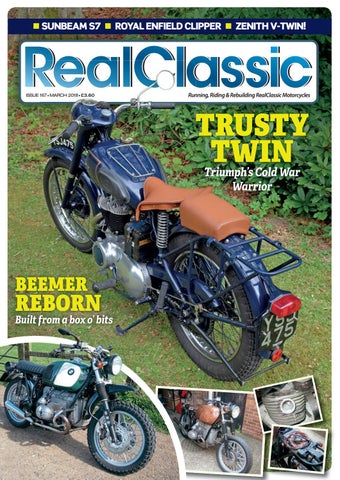
SUNBEAM S7
ISSUE 167 1 MARCH 2018 £3.60
ROYAL ENFIELD CLIPPER
ZENITH V-TWIN!
Run nning, Riding & Rebuilding RealClassic Motorcycles
40
WHAT LIES WITHIN SUNBEAM S7 ................................................6
MASH ROADSTAR...................................... 58
All British parallel twins are the same, just with different badges, we’re told. Not so, says Frank Westworth; here’s an overhead cam inline twin with shaft drive
There’s much ado about these singlecylinder roadsters, which combine timehonoured classic credentials with all mod cons. But how does the Mash perform, months after the initial test ride? An owner buys, rides and reports
ZENITH BIG TWIN...................................... 28
Zenith certainly achieved the zenith of performance in competition. They also built more pedestrian machines, and even tried to restart production after WW2. Alan Cathcart found a charming survivor from 1950: a sidevalve V-twin with Druid forks
RE BULLET TIDY-UP................................... 84
Roger Slater has been fettling a fuel-inject Classic 500 single. In this final episode, he tackles its tingles with some dynamic balancing
ROYAL ENFIELD CLIPPER ...........................52
Remember when you were 17, and could buy a budget bike for less than a tenner? And then thrash it senseless and sell it for five times the price? A 350 single costs a little bit more these days, it seems
THE CONTENTS PAGE ....................................3
You read this bit first but we always write it last. Nifty, eh? INCOMING!...................................................18
RC readers write, rant and rattle on… so much that this section could’ve stretched on to infinity and beyond. Apologies if the guillotine fell on your missive. Maybe next month…
All British parallel twins are the same, just with different badges, we’re told. Not so, says Stuart Urquhart, here’s a sidevalve twin with tele forks and rigid rear end
An earlier encounter with an airhead BMW didn’t work out well. So Chris took quite a gamble when he bought a half-finished project. Why had its previous owners abandoned the build? And if he could complete it, would he even enjoy riding an old airhead? Thinking of buying a BSA 650 twin? Would you splash out on a pre-unit A10 or save some cash with a later A65? An owner of both reveals which one he prefers as a classic ride
RC REGULARS
TRIUMPH TRW........................................... 66
BMW BOXER SPECIAL................................ 40
BSA A65 STAR............................................ 46
REALCLASSIC 167; PUBLISHED IN MARCH 2018
EVENTS ........................................................76
Spring in the air! Which means March is an eventful month READERS’FREE ADS ....................................78
Aha! Some people have finished their winter projects, plainly, while other folk need to make space for a New Machine in the Shed. That would be the case here at RCHQ. Anyone want to buy Frank’s rotary?
TOP TECH TIPS .......................................... 92
Every mechanic who works on old bikes has his own selection of absolutely essential tools, techniques and equipment. An engineer shares his secrets of spannering success
PUBTALK....................................................102
Jacqueline Bickerstaff’s month involved trips to Vintage Stony and the Bristol Show, and much mulling over chain sizes TALES FROM THE SHED .............................108
BSA TRACKER PROJECT ............................ 96
This month, Frank was supposed to be getting on with his BSA project. Again. So of course, the mighty Matchless G12 is on the bench and there’s much ado about carburetion
Odgie’s project to transform an A65 roadbike into a competitive scrambler draws close to completion. The metal bashing is (mostly) over, and now it’s time to fit the new components like carbs and shocks and a snazzy saddle…
SUBSCRIBE
TURNTO
You won’t find RealClassic on the shelves in UK newsagents. If you want to enjoy regular RC reading then take out a subscription and join us in the RealClassic Club.That way, each issue costs just £2.50. Bargain!
P114
TODAY & SAVE
WHO’S DONE WHAT REALCLASSIC sneezed and snuffled into print this month courtesy of Kleenex, LemSip and Strepsils, with bleary input from Rowena Hoseason and Frank Westworth (aka The Cosmic Bike Co Ltd). The top team at Horncastle (including Mike Baumber, Libby Fincham and Kelvin Clements) did sterling work converting our delirious babbling into an actual magazine This month’s COVER PHOTO was taken by Stuart Urquhart, and very handsome it is too. Heaps more RealClassic reading is available throughout the month at www.Real-Classic.co.uk TRADE ADVERTISERS for the magazine or website should call Helen Martin on 01507 529574, email hrmartin@mortons.co.uk EDITORIAL ENQUIRIES should be sent to Frank@RealClassic.net or to PO Box 66, Bude EX23 9ZX. Please include an SAE if you want something returned or a personal reply SUBSCRIPTION INFO is on pg114. Call 01507 529529 to subscribe or renew or buy back issues SUBS QUERIES, late deliveries, or changes of address should be directed to 01507 529529, or email subscriptions@realclassic.net ALL MATERIAL in RealClassic is copyright its authors, so please contact us before reproducing anything. RealClassic is printed by William Gibbons & Sons of Wolverhampton. Our ISSN is 1742-2345. THIS MONTH we’ve been reading ZEN AND THE ART OF MURDER (weird Eurocrime, with a monk in the frozen snows of the Black Forest); LAST TRAIN TO HELSINGØR (home of Hamlet, but in this case it was a selection of surreal Scandi short stories); THE SHERLOCK EFFECT (a somewhat wobbly ‘modern re-imagining’ of the world’s greatest detective), and were treated to a sneak preview of NIGHTFALL BERLIN by Jack Grimwood, a truly clever and thought-provoking spy story set in the dying years of the Soviet empire. But the story – also a murder mystery – is far, far more than that. Great book. A complete highlight. MEANWHILE AT THE MOVIES… yuk phooey too ill to go see Hostiles with Christian Bale, or The Shape Of Water, or even Black Panther. Too poorly to even watch any Game of Thrones [insert self-pitying sniffle here] RealClassic is published monthly by MMG Ltd, PO Box 99, Horncastle, LN9 6LZ, UK. USA SUBSCRIPTIONS are $58 per year from Motorsport Publications LLC, 7164 Cty Rd N #441, Bancroft WI. 54921. Postmaster: Send USA address changes to RealClassic, Motorsport Publications LLC, 715-572-4595 chris@ classicbikebooks.com
FROM THE FRONT
T
hanks to everyone who writes in with comments and (mostly) sane suggestions regarding my endless chaos out in The Shed. I try to reply to them all, but sometimes it’s not possible, due to age, weariness and – remarkably – infirmity. Nothing dramatic, but as a long-time scoffer at those who whine with surprisingly vigorous venom about ‘manflu’, I certainly got my comeuppance. Oh yes, and here’s how. I’d arranged to drop off a 3-wheeler for its service and had also arranged to meet up for a charming lunch with Oliver Hulme, writer for another organ, RC subscriber and a decent bloke. For a Viking. Lovely, lovely February morning. A riding day to dream of and a great trip out. There are loads of fine roads between Bude and Ilfracombe, nearby to the servicing guys, and I skimmed through several sets of directions and alternative routes, both there and back. Circular routes are so much more interesting than just a straightforward there’n’back, don’t you think? Woke up after a bad hot and cold night with a sore throat, but hey. I’m an unreconstructed bloke, me. Sniffle? Piffle. Modern bike gear is superb, and the skies were clear and because I had three wheels on the wagon I truly didn’t care much about ice under trees. Isn’t technology wonderful? Beautiful. I decided to head up Devon’s Atlantic Highway (the A39 to mortals and those immune to marketing hype), choosing to navigate straight there and save the sightseeing for the return leg. I was also running late. This never happens of course and you did not read it here. And then, crossing the river at sublime Barnstaple I suddenly, quite out of the blue and entirely to my surprise, realised that I had no idea where I was going, or how to get there from where I was. I knew that there was a Mitsubishi agent nearby (do not ask) and that the hospital was in the opposite direction, but I also realised that I wasn’t going to either of them… Sanity resumed in a minute or two, but it was something of a grand surprise, believe
CONTACT US! BY POST: BY EMAIL: TP@RealClassic.net ONLINE: www.Real-Classic.co.uk
me. I pulled over and checked my instructions. No problem: head north on the A361 until the only roundabout with a B-road on it, turn right and just follow the wheel, as they say. Except… there was no B-road, which is how I found myself trundling bemused and bewildered through off-season Ilfracombe, which is possibly a very nice place, though it seemed mostly closed. Sorted that out and wandered off to the garage by an unusual route, accepting a hot coffee… except I couldn’t face the thought of drinking coffee, so had a very weak tea instead. We laughed and joked about whether one dip or two for the teabag would be better. I was OK with the humour and got as good as I gave, but when they offered me a super-duper sports machine to meet up with Oliver … I asked for a car instead. It was all downhill from there. In the end I asked Rowena to collect me because I accepted that I was in no fit state to ride. Happily … she agreed. There’s a moral here. Although it’s fun to poke fun at a chum when they complain about ‘manflu’ (is there actually also a ‘womanflu’?), there is a time to understand that the moment for plodding along, increasingly unwell, has passed. This is not an age for heroes. Ride safely Frank Westworth Frank@realclassic.net
THE NEXT ISSUE
RC168 WILL BE PUBLISHED ON APRIL 2nd, AND SHOULD REACH UK SUBSCRIBERS BY APRIL 6th
6 I MARCH 2018
More old bikes online: Real-Classic.co.uk
SUNBEAM S7
All British parallel twins are the same, just with different badges, we’re told. Not so, says Frank Westworth, revisiting an old friend Photos by RC RChive
SUNBEAM S7 SUNBEAM S7 FACT PACK Engine
Air-cooled vertical inline sohc twin
Bore / stroke
70mm x 63.5mm
Capacity
487cc
Compression
6.5:1
Power
25bhp @ 5800rpm
Carburettor
Amal
Lubrication
Gear type oil pump
Transmission
4-speed gearbox to shaft final drive
Clutch
Single plate
Frame
Duplex loop
Front suspension
Tele forks, hydraulic damping
Rear suspension
Plunger
Front brake
sls 8-inch drum
Rear brake
sls 8-inch drum
Front wheel
4.50 x 16
Rear wheel
4.75 x 16
Saddle height
30 inches
Wheelbase
57 inches
Weight
435lb dry
Fuel economy
69mpg at 50mph
Braking
33ft from 30mph
Top speed
80mph
Above: Give a decent designer a clean sheet of paper and a free hand, and it’s possible that you’ll be surprised by the result. BSA quite possibly scratched their collective heads when they first saw this Left: Whichever way you look at it, it is impossible to mistake a Sunbeam twin for any other British bike
W
hat with the current and entirely entertaining trend for bobber bikes built with big fat front tyres, this seemed like a good time to remind myself that … well … there’s nothing new under the classic sun. Take the Sunbeam S7, possibly the world’s original gentleman’s bob. Except … it’s not a bobber at all. Bobbing refers to the mudguards, mostly to the rear, and the S7 was constructed with seriously generous mudguarding. I have seen a couple of chopped Sunbeams, a remarkable thought in these restorative days, but never a bobber ’beam. This is possibly just as well. Sunbeam’s misty green machine (OK, so they also painted them black, but green is so much more … green) was never the glorious success its builders had hoped for. You almost certainly know the story. BSA – owners of the Sunbeam name after buying it from AMC in November 1943 – were intent upon producing a high quality motorcycle, aiming for that elusive high quality rider, I suppose. They took a long, calculating look at a current BMW, with telescopic forks, wide cradle frame and sprung rear end, and presumably pondered.
It was presumably pretty easy in 1943 to calculate exactly how well an obvious replica of a German motorcycle would sell to British motorbicyclists, come the inevitable cessation of the current hostilities, so powering their new up-market bolide with a sweetly-balanced and mechanically civilised flat twin engine was something of a nonstarter. However … BSA also built cars before the war, and were thus no strangers to the idea of small capacity multi-cylinder engines. Once the original flat-twin idea had been ditched, BSA considered using an in-line twin. History has it that they resurrected a 1928 design usually referred to as the Line Ahead Twin, and that same history reveals that the bike’s designer – the excellently-monickered Erling Poppe – had a prototype example of that engine parked on a cabinet in his office. Be that as it may, BSA’s decision to design and bring to market an entirely new motorcycle was both bold and smart. They reasoned – correctly – that many other manufacturers would simply dust off their pre-war or wartime models as soon as they could, aiming to get back into civilian production as soon as possible.
Subscribe and save: www.Real-Classic.co.uk/subs
MARCH 2018 I 9
The entire power train was unique for a 1940s British motorcycle, and BSA’s own view of it was certainly enthusiastic. It’s not easy to imagine a machine further removed from the other parallel twins which surrounded it in the showrooms
Sensible thinking, because that’s exactly what happened. They also understood that the serious sales success of the Triumph parallel twins was as obvious to their rivals as it was to BSA, and that everyone would be pedalling frantically to produce their own take on this popular approach to a compact powerplant. And in fact BSA were themselves well down development highway with prototype parallel twins of their own, including one with a bevel-driven overhead cam. Hmmm… an ohc twin for the smart new Sunbeam? It would certainly add some sophistication.
It would also be expensive, relatively speaking. But the new Sunbeam – a sophisticated motorcycle for the discerning and hopefully affluent motorbicyclist – would surely be able to charge a premium price for this premium product. It made sense, plainly, because that is what they did. It’s tediously typical that the new machine has ended up with something of a tarnished reputation. Although the super Sunbeam twin was hardly a commercial success, it was not the disaster that so many have said. Ride one and see, if you doubt this. And if you’ve
Although most photos show the bike from the right – exhaust pipe – side, the engine is equally striking from the left. The finned cover hides the pair of angled spark plugs and is finned to match the engine. And the HT leads are far too long…
Final drive was famously by an exposed shaft. The red device is a universal joint, essential to allow the drive shaft to move vertically along with the plunger-sprung rear wheel
10 I MARCH 2018
ridden one before … ride another. Every time I ride one I am reminded how remarkable they are, and how completely exceptional they were when production commenced in 1947. However, then as now, the rider with a wallet sufficiently swollen to buy a new motorcycle had a tendency to buy something familiar. Then as now, resistance to change was considerable. I call Bert Hopwood to strengthen my case. This is what he wrote about the new machine: ‘The Sunbeam was lauded by many cranks whose writings on the subject practically filled the gossip columns of the technical press – none of these admirers were anxious to own one of these wonders. Very few were sold.’ Thank you, Bert. Back to the bike. Having decided that the Sunbeam would follow the BMW practice of a twin with its crankshaft in line with the frame, it was obvious that the engine would also need to have its own gearbox and shaft final drive – either that or twist the drive through a right-angle to employ a chain final drive, which was to be the Douglas way. Instead, BSA employed Mr Poppe’s knowledge of 4-wheeled transmission systems, fitted a car-type clutch between the engine and its in-line gearbox, and sent the power to the rear wheel by shaft, rather than chain. As was fitting for a gentleman’s motorcycle, of course.
More old bikes online: Real-Classic.co.uk
Subscribe and save: www.Real-Classic.co.uk/subs
MARCH 2018 I 11
If the S7 and its close relative the S8 have A Most Famous Fault, it lies at the end of that shaft drive. Instead of turning the drive through that right-angle (there is no getting away from this with an in-line engine) at the gearbox, Sunbeam performed the trick at the rear wheel, employing an underslung worm arrangement rather than bevel gears to do so. Everyone knows that this is the famous weak point. It may have been, but not as weak as its reputation suggests. What is less often reported, and which cannot have helped sales, is that the rear drive soaked up too much power. What should have been a lively ohc design, more modern in almost every way than any contemporary British twin, never feels fast, and certainly isn’t quick. Which might make you wonder why BSA went for the relatively rare ohc engine. We can of course only speculate, as reading everything available about the bike doesn’t provide a definitive answer. Maybe it was for the sheer kudos involved in the overhead cam? After all, only pukka racers employed them – along with their roadgoing relatives,
The drive was turned through 90° by an underslung worm drive, which sounds a little strange. Hopefully the diagram will show how it works
mainly from Veloce and Norton. So a little brochure excitement, maybe? Another theory is that it kept the engine slim, which is an idea, although it also made the engine tall, meaning that it had to be mounted low in the frame – or as low as its wet-sump would allow. But theories are exactly that – theories. If the Sunbeam was intended to be entirely remarkable while at the same time being completely practical, then it succeeded. It’s always more positive to consider success than failure, and riding a decent Sunbeam S7 should serve as a reminder that this is one of the great unacknowledged triumphs of the post-war British motorcycle industry. And right away I should state, loud and bold, that this is my own view – other views are extremely common. Whenever I ride a bike to write a feature about it, I like to take notes, starting with Left: These engines are among the least oil leakprone Brit twins, even though great care was taken to include a modern lubrication system
Creature comforts were well taken care of with a fine solo saddle. These are hard to find now as too many folk fitted horrid dualseats, but they’re very easy on the … backside
12 I MARCH 2018
sitting down and seeing how hands and feet fit to handlebars and footrests. This is an entrenched habit, mainly because for several decades I’ve tried to avoid describing how the controls fall readily to hand. Because they always do. Almost always. The S7 is no different. In terms of the ergonomic relationship between backside, head, hands and feet it feels very familiar. Your feet are more or less below your knees, your back is straight and your hands are a little high and a little wide. The bike you can see here isn’t an early S7, in fact it’s an S7 De Luxe, but it retains the purity of the fine solo saddle. Shades of the new Triumph Bobber maybe, but if you get an original S7 saddle then you’ve got the more comfortable seat of the two. Early S7s came with really old-fashioned inverted levers for the front brake and clutch, but they didn’t last long. Really early S7s were built with rigid engine mountings, but I’ve never ridden one of those – maybe it’s time to be thankful for small mercies, as they apparently vibrate over-enthusiastically.
The electricals all live inside a neat gubbins box, which carries both the combined ignition / lighting switch and the ammeter in its lid. There’s even provision for a couple of spare lightbulbs inside
More old bikes online: Real-Classic.co.uk