MATCHLESS G15CS
ISSUE 166 FEBRUARY 2018 £3.60
TRIUMPH T100C
LAVERDA JARAMA!
Running, Riding & Rebuilding RealClassic Motorcycles
PRINTED IN THE UK
WHAT LIES WITHIN
32 ARIEL OUTFIT............................................6
NORTON ES2 ...........................................64
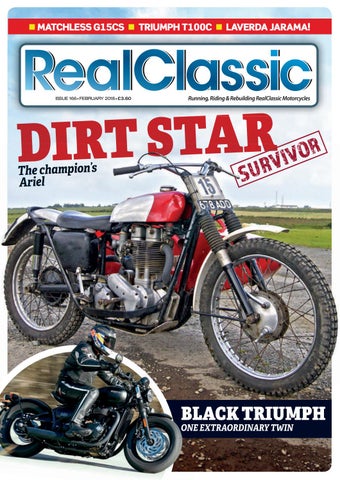
Six decades ago, trials ace Ron Langston won countless scrambles and an ISDT gold medal piloting Ariel’s acclaimed off-roader. These days, one of his surviving sidecar outfits enjoys a more leisurely life in the wilds of the west country. Rowena Hoseason investigated the machine’s history while Frank Westworth was actually brave enough to bounce around on the beast…
Not everyone can afford to own a cammy Norton, and not everyone would want to run one. But Norton’s pushrod single offers plenty of potential at a considerably lower price. Henry Gregson discovers a garden-gate special which emerged from a garden shed…
TRIUMPH BOBBER BLACK ......................32
While the riding world has become accustomed to the idea – and reality – of the retro, it’s taking a while for the retrocustom bike to find its feet. Alan Cathcart has been out and about on the newest almost trad twin from Triumph MATCHLESS G15CS .................................44
Many factory-built parts-bin specials are famous for being little more than mongrels, but sometimes necessity can be the mother of magnificence. Frank Melling explains why Norton’s big twin engine ended up in AMC’s enduro frame, and how the whole proved greater than the sum of its parts… LAVERDA JARAMA..................................56
The original 180-degree incarnation of Laverda’s Jota is famous for being the big beast of the breed, the chest-thumping Neanderthal of the triple clan. But the late 1970s spawned an almost civilised counterpart specifically for the USA, as Nolan Woodbury explains…
REALCLASSIC 166; PUBLISHED IN FEBRUARY 2018
RC REGULARS THE CONTENTS PAGE ...................................3
It’s a whole new year here! Welcome. Hope to see you soon somewhere!
BSA A10 SPECIAL ....................................70
A long time ago, Rob Smith bought a clapped-out classic with seriously canine credentials. The sleeping dog lay for 15 years, until Rob was inspired to undertake a back-to-basics budget build. This, then, is his cut-price creation…
WE’VE GOT MAIL! ...................................... 18
TRIUMPH T100C......................................72
READERS’FREE ADS .................................. 84
Lots and lots of letters. Lots of folk with lots to say EVENTS ...................................................... 78
Wrap up warm, now. Make sure you wear your winter gloves and stout boots
‘Needs light recommissioning’ might mean fresh petrol and a new spark plug, or it could entail an entire engine rebuild. Paul Henshaw tames two Tigers which recently came back from the States, and finds out what the 500 street scrambler is like to ride…
We’ve been bargain hunting. Well… it’s a challenge! PUB TALK ................................................. 102
PUB has been invited to Christmas by her sister, AJS Mary, unaware that the plan involved a Christmas ‘re-enactment’ down in Mary’s (motorcycle) stable at the bottom of her garden…
RE BULLET TIDY-UP ................................90
Roger Slater found a low mileage, fuelinjected Royal Enfield Classic; something of a rarity in the US of A. It worked well enough, but Roger couldn’t resist fettling it towards perfection…
TALES FROM THE SHED ........................... 108
Take two Brit twins. Frank’s almost decided to build a custom out of a stocker and a stocker out of a custom. And then a whim changed everything. Matchless madness…
BSA TRACKER PROJECT ..........................96
Odgie’s project to transform an A65 roadbike into a competitive scrambler continues with engine upgrades, converting the heavy 650 lump into a lightweight 750 powerplant. At this moment, he remembers that it’s better to be born lucky than good looking...
SUBSCRIBE
TURNTO
You won’tfindRealClassiconthe shelvesin UKnewsagents.Ifyou wanttoenjoy regularRCreading then take outa subscriptionand join usin theRealClassicClub.Thatway, each issue costs just£2.50.Bargain!
P114
TODAY & SAVE
WHO’S DONE WHAT REALCLASSIC stomped merrily through the winter snow and into print at the hands of Rowena Hoseason and Frank Westworth (aka The Cosmic Bike Co Ltd), and Mike Baumber, Libby Fincham, Kelvin Clements and rest of the Mortons production team at Horncastle This month’s COVER PHOTO was snapped by RH on a windy day at Davidstow airfield Heaps more RealClassic reading takes off throughout the month at www.Real-Classic.co.uk TRADE ADVERTISERS for the magazine or website should call Helen Martin on 01507 529574, email hrmartin@mortons.co.uk EDITORIAL ENQUIRIES should be sent to Frank@ RealClassic.net or to PO Box 66, Bude EX23 9ZX. Please include an SAE if you want something returned or a personal reply SUBSCRIPTION INFO is on pg114. Call 01507 529529 to subscribe or renew or buy back issues SUBS QUERIES, late deliveries, or changes of address should be directed to 01507 529529, or email subscriptions@realclassic.net ALL MATERIAL in RealClassic is copyright its authors, so please contact us before reproducing anything. RealClassic is printed by William Gibbons & Sons of Wolverhampton. Our ISSN is 1742-2345. THIS MONTH we’ve been reading HOLLYWOOD STATION by Joseph Wambaugh (superb streetcop policing, like the 85th Precinct series crossed with NYPD Blue); UNDER THE BRIGHT LIGHTS by Daniel Woodrell (deeply gritty Louisiana noir); SIX STRINGS by FW of this parish (editing and proofing and nearly ready for publication!) Also THE AUTOMOBILE CLUB OF EGYPT by Alaa Al Aswani (utterly brilliant tale of the club and of British rule in that awesome country), and FAMILY HONOR by Robert B Parker (excellent and short PI procedural set in Boston) MEANWHILE AT THE MOVIES… we finished the DEAD OR ALIVE trilogy of seriously strange Japanese shockers; adored Frances McD in THREE BILLBOARDS; think Ridley seriously lost the plot with ALL THE MONEY IN THE WORLD, and Frank flat-out hated MOLLY’S GAME. But DEVIL’S ADVOCATE with Kenau and Pacino was a romp! RealClassic is published monthly by MMG Ltd, PO Box 99, Horncastle, LN9 6LZ, UK. USA SUBSCRIPTIONS are $58 per year from Motorsport Publications LLC, 7164 Cty Rd N #441, Bancroft WI. 54921. Postmaster: Send USA address changes to RealClassic, Motorsport Publications LLC, 715-572-4595 chris@ classicbikebooks.com
FROM THE FRONT I always really enjoy this time of year. My inbox and Facebook sessions are filled with endless grousing about the rain (‘In January! How shocking!’) or the cold (see previous parenthesis), followed by endless outrage at … well … anything and everything. Not here. Here in the windy wetness of Cornwall (some great gales so far, thanks for asking), all is furtive planning. Because last year I discovered something I’d not really recognised before. I’d better whisper it, because it’s one of those things which everyone knows everything about … apart from me. Did you know that several motorcycle emporia boast a café? I sort-of did, although a café, coffee and cake have never been a reason to visit a bike shop. Not really. I often somehow manage to steal a coffee when watching the Ace mechanics down at Ace Mosickles in Bude repair / MoT / laugh at my bikes, but that’s not the same as sitting in a café contemplating the wonder of nature which is a bacon buttie. Or a slice of fruity cake. Not that… And then I was wondering where to break the dull drive home from somewhere even further north than Bristol, and it dawned on me that there’s a big bike shop in Bridgwater which has a genuine caff serving genuine stuff. So we pulled in there and … and … took a bike out for a test ride and … I’ll stop now. And then North Cornwall Motorcycles moved premises and found themselves with a great big car park … so they slotted in a portacabin and a few tables and chairs and hey presto! Another excuse for a ride around. ‘I’ll just pop out to buy …um … a spark plug!’ (also a coffee and maybe an egg’n’bacon sandwich, and…) And I fell to wondering. Wondering is a good thing at this time of year, when opportunities for wandering can be restricted by unavoidable forces of nature. How many other bike shops – large or small, urban or rural – also boast a café, a place where a chap can ride up, sit down, warm up and
CONTACT US! BY POST: BY EMAIL: TP@RealClassic.net ONLINE: www.Real-Classic.co.uk
sup up while surrounded by other chaps chatting about bikes and things like that, rather than whining about the weather or the price of things? Do you know any you can recommend? This has to be a bike shop with a café, not a café which just happens to attract bikes… If this sounds like I’m sort-of looking for excuses to go riding off to bike shops as an excuse to look at bikes and maybe talk about bikes … well, that’s exactly what I’m doing. Time was, I would plan my navigations on a Little Chef roadmap, often detouring through all manner of odd places in a quixotic quest for the elusive hot coffee or all-day Olympic breakfast, caffeine and sat-fats being essential ingredients for rider wellbeing on such a winter’s day. And now … hardly any Little Chefs and no free road maps showing where they are. Any suggestions? I’m planning for a whole pile of summer rides, see, and need excuses to visit unfamiliar places. Ride safely Frank Westworth Frank@realclassic.net
THE NEXT ISSUE
RC167 WILL BE PUBLISHED ON MARCH 5th, AND SHOULD REACH UK SUBSCRIBERS BY MARCH 9th
Six decades ago, trials ace Ron Langston won countless scrambles and an ISDT gold medal piloting Ariel’s acclaimed off-roader. These days, one of his surviving sidecar outfits enjoys a more leisurely life in the wilds of the west country. Rowena Hoseason investigated the machine’s history while Frank Westworth was actually brave enough to bounce around on the beast… Photos by Rowena Hoseason, Frank Westworth, Mortons archive
6 I FEBRUARY 2018
ARIEL TRIALS OUTFIT
‘I
t’s great fun on the road,’ says owner Roger, in an encouraging tone of voice. There’s an agenda here, I sense, one which involves me perching on the passenger plinth of this Ariel outfit while he pilots the plot around a windswept Davidstow airfield. Long-time readers might recall that the last time I went anywhere near a trials outfit, the escapade ended in tears (and A&E). A
main course of caution with a side order of suspicion seems to be the order of the day – confirmed by Roger’s next statement. ‘Mind you, it’s not too comfortable for the passenger, and it’s not a passive ride.’ No kidding? ‘The second person needs to be able to lean and clamber about all over the bike for optimum performance. Screaming is discouraged – even if both driver and passenger have occasion to be in the chair
at the same time on left-handers.’ Pardon, sorry, what? ‘I can even ride it on two wheels with the third whirling around of its own free will in the fresh air. Joy!’ I decide that I’m busy today, tomorrow, and possibly for the rest of my lifetime, but my admiration for the men who created and campaigned these machines goes through the ceiling. Who built this bike, and what exactly is it?
Left: Power – not too much of it – is supplied by this handsome all-alloy Ariel comp engine. Most of them carry a model designation cast into the timing cover, but as they were swapped several times in every season, exact history can be a challenge Above: One secret of an effective outfit is solid connections between bike and chair. These are seriously hefty Right: The Burman gearbox is well up to the demands of trials riding, and works as well as they always should. Observe the slightly heroic footrest hangers, too, as well as the extra bash protection provided for the power train
THE MAN Legend has it that a 19 year-old Ron Langston competed in his first novice trials event in the early 1950s – and won it. He rode trials during his time in the army, and joined the Ariel factory works team in 1956. He was an archetypal all-rounder of the old school who campaigned on two and three wheels, in trials, scrambles and road races. Equipped with Ariel’s new HS/HT 500 offroader he immediately won the Cotswold and Greensmith trials, went on to claim a gold medal in the ISDT, and represented Great
Britain in the Motocross des Nations. And those are only the highlights of an actionpacked riding life. Ariel closed their competition shop in 1959. Ron was suffering from a back injury so he tried his throttle hand at something a bit less bumpy than flat-out scrambles. This speaks volumes as to the mettle of the man, if his idea of taking things a bit easier was championship level road racing. In his third outing on tarmac, Ron achieved a ‘sensational’ second place in the 1959 Manx GP. Ron was ‘the best all-rounder for many years,’ said
Motor Cycle. His ‘determination and daring have been obvious right from the start; to that he has added superb throttle control.’ More trips to the top of the podium followed – including at the Southern 100 and the Thruxton 500 mile endurance event – while 1961 saw Ron compete in the Belgian Grand Prix and the Senior TT. But the allure of off-road competition kept pulling him back to the muddy stuff, riding an Ariel 500 scrambles single which came directly from the factory, fitted with a trials sidecar for his regular passenger, Doug Cooper. Together, Doug and Ron participated in countless events during the 1960s, winning five British Championships along the way. ‘Ron and Doug were extremely successful as a team,’ explains Roger, current custodian of the Ariel. ‘To reach the levels of success that they achieved you do need a very special relationship with each other. Each has to have complete confidence in the other. It’s second nature for them both to anticipate where the bike will go, how it will behave and what are the optimum relative positions – which change constantly. Speaking from experience, this takes a lot of doing. The bike’s provenance is impeccable. Even though it’s currently fitted with a stock oil tank, the hand-made alloy original is with it. Old alloy can be prone to cracking, so…
8 I FEBRUARY 2018
More old bikes online: Real-Classic.co.uk
ARIEL TRIALS OUTFIT
One championship-winning trials outfit. Simple, rugged and reliable
‘People who saw the pair ride suggest that their preferred method of tackling a section was to go back as far as possible from the section, wind it up, and go like hell into it. ‘Sounds simple? It’s not, believe me.’
Although it’s not currently fitted, the Ariel’s handmade air filter has survived along with the bike itself
THE MACHINE Royal Enfield first took the plunge with a fully sprung trials bike and, when it was obvious that their experiment was successful, AJS, BSA and Triumph followed suit. Ariel joined the fray in 1953 when the comp shop pulled apart their old rigid frame and its faithful Red Hunter engine, making significant changes to keep up with (and ideally overtake) the competition. For instance, the size of the exhaust valve was reduced, which didn’t damage peak power but provided more low-rev grunt. This modification lowered the temperature around the exhaust valve and the charge temperature at the end of the induction stroke – a small increase in volumetric efficiency made maximum torque available a couple of hundred rpm lower down the rev range. Low speed running was also improved by fitting new cams with quietening ramps, which had the additional effect of making tappet clearance less critical. Ariel were among the early adopters of Amal’s new Monobloc carb while it was still in its experimental stage. Swapping from the earlier carb to the new design meant they
could drop the size from 1 3/16th to 1 1/16th on the 500 competition engine, while the 350 used a one-inch version. The prototype springer frame was put together in the winter of 1954. Ariel did all they could to make sure that the swinging arm chassis wasn’t significantly heavier than its rigid predecessor, and the all-brazed, large diameter spring frame weighed just 4lb (!) more than the rigid one. Burman also shaved weight from the gearbox, and made it shorter as well, while the two-gallon alloy petrol tank and a skinny front wheel shaved off even more ounces. In the end, the springer Ariel trials bike was 10lb lighter than the VCH it replaced; a remarkable achievement. Even so, many competitors ditched a stack of standard components to save more weight – one Mr Miller built an entire business around this process, of course. Said Don Morley; ‘It was a mystery how Ariel would fit so many heavy bits yet finish with just about the lightest bike.’ The Ariel 500 was also one of the most
powerful engines in its class, so perhaps it’s no surprise that Sammy Miller went onto achieve glory with GOV 132. When the HT5 was launched in 1955, ‘Ariel had possibly the best purpose-built trials bike ever built,’ according to Don Morley. It wasn’t perfect, of course. Some riders criticised the swap from the BT-H racing magneto over to the Lucas wader, which ‘never managed as large a low-rev spark as its predecessor.’ But as Ron Langston so ably demonstrated, the Ariel 500 was the class act of its era. A 346cc version followed in 1956, using the all-alloy Red Hunter-type motor with a caged, double roller big end. It was very similar to the 500 apart from its gear ratios and cost much the same, so while some 450 HT5s were built, fewer than 40 HT3s saw any action. That was a shame, reckoned Don Morley. ‘Even in its detuned HT form, the 500 was always too rorty.’ He thought that the HT3 would be ‘better for the less experienced rider, while still at a weight advantage over the 350cc offerings from BSA, AMC and Royal Enfield.’
Subscribe and save: www.Real-Classic.co.uk/subs
FEBRUARY 2018 I 9
Further factory development was cut short when Ariel switched their attention over to twostroke road bikes – but that didn’t stop riders like Langston keeping their bikes competitive well into the following decade. Fork shrouds were jettisoned to improve steering lock, which usually meant the petrol tank would soon sport a pair of matching dents. Smaller and lighter front hubs were fitted; the underside of the petrol tank could be cut away so it sat lower down on the frame. Even the oil tank could be abandoned, and the engine oil carried inside the frame seat downtube. And who needs an air filter, anyway? HT5 owners did need to keep a close eye on lubrication, because the cam and followers were prone to wear rapidly, while the oil pump would cheerfully stop scavenging if dirt blocked the ball valve. The more powerful Triumph Bonneville oil pump could be made to fit. Riders with longer legs were well advised to modify the carb’s jutting-out
10 I FEBRUARY 2018
angle. If fitted with an air cleaner it was almost guaranteed to knock a kneecap, significantly affecting the rider’s manoeuvrability. The solution was to cut and re-weld the cylinder head inlet stub angle, to tuck in the carb almost parallel to the frame.
Above: Langston and Cooper, 1956 British Champions, handling the mighty Ariel on their way to victory Below: It’s now 2017 (or it was when the pic was taken), and Roger and Rowena demonstrate their own winning ways…
More old bikes online: Real-Classic.co.uk
12 I FEBRUARY 2018
More old bikes online: Real-Classic.co.uk