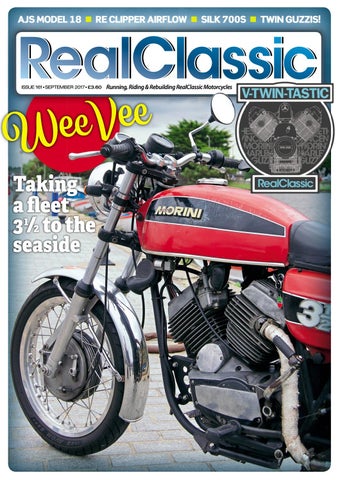
AJS MODEL 18 RE CLIPPER AIRFLOW SILK 700S TWIN GUZZIS!
ISSUE 161 SEPTEMB BER 2017 £3.60
Running, Riding & Rebuilding RealClassic Motorcycles
WHAT LIES WITHIN
AJS MODEL 18...............................................6
Stuart Urquhart has dreamed of owning an iron-head AMC single since he was a wee nipper and his dad rode a Matchless G80. But in the way of old bikes and long-held ambitions, the reality threatens to turn into a total nightmare… TWIN GUZZIS ..............................................26
Take two V-twins of the same engine capacity, built by the same manufacturer, in the same decade. Surely the riding experience will be similarly consistent? Nick Adams experiments with an automatic Convert alongside his old faithful Eldorado… RE CLIPPER AIRFLOW .................................36
Royal Enfield reckoned that their Airflow fairings would improve fuel consumption by 20% and add 5mph to a bike’s top end. Oily Boot Bob experiments with the elements and shoots the breeze… MORINI 3½..................................................44
RealClassic played host to a truly remarkable machine; a Morini 3½. Frank Westworth got carried away SILK 700S ....................................................52
Few people ever clapped eyes on a Silk 700 when these two-strokes were new, back in the late 1970s. Less than 150 Silks were built
06
REALCLASSIC 161; PUBLISHED IN SEPTEMBER 2017
and maybe one-third still survive… so it’s faintly amazing that Stuart Francis found one – in New Zealand!
RC REGULARS THE CONTENTS PAGE ....................................3
VEE VARIATIONS.........................................58
An eccentric and remarkable collection of motorcycles. Something for everyone, hopefully!
Over the years, John Waltham has owned a succession of big V-twins: pre- and post-war Vincents, Harley and Hesketh heavyweights. Which machine does he rate as the best of the bunch? The answer may surprise you…
WE’VE GOT MAIL! ........................................16
Loads and loads and loads. Everyone loves reading letters: write more! Send more ancient pics! More opinions!
TALE OF THE TRI-FLY ..................................66
You never know quite where the search for a previously-owned motorcycle will take you. Alan Freke wondered what happened to his old Triumph twin, and uncovered the curious affair of the double-engined Douglas…
EVENTS ........................................................72
Sizzling roads, cloudless skies and heroic suntans await anyone riding to all these events. Also free beer. Or possibly not… READERS’FREE ADS ....................................74
An increasingly interesting range of bikes for sale. Few bits, strangely. Are there no bits left? Anywhere?
MATCHLESS MODEL X ................................80
A very long time ago, Frank of this parish acquired a non-running Matchless Model X as a project. Inevitably, he did nothing with it. Richard Negus is a man who can, and indeed did, and this is continuing story…
PUB TALK ...................................................100
PUB suffered an embarrassing ‘almost breakdown’, and provided the mid-day entertainment at her club’s annual rally
BSA TRACKER PROJECT ..............................88
TALES FROM THE SHED ............................106
Work commences on Odgie’s dirt-track scrambler. He begins with big bits from a BSA A65, adds a sprinkle of Triumph T140, Moto Morini and Can-Am components, and sets to with the welding kit…
Progress! Success everywhere! It cannot last! Well, maybe…
BMW R80.....................................................94
Gearbox problem? Fixed. Electrics? Sorted. Stephen Herbert now turns his attention to petrochemical matters as his ‘bargain’ eBay Boxer gets set to return to the road. Time to seal the tank and balance those carbs
SUBSCRIBE
TURNTO
You won’tfindRealClassiconthe shelvesin UKnewsagents.Ifyou wanttoenjoy regularRCreading then take outa subscriptionand join usin theRealClassicClub.Thatway, each issue costs just£2.50.Bargain!
114
TODAY & SAVE
WHO’S DONE WHAT REALCLASSIC rasped into action this month, ignited by Rowena Hoseason and Frank Westworth of The Cosmic Bike Co Ltd, and Mike Baumber, Kelvin Clements and rest of the Mortons production team at Horncastle Heaps more bike features are posted throughout the month at www.Real-Classic.co.uk TRADE ADVERTISERS for the magazine or website should call Helen Martin on 01507 529574, email hrmartin@mortons.co.uk EDITORIAL ENQUIRIES should be sent to Frank@RealClassic.net or to PO Box 66, Bude EX23 9ZX. Please include an SAE if you want something returned or a personal reply SUBSCRIPTION INFO is on pg114. Call 01507 529529 to subscribe or renew or buy back issues SUBS QUERIES, late deliveries, or changes of address should be directed to 01507 529529, or email subscriptions@realclassic.net ALL MATERIAL in RealClassic is copyright its authors, so please contact us before reproducing anything. RealClassic is printed by William Gibbons & Sons of Wolverhampton. Our ISSN is 1742-2345. THIS MONTH we’ve been reading the VARG VEUM hardboiled Nordic Noir thrillers (books much better than TV series shock); the LUCIFER graphic novels (books much better than TV series shock); How to Remove a Brain: And Other Bizarre Medical Practices (there is no TV series – yet!). We also strode through THE MAN FROM BERLIN, by Luke McCallin (a WW2 military detective tale), YOU KNOW WHAT YOU COULD BE, from Mike Heron and all about marvellous 60s hippy music), and DARK WATER by Parker Bilal (sadly disappointing detective tale set in Cairo and Istanbul). MEANWHILE AT THE MOVIES we adored Kedi (the cats of Istanbul) and Valerian (superbly overeverythinged sci-fi); boggled at Out Of Thin Air (false confessions to true-life murders in Iceland), and thought Fight Club was possibly more relevant now than two decades ago… RealClassic is published monthly by MMG Ltd, PO Box 99, Horncastle, LN9 6LZ, UK. USA SUBSCRIPTIONS are $58 per year from Motorsport Publications LLC, 7164 Cty Rd N #441, Bancroft WI. 54921. Postmaster: Send USA address changes to RealClassic, Motorsport Publications LLC, 715-572-4595 chris@ classicbikebooks.com
FROM THE FRONT
I
had a dream. That’s always good opening line for a short story – or even a speech! Anyway, this is a short tale about a motorcycling dream. The dream started off like this… I’ve long been a considerable fan of Nortons – although not of the famous featherbed variety, unusually. I’ve always enjoyed the non-featherbed singles and twins, the 750 hybrids, Commandos – even the lightweights! And I have ridden more miles aboard rotary Nortons than aboard any other British bikes: when production ceased I was seriously unhappy. The great 1990s sillinesses followed, with obviously daft ideas like the V8 and the like polluting the great name of Norton. And then, much later, friends in the USA sent me details of a new Norton, an air-cooled parallel twin labelled up as a Commando. It looked awesome. An American Norton? Why not? If it’s OK to build Harley-Davidsons in India and Triumphs in Thailand, then why not Nortons in America? Especially as the quality appeared to be high. Then that project collapsed. Again, I was disappointed. Then that project reappeared, this time in the UK, where a serious businessman had reacquired the Norton name and announced plans to build them in the UK. Based on the US machines, these were every bit as interesting to me – more so, because they were to be built in Derbyshire. This is good. However, as I have a reasonable experience of business and can do sums, I could not see how a tiny company could build affordable bikes by hand then sell them at both a price affordable by humans and at a profit. At the time it was a popular topic of conversation among my pals and I remarked that if they ever did get one into production I would buy one. They did … and I did. It is a remarkable and remarkably interesting machine. The bike arrived in the late summer of 2010 and was everything it claimed to be. It’s fast, it steers flawlessly, it has excellent brakes and looks truly brilliant. Every time I looked at it
CONTACT US! BY POST: BY EMAIL: TP@RealClassic.net ONLINE: www.Real-Classic.co.uk
I experienced a warm glow of two-wheeled happiness. Every time I rode it I struggled with it. The miles continued to clock up on the old rotary Commander – an excellent touring bike. Also on the Mk3 Commando – excellent for everything bar motorways. And on the unfaired rotary too, which is in fact just excellent – and suits the way I ride. Almost every day there was an excuse not to ride the 961 Commando. And eventually I wrapped it up, oiled it to stop the salt getting to it and rode other bikes. And finally, after 7 years and less than 700 miles, it’s gone. There’s nothing wrong with the bikes, but I do not ride the way they do, so… So why does it feel like an odd personal failure? Back, then, to less sporting machines! Ride safely Frank Westworth Frank@realclassic.net
THE NEXT ISSUE
RC162WILL BE PUBLISHED ON OCTOBER 2nd, AND SHOULD REACH UK SUBSCRIBERS BY OCTOBER 6th
6 I SEPTEMBER 2017
More old bikes online: Real-Classic.co.uk
AJS MODEL 18
Daydream
BELIEVER Stuart Urquhart has dreamed of owning an iron-head AMC single since he was a wee nipper and his dad rode a Matchless G80. But in the way of old bikes and long-held ambitions, the reality threatens to turn into a total nightmare… Photos by Stuart Urquhart
Subscribe and save: Real-Classic.co.uk
SEPTEMBER 2017 I 7
Above: The major difference between AJS and Matcchless versions of the 500 singles was the position of the magn neto: on the AJS it’s in n front of the cylinder
Left: The engine is a treat, as are a lot of iron-head d siinglles, and d the basic design lived on until 1967
R
eaders may recall RC105 and my fruitless search for a rigid Matchless G80 iron head much like my father’s – a rare AMC motorcycle and one that has eluded me for many years. As a kid I always admired demobbed dad sitting proudly on his new Matchless. His sepia-tinted picture enjoyed pride of place in our family home. I suppose most kids idolise their fathers, especially one who encourages motorcycling in his impressionable progeny. I feel indebted to him for my initiation into the magnificent world of motorcycling, and I’m certain he would approve that I’m now handing down his two-wheeled values to my daughter. What follows could be interpreted as the conclusion of a rather long but fruitful journey for me. RC147 told the story of a cracking AJS Model 18 iron head now used by
8 I SEPTEMBER 2017
our own respected editor. Another side to this story goes something like this: I missed this striking and original AMC machine by a gnat’s whisker. The advert inspired dreams of it flying up and down some of Scotland’s finest roads – but that dream would be shattered if RC’s editor could call upon his wonky knee to kickstart the beast. And of course he managed this defining task, and ‘with not too much effort’ by his own account. Thus I, and several others who had joined the shuffling cyber queue to Venture Classics’ portal, reluctantly removed our bookmarks and dispersed quietly into the ether, muttering in disappointment. But as the ancient adage goes, ‘Everything comes to those who wait’. Would you believe that several months later not one but two AMC rigid 500cc singles turned up on different portals? One was a Matchless, the
other an AJS, and the latter was very similar to Frank’s beauty; same year, same defining black. With my dad’s portrait very much in mind I was naturally drawn to the Matchless, but while I was deliberating over what to do next, the requested pictures from the vendor Kettering Classics popped onto my screen. It was a rather splendid looking Model 18 and before I could help myself, I agreed to buy it. Less than one week later the AJS was sitting in my car port. I suppose a brief intro about this AMC model would be a timely interlude before we take a serious look at whether the Ajay was an inspired buy... or not? In 1931 during a difficult depression Matchless took over struggling rivals AJS and six years later formed Associated Motor Cycles (AMC). The merged business continued to manufacture both makes as
More old bikes online: Real-Classic.co.uk
AJS MODEL 18
Stuart U reckons this to be one of the best-ever looking motorcycles. Who’s going to argue?
essentially identical machines apart from one obvious difference; the Matchless had its magneto mounted behind the cylinder while the AJS was located forward. The archetypal 500cc singles were re-introduced in 1945 on the back of AMC’s excellent WW2 military Matchless G3 350cc, of which the firm supplied over 80,000 machines for the war effort. The post-war civilian models were essentially similar machines with an all iron barrel and cylinder head, four-speed gearbox, Teledraulic forks, rigid frame and sprung solo saddle. The 500cc rigid model had a bore and stroke of 82.5 x 93mm with a substantial roller bearing bottom end. Renowned for a long stroke and lazy engine, both models gave long and reliable service and required minimal maintenance to remain in peak condition. AMC’s own patented Teledraulic forks were introduced in 1941 and by 1947
models were updated to swinging arm rear suspension with ‘candlestick’ shock absorbers. AMC replaced these with the firm’s famous ‘jampot’ units in 1951. My concern before lifting the lid on my newly-acquired AJS was that I do tend to land rescue projects. Certainly this latest purchase looked original and tidy and I would be the first to congratulate late 1940s AMC designers for scoring a bull’s eye with the M18’s rugged looks. But non-standard Italian Radaelli rims and a pattern cheese-grater horn hinted at an earlier restoration, although mercifully not too much attention had been lavished on the gleam factor. The original brass tank badges are a nice touch and rare items according to KC. Unfortunately no history came with the bike but complimentary membership to the owners’ club did, and I intend to contact the dating officer and see what history I can dig up.
Subscribe and save: Real-Classic.co.uk
Depressingly, my inspection was about to expose several mechanical faults that would scupper any immediate joy ride. But more distracting was the set of monstrous vinyl transfers that were splattered across the front number plate. My initial remedy was to find a local signwriter who could letter up my plates in traditional 1940s style and the result could have been admired hereabouts, except the cost was too steep. Instead I replaced the offending letters myself for a cheaper set of inconspicuous transfers. Of a much bigger concern to my wallet was the pre-Monobloc carburettor on which the throttle valve was well and truly seized. But the real potential cash-gobbler was a fried clutch that refused to disengage when I attempted to use the kickstarter. More troubles lay in wait... An offensive odour that permeated ➤
SEPTEMBER 2017 I 9
Rigid rear ends depend on a decent saddle for rider comfort. And many riders prefer these to early AJS swinging arm rears, too
10 I SEPTEMBER 2017
Despite the most robust anchoring method ever, the front brake isn’t particularly fierce. The early Teledraulic forks work well, too
from the open petrol tank almost had me convinced that KC’s workshop cat had been using it as a litter tray. Fearing the worst, I gingerly removed the fuel lines and opened the taps over a strategically positioned basin to be horrified at the red viscous fluid that vomited and gurgled into my quaking basin. The putrefying goo that had at once been petrol was an ominous pointer to a badly rusting interior and its worrying consequences for fuel taps, petrol lines and carburettor. At the risk of setting off a thermonuclear reaction, I shone a powerful LED torch into the petrol tank and discovered random patches of rust around the base and upper neck of the filler cap. Thankfully any corrosion appeared to be superficial and I expected to get away with an abrasive wash without resorting to chemical sealants. The carb’s slide resisted all pressure and was obviously cold-seized to the bore. I removed the top cap and managed to free the slide by using a piece of wood and some gentle tapping – but once reassembled, every time I opened the twistgrip, the slide would seize at about mid-throttle. So I was forced to remove the carb and strip it down. Given
More old bikes online: Real-Classic.co.uk
AJS MODEL 18 the state of the carburettor, smarter readers than me would have replaced it. Instead I decided to work with what I had, at least until I had carried out some definitive start-up and running tests. I was fairly confident it would be possible to lap the sticking slide into the bore by the careful use of grinding paste. Whether this would prove conducive to an efficiently running engine was anyone’s guess, but after several hours of grinding and polishing the slide was sliding smoothly up and down inside its bore. At last I had a working carburettor. Next job was the clutch. The clutch lever felt very heavy in action and failed to disengage the drive from the engine, so naturally I suspected that the clutch was seized or completely worn out. Both cable adjusters were also fully extended at the gearbox and handlebar ends and any further adjustment of the clutch was thus impossible. The adjuster screw provided in the gearbox cover was also at the limit of its adjustment and my only choice was to strip the primary drive and dismantle the clutch. Several days later I removed the primary
cover. Kickstart tests with the clutch plates whizzing around in the basket revealed that the springs and cups were restricting the pressure plate’s movement in and out – one obvious reason that the clutch felt seized. On stripping the clutch I also discovered worn fibre and several warped plain plates. The four clutch studs and their spring retaining screws and cups looked in poor condition too, and one stud proved to be shorter than its neighbours. The clutch pushrod, inner ball bearing and the short pushrod / plunger fitted at the gearbox end all proved to be heavily worn. My parts list began to grow arms and pushrods! Next I cursed a previous owner’s overzealous peening of the clutch basket retaining nut because its removal was obviously going to be difficult. Removal of this battle-scarred nut was imperative because I had also noticed the gearbox drive sprocket was badly worn. Consequently, so was the rear wheel sprocket and drive chain. All looked as if they had been in service since Mark Knopfler strummed his first guitar. But the howler (and I did) was that for some perverse reason, post-war engineers had ➤
The Burman gearbox was something of a challenge… Removing the clutch was not made easy by some over-keen peening of the main nut
Reason for gearbox removal? Sprocket replacement
Opening up the box reveals hefty gears and elderly lubrication
AMC’s steel primary chaincases still get regular stick for being leaky, but they needn’t be. Although it’s impossible to see on the page, the engine number confirms that the engine is a 1948 AJS 18 – and also that the bike was fitted with Bowden control cables!
Subscribe and save: Real-Classic.co.uk
All those complicated geary things and a new sprocket
SEPTEMBER 2017 I 11
The noble (and economical) art of DIY gaskets
Fitting a later Monobloc carb required some new made to measure studs… …and these are they, made specially by Mike Jobson
decided it would be amusing to task classic enthusiasts to strip down a CP gearbox just in order to renew its drive sprocket. Like me, you’ll be questioning the need for a forged one-piece mainshaft that locks in the gearbox sprocket from the clutch side. Any joy ride had just been moved backwards by several tomorrows. Much to my surprise, the clutch basket’s heavily-cratered nut was removed with ease (unlike me, you might have guessed why). The basket and rollers now fell away readily, allowing me to remove the primary chain and drive sprocket, followed by the engine shock-absorber spring and dynamo drive. Once the inner chaincase and dynamo were removed, the gearbox could be lifted from the frame. I slackened all of the rear engine plate bolts before I removed the top and lower gearbox mounting bolts – this allows the gearbox to be easily withdrawn from the timing side. Next up was the disheartening task of stripping the gearbox and removing the mainshaft – just so I could fit a new drive sprocket. Meantime I contacted Steve at AMC Classic Spares and ordered all of the required parts, including a set of drive sprockets and a rear chain. I reckon Steve was more pleased with the condition of my Model 18 than I was. With the gearbox secured to my workbench, I removed the mainshaft nut and four inner cover nuts before carefully prising off the cover and catching the twelve minirollers that fall away from the gear selector timing shaft. If like me, you forget to place a suitable receptacle beneath the box, then expect to be crawling around the garage floor on all fours searching for runaway rollers.
Now that I could see the gears and their selector forks I carefully removed them, noting their order. It is also worthwhile to take photographs as a visual aid for the rebuild. It’s really not a daunting task to strip a gearbox, however correctly retiming a CP gearbox on assembly is extremely important – as I would discover to my cost much later. Once the new sprocket is fitted to the main gear (remember to fit a new tab washer and nut) the mainshaft can be slipped back through, and the gearbox rebuild can begin. The gears, layshaft and selectors are inserted next, along with the selector fork spring and piston (if removed earlier). Refitting the inner cover over the gear selector shaft and dowels is a bit of a head scratcher – thanks to the mini-rollers, which must be greased into place before you ‘time the gears’ (ie. align the ‘dots’) and tap the cover home. With new clutch parts and primary drive assembly ready, I refitted the gearbox. This was followed by the clutch basket and primary drive. Then I was horrified that the gearbox mainshaft would not accept its brand new clutch retaining nut. It appeared that the removal of Mr Bodge’s over-peened nut had damaged the mainshaft thread. Just to sort this thread I was looking at the removal of all and sundry once again and another strip of the gearbox. Thankfully my ‘third hand’ Dave Stanford arrived with an imperial thread file and patiently saved the day – earning himself a crate of Real Ales for his sterling work. With the new nut now freely spinning onto the mainshaft thread, I assembled the new clutch plates, pushrods, ball, cup and pressure springs and at last I had a normal working clutch. It was a pivotal moment!
This is useful stuff where great strength is not required
Scored joint face repaired using JB Weld. It’s perfect for this
Rider’s view: time to cease fettling and start riding!
12 I SEPTEMBER 2017
More old bikes online: Real-Classic.co.uk