Z
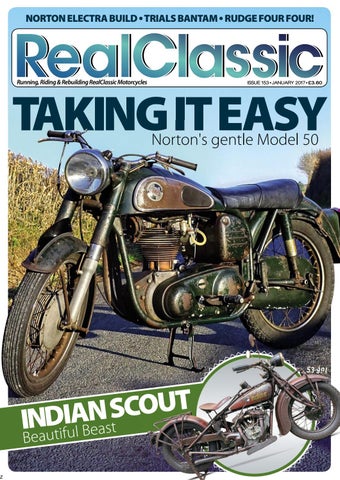
NORTON ELECTRA BUILD TRIALS BANTAM RUDGE FOUR FOUR!
Running, Riding & Rebuilding RealClassic Motorcycles
ISSUE 153 JANUARY 2017 £3.60
TAKINGITEASY Norton's gentle Model 50
T U O C S N A I D IN ul Beast B e a u t if
WHAT LIES WITHIN
08
REALCLASSIC 153; PUBLISHED IN JANUARY 2017
RC REGULARS
LAVERDA SFC1000 8
NORTON MODEL 50 52
This time, Seasonal Tester Miles becomes acquainted with a wild Italian; Laverda’s classic 3-pot stormer
THECONTENTSPAGE 4
RUDGE FOUR 28
Fitting a very slow engine into a very fast frame seems strange now, but the result is remarkable. Frank Westworth makes a reacquaintance
The four-speed four-valve Rudge 500 of the 1920s was a technological marvel. Henry Gregson discovers one which spent decades in a chicken shed, and Rowena Hoseason investigates its very special specification
CANADIAN GUZZIS 62
For most RC riders, the Compass Challenge wasn’t too tricky and involved little more than a ride down the road to find a suitable street sign. On the far side of the pond, Nick Adams took things just a tiny bit more seriously…
WE’VEGOTMAIL! 16
TRIALLING A BANTAM 36
BSA B21 REVIVAL 78
Odgie finds a bike for a friend, and then keeps it for himself. Has the man no honour? But you can’t entirely blame him. A mid-trials bodge involving a missing footrest, a screwdriver, a ring spanner and a bootlace proved to be one of those bonding moments between man and machine…
John Lay has been reconstructing what was once a 1937 BSA 250 single. This month he makes a rear stand and an exhaust pipe, fits an engine, and gets to grips with the primary drive
INDIAN SCOUT 44
The second generation of Indian Scouts, the 101 series, is considered by many marque enthusiasts to be the best of the bunch – perhaps, even, the best bikes Indian ever built. Tim Pickering discovered a 610cc Scout, barely touched since it was sold in 1928, enjoying a renaissance on the far side of the world…
Scruffy Nortons rule! We like those, especially standing outside RCHQ Loads of space this time, so loads of letters. Many make sense. A few replies do, too EVENTS 70
And so… it all comes round again! Welcome to another fine year of eccentric motorbicycling READERS’FREEADS 74
Only a very tiny number of ads this time. TP is bereft of course PUBTALK 102
It will be 2017 by the time this issue of RC arrives (so Happy New Year all), and we trust that Father Christmas has been kind to you – be that an MV, a veteran or a lathe. PUB really needs a double garage, but sadly Santa couldn’t find anywhere on her premises to leave it so space remains in short supply…
SUZUKI GT750 PROJECT 84
Canadian Ian R Sandy relishes a challenge, and found one in the form of several decrepit Suzuki two-strokes which he was inspired to convert back into running motorcycles. And so began the Oily Purple project… TRIUMPH TIGER 100 RESURRECTION 90
TALESFROMTHESHED 108
Twenty years ago, Chris Moorhouse brought a 1949 Triumph T100 back from the brink of oblivion. Now it’s his time machine, rolling back the decades to the high times of his teenage rides
Frank Westworth’s first ride. Well… his first on this BSA for quite a while. An interesting experience, apparently RCCOMPASSCHALLENGE 114
We’re delighted that so many RC riders were inspired to drag a motorcycle out of hibernation, ride somewhere and grab a snap of it next to a sign. We promised that the most creditable efforts would be justly rewarded so… cue fanfare and balloons! We have our winners!
NORTON ELECTRA PROJECT 96
Peter Holland’s decade-long project to rebuild an electric-start lightweight twin moves into the exciting stages. Wheels are fitted. Dents are removed. Tanks are painted. Hang on, why doesn’t the electric starter work any more?
SUBSCRIBE
TURNTO
You won’t find RealClassic on the shelves in UK newsagents. If you want to enjoy regular RC reading then take out a subscription and join us in the RealClassic Club.That way, each issue costs just £2.50. Bargain!
P7
TODAY & SAVE
8 I JANUARY 2017
More old bikes online: Real-Classic.co.uk
LAVERDA SFC1000
Raw power has its addictive attractions, and Paul Miles has been seduced by the ultimate incarnation of the Laverda triple. It might, he argues, be the very best three-cylinder machine to come barrelling out of Breganze
T
here’s a scene in the movie Mad Max where two guys discuss the eponymous hero’s car, one of the few still working in this postapocalyptic world. ‘The last of the V8s,’ says one road warrior in awed tones. In many ways the Laverda you see here is motorcycling’s equivalent of the Max mobile, a lusty, noisy, mechanically raw air-cooled three-cylinder massive dinosaur still roaming the roads in a world that had turned to sophisticated watercooled fours. But why? By 1988 it wouldn’t have been unreasonable to expect Laverda to have replaced their venerable three banger, whose roots were firmly placed in the early years of the previous decade. Indeed, the factory itself had announced plans several years earlier to produce a new triple, one with water cooling. The SFC1000, a nod to their illustrious racing past (SFC –super freini competizione: super competition brakes) was to be built as a last hurrah to the glorious reign of the Italian dinosaur, a limited edition of just 200 examples. The SFC1000 is in many ways the best of Laverda’s triples. The potent but vibratory 180-degree cranks of the earlier motors had long since been replaced by the smoother 120° engine, which was then
Subscribe and save: Real-Classic.co.uk
Photos by Paul Miles rubber mounted to further dampen the vibes. The impossibly heavy ‘real men only need apply’ cable clutch was also consigned to history, a hydraulic set-up offering, in truth, no more than a modicum of improvement. The SFC retained the sweeping style of the previous RGS model, itself a gentleman’s express in the grand touring mould. In another homage to the racing heritage, the exotic Bayflex mouldings were replaced by lighter and cheaper fibreglass, losing the car-style filler cap in the process. Clocks and other instruments were stripped back for a minimalist racing look and the top yoke no longer wore a padded cover. Speaking of which, the SFC1000 sported what must be the best looking twin fillers in motorcycling history, aping the endurance racers of the previous decade. In order to further cement its reputation as the ultimate triple, the factory threw all their hard-won knowledge into building their most powerful triple ever. A claimed 100bhp was achieved from the 981cc engine by utilising high lift camshafts plus a big valve, high compression head. It was very fast, with a claimed top speed of 156mph, a telling one mile per hour faster than the class-redefining Kawasaki GPz900. But the SFC was also very heavy at a claimed dry weight of 244kg. Laverda’s ultimate triple also had Marzocchi M1R forks, with adjustable damping, plus an alloy box-section swinging arm; cutting edge technology at the time. The very last batch of, as I understand it, thirty machines was painted shiny jet black and equipped with beautiful (if by now old-fashioned looking) alloy wire wheels, inspired by a Witt design.
JANUARY 2017 I 9
L
ike most of us, as a teenager John had a passion for motorcycles, and he owned a few. Also like most of us, as he matured his horizons broadened and his interests developed in other directions. One of these was towards stationary engines, which he enjoyed collecting and restoring. (Most of my stationary engines have been positioned between an equally stationary pair of wheels by a frame, but that’s another story). The legendary ‘pot of gold at the end of the rainbow’ always beckons the collector or restorer and, with this in mind, John went to view a ‘barn find’ stationary engine he had been told about. Perhaps ‘barn find’ is the wrong term as the engine was housed in a chicken shed. Disappointingly, it didn’t turn out to be eggsactly a rare find after all. However, while in the shed, John did notice a pair of inverted handlebar levers sticking out from under some old fertiliser sacks and a plastic sheet. Obviously there was a bike of some description underneath,
30 I JANUARY 2017
and permission was granted to remove the covering and view the machine underneath. A bike was revealed, a disaster of a bike but, as further investigations uncovered, a bike that was still equipped in totally standard trim. The only components which were missing were the glass for the tax disc holder, the petrol tank cap and the horn bulb. Everything else was present and correct: absolutely amazing. Was this the legendary pot of gold at the end of the rainbow? Maybe it was. The chicken shed motorcycle turned out to be a 1927 500cc four-valve, fourspeed Rudge, known as a Four-four. In 1926 this model sold for the princely sum of £56. The story behind the bike was gradually discovered. In 1927 the original owner, farmer Tom Peel, received the bike for his 21st birthday. However in 1931 he was gored by a bull and sustained head injuries which affected his sense of balance. This meant he was no longer able to ride the bike, so it was pushed into the chicken shed and into early retirement.
Above: The Sports version of the Four was intended for hill-climbing, speed tests and reliability trials. Its engine came sans compression plate, raising the ratio to 6.2:1 and boosting top speed to 80mph. The gearing, handlebars, saddle, exhaust and steering damper were all specified to suit Below: ‘You don’t need to be rich even to buy a Rudge outright,’ said the Rudge Book of the Road in 1927. But ‘if your pocket has to be considered then it gives steadfast, unvarying service, month in, month out’
More old bikes online: Real-Classic.co.uk
The second generation of Indian Scouts, the 101 series, is considered by many marque enthusiasts to be the best of the bunch – perhaps, even, the best bikes Indian ever built. Tim Pickering discovered a 610cc Scout, barely touched since it was sold in 1928, enjoying a renaissance on the far side of the world‌
ARY 2017 44 I JANUA
More old bikes online: Real-Classic.co.uk
INDIAN SCOUT
K
Model 101. She rides the bike with such style, poise and panache that it’s clear this particular example of fellow Irish-person Charles B Franklin’s design masterpiece is her pride and joy. What is it about these early Scouts? Does the reality live up to the hype? I caught up with Kay during the barbecue lunch stop to quiz her about the bike of her affections.
ay and Conor hail originally from Cork in Ireland, and 29 years ago moved to Melbourne in Australia. At the 2016 Krusty Rally, organised by the Indian Motorcycle Club of Australia IMCA in new South Wales, Kay participated in three days of organised rides on country roads at the controls of this lovely original-paint 1928 Scout
by Tim Pickerin Photos g, Ka y a n dC on
o r; B on
ha
m
ne tio uc sa
ers
Subscribe and save: Real-Classic.co.uk
JANUARY 2017 I 45
For most RC riders, the Compass Challenge wasn’t too tricky and involved little more than a ride down the road to find a suitable street sign. On the far side of the pond, Nick Adams took things just a tiny bit more seriously… Photos by Nick Adams
I
t all seemed a too easy and a bit silly at first: race around the countryside looking for places with North, South, East and West in their names, then take pictures of your bike next to the sign, but it didn’t take long before I was hooked. The Compass Challenge started in January but, in Ontario, little complications like snow and ice tend to get in the way and there were few enough opportunities until three months had come and gone. Even then, my challenge start was accidental. I was out on my Moto Guzzi Quota 1100 when I noticed the village sign for Camden East. The sign was new, the bike was as clean as it ever gets, the roads were dry and I had my camera. Click. And that’s really all it took. I extended my ride home to include a couple of other local places (Westport, South
62 I JANUARY 2017
Frontenac) then spent the evening looking at road maps, scribbling down names and searching online. Until then my day trips had been vaguely aimless and unfocused. I would often set the GPS to avoid highways, tolls and U-turns, to accept gravel roads and to take me on the shortest but not the quickest route from A to B. The destination was rarely the objective. I had direction, but not destination. Now I had destination. At first I limited my searches to places I could comfortably get to within a few hours, but my mileage grew rapidly as most trips, even for a few compass points, were 200 miles or more. In late June, I packed my gear onto my Eldorado and headed north. I had found a tiny community in northern Ontario called Westree. It looked like little
more than a whistle stop on the transcontinental Canadian National Railway line. It was the perfect destination, suitably distant, and I could pick up a few others along the way. It was also the perfect excuse to ride some northern Ontario roads and visit some places I hadn’t seen in decades. The first sign to Westree was a small green maker pointing 10 kilometres down a gravel road from Highway 560, the delightful curvy road between Elk Lake and the Watershed Gas Bar on Highway 144. I duly parked the bike and snapped a quick picture before heading on to the gravel. I had already ridden over 500 miles to get there, but northern Ontario summer evenings are long, there was plenty of time left in the day, and I still had plenty of energy. Deep, freshly graded gravel is not my favourite,
More old bikes online: Real-Classic.co.uk
MOTO GUZZI GALLOP so I kept my speed down, avoided the deeper sections and let the Guzzi’s fourth gear torque do most of the work. On gravel, the front brake is your enemy: any slowing I had to do was managed by rolling off the throttle and using the rear brake only when necessary. Gravel travel has a remarkable capacity to focus the mind, so the 10 kilometres to Westree passed quickly. At the outskirts of the village I stopped to photograph another sign and was immediately invited across the road for beer and hamburgers by some folks who were well into the former and hadn’t quite managed to eat all the latter. I was sorely tempted, but as they had too much of a head’s start, I politely demurred. About a mile further on, the road split where the railway line ran along the lake shore and I was
in luck. Right at the split was a village sign, complete with silhouettes of a bear and a moose, flanking the village name. I had a quick look around but there really wasn’t too much to get excited about. I gingerly retraced my ride back to the highway. The idea of beer and hamburgers had lodged itself in my consciousness and I was happy that there were only twenty miles to the Watershed. It’s an unprepossessing looking place: essentially a vast flat gravel field punctuated by the serve-yourself gas pumps, the restaurant and shop building and a few tawdry-looking industrial trailers set up as accommodation for construction workers or the occasional brave traveller like myself. Inside the store, I ignored the camo hunting boots, the day-glo work shirts, lottery
Subscribe and save: Real-Classic.co.uk
tickets and live bait, but bought a six-pack of industrial beer, some Doritos and chocolate cookies for supper. As I handed over my forty dollars, the young native guy at the counter passed me a key and pointed me towards trailer number 2. ‘Just go around the back and help yourself,’ he said. After 568 miles I was ready for a good sleep. The following morning I rose early and was soon heading west, stopping briefly at the Wakami River crossing to take a little video. As I set up the camera, only the sound of the water rushing beneath the bridge broke the silence. I planned to ride along the TransCanada highway as far as White River, which once touted itself as Canada’s coldest place (minus 72-deg F). I was expecting rough pavement with potholes and frost heaves,
JANUARY 2017 I 63
W
ith the wheels in and the mudguards on, the BSA was beginning to look like a real bike. It was still propped up on its temporary wooden frame. The original rear stand was missing and I had no luck finding another. So this demanded another journey down the ‘make one’ route. Fortunately I’d seen a genuine stand on a similar machine at a vintage rally so I at least had some idea what it should look like. First the ends of the stand, where it attaches to the frame using the previously re-taped holes, were turned and milled up from solid bar. These were brazed into the tubes that formed the stand legs. These tubes are of a tapered D-section, not the sort of thing you are going to find at your local steel stockholder. Happily just this sort of tubing was commonly used for the manufacture of the rear chainstays of push bikes. A visit to my nearest scrapyard procured an old frame which was then cut up to provide the required parts. Two large washers brazed on formed the stand feet. Unlike many rear stands of this period, the stand does not stay up by fitting into a clip on the rear guard. Instead it has a spring attached to an offset arm that provides an over-centre action to keep the stand in place, up or down. This was made up from metal plate and fixed to the off side leg. With the new stand in place, my attention turned to the engine, As found, the B21 engine was minus its rockerbox. I did have a KB26 350cc engine acquired some time before and I thought it might do for spares, or possibly as an entire replacement. I was also able to find the barrel, head, rockerbox and pushrod tunnel from a KB21 engine, so it seemed my problems were over... Not a bit of it, of course. Nothing is ever that easy. I then learned that between 1937 and ’39 the engine had undergone quite a major redesign. The bottom end, timing gear, crank, Scrap metal sourced from a Kwik-Fit skip: the perfect starting point for a new exhaust system
78 I JANUARY 2017
John Lay has been reconstructing what was once a 1937 BSA 250 single. This month he makes a rear stand and an exhaust pipe, fits an engine, and gets to grips with the primary drive Photos by John Lay / Graham Lay crankcase breather arrangement and pushrod tunnel were all different. For example, the later pushrod tunnel is of the famous ‘light house’ shape with a large castellated nut at the top, while the earlier type has a flat top held in place with a pair of bolts.
The later head, rockerbox and pushrod tunnel would probably fit the earlier engine but, on close inspection, the crankcase of the original engine was damaged. A large piece was missing, under the magneto platform. So perhaps I should just use the 350. The problem with that plan was that it was seized up solid. Then I had a bit of luck. A rebuilt KB21 engine was advertised in the VMCC magazine, complete with reconditioned magneto, dynamo and carburettor. My machine had no dynamo and both the magneto and carburettor were damaged. The owner turned out to be a retired engineer, who’d once been in charge of a machine shop. He looked and sounded as though he knew what he was about. Not only that, he also had some other bits and pieces for the clutch. Cheating a bit, I know, but the original engine will be kept with the bike and could always be rebuilt later if the need arises.
More old bikes online: Real-Classic.co.uk
Photos by Ian R Sandy
Canadian Ian R Sandy relishes a challenge, and found one in the form of several decrepit Suzuki two-strokes which he was inspired to convert back into running motorcycles. And so began the Oily Purple project…
I
have been repairing, rebuilding and occasionally even riding motorcycles as a hobby since 1970. While there was a short BMW interlude, and more recently a Nimbus aberration which I may write about in the future, during that 46 year stretch all of my motorcycles were either Yamahas, Hondas or Suzukis. I can explain the Nimbus: I was looking for something older than I am, and it had to be metric, ‘interesting’, and with the shift lever on the correct (left) side. The BMW is harder to explain, but I came into used R75/5 ownership with the insurance settlement after my brand new 1974 GT750 was stolen. So I blame the lapse in common sense on grief due to my then-recent loss, youth and inexperience! The Suzuki GT750 Water Buffalo (Kettle, Water Bottle, or Wasserbueffel) is my preferred ride. I have several of them, one of which I’ve now owned for over 30 years. I do not own a ‘modern’ bike, and indeed until
84 I JANUARY 2017
very recently I had never ridden anything more recent than a 1977 model. Given that my exposure to modernity was a neighbour’s cruiser (so not a ‘real’ bike) and was only a five minute ride, I have convinced myself that it doesn’t really count and consider my somewhat Luddite motorcycle riding record to still be intact. Why limit myself to bikes prior to 1977? Well, Canada changed to metric in that year, and models sold thereafter have metric speedometers, so I’ve somewhat arbitrarily decided to generally stick with Canadian model mph bikes. It is good to at least try to limit one’s addictions, and this one will do for me. You can visit my site (www. oldjapanesebikes.com) for anorak level detail about the different models of Suzuki GT750 if you are interested, but suffice to say that it is a three cylinder, two-stroke, liquid-cooled touring machine of 738cc displacement. In stock form it typically has about 50bhp
available, making it more than capable in modern traffic at higher than legal speeds. It is somewhat heavy, the stock suspension is over-sprung and under-damped, and early 1972 models are not especially good on twisty roads although later ones are a lot better. I’m told it has mediocre braking by modern standards but I have nothing to compare it with. While the GT750 is not especially good in the fuel consumption area, it will make many fewer refuelling stops than a similar vintage Kawasaki two-stroke of the same displacement. I typically manage about 45mpg on average, so at about 110 miles you should be looking for a place to fill up. A tank of injector oil lasts about 900 miles. Roughly 77,000 of this model were sold worldwide between 1972 (actually beginning in 1971 in Japan) and 1977, and it has come to have a somewhat fanatical worldwide owners’ community. There are at least a couple of Suzuki GT750 specific owner
More old bikes online: Real-Classic.co.uk
Twenty years ago, Chris Moorhouse brought a 1949 Triumph T100 back from the brink of oblivion. Now it’s his time machine, rolling back the decades to the high times of his teenage rides
H
ot summer days, sixteen years of age. Full throttle in every gear, flat down on the tank, carving up West Cumbria on my mate’s Triumph 350 Twenty One. While we rode, in the garden shed languished his dad’s 1949 Tiger 100, in bits for at least half of its life. It would take me the next 27 years to persuade him to accept that he was never going to get it back together himself, and that I was dead keen to do that. After tarns of time had flowed under many granite lakeland bridges, it came to pass that on a hot June day in 1997, having struck a cast-iron deal, the dismembered and heavily decayed remains of the creature were exhumed from its tomb. Here the Tiger had lain for forty years, waiting in limbo for new life to be breathed into its heart. The original, one and only, owner and I raised the engine onto a bench and took off the cylinder head. There had been no bolts securing the head to the barrels and, probably due to the raised rim and groove feature between the two faces, miraculously
90 I JANUARY 2017
Photos by Chris Moorhouse
the bores still gleamed, untainted in the sunlight. Gripping a spanner on the end of the crank I turned the shaft to watch, in disbelief, the pistons glide willingly along their paths. Then, amazingly, on poking a finger into the magneto, I spun the armature to be instantly warned off by a stinging 20kV crack! Initially, I was going to have a go at restoring the bike myself, but I made the mistake of getting the tank bead blasted beyond repair. Next I attempted to dismantle the magneto and damaged the slip ring in the process. So I handed the job over to John Reeve of Twickenham. Much of the Tiger was either completely shot or missing. Mudguards and wheels were rebuilt by John, and it took two tries to obtain the correct outer gearbox case, as the one for that year was uniquely shaped. A petrol tank was bought at great expense which needed all the dents tapping out, then chroming and painting. It took two attempts to get the frame painted right. Fortunately the entire engine, gearbox and clutch parts were either good or OK, only requiring new piston rings, main
and gearbox bearings but everything needed hours of painstaking cleaning and polishing. After three and a half years, at a £ton a month, she was just about finished. With the whole frame number written on the MoT certificate, it then took three months for the DVLA to certify the bike’s authenticity in order for it to be eligible for an aged-related plate, as all original documents had been lost along with the index number. Many thanks to Roy Jordan of the TOMCC for researching the archives and for supplying me with the info needed to re-register her. Roy informed me that she had been despatched from Allersley to Pickering’s Motorcycles, a dealer in Leamington Spa, in December 1948. The engine and frame numbers tallied and now, since being re-registered, she’s the only one of that year listed with the club. I learned afterwards from the original owner that he had bought her in Middlesbrough in 1949 and that the last two letters of the index number would have been DC. But even this scrap of information was of no benefit in tracking down the original index number.
More old bikes online: Real-Classic.co.uk