M
NORTON CLASSIC HONDA CB250 RS NORTON ELECTRA COMPLETED!
Running, Riding & Rebuilding RealClassic Motorcycles
ISSUE 154 FEBRUARY 2017 £3.60
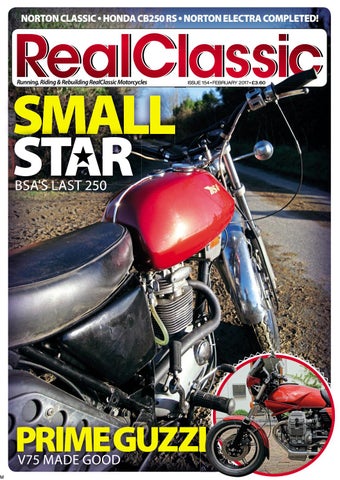
PRIMEGUZZII V75 MADE GOOD
WHAT LIES WITHIN
06
BSA B25SS ......................................................... 6
NORTHAMPTON’S MOTORCYCLES .......... 58
There’s no escaping the moment of truth when you subject a freshly rebuilt bike to its first lengthy test ride. But hang on, haven’t we been down this road more than twice? Rowena Hoseason experiences déjà vu all over again…
We all know about British bikes built in and around Birmingham – many of the most famous English marques were manufactured in the Midlands. But hang on, says Richard Jones, what about the motorcycles made in Northampton. What indeed?
MOTO GUZZI V75............................................ 28
Reuben Fowles reckons that the squareset 750 Guzzi V-Twin of the late 1980s was something of a pig’s ear. So he set about transforming one into a proper silk purse NORTON CLASSIC........................................... 40
Tony Gutteridge made his motorcycling dreams come true when he took a chance on a rotary-engined Norton Classic. When the Classic and those dreams were reduced to ruins, he kept the faith and brought the bike back to life once again HONDA CB250RS............................................ 46
John Shearer takes a convoluted path to owning what he considers may be the best, inexpensive, vintage-eligible motorcycle in the world… MZ HISTORY.................................................... 52
In an effort to understand where MZ came from, Nigel Shuttleworth attempts to untangle a most complicated web of companies, a steam powered car, motorcycles, more cars, some two-strokes, a couple of world wars and the first foreign motorcycle to win a TT…
REALCLASSIC 154; PUBLISHED IN FEBRUARY 2017
RC REGULARS THE CONTENTS PAGE ....................................4
Finally, finally at last, Rowena of this parish was able to ride her BSA
ROBBIE ALLAN ......................................... 64
WE’VE GOT MAIL! ........................................16
To celebrate his 60th birthday, Odgie crammed three demanding off-road rides into one short weekend for the Robbie Allan Memorial Meeting. Can our sexagenarian survive a pre-65 trial, scramble and enduro on three different old bikes?
The customary eclectic collection of letters. Send more – we always enjoy them!
BSA B21 BUILD ......................................... 84
READERS’FREE ADS ....................................78
EVENTS ........................................................74
Lots to do, places to go, bikes (and even people) to see. And the sun will always shine. Well…
John Lay has been assembling a 1937 BSA 250 single, aiming to build a bike which works perfectly but looks like it’s never been restored. This time, the temptation to see if the engine will run proves overwhelming…
Interesting variety. Is there something happening in the crazy world of the Tiger Cubs? PUB TALK ...................................................102
PUB has been grovelling in the garage this holiday season – fixing her more modern machine. Then, for something completely different, PUB returns, as promised in 2015, to E.J. Pennington’s ‘long mingling spark…’
SUZUKI GT750 PROJECT........................... 90
Canadian Ian R Sandy is converting several wrecked water-cooled Suzuki two-strokes into one working Kettle. This time he tackles those all-important engine seals and the water pump…
TALES FROM THE SHED .............................108
Life? A never-ending quest for an unattainable intangible. Or something. Frank Westworth gets philosophical. It’s an age thing…
NORTON ELECTRA PROJECT .................... 96
It took Peter Holland over a decade to return his electric-start Norton 400 twin to the road, involving something of a frantic scramble to find the really rare spares. After all that effort, is he satisfied with the results?
SUBSCRIBE
TURNTO
You won’t find RealClassic on the shelves in UK newsagents. If you want to enjoy regular RC reading then take out a subscription and join in us the RealClassic Club.That way, each issue costs just £2.50. Bargain!
P114
TODAY & SAVE
WHO’S DONE WHAT REALCLASSIC is written by people like you and assembled by Rowena and Frank, aka the Cosmic Bike Co Ltd. Mike Baumber designs most of the pages with able assistance from Libby and the production team at Horncastle There’s stacks more RC reading on our spangly new website at: www.Real-Classic.co.uk TRADE ADVERTISERS should call Helen Martin on 01507 529574, email hrmartin@mortons. co.uk EDITORIAL ENQUIRIES should be sent to Frank@RealClassic.net or to PO Box 66, Bude EX23 9ZX. Please include an SAE if you want something returned or a personal reply SUBSCRIPTION INFO is back on pg114 (its ancestral home!). Call 01507 529529 to subscribe or renew or buy back issues SUBS QUERIES, late deliveries, or changes of address should be directed to 01507 529529, or email subscriptions@realclassic.net ALL MATERIAL in RealClassic is copyright its authors, so please contact us before reproducing anything. RealClassic is printed by William Gibbons & Sons of Wolverhampton. Our ISSN is 1742-2345. THIS MONTH we’ve been reading Real Tigers by Mick Herron (a great modern spook series); The Winter Over by Matthew Iden (trapped in Antarctica!); Time Lies by Magnus Stanke (sibling rivalry in Cold War-era Germany) and the original Berlin Noir Bernie Gunther trilogy (which knock spots of the modern novels). Not to mention Dogstar Rising, by Parker Bilal, which is a really fun series set in Cairo (can’t spell Egypt)… MEANWHILE AT THE MOVIES we finally saw Rogue One (more than once) and it utterly lived up to expectations. But then came Bone Tomahawk, a simply brilliant and brutally savage western with Kurt Russell, and all else pales into insignificance … apart from John Woo’s impossibly amazing Last Hurrah For Chivalry. Best movie that day, plainly RealClassic is published monthly by MMG Ltd, PO Box 99, Horncastle, LN9 6LZ, UK. USA SUBSCRIPTIONS are $58 per year from Motorsport Publications LLC, 7164 Cty Rd N #441, Bancroft WI. 54921. Postmaster: Send USA address changes to RealClassic, Motorsport Publications LLC, 715-572-4595 chris@ classicbikebooks.com
FROM THE FRONT
I
t’s that time of year again. Time to dig out all the expiring MoT certificates to see when those dates fall due; time to pretend to make decisions about which bikes to put on the road, time to rediscover that modern riding gear is both waterproof and warm. We’re heading towards Spring, which is traditionally the start of the ‘riding season’, although this year’s first month has actually provided some really fine riding weather – at least it has in the soft southerly parts of the country. There are always occasional days in the January darknesses when it’s OK to take out the bike, to wrap up warm and head off somewhere to meet a mate and maybe sup a cup of something hot. This January has been exceptional. I even managed a decently long ride – hence my comments about modern riding kit. Despite temperatures around 6°C and rain varying between drizzle and decently drenching, I stayed relatively warm and pretty much dry – even during a couple hundred miles of motorway. In fact the only time I felt chilled was while on the motorway, and that was down to wind chill more than to the ambient temperature. The purpose … OK, the excuse for the ride was to cast a leg over a plunger Flash. Not a particularly Golden example – this one is black – but a welcome reminder of another of the riding life’s unsung charmers. A great machine, and with hidden modern enhancements to improve grip and lighting it was a handsome reminder of what a great winter bike a machine like that is. They were intended for all-year all-weather riding when BSA were churning them out in great numbers, and a decently well set-up example still performs that same function. It’s only a personal thing, but I’ve always enjoyed riding BSA twins, be they gentle preunit tourists like the plunger Flash or decently sporting US-spec unit soft-roaders. Sadly, I cannot say the same about BSA’s singles. Although the pre-unit plodders are fine – I avoid Gold Stars at every opportunity – the unit machines always wear me out somehow.
CONTACT US! BY POST: BY EMAIL: TP@RealClassic.net ONLINE: www.RealClassic.co.uk
I do understand why that is. Somewhere in the handover from pre-unit to unit construction a decision was made to stretch a small engine from the initial Cub’s 199cc all the way to the B50’s 499cc, all those enlargements of the original Triumph design were on a quest for power, and by the time BSA reached the B44 they really should have introduced something different. But they didn’t. Musing upon the wonderfully pointless – why did BSA do this? Why aren’t their late singles as excellent as their late twins? – passes the time in a totally pleasant way, as I’m sure you know, and I dream up most of my writing ideas while actually riding the bike and letting the machine and myself run on autopilot – to some degree. It’s all part of the rhythm of riding a decent distance over familiar roads, whatever the weather and only if there’s no rush involved. But it reminded me that I want to find a scrapper late OiF A65 to build a project bike – and I have failed to find one in over a year. Maybe at the next show, the next jumble, maybe over the next roadside coffee. New year, same riding delight. Hope we all enjoy it! Ride safely! Frank Westworth Frank@realclassic.net
THE NEXT ISSUE
RC155WILL BE PUBLISHED ON MARCH 3rd, AND SHOULD REACH UK SUBSCRIBERS BY MARCH 6th
SHAKEDOW H K DOWN ! There’s no escaping the moment of truth when you subject a freshly rebuilt bike to its first lengthy test ride. But hang on, haven’t we been down this road more than twice? Rowena Hoseason experiences déjà vu all over again…
6 I FEBRUARY 2017
More old bikes online: Real-Classic.co.uk
BSA B25SS
T
he last time I rode this bike it had three gears. No first gear, and it pulled like a wet lettuce. That was a massive disappointment. Twenty years ago the oilin-frame BSA 250 was my first British bike and my first rebuild project and it took for-blinkin-ever to complete. We started with a disassembled bike in big bits but, it transpired, missing a significant number of crucial components. Even the expert assistance of the BSA Owners’ Club’s unit singles specialist, ‘Rupert Ratio’ aka Dave Smith, couldn’t ameliorate the effects
of worn out original spares, mismatched replacements and the depressingly poor quality of many of the pattern parts being sold at the time. Frank and I scoured the world (in the days before the internet properly existed) for nigh-on unobtainable spares and laboured for a couple of years to build the BSA, but my less than triumphant first ride revealed that those repro components had undermined all of our efforts. To make matters worse, the skanky, maltreated, dismantled and blown-up Triumph T25 which we’d bought for spares turned out to be a better runner than my beautiful Beezer in almost every respect. So we put the rebuilt T25 on the road instead, and gazed in dismay at the three-geared B25 wonderbike.
Subscribe and save: Real-Classic.co.uk
We didn’t actually admit defeat, but when it became clear that we were going to have to take the primary drive apart all over again, and rebuild the gearbox all over again, and couldn’t be entirely certain that the replacement supposedly NOS gear selector plate would be any more effective than the brand new but faulty one we’d fitted last time around… we muttered miserably and shoved the B25 into a dark corner of The Shed. I’m sure you’ll be familiar with the intention. We would come back to it. Next winter. Maybe. That at was as more o e tthan a 15 5 yea yearss ago. This time, the ride is entirely different. The bike’s far from perfect – this is its firstt proper shakedown trial after its recent two year re-re-rebuild – but once it condescends to start it simply rips away down the lane. Even mostly cold, the nearly-no-miles engine has some real rassp about it. And get this: it behaves just like a ‘proper’ Gold Star. By this, I mean the B25 5 tries to snap your ankle when you kick it over with anything less than complete conviction. It won’t idle, so you have to keep the revs raised and blipping the throttle generates an astonishing crackle e from the chunky silencer. Was it really thiis loud last time around? Really? Or has my
FEBRUARY 2017 I 7
hearing somehow become more sensitive with the passage of time? First gear goes on, and on, and on for the better part of a half mile and easily past 30mph. Change up to second too soon and the plot bogs down, produces a resounding POP! and glides to a silent stop at the side of the road. Wow. No wonder trying to ride it without first gear was so stupendously unsuccessful last time around – paddling away and slipping the clutch simply won’t work with this gearing and the engine’s impressively poky performance. Now all I have to do is start it again, and see what happens with the other three gears…
‘For the big escape, rely on BSA’ The B25SS and its B25T stablemate were manufactured for a little less than a year until the autumn of 1971. While the earlier C25 Barracuda and B25 Starfire 250s were teenage-legal roadburners, the 1971 singles were aimed squarely at the muddy stuff. The new oil-bearing frame was different to that which served the big twins, but was similar to that used to great effect by BSA’s works scrambles squad. Paired with pulled-back handlebars and a high-level silencer it gave all the singles a distinctly off-road attitude. Even the ‘street scrambler’ Gold Star SS models looked like more trail bikes than the typical British road racer. One glance at the 1971 catalogue cover leaves you in no doubt about the image BSA aimed at. So if you were a learner rider in 1971 and you wanted a BSA roadster which actually looked like a roadbike then your only option was a Bantam D175… In some ways this could have been pure prescience by BSA’s marketing department – just look how popular street scramblers and high-bar adventure bikes of all capacities have become. Yet it’s more likely to be a reflection of the chaotic situation as the company tried to modernise and streamline component supply while introducing two new frames, a range of new engines and the computerised production lines on which to build the bikes.
8 I FEBRUARY 2017
In 1971, BSA certainly weren’t tryying to sell streetbikes… not if this brochure is anything to go by
Indeed, there’s a rumour that there could have been four versions of the 250. There are three interpretations of the mighty 500 single: the SS street scrambler, the Victor trail bike and the Victor MX moto-cross monster (which has teeth and claws and I’s scared of it). The 250s were offered only in Victor and SS trim, but there’s a suggestion that a 250 MX and a 250 R were also on the cards. The putative Roadster would have used the fatter three-gallon steel petrol tank and nearly flat 24” handlebars – the T models typically came equipped with high-rise 33” braced bars, while the handlebars on the SS were normally
32” wide and a little lower. The 250 Fleetstar, built in the autumn of 1971 after production of customer OiF 250s had ceased, featured some of the components which might’ve made it onto a 250R, including a low-level silencer and the revised kickstart lever and brake pedal to suit, and a three-quarter length saddle – different to the types fitted to the Victor MX and the TR5T – which would look just the job on a home-market café racer Roadster. Another ‘neverwozza’, maybe? My B25 might even be a missing link in this chain. We traced its history back to when
More old bikes online: Real-Classic.co.uk
BSA B25SS it was new, and it was initially delivered to a dealer with a Dove Grey frame during 1971. But it didn’t sell, and went back to the factory to be re-finished with a black frame to match the 1972 colours. It probably gained the supporting frame gussets under the sidepanels at the same time. And when we took possession of the B25, the boxes of bits all appeared to be from one bike. There was plenty missing, including the silencer, but narrow bars and a three-gallon tank were present and correct. Those bars proved to be horribly uncomfortable and really don’t suit the natural riding position prompted by the SS-style foot controls. So this time around we opted to risk offending the gods of originality and fitted a set of higher Renthals. Looking at the photos, I think we should maybe go the whole SS hog and put that big petrol tank back on the shelf, stored for posterity. At the moment, the B25 looks like it’s having something of an identity crisis – I can’t help thinking that giving it a two-gallon tank might make it feel like a more coherent motorcycle. (Fitting an ultra-skinny one-gallon MX tank from the B50 would be going a little too far.) We could always have a crack at building another 250 in Roadster trim sometime in the future. Maybe…
‘The power of British engineering: the glory of American styling’ Hardly any 250s were featured by the motorcycle press when they were new as the 500s tended to grab all the attention, but when a 250 did get tested it made a massive impression. One American journalist described the Triumph Trail Blazer as ‘the best 250 on the market.’ High praise indeed, given the motorcycles being built in Japan at the time. UK magazines understood that the BSA-Triumph singles were styled for the American market, and therefore came with the necessary equipment to meet the USA’s increasingly demanding regulations. However several journalists weren’t impressed by all the mod cons. In the same way that we
grumble today about, say, tyre pressure monitoring systems or clutchless gear selection as being unnecessary, expensive and inevitably bound to malfunction, so the roadtesters of the time felt that turn signals were a step too far. ‘They must add £10 to the cost,’ squawked one indignant scribe, who bemoaned the lack of a specific model for the UK market. See: there was at least one customer for a B25R. Despite those pesky indicators, the T25 was considered to be a ‘good, reliable robust machine’ with a very fair turn of speed. Just as I was quite taken aback by the B25’s alacrity, so the roadtester in 1971 mused that maybe the Trail Blazer was over-endowed
ABOVE: The long dark shadow was already falling across BSA when this neat 250 rolled down the Small Heath track BOTTOM ROW, LEFT TO RIGHT: 1. The B25’s off-road heritage is encapsulated in its rear brake pedal, tidily tucked away high and tight to the engine casing where it won’t snag any protruding rocks or branches on the trail. This doesn’t make it immediately easy to locate, however 2. BSA’s last 250 single was a true dual purpose machine, equally unsuited to both road and rough – but monster entertainment on both 3. When Cycle Guide tested the heavier B50SS in 1971, the 7-inch 2ls front brake stopped it in 29.6ft from 30mph. Rowena’s brake fitted to the lighter 250 is not quite that efficient. 29 feet? 29 minutes more like 4. The engine looks a little weedy, and isn’t weedy at all. The monster front brake looks super powerful, and it’s … not 5. BSA-Triumph’s ‘Ceriani-style’ two-way damped slimline forks provide almost seven inches of travel and help to lighten the B25’s load. Capable of coping with the worst that the 500 moto-cross model could endure, they’re excellent on the road 6. ‘A superb dual seat, large and comfortable,’ said the man from Motorcycle Sport. ‘After eight hours sitting on it I felt no trace of saddle soreness’
Subscribe and save: Real-Classic.co.uk
FEBRUARY 2017 I 9
for its intended role. ‘22.5bhp at 8250rpm is very respectable,’ he commented, ‘almost too respectable for a cross-country noncompetitive machine.’ With road gearing it would happily see 80mph and on tarmac it ‘showed itself to be a very good machine indeed. Its handling was excellent… content to buzz along happily.’ Speaking of buzzing, back in 1971 Motorcycle Sport observed that ‘there was no vibration transmitted to the rider no matter what speed the Blazer was ridden at.’ I can attest to the truth of that statement. Sailing along the lanes, preoccupied with evaluating the gears and brakes and such, I had no impression of any vibration whatsoever. Yet you’ll notice from the photos that just about every indicator and the headlamp had swivelled entertainingly during my shakedown ride. My mechanic assures me that they were all tightened to the specified tensions before I rode away. BSA-Triumph obviously did a great job of isolating the rider from the not inconsiderable vibes generated by that poky motor. With hindsight, that could easily have contributed to the B25’s reputation for detonation as fast lads attempted to reach its theoretical 90mph top whack… I was truly startled by the B25’s turn of speed. About 18 months ago I rode a decent Starfire (see RC137) which was certainly no slouch. The off-road appearance of the B25 lured me into thinking it would be slightly slower, reinforced by the knowledge that the Gold Star’s output was rated at 22.5bhp compared to the Starfire’s 25bhp. In itself, these numbers are slightly strange as the later bike runs 10:1 compression (compared to 9.5:1 for the Starfire) and revs 250rpm higher. Both the Starfire and Gold Star use a 28mm Concentric and the gear ratios for the roadbikes aren’t wildly different. My guess is that the 2.5bhp decrease can be attributed to the Gold Star’s ‘new improved performance air intake system’ and the strangling effect of that substantial silencer. So why does the less powerful Gold Star feel comparatively fast? Well, for one thing the B25 was fuelled only with a bare minimum (in case something sprang a leak after all that while in storage) while the Starfire carried over three gallons on my earlier ride. That’s a couple of kilos of weight saved – not to be sniffed at alongside the much lower mass of the new frame with its integral oil tank and the BSA group’s new lightweight front end. A Starfire fitted with a steel petrol tank weighed 143kg dry, while the Gold Star tipped the scales at just 132kg. So my B25SS could be more than two stone lighter than the Starfire I rode. No wonder it scampered off like a scalded cat!
10 I FEBRUARY 2017
‘The take-you-anywhere bike’ Even when new ‘starting really did need a generous swing… it usually took about three kicks to bring it to life.’ Well, it takes about three dozen kicks to provoke the beastly little B25 into activity these days and the tickover has taken a time out. We suspect that there’s something not quite right w ith the timing, although the motor might just need to run in a bit – it did appear to be getting easier to start the more we rode it, but we ran out of puff before it did. Kicking the high-comp engine over isn’t made any easier by how upright the bike is when it’s parked on the sidestand – I’ll have to get into the habit of starting it on the centrestand, I reckon. The engine’s propensity for ‘popping’ to a sudden stop was apparent in 1971 as well: ‘The highly-tuned engine was susceptible to clumsiness and would expire with a splutter if one leaned too heavily upon its good nature.’ All of which suggests that we might be advised to ditch the points and go with electronic ignition… although that then tends to open a can of worms about keeping the battery up to snuff. I mentioned earlier that the exhaust note is rather more raucous than we’d remembered it. When new the silencer ‘conspired with the characteristics of the engine to produce a deep, sharp but inoffensive note reminiscent of old-time trials singles.’ Ah. Oh. My bike sounds more like a Saturday night special after some bright spark has rattled the baffles with a sharp stick. Maybe the silencer internals have just dissolved with 15 years’ exposure to sea air? Maybe that’s why it’s teeth-rattlingly rapid? Or perhaps it only feels fast because my front brake is so truly appallingly awful. The rear 7” stopper works just fine when I can locate the pedal: in true trials style it is curved in tight to the engine case and sits a couple of inches above the footrest. It’s also on the left, which is not my natural braking side. Experimental investigations revealed that the most effective way of stopping my B25 – when I grabbed the front brake lever and naff-all happened and then I floundered around with my foot and failed to find the brake pedal – was to point it up a muddy track at the side of the lane and let physics bring things to a halt. This would not be ideal on a dual carriageway. As my 250 is an SS it comes with the 8” 2ls front brake; the Victor trail bike would have used a 6” sls stopper, much more suitable for off-road escapades. The B25T also differed in its wider, braced handlebars, folding footrests, high alloy mudguard, 20” front wheel, chunky tyres, alloy petrol tank and a
More old bikes online: Real-Classic.co.uk
Most folk hated the looks of the giant lozenge silencer when BSA-Triumph introduced it. These days it doesn’t look the least bit out of place. More mysteriously, it doesn’t seem to silence things as much as it used to…