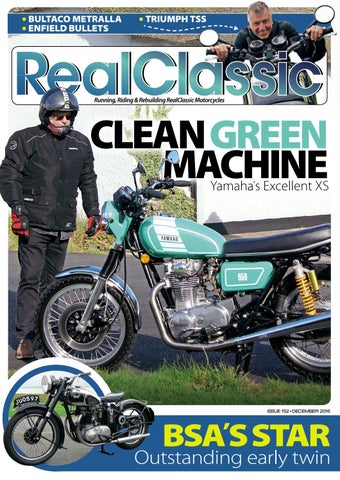
BULTACO METRALLA ENFIELD BULLETS
TRIUMPH TSS
Running, Riding & Rebuilding RealClassiic Motorcyclees
CLEA EANG A GREEN MA ACHINE
Yaamahas Excellent XS
ISSUE 152 DECEMBER 2016
BSASSTAR
Outstanding early twin
WHAT LIES WITHIN
TRIUMPH .....................................................8
26
REALCLASSIC 152; PUBLISHED IN DECEMBER 2016
This time, Festive Tester Miles becomes acquainted with the last of the line, the ultimate evolution of the original Triumph Bonneville
RC REGULARS THE CONTENTS PAGE ....................................4
Is it a twin? Is it a Triumph? Is it a Yamaha? Can’t see it from here!
YAMAHA XS650 .........................................26
Probably the first successful attempt at a Japanese Bonneville came from Yamaha, whose XS650 has stood the test of time as well as most Triumphs. Frank Westworth was compelled to ride one…
BSA A7 STAR ...............................................34
In seven decades, this unusual 500 twin has been ridden, crashed, relegated to a cellar, rebuilt, restored and revitalised. Henry Gregson reckons its future could be as interesting as its past…
BULTACO METRALLA ..................................42
There ain’t no substitute for cubes, goes the saying, describing America’s love affair with massive motors. But then a titchy Spanish 250 was clocked at 100mph and that turned even American heads, as Nolan Woodbury explains…
WE’VE GOT MAIL! ........................................16
Every month, this is your chance to have a say, have a rant, argue or simply say nice sweet things. We prefer those…
SPEEDING BULLETS ....................................56
How does a modern Indian-built Enfield compare to the original big single from Redditch? Adrian Saunders has fettled and fine-tuned four different Bullets: two old and two nearly-new…
EVENTS ........................................................76
The end of another pretty good year here at RCHQ. Festive greetings and good wishes to all
TRIUMPH T150 TRIDENT ............................64
Every restoration of an old British bike has to be an extended tale of woe, angst and endurance, right? Wrong. Ken Atkinson bought the bike he’d always wanted, rebuilt it PDQ, and revels in riding the result
READERS’FREE ADS ....................................78
Lots and lots of chocs … very few bikes for sale. Strange, but acceptable
PUB TALK ...................................................100
PUB has been off to a museum in Birmingham, but not the Birmingham of flat ’ats, nor of the NMM. This Birmingham was in Alabama, home of the Barber Museum, and host to the 2016 Barber Festival
BSA B21 REVIVAL........................................82
Last month, John Lay began the reconstruction of what was once a 1937 BSA 250 single. There are no new spares anywhere…
EXCELSIOR UNIVERSAL ..............................50
Once upon a time, simple two-strokes were appreciated for their light weight, easy manoeuvrability, reasonable running costs and affordable purchase price. It’s déjà vu all over again, says Steve Hodgson…
HONDA CB350 CAFÉ RIDER ........................88
TALES FROM THE SHED .............................106
Eddie’s budget-build four-cylinder café racer goes back together with a home-made exhaust system and a collection of carbs. The time comes to fire it up – you might want to wear ear-plugs!
There comes a point when even the most awkward motorcycle simply must agree to run. Hopefully… Frank Westworth kicks back RC COMPASS CHALLENGE.........................112
It’s the end of the year, Challenges everywhere can take a rest. What should we all do next year, huh?
NORTON ELECTRA PROJECT ......................94
Peter Holland’s decade-long project to rebuild an electric-start lightweight twin moves onto the motor. He discovers a few flaws which escaped AMC’s original QC teams…
SUBSCRIBE
TURNTO
You won’tfindRealClassiconthe shelvesin UKnewsagents.Ifyou wanttoenjoy regularRCreading then take outa subscriptionand join usin theRealClassicClub.Thatway, each issue costs just£2.50.Bargain!
P7
TODAY & SAVE
This time, Ace Tester Miles becomes acquainted with the last of the line, the ultimate evolution of the original Triumph Bonneville Photos by Paul Miles
S
tudy the timeline of a popular motorcycle and it generally follows a familiar arc. As a brand new design there will be innovations and features that should, in theory, further stretch the boundaries of motorcycling; usually performance. Subsequent models will include modifications to overcome shortfalls in the original design that are only exposed by these early purchasers acting as high mileage test riders. The machines often get heavier and slower as the market or legislature demands more complex gadgetry, with the last version bearing little more than a passing resemblance to the bright vision of the original designer. Yet the later bike is likely to be the most fully developed and reliable example of the model. History is littered with such stories. Think of the first Z1 variants from Kawasaki, for example; the fastest, purest concepts. Later Z900s then Z1000s were heavier and slower although less thirsty, more reliable and far better in the handling and braking stakes. Collectors, of course, desire the early model, riders perhaps, the latter.
8 I DECEMBER 2016
You’ll find more Miles on Twitter: @classicrider
See RealClassic.cco.uk for hundreds of classic bike profiles
TRIUMPH TSS
34 I DECEMBER 2016
See RealClassic.co.uk for hundreds of classic bike profiles
BSA A7
Cel llar SURVIVOR Photos by Henry Gregson
In seven decades, this unusual 500 twin has been ridden, crashed, relegated to a cellar, rebuilt, restored and revitalised. Henry Gregson reckons its future could be as interesting as its past…
T
he introduction of Triumph’s groundbreaking Speed Twin in 1938 left the rest of the major British motorcycle manufacturers playing catch up. BSA’s answer to Triumph’s new parallel twin was the A7… but not the bike which Bert Hopwood designed, sibling to the A10. No, the original A7 was quite a different machine from its muchloved descendant. BSA came up with their own take on the vertical twin format with a long-stroke iron head engine, the basic design of which is generally credited to Val Page. However, Edward Turner, Herbert Perkins and David Munro are all also known to have had input into the design. With designers of this pedigree you would have expected BSA to have got it right first time. Design work started in 1939 which, obviously, meant the A7’s launch couldn’t happen until 1946. Then there were a couple of problems which possibly contributed to the bike’s short production run; in 1950 the A10 and subsequently the revised A7 were introduced. The original A7 was an ohv, iron head vertical twin with a single camshaft and a four-speed gearbox which was bolted to the rear of the engine. The crankshaft assembly was unusual in that it comprised three main parts, yet despite its complexity the design was intended to be easily rebuilt by the home mechanic. It was, however, very quickly replaced by a re-designed single-piece unit, possibly because of the manufacturing cost of the original; the replacement version being interchangeable with the first. A 62mm by 82mm bore and stroke gave a capacity of 495cc. Compression ratio was 7:1 and a single carb was used. Output was claimed to be 26bhp.
Real Bikes. Real People. RealClassic: online at www.RealClassic.co.uk
DECEMBER 2016 I 35
BULTACO METRALLA Mk2 BULTACO METRALLA Mk2 Built
1967 to 1975
Gearbox
5-speed
Rear brake
160mm sls drum
Engine
Air-cooled, piston port single
Primary drive
Duplex chain
Front tyre
2.75 x 18
Bore / stroke
72mm x 60mm
Ignition
Crank-mount magneto (upgraded to digital electronic)
Rear tyre
3.00 x 18
Capacity
244cc
Chassis
Single loop in tube steel
Wheelbase
51 inches
Compression
8.5:1
Front suspension
Bultaco telescopic forks
Seat height
30 inches
Power
27.3bhp @ 7500rpm
Rear suspension
Swinging arm, twin Betor shocks
Weight
225lb dry
Carburettor
27mm Amal
Front brake
160mm 2ls drum
Top speed
103mph (factory claim)
Real Bikes. Real People. RealClassic: online at www.RealClassic.co.uk
DECEMBER 2016 I 47
TRIUMPH T150 TRIDENT Every restoration of an old British bike has to be an extended tale of woe, angst and endurance, right? Wrong. Ken Atkinson bought the bike he’d always wanted, rebuilt it PDQ, and revels in riding the result Photos by Ken Atkinson
64 I DECEMBER 2016
See RealClassic.co.uk for hundreds of classic bike profiles
TRIUMPH T150 TRIDENT
Above: Megaphone style silencers are in fact remarkably quiet, and the indicators can have minds of their own Left: Although the front forks were pretty much top class when they were new, they’re stiff compared to more modern items. The conical 2ls stopper can be variable
Classic clocks, obscured as they usually were by clutch and front brake cables. Why were they designed like this? Does anyone know?
O
nce again, I’d travelled across the country, supposedly to look at an immaculate barn find. Once again I was disappointed when it turned out to be anything but. It has always amazed me what some people think classifies as ‘top money immaculate.’ I am really unsure whether they don’t know or simply hope that the prospective purchaser doesn’t know. Similarly, just how many barns are out there containing long-forgotten motorcycles? It appears to have become the norm to declare any rusty old relic as a barnfind, as if this immediately gives the bike some sort of credibility. Either way, enough was enough. It was time to have a rethink. My original idea that it would probably be cheaper to buy somebody else’s completed restoration than do one
myself was now replaced by the notion that I could do better myself. Clearly, it was now time to do my own thing. Deciding that this was the way forward, I had to choose a bike that would best suit my needs. I had a couple of bikes in mind and these ranged from a B31/B33 to a Norton SS – but I also had a forty-year-old passion for a Triumph Trident T150, a bike I’d lusted after as a twentysomething young lad but never managed to afford. By the time I could afford one, I was well and truly hooked by the land of the rising sun. A quick perusal of that well-known auction website identified a possibility and I was looking forward to viewing a 1972 T150V that the owner had candidly described as ‘oily rag’. To be fair, that was exactly what it turned out to be: a very tired-looking oily
rag. On the positive side, it was complete, had conical hubs, a valid MoT, started on the third kick and the engine sounded fit. It also had matching engine and frame numbers and these were prefixed with the letters H and G which confirmed a manufactured date of July 1972. It had less than 15,000 miles on the clock and this was supported by a pile of MoT certificates going all the way back to 1990. As with most bikes of that age, it was exported to California (Hollywood no less) and repatriated to the UK in 1990, having had three other owners since then. It appeared to be perfect for what I wanted and I could feel my wallet twitching. Trying not to sound too enthusiastic, I asked if ‘this handful of cash would buy it now’ which provoked a sharp intake of breath and it was quickly but politely refused.
Real Bikes. Real People. RealClassic: online at www.RealClassic.co.uk
DECEMBER 2016 I 65
Last month, John Lay began the reconstruction of what was once a 1937 BSA 250 single. There are no new spares anywhere… Photos by John Lay / Graham Lay
A
fter refurbishing a set of forks, an examination of the frame was called for. This, apart from dirt and some surface rust, proved to be in quite good condition. Good, that is, with the exception of the rear wheel mountings at the end of the chainstays. These were badly worn, out of shape, oversize holes with stripped threads. Much work with the welding torch was called for, rebuilding the wear, straightening out while hot, re-drilling the holes and re-cutting threads. An angle grinder was used to reshape the built-up weld, and then all was covered in a coat of anti-rust paint. As the frame and forks were together it seemed appropriate to fit the wheels. This would allow the BSA to be rolled in or out of the workshop, instead of me carrying it, and I could get it up on to the workbench. The rear stand was missing, so I made a simple wooden frame which located onto a length of bar passed though the engine plates. With the bike in place, my attention turned to the rear wheel. This appeared complete, still fitted with a Dunlop Universal tyre. Amazingly it pumped up and stayed up! So that was left for the time being, to be replaced with a new one when the bike was ready for the road.
Complete the wheel might have been, ready to be fitted it was not. On removing the brake plate I found that not only was the sleeve for the actuating cam detached from the plate, so was the shoe pivot pin. Incredibly, it was clear that someone had continued to ride the bike in this state! The shoes can’t of course get out of the drum with the wheel in place, but with nothing keeping in them line with the brake plate you can imagine the result… The brake’s shoes were completely knackered. Happily there are lots of British bikes about with 7” brakes so this didn’t look like much of a problem. As luck would have it, a genuine set of NOS shoes turned at a jumble, so the original pivot pin could be used after all. But where to fit it? The pivot needs to be in the correct position, otherwise the shoes will not be centred within the drum. As the hole within the brakeplate had become somewhat enlarged, this might be tricky. The answer was to make the brake ‘fully floating.’ To do this the pivot was popped into the lathe, faced off, bored through and taped 5/16 CEI, then secured to the brake plate with a large flat washer and a suitable bolt. Because the hole in the plate is oversize,
The rear wheel; note the bolt securing the brake shoe pivot to the left of the frame. You may also be able to identify the top of the homemade rear stand and brake arm
82 I DECEMBER 2016
when the brakes are applied the shoes will move into the correct position. They have, in effect, become self-centring. With the brake held on, do up the bolt and there you are. However, this wasn’t the only challenge. A large, triangular-shaped piece of steel is riveted to the brake plate and this forms the anchor which prevents the plate’s rotation when the brakes are applied. This in turn is connected to the torque arm below the chainstays. Movement of the plate had caused this to be in contact with the rear drive chain and it had worn away on one side, almost to a knife-edge. So more welding up and grinding were required. Before putting everything back together, the wheel bearing were examined. These are cup and cone type and, once the considerable amount of old grease, dirt and general crap was removed they appeared to be OK. They were repacked with new grease, the whole assembly was put back together, and the wheel fitted to the frame. Now to the front wheel. With the old tyre removed, I discovered that it was the wrong
Original Bantam wheel and brake plate on the left, compared with modified one on the right
See RealClassic.co.uk for hundreds of classic bike profiles
PA TH RT RE E
Peter Holland’s decade-long project to rebuild an electric-start lightweight twin moves onto the motor. He discovers a few flaws which escaped AMC’s original QC teams… Photos by Peter Holland and Nolan Woodbury
N
orton lightweight twins have a unit construction engine and gearbox. It soon becomes apparent that the primary drive has been opened and then left in a damp environment. The starter motor drive chain is rusted rock solid, but the duplex chain has very little corrosion. Perhaps condensation forms in some areas of the engine and less in others. There is damage on the crankshaft drive end due to the end bolt not properly clamping the engine sprocket / alternator rotor / starter sprag. Careful investigation reveals that the partially threaded bolt runs out of thread just before clamping forces are achieved. To the casual assembler, who feels the bolt getting hard to turn, all is well. However, the plain part of the bolt is trying to drive itself down the threaded hole in the crankshaft. The heads are removed without trauma, and two pistons, still on standard 66mm bore, reciprocate smoothly in moderately ridged cylinders. The barrel is lifted and pistons removed. Rings are seized in their grooves and the gudgeon pins are definitely worn Line drawings are always wonderful things, and a study of this one shows the engine’s unusual construction
94 I DECEMBER 2016
where they rotate in the conrods. The left hand conrod has perceptible twist and play at the big end. The right hand feels OK. I make special tools and pullers where required and strip the rest of the engine with care. Oil is fed to both crankshaft journals from the timing end of the crankshaft. By making the cross-drilling vastly oversize, Norton create a centrifugal gallery inside the crankshaft for catching heavier oil contaminants. The threaded aluminium cap at the end of the cross-drilling is removed with difficulty, totally destroying the cap. Now the reason for big end failure becomes obvious. A very compacted sludge had built up in the gallery and at the far end, adjacent to the left hand big end feed, the sludge completely fills the cross drilling, blocking the feed to the journal. I recall that the Honda CB250 had a centrifugal oil filter at the end of the crankshaft. No bother with the Japanese design, where three screws and a circlip give immediate access for cleaning at every 1000 mile oil change. Be warned, all Norton lightweight owners, who think a blast of compressed air or solvent will clean the crankshaft oil galleries. It takes a determined attack with long screwdriver blades to shift the sludge build-up. What sort of service interval did Norton have in mind? Maybe ‘every three years, when the big ends or mains fail, remember to clean the sludge trap.’ I wonder why this advice never got published… Finally, the crankshaft is mounted between centres on the lathe and checked for true running. Minor damage to the drive side bearing journal, and to the radius between it and the crankshaft, is
Norton’s lightweight twin. Although their reputation is not entirely positive, they are a clever and advanced design for their day, and can be as reliable as any other machine
repaired. Then the crankshaft is reground at W Drake’s engineering workshop in Bradford, to minus 10 thou. A pair of relatively rustfree and unworn Navigator camshafts, the same as in the Electra, are bought on eBay to replace the badly corroded pair in the bike. I note a dent on the otherwise flat surface of the crankcase top face. It is quite deep, near the crankcase joint, and in the region between the two spigot holes. Looking at the mating face on the underside of the cylinders I see, between the two cylinder liners, a casting flash that has remained in place, unobserved by the Norton machinist, inspectors and assembly staff for nearly half a century. It will have pushed through the
See RealClassic.co.uk for hundreds of classic bike profiles
Sears motorcycles were badged and sold by the Sears department stores (delivered to home), but were made by various manufacturers. This one is probably dating to around 1915 and was probably made by the De Luxe Motorcycle Co. of Indianapolis, with a Spacke motor from the same town
Below: Circa 1905 Erie from the Motorcycle and Equipment Supply Co, quoted variously as Lake Street, Hammondsport, NY, and Main St. Buffalo, NY. Engines used were Belgian Minerva and US Curtiss
PUB has been off to a museum in Birmingham, but not the Birmingham of flat ’ats, nor of the NMM. This Birmingham was in Alabama, home of the Barber Museum, and host to the 2016 Barber Festival
100 I DECEMBER 2016
T
he Classic Mechanics Show, which it might be expected would feature at this time of year, has been usurped by the remainder of the US trip story started last month. So too the National Motorcycle Museum open day on 5th November, which looks like an open goal for tasteless bonfire jokes, but this column will let readers make up their own. Moving on swiftly, last month PUB went in a vain search for Sylvester Roper’s actual 1869 steam motorcycle. After the stop-off at Dale
See RealClassic.co.uk for hundreds of classic bike profiles