Z
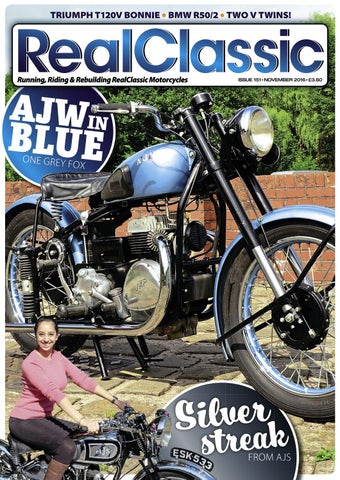
TRIUMPH T120V BONNIE BMW R50/2 TWO V TWINS!
Running, Riding & Rebuilding RealClassic Motorcycles
ISSUE 151 NOVEMBER 2016 £3.60
WHAT LIES WITHIN
44
AJS SILVER STREAK ......................................8
RE’S NEW BULLET .......................................60
When Associated Motorcycles wanted to catch the eye of the discerning 1930s customer, they jazzed up their ohv AJS singles with dazzling coats of chrome. Ace Tester Miles rides the result, wearing shades…
Royal Enfield’s new-for-1963 unit construction single bore little resemblance to the traditional Bullet which preceded it. James French found one of these really rare 350s, and then he found a couple more
DIVERGENT TWINS .....................................26
Take two beefy V-twins built more than a decade apart, one in Europe and one in Japan, and with very different engineering and kerb appeal. Paul Tebbett rides them both and uncovers more similarities than you might imagine… BLOCKADE BONNIE ....................................34
Born under a bad sign, amid strikes, sit-ins and industrial strife, this oil-in-frame 650 twin could’ve been nothing but trouble. But when Stuart Urquhart gets it ready to ride, he discovers that it challenges many of his preconceptions. In a good way BMW R50.....................................................44
Just another dull old 500 twin, then? Well… not exactly. Frank Westworth discovers a flat delight AJW GREY FOX............................................52
In his continuing mission to search out the oddball and unusual, Odgie uncovers another idiosyncratic animal – this time a sidevalve parallel twin, aka the Grey Fox
REALCLASSIC 151; PUBLISHED IN NOVEMBER 2016
RC REGULARS THE CONTENTS PAGE ....................................3
An AJW? A what? And an AJS? Which is the misprint? WE’VE GOT MAIL! ........................................16
MARATHON MAN........................................68
Every month, this is your chance to have a say, have a rant, argue or simply say nice sweet things. We prefer those…
During a lifetime of motorcycling, Mike Estall has made many friends from all around the world. One of those classic riders is also a long distance runner who hails from the frozen north, and who owns a fascinating collection of vintage vehicles
EVENTS ........................................................76
Worn out by Stafford’s thrills and spilled coffee, we’re drifting towards Christmas now. Mince pie?
BSA B21 REVIVAL........................................34
Take a pile of rusty old motorcycle parts, recognise their value, build a bike from the bits. Sounds simple … but it’s not. John Lay took on a serious BSA challenge
READERS’FREE ADS ....................................78
HONDA CB350 CAFÉ RIDER ........................90
Steam is on this month’s agenda, as PUB gets onto the footplate of road and railway engines, and then goes in search of the Roper steam motorcycle…
Some top tackle here, too. And TP has been fed, we can reveal PUB TALK ...................................................102
Eddie bought his new project bike largely unseen and it turned out to be bodged beyond belief. No problem: he intended to strip it right back to basics and build a café racer. But how well would the four-cylinder Japanese engine have withstood four decades of neglect?
TALES FROM THE SHED .............................108
Frank W is uncertain what BSA stands for, but is sure it’s not Brilliant Starts Are … available
NORTON ELECTRA PROJECT ......................96
RC COMPASS CHALLENGE.........................114
Surely, mused Peter Holland, it can’t be that hard to restore an old British bike? So began a decade-long project to bring a Norton lightweight back to life. Part two: your starter for ten
SUBSCRIBE
Some truly remarkable navigational skills and imaginations are on display here. Get riding; it’ll soon be winter!
TURNTO
You won’tfindRealClassiconthe shelvesin UKnewsagents.Ifyou wanttoenjoy regularRCreading then take outa subscriptionand join usin theRealClassicClub.Thatway, each issue costs just£2.50.Bargain!
P7
TODAY & SAVE
Neighbours
Take two beefy V-twins built more than a decade apart, one in Europe and one in Japan, and with very different engineering and kerb appeal. Paul Tebbett rides them both and uncovers more similarities than you might imagine… Photos by Paul Tebbett
26 I NOVEMBER 2016
T
hinking back, I’ve been lucky with neighbours. There’s never been the slightest complaint about any possible excess of enthusiasm for, say, cats or motorcycles. Girl Next Door is a case in point; in return for taking charge of its maintenance I am welcome to take her bike out at any time. Now that’s what I call neighbourliness, the sort of thing we could do with more of, and it would be plain churlish to refuse. She admits to not riding
it enough but won’t sell because she simply loves the ‘Girl on Virago 1100’ image. Well, it’s one reason for owning a bike, the very reason why cruisers exist I suspect. Thinking back, Dave Minton has much to answer for. In 1976 I traded up from learner’s RD250 to Ducati 860 GT, due mainly to naïvety under sales pressure but also after reading his brief test report in one of the comics. A brilliant design ruined by dreadful components it was, quite simply, a bad ’un. A year later it was
See RealClassic.co.uk for hundreds of classic bike profiles
GUZZI SPADA/YAMAHA VIRAGO
traded in for a Moto Guzzi 850 T3 and once again his detailed report had great influence. But this time he (and I) got it right. There followed sixteen years of great motorcycling, for which I thank him, and an enduring affection for Guzzis of the period. But things and people move on, Hinckley Triumphs have come and gone, good machines all. Thinking back … never mind all that, there’s an ad in RC for a 1980 Spada. Hmmm! It was a 900 mile round trip or take a chance. Too
late for me these choice words of wisdom: ‘No sane individual should ever, ever buy a bike without at least seeing it’ (Westworth, F, ‘Tales From The Shed’). Besides, like the man himself, I would only have ignored them. There were two obvious faults, no charging – a broken wire in the alternator repaired in half an hour the day after delivery – and weeping fork seals. Closer inspection over the following weeks uncovered more, due mainly to well-worn components and an
apparent rush by PO to finish putting it all back together after a reasonable cosmetic renovation. Nothing nasty though and, if more has been spent, only £350 was essential for reasons of safety and reliability. Additionally, our dry, brilliantly sunny and therefore bitterly cold (lowest daytime -15°) Lochaber winter was the more interesting. It was all part of the plan to relive a motorcycling past, which could be to invite disappointment of course.
Real Bikes. Real People. RealClassic: online at www.RealClassic.co.uk
NOVEMBER 2016 I 27
44 I NOVEMBER 2016
See RealClassic.co.uk for hundreds of classic bike profiles
1962 BMW R50/2
Boxing Lesson Just another dull old 500 twin, then? Well… not exactly. Frank Westworth discovers a flat delight Photos by Chris Spaett, Frank Westworth, Mortons archive
E
ven in these remarkable days of the rose-tinted rearview mirror it is entirely possible to forget that way back in the great Sixties heydays of great bikes, not all of them were British. We’re talking the early 1960s here, when BSA and Triumph were discovering the joys of unit construction, Norton were contemplating fitting their lighter twins with an electric start and although the Japanese were in the hallway, they appeared to be no threat at all to the established order of things. That changed. Just not quite yet. As well as the steadily increasing tide of remarkably engineered small capacity machines from the thus-far largely misunderstood east, we Brits were also offered motorcycles from mainland Europe. There was in fact quite a range, and although a large proportion of the bikes successfully making it onto a pretty conservative UK market were smaller capacity machines, there were also BMW motorcycles. BMW also built cars – as I understand they do today – but they were a rare sight on UK roads. Back then we built our own cars, and indeed our own motorcycles, thank you very much, and although the weekly motorcycling comics carried occasional short pieces on imports from the mainland, most of us could not have cared less. Our loss. Long before your less-than-humble scribe dipped a nervous toe into the shark-packed waters of motorcycle journalism, I was a great reader of motorcycle publications. This helps if a chap has aspirations to become a writer. Read first: write later. And among the mountain of features I read, ancient, modern and somewhere in between, it became possible to read between the lines.
Real Bikes. Real People. RealClassic: online at www.RealCllassic.co.uk
NOVEMBER 2016 I 45
Higher Calibre Photos by James French and Bob Murdoch
60 I NOVEMBER 2016
See RealClassic.co.uk for hundreds of classic bike profiles
ENFIELD 350 SINGLE
Royal Enfield’s new-for-1963 unit construction single bore little resemblance to the traditional Bullet which preceded it. James French found one of these really rare 350s, and then he found a couple more…
T
he 350 unit construction ‘New Bullet’ was conceived in 1961 and was in production at Royal Enfield’s Redditch factory from 1963 to 1965. Early literature from the factory announced it as the ‘big brother’ of the established Crusader range which had been introduced as a new design by Reg Thomas in 1956. Unfortunately the timing of the New Bullet’s introduction to the UK market was not good. Recent bad press for motorcycling
and the introduction of the 250cc learner law left the 350 market in limbo. Yet because BSA had their B40 and Norton their Navigator twin, so Enfield thought they needed a model in that capacity category. The name New Bullet was coined to allow Enfield to continue with the name ‘Bullet’ in the range after the production of the preunit 350 models ceased. The old Bullet had served Enfield well over the years in terms of sales – including a large order for the Indian
Real Bikes. Real People. RealClassic: online at www.RealClassic.co.uk
NOVEMBER 2016 I 61
September might be one of the best months for classic rides in the UK. Not too wet, not too cold, not too much traffic; a splash of autumn colour in the trees. All we needed was somewhere appropriately interesting and unusual to meet. Say, how about the Internal Fire museum near Cardigan? Just the job!
When Rowena and Frank passed this Enfield, somewhere in south Wales, on the day before the get-together, RH waved cheerily saying ‘That bike could ONLY be coming to an RC event!’
It was wonderful to be joined by members of the Pembrokeshire Vintage and Classic club, who raised the tone considerably by bringing bikes as beautiful as this one
RC riders came from far and near to attend: Richard Jones rode his Bonnie from Milton Keynes, MartinP trekked by Triumph from Lincolnshire (and stopped at a famous way-station, as seen here), JohnB rasped on a 500 miles round-trip aboard his yellow peril, and even that Bill Nelson turned up on two wheels (shock!). However, the Distance Award definitely goes to Rene from Amsterdam who rode from… erm… the Netherlands. Serious respect! (Drop us a line, Rene, to claim your prize – we’re not quite sure where to send it)
Editor Westworth was seriously smitten by this Sessantacinque GT, which wafted in serene near-silence through the crowded car park. What a sweetie (the Guzzi, not FW…)
MASSIVE THANKS to the team at the Internal Fire Museum of Power, which houses one of the largest collections of historic working stationary engines in Europe. It was great to see so many of the giant diesels in action – and everyone appreciated the teas, coffees and cakes! If you’re ever out west then it’s definitely worth a detour to spend half a day at the museum, and the local riding roads are simply superb. All the info is at internalfire.com Real Bikes. Real People. RealClassic: online at www.RealClassic.co.uk
NOVEMBER 2016 I 75
Take a pile of rusty old motorcycle parts, recognise their value, build a bike from the bits. Sounds simple … but it’s not. John Lay took on a serious BSA challenge Photos by John Lay / Graham Lay
B
SA, obviously, stands for Best Sort Available – not Bits Stuck Anywhere or the other, even less complimentary appellations applied to the marque. BSA claimed that ‘one in four is a BSA’ and, given the myriad array of makers at the time, to have 25% of the market was no mean feat. So how did they do it? Well, by selling the sort of bikes that people wanted to buy. Sounds obvious now, but although people might have dreamed of owning an Inter Norton, a cammy Velo or the like, what they actually bought was a simple, reliable, sturdy machine to get them to work and home each day. Back then, a motorcycle was a necessity for many people rather that a leisure item. However by the mid-1930s even some of BSA’s range was beginning to look a bit staid. What was needed was some fresh thinking, and that was just what BSA got in the person of Val Page. He set about redesigning the range, with the exception of the V-twins, to produce two new basic models, the B and M series. The first was a range of lightweight 250 to 350cc sidevalve and ohv models. The second were heavyweights of 350, 500 and 600cc, again sv and ohv. With many common parts shared across the range to simplify and therefore reduce production costs, these machines were to form the basis of BSA’s singles for the next 25 years. Right: The derelict remains of a sidevalve B20 and an ohv B21, muddled in together. We’d like to say that the photo looks worse than the reality, but that would be a big fat furry fib
84 I NOVEMBER 2016
It’s at this point that the hero of this little tale first appears, dispatched from the factory on the 21st April 1937 to Welshpool. It stayed in the Principality for the next 70 or so years. It had migrated to Montgomery in November 1962, and by 2013 it had reached Chirk, just over the border from Shropshire where it was acquired by the present owner. As so often, a chance conversation led to its discovery; the vendor had a complete running example displayed at the Cheltenham autojumble. The bike for sale, unlike the one on display, was neither running nor complete. It consisted of a collection of dismantled, semi-derelict remains of two machines, a B21 and a B20. If ever the ‘bits stuck anywhere’ term could be honestly applied, this was it!
A deal was done, and the remains made the journey south into England. Once home, the bits and pieces were sorted out to see what was there or, more importantly, what was not there. Quite a lot was missing; don’t be fooled by the photo, which makes the machine look much more ‘together’ than it really was. From the very beginning it was decided that this was not going to be a ‘restoration’ but rather a ‘repair’. The BSA should stay looking as a 79 year survivor should look, not a pseudo ‘new’ bike. So no powder coating, stainless nuts and bolts, flashy pattern parts or other improvements. Where parts were missing they should be replaced with the right parts of similar condition where possible, or modified from other BSA models. Failing that, components could be fabricated from scratch. However sentiment is no substitute for safety, so anything worn beyond repair would need to be replaced. That of course would include all the expendable items; brakes, tyres, bearings, chains, etc. Where to start? As the forks were not attached to the frame that seemed to be as good a place as any. Examining the two sets, the loose pair appeared to be in the better condition, but were missing their lower yoke and steering head spindle. The top yoke was discovered in one of the various boxes that came with the machines. The forks from
See RealClassic.co.uk for hundreds of classic bike profiles
PA TWRT O
Above: No matter how worn out and rusty they are, Norton’s short Roadholders can always be rebuilt. Not least because all the parts are available new
96 I NOVEMBER 2016
See RealClassic.co.uk for hundreds of classic bike profiles
TALES FROM
THE
D E H S sure A stands for, but is BS t ha w n ai rt ce un Frank W is ts Are … available it’s not Brilliant Star
K
icking a bike for an hour or two is character building. It’s also great exercise for the legs, improves blood circulation and helps in a chap’s weight control programme. It’s possibly also good for the development of zen-like patience and an increased understanding of the ennui of the universe. In the case of Possibly The Best Bike Ever – the Shed BSA B25SS – what it does not produce is a swift opportunity for a nifty nip around the lanes aboard Small Heath’s finest. It scores only two out of three on the blood, sweat and tears chart. It’s been a while since I sliced myself while attempting to fix this machine – in case you were wondering. And of course kicking over an engine is much less irritating if the clutch does not endlessly slip. Prior to this jolly and apparently interminable rebuild, the clutch worked perfectly. As did the ignition, although that’s a different matter. We’ll get to the ignition later. Probably. Taking a clutch apart and rebuilding it exactly as it was should have no effect whatsoever on the device’s operation. On the contrary, a dose of
108 I NOVEMBER 2016
cleaning should make it better, if anything. But… So, off with the primary chaincase outer. This is easy on a B25SS, involving removing a footrest and disconnecting the rear brake. Modern joint sealants are marvellous things. They cure leaks, you know. They also stick very well. Some chaincase designs feature cast-in bosses to allow a little judicious violence which helps split the joint. BSA did not do this. Had they never heard of high quality sealants? Possibly not. Speculation does not remove a chaincase lid. In fact, the seriously tenacious grip between chaincase outer and the crankcase is down to the dowels and accurate machining as much as to the sealant, I think. So. Off with both small inspection covers and insert two fingers. Yank. Manage to do this without pulling the bike over on top of me. Just as well, as I didn’t have a camera handy and moments like that should of course be recorded for posterity. At first the thing refused to budge. Of course it did. But then, for some mysterious astronomical reason known only to Prof Brian Cox (possibly) a
bubble emerged, squinting, at the top of the case. Movement! But why a bubble? It is a mysterious universe, just ask Prof Brian Cox. Take the bubble as A Sign, and proceed to apply Thor, King of Hammers, to the periphery of the case. The leather face not the copper one – do you think I’m stupid? No answer required. Apply further heaves, ignoring the increasing pain from the fingers, as a chap should when the fever is running high, and eventually away it comes. Of course I’d remembered to put a drip tray beneath the engine, so the beautiful clean oil from the chaincase poured into it. Wish I’d cleaned out the tray first so I could have re-used the oil. Unlike the very silly AMC arrangement, where the alternator stator lives in the chaincase outer, BSA had been sensible and mounted theirs on the crankcase, so there was no need to disturb it. It didn’t look disturbed, to be honest. How can you tell an disturbed alternator from a calm, placid, happy alternator? I have no idea. The clutch. I know how to fix clutches. I must have built several dozen – many of them repeatedly, such is my skill with
See RealClassic.co.uk for hundreds of classic bike profiles