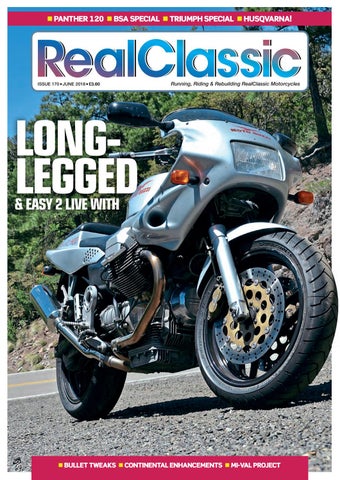
PANTHER 120 BSA SPECIAL TRIUMPH SPECIAL HUSQVARNA!
ISSUE 170 JUNE 2018 £3.60
Running, Riding & Rebuilding RealClassic Motorcycles
LONGLEGGED & EASY 2 LIVE WITH
BULLET TWEAKS CONTINENTAL ENHANCEMENTS MI-VAL PROJECT
WHAT LIES WITHIN
24
MOTO GUZZI 1100 SPORT ............................6
HUSQVARNA RACER ...................................50
The last of Moto Guzzi’s carb-equipped big V-twins is often overshadowed by its Daytona and Corsa counterparts. But owner Nolan Woodbury argues that this model offers an unbeatable combination of old-style engineering and outright performance at an affordable price…
Husqvarna built serious scramblers, right? Right … but they built GP racers too. Alan Cathcart did the business with a fast V-twin. A story in two parts…
BSA A10 SPECIAL ........................................24
It’s always risky trying to recreate memorable moments from your youth, but Nick Adams was ready to roll the clock back by four decades. His time machine turned out to be Panther’s mighty sloping single…
If you want to buy a genuine Spitfire Scrambler then you’ll need deep pockets to finance the five-figure price tag. But Odgie’s found a fella who built himself a seriously trick 650 special for a fraction of the cost… TRIUMPH T100 SPECIAL .............................32
When its owner first bought this preunit 500 twin, he was aged 18 and the motorcycle was tricked out as a café racer. Four decades later they’re still together, but the bike’s undergone a radical revamp, as Stuart Urquhart explains… HONDA XBR – MOSTLY! ..............................40
Honda’s single-cylinder bikes of the 1980s aren’t everyone’s cup of tea. But Chris Wood is obviously a coffee connoisseur. He’s rebuilt four of them, with distinct café racer inclinations, and not one of them is a flat white…
REALCLASSIC 170; PUBLISHED IN JUNE 2018
RC REGULARS THE CONTENTS PAGE ....................................3
HUSQVARNA MUSEUM...............................56
Spice, so they say, is all about variety. Which makes this the Vindaloo issue!
…and this is the second part
WE’VE GOT MAIL! ........................................14
MIGHTY PANTHER 120 ...............................60
Lots and lots of letters – hurrah! Including a special trick duplication EVENTS ........................................................80
Ah, the gentle fragrance of melting Tarmac… READERS’FREE ADS ....................................82
The increasingly curious selection of bikes on offer continues to be … curious
ROYAL ENFIELD BULLET 500 ......................68
Damien Hammond got more than he bargained for with his Royal Enfield Bullet, named George. Intent on an easy life, slumbering in the shed, the machine caused continual mechanical mayhem. Finally, Damien was forced to take up the spanners for a serious rebuild, as George explains…
PUB TALK ...................................................102
A regular event turned into a non-event, followed by a non-regular event that turned into an eventful event, but mostly events really have just not gone to plan this month… TALES FROM THE SHED .............................108
ROYAL ENFIELD REBUILD ...........................88
Two steps forward, two steps back. Frank’s running on the spot again…
Royal Enfield’s sporty GT was (and some would argue still is) one of the prettiest bikes around. Ted Connolly finally gets his hands on one after waiting five decades. He apologises for the uninspired title, but how else would you flag up a café racer called the Continental? Exactly MI-VAL PROJECT.........................................96
Stu Thomson plainly enjoys a challenge. Not content with restoring a Gilera Giubileo to the road, he’s now tackled something even less usual – at least in the UK. And here’s how…
SUBSCRIBE
TURNTO
You won’t find RealClassic on the shelves in UK newsagents. If you want to enjoy regular RC reading then take out a subscription and join us in the RealClassic Club.That way, each issue costs just £2.50. Bargain!
P114
TODAY & SAVE
WHO’S DONE WHAT REALCLASSIC clattered into action this month, bump-started by Rowena Hoseason and Frank Westworth of The Cosmic Bike Co Ltd, with tricky design and production stuff handled by Mike Baumber, Libby Fincham, Kelvin Clements and the team at Horncastle. Thanks as ever to all the folk who handle the admin and back office bits, without whom the magazine wouldn’t see light of day… COVER IMAGE by Nolan Woodbury: check out his site at woodburymotomedia.com You’ll find stacks more classic bikes, book reviews and events info at www.Real-Classic.co.uk TRADE ADVERTISERS for the magazine or website should call Helen Martin on 01507 529574, email hrmartin@mortons.co.uk EDITORIAL ENQUIRIES should be sent to Frank@ RealClassic.net or to PO Box 66, Bude EX23 9ZX. Please include an SAE if you want something returned or a personal reply SUBSCRIPTION INFO is on pg114. Call 01507 529529 to subscribe or renew or buy back issues SUBS QUERIES, late deliveries, or changes of address should be directed to 01507 529529, or email subscriptions@realclassic.net ALL MATERIAL in RealClassic is copyright its authors, so please contact us before reproducing anything. RealClassic is printed by William Gibbons & Sons of Wolverhampton. Our ISSN is 1742-2345. THIS MONTH we’ve been reading THE BROKEN SHORE by Peter Temple (seriously splendid Australia noir); CALIFORNIA FIRE & LIFE by Don Winslow (arson investigation in surfer’s paradise); HER NAME IS MERCIE by Chris Roy (authentically gritty); and Frank’s fave, NIGHTFALL BERLIN by Jack Grimwood (who is an RC reader, by heck!). It’s a cold-war thriller set in … ah … Berlin. Great read. Also THE BUTCHERS OF BERLIN by Chris Petit, which is also set in Berlin, oddly enough, but set around 1943. Gritty stuff indeed. MEANWHILE AT THE MOVIES… we were mightily amazed by INFINITY WAR (and comprehensively cliff-hung. Help!); reminded ourselves how wickedly delicious was DEADPOOL (ahead of seeing the sequel); adored HELL OR HIGH WATER (The Dude!) and ditto BRIMSTONE (Guy Pearce!). Amid all that excitement, we even tried our first Bollywood thriller: TALAASH, which was different. And brilliant… RealClassic is published monthly by MMG Ltd, PO Box 99, Horncastle, LN9 6LZ, UK. USA SUBSCRIPTIONS are $58 per year from Motorsport Publications LLC, 7164 Cty Rd N #441, Bancroft WI. 54921. Postmaster: Send USA address changes to RealClassic, Motorsport Publications LLC, 715-572-4595 chris@ classicbikebooks.com
FROM THE FRONT
I
t’s been an unusual month on the old bike front. How come? Well, it’s not every day – or every week – that I go out to ride a bike for a story and end up not riding it at all but riding another instead. And it happened twice within the space of a week. The first switchover was really unexpected. I’d wandered into a local bike shop, because I’d arranged to borrow a bike I’ve never ridden (at least, I can’t remember riding one, which is not entirely the same thing) and about which I get asked a lot of questions. Increasingly recently for some reason, which is the reason I’d asked to borrow the bike. Which bike? A Kawasaki W650, one of the earlier models, the one many, many riders have insisted was the bike the Hinckley Bonnie should have been. The Kwak looked grand, and Mike the owner wheeled it out into the sunshine, not looking at all nervous, which was handy. On the way, we passed something oddly familiar but at the same time oddly … odd. I stopped, turned around and stared. It’s not everyday you stumble across a Panther Model 50 in your local modern motorcycle emporium! ‘Does it work?’ I wondered, still not quite believing my eyes. It did. Three quick and easy kicks and off it ran. Helmet, gloves and off into the sun, then. I mean … Kawasaki 650 or mysterious Panther? No contest. And by the time we were done it was too late to ride the Kawasaki. Never mind, it’s nearby, and the patient owner was far more amused than irritated. Fortunately. Almost exactly a week later I was up in the Marcherlands – for many years my favourite riding roads, threading along the border between Wales and England. The excuse for the trip was the offer of an Ariel twin for the day. Not the reasonably commonplace 650 Huntmaster, its engine based around BSA’s A10 design. This example – and a very shiny example too – was the rather less familiar 500 Fieldmaster and, although I’ve ridden them before, the experiences have been oddly mixed.
CONTACT US! BY POST: BY EMAIL: TP@RealClassic.net ONLINE: www.Real-Classic.co.uk
The Ariel was waiting, shining in the May sunshine, fettled and fit for a few miles on familiar roads. We were chatting, as is the way when bike nuts get together, and while we wandered around looking at other bikes I found myself gazing at an unfamiliar rear mudguard. A rear guard with an ‘AJS’ transfer but with no stays to support it. ‘Aha!’ I announced with just the hint of an anorak showing. A Model 14!’ But no, it was the rather less common Model 8, and a deliciously neat example too. The same question: ‘Does it work?’ The reply was actually filled with honest doubt. The little Ajay had not run for quite some time, and the battery was too flat to light a light or make that odd clicking noise when the horn button is pushed. Oh well, maybe another day. Or not. These little AJS singles boast an ‘emergency’ starting position on their ignition switches. Would it? Three kicks, and off it ran. Sweet as a bird. Helmet, gloves, then back too late to ride the Ariel. Another day then, another excuse to visit those favourite roads. And how could life be better than that? Ride safely Frank Westworth Frank@realclassic.net
THE NEXT ISSUE
RC171 WILL BE PUBLISHED ON JULY 2nd, AND SHOULD REACH UK SUBSCRIBERS BY JULY 6th
The last of Moto Guzzi’s carb-equipped big V-twins is often overshadowed by its Daytona and Corsa counterparts. But owner Nolan Woodbury argues that this model offers an unbeatable combination of old-style engineering and outright performance at an affordable price…
I
n the early 1970s, it was easy to distinguish European motorcycles from those created with Japanese technology. Those Euro firms which still remained in business survived by incorporating themselves into a story
6 I JUNE 2018
Photos by Nolan Woodbury rewritten by the 750 four. Unlike the European marques, however, Honda’s success didn’t include decades of bike building experience and the traditional manufacturers had their old assets to fall back on. With machines that were lighter, tighter and more
powerful where they needed to be than the modern multis, what the old brands lost in sales was taken back on the road where stability and roadholding still mattered. Better known for their long-established single-cylinder machines, Moto Guzzi’s
More old bikes online: Real-Classic.co.uk
MOTO GUZZI 1100 SPORT
Italian V-twin finally flourished during this era. The Guzzi twin engine is unmistakable: mechanically transparent, large cylinders rise symmetrically to draw a theoretical line, and the rest plugs in neatly behind. The theory that it was based on an old auto has long divided Guzzi enthusiasts into yay or nay factions, and there’s no wrong answer. While it carved its niche as a flashy shaftie, Mandello’s twin proved reliable as a bus – but one with real Italian legs. Distinctively simple yet deceptively fast in Sport and Le Mans
form, the Moto Guzzi V-twin became the traditional choice of the non-conformist. Yet while the Guzzi’s charm endured, its position in the wildly competitive 1980s superbike market didn’t. Not on paper at least, where most editors or testers snickered when forced to compare the dated Italian to Japan’s latest multi. That changed in America when Dr John Wittner won one, two, then a third AMA championship on three different Moto Guzzi racers, and the machine you see here is a direct descendant of that effort.
Subscribe and save: www.Real-Classic.co.uk/subs
The 1100 Sport made its debut late in 1994, just in the nick of time to give Guzzi’s owner Alejandro De Tomaso one last winning hand before he backed out of the game a year later. The 1100 offered a definitely rough’n’tumble experience, and some enthusiasts didn’t buy what Guzzi’s last carburetted sport was selling; Wittner himself has publically admitted its flaws. That said, nearly 2000 units sold worldwide and the 1100’s unconventional build makes sense when one remembers Guzzi historically responded
JUNE 2018 I 7
Artistry everywhere, even in the exhaust pipes Above: The Sport’s power comes from the 2-valve engine, seen here with neat protectors fitted to the heads Left: This is a carb, not an injector. In case you were in any doubt Below: Where it’s most at home: Guzzi Sport out in the country
8 I JUNE 2018
(more accurately, budgeted) to market moves made by Ducati or BMW, not Japan. An unlikely contender, Moto Guzzi’s 1100 Sport had the fangs to stay in the fight. By 1995, Europhiles in the USA saw the hyperbike range filling out nicely. Guzzi’s 1100 squared off against the recently revamped oilheads from Berlin; Ducati’s iconic four-valve fuel-injected 916, and even a brace of bold new triples from reborn Triumph in England. Guzzi’s big splash for 1993 was the 992cc Daytona (not to be confused with the Hinckley multis of the same name); a limited edition, pure sports roadster with a genuine racing pedigree and a jarring price tag. No doubt impressed (and possibly surprised) by Dr John’s success, Guzzi boss De Tomaso brought Wittner to Italy and laid out a plan to build a proddy version of the good doctor’s 1987 racer. Thus a collaboration between the American dentist and engineer Umberto Todero was formed, combining Wittner’s frame with a new ohc twin that Todero had not yet taken past the prototype stage. The ever-present budget and manpower limitations held the four-valve V-twin out of showrooms until 1992, but nevertheless Guzzi’s new flagship was the first major revision to the line in over twenty years. I’ve spent considerable time with Italian bike merchant Steve Spreter, and remain appreciative of his hospitality and teaching. Steve took an interest in my Le Mans project, and I interested in everything else inside his Renaissance Motorcycles dealership, so many hours passed behind those walls – located, appropriately enough, on Speedway Boulevard. I first saw Guzzi’s Daytona twin there and noted its initial appeal, but stronger feelings didn’t develop. It was quite the opposite 18 months later when the Sport arrived, and with considerable fanfare. The 1100’s mix of modern and traditional was a logical slam dunk for me, and all reason left when Steve and I unpacked a first-batch
MOTO GUZZI 1100 SPORT Instrumentation is very much of its time. Note the nice white-faced tacho
NUTS, BOLTS & BITS
Sport in early 1995. Resplendent in silver, it had sleek lines where the Daytona had unsightly lumps; there was little doubt I’d someday be a buyer. Mind you, I didn’t envision having to wait thirteen years… Being dreadfully superficial, I’d passed on a couple non-silver Sports before spotting this one locally on eBay in 2008. Showing less than 10,000 miles, the 1996 carb model was one of a last few made before a switch in specs (fuel injection, USD forks, etc) later that year. The seller said he’d take $500 less if I showed up with cash, so the last wisp of objectivity floated away as I handed the seller his fee and rode away inside of a ten-minute window. I was thrilled to finally own a portion of the Dr John legacy, and my interactions with Wittner revealed both his affection for the Mandello brand and his sincere humility. Wittner discovered early that finishing was key: his first battleship was a stock Le Mans 850 Mk3 which became his first championship winner. The 850 competed in a new AMA endurance series against 600750cc multis, and then Wittner and his team moved to (and won) the open class in 1985 on a 1000cc Le Mans. Legend tells a tale of the Guzzi’s long battles with factory-backed 1000cc Hondas that year. With more on top, the heavy V-four gained ground down the straights, only to burn up its brakes keeping the Le Mans in sight on the road course. Civilian Daytona and 1100 Sport models feature a modified copy of the original racing spine frame which was commissioned by De Tomaso and funded by US importer Maserati. Dr John’s triple-crown was completed using a fast but fragile 998cc two-valve special built for the 1987 Pro Twins series. I have not ignored the rumblings that connect Guzzi’s cantilever frame to a design from engineer Tony Foale (nor, as quoted by Wittner, the inspiration from an early 1970s Aermacchi design), but the Sport frame shows several unique design elements. Measuring 61 x 46mm, a rectangular strut made from chrome
There’s no lack of information available for Guzzi’s work-in-progress 1100 Sport, and it seems to be divided equally between the carburetted (1994-96) and injected (1997) versions. I tend to favour the carbequipped version’s basic layout, and it is the lightest among all Wittner-framed machines made between 1993 and 2006. Post-1999 V11s were remade with a sixspeed transmission, restyled plastic (and more of it), plus changes to the frame and steering geometry. Pull the V11’s bodywork and you’ll see strong ties to the original Daytona/Sport, but the machines feel very different on the road. Purchased with just over 9000 miles on it, the Sport was largely standard save for the two important aftermarket upgrades; a stainless Mistral exhaust crossover (replacing the original ‘colostomy bag’) and HeliBar clip-ons. Several versions of the crossover remain available, but the slightly higher/wider HeliBars are not. The low mileage and choice aftermarket bits were the good news, but the Sport’s low purchase price was no doubt a reflection of its weathered finish. Originally from Maine on the East Coast, moisture and salt oxidised most of the aluminium, destroyed the driveline’s grey paint and select spots on the frame. The wheels were re-shot in straight black (original was a very deep purple) and not exactly well, meaning at some point it’ll need a complete teardown for cosmetic refinishing. Guzzi’s bare castings are easy to keep clean which makes the decision to paint regrettable, but spraying them poorly is borderline irresponsible. Happily, the top side silver remains glossy, and the 2-into-2 stainless exhaust polishes up well. A few mods have been done over the years. Owners tend to follow a pattern to increase reliability on frequentlyridden
Subscribe and save: www.Real-Classic.co.uk/subs
Frame and airbox detail
Machined breather
examples, to boost performance or ease service chores, like ditching the solenoid fuel taps for manual levers, and pulling the engine’s goofy sump-breather and its oily mass of hoses off in favour of a simple drain plug. Factory photos show typical squarehead breather lines in the heads, but these were cast solid on my engine. I machined my own in the rocker arm covers and ran the lines to the large frame banjos that vent into the frame. It works. The bike was rejetted to Euro specs with a 60/5 slide, K18 needle in the third notch, 152 main jet and a 57 pilot. Per instruction I yanked the ram air tubes, drilled the airbox lid and fitted larger mains, but it ran worse so I switched them back. The plugs say it’s good, but I believe there’s more smoothness and power hiding inside, waiting to be revealed. So next will come a set of Joe Caruso straight-cut timing gears, which will allow more paint patching. Also on the list is an idea to replace the standard 8/33 drive pinion with a 7/33 ring as fitted to the 1000cc Le Mans. The slight reduction in gearing should boost the bottom end for better acceleration through the change up, yet maintain a somewhat relaxed rpm at speed. Not all of my fiddling has produced positive results, but this is a bike that rewards persistence. A work in progress. Joe Caruso timing gears
JUNE 2018 I 9
Silver treasure
molybdenum knifes between the splay to connect steering head to a swinging arm tube fit inside those distinctive pork chop side-plates. More rethinking was applied to the square-section CrMo swinging arm and White Power monoshock, fastened between the main rail and a tubular loop that is part of the unit’s bracing. A bridged casting atop the trimmed and lightened rear drive box holds a torque arm affixed with Heim joints to thwart unwanted pinion forces on the suspension. The Sport’s frame is actually a third revision. It’s dimensionally identical to the Daytona unit, with 26 degrees of rake and 4 inches of trail, but the tubular crankcase attachments are welded and not bolted to the main beam
for increased rigidity. Carryovers from the four-valve include the brakes and wheels, the former in cast alloy with six radius spokes and identical in size; a 120/70 17”front and 160/60 18”rear. Goldline four-piston calipers squeeze conventional, non-linked 320mm Brembo floaters in thin stainless steel with a matching 260mm rear. Not elegant but effective, grease fitting were added to the 1100’s twin U-joints to add life, along with a protective scattershield. Those weaned on Tonti Guzzis will find the 1100 Sport a departure. Measuring 31 inches from the earth, the flat, broad seat makes the bike feel taller than it is. Turn the key and thumb the 1100’s lightweight Valeo starter for another surprise, as the engine’s instant
Above: Big pistons demand big batteries to move them. Known fact Below: The exciting mixture of Go and Weight demands a decent amount of Stop. As seen here
10 I JUNE 2018
More old bikes online: Real-Classic.co.uk
MOTO GUZZI 1100 SPORT The Sport also looks good in monochrome
take-up comes from its pie plate flywheel and lightened crankshaft. Rumour has it that Guzzi engineered the rattling clutch to attract Ducati riders... Pitched to De Tomaso by Wittner, the decision to draft the company’s trusty two-valve pushrod twin into the Daytona chassis was mutually accepted, providing the crankcase casting was unaltered. Getting serious, Todero and Wittner devised a plan to make a truly special engine. Deciding the cylinder spigot was at its maximum with a 92mm bore, the unlikely team found more displacement with a new 80mm crank, giving a total of 1064cc. Dr John used connections at Crane Cams in Florida to develop a high
lift cam profile, then tuned it with domed 9.5 pistons, the Daytona exhaust, and two Dell’Orto PHM 40mm carbs hooked to a pressurised airbox. Nearly every engine component was altered, lightened or made stronger compared to the previous 949cc Le Mans engine. These changes include slightly smaller 46.5 intake and 39.5mm exhaust valves, a Marelli digital ignition, and straightcut cogs in the five-speed transmission. Out in the open is where the Sport belongs. Low, long and feeling even longer with its raked 41.7mm Marzocchi M1R fork, the 59 inches stretching between the axles combines with the frame rigidity to deliver
MOTO GUZZI 1100 SPORT FACT PACK Built
1994 to 1996
Engine
90-degree air-cooled V-twin
Capacity
1064cc
Power
90bhp @ 7800rpm
Carbs
2x Dell’Orto PHM 40
Ignition
Marelli Digiplex
Transmission
Direct drive 5-speed, Daytona 10-spring two-plate dry clutch
Final drive
Twin cardan shaft
Chassis
CrMo spine, tele fork, monoshock
Weight
440lb dry
Top speed
146mph
unflappable high speed stability. Setting the suspension is easy: rebound on the left tube, compression on the right. A dampener dial for the WP unit lives on the reservoir and the shock gives 11 clicks of rebound adjustment. However, city work, slow switchbacks or any riding with on/off throttle transitions unearth the gremlins. That famous 2000rpm flat spot teams with the bike’s lashy crashbox to deliver a gear-crunching mess of a ride. Tales of gear pitting and phenolic failure lead any owner’s fear list, moving some to refit the old helical gearbox. Others claim the pork chops are prone to breaking if it lands wrong, but I’m not anxious to confirm or deny. With my own bike closing in on 25,000 miles, my solution thus far has been to avoid civilisation and twist away, enjoying the Sport’s neutral
Subscribe and save: www.Real-Classic.co.uk/subs
JUNE 2018 I 11
steering and zesty confidence in the bends. It’s comfy enough to while away the miles, so consider the 1100 Sport a racing tourer that’s happiest when you go and keep going. In a 1995 Cycle World test, an 1100 Sport with less than 1000 miles of running-in time recorded a standing start quarter-mile of 11.91 seconds; nearly two-tenths faster than the company’s flagship four-valve. Properly spooled, the 1100 smartly outgunned the Daytona on roll-on tests too, and recorded the same 136mph top speed. Lavishing praise for the handling and its zinging engine, the editors wrote that the Sport’s superior performance was even more shocking than its $3500 price difference. Removed from Guzzi’s US line-up late in 1995, the four-valve would return in RS form two years later with Sport bodywork and upgrades shared with the two-valve 1100i. Most Guzzi owners with experience know the 1100 Sport was a superior machine in
Left: The frame design is certainly distinctive Below: The drive shaft is not carried inside the swinging arm
1995, and the reasons have everything to do with the expertise of Dr John and Ing Todero. Being the last of its kind makes the 1100 Sport a special motorcycle, and the cost to obtain a truly standout Guzzi with a chrome moly frame and direct ties to a world champion racer remains shockingly low. That may or
may not change, but the Sport’s neoclassic style, performance and its relative rarity are all qualities common among high priced exotics. It’s one of those bikes which is far better unleashed on the road than parked in a museum: Moto Guzzi’s 1100 Sport proves that technology and tradition can mix very well.
What it’s really for…
THINKING OF BUYING?
You’ll find many more fuel-injected Guzzi V-twins from this era than you will carbequipped machines – there wasn’t a single one on offer as we went to press. But if you can cope with the pros and cons of early injection, then there’s a decent selection at different price points. Made In Italy
12 I JUNE 2018
Motorcycles currently have a four-valve ohc fuel-injected Daytona in stock, fitted with new tyres and clutch, for £8500. In 1998, 200 examples of the ‘Corsa’ special edition 1100 Sport were released with upgraded fuel injection, Carrillo conrods and a Termignoni sports exhaust. Skinner Motorcycles are offering a low miles
example for £8995. Offered for private sale, a 1997 yellow 1100 Sport is up at £4750. It’s done 25k miles and has the requisite new clutch (are we sensing a pattern here?) and the bevel and gearboxes have been recently rebuilt. Sensible tuning mods and a recently refurbished starter motor too. A snip?
More old bikes online: Real-Classic.co.uk