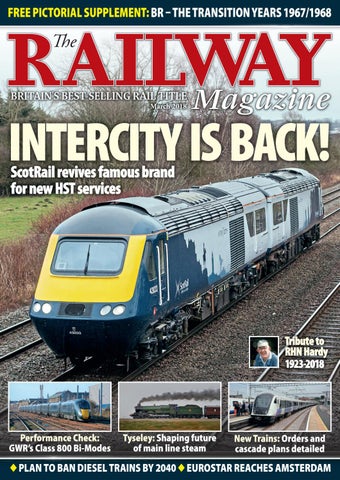
FREE PICTORIAL SUPPLEMENT: BR THE TRANSITION YEARS 1967/1968
BRITAIN’S BEST-SELLING RAIL TITLE March 2018
INTERCITY IS BACK! ScotRail revives famous brand for new HST services
Tribute to RHN Hardy 1923 2018 1923-2018
Performance Check: GWR’s Class 800 Bi-Modes
Tyseley: Shaping future of main line steam
New Trains: Orders and cascade plans detailed
◆ PLAN TO BAN DIESEL TRAINS BY 2040 ◆ EUROSTAR REACHES AMSTERDAM
K_\
EDITORIAL
Editor: Chris Milner Deputy editor: Gary Boyd-Hope Senior correspondent: Ben Jones Designer: Tim Pipes Picture desk: Paul Fincham and Jonathan Schofield Publisher: Tim Hartley Editorial assistant: Jane Skayman Production editor: Sarah Wilkinson Sub-editor: Nigel Devereux Consultant editor: Nick Pigott Classic Traction News: Peter Nicholson Operations News: Ashley Butlin Narrow Gauge News: Cliff Thomas Metro News: Paul Bickerdyke World News: Keith Fender By post: The Railway Magazine, Mortons Media Group, Media Centre, Morton Way, Horncastle, Lincs LN9 6JR Tel: 01507 529589 Fax: 01507 371066 Email: railway@mortons.co.uk © 2018 Mortons Media ISSN 0033-8923
CUSTOMER SERVICES
General Queries & Back Issues 01507 529529 Monday-Friday: 8.30am-7pm Saturday: 8.30am-12.30pm Answerphone 24hr help@classicmagazines.co.uk www.classicmagazines.co.uk Archive enquiries: Jane Skayman 01507 529423 jskayman@mortons.co.uk
ADVERTISING
Divisional advertising manager: Sue Keily Advertising: Craig Amess camess@mortons.co.uk Tel: 01507 529537 By post: The Railway Magazine advertising, Mortons Media Group, Media Centre, Morton Way, Horncastle, Lincs LN9 6JR
PUBLISHING
Subscription manager: Paul Deacon Circulation manager: Steve O’Hara Marketing manager: Charlotte Park Commercial director: Nigel Hole Publishing director: Dan Savage Published by: Mortons Media Group Ltd, Media Centre, Morton Way, Horncastle, Lincs LN9 6JR
SUBSCRIPTION
Full subscription rates (but see page 48 for offer): (12 months 12 issues, inc post and packing) - UK £52.80. Export rates are also available - see page 121 for more details. UK subscriptions are zero-rated for the purposes of Value Added Tax. Enquiries: subscriptions@mortons.co.uk
PRINT AND DISTRIBUTIONS
Printed by: William Gibbons & Son, Wolverhampton Distribution by: Marketforce UK Ltd, 5 Churchill Place, Canary Wharf, London E14 5HU 0203 787 9001
EDITORIAL CONTRIBUTION
Accepted photographs and articles will be paid for upon publication. Items we cannot use will be returned if accompanied by a stamped addressed envelope, and recorded delivery must clearly state so and enclose sufficient postage. In common with practice on other rail periodicals, all material is sent or returned at the contributor’s own risk and neither The Railway Magazine, the editor, the staff nor Mortons Media Ltd can be held responsible for loss or damage, howsoever caused. The opinions expressed in The RM are not necessarily those of the editor or staff. This periodical must not, without the written consent of the publishers first being given, be lent, sold, hired out or otherwise disposed of in a mutilated condition or, in any unauthorised cover by way of trade or annexed to or as part of any publication or advertising, literary or pictorial matter whatsoever.
This issue was published on March 7, 2018. The next will be on sale on April 4, 2018.
How hard is it to design a comfortable train seat? TRAIN OF THOUGHT M Editor’s AYBE the question should be how difficult is it, as an increasing number of passengers are finding the seats on the rising numbers of Class 700 and 800 trains entering service very hard. Having experienced seats on these trains – one on a 25-minute journey, the other for 90 minutes – I too am unimpressed. They are much firmer than previous seats and finding a comfortable position can be a chore. Neither it seems are RM readers, nor the wider public, over-enthusiastic about the seats. Commuters in particular have been critical of the Class 700 Thameslink trains (pictured right) with their harsh lighting, sterile interiors and the lack of a table of any kind on which to place a hot drink or a laptop (which has limited use with no on-train wi-fi). The issue of the poor thickness to the seat padding has been picked up by the national media, but responses from Department for Transport and operators claim the reduced padding is necessary to meet new fire regulations and anti-vandal measures. With the lack of tables and wi-fi, it also keeps the unit cost within a specific price band. However, seat covers with improved padding and meeting revised fire regulations would cost roughly £100 more per seat. When you break that figure down over a 30-year life span of a unit, £100 is a minuscule amount, and in hindsight a poor financial decision, which is generating more adverse publicity the railways could do without. The DfT claims there were focus groups to test the various seat designs, which also had to meet crashworthiness standards, but did they listen to the feedback? It would appear not. I simply do not believe a high percentage of opinions favoured such awful seats that are a backward step on what passengers had before. What happens when passengers on the East Coast
Comment
route are faced with the possibility of ‘ironing-board’ seating for journeys of four hours or more that are such a retrograde step to the recently refurbished Mk3 and Mk4 interiors? It is pointless spending billions of pounds on shiny new trains, trumpeting about how the railway is investing and improving, only to skimp on what is one of the key points that passengers will judge the trains on. The seats. So if you have the misfortune to ride one of these trains, please don’t blame the train operator for the uncomfortable seats – Thameslink and GWR didn’t have a say in the decision. Blame the Department for Transport for its Scrooge-like procurement and specification methods.
Celebrating the best in heritage and preservation FEBRUARY is the month when the preservation sector holds its ‘Oscars’ – otherwise known as the Heritage Railway Association awards. Magazine editors always have an input into the nominations, however when the nominees are announced to a wider audience at the annual HRA dinner, it makes you realise the depth, breadth and variety of these projects.
Preservationists are unsung heroes. These restoration or extension projects are undertaken by groups large and small, but also act as a reminder of how far the movement has come since the embryonic days of the 1960s. Let’s also never forget preservationists are the kind of people who do not take ‘no’ for an answer. Long may that continue.
We need your help! HERE at The Railway Magazine we want to learn more about you – our readers – so we can ensure the magazine and any products associated with it are as relevant as they can be. To this end we’ve created an online survey – www.railwaymagazine.co.uk/survey – for you to complete. By way of thanks from us for your completion of the survey, all respondents will be entered into a
FREE PRIZE DRAW with a chance of winning a footplate experience on a leading heritage line. It will only take you a few minutes to complete and I’d be grateful if you could take a little time to visit our website and give us your thoughts. Many thanks, and good luck in the prize draw! CHRIS MILNER, Editor
Contents
March 2018. No. 1,404. Vol 164. A journal of record since 1897.
Headline News
The first of 34 Italian-built Class 802 bi-mode trains for GWR's West of England routes was rolled out to the press and VIPs at Hitachi's Pistoia plant on February 8. BEN JONES
Hitachi rolls out first Italian-built Class 802 for GWR, Government aims to ban diesel-only trains from 2040, Network Rail unveils £47bn plan for 2019-24, LNER livery for 'B1', A1 Trust, RPSI, Swanage and Barrow Hill win heritage awards.
On the cover COVER: HST power car Nos. 43033 and 43148 carry the special ScotRail livery plus InterCity branding ready for the launch of a new service connecting seven Scottish cities in May. The pair pass Trowell Jct during a move after overhaul and a repaint from Wabtec Brush . STEVE DONALD INSET 1: A GWR Class 800 IET at Swindon. INSET 2: GWR 4-6-0 No. 5043 at speed. INSET 3: A Class 345 for the new Crossrail service.
Track Record The Railway Magazine’s monthly news digest 66 Steam & Heritage End of main line dream for 'King' No. 6023, 'Lizzie' moves to Carnforth ahead of main line return, Rocket to redeveloped NRM? Tornado to tour heritage lines as part of 10th anniversary events
72 Industrial
74 Irish 75 Steam Portfolio 76 Narrow Gauge 78 Freight 80 Railtours 84 Classic Traction 88 Network 91 World 94 Metro 96 Miniature 98 Traction & Stock ScotRail revives InterCity brand for HSTs, windscreen issues delay Class 385 introduction, first Class 365s head for storage, Crossrail Class 345 debut at Paddington.
The new face of the NRM? A £50million redevelopment looks set to transform the museum by 2025 and could see George & Robert Stephenson’s Rocket move from the Science Museum in London.
101 Traction Portfolio 102 Stock Update 103 Operations
Regulars 12 Multiple Aspects With Lord Berkeley.
The Railway Magazine’s audited circulation of 36,072 copies per month makes it by far the
UK’S TOPSELLING RAIL TITLE!
12 Railways in Parliament 48 Subscription Offer Subscribe today to receive your monthly copies of The Railway Magazine from only £20.
52 Readers’ Platform 60 Panorama
Climbing the last few hundred metres to Brocken station, 1,125m (3,690 feet) above sea level, Harzer Schmalspurbahnen (HSB) 2-10-2T No. 99.7234 makes the approach in perfect sunlight and sub-zero temperatures on February 6, passing trees frozen with snow and ice that form amazing shapes. GRAHAM NUTTALL
Our regular gallery of the best railway photography.
Almost 25 years ago, but looking more like the 1950s, Stroudley 'Terrier' No. 32658 re-creates a timeless scene at Hexden Bridge on the Kent & East Sussex Railway on December 16, 1993. PETER ZABEK
64 From The RM Archives
110 Heritage Diary
Find out what The RM was reporting 20, 50 and 100 years ago.
Details of when Britain’s unique collection of heritage railways and railway museums are open.
108 Meetings
122 Crossword & Where Is It?
Subscribe today and save money on every issue. Call 01507 529529 or see page 48 for our latest offers
Features
14 Bi-modes and Western wires
28 Giving the Railway the WOW Factor
Keith Farr assesses the performance of GWR's new Class 800s and how they compare to the InterCity 125s that have worked the route since 1976.
Steven Knight meets Sam Jessup, a creative designer once with Virgin Trains and now London Northwestern Railway, to find out how he uses his talents to create memorable brands.
20 Shaping the Future of Main Line Steam
33 A Lancashire Half Century
As main line steam undergoes one of its most significant overhauls for many years, Gary Boyd-Hope talks to Tyseley chairman Michael Whitehouse about Vintage Trains' bid to become a Train Operating Company.
Opened in 1967, the West Lancashire Light Railway is celebrating 50 years of family-friendly narrow gauge operations, as Mark Smithers dicovered when he visited.
38 Moving In, Moving On, Moving Out With more than 5,700 new vehicles now on order
MAIN LINE AMBITION: Tyseley goes big – p20
WOW FACTOR: Modern livery design – p28
or being delivered, Britain's train fleet will change quickly over the next three years. Ben Jones outlines all the new deliveries and how current fleets will be affected.
51 Obituary: RHN Hardy Nick Pigott pays tribute to a legendary railwayman, one of the last links with the ‘Big Four’, and a prolific writer, who inspired generations of enthusiasts.
54 Railcam Want to watch live trains from your armchair? Aidan Goldstraw explains how.
NEW TRAINS GALORE: Full details of Britain’s new train fleets - p38
March 2018 • The Railway Magazine • 5
HeadlineNews
Passenger groups angered by lack of 12-week booking window RAIL watchdog Transport Focus (TF) has accused Network Rail of badly letting down passengers after it was announced confirmed timetable information, which allows the booking of advance tickets, would not be available for the next six months to the usual rolling 12-week window from the May 20 timetable change. Known as ‘T minus 12’, it means timetables for available routes have been agreed between Network Rail and train operators after consideration
of line closures for engineering work. In some cases, the 12-week margin will shrink to six weeks or even four in some cases, meaning advance tickets will be on sale much later than usual. TF chief executive Anthony Smith said: “Passengers have been badly let down and will be deeply frustrated that they can’t make plans with certainty. “They are also at risk of paying more, so we will monitor the effectiveness of the industry’s no-quibble commitment.”
Open Access operators leading the way in passenger satisfaction EAST Coast Main Line open access operators Grand Central and Hull Trains topped the rail passenger satisfaction league table in 2017, according to the latest result released by Transport Focus. The two operators scored 96% and 95%, respectively, with Virgin Trains East Coast (VTEC) the best of the long-distance franchised companies at 92%. Virgin Trains West Coast scored 91%, both well above the average long-distance score of 86%. Of the other inter-city operators, Great Western was the worst performer at 79%, with CrossCountry achieving 83% and East Midlands Trains 85%. Scores for commuter operators in London and the south-east of England continue to lag behind, with South Western Railway suffering the largest year-on-year decline from 83% to 75%. Major disruption during and since last summer’s Waterloo upgrade had a detrimental effect on SWR’s performance. Southern remained behind at 72%, although this was actually an increase of 7% over the previous year. However, just 25% of Southern passengers were satisfied with the way it handled delays and disruption. Traditional commuter issues, such as punctuality, lack of seats
and value for money, dominate scores for these operators, but the poor performance in surveys highlights the need for continued investment in capacity and rolling stock, according to Transport Focus. Southeastern scored 80%, Thameslink 83%, Great Northern 77%, TfL Rail 75% and London Overground was rated at 87%, but the leading commuter operator in and around London was c2c, which secured a 90% overall satisfaction rate with passengers – a significant improvement from its days as the ‘Misery Line’. Chiltern Railways scored an 88% satisfaction rate for its commuter and long-distance operations. Away from the capital, satisfaction with regional operators varies, with Arriva Trains Wales scoring just 79%, Northern and TransPennine Express at 81%, and ScotRail falling from a record high of 90% in spring 2017 to 85%. The best-performing large operator in the country was ScotRail, despite satisfaction with punctuality, overcrowding and value-for-money all dropping. Merseyrail’s rating remained high at 89%. despite recent industrial action and closures for rebuilding work in the Liverpool loop tunnels.
In addition, TF is insisting if passengers buying a more expensive ticket later find a cheaper ticket becomes available, they should get a noquibble refund. TF also want a commitment that train operators will still offer the same number of cheaper advance tickets as usual. The cause of the delay in confirming timetables stems from delays to a number of infrastructure projects, such as the Preston to Manchester electrification, which is well
behind schedule, with the agreement of timetables having a knock-on effect on the timetables of at least six operators. The Rail Delivery Group claimed just 2% of passengers would be affected, but that could mean as many as 20 million travellers. The Office of Rail and Road is conducting an informal enquiry into problems. Chief executive Joanna Whittington said: “We are concerned about the impact of
producing a final timetable six weeks before travel. We have called in Network Rail to explain the arrangements it has put in place and will be monitoring the performance of train companies in keeping passengers informed. “We are investigating how this issue arose, industry’s delivery against its obligations and the on-going response of all parties in minimising the impact on passengers. “We want to ensure any lessons learned from this are properly addressed for the future.”
‘Cromwell’ tribute to RHN Hardy A FLORAL wreath in tribute to former Doncaster Premium Apprentice and BR divisional manager R H N (Dick) Hardy, who died on February 18, is carried by BR‘Standard’ No. 70013 Oliver Cromwell, which is approaching Stratford on February 22. A hot big end was discovered on the loco at Diss, and it continued to Norwich for repairs at reduced speed. An obituary to Mr Hardy appears on page 51. A two-part feature on the life of Dick Hardy appeared in the April and May 2015 issues. PICTURE: GRAHAM NUTTALL
Kenilworth misses another opening date THE opening of Kenilworth’s £13.6million station has missed another deadline for train services to begin serving the town’s 22,000 population. After the December 11 date was missed, the station was expected to open on February 26, but that date slipped again and means a fourth‘opening’date has passed. March 5 has been pencilled in
on the basis all inspections have been completed, and legal and regulatory approvals received. Provisional train times are listed on RealTimeTrains, the first being at 06.08 to Coventry and 06.45 to Leamington.The last train is the 22.17 from Leamington and 22.43 back from Coventry. There will be no Sunday service. Redoubling the track between
Milverton Junction (Leamington Spa) to Kenilworth was a part of the new station plan in order to avoid a higher risk of delay to other train operators at Leamington Spa and Coventry, but was shelved by Network Rail in CP5. It is hoped it will take place in CP6. When services begin, they will use a Class 153, but change to a Class 172 when one is available.
Lottery cash supports BESTT engineering training programme READ THESE AND HUNDREDS MORE EDITIONS IN THE RAILWAY MAGAZINE ARCHIVE classicmagazines.co.uk/ rmarchive
THE Heritage Lottery Fund has awarded the Boiler & Engineering Skills Training Trust (BESTT) a grant of £594,300 for its new mechanical overhaul training programme. The programme is supported by six of the country’s leading heritage railways and will teach 16 engineering hopefuls how to overhaul the
6 • The Railway Magazine • March 2018
mechanical components of steam locomotives, ships and steam road vehicles. The trainee placements will last up to 15 months, beginning with a three-month basic training placement to acquire workshop skills, followed by a 9-12 month syllabus-based training placement that will follow a new steam mechanical
overhaul syllabus, as started by BESTT. Candidates must be 18 years of age at the start of training and are paid £11-15,000 per annum, with a £3,000 bonus on successful completion. Applicants should have basic maths and English and be able to demonstrate practical ability. Gordon Newton, chairman of BESTT, said “We are delighted
to have this further grant from the HLF, which will enable us to attract a wider range of people into heritage engineering. “It will also enable us to extend syllabus-based training to a wide range of steam workshops across the UK.” For more details send an email to enquiries@bestt.org.uk together with a CV or personal statement.
Have you got a story for us? Email: railway@mortons.co.uk
Hitachi rolls out first Italian-built ‘802s’ for GWR By Ben Jones
FEBRUARY 8 saw the first two completed Class 802 bi-mode trains unveiled at the Hitachi Rail Europe (HRE) plant in Tuscany. Five-car AT300s Nos. 802003 and 802004 (T4/T5) are the first of 33 trains being built in Pistoia to replace Great Western Railway (GWR) InterCity 125s on the West of England route. A total of 22 five-car ‘802/0s’ and 14 nine-car ‘802/1s’ have been ordered, financed by Eversholt Rail, with modifications to cater for the longer journeys to Devon and Cornwall and greater use on diesel power over hillier routes. Three Japanese-built pre-series trains (T1-T3) have been on test in the UK since 2017. Nos. 802003/004 were set to leave Pistoia in late-February for the six-day journey to the UK. Hitachi expects to deliver one train every 12-14 days, with the last due in January 2019. RailAdventure, the German operator specialising in the delivery of new trains, will haul the new trains through Austria, Germany and France to Calais. GB Railfreight will move the trains through the Channel Tunnel and in the UK. Five-car sets will be delivered in pairs, with the nine-car ‘802/1s’ travelling solo. The tight delivery schedule calls for all 36 trains to be in
traffic by March 2019, with the sets expected to make their passenger debut on GWR’s 07.30 Paddington-Penzance on July 16. An option for a further seven nine-car Class 802/2s was taken up in August 2016 after it became clear more bi-mode trains would be needed to support the Class 800 fleet on fast trains to Oxford and Bedwyn, following the curtailment of Network Rail’s GW main line electrification programme.
Flatpack
In mid-February, bodyshells for trains up to T25 were under assembly at Pistoia. All 22 five-car trains are now being constructed, and work has started on the nine-car sets. In contrast to HRE’s Network Aycliffe plant in the UK, which receives part-finished bodyshells from Japan, the Italian factory assembles the aluminium bodies from flatpack kits produced by Hitachi’s Kasado plant. Each set takes around 40 days to build. After low-speed and static tests in Italy, the first three ‘802s’ will be required to complete 5,000 miles of fault-free running in the UK, reducing to 1,000 miles for later sets. The ‘802’ specification includes MTU diesel power packs rated at their full 940hp – as opposed to 750hp - and 20% larger fuel tanks for West of England duties,
‘Foremarke’ and Faulkner to re-open Broadway LORD Faulkner of Worcester will formally open the Gloucestershire Warwickshire Railway’s new Broadway extension and station on Good Friday (March 30), 58 years since the last train stopped there. A commemorative plaque will
be unveiled to mark the occasion, after which the railway’s flagship locomotive – ‘Modified Hall’ No. 7903 Foremarke Hall – will depart at 09.40 with the first official passenger train from the re-created station, bound for Cheltenham Racecourse.
Trawsfynydd heritage plan halted by Network Rail PLANS by the Trawsfynydd Railway Company to reopen eight miles of the Trawsfynydd to Blaenau Ffestiniog line have been dealt a blow after Network Rail revoked the company’s licence agreement. Network Rail said the
community group had committed serious breaches to health and safety legislation following the discovery of a large slab of masonry under a bridge, thought to be caused by a digger too heavy for the bridge.
New Class 802/3 units No. 802003 and 802004 for GWR's West of England services inside the Hitachi factory at Pistoia, Italy on February 9. BEN JONES
but GWR says the ‘800s’ will be modified to match as they will now spend more time running on diesel power than expected. As a result the main difference between the two designs will be the larger roof-mounted braking resistors of the ‘802s’, which are raised slightly to lift them away from seawater pooling in the roof well during high tides along the Dawlish sea wall section. This modification to the design is a response to electronic problems suffered by Voyager DEMUs on this route. Internally, the trains are similar to the Government-sponsored Class 800s, with identical seating and interior layout. GWR says
‘802’ diagrams will include duties to Bristol, South Wales and the Cotswold Line as well as Devon and Cornwall, but ‘800s’ are unlikely to venture west except on the busiest summer weekends. Replacement GWR seating moquette is due to be fitted on the ‘802s’ when they arrive in the UK, although the trains retain the firm seats that have been the cause of much adverse comment since the Class 800s entered traffic last October. Hitachi expects to build at least some of the similar Class 802/2 and ‘802/3’ bi-mode trains – for TransPennine Express and Hull Trains, respectively – in Pistoia, although the details are yet
to be confirmed. The first two of TPE’s 19 five-car trains are under construction in Japan and assembly of the remaining 17 sets, plus the five for Hull Trains, is expected to be split between Pistoia and Newton Aycliffe. Both fleets are due to be introduced in 2019. HRE's Pistoia plant is also engaged in the construction of up to 300 ‘Rock’ double-deck regional trains for Trenitalia, new metro trains for Milan and the overhaul/modification of AnsaldoBreda V250 high-speed trains rejected by Dutch and Belgian railways. The latter have been acquired by Trenitalia to work the Rome to Bari route.
Thameslink preview services begin THE first Thameslink services operated from Peterborough and Cambridge to south of the River Thames using the new Canal Tunnel ran as preview services from February 26. The tunnel connects the East Coast Main Line, north of King’s Cross, to the sub-surface platforms at St Pancras International. Two Peterborough to Horsham services (and return) and a return Brighton to Cambridge working will be formed of 12-car Class 700 EMUs, all calling at London Bridge. The diagrams are: 09.46 9J57 Peterborough to Horsham 13.17 9J63 Peterborough to 11.32 9S24 Brighton to Horsham Cambridge 10.00 9J52 Horsham to 14.24 9S39 Cambridge to Peterborough Brighton 13.30 9J58 Horsham to Further services are expected to Peterborough be introduced later in the year.
Class 700 Thameslink unit No. 700053 passes Polegate on February 18 with a Three Bridges to Eastbourne driver test run. CHRIS LIVINGS
Four companies shortlisted to contest next Midland Main Line franchise STAGECOACH will compete against Deutsche Bahn subsidiary Arriva, Abellio of the Netherlands and a First/ Trenitalia joint venture in its bid to retain the Midland Main Line franchise. The quartet has been shortlisted by the Department for Transport (DfT) for the next franchise, which will assume control of inter-city services between London, the East Midlands and South Yorkshire,
and regional routes across the East Midlands from August 2019. Stagecoach, operating as East Midlands Trains, has run the franchise since 2007. Despite calls for it to be excluded from bidding for new franchises after the recent Virgin Trains East Coast controversy, Transport Secretary Chris Grayling said there were “no adequate legal grounds” to do so. The new operator will be announced in April 2019 and is
expected to replace the current High Speed Train fleet and introduce new bi-mode trains from 2022, reduce journey times, and deliver an extra 1,000 seats per hour to and from London St Pancras at peak times – an increase of more than 50%. However, the new MML franchise remains controversial following last year’s cancellation of planned electrification between Kettering and Sheffield.
Government says the benefits of new trains will be better delivered by using bi-mode trains on the route, avoiding several years of disruption to install overhead line equipment and upgrade track and signalling. Stakeholders along the route disagree and fear the economic development of their regions will be damaged by the cancellation. The aspiration to bring journey times between
Sheffield and London under two hours also relies on eliminating station stops south of Kettering. This would free up additional capacity and accelerate long-distance trains, but it would leave Luton, Bedford and Wellingborough without fast trains to/from the north. Stations between London and Kettering will instead be served by 12-car EMUs when electrification from Bedford to Corby is completed in 2019.
March 2018 • The Railway Magazine • 7
HeadlineNews
A1 Trust, Barrow Hill, RPSI and Swanage win major HRA awards AWARDS to preservation groups, promoting No. 60163 Tornado societies and individuals to to new and wider audiences recognise their achievements through national media and in specific categories were cinema, inspiring people with presented at the annual the first 100mph steam run in dinner of the Heritage Railway half a century, as well as the Association in Birmingham on Settle and Carlisle ‘Plandampf’, February 10. and the Paddington 2 film. Barrow Hill Roundhouse won The A1 Trust’s second the Mortons Media (Heritage achievement of the night Railway) Interpretation was the John Coiley award, Award for the conservation and presented for an outstanding restoration of what was once a engineering project in the common, but now unique, key field of locomotive overhaul, part of British Railway heritage, restoration or preservation, while its project leader Mervyn which the trust won for Allcock won The Railway certifying Tornado for 90mph Magazine award for his vision, running on the main line. drive, determination and Runner-up awards were given passion over a 30-year period, to the North Norfolk Railway, culminating in the realisation of M&GN Railway Society the Barrow Hill Roundhouse. for a major overhaul of ‘WD’ Sister title Rail Express No. 90775, the Great Central presented its award to the East Railway for the restoration of BR Lancashire Railway Diesel Group, ‘5MT’ No. 73156 restoration, and for its superb restoration of the the Merchant Navy Locomotive last surviving complete Class Preservation Society, owners of 105 DMU power car and trailer. No. 35028 Clan Line. The A1 Steam Trust won two The HRA award for Small awards, one was the Steam Groups went to the Glenfinnan Railway Magazine Award, Railway Museum, with given jointly with DB Cargo for runner-up awards to Bahamas
Locomotive Society for its Learning Coach at Ingrow station, the West Lancashire Railway for its 50th anniversary celebrations, Rother Valley for the new connection at Robertsbridge, and the Telford Steam Railway for its ‘Polar Express’ event. In the larger groups category, the award was won by the Ravenglass and Eskdale Railway for its new museum, with the Gloucestershire and Warwickshire Railway winning a runner-up award for the construction of Hailes Abbey Halt, with the Romney Hythe & Dymchurch Railway also a runner-up for its level crossing protection system. A new award for 2017 was that for outstanding visitor attraction, with the inaugural winner being Beamish in the large museum category and the Perrygrove Railway winning the small museum sector. Runnerup awards were presented to the East Lancashire Railway, Great Orme Tramway and the Lappa Valley Steam Railway.
RM’s Chris Milner hands The Railway Magazine Preservationist of the Year award to Mervyn Allcock.
The Morgan Award for Outstanding Achievement was won by the Lynton and Barnstaple Railway for the new-build loco Lyn and carriages, with the Headhunters Railway Museum (for marking the 60th anniversary of the closure of railways in Fermanagh) and the Gwili Railway (for Abergwili
Extension) the runners-up. The HRA’s Peter Manisty award for excellence is awarded on an occasional basis, and for achievements in 2017 had two winners – the Swanage Railway, for returning passenger services to Wareham and the Railway Preservation Society of Ireland for its Whitehead Museum project (also see p74).
Amtrak trains involved in Just two in bidding for Wales franchise after multiple serious incidents Abellio drops out following Carillion failure Amtrak employees. Initial investigation by the National AMERICAN national passenger Transport Safety Board (NTSB) operator Amtrak has not had a suggests a signalling error good start to 2018. Only weeks made by infrastructure provider after the fatal derailment of CSX caused the Amtrak train to the inaugural run of a Seattle be on the wrong track. to Portland train via the rebuilt On February 6, a potentially Point Defiance Bypass inland disastrous incident occurred route on December 18 when an ‘Acela’ high-speed train, (RM Jan) the operator’s trains operating from Washington have been involved in several DC to New York, split in two at serious accidents this year. 125mph between Baltimore On January 31, an Amtrak and Wilmington when the train chartered by the inter-carriage fixed coupling Republican members of broke. Congress, travelling from Fortunately, nobody was Washington DC to a conference, hurt, but Amtrak immediately collided with a rubbish inspected the rest of the truck on a level crossing at ‘Acela’ fleet to check for similar Crozet, 10 miles north-west of problems. Charlottesville, Virginia, killing Government-owned Amtrak one of the people in the truck. could lose a substantial part Several of the senior of its budget after President politicians on board, who had Trump proposed deep cuts to medical backgrounds, assisted its funding. in the immediate aftermath. The President has made Four days later, on February 4, clear his opposition to funding the southbound ‘Silver Star’ Amtrak’s priority project – a (New York to Miami) collided new rail tunnel from New head-on with a stationary CSX Jersey to Manhattan – despite freight train near Cayce, South his administration having Carolina, while travelling at previously stated infrastructure around 50mph, killing two investment was a priority. By Keith Fender
SUBSCRIBE TODAY! P48SEFEOR DETAILS FROM ONLY £20 8 • The Railway Magazine • March 2018
THERE will be just two bidders competing to run the next Wales and Borders franchise after Abellio Rail Cymru said it was withdrawing from the competition, unable to overcome the collapse of its joint venture partner Carillion, which went into liquidation in January.
The decision leaves MTR and KeolisAmey battling to run the franchise that will be awarded by Transport for Wales. Incumbent Arriva withdrew from the bidding last year. It is expected the winner will be announced in May, take over services from October, and will
need to include a commitment to modify or replace the Class 142/143 Pacers. The franchise award will include operation of the South Wales Metro, an integration of heavy rail with a proposed light rail operation, using Cardiff Central as the hub.
Class 345 testing moves to Paddington
Testing of Class 345 EMUs for the Elizabeth Line (Crossrail) have reached London Paddington – under their own power. On February 22, set No. 345020 operated a test run from Maidenhead carriage sidings and is seen under the Brunel roof. The Crossrail testing programme has also seen a Class 345 (under its own power) driven into the tunnel from Abbey Wood station under the Thames, heading for Connaught Tunnel, before returning to Abbey Wood station. Services from Abbey Wood to Paddington are due to begin in December. EIKI SEKINE
Have you got a story for us? Email: railway@mortons.co.uk
DfT aims to eliminate diesel trains by 2040 DIESEL-powered trains could be a thing of the past by 2040 under a new Department of Transport (DfT) initiative to reduce air pollution. The announcement comes just a few months after the Government curtailed a rolling programme of main line electrification in favour of bi-mode trains that are heavier and more expensive to buy and maintain than conventional trains. Hydrogen and battery technology is being promoted as a possible way forward for traction away from electrified
routes, but both are largely untested in everyday service, and currently regarded as unsuitable for heavy freight trains and intensively worked main lines. Transport Minister Jo Johnson announced the aspiration on February 12, saying: “I would like to see us take all diesel-only trains off the track by 2040. “If that seems like an ambitious goal it should be and I make no apology for that. “Rail may be less carbon intensive than road transport. That’s why modal shift’s so important; getting freight and passenger vehicles off the roads
onto greener forms of transport. “That does not absolve the rail industry from cleaning up its own act.” However, the announcement was immediately criticised by various groups, including the Rail Freight Group. RFG executive director Maggie Simpson said: “While battery and hydrogen may show promise for lightweight passenger trains, their application for heavy duty freight is at best unproven, and setting an arbitrary deadline of 2040 could well therefore be counterproductive, damaging
the case for investment in our could result in prohibitively high sector.” Mick Cash, General construction and leasing costs, Secretary of rail union RMT, and possible larger fare rises. added: “If you were serious Another potential area of about phasing out diesel trains confusion is how the policy you wouldn’t be scrapping key might be applied. electrification projects.” A Department for Transport Industry sources also warned spokesman confirmed to The RM the aspiration could have a the announcement was a DfT detrimental effect on aspiration, rather than a wider medium-term plans to replace environmental policy. 1980s ‘Sprinter’-generation However, responsibility for DMUs in the early- to mid-2020s. transport policy is devolved Should new technologies to the Scottish and Northern prove unsuitable, procuring new Ireland governments, and in the DMUs with an expected life of process of being devolved to less than 20 years – as opposed Wales, leaving DfT responsible to the current norm of 30 years – only for policy in England.
CAF unveils Northern Class 331 EMU By Keith Fender
Could the Class 153s be rebuilt and reformed? GWR unit No. 153370 is seen at Barnstaple with No. 153373 before working the 11.43 service to Exmouth on December 20. TIM SQUIRES
Diesel ban could see a reprieve for older DMUs THE Department of Transport’s design. As a result, operators and aspiration to ban the use of ROSCOs are currently examining diesel trains after 2040 could various options to extend the lives inadvertently lead to a revival for of various DMU classes, including older DMUs that were planned the single-car Class 153s that were for withdrawal over the next two expected to disappear by the end years. of 2019. The move comes a few months Possible options include after the cancellation of a rolling reuniting two ‘153s’ to re-create electrification programme that Class 155 sets, one car of which would have seen EMUs cascaded will have an accessible toilet, or around the country to replace inserting ‘153s’ into other DMU many diesel trains, and leaves classes, such as Class 150s and many parts of the country with a 156s, to increase capacity for continuing need for diesel traction. passengers and bicycles. Current However, with hydrogen users of Class 153s are Northern, and battery technology largely GWR, East Midlands Trains and untested and still being developed, Arriva Trains Wales, with ownership rolling stock leasing companies of the 70 vehicles split between (ROSCOs) will be reluctant to Porterbrook and Angel Trains. finance new diesel trains that may The Class 142-144 ‘Pacers’ are only have a life of 15-18 years expected to disappear from compared to the more usual passenger service, but ROSCOs 30-year-plus minimum. report scrapping the trains under Industry sources also report current recycling regulations could that a lack of current DMU designs incur high costs and other options, for the British market mean including export and conversion purchase costs could reach around for other uses, are being examined. £2.5million per vehicle for a new
THE first of 43 Class 331 EMUs being built by CAF for Arriva Trains Northern was unveiled to the media and stakeholders at CAF’s Zaragoza factory, Spain on January 31. Body shells for both the EMUs and the Class 195 DMU fleet on order for Northern are made in Zaragoza, with the production line turning out alternate Class 331 and Class 195 vehicles. Final assembly for the DMUs is undertaken in another CAF factory in Irun, with the bodyshells moved there by road. CAF has previously built the Class 333 trains for West Yorkshire at Zaragoza as well as DMUs for Northern Ireland. Dynamic testing of the Class 331/1 four car train – No. 331101 – will be undertaken later this year, initially at Velim in the Czech Republic, between March
The bodyshell of a Class 331 unit on the CAF production line. KEITH FENDER
and June, with UK testing from August onwards, and an aim of gaining approval for use in service by late 2018. Northern will introduce the 331s on their busiest routes serving Manchester from early 2019, with the units based at Allerton depot. The EMUs are being supplied in three- and
four-car formations: the three-car trains numbered 331001- 031, with 203 seats, and the four-car trains with 283 seats, numbered 331101-112, have one additional unpowered trailer vehicle. CAF says the Class 331 trains could be extended to five cars in the future if required.
A view of the assembly hall at CAF's Zaragoza factory on January 31. KEITH FENDER
First CAF Class 195 units for Northern to be tested in Romania By Keith Fender
CAF is building 55 Class 195DMUs for Northern, the first batch of which will be tested in Romania. These DMUs use essentially the same body shell as the Class 331 (see story above right), and have almost identical interiors with identical seat layouts. The Class 195 fleet comprises 25 two-car trains, with 123 seats
(Nos. 195 001-025) and 30 three-car units, with 203 seats (Nos. 195 101-130). All Class 195 vehicles will be equipped with MTU power packs, incorporating 390kW Daimler engines and hydraulicmechanical transmission, supplied by ZF. Northern say they plan to use the new DMUs between Chester and Leeds from December 2018, as approval for
service is anticipated following dynamic testing in Velim (Czech Republic), Romania and the UK. The Class 195s will be based at Newton Heath depot. Designed for 100mph operation, both the ‘195s’ and 331 EMUs have central driving seats, are equipped with Dellner auto couplers, and both feature pre-installed CAF Signallingmanufactured ERTMS equipment.
However, that is unlikely to be commissioned for use for several years as the routes intended for service may never have ERTMS. The train interiors are common to both fleets, incorporating Fainsa seats and a specially designed seat cushion and fabric and tables or seat back drop-down tables at all seats. Electronic seat reservation indicators as well as power
sockets are provided. Free onboard wi-fi will be offered to all passengers. The £492million order for the combined fleet of 281 vehicles was placed by Eversholt Rail in January 2016, and options exist to order additional vehicles. Both fleets will arrive by sea from northern Spain, and allow the cascade or withdrawal of current units to begin.
March 2018 • The Railway Magazine • 9
k
HeadlineNews SIDELINES Far North sleeper plan moves forward HITRANS (the Highlands and Islands Transport Partnership Board) has been given support for further studies to be carried out into its proposal to introduce an overnight sleeper train from Edinburgh/Glasgow to Thurso. The study will be carried out by SYSTRA. Dubbed ‘The Midnight Train to Georgemas’, the service would use surplus Mk 3 sleeping cars and provide a connection with ferry services to Orkney from nearby Scrabster.
Boy and grandfather die in crossing crash GRANDFATHER Barry Hearnshaw (72) and his 15-year-old grandson Will Hallett died when their car was hit by a Southern Class 377 EMU at a level crossing at Barns Green, Sussex on February 17. Both BTP and RAIB are investigating.
Virgin East Coast drops quiet coach THE First Class quiet coach on Virgin East Coast services will be dropped from May 20. Virgin says that just 9% of passengers said they appreciate the First Class quiet coach. The Standard Class quiet coach remains unchanged.
‘Record price’ for diesel negative A LARGE format black and white negative of two North British Class 21 diesel locos and a Class 20 on shed in 1960 sold on eBay last month for £506. It is believed to be a record price for a railway negative in the UK.
Police Scotland merger on indefinite hold PLANS to merge the British Transport Police in Scotland with Police Scotland have been put on hold indefinitely. The merger received substantial opposition in both Scotland and England, but was due for completion by April 2019. However, according to Police Scotland’s Deputy Chief Constable Iain Livingstone, ‘unresolved issues’ mean that combining both forces could compromise public safety. The Scottish Government will review the timetable. Scottish Conservative Shadow Justice Secretary Liam Kerr said the plan was “an unpopular move that virtually nobody is in favour of”. The official line of both the British Transport Police and Police Scotland is that both forces are working to ensure the proposed merger goes ahead as smoothly as possible.
Virgin West Coast deal extended – but East Coast close to collapse
VIRGIN and Stagecoach have been granted a further extension of their contract to operate the InterCity West Coast (ICWC) franchise, taking their deal through to March 31, 2019. However, the troubled Virgin Trains East Coast (VTEC) franchise could come to an end even more quickly than feared as its losses mount. The current ICWC franchise expires on March 31, but the Department for Transport (DfT) has extended it for one year, with an option for a further year, to ensure continuity before the start of the new West Coast Partnership franchise. In return for the longer contract, Virgin will spend £7.5million to refit its Class 390 ‘Pendolino’ fleet with improved on-board wi-fi and allow free use for all passengers. Installation begins in May and should be completed by January 2019, at which point free wi-fi will become available to Standard Class passengers as well as First Class. VT has also been tasked with identifying and eliminating
Class 91 No. 91111 For the Fallen, stands at Newark Northgate with the 1D26the 18.03 London King's Cross to Skipton on February 20. STEVE DONALD
locations on its network where there is no mobile communications signal. As part of the new contract, VT will upgrade all station ticket machines to accept contactless payment, provide more staff
at stations during busy times, spend more than £3m to improve station and train environments, provide additional seating at stations, and improve toilets, lighting and carpets on its trains. The invitation to tender for
the new West Coast Partnership is expected to be issued shortly. Virgin Trains is one of the shortlisted bidders for this franchise, in partnership with Stagecoach (50%) and SNCF (30%).
‘Radical’ NR five-year plan targets 15% cut in delays By Ben Jones
NETWORK Rail’s draft strategic business plan for 2019-24 prioritises renewals and upgrades aimed at reducing delays by 15% across the network, plus a greater emphasis on safety and a commitment to recruit 50% more women by 2024. More than £47billion will be invested in completing previously agreed enhancements, maintaining and improving Britain’s railways over the five-year plan, known as Control Period 6 (CP6). However, in comparison to previous control periods, there is a noticeable lack of new major projects, with NR focusing on general improvements and completing current schemes. Outgoing NR chief executive Mark Carne said: “This is a radical plan, an ambitious plan. It is not without challenge and risk. But with great people, great teams, the right quality of leadership, the right incentives and the determination to see it through, it can deliver the better railway that a better Britain needs.” NR has allocated £18.5bn for
operations and maintenance, a 25% increase over CP5, and a similar figure will be spent on the renewal of life-expired equipment. The plan also includes £10bn to complete previously agreed enhancements. New major projects are to be subject to a completely separate funding process, handled directly by the Treasury as business cases are presented to Network Rail, which has allocated £1bn to supporting and developing these schemes in CP6. One major project that does feature is the trans-Pennine Route Upgrade, which is already in progress. ‘Digital Railway’ initiatives such as Traffic Management Systems (TMS) and European Train Control System (ETCS), allied to other capacity improvements, are expected to allow the delivery of an additional 1,000 trains per day from 2021. NR plans to deploy new digital safety technologies to reduce the general risk of accidents to passengers by 10%, aims to reduce the risk of level crossing accidents by 13%, and halve time lost to workforce because of injuries by the end of the plan.
Infrastructure renewals will be better phased, with contracts issued over longer periods to avoid overloading the supply chain. The cost of improvements per passenger kilometre will be reduced by around 10%, building on the 40% total achieved across CP4 and CP5. CP6 will also see NR continue its transformation into a ‘federation’ of devolved regional businesses competing to develop best practice, reduce costs and deliver better performance. Regionally, headline targets include more than £2bn to be spent by the Western Route, supporting an additional 140,000 trains per year from 2019. Efficiency savings of 6% could save more than £100million and close co-operation with operators aims to improve reliability by 11%. Specific schemes will include a £50m signalling upgrade for London Paddington, further extreme weather protection work at Dawlish and Teignmouth, by providing extra sea defences, track upgrades in Devon, and £40m to restore the historic overall roof at Bristol Temple Meads.
In Wales, projects will include the restoration of Barmouth Bridge and Phase 2 of the Port Talbot resignalling scheme, plus a number of smaller projects to deliver better journey times. More than £3.5bn will be spent on Southern routes to help improve reliability on some of the country’s most congested railways. Agreed projects include complete replacement of signalling systems at London Victoria and along the Brighton Main Line to Balham, to Penge East via Brixton and suburban lines to Denmark Hill and Crofton Park, and the introduction of TMS across the whole region, giving signallers and planners the ability to predict delays and implement mitigation plans. More than 750 sets of points at key locations and earthworks at 300 locations will be improved to reduce the risk of landslips. The LNW route has been allocated more than £5bn to maintain its network and ahead of HS2, while another £2bn will be spent on the Anglia route to help Greater Anglia prepare for an entirely new train fleet in 2019/20.
Mark Carne to retire – search begins for new NR chief CHIEF EXECUTIVE of Network Rail Mark Carne has announced he will retire later this year. His decision will allow NR time to headhunt a new CEO ahead of the start of Control Period 6 (CP6), the next five-year regulatory period, which begins in April 2019.
10 • The Railway Magazine • March 2018
Chairman of Network Rail Sir Peter Hendy CBE said: “Mark has done an outstanding job and I want to applaud him for what he has achieved in his time at Network Rail. His leadership steadied the ship during the challenging transition to a public sector organisation
and he has been the architect behind the huge positive changes in the company, driving transformation, devolution and efficiency, with an emphasis on equality and diversity, too. “Three years ago he set out a strategic vision for a digital
railway transformation, which is now becoming a reality in our plans. “Perhaps his biggest legacy, however, is the change in safety culture that he has very personally led and which has done so much to make the railway and our workforce safer.”
Have you got a story for us? Email: railway@mortons.co.uk
Eurostar launches direct services to Amsterdam By Keith Fender
EUROSTAR launched its new direct service to Amsterdam and Rotterdam on February 20, running an inaugural train in the timings of one of the two planned daily services. When regular services begin on April 4 these will be the first direct trains connecting the UK and the Netherlands. The train, with invited guests and the media on board, was formed of unit Nos. 374031 and
The new destination of Amsterdam on the screen at St Pancras. ALL: KEITH FENDER
374032, which were delivered to Eurostar in 2017. The final seven Class 374 trains ordered (Nos. 374021-034) have been delivered with signalling systems for the Dutch network pre-installed. All but the last train (Nos. 4033/34) are now in service. Two trains will leave St Pancras International at 08.31 and 17.31, arriving in Rotterdam three hours one minute later, and taking another 40 minutes to reach Amsterdam. The Amsterdam trains will be timed for 1hr 48min non-stop between London and Brussels – the fastest timing on that route. Initially, at least, the trains will not serve Antwerp or Amsterdam Schiphol airport. Eurostar is partnering with the international part of Dutch national operator NS to crew the trains north of Brussels. Twenty Dutch drivers have been trained to drive the Eurostar ‘Velaro’ trains in intensive classroom training undertaken at Temple Mills, where the Eurostar simulator is located. The NS drivers also drive the Thalys TGV-derived trains between Amsterdam and Brussels. Eurostar drivers will change in Brussels with Eurostar drivers from the UK, Belgium or France driving from London. There will be no direct trains from Amsterdam to London
Set No. 374032 on arrival with the first train from London at Amsterdam CS – the 08.31 from London St Pancras International on February 20.
until December 2019 because of the need to agree immigration arrangements between the Dutch and British governments, with British immigration staff working in the Netherlands, as they do in France and Belgium for Eurostar services. For trains from London, the French police working at St Pancras will act as immigration authorities for Amsterdam-bound passengers
‘B1’ emerges at Grosmont after LNER repaint
THOMPSON ‘B1’ 4-6-0 No. 1264 emerged from the North Yorkshire Moors Railway’s Grosmont works on February 25 resplendent in newly applied LNER black. John Furness completed the transformation from the previous BR black into LNER livery with red lining in time for the loco’s appearance at the Severn Valley Railway spring gala on March 16-18. The Thompson ‘B1’ Locomotive Trust locomotive was built by North British months prior to Nationalisation, but never carried this livery under LNER ownership, having been turned out in apple green. MARK O’BRIEN
as the Netherlands is a member of the EU ‘Schengen’ travel area. Eurostar is building new departure lounges, which will include security and immigration-screening areas at both Amsterdam and Rotterdam. Until direct trains are available from Amsterdam to London a series of connecting trains will use Thalys units to Brussels, with passengers changing to Eurostar from Brussels Midi.
These will offer journeys of around 4hr 45min between Amsterdam and London with a layover of about 50 minutes for the change, and security and immigration checks. Until the start of through trains, servicing of the Amsterdam sets will take place at Brussels Forest depot, the return working to the Belgian capital being promoted by Eurostar and Thalys.
Join an RM trip to see Union Pacific's ‘Big Boy’ ‘BIG BOY’No. 4014 has been undergoing a mammoth restoration – and you can be one of the first to ride behind the Union Pacific (UP) giant. The Railway Magazine is in discussions with specialist tour operator Darjeeling Tours to take you to see the‘Big Boy’, the UP heritage base at Cheyenne and lots more of railway interest in the Colorado and Wyoming areas, and maybe further afield. In their heyday, 25 4-8-8-4 ‘Big Boys’were produced for the UP between 1941-1944, working heavy freight between Wyoming and Utah, over the Wasatch mountains. Forced out by diesel locomotives, the last revenue train hauled by a‘Big Boy’ran in July 1959, with a number of the class remaining on
standby for several years afterwards. Of the 25 built, eight survive and No. 4014 was re-acquired by UP in 2013, with the aim of returning the loco to steam as part of the company’s Heritage Operations active fleet. No. 4014’s mammoth restoration is expected to come to a conclusion in the spring or summer of 2019. An outline itinerary is still being developed, but you can register your interest now, with no commitment, and will be sent details of the tour as soon as they become available. Email peter@darjeelingtours. co.uk in the first instance or write to Darjeeling Tours Ltd, Lime Tree Lodge, Thorpe Road, Mattersey, Doncaster DN10 5ED.
Global giants planning ‘world class’ test centre for Long Marston HITACHI Rail Europe (HRE) and Bombardier have joined forces in a proposal to build a‘world class’ test centre for new trains at Long Marston in Warwickshire. The two global transport giants are also working with Quinton Rail Technology Centre – home to Vivarail and a large quantity
of stored rail vehicles – and have applied to Stratford-upon-Avon District Council for planning permission to develop the centre. If authorised, the centre would be used for new train approvals, endurance testing, commissioning, acceptance and signal integration testing, and
could create up to 50 new jobs by 2022. Currently, capacity and capability for testing new trains in the UK is limited, with the main facility being Network Rail’s Rail Industry Development Centre (RIDC) near Melton Mowbray – formerly the BR Old Dalby test track. However, no
large test loop allowing continuous running is currently available. The large volume of new train types requiring testing and approval over the next few years means many are being tested abroad – for example in Germany, Spain, the Czech Republic and Romania (see separate story on p9).
HRE and Bombardier have created a joint venture to bid for London Underground’s DeepTube Upgrade contract, potentially delivering up to 250 new trains for the Bakerloo, Piccadilly,Waterloo & City and Central line. Both are also hoping to supply new trains for the next South Eastern franchise.
March 2018 • The Railway Magazine • 11
Multiple Aspects
with Lord Berkeley
Confidential task force will identify ‘annoying’ EU rules and laws to be scrapped in post-Brexit period
B
REXIT provides an opportunity for ministers to scrap (and take the credit for doing so) many of those irritating European Union (EU) rules and standards that prevent Governments from doing what they’d like to do by allowing the implementation of plans not enforced by EU legislation that would ultimately make the railways better, cost less and help passengers – and freight if they have heard about it! MPs have set up a special and confidential task force to identify which rules and standards they will
abolish immediately we leave the EU – and in the mean time, ignore others, where possible. There has been no debate or consultation about this and, no doubt, the Government intends to make these changes using secondary legislation or other means, known as Henry VIII clauses, named after the monarch who made laws as he went along and beheaded anyone who opposed them. In the UK we have some good pressure groups who look after the interests of different users of the
railway, safety, and public transport generally. However, is it not time Government introduced legislation to make the road users of level crossings responsible for their own failings? At present, whatever an errant motorist does to avoid waiting for a train to pass, it is ‘always Network Rail’s fault’, often causing NR to spend more than £1million per crossing to protect motorists from their own stupidity. The same comments apply to bridge bashing; again it is usually the fault of NR if a truck hits a bridge
because the truck driver does not know the height of their vehicle or has not seen the sign. The Law Commission proposed some sensible changes to such legislation some five years ago, but Government has done nothing. I can see little chance this will be part of Brexit transport changes as they could require all drivers to understand English road signs; instead they are more likely to make it easier to exceed the speed limit, lower fuel duty and change MOT tests. every 10 years.
Dragging feet over border checks on Eurostar Amsterdam service
Forging closer collaboration with the heritage sector
Consultants still rule the roost
way. Is this why costs are so high?
AT A time when our politicians seem keen to cut every link to the Continent, it is good to hear Eurostar is starting a through service from London to Amsterdam in April. This should create competition with popular air services, and also with the lesser-used Harwich/Hook of Holland night ferry, where a solo cabin costs only £60, including the fare for a foot passenger. Sadly, a through return Eurostar service from Amsterdam to London becomes a service with change at Brussels because the four governments involved – after many years of negotiation – are still unable to agree how and where to do the border checks and still refuse to do them on the train. However, our ministers never had to experience the delays and frustrations of immigration checks when on business – they are simply waved through the VIP channel!
I WAS honoured to be invited to speak at the Heritage Railway Association annual dinner in Birmingham on February 10. It was an amazing event, with people from all around the UK and Ireland demonstrating their commitment to service quality, safety, and engineering excellence on their railways, large and small, and showing the power of the voluntary sector in not only giving training and many new skills, but having fun doing it all. It is good ministers are now encouraging this sector’s own businesses by suggesting there is demand for expansion, for reopening old lines, and also for working more collaboratively with Network Rail to allow through running, as has happened on the Swanage line. This is an area where the bureaucracy of NR needs reviewing! The HRA President, Lord Faulkner of Worcester, and chairman, former MP Brian Simpson, do a great job in looking after the interests of the HRA. Keep up the good work!
THE saga of Network Rail’s costs goes on and on. I recently heard there was a plan to relay the two tracks between Totnes and somewhere east of Plymouth next year, and there is interest among the Peninsular Rail Task Force, representing councils and other authorities in the South West, to encourage Network Rail to increase the line speed of this section from 60 to 75mph, in order to save a few minutes on the journey time to Plymouth. It apparently involves increasing the cant on the track without any realignment, but the cost quoted of £300million seems heroic; worse still is the apparent need for £60k of ‘consultants’ study to work out how to do it! So NR is going cap in hand to the Department for Transport for this money since the ORR has decided this is an ‘enhancement’ and not a ‘renewal’, which needs ORR and DfT approval. No doubt the £60k is for consultants to make the business case for going a bit faster; surely any competent track maintenance and renewal company knows how to do this and, of course, check and report on the clearances to structures on the
Diesel fade-out quandary
SO ONE Minister of Transport tells us diesel-powered trains will be phased out by 2040 and another cancels electrification projects at the drop of a hat! Given many trains and locomotives can last 30 to 40 years, what means of propulsion do minsters expect the railways to use after 2040? There is hydrogen, but that still seems in its infancy, and there could be trains with solar panels on their roof, but less useful at night or in tunnels. Battery technology is developing fast, but how much battery power would a freight locomotive need to haul 2,000 tonnes of aggregate, competing with hundreds of trucks still using diesel – albeit getting cleaner all the time! Maybe ministers should not try to micro-manage the railway and, instead, challenge the sector even more vigorously to reduce its costs and improve its efficiency. berkeleyafg@parliament.uk
■ (The independent views expressed do not necessarily reflect those of The RM or the Rail Freight Group, of which Tony Berkeley is chairman).
Railways in Parliament
by Jon Longman
Strike mandate ends
LEO Docherty (Aldershot) asked what steps the Department for Transport (DfT) is taking to prevent future strikes on the South Western Railway. Transport Minister Joseph Johnson said: “The RMT’s current mandate for strike action on South Western Railway (SWR) expires in April. During the RMT strikes over Christmas and New Year, SWR operated around 70 per cent of their services, keeping passengers on the move. “In December, the Secretary of State met with Mick Cash to renew his offer of guarantees of employment to people who currently fulfil the role of the second person on the train beyond the length of the franchises. “The Secretary of State and I continue to encourage a dialogue between the parties to resolve the union’s dispute and avoid further unnecessary strikes for passengers.”
Ticking TOCs plans
LAYLA Moran (Oxford West and Abingdon) asked if the DfT will make it policy to include an automatic delay repay scheme in future rail franchise agreements. Mr Johnson replied: “We want train operating companies (TOCs) to make claiming compensation for delays swift and simple. “We have encouraged better promotion and increased awareness of delay repay schemes and we have encouraged TOCs to make the claims process simple and easy to use. We welcome the fact that all TOCs now have a dedicated online claim process. “Passengers are more willing than ever to demand and get fair compensation if their train is late or cancelled, with more than £73 million paid out to successful claimants in
12 • The Railway Magazine • March 2018
2016/17 – an increase of 63.8 per cent on the 2015/16 total of £44.9 million. “We are improving passenger compensation by introducing relay repay from 15 minutes, which is being rolled out across the network as franchise contracts come up for renewal.”
Rural expansion
DR David Drew (Stroud) asked what steps the DfT is taking to encourage the reopening of rural railway lines and halts. Mr Johnson said: “The Government is working with local authorities and other partners to identify the best new rail projects that can unlock new housing and economic growth, ease overcrowding, meet future demand, and offer good value for money. “It is also helping them to identify new ways of designing, financing and funding
additional rail capacity. “We will consider proposals on a case by case basis, based on the economic benefits and business case put forward by local partners.”
26-30 Railcard roll-out
ALEX Sobel (Leeds North West) asked when the DfT plans to roll-out the 26-30 Railcard nationwide. Mr Johnson replied: “The Government will work with industry to extend the benefits of discounted rail travel to ensure those aged 16 to 30 can access concessions. “This will include the introduction of a new railcard for ages 26 to 30, which the Government anticipates will increase the number of journeys taken. “Further details will be announced in agreement with industry and will be implemented from spring 2018.”