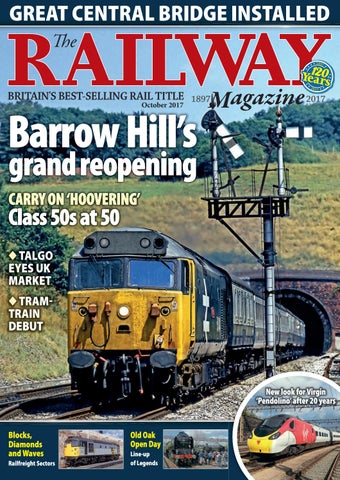
GREAT CENTRAL BRIDGE INSTALLED
Magazine
BRITAIN’S BEST-SELLING RAIL TITLE 1897 October 2017
Barrow Hill’s
2017
grandreopening CARRY ON ‘HOOVERING’
Class 50s at 50 ◆ TALGO EYES UK MARKET ◆ TRAM TRAIN DEBUT
New look for Virgin ‘Pendolino’ after 20 years
Blocks, Diamonds and Waves Railfreight Sectors
Old Oak Open Day Line-up of Legends
K_\
EDITORIAL
Editor: Chris Milner Deputy editor: Gary Boyd-Hope Senior correspondent: Ben Jones Designer: Tim Pipes Picture desk: Paul Fincham and Jonathan Schofield Publisher: Tim Hartley Editorial assistant: Jane Skayman Production editor: Sarah Wilkinson Sub-editor: Nigel Devereux Consultant editor: Nick Pigott Classic Traction News: Peter Nicholson Operations News: Ashley Butlin Narrow Gauge News: Cliff Thomas Metro News: Paul Bickerdyke World News: Keith Fender By post: The Railway Magazine, Mortons Media Group, Media Centre, Morton Way, Horncastle, Lincs LN9 6JR Tel: 01507 529589 Fax: 01507 371066 Email: railway@mortons.co.uk © 2017 Mortons Media ISSN 0033-8923
CUSTOMER SERVICES
General Queries & Back Issues 01507 529529 Monday-Friday: 8.30am-7pm Saturday: 8.30am-12.30pm Answerphone 24hr help@classicmagazines.co.uk www.classicmagazines.co.uk Archive enquiries: Jane Skayman 01507 529423 jskayman@mortons.co.uk
ADVERTISING
Divisional advertising manager: Sue Keily Advertising: Craig Amess camess@mortons.co.uk Tel: 01507 529537 By post: The Railway Magazine advertising, Mortons Media Group, Media Centre, Morton Way, Horncastle, Lincs LN9 6JR
PUBLISHING
Subscription manager: Paul Deacon Circulation manager: Steve O’Hara Marketing manager: Charlotte Park Publishing director: Dan Savage Commercial director: Nigel Hole Published by: Mortons Media Group Ltd, Media Centre, Morton Way, Horncastle, Lincs LN9 6JR
SUBSCRIPTION
Full subscription rates (but see page 32 for offer): (12 months 12 issues, inc post and packing) - UK £51.60. Export rates are also available - see page 121 for more details. UK subscriptions are zero-rated for the purposes of Value Added Tax. Enquiries: subscriptions@mortons.co.uk
PRINT AND DISTRIBUTIONS
Printed by: William Gibbons & Son, Wolverhampton Distribution by: Marketforce UK Ltd, 5 Churchill Place, Canary Wharf, London E14 5HU 0203 787 9001
EDITORIAL CONTRIBUTION
Accepted photographs and articles will be paid for upon publication. Items we cannot use will be returned if accompanied by a stamped addressed envelope, and recorded delivery must clearly state so and enclose sufficient postage. In common with practice on other rail periodicals, all material is sent or returned at the contributor’s own risk and neither The Railway Magazine, the editor, the staff nor Mortons Media Ltd can be held responsible for loss or damage, howsoever caused. The opinions expressed in The RM are not necessarily those of the editor or staff. This periodical must not, without the written consent of the publishers first being given, be lent, sold, hired out or otherwise disposed of in a mutilated condition or, in any unauthorised cover by way of trade or annexed to or as part of any publication or advertising, literary or pictorial matter whatsoever.
This issue was published on October 4, 2017. The next will be on sale on November 1, 2017.
Praise in different ways
O
LD Oak Common held an open day at the beginning of September – and what a magnificent event it was. However, the pictures of the wonderful array of locomotives (see p36) tell just part of the story. As someone who played a small part in organising the Eastleigh Works open day in 2009, I know exactly how difficult, complex and stressful such events can be – not just the planning of locomotive movements, any gauging issues, and the amount of staff time over and above their normal jobs, but more so from the legal side, where those responsible for public events and public safety carry a corporate liability that could, in a worst case scenario, mean imprisonment. Open days on the modern railway are few and far between, so I raise my hat to praise the men and women of the GWR who worked so hard to give those who visited the depot many lasting memories. Praise must also go in the direction of the Barrow Hill roundhouse, which, without the vision of Mervyn Allcock, (pictured above) might well be an industrial estate today. Mervyn’s dogged determination back in the 1990s was to save the Victorian roundhouse for posterity, and supported by a faithful contingent, Barrow Hill has gone from strength to strength over the past 20 years, developing strong commercial activities that have helped secure an important aspect of life from the past
TRAIN OF THOUGHT
Editor’s Comment
for future generations. With a new extension opening last month (see p9), there are plenty of other good things about to happen at Barrow Hill. “Well done” to Mervyn and his team from everyone at The RM!
Embarrassments and ‘white elephants’ IT IS no secret the main reason the Government has dropped many electrification schemes is down to rising costs. The off-on-off electrification of the Midland Main Line wasted in the region of £40million before the project was finally abandoned, with more than £7m spent rebuilding three bridges in Leicestershire that need not have been altered. No amount of gloss and spin will convince the travelling public that bi-mode trains are the real answer to electrification from an emission or efficiency perspective. There are also questions whether bimode will bring genuine journey-time reductions that really are needed on a 21st century railway. What is becoming increasingly apparent is the cost of electrifying lines in this country tends to be double what it is in Germany and elsewhere, based on recent news stories. Are our methods of cost estimating carried out
on the back of a cigarette packet, or do we build in so much cost contingency because we know things will go wrong? Passengers are fed up of Government acting like ‘Bad Santa’ – handing gifts over only to take them back – and overseeing an industry that has an inability to control its costs, so much so planned schemes that would benefit far many more people than HS2 have to be dropped. The Sheffield to Rotherham tram-train project, Edinburgh to Glasgow electrification, and the Great Western route upgrade are all over time, over budget and an embarrassment – and I won’t begin to note projects that have become ‘white elephants’ since completion. If Britain’s railways are to see any future electrification at all, then proper project costing with strong project management are essential. CHRIS MILNER, Editor
October 2017 • The Railway Magazine • 3
Features
14 20 Years of Virgin West Coast
30 Railway Children
40 30 Years of Railfreight Sectors
Former Virgin Rail PR manager Steven Knight reflects on the high-profile ups and downs of two decades of Virgin operations on the WCML.
The RM is backing the Railway Children charity’s campaign to protect vulnerable young people both in the UK and abroad - our October 7 railtour to Glasgow will raise money to support that campaign.
In October 1987 BR relaunched its Railfreight business with a bold new image that remains one of the most popular and successful of the pre-Privatisation period. Ben Jones looks back at how and why it was done.
36 Farewell to Old Oak Common
48 50 Years of Hoovering
September 2 saw a final gathering of iconic Great Western Main Line trains at the West London depot before it is closed to make way for a new facility and High Speed 2 interchange.
Celebrating a half century of these cult English Electric Type 4s, Ben Jones considers their controversial introduction and the recent main line revival of the class.
20 Practice & Performance: WD 2-8-0s John Heaton considers the merits of the Riddles ‘Austerity’ 2-8-0s built during the Second World War and later acquired by British Railways.
26 Building for the Future Ben Jones visits Bridgnorth to see how the Severn Valley Railway is investing at the station to accommodate increasing visitor numbers.
TWO DECADES OF VIRGIN: Looking back on the ups and downs of Virgin West Coast’s first 20 years. - p14
4 • The Railway Magazine • October 2017
SUBSCRIBE TODAY TO THE UK’S TOPSELLING RAIL TITLE! TURN TO PAGE 32
UNSUNG HEROES: Assessing the performance of the Riddles WD‘Austerity’ 2-8-0s. - p20
50 NOT OUT: Celebrating half a century of English Electric Class 50s. - p48
Contents
October 2017. No. 1,399. Vol 163. A journal of record since 1897.
Headline News
100mph Pacifics united for Barrow Hill Roundhouse reopening, Edinburgh-Glasgow wiring complete, South Yorkshire tram-train carries first passengers, Talgo to bid for British train contracts, Eurostar starts Amsterdam tests, first ‘refreshed’Virgin ‘Pendolino’ unveiled, Loughborough GCR bridge installed Stagecoach Supertram presented its new Stadler Class 399 ‘Citylink’ tram-trains to the press and public in mid-September, ahead of their introduction in May 2018.
On the cover COVER: No. 50040 Leviathan hurries the 09.20 LiverpoolPaignton out of Whiteball Tunnel on July 30, 1983. JOHN CHALCRAFT
INSET: Three decades of Railfreight sector grey livery. INSET: Famous guests at Old Oak Common open day. INSET: New livery for Virgin ‘Pendolino’.
Track Record The Railway Magazine’s monthly news digest 66 Steam & Heritage Repton and Bluebell star at Severn Valley Autumn Gala, Dartmouth ‘4MT’ to visit West Somerset, ELR plans major redevelopment for Rawtenstall.
72 Industrial Steam 74 Steam Portfolio
76 Irish 78 Narrow Gauge 80 Metro 82 Heritage Trams 84 Network Merseytravel starts work on new Maghull North station, London Bridge revamp ‘in home straight’.
86 Traction & Stock ScotRail receives first HST set, TransPennine Express Class 68 and Class 397 break cover, Class 700s complete Thameslink takeover. Stanier Pacifics Nos. 46203 Princess Margaret Rose and 46233 Duchess of Sutherland come face to face at Swanwick Junction during a Timeline Events charter at the Midland RailwayButterley on September 9. It was a rare foray beyond its West Shed home for ‘Maggie Rose’, the loco not having steamed for 21 years. PETER ZABEK
The Railway Magazine’s audited circulation of 37,250 copies per month makes it by far the
Recently restored ‘Schools’ 4-4-0 No. 926 Repton was one of the star guests at the Severn Valley’s autumn steam gala.
89 Stock Update 91 Traction Portfolio 93 Classic Traction 98 Railtours 102 Freight 104 World 107 Operations
Regulars 12 Multiple Aspects With Lord Berkeley.
UK’S TOPSELLING RAIL TITLE! Subscribe today and save money on every issue. Call 01507 529529 or see page 32 for our latest offers
12 Railways in Parliament 32 Subscription Offer Subscribe today to receive your monthly copies of The Railway Magazine from only £20.
46 Reviews 56 Meetings 58 Readers’ Platform 59 From The RM Archives Find out what The RM was reporting 20, 50 and 100 years ago.
On a glorious June 12, 1976 No. 55010 The King’s Own Scottish Borderer passes Lamberton, north of Berwick, bound for Edinburgh Waverley. JOHN COOPERSMITH
112 Heritage Diary
60 Panorama
Details of when Britain’s unique collection of heritage railways and railway museums are open.
Our monthly gallery of the best railway photography.
122 Prize Crossword and Where Is It?
HeadlineNews
GA facing industrial action over driver-only operation RMT members working for with GA, as there is no definitive to try and resolve the issues Greater Anglia (GA) have voted answer on whether or not there involved and to avert industrial to strike on October 3 and 5 over will be an increase in DOO, action. the possible extension of driver- they have served notice on the “We value our conductors only operation (DOO). company regarding the strike highly and we have guaranteed New trains on order from ballot, the result of which was their jobs until the end of the Stadler and Bombardier – due more than two to one in favour franchise in October 2025. In for introduction from 2019 – of action. fact, we will be recruiting have provision for the driver to GA’s train service delivery additional conductors.” control the doors. However, the director Richard Dean explained: After 18 months of industrial union has taken the view that “We are obviously disappointed. action on Southern over DOO in spite of face-to-face talks We’re keen to talk to the RMT – now the longest dispute on
Britain’s railways – plus ongoing in the new Wales and Borders strikes at Merseyrail and franchise, which will begin in Northern, with more planned for October 2018. October 3 and 5, the union has ■ Concerns have been voiced recently balloted South Western by the RMT that East Midlands Railway drivers and guards over Trains staff have still not had the possible extension of DOO their April pay increase. The at that franchise following the 2.7% offered, with productivity order for 90 new ‘Aventra’ trains. improvements, has been The RMT has also warned branded totally inadequate both industry and Government by the union, which is making against introducing DOO trains preparations for a strike ballot.
First Hitachi IET visits Edinburgh
Crossrail tracklaying complete
FOLLOWING the first visit of a Hitachi Class 800 IET (Intercity Express Train) to Dunbar on August 16 (RM Sept, p83), set Nos 800001 and 800002 became the first to venture to Edinburgh Waverley on September 7, working from Doncaster. The appearance in the Scottish capital is part of the ongoing testing programme ahead of the introduction of 65 IETs on the East Coast that will replace the HST fleet and the majority of Class 91 and Mk4s from next year. Class 800s on test are becoming common on the ECML, working between the Hitachi factory at Newton Aycliffe, and maintainence depots at Doncaster and North Pole. Picture: HITACHI RAIL EUROPE
Trial to simplify fares behind schedule, but progressing By Steven Knight
THE Rail Delivery Group (RDG) has confirmed to The Railway Magazine that plans to simplify rail fares (RM June 2017), announced in February, are still being progressed. Despite the RDG and the Department for Transport (DfT) initially suggesting the three-fares projects would go live by May this year, the earliest start date for just one of the trials is expected to be January 2018. The RDG says it has been working to develop an effective way to update and simplify the complex contractual fares structure inherited from British Rail. This structure has not been overhauled since 1993 when
it was finalised in readiness for Privatisation. The fares database contains detail around the ownership of routes and fares, with millions of fares interlinked contractually between train operators and many also controlled by Government regulation.
Roll out
The RDG says it is important to not only provide a way of accommodating the individual trials but to also unlock the ability to roll out the improvements to the wider rail industry. This is taking considerably longer to progress than had been expected. As a result, the first trial, reducing the through fare price
to that which can be obtained by buying a number of tickets for various legs of the journey (split ticketing) will go live on CrossCountry in January next year on as yet undisclosed journeys. There is still no expected introduction date for single-leg pricing on selected London to Scotland journeys on Virgin Trains’ West or East Coast routes, but it may be introduced initially for web bookings. Simplifying Sheffield to London tickets is proving more complex because of the contractual arrangements between various train operators. Prior to Privatisation, British Rail frequently modified or withdrew ‘Any Permitted’ routing, but since Privatisation
it needs the approval of all train operators involved as well as the DfT. The RDG is also looking at how digital ticketing can be developed and is working with both Greater Anglia and South Western Railway on Pay As You Go ticketing and also ‘part-time’ season tickets. .
Innovation
An option of innovative ways of managing railcards – which could involve a ‘mix and match’ option, where passengers could use more than one Railcard (maybe a Two Together and a Senior Railcard) is under investigation. The RDG remains cautious on how long it will take to make any future changes.
Work will now turn to testing and validation to enable staff training before the introduction of electric trains in December. The completion of electrification of 46 miles of railway between Edinburgh Waverley and Glasgow Queen
6 • The Railway Magazine • October 2017
Street marks an important event in the delivery of EGIP, which promises a 20% reduction in journey times and 30% more capacity on longer electric trains. The current ScotRail Class 170 three-car DMUs will be replaced
£200,000 now pledged to buy Tornado’s tender
MORE than 163 supporters have now joined The 163 Pacifics Club – which is fundraising to buy the locomotive’s tender from William Cook Cast Products – and have helped the appeal reach its initial target of £200,000 pledged. Tornado’s tender is leased to the A1 Steam Locomotive Trust under a 15-year loan agreement, which will come to an end in 2021. The tender is a development of the original Peppercorn from late 2017 by new design. It has a water capacity Hitachi Rail Europe Class 385 of 6,200 gallons and carries three- and four-car EMUs, which seven tons of coal, as opposed are currently under construction. to 5,000 gallons and nine tons However, crew training, on the original. testing and initial electric August 2018 will mark services will be with Siemens the 10th anniversary of the Class 380 EMUs. completion of Tornado.
Milestone passed as Edinburgh to Glasgow wires go live SEPTEMBER 2 saw the Edinburgh Glasgow Improvement Programme (EGIP) pass a major milestone when the 25kV AC overhead wires were energised between Newbridge Junction and Glasgow via Falkirk High.
TRACKLAYING work on the new Crossrail routes through London was completed in mid-September. Transport Secretary Chris Grayling joined Crossrail chairman Sir Terry Morgan and CEO Andrew Wolstenholme in the new Whitechapel station to see Ellen McGuinness, track quality control engineer, fix the final rail clips into place on September 15. Over the last two years, 1,000 workers have installed 63,000 sleepers, 51,419 metres of rail and more than 800 sections of long-welded rail to complete more than 50km of new track. Work is now focusing on the installation of platform screen doors, signalling, tunnel ventilation and communications systems, along with the overhead lines that will power the new Class 345 EMUs.
Have you got a story for us? Email: railway@mortons.co.uk
With one beam in place over the Midland Main Line, the second is carefully lowered into place on September 3, as part of the plan to reconnect both sections of the Great Central Railway. ANDREW MORLEY
The first main line steam excursion to pass under the newly installed Great Central bridge at Loughborough on September 15 was ‘A3’ No. 60103 Flying Scotsman, working a London Victoria to York charter. In the 1950s, No. 60103 was allocated to Leicester Central, so is more than likely to have crossed over the original GC bridge over the Midland Main Line. JOHN CALTON
Long wait over as Great Central gap is finally bridged DECADES of campaigning and fundraising finally came to fruition during the early hours of September 3 when the Great Central Railway’s new bridge over the Midland Main Line at Loughborough was lowered into position. The £2.5million structure represents the most significant piece of the GCR’s Bridging the Gap project, which will ultimately see the northern and southern portions of the preserved GCR reconnected after a gap of
almost 40 years. The scheme to create an 18-mile heritage line is undoubtedly one of the most ambitious undertaken by a preserved railway, ranking alongside the Bluebell Railway’s extension to East Grinstead and the Ffestiniog Railway’s rebuilding of the Welsh Highland Railway.
Single span plan
Construction of the concrete abutments began in February ahead of the single-span bridge going in. The original bridge was
supported on three brick piers, but Network Rail’s insistence the new abutments be at least 15ft away from the running lines to accommodate the now aborted MML electrification resulted in the design for the single span. From around 23.00 on the night in question a number of supporters started to gather in order to witness such a seminal moment for both the GCR and Great Central Railway – Nottingham. However, transport delays meant the first of the
122ft-long beams did not arrive on site until after 01.30, with the lift starting at 02.20.
In position
Those who had braved the cold would have another 90 minutes to wait until the mammoth 1,722-ton crane had lowered the second beam into position. For the time being the beams are being held in alignment by steel ties; the deck plates require a second overnight possession in order to install them.
Further work to reconnect the two railways will include reinstating around 500m of missing embankment and a bridge over the A6, which will utilise the bridges reclaimed from Reading during the GWML improvements. The GCR’s CEO Richard Patching said: “For over 40 years our supporters and friends have dreamt of work starting on the reunification. We hope to continue raising funds to complete the project and join the two railways.”
New look for Virgin’s ‘Pendolino’ A PLANNED repaint has seen the first of 56 Class 390 ‘Pendolino’ trains emerge in a revised livery. The new livery is the first major change since the sets were introduced 15 years ago, with this mid-life repaint needed as part of the leasing arrangements. Its style and colour is similar to how Virgin says its new Class 800 ‘Azuma’ trains will be painted. Set No. 390010 Cumbrian Spirit received its revised colour scheme at Alstom’s new repair and refurbishment facility in Widnes, and
by the end of 2019 all sets should have been repainted. Set 390006 is now in the paintshops to be completed by early October, and a repainted set should be released into traffic every two weeks. In a further change the aluminum cast nameplates have been replaced with stick-on versions. With the West Coast franchise up for renewal in March 2019, the colour scheme provides a neutral base for whoever wins it, which will include HS2 operations. Picture: VIRGIN TRAINS
South Western Railway formally launched at Waterloo
South Western Railway’s new livery as carried by ‘Desiro’ No. 444040, bringing up the rear of the 14.03 Weymouth-London Waterloo, with 444010 leading, as the pair pass Winchfield on September 13. KEN BRUNT
AFTER a low key start to the new South Western Railway (SWR) franchise the new era was formally launched at London Waterloo on September 4. SWR took over from South West Trains on August 20.
The offical launch was delayed until platform extensions at Waterloo were completed. First Group and MTR jointly operate SWR, and used the event to reveal the new SWR livery. SWR has ordered 750 new
‘Aventra’ EMUs from Bombardier, which will be formed into fiveand 10-car units. They are due to enter service from mid-2019 and will provide an extra 20,000 seats in the morning peak into London. SWR will introduce a
new customer app for mobile ticketing, increased wi-fi coverage, 1,150 extra car parking spaces and invest £90million in station upgrades. SWR is headed by managing director Andrew Mellors,
East Coast operators team up NETWORK Rail’s London North Eastern Route and East Coast Main Line operators have formed a route supervisory board aimed at reducing disruption and driving improvements on the route. The board is being chaired by Sir Gary Verity, chief executive of Welcome to Yorkshire, and comprises senior representatives of NR and ECML train operators, representatives of passenger groups, and regional economies along the route.
October 2017 • The Railway Magazine • 7
HeadlineNews Wensleydale shareholders agree to sell Aysgarth A PROPOSAL to sell off the Wensleydale Railway’s Aysgarth station to an unnamed buyer in order to release much-needed capital has been ratified by the railway’s shareholders. The controversial move (RM Sept) was given the green light at the Wensleydale Railway plc annual general meeting on September 9, clearing the way for the cash-strapped plc to dispose of the station for around £400,000. This will enable the company to clear the £195,000 mortgage on the site, leaving around £200,000 to be ploughed back into the railway’s infrastructure. However, the decision has not seen unanimous approval, with some believing it will have a negative impact on the longerterm aim of reaching Hawes. In spite of pledges from the buyer that he would like to see the station linked with the WR’s Redmire terminus, and also be included as part of the Hawes scheme, the fact the station will not be in railway hands is seen as an unnecessary obstacle to future developments. PICTURE: MIKE HADDON
India to build first high-speed line in next five years By Keith Fender
WORK to build a 508km-long 350km/h high-speed railway between Ahmedabad and Mumbai officially began on September 14, when Indian Prime Minister Narendra Modi and his Japanese counterpart Mr Shinzō Abe laid the foundation stone. The $17billion cost of the new line is to be mostly paid for by $14bn in loans from Japan; in return Japanese firms will supply Shinkansen high-speed trains and technology, which will be assembled in India. The new line will open with 750-seat trains on August 15, 2022 – the 75th anniversary of India’s independence. The new line will feature a 21km tunnel section between Thane, north of Mumbai, to Virar. In Mumbai an entirely new terminus station will be built in the Bandra-Kurla Complex, near the main airport and 11 other stations will be provided. The new high-speed trains will be 1,435mm gauge and unable to use the main Indian Railways network. Journey times from Ahmedabad to Mumbai are expected to be two hours – a reduction of 4 hr 15 min on the current best time.
Tunnel collapse closes key European route By Keith Fender
FOLLOWING the collapse on August 12 of a new railway tunnel being built under the German town of Rastatt, the Karlsruhe to Basel main line railway (above the new tunnel) was badly damaged, with significant track deformation leaving it closed to all rail traffic for at least eight weeks. This two-track section between Rastatt and Baden Baden is already a major bottleneck in the route between Northern Europe and Switzerland/Italy, being used by up to 200 freight trains a day, plus more than 100 regional and international passenger services. German national rail operator DB and the tunnel contractors spent September stabilising the collapsed tunnel by pouring in more than 10,500cubic metres of concrete to completely fill a 160 metre-long section and then building thick concrete slabs on the surface where the tunnels will pass under – the railway will be rebuilt on top of these slabs.
Reopening is planned for October 2, but in the meantime freight services have been severely disrupted and are being diverted via often much
longer alternative routes – some via neighbouring countries. Passenger services have been replaced by buses either side of the blockage.
The damaged Karlsruhe to Basel main line on the surface, after the tunnel collapse, as the void is plugged with concrete. COURTESY DB
Loco shortage sees Swanage cancel steam gala A LACK of available locomotives has forced the Swanage Railway to cancel its ‘Class of 1967’ gala on October 13-15, which was to feature Ivatt ‘2MT’ tank No. 41312. The move comes as a direct result of the low-speed collision between ‘Battle of Britain’ No. 34070 Manston and BR ‘4MT’ 2-6-4T No. 80104 on July 24, which has resulted in both engines being taken out of service. The situation has not been helped by the unserviceability of the National Railway Museum’s LSWR ‘T9’ 4-4-0 No. 30120, which arrived
on the railway in late July, but has not turned a wheel since owing to issues with its already suspect inside cylinder block. Although the railway has ‘M7’ 0-4-4T No. 30053 and ‘U’ 2-6-0 No. 31806 in traffic, it has struggled to maintain a steam presence on services this summer. In a joint statement, Swanage Railway Company chairman Trevor Parsons and Gavin Johns, chairman of the Swanage Railway Trust, said: “Since the unfortunate incident in July, we have struggled to run a steam service on many days. Although we
Skelmersdale link study MERSEYRAIL services could be extended over a new branch to the Lancashire new town of Skelmersdale by the late-2020s if a new study finds a strong business case for the £300million link. The town is the second largest in the North West without a rail connection and Merseytravel and Lancashire County Council are investing more than £5m in studies to build the case for a new station at Headbolt Lane in Knowsley and a link to Skelmersdale town centre. If it goes ahead, Merseyrail trains would be extended from their current terminus at Kirkby to serve Headbolt Lane, Rainford and Skelmersdale, which would
8 • The Railway Magazine • October 2017
become the new interchange for Merseyrail and Northern trains to Wigan and Manchester. Merseyrail’s new Stadler EMUs, due to enter service in 2020, will undergo trials using battery power to enable their use away from 750V DC electrified lines, and the Skelmersdale extension is suggested as one possible route for the deployment of this technology, avoiding the cost and added complexity of electrification. The use of Northern Class 769 ‘Flex’ bi-mode trains converted from Class 319s has also been suggested. The study will also look at the potential for a freight connection to Knowsley Industrial Park.
have operated every scheduled train, on many days this has been using diesel traction, a situation that is unacceptable to many of our customers, our volunteers and staff. “Our contingency plans came unstuck with the discovery of the unserviceability of the ‘T9’ when we were preparing it for service. “It is important to restore services gradually and at a managed and measured pace without the very considerable pressure of preparing and delivering the Autumn Steam Gala. For that reason
the Autumn Steam Gala has been cancelled. This will be a disappointment to many and we most sincerely apologise for any disappointment or inconvenience caused.” The situation will be eased once Southern Locomotives Ltd’s recently overhauled Bulleid Pacific No. 34072 257 Squadron enters service, and with the arrival of sister engine No. 34053 Sir Keith Park from the Severn Valley Railway. In the meantime the visit of No. 41312 will go ahead as planned and the loco will be in service over the weekend.
Alstom and Siemens to merge? ALSTOM announced on September 22 it was in merger talks with Siemens, writes Keith Fender. The French rail engineering group has multiple factories in France, plus several more in other European countries, particularly Italy and Germany, and owns 33 per cent of Russian rail engineering giant Transmashholding. Siemens had previously been
in discussion with Bombardier earlier this year about creating joint rolling stock and signalling companies through a merger of their current rail businesses. An Alstom-Siemens merger would result in Siemens selling its rail businesses to Alstom, reportedly for around €7billion, and in return receive half the shares in the new bigger Alstom group.
SUBSCRIBE TODAY! P32SEFEOR FROM ONLY £20
DETAILS
Have you got a story for us? Email: railway@mortons.co.uk
FREE DVD
next month A proud and shocked Mervyn Allcock holds an award from The RM recognising his achievements at the roundhouse spanning nearly three decades. R FALCONER Flying Scotsman sits on the Barrow Hill turnable. It is the first time the ‘A3’ has been inside the roundhouse. B JONES
100mph Pacifics bring bumper crowds to restored Roundhouse EXCLUSIVE By Ben Jones
MORE than 5,000 visitors flocked to Barrow Hill Roundhouse to celebrate the depot’s reopening on September 22-24. The lure of seeing ‘A3’ No. 60103 Flying Scotsman and ‘A1’ No. 60163 Tornado together proved irresistible for many. Highlight of the weekend was the first double-header of the two Pacifics – the first and latest British steam locomotives to officially reach the magic 100mph mark. It was also No. 60103’s first visit to Barrow Hill since a 1974 open day and its first appearance on the turntable inside the former Midland Railway roundhouse.
Ribbon
September 21 saw the official reopening of the building, after a £1.4million restoration supported by the Heritage Lottery Fund (HLF). Sir Peter Luff, chairman of the HLF cut the ribbon before specially invited guests, and the media were given the chance to explore the impressive new entrance and cafe, restored museum shop, offices and new displays of artefacts and archive images. Inside the roundhouse,
steelwork in the roof and brickwork has been repaired and repainted, while much of the 1870 building’s external brickwork has been repaired and repointed. The HLF grant has also allowed Barrow Hill to recruit a learning & access officer and develop a new learning programme, improve access to the site and collections, produce new interpretation displays, and appoint a volunteer coordinator. Funding will also allow the roundhouse team to encourage heritage skills, training and apprenticeship schemes, and develop a programme of events and activities. A major part of the festivities was a professionally produced play – ‘Down the Line’ – which was commissioned to mark the reopening of the roundhouse, and supported by The Arts Council. Three sold-out performances on the evenings of September 21-23 involved a cast of professional actors, including Barrow Hill general manager Mervyn Allcock, and hundreds of local people, plus a community choir and Ireland Colliery Chesterfield Brass Band. The production is thought to be one of the few stage plays to have featured live, moving steam locomotives and also
THE November issue of The Railway Magazine will contain a free DVD – worth £12.99 – featuring steam in the 1920s. Supplied by Duke Marketing for The RM and produced by Jeremy English, the DVD looks at the Grouping in 1923, and using archive film from the latter part of that decade examines the stock inherited and the many new types of locomotive introduced.
There’s a great variety of locomotives, many on DVD for the first time, and will include: ‘ Dean Goods’, ‘Counties’, ‘Aberdares’, ‘Lord Nelsons’, Midland ‘2Ps’, former Great Central 4-6-0s and Gresley ‘A1’ Pacifics. ■ Order your copy of The Railway Magazine today, or call 01507 529529 to take out a subscription so that you never miss an issue.
Above: Tornado and Flying Scotsman double head at Barrow Hill. CHRISTOPHER BRAILSFORD
Right: Artefacts and new interpretive panels tell the story of Barrow Hill and life in a roundhouse. ROBERT FALCONER
marked Flying Scotsman’s stage debut. The Gresley Pacific received a five-minute standing ovation from the audience during the Saturday night performance. The first members of the public to see the restoration work were passengers on UK Railtours’ sell-out ‘Grand Reopening’ special from London
on September 21, which arrived shortly after the reopening ceremony. Supported by Mortons Media, publisher of The RM and Heritage Railway, the reopening gala also featured various locos from the modern railway, including DRS No. 68024 Centaur, Colas No. 37099 Merl Evans 1947-2016, and a selection of resident diesel and electric locomotives.
Barrow Hill's new cafe and museum area blends into the original Midland Railway structure. BEN JONES
Heritage Lottery Fund chairman Sir Peter Luff cuts the ribbon to open the new extension, as Barrow Hill chairman Mick Robinson applauds.
Sellout
‘Marquess’ moves to Bo’ness THE first move towards the long-term static future of John Cameron’s ‘K4’ 2-6-0 No. 61994 The Great Marquess took place on September 21, when the Gresley Mogul left the North Yorkshire Moors Railway bound for Scotland. The loco had been in store at the NYMR since it failed in 2015, and is destined to take up residence in a new private museum being built by Mr Cameron on his estate in Fife. Until the new building is ready to receive the ‘K4’ in around two years’ time, No. 61994 will be displayed in the Bo’ness & Kinneil Railway’s Museum of Railways from this October. Mr Cameron’s ‘A4’ No. 60009 is also destined for static display once its main line certificate expires in 2019.
October 2017 • The Railway Magazine • 9
HeadlineNews NORTH Norfolk Railway-based BR ‘4MT’ No. 76084 may be offered for sale after its owning group, the 76084 Locomotive Company, announced its largest shareholder had notified them of his intention to seek a buyer for his stake in the loco. The shares represent a full 50% of the voting total, and the company feels the sale may trigger an offer for the entire locomotive. Parties with a serious interest in acquiring a large or 100% stake in the main line-certified locomotive are invited to contact the company secretary at secretary@standard4.com by October 15 at the latest.
GWR gears up for Class 800 introduction AS WE closed for press, it was expected Great Western Railway (GWR) would introduce the first Class 800 sets into passenger service during October. Industry sources are suggesting the start date will be on October 16 on the London to Bristol Temple Meads and London-CardiffSwansea routes. Hitachi has produced 19 Class 800/0 units for the GWR, which have been undergoing extensive testing on the network.
First Class upgrade for VTEC ‘app’ users VIRGIN Trains East Coast passengers with Standard Class tickets can now bid for ‘last-minute’ upgrades to First Class from just £5. In a world-first for a rail company, VTEC has introduced the Seatfrog smartphone application, which allows passengers to upgrade their seat between 30 mins and 2½ hours prior to departure. The upgrade comes with the usual First Class perks.
New general manager for Great Central THE board of the Great Central Railway plc has appointed Michael Gough as a director; he will take up the post of interim general manager. Mr Gough has a wealth of experience at board level, and will report to the railway’s chief executive officer Richard Patching.
Devon-based railway artist to give lecture RAILWAY artist Philip Hawkins will give a lecture called Tracks on Canvas at the Public Library, Lawn Terrace, Dawlish on October 12. Tickets are on sale at the library at £5, but space is limited.
Snaefell services suspended indefinitely THE Snaefell Mountain Railway suspended all services until further notice on September 25 amid safety concerns. A review by the Department of Infrastructure following the runaway incident on August 4 (RM Sept) highlighted several issues that must be addressed before services can resume.
DAVID SHEPHERD CBE, FRSA, FGRA 1931-2017 THE art and railway worlds The Green Knight, running the are mourning the death of loco for many years before selling David Shepherd, who died it to the North Yorkshire Moors on September 19. He was 86 Railway in order to finance and had been suffering from Black Prince’s overhaul. Parkinson’s Disease. David first took Black Prince to After leaving school, David the North Norfolk Railway more travelled to Kenya with than 10 years ago, and according aspirations of being a game to NNR director Julian Birley was warden, but was turned down. a turning point for the railway’s He faced further rejection by fortunes. With David’s support an art school in London, but was and the immense popularity of taken under the wing of artist both him and the engine, visitors Robin Goodwin, who spent three came from all over the country to years training him. see them. During a trip to Africa, the When the loco was bought discovery of large numbers of by the NNR in 2015, David’s dead zebra near a poisoned ownership of the ‘9F’ had been waterhole kick-started David’s just short of 50 years – six times interest in conservation, and he the length of BR ownership. became a world campaigner David was presented with with some forthright and South African Railway ‘15F’ 4-8-2 controversial views. No. 3052 by Spoornet, in 1991, David’s paintings of elephants, which he named after his wife buffalo, tigers, lions and other Avril; it remains in the country. wild creatures have become He also owned two Zambian legendary and much sought locos, given to him by President after, raising large sums for Kaunda. conservation through his Being the owner of two eponymous wildlife foundation, former BR locos, David needed which has raised more than somewhere to run them and £8million in grants for projects in in 1971 visited and later bought Africa and Asia. Cranmore station on the former He also painted portraits, one East Somerset Railway, opening a of his most famous being of short section of line for brakevan The Queen Mother. rides in 1973. The railway However, for many, David extended in piecemeal style and Shepherd will be inextricably is now a leading tourist attraction linked with BR ‘9F’ No. 92203, in Somerset. which he named Black Prince, Wherever Black Prince went, so and bought from BR in 1967 did David, his loco being seen for £3,000 after a sell-out art at Foster Yeoman’s Merehead exhibition in New York. Quarry in September 1982 when A passionate railway enthusiast, it hauled the heaviest freight he also acquired BR Class ‘4MT’ train in Britain at 2,198 tonnes. No. 75029, which he named The ‘9F’ also visited Shotton
CHRISTOPHER NICHOLSON
STOP PRESS 76084 for sale?
OBITUARIES
steelworks in 1997 when the 30th anniversary of the last ‘Summer’s’ iron ore train from Bidston Docks to Shotton was re-created – with David on the regulator. Black Prince also visited Barrow Hill and several other railways, and many readers have commented how generous he was with his time, always prepared to stop and talk. David was the guest speaker at The Railway Magazine’s centenary dinner at the NRM York in June 1997, entertaining fellow guests with a witty and enthralling speech. This was followed up in the November 2002 issue of The RM when he was interviewed by former editor Nick Pigott. Chief executive of the David Shepherd Wildlife Foundation Karen Botha said: “David’s passion for wildlife and the role of man in its demise infuriated and inspired him.
“He was dedicated, tenacious and outspoken, a champion of animals and the people who worked to protect them. He will be greatly missed.” This was echoed by Julian Birley, who added: “It is the end of an era. A great man who will forever be credited as one of this country’s greatest pioneers of railway preservation. And in so doing brought pleasure to hundreds of thousands of people.” David Shepherd, who was awarded an OBE in 1979 and appointed a CBE in 2008, is survived by his wife Avril and four daughters, nine grandchildren, and great grand-daughter, who will continue his passion for conservation. A book of condolence can be signed at the foundation office reception in Shalford, Guildford. Messages of condolence can also be emailed to mandy.gale@ davidshepherd.org
taken elsewhere for the work, so Roland removed several major components ensuring it had to take place in West London! Sir William McAlpine also recommended to Dr Marchington that Roland was the best man to look after ‘Scotsman’ and a three-year, £750,000 overhaul was undertaken under his direction. When Flying Scotsman was put up for sale in 2003 and bought by the National Railway Museum, it ended Roland’s 18 year association with the ‘A3’ as chief engineer; he was never contacted by consultants called in to report when all the subsequent repair issues arose.
After ‘Scotsman’, Roland’s attention turned to No. 46100 Royal Scot at Bressingham Museum, and he also acted as consultant in the overhaul of ‘A4’ No. 4464 Bittern, guiding the team to turn the loco out as No. 4492 Dominion of New Zealand, complete with valances. Despite failing health, Roland was reunited with Flying Scotsman on July 1, riding behind the loco from King’s Cross to York, courtesy of Nigel Dobbing’s Railway Touring Company, and once more stood on the footplate. Roland’s funeral is on October 10 (10.45) at Bedford Crematorium.
ROLAND KENNINGTON, 1937-2017 ROLAND Kennington, the former chief engineer of ‘A3’ No. 4472 Flying Scotsman for 18 years, has died aged 80. The world’s most famous steam locomotive played a massive part in Roland’s life after he first saw the thoroughbred Pacific in a professional capacity during an overhaul at Carnforth in 1985, ahead of working steam specials out of London Marylebone. Roland’s day job was as manufacturing manager at engineers W H Allen of Bedford, where he oversaw 380 staff. However, he had previously come into contact with steam locos three years earlier, working on an overhaul of Sir Nigel Gresley, but a reduction in the team working on Flying Scotsman led to a telephone call from Carnforth general manager George Hinchcliffe offering Roland the position of chief mechanical engineer. Completing the overhaul of ‘Scotsman’ took far longer than Roland estimated. A test run following the Carnforth overhaul resulted in a broken combination lever, and temporary welded repairs
10 • The Railway Magazine • October 2017
were organised by Roland so Flying Scotsman could haul a 50th birthday train for owner Sir William McAlpine. Roland prepared the ‘A3’ for its visit to Australia between August 1988 to December 1989, including the fitting of air brakes. The loco ran just under 30,000 trouble-free miles, including a non-stop run of 422 miles from Parkes to Broken Hill – a world record. When the loco returned to the UK it was suffering from seriously leaking tubes, and was dispatched to Babcock Robey, in the West Midlands, where along with a re-tube, Roland persuaded the company to renew the smokebox, fit a double chimney and German smoke deflectors, and paint the loco Brunswick green!. After ‘Scotsman’s’ main line boiler ticket expired, the loco – and Roland – did the rounds of several heritage railways before the ‘A3’ was sold to Dr Tony Marchington in February 1996 for £1.5million. With the loco back at Southall, and needing a major overhaul because of a fractured backplate, rumours circulated the loco might be
PHIL MARSH
SIDELINES
Have you got a story for us? Email: railway@mortons.co.uk
Eurostar starts preparations for 2018 Amsterdam services
TEST and training runs with ‘e320’ high-speed trains have started in the Netherlands, ahead of Eurostar’s London to Amsterdam services starting in Spring 2018. Nos. 4013/14 visited Amsterdam Centraal on September 15, prior to starting tests on the HSL Zuid highspeed line between Rotterdam and Breda the following day. The train was also tested on the conventional Rotterdam to Amsterdam route, over which Eurostar services will need to be diverted when the high-speed line is closed. Trial services to both Rotterdam and Amsterdam are expected to start this coming December, with two return London to Brussels train pairs running each day, extended to serve the Dutch cities in March/ April 2018.
Eurostar ‘e320’ sets Nos. 4013/14 attract a small crowd at Amsterdam Central on September 15. Through services from London are scheduled to begin in December. STEFAN GEERTSEN
First tram-train starts public service in Sheffield THE first Class 399 tram-train sets entered service on the Sheffield Supertram network on September 14. The fleet will be initially restricted to the tram network until the connection to Rotherham Parkgate via Network Rail metals is completed in 2018. No. 399202 was chosen for the first run, which ran empty from the depot at Nunnery to Meadowhall, and then worked in service with a 14.45 departure to Middlewood and back. It had earlier been named Theo by the mascot of Sheffield’s Children’s Hospital Charity, aided by Transport Minister Paul Maynard, who said: “The first passenger service is a significant milestone for this scheme which remains on track to be completed next year and will improve journeys between Sheffield and Rotherham.” The £75million project is currently due to be completed in May 2018 – which is five times over budget and almost three years late, according to a recent
report by the National Audit Office. A new chord and junction linking Supertram and Network Rail tracks has been built near the Meadowhall South/Tinsley stop. However, electrification and new platforms at Rotherham Central and the terminus at Rotherham Parkgate have yet to be completed. Despite the expense and delay, the Government has refused to pull the plug on the project because it is a proving ground for the technology in this country and, if successful, could be rolled out to other cities such as Bristol, Leeds and Liverpool. The seven Class 399s are being phased into service with Supertram from September 18, initially as unadvertised extra trips (in case of failures), but then on scheduled journeys from January. The tram-train pilot to Rotherham is due to run for two years, during which customer satisfaction, passenger numbers, reliability and costs will be measured.
No. 399202 at Meadowhall on September 14, about to carry its first passengers with a 14.45 departure to Middlewood. PAUL BICKERDYKE
£3.4bn West Midlands transport plan approved WEST Midlands Combined Authority (WMCA) has approved a new transport plan that should deliver £3.4billion worth of improvements in the region over the next decade. The plan covers major road improvements, as well as public transport, and includes extensions to the Midland Metro tram network via the Birmingham HS2 hub at Curzon Street, Digbeth and north Solihull to Birmingham Airport/HS2 Interchange, and a branch from Wednesbury on the Birmingham to Wolverhampton route to Brierley Hill and Dudley. Heavy rail improvements are led by the Camp Hill Chords project – two new connections from the Snow Hill to Tyseley line to the Saltley to Kings Norton ‘Camp Hill’ line,
allowing more trains to serve Snow Hill and creating new suburban lines serving areas such as Castle Vale and Castle Bromwich in the north and Moseley and Kings Heath in the south of Birmingham. Other schemes include the redevelopment of Coventry station and the creation of a new passenger service between Walsall and Wolverhampton over freight/ diversionary routes. Two new stations at Willenhall and James Bridge would also be provided on the route. The plan is for the first delivery phase of a 20-year strategy to improve transport and unlock economic growth across the West Midlands to be ready for the arrival of HS2, Phase 1 of which will open to Birmingham in 2026.
Talgo targets UK market SPANISH train builder Talgo is the latest European company to target the buoyant British market for new trains. The company is setting up a UK office in London and has appointed its first sales manager for this country – former Hitachi Rail Europe employee Jon Veitch. While the £2.5billion High Speed 2 (HS2) train order is a prime target, given the company’s experience in building 350km/h AVE trains for Spain, Talgo is also looking to win orders for inter-city, regional/commuter trains, and possibly even locomotives. The company has hinted it may even build a British factory if it
wins sufficient orders over the coming years. Talgo was founded in 1942 and employs around 1,100 people in Spain. It takes its name from the original lightweight train invented by Alejandro Goicoechea and José Luis Oriol – Tren Articulado Ligero Goicoechea Oriol (TALGO). Talgo is best known for its lowslung, variable gauge trains riding on single paired wheels between vehicles. It is a major player in its home market, but has also exported trains to the USA, Russia, Germany, Kazakhstan, Uzbekistan, Saudi Arabia, and Bosnia-Herzegovina.
Wansford and Bury for ‘A1’ next year CELEBRITY ‘A1’ No. 60163 Tornado has added two more heritage lines to its 10th anniversary year itinerary in 2018. The Peppercorn Pacific, which was completed in 2008, will be operating on the East Lancashire Railway from March 29 to April 2, just weeks after a seven-date appearance at the North Yorkshire Moors Railway, from March 3-11. Tickets for the ELR visit are expected to go on sale during November. Additionally, the Nene Valley Railway has announced that No. 60163 will return to Wansford in May. The exact dates have yet to be finalised, but the loco is expected to take part in two driver experience courses and the ‘Jolly Fisherman’ fish & chip specials during its stay.
30 injured in Parsons Green terror attack AN 18-year-old man has appeared in court charged with attempted murder following a bomb attack on a rush-hour District Line train at Parsons Green on September 15. Ahmed Hassan, of Sunbury, Surrey, is also accused of causing an explosion likely to endanger life or cause serious injury. He was arrested trying to leave the UK at Dover. Police have made other arrests, though some suspects have been released. Thirty passengers were injured after an improvised explosive device failed to detonate correctly, most suffering burns following the explosion. Met Police chief Cressida Dick said the bomb – carried in a bucket and concealed in a shopping bag – had been packed with shrapnel.
Class 385s visit Germany TWO ScotRail Class 385 EMUs have been moved to Minden, Germany, in order to undergo unpowered dynamic testing on the DB rail network. Problems in obtaining train paths here have led to the move, which involves DB Systemtechnik, which is carrying out the tests. It is understood this will speed up the approval process for the class Hitachi is building at Newton Aycliffe. During the tests, which will take place in several locations, the sets will be loco-hauled at up to 100mph to establish the dynamic performance and stability is in line with technical standard EN14363.
October 2017 • The Railway Magazine • 11
Multiple Aspects
with Lord Berkeley
Use surplus stock for sporting events and ‘specials’? BY LETTING franchises with many new trains, such as for the south west of London, the Government is intentionally or otherwise creating a large stock of second-hand ones. Most of these are still serviceable but, given the cost of heated storage, they will probably be scrapped if a use is not found for them. Certainly, the new trains should provide greater comfort and, in many cases, air conditioning; more capacity is also promised. It also helps demonstrate the Government is investing in the railways – even if the money comes from the private sector, it is no doubt virtually guaranteed – and avoids them being seen to invest in Network Rail, which is currently in the ‘doghouse’ over costs. The extra capacity is welcomed on many routes; longer or more frequent trains cannot always be provided, but
clearly this new rolling stock is a good attempt to meet the growing demand for rail travel. However, what it fails to deliver is meeting the fluctuating demands on some inter-city routes. Football or seaside specials are classic generators of demand that can readily be predicted. The reaction to some peak demands is to ‘close stations for safety reasons’. Whereas this may sometimes be necessary, an alternative is to run more trains – as specials. GWR has done this for the Glastonbury music festival, but often at the expense of cancelling other timetabled services. Other TOCs try to put on additional carriages at times of peak demand, but there must be many locations and times where the predicted demand for a seat exceeds what is provided in a franchise agreement, and the Department for Transport does not seem to welcome
TOCs having enough rolling stock to meet what they might call occasional extra demand, especially if it is not ‘business led’. Of course, the charter and special train providers do a good job, but it is not often one sees such trains fulfilling regular summer weekend workings to popular destinations. So would it not be a good idea to keep on standby a number of spare trains of different types ready for use by TOCs at times of predicted high demand? They could be retired third rail EMUs or Mk3 coaches loco hauled, since the demand for electric haulage is clearly going to reduce because of the Government’s cancellation of so many electrification projects. However, who would own and provide them, and run the services? Owning them and providing traction is surely not a problem these
days, but how does one incentivise franchised TOCs to want to hire them in, staff them and provide a service that might be rather different from the normal GWR, Virgin or ScotRail offering: surely it is still much more acceptable to passengers than having to stand for several hours? I suspect the reason the TOCs and DfT are happy to operate to a consistent timetable throughout the week or month is it is easier to administer; the need for rolling stock is more easily quantifiable and, anyway, such extra passengers for events or weekends are not core business. They were in days gone by, and there is clearly a demand today – evidenced by people being prepared to stand for several hours. It is time for the DfT and the TOCs to come up with solutions that incentivise them to meet such fluctuating demands.
Chaos follows German tunnel collapse Cash-based ticket machines on the decline THE collapse of the main rail line at Rastatt in Germany in August has caused massive disruption to the main North-South Rotterdam to Genoa Rail Freight Corridor, and is only likely to be repaired in early October. The collapse was caused by DB Netz’s contractor trying to dig a tunnel under the tracks. DB Netz was slow to provide diversions, and the ones chosen, through France and Austria, revealed a complete absence of contingency plans, traction current, axle weight limits, train lengths, drivers’ route knowledge, and language problems. According to some operators, only around 15% of the normal 200 freight trains a day in each direction have got through on diversion routes, with ICE and local passengers diverted to buses. Claims for compensation, if they followed the UK rates, could go to tens of millions, and it is unlikely DB Netz could claim force majeure for what appears to be a construction error.
So, what might be the effect on the rail businesses and their customers? For freight, if perhaps 150 trains each way were cancelled over a six-week period, and each train carried 30 containers, the number of containers affected would be more than 300,000. How many of the container shippers will say ‘never again’? Rail freight corridors have been developed over the last five years with the intention of leading the way to a Europe-wide network of common gauge, axle weights, train lengths and traction supply, with many paths reserved each day for international traffic. Sadly, nobody thought of identifying diversion routes and ensuring they were at least capable of taking some of the diverted traffic in advance of an emergency closure, let alone a planned maintenance. Maybe this will teach the infrastructure managers and their owners, and governments, a lesson – or not!
I HAVE commented about ticket machines before; they may be expensive to buy, but if TOCs demand paper tickets before people join the train, then it seems reasonable to require them to provide enough working machines to avoid massive queues. A poor example of this is at Paddington, where there are two national rail machines at the new taxi rank, both of which have not taken cash for several months. In September, they were both ‘out of order’, requiring a 10-minute walk to the bank of 10 machines on the station concourse. Four of these were also out of order one Friday in early September, with the others also not taking cash. With an air of optimism, they have had the same notice on them for several months: ‘The fault has been reported and is being dealt with urgently’. The same cashless notice was at King’s Cross. Maybe this is because of new coins or new notes, but surely at
least some machines could be kept in working order for cash? It is not much better in some other member states: whereas Eurostar and Thalys give you the option of using electronic tickets, when I had to buy a ticket from Brussels to Luxembourg, the options were more limited. SNCF’s website accepted the booking but made me go to the ticket office in Brussels, where I was quizzed as to where I lived and why I had used SNCF to buy the ticket to Luxembourg and beyond to France. Apparently, SNCF charge an extra €20 to pick up this ticket at Brussels Midi, but if I had bought it on the SNCB website, I would only have to pay €10 to collect the ticket. Roll-on through electronic ticketing! berkeleyafg@parliament.uk
■ (The independent views expressed do not necessarily reflect those of The RM or the Rail Freight Group, of which Tony Berkeley is chairman).
Railways in Parliament
by Jon Longman
Crossrail 2 concerns
SIR Vince Cable (Twickenham) asked in the House of Commons, with reference to the Department for Transport’s paper ‘Rail passenger numbers and crowding statistics: 2016 report’ (published on July 27), what assessment has been made of future crowding on South West Main Line into Waterloo and the effect of Crossrail 2 on those figures. Transport Minister Paul Maynard said: “The Department for Transport has recently published its High Level Output Specification for rail which sets out demand forecasts for years 2018/19 and 2023/24. “These forecasts are for peak-hour and peak three-hour demand on all South West Trains services into Waterloo. For the peak three hours, the arrivals
into Waterloo are 119,100 and rise to 123,500 by 2023/24. That is why we are currently investing in the Waterloo and South West upgrade programme, which will provide space for 30 per cent more passengers during the busiest times of the day. “The Government recognises the case for further capacity improvements in London and the South East, such as those that Crossrail 2 could deliver.” He added: “We are currently considering Transport for London’s business case for the proposal, which contains analysis of the impact Crossrail 2 could have on crowding across London and the South East.” ■ The forecasts, published in Table 2 of Annex A, can be be found at: https:// tinyurl.com/ya72y4rs
12 • The Railway Magazine • October 2017
On the high wire!
LORD Bradshaw asked Her Majesty’s Government in the House of Lords what has been the cost, and what is the predicted cost, of extending the electrification clearance through train stations from 2.75 metres to 3.5m; and whether they intend to make representations to the Office of Road and Rail with regards to the new requirements for increased clearance at train stations. Transport Minister Lord Callanan replied: “The Rail Safety and Standards Board determine appropriate national technical standards for electrical clearances in consultation with Network Rail. “The appropriate clearance distances are subject to adequate risk assessments and it is a matter for Network Rail to
determine how best to protect the public. “ The Department for Transport does not intend to make representations to the Office of Road and Rail about these standards. “In regard to costs, this information is held by Network Rail.”
Angel to decide 707s future
PETER Kyle (Hove) asked what plans the Department for Transport has for the future use of 30 Class 707 EMUs that South Western Railway plans to stop using in 2019. Transport Minister Paul Maynard said: “Once released by the South Western Railway, the trains will be returned to their owner, Angel Trains Ltd, who will be responsible for finding a future operator to lease the trains.”