HELP US SAVE SEVERN VALLEY’S FALLING SANDS VIADUCT
BRITAIN’S BEST-SELLING RAIL TITLE April 2018
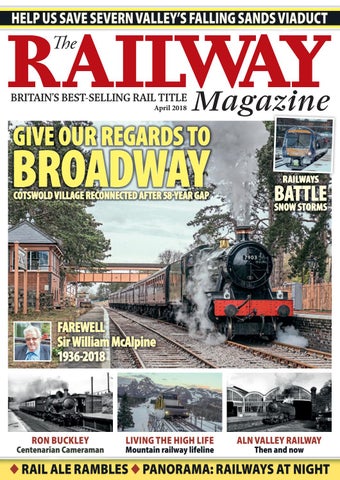
GIVE OUR REGARDS TO
BROADWAY
COTSWOLD VILLAGE RECONNECTED AFTER 58YEAR GAP
RAILWAYS
BATTLE SNOW STORMS
FAREWELL Sir William McAlpine 1936-2018
RON BUCKLEY
Centenarian Cameraman
LIVING THE HIGH LIFE
Mountain railway lifeline
ALN VALLEY RAILWAY Then and now
◆ RAIL ALE RAMBLES ◆ PANORAMA: RAILWAYS AT NIGHT
K_\
EDITORIAL
Editor: Chris Milner Deputy editor: Gary Boyd-Hope Senior correspondent: Ben Jones Designer: Tim Pipes Picture desk: Paul Fincham and Jonathan Schofield Publisher: Tim Hartley Editorial assistant: Jane Skayman Production editor: Sarah Wilkinson Sub-editor: Nigel Devereux Consultant editor: Nick Pigott Classic Traction News: Peter Nicholson Operations News: Ashley Butlin Narrow Gauge News: Cliff Thomas Metro News: Paul Bickerdyke World News: Keith Fender By post: The Railway Magazine, Mortons Media Group, Media Centre, Morton Way, Horncastle, Lincs LN9 6JR Tel: 01507 529589 Fax: 01507 371066 Email: railway@mortons.co.uk © 2018 Mortons Media ISSN 0033-8923
CUSTOMER SERVICES
General Queries & Back Issues 01507 529529 Monday-Friday: 8.30am-7pm Saturday: 8.30am-12.30pm Answerphone 24hr help@classicmagazines.co.uk www.classicmagazines.co.uk Archive enquiries: Jane Skayman 01507 529423 jskayman@mortons.co.uk
ADVERTISING
Divisional advertising manager: Sue Keily Advertising: Craig Amess camess@mortons.co.uk Tel: 01507 529537 By post: The Railway Magazine advertising, Mortons Media Group, Media Centre, Morton Way, Horncastle, Lincs LN9 6JR
PUBLISHING
Subscription manager: Paul Deacon Circulation manager: Steve O’Hara Marketing manager: Charlotte Park Publishing director: Dan Savage Commercial director: Nigel Hole Published by: Mortons Media Group Ltd, Media Centre, Morton Way, Horncastle, Lincs LN9 6JR
SUBSCRIPTION
Full subscription rates (but see page 36 for offer): (12 months 12 issues, inc post and packing) - UK £52.80. Export rates are also available - see page 121 for more details. UK subscriptions are zero-rated for the purposes of Value Added Tax. Enquiries: subscriptions@mortons.co.uk
PRINT AND DISTRIBUTIONS
Printed by: William Gibbons & Son, Wolverhampton Distribution by: Marketforce UK Ltd, 5 Churchill Place, Canary Wharf, London E14 5HU 0203 787 9001
EDITORIAL CONTRIBUTION
Accepted photographs and articles will be paid for upon publication. Items we cannot use will be returned if accompanied by a stamped addressed envelope, and recorded delivery must clearly state so and enclose sufficient postage. In common with practice on other rail periodicals, all material is sent or returned at the contributor’s own risk and neither The Railway Magazine, the editor, the staff nor Mortons Media Ltd can be held responsible for loss or damage, howsoever caused. The opinions expressed in The RM are not necessarily those of the editor or staff. This periodical must not, without the written consent of the publishers first being given, be lent, sold, hired out or otherwise disposed of in a mutilated condition or, in any unauthorised cover by way of trade or annexed to or as part of any publication or advertising, literary or pictorial matter whatsoever.
This issue was published on April 4, 2018. The next will be on sale on May 2, 2018.
Going beyond the call of duty
T
HERE was plenty of warning of the snow and freezing temperatures that the storm dubbed the ‘Beast from the East’ (and its successor a couple of weeks later) was to bring to Britain. No matter how Network Rail and the train operators planned for the worst, there were some areas of the country where services could simply not operate because of the power of the winter weather. Greater Anglia’s planned rundown of services came in for unfair criticism after the worst of the storm didn’t hit quite as expected. A case of damned if you do and damned if you don’t? ScotRail had a torrid time, particularly in the central belt, with snow more than 40-45cm deep in places. This resulted in both the East and West Coast Main Lines being closed to all trains for several days – a situation I can not previously recall in my time with The RM. The Settle & Carlisle was also closed, as were many branch lines. Sleeper services were cancelled, thousands of services were disrupted, and some East Coast expresses arrived in London between five and six hours late as staff battled through awful conditions. Passengers were marooned on trains overnight near Christchurch, too. Throughout both winter storms, the ‘railway family’ worked incredibly hard to clear tracks and points of snow and ice, remove fallen trees, operate ghost services to keep lines open, clear
snow and ice platforms, work extra hours to devise temporary timetables, and also be there for passengers. Incredibly, and in spite of repeated advice for ‘essential travel only’, some passengers who did chance it, had the audacity to complain when their trains were cancelled or terminated short of intended destinations. There was no appreciation staff might have been out of hours or it was not safe for them to travel to work either – nor a comprehension by passengers of what ‘essential’ meant. Even when the thaw came Network Rail and train operators were facing an uphill battle to reopen lines and repair the many trains where snow had damaged electrical components. Thousands of staff worked beyond the call of duty, from which emerged many heart-warming tales of acts of kindness by train company employees to the passengers. It truly epitomised the British spirit.
TRAIN OF THOUGHT
Editor’s Comment
Serious problems on the railways IT’S frustrating to heap praise for staff ‘going the extra mile’ in one breath yet pour criticism on it in another. However, in the past month, some news stories to have made the headlines were possibly avoidable: ■ Delays to the electrification to Blackpool ■ A major problem with the driver’s windscreen on Class 385 EMUs, which could well mean a front-end redesign and more delays in the class entering service ■ A section of rail left fouling a main line and struck by a passenger train ■ Track or points that have damaged trains, forcing safety checks
■ Passengers walking past open ticket gates at a major station and getting on the track to stage a mass political protest ■ A communications failure which led to the self-evacuation of passengers, marooned on a number of trains in south-east London, on to live third rail lines ■ The mad scramble by millions of 26-30 year olds to get their hands on an allocation of just 10,000 railcards, which crashed the website. Some of the above incidents might not have happened with better planning and communication protocols, but let’s not overlook the fact that in several of the above incidents, lives have been put at unnecessary risk.
‘The job’s a good ‘un’, as they say ON GOOD Friday, the Gloucestershire Warwickshire Railway extended its passenger services to Broadway, one of the key tourist hotspots in the Cotswolds. For volunteers and staff it is the culmination of many years of effort, both in physical and financial terms, and with the reconstruction of the buildings at Broadway in GWR style, it rates as one of preservation’s more remarkable achievements,
considering less than 40 years ago there was no track at all between Broadway and Cheltenham. With a near 14-mile long line in one of the most attractive parts of England, this extension will enhance the railway’s appeal, cementing its place in the ‘Premier League’ of heritage tourist railways. In short, it’s a job very well done. CHRIS MILNER, Editor
April 2018 • The Railway Magazine • 3
Contents
April 2018. No. 1,405. Vol 164. A journal of record since 1897.
Headline News
Gloucs Warks opens to Broadway, Lottery cash for SVR viaduct, Blackpool North reopening delayed, First TPE 'Nova 3' set on test in Czech Republic, Heavy snow causes widespread rail disruption, ScotRail Class 385s delayed again, First automatic run for Thamelink Class 700, GWR 'Castle' HST debut. West Coast Railways Class 37 No. 37516 rests at Balloch near the shores of Loch Lomond after battling through snowdrifts on March 1. NETWORK RAIL
On the cover
S&D ‘7F’ stands in for ‘B1’ at SVR gala, ‘KE1’ mobile again, The RM to sponsor Gloucs Warks May gala, Tornado tops 100,000 miles during Moors visit, snow disrupts heritage operations.
72 Industrial Steam
INSET 1: Celebrating Britain’s oldest railway photographer - Ron Buckley. INSET 2: Mountain railways - a lifeline for many Swiss communities. STOOSBAHN INSET 3: The Alnwick branch, from closure to rebirth.
73 Irish News 74 Steam Portfolio 76 Narrow Gauge 78 Network NR gets funding for Croydon remodelling, Hope Valley capacity upgrade, Midlands calls for greater rail investment.
ScotRail Class 170s move to Northern, CAF Class 195 on test at Velim, Class 68s take over Cumbrian Coast diagram, GN Class 717 starts testing.
101 Traction Portfolio 102 Stock Update 103 Operations
Regulars 14 Multiple Aspects 14 Railways in Parliament 36 Subscription Offer Subscribe today to receive your monthly copies of The Railway Magazine from only £20.
A stunning collection of nocturnal railway photography.
64 From The RM Archives Find out what The RM was reporting 20, 50 and 100 years ago.
16 Ron Buckley: Britain’s Oldest Railway Photographer Chris Milner meets a centenarian photographer who has been recording Britain’s railways on film since the 1930s.
26 Homeward Bound: York-Huddersfield in the 1970s This month's Practice & Performance looks back at John Heaton’s commuting journeys on the trans-Pennine route in the days of Class 40s and‘Peaks’.
33 40 Years of Rail Ale Rambles Dave Richardson looks back on 40 years of connecting railways with visits to breweries and beer festivals.
42 Living the High Life Switzerland’s famous mountain railways provide more than just an unfortgettable day out for tourists, as Ben Jones discovered on a recent trip to the Lucerne region.
48 Then & Now: The Aln Valley Railway Alan Barnes looks back at this well-known line in Northumberland, which recently became one of the UK's newest heritage railways.
The Railway Magazine’s audited circulation of 36,072 copies per month makes it by far the
With Lord Berkeley.
40 Readers’ Platform 54 Reviews 56 Meetings 61 Panorama - at night
Thhe RM pays tribute to one of the railway heritage movement's most deedicated and influential supporters, who passed away last month.
JACK BOSKETT
82 Heritage Trams 83 Trams Portfolio 84 Metro 87 Railtours 91 Classic Traction 96 World 98 Traction & Stock
A gorgeous combination of LNER green ‘B12’ No. 8572 and Gresley teak stock at the Severn Valley Railway's Spring Steam Gala on March 16. BOB GREEN
122 Obituary: Sir William McAlpine M
COVER: GWR 'Hall' No. 7903 Foremarke Hall arrives at Broadway with a loaded gauging run on March 9, shortly before the official opening of the G-WR's extension from Toddington.
Track Record The Railway Magazine’s monthly news digest 66 Steam & Heritage
FFeatures
The crew of Harzer Schmalspurbahnen 2-10-2T No. 92 7239 dispose of their charge after a hard day’s work on the German metre-gauge network on February 1. GARETH JONES
110 Heritage Diary Details of when Britain’s unique collection of heritage railways and railway museums are open.
122 Prize Crossword and Where Is It?
UK’S TOPSELLING RAIL TITLE! Subscribe today and save money on every issue. Call 01507 529529 or see page 36 for our latest offers
HeadlineNews
Hitachi working on Class 385 windscreen issues
THE issue of curved windscreens, raised by rail union Aslef, (RM March), which has halted the introduction of the new Hitachi AT200 series Class 385 EMUs on ScotRail’s key Edinburgh to Glasgow and other routes could take some time to resolve. Drivers claim they can see two signals at night because of the curved nature of the windscreen’s design, and despite them being compliant with required standards, the trains cannot enter public service from a safety point of view.
Hitachi is working with the glass manufacturer in conjunction with ScotRail and the unions to find a solution.
Timeline
As we closed for press, Hitachi said it was working to create a clear timeline, adding: “Driver and passenger safety is our top priority. We have listened to the drivers and we’re looking at new windscreen options. “Once the final design is agreed, windscreens will undergo rigorous testing, working with ScotRail, regulators and unions, before
the trains enter service.” ScotRail has already begun the cascade of 16 Class 170 three-car units to Northern (see p98), but with no 385s as replacements, it could leave the operator short of units. Some services have been running with reduced capacity. The timescale for a resolution is unclear, leading ScotRail to state neither driver training or the unit-testing regime have been suspended, with no testing being conducted during the recent bad weather. ScotRail said lots of options in terms of contingency were
being assessed, and The RM understands one of these could involve the use of stored Class 365s at Ely or other units.
Delayed
The plan to run electric trains between Edinburgh and Glasgow via Falkirk High has been delayed substantially by a combination of infrastructure, electrification issues and unit production problems. The sets were to begin service last autumn, then December 2017, which was put back until May, but is again on hold.
FREE DVD
NEXT MONTH
IN THE May issue of The Railway Magazine we are giving away a free DVD entitled The Golden of Steam. It will include footage of Victorian and Edwardian locomotives. Order your copy today, or save money by taking out a subscription. See p36 for our latest offers or call customer services on 01507 529529.
Fresh hope for revival of Matlock to Buxton route By Ben Jones
Testing at Velim for TPE Mk5 set THE first completed TransPennine Express Mk5 set with a passenger driving trailer has arrived at Velim, Czech Republic for testing with two Class 68 locos that have arrived from the UK (see p98).
Millennial railcard chaos crashes website THE offer of 10,000 railcards made available on March 12 for people aged 26-30 led to the national website crashing after more than 12 times the expected number of visitors tried to access it. The railcard costs £30 and can mean savings of up to a third on rail fares. Following a trial in Greater Anglia late last year, a limited number of the one-year cards went on sale nationally last month, although it does have a minimum £12 fare applicable in the morning peak. The railcard has not been fully rolled out as train operating companies are uneasy over the wider financial impact these cards could have on revenue on which they made their franchise bids. Operators were also unhappy at the lack of consultation ahead of the announcement in November last year by Chancellor of the Exchequer Phillip Hammond.
The smart-looking fivecarriage set was built in Spain and shipped to Bremerhaven, Germany. It is seen passing Königstein, Germany, close to the Czech border on March 11. Haulage was provided
by Railadventure, using locomotive No. 111.215. A longer report about the new sets, which will be called ‘Nova 3’, will appear in the May-dated issue. Picture: QUINTUS VOSMAN
First Thameslink train uses ATO in passenger service THE first passenger train to use AutomaticTrain Operation (ATO) ran between St Pancras and Blackfriars on March 17. This is the core section over which ATO will control trains at closer intervals than conventional signalling when Thameslink services are fully implemented, with up to 24 trains per hour from May 2019, extended to London Bridge by December 2019. Siemens Class 700 unit No. 700019 initially transitioned into ETCS Level 2 Full Supervision and then ATO on its approach from KentishTown before the computer-controlled system brought the train – destinationThree Bridges – to a halt at St Pancras International. After the driver had checked the platforms and closed the doors he then selected ATO again, and the train, with its in-cab signalling, continued
under fully automatic control through Farringdon to Blackfriars, where it transitioned out of the ETCS on its exit from Blackfriars, as it headed towards Elephant & Castle. GTR’s systems integration manager Jim Doughty said:“This is a real world-first and I’m delighted. It is the culmination of a programme of work that we have been involved in since the start of our franchise three years ago. “It is critical to our programme to modernise the busiest part of the UK rail network. “The run follows nearly two years of on-track testing and paves the way for further runs, which will not only help build industry confidence in the system, but also facilitate the start of the delivery of a world-class training package to our drivers in readiness for the increase in services.”
PEAK Rail, supported by major Derbyshire quarry companies, is seeking bids for a feasibility study into the reopening of the former Midland Railway route between Rowsley and Peak Forest. The study will examine the engineering and administrative feasibility of rebuilding the missing section and upgrading the Ambergate to Matlock line to accommodate additional traffic. It will also consider how to maintain the popular ‘Monsal Trail’ walking and cycling routes that now occupies much of the trackbed. The 12-mile missing section was closed 50 years ago, on July 1, 1968, and has been the subject of numerous revival
schemes over the decades since, but to date only the four miles between Matlock and Rowsley South have been reinstated since Peak Rail was formed in 1975. The heritage line is keen to extend its operations further in to the Peak District National Park to serve key locations such as Bakewell and, ultimately, Buxton, where it once had a base. However, the principal ambition of the proposal is to provide a more direct route from the rail-served quarries near Buxton to the Midlands and south of England. Millions of tonnes of Derbyshire limestone is quarried every year and sent south by rail from locations such as Peak Forest and Great Rocks via the indirect and congested Hope Valley route.
The still image from the front-facing cab video camera of the obstruction. PICTURE: RAIB/VIRGIN TRAINS EAST COAST.
HST strikes rail obstruction AN INVESTIGATION has started after a Virgin East Coast HST hit the end of a 129m-long section of surplus rail at Cradlehall, south of Inverness, that was fouling the rail head. The train was working the 07.55 Inverness-King’s Cross ‘Highland Chieftain’ and was travelling at 53mph. The rail had been left in this position following earlier engineering work. It was
knocked clear, and fortunately no significant damage was caused to the train. RAIB is investigating and will publish a safety digest in due course. RAIB has issued a urgent safety advice notice to Network Rail as this is one of four incidents since October 2014 when the track has been returned for operations in an unsafe condition after engineering activities.
April 2018 • The Railway Magazine • 5
HeadlineNews
Blackpool electrification delayed NETWORK Rail has blamed poor weather and engineering train failures for pushing back the reopening of the Preston to Blackpool North line until April 16. Services were due to restart on March 26 after a five-month blockade of the route, having been suspended since November 11 to allow electrification work, resignalling and track replacement to proceed without interruption. However, NR announced in mid March it would miss its deadline, leaving Blackpool without its main rail route over the busy Easter weekend. Andrew Morgan, senior sponsor for Network Rail, said: “While we’ve made fantastic progress in upgrading the line over the last six months, the recent bad weather and unexpected maintenance of critical machinery has hampered us slotting in final pieces of this important jigsaw, at one of the busiest times of the closure.”
‘High-Speed Rail M25’ to link Gatwick and Heathrow to HS1 LONDONBASED engineering consultancy Expedition has proposed a £10billion, 90-mile high-speed railway linking HS1 to Gatwick and Heathrow airports and the Great Western Main Line and HS2. Under the working title of HS4Air, the proposal is designed to play a similar role to the M25 London orbital motorway, providing a fast route around the capital and links between mainland Europe via HS1 and the Channel Tunnel – Britain’s two busiest airports and main rail routes to the west and north. Connections are proposed with HS1 at Ashford and with HS2 near Denham. Around 20% of the route would be in tunnels to reduce the impact on the landscape, and 40% would re-use the railway between Tonbridge and Ashford, which would require upgrading to permit high-speed trains. Passengers from cities including Birmingham, Manchester, Leeds and Cardiff would be able to travel to Heathrow and Gatwick without changing trains, reducing road congestion, air pollution and travel times. Journeys from Sussex and Kent to the Midlands and the West could also be reduced by up to one hour. Expedition director Alistair Lenczner said: “This will offer enhanced benefits and provide better value for the investments being made in UK infrastructure.”
Contractors working on the approaches to Blackpool North in the early part of the project. NETWORK RAIL
However, local sources called NR’s excuses ‘feeble’ and criticised the management and execution of the work. Paul Nettleton, chairman of the Blackpool and Fylde Rail Users Association, said: “There has been bad weather, but we haven’t had it as bad as other parts of the country, and I’m sure they have more than one
engineering train. It’s a pain for commuters and visitors, but people can still travel via Blackpool South.” Work on the line includes the rebuilding of 11 bridges, remodelling 11 platforms at Blackpool North, Poulton-leFylde and Kirkham & Wesham, upgrading drainage, replacing 11km of track, and installing
electrification equipment and 84 new signals. The Blackpool delay follows a succession of similar setbacks for Network Rail’s Great North Rail Project, most notably on the Manchester-Bolton-Preston electrification scheme. Initially due for completion in December 2016, the date was put back to December 2017,
then to May, and eventually December 2018, after various problems were encountered. These included the collapse of an overbridge at Moses Gate and the need to redesign 25kV AC catenary and mast installations to cope with uncharted old mine workings, running sand and unstable ground conditions.
Siemens propose £200m rail factory in Goole SIEMENS could build a new train “It not only has the potential assembly and commissioning scale we need, but also ready facility in Goole if it is successful access to the skilled people we’d in winning further orders for the need to build and operate the UK market. factory.” The German company, which Siemens’plans include announced its intention to merge manufacturing and its train building business with commissioning buildings, Alstom last year, has signed a long- warehouses, offices, and stabling term agreement to lease a 67-acre sidings, with potential for the site close to the M62 in Goole. development of a test track. It could invest up to The company is already one £200million in the factory, of the biggest employers in potentially creating up to the UK rail sector, with 4,400 700 skilled engineering and employees working in railmanufacturing jobs, plus up to and wider transport-related 250 construction jobs. Around roles. It currently has more 1,700 indirect jobs could also than 450 trains in service in be created throughout the UK the UK with South Western supply chain. Railway, Transpennine Express, Jüergen Maier, Siemens UK ScotRail, Greater Anglia, London chief executive, said:“Having Northwestern Railway and considered multiple locations, I’m Heathrow Express, and is in the delighted to confirm that we’ve process of delivering 1,140 Class identified a site in Goole for our 700 Thameslink vehicles and new UK rail factory. 25 six-car Class 717s to Great
An artist’s impression of how the Siemens factory at Goole may look.
Northern. However, once the latter order is completed later this year, Siemens has no further outstanding orders for trains in the UK. Along with Alstom, Talgo, Hitachi and Bombardier it has been shortlisted for the £2.75billion HS2 Phase 1 train
contract, which is expected to be awarded in 2019. If constructed, the new facility will complement Siemens’ operations, which include eight purpose-built maintenance depots, plus electrification, signalling and train control activities across the UK.
‘Blame-game’ as Kenilworth station still awaits approval and sign-off By Fraser Pithie
A BOMBSHELL was dropped on March 16 when chief executive of the Office of Road and Rail (ORR) Joanna Whittington confirmed Kenilworth’s £13.6million railway station was still pending approval and sign off because ORR is still waiting for information from project sponsor Warwickshire County Council (WCC). Ms Whittington also stated the county council, which retained SLC Rail through a‘rail advisor framework’to project manage the Kenilworth scheme, had still not advised the ORR when they
6 • The Railway Magazine • April 2018
wish to start passenger services from the town. Disquiet has grown in the town following a series of opening dates for the station, all of which failed to materialise. Ms Whittington’s statement, effectively calls into question WCC’s claim it had completed the station, but blamed other stakeholders for the failure to open on the planned date of December 10, 2017. Freedom of Information (FoI) responses have revealed the county council agreed at a cabinet meeting in 2015 – which the public was excluded from attending, and which means
the reports and minutes are effectively beyond the scope of FoI – to underwrite any operating losses incurred by the train operator at Kenilworth for the first three years. WCC has now admitted this has been superseded by what it called a‘new deal’with a‘one-off’ fee being paid by WCC; its value has not been divulged. In another FoI response, WCC fails to explain the mathematics behind an apparent discrepancy highlighted by a resident who attended a public meeting in February 2018. The council suggested a forecasted daily passenger usage was 445, yet
details of the original business case stated 275,000 a year, which equates to 753 each day. The cost of Kenilworth is more than new stations at Oxford Parkway or Ilkeston, its price having soared by more than 20% from an original estimate of £11.2m to £13.6m. Local MP and Attorney General Jeremy Wright has received requests from some residents highlighting what they describe as a‘lack of governance’and asking for it to be referred to the Secretary of State for Communities and Local Government and Transport Minister Chris Grayling.
Have you got a story for us? Email: railway@mortons.co.uk
COVER STORY
'Merchant Navy' No. 35006 Peninsular & Oriental S. N. Co hauling the 10.00 ‘shareholders’ special’ from the newly opened section between Broadway and Toddington on March 31. PETER J C SKELTON Left: No. 35006 Peninsular & Oriental S. N. Co runs around the first shareholders’ train to Broadway on March 21. JACK BOSKETT
Gloucs Warks achieves Broadway dream as new extension opens BY THE time this issue of The Railway Magazine hits the newsstands, the Gloucestershire Warwickshire Railway’s extension to Broadway will be officially open. Lord Faulkner of Worcester was to have the honour of formally opening the re-created station on March 30, unveiling a commemorative plaque, before the line’s flagship locomotive – ‘Modified Hall’ No. 7903 Foremarke Hall – headed the 09.40 departure to Cheltenham Racecourse, the first public train to leave Broadway in 58 years. It marked the culmination of a
dream started in the early 1980s number of ‘Return to Broadway’ when the first operations of the specials hauled by Bulleid preservation era got underway ‘Merchant Navy’ No. 35006 at Toddington. Peninsular & Oriental S. N. Co on In the years since, the GWSR March 21-22 for the benefit of has extended its operation the railway’s many shareholders to the north and south, and volunteers. triumphing over adversity Almost 2,000 supporters along the way, to create almost flocked to the railway to travel 14 miles of heritage railway on these first trains, taking the through the delightful Cotswold opportunity to admire the new countryside. station, built to replicate the The first steam-hauled train original. ran into Broadway on March 9 Currently, the new station when Foremarke Hall took part building on platform 1 is open, in a gauging run, ahead of its along with the ticket office, but big moment on Good Friday. platform 2 and the footbridge This was followed by a are off-limits for the time being
as there is still work to complete. “This was the pinnacle of achievement for everyone who has played a part in making the dream of reaching Broadway again a reality,” said Richard Johnson, the voluntary chairman of GWSR Plc. “These two days have been a way to enjoy the fruits of all this hard work and being among the first to travel by train to Broadway after a gap of more than 58 years. “Connecting Broadway with Cheltenham by rail again was the vision of those early pioneers who first took over a
derelict Toddington station in 1982. Broadway station, along with most other stations on the line, had closed way back in March 1960. “Embankments and bridges have been repaired, drainage fixed, new track laid and a brand new station built on the site of the original – all by volunteers.” Over the Easter weekend the railway was to operate a busy timetable featuring eight departures from Broadway. Motive power included No. 7903, No. 7820 Dinmore Manor and ‘28XX’ No. 2807.
Major theft of loco components rocks Cottesmore volunteers
VOLUNTEERS at Rocks by Rail in Cottesmore have been left stunned after thieves broke into the site during mid March and made off with dozens of components, non-ferrous included, belonging to one of its under-restoration locomotives. The incident occurred between the night of March 13 and the morning of March 15.The thieves broke into storage units belonging to the 1308Trust, which is restoring ex-Stewarts & Lloyds Hudswell, Clarke 0-6-0ST No. 1308 Rhos.The list of missing parts is extensive, with most being
stamped with the locomotive’s works number 1308. Items taken include the vacuum exhauster, setter and relief valve; vacuum gauge and steam pressure gauge; blower valve; whistle and whistle valve; coupling rod bearings; both little-end bearings and big-end brasses; water valves; steam inlet valves; blow down valve; injectors; copper tubing; and two rivet guns. Information on the theft can be provided to Leicestershire Constabulary on 101 or Crime Stoppers on 0800 555 111, crime reference is 18000118895.
Vivarail to trial DMU in USA By Keith Fender
Great Western short HST set testing begins GWR has started testing the short 2+4 HST sets following completion of the conversion of the initial batch of carriages from slam door to plug doors at Wabtec Doncaster. On March 19-22, the four trailers and two power cars – Nos. 43016 and 43093 (Old Oak Common) – worked with trailer Nos. 48101
(ex-42168), 48102 (42177), 48111 (42093) and 49101 (44055) on a Laira-Exeter St Davids-TruroExeter-Laira diagram, making station calls en route as part of the process of checking point-to-point timings with a train that has an improved power to weight ratio. On March 23, the training set continued to Penzance.
GWR will form 11 four-car short sets that will be used between Exeter to Plymouth/Penzance and Cardiff to Taunton. The sets will be known as the‘Castle’class. The first completed set is pictured near St Germans on March 19, the inaugural day of testing, and making its debut in Cornwall. BARRY JONES
AMERICAN railway investor Railroad Development Corporation (RDC) is planning to take one or two Vivarail Class 230 trains to the USA and trial them on lines that currently have no passenger services. The Vivarail train is seen by RDC as a potential solution for American cities or parts of cities that wish to introduce passenger rail services, but cannot afford the substantial
costs of infrastructure investment and new stock. RDC believes mixed operation of freight lines – passenger trains in daytime and freight at night, (known as temporal separation) – would mean the Class 230 type train could be used with limited expenditure to create or modernise platforms at stations for a trial service. RDC has been in discussions with cities on both the east and west coast of the USA.
April 2018 • The Railway Magazine • 7
HeadlineNews Lynton & Barnstaple granted permission for extended line SIDELINES
Elderly passenger dragged into tunnel by Tube train
AN INCIDENT where an elderly passenger was dragged along the platform after her bag became stuck in the doors of a Central Line Underground train on January 31 is being investigated by the Rail Accident Investigation Branch (RAIB). The emergency stop was activated by other passengers, but by the time the train stopped, six of its eight coaches were in the tunnel. The passenger was rescued from a space between the underside of the train and the tunnel wall.
European firms given ‘franchise passports’ THE Department for Transport has approved Spanish national operator RENFE, Italian open access operator NTV and French company Transdev to hold pre-qualification passports. This allows them to express an interest in UK rail franchises without the need to submit technical information.
Pro-Kurdish political protests halt trains TRAIN services in and out of Manchester Piccadilly were disrupted on March 11 when an estimated 100 pro-Kurdish protestors, some with children in pushchairs, walked through open barriers and onto tracks at the south end of the station. Passengers were stuck on trains for up to three hours, with all services halted. A similar protest by protestors aiming to get on the tracks at King’s Cross was thwarted by transport police. BTP was investigating with a view to arrest and prosecution.
By Cliff Thomas
EXMOOR National Park Authority (ENPA) has approved Lynton & Barnstaple Railway Trust’s planning application to reinstate the iconic 2ft-gauge line between Killington Lane and Blackmoor Gate. The March 6 meeting of ENPA, held in Lynton Town Hall, not only approved the 3½-mile extension of the line from Killington Lane – the terminus of the present one-mile-long line from Woody Bay station, through to Blackmoor Gate – by 15 votes to nil, but also granted permission for construction of an engineering centre and rolling stock shed north of Blackmoor Gate. However, while permission was granted for demolition of a bungalow on the trackbed at 1987-built Parracombe Halt, ENPA rejected an application to replace the building with two semi-detached houses. The L&BR Trust secured planning permission from North Devon Council in June 2016 to rebuild the line from Blackmoor Gate to Wistlandpound together with conversion of the Old Station House Inn (formerly Blackmoor station) into a new station, incorporating the pub/ restaurant business. Approval of these applications means the way is now clear to expand this classic narrow gauge line. Many people believe it
Lyd hauls a trio of re-created Lynton & Barnstaple Railway coaches towards Woody Bay during a September 2014 visit from its Ffestiniog Railway base. Lyd is a near-replica of a Lynton & Barnstaple Railway Manning, Wardle 2-6-2T. CLIFF THOMAS
should never have been closed and view this as the final major piece of unfinished narrow gauge restoration business, as detailed in a major feature in The RM (April 2016). The two sets of planning applications were required since Blackmoor is on the boundary between North Devon Council and Exmoor National Park Authority planning jurisdiction. The current line between Woody Bay and Killington Lane carried nearly 50,000 passengers
Bridge moved after skip lorry strike
THE discovery of a crack in a set of points at Wokingham, Berkshire, between March 1-9, led to GWR scaling back their Reading to Redhill services to operate between Blackwater and Redhill. Passengers had to use South Western Railway services to and from Reading.
Snow duties for ‘Hoover’ KEEPING the Midland Main Line clear of snow between Leicester and Kettering was a duty afforded to Class 50 No. 50049 Defiance on the evening of March 1. The ‘Hoover’
was operated by the Rail Operations Group, and having charged a snow drift on the Up line, the crew had changed ends and were preparing to tackle the down line. DARREN WETHERALL
Deutsche Bahn buys ‘lengthy’ British rail By Keith Fender
BRITISH Steel has won an order to supply 120m-length rail to German national rail infrastructure manager DB Netze. The Scunthorpe plant has recently been modernised to
construction works. A separate company, L&B Blackmoor Company plc, set up by the trust, will buy and remodel the Old Station House Inn. Long-term, the trust aims to reinstate the entire line through to Lynton and back to Barnstaple. ENPA has approved a shuttle bus service from Woody Bay to Lynton until the journey can again be undertaken by rail. The original L&BR opened in 1898 and closed in 1935. Revival at Woody Bay started in 2004.
Greater Anglia forced to seek alternatives for new depot
A BRIDGE strike at Castleton Moor by a skip lorry on the Middlesbrough to Whitby line on March 12 shifted the track by 10 inches and prevented ‘A1’ No. 60163 Tornado moving by rail to the Severn Valley Railway. There was also structural damage to the bridge, meaning Tornado had to move by road.
Points crack causes delay at Wokingham
last year. The expanded railway is forecast to directly support 24 full-time jobs and many more in the wider service sector locally. Apprentices will also be trained in the engineering centre. The net economic benefit compared to current operations is predicted to inject an extra £62million into the local area over the first 10 years of construction and operation. Lynton & Barnstaple Railway Trust can now embark on raising money to undertake
enable production of this rail length, which is the standard used by most major EU countries. British Steel also owns the former Tata long rail plant in Hayange, in eastern France, which has previously supplied DB Netze. The Hayange plant uses steel
8 • The Railway Magazine • April 2018
provided by rail from the UK. Twenty-thousand tonnes of 120m-length rail will be supplied to DB Netze from Scunthorpe over the next two years. The finished product will be moved from Scunthorpe to Germany by rail via the Channel Tunnel.
ALTERNATIVE options for movements on the level new depot facilities are being crossing at Manningtree, and sought by Greater Anglia after we have been working with its proposed site at Brantham, Network Rail about this.” near Manningtree, encountered The operator says it is planning and land ownership considering alternative options issues. for maintenance and servicing Work to prepare the site work on its new Bombardier alongside the River Stour, ‘Aventra’ and Stadler ‘FLIRT’ on part of a long-closed ICI EMUs, which are due to start chemical works, has been arriving later this year. suspended for at least three Much of the commissioning months after local councils and and maintenance work on the Network Rail raised issues over new fleets was expected to be frequent train movements in undertaken from Brantham, and out of the depot, causing which was planned to have 13 traffic congestion at a nearby outdoor stabling tracks and level crossing. a 300-metre long, two-road A Greater Anglia (GA) workshop building. spokesperson said: “There Preparation work is now are a number of issues to be focusing on providing updated resolved in order to progress facilities to accommodate with our proposed new depot new trains at Crown Point in at Brantham. These include Norwich, but additional work preparation of the site, train may also be required at GA’s access to the site and the fact other depots at Clacton and that we have yet to agree Ilford. commercial terms with the GA is investing £65,000 in landowner involved. new LED lighting at Clacton “A potential further EMU depot as part of a drive complication relates to the to save energy and reduce the impact of additional train operator’s carbon footprint.
Have you got a story for us? Email: railway@mortons.co.uk
Lottery grant starts Severn Valley viaduct repairs A £71,800 award from the Heritage Lottery Fund (HLF) has kick-started the Severn Valley Railway’s (SVR) project to carry out essential restoration work to the photogenic seven-arch Falling Sands Viaduct, near Kidderminster. The 141-year-old structure dates from 1877 and carries the railway 64ft above the River Stour and the Staffordshire & Worcestershire Canal conservation area. However, age has caught up with the viaduct, with water ingress causing significant erosion, to the point where the SVR imposed a 20mph speed restriction over it. Restoration work is expected to cost in the region of £1.26million. The HLF award is development funding to help the Severn Valley Railway Charitable Trust (SVRCT) progress its plans to apply for a full grant of £1m later this year, likely around September. If successful the funding will enable the railway to secure the longterm future of the viaduct, but also engage a wider audience
for the railway, encouraging an appreciation and understanding of local heritage and structural engineering by highlighting the part played by the SVR in the area’s social and industrial history. In order to secure the full £1m grant from the HLF, the SVR needs to raise £275,000 of match funding. Therefore, Severn Valley Railway Holdings Plc and the SVRCT has teamed up to launch an appeal called Helping hands for Falling Sands, with The Railway Magazine’s publisher Mortons Media as the official media partner. There are several strands to the SVR’s fundraising campaign, including individuals adding their names, or the names of loved ones, to the railway’s first donation wall through £50 amounts. It is hoped local businesses will also get involved. Donations can be made online at: www.svrtrust.org.uk/ourprojects/falling-sands-viaduct. html The target date for completion of the project is 2020.
French government to reform country’s railways By Keith Fender
THE French Prime Minister Mr Édouard Philippe announced wide-ranging plans to change the railway industry in late February. Included in the proposals are an end (for new employees only) to the ‘Cheminot’ special employment rights enjoyed by most SNCF workers. The Government commissioned two independent reports last year, one looking at infrastructure plans, the other looking at the whole rail market and state operator SNCF’s finances. Both reports were published early in 2018 and the Government announced it would implement many of the recommendations. The infrastructure report states investment should be focused on major cities with few new/high-speed lines to be built in the next two decades – the new Bordeaux to Toulouse line currently being planned is the major exception. One recommendation – to close around 9,000 km of very lightly used passenger and freight routes – was rejected, although the final decision was passed down to French regional governments, so closures remain likely, but not all at once. The Government has also ruled out privatisation for SNCF or ‘British-style’ fragmentation of the industry, instead proposing SNCF be restructured as one company again (it is currently a special hybrid structure).
The Government does intend to introduce tendering for regional services from 2021, and if the experience from the last decade in Germany is anything to go by this may increase service provision, while reducing costs by at least 30%. The reports shows SNCF costs France around €14billion a year, which is more than the country’s entire police budget, according to the Government. SNCF also has large debts of nearly €50bn, which have more than doubled in the last 20 years, mainly because of high-speed line construction. Interest payments alone cost €1.5bn each year. The Government argues SNCF is too expensive (operational costs are 30% more expensive than in Germany) and this is in part because of the cost of SNCF employees as well as the lack of investment in the core network away from the high-speed lines. The changes proposed by the Government will be implemented by a series of orders, legislation to permit this was presented to the French parliament in mid March. SNCF’s trade unions, which have largely been successful in fighting all previous Government plans to change employees’ terms and conditions, have announced 36 one-day national strikes between April and July, with more promised over the summer. Opinion polls conducted during March indicate the public is supportive of the Government’s plans for SNCF.
Visiting 0-6-0WT Bellerophon crosses Falling Sands Viaduct during the Severn Valley Railway’s recent Spring Steam Gala on March 16. ANDREW BELL
Government backs Crewe HS2 hub – and high-speed connection for Stoke SECRETARY of State for Transport Chris Grayling has given his backing for a proposed High Speed 2 (HS2) hub at Crewe. This project is aimed at providing improved inter-city links to the region, and to nearby Stoke-on-Trent, from 2027. Plans for Phase 2a of HS2 from the West Midlands to Crewe will now be modified to include an extension of platform 5 at Crewe to 400 metres, allowing the splitting and joining of HS2 trains and better opportunities to serve Stoke-on-Trent using ‘classic, compatible’ high-speed trains. Bidders for the West Coast Partnership franchise will be asked to include a high-speed service to Stoke-on-Trent as part of their market development and service plans. Once Phase 2b of the project is completed in 2033, between five and seven HS2 trains each hour could call at the Crewe Hub, improving connections
to Shrewsbury, Chester and businesses in Staffordshire will North Wales. The revised be able to benefit from quicker plan will also introduce a journeys to London and more efficient design for the Birmingham, and to the North proposed platform on the from 2026.” Manchester Independent Plans to create a new urban Lines at Crewe, incorporating quarter around the HS2 a transfer deck to the main interchange station in Solihull station, and a redesign of the took a major step forward southern connection from HS2, in March after £10million in so the line joins and takes over funding was secured from the two central lines on the the West Midlands Combined four-track route. Authority to develop the site and provide new transport Vision links. Sir John Peace, chairman This lays the foundations for of the pan-regional transport major development at the site partnership Midlands near the NEC and Birmingham Connect, representing local Airport, known as Arden Cross. stakeholders, said: “This Changes will include the commitment from the development of a plaza and Government will help unlock public transport interchange a vision for an additional to create a significant sense of 100,000 homes and 120,000 arrival at the new HS2 station, jobs across North Staffordshire new multi-storey car parks, and East Cheshire by 2040.” improved pedestrian links Mark Winnington, of and reduced journey times on Staffordshire County Council, the automated people mover added: “While we need to connecting Birmingham look at the proposals in more Airport, the NEC, Birmingham detail, this does appear to International and the planned mean more people and HS2 Interchange.
Serco sleeper operation takes financial hit CALEDONIAN Sleeper train operator SERCO says its franchise has taken a £30.6million hit, which stems from the late delivery of the new Mk5 carriages. The company has indicated it will examine a number of options for reducing costs on the Anglo-Scottish six-days-perweek service. From 2020, the franchise
agreement provides a mechanism where Transport Scotland has to bear 50% of losses, along with the provision from 2022 that the financial terms of the franchise can be altered to result in a ‘positive profit margin’ for Serco. It also gives them the option to hand the keys for the franchise back, should that be necessary. Serco says it is fully
committed to the franchise, and Transport Scotland said it has been working with the company to understand its position more fully, and to learn more about the company’s forward planning. Delivery of the first few batches of 75 new carriages built by CAF has started, but entry to service isn’t expected until the autumn.
April 2018 • The Railway Magazine • 9
HeadlineNews
West Coast Railway’s Type 3 No. 37516 at Balloch station after battling through snow drifts. Good to see the platform has been cleared. PICTURES: NETWORK RAIL/TWITTER
Network Rail staff faced a difficult time dealing with thousands of icicles in many tunnels.
Snow drifts on the East Coast Main Line at Fenham Low Moor between Alnmouth and Berwick-upon-Tweed.
Passengers marooned on trains across UK as ‘Beast from the East’ creates Arctic challenge SEVERAL days of snow, sub-zero temperatures and high winds at the start of March from a weather system nicknamed ‘Beast from the East’ combined with Storm Emma to create some of the most horrendous winter weather the UK has seen for years. The conditions wreaked havoc on large parts of the railway network between February 28 and March 3. Red and amber warnings were issued on February 27 and 28 as the winter weather from Siberia swept in, meeting Storm Emma, pushing north from Portugal, to create freak weather. Rail passengers on Greater Anglia (GA) were critical of the operator, which cancelled more than 1,000 services ahead of the expected snowfall, only to find the storm passed further south than predicted. Network Rail and GA said it made a judgement based on the information available, with its aim to make sure passengers were not trapped on trains in freezing
conditions and no real prospect of rescuing them quickly. In the North, both the East and West Coast Main Lines became blocked in places by deep snow drifts, curtailing all scheduled services between England and Scotland. In Lanarkshire, nearly 50cm of snow fell, and in central Scotland services between Glasgow Central and Edinburgh were halted because of snow and iced overhead electrification. ScotRail ran services down early on February 28, with the last Glasgow to Ayr train at 17.05, final service to Dundee at 16.00, and all services withdrawn via Glasgow Low Level. The only services running in Scotland at one stage were Inverness to Aberdeen, Aberdeen to Dundee and Inverness to Perth. The Caledonian Sleeper was cancelled for several nights in succession as both lines south to England remained blocked, with postal trains also cancelled. Road transport was also impossible in many places.
10 • The Railway Magazine • April 2018
On February 28, trains that had left Edinburgh struggled through the snow to Newcastle, the 15.08 Edinburgh-Plymouth hitting problems between Burnmouth and Reston, a 10min deficit stretching out to 123min, the train later being terminated at Newcastle 214min late. Virgin East Coast’s 14.00 Edinburgh-King’s Cross left the Scottish capital 42min late, but had brake problems because of an ingress of snow, and was also terminated at Newcastle 288 min late. At the height of the snow, many East Coast services for Scottish destinations began and finished at Newcastle, West Coast services starting and ending at Carlisle. This was the pattern for many services, a succession of trains trying to get to the sanctuary of Newcastle station, and the situation was not helped by poor road conditions, meaning no onwards transport. While many freight workings were cancelled, passenger train
crews battled in white-out conditions. On one of the snowy days, the 14.52 Aberdeen-King’s Cross, which left right time, was 196min late by Newcastle, and arrived in London at 03.09, 297min later. Other late arrivals at King’s Cross ranged from between 154min and 255min late. On March 1, many operators had invoked emergency timetables on routes that were open because trains were being repaired after damage by snow and ice, the overriding message being not to travel. Train crews from DRS, Colas and West Coast braved terrible conditions to crew snowplough trains. A mix of locos were fitted with miniature snowploughs and independent ZZA ploughs, battling their way through four-to-five-foot drifts that had accumulated on the East and West Coast routes, and on other main routes. On the ground, staff endured bitter winds to clear points of snow and ice, but in many cases, snow was soon blown
back on the tracks by strong winds. In the South West, heavy seas pounded the sea wall at Dawlish causing some minor damage near the station. With the risk of debris being swept onto the tracks, the Night Rivera sleeper service and other trains were cancelled, including CrossCountry services west of Exeter. Branch line services in Devon and Cornwall were also affected by drifts and services suspended. When the snow hit Norfolk, the Norwich to Cromer, Lowestoft and Great Yarmouth as well as Ipswich to Lowestoft and Ipswich to Felixstowe lines were closed, and one pair of DRS Class 37s, sent to clear drifts ,was reported as getting blocked. Class 50 No. 50049 Defiance was summoned to keep the Midland Main Line clear (see p8). Disruption continued to March 2, with Eurostar cancelling a number of services to Paris and Brussels. This was the day when a couple of major incidents occurred, and Southeastern withdrew services
Have you got a story for us? Email: railway@mortons.co.uk At first glance this doesn’t look like Dawlish, where GWR Class 150 No. 150248 departs with the 07.02 Par-Exeter St David’s on March 19, passing No. 143621 on the 09.00 Exeter St David’s-Paignton. PHILIP D HAWKINS
on several lines in Kent, with 70 stations remaining closed for several days. The 17.05 Waterloo-Weymouth became stuck in snow between Hinton Admiral and Christchurch after struggling to make progress from Southampton. Around 80 passengers ended up spending the night on the train, with no power, lights and heating. Passengers used plastic bags inside their boots to stave off the cold. The third rail collection shoes of the unit had become welded to the train because of repeated arcing, however, fire brigade and paramedics did get to the stranded train to check passengers’ welfare, with rescue coming 11 hours later when a CrossCountry ‘Voyager’ drew alongside to offload passengers. The most serious situation also occurred on March 2 when an estimated 9,000 passengers were stuck on several Southeastern trains in the Lewisham area of London in the evening rush hour. One train had left Lewisham, but then was unable to draw power, and had not cleared the signal section, with another train behind, the 16.26 Charing Cross-Dartford, formed of two Class 376 units, unable to pull into the station 200 yards away. Other trains were also
halted because of similar signalling issues. The 376s sat in this position for 90 minutes before passengers took matters into their own hands and self-evacuated onto the track, where the third rail was still live. Conditions inside the train were said to be unpleasant with no toilets, and passengers becoming desperate. A Network Rail mobile operations manager (MOM), who was sent to help and assist by de-icing the third rail, requested an emergency power isolation when he saw the evacuation begin. In total, self-evacuation took place on at least five trains. Stranded passengers were critical of Southeastern’s communication via social media, and it was no surprise to learn RAIB is carrying out an investigation into the circumstances of so many trains becoming stranded. Their report was due to be published the day after this issue closed for press. In spite of all the problems around the network, and further snow on March 19-20, there were many positive stories on social media of where thousands of railway staff worked additional hours and went the extra mile to help and comfort stranded passengers.
Frozen up: ScotRail Class 334 No. 334033 at Helensburgh Central is going nowhere soon. Hard to believe this is Eastfield depot, Glasgow.
With snow this deep at Brora, there were no trains south from Wick and Thurso.
Damage to railway fencing after being pounded by heavy seas at Dawlish.
April 2018 • The Railway Magazine • 11
Obituary
SIR WILLIAM McALPINE 1936-2018 IN RAILWAY heritage terms, giant is too small a word to describe Sir William McAlpine. The man was quite simply a colossus. Described variously as ‘Britain’s greatest railway enthusiast’, ‘Preservation’s best friend’ and ‘Champion of the heritage sector’, he bestrode the world of steam in a way no-one else is ever likely to again. Perhaps best known as the millionaire who rescued Flying Scotsman from America in 1973, his contribution to the British heritage scene encompassed far, far more than that. Indeed, it seemed at times as though there wasn’t a railway society in the country that didn’t have his name on its letterhead as chairman, president, trustee or patron, so strong was his desire to support the guardians of transport history. Everything Bill did was larger than life. Not content with merely owning the planet’s most famous locomotive, he shipped ‘Scotsman’ all the way to Australia, where it set a world record for non-stop running. In the grounds of his estate in the Thames Valley, he built the biggest and best private railway in the land – a standard-gauge line featuring Britain’s steepest
adhesion-worked incline – while the transport museum he established was stocked with so many precious exhibits visitors often described it as second only to the National Railway Museum. Sir William was the heritage world’s ‘A-List celebrity’ and his death on March 4 at the age of 82 has robbed the movement of its greatest ally and benefactor. Born on January 12, 1936, William Hepburn McAlpine had steam in his blood from the very beginning, for he was the great grandson of Sir Robert McAlpine, the famous Victorian railway builder known as ‘Concrete Bob’.
Tradition
Early childhood was spent in Nutfield, Surrey, and his earliest memories are of trains on the ex-South Eastern & Chatham line from Redhill to Tonbridge. When he was five, his father, Lord McAlpine of Moffat, took him to one of his construction sites near Reading and let him ride in a 2ft-gauge Simplex loco, but the rail interest then lay largely dormant until Bill met a fellow pupil at Charterhouse School by the name of Christopher Walford. “Chris, who later became Lord Mayor of London, was a
knowledgeable railway enthusiast and taught me a lot,” said Bill. “We went on many train trips together, but curiously enough, I was never bitten by the loco-spotting bug.” It was a McAlpine tradition to leave school at 16 and join the family firm, so in 1952 William began working at the company’s main plant depot in Hayes, Middlesex, a site that not only possessed an engine shed, but was located alongside the Paddington main line. National Service two years later saw him spend time in Egypt with the Life Guards, and on his return he was appointed a director of Sir Robert McAlpine Ltd. Marriage to first wife Jill in 1959 was followed by fatherhood, but his bride showed little interest in trains and Bill’s enthusiasm waned for a few years until a lifechanging moment in 1965. He was in his office when the site foreman mentioned that the last of the 200 steam locos the McAlpines had owned since Victorian times was about to be cut up. The dimly glowing embers of passion suddenly burst into flames and Bill said: “Don’t scrap it… send it to my home!” Home was a 200-acre estate at Fawley Hill, near Henley-on-
Thames, and Hudswell, Clarke 0-6-0ST No. 31 was duly moved in. “I envisaged putting it on 100 yards of track in the garden and steaming it once a year,” said Bill. “Little did I realise what I was letting myself in for!”
Stranded
Just a year later, he and fellow enthusiast John Gretton joined forces to buy the celebrated Great Western 4-6-0 Pendennis Castle, star of the GWR/LNER locomotive exchange of 1925. At first, they based it at Didcot, but in 1972/73 transferred the loco to a former ironstone line depot in Market Overton, Rutland. That winter, Bill took a decision that hundreds of thousands of fellow enthusiasts will forever be thankful for. He bought Flying Scotsman. The LNER ‘A3’ was stranded in an army base in California after owner Alan Pegler’s brave American adventure had ended in bankruptcy, and Bill put up what was then a fortune to pay off the creditors and arrange for No. 4472 to be shipped home via the Panama Canal. Once it was safely back in Britain, he paid for a major overhaul at Derby Works, and it was then put to work on
the Torbay Steam Railway for the summer. While all this was going on, Bill was leading a financial rescue of the 15in-gauge Romney, Hythe & Dymchurch Railway and had become its chairman, but his next big move would be fully into the heady world of main line steam specials. In the mid-1970s, BR closed Market Overton’s main line connection and Bill transferred his operation to the ex-LMS steam shed at Carnforth, Lancs, of which he effectively became owner. He was also instrumental in the formation of the Steam Locomotive Operators’ Association (SLOA) – and it’s no exaggeration to say steam on BR might have ceased had it not been for his efforts. At about that time, he was approached out of the blue by Rio Tinto Zinc managing director Sir Russell Maddigan, who asked if he could buy Flying Scotsman and take it to Australia. “What!,” exclaimed Bill. “I’d be lynched if I allowed that to happen!” The businessman was about to turn dejectedly away, when Bill added: “But you can buy Pendennis Castle if you like!” That’s how the GWR icon (of which he
Sir William McAlpine and his two granddaughters at the Bluebell Railway on the re-creation of a meeting 90 years previously of ‘A3’ No. 60103 Flying Scotsman, which he rescued from the USA, and Davey Paxman 4-6-2 No. 7 Typhoon from the Romney, Hythe & Dymchurch Railway, a line he helped save and of which he became chairman. STEVEN TOWN/ALAMY STOCK PHOTO
12 • The Railway Magazine • April 2018