WHEN SATURDAY CAME… Recalling summer Saturdays at Newquay
‘CRAVENS’ RESTORED The latest addition to the ELR DMU fleet
Essential reading for today’s rail enthusiast
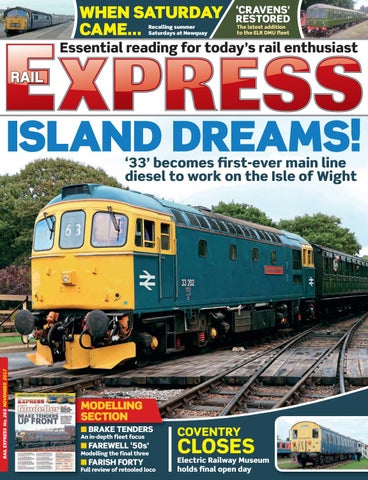
ISLAND DREAMS!
RAIL EXPRESS No. 268 NOVEMBER 2017
‘33’ becomes first-ever main line diesel to work on the Isle of Wight
MODELLING SECTION ■ BRAKE TENDERS An in-depth fleet focus
■ FAREWELL ‘50s’ Modelling the final three
■ FARISH FORTY
Full review of retooled loco
COVENTRY
CLOSES
Electric Railway Museum holds final open day
Issue No. 258 November 2017
CONTENTS
‘GOYLES’ OF MANY COLOURS: Class 31 ‘Goyles’ notch up 60 years in service this year, and to mark the anniversary the Nene Valley Railway’s autumn diesel gala on October 13-15 was due to have eight of the Type 2s in action. Five of them moved from Derby to Orton Mere on October 6 – seen at Uffington, between Stamford and Peterborough, with No. 31452 hauling Nos. 31459, 31465, 31285 and 31466. James Welham
6
HEADLINE NEWS Tour marks Class 50’s golden anniversary; Network Rail chairman calls for ‘Metroisation’ of commuter routes; Coventry's Electric Railway Museum closes; Barrow Hill reopens; Diesel first for Isle of Wight; More locos for DRS; Northern Belle sold?; Amsterdam's first Eurostar; Talgo eyes UK market; Class 230 at Loram; ScotRail calls in financial help; New livery for ‘Pendolinos’; Shunter for UKRL; Northern Powerhouse to get rail funding boost; RHTT services begin.
15
RETURN OF A ‘CRAVENS’ The only surviving Class 105 has been restored and returned to service as part of the East Lancashire Railway’s DMU fleet.
18
SUBSCRIPTION OFFERS
28
Looking back to November news from the past five decades.
30
70
27
72
29
75
31 MODELLING There’s good news for ‘N’ gauge modellers as Revolution Trains looks at releasing an APT-E, while Dapol restarts work on a Class 50. We take an in-depth look at brake tenders and how to model them, while our reviews include a retooled Farish Class 40 and Kernow’s 4-TC.
££21.50 NEVER MISS AN ISSUE... SUBSCRIBE TODAY – PAGE 18
RAILTOURS
PRESERVATION DBSO preserved for use with Royal ‘47/7’; Class 73 leave and return to preservation; Unique ‘Clayton’ to star at South Devon Railway gala.
80
POWER BY THE HOUR Limited return for DRS ‘Choppers’; Class 88s back after modifications; Another ‘ED’ for GBRf.
82
POWERSCENE Our round-up of key workings over the last month.
MOMENT IN TIME: TORRINGTON The last loco-hauled charter to the last outpost of the Atlantic Coast Express.
FFROM ONLY
Saphos Trains enters railtour market; ‘Cats’ prowl the Great Eastern; 10 years of the Fellsman.
0-60: CLASS 156 Testing ‘Super Sprinter’ acceleration in Derbyshire.
EXPRESS MAILBAG AND REVIEWS Class 50 rarities; Shunter nameplate; Scottish ‘Clay Tigers’; and a selection of railway books.
WHEN SATURDAY CAME: NEWQUAY Recalling loco-hauled holiday trains to the Cornish seaside town, which ended 30 years ago.
LU WORLD 1938 Stock return delayed; Sarah Siddons arrives at Eastleigh; ‘Choppers’ star in Steam on the Met.
The best ways to get Rail Express every month.
20
TIME TRAVELLER
90
UNITARY AUTHORITY More ‘707s’ enter service; Class 399 starts work.
93
SHUNTER SPOT HNRC rounds up ‘08s’; New GBRf duty.
94
COACH COMPARTMENT DBSO fleet in focus; Eurostar barrier scrapped.
95
WAGONS ROLL GBRf acquires first rake of branded JNAs.
96
IRISH ANGLE Warning of possible route closures; Final year for Sandite DEMU; Tour takes NIR loco to Sligo.
The Isle of Wight Steam Railway pulled off a remarkable coup in late September, when it ‘imported’ the first-ever main line diesel to the island. No. 33202 arrived by ferry and took part in the line’s diesel gala on September 29-October 1, seen arriving at Havenstreet with the 10.05 from Smallbrook Junction on the middle day. Neil Walkling
Editor’s Comment PRINT & DISTRIBUTION
Newstrade & distribution Marketforce UK Ltd, 5 Churchill Place, Canary Wharf, London, E14 5HU. 0203 787 9001 Printed by William Gibbons and Sons, Wolverhampton Published Third Friday of every month This issue October 20, 2017 Next issue November 17, 2017 Advertising deadline November 2, 2017 ISSN No 1362 234X
Paul Bickerdyke Rail Express Editor
First, last and full circle THE next time anyone says there’s no variety any more, or that our hobby has become somehow less interesting, they need to be reminded of months like this, which has seen a diesel loco break unlikely new ground; the dispersal of a unique EMU collection; and a return to classic stamping grounds of a type celebrating its golden anniversary. The new ground for a diesel was the Isle of Wight of all places. The island missed out on dieselisation due to its particular restrictions on suitable rolling stock – meaning steam was replaced by ex-London Underground electric trains in the 1960s, and the only diesels ever sent there were shunters for engineering duties. All that changed at the end of September when the Isle of Wight Steam Railway hired in a Class 33 for its three-day diesel gala – surely the most powerful loco ever to work on the island. There was a time when I would have said this was one of the last barriers that modern traction had to break down, but now it seems that nothing is impossible and who knows what might happen next? In contrast, the Electric Railway Museum near Coventry has staged its last ever open day. The museum had noble ambitions, and the exhibits included many sole-surviving examples
of EMU classes long gone, so it is a shame its licence could not be renewed by the local council. New homes have already been found for much of the collection, but the sad thing is they will be scattered across the country. Interest in Class 50s has always been high – and no less so now that they have notched up 50 years since first entering traffic. Back then it was to help speed up journeys on the northern half of the West Coast Main Line, so it was a triumphant return at the beginning of October as a railtour sponsored by our sister title The Railway Magazine took Nos. 50007 and 50049 back to Glasgow for the first time in many years. What a sight and sound they made thrashing over the border at speeds of up to 100mph. And, importantly, the many that were on board, at stations, and along the lineside only go to prove that the interest is very much still there. Paul Bickerdyke
Want to know when your next edition of Rail Express is on the shelves?
© Mortons Media Group Ltd. All rights reserved. No part of this publication may be reproduced or transmitted in any form or by any means, electronic or mechanical, including photocopying, recording, or any information storage retrieval system without prior permission in writing from the publisher.
Rail Express is pleased to consider contributions for publication
Please do not send images that have already been sent to other publications. Prints & slides are sent at the owner’s risk and must be accompanied by a SAE for return. Digital images can be sent by email, but please bear in mind we may not be able to reply to every one, as we receive hundreds of images each week. Although care will be taken with submissions, Rail Express assumes no responsibility for loss/damage, however caused. Submitted material may also be used in connection with other Mortons Media Group projects or as content on the internet. Payment for material used will be made promptly. Please send digital submissions to RailExpressEditor@mortons.co.uk or via CD or DVD to the editorial address. IMPORTANT: Images should be ex-camera with no Photoshop manipulation.
ADVERTISING
Divisional advertising manager Sue Keily skeily@mortons.co.uk Advertising Fiona Leak Tel: 01507 529573 Email: fleak@mortons.co.uk Publishing director Dan Savage Publisher Tim Hartley Production editor Sarah Wilkinson Designer Tim Pipes Reprographics Jonathan Schofield Subscription manager Paul Deacon Circulation manager Steve O’Hara
EDITORIAL
Editor Paul Bickerdyke Tel: 01507 529540 Email: RailExpressEditor@mortons.co.uk Editorial address Rail Express Magazine, Mortons Media Group Ltd, PO Box 99, Horncastle, Lincolnshire LN9 6LZ
Scan this QR code for a reminder.
Having trouble finding a copy of this magazine? Why not just ask your local newsagent to reserve you a copy each month
Independent publisher since 1885
Like us on facebook facebook.com/RailExpressMag Follow us on twitter@railexpress Visit our website railexpress.co.uk
Simon Bendall Editor Rail Express Modeller
David Russell
Power by the Hour Shunter Spot Name Game Spectrum
Preservation Unitary Authority Coach Compartment
Gareth Bayer Wagons Roll
Christopher Westcott
David Rapson
LU World (with Piers Connor)
Powerscene
William Watson Irish Angle (with Alan McFerran)
‘Industry Witness’ News Writer
Above: The tour’s headboard was modelled on that of the original ‘Caledonian’ service train. Left: No. 87002 Royal Sovereign powered the 1Z50/06.10 departure from Euston to Crewe, where the ‘50s’ took over for the run to Glasgow. Paul Bickerdyke
The historic arrival in Glasgow saw the locos swamped by photographers – much to the bemusement of the station’s ordinary passengers.
No. 50049 led on the 1Z52/16.08 return – seen ready for the off at Glasgow Central’s platform 11. No. 87002 took over again at Crewe.
TOUR MARKS GOLDEN ANNIVERSARY: To mark the 50th year of the Class 50s, our sister title The Railway Magazine teamed up with Pathfinder Tours to run ‘The Caledonian’ from Euston to Glasgow Central via the West Coast Main Line – re-creating the use of ‘50s’ north of Crewe in the late 1960s and early 1970s. Some sustained running saw the Class 50 Alliance’s Nos. 50007 Hercules and 50049 Defiance reach speeds around the 100mph mark with their 13-coach load, although there was the inevitable looping to let service trains pass. The climb of Shap was begun around 90mph and topped at 63mph, but the attack on Beattock was thwarted by the need to loop the tour at the top – despite running early at that point. The return 16.08 to Euston is pictured in a rare patch of sun that day at Gretna, on the England-Scotland border. David Dockray
Like us on facebook facebook.com/RailExpressMag
HEADLINE NEWS
Network Rail chairman calls for ‘Metroisation’ of commuter routes Main line commuter operations should try to match London Underground’s frequencies using standardised train fleets, regular calling points and better designed termini. By ‘Industry Witness’ THE advent of the digital railway will enable many services to be converted to provide the type of frequencies seen on London Underground, where the Victoria Line can now be operated with a frequency of 36 trains per hour. This is the view of Network Rail chairman Sir Peter Hendy, who believes the ‘big railway’ will need to mirror LU’s level of utilisation if it is to cope with growing capacity demands, and he labelled the idea ‘Metroisation’. There have been instances in the past when main line railways have operated very high service frequencies – for example, there was a time when trains between London Liverpool Street and Shenfield operated on a twominute headway using the electric lines and six dedicated platforms at the London terminal, allowing 25 trains per hour to be timetabled. However, the capacity was reduced when a British Rail resignalling project increased the headway to three minutes. It is the design of the terminal that is key to the highest level of track
utilisation, with London Underground using a system of bi-directional working using two platforms, with a pair of crossovers to gain access to the correct running line. In all such applications, it is also essential that the trains have the same acceleration, braking, and dwell time characteristics. The latter is something that has not been given great attention for main line operations, and it is only in the most recent rolling stock specifications that there has been a focus on the time taken for doors to open and close, which has now been reduced to under one minute.
NEW STOCK REPLACED
Dwell times is the reason for the decision by First MTR to discard the different types of rolling stock operating on the South Western Railway inner suburban services, including the new Siemens-built Class 707 trains currently still being delivered. In the future, a fleet of 60 ten-car and 30 five-car Class 701 ‘Aventra’ units will be supplied by Bombardier featuring a faster door opening and closing
mechanism to reduce dwell time. There are drawbacks to a metrostyle of railway operations, the most obvious being that the trains have to call at all stations unless there are additional running lines to allow limited stop services to pass. There is therefore a journey time limit in terms of competitiveness, a situation that also applies to light railway operations, which can have the added disadvantage of removing the available infrastructure and future connectivity for freight operations. The tram-train approach answers the latter objections, but in practice the experimental service that will link the Sheffield light rail system to Rotherham using heavy rail infrastructure has risen in cost to the point where the project came close to cancellation (see also page 90). This is despite experience with the Tyne and Wear Metro, where light rail rolling stock successfully shares eight miles of track between Pelaw Metro Junction and Sunderland with heavy rail services. What of future metro schemes? Clarity is needed about what characteristics will make the idea
work. Most London Underground lines terminate within 20 miles of central London, as is the case with Shenfield. This suggests that the aspirations for a South Wales metro to replace the heavy rail lines in the Cardiff Valleys is pushing at the threshold to be competitive, as some of the routes exceed this distance – for example Merthyr Tydfil, which is 25 miles from Cardiff. Thameslink is certainly seen as a metro scheme, but can it work when services as far away as Peterborough (76 miles from London) and Littlehampton on the South Coast (at a similar distance) are served? The aspiration on Thameslink is to run 24 trains per hour through the central section via Farringdon. That is not going to work without a considerable performance deficit. As the project is currently planned, there are too many opportunities for delay over the length of the route. The more appropriate operating boundaries would be Luton, Welwyn Garden City, Hertford North, Gatwick Airport, Rainham (Kent) and the Sutton loop. E
AS ONE DOOR CLOSES… The Electric Railway Museum held its last ever open day
…ANOTHER REOPENS: Barrow Hill Roundhouse reopened to the public with a
on October 8, as the landowners Coventry City Council has not renewed the lease. The ERM’s trustees announced in July that this would be the tenth and final year of open days, and that the collection would be split up and distributed across a number of other heritage sites. The museum is home to the largest collection of electric traction in Britain, mostly made of unique survivors from EMU classes long gone. As this issue closed for press, it is understood that one of the two last-surviving Class 309 ‘Clacton Express’ sets (Nos. 309616 and 309624, pictured) will go to the Lavender Line in East Sussex; the Class 307, 308 and 312 cars to the Colne Valley Railway (Essex); the Class 457 car to the East Kent Railway; the Tyneside EPB, Lab4 Hastings and various other stock to the Battlefield Line; and the 4-SUB, Class 503, and spare EPB trailer will go to secure storage in the south of England pending long-term restoration. The future of the rest of the exhibits has still to be announced. Chris Milner
gala event on September 22-24, marking the completion of a year-long restoration and improvement project backed by a £1.2 million award from the Heritage Lottery Fund. The ‘Moving Forward’ project included essential renovation work to the roundhouse and the construction of new visitor facilities to help tell the story of the building. Stars of the reopening gala were steam locos Nos. 60103 Flying Scotsman and 60163 Tornado, which took turns to haul shuttles on the demonstration line. However, most of the locos present were diesels and electrics, including preserved ones based there and others from main line operators in store or present for work to be done on them. Examples from Classes 02, 03, 07, 10, 20, 37, 40, 45, 47, 55, 68, 81, 82, 83, 85 and 89 were all present. This view of the yard shows the two steam locos sandwiching DRS' No. 68024, one of the fleet that will be modified for use with TransPennine Express. Paul Bickerdyke dy e
ESSENTIAL READING FOR TODAY’S RAIL ENTHUSIAST... EVERY ISSUE! ■ ONLINE ■ POST ■ PHONE ■ SUBSCRIBE TODAY ON PAGE 18 8 RAIL EXPRESS November 2017
Follow us on twitter @railexpress
HEADLINE NEWS
History is made – No. 33202 became the first main line diesel ever to work on the Isle of Wight, this shot taken on the gala’s second day (September 30) at Havenstreet. Neil Walkling
Diesel first for Isle of Wight The Isle of Wight Steam Railway made history at the end of September by running the island’s first-ever main line diesel locomotive. THE railways of the Isle of Wight have always been a little different. Isolated from the mainland, and with a restrictive loading gauge due mainly to the tunnels under Ryde Esplanade, they have always been worked by dedicated locos and stock throughout their 150 year history. This is why the remaining rump of the once extensive system is worked by former London Underground 1938 Stock. It is also why no main line diesel has ever been transferred to the island – that is, until the end of September this year. Building on its first-ever diesel gala in 2016, which made use of diesel shunters, the Isle of Wight Steam Railway’s second such event on September 29-October 1 featured Type 3 ‘Crompton’ No. 33202 Dennis G Robinson. The loco arrived from an appearance at the Epping Ongar Railway via the 19.00 Portsmouth to Fishbourne ferry on the evening of September 28. It had been carefully squeezed into the MV St Clare’s vehicle deck, with the crew needing to make sure the 74-tonne loco and its transporter lorry were positioned centrally within the vessel. It was then taken to the IoWSR’s headquarters at Havenstreet for offloading. The loco was in action the next day, running the full length of the line between Smallbrook Junction and Wootton. It was able to run round at Smallbrook, but not at Wootton as the ‘33’ was too long to fit in the headshunt there. The gala also saw Class 03 No. D2059 (03059) in action, however classmate No. 03197 was unavailable and so just on static display. Brake van rides were offered behind Class 05 No. D2554 (05001), which was transferred to the island in 1966 to work engineering trains and has stayed there ever since. The ‘05’ is not fitted with train brakes and so cannot ordinarily work passenger trains. No. 33202 was taken back to the main land on October 3, as was No. 03197. E
IN BRIEF MORE ORDERS FOR DRS DIRECT Rail Services issued an OJEU (Official Journal of the European Union) notice in September for the purchase of 10 mixed-traffic diesel locos. The contract value is estimated at £53 million, to include financing, maintenance and technical support – and will be required to be in service towards the end of 2019. These will be on top of the current order for ten additional Class 68 locos from Stadler Rail (Vossloh), Nos. 68035-68044. ■ Meanwhile at least three DB Cargo Class 66s are believed sold to rival operator GB Railfreight, these being from the ten offered for sale by DBC in August. Nos. 66058. 66132 and 66184 are the locos involved. Nos. 66008/16/46/81/141/238/250 were the others put up for sale.
NORTHERN BELLE SOLD? AS this issue closed for press, there were strong suggestions that Belmond was about to sell off its Northern Belle luxury train operation. Belmond offered no comment, but it is believed that a consortium, which includes a leading charter train operator, is interested in buying the business. Such a deal would likely lead to a change in traction, which is currently supplied by Direct Rail Services in the form of Class 57 and 68 locos. Belmond also operates the British Pullman and the Royal Scotsman, which are not thought to be part of the deal.
AMSTERDAM EUROSTAR
Type 3 No. 33202 tries and fails to blend in aboard the MV St Clare, as it is transferred from Portsmouth to Fishbourne on September 28. Simon Robinson
CLASS 374 ‘e320’ set Nos. 4013/4 reached Amsterdam on September 15, as Eurostar’s plans to start regular running to the city moved a step forward. The day after arriving at Centraal station, the ‘374’ then undertook test runs on the HSL Zuid high-speed line between Rotterdam and Breda. It was also tested on the conventional Amsterdam to Rotterdam line, which will be needed as a diversionary route. Trial services from St Pancras to Amsterdam are expected to begin in December, with a full service following in spring 2018.
TALGO EYES UK SPANISH train builder Talgo is set to enter the British market after setting up a UK office in London. New trains for HS2 would be the prime target given the company’s experience in building 350km/h trainsets for Spain. However, it could also bid for other inter-city, regional, commuter and locomotive orders. The company has also hinted it could build a factory in Britain if it wins sufficient business.
VIVARAIL ‘230’ AT LORAM
End of the line at Wootton, where the ‘33’ was too long for the headshunt and so its train was hauled back to Havenstreet by ‘03’ No. D2059. Robert Sherwood
ONE of Vivarail’s Class 230 units was spotted at Loram in Derby in September. The unidentified set, which has been converted into a DMU from ex-London Underground ‘D’ Stock, is believed to be destined for use with the new West Midlands franchise on the BedfordBletchley route. It is due to receive body repairs and a new livery at Derby.
November 2017 RAIL EXPRESS 9
Like us on facebook facebook.com/RailExpressMag
HEADLINE NEWS IN BRIEF ELIZABETH LINE TRACK LAYING COMPLETED THE track for London’s newest railway, the Elizabeth Line (Crossrail), was officially completed on September 14. The Secretary of State for Transport Chris Grayling and London’s Deputy Mayor for Transport Val Shawcross joined Crossrail chairman Sir Terry Morgan and chief executive Andrew Wolstenholme in the eastbound tunnel of the new Whitechapel Elizabeth Line station, where the final rail clips were fixed to the track. Trains are now able to travel through the full length of both east-west tunnels.
SNOWPLOUGHS READIED FOR WINTER WEATHER FAIRWATER Yard (Taunton) snowploughs Nos. ADB 965209 and ADB 965231 were given a test run ready for winter on September 20. Direct Rail Services Class 37/6s Nos. 37605 and 37606 were entrusted with the circuit, undertaking a 7Z09/16.29 Fairwater Yard circular working via Exeter Riverside. DRS power was also in charge of a similar working on the same day with March-based Nos. ADB 965211 and ADB 965237. The two ZZA snowploughs bookended Class 57/0s Nos. 57002 and 57007 on a 7Z40/12.15 March Down Yard to March Down Yard via Peterborough.
FELIXSTOWE DOUBLING THE long-awaited scheme to redouble the Felixstowe branch in Suffolk has finally been given the go-ahead. The line, mostly single-track, is currently shared by passenger and intermodal freight services, and has become a major bottleneck to developing container traffic from the port. The £60 million scheme will reinstall a second line between Trimley and Grimston Lane foot crossing, allowing up to 47 freight services to run each day – 14 more than now. Construction is expected to begin later this year.
NEW LOOK FOR ‘PENDOLINOS’: Virgin Trains has begun a rolling programme to repaint its fleet of 56 Class 390 sets – their first major new look, apart from promotional specials, since they were first introduced to the West Coast Main Line in 2002. No. 390010 was the first to be given the new look, with the work being done at Alstom’s recently-opened facility in Widnes. The new livery has been named ‘flowing silk’ and is similar to that which will be applied to the Class 800 and 801 ‘Azuma’ sets being built for the Virgin East Coast route. At present, only the driving cars feature the design, with the rest being turned out in white with black doors – this pending the outcome of the competition to run the next West Coast Partnership franchise, which is due to be awarded in November 2018 to commence in April 2019. As part of the repainting, the fleet’s cast nameplates are being replaced with vinyl versions. No. 390010 is pictured showing off the new look at Edge Hill (Liverpool) on September 14 before re-entering service. Virgin Trains
ScotRail calls in financial support
Strikes, engineering works and falling revenue led franchise holder Abellio to ask its Dutch parent company for a £10 million loan to fund franchise commitments. By ‘Industry Witness’ THERE has been a significant national decline in passenger demand for rail services in the first quarter of the 2017/18 financial year, according to statistics compiled by the Office for Rail and Road. The ORR found that 416 million journeys were made in the period, compared with 427 million the year before. The most pronounced decline is in London and the South East, where there was an 8.8% fall in recorded usage for South West Trains, 7.3% for South Eastern, and 2.9% for Govia Thameslink. Train operating company Abellio has also reported tough trading conditions in Scotland, which has resulted in the ScotRail franchise making a loss of £3.5 million in the year to December 2016. This loss has impacted on the
ability to fund franchise commitments, where investments total £475 million. As a result, Abellio’s state-owned parent company in Holland, Abellio Transport Holdings, has provided a loan of £10 million, which follows previous funding of £14 million.
CONTRIBUTING FACTORS
Franchise revenue has been lower as a result of the disruption to services caused by the rebuilding of Glasgow Queen Street station, work to electrify the main line between Glasgow and Edinburgh, as well as a series of strikes by conductors objecting to the introduction of driver controlled operations. The strikes were resolved by scrapping the DCO proposal, with undertakings given that all services operated by new Class 385 electric units
will continue to have on board staff in addition to the driver, and they will have full training in safety critical duties. The RMT union sees this decision as one that should be replicated for Merseyrail operations, run by an Abellio/ Serco joint venture company, where retaining guards on new rolling stock to be introduced in 2019 is estimated to cost £5 million per year. For ScotRail, the financial profile is expected to improve as electric services are introduced following the completion of the Edinburgh Glasgow Improvement Programme – for which the overhead wires were energised for testing on September 2. Longer distance operations will also benefit from the cascade of High Speed Train sets from Great Western Railway, which are due to be refurbished to a high interior standard. E
READ THESE AND HUNDREDS MORE EDITIONS IN THE RAILWAY MAGAZINE ARCHIVE classicmagazines.co.uk/rmarchive
SHUNTER FOR UKRL: Hudswell Clarke 0-4-0 shunter Claire (works number D1388 of 1970) was moved from Shropshire to Leicester on September 11, to take up residency as depot shunter for UK Rail Leasing. The Andrew Briddon-owned shunter was needed as the smoke and noise from using a Class 56 was leading to complaints from URKL’s neighbours. It is pictured lurking at the rear of this shot taken at the Leicester depot on September 26. In the foreground are Nos. 37601, 37800 and 56301, with heavily stripped DB-liveried No. 37670 just behind. Derek Fry.
10 RAIL EXPRESS November 2017