THE MISSING LINK The plan to create a second Brighton Main Line
EAST COAST
HISTORY
Four trains, one unique event
Essential reading for today’s rail enthusiast
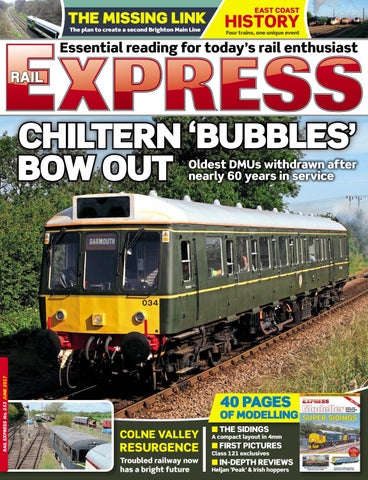
CHILTERN ‘BUBBLES’ BOW OUT
RAIL EXPRESS No. 253 JUNE 2017
Oldest DMUs withdrawn after nearly 60 years in service
40 PAGES
OF MODELLING COLNE VALLEY
RESURGENCE Troubled railway now has a bright future
■ THE SIDINGS
A compact layout in 4mm
■ FIRST PICTURES Class 121 exclusives
■ IN-DEPTH REVIEWS Heljan ‘Peak’ & Irish hoppers
Issue No. 253 June 2017
CONTENTS
FIRST PASSENGER WORKING FOR CLASS 88: New DRS Class 88 No. 88002 Prometheus became the first member of the class to work a passenger train on May 9 with the ‘VIP Launch Train’ from Euston to Carlisle – a simple out and back working via the West Coast Main Line formed of the Northern Belle set. The train, which had No. 68022 at the rear, is pictured on the outward leg at Bushey, near Watford. Cieran Jebb
8
HEADLINE NEWS Next Government faces rail funding challenge; SNCF to join bid for West Coast franchise; First Class 802 leaves Japan; ‘Azuma’ fleet production ramps up; New ‘68’ gets interim livery; Full restoration of Waverley Route to be assessed; Damaged ‘OLIVe’ moves to Ingrow for repairs; Western Supervisory Board established; Final ‘D’ Stock withdrawn; Rail can gain from bid to lower road pollution; Final ‘Bubbles’ bow out.
12
FOUR TRAINS, ONE UNIQUE EVENT The amazing event that saw four generations of train running side by side on the East Coast Main Line north of York.
14
26
28 29
EXPRESS MAILBAG BR’s big shake-up; Return to Skegness; Class 442 farewell; NRM cabs.
30
FFROM ONLY
££21.50 NEVER MISS AN ISSUE... SUBSCRIBE TODAY – PAGE 78
LU WORLD Internal redesign for Tube Stock; Historic Kensington platform to be brought back into use.
72
RAILTOURS ‘Deltic’ to make rare Southern foray; New tour operator enters the scene.
74
PRESERVATION CTLS ‘Chopper’ to stay at Epping for 18 months; NNR Suburban Mk.1 rake launched; ‘Choppers’ planned for West Somerset gala.
80
POWER BY THE HOUR Last NR ‘31’ stored; Colas receives final four Class 70s; ROG ‘47s’ in the news.
0-60: CLASS 317 These humble BR-built units can hold their own in terms of comfort and acceleration.
REVIEWS Seventies Spotting Days and DMU Allocations.
WEST COAST PAIRS The upper half of the West Coast Main Line is the place to see pairs of locos and units.
TIME TRAVELLER June news from decades past.
BML2: COULD IT BE VIABLE? Examining the plan to ease congestion on the Brighton Main Line by reopening Uckfield to Lewes for 100mph running.
20
27
82
POWERSCENE Notable workings from around the country.
90
MODELLING With excellent timing, Hattons has received livery samples of its exclusive Dapol Class 121, which include one of the Chiltern pair. Then we focus on The Sidings, a compact layout based on York, while our reviews this month include Heljan’s ‘O’ gauge ‘Peak’.
UNITARY AUTHORITY ‘319’ arrives at Brush for ‘Flex’ conversion.
93
SHUNTER SPOT The latest on the Class 08/09 fleet.
94
COACH COMPARTMENT Power-door HST ready by summer.
95
WAGONS ROLL Coal hoppers shortened for aggregates.
96
IRISH ANGLE 071 Class in demand for railtours.
The last two Class 121 ‘ Bubble Cars’ are to be withdrawn just after this issue goes to press after nearly 60 years in service. Over the past decade, blue-liveried No. 121020 and green No. 121034 have achieved celebrity status with Chiltern Railways – the latter captured soon after leaving Aylesbury on July 4, 2016, with the 08.49 to Princes Risborough. Jamie Squibbs
Editor’s Comment PRINT & DISTRIBUTION
Newstrade & distribution Marketforce UK Ltd, 5 Churchill Place, Canary Wharf, London, E14 5HU. 0203 787 9001 Printed by William Gibbons and Sons, Wolverhampton Published Third Friday of every month This issue May 19, 2017 Next issue June 16, 2017 Advertising deadline June 1, 2017 ISSN No 1362 234X
Paul Bickerdyke Rail Express Editor
Never say you’ve seen it all!
R
AIL enthusiasts are blessed to have a hobby where nothing ever stands still. Yes, there is a healthy streak of nostalgia involved, looking back to the ‘golden years’ (of which everyone has a different opinion). But that nostalgia is only driven by the ever-changing scene, as new locos and units enter traffic and old ones are retired. So never can we say we have seen it all, as something always comes along to prove us wrong – witness the recent ‘Four Trains’ event in York, which saw Virgin Trains make use of a Network Rail possession to run four trains side by side along the East Coast Main Line. It drew thousands of people from across the country, despite taking place very early on a Sunday morning. Celebrity steam loco No. 60103 Flying Scotsman ran in formation with a Virgin Trains HST, Mk.4 set and Class 800 ‘Azuma’ – with the NRM’s ‘Deltic’ involved too (sort of – see page 12). Together this represented nearly 100 years of East Coast power, something none of us lucky
enough to witness will forget in a long, long time. Well done to everyone involved! ‘BUBBLE’ GOES POP Speaking of nostalgia, Chiltern Railways has bid farewell to its Class 121 ‘Bubble Car’ operations after nearly 15 years. These 57-year-old units found a niche on the Aylesbury to Princes Risborough branch, but have finally had to be retired. They far outlived all of their First Generation DMU cousins, becoming the oldest units left in main line passenger service – just imagine the changes they have seen since introduced in 1960. Happily, if you missed them with Chiltern, these popular and versatile units will now surely be snapped up by preservationists. Paul Bickerdyke
Want to know when your next edition of Rail Express is on the shelves?
© Mortons Media Group Ltd. All rights reserved. No part of this publication may be reproduced or transmitted in any form or by any means, electronic or mechanical, including photocopying, recording, or any information storage retrieval system without prior permission in writing from the publisher.
Rail Express is pleased to consider contributions for publication
Please do not send images that have already been sent to other publications. Prints & slides are sent at the owner’s risk and must be accompanied by a SAE for return. Digital images can be sent by email, but please bear in mind we may not be able to reply to every one, as we receive hundreds of images each week. Although care will be taken with submissions, Rail Express assumes no responsibility for loss/damage, however caused. Submitted material may also be used in connection with other Mortons Media Group projects or as content on the internet. Payment for material used will be made promptly. Please send digital submissions to RailExpressEditor@mortons.co.uk or via CD or DVD to the editorial address. IMPORTANT: Images should be ex-camera with no Photoshop manipulation.
ADVERTISING
Divisional advertising manager Sue Keily skeily@mortons.co.uk Advertising Fiona Leak Tel: 01507 529573 Email: fleak@mortons.co.uk Publishing director Dan Savage Publisher Tim Hartley Production editor Sarah Wilkinson Designer Tim Pipes Reprographics Jonathan Schofield Subscription manager Paul Deacon Circulation manager Steve O’Hara
EDITORIAL
Editor Paul Bickerdyke Tel: 01507 529540 Email: RailExpressEditor@mortons.co.uk Editorial address Rail Express Magazine, Mortons Media Group Ltd, PO Box 99, Horncastle, Lincolnshire LN9 6LZ
Scan this QR code for a reminder. Independent publisher since 1885
Like us on facebook facebook.com/RailExpressMag Follow us on twitter@railexpress Visit our website railexpress.co.uk
Member of the Professional Publishers Association Having trouble finding a copy of this magazine? Why not just ask your local newsagent to reserve you a copy each month
Simon Bendall Editor Rail Express Modeller
David Russell Preservation Unitary Authority Coach Compartment Railtours
Power by the Hour Shunter Spot Name Game Spectrum
David Rapson
Wagons Roll
LU World (with Piers Connor)
Powerscene
William Watson Gareth Bayer
Christopher Westcott
Irish Angle (with Alan McFerran)
‘Industry Witness’ News Writer
EASTER ‘SYPHONS’: Pathfinder ran its four-day ‘Spring Highlander’ tour on April 14-17, which worked from Eastleigh to Inverness on the first day, then Aberdeen on day two, Kyle of Lochalsh on day three, and back to Eastleigh on day four. DRS Type 3s Nos. 37259+37609 were the main tour locos, but No. 37605 replaced No. 37609 at Inverness for the Kyle leg, which is pictured running alongside Loch Carron at Attadale with the 1Z40/09.45 ex-Inverness. All photos by Jamie Squibbs
Nos. 37259+37605 thrash out of Garve on April 16 – getting the 12-coach train back on its way towards Kyle of Lochalsh. The level crossing here replaced a road overbridge when the A835 was upgraded in the late 1980s.
While the railtour was at Kyle, the town was also visited by Nos. 37421 and 37057 ‘top and tailing’ a 1Q78 test train from Inverness – meaning for a while there were four Class 37s in Kyle for the first time in many years.
Like us on facebook facebook.com/RailExpressMag
HEADLINE NEWS
The next Government will face a rail investment funding challenge While income now exceeds subsidies for the passenger franchises, large infrastructure projects like East West Rail will require private sector funding if they are to become a reality. By ‘Industry Witness’ MOST assessments are that Theresa May will remain at the head of the Government after the general election on June 8. This may not mean that railway policy will remain unaltered, however, as a new Parliament is an opportunity to bring forward change, particularly in ministerial teams. Rail is not high on the Government’s agenda, as the continued rise in passenger numbers and the effect of controlled fares being set at the ‘RPI inflation index + 1%’ mean that operating subsidies have effectively been eliminated, with franchise premium payments exceeding the support payments paid for regional and rural passenger services. There remains a substantial cost to the Government for enhanced
infrastructure to cater for the growing demand. Previously, Network Rail had been allowed to borrow the money required from private funding sources. But that ended in 2014 when it was ruled that the guarantee given to lenders placed the company in the public sector. The formation of a new Government comes at a time when the High Level Output Statement to determine railway projects for the period between 2019 and 2024 is due to be published along with the associated Statement of Funds Available. These are important documents that will determine the development of the national network in terms of future electrification, capacity enhancement, and any line reopenings. It is unlikely the settlement will be as generous as has existed for the current five-year programme to 2019. There is less confidence that the rail
industry can deliver projects efficiently following the cost escalation for Great Western electrification and excessive expense of the replacement HST rolling stock.
PRIVATE INVESTMENT
As it currently stands, the electrification projects to reach Bristol, Swansea, and Sheffield have been reduced in scope – and it is more difficult to justify their completion, as bi-mode trains can run beyond the electrified network, allowing through services to be maintained. Nevertheless, it is likely money will be allocated in the period up to 2024 on environmental grounds, to provide the wiring so that services can be operated throughout using ‘greener’ electric traction. The Government will be seeking to find a formula for private investment in
rail infrastructure given a commitment to provide public funds elsewhere, and the East West project to reopen the route between Bicester and Cambridge has already been chosen as a test bed for new ideas. This will also be an integrated railway, with the company building and maintaining the infrastructure as well as providing a train service. It is an ambitious project, with the intention that the largely in situ infrastructure (albeit disused in some sections) will be restored as far as Bedford by 2025. There is a commitment to continue to Cambridge in the longer term, although much of the original route that was closed in 1967 has been lost to development, with a new alignment required in a number of locations to allow services to be restored. E
SNCF to join bid for West Coast franchise VIRGIN Trains and Stagecoach have announced that French state operator SNCF will join them to bid for the next West Coast passenger franchise, which will include running trains on HS2. The ‘West Coast Partnership’ franchise will run from 2019, and SNCF has been brought in for its knowledge of running high speed intercity services. It has the largest fleet of high speed trains in Europe (over 400 trainsets) and operates around 700 services per day at speeds up to 200mph. SNCF will hold a 30% stake in the joint venture, with Stagecoach 50% and Virgin 20%. The three firms have already submitted an expression of interest and will now prepare for the Invitation to Tender, which is expected to be issued by the end of the year.
Follow us on twitter @railexpress
FIRST CLASS 802 LEAVES JAPAN: The first of the five-car, bi-mode Class 802 fleet for Great Western Railway is on its way to the UK. The trains are destined for use on its West of England services to Devon and Cornwall, and are similar to the Class 800 bi-modes now being built at Hitachi’s plant in Newton Aycliffe, County Durham. The ‘802’ is pictured at Kobe port before leaving on April 26, and is due to arrive in the UK in June. The bulk of the ‘802’ fleet will be built in Pistoia, Italy, and should enter service in 2018. Hitachi
‘AZUMA’ FLEET PRODUCTION: Hitachi is also
ESSENTIAL READING
FOR TODAY’S RAIL ENTHUSIAST...
EVERY ISSUE!
SUBSCRIBE TODAY ON PAGE 78 8 RAIL EXPRESS June 2017
ramping up construction of the Class 800/801 fleet for Virgin Trains East Coast. Bodyshells like this one are manufactured in Kasado, Japan, before being shipped over to Newton Aycliffe for assembly. VTEC has ordered 23 Class 800 (bi-mode) and 32 Class 801 (electric-only) sets, which are due to start work out of King’s Cross from 2018. Another 57 Class 800 sets are being built for GWR, 21 of which were originally going to be Class 801. Hitachi
Follow us on twitter @railexpress
HEADLINE NEWS IN BRIEF SIEMENS AND BOMBARDIER IN RAIL MERGER TALKS
NEW ‘68s’ GET INTERIM LIVERY: DRS’ latest Class 68s Nos. 68026 and 68027 have received an interim livery comprising the company’s ‘compass’ logos on an otherwise plain blue body. The two locos arrived via Workington Docks at the end of March, and are part of an expansion of the fleet ahead of them taking up passenger duties with TransPennine Express from 2018. No. 68027 is pictured at Gateshead Metrocentre on May 4 with a rake of ballast wagons from Mountsorrel to Carlisle. Sean White
Full restoration of Waverley route to be assessed With Edinburgh to Tweedbank a success, Transport Scotland is looking at pushing on to Hawick and eventually Carlisle. By ‘Industry Witness’ THE success of the Borders Railway has resulted in Transport Scotland taking forward an appraisal to reopen the complete Waverley route between Edinburgh and Carlisle, which was closed in 1969. The existing restored line covers 30 miles of the route as far as Tweedbank, leaving another 63 miles to reach Carlisle. Since train services were restored to Tweedbank in September 2015, the annual number of passengers has reached 1.4 million, which is far above predicted demand, and the terminus at Tweedbank alone recorded more than 300,000 passengers in its first year of operation. This is a greater number than expected, with the availability of a rail service proving an invaluable asset in restoring economic well-being by providing access to jobs in Edinburgh from towns served by the railway. As a result, the Scottish
Government’s Strategic Transport Project Review is to assess the benefit-cost ratio of an extension to Carlisle. The Edinburgh employment catchment area almost certainly extends to Hawick, a further 18 miles, but beyond there the route to Carlisle serves no significant population and is rural in nature.
BEYOND HAWICK
For this section, the economic driver is the opportunity for the movement of timber from the Kielder Forest, where it has previously been assessed there would be regular demand for two daily trainload operations to processing plants in England and Wales, such as at Chirk. The restoration of the through route would also bring the benefit of a diversionary option to the West Coast Main Line between Carlisle and Glasgow. Currently there is no spare capacity at busy times to cater for a growing demand for paths, with passenger numbers between North West England and Scotland increasing
as a result of improved services. There is continued criticism about the low level of ambition that caused the reopened section to be engineered as a single line with limited passing loops. In fairness, the firm of Scott Wilson that prepared the specification said it had to be a minimum cost solution as the revenue projections did not justify a two track route. This decision will bring a penalty in terms of the potential for using the route for through services and diversions, either for planned engineering work or out of course mishaps. As a result, further investment will be required to improve capacity on the existing section of line if an extension is justified on this basis. Improving Borders Line capacity will also benefit current performance, as punctuality has continued to fall short of the 92.5% level required in the ScotRail franchise because of the magnified impact any incidents have on the current single line operating at capacity.
A REPORT by Bloomberg.com says that Siemens and Bombardier are in talks to combine their rail operations, potentially creating a business that could fend off increasing competition from China. The report states that the proposed joint venture could be worth at least £8.5 billion and would merge the firms’ trainmaking and signalling activities. Combining the Bombardier and Siemens businesses would create a rail powerhouse better able to rival industry leader CRRC Corp. of China, and would also help fend off challenges in Europe, which has become the fastest growing rail market as governments seek to ease crowded roads and reduce carbon emissions.
RAILWAY TREE CENSUS DELAYS caused by trees falling onto the tracks could dramatically reduce as Network Rail rolls-out a national ‘tree census’ database with the ability to identify and target specific trees. More than 10 million trees have been catalogued as part of an aerial survey covering 20,000 miles of Britain’s track. The database provides engineers with a heat map indicating higher priority ‘problem trees’ or overhanging tree canopies that need attention before they fall onto the tracks and cause delays. Part of the Offering Rail Better Information Service programme (ORBIS), the database is now completed and deployed across the company, and it is hoped it will revolutionise the way lineside engineers target their work, as well as save the company time and money.
COAL-FREE DAY THE National Grid said that April 20/21 saw the first 24-hour period that Britain had not used coal to generate electricity since the Industrial Revolution. The energy provider said the lack of coal usage was a watershed moment. Britain’s longest continuous energy period without coal until then was 19 hours. This was thought to be the first time the nation has not used coal to generate electricity since the world’s first centralised public coal-fired generator opened in 1882 at Holborn Viaduct in London. The Government plans to phase out Britain’s last plants by 2025 in order to cut carbon emissions – the large reduction in coal traffic by rail has hit the freight companies hard.
DAMAGED ‘OLIVE’ MOVES TO INGROW:
NSE OPEN DAY
Volunteers from the EM2 Locomotive Society spent the Easter weekend stripping Overhead Line Inspection Vehicle (OLIVe) No. DB998900 of charred interior parts following the arson attack last year at the Middleton Railway, Leeds. The vehicle was then moved to the Keighley & Worth Valley Railway on May 2 to be repaired at Ingrow by the Vintage Carriages Trust, pictured en route near journey’s end. Donations towards the unit’s rebuild are still being sought, please visit the website at www.em2ls.org.uk for more details. Ben Bucki
THE Network SouthEast Railway Society is staging a public open weekend on August 12/13 at Finmere, Oxfordshire, which is on the trackbed of the former Great Central Main Line. The event will feature the only complete and original Phase One 4-CIG No. 1753 working with electro-diesel No. 73130. Refreshments will be available from the BIG buffet over the weekend. This is a private site and will be a ticket-only event, with tickets limited to 150 a day.
June 2017 RAIL EXPRESS 9
Follow us on twitter @railexpress
HEADLINE NEWS IN BRIEF ATTEMPT TO PROVE BOX TUNNEL SUNRISE THEORY APRIL 9 was Isambard Kingdom Brunel’s 211th birthday, so a team of Great Western Railway engineers went to Box tunnel, just outside Bath, to test the theory surrounding the rising sun. It is believed that Brunel deliberately designed the two mile-long tunnel so that every year on his birthday the rising sun would shine directly through from one end to the other. The engineers found that the tunnel does in fact align with the rising sun, which lit up a significant section of the tunnel. However, despite ideal conditions on the morning, the sun’s rays did not make it all the way through to the other end.
The Branch Line Society ran the ‘Bubble and Squeak Tracker’ on April 9 from Aylesbury to Marylebone and Oxford. It featured greenliveried No. 121034, the 57-year-old unit contrasting with the modern infrastructure at Wembley Stadium en route to London. Richard Allen
Final ‘Bubble Cars’ bow out The oldest DMUs still in regular use have finally been withdrawn by Chiltern Railways after nearly 60 years in traffic. CHILTERN Railways has withdrawn its last two Class 121 ‘Bubble Cars’, which were the oldest diesel units still in regular main line passenger service and the final ones to operate with vacuum brakes. The final day for Nos. 121020 (55020 in blue livery) and 121034 (55034 in green livery) was due to be May 19, the final weekday before the summer timetable came into force. The heritage slamdoor units had been retained for use on the Aylesbury to Princes Risborough shuttle during the morning and evening peaks, when the TOC’s more modern units were needed elsewhere. Class 121 DMUs were introduced in 1960, with 16 being built by the Pressed Steel Company followed by 10 trailer cars with a cab at one end. They were built for use on Western Region branch lines, such as those in Cornwall and the Thames Valley – outliving the similar Gloucester RC&W Class 122 ‘Bubbles’, which were built for the London Midland Region but all withdrawn by 1995. Chiltern acquired No. 121020 from Network Rail in 2003, then No. 121034 arrived from Tyseley in 2011. A third ‘Bubble’ No. 121032 was bought from Arriva Trains Wales in 2013, but this was sold into preservation in 2015. The usual diagram saw one unit used on five departures from Aylesbury (at 06.35, 07.47, 08.49, 17.26 and 18.28) and six from Princes Risborough (at 07.20, 08.23, 09.16, 17.00, 18.06 and 19.30). On the final day, a small ceremony was planned for Aylesbury in the late morning with Chiltern’s Managing Director, Dave Penney. This was followed by additional non-stop services to Risborough formed of one of the Class 121s at 12.19, 13.19 and 14.19, returning at 12.50, 13.50 and 14.50. The ‘Bubbles’ are being withdrawn as they are increasingly non-standard
DB CARGO REACHES UNION AGREEMENT DB Cargo has reached successful agreements with the four trade unions representing a majority of its workforce, meaning it will launch its future business model on July 2 as planned. ASLEF, RMT, TSSA and Unite have been in discussions with the rail freight operator since October 2016, when the company announced proposals to cut 893 jobs (almost a third of its workforce) in a restructure triggered by the rapid decline in the core market of coal. The working arrangements of employees will also be updated and modernised.
GREAT WESTERN TO LAUNCH SMARTCARD GWR is to launch a smartcard for the Severn Beach Line as part of a pilot that could see combined rail and bus travel in a single ticket offered across Bristol. The pilot project is being run in partnership with Bristol City Council. The smartcard, to be known as ‘touch’, will enable both adults and children to add weekly and season tickets to their card using their online account, or at a smartcard enabled ticket vending machine. No. 121034 leaves Quainton Road on May 1, running a shuttle service to and from Aylesbury for the Buckinghamshire Railway Centre’s gala – as Chiltern’s two ‘Bubbles’ have done on other occasions over the years. Lewis Bevan Blue-liveried No. 121020 is Chiltern’s other unit, pictured at Quainton Road on May 3, 2010. This vehicle has been out of service for repairs, but these were expected to be completed in time for the final day’s service with the operator. Creative Commons/John F
and their maintenance needs are increasing, while it is understood that new tyres are needed but there is no longer a main line specification for them. Both will be sold on into preservation, joining 10 others (Nos. 55022, 55023, 55024, 55025, 55027, 55028, 55029, 55031, 55032 and 55033) plus two trailer cars (Nos. 56287, 56289). These are on top of the eight Class 122 (Nos. 55000, 55001, 55003, 55005, 55006, 55009,
55012 and 55019) that have also been preserved. ■ FAREWELL TOUR: In advance of the last day, No. 121034 operated a Branch Line Society charter on April 9, paying a final visit to Marylebone and also making a run to Oxford via the new Bicester chord. Chiltern’s other ‘Bubble Car’ No. 121020 was out of action for much of March and April after suffering a mechanical problem, but it was hoped to be back for the official last day in service.
CAMBRIDGE NORTH OPENS GREATER Anglia has opened the new station at Cambridge North, which serves Cambridge science and business parks and the suburbs and villages north of Cambridge city centre. The three-platform station, which was built by Network Rail, will serve trains operated by Greater Anglia on the Cambridge to London Liverpool Street and Cambridge to Norwich routes. Initially four GA trains an hour will call, one service to/ from London, and one to/from Cambridge/ Norwich.
BEACON RAIL SOLD INVESTMENT firm J P Morgan has bought the Luxembourg-based Beacon Rail. Beacon owns a fleet of 190 locomotives, 944 freight wagons and 20 passenger trains, which it leases to operators in Britain, France and several other European countries. It is also financing new trains for TransPennine Express, which are currently being built by CAF in Spain. These will be 13 five-car loco-hauled sets that are due to enter service from 2018 powered by DRS Class 68s.
June 2017 RAIL EXPRESS 11
Like us on facebook facebook.com/RailExpressMag
HEADLINE NEWS
Four trains: one unique event!
The unique line-up on April 23 featured (from left) No. 60103 Flying Scotsman, IEP No. 800101, Mk.4 set Nos. 82205/91105 and HST set Nos. 43238/43290. After travelling side by side along the East Coast Main Line from Tollerton, 10 miles north of York, the trains paused for this shot at The Sidings Hotel in Shipton. Paul Bickerdyke
A ONE-off event on April 23 saw four generations of East Coast traction run side by side along the four-track main line north of York. It was staged as part of a publicity campaign for Virgin Trains. The event – jointly organised by Virgin Trains, Network Rail, the National Railway Museum, Hitachi and Welcome to Yorkshire – featured A3 steam loco No. 60103 Flying Scotsman, Hitachi IEP No. 800101, VTEC Mk.4
set Nos. 82205/91105 and VTEC HST Nos. 43238/43290. The NRM’s ‘Deltic’ No. 55002 was also involved ‘top and tailing’ with Flying Scotsman. The event took advantage of an engineering possession that had closed the East Coast Main Line north of York. It began at Tollerton, about 10 miles north of the city, where the trains assembled in the early hours before setting off in formation around 06.00 – pausing for a press line-up alongside
The Sidings Hotel at Shipton. Crowds flocked to the bridges and lineside along the route to get a glimpse of the unique line-up, but those just south of Shipton were disappointed as the IEP broke formation and sped ahead as part of a planned move for the film crews overhead in helicopters. Crowds also gathered at York station to watch the trains arrive. First was the HST, followed by the Mk.4
set, then Flying Scotsman and the IEP running in parallel. The four trains were again lined up for a short time on adjacent platforms at the south end of the station before going their separate ways. The ‘Deltic’ and Flying Scotsman retired to the NRM, and their West Coast coaching set was taken back to Carnforth behind Nos. 47826 and 57315. The IEP returned to Doncaster and the VTEC trains went into normal service. E
The four trains lined up on adjacent platforms at the south end of York station, this shot showing (from left) Nos. 55002, 60103, 43238, 82205 and 800101. Maurice Burns
The NRM’s ‘Deltic’ No. 55002 was involved at the rear of the Scotsman’s train for positioning purposes. Here it is pictured getting attention from the crowds after arriving at York.
12 RAIL EXPRESS June 2017
Crowds at the north end of York station wait for the trains to arrive. Has an East Coast Mk.4 set ever had this much attention before?
Crowds also assembled on the bridges and lineside north of York to witness the unique event. Chris Playfair