LONDON FROM ABOVE Stunning views of railways from some of the capital’s high-rise buildings
ON SHED!
Part 2 of our survey of modern traction depots
Essential reading for today’s rail enthusiast
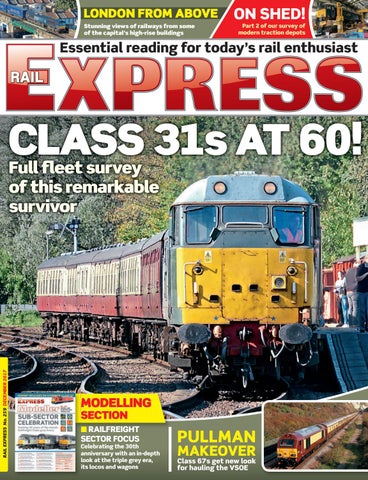
CLASS 31s AT 60!
RAIL EXPRESS No. 259 DECEMBER 2017
Full fleet survey of this remarkable survivor
MODELLING SECTION S
■ RAILFREIGHT SECTOR FOCUS S
C Celebrating the 30th anniversary with an in-depth a look at the triple grey era, its locos and wagons
PULLMAN
MAKEOVER
Class 67s get new look for hauling the VSOE
Issue No. 259 December 2017
CONTENTS
CAB LEAVES PLYMOUTH: An unusual job for Railway Support Services on November 1/2 was to remove the remains of Class 47 No. 47738 from the former Rail Incident Safety Centre next to Plymouth station. The loco had been there since 2002 to train staff for emergency situations, as well as local schoolchildren about the dangers of railways. The RISC building is now being demolished to make way for a GWR staff car park, so the loco had to be moved. The cab is destined for The Cab Yard in South Wales, while the bogie is heading to Raxstar in Eastleigh. Paul Fuller
6
HEADLINE NEWS Knottingley open day celebrates 50 years; Government increases CP6 rail funding; Bidders revealed for HS2 trains; ‘Deltic’ works freight train; Pullman makeover; Northern Belle sold; Orient Express visits St Pancras; Gala launch for restored ‘105’; TPE Mk.3s head north; West Midlands franchise will revive LNWR name; First IETs enter service; First ‘385’ reaches Queen Street; Crossrail unit goes underground.
14
20
HAPPY BIRTHDAY CLASS 31
32
December news from the past five decades.
33
84 85
31
ON SHED
87
0-60: CLASS 345 There is a new leader, as a Crossrail EMU sets a blistering start time in East London.
MODELLING This month’s edition is dedicated to the Railfreight grey era, celebrating the 30th anniversary of its launch with an in-depth look at the various sub-sector locos and wagons, and how to model them on your layout.
FFROM ONLY
££21.50 NEVER MISS AN ISSUE... SUBSCRIBE TODAY – PAGE M5
EXPRESS MAILBAG Class 50 on coal; Class 50s at Carlisle; ‘325’ cab.
86
The high-rise buildings of the capital offer some great opportunities to shoot railways in an urban environment, as this selection shows.
LU WORLD Plan to build additional trains is ‘paused’.
These hardy workhorses have now notched up 60 years in service, so we round up the surviving fleet and look at the celebratory gala held at the Nene Valley Railway.
LONDON FROM ABOVE
MOMENT IN TIME: CREWE One photo captures three types of electric loco together at Crewe Works: DC, AC and third-rail.
RAILTOURS Tastes are changing in the charter market.
PRESERVATION ‘Bubble Car’ bound for Bodmin; ‘Skinhead’ back in action; ‘Chopper’ bound for scrap; Five ‘Whistlers’ for East Lancs spring gala?
Part two of our comprehensive survey of surviving modern traction depots, this time looking at London, Southern England and Wales.
26
TIME TRAVELLER
94
POWER BY THE HOUR GBRf takes on DB rejects; RHTT round-up.
98
POWERSCENE Class-by-class round-up of notable workings.
106 UNITARY AUTHORITY Class 442 refurbishment contract awarded.
109 SHUNTER SPOT RSS prepares additional ‘08s’ for service.
110 COACH COMPARTMENT More HST sets stopped by GWR.
111 WAGONS ROLL GBRf shows off new biomass hoppers.
112 IRISH ANGLE Celebrity locos in demand for railtours; NIR ‘Thumper’ DEMU back in use on Sandite duties.
To mark the 60th anniversary of Class 31s, the Nene Valley Railway held a celebratory gala on November 13-15, featuring no less than eight of the Brush Type 2s in action (see pages 16/17). BARS' No. 31452 is pictured at the NVR’s Peterborough station on the middle day, after arriving with a service from Wansford.
Editor’s Comment PRINT & DISTRIBUTION
Newstrade & distribution Marketforce UK Ltd, 5 Churchill Place, Canary Wharf, London, E14 5HU. 0203 787 9001 Printed by William Gibbons and Sons, Wolverhampton Published The day after the third Thursday each month This issue November 17, 2017 Next issue December 22, 2017 Advertising deadline December 7, 2017 ISSN No 1362 234X
Paul Bickerdyke Rail Express Editor
© Mortons Media Group Ltd. All rights reserved. No part of this publication may be reproduced or transmitted in any form or by any means, electronic or mechanical, including photocopying, recording, or any information storage retrieval system without prior permission in writing from the publisher.
‘Goyles’ on film
W
HEN I think about Class 31s, one of the strongest memories for me is of the second batch of ETH conversions in the early 1980s. These allowed a mini-renaissance in loco-hauled workings around where I lived at the time in West Yorkshire, filling a gap between the withdrawal of first generation DMUs and the start of the ‘Sprinter’ revolution. As such they were rostered on services from Leeds to Lancaster, Carlisle, Scarborough, Holyhead and others. More importantly for me, one of the first turns for the new conversions after they left Doncaster Works was a morning Hull to Bradford service, which just happened to be my train to work. This meant every week or so I could pick off a new one at the head of the train, which was usually formed of a rake of Mk.1s including some corridor stock – what a great way to start the day that was. Fast forward more than 30 years and it is amazing to see the class (just about) still there on the main line. Even better, there are over 20 examples safely in preservation, most of which are operational, meaning you can have a run
behind one of these fine locos on heritage lines from the Spa Valley to Strathspey, North Norfolk to Dean Forest. The first of the class No. D5500, which entered traffic at the end of 1957, is part of the National Collection and on show at the NRM in York. Sadly, it is now a non-runner, but to mark the 60th anniversary the Nene Valley Railway organised a Class 31 gala that gathered together no less than eight examples for a three-day event (see our photo report on pages 16/17). It is a long time since I have seen so many ‘Goyles’ in one place at the same time, and even longer since it was possible to bash so many in one day. Well done to all involved at the NVR event. It was a fitting tribute to an enduring underdog loco. Paul Bickerdyke
Want to know when your next edition of Rail Express is on the shelves?
Rail Express is pleased to consider contributions for publication
Please do not send images that have already been sent to other publications. Prints & slides are sent at the owner’s risk and must be accompanied by a SAE for return. Digital images can be sent by email, but please bear in mind we may not be able to reply to every one, as we receive hundreds of images each week. Although care will be taken with submissions, Rail Express assumes no responsibility for loss/damage, however caused. Submitted material may also be used in connection with other Mortons Media Group projects or as content on the internet. Payment for material used will be made promptly. Please send digital submissions to RailExpressEditor@mortons.co.uk or via CD or DVD to the editorial address. IMPORTANT: Images should be ex-camera with no Photoshop manipulation.
ADVERTISING
Divisional advertising manager Sue Keily skeily@mortons.co.uk Advertising Fiona Leak Tel: 01507 529573 Email: fleak@mortons.co.uk Publishing director Dan Savage Publisher Tim Hartley Production editors Sarah Palmer, Sarah Wilkinson Designer Tim Pipes Reprographics Jonathan Schofield Subscription manager Paul Deacon Circulation manager Steve O’Hara
EDITORIAL
Editor Paul Bickerdyke Tel: 01507 529540 Email: RailExpressEditor@mortons.co.uk Editorial address Rail Express Magazine, Mortons Media Group Ltd, PO Box 99, Horncastle, Lincolnshire LN9 6LZ
Scan this QR code for a reminder.
Having trouble finding a copy of this magazine? Why not just ask your local newsagent to reserve you a copy each month?
Independent publisher since 1885
Like us on facebook facebook.com/RailExpressMag Follow us on twitter@railexpress Visit our website railexpress.co.uk
Simon Bendall Editor Rail Express Modeller
David Russell
Power by the Hour Shunter Spot Name Game Spectrum
Preservation Unitary Authority Coach Compartment
Gareth Bayer Wagons Roll
Christopher Westcott
David Rapson
LU World (with Piers Connor)
Powerscene
William Watson Irish Angle (with Alan McFerran)
‘Industry Witness’ News Writer
Like us on facebook facebook.com/RailExpressMag
HEADLINE NEWS
Red-liveried ‘Tug’ No. 60015, currently in use as a ‘super-shunter’ at Doncaster, was moved during the event to line up with silver Drax-liveried No. 60066. Ironically, No. 60066 cannot be used on biomass services to Drax Power Station because biomass requires a discharge speed below that of the Class 60’s lowest setting.
Knottingley celebrates 50 years Staff at DB Cargo’s West Yorkshire depot organised a mini open day on October 28, raising money for Cancer Research UK and marking the depot’s 50th anniversary. THERE was a rare opportunity to peek behind the scenes at Knottingley depot, West Yorkshire, on October 28, as staff there took the initiative to arrange for 100 members of the public to have a guided tour of the facilities. Knottingley is a purpose-built diesel depot that opened in July 1967, meaning this year marks its 50th anniversary. The first loco allocated there was a Class 03 shunter, but the depot has always been synonymous with heavy freight locos, such as Class 47, 56, 58, 60 and 66. The depot is located in a triangle
6 RAIL EXPRESS December 2017
of lines that lead to Goole, Doncaster/ Scunthorpe and Castleford/Wakefield/ Milford West Sidings. It was originally built for the heavy Merry-Go-Round traffic between the Yorkshire coalfields and Aire Valley power stations – and, while coal traffic has diminished today, the depot is still busy with gypsum and biomass traffic, particularly for nearby Drax Power Station, with workings from the Humber ports at Hull and Immingham. Knottingley comprises four main buildings: a staff and administration block, which includes a training
simulator; a four-road loco shed; a single-road wagon repair shop; and a two-road wagon maintenance building – the latter having access from both east and west. One of the loco shed’s roads is for fuelling – the ‘Greenhouse’ – and the other three are for maintenance. Depending on demand, the depot handles up to half-a-dozen locos per day, covering fuelling, daily servicing and weekly ‘A’ exams. Besides the loco work, the depot is also busy with a range of wagon repair work – such as replacing any wheel sets that incur flatspotting.
The open day was arranged in cooperation with Network Rail, DCR and the Deltic Preservation Society – the latter two lending locos Nos. 56303 and 55009 respectively, and NR waiving the track access fees for the loco movements. Other locos taking part were Nos. 60015, 60066, 66014, 66069, 66082, 66100, 66129, 66160 and 67029. More than £2000 was raised on the day for the staff’s chosen charity Cancer Research UK, a commendable effort and one that will hopefully lead to other similar events in the future. E
Follow us on twitter @railexpress
HEADLINE NEWS
DCR’s No. 56303 pictured through the ‘Greenhouse’ – the fuelling road of the loco servicing shed.
No. 66129 in the wagon maintenance shop, with FCA flat wagon No. 610094 just visible on the right.
A gypsum wagon in the single-road wagon repair shop.
Knottingley is home to preserved HAA wagon No. 350002, the third such wagon ever built. HAAs were synonymous with MGR coal traffic around Knottingley from the late 1960s to early 2000s, but this one is now plinthed outside the depot’s administration building. ‘Deltic’ No. 55009 is visible in the background next to the fuelling road.
A general view of the depot looking west, with (from left) Nos. 55009, 56303, 60015, 66082 and 67029. The locos are outside the loco servicing shed, with the wagon repair shop to the right and the wagon maintenance shed on the far right. All photos taken on October 28 by Paul Bickerdyke
December 2017 RAIL EXPRESS 7
Like us on facebook facebook.com/RailExpressMag
HEADLINE NEWS
Government increases CP6 rail funding
Network Rail is given a budget of £48 billion for the five-year Control Period 6 from 2019 to 2024. By ‘Industry Witness’ THE rail industry is to receive higher funding than expected for the five-year Control Period 6 (CP6) between 2019 and 2024, with permitted Network Rail spending of £47.9 billion including £34.7 billion of direct Government Grant. The previous ceiling for CP5 (2014 to 2019) was £38.6 billion, equivalent to £42 billion at current day value. The next stage in the process is for the Office of Rail and Road (ORR) to agree with NR how the money will be spent. With the benefit of hindsight, it can be seen that productivity savings in CP5 for operating, maintaining and renewing the network (OMR) were set at an unachievable level that required a 20% cut in funding. Although NR said at the time that the allowance for day-to-day spending was inadequate, it accepted the settlement as it was then in a position to make up any shortfall by issuing private sector bonds to raise additional money. With the subsequent decision in 2014 to make NR dependent only on Government
funding, this option was no longer available. The result has been that the Government has had to provide emergency funding, such as for the Southern network when it became apparent that insufficient money was available for renewals to ensure a reliable service. The OMR forecast is likely to be more difficult to dispute this time, as it will be route-based with more local input on the need for track and civil engineering renewals required for reliable operations. The gap between the grant provided and the spending ceiling is made up of track access charges, income from property and an expectation that there will be private sector funding for projects such as the East West Rail Link. There is also the expectation that a franchise partnership will be formed to fund the electrification of routes that make up the proposed South Wales Metro – but this has received a setback, as the current
franchised operator Arriva Trains Wales has withdrawn from the competition. It is the intention that projects originally planned for CP5 will be funded in CP6, although this is unlikely to see the restoration of the original electrification programme. New projects are to be assessed on an individual basis, with greater contribution sought from devolved transport organisations rather than central government. The last decade has been about capacity enhancement to meet an ever-rising number of passengers and freight movements, but there is evidence that demand is stabilising. For freight operations, the relegation of the remaining coal-fired power stations to reserve status has reduced the need for freight train paths, although intermodal traffic has continued to grow. In the passenger market, the level of fare rises is now far above the average increase in pay. The January 2018 increase in controlled fares, such
“New projects are to be assessed on an individual basis”
as season tickets, will be 3.8% – more than double the average take home pay rise of 1.7%. So there is a point where fares become unaffordable and there has already been a 0.5% fall in journeys in the first three months of 2017, while commuter journeys in London and the South East has fallen by 1.9%.
FLEXIBILITY PROMISE
There had been hopes that the Fares and Ticketing Review launched by the Government in 2015 would dilute the effect of inflationary fare increases. This included the concept of part-time season tickets for commuters that do not travel daily or use trains at peak hours. More flexibility was also promised with single leg ticketing reflecting travel that might take place one way in the peak and the other during the off peak. Smart ticketing was also promised that would avoid the use of paper tickets by the end of 2018, with the expectation that Oyster style ticketing of the type seen in London would reduce journey costs. However, no progress on this has yet been made. E
Bidders revealed for HS2 trains ALSTOM, Bombardier, Hitachi, Siemens and Talgo have been shortlisted for the £2.75 billion contract to build trains for use on HS2. The five companies will now be invited to tender for the contract in spring 2018, which includes the design, build and maintenance of at least 54 highspeed trains able to run on high-speed and conventional lines. The contract is due to be awarded in 2019 to deliver prototypes in the early 2020s and entry to service in 2026. The 225mph (360kph) trains will be based at Washwood Heath, Birmingham. Besides running on HS2 from Euston, they will also reach Newcastle, Liverpool, Glasgow and Edinburgh. ■ TALGO SCOUTS UK PLANT: Shortlisted bidder Talgo has already begun looking for possible locations for a UK train building factory. The Spanish firm is analysing a dozen locations in the UK, and has already engaged in formal contacts with local authorities and key interest groups from the districts concerned, as well as with local MPs. The manufacturer has devised a long-term industrial plan, which includes the construction of a plant in the UK and the creation a fully localised supply chain. It wants to offer a ‘full spectrum’ of rail solutions in Britain, ranging from the supply of high-speed rolling stock to full vehicle overhaul services.
Like us on facebook facebook.com/RailExpressMag
Follow us on twitter @railexpress
8 RAIL EXPRESS December 2017
‘DELTIC’ HAULS FREIGHT: Following its appearance at the Knottingley open day on October 28 (see pages 6/7), the next day saw the Deltic Preservation Society’s main line-certified No. 55009 Alycidon make an extremely rare appearance at the head of a freight train. Special arrangements were made for the loco to run light engine from Knottingley to nearby Milford West Sidings and then power 14 empty bogie hopper wagons as the 6Z55/15.32 to Neville Hill (Leeds) via Castleford – pictured passing a row of Class 70s at Freightliner’s Midland Road depot in south Leeds. DB Cargo’s No. 66082 was included as a translator for the buckeye couplings. After depositing the wagons, the ‘Deltic’ ran light engine to the NRM in York and the ‘66’ returned to Knottingley. Paul Bickerdyke
Follow us on twitter @railexpress
HEADLINE NEWS IN BRIEF ARRIVA QUITS WALES AND BORDERS FRANCHISE BID ARRIVA Trains Wales, a subsidiary of Deutsche Bahn, has pulled out of the bidding process for the next Wales and Borders franchise. ATW operates the current franchise, which runs until late 2018. Its departure leaves three companies in the race for the 15 year contract: KeolisAmey, MTR Corporation and Abellio. Final bids are due in December, and are expected to include plans for either electrifying the Valley Lines or converting them to some form of light rail metro. Transport for Wales said it is not yet clear why Arriva pulled out.
BLACKBURN DEPOT OPENS
PULLMAN MAKEOVER: DB Cargo Class 67s Nos. 67021 and 67024 have been repainted at Toton into Pullman umber and cream colours, matching the rake of stock used on Belmond’s ‘British Pullman’ trips. On November 2, the pair were used to ‘top and tail’ the 1Y46/10.58 Victoria to Folkestone West, seen near the end of its journey at Capel-le-Ferne, having travelled via Canterbury East and Dover. Jamie Squibbs ■ NORTHERN BELLE SOLD: Luxury travel company Belmond has announced that it has sold its Northern Belle operation to a joint venture company owned by David Smith, chairman of West Coast Railways, and his business partner David Pitts. Few details were known as this issue went to press, although a statement from Belmond said the remainder of the 2017 programme would be unchanged and details for 2018 would be announced shortly. Questions remain about whether DRS will continue to provide traction, as WCR has its own loco fleet, and if the train will continue to be based at Kidderminster – to where it moved from Crewe earlier this year in a 10-year deal with the Severn Valley Railway. ORIENT EXPRESS VISITS ST PANCRAS: As part of the publicity for the new film version of Murder on the Orient Express, the seven coaches that form SNCF’s luxury ‘Pullman Orient Express’ – which is a different train to Belmond’s Venice Simplon Orient Express – spent the day at St Pancras International on November 2. They were hauled through the Channel Tunnel by a GBRf Class 92, before being taken on to London ‘top and tailed’ by Eurotunnel Class 0001 Krupp diesels Nos. 0003 and 0004, which spent the day in the loco siding at St Pancras while the coaches were in platform 10. The rake includes vehicles built by the Birmingham Railway Carriage & Wagon Company in the 1920s. Keith Fender
STOP PRESS: RESTORED ‘CRAVENS’ DMU WINS MAJOR HERITAGE AWARD The East Lancashire Railway's newly-restored Class 105 DMU has been chosen as this year's winner of the Heritage Railway Association's Modern Traction Award, which is sponsored by Rail Express. The unit has just completed a 21-year rebuild (see November issue) and was relaunched into traffic at the ELR's 'Scenic Railcar' gala on November 4/5. The greenliveried two-car 'Cravens' set Nos. 51485+56121 is pictured arriving at Irwell Vale on the first day with a service from Heywood to Rawtenstall. Class 105s are authentic for use on this route, as they featured on services from Bury to Bacup in British Rail days as well as the wider Manchester area. Paul Bickerdyke
NORTHERN and Network Rail have officially opened a new £23 million maintenance depot in Blackburn. It will be used to maintain up to 30 DMUs displaced by electrification of the Preston to Blackpool line, and will be a key part of the modernisation of the railways in the North West. There is a six-track stabling and maintenance building, as well as train washing and fuelling equipment. It will be the base for more than 100 employees.
‘700s’ START ON GN NOVEMBER 6 saw the first Class 700 EMUs start work on Great Northern services to King’s Cross. Two diagrams were introduced that day, starting with No. 700128 on the 1P05/06.56 Peterborough to King’s Cross and No. 700125 on the 1P49/07.33 Peterborough to King’s Cross. They were due to work back on the 1P68/18.12 and 1P66/17.42 ex-King’s Cross respectively, but in the end ran empty after a fatality disrupted services.
BARMOUTH BRIDGE 150 A SPECIAL rail service was arranged by DB Cargo on October 10 to celebrate Barmouth Bridge turning 150. Built in 1867, the bridge runs over the River Mawddach estuary on the coast of Cardigan Bay in Wales, and has survived two world wars, a live naval mine and an attack of marine wood worm. The single track, largely wooden viaduct is a Grade II listed structure and one of the longest timber viaducts still in regular use in Britain. It stretches a staggering 800 yards and is supported by 113 wooden trestles. The train was hauled from Shrewsbury by Network Rail Type 3s Nos. 97304 and 97303.
MOSSEND RAILFREIGHT PARK APPROVED PLANNING approval has been given for the construction of a new Mossend International Railfreight Park (MIRP). The site in North Lanarkshire will create a modern, strategic rail facility in central Scotland, with connections to the rest of the UK and Europe. Benefits will include a lower cost, efficient and more sustainable alternative to long-haul road transport, as well as improved access and delivery times for businesses moving goods, removal of all associated HGV traffic from the local road network, and up to 4900 construction and operational jobs.
December 2017 RAIL EXPRESS 9
Like us on facebook facebook.com/RailExpressMag
HEADLINE NEWS IN BRIEF HST POWER CAR NAMINGS CELEBRATE HISTORY SCOTRAIL and Virgin Trains have each named an HST power car to celebrate key moments in railway history. No. 43132, which is one of the power cars from the ScotRail HST training set, was named Aberdeen Station 150th Anniversary on November 4 to mark the opening of the city’s station in 1867. Meanwhile, Virgin Trains East Coast’s No. 43302 was given the name World Speed Record – HST at Edinburgh Craigentinny depot on October 30, the subsidiary text of the vinyl stating ‘The 30th anniversary of Power Car 43102 (43302) reaching 148.5mph on 1st November 1987, setting the world speed record for diesel traction which still stands today’. No. 43159, which is now part of the Great Western Railway fleet, was its partner on the historic day.
NR CAMPAIGN TARGETS LORRY BRIDGE STRIKES HUNDREDS of thousands of passengers will have suffered hours of delays and cancellations this autumn as bridge strikes by lorries reach a peak at this time of year. Around 10 incidents per day are typically reported in October and November. The railways suffer almost 2000 bridge strikes every year, estimated to cost taxpayers around £23 million in damages and delays. ‘What the truck’ and ‘Lorries can’t limbo’ are just two of the eye-catching straplines for Network Rail’s new bridge bash campaign aimed at HGV drivers and haulage companies. On average, each bridge strike costs £13,500 and causes two hours of delays to train services
TPE MK.3 COACHES HEAD NORTH: DRS Class 68 No. 68025 Superb left temporary store at Barrow Hill on October 28 to take its place in the modification programme at Crewe Gresty Bridge for future use with TransPennine Express. Two days later, however, the loco was sent south to Laira to collect five Mk.3s that had been in store at the Plymouth depot since November 2016. The loco returned to Crewe on October 31 hauling Nos. 10229, 11048, 12011, 12122 and 12138, seen passing Flax Bourton in Somerset. The coaches will be used to train TPE staff on loco-hauled workings. Stuart Kirkby
West Midlands franchise will revive LNWR for long routes Two new liveries are set to appear for main line and metro operations. Left: How the London & Northwestern brand will look on a Class 350 EMU.
MOVIE TRAIN RESCUES FAMILY A FAMILY stranded in the Scottish Highlands was rescued by the ‘Jacobite’ steam train running between Fort William and Malliag. Jon and Helen Cluett and their four young children were staying at a remote bothy in Lochaber when their canoe was swept away by a swollen river. After calling for advice, the police arranged for the train – made famous through its use in the Harry Potter films – to pick them up rather than try to reach them by car.
10 RAIL EXPRESS December 2017
Right: An impression of the West Midlands Railway brand on a Class 172 DMU.
By ‘Industry Witness’ THE new operator of the West Midlands franchise is to revive the London and Northwestern name for services
operating on longer distance routes between Euston, the Midlands and the North West. Trains operating elsewhere will use the West Midlands Railway brand, which reflects those services that could come under the control of Transport for the West Midlands in the future. The contract, which was won by Abellio backed by Mitsui and the East Japan Railway, will replace London Midland on December 10 and run for nine-years to 2026. Plans to provide new rolling stock have been announced. Bombardier will supply EMUs made up of 45 five-car 110mph trains using the Aventra design platform and 36 three-car 90mph sets for West Midlands metro services. 10 four-car Class 350/4 units will also be cascaded from TransPennine Express in December 2019. There will also be new DMUs built by CAF, which will be made up of 12 two-car and 14 four-car units. Vivarail is also to receive an order for three two-
car Class 230/2 sets converted from former London Underground vehicles, which will be allocated to the Bedford to Bletchley route. Eight Class 172 units will be transferred in December 2018 after they are displaced from the Gospel Oak to Barking line by electrification. The purpose of the 110mph Bombardier trains will be to provide a credible alternative to services provided by Virgin West Coast and CrossCountry on the West Coast Main Line. The metro units will provide more standing space on crowded short distance services. This is said to allow an additional 70,000 peak hour passengers to be accommodated in the West Midlands conurbation. In all, there will be a 25% increase in the number of vehicles available, which will allow some older types to be cascaded out of the franchise, such as the ageing Class 150 DMUs along with Class 170 'Turbostars'. E