LIGHTWEIGHTS! The Wallis 3-ton tractor Britain’s Best seller for
29
years
No. 321
NOVEMBER 2016
A SSAUL LT on CROCKEY HILL
BEDFORD Showman’s special
Wo orld Plo oughing Cha ampionship
Plus
WYNN’S SENTINEL STEAM | A 1930s RAIL CURIO
SCANIA 125 YEARS
Fairgrounds in the Great War David Brown ‘Selectamatic’ Greens of Leeds – the latter days Shand Mason steams again oldglory.co.uk
£4.20
Contents No 321 | November 2016 NEWS 6-28 News & Events 94 OG in Mini News
FEATURES 32 A Shand Mason reborn
Following the theft in early 2015 of many vital parts, Shand Mason St. George is up and running again thanks to many friends in the preservation movement.
42 The Wallis 3-ton steam tractor A relaxation of road weight restrictions in 1903 and 1904 rendered these Wallis products almost redundant overnight.
46 Fairgrounds during the Great War
42
74
The period leading up the outbreak of the First World War is often described as a ‘Golden Age’ for British fairgrounds, but everything was soon to change…
52 Assault on Crockey Hill
The Steam Plough Club 50th Anniversary special exhibition and demonstrations at the World Ploughing Championships at Crockey Hill, York, held in September.
REGULARS
60 Robert Wynn: The Sentinel years
23 38 40 84 88 90 100 114
66 Blackpool’s heritage tram fleet
READER SERVICES
58 The Schienenzeppelin
A German aircraft inventor’s successes on rails.
Steam waggons from the Shrewsbury manufacturer made up the greater proportion of Wynn’s haulage steam fleet with over 20 vehicles owned at various times.
More vintage trams have operated than ever since the 2012 modernisation programme and the future is even more promising.
70 Scania’s 125th anniversary
Bookshelf Enginelines Helpline Vintageworld Narrow & Industrial Steam Archive What’s On ‘Tail Lamp Tom’
36
Save money with a subscription to Old Glory 107 Advintage
The amalgamation of two rival Swedish engineering companies in the early 1900s resulted in the formation of what is today one of the leading truck manufacturers in the world.
74 Green’s of Leeds: the latter years
An 1970s insight into the latter days of a successful roller manufacturing company and its subsequent indecent demise.
78 The David Brown 1200 Selectamatic
Peter Williams’ rare 1970 David Brown 1200 Selectamatic 4WD tractor.
4 | NOVEMBER 2016 OLD GLORY
NEVER MISS AN ISSUE...
SAVE
20%
off the cover price
ON PAGE 36
66
Having finding trouble a this mag copy of azine?
52
Why not Ju newsagen st Ask your local t to a copy ea reserve you ch month ?
70
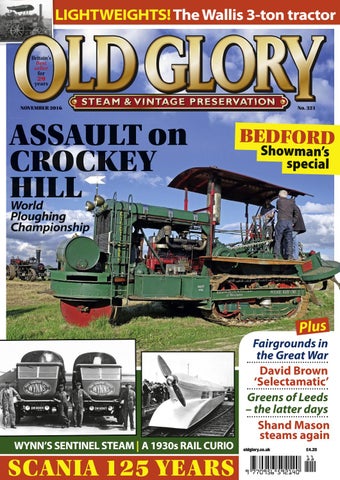
Front Cover: A rare Fowler Motor Gyrotiller taking part in the World Ploughing Championships special display near York in early September 2016. JAMES HAMILTON This issue was published on Thursday October 20, 2016. The December 2016 issue of Old Glory (No 322) will be on sale from Thursday, November 17.
32
60
Meet the team Derek Rayner
Colin Tyson Editor
Technical Advisor
Mike Dyson
Steve Dean Correspondent
Correspondent
James Hamilton
Ricky Nichols Advertising Executive
Malcolm Ranieri Correspondent
Correspondent
Contact us – details on Page 40
OLD GLORY NOVEMBER 2016 | 5
News&Events Fowler No 15564 and ploughing contractors’train.
Robey tandem roller No 41953 which was at its first rally after considerable boiler and firebox work following an absence of several years. ALL: DAVID WARREN
Robey tandem surprise at Cumbria Gathering CUMBRIA Steam & Vintage Society held its annual Gathering at the eminently suitable former Cark Airfield site at Flookburgh, west of Grange-over-Sands, reports David Warren. A total of 22 full-size engines were on show, a surprise being the appearance of Robey tandem roller No 41953, which was at its first rally after considerable boiler and firebox work following an absence of several years – a few finishing touches to its restoration have yet to be undertaken.
The largest engines present were a very impressive pair of Fowler AA7 ploughing engines belonging to Alex Sharphouse. Although they have been together all their lives, No 15563 worked until 1963 whereas sister engine No 15564 was laid up in 1949 and was only restored to working order last year. They were presented in fine style, along with a complete ploughing contractors’ train, each having a living van – one of which had a newly built body made to original Fowlers plans for which
Alex holds the company rights. Also with these was a cultivator, balance plough and splendidly restored water cart. Steam wagons were particularly well represented with six examples. The only Foden was WD-liveried No 7768 along with locally based unique Fowler No 19708 which was rebuilt by the late Tom Varley and is still with the family. There were also four Sentinels, Winterbottom’s S4 No 9086, the Tarmac-liveried pair S6 No 8821 and DG8 No 8016 plus
Guy Rutter’s lightweight Super No 1465 built in 1916, but later rebuilt by Sentinel in 1940 and used by the company as works transport during the war. This was one of several engines over from the North East including the Robey tandem roller. Other rollers included Brian Wainwright’s S-Type Marshall Jane which was at the event for the first time having travelled under its own steam and Aveling-Barford W Type No AD073 which is based nearby at the Lakeside & Haverthwaite Railway with the Maher family. A fine array of miniature engines of varying scales were also in attendance, and as usual an impressive display of over 100 commercial vehicles of all types. The vintage funfair is another of the regular attractions at the Gathering. This included Jack Schofield’s steam Gallopers and Dorman’s Electric Yachts. It was good to see excellent attendance levels on both days thanks to favourable weather conditions.
Miniature line-up at Cumbria; 3in Burrell single, 4in McLaren and 4.5in Foden C Type.
1956 ERF KV and 1957 AEC Mammoth Major.
The
WALLIS & STEEVENS 3-ton STEAM TRACTORS O S
The relaxation of weight restrictions under the terms of the 1903 Motor Act and subsequent 1904 regulations allowed UK manufacturers to develop heavier road-going steam engines. However for Wallis & Steevens it rendered one of its models virtually obsolete overnight, writes Alan Barnes
A
ny further development of Wallis & Steevens’ roadgoing 3-ton steam tractor was abandoned following the increase by a ton in the permitted weight. However it was arguably the 3-ton tractor which had laid the foundation for the subsequent success of the larger Wallis tractors and the development of the use of the oil bath in their design. It is believed that the initial impetus for the Basingstoke company’s development of the light steam tractor came from a visit by Frank and Alfred Wallis to the 1896 Motor Car Show at Crystal Palace, London. Although there were only six machines on display (three motor vehicles and three steam powered) Frank Wallis concluded in his report on the event that “these Motor Cars are not sufficiently developed to prove immediately a commercial success”. He also observed: “We have much confidence that if the present Bill before the House of Commons becomes Law that light Traction Engines and Trucks will be much used in future and that considerable attention should be given to this part of our manufactures.” The Locomotives on the Highway Act 1896 came into operation on November 14 of that year and went some way in removing the strict rules and regulations on speed limits and weight restrictions. The Act defined a new category of vehicle, the ‘light locomotive’, which were vehicles under three tons unladen weight which were exempt from the three-man crew restriction and which would be allowed to travel at a maximum speed of 14mph, although local authorities still had the power to reduce that limit to 12mph if they felt that was appropriate in their area. While the 3-ton unladen weight restriction was still severe the directors at Wallis & Steevens saw this as an opportunity to develop a new light steam tractor, especially as few of their competitors were showing any inclination to develop such machines of their own. This must be regarded as a bold move by the company as at this time long distance commercial haulage was firmly the province of the railway and canal companies while it fell to the horse teams to move goods by road. There
PART
1
No 2410 of 1898 was mostly used by Wallis & Steevens as a yard engine. JAMES WATERFIELD COLLECTION
would certainly be rapid development of the internal combustion engine but in the late 1890s and early 1900s road steam haulage was seen by some as still the way forward. It seems likely that design work had already started before the Act had come into force, for as early as 1897 the first 3nhp single-cylinder road engine had been completed. This was No 2380 which was delivered to Walter Arnold & Sons of Paddock Wood, Kent on August 28, 1897 although the engine was later sold to Smith & Co, brewers of Lamberhurst. The 3nhp road engine used a three-shaft layout – a design which had already been used in the company’s earlier 5nhp traction engines. The new engine had a working pressure of 120psi and the cylinder had a 6in bore with a 10in stroke. This first 3-ton engine had been recorded in the document and build lists as a ‘road engine’ but the next engine to be built in 1898, No 2410, was the first to be referred to as a ‘tractor’. This engine did not apparently enjoy a life on the open road as it was used mainly around the Wallis & Steevens yard as a shunter, although it did make occasional trips to the nearby station. The engine was used here for many years before eventually being bought by a showman and its ultimate fate is unknown. It would appear that these two engines did not perform particularly well and
the enthusiasm for the new light tractor seems to have become rather subdued. However demand for the company’s other types of engine was very healthy and the market for agricultural machinery was now experiencing something of an upturn after years of depression. It was not until the summer of 1899 that work on the next tractor began and this incorporated some design changes. The engine, No 2516, was unsprung, had smaller cylinders and no expansion gear and was subject to a period of experimental running before going to export agents John Birch & Co in 1900. This particular engine came back to the Basingstoke Works in 1907 where it was converted to a road roller and is thought to have been sent for export. ❱
Probably built in 1898, No 2451 was exported to Switzerland in February 1899. OLD GLORY NOVEMBER 2016 | 43
WORLD PLOUGHING CHAMPIONSHIPS Malcolm Ranieri reports from the Steam Plough Club 50th Anniversary special exhibition and demonstrations at the World Ploughing Championships at Crockey Hill, York, held from September 8-11 The Steam Plough Club’s golden jubilee line-up of ploughing engines on Saturday evening at Crockey Hill. DAVID WARREN
T
he Steam Plough Club (SPC) was founded in 1966 by the late Harold Bonnett, steam enthusiast and author, and the SPC committee decided that this milestone, the golden jubilee of the club, should be celebrated in appropriate style to the aims of the club. From this grew the celebration of steam cultivation, held over four days in early September at Crockey Hill, near York, invited to do so by the Society of Ploughmen as part of its annual World Ploughing Championships.
The site at Crockey Hill is a huge, flat area, containing not only the grounds for the World Ploughing Championships with classes for modern, classic and vintage ploughing including horse power, but also 65 acres allotted to the SPC’s celebration of steam cultivation, these being divided into suitable plots for working steam. While steam ploughing is demonstrated at selected rallies throughout the year, and also at the Great Dorset Steam Fair where land is available, usually under the auspices of the SPC, nothing on the scale of Crockey Hill had been attempted before.
1903 Fowler A4 Direct Plough Engine, 1917 Fowler BB Wilbur and 1876 Howard ploughing engine The Farmers Engine. MALCOLM RANIERI 52 | NOVEMBER 2016 OLD GLORY
This form of cultivation goes back to the third decade of the 19th century, but not until John Fowler developed a plough which could be drawn across a field in the 1850s-1860s by steam engine did this form of agriculture take off. In the first few years the ‘roundabout system’ was deployed, whereby a windlass was situated at a field end and cable drawn by a steam engine. A portable engine could be used, but this was gradually replaced by the steam ploughing engine, and then one steam engine at each end of the field (the ‘double engine cable’ system), drawing the plough by steel cable, which became accepted practice. Fowlers of Leeds were the dominant force in steam cultivation; harrowing, tree stump pulling, dredging and digging – and to this day there are around 180 preserved ploughing engines in the UK, with a handful from other companies such as two McLarens, two Burrells, a Howard and two Aveling & Porters. The roundabout system was demonstrated at the event, as was the cultivation equipment used – and ploughs of all types, harrows, dredging implements etc., were on display and in use at the event. The system of direct ploughing, whereby one steam engine, usually in traction engine form, pulled the cultivator implement behind the engine, was not popular in Britain, due to the sizes of fields and ground conditions, but abroad in more temperate weather conditions and larger fields, such as Australia and in the US, this form of cultivation was used extensively. Direct cultivation was also demonstrated at the event.
The classic Blackpool tram scene with Blackpool & Fleetwood Electric Tramroad box car No 40 just passing the junction which accesses the depot, on its way to Pleasure Beach. ALL: BARRIE WOODS
ILLUMINATING! A bright future for Blackpool’s heritage fleet
This year more vintage trams have operated than ever since the 2012 modernisation programme and on more days throughout the summer and the current illuminations display. Barrie Woods goes depot-bound where the future is even more promising
T
he writing seemed to be on the wall for the town’s heritage fleet of trams when the system was modernised in 2012 and the swish five-car Flexity2 trams took to the tracks. But the heritage fleet is not just getting a look-in but is actively being reconstructed, overhauled, maintained and run – to the delight of visitors and enthusiasts.
66 | NOVEMBER 2016 OLD GLORY
The recent spectacular event over the weekend of September 24-25 was no exception. Around 20 trams were out on the promenade over the weekend, including the ‘Persil’ white modernised Balloon No 718. This tram is now bereft of its previous all-over Vodka advertisement, but not yet repainted into traditional livery. In addition Balloons Nos 700, 701, 710, 711, 715, 717, 719 and 723 were all seen out, the latter serving as a sales/
souvenir outlet at North Pier. In the depot several more were stabled in readiness for action or just stored hopefully awaiting their return to service. The changeable weather was acceptable enough to tempt visitors into open boats Nos 227, 230 and 600 and they all carried good loads, although the latter briefly came to grief by derailing on Sunday on the pointwork at Pleasure Beach. Twin cars Nos 272+T2 were about on Saturday but suffered a slight problem, but with so many available trams now in Rigby Road depot, another twin-set, Nos 685+675, was immediately pressed into service and worked well all weekend. Centenary car No 648 was out and looking splendid, as was ex-towing modified rail coach No 680, on loan from Heaton Park, Manchester.
COMMERCIAL VEHICLES
SCANIA
125 ANNIVERSARY th
The amalgamation of two rival Swedish engineering companies in the early 1900s resulted in the formation of what is today one of the leading truck manufacturers in the world
WORDS: ALAN BARNES PHOTOS: SCANIA MEDIA LIBRARY
1897 replica Vabis carriage and Scania T144.
T
his year Scania AB celebrates its 125th anniversary and with the release of its new range of trucks due later in the year the company seems certain to build on an already impressive heritage. Neither of the two companies, which would eventually come together, started life as truck manufacturers; indeed when one of the firms, Vabis, was formed in 1891 the motor vehicle was very much in its infancy. Vabis had been established as a privately owned company to produce railway wagons and had opened a works at Sodertalje. Also in 1891 a British firm, Humber Cycles, with a view to expanding into the wider European market, had opened a bicycle production factory in Malmo in southern Sweden. Humber Cycles sold the rights to produce its machines in 1900 to Swedish firm Scania, which continued to operate the Malmo plant. In the early 1900s both Vabis and Scania began developing motor vehicles, Scania starting with a motorised version of the bicycle and then moving on to develop four-seater passenger-carrying vehicles. The two companies also explored the potential
70 | NOVEMBER 2016 OLD GLORY
of developing goods-carrying vehicles and by 1902 Scania had already produced a 10hp chain-driven lorry although the model was never put into production. Vabis had produced its first passenger vehicle in 1898 and it too developed a goods vehicle, with a 9hp shaftdriven lorry also being completed in 1902. Over the next few years the two companies developed their next heavi vier i and more powerful commercial vehicles as rivals and met with varyi ying i degrees of success – with Vabis presenting its motor lorry at the first truck rally to be held in Sweden in 1909. This was organised by the Royal Swedish Automobile Club and was designed to give the motor manufacturers the opportunity tyy to showcase their products. Surprisingly Scania did not take part although the company stole some of its rival’s thunder when it announced that one of its 24hp 3½ ton Model IL trucks would undertake a road run from the company’s factory at Malmo to Stockh kholm, h a distance of 692km km. m Although the run was completed successfully and certainly raised the profile of the Scania name it seems that the company saw greater potential in developing its range of passenger motor cars rather than goods vehicles. Vabis
continued to develop both lines but the privately owned company was facing financial difficulties and by 1909 closure of the business was seriously being considered. Selling parts of the business was also an option but Scania recognised an opportunity for expansion and made an offer to take over the business in November 1910 with the merger agreement being finalised the following year. The enlarged company was to be known kn n as Scania-Vabis and the two manufacturing plants at Sodertalje and Malmo would remain in operation. The Scania factory in Malmo would concentrate on the manufacture of motor trucks while the old Vabis factory would be used for engine development work and the production of light vehicles. However the consolidation of the two old rivals under one banner did little to improve overall profitability although more than a third of the total output was being exported. In 1913 a new subsidiary was established in Denmark and the factory in Copenhagen produced its first Scania-Vabis truck in 1914. However the venture was not a success and by 1921 the operation had been closed down, having built a total of 175 trucks and 75 motor cars.
MOTOR ROLLERS
GREEN’S OF LEEDS Motor roller construction – the latter days
The products of Thomas Green & Son of Leeds are well known, not just in roller manufacturing circles but also in the grass-cutting machinery business. Derek Rayner provides an 1970s insight into the latter days of a successful company and its subsequent indecent demise The Motor Industry Research Association’s premises at Nuneaton in 1974 was the location for a combined demonstration, in conjunction with Tarmac Roadstone, of a Blaw Knox paver and a Green’s Pacemaker roller with an ‘attachment’ in the form of a Duomat roller working on a banked section of MIRA’s high-speed
T
homas Green’s many and varied products ranged from washing machines, steam trams, vertical boilers and engines, hand rollers, steam and motor rollers, pub tables, agricultural rollers, steam-powered lighting engines, lawnmowers and railway locomotives. The firm’s story has been told in detail by Leeds author John Pease in his 2014 book, The History of Thomas Green & Son Ltd (ISBN 13:
978 1899889 81 5) published by Lightmoor Press. In this publication, John takes the reader back to the very early days of the company and describes the construction of a multitude of equipment of all types that came out of the Smithfield Iron Works on North Street in Leeds. Rollers, along with lawnmowers, were made right through to the latter days of the company’s existence when motor roller production was an extremely large and successful business.
The 1974 Public Works Exhibition took place at Olympia, London, from November 18-23. The Greens stand featured rollers such as the Pacemaker; Viped; TVRX (small tandem vibratory); Unirol and a selection of the double-drum Duomats. This display does not give the impression of a firm in decline. However, at that time, the employees could have had no knowledge of their demise within the next 12 months. 74 | NOVEMBER 2016 OLD GLORY
Thomas Green & Son had been owned by Blackburn & General Aircraft Ltd since 1951 and after some both good and mediocre years for the Leeds firm, the Blackburn & General company was bought out by Hawker Siddeley, the well-known aircraft manufacturers. Following this, some rationalisation took place and later, Green’s purchased land on Bridge Street, closer to Regent Street, after the demolition of the previous building on that site. The Bridge Street works was then constructed specifically for roller production at the time when Robert Blackburn was in charge of the company. These premises were later developed in the early 1970s for the introduction of the last design of roller – the Pacemaker – with the installation of more modern machine tools and equipment. Greens became an extremely successful company during the 1960s, such that on May 28, 1970, it was the recipient of a Queen’s Award to Industry during a visit by Brigadier Hargreaves, Her Majesty’s Lieutenant for the West Riding and the City of York, together with Arthur Brown, the Lord Mayor of Leeds. As well as Green’s representatives being presented to Brigadier Hargreaves, also included were the directors of Hudswell Badger, the latter firm being the vestiges of locomotive builders Hudswell-Clarke of Jack Lane, Hunslet.
Vintageworld
These Leeds-built Hathorn Davey steam pumps date from the latter years of the 19th century.
Rare Hathorn Davey engines in Queensland
The pumping station’s chimney is a notable landmark in the Charters Towers area. However, getting to it was a different matter, as Andy discovered! BOTH: ANDY PLUNKETT 84 | NOVEMBER 2016 OLD GLORY
WHILE Andy Plunkett was in Queensland visiting Charters Towers, it was with some difficulty that he tracked down the site of the town’s former steam-powered water pumping station, located in the scrubland beside the Burdekin River. This pumping station’s initial construction period was between 1887 and 1891. The engines are Hathorn Davey & Co inverted-compound nonrotative machines, built in Leeds and coupled to a two-stage pumping system which had a capacity of 20,000 gallons per hour. The second engine was installed in 1896 to cope with growing demand. Steam was initially obtained from coal-fired Lancashire boilers with timberburning furnaces added later. In 1915-16, second-hand Cornish boilers from a gold mine replaced the Lancashire types. It is believed that these Hathorn Davey inverted cross-compound non-rotative pumping engines are the only survivors of their type from this Yorkshire manufacturer. Both pumps were in service until 1942
when electric pumps were installed in an adjacent new shed. Charters Towers underwent a growth spurt as a result of Japan entering the war. A number of military bases for both Australian and US forces were constructed on the outskirts of the town, thus creating an increased demand for water. Steam pump No 2 continued to be used occasionally until 1954. During the 1960s, the boilers were removed and scrapped. The electric pumps ceased operating in 1975 when a new pump house was established upstream at the weir. Today these unique steam pumps are quite deservedly State Heritage listed. Andy’s visit revealed that the engines and their foundations are relatively intact. The fibrous-cement clad building housing the electric pumps and the steam pumps are contained within a security fence. Other remains extant are the brick chimney, remnants of the timbercarrying tramway and foundations of the ‘Flying Fox’ (aerial cableway) which transported timber to the boilers.
STEAM AM M ARCHIVE AR R VE E
The famous
THURSTONS
I
Miike Mik k Dyson looks at some engi gin ines n from frr the th h fleet of the th h Thur urston r fam ami miilly, l who domi min inated n th the h showlan and n scene in n the th h east of Engl glan land n
n the days of steam there were some very famous showmen’s families who were able to adapt and innovate with their equipment in the latest technologies of the day to take the travelling fair to new heights. Amusements ranged from the
Thurston family tree.
introduction of steam roundabouts to the earliest cinemas and electric lighting to thrills based on the latest fashion for speed and excitement, such as the Moonrocket. Transport moved from horses and railways to road locos, eventu tual ualllly l givi vin ing n way to diesel dii lorries in n the 1930s.
At the forefront of all these developments were a group of showland families each based in a different part of the country. The Midlands were dominated by the Collins family, the west of England by Anderton & Rowland and eastern England by the Thurstons.
Foster No 12415 Dreadnought photographed at Cambridge midsummer fair sometime in the 1930s.The big 8nhp engine could easily handle a 30-ton load.
Unlike other Thurston engines Foster No 14153 Admiral Beatty does not have yellow wheels. In the background is one of Thurston’s Garrett tractors which could be either No 27185 or No 33403. 90 | NOVEMBER 2016 OLD GLORY
WORDS/PHOTOS: PAUL RITCHIE
TOPSY A half size Garrett 4CD
A engine often seen out and about on the roads of An Poole in Dorset is an impressive 6in 4CD Garrett tractor, P owned and run by Ivor Vaile and his family o
T Miniature man: Ivor Vaile. 96 | NOVEMBER 2016 OLD GLORY
his impressive engine makes for a very pleasant sight as it frequently steams along the streets when not on local rally fields. The steam tractor was built over tw wo years by Bob Whitehead of Syresham, Northamptonshire, and was completed in late N 2005, when Ivor purchased it. The boiler, with a capacity of 50 litres, was manufactured by Bells of Gloucester in 2004 m an nd is number BB90. Its working pressure is 200psi, and is hydraulic tested to 400psi. With a weight of 1100kgs, this 4nhp
compound engine is a powerful machine which makes easy work of the local gradients, running comfortably with a load of passengers at 6-7mph. Ivor named the engine Topsy, his pet name for his wife Jeanette, to whom he has been married for more than 50 years. It is often a clever move by engine owners to name their engines after their ‘better halves’ to ensure they give their blessing to the hobby! Ivor’s interest in steam began as a boy in the 1950s, as it did for so many during that era, with him building a static steam engine at the age of 16. Ivor’s career saw him employed at