WIN!
TICKETS TO LONDON MODEL ENGINEERING SHOW
Britain’s Best seller for
29
years
No. 323
JANUARY 2017
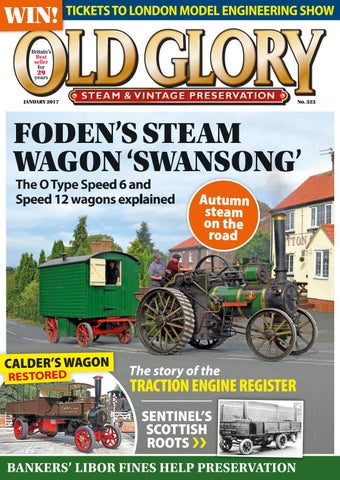
FODE EN’S ST TEAM AM M WAGO ON ‘SW WANSO AN N ONG’ The O Type Speed 6 and Speed 12 wa agons explaine ed
CALDER’S WAGON RESTORED
Autumn steam on the road
The story of the
TRACTION ENGINE REGISTER SENTINEL’S SCOTTISH ROOTS ❯❯
BANKERS’ LIBOR FINES HELP PRESERVATION
Contents No 323 | January 2017 NEWS 6-25 News & Events 97 OG in Mini News
FEATURES 28 Foden’s steam wagon ‘swansong’ Mike Dreelan’s Foden Speed Six and Foden Speed Twelve are both unique examples of the O Type wagon which was arguably the pinnacle of Foden’s steam wagon design.
42 Autumn road runs
A round-up of seasonal road runs to fill that time between rallies and drain-down time.
48 A Foden wagon reborn
Ian and Stuart Calder have completed the restoration of their Foden 3-ton wagon No 3398 of 1912.
60 88
53 Workshop Christmas goodies Peter Love takes a look at a whole host of Christmas workshop goodies that he has come across in his travels recently.
58 50 years of the Traction Engine Register
Editor Brian Johnson explains the history of the still-popular register and how it relies on your help for updates.
60 The early Sentinels
The founding history in Scotland behind what became the successful Sentinel steam waggon from Shrewsbury.
66 Pumping it large
The Crossness Engines Trust continues to make great strides in its project to restore a second beam engine and improve its visitor offer and presentation.
70 Great Saling 1955 – Part 2
The pioneering days of the 1950s with a look at the first traction engine rally to be held in East Anglia.
75 City of Adelaide
A restoration progress report from the Port of Adelaide.
REGULARS 38 40 82 87 88 92 102 114
Enginelines Helpline 2017 Rally Claiming Dates Bookshelf Vintageworld Steam Archive What’s On ‘Tail Lamp Tom’
READER SERVICES
36 Save money with a subscription to Old Glory 107 Advintage – The biggest Steam & Vintage Marketplace
78 The Austin Model R tractor
The Austin Motor Company’s involvement with tractor production was relatively short-lived but they could not compete with Fordson on price.
98 Four-inch scale Burrell
Derek Finch chose a Steam Traction World Burrell and then, at his request, had all the normal monthly kits of parts delivered within just three months.
4 | JANUARY 2017 OLD GLORY
NEVER MISS AN ISSUE...
SAVE
20%
off the cover price
ON PAGE 36
58
Having finding trouble a this mag copy of azine?
48
Why not Ju newsagen st Ask your local t to a copy ea reserve you ch month ?
Front cover: Marshall Mary Margaret passes the Sutton Arms at Faceby with matching Marshall living van on the Great Yorkshire Traction Engine Club’s road run on September 24, 2016. DAVID WARREN
28
This issue was published on Thursday, December 15, 2016. The February 2017 issue of Old Glory (No 324) will be on sale from Thursday, January 19.
66 Meet the team Derek Rayner
Colin Tyson
78
Editor
Technical Advisor
Mike Dyson
Steve Dean Correspondent
Correspondent
James Hamilton
Ricky Nichols Advertising Executive
Malcolm Ranieri Correspondent
Correspondent
Contact us – details on Page 40
OLD GLORY JANUARY 2017 | 5
Got a story? Tell Old Glory ryy 01507 529306 | cty tyson@mortons.co.uk y
Champion set for Boxi xing i Day run
Some of the tractors that took part in the 2015 Boxing Day Larling run.
CONGRATULATIONS to vintage preservationist and Fordson Dexta man Shaun Garrod on winning the coveted British High Cut Ploughing Championship on September 9 at Crockey Hill, York. Shaun was the winner with 247 points and comes from Great Ellington, Norfolk. He was the winner on the Thursday and finished third on the Friday to give him the overall title, writes Peter Love. Shaun used his 1962 Fordson Dexta that was originally from Suffolk and has not done much work. “I bought it from a Cheffins sale and liked it because it was a nice original tractor,” he said. Shaun has been ploughing for about 18 years and started with a Ransomes Motrac and Fordson Standard N. However to be competitive the Ransomes RSLD is the preferred plough for competitions. He purchased one and built himself a Perkins P6 Standard Fordson N and started ploughing competitively in its immaculate dark blue livery with red wheels. At this time he was working on a farm and was head tractor driver, with jobs that included ploughing, ridging land for vegetables and being harvester driver with a very keen eye for straightness. He changed tack in more ways than one and is now a talented commercial fitter for Baileys and went High Cut ploughing with boats and skimmers behind. He has now been in six British National finals. Shaun said: “I used to watch a close friend of mine, Peter Copeman, another dark blue Standard N Perkins P6 user, while ploughing High Cut and very much liked the style of it.
“At Christmas 2009 I got a surprise; my wife had purchased the plough from Peter Copeman as he had retired from ploughing and all the training began under his careful guidance. I first entered the British National in Grange-de-Lings, Lincoln, and the bug has got me.” Shaun not only ploughs, but is a keen preservationist from steam to restoring tractors like his excellent Flambeau-style Case DEX. This came out at the 2015 Larling Angel and led the 150 tractors around this excellent Boxing Day event. It’s restored to a very high standard as is his Foden 6in steam wagon, which we caught up with at Euston in June 2016, where it was admired by many. As always Shaun is supported by his long suffering wife Melissa and family who do
Some people go to great efforts at the Boxing Day run.
so much for charity at Christmas. After the previous organisers needed to retire owing to ill health and no one stepped forward to take over the Larling Angel Boxing Day event the family stepped in. They have continued this high-profile event and more tractors continue to join in each year. The event comes recommended and if you want a Boxing Day out, it starts at the Angel Inn, Larling, Norwich NR16 2QU at 10am. Entry forms are available on the Larling Angel website, but bookings can also be taken on the day. For further information, tel. 07787 243015 or 07979 066073. As always the event is for local charities and annually raises thousands of pounds.
Top-class fitter Shaun Garrod (left) with his 2016 trophy after being crowned at the British High Cut Ploughing Championship. OLD GLORY JANUARY 2017 | 17
NTET: Rolling ever onwards…
NTET executives David and Julie Smith’s Burrell traction engine No 3121 of 1909 Keeling at Pitchill, Salford Priors, on the SE Davies road run on October 29, 2016. MALCOLM RANIERI
T
he 2016 steaming season has been and gone and for many owners and crew this time of year is very busy attending to those niggles that have irritated throughout the year. The aim is to put any issues to rest before the weather becomes too horrid to face an engine shed or open corner of a yard somewhere. Here at the National Traction Engine Trust, although our own physical activity with engines and events also quietens down, the workload doesn’t. By the time you read this, both our Annual General Meeting and Affiliated Clubs Day will have passed, with no doubt a tale or two by association, and we’ll be heading towards another General Council meeting, the engine owners, drivers and crew get-together, the rally organisers’ conference and so on and so forth. It’s almost non-stop, but it’s all vital work and despite the fact that as an organisation we still face criticism at times it all goes to build a bigger picture and does keep the majority on the same page – even if not everyone agrees with all of the content all of the time. As an organisation we continue to look forward; we are often reminded that it’s not just the short-term work that needs addressing, but more often than not the longer term, bigger picture that will serve others long after the current crop of trustees have moved on. With this in mind the expression ‘succession planning’ often rears its head. We have said it before but as we look back we have missed several vital tricks on this particular topic and let good people slip from the team, which as an organisation we can ill afford to do. We need to stop talking about it and start putting in place systems and officers (for want of a better description) who will underpin the work of the General and Executive Councils and help secure the trust’s relevance and value for generations to come. To start with, the trust has recently created two voluntary, expenses-paid positions that we would dearly like to fill in the very near future.
The first is that of archive officer. As you’d expect of an organisation of this vintage, we have a large archive now which is dotted at various locations all over the UK. The idea is to get it housed in one location and make it more widely available to the membership, be that online or in a more physical sense. Geographical location is unimportant as a starting point, as we would like to start from scratch and make it work for the individual, or individuals, who take it on. The role can be developed to suit, and if you’re not interested in the day-to-day running or activities of the trust it isn’t an essential part of it – in short, although you’ll be under the PR and marketing side of things, you’ll be left to your own devices but offered as much support as you require. Also under the same section, we are looking for an education officer. This is a position that could really mean anything, but in essence we want it to be a grounding position that we work from. We want to work with other external groups and bodies as well as our own internal departments to promote historical facts about our world, to create new initiatives to further promote not only the activities of this organisation but others as well and tie it all in together on to that ‘same page’. Again it’s one that is to be developed to suit the applicant as much as anything else, so if you are interested at all in either role, or you feel we are missing something and have a suggestion you’d like us to look at, drop us an email at public.relations@ ntet.co.uk or on 07807 616320 and we can roll a few ideas about and see what happens. With 2017 now upon us, we are looking forward to what will essentially be another busy year. We’d like to thank everyone who has shown us support in 2016 and look forward to seeing you out and about in the months ahead. We wish you all a very happy and enjoyable new year. Matt Shipton – NTET head of PR, marketing and commercial National Traction Engine Trust
Two ex-Leicestershire County Council rollers, Marshall No 78572 and Aveling No 5163, along with P Van-Houten’s Foden, welcome NTET AGM delegates to the Hilton Hotel, Leicester, on November 19, 2016. COLIN HARRIS OLD GLORY JANUARY 2017 | 35
Chris Griffiths’ run
1910 Clayton & Shuttleworth The Gaffer heads the run at Tring.
Chris Griffiths’ yard at Gubblecote near Tring is the starting point for the annual run around the Hertfordshire countryside, held on October 22, reports Malcolm Ranieri. Three steamers were in the yard from Chris Griffiths’ fleet – Clayton & Shuttleworth traction engine No 4320 of 1910
The Gaffer, with Chris at the helm; the 1914 Fowler DD 8nhp ploughing engine No 13910 My Delight, recently purchased from the Keeley sale and the only one remaining of its class, driven by Ben Griffiths and 1913 Aveling & Porter 10-ton roller No 8064 Nulli Secundus, crewed by Kevin and Lynn McGill. 1954 Foden crane truck in superb original condition. ALL: MALCOLM RANIERI
1933 Foden tractor Duchess of Gloucester at the pub stop.
44 | JANUARY 2017 OLD GLORY
Also on the run was Chris’s 1954 Foden OG crane truck, in superb original condition, a Ferguson tractor and Joe Stone’s 1960 AEC Marquise fire engine. The engines proceeded through Hertfordshire countryside, crossing the Grand Union Canal, through Marsworth to the lunch stop at the Half Moon at Wilstone. Here the group were joined by the Walker family’s 1927 Burrell 4nhp Gold Medal tractor No 4072 The Cranleigh Belle and 1933 Foden D type tractor No 14084 Duchess of Gloucester – the youngest preserved Foden steamer.
OLD GLORY JANUARY 2017 | 57
STEAM TRACTION
The Sentinel family tree has its roots in the Simpson and Bibby partnership – pictured above is a Simpson Bibby wagon at Horsehay Works in 1902.
The days of EARLY SENTINELS Alan Barnes relates the founding history behind what became the successful Sentinel steam waggon
The 1898 Simpson‘lurry’. 60 | JANUARY 2017 OLD GLORY
I
n July 1915 the first Sentinel steam waggon to be built at the Shrewsbury factory steamed through the gates to undergo its road tests. From the available information it would seem likely that the waggon in question was a 6-tonner built as No 1102 and which carried the Shropshire registration AW 2409. However the story of the development of the Sentinel steam waggons began not in Shrewsbury but in Scotland where, in 1874, engineers Stephen Alley and John MacLellan formed a new partnership. They founded the Sentinel Engineering Works at London Road in Bridgeton where production of a range of specialist valves and other industrial equipment began. The business grew quickly and by 1880 had really outgrown the London Road works and there was a pressing need for new and larger premises. A suitable site was acquired at Polmadie, south of Glasgow. The land was not only big enough for the building of a new factory but there would also be additional space for future expansion. An added bonus was that the site of the proposed new works was alongside the Caledonian Railway, thus providing excellent transport links to the rest of the country. It would still be some 25 years before the firm would produce the first of its steam waggons but during that time Alley and MacLellan established an excellent reputation for the standard of their engineering and the quality of their products which ranged from simple pressure valves to prefabricated ships.
ON THE WATER
CITY OF ADELAIDE looks to the future fu u
Adelaide towers over the quayside at Port Adelaide. ALL: HUGH DOUGHERTY
Having followed the story of the unloved clipper City of Adelaide from dereliction in Scotland and its journey ‘home’ to Australia, Hugh Dougherty recently caught up with an old friend to view progress
P
eter Christopher, clipper ship City of Adelaide director, is looking forward to marking the third anniversary of the world’s oldest composite clipper arriving at Port Adelaide in 2017. And he’s celebrating the fact that, over the last two years in which the historic ship has been open to the public, following its rescue from certain oblivion on the slipway at the Scottish Maritime Museum, more than 7500 paying visitors have taken the tour of a vessel that is still very much a work in progress. “We’ve done remarkably well since bringing the ship from Scotland in 2014, and 2017
Work under way on the stern crest.
will be a memorable year for us, especially as the South Australia Government is due to announce the site of Port Adelaide’s seaport village where she’ll be permanently based as the centrepiece that celebrates the ship, immigration and our colonial history and heritage,” he said. Meanwhile, the ship remains open to the public, daily, on a barge at the port’s dockside as a very visible symbol of the past and I signed up for a tour of the ship in the capable hands of volunteer Lionel Elmore, one of some 250 volunteers who run the tours, restore the ship and keep the project ticking over behind the scenes.
The main deck area is being restored. Replica cabins will be built at the top right of the picture.
Lionel, a retired touring coach driver and long-term member of the drive to bring the ship home, has really taken City of Adelaide to his heart, and, as we climbed up the staging to enter the mid-deck section, he revealed that much research has been carried out on the clipper since she berthed at the port. “Basically,” he said, “we’ve discovered that the ship was the Cunard liner of its day, with a very expensive £69 single fare from London to South Australia in 1864. That got you a berth in a cabin and we’ve been able to discover the site of the cabins, which had lavatories and ceiling lighting from the upper deck, and we’re now well on the way to building replicas. We’ve been quite astounded at their relative level of comfort which we’ll be able to display to visitors.” Lionel also showed me where the ship’s desalination plant had been, again a very advanced piece of engineering for its time, while research has shown that the lavatories fed down into a containment tank which was emptied at night into the sea, again underlining the advanced technology in use on the ship and also its place in serving the luxury end of the market. ❱ OLD GLORY JANUARY 2017 | 75
Vintageworld This impressive line-up of engines greets visitors on entering the museum. At the front are two Foden traction engines – single No 2108 of 1910 and 1909 compound No 1828 – with the horse of the Aveling KT type traction engine just visible and with two Marshalls beyond.
Venerable Aveling & Porter 6nhp traction engine No 2524 is now undercover after a long period around the back of the shed standing out in the open.
A mecca for engine enthusiasts in Tasmania AN EXCELLENT traction engine collection which attracts visitors from Australia and elsewhere around the world is Pearns Steam World in Westbury, close to the Bass Highway, about two-thirds of the way between Devonport and Launceston in Tasmania.
Fowler K7 ploughing engine No 14047 of 1914 came out to Tasmania in 1951. It was acquired by Pearns in 1969.
The Pearns Collection was visited by Terry Jepson while he was holidaying in Tasmania and he was amazed at what he found on display there. Housed in one of two ‘Nissan hut’ type buildings are more than a dozen traction engines and rollers while the other building contains a large collection of tractors. Of interest to British enthusiasts are two Foden traction engines, Nos 1828 of 1909 and 2108 of 1910; Aveling & Porter KT type piston valve compound traction engine, No 11733 of 1926, the last survivor of three or four similar machines purchased by the Government Public Works Dept; Marshall ‘S type’ roller No 83221 of 1926; Marshall traction 60137 of 1912 plus 1926 Marshall portable No 81563 and a couple of Fowler ploughing engines. The latter were among several taken out to Tasmania by Lunnick’s, previously of Reading, in 1951 for use on the Trevallyn Power Station scheme – Fowler K7 No 14047 of 1914 and
Some of the many tractors which can be seen in Shed 2. A Farmall F-12 and a 1922 Wallis are to the fore. ALL: TERRY JEPSON
88 | JANUARY 2017 OLD GLORY
1912 Marshall 8nhp traction No 60137 is exhibited in‘as-found’condition. Consecutively numbered 60136 returned to Britain from Tasmania some time ago.
BB1 No 15141 of 1918 – this latter being, at one time, oil fired! An Aveling engine has only recently been brought into the museum building, having been standing outside for many a long year; this being No 2524 of 1889. As a result of its long exposure to the sometimes harsh atmosphere, since the museum is not too far away from the island’s northern coast, it appears to have unfortunately suffered considerable deterioration over time. Perhaps now it’s inside, some conservation work will take place on the machine. A trio of US-manufactured traction engines complete the steam exhibits; Birdsall No 2538; Frick Eclipse No 7491 and a 1905 Buffalo-Pitts. Other items on display included a large number of stationary engines, Garrett threshing drum No 10646 and some miniature traction engines. Noted in the host of tractors were those by Marshall, Lanz, Case, McCormick Deering, Wallis and an Australian produced Chamberlain. Outside were to be found a couple of large motor rollers, one by Aveling-Barford, the other a Marshall and there was also a miniature railway. A very comprehensive and interesting collection!
STEAM AM M ARCHIVE AR R VE E Fowler No 9904 is shown hauling a barge to a gravel pit. Notice the belt from the flywheel to the dynamo mounted in the canopy and the unusual uptake from the safety valves.
A MIXED COLLECTION
Mike Dyson’s selection of photographs this month comes from a range of different manufacturers including the small company of W Lampitt & Co of Banbury ry, y Oxf xfordshire, f who only built a handful of engines Burrell 10-ton Compound Roller
The first roller completed by Burrells was in 1891, a 10-ton single crank compound. The design was changed in 1895 which is well illustrated with No 2145. The roller left the works in November 1898 and was delivered to J J Martin of Piddington, not far from Northampton, who combined his work as a threshing contractor in the winter months with rolling in the summer. In 1943 many of the engines including Burrell No 2145 were sold to Esmond Kimbell of Boughton, also in Northamptonshire. He had a similar business that was expanded during the war and which later became a very successful construction company. The roller was last used in 1952 and was scrapped soon afterwards. 92 | JANUARY 2017 OLD GLORY
A numb ber off pub bliciity ph hottograph hs were takken off Walllis & Steevens No 2537 wh hen it was fi firstt purch hased d in 1901. They usually show it hauling three pantechnicons.