Buy, sell and browse at
’Normous Newark Autojumble Upcoming dates… Sundays, August 7 and September 25, 2016
In association with
newarkautojumble.co.uk
July 2016 £2.10
ISSUE
373
OLD BIKE MART ’
SUBSCRIPTION ONLY
Available from the first Saturday of every month
NEXT ISSUE: AUGUST 6
e Now Advance Tickets On Sal
September 2-3, 2016 Netley Marsh, Hampshire
529 BUY TICKETS 01507 529 m .co ows esh bik ssic cla
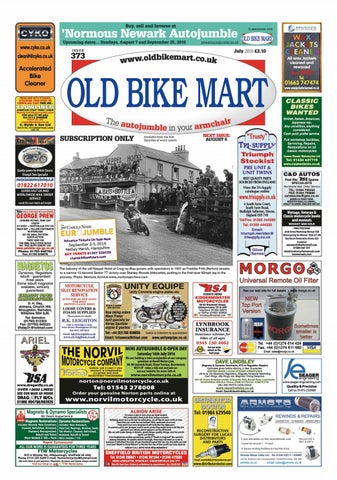
The balcony of the old Keppel Hotel at Creg-ny-Baa groans with spectators in 1937 as Freddie Frith (Norton) streaks to a narrow 15-second Senior TT victory over Stanley Woods (Velocette), putting in the first-ever 90mph lap in the process. Photo: Mortons Archive www.mortonsarchive.com
2 NEWS
July 2016
Pete’s Prattle www.oldbikemart.co.uk email: info@oldbikemart.co.uk
Editor Pete Kelly OBMEditor@mortons.co.uk Designers Charlotte Fairman, Tracey Barton Production editors Sarah Palmer, Sarah Wilkinson Picture Desk Paul Fincham, Jonathan Schofield Advertising Ricky Nichols rnichols@mortons.co.uk Alan Green agreen@mortons.co.uk
01507 524004 Marketing manager Charlotte Park Circulation manager Steve O’Hara Publisher Tim Hartley Publishing director Dan Savage Commercial director Nigel Hole Associate director Malcolm Wheeler General Queries Customer Service Number: 01507 529529 Telephone lines are open: Monday-Friday 8.30am-7pm, Saturday 8.30am-12.30pm and 24hr ansaphone Archive Enquiries Jane Skayman jskayman@mortons.co.uk 01507 529423 Founder Ken Hallworth OLD BIKE MART (ISSN:1756-9494) is published monthly by Mortons Media Group Ltd, PO Box 99, Horncastle, Lincolnshire LN9 6LZ UK. USA subscriptions are $48 per year from Motorsport Publications LLC, 7164 City Rd N #441, Bancroft WI 54921. Periodical Postage is paid at Bancroft, WI and additional entries. Postmaster: Send address changes to OLD BIKE MART, c/o Motorsport Publications LLC, 7164 City Rd N #441, Bancroft WI 54921. 715-572-4595 chris@classicbikebooks.com PUBLISHED BY
PRINTED BY
In recent months we’ve had an astonishing mailbag from readers in response to various memory-jerking subjects raised in Old Bike Mart – and they continue to rumble on in this issue. After the recent spate of correspondence about old bike shops, it occurred to me that many of us will also have fond memories of the cafes we used to visit, too. We’ve all heard of the Ace Cafe, of course, but this month’s Muc-Off winner, Graham Cole, mentions two great stopping-off places of yore in Kent, Johnson’s Café on the A20, where ton-up displays were a regular occurrence, and the lovely-sounding Anne’s Pantry at Biggin Hill. Many readers will also have heard of the Hog’s Back Café in Surrey, not far from the spot where Titch Allen and the other Vintage Motor Cycle Club founder members held their
first meeting in 1946. The club’s 70th anniversary baton relay recently called there after the baton was handed over at Brooklands Museum. Much further north, after hot dogs and milky coffee at the ‘Hogie Wagon’ in the centre of Warrington back in the 1960s, my mates and I would tear along to various transport cafes and espresso coffee bars within a 25-mile area. If you felt your rear suspension go down just before setting off, it meant you probably had a girl on the back, but as it wasn’t ‘cool’ (not a modern expression at all) to look round and see who it was, you left that delight until arriving at the next destination – by which time you’d have formed an opinion of whether she was right for you based purely on her pillionriding expertise! While at Motor Cycling in 1965-66, I often broke my regular ride back
New Taunton autojumble
Pete Dear is organising a revived autojumble at Taunton Rugby Club, Hyde Lane, Taunton, on Sunday August 28, starting at 9am. Pete used to run the autojumble at the cattle market that’s now been redeveloped, and the late decision to run the new event was brought about by the excellent new venue being found.
Last call for Graham Walker Memorial Run Entries close on July 21 for the Sunbeam Motor Cycle Club’s 54th Graham Walker Memorial Run, which will start from the National Motor Museum at Beaulieu, Hampshire, on Sunday August 7. After assembling at the museum from 9.30am, participants in the event, which is open to any and all
motorcycles built before 1940, will set off on the road safety run at 1.15pm. The run is also ideally suited to early veteran machines. Entry forms are available on the sunbeam-mcc.co.uk website or by calling 01293 771446, and entry includes access to the Motor Museum, Abbey and Palace House.
to London on a Sunday afternoon by calling at a cafe on the left-hand side of the A5 somewhere. It looked like an ordinary house or bungalow from the outside, but it was a cafe all right, and a very good one at that. The cheese omelette, chips and beans, milky coffee and apple pie and custard that I invariably ordered set me up for the rest of the journey and the ‘night shift’ in Fleet Street (topped up between 9 and 10pm by crusty cheese rolls from the all-night Mick’s Café just down the street). Many of you will remember the bikers’ cafes you once knew all over Britain, and we can’t wait to hear your stories. In response to my query in last month’s ‘Prattle’ about the Ducati Sebring I was forced to sell, one reader kindly informed me that it was last taxed in 1986, and that at the time CDN 85K was black.
As the machine still wore its original (but not very good) black and silver paint scheme when I acquired it, that seems to make sense, but I still wonder whether it remains somewhere as a complete machine, or was long ago broken up as a source of spare parts. Keep safe,
Roy Peplow is NMM Tiger Cub day guest The Triumph Tiger Cub meeting at the National Motorcycle Museum on Sunday June 26 had an unexpected guest in the shape of 1950s-60s trials hero Roy Peplow. Roy, who even beat Sammy Miller on occasion, and whose victories included the Scottish Six Days Trial, agreed to go along and meet the Cub owners in response to a personal request, and a full report with pictures will appear in next month’s OBM.
Fordingbridge beer and bike festival Two bands have been booked to play at the Augustus John Pub Beer & Bike Festival, organised by Wheelers Motorcycle Events, at the Augustus John pub in Fordingbridge, Hampshire, on Saturday July 16. Trade stands will be available for a negotiated donation to charity (suggestion £25) and there will be a hog roast and convenient camping close by. For more details, see www.wheelersmotorcycleevents.co.uk
6 NEWS
VMCC’s birthday baton makes Brooklands call The Vintage Motor Cycle Club’s Berkshire section arrived at Brooklands Museum with the VMCC’s 70th anniversary baton on June 5, and after viewing the motorcycle exhibits – including an ex-Titch Allen Rex Acme Brooklands racer – section chairman Bill Barns handed the baton to Brooklands chairman, Richard Huckle, outside the clubhouse. Next day Richard and a team of riders assembled at the Hog’s Back Café, not far away from where Titch and the other VMCC founder members first met in 1946, before setting off on a 45-minute run to Lasham Airfield to pass on the baton to the South Hants section for its next leg of its journey.
Still on the move – the VMCC’s 70th anniversary baton.
July 2016
T160 triplex primary drive problem solved Owners of T160 Triumph Tridents might be interested to know that a T160 Triplex primary drive conversion sprocket is now available from Clive Scarfe Systems. David and Ian Wright from Classic Triumph in Australia manufacture a Triplex shock absorber sprocket that allows the fitting of a T150 Triplex primary drive without any modifications at all, and it’s been proven on their own T160 and others around the globe. The only problem UK and European owners would face would be the considerable import duty and VAT that governments would charge on imported products, but this has been solved by a collaboration between Clive Scarfe
systems (www.clivescarfesystems. co.uk) and Classic Triumph (www.classictriumph.com) under which Clive will act as sole UK and European agent on behalf of Classic Triumph and have this item manufactured in the UK. All that’s needed to complete the Triplex installation to your T160 is a decent mechanical aptitude, your original spider assembly and shock absorber rubber retaining plate, a T150 primary chain and a T150 Triplex engine sprocket. The sprocket conversion costs £220 including VAT, plus post and packing. For further information, contact Clive Scarfe by email on clivescarfe@hotmail.com or through his website.
Ross-on-Wye jumble will suit whole family Now in its 25th year, the busy South Midlands Auto Jumble will return to Ross-on-Wye Livestock Centre, HR9 7QQ, on Saturday, July 16 for the 58th running of the event.
Many customers and stallholders use the autojumble as a stop-off before continuing to the VMCC Founder’s Day autojumble the next day. As a discount shopping centre shares the Ross-on-Wye site, wives and girlfriends not impressed by rusty metal at least have an alternative! The site is just off the roundabout 400 yards from the end of the M50, and there’s free parking and a cafe on site. Stalls cost £15 in advance (£20 on the day) and public admission costs £4. A 750cc Honda CBX and a neat Triumph Tiger Cub were among the goodies seen at a previous South Midlands Auto Jumble.
All you need to carry out the T160 conversion is the new sprocket, your original spider assembly and shock-absorber rubber retaining plate, a T150 primary chain and T150 Triplex engine sprocket.
Mortons acquires Kempton Park events
Mortons Media Group has acquired the Kempton Park bike jumbles and motorcycle shows, adding seven one-day events to its calendar that already includes the two Stafford classic shows, the Telford offroad show and the ‘Normous Newark Autojumbles. The new organising team will run the next event on Saturday, July 23, and during the transition period Andy Kitchen of Mortons’ events division asks that traders, exhibitors and visitors contact him with any queries through akitchen@mortons.co.uk or by calling 01507 529435. Although founder Eric Patterson has decided the time is right to step down after 30 years, he will remain on board with Mortons to develop the shows even further over the coming years. “It’s going to be strange no longer being ‘in charge’,” he said, “but I’m delighted to be handing over the reins to a company I’ve worked with for several years.” The remaining Kempton Park dates this year are Saturdays September 17, October 22 and December 3, the last-mentioned also embracing the Southern Off Road & Racing Show. For more details, visit www.egp-enterprises.co.uk
14 READERS' LETTERS
July 2016
✪ Muc-Off Star Letter Does anyone remember these likely lads? This is the story of two Peckham boys, John Bowden and Graham Cole, and their biking days in the 1950s and 60s, and I’m writing it because of John’s sad and early death in April after a brave battle against illness. I gave my eulogy at his funeral service, and the accompanying group photograph, which was printed in the order of service, created a lot of interest. I was asked by his family if I could find out the names of any of the lads in the picture, which was taken more than half a century ago, and I cannot remember them. It’s the only photo of John that I have from the early days, and he’s on the front row, fourth from the left, with me behind him leaning on his shoulder. Also attached is a photo of myself leaning from a sidecar outfit on the first left-hander at Brands Hatch, with Mick Rodgers driving. We were members of the 55 Club, and in October 1962 went with the club to the Bob McIntyre Memorial Meeting at Oulton Park with the 55 shield attached to the radiator grille at the front of the coach – not the best decision because the engine overheated and a replacement coach had to be found! John lived in Alpha Street, off Rye Lane, Peckham. Alpha Street was behind what was then the Tower Cinema. John became a master butcher before training as a crane driver. I lived at 125 Kirkwood Road, off Nunhead, and worked in Leadenhall Street in London. My first ride on a motorbike was in 1957, when I was 15. It was my cousin’s BSA Bantam, and to his horror (and my terror) I performed a number of unintentional wheelies, but managed to cling on and return the bike in one piece to Bertie. I was somewhat shaken, and couldn’t imagine why anyone would want a more powerful machine! As soon as I reached the age of 16 I bought my first bike – a 200cc Triumph Tiger Cub, and passed my test first time, although with hindsight I’m not sure whether that qualified me to cope with my next machine – a beautiful 1957 Norton Dominator 99. I soon converted it to a cafe racer with clip-ons, alloy guards, set-back gear and brake pedals etc and some amateur tuning including a bigger jet, polished ports and different silencers (ill-named!). I was only tinkering, but it was fairly quick.
Having a go at Brands – Graham keeps everything stable on Mick Rodgers’ sidecar outfit as he leans out on the first left-hander.
The likely lads in their prime! John Bowden is fourth from left on the front row, with Graham Cole leaning on his shoulder from behind.
Our favourite haunt was Johnson’s Café on the A20, where we would leave our coffee to ride past Johnson’s and the crowd of bikers, changing from third to fourth and reaching the ton as we passed. Incidentally, does anyone remember Ivor, who sometimes followed us on his Goldie to confirm that we actually achieved that magical speed? Another favoured venue was Anne’s Pantry at Biggin Hill. The riding was different, but perhaps more challenging with its narrow, twisting lanes. We had great fun in Anne’s and at the dances we attended in the village, but looking back, I wonder whether we were actually wanted at the village hall! We covered thousands of miles throughout Kent, but the best challenge was to ride along the Sidcup bypass to the end and take the rightand left-handers under the bridge at 90mph. It wasn’t all about bikes, just nearly so. John’s relatives had an interest in the Seasalter Oyster Fishery near Whitstable. John and I were invited to stay with the family one Friday evening to go out on the fishing boat at dawn the next morning to help with the catch. It didn’t go quite to plan as the Friday evening was spent in the local playing darts, chatting and sinking pints. You can imagine that we weren’t in the best shape when we were called at 5am, but we went on board and slept on deck for the entire trip! That would have been fine if it hadn’t been a very sunny summer’s day, so we were redder than lobsters with sunburn and embarrassment! Whitstable was a regular run, and might awaken some memories. There are many more memories from those very best of times, and perhaps there might be some ton-up boys out there who remember us and can put a name to a face or two in the photograph. In any event, I’d love to hear from bikers from that era with similar memories. Graham Cole, Email So would we, Graham, and thank you for such a lovely letter. They were indeed the best of times, and I wonder how many of us of a particular age realised just how lucky we were to live through them? – Ed.
Keep your motorcycle in concours condition with the help of Muc-Off. Its fantastic range of bikecleaning products will make short work of shifting all sorts of road dirt. Get that muck off with MucOff! Each month the star letter on OBM’s ‘Your View’ page will get a litre of Muc-Off Bike Cleaner for your clean start. Visit www.muc-off.com to see the full range, or find Muc-Off on Facebook.
Panther’s bid for trials success I enjoyed your article in the April issue about the legacy of Phelon & Moore and the Panther motorcycle.
Tommy Handley’s brother rides a 250cc Panther trials machine in the 1952 Scottish Six Days’ Trial, from which he took home a silver award.
If I may be allowed to add to the story, 1950-53 saw P&M attempt to break into the competition market with 250cc and 350cc Panther trials machines. During those years I worked in the family business of Border Motor & Cycle Works of Wrexham, and the photo shows my brother in the 1952 Scottish Six Days Trial on a 250cc Panther. He was the youngest competitor that year, and came home with a silver award. I bought the machine in later years, and because of its rarity I should have hung on to it, but because by that time I had a girlfriend I swapped it for a 1953 Ariel KHA – that’s another one I should have hung on to, don’t you think?
Tommy later bought the Panther and fitted it with a BSA swinging arm, but swapped it for an Ariel KHA when a girlfriend came along!
Are you still out there, HCA 972? I’d love to know. Tommy Handley, Bwlchgwyn, Wrexham
16 MADE IN JAPAN
July 2016
Good try, Ducati – but sushi and pasta just didn’t mix! Steve Cooper strays from the Japanese path once more as he examines the reasons why Ducati’s controversial ultra-short-stroke parallel twins were never going to succeed amid motorcyclists’ ever-changing expectations of the 1970s.
The 500cc wire-spoked GTL had great Darmah-like styling by Leo Tartarini and great brakes – but it was the wrong bike at the wrong time. Photo: Mortons Archive www.mortonsarchive.com
T
hink of Ducati and you’ll be conjuring up images of rorty V-twins and lusty singles. Both will bellow in their own inimitable way, but you’d instantly know that they came from the same stable. If someone told you the offbeat exhaust notes of a 180-degree four-stroke parallel twin also came from the same factory, you might, understandably, do a double-take. Surely such sets-ups are mostly Japanese in origin and have nothing to do with the famous Bologna factory? Can you really marry sushi with pasta and get away with it? As Ducati found out to its cost, the answer was an unequivocal ‘No’! Let’s go back to the earlier part of the 1970s: Ducati had found success with its bevel-drive 750 V twins – in fact they had revitalised a company that was teetering on the edge of an abyss. Sales were good, but the machines were either very focused singles or expensive, high-end V-twins with no middle ground. The management board decided the company needed a practical middleweight, and came up with the notion of parallel twins that would be easy to make and cost-effective – in theory at least. When the plan was run by legendary engine designer Fabio Taglioni, he threw up his hands in horror and refused to be part of the programme.
Instead, he dumped the management board’s idea firmly in the lap of his assistant, Bruno Tumidei – after all, that’s what assistants are for – but the truth is that Taglioni had already offered Ducati a Honda-beating parallel twin almost a decade earlier and had been rudely rebuffed. Hell hath no fury like an Italian designer shunned! Tumidei stepped up to the plate and did his best, turning out a pair of motors at 350 and 500c. Both were massively over-square (71.8 x 43.2mm and 78.0 x 52.0mm) and designed to rev north of eight grand. The ultra-short strokes were quite possibly influenced by Benelli’s 650 Tornado, which also revved its heart out for a twin. Initially Desmodromic valve actuation was passed over in favour of dual springs to each of the four valves, with the whole thing operated via a cam chain. These were Ducatis like nothing before them. Styling was by Giorgetto Giugiaro of car designers Italdesign of Turin and proved, once again, that car designers know little about motorcycles (cf Odell Design and the infamous bread bin BSA/Triumph triples). The strange globular tank was at odds with the slabby side panels, and public reaction was less than favourable. Italjet designer Leo Tartarini was quickly called in and he restyled the bikes with a Darmah-style makeover. The satin black sidepanels still raised eyebrows, but at least the bikes now looked like Ducatis. At first the bikes were badged as GTLs, fitted with wire wheels and running an open-bottomed frame that used the massive engine cases as part of the chassis. This feature remained until the end of production, but the single downtube of the GTLs was soon replaced by a stronger triangulating pair of downtubes. This, then, was the basic layout for what became known as the GTV range when equipped with some rather smart six-arm, twin-spoke, alloy wheels.
38 NEWS
July 2016
Nimble, stylish and a joy to ride – a tale of just what might have been Concluding the story of his endless quest to find a dohc 350cc BSA Fury, Tony Page tells how he ended up with a Triumph Bandit as well – and what the bikes are actually like to ride.
D
With the high-level exhausts on the other side of the machine, this unobscured view of Tony’s Triumph Bandit emphasises the size of the engine in relation to the smallish frame.
Tony’s BSA Fury shows off its compact, nimble lines.
The front end of Tony’s BSA Fury is highlighted from an unusual angle.
Rivals come face to face in these contemporary American advertisements for the Honda CL-350 and BSA Fury.
espite there being a lot of common components for the entire BSA and Triumph range, including the Bandit and Fury, there are many unique parts on the P30. Luckily, one of my first successes in The Quest was finding a BSA Fury parts book. Gold! Pure gold! With this, I could work out which parts were specific to the 350 twin and which parts I could nip down to the local Triumph dealer to pick up. Being the early 1980s, the internet didn’t exist, and nor in my case did personal computers, so all this was done on spreadsheets using a pen. My adverts in the bike press were slowly getting results, and I accumulated plenty of literature, if only a few parts. However, information is power, so it’s said, and I began to get an idea of where parts might be. I travelled far and wide sniffing out likely stashes of long-forgotten parts, and this took me across the United States and to New Zealand. Yes, it was nuts, but I wasn’t going to be beaten. I think my constant barrage of “will go anywhere to look or collect” advertising caused people to take pity on me, and various benefactors – including some who used to work at BSA and Triumph, suggested places to look. I was sent photographs dated November 1970 of the official launch of the 1971 BSA/Triumph range at London’s Royal Lancaster Hotel, along with various studio and onlocation promo shots that had been taken only that autumn. To my astonishment, I learned subsequently that the bikes depicted had been devoid of engine internals because final testing was still incomplete, and this was later proven when I came into the possession of the P30 engine and the dyno tester’s original hand-written notes, clearly dated May 17, 1971 to October 20, 1971. Incredibly, they were still testing the engine in late October 1971.
A breakthrough came when I was given the chance to photograph a BSA Fury, resulting in an up-close and personal look at only the second one I’d ever seen. I took plenty of detail-revealing photos, and upon leaving asked that, if ever the owner should want to sell it, he’d phone me first. Then things started to happen fast. I was contacted by another Fury owner, George Homer, who kindly donated a large box of spares and yet more paperwork. Soon after this, a former BSA employee phoned and said he had “a couple of test-bed engines, one without a cylinder head” along with a crate of engine parts, some damaged. I rushed up to meet him, did the deal and rushed home again. Within a few weeks I saw an advertisement in Motor Cycle News for a ‘Bandit-framed BSA Starfire. I bought it over the phone, of course, and immediately collected it. Sure enough, it was a complete Bandit, but with a single-cylinder 250cc Starfire engine. I couldn’t believe my luck – a Bandit rolling chassis and a crate of Bandit/Fury engine components within a few weeks of each other. I smelled victory, but unknown to me at the time it would still be a long, long road. The engines I’d bought from the exBSA man had no gearboxes. Instead, they had dummy mainshafts which, as I realised from photos in various period magazine articles, was how they were fixed up to the dynamometer for testing. There were no outer gearbox covers, but I didn’t think that would be a problem as I’d acquired various engine castings during The Quest. However nothing lined up: the outer (and indeed inner) cases were all different, and none of the screw and/ or bolt holes lined up. Never mind – at least I had something to work with. Unfortunately I am neither an engineer nor a very talented mechanic, but I know people who
40 VMCC BANBURY RUN
July 2016
Another brilliant Banbury Run – and it’s still the biggest and best in the world! A
Tim Reynolds’ Norton, used by Jimmy Shaw in the 1921 Senior TT, takes centre stage before the Banbury Run gets under way, with Alison Hunt’s 1928 Scott Flying Squirrel tucked in behind.
It was Ian Hood’s third run on this 1926 ‘Big Port’ AJS, but pillion rider Dan’s first. “It’s more like a trampoline than I expected,” said Dan, but he added: “It’s the best fun I’ve ever had.”
lmost 500 riders took part in the Vintage Motor Cycle Club’s 68th Banbury Run, open only to VMCC members on pre-1931 machines, on Sunday, June 19 – down a little on the 600 or so during the halcyon days of a few years ago, but still living up to the event’s tag of ‘the largest gathering of veteran and vintage machines in the world’. Starting from what has now become the event’s home, the British Motor Museum (formerly the Heritage Motor Centre) at Gaydon, Warwickshire, 487 riders (with No. 488 a late entry) set off along three carefully-tailored routes. Route A is for mainly veteran (pre-1915) machines; route B for early vintage (1915-24); and route C for late vintage (1925-30). Routes for the latter two classes include the famous Sunrising Hill, part of the test route of several manufacturers during those periods. It remains the favourite place for spectators to congregate, and still presents a challenge to the riders,
particularly those of the lower-powered motorcycles. As well as being the run’s start and finish point, with an excellent commentary as the riders depart, Gaydon hosts a sprawling autojumble that’s busy all day long. This year’s commentator was visiting American enthusiast Paul D’Orleans, who runs the website thevintagent.com and is a columnist for OBM’s sister title, Classic Bike Guide. The nature of the event means there’s only a very short period when things go quiet, just enough time for a quick tour of the museum and a bite to eat before the motorcycles start rolling in again, and the riders start to tell their diverse stories of the day. One of the oldest entries was Jacqueline Bickerstaff’s 1898 4hp Léon Bollée tandem tricycle. We are grateful to James Robinson and Martin Gegg for this report and photos. There will be more about the Banbury Run, including a full list of results and more pictures, in next month’s OBM.
Mike Wills’ fully-loaded 1911 Bradbury leads out Jacqueline Bickerstaff’s 1898 Léon Bollée.
July 2016
NEWS 47
unearthed
If you have unearthed something recently and would like to share the news, or think I could help, write to me Mike Worthington-Williams, The Old Schoolhouse, Cenarth, Newcastle Emlyn, Carmarthenshire SA38 9JL email worthycomments@btconnect.com
LAMBRETTA LD 150
SUPER FIVE
Pete Lissaman is a regular reader of OBM and a member of the VMCC, and over the years has restored a 1965 BSA Lightning, a 1965 Triumph TR6 SS and a 1970 Triumph TR6 C. He’s recently found the complete Lambretta LD 150 you see here, albeit dismantled in boxes. It’s a 1955 model and he’s decided to restore it. Sadly, the numberplate that came with it is incomplete and the DVLA says it cannot help. The date of manufacture has been confirmed, however, so an age-related number could be allocated. Pete would prefer to recover the original number, and if he can tell me the first three letters I can advise him whether the records survive and, if so, where they are located.
Bill Wise in Leamington Spa reckons that my comments on the Royal Enfield Super 5 are “bang on”. Having owned a new Crusader in 1956, ex-Bristol Street Motors, he was pleased to renew his acquaintance with the marque when he found another Enfield in pieces with the vendor not knowing what model it was. He acquired and restored it, and found it was a Super 5. Here you see it at the Stoneleigh Showground. Bill praises its ride and handling with those leading link forks and suspension, five gears and 17in diameter wheels. Only 114 Super 5s were made, so they are becoming rarer. Apparently Royal Enfield got it right because it took the trouble to go out on the street and ask young riders what appealed to them. What a pity that some of the others didn’t do the same.
GRIFFON
ONOTO
Etablissements Griffon, of Courbevoie (later Paris) was early on the scene in 1902 with singles and twins following, and some had the company’s own engines. Like many other smaller manufacturers, however, the firm was taken over by Peugeot in the 1920s, but continued offering bikes under its own name (albeit merely rebadged Peugeots) until 1955. My friend Tim Lezard, who has a house in France, saw this 1939 100cc example at an auction recently. It was in need of total restoration.
Another one from the French auction was this circa 1934 Onoto 100cc bike. The firm was in business only from 1934 to 1939, and the bikes were powered by Aubier-Dunne two-stroke engines of 100cc to 175cc. This one looks complete and restorable. Other sources indicate that the firm was in business from 1922 until 1954, and this example certainly looks earlier than 1934.
NIMBUS Back in the 1950s, when I was in the RAF in Germany, I was stationed at Schleswigland, near the Danish border. We made frequent trips into Denmark in our ancient Opel Kapitan, and often had to rely on the services of the Danish AA, which was equipped with four-cylinder shaft-driven Nimbus motorcycles, made in Copenhagen. Nimbus ceased manufacture in 1957, and the machines are rarely seen now. However, old-established dealer Veetopia (01404 890084) is currently offering one alongside a delectable array of other bikes, and here you see it. Veetopia has also moved – see the website at www.veetopia.com
If you have unearthed something recently and would like to share the news, or think I could help, write to me, Mike WorthingtonWilliams, The Old Schoolhouse, Cenarth, Newcastle Emlyn, Carmarthenshire SA38 9JL. email worthycomments@btconnect.com
EXCELSIOR (USA) JONGHI Among many other unrestored bikes in the aforementioned French auction was this 98cc Jonghi. This company was established in 1930 in Choisy-le-Roy, Seine by ex-patriot Italians Tito Jonghi and Giuseppe Remondini. The latter had been with Frera and Negas & Ray. In the 1930s they became associated with Prester of Courbevoie, and after 1945 they concentrated on two-strokes of 100cc, 125cc, 175cc and 250cc.
A7 Joel Kutock acquired the BSA A7 shown here from a friend who had owned it for 30 years. In his youth he had apparently travelled extensively abroad, but the bike was left to rust in his mum’s garage. Joel will be restoring it, and needs advice on how to obtain an up-to-date V5c for it. I’ve given him all the information he needs, and as he has an old-type blue V5, there will be no problem in retaining the original registration number with its London DXU series, even though the archive records have been destroyed.
ROUND TANK Billy Pickering has just acquired this 1924 BSA ‘Round Tank’ in nice original condition. It’s registered MF 9938, an old Middlesex series. The VMCC has dated it, and it came with 1929 tax discs issued in East Sussex. The old Middlesex registration records are held by The Omnibus Society and I’ve directed Billy to its librarian, Alan Mills, in Walsall. Unfortunately, the DVLA recently announced that it is no longer accepting tax discs as proof of entitlement if not accompanied by other evidence. Let’s hope that the registration archive records provide this.
Prewarcar.com often shows interesting vehicles on its website, but motorcycles are the exception. This 1911 Excelsior was recently shown, however, as being available for sale in Belgium. A product of the American Excelsior company (there was a German one too, in addition to the better-known English one), which was based in Chicago, it had no connection with the other two. The firm took over the Henderson four-cylinder bikes in 1917 and changed the product name to Super X in 1924. The firm was owned by the Schwinn family, and all production ceased in 1931. The vendor of this example is seeking 50,000 Euros, which might seem a little optimistic given its condition.
TURBO TWIN SPORTS Some time ago Doug Watts, in Bristol, asked me for assistance in recovering the registration number for a 1965 Royal Enfield Turbo Twin Sports LWC 45C. While I can no longer actually recover numbers, I am always happy to assist in pointing people in the right direction. In this case, I referred Doug to the Essex registration records held at Chelmsford, which do show frame numbers (in this case 68973) and are therefore acceptable to the DVLA. This bike was delivered new to Canvey Cycles and registered on May 13, 1965, and the DVLA has now issued a V5c for the original registration number. The bike is shown here both before and after its restoration.
50 NEWS
July 2016
‘He’s getting too old for these wheelies!’ You’d never believe that a marauding group of moped and autocycle riders could cause so much mayhem, as Ted Bemand continues his report on the Wirral Wobblers’ laugh-a-minute tour of Northern Ireland.
L
ast month’s report on the NACC Wirral Wobblers’ tour of Northern Ireland ended with two machines crashing into each other while searching for the ‘Invisible Lake’ – fortunately without injury and the bikes still usable – while the more powerful machines (all relative, you know!) took the hilly coast route to Torr Head, led by Ian Shrage on the Hippo C90. On my 2bhp, three-speed Puch, I decided to follow the hill-huggers, but the little motor had to work hard to keep up, and as the pack surged past on a particularly steep section, John Holding, 80, with his 77-year-old wife on the back of their Honda C90, stamped the box into first, and gave it the gas as the gear/clutch pedal came up. Bad move, John! The bike reared up vertically and, like a Torvill and Dean Boléro routine, Jackie fell off with her husband on top as the bike dropped neatly into the ditch. It was so beautifully choreographed it was well worth a 10 on the scorecard! My head cam recorded the whole event. “It’s only a scratch,” said John, and Jackie responded with: “He’s getting too old for these wheelies.” Deckie, in the back-up car, waited patiently while they readjusted the Honda’s leg shields (only the mirror was broken) before the Honda rejoined the fray. By now the pack, unaware of the second crash, was miles ahead. Deckie guided me, on my own as the back rider, to Torr Head down one of the steepest, twistiest of
roads we’d seen so far, and by the time we got there, the others had gone! I had to zig-zag in first gear, with the engine screaming, to get back up (no pedal assistance on the Puch) and it was probably another 10 miles before we met up with the group at Ballycastle. After visiting Ballymoney to see the Dunlop memorial garden, Deckie had a treat for us. Tapping the side of his nose, he just said: “Follow me,” and we came to a small garage business in Armoy that housed a superb collection of old and very old racing machines. The owner was a former backer of Joey, and trust and friendship seems to be the currency of door-opening in Northern Ireland. The last stop was the famous King’s Road setting from Game of Thrones, Dark Hedges Road, but without leaves it wasn’t quite as impressive as we’d imagined. Back in our hotel in Coleraine that evening, we started to add up the scores on the doors. In two days we’d had two crashes and collected £90 for Medecins Sans Frontieres (Doctors Without Borders). John Holding had got himself a puncture, which is a pig of a job on a Honda, getting the bike high enough to drag the back wheel out. Howard Bentham, the original ultra-lightweight traveller (at last year’s Isle of Man event he managed, he used a back-pack I’d have had difficulty getting my sandwiches in), had the idea of getting his washing done by the hotel, but sadly his T-shirt
Picture of the month! It wasn’t so much an Eddie Waring 'up and under', but more of an 'up and over' as an unintentional wheelie by the Honda C90 of John and Jackie Holder (157 years between them) are dumped, Torvill and Dean fashion, onto the steep road. Neither was hurt, and after bashing the step-thru’s leg shields back into the shape, they were soon back in action.
came back like a shrunken head, just about right for a four-year-old! We also had one retirement because of an abscess. Peter Hansen, on the Moto Guzzi Cardellino, had to make an emergency pit stop at a friendly dentists. Drilling, draining and antibiotics followed – and the dentist even put a tenner into our MSF pot! Next day, in bright sunshine for a change, John Maconaghie turned up with his very nice Autocycle to lead the group, passing over the North West 200 race circuit
at Portrush to reach the Giant’s Causeway… Neolithic block paving gone mad! It’s quite amazing what the power of nature can produce, and makes our feeble efforts to create feats of engineering seem totally insignificant. Then it was on to the famous Carrick-a-Rede ‘rope bridge’, now steel cables. The 1km walk deterred some, but after the memorable (if short) crossing, we were stopped immediately by a sign that read: ‘Path closed due to H&S.’ We retraced our steps, and
some riders (the Guinness testers) went on to Joey Dunlop’s Bar while the rest followed John to a headland viewpoint 2km further on. Just as we arrived, a strange black cloud could be seen moving quickly towards the land, from which vertical lines descended to the sea. All too soon we realised what it was when the mother of a hailstorm hit us (and also the drinkers at Joey’s Bar) but in minutes it had gone and the sun returned. Back at the hotel, we discovered that Peter Hansen, who’d been in
July 2016
NEWS 55
Getting dirty has never been easier
More than just a magazine for the off-road world enthusiast, Classic Dirt Bike is the publication for people who live, breathe, eat and sleep dirt bikes... and we've got a great subscription offer.
L
SPORT HOME AND AWAY
ACTION FROM ACROSS
DIRTbike CLASSIC
KIA SERIES
TWO EASY WAYS TO SUBSCRIBE X2
// SIX OWNERS
ISSUE
thirty-eight Spring 2016
// ONE WORLD CHAMP
SID’S SCOTTISH SHOWTIME SOMETHING SPECIAL BSA’s swansong
The best from
#38
EXPIRES: 06/08/16
SEVEN BIKES
/ Super CZ / IT465
VISIT: www.classicmagazines.co.uk/CDB91 CALL: 01507 529529 QUOTE: CDB91
THE UK AND ABROAD!
50 / Tech Talk
■ Delivered straight to your door ■ CDB is not available in the shops ■ Never miss an issue ■ Membership of ClassicBikersClub.com
£15 Norton Model
SUBSCRIBER BENEFITS
4
ISSUES FOR
Montesa H6 /
aunched by people with a passion for the dirtier side of motorcycling, OBM’s sister title Classic Dirt Bike continues to be compiled by enthusiasts with that passion... be they trials riders, scramblers, enduroistas, solo or sidecarrists. CDB strives to bring you the best in trials, scrambles, MX and enduro from the mid-1950s to the late Eighties... with extra flexibility if something really tasty is out there or there’s an important anniversary to celebrate. We cover events, we interview people, we showcase bikes, we risk the wrath of our normally mild-mannered archivist as we delve into the Nick Nicholls photo collection or rake through images from 80 years of the Blue ’Un and Green ’Un in order to produce a ‘read’ that you cannot put down and will have you clamouring for more. In our pages you’ll find archive features on when a Manx Norton won the European MX championship, or the ISDT that nearly didn’t happen, or 100 years of that toughest of trials – The Scott. We find superb motorcycles to whet your offroad appetite and the story behind them. It isn’t just the bikes and events either, our technical section tells you how to fix what’s broken, improve what’s old and service what you’ve got. There’s an ongoing restoration series where we’ve taken a wreck and made it work – the mighty IT465 Yamaha enduro missile is the current project of choice, while waiting in the wings is a classic Triumph. On top of that there are letters pages, news pages, plus a website and Facebook page where we put all the stuff we can’t squeeze into four fabulous print editions a year… come on, dive into the enthusiasm and subscribe to CDB!
Classic Dirt Bike is all about motorcycles made for the rough stuff and those who ride them.
PLUS
Stafford and Stoneleigh
LITO’S X CAM
MONTESA H6 // NORTO 085 CoverDIGITAL_038
.indd 85
N MODEL 50 // TECH
1956 THAT WAS
THE YEAR… … LES ARCHER WAS KING OF EUROPE TALK // SUPER CZ // IT 465 X 2