Buy, sell and browse at
’Normous Newark Autojumble
In association with
Upcoming dates… Sundays, December 11, 2016 and January 29, 2017 newarkautojumble.co.uk
December 2016 £2.10
ISSUE
378
OLD BIKE MART ’
SUBSCRIPTION ONLY
Available from the first Saturday of every month
NEXT ISSUE: JANUARY 7
January 7-8, 2017 Newark Showground, Nottinghamshire
BUY TICKETS 01507 529529 classicbikeshows.com
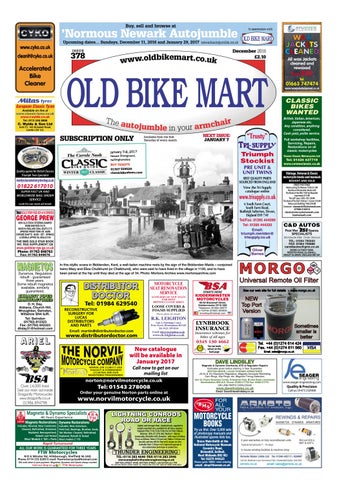
In this idyllic scene in Biddenden, Kent, a well-laden machine rests by the sign of the Biddenden Maids – conjoined twins Mary and Eliza Chulkhurst (or Chalkhurst), who were said to have lived in the village in 1100, and to have been joined at the hip until they died at the age of 34. Photo: Mortons Archive www.mortonsarchive.com
2 NEWS
December 2016
Pete’s Prattle
www.oldbikemart.co.uk email: info@oldbikemart.co.uk
Editor Pete Kelly OBMEditor@mortons.co.uk Designers Charlotte Fairman, Tracey Barton Production editors Sarah Palmer, Sarah Wilkinson Picture Desk Paul Fincham, Jonathan Schofield Advertising Tania Shaw tshaw@mortons.co.uk Alan Green agreen@mortons.co.uk
01507 524004 Marketing manager Charlotte Park Circulation manager Steve O’Hara Publisher Tim Hartley Publishing director Dan Savage Commercial director Nigel Hole Associate director Malcolm Wheeler General Queries Customer Service Number: 01507 529529 Telephone lines are open: Monday-Friday 8.30am-7pm, Saturday 8.30am-12.30pm and 24hr ansaphone Archive Enquiries Jane Skayman jskayman@mortons.co.uk 01507 529423 Founder Ken Hallworth OLD BIKE MART (ISSN:1756-9494) is published monthly by Mortons Media Group Ltd, PO Box 99, Horncastle, Lincolnshire LN9 6LZ UK. USA subscriptions are $48 per year from Motorsport Publications LLC, 7164 City Rd N #441, Bancroft WI 54921. Periodical Postage is paid at Bancroft, WI and additional entries. Postmaster: Send address changes to OLD BIKE MART, c/o Motorsport Publications LLC, 7164 City Rd N #441, Bancroft WI 54921. 715-572-4595 chris@classicbikebooks.com PUBLISHED BY
PRINTED BY
F
rom the moment I first opened a twist grip – quite illegally, on a Post Office BSA Bantam – motorcycles and those who ride them have been a pivotal part of my life. In 1961, after first working in a wire factory, I settled on journalism as a career and eventually found myself in the privileged position of working on a succession of motorcycling titles with colleagues whose names have since become legendary, and with Christmas being such a time for reflection, I often find myself remembering them. Dear old Norrie Whyte, who worked with me on Motor Cycling and lived in a flat below mine in Portland Rise, Finsbury Park, often used his impressive bulk to
help me bump-start my Velocette Venom Special, and what nights out we had as well! Sports editor Mick Woollett’s enthusiasm for Grand Prix racing remained bright right to the end; and technical genius Vic Willoughby, who read the Motor Cycle page proofs with me at Colchester every Monday, always talked like a machine-gun at lunch time – and every word was a precious gem! The time I knew staffman John Ebbrell was all too brief because he lost his life while testing a Suzuki trail bike in 1974. His widow Eileen keeps in touch with me to this day. I never got to know Bob Currie as closely as I’d have liked because he was based in the Midlands, not London, but I always found him a straight talker who doggedly stood
by the British motorcycle industry at a time of great change, and certainly never suffered fools. In a way they’re all still alive and well today, because their words live on in our archives, and whenever we republish them in Old Bike Mart they remain as fresh and inspiring as the days they were written. There’s plenty about the old days in this issue, with a feature on Paul Weeks’ 1947 Dot Utility tricycle and 1931 Raleigh Karryall on page 12, a spread of wonderful archive images on pages 24-5 (including one of John Ebbrell), a rerunning of an inspirational essay by T E Lawrence about a ‘race’ with a Bristol Fighter on his Brough Superior SS100 Boanerges on pages 28-9, and Terry Sharp’s impressions of a 1936
It’s showtime again at Telford The Classic Dirt Bike Show, sponsored by Hagon Shocks, will return to Telford International Centre over the weekend of February 18/19, 2017. Roger Harvey, the 1983 British Motocross Champion and current Honda MXGP team manager, and ISDT competitor and motorsport media mogul Peter Duke are set to appear on both days of the show, and it promises to be a lively chat as they are interviewed by Classic Dirt Bike editor Tim Britton. The halls will be packed as traders and jumble sellers offer bikes, riding gear, clothing and accessories along with the spares and parts you’ll need for almost every project, and club stands and private entrants
will display a variety of classic bikes from all the disciplines. If you’ve been thinking of having a go at motorcycle sport, all the major associations and organisations will be there to offer advice and guidance. Bought in advance, an adult one-day ticket will cost £11 (gate price £13); a Saturdayonly adult one-day with early entry to the autojumble £13 (gate price £17); an adult twoday ticket £22; and an adult two-day ticket with early entry to the autojumble (Saturdayonly) £25. Children under 12 will be admitted free, and opening times are 10am-5pm (early-entry autojumble open at 9am) and Sunday 10am4pm (early-entry autojumble open at 9am).
650cc Triumph 6/1, the pioneering parallel twin designed byy Val Page, on page 33. d Good reading – and a Happy Christmas to you all.
Torrens Trophy contenders
Contenders for the 2016 Torrens Trophy have been announced as Northern Irishman Jonathan Rea, who this year became the first man since Carl Fogarty to successfully score back-to-back World Superbike championships; Cal Crutchlow, who this year twice beat nine-times world champion Valentino Rossi to score Britain’s first premier class Moto GP victories since Barry Sheene’s last success in 1981; and Michael Dunlop, who won two more Isle of Man TT races in June and raised the lap record to 133.962mph.
North Devon Club runs
The North Devon British Motorcycle Owners’ Club’s first run of 2017 will be the Breakfast Run on June 11, followed by the Annual Tarka Run on July 16, the Three Moors Run on August 13 and the Dartmoor Run on September 10. To learn more, contact Yvonne Coleman, Bassett Lodge, Pollards Hill, Torrington, Devon EX38 8JA (01805 622049).
December 2016
NEWS 3
The ‘Flying Vicar’ is at it again! In the June issue of OBM, we published a letter from Malcolm Walter telling of a bright yellow off-road BSA Bantam built by a clubmate of his called Richard. Well, Richard has been at it again, this time trying three wheels for a change, and regulars at the Goodwood Revival might well have encountered him, for he’s also
known as the ‘Flying Vicar’ and can usually be seen at the end of the tunnel. He’s designed and built an eye-catching BSA Bantam combination whose ‘sidecar’ does not carry a passenger, but rather a colourful variety of ‘spares’ in the tradition of the old AA and RAC patrol outfits. The ‘spares’ are in fact odds and
The little Bantam outfit is testament to ‘The Flying Vicar’s’ building skills.
ends from his garage, some in compartments with plastic tops to reduce bounce, and some superglued in to deter any lightfingered onlookers. The purpose-made fittings include a facility for adjusting the toe-in, and the sidecar is weighted with some building blocks for stability. As Richard had never ridden
an outfit before, the early excursions were undertaken with a ‘minder’ following, but in no time at all he was cruising at 40mph with ease. The accompanying pictures underline the fact yet again that you don’t have to spend a fortune to have fun on a motorcycle, and watch this space – it might have a trailer soon!
The box sidecar opens to reveal an interesting variety of odds and ends from the garage.
Triumph riders embark on trip of a lifetime Supported by Triumph Motorcycles UK, who have provided two Tiger 800 XCa machines for their journey, adventure motorcyclists Max MacGillivray and Gareth Jones have set off on a 10,000-mile journey to South Africa to raise awareness about the importance of fresh fruit and healthier living. They left New Spitalfields Market in London on Tuesday, November 8 and will be riding to Cape Town as part of The Great Fruit Adventure (www.thegreatfruitadventure.com). Max said: “I want to tell the story of the fantastic places where so much of our fruit and vegetables are grown, and to help young people understand that it doesn’t just magically appear on the supermarket shelves. The terrain will no doubt be testing as we ride further south, but Gareth and I are looking forward to putting the Tigers through their paces.” The high-spec XCa has been designed to handle every type of terrain as the pair travel through Spain, Morocco, Senegal, Ghana, Ethiopia, Kenya and Tanzania before arriving at the Cape.
Smaller Neolite units from Hitchcocks Motorcycles Having marketed a Neolite 7in light unit with great success for some years now, Hitchcocks Motorcycles are now offering a 5.75in Neolite headlamp. Making use of an H4 Halogen bulb, available in 12 or 6-volt versions, it will be of interest to owners and restorers of lightweight BSA, Triumph, Norton and other makes of British motorcycles. The unit is also ideal for many larger machines, specials, off-road or dualpurpose bikes. The Neolite has significant advantages over the regular replacement 5.75in light units, which generally accept only British pre-focus-type bulbs, or are a sealed-beam arrangement. Accepting H4 Halogen-type bulbs (and pilot light), the Neolite gives a high-intensity beam with accurate focus for more effective lighting. The 5.75in light unit alone (part no 92098) costs £24; the 5.75in light unit supplied with 12v Motovision Halogen bulb (part no 92099) £30; the 7in light unit alone (part no 92090) costs £24 and the 7in light unit supplied with 12v Motovision Halogen bulb (part no 92092) £30. All come with left-hand dip for UK roads (the 7in unit is also available for right-hand dip) and the prices are plus postage and VAT (where applicable). They are available from Hitchcocks Motorcycles, Rosemary Court, Oldwich Lane West, Chadwick End, Solihull B93 0EY (01564 783192, email info@hitchcocksmotorcycles.com).
These smaller 5.75in Neolite headlamp units now available from Hitchcocks will be ideal for a large variety of British motorcycles.
The two adventurers prepare to set off on their 10,000-mile journey to South Africa from London’s New Spitalfields Market on November 8.
Coming for dinner? Hosted by Classic Dirt Bike editor Tim Britton, the traditional Saturday evening dinner held during the Classic Dirt Bike Show weekend will take place at the Holiday Inn, just a stone’s throw from the International Centre at Telford. Show guests will be at the dinner to entertain diners with their speeches. Sponsored by Hagon Shocks, the show takes place over the weekend of Saturday and Sunday, February 18/19, 2017. Seats for the prestigious three-course dinner will cost £32, and to confirm your seats, visit classicmagazines.co.uk or call customer services on 01507 529529, payment is accepted over the phone using your debit or credit card. When booking, please confirm the names of all the attendees you’re buying for, along with any information about their individual dietary requirements.
Former British Motocross Champion and current Honda MXGP manager Roger Harvey will be in attendance at both the show and Saturday evening dinner.
4 NEWS
December 2016
Bonneville family covers every lifestyle choice
TO ADVERTISE CALL ALAN 01507
529467 or
TANIA 01507
529465
Triumph has launched a comprehensive new range of 900cc liquid-cooled eight-valve Bonneville variants to suit every preference, from the straight T100 and T100 Black to the Bobber, Street Cup and Scrambler, each designed to suit the customers’ particular lifestyle choices yet all sharing the same sound basic engineering principles. Styled on café racer lines, the 54bhp Street Cup features an authentic bullet seat with silver contrast stitching and an easily-removable seat cowl, a colourmatched fly-screen with matching graphic, bar-end mirrors with forged arms, twin clocks with polished stainless steel bezels as featured on the Thruxtons, Thruxton R-styled foot pegs, Thruxton forged headlight mounts and painted bowl and bezel, sporty fork protectors replacing the Street Twin’s classic fork gaiters and black bullet indicators. The two-tone paint options are Racing Yellow and Silver Ice with Jet Black hand-applied coach lining and Racing Yellow wheel pin-striping, or Jet Black and Silver Ice with Gold hand-applied coach lining and Gold wheel pin-striping. Compared to the Street Twin, the rider is seated slightly higher and further back, and the handlebar position is lower and slightly further forward. There are new distinctive ace-style bars and new, model-specific rear suspension units that are longer (though still with the same 120mm rear wheel travel of the Street Twin) and raise the back end and steepen the head angle. A new two-piston sliding axial Nissin caliper with machined branding and a floating brake disc also enhances the Street Cup’s specification. The 900cc engine features a 270-degree firing interval for smooth, linear power delivery from the slick five-speed gearbox, and is tuned to deliver an 18% increase in peak torque and up to 22% greater horse-power in the mid-range than the previous generation engine. Ride-by-wire fuel injection and a liquid cooling system reduce fuel emissions and improve fuel efficiency by up to 36% on the previous generation, and allow an extended 10,000-mile service interval. Shorter and lighter twin upswept silencers, with a satin black-painted wrap and stainless steel end cap, deliver the unmistakable sound of a British twin with a rich, deep and full exhaust note to match its sporting character. More than 120 high-quality accessories are available to enable Street Cup owners to add even more performance, style, comfort and practicality, including fully-adjustable rear suspension units from Fox, exhaust silencers from Vance and Hines, adjustable billet-machined aluminium levers, compact LED bullet indicators and heated grips.
The all-new Street Scrambler has bags of attitude, and some very special touches as well.
Could this be the finest Bonneville of the Hinckley era? With its many distinctive styling touches and two striking colour schemes, the high-performance café racer-styled Street Cup is a delight on the eye.
Triumph have taken the bull by the horns and designed its all-new Bobber from the ground up. The ‘solid back end’ is in fact well sprung, and the newcomer’s high bars, ultra-low single seat, custom exhausts and tidy overall appearance will stand it in good stead both here in Britain and especially on the American market.
Right at the other end of the scale, Triumph has taken a really bold step with its all-new Bonneville Bobber that was launched at the recent Regent Street Motor Show. Far from being just a slightly-modified T120-based machine, it’s been freshly designed right down to the tiniest detail, and should be an outstanding sales success in the USA. Although the back end looks just like a hardtail, it’s actually a fully-suspended swinging cage using a monoshock mounted under the low single seat on a well-crafted shock linkage. All the untidy bits such as electrical wiring and the battery have been carefully tucked away, and the 1200cc eight-valve, liquid-cooled, single overheadcamshaft parallel twin delivers torque in spades. Other new machines in the Triumph range include the all-new Street Scrambler, powered by the 900cc Bonneville high-torque engine, whose new chassis provides a commanding riding position with longer rear shocks, wider handlebars and a 19in front wheel. High pipes, dual-purpose Metzeler Tourance tyres, improved brakes, a switchable ABS (unique to the model), switchable traction control and a torque-assist clutch also come as standard, and the Street Scrambler is offered in three distinctive paint schemes – Jet Black, Matt Khaki Green and Korosi Red and Frozen Silver with Jet Black-painted coach lining and unique tank decals. Add to these models the all-new Triumph Bonneville T100 and T100 black, and it seems that Triumph will have plenty to celebrate in 2017.
For those who like Triumph’s well-tried classic look, the Bonneville T100 and Bonneville T100 Black offer new levels of refinement.
6 NEWS
December 2016
Jim Redman helps Ardingly Show go with a swing Six-times world motorcycle road racing champion and six-times TT winner Jim Redman, guest of honour at ELK Promotions’ Ardingly Show on Sunday, October 23, was busy all day long chatting to fans and signing his autobiography, and played a huge part in making it the best event so far. The Fire-Up Paddock for the Jim Redman-themed bikes went really well, but a silver 125cc Honda CR93 that owner Brian Roe used to campaign back in the day would run on only one pot to start with. Some new plugs purchased in the autojumble did the trick, and the little machine was on full chime for the afternoon session. Produced from 1962 until 1964, and sold over the counter to clubmen, the CR93 production racers were essentially 1961 works machines featuring gear-driven double overhead camshafts, four valves per cylinder and five-speed gearboxes. No fewer than 120 stalls were booked in the all-motorcycle
jumble set in 150 acres of rolling Sussex countryside at the South of England Showground. 2017 SHOW DATES: ELK’s show dates for 2017 are the South of England Classic Show & Bikejumble at the South of England Showground, Ardingly, West Sussex RH17 6TL from 10am on Sunday, April 2; the Ashford Classic Motorcycle Show & Bikejumble at Ashford Market, Orbital Park, Ashford, Kent TN24 0HB from 10am on Easter Monday, April 17; the MCN Festival of Motorcycling with Autojumble at the East of England Showground, Peterborough PE2 6HE on May 13/14; the Romney Marsh Bikejumble at Marsh Road, Hamstreet, near Ashford, Kent TN26 2JD (A 2070, six miles M20 J10) from 10am on Sunday, May 21; the Romney Marsh Show & Bikejumble at Marsh Road, Hamstreet, from 10am on Sunday, June 25; the South of England Summer Classic Show & Bikejumble at the South of England Showground, Ardingly, from 10am on Sunday, July 16; the Romney Marsh Bikejumble at Marsh Road, Hamstreet, 10am on Sunday, September 17 and the South of England Classic Show & Bikejumble at the South of England Showground, Ardingly, from 10am on Sunday, October 29.
In his element at Ardingly on Sunday, October 20 – the evergreen Jim Redman.
First prize for David as he joins the Rotary club
David Schofield from County Durham became the lucky owner of the 1990 588cc Norton F1 Rotary motorcycle that was first prize in the National Motorcycle Museum’s 2016 summer raffle when the winning ticket was drawn by road racing legends Carl Fogarty, John McGuinness and Ian Hutchinson at the NMM’s ‘Museum Live’ open day on Saturday, November 5. Second prize, a 1951 500cc Norton ES2, went to Colin
David Schofield from County Durham poses with the 1980 Norton F1 Rotary that he won in the National Motorcycle Museum’s summer raffle on November 5.
Hodgkins from Staffordshire, and the luxury classic weekend break for two people that constituted the third prize was won by Iain Gordon from Hampshire. The amazing first prize announced by museum director James Hewing for the winter 2016 raffle will be a brand new 1200cc Triumph Thruxton R with a factoryfitted track racer kit, together worth £13,800, that will be registered new to the winner next April. Second prize will be a 1954 500cc AJS Model 18 that’s a matching-numbers example of a practical and thoroughly usable postwar classic. Third prize will again be a luxury classic weekend break for two. The draw will take place on Sunday, April 23 at the International Classic Motorcycle Show at Stafford. Available from the museum by calling 01675 444123 or emailing shop@thenmm.co.uk the tickets cost just £2 each and can also be ordered online at www.thenmm.co.uk
Another Pip Squeak Run in April After organising its first-ever Pip Squeak Run, exclusively for the riders of sub-98cc machines in the spring, the Glasgow section of the Vintage Motor Cycle Club will be repeating the event on April 9. Around 20 riders from all over the country enjoyed the first ride around rural Ayrshire, and once again the riders will start out from Kilmarnock along quiet roads, but next year the organisers plan two different routes. The first will be aimed at those courageous enough to ride cyclemotor machines from 30 to
48cc, and for those on machines up to 100cc, a slightly longer route that might even offer a few gentle hills, so you might actually need more than one gear. Ride captain and route planner John Shaw aims to use his Scottishbuilt Cyclaid machine on the run, so if you’re a masochist you’ll find yourself in good company. For more information and entry details, contact VMCC Glasgow secretary Gordon Mowat on 01475 638528 (email: rustynuts@talktalk.net).
www.oldbikemart.co.uk
Entrants riding machines in the 30 to 48cc engine capacity in next year’s Pip Squeak Run might find themselves in the company of John Shaw – if they can keep up with him, that is.
A potent brand new Triumph Thruxton R motorcycle complete with factory-fitted track racer kit will be the fabulous first prize in the NMM’s 2016 winter raffle.
12 NEWS
December 2016
D’you know how to make toffee apples, love? After seeing the Dot utility tricycle pictured at the Manchester factory’s open day in last month’s Old Bike Mart, Paul Weeks of Sittingbourne, Kent, couldn’t resist telling us about his own two rare commercial three-wheelers which, in restoration, have been carrying out the tasks for which they were designed.
I
’ve always enjoyed restoring motorcycles as a hobby, the stranger or more unusual the better, and around 25 years ago I received a phone call from a local chap who said he had something that might interest me. I went over to have a look, and it turned out to be a rusty and dilapidated trade tricycle. To shorten the story, I paid out the £250 being asked – and then started thinking about how I was going to introduce it to the wife. “Whatever are you going to do with that thing?” was her opening line, but I was ready for her. “I’m going to restore it and sell toffee apples from it, trading as it used to be,” was my prompt reply, and she settled for that, so all I now had to do was restore it. My research revealed that it was a utility trade motor tricycle that had been built by Dot Motorcycles in 1947, and driven by a 122cc Villiers 9D engine with a three-speed gearbox. Customers bought the vehicles as flatbed trucks and then put whatever they needed on the front for carrying out their trades, including selling ice cream and delivering milk, bread or groceries. I believe that at some point the Jaguar plant used them for delivering parts around the factory. When I thought about tracing the history of my particular trike, my wife suggested I send a letter to a person named in the brown log book. I knew he would then have been in his 80s, but I tried anyway, and a few weeks later received a very shaky letter saying that, if I’d like to visit him at his house in Knatts Valley, set deep in the Kent countryside, he’d tell me all about the Dot. As we neared his home, we started seeing cardboard signs in the bushes, with arrows and ‘Mr Weeks’ scrawled on them, and after following these, we eventually came across an old lady standing in the middle of the road, who scolded us for being five minutes late and gestured us up their drive. The house was like a time capsule set in the 1940s, and the lady sent us
This is what the 1947 Dot looked like when Paul bought it for £250.
Paul Weeks enjoys a sunny day with his restored Dot tricycle truck. The front box was made by Olympia Joinery.
n to see an old gentleman who was waiting to tell us the story. The Dot trike started life selling ice creams in London, but came up for auction in 1949 when the first owner went bust. Because cars and motorcycles were in very short supply just after the war, the old gentleman had bought the Dot and actually fitted an armchair on the front for transporting his wife. This went on for a year or two until he finally managed to buy a car, and the Dot then lay in his barn for the next 40 years. With help from my good friend Les Haddock, I spent the next two years restoring the Dot to its former glory, and got Olympia Joinery to make a front box of suitable period specification, with an ash frame and ply covered with metal sheeting for the exterior surfaces. When everything was finished, all I had to do was perfect the art of making toffee apples! After a few failed attempts we got it off to a ‘T’ and started trading in the oldfashioned way, complete with white coat, straw hat and leather money bag, at steam fairs and vintage vehicle shows. Once, at a Chatham Dockyard
Judging by the ‘bombed out and homeless’ couple pushing a handcart with the few possessions they’ve managed to salvage, the Dot, with its sign written ‘Plump peanuts and finest toffee apples’ at the front of its ash-framed box, is seen at a wartime reenactment event.
The 1931 Raleigh Karryall is seen in all its glory at a classic and vintage show.
classic bike show, we were presented with the best bike in show award by none other than John Surtees. When we were at a Bromley Pageant of Motoring with the Dot, a gentleman approached me and said: “I’ve got a tricycle at home that you’d like to see,” and he promised to bring a picture of it to the following year’s pageant. The machine turned out to be a 1931 Raleigh Karryall, and for the whole of the following year thoughts of it kept popping into my head. The third time the owner visited the pageant, I asked if he’d be interested in selling the trike – and that’s how I came to own it. The Karryalls, which had a girderfork motorcycle front end and a rear pick-up bed, were first made in 1930 featuring a 500cc single-cylinder sidevalve engine with a three-speed plus reverse Sturmey Archer gearbox, and the back axle was driven by duplex chain. In 1931 the capacity was upped to 600cc. I’m led to believe that the person responsible for the design and manufacture left Raleigh to set up Reliant, where production eventually evolved into the Safety Seven, with a four-cylinder engine and van-type body. This particular trike had been bought as a pile of parts in someone’s attic, the buyer thinking that it was a Raleigh motorcycle. When he realised what it was, he obtained a special grant because of its rarity value and undertook a complete restoration. A newspaper article recording the Karryall’s restoration came with it when I bought it. Now that I had it, though, what was I going to do with it? Well, I could always use it for selling toffee apples, candy floss and sweets at steam rallies and other shows. I got together with some friends who were into vehicle restoration, and between us we designed a display unit that we could fit on the back of the Raleigh, along with a roof and canopy, and a collapsible trailer for a candy floss machine. All of these additions had to be sympathetic with
At the heart of the Dot was this doubleexhaust Villiers two-stroke single.
Paul receives a ‘best in show’ award from John Surtees at a Chatham Dockyard classic bike show.
Read all about it! Complete with period advertisement, this information board tells the Dot tricycle truck story.
the age of the vehicle, and be quickly removable. After lots of head-scratching and fag packet drawings we had a plan! Ron Mellowship from Olympia Joinery constructed a unit from ash-faced
With its awning, display shelves and candy floss trailer, the Karryall has been made into a magnificent sales outlet.
timber that slides into the bed; Les Haddock machined brass corner brackets for holding barley-twist roof support poles; and I made a chassis for the candy floss trailer. After more woodwork from Ron, in the form of a foldable roof and slidein panels for the trailer, along with some decorative woodwork behind the seat, all that was left to do was the painting, and when it was finally finished, it joined the Dot at events including the Goodwood Revival, the Ascot Red Bull Air Race, the Kent County Show and many more. We have thoroughly enjoyed travelling all over the country for the last 22 years, and many of the people we’ve met have been just as interested in the trikes as the wares we were selling, but now I’ve finally decided to hang up my straw hat and let someone else have some fun with the trikes instead. If you’re interested, call me on 07753 663020.
20 TACOMA CONCOURS
December 2016
Triumph GP best in show at top American event Ian Kerr visits an up-and-coming motorcycle concours event in Tacoma, USA, to prove the point that beautifully-restored classics are equally impressive no matter where in the world they are shown.
E
Restored to perfection rather than over-perfection, Tom Rutan’s 1949 Triumph GP started first kick, ticked over beautifully and was a worthy winner of the best in show award at America’s Car Museum.
ach year America’s Car Museum at Tacoma, just south of the port of Seattle, in Washington State, hosts a motorcycle concours event that’s fast becoming the two-wheeled equivalent of the prestigious Pebble Beach car concours. Since its inception five years ago it has gradually grown to the point where more than 300 machines of all types and capacities appear from all over the USA and Canada in the hope of winning the best in show award, or at least a best in class. While more classic Japanese and European machines are being entered, British bikes, both road and competition, still dominate the entry, so it was no surprise this year when the judges almost unanimously voted a 1949 Triumph Grand Prix machine, owned and restored by local man Tom Rutan from Lake Oswood, as the best overall, closely followed by a BSA Bantam fitted with every conceivable BSA accessory available at the time. In every respect the Triumph was the closest to standard specification, with the level of restoration not
exceeding the factory finish. It also started (a requisite for an award) first kick and ticked over, picking up cleanly when the throttle was opened – not bad for a racing motorcycle! Some of the Japanese bikes, such as an immaculate Kawasaki Z1 and some small Hondas, were equally impressive, as was a limited edition 750 Laverda. In fact every bike present was worth a good long look, including an MZ outfit that had recently been rescued from a war zone. Entry to the event also gains you entry to the museum, based on the vehicle collection of Harold LeMay that made the Guinness Book of Records as the largest in the world, with more than 3000 diverse two, three and four-wheeled vehicles, and this makes the trip more than worthwhile any time of the year. If you can get your hands on a bike at the concours, the day afterwards there’s a Sunday ride-out along some superb biking roads in Washington State, and many of the entrants take part. Definitely one for the bucket list!
This gorgeous little BSA Bantam, fitted with every genuine BSA accessory available at the time, was a worthy runner-up in the concours honours at Tacoma.
With its huge tank and sweeping matching panniers, this imposing Beemer looks ready for any riding challenge in the USA.
Rescued from a war zone, this well-equipped MZ outfit caught the attention of many visitors.
Japanese machines played a big part in the event. This immaculate 350cc Honda Four typified the high level of restoration seen.
This fine line-up of Norton Commandos shows the respect in which many American motorcyclists still hold classic British machinery.
24 FROM OUR ARCHIVE
December 2016
Our brilliant window on the past The world-renowned Mort ons Archive collecti on cont ains th ousands of images fro m more th an a cent ury of mot orcycling phot ography, many originatin g fr om fv1otorCycling, fi rst published in 1902, and The fv1otorCycle (1903) - and th anks t o th eir edito rs' insist ence on dat e-sta mping and fi ling away every phot ographic image fo r possible fu t ure use, we can still enjoy t hem t oday.
Giving a good idea of the proport ion of sidecar outfits then on the roads, this busy scene was received by The Motor Cycle immed iately after the ACU National Rally in 1951 and shows the checking -in points at Billing. Few safety helmets are in evidence - and there's not a single set of one-piece leathers to be seen!
Dragon Rally visitors splash through the Llanberis Pass downpours of the 1966 event in this picture from The Motor Cycle.
With his ' spaceman' helmet, the rider can on ly be the late John Ebbrell. His mount is one of the short- lived 200cc versions of the Arie l Arrow, and the location is the top of the hill where the beacon fo r the 1965 Dragon Rally was to be sited . In the distance, to the south , is the Llanberis Pass, and the picture was pub lished in The Motor Cycle of January 14, 1965, exact ly a month before the rally.
In 1956, when this photograph of an instructor and his pup il - both Excelsiormounted - was taken for The Motor Cycle , the RAC/ACU train ing scheme at Crystal Palace was claimed to be the world's largest civil motorcyc ling train ing schoo l, with 60 pupi ls each unde rgo ing 24 train ing sessions .
28 CHRISTMAS SPECIAL
December 2016
A ‘dogfight’ with a difference!
One of the finest descriptions of fast riding ever written was T E Lawrence’s essay, ‘The Road’, describing an impromptu ‘race’ between Boanerges, his beloved Brough Superior 100SS, and a Bristol Fighter in Lincolnshire. It appeared in the December 27, 1962 issue of The Motor Cycle after first being published in a book entitled The Mint, published 30 years after Lawrence’s death and describing his life in the Royal Air Force.
A
To add to the fun, that lthough, in the season of tremendously gifted breed, the goodwill towards all men, technical cartoonists and illustrators, a rudimentary ‘Happy would also be given their special Christmas’ at the end of editorial tasks for the Christmas and New Year columns is about all we’ve come to issues, and the combined result of all expect from so many publications these efforts was sheer magic. today, years ago the weekly At this time of year, it’s always a motorcycle magazines simply treat to visit the Mortons Archive and glowed with seasonal joy. look through the bound volumes of Mastheads and feature headings Motor Cycling and The Motor Cycle were covered in freshly-fallen to bring a special Christmas feature snow, and articles such as Yuletide memories, ghost stories and unusual or two back to life to give the readers of Old Bike Mart a taste of how road tests had to be planned well in things were during those wonderful advance so that the editorial teams could relax and enjoy a few days’ rest. vintage and classic motorcycling years – but ironically one of the most With few news stories about memorable Christmas features ever at that time of year, the two published by The Motor Cycle, in consecutive Christmas issues its issue of December 27, 1962, had had to be put together virtually as nothing to do with Christmas at all. one, and staff would each be given a specific Christmas feature to write. Those with an imaginative Unforgettable streak – The Motor Cycle’s Bob That year, the film Lawrence of Currie, for instance – might dream Arabia, starring Peter O’Toole, had up an entertaining work of fiction, been released, and permission was or undertake a special road test on sought to reproduce an extract from a steam roller or vintage Leyland the book telling of his life in the coach. RAF. Old Bike Mart has followed the His colleague, Vic Willoughby, same procedure. might take a look at the year’s Although T E Lawrence was technical advances in road racing, fatally injured in a motorcycling while others might review the accident in Dorset in 1935, his road test machines they’d ridden brilliant essay from The Mint during the year, write about winter entitled ‘The Road’, telling of a motorcycle maintenance or give ‘race’ with a Bristol Fighter on his some hints and tips about riding in beloved 988cc overhead-valve SS100 the snow. Brough Superior Boanerges, is an
unforgettable description of fast riding during a long-vanished age:The extravagance in which my surplus emotion expressed itself lay on the road. So long as roads were tarred blue and straight; not hedged; and empty and dry, so long as I was rich. Nightly I’d run up from the hangar, upon the last stroke of work, spurring my tired feet to be nimble. The very movement refreshed them, after the day-long restraint of service. In five minutes my bed would be down, ready for the night: in four more I was in breeches and puttees, pulling on my gauntlets as I walked over to my bike, which lived in a garage-hut, opposite. Its tyres never wanted air, its engine had a habit of starting at second kick: a good habit, for only by frantic plunges upon the starting pedal could my puny weight force the engine over the seven atmospheres of its compression. Boanerges’ first glad roar at being alive again nightly jarred the huts of the Cadet College into life. “There he goes, the noisy ...,” someone would say enviously in every flight. It is part of an airman’s profession to be knowing with engines: and a thoroughbred engine is our undying satisfaction. The camp wore the virtue of my Brough like a flower in its cap. ty came Tonight Tug and Dusty to the step of our hut to see me
Lawrence of Arabia on his beloved Brough Superior Boanerges. off. “Running down to the Smoke, perhaps?” jeered Dusty; hitting at my regular game of London and back for tea on fine Wednesday afternoons. Boa is a top-gear machine, as sweet in that as most singlecylinders in middle. I chug lordily past the guardroom and through the speed limit at no more than 16. Round the bend, past the farm, and the way straightens. Now for it! The engine’s final development is 52 horse-power. A miracle that all this docile strength waits behind one tiny lever for the pleasure of my hand. Another bend: and I have the honour of one of England’s straightest and fastest roads. The burb ble of my exhaust unwound like a long cord behind me. Soon my speed snapped it, and I heard only the cry of the wind which my battering head split and fended aside. The cry rose with my speed to a shriek: while the air’s coldness streamed like two jets of iced water into my dissolving eyes. I screwed them to slits, and focused my sight 200 yards ahead of me on the empty mosaic of the tar’s gravelled undulations. Like arrows the tiny flies pricked my cheeks: and sometimes a heavier body, some house-fly or beetle, would crash into face or lips like a spent bullet. A glance at the speedometer: 78. Boanerges is warming up.
Pictures: Mortons Archive www.mortonsarchive.com
Projectile
These graphic illustrations of Boanerges at speed and a challenger in the shape of a banking Bristol Fighter accompanied the original article in The Motor Cycle of December 27, 1962.
I pull the throttle right open, on the top of the slope, and we swoop flying across the dip, and up-down up-down the switchback beyond: the weighty machine launching itself like a projectile with a whirr of wheels into the air at the take-off of each rise, to land lurchingly with such a snatch of the driving chain as jerks my spine like a rictus. Once we so fled across the evening light, with the yellow sun on my left, when a huge shadow roared just overhead. A Bristol Fighter, from the Whitewash Villas, our neighbour aerodrome, was banking sharply round. I checked speed an instant to wave: and the slip-stream of my impetus snapped my arm and elbow astern, like a raised flail. The pilot pointed down the road towards Lincoln. I sat hard in the saddle, folded back my ears and went away after him, like a dog after a hare. Quickly we drew abreast, as the impulse of his dive to my level exhausted itself.
The next mile of road was rough. I braced my feet into the rests, thrust with my arms, and clenched my knees on the tank till its rubber grips goggled under my thighs. Over the first pot-hole Boanerges screamed in surprise, its mudguard bottoming with a yawp upon the tyre. Through the plunges of the next 10 seconds I clung on, wedging my gloved hand in the throttle lever so that no bump should close it and spoil our speed… The bad ground was passed and on the new road our flight became birdlike. My head was blown out with air so that my ears had failed and we seemed to whirl soundlessly between the sun-gilt stubble fields. I dared, on a rise, to slow imperceptibly and glance sideways into the sky. There the Bif was, 200 yards and more back. Play with the fellow? Why not?
Goggled grin
I slowed to 90: signalled with my hand for him to overtake. Slowed 10 more: sat up. Over he rattled. His passenger, a helmeted and goggled grin, hung out of the cockpit to pass me the “Up yer” Raff randy greeting. They were hoping I was a flash in the pan, giving them best. Open went my throttle again. Boa crept level, 50 feet below: held them: sailed ahead into the clean and lonely country. An approaching car pulled nearly into its ditch at the sight of our race. The Bif was zooming among the trees and telegraph poles, with my scurrying spot only 80 yards ahead. I gained though, gained steadily: was perhaps five miles an hour the faster. Down went my left hand to give the engine two extra dollops of oil, for fear that something was running hot: but an overhead JAP twin, supertuned like this one, would carry on to the moon and back, unfaltering. We drew near the settlement. A long mile before the first houses I closed down and coasted to the cross-roads by the hospital. Bif caught up, banked, climbed and turned for home, waving to me as long as he was in sight. Fourteen miles from camp, we are here: and 15 minutes since I left Tug and Dusty at the hut door.” • When the Brough Club reenacted the race at Cranwell during the 1980s, a Tiger Moth biplane was substituted for the Bristol Fighter and a Brough SS80 for Lawrence’s SS100. The event was enthusiastically reported in the national press, but of Boanerges itself, which was registered RK 4907, there remains no trace.
December 2016
IT'S MY BIKE 33
My wonderful 80-year-old Triumph twin After seeing a photo of his 1936 650cc Triumph 6/1 at a Taunton Classic Motorcycle Club Exmoor Run, we asked owner Terry Sharp to tell us something about his pioneering parallel twin. This is his story.
I
bought my 1936 650cc Triumph 6/1 at a Cheffins auction at Cambridge in 2008. It wasn’t my first choice, but the Rudge I’d travelled up to bid for failed to turn up, so, always having been a Triumph fan, I took a look and decided to bid for the 6/1 instead. After getting it home, I set about two things: finding out about its history and getting the thing running. The bike has been repainted at times and has had a few new bits added, but it has not been restored, and the nuts, bolts, levers etc appear to be as originally fitted. Interesting bits include a left-hand twist grip that controls the advance/retard mechanism, linked brakes and a useful telescopic Esway sidestand. Control cables from both twist grips pass through the handlebars. Unlike earlier models it has a foot gear change which I believe to be a factory-fitted device. Valves, guides and springs were shot, so new ones were fitted and improved things hugely. Interestingly, the nearside exhaust valve was in a far worse state than its opposite number due to the offset engine which results in inadequate cooling of the nearside cylinder. It’s fitted with period (I think) Lodge C8 plugs bought at a Shepton Mallet autojumble, and it starts first or second kick from cold and ticks over reliably. The Lodge plugs also look the part. I’m not sure whether they’re the correct fitment, but they are the right length, don’t foul and there’s no sign of overheating. Although a bit of rewiring was required, the electrics are up to the job. The dynamo is a third brush type which gives about 6.9 volts and houses the relay, so no external
VCC box is required. It works okay if the battery is in good condition. The magneto and dynamo look as if they’ve never been refurbished, and are a bit ropey, but as they both work well, I’m happy to leave them like that. A black-painted brass headlamp holds the standard bulb, which is not pre-focus. At some stage a second pilot bulb was fitted – the mirrored brass reflector makes this possible – and I think this was to provide better lighting without over-taxing the dynamo. With the headlamp on, the dynamo won’t provide enough power to prevent flattening the battery at less than about 40mph in top gear. Oiling is achieved very successfully by a single pump – no scavenge required. The oil tank is in the sump, with a couple of shuttle valves for the inlet valves and upper cylinder. There aren’t any oil seals, and if the tank is filled too much, oil fills the primary drive and comes out through the gearbox drive shaft. I run it about two-thirds full and check it frequently. Some pictures show the bikes fitted with an external filter, but mine hasn’t got one and, judging by the neat pipe work, never did. Handling is predictable and the ride ‘robust’, but even after trips of more than 80 miles, nothing falls off me or the bike. I rode it a few years ago in what was billed as a ‘Gentlemen’s Trial’ which, having looked this up on the internet, seemed to involve taking a road bike off-road on gentle inclines and tracks – but not this one! It was more akin to a club trials event, and definitely not suited to a machine with only four inches of ground clearance.
Unlike our correspondent’s own Model 6/1 Triumph twin, the one seen in this period advertisement is fitted with a hand gear-change, and if you had £77 it could be yours.
What I did learn on the two sections I attempted was that the 6/1 has bags of torque and plenty of traction, but I gave up after the second section and spent a fraught, challenging half-hour extricating myself and the bike from the woods. I ride the 6/1 on some local bike runs and to local autojumbles – the VMCC ones at Shepton Mallet have become a regular outing – but most of my rides are in the evenings or at weekends when I ride alone or with a good friend on one of his old BSAs. So eight years after buying CUV 570 at auction, I’ve covered 5000 miles with no breakdowns (honestly) and am the proud owner of the first parallel twin model produced by Triumph – and a fine job they made of it too. My greatest respects go to Val Page and Triumph.
Note the foot gear-change arrangement on Terry’s 650cc Triumph.
Oh, what the future looked like in 1934! Stamped E T Pink of Harrow, this brochure cover shows, as well as the pioneering Triumph parallel twin, highrise buildings, modern trains or trams, and strange-looking aircraft with helicopter blades atop their wings.
With the 6/1’s four inches of ground clearance, Terry took on a little more than he bargained for in this Gentleman’s Trial.
This beautifully-sectioned engine shows how everything worked on Val Page’s pioneering Triumph parallel twin, which made its debut in 1933.
CUV 570 shows off its distinctive lines.
The 1935 Triumph is seen to advantage as it stands close to the Wellington Monument, at the highest point of the Blackdown Hills, two miles south of Wellington, Somerset.