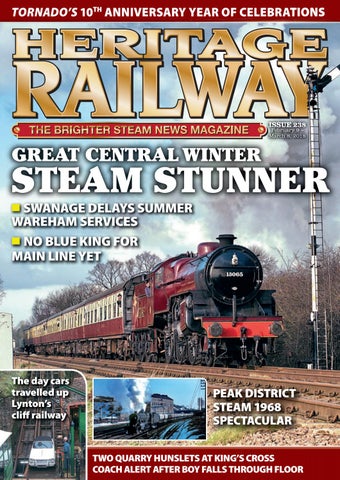
TORNADO’S 10TH ANNIVERSARY YEAR OF CELEBRATIONS IONS
ISSUE 2 238 February y9– March 8, 2 2018
GREAT CENTRAL WINTER
STEAM STUNN STUNNE ER
SWANAGE DELAYS SUMMER WAREHAM SERVICES ■ NO BLUE KING FOR MAIN LINE YET
■
The day cars travelled up Lynton’s cliff railway
PEAK DISTRICT STEAM 1968 SPECTACULAR TWO QUARRY HUNSLETS AT KING’S CROSS COACH ALERT AFTER BOY FALLS THROUGH FLOOR
OPINION
BR Standard Britannia Pacific No. 70013 Oliver Cromwell – which took part in the ‘Fifteen Guinea Special’, the last steam-hauled passenger train run by British Rail on August 11, 1968, speeds past Worting Junction with the Railway Touring Company’s ‘Sherborne Christmas Carol’ from Victoria on December 14. KEN LIVERMORE EDITORIAL
Editor Robin Jones 01507 529305 rjones@mortons.co.uk Deputy editor Brian Sharpe bsharpe@mortons.co.uk Senior contributing writers Geoff Courtney, Cedric Johns Contributors Fred Kerr, Roger Melton Designer Tim Pipes Reprographics Paul Fincham, Jonathan Schofield Production editor Sarah Wilkinson Publisher Tim Hartley Editorial address Heritage Railway magazine, Mortons Media Ltd, PO Box 99, Horncastle, Lincs LN9 6LZ Website www.heritagerailway.co.uk
ADVERTISING
Advertising representative Andrew Bruce 01507 529310 abruce@mortons.co.uk Divisional advertising manager Sue Keily skeily@mortons.co.uk
CUSTOMER SERVICES
General Queries & Back Issues 01507 529529 Monday-Friday 8.30am-7pm Saturday 8.30am-12.30pm Answerphone 24H help@classicmagazines.co.uk www.classicmagazines.co.uk
DISTRIBUTION & PRINTING
Distribution Marketforce UK Ltd 5 Churchill Place, Canary Wharf London E14 5HU 0203 787 9001 Printing William Gibbons & Sons, Wolverhampton
Independent publishers since 1885
MORTONS MEDIA GROUP LTD
Circulation manager Steve O’Hara Marketing manager Charlotte Park Subscription manager Paul Deacon Commercial director Nigel Hole Publishing director Dan Savage
ARCHIVE
Enquiries Jane Skayman 01507 529423 jskayman@mortons.co.uk
SUBSCRIPTION
Full subscription rates (but see page 30 for offer): (12 months 12 issues, inc post and packing) – UK £55.90. Export rates are also available – see page 30 for more details. UK subscriptions are zero-rated for the purposes of Value Added Tax. Enquires: subscriptions@mortons.co.uk
EDITORIAL CONTRIBUTIONS Contributions to this magazine should be clearly typed and ideally sent by email. Photographs, which should be clearly marked with the contributor’s name and address, are submitted at the owner’s risk. Mortons Media Group Ltd cannot be held responsible for loss or damage, however caused. All postal submissions must include an appropriate SAE for the return of all material. Opinions expressed in this magazine are not necessarily those of the editor or his staff. © Mortons Media Group Ltd. All rights reserved. No part of this publication may be reproduced or transmitted in any form or by any means, electronic or mechanical, including photocopying, recording, or any information storage retrieval system without prior permission in writing from the publisher. ISSN No 1466-3560
Published Every four weeks on a Friday. Advert deadline February 26, 2018 Next issue on sale March 9, 2018
Having trouble finding a copy of this magazine?
Much to celebrate after 50 years! T
HIS year much attention will naturally be focused on the 50th anniversary of the end of British Rail standard gauge steam haulage in August 1968. I remember the time well – looking forward to a caravan holiday at Salcombe’s South Sands, buying my first single records – from memory it was MacArthur Park by Richard Harris, and although he is long gone, I recently had the pleasure of meeting backing singer Ginger Blake – and preparing to start grammar school. But after August 11 all talk of trains went out of the window, as the next generations of schoolboys were instead becoming inspired by the Apollo trips around and to the moon. There was an underlying feeling“well that’s that then,” as the nation’s trainspotters, by necessity, consigned their ABC spotters’guides to the bottom drawer. However, there were those who went on to pastures new, and those who found themselves driven to ensure that steam would never die. And look at the forever-expanding encyclopaedia of their achievements over the past half century – around 120 heritage lines and venues set up to become a major plan of local tourist economies, a fabulous National Railway Museum now planning the next major stage of its development, steam locomotives big and small built from scratch, with one having run last year at 101mph… The (temporary) end of steam in 1968 is not the only 50th anniversary to remember this year. On June 29, 1968, the Keighley & Worth Valley Railway opened to passengers, after blazing a trail for others to follow, not least of all the way in which it cut through red tape to buy the branch from British Rail. The line very soon became famous for two productions of Edith A Nesbit’s classic novelThe Railway Children,
the first on black-and-white BBCTV in 1968 and the second on the big screen courtesy of EMI. Just at the 1953 Ealing comedyTheTitfield Thunderbolt inspired the public imagination after the dawn of volunteer-led railway preservation, the impact ofThe Railway Children movie proved cataclysmic, and even today, visitors are drawn to the Worth Valley to see the locations for themselves.The impact of that film and the KWVR on the future of the heritage sector is immeasurable. As highlighted in our News section, this fabulous railway is appealing for extra cash to restore one of the two locomotives that hauled its first public train in 1968. Loose change time everyone please! There was to be another first in the Worth Valley later that year, when Midland 4F 0-6-0 No. 43924 became the first of 213 locomotives from Barry scrapyard to be bought for preservation, and was taken to Haworth. Since then, we have seen countless miracles performed with the restoration of rusting Barry hulks, with several of them having run on the main line, and each of them contributing to making Britain’s railway heritage sector the finest in the world. For youngsters of all ages, the new Channel 4 series The Biggest Little Railway in the World, in which teams of enthusiasts built a 71-mile O gauge railway through Scotland’s Great Glen, brought back happy memories of those pre-modernisation days in which there were very few schoolboys who were not rail enthusiasts. Thanks to those who did not give up hope in 1968 – the next generations who may be turned on to steam by inspirational programmes like this have a heritage sector bursting with promise and opportunity in which to immerse themselves. Robin Jones Editor Heritagerailway.co.uk 3
CONTENTS ISSUE 238
February 9 – March 8, 2018
News
8
Headline News
6
Swanage Railway suspends Wareham services until DMUs are ready; RAIB issues maintenance warnings after toddler falls through hole in a coach toilet floor; Didcot’s blue King may not run on the main line, and the day classic cars rode up the Lynton & Lynmouth Cliff Railway.
9
News
10
Broadway extension progressing in leaps and bounds towards March 30 opening; first components for new Gresley V4 arrive; VIP opening as historic signalbox gets new lease of life at Amberley; plans for a fourth tourist line in South Devon by 2020; National Railway Museum upgrade moves towards final blueprint; thieves steal irreplaceable Australian loco parts and return for more; Severn Valley raises £10K in a week for vandalised coaches; Oswestry revival £120K boost; St Austell footbridge may go to Bala Lake; and after 135 years, a railway spans the Great Glen.
56
Regulars
Subscribe Today
30
Railwayana
68
Centre
54
Main Line Itinerary
61
Platform
88
Up & Running
94
Geoff Courtney’s regular column. The crimson ‘Crab’ on the Great Central by Brian Sharpe.
Main Line News
56
Vintage Trains season on hold; Government orders regular trains to Okehampton; Mayflower nearly ready; Clan Line Cornwall first and Flying Scotsman summer programme.
With Full Regulator
Don Benn reports on steam over Shap and in Kent.
4 Heritagerailway.co.uk
62
Steam and heritage diesel railtours. Where your views matter most.
Features Steam across the High Peak
Brian Sharpe recounts the story of steam’s return to one of Britain’s most popular tourist areas 50 years after BR retired its last six steam engines in the region.
42
Guide to railways running in early 2018.
The Month Ahead
106 Find us on www.facebook.com/heritagerailway
CONTENTS: Visiting BR Standard 2MT 2-6-0 No. 78018 crosses the River Nene near Castor on the Nene Valley Railway on January 7. ROBERT FALCONER COVER: LMS ‘Crab’ 2-6-0 No. 13065 accelerates away from Quorn & Woodhouse on the Great Central Railway on January 28. MICHAEL ANDERSON
‘Big Four’ liveries steal show at GCR gala
The Great Central Railway’s January 26-28 winter steam gala proved a resounding success, thanks to the appearance of two guests in ‘Big Four’ colours – B12 No. 8572 in LNER apple green and LMS ‘Crab’ No. 13065 in crimson lake, writes Robin Jones.
48
Make tracks for Bellingham
66
Many villages have heritage centres, often sited at their long-closed railway stations. Hugh Dougherty visits a village heritage centre that demonstrates how it should be done.
Steaming back to strength
Threatened with closure almost 10 years ago, Gareth Evans finds that the Sittingbourne & Kemsley Light Railway is bouncing back, enhancing its offering with additional attractions and locomotive projects, as well as planning its next 50 years.
72
Winter activities
Expectations have always been high that major infrastructure work and other repairs and improvements will take place on heritage railways and centres during the winter months. But the popularity of such events as Santa Specials has given less time for the work to take place, as Peter Brown found when beginning this exclusive survey just before Christmas 2017.
SUBSCRIBE
FROM JUST £20* *THAT’S JUST
£3.33 AN ISSUE
IF YOU PAY BY DIRECT DEBIT EVERY 6 MONTHS
See page 30
80
Write to us: Heritage Railway, Mortons Media Ltd, PO Box 43, Horncastle, Lincs LN9 6LZ.
Heritagerailway.co.uk 5
HEADLINE NEWS
Swanage-Wareham second summer season postponed By Robin Jones THE Swanage Railway has decided to delay the full second year of its ground-breaking diesel-hauled services to Wareham. While hugely successful in terms of passenger numbers, the service ran at a loss because of the cost of hiring an outside party to run them, and having to use diesels at both ends because of the lack of run-round facilities at Wareham. The railway will now wait to resume the Wareham timetable until the refurbishment of its two DMU units – a Class 121 ‘bubblecar’ and a threecarriage Class 117 unit – by Arlington Fleet Group Ltd at Eastleigh Works is complete. The two DMUs are being given new wheelsets, supplied by separate contractors, as well as being equipped with Network Rail-compliant TPWS, OTMR, and GSM-R wireless communications system apparatus and central door locking so they can run on the main line from Worgret Junction into Wareham station. It had been planned to run a 90 selected-day trial train service to Wareham during 2018 using the DMUs directly operated by main line-qualified Swanage Railway drivers and guards. However, while some special diesel and steam trains may run between Swanage and Wareham during late 2018, the full second year of the grant aid-funded trial ‘real’ train service to Wareham is now set to start during Easter 2019. The railway’s Project Wareham director Mark Woolley said: “We are committed to operating the second year of our trial train service to Wareham
Above: Swanage Railway Project Wareham director Mark Woolley. ANDREW PM WRIGHT Right: One of the 2017 summer services from Swanage to Wareham operated by West Coast Railways passes Corfe Castle. ANDREW P M WRIGHT using our two heritage DMUs which have diesel engines under the floor so there is no need to use a diesel locomotive at each end of a set of carriages as we did with our trial service to Wareham during the summer of 2017. “The extensive overhaul, refurbishment and upgrade to exacting main line standards of our two former British Railways diesel multiple units by several specialist contractors has been very challenging work because of the heritage nature of the trains. “The performance of our Wareham trains was good thanks to a robust timetable and our connections with main line trains were well maintained. “Despite the operational success of the 60 selected-day trial, the service was operated at a financial loss and the use of a contracted third party operator
cannot be repeated in 2018. “Visual surveys indicated that up to 70% of passengers travelling on last year’s Swanage to Wareham service arrived or departed from Wareham by a main line train which fulfils one of the trial service’s key objectives. “Just over 13,000 passengers were carried during the first year of our trial train service to Wareham – during the summer of 2017 – which compares well with the target figure of 12,000 passengers in the Purbeck Community Rail Partnership business plan.” For the first year of the trial service to Wareham, the railway contracted main line train operator West Coast Railways to run the service on Tuesdays, Wednesdays, Thursdays, Saturdays and Sundays between June 13 and September 3. The drivers, guards, diesel
locomotives and carriages needed to run the trains were supplied by the Carnforth-based operator. One of the Swanage Railway’s main line certificated heritage diesels, 1960-built Class 33 D6515 Lt Jenny Lewis RN, was also used to help run the service. The heritage 1967-built Southern Region 4TC four-carriage set used for the first year of the trial Wareham service was hired from the London Transport Museum. The two DMUs are due to be delivered to Swanage Rduring the early summer of 2018, after which they will be intensively tested. The Swanage Railway drivers and guards that will operate the two trains into Wareham will also complete their training on the new units.
Southern Locomotives Ltd’s Bulleid Battle of Britain Pacific No. 34053 Sir Keith Park digs into the climb of Erdington Bank on its way to Bridgnorth during one of its last turns on the Severn Valley Railway before its move back down south and to the Swanage Railway. MATT YARDLEY
6 Heritagerailway.co.uk
Find us on www.facebook.com/heritagerailway
Lines must improve coach maintenance – RAIB By Robin Jones HERITAGE Railways have been advised to draw up improved examination regimes to ensure that coaching stock does not deteriorate to the point where safety is compromised. The Rail Accident Investigation Branch has called on heritage lines to apply “appropriate standards for vehicle maintenance” following an incident in which a three-years-old boy fell through a missing carriage toilet floor. The boy was saved from potentially serious injury only by the quick actions of his mother, who grabbed his arm before he could fall. The incident happened at 1.15pm on June 22 last year, when the mother and her son were travelling on a South Devon Railway train from Totnes Riverside to Buckfastleigh. A RAIB report published on January 30 said that shortly after leaving Staverton station, while the train was travelling at around 20mph, the child left his seat and went towards a toilet on the train, followed by his mother walking a short distance behind. “The child entered the toilet, and as the door opened and the child stepped through it, he fell forward because the floor was missing in the compartment he had entered,” said the report. “A more serious accident was only prevented by the quick reaction of the mother who grabbed the child’s arm and prevented him falling through the opening and onto the track below. The child suffered minor bruising, and both mother and child were shocked.” The accident was reported immediately to the railway company, but the RAIB was not advised of what had happened until June 25, three days later. The South Devon Railway had carried out a repair to the carriage in April. The location of the repair was difficult to
gain access to and required the floor of the toilet cubicle to be removed, said the report. The railway’s management decided that the door would be secured and notices placed on the door, allowing the carriage to enter service with the toilet floor missing. The RAIB said that the method of securing the door was inadequate, so that over time the door became less secure to the extent it was possible for the child to open it. “The risk associated with the absence of the toilet floor was not sufficiently appreciated nor adequately managed after the carriage was allowed to enter service,” said the report. “The RAIB also found that the South Devon Railway had no formal competence management assessment for staff involved in carriage maintenance. Both of these factors led to no-one detecting that the door had become unsecure. “The RAIB observed during the investigation that the South Devon Railway’s maintenance regime did not identify the extent of the deteriorating condition of the carriage structure, and the railway’s fitness to run process was not being correctly applied.” The RAIB has now made one recommendation to the SDR, and that is to commission an independent review of the actions it has taken since the accident to address the deficiencies in its processes. In its conclusion, the report said: “The RAIB believes that the investigation has also identified an important lesson likely to be applicable to other heritage railways, about applying appropriate standards for vehicle maintenance, to ensure that the examination regime which they have in place will identify the foreseeable deterioration of vehicles, before it reaches a stage that may affect safety.”
Two Quarry Hunslets at King’s Cross TWO Quarry Hunslet 0-4-0STs will take pride of place at King’s Cross station from February 10-18. No. 409 of 1886 Velinheli from the Launceston Steam Railway and No. 855 of 1904 Hugh Napier, which is owned by the National Trust and while part of the Penrhyn Castle Railway Museum spends its time as a guest of the Ffestiniog Railway, will be rolled into the station’s ticket hall at 1pm on February 10. The pair, which used to transport slate around the quarries of Bethesda and Llanberis, will be used to promote North Wales as a tourist destination, and the Ffestiniog & Welsh Highland Railways in particular. The railways carry nearly 400,000 passengers each year and trains cover 63,500 miles – more than two and a half times round the earth at the equator
Ffestiniog & Welsh Highland Railways general manager Paul Lewin on the footplate of Velinheli during a visit to Porthmadog Harbour station on May 29, 2016. F&WHR During the display, there will also be the opportunity to win a short break in North Wales, staying at Portmeirion and including and first class tickets on both railways.
The Triumph Vitesse all set to be taken up the Lynton & Lynmouth Cliff Railway. LLCR
Cars taken up Lynton & Lynmouth Cliff Railway By Robin Jones THE phrase “the car became king” is often used by railway historians when describing the demise of the national network. However, it was certainly true on Monday, January 29, when the motor vehicle reclaimed another piece of rail territory. A special Cars up the Cliff event saw the Lynton & Lynmouth Cliff Railway take a succession of classic cars up the funicular line which links the town to the harbour village below. The event was staged for a photoshoot for Practical Classics magazine. The last time that road vehicles were carried up the cliff via the Victorian railway was in 1952 during the Lynmouth flood disaster. Back then, it was the only means of getting stranded cars out of Lynmouth. The railway – which was originally designed to transport freight as well as people – was also pressed into service when it carried an E-type Jaguar up the cliff in the Sixties. Cliff Railway director Rob Shaddick, whose great-great-grandfather Bob Jones was responsible for the creation of the railway, said that much work had gone on behind the scenes to prepare for the event, which started off as a challenge to find a car which was pictured on the railway in 1905. The car belonged to financier and
Write to us: Heritage Railway, Mortons Media Ltd, PO Box 43, Horncastle, Lincs LN9 6LZ.
local benefactor Sir George Newnes, who funded the building of the cliff railway and also played a major part in the promotion of the Lynton & Barnstaple Railway. In the car lift Rob went up in his Triumph Vitesse. “I went up in the first car and I must say it’s quite surreal to sit in the car going up,” he said. The railway is a listed heritage monument, and is the steepest fully water powered railway in the world, and the only one of its kind in the UK. General manager and chief engineer Ashley Clarke explained that a window of opportunity to stage the event arose because the passenger carriages were not on the track, as would have been the case this time of year. The carriages had been lifted off their decks for winter maintenance. He explained: “We can’t attach the cars to the deck in the same way. We are actually using ratchet straps, the same kind you would use on a trailer.” The classic cars taken up the railway were two Triumph Heralds, a Triumph Spitfire, an MGB, an MG Midget and a Morris Minor as well as Rob’s Vitesse. The 862ft line which opened in 1890 rises 500ft with a gradient of 57% providing panoramic views across Lynmouth Bay to Sillery Sands and the cliffs and Bristol Channel beyond. The car in the old picture was subsequently identified as a 1903, 24hp, Georges Richard limousine. Heritagerailway.co.uk 7
HEADLINE NEWS
No main line for blue King yet By Cedric Johns & Brian Sharpe WORK on blue-liveried 4-6-0 No. 6023 King Edward II at Didcot Railway Centre has reached the stage whereby the engine is virtually ready for main line running. However, it has been stated in the Great Western Society’s magazine, the Great Western Echo, that it has been agreed the aim of running the engine on the main line should be postponed for the time being. Among the reasons given is the length of time left on the boiler certificate and the general turmoil within the steam charter business. The next major step in the King’s future is, it was understood, a move to the Severn Valley Railway where the 4-6-0’s steaming qualities are to be tested under progressively-increased loading conditions. A similar move to the West Somerset Railway was contemplated 10 months ago but the plan had to be abandoned when the engine’s axle loading was considered too heavy for sections of the heritage line’s track. It was also increasingly found that the engine was out of gauge for movement by rail because of work being carried out to move platform edges closer for modern stock. Those concerned with the King’s well-being must hope that the Severn Valley trip proves to be successful because much boiler time has been lost
GWR 4-6-0 No. 6023 King Edward II at Didcot during a photo charter in 2017. JOHN TITLOW through periods of an apparent lack of positive action. As part of the agreement with the SVR, No. 6023 is to be made available for the SVR’s March 16-18 spring steam gala. It is also likely to appear at the ‘Give my regards to Broadway’ themed Cotswold
Festival of Steam on the Gloucestershire Warwickshire Railway over the late May bank holiday weekend and possibly other heritage lines before it returns to Didcot. The current intention is to earn income from heritage line visits which
Passenger numbers soar on heritage lines
By Robin Jones
SEVERAL heritage railways saw passenger numbers rise during 2017, despite rising inflation and Brexit fears. The Swanage Railway carried a total of 213,518 passengers during 2017 – an increase of 2443 passengers or 1.2% on 2016. Just over 13,000 passengers were carried on the 60-selected day trial train service from Swanage to Wareham, above the target figure of 12,000 passengers in the Purbeck Community Rail Partnership business plan. The Chinnor & Princes Risborough Railway carried more passengers than ever before in 2017 despite losing the planned visit of GWR steam railmotor No. 93 and a Santa special day because of heavy snow. Just under 60,000 passenger journeys were recorded. Passengers have increased by 119% between 2014-17, and 2018 will see the first regular five carriage trains operated due to the ever-growing business. The West Somerset Railway’s
8 Heritagerailway.co.uk
passenger figure for 2017 is 189,359 compared with the 2016 number of 186,603. General manager Paul Conibeare said: “I am delighted with the results for 2017, showing the hard work put in by staff and volunteers, has resulted in another great year for the WSR. Passenger numbers on the Llangollen Railway soared by 15% to around 87,000. The East Lancashire Railway reported a 6% fall in visitor numbers to 188,947 visitors, as compared to 2016 where the figure was 201,916. However, Flying Scotsman visited the railway twice in 2016 and attracted 27,500 visitors, therefore massively increasing patronage. The underlying trend showed a 17% increase in the 2017 figures over 2015. Britain’s most popular heritage line, the North Yorkshire Moors Railway, reported passenger numbers of around 350,000, roughly the same as last year. Keighley & Worth Valley Railway director Philip Balmforth said that line hosted around 105,000 passengers last year, not including the thousands
more who came along for Flying Scotsman’s visit. “We’re happy with that,” he said. “As a charity we’re not here to make money and the profits we get are reinvested back into the railway.” The Epping Ongar Railway reported nearly 40,000 passengers carried, a small fall from 2016. However, the poorer performance during the year was compensated by a bumper Santa special, the line’s best yet with a 25% rise in revenue and a significant increase in passengers in December. The Lynton & Barnstaple Railway carried 49,331 passengers in 2017, a fall of around 5% on the previous year, when UK Railtours’‘Tarka Tourer’ HST from Paddington to Barnstaple on April 17 brought 250 enthusiasts to Woody Bay to boost numbers. The North Norfolk Railway experienced a fall of 2.35% to 161,944 passengers carried. The Lincolnshire Wolds Railway ended 2017 with its most successful festive period ever. The Ludboroughbased line saw a 30% increase in ticket sales on its popular Santa Special trains, compared to 2016.
can go towards the cost of the next boiler overhaul, which is now quite imminent. The engine will however be maintained in main line condition so that should the situation change it could operate on the main line without delay.
NYMR steaming ahead with appeal response THE North Yorkshire Moors Railway has had more than £200,000 pledged since it launched its £2,500,000 Yorkshire’s Magnificent Journey campaign last October. The funding is needed for eight different projects over the next five years, including renewing and repairing the worn-out iron bridges around Goathland; creating a shed for 40 coaches, building a new volunteer hostel at Grosmont to encourage new young and family volunteers and the introduction of accessible carriages in every train. North Yorkshire Moors Historical Railway Trust chairman John Bailey said: “We’re extremely proud of how much money has already been raised and we would like to say a huge thank you to everyone who has donated, no matter how big or small. “The railway has been one of Yorkshire’s much loved attractions for the last five decades, with a history of creating long lasting family memories. Now, as we look to secure our future, these funds will be invaluable.”
Find us on www.facebook.com/heritagerailway
P2 Prince of Wales now wheeled next winter
THE A1 Steam Locomotive Trust has received pledges of more than £2.8 million towards the project to build new Gresley P2 No. 2007 Prince of Wales less than four years after the frames were rolled at British Steel’s plant in Scunthorpe Public interest in seeing a new P2 become a reality sooner rather than later – the projected completion date is 2021 – remains high and more than 840 people have already signed up to the ‘P2 for the price of a pint of beer per week’ (£10 per month or more) covenant scheme since its launch in March 2014. The average monthly donation is now around £17.40 per covenantor (including Gift Aid) Other funds have been raised through The Founders’ Club (over 360 people have donated £1000 each – target 100 people, now closed), The Boiler Club (136 people have pledged £2000 each to fund the boiler – target of 300 people – meaning half of the £600,000 target now pledged), The Mikado Club (177 people have pledged £1000 each – initial target 160 extended to 200 to wheel the tender in addition to the engine – meaning that £221,250 now pledged), The Cylinder Club ( launched at the trust’s last convention – 81 people have already pledged £1000 each – target 100 people) and Dedicated
Donations (over £220,000 from existing supporters sponsoring a variety of components). The Gresley Society Trust has also sponsored the P2’s distinctive front end. One problem has been the incorrect machining of the keyways in the plain coupled axles leading to a long wait for the new axles to be supplied from South Africa. While the effect has been the delay of the process of wheeling the frames of No. 2007, progress on other fronts means that this will have no effect on the overall timetable and Darlington Locomotive Works has been far from idle over the past few months. However, the trust still needs to complete the funding of The Mikado Club as soon as possible so that it can wheel both the engine and tender. The trust remains hopeful that the rolling chassis for No. 2007 Prince of Wales will be completed in winter 2018, but to maintain the current rate of progress, it needs to continue to raise more than £700,000 per year, which given the nature of the regular donation scheme becomes more challenging as each year passes. * For information on how you can help to build Britain’s most powerful steam locomotive visit www.p2steam.com email enquiries@p2steam.com or call 01325 460163.
The restored boiler for new GWR Saint 4-6-0 No. 2999 Lady of Legend was fitted in the frames at Didcot Railway Centre on January 23. Boilersmith Ali Matthews is seen standing on the bufferbeam with the boiler in place. DIDCOT RAILWAY CENTRE
Packed programme as Tornado team marks A1’s 10th anniversary
On January 1, on-loan GWR 0-6-0PT No. 6412 heads the last Chinnor & Princes Risborough Railway train of the season into Princes Risborough, where tracklaying into the platform is set to start. PHIL MARSH
Horse tram goes electric
A DOUGLAS horse tram will be pulled through Laxey station in September as part of the Manx Electric Railway’s 125th anniversary, following a successful test run. It is believed that it will be the first time in history that a horse has pulled a tramcar through the station.
Nene Valley visitor
THE Nene Valley Railway has booked GWR 0-6-2T No. 5619 for the new season. The 1925-built locomotive will also be available for driver experience courses.
THE A1 Steam Locomotive Trust has lined up a series of railtours and visits to heritage lines for Peppercorn A1 No. 60163 Tornado to mark its 10th birthday. On February 10/11, Tornado, one of the stars of the new Paddington 2 movie, will run four trains a day over the Great Central Railway (Nottingham), following the completion of winter maintenance at Locomotive Maintenance Services of Loughborough. The visit is seen as “running in” for the A1. On Friday , February 16, Tornado is booked to head the Belmond Pullman and on Saturday, February 24, it’s the ‘North Briton’ over the Settle and Carlisle line. The £3 million new-build locomotive will visit the North Yorkshire Moors Railway from March 3-11 and the Severn Valley Railway spring steam gala from March 16-18. Saturday, March 24 sees No. 60163 take the ‘Sulis and Sarum, to Bath and Salisbury, and on March 29-April 2, it will appear on the East Lancashire Railway. It will haul the Belmond ‘Surrey Hills’
Write to us: Heritage Railway, Mortons Media Ltd, PO Box 43, Horncastle, Lincs LN9 6LZ.
on April 7 and the ‘Ebor Flyer’ from King's Cross to York on April 14, which will mark its regular 90mph debut, before visiting the Midland Railway-Butterley on April 20-22. The next tour is the ‘Ynys Mon’ to North Wales on April 28 followed by a visit to the Nene Valley Railway from May 1-13. On Saturday, May 19, Tornado will take ‘The Canterbury Tale’ to where else but Canterbury, and May 24-29 will see it in action on the Bluebell Railway. Saturday June 2 will see the A1 head the ‘Yorkshire Pullman’ to York and Scarborough using British Pullman stock, and on June 16 and July 14, it will haul more Belmond ‘Surrey Hills’ trips. On Saturday, July 21, Tornado will head ‘The Talisman’ to Newcastle, with a Deltic on the return leg to King’s Cross. Wednesday August 1 will see the A1 take ‘The Mad Hatter’ to Chester, August 11 and 15, two Pathfinder Tours over Shap and the Settle & Carlisle. On August 18, it will head ‘The Bard of Avon’ to Stratford-upon-Avon before embarking on the luxury land cruise from October 12 to 25. Heritagerailway.co.uk 9
NEWS
After 135 years: a railway that spans the Great Glen! Right: Laying the O gauge track around all sorts of obstacles. LOVE PRODUCTIONS Below: Silver Lady steaming through Inverness. LOVE PRODUCTIONS
Dick Strawbridge and Claire Barrett with Silver Lady. LOVE PRODUCTIONS By Robin Jones CHANNEL 4 has succeeded where Victorian entrepreneurs and engineers failed: to build a railway the complete length of Scotland’s Great Glen. In 1883, a scheme to build a line from Glasgow via Loch Lomondside and Glencoe to Fort William and Inverness was proposed under the banner of the Glasgow & North Western Railway. The aim was to alleviate the depressed economic conditions in the West Highlands, but when the scheme went before Parliament that year, it was vehemently and successfully opposed by the Highland Railway, which saw it as a threat to its monopoly. As a result, the only railway that was built in the Great Glen was the Invergarry & Fort Augustus Railway, a branch from the West Highland Line at Spean Bridge, which opened in
1903. Never commercially successful, passenger services were withdrawn in 1933 and freight in 1946. However, a 71-mile railway has now been laid through the Great Glen – but in O gauge. Love Productions gathered 56 volunteers and model railway enthusiasts to lay track between Fort William and Inverness for its five-part weekly TV series, The Biggest Little Railway in the World, the first instalment of which was broadcast on January 7. One of the aims was to create the world’s longest model railway. Working between June 20 and July 1 last year, the team had to lay track up mountains and over hills, across fields, the Caledonian Canal, paths, and around a wide variety of other obstacles in one of Britain’s most unforgiving landscapes – not to mention the dreaded West Highland midges. The team even had to
build a train ferry to go under a bridge on the canal. Co-presenter Dick Strawbridge said: “It’s a very British idea – part of me says that it’s bonkers, but it’s very British. TV allows you to do bonkers ideas. “It’s a very simple idea: the Victorians failed to build a railway along the Great Glen Way, and it was one part of the railway network in Scotland that was never built. So we had the idea of building a model railway across Scotland.” “The train is so tiny that the trip from Fort William to Inverness is (equivalent to) half the distance of the Trans-Siberian railway. “One of the hills we went up, to scale, we were taking it up one-and-a-half times the height of Everest. “It was tough towards the end. We couldn’t lay the last track until the last day, because we couldn’t leave track
running through Inverness. We had to get to the outskirts of Inverness by the 11th day. So we had to work really tough shifts. People were getting utterly exhausted.” The team faced major challenges just like Victorian railway builders would have done. There was the need to make the railway secure at night, deal with vehicles running over the track, and the building teams facing exhaustion. The train was pulled by a steam locomotive called Silver Lady , with the track costing £7 per metre. Claire Barrett, Dick’s co-presenter, said: “Three days in, the train started to move. No one knew whether it would work or not, if we had the right engine, the right system, the right rails, how the public would react or how we would cope. “So when it set off and did the first tiny bit of its journey, there was an amazing kind of euphoria amongst the teams.”
Cornwall's Truthall Halt reappears from the past THE Helston Railway is making rapid progress in rebuilding Truthall Halt. Original GWR plans were used to make the necessary components for the traditional pagoda-style station, which has been built from new and replicates the original. Truthall Halt was opened on July 3, 1905, 1¾ miles north of Helston. The halt was the first stop out of Helston and served the village of Trannack and also Truthall Manor. The platform has been rebuilt to its original two-coach length by the
10 Heritagerailway.co.uk
heritage line as a second station, with as many original features as possible Carn View Commercials lifted the body and roof of the station building into position on the platform. On March 16 last year, the line’s first train of the season was able to stop at Truthall Halt and passengers were able to disembark. It was the first time in 54 years trains were able to stop there since the closure to passengers in 1962. Right The Helston Railway’s new Truthall Halt. HELSTON RAILWAY Find us on www.facebook.com/heritagerailway
Broadway progressing in leaps and bounds THE Gloucestershire Warwickshire Railway is racing flat out to have its new Broadway terminus ready for the first public trains on March 30. The railway has been handed a massive boost by supportive Wychavon Borough Council, which has agreed to pay for a £580,000 car park, with a 99-vehicle capacity, between Evesham Road and Childswickham Road, to serve the station. Currently, the station has no public car parking. Council leader Linda Robinson said: “We are very happy to support this. It is a wonderful way to bring more tourists to the district, and I hope that it will go even further than Broadway.” By late March, the station building will be substantially finished although the only facilities fully functioning will be the booking office and the toilets. The car park will be created at the foot of the embankment which was stabilised late last year using geo-technical systems, including soil nails; a pedestrian crossing will also be installed. January 24 saw the first train to reach the buffer stops on the northern headshunt at Broadway in the form of a
Class 73 electro-diesel E6036 went further north than any Gloucestershire Warwickshire Railway locomotive had ever done before, by taking its ballast train to the Broadway headshunt. JO ROESEN/G/WR ballast train. It was the furthest north any train on the heritage railway has run. The train, headed by Class 73 electro-diesel E6036, comprised six Dogfish ballast wagons and a plough. The contents of the wagons were dropped on the headhunt so the track could be lined and levelled. The fence beyond the buffer stops marks the boundary of the G/WR’s property. From the bridge, which carries Springfield Lane over the trackbed, the course of the old railway is owned by
cycling charity Sustrans, which has been in touch with G/WR officials over the future extension to Honeybourne and a main line connection. The bridges north of Broadway are in poor condition and the G/WR is not willing to take on the liability for them. However, the long-term aim of the railway remains to “restore as much as possible of the former Stratford-uponAvon to Cheltenham railway line”, with Honeybourne still on the long-term agenda.
Meanwhile, the £65,000 repair work to Broadway’s Station Road bridge has been completed and the road reopened. The repairs were needed following a bridge strike by a low loader carrying earth-moving equipment, but they are covered by insurance. It was the worst of a few strikes since the bridge was completely refurbished three years ago, with the railway almost certain to install steel crash beams to prevent strikes damaging the bridge itself.
Severn Valley Railway three-day May diesel gala line up complete By Paul Appleton THE Severn Valley Railway’s big diesel bash – one of the biggest in the country – takes place over three days from Thursday, May 17 through to Saturday, May 19, when a large number of visiting machines will reinforce the line’s own impressive fleet for the annual Spring Diesel Festival. The range of visiting diesels spans the pilot diesel era of the late 1950s and early 1960s, through to the very latest diesel electric traction, courtesy of Direct Rail Services, which has promised one of its new Class 88s for the event.
First time in tandem
The Bury Hydraulic Group will be taking its Class 42 Warship dieselhydraulic D832 Onslaught. The green-liveried WR locomotive will be operating trains for the first time in tandem with maroon SVR-based Diesel Traction Group-owned classmate D821 Greyhound. Representing ultimate east coast diesel power is Class 55 Deltic No. 55019 Royal Highland Fusilier, owned by the Deltic Preservation
Society, which will be making the journey from Barrow Hill. The ‘Deltic’ is currently running in BR blue with full yellow warning panels. More big diesels joining up for the special event include BR blue-liveried, English Electric Type 4 Class 40 No. 40135 (formerly D335), which is owned by the Class 40 Society, and based at the East Lancashire Railway; Sulzer ‘Peak’ Type 4 (Class 45) No. 45060 Sherwood Forester, which is also based at Barrow Hill, and currently in the ownership of the Pioneer Diesel Locomotive Group. The split-headcode ‘Peak’, previously numbered D100, is another currently restored to post-TOPS BR blue livery. Always popular with diesel enthusiasts, an example of the English Electric Type 3 (Class 37) is also joining the roster in the shape of D05 Preservation Ltd’s No. 37688. This machine started life as BR’s D6905 and later received the TOPS number 37205, before modification as a Class 37/6 when it received its current number. It carries Direct Rail Services blue livery and can normally be found on the Mid-Norfolk Railway.
The seventh and final guest is one of just three Class 56 locomotives to be preserved so far. No. 56097, which is normally based at the Great Central Railway (Nottingham), is in Railfreight Coal Sector colours and fits into the gap between the early diesels and the latest DRS Class 88, the type being introduced between 1976 and 1984, with this example being built in October 1981 at BREL, Doncaster.
Three Class 50s
Resident diesels operating during the gala will include WR Class 14 0-6-0DH D9551, which is currently in experimental golden ochre livery; another pair of Western Region hydraulics in the shape of Class 52 D1015 Western Champion and D1062 Western Courier, the former in BR maroon, while the latter was repainted in BR blue last year. Also, three English Electric Class 50s are available: Nos. 50031 Hood, 50035 Ark Royal and 50049 Defiance. Finally, the Southern Region is represented by Class 33 No. 33108, which is currently in blue livery. Kidderminster Diesel Depot will be open to the public on the Saturday
Write to us: Heritage Railway, Mortons Media Ltd, PO Box 43, Horncastle, Lincs LN9 6LZ.
and Sunday, the latter being a mixed traction day, when diesels are joined by members of the SVR’s steam fleet. Services run late into the evening during the diesel festival in what is an intensive timetable, and during the three days there will also be a number of footplate experience opportunities. Visit www.svr.co.uk for full details ➜ The SVR has also announced a special event – Class 50 Golden Jubilee Anniversary – planned for October 4-6, when it will mark the 50th anniversary of the class. The railway has stated it plans to host the largest ever operational gathering of one type of locomotive in preservation. To do this it will need 10 working examples of the class. It has around five based on the railway at any one time, so others will need to be sourced as guests. ➜ The Mid-Norfolk Railway’s March 16-18 spring diesel gala will also feature a new Direct Rail Services Class 88. Also confirmed are Class 26 No. 26043 from the Cotswold Mainline Diesel Group, and residents Class 47s Nos. 47367 and 47596 and Class 04 D2334. Heritagerailway.co.uk 11
NEWS
First components for new Gresley V4 arrive By Robin Jones
THE A1 Steam Locomotive Trust has received the first components for its third new-build project – the £2.5 million Gresley V4 2-6-2 No. 3403, it announced on January 29. At its Silver Jubilee convention in October 2015, the trust revealed that it would follow its crowd-pulling Peppercorn A1 4-6-2 No. 60163 Tornado and Gresley P2 2-8-2 No. 2007 Prince of Wales with the construction of further extinct LNER types – a Gresley V4, a Gresley V3 2-6-2T and a Gresley K3 2-6-0. At its annual convention last September, the trust confirmed it had started work identifying and scanning the original drawings for the V4 at the National Railway Museum in York in order to create the design book for the new locomotive in 3D Computer
Aided Design software. The trust has since acquired and taken delivery of a complete set of fully-certified tyres for the V4’s pony, Cartazzi and 5ft 8in driving wheels.
Chimney part of deal
They have been purchased from David Buck, owner of Thompson B1 4-6-0 No. 61306 Mayflower, along with a chimney, two BR Class 08 shunter speedometer drive generators and two two-stage single spindle air pumps of Finnish origin, including lubricator pumps and check valves for use on No. 2007. The tyres were originally made in South Africa in the late 1990s for Malcolm Barlow, a Doncaster scrap dealer, who launched the Gresley V4 Society in 1994 to build a new example of the class.
Derbyshire tramway village calls for volunteer crew and drivers DO you fancy learning how to drive vintage trams? Then Crich Tramway Village is looking for you. The village, home of the National Tramway Museum near Matlock, wants to recruit more volunteer tram crewmembers. Would-be drivers need to be of smart appearance with good customer service skills with a minimum age of 16. Training will be given to successful applicants, starting as a conductor/guard responsible for the safety of passengers boarding and alighting, ticketing and assisting the tram driver. After two years as a qualified conductor, and subject to holding a full DVLA car licence for at least a year, you could also apply to be a tram driver. Discounted accommodation is on offer for those travelling from afar: the village currently has more than 150 volunteers who come from all over the UK and Europe. Some volunteers have gone on to secure employment after gaining valuable experience at the village. Volunteer conductor at Crich and LRV Driver (tram driver) at Metrolink in Manchester, Joseph Burberry, said: “I started volunteering in 2012 after an Ultimate Driving Experience at Crich. I started as a conductor, which is a great role because you get to meet so many new people and make some great friends too.
12 Heritagerailway.co.uk
Manchester Metrolink driver Joseph Burberry learned how to drive trams at Crich. CTV “Even if you believe you are too shy to have a go at something like conducting, you’d be surprised at how doing a role like this can bring you out of your shell. “The skills you learn here are great for any future career you go into within the railway industry. “The skills and job experience I have gained while at Crich Tramway Village have helped me enormously in getting my dream job at Manchester’s Metrolink. “There aren’t many people who can say they had a licence to drive first generation trams before second generation trams. It’s a great thing to add to your CV!” ➜ Anyone interested in becoming part of the Crich volunteer tram crew is invited to email volunteering@tramway.co.uk or visit www.tramway.co.uk
David acquired the parts six months ago in a job lot of items that Malcolm had salvaged from Doncaster Works on its closure – including a number of B1 class components. Gresley designed the V4 for mixed-traffic use and it was his last design for the LNER before he died suddenly in April 1941. The class V4s had similarities in their appearance and mechanical layout to the V2s, of which pioneer No. 4771 Green Arrow is preserved as a part of the National Collection. The V2s, introduced in 1936, had limited route availability and the class V4 was a lightweight alternative, suitable for use over the whole of the LNER network. Two V4s were built at the LNER’s Doncaster Works in 1941. The first locomotive, No. 3401 Bantam Cock, had a scaled-down version of the Gresley
The tyres for the new Gresley V4 inside Darlington Locomotive Works. DAVID ELLIOTT/A1SLT Pacific boiler with a grate area of 27½ sq ft. Its tractive effort of 27,000lbs was produced by boiler pressure of 250psi and three cylinders of 15in diameter.
‘Bantam Hen’
The second locomotive, No. 3402, incorporated a fully-welded steel firebox and a single thermic syphon for water circulation. It was never named but was known unofficially as ‘Bantam Hen’. The class was tried on the Great Eastern section of the LNER, and was well received, with more power than the existing Gresley B17 4-6-0s and better riding qualities. It was anticipated that many more would be produced, but after Gresley’s death and his succession by Edward Thompson, no more were built. Instead, the simpler two-cylinder Thompson B1 4-6-0 was adopted
New-look Colne Valley to be ready by the summer THE £2.4 million overhaul of the Colne Valley Railway is set to be completed by the summer. A £1.75 million Heritage Lottery Fund grant secured the heritage railway’s long-term future as it allowed the registered charity to purchase the Yeldham Road site in Castle Hedingham, where it is based. The upgrade, now in its final stages, will include a new car park and entrance hall, a new museum and also a carriage restoration centre Colne Valley Railway Preservation Society chairman Paul Lemon said: “Work has been plodding on for a while now, but it has been protracted and frustrating
at times waiting for permission for certain things. “The museum has taken a while because there were complications with the foundations, but we are expecting builders to start work on the walls very soon. “In terms of the entrance and car park, they should be up and running around Easter or in May, which will be a massive step forward.” Paul also said that the railway would like to expand and officials were in talks with local landowners. “A heritage railway needs to be at least five miles long. Ours is quite a short line so we need to find a way to expand it,” he said.
Wallingford to get a canopy
Cornwall set for more steam?
WORK has started at the Cholsey & Wallingford Railway’s Wallingford terminus on fitting the canopy formerly located at Maidenhead, where it stood for over 130 years. It was erected at Maidenhead in the 1880s but it is thought to have been moved from another local station, where it may have been installed under the supervision of Isambard Brunel himself. It certainly originally saw broad gauge engines passing beneath it. The restoration of this historic building is being undertaken by Civil Engineering contractors McCurdy’s and is being financed by the Railway Heritage Trust.
A PLANNING application for a new miniature railway in Cornwall has been submitted. Cornwall Miniature Railway wants to build the 7¼in line on a site next to Mawgan Porth Village Hall, near Newquay. A locomotive named Royal Scot, which has been obtained from the Little Western Railway at Trenance Park in Newquay, is undergoing restoration. The application concerning the construction of the miniature railway attraction, including indoor and outdoor attractions and amusements, and associated development, was lodged with Cornwall Council on January 19.
Find us on www.facebook.com/heritagerailway