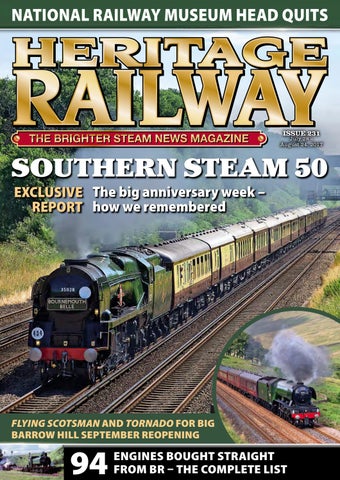
NATIONAL RAILWAY MUSEUM HEAD QUITS
ISSUE 231
July 28 – August 24, 2017
SOUTHERN STEAM 50 EXCLUSIVE The big anniversary week – REPORT how we remembered
FLYING SCOTSMAN AND TORNADO FOR BIG BARROW HILL SEPTEMBER REOPENING
94
ENGINES BOUGHT STRAIGHT FROM BR THE COMPLETE LIST
OPINION
Bulleid Merchant Navy Pacific No. 35028 Clan Line arrives at London Waterloo with UK Railtours’ ‘Waterloo Sunset’ tour on July 9 – 50 years to the day since sister engine No. 35030 Elder Dempster Line hauled the last BR steam train into the terminus from Weymouth. SEKINE EIKI EDITORIAL
Editor Robin Jones 01507 529305 rjones@mortons.co.uk Deputy editor Brian Sharpe bsharpe@mortons.co.uk Senior contributing writers Geoff Courtney, Cedric Johns Contributors Fred Kerr, Roger Melton Designer Tim Pipes Reprographics Paul Fincham, Jonathan Schofield Production editor Sarah Wilkinson Publisher Tim Hartley Editorial address Heritage Railway magazine, Mortons Media Ltd, PO Box 99, Horncastle, Lincs LN9 6LZ Website www.heritagerailway.co.uk
ADVERTISING
Advertising representative Sue Needham 01507 529310 sneedham@mortons.co.uk Divisional advertising manager Sue Keily skeily@mortons.co.uk
CUSTOMER SERVICES
General Queries & Back Issues 01507 529529 Monday-Friday 8.30am-7pm Saturday 8.30am-12.30pm Answerphone 24H help@classicmagazines.co.uk www.classicmagazines.co.uk
DISTRIBUTION & PRINTING
Distribution Marketforce UK Ltd 5 Churchill Place, Canary Wharf London, E14 5HU 0203 787 9001 Printing William Gibbons & Sons, Wolverhampton
Independent publishers since 1885
Having trouble finding a copy of this magazine?
MORTONS MEDIA GROUP LTD
Circulation manager Steve O’Hara Marketing manager Charlotte Park Subscription manager Paul Deacon Commercial director Nigel Hole Publishing director Dan Savage
ARCHIVE
Jane Skayman 01507 529423 jskayman@mortons.co.uk
SUBSCRIPTION
Full subscription rates (but see page 30 for offer): (12 months 12 issues, inc post and packing) – UK £55.90. Export rates are also available – see page 30 for more details. UK subscriptions are zero-rated for the purposes of Value Added Tax. Enquires: subscriptions@mortons.co.uk
EDITORIAL CONTRIBUTIONS
Contributions to this magazine should be clearly typed and ideally sent by email. Photographs, which should be clearly marked with the contributor’s name and address, are submitted at the owner’s risk. Mortons Media Group Ltd cannot be held responsible for loss or damage, however caused. All postal submissions must include an appropriate SAE for the return of all material. Opinions expressed in this magazine are not necessarily those of the editor or his staff. © Mortons Media Group Ltd.
All rights reserved. No part of this publication may be reproduced or transmitted in any form or by any means, electronic or mechanical, including photocopying, recording, or any information storage retrieval system without prior permission in writing from the publisher. ISSN No 1466-3560
Published Every four weeks on a Friday. Advert deadline August 10, 2017 Next issue on sale August 25, 2017
Member of the Professional Publishers’ Association
A major challenge to the heritage sector
I
T was always going to be the keynote occasion of the year, but the glorious sunshine in the second week of July made certain of that. The series of main line specials marking the 50th anniversary of the end of Southern Region steam proved to be the outstanding success that the occasion merited, and accordingly the event forms the core theme of this special edition. Of course, Southern steam did not die in 1967: it was just a case of turning the volume down for two decades or so, as an army of enthusiasts rescued and restored Bulleid Pacifics and others from Barry scrapyard, and tour operators gingerly reclaimed lost territory including electrified routes, to the point where today we have operators like Steam Dreams and the Railway Touring Company running regular charters over the Sunny South behind historically-appropriate locomotives. So much has been accomplished in the heritage sector over the last half century, and the anniversary main line runs and gala events have showcased our superb achievements in keeping Southern steam alive. The romance of steam is guaranteed a perennial public following, but not so much the traction that replaced it on much of the Southern Region. Electric traction has been, and is likely to always be, a poor third when it comes to preservation, after steam and diesel. There is currently no electrified heritage line, and if historic EMUs are to be run, it must be as locomotive-hauled stock. Apart from that, their only chance of being preserved is as static exhibits, and often as not end up stored as sheeted-over and neglected eyesores, with little or no commercial potential. That gives an instant and automatic disinclination for heritage lines to take such vehicles on board and afford them valuable siding space. Yet if we are truly serious about railway “preservation” in the strictest sense of the word, we should conserve items from the whole spectrum of traction and rolling stock, not just those which the public of the day finds
“sexy”and have an immediate and obvious second-hand use. A symphony consists of the entire work, not just the popular ‘sing-along’ bits. The only venue in the UK devoted to saving electric traction, the award-winning Electric Railway Museum next to Coventry Airport, has been told by the city council that its lease will not be renewed, and accordingly it must close on October 8. What will happen to its unique stock collection afterwards is anyone’s guess: sympathetic heritage railways might offer a temporary bolthole to one or two vehicles, but if another home is not found, the collection will be dispersed with the future of many of its items in jeopardy. It is a statement of the obvious that much of today’s national network is electrified, yet comparatively little is being done to save examples of classic electric traction for future generations. Much the same happened in 1892, after the GWR became fully converted to standard gauge, with a mass extinction of broad gauge locomotives. The only surviving Brunel broad gauge locomotive in its original form today is Tiny, an 0-4-0VBT in the South Devon Railway’s museum at Buckfastleigh: it is as representative of the 7ft ¼in gauge empire that was, as Del Boy’s Reliant Robin is of the entire British motor car industry. If we really are ‘preservationists’ as opposed to weekend enthusiasts ‘playing with trains’, then we must act now to ensure that the Coventry collection is conserved, and a new home is found. An ideal location for a national electric railway museum might be Brighton, home to the Volk’s Electric Railway, the world’s oldest electric line still in service. Or perhaps the Science Museum could help, finding space at its Wroughton depot in Wiltshire? This is a major challenge for the entire heritage sector, if that is what it really is. Robin Jones Editor Heritagerailway.co.uk 3
CONTENTS ISSUE 231
July 28, 2017 – August 24, 2017
News
Headline News
9
6
National Railway Museum head Paul Kirkman steps down; investigation launched after child nearly falls through hole in moving carriage floor on South Devon Railway; shock death of auction house boss rocks railwayana movement and Wolverton Works demolition begins.
22
News
10
Flying Scotsman and Tornado for big Barrow Hill September reopening; royal visit for South Tynedale Railway as Slaggyford extension opens; sudden closure of Penrhyn Quarry Railway; Gwili Railway southern extension launch picture special; Foxfield Railway 50th anniversary gala stunner; fresh hopes for Ashburton revival; Darjeeling Himalayan Railway closed by separatist riots; steam back at Southwold after 88 years; wagon shed planned for Severn Valley; NRM denies reports of offer for Australian UK-built Garratt; council boost for Churnet Valley’s Leek extension; steam back on Kingsbridge Quay and big push to buy Tornado tender.
58
Regulars
Subscribe Today Railwayana
30 44
Centre
54
Geoff Courtney’s regular column.
Main Line News
58
B1 Mayflower: owner David Buck now aiming for Christmas comeback; ‘Black Five’ The Sherwood Forester back on main line; why a diesel worked the ‘Torbay Express’; A4 Sir Nigel Gresley to keep blue livery and Tyseley’s two Castles to Carlisle bid.
With Full Regulator
62
Don Benn reports on Southern steam anniversary performances.
4 Heritagerailway.co.uk
Clan Line on the ‘Bournemouth Belle’ at Vauxhall by Mick Alderman.
Main Line Itinerary
66
Features 50 years after the end.
It is now half a century since Britain’s last steam main line went over to electric traction overnight. Brian Sharpe gives a summary of how this historically significant anniversary was marked.
46
Steam and heritage diesel railtours.
Platform
84
Where your views matter most.
Up & Running
94
Guide to railways running in August.
The Month Ahead
106 Find us on www.facebook.com/heritagerailway
CONTENTS: LMS 4-6-0 No. 46100 Royal Scot drops down Grosvenor bank into Victoria with the Belmond Pullman on July 1. NEVILLE WELLINGS COVER: Bulleid Merchant Navy Pacific No. 35028 Clan Line heads the ‘Bournemouth Belle’ past Potbridge near Winchfield on July 5. PHIL WATERFIELD
94 of the best
50 years ago there was only one standard gauge preserved railway running timetabled steam services and time was running out to save any more main line steam engines for posterity. Brian Sharpe pays tribute to the steam engines purchased from BR during the 1960s to carry on steaming in the first wave of heritage railways to be opened.
68
Western Cape Steam Revival
The recent reopening of an 11-mile former closed railway through Mitchell’s Pass in the Western Cape, South Africa has led to new steam excursions by Ceres Rail using two former British-built locomotives. Rodney Towers tells the story.
76
All aboard the Jumbo Express
The Whipsnade Zoo railway leads a quiet existence and is rarely reported on. Peter Brown visited the railway in July for an update.
91
Write to us: Heritage Railway, Mortons Media Ltd, PO Box 43, Horncastle, Lincs LN9 6LZ.
SUBSCRIBE
FROM JUST £20* *THAT’S JUST
£3.33 AN ISSUE
IF YOU PAY BY DIRECT DEBIT EVERY 6 MONTHS
See page 30
Heritagerailway.co.uk 5
HEADLINE NEWS
National Railway Museum head quits By Robin Jones PAUL Kirkman has stepped down as director of the National Railway Museum after nearly five years in the job. During that time he oversaw the Mallard 75 event – one of the most successful in the museum’s history – which saw all six surviving A4s reunited to mark the 75th anniversary of No. 4468 setting the world steam railway speed record in 1938. While the event was planned and orchestrated by his predecessor Steve Davies, it was Paul who oversaw the three Great Gatherings, which included
Paul Kirkman shows the Prince of Wales around the York museum on July 22, 2013, after the start of the landmark Mallard 75 celebrations. ROBIN JONES
the temporarily-repatriated Dominion of Canada and Dwight D. Eisenhower, and which turned in a sizeable profit. He also oversaw the completion of the return to steam of Flying Scotsman in 2016, to a rapturous public reception. Paul initially replaced Steve, who quit on September 19, 2012, as acting director on a one-year secondment from the Department of Culture, Media and Sport, and in July 2013 was given the job on a permanent basis. He studied philosophy at Edinburgh University before joining HM Treasury. In between three spells at the Treasury, he was private secretary to the director general of the Confederation of British Industry, studied for an MA in Art History at Goldsmiths College and was head of policy and planning at the Natural History Museum. He joined the DCMS in September 2005 as Head of Museums & Libraries and became Head of Arts and Creative Industries at DCMS. No reasons for his decision to resign have been given by the museum, and as we closed for press, it remained unclear as to where he was going next. However, in a statement, Paul said: “I could not be prouder of the National Railway Museum’s accomplishments during my tenure as director. “Working with the Board, curators, and the Science Museum Group, the museum is now poised for a giant leap in its development, a major transformation that will change the city
and this wonderful museum.” His statement refers to what is planned to be the biggest physical change in the museum since it was founded in 1975, with a major redevelopment of its main gallery, the Great Hall, which will tell the story of how modern science and engineering have transformed the railways over the last 200 years. The overhaul is expected to be complete by 2025. The project will coincide with the development of York Central, which, as previously reported, will create a new cultural quarter for the city including the NRM over the next two decades. Museum officials hope that York Central will push up its visitor numbers to more than a million per year over the next decade. Paul said he was happy to have started the proceedings, and he was confident the museum would thrive under a new director, who could also help the NRM work together with developers of York Central. Ian Blatchford, director of the Science Museum Group, of which the NRM is part, said: “Paul has accomplished much during his time at the museum and we look forward to building on his achievements in coming years, to reimagine the visitor experience so the museum can demonstrate how modern science and engineering are transforming our railways, and as the York Central development builds momentum.”
Judith McNicol, temporarily in charge of the NRM. NRM
New first lady of railway heritage PARACHUTED in to replace Paul Kirkman has been Judith McNicol, director of people and culture, at the Science Museum. She will take over the job as interim director on a temporary basis until a permanent successor is found. Judith said: “For those that don’t know me, I’ve been with the Science Museum Group for 13 years. “The National Railway Museum is close to my heart; my great greatgrandfather was one of the many to die in the building of the Forth railway bridge; from a young age I remember travelling across that bridge in awe of the scale, beauty and the possibilities that it held; and joining the museum to work amongst the great ‘firsts’ – Stephenson, Brunel, Mallard, Rocket and of course Flying Scotsman – was a childhood dream come true.”
LNER A3 Pacific No. 60103 Flying Scotsman climbs towards Ais Gill at Mallerstang with the second of the Railway Touring Company’s regular Sunday ‘Waverley’ tours from York to Carlisle, on July 16. Flying Scotsman will feature in the annual steam gala at the Locomotion museum at Shildon on September 16/17 when it will be joined by guest locomotive, Great Central Railway-based BR Standard 2MT 2-6-0 No. 78018. JOHN DUNGATE
6 Heritagerailway.co.uk
Find us on www.facebook.com/heritagerailway
Flying Scotsman crosses the River Wharfe at Ulleskelf at sunset on July 9. ALAN WEAVER
Historic Wolverton Works: Ffestiniog an essential link the end has begun for ‘All the Stations’ couple
THE demolition of historic Wolverton Works began in July, signalling the end of 179 years of history. The works was built in 1838 by the London & Birmingham Railway at the mid point of the 112-mile route between the two cities. The redevelopment on the disused two acres of land at the east end of Wolverton Works commenced on July 10, and the end result will be a discount supermarket opening in 12 months’ time. This is the first phase of the works’ demolition which lies 100% within a designated Conservation Area – that was not enough to save the buildings. Demolition contractors moved on
site to break up the floor and track of the 1860’s built carriage, wagon and repairs shops. In the first few days of breaking up the cement floor, they dragged out rails and other railway items dating back to Victorian times, including a thick metal rope probably used to haul stock in and out of the shops via a capstan. Some of the workforce took pictures of their work saying that it was a historic location, but nonetheless they had a job to do. A detailed planning application is expected possibly by the end of 2018, which if passed will see the works vanish completely in five years’ time.
A COUPLE who aim to visit all of Britain’s 2563 main line stations in 14 weeks, travelled on the Ffestiniog Railway as part of their journey. Vicki Pipe and Geoff Marshall rode between Porthmadog and Blaenau Ffestiniog on July 1, using the heritage railway as a link between the Cambrian Coast and Conwy Valley lines as part of their marathon odyssey. Up to that point, they had visited 1604 stations. The FR upgraded the couple to the first class observation carriage which allows an unobstructed view through huge windows. The couple are not getting out at every station, but they have to be on a train that stops at the place they want to tick off. They are also using taxis and
lifts from friends to save doubling back on branch lines. Enjoying a cup of tea at Wrexham General station, after concluding their Welsh leg of the tour, Vicky 34, said: “We have really enjoyed the past week. Everyone has been so welcoming and the scenery has been wonderful. “The Ffestiniog Railway may be narrow gauge but it is part of the journey allowing us to make the link between Porthmadog and Blaenau Ffestiniog and rejoin the national network. “We’ve not just been travelling continually. We’re exploring the area as well and the Ffestiniog Railway shows how you can visit places by rail and visit castles and historic places.”
IN BRIEF
Site clearance at Wolverton works on July 17 reveals a capstan wire rope. PHIL MARSH
Two Y7s to run together BOTH surviving NER Y7 0-4-0Ts will be running together at the Mid-Suffolk Light Railway’s September 9/10 steam gala. Middleton Railway-based No. 1310 will be coming to Brockford in time for the
August 27/28 Bank Holiday Bash when it will meet up with sister LNER No. 985. The pair will run with resident Cockerill tram and Bagnall 0-4-0ST No. 2565, at the gala two weeks later.
➜ THE newly-formed Carlisle Railway City Group which wants to make the city as well known for its railways as Crewe and Swindon, held its first public meeting at Tullie House on July 8. Chaired by broadcaster Eric Robson, around 50 people showed up and suggestions include the establishment of a railway museum, research into railway workers and individual streets, to investigate how the railways shaped the city, and the establishment of dedicated walks along old trackbeds. ➜ THE Talyllyn Railway has appointed volunteer of more than 20 years Chris Smith as its new
Write to us: Heritage Railway, Mortons Media Ltd, PO Box 43, Horncastle, Lincs LN9 6LZ.
engineering manager. Having served an apprenticeship as a mechanical fitter, he has worked on main line diesels and was the lead engineer on the overhaul of over 600 wagons for Freightliner. He has been employed as a contract fitter for the new-build A1 Pacific Tornado and helped restore Schools 4-4-0 No. 925 Cheltenham on the Mid- Hants Railway. ➜ TRAINS to the Seaside is the summer theme at The Midland Railway-Butterley. Services will run every day from July 31 until September 3, taking passengers to a beach complete with sand, pebbles, and a promenade next to the station at Swanwick Junction. Heritagerailway.co.uk 7
HEADLINE NEWS
Mother and young son in ‘near miss’ on South Devon train By Robin Jones A MAJOR investigation was launched after a mother saved her young son from falling through the open floor of a toilet compartment on a moving South Devon Railway train. The service from Totnes Riverside to Buckfastleigh had just passed Staverton on June 22, when the pair opened the door of the lavatory compartment on the fourth carriage. They found that the floor was missing, exposing the wheels below. The mother managed to catch hold of her son and stop him falling through the hole on to the undercarriage and tracks. He was reported to have suffered minor bruising, while both were in shock. The train was travelling at around 20mph at the time. The mother reported the incident to the guard of the train, and the lavatory door was secured. The incident was reported to the Rail Accident Investigation Branch three days later.
Floor was removed
The BR Mk.1 Open Second coach had undergone repairs to its brakes and the toilet floor was removed to allow the work to take place. The floor was not replaced afterwards and staff had placed a notice on the toilet and made attempts to secure the door – but they had not worked. A spokesman for the heritage line said: “The South Devon Railway takes this incident extremely seriously in which safety on a moving train was badly compromised and that could have resulted in serious injury to a female
Above: The view through the toilet floor to the coach underframe and tracks. SDR Left: The lavatory with the floor removed. SDR passenger and her young son. “We regret that this incident took place and wish to apologise to the lady and family involved for the trauma which they suffered. The coach was taken out of service and quarantined pending different investigations by the RAIB, Office of Rail and Road and the heritage line itself. “On the day in question, something clearly went wrong with our safety control and hazard monitoring systems as evidenced by the incident having taken place – it simply should not have happened. “As a result, we took steps to check all of our coaches and, subject to RAIB and ORR guidance, plan to implement an enhanced and rigorous inspection and monitoring regime for all passenger vehicles for the future. “Despite this incident occurring, we are pleased that the SDR will continue to run its steam trains whilst the ORR and
RAIB investigations are pending. “Whilst we await the findings of the RAIB and ORR investigations, our own internal inquiry will leave no stone unturned either, in order to discover how this incident occurred, how we might learn lessons from it, and how we can act accordingly in making improvements.
Old-style coaches
“As a popular family-based attraction which carries over 100,000 people a year, part of the attraction of the South Devon Railway to visitors is that they can travel in old-style heritage railway coaches pulled by steam locos. “But many of these passenger vehicles are now over 60 years old, some even older, and so they require considerable maintenance efforts to keep them in good running order. “On train toilets are problematic for us – and every other heritage railway in
the country – not only because some toilet floors have rusted out over time and so need to be replaced, but also because access to the vital brake pipes are beneath them. This is why the toilet floor had been removed in this coach, for brake pipe repairs to be carried out and the toilet door sealed out of use. “The care and maintenance of our valuable coaches, for future generations to enjoy, is exactly why the SDR is now building a new £250,000 covered carriage storage shed at Buckfastleigh, in order to better preserve them for the future. “We are committed to putting safety at the heart of every area of our operations and – whilst this was an isolated incident without any previous precedent – there can be no room for complacency where railway and passenger safety is concerned. “Having been in the tourism attraction business for nearly 50 years now, the SDR has a good and proven record of safe railway operations, and our visitors can rest assured that their safety is our number one priority.” He said that the railway was unable to make any further comment about details of the incident at this time whilst the twin, but separate investigations by the regulatory bodies, and the SDR’s own internal inquiry, are underway and their findings and subsequent reports drawn up. However, in an act of transparency, the railway released pictures of the missing floor. The story was widely reported not only in the national press after it surfaced in early July, but in newspapers around the world.
DMU first for new Gwili extension SATURDAY, July 8, was the first time that a DMU operated on a timetabled revenue-earning service over the Gwili Railway’s newlyopened extension from Abergwili Junction near Carmarthen to Bronwydd Arms. The only previous known operations of DMUs on the former Carmarthen to Aberystwyth line were in the late 1960s and early 1970s when several railtours operated over the remaining sections of the by-then truncated route. The Pressed Steel Class 117 three-car set will be operating in the daytime on Saturdays in July and August and in the evening on the Fish and Ale specials. The three vehicles which make up the set were not originally delivered
8 Heritagerailway.co.uk
in the formation seen today, but were all initially allocated to Southall depot in 1960. Each of them found their own way into preservation. After being purchased from the Nene Valley Railway, the DMU set arrived at Bronwydd Arms in March 2009 and entered service at the beginning of the season. The continuing restoration process has seen it returned to lined green with ‘speed whiskers’ and also the brake/guards area converted with a bar facility rescued from a local hotel. ➜ Gwili Railway opens new extension: report and pictures on pages 22 and 23. The Gwili Railway’s Class 117 DMU en route to Abergwili Junction on July 8. SCOTT ARTUS Find us on www.facebook.com/heritagerailway
Making a surprise last-minute appearance at the Keighley & Worth Valley Railway’s small engines gala weekend, Bodmin-based LSWR Beattie 2-4-0WT No. 30587 pilots LNWR Coal Tank 0-6-2T No. 1054 out of Keighley on July 9, the 50th anniversary of the end of Southern steam. MIKE HEATH
Sudden death of auction house boss shocks railwayana movement By Geoff Courtney
THE world of railwayana is reeling from the sudden death of auction house principal Nigel Maddock, who died from a heart attack on June 28, only 11 days after his summer auction. He was 59. Nigel ran Solent Railwayana, which he took over from founder Alan Tonks 14 years ago. He was one of railwayana’s genuine nice guys, a person who was universally liked and about whom nobody had a single bad word. He always seemed calm – laid-back even – was trustworthy, and invariably had time for a chat. I had been in email contact with him after his June 17 sale, and his wife Mariella told me that Nigel was “not too well at the moment,” and that she would send me his thoughts on the auction, which she duly did. Two days later he passed away. Apart from running Solent Railwayana, Nigel’s ‘day job’ was part-time admin manager at a Renault garage near his Locks Heath home. Such was his popularity and the
warmth felt towards him that many within the railwayana circle paid tributes to Nigel, and one of those was GW Railwayana’s Simon Turner, who said: “He was a gentle man in every respect. He was always humble enough to seek advice, and had a very dry sense of humour. Just a nice person who saw the good in everyone.”
Almighty shock
Another auction house principal who admired Nigel is Mike Soden, director and auctioneer of Great Central Railwayana, who had been chatting to him only three days before his death at a swapmeet at Quorn, Leicestershire. “It is an almighty shock,” said Mike. “He was extremely well liked and respected, and I can honestly say that I never heard a bad word about him. He was a really good ambassador for the railwayana movement.” Mike said that Nigel, who met Mariella when they both worked at the Ordnance Survey HQ in Southampton, created a relaxed, friendly environment at his auctions at Wickham, east of
Southampton. These were family affairs involving Mariella, his step-daughter Charlotte, whose husband Lance became a porter at the thrice-yearly auctions, and Mariella’s sister Moira. In addition, even Nigel’s four-year-old granddaughter Darcey was involved at his last auction on June 17, when she delighted collectors by holding up some of the smaller items going under the hammer for bidders to see. Speaking to Heritage Railway two days after his passing, Mariella said: “Everyone within railwayana has been so supportive following his death, and I could not have wished for more – the movement really is a family. They all liked Nigel very much, he was straightforward and loved running the auctions.” Mariella was unable to confirm the future of Solent Railwayana, although she said the next scheduled auction, on October 21, would not take place. “Nigel was the knowledgeable one,” she said. Nigel’s funeral took place on July 18 at Wessex Vale Crematorium in West End, Southampton.
Write to us: Heritage Railway, Mortons Media Ltd, PO Box 43, Horncastle, Lincs LN9 6LZ.
Sadly missed: Nigel Maddock is typically relaxed and smiling at his Solent Railwayana auction at Wickham on June 17, just 11 days before his untimely death at the age of 59. PETER CANE Heritagerailway.co.uk 9
NEWS IN BRIEF ➜ THE next former Barry scrapyard locomotive to return to running order, BR Standard 5MT 4-6-0 No. 73156, will appear at the Great Central Railway’s October 5-8 autumn steam gala. No. 73156 is a veteran of the ‘Master Cutler’ workings over Great Central metals from Marylebone to Sheffield and was based at Leicester and Woodford Halse prior to its withdrawal in November 1967. It will run alongside gala guests Bulleid Pacifics No. 34081 92 Squadron and No. 34053 Sir Keith Park in a nod to the 50th anniversary of the end of Southern steam. ➜ THE Darlington Railway Preservation Society’s Peckett 0-4-0ST No. 2142 of 1953 Northern Gas Board No.1, currently undergoing a 10-year overhaul in its workshop, has been stripped down ready for a boiler lift. The restoration will be done by society members, except for major boiler work, including new stays, replacing rivets around the fire hole door, and welding a new boiler patch, by the Scarborough-based North Bay Railway Engineering Services Ltd. The engine may return to the Cholsey & Wallingford Railway for the 2018 season. ➜ CONSERVATION group the Totnes and District Society is pleading with Network Rail to save the town’s unique railway station fish-filled pond and garden, which dates from the line’s opening by the South Devon Railway 170 years ago. It is set to be obliterated by £4 million plans to build a new station footbridge with a pair of 26ft-high lift towers along with ramp access, and the group wants to see either the footbridge or the pond relocated. ➜ APPRENTICES at the Vale of Rheidol Railway’s workshop have made a new set of wheels for Aberystwyth’s cliff railway through the training programme and project called Our Past Is Their Future.
Tornado’s ‘Christmas Cracker’ THE A1 Steam Locomotive Trust is to run its seasonal special on November 25. Departing Euston at 8am, the ‘Chester Christmas Cracker’ headed by A1 No. 60163 Tornado will pick up at Watford Junction, Milton Keynes Central and Northampton en route, and will arrive back at 8.45pm. It will include a break of more than three hours in Chester, which will be reached around lunchtime. More details can be found at www.a1steam.com
10 Heritagerailway.co.uk
Sudden closure of Welsh narrow gauge railway By Robin Jones
THE Penrhyn Quarry Railway at Bethesda has closed down at short notice. The group running the fifth-of-a-mile section of the former Penrhyn Railway is also dispersing its stock from its Felin Fawr base to other narrow gauge lines. In a statement posted on Facebook, Penrhyn Rail Ltd director Ellis Griffith Morey said: “It is true the Penrhyn team are moving from Felin Fawr. The railway is not being evicted. “Over the past few weeks it has become clear the railway could not continue at Felin Fawr due to circumstances beyond our control. “We will be issuing a further statement once all of our supporters have been contacted and informed of what is going on. We are currently following a few leads for the future.” No explanation for the sudden demise of the revival attempt was given, but there was internet speculation that it might have been due to a series of break-ins at Felin Fawr.
Llandegai Tramway
The line opened in 1798 as the Llandegai Tramway and became the Penrhyn Railway in 1801 on a different route. The six-mile railway was built to carry slate from Lord Penrhyn’s giant quarries at Bethesda to Port Penrhyn near Bangor. It closed on July 24, 1962, and when
Back at its former workplace: Quarry Hunslet George Sholto at the 2012 opening of the first section of the revived line. PENRHYN QUARRY RAILWAY it was lifted in 1965, track was sold to the Ffestiniog Railway, which also bought 1893-built Hunslet 0-4-0STs Linda and Blanche and converted them to 2-4-0STTs. Sections of the formation have since been converted into Lon Las Ogwen, a popular cycleway. In 2012, a section of the railway southwards from Coed y Parc to St Anns was restored by Penrhyn Quarries Ltd with a further mile-long section planned. One of the original line’s
locomotives, Quarry Hunslet 0-4-0ST George Sholto of 1909 was borrowed from Bressingham Steam Museum for a day to commemorate 50 years since the railway closed. The Penrhyn Railway Supporters group was formed to back the operating company Penrhyn Rail Ltd. Open weekends with public running have been held annually from 2013, with steam galas added later. Last year, diesels hauled regular weekend trains.
Royal opening for revamped Alston station SEVERN Valley Railway patron Prince Richard, the Duke of Gloucester, was scheduled to launch new workshop facilities on the South Tynedale Railway, on the day that its northern extension to Slaggyford was also officially opened. At an official engagement in the afternoon of July 24, after we closed for press, the duke was to visit Alston station for a private event for the unveiling of the new fully accessible Heritage Engineering Workshop, which has been financed by a £4.2 million Heritage Lottery Fund grant and £300,000 from
the Cumbria Growth Fund. He was also due to present the Queen’s Award for Voluntary Service, which was recently bestowed on the 2ft gauge line. In the morning, a separate private event to officially open Slaggyford station was set to be held, although track work remains to be completed. Kathryn Tickell, OBE, Deputy Lieutenant of Northumberland, was due to represent the Lord Lieutenant, the Duchess of Northumberland. South Tynedale Society general manager Heather Palmer said: “This is
Southern terminus: The beautifully designed Alston trainshed roof. STR
an exciting time in our history when we have upgraded and added to our beautiful heritage attraction and finally reached the second of the original five stations on the old branch line. “We are honoured and delighted to have HRH The Duke of Gloucester with us to open the new Alston station facilities. We are also delighted that Ms Tickell is with us in our new Northumberland terminus and it is fitting that a much-admired Northumbrian will open this beautiful station.”
Slaggyford station waiting for trains. STR Find us on www.facebook.com/heritagerailway
Trains back in Poole Park
On July 1-2, the Museum of Science & Industry in Manchester organised a railway-themed weekend for the last appearance of Gorton-built LSWR 2-4-0WT No. 30587 at Liverpool Road station. The well tank lined up alongside EM2 electric No. 1505 (E27001) Ariadne, making a rare appearance outside the museum, and the replica Liverpool & Manchester Railway 2-2-0 Planet. TERRY EYRES
First train passes through Scotland’s Great Glen A MODEL locomotive train has reached Inverness after an historic 72-mile journey through the Great Glen from Fort William. Model railway enthusiasts and volunteers helped build the track for its journey that started on June 20, for a TV programme made by Love Productions, The Biggest Little Railway in the World, due to be screened in October. About 100 volunteers worked in four separate groups to help lay the track at different stages along the Great Glen Way. Hoists were used to elevate parts of the track at the steepest sections. As the train
passed, the sections before it were lifted and placed in front of it further on. Just before 4pm on July 1, the 3mph gas-powered locomotive, heading its train the ‘Roundhouse Silver Lady’ reached the end of its line at Inverness Castle, where a crowd of more than 150 people applauded. Inverness and District Model Railway Club displayed a layout depicting the town’s station in the 1950s. The idea of building a railway through the glen was mooted in Victorian times, but the plans came to nothing.
Evergreen line to find new home A MINIATURE railway has been saved from closure after being inundated with 11th-hour offers of help. The 5in and 7¼in gauge Evergreen Miniature Railway in Main Road, Stickney, north of Boston, was faced with being left homeless. The owner of the house where it was founded 15 years ago is having to leave because of illness. The buyer of the property does not want the railway to continue there. The railway’s members had been
prepared to invest in buying the property, but found an agricultural tie to be a stumbling block. Following a plea for help on social media, the railway has received several offers of a new home. Railway chairman Martin Manning said that a decision as to its new home will not be rushed. “There are a number of offers, which we will look into and assess to see if they suitable,” he said. The line’s final running day on its present site is July 29.
B12 returns to Severn Valley THE Severn Valley Railway has made the unusually early announcement that LNER-liveried Holden B12 4-6-0 No. 8572 from the North Norfolk Railway, will be visiting for its March 16-18 spring steam gala. The unique inside cylinder 4-6-0, which is owned by the Midland & Great Northern Joint Railway Society and which is being prepared for limited main line dining train service over the Bittern Line from Sheringham to Cromer, will
be making a return visit, having last appeared at the SVR in September and October 1998. The railway will take the opportunity to match the 1928-built apple green locomotive with its set of immaculate LNER Gresley teak coaches during the gala weekend, which will also feature at least two other guest locomotives, plus the gala debut of newly restored BR Standard 4MT 4-6-0 No. 75069 (see separate story, page 31).
THE new operators of Poole Park’s miniature railway have taken delivery of their first locomotive, and were aiming to restart services on July 22, the first day of the school summer holidays. The Hastings Miniature Railway has loaned the new leaseholder the Friends of Poole Park the 2012-built Alan Keef/ RVM Engineering steam outline 4wDH Princess Swee’Pea. The Friends group were handed a 30year lease on the 10¼in gauge line after Poole Borough Council decided not to reissue the lease to former operator Chris Bullen. The group now hopes to extend the line by 330 yards and build a new visitor centre.
Open day at Glasgow & South Western Railway archive THE Glasgow & South Western Railway Association is to hold an open day at its Records Room at Kilmarnock station, from 10am to 3pm on Sunday, August 13. The room contains drawings, maps, photographs and literature on the G&SWR, with the oldest material dating from 1851 and the rest bringing the story of the old Sou’ West and its successors right up to the 1970s. On show will be the room’s unique, 1:20, 1880s-built, model of a Hugh Smellie-designed, “wee bogie”, 4-4-0 tender engine, painted, it is believed, in original G&SWR green with actual company locomotive paint, as well as well-archived shelves of historical
materials covering the railway’s mainlines and branches. G&SWRA archivist Stuart Rankin said: “We normally open every Thursday, but we feel that a Sunday open day will help make us more accessible and all are very welcome to browse our priceless archive on Sunday, August 13. “The Ayrshire Railway Preservation group’s industrial railway centre is open at Dunaskin on the same day, so we suggest that a visit to the records room could be combined with a trip to Dunaskin to sample the steam on offer there after reading about the Waterside line in our collection for a true G&SWR heritage railway experience.”
Garratt adds to Vale of Rheidol fleet THE Vale of Rheidol Railway has followed in the footsteps of the Welsh Highland Railway by adding a former South African Railways Beyer Garratt articulated locomotive to its fleet. After three years of careful negotiations, privately-owned NGG13 No. 60 Drakensberg arrived on the line in mid-July following an 800 mile journey from Switzerland. The move began on July 12 with a police escort for the low loader carrying No. 60 through
the centre of Basel. The lorry went through Germany before arriving at Antwerp. No. 60 is to be loaned to the VoR for a “prolonged period” and following restoration work, will be available to bolster the operational fleet if needed. It is most likely No 60 will operate some heavy summer trains and special charter trains. The first chance to see the locomotive on display will be at the railway’s Roaring 1920s and 30s weekend on September 14-15.
SUBSCRIBE TODAY! FROM ONLY £20
Write to us: Heritage Railway, Mortons Media Ltd, PO Box 43, Horncastle, Lincs LN9 6LZ.
SEE P30 FOR DETAILS
Heritagerailway.co.uk 11
NEWS Lottery boost for Bo’ness visitor route project THE Scottish Railway Preservation Society is on track for a major Heritage Lottery Fund grant for a new visitor access project at Bo’ness. The Lottery has given the SRPS a first round pass for its Steaming Ahead project, which will see the development of a new visitor route at the headquarters of the Bo’ness & Kinneil Railway. The route will be based around a new steam engineering facility, with public access and interpretation along the route to a new entrance to the Museum of Scottish Railways. SRPS chairman Vic Michel said:“This is a fantastic opportunity for the society to improve public access to the museum, while also ensure that we are in a good position to be able to preserve our locomotive collection well into the future.” A first round pass is given when the Lottery has endorsed outline proposals and earmarked funding. The society now has time to further develop the project before submitting a second round application. The project will create two new jobs in the SRPS during the development phase – a volunteer development officer and an individual to help with further development of the project and with the submission of the second round Lottery application.
Heritage skills
Lucy Casot, head of the Heritage Lottery Fund in Scotland, said: “We know that the heritage skills required to care for Scotland’s collection of steam locomotives are at risk of loss and without them, the collection’s future is in jeopardy. Thanks to players of the National Lottery, we are delighted to give our initial support to a project where experts can pass their specialist engineering knowledge on to the next generation, providing a much-needed pool of talented people to help the Museum of Scottish Railways flourish.” Construction of the new steam facility is planned for early 2019 and there will be a new staff member with an important role offering training for up to four apprentices at a time. Training will also be available for new and existing volunteers to ensure that the society is able to continue as a largely volunteer-run organisation, supported by key staff positions.
London, Chatham, Dover… and Corwen! By Robin Jones
THE Llangollen Railway’s new Corwen Central terminus will have a ‘capital city’ feel about it. The project has obtained 13 cast-iron columns that came from Blackfriars station for use as the basis of the platform canopy. Collected from the Pontypool & Blaenavon Railway, the columns are thought to be of London Chatham & Dover Railway origin. Another acquisition is a set of fencing panels and handrails formerly installed at Burnham station near Slough for use at the platform subway access. The building of the 510ft wall for platform 2 was complete as of July 13 with work on the return ends to mark the limit of the platform. At the western end, the section relative to the first of eight coach positions, has had the back wall completed and infilling has begun. The progress so far has taken six months of part-time endeavour by a small team of volunteers. The footings took 13 Readymix loads totalling 78 cubic metres, the base was formed by 261 Easi-blocs totalling 196 tonnes, and the overhang required 541 oversail blocks with some 3000 concrete blocks to build up to the required level and backing. Still to be installed are the edging flags that will follow when the area between both platform walls is filled in – a target for the autumn when platform 1 is finished. Project manager Richard Dixon-Gough said: “As a new facility the modern form of construction was appropriate within available resources and at considerably less expense and far quicker than a traditional brick-built structure. It may not be very heritage but to have been built in brick would have taken a lot longer and at greater expense.” Grant aid will cover 80% of the estimated £161,000 cost. However, it has been calculated that the value of the volunteer time spent on building the platform so far amounts to £200,000. The other major item of civil engineering on the site work began with the ‘big dig’ for the siting of the signalbox on the northern side of the embankment.
Above: The west end of Corwen Central platform 2 as complete with rear wall and space awaiting infill. GEORGE JONES/LR Left: The base of the new Corwen Central signalbox. GEORGE JONES After a survey was conducted for the site at the bottom of the embankment, an excavation down to 10ft provided an area of approximately 325 sq ft in which volunteers laid the foundations comprising a porous membrane and geo-plastic grid mat topped up with a layer of crushed stone and a pouring of Readimix.
Special mix
Contractors then installed the rods and bars to provide the reinforced concrete base and, with shuttering installed, the pouring of a special mix of concrete took place on July 8. Now the concrete is set, further work by contractors will provide for the reinforced walls that will make up the signalbox to the level of the embankment. This base will provide for a locker room on which the as-yet-to-be restored signalbox will be sited. However, it will largely disappear from sight as the embankment is consolidated around it in readiness for the eventual positioning of the east end points for the station loop on the adjacent ground. The final westerly extension of the Corwen project began in July with
preparations for the lengthening of the headshunt, which will be big enough to accommodate a BR Standard 9F 2-10-0, should one ever visit the line. This venture required the dismantling of the original ‘statement of intent’ stop block and surveying of the ground onto the grassy knoll that forms the remains of the original embankment out onto Green Lane and marks the limit of the 2010 Transport & Works Order. Supporters continue to respond to the appeal to buy shares in Llangollen Railway and to date £69,000 has been raised, plus donations for the various appeals for specific funds – Tenner for a Tonne (for platform infill) and the Water Tower. ➜ Donations with Gift Aid can be given to the Llangollen Railway Trust, shares can be purchased in Llangollen Railway plc through the Big Push promotional brochure available on 01978 860979, www.llangollen-railway.co.uk or email info@llangollenrailway.co.uk and, in smaller amounts, to the fundraising pots of Tenner for a Tonne (or the Water Tower Appeal) c/o Paul Bailey, Dolwen, Bryn Eglwys, Corwen, Denbighshire LL21 9LY
The Lincolnshire Wolds Railway has been presented with the Heritage Railway Association’s publicity award for 2016. Ian Leigh from the HRA handed over a commemorative plaque at a special presentation held on Sunday, July 16 at Ludborough station, which was attended by Martin Vickers, MP for Cleethorpes, and the mayor of Louth, Coun Mrs Pauline Watson and her consort, Stuart Watson. The judges’ comments on the leaflet produced by the line were “Continued high standard. Attractive and informative. Clear layout. Sells itself very well,” and “Very good indeed”. Pictured from left are – Stuart Watson, Pauline Watson, Martin Vickers, Garth Lewin (Lincolnshire Wolds director), Ian Leigh (HRA), Leyland Penn (LWR society chairman) and Tony Jones (society vice president). PHIL ELDRIDGE
12 Heritagerailway.co.uk
Find us on www.facebook.com/heritagerailway
LMS Jubilee 4-6-0 No. 45690 Leander seen south of Armathwaite with Statesman Rail’s ‘Fellsman’ on July 11. DAVID PRICE
Five in steam as Isabel returns
Isabel’s valves lifting at 160psi during the boiler’s steam test on July 11. EOR
THE Epping Ongar Railway is set to have at least five locomotives in steam for its September 29-October 1 gala. The event, which replaces the line’s fifth anniversary gala earlier this year, will include guests Ivatt 2MT 2-6-2T No. 41312, BR Standard 4MT 2-6-4T No. 80078 and ‘Jinty’ 0-6-0T No. 47406. They will run alongside home-based GWR 0-6-0PT No. 6430 and Hawthorn Leslie 0-6-0ST No. 3437 of 1919, Isabel, the line’s first steam locomotive, which it acquired from Llynclys Junction in 2010. Isabel spent its entire working life at the ICI foodstuffs Blackley (Manchester) dye plant until withdrawal in 1969. During the General Strike of 1926, while being driven by a team of
enthusiastic amateurs it ran away, demolished the locomotive shed doors and wrote off its sister engine, which was standing in the shed! It is rumoured that this is where Isabel gained the flat spot on its wheels, which it still carries. It was first preserved at the former Somerset and Dorset Trust site at Radstock station and then at Washford on the West Somerset Railway, where it shunted the yard. For the last three years, Isabel has been undergoing a major overhaul with the line’s paid staff and volunteers. On July 11 the work reached a milestone when a steam test confirmed that the boiler was leak free for a formal boiler inspection on July 24.
Steam returns to Fleetwood in the form of 1894-built Grant Richie of Kilmarnock 0-4-0ST No.272. On a low loader, it steamed outside the North Euston Hotel on Sunday, July 16 as part of the resort’s Tram Sunday exhibits. The loco normally resides at the Ribble Steam Railway at Preston and is the only surviving 0-4-0ST from that manufacturer. BRIAN DOBBS Write to us: Heritage Railway, Mortons Media Ltd, PO Box 43, Horncastle, Lincs LN9 6LZ.
Help wanted with Goathland Incline dig EXCAVATIONS of the ‘first’ North Yorkshire Moors Railway by a team of archaeologists are now under way – and volunteers are being asked to help. The North York Moors National Park Authority wants members of the public to join its expert team excavating three trenches at Goathland Incline. The mid-19th century railway station spot was at the heart of the Industrial Revolution and the excavation work will focus on the buildings and structures that played a part in the transportation of ironstone to ironworks across the North East. Surveys suggest that the remains of the stationmaster’s house, buildings associated with the steam engine and a turntable may be uncovered. Tom Mutton, programme manager for the authority’s This Exploited Land of Iron project, said: “The excavation is an exciting prospect where we’re hoping to discover some fantastic remains that have been hidden from view for generations.” The excavation began in July and will resume on August 1-5. There will be daily site tours at 11.30am and 1.30pm on August 3-5. Heritagerailway.co.uk 13
NEWS
NRM denies reports of offer for Australian UK-built Garratt EXCLUSIVE
By Geoff Courtney THE National Railway Museum has dismissed reports from Australia that it is considering a bid for Beyer-Garratt No. 6029, the world’s largest operational locomotive which is currently at the heart of enthusiasts’concerns down under, following the collapse of the society that owns it and the closure of its museum home. Built by Beyer Peacock in Manchester in 1953 for New SouthWales Government Railways, the giant 4-8-4+4-8-4 is owned by the ACT division of the Australian Railway Historical Society (ARHS ACT) that last November was placed in provisional liquidation with liabilities that were believed at the time to be about £300,000. At the same time the locomotive’s Canberra Railway Museum home, which was run by the society, was closed with immediate effect and the Canberra Railway MuseumTrust placed into receivership. The suddenness of the liquidation of ARHS ACT and the museum’s closure sent shock waves through the Australian railway heritage movement, and
enthusiasts’despair was furthered when No. 6029 and another UK-built museum resident, 4-6-0 No. 3016, were relocated within days from Canberra toTrainworks Railway Museum 150 miles away in Thirlmere, south-west of Sydney. Like the 254-ton Garratt, No. 3016 was a Beyer Peacock product, having emerged to traffic in 1903 for service with NSW Government Railways. One of the main reasons for enthusiasts’ concerns – and in some cases anger – about this unexpected turn of events is that No. 6029, the pride of the ARHS fleet and one of the flagships of the southern hemisphere preservation movement, returned from a major overhaul only two years ago and had been wowing the public ever since. Their concern is also that ARHS members feel proprietorial about, and intensely proud of, the mammoth locomotive, and some are uncomfortable that it is now under the wing of a museum run byTransport Heritage NSW, a division of the state government.
Febrile environment
In such a febrile environment rumours are bound to proliferate, with one doing
the rounds in Australia being that the NRM has made an offer for No. 6029, or is planning to do so, with one even mentioning the price – 1½ million, although whether this is UK sterling or Australian dollars is not clear. Be it sterling or dollars, the NRM is having none of it. PR & communications manager Simon Baylis said:“We’ve checked with the curatorial team and your source is not correct,” a denial reinforced by head of communications and PR Darryl Butcher who said:“There’s no truth to these rumours.” Following the provisional liquidation of ARHS ACT in November, global accountancy firm Deloitte was appointed administrators, and in a statement to HeritageRailway, the company’s communications national manager Simon Rushton supported the NRM’s denial that it had made a formal offer for the Beyer-Garratt. “We are looking to restructure this organisation (ARHS ACT and the museum trust), and‘big ticket’items such as No. 6029 are not for sale,” he said.“It is in safe storage and no formal interest in its purchase has been received from the UK.” Simon Rushton did reveal, however,
Steam giant: Beyer-Garratt No. 6029, built in Manchester in 1953 for New South Wales Government Railways, lets off steam at a ceremony in Canberra on February 25, 2015, at which it was named City of Canberra. The 254-ton 4-8-4+4-8-4 was moved from its Canberra Railway Museum home last November after its owner, the ACT division of the Australian Railway Historical Society, collapsed into provisional liquidation with liabilities now said to be about £425,000. HOWARD MOFFAT
that certain surplus assets, but not main historical items, would be sold, and on July 7 a court hearing was held to consider the sale of such assets. At that hearing a Deloitte’s representative said it was the intention to reopen the museum on a sound and viable platform, and that the sale of surplus equipment would go against a debt of $700,000 (about £425,000). An auction of some of this equipment is being held on site at the museum on August 2 and will comprise about 100 items, including steam locomotive No. 3102, built as a 4-6-4T by Beyer Peacock in Manchester in 1912 for NSW Government Railways and subsequently converted to a 4-6-0. An 1800hp Co-Co diesel built in 1966 by AE Goodwin of Sydney for NSWGR, which like No. 3102 needs restoration, will also be going under the hammer. Other highlights include a 1915 Ransomes & Rapier 35-ton steam crane, rolling stock including a variety of carriages, the oldest of which date from 1905, wagons and vans, and Garratt parts. The Deloitte’s administration team is led by Ezio Senatore, who said recently
that the future of the society and the trust was a decision he would make based on available financial information, adding: “Ultimately, the decision will be mine.”
Behind the scenes
After the news of the society’s liquidation had sunk in, a number of its members formed the Friends of the Canberra Railway Museum, in a bid to ensure the museum and its assets – including, of course, No. 6029 – were not sold off or dispersed. A recent Friends’update reported that the group had been actively working behind the scenes in an effort to be prepared for when a new organisation could take on the running of ARHS ACT and the museum, although the statement added that the big unknowns were what form the society would take and the museum’s location – unknowns, it said, that made planning virtually impossible. “What is known is that the provisional liquidator is recommending to the court to formally wind up ARHS ACT and disposal of a number of assets,” the update revealed, saying that the documents presented to the court ran to 447 pages. A source told Heritage Railway that there was every intention of getting the museum up and running again on a sound financial and administrative footing, but No. 6029 could be out of service for a few years, dependent on what was resolved with the museum after all debts had been cleared and a new direction formulated. The NRM’s denial of interest in No. 6029 and Simon Rushton’s commitment that it would remain in Australia may put a lid on the reports, but doubtless that won’t stop some UK enthusiasts
believing such an acquisition would be a massive coup for theYork museum.The locomotive is big, awe-inspiring, a credit to British engineering and locomotive manufacture, and a crowd-puller. Although it is understood to require work on its boiler, it is to all intents operational – and of course, is standard gauge. However, the argument that it deserves to stay in Australia, where it gave sterling service for nearly two decades, is a strong one, and sources in Australia emphasise every effort will be made to ensure that it does. It is regarded as the country’s equivalent to Flying Scotsman in terms of prestige and fame, although that accolade could just as equally be applied to streamlined Pacific No. 3801, which sadly has also been embroiled in controversy in recent times down under.
Streamlined Pacific
No. 3801 is a C38 class Pacific built in 1943 by Clyde Engineering of Sydney for NSW Government Railways. It was one of just five in the 30-strong class to be streamlined, and was saved for preservation by the state government in 1962. In November 2006 it was taken off railtour duty for a £1¼ million restoration that was initially expected to be completed by 2011, but is still unfinished six years later. At the heart of the delay is a new boiler built for the loco by DB Meiningen of Germany at a cost of £600,000.This boiler was delivered to Australia in October 2010 but sent back the following year to DB Meiningen, who manufactured the boiler for A1 Peppercorn Pacific No. 60163 Tornado, for rectification after being declared“not fit for purpose.” It returned to Australia in January 2015, still unusable due to a number of defects,
and management of the restoration was transferred toTransport Heritage NSW. In September of that year,THNSW stunned the heritage railway movement by announcing the old boiler removed from the Pacific at the start of the restoration some nine years previously would be overhauled and fitted to the Pacific rather than the new one. At that time,THNSW forecast No. 3801 would return to service by the end of this year. However, that timescale has now slipped, as explained by Andrew Moritz, chief executive officer forTHNSW.“We are still confident of having 3801 back together by the end of this year, and will soon announce a specific date for its return to service for early 2018. “While this is slightly later than originally envisaged, our staff and volunteers are continuously overcoming the challenges as they arise to ensure 3801 returns in the quickest possible time.”
Of the locomotive’s old boiler that will be reunited with the Pacific at the Sydney works where the restoration is being carried out, Andrew said:“It is currently with our contractor, and is expected to be returned in the third quarter of this year.” Work on this boiler includes replacement of the entire inner firebox and outer and inner backheads and throatplate, while recent ultrasonic testing has also revealed smokebox tubeplate defects. The brand-new DB Meiningen boiler, which most Australian railway preservation observers believe will never be used, is currently in the open air on railway land in Newcastle, 100 miles north of Sydney. “Our focus remains on returning 3801 to service with its original boiler,” said Andrew.“Once this enormous task is complete, we will reassess the DB boiler in view of our broader fleet strategy requirements and resourcing.”
Railway’s newest driver one of youngest in UK
Resplendent in its new paintwork: Peter the shunter now running again at Bodmin. BWR
Peter back in action after 55 years Fowler 0-4-0 diesel shunter Peter, built in 1940 and purchased by the North Devon Clay Company at Meeth to work the company’s extensive network connecting their ball clay trains to the North Devon & Cornwall Junction Light Railway between Halwill Junction and Torrington, has run for the first time since 1962.
Preserved delight: Streamlined NSW Government Railways’ Class C38 No. 3801 heads unstreamlined fellow class member No. 3813 at Tarana, NSW, on August 22, 1970, with the ‘Western Endeavour’, the first steam train to cross Australia. No. 3801 is currently being restored in Sydney and is expected to return to railtour duty next year fitted with its old boiler rather than a new one built by DB Meiningen at a cost of £600,000. HOWARD MOFFAT
At the end of its working life it was acquired by a group of Bodmin & Wenford Railway volunteers with a view to preservation. It languished at the“back of the shed”for several decades until a full restoration programme finally began at Bodmin three years ago. It is not known why its worksplate carries the number 40,000,001!
A 21-year-old formerVale of Rheidol Railway engineering apprentice has become the youngest driver on the line. Jac Smith is also one of the youngest qualified steam drivers in the UK. He joined the railway as an engineering apprentice after leaving school at 16. After completing his training and apprenticeship, he was employed full time by the railway as a fireman as well as in the line’s engineering workshop, working on restoring and maintaining steam locomotives. He grew up on and around the railway as his father Pete Smith has been a driver on the railway since 1989 and is thought to be one of the most travelled steam engine drivers in the UK. Pete and Jac often work together on the locomotives. Driver training is carried out‘on the job’ by working alongside other qualified drivers and learning the skills required. Jac passed a practical assessment as well as an examination on the railway’s rules and regulations. Railway manager Llŷr ap Iolo said:
Write to us: Heritage Railway, Mortons Media Ltd, PO Box 43, Horncastle, Lincs LN9 6LZ.
Jac Smith (right) with Vale of Rheidol Railway general manager Llŷr ap Iolo. VOR “We are proud of Jac for becoming the railway’s newest driver.TheVale of Rheidol is fortunate to have a large number of young staff members. It ensures the traditional railway skills are passed on to the next generation.” Heritagerailway.co.uk 15
NEWS Churnet Valley Leek extension gets £33K boost A BID to help the Churnet Valley Railway’s long-time ambition of extending into Leek has been boosted by a local authority grant of more than £33,000. The Moorlands Partnership Board, which is run by Staffordshire Moorlands District Council, has approved a grant of £22,000 for relaying of rails from Leekbrook to Leek. The grant will help finance a series of studies including a full tree survey; flood risk, noise and vibrations and a habitat, bat and reptile survey. It will also cover the planning fee. The surveys will be completed prior to a full planning application for the extension which is set to be lodged in the coming months. The partnership board also awarded a £7300 grant for the reinstatement of a waiting room at Leekbrook station next to the Grade II listed signalbox. Another grant of £4000 was approved for repair and refurbishment work at Cheddleton station.
Identified potential
In a report to councillors, the local authority’s executive director Dai Larner said: “The Churnet Valley Masterplan identified the potential for the extension of the canal and railway as an opportunity to address the employment, tourism and leisure needs of the area. “The masterplan specifically included the reinstatement of the heritage rail link between Leekbrook and Leek (Cornhill) as a key development strategy action. “While this line will be operated as a heritage line, it has the potential to be adopted and used as a branch line (subject to funding in the future) to establish the rail connection between Leek and Stoke on Trent. “The Leekbrook to Leek rail line extension is a strategic first step of delivering a corporate objective to reinstate the rail connection to Stoke and main line rail.” Council leader Sybil Ralphs said: “This package includes giving access rights to the CVR over the council-owned trackbed and making a planning application to enable the investment in the line. Another £25,000 is needed for a station building at Leekbrook.
16 Heritagerailway.co.uk
Darjeeling line brought to a halt by local separatists By Robin Jones THE British-built Darjeeling Himalayan Railway found itself at the centre of riots and protests by a local separatist group. At least three stations on the 2ft gauge line, a UNESCO World Heritage Site, have been targeted by arsonists, and services have been suspended. The problems date back to 1949, when after India became independent, the All India Gorkha League launched a movement for a separate state in the region. Major protests erupted during 1986-88 and since then, protests have been flaring up every few years. The current disturbances started on June 8 when leaders of Gorkha Janamukti Morcha, which wants a separate state to be carved out of West Bengal’s northern hills, led a protest demonstration demanding the reversal of a controversial decision to make Bengali a compulsory subject in all schools, including those in the Darjeeling Hills. The region’s Nepali-speaking majority was upset over the decision to “impose”
Bengali on them. Anger quickly spread and after GJM supporters clashed with police in Darjeeling, the Indian government sent in the army. Darjeeling schools then won an exemption from the language edict, but by then the protests had snowballed into a fully-fledged demand for a separate state, provisionally known as Gorkhaland.
Services suspended
As the situation worsened, train services along the 55-mile route from New Jalpaiguri to Darjeeling were suspended indefinitely on June 12. Railway officials claimed that GJM supporters were stopping stationmasters from doing their jobs On June 15, police raided both the GJM office and the home of its leader Bimal Gurung, after the group called for an indefinite strike. That day, an attempt was made to torch Gayabari station but locals prevented major damage. Two days later, three protesters were killed, allegedly when police opened fire in Darjeeling. Ghum station saw fighting
between GJM supporters and the Indian security forces. In response, the government blocked internet services in Darjeeling. On June 29, a Gorkhaland movement coordination committee was formed to head the struggle for a separate state. Three more people were killed in alleged police action on July 8 as protesters vandalised government buildings and targeted Sonada station, vandalising furniture and setting the waiting room on fire. The incidents resulted in the army being sent back only a week after it had left. On July 13, Gorkhaland activists set fire to the railway’s headquarters at Kurseong. The two-storied building which houses the line’s headquarters, the UNESCO office and Elisa Palace Museum. A wooden corridor was damaged in the fire which was extinguished by staff and security personnel. The disturbances have deterred tourists from visiting Darjeeling while schools, offices and businesses have been shut for several weeks. Visitor numbers to the region are said to have fallen by around 20%.
Bagnall 0-6-2T Superb, normally resident on the Sittingbourne & Kemsley Light Railway and 1971-built Hudswell Clarke 0-6-0DH Badger, owned by the Statfold Barn Railway, will both be running on the Welshpool & Llanfair Light Railway this summer. Superb, which was built in 1947, will top the bill at the September 1-3 annual steam gala, when it will be posed with home-based Kerr Stuart 0-6-2T Joan of 1927, representative of a class from which its design was derived. Badger, built to work at Shotton Steelworks, will be the first visiting locomotive to attend the Llanfair Line’s annual diesel day on September 23. WLLR Find us on www.facebook.com/heritagerailway
The replacement DEMU driving trailer under repair in the Hayes Knoll workshops. SCR
SOS to get Swindon DEMU running again
THE Swindon & Cricklade Railway is appealing for extra help in rebuilding a 58-year-old DEMU driving trailer, which replaced another destroyed in an arson attack. Skilled welders and steel fabricators are required to return the ‘Thumper’ vehicle to its former glory, and the heritage railway is offering free membership to anyone who can help. The driving trailer (No. 60901) of the line’s ‘Thumper’ DEMU, No. 1302 a mainstay of services on the heritage line, along with three wagons were destroyed in an arson attack near Hayes Knoll, in May 2016, as reported in issue 216. However, only 15% of the line’s £80,000 claim was paid out by insurers. A 1959-built Class 205 driving trailer, No. 60669, was shortly afterwards donated by a private individual, a member of the Lavender Line, following the blaze. It had been in storage for 10 years at Throckmorton Airfield near Pershore in Worcestershire.
Project volunteer Adrian Thompson said: “We are basically trying to get the railway back to where it was before the arson attack. It could have got people down, but it’s given people a spirit and that pride to want to restore it. “We’ve got qualified welders and fabricators there at the minute, but because it’s such a small team we want some more to help us get the work done. “At the present rate of progress, it looks like we’ve got three years’ work to get it back into service. We are finding more and more work is necessary to bring it back to working order. On July 1, vandals struck again at the railway, spraying graffiti in orange paint at the line’s southernmost point, Taw Valley Halt. The handle of a piece of equipment was also coated entirely in orange paint. ➜ If you can help, please email Adrian at adge-peanuts@hotmail.co.uk or telephone 07402 050559 and leave a message.
Nearly 250 members of the LMS-Patriot Project attended its annual members’ day at Llangollen on July 8. Work has been progressing on the bottom end of No. 5551 The Unknown Warrior in the engineering works over the last few months, so much so that the motion has been trial fitted and was a real surprise for the attendees. More than £6000 was raised on the day with more being pledged between now and November 2018. Work was still ongoing at LNWR Crewe on the boiler in early July, although the firm is due to pull out of the job during a realignment of its resources, as previously reported. As yet, the replacement contractors for the boiler assembly have yet to be agreed but discussions are continuing with several boilershops. Meanwhile the project is seeking new regular donors or one-off donations: if you can help steam the locomotive by the centenary of the armistice in November 2018, visit www.lms-patriot.org.uk for more information. LMSPATRIOT PROJECT Write to us: Heritage Railway, Mortons Media Ltd, PO Box 43, Horncastle, Lincs LN9 6LZ.
Heritagerailway.co.uk 17
NEWS
Wagon shed planned for the The plan of the proposed new Severn Valley Railway wagon shed. SVR
By Paul Appleton PLANS have been announced for a new three-road wagon shed to be constructed on the site of the former British Sugar Corporation sidings at Foley Park, between Kidderminster and Bewdley on the Severn Valley Railway. The proposal has come about following discussions between the SVR’s wagon department and other related groups during the summer of 2015, which resulted in the formation of the Wagon Review Group, in order to progress ideas for a wagon shed and associated restoration facilities. Since then, a plan has emerged that will see a three-road wagon storage shed, capable of housing 60 of the line’s wagons, many of which are historically important, along with an external run-
Signalbox project moves forward LAND for the re-erection of Lincolnshire’s Deeping St James signalbox has been bought. The Great Northern Railway signalbox on the Peterborough to Spalding line was taken down brick by brick in 2014, after being declared redundant, and the components were stored pending its re-erection by a local community group as a railway heritage centre. On May 22, the Support Our Signal Box Group, which has been backed by Heritage Railway, held a public meeting at The Goat Inn in nearby Frognall. Among those attending were supporter John Hayes MP and a representative from Stamford College’s construction department, which would like to involve as many trades as possible in the rebuilding programme. It was announced that the transfer of the land to Deeping St James United Charities was in hand. This transfer will enable the group to have sufficient funds to start the building programme. The group now intends to apply for grant aid to rebuild the signalbox and appoint a project manager.
18 Heritagerailway.co.uk
round loop to assist in the formation of demonstration goods trains without having to foul the main line, and an engineer’s siding for offloading ballast and rail.
Educational facility
The plan would also free up valuable siding space at Bewdley, allowing the goods shed area to be developed as an educational facility, telling the story of the humble goods wagon and its importance to the railway, and in particular the role of the goods train in the Severn Valley. A new dedicated wagon restoration shed would also be constructed in the yard at Bewdley. There are currently over 100 goods wagons on the SVR, with around half of these the responsibility of the Wagon Department to restore and maintain,
while the rest are the responsibility of other groups and departments, such as the fleet of ballast wagons used by the permanent way department. At present, only around 15 wagons and two brake vans are operational from the heritage fleet, these being used during galas and for photographic charters. The SVR famously turned out a full train of restored GWR vehicles for a special train to mark the Paddington empire’s 150th anniversary behind Churchward 2-8-0 No. 2857, which travelled over (then) BR metals from the SVR to Newport and back in 1985. The rapid development in recent years of the former sugar factory site has brought more urgency to the proposals as hundreds of new houses are being built alongside the railway’s property. A great deal of background work has
already been carried out, including discussions being held with the developers of the site, while the area has been cleared of scrub and a full survey of the former siding area carried out.
Small platform
Provision in the plans is also being made for a possible small platform at Foley Park. There was a single platform with pagoda-style building at this location, which was moved to the opposite side of the line when the sidings were laid, but has long since been closed and demolished. Estimates for the cost of the new building and associated works have been put at £200,000. Some track work and the turnout from the main line are already to hand, but more track materials will need to be acquired. It is
Irish revivalists mourn joint founder THE Downpatrick & County Down Railway has been in mourning following the sudden death of its cofounder and president Bill Gillespie. Bill, who was 85, passed away on June 30, while on holiday in Jersey with his wife Winnie. He and co-founder Gerry Cochrane first met Eddie McGrady in 1982 to propose a heritage railway scheme in Downpatrick. The DCDR was established in 1985 with the aim of restoring a portion of the former Belfast and County Down Railway as a working railway museum. The original line was closed in January 1950. Bill’s father was killed in action during the Second World War, and his name is displayed on the BCDR war memorial on display in Belfast Central Station. A DCDR statement said: “Bill had a very strong personal connection to the original railway line, the Belfast & County Down Railway, as his father drove the BCDR diesel locomotive No. 2 on the Ballynahinch branch, a locomotive he attempted to preserve in the 1970s but which was unfortunately scrapped. What an artefact that would have been. “Bill carried on that legacy by helping to purchase and transport the two E Class locomotives, E421 and E432, to Downpatrick in the 1980s – E421 was named WF Gillespie OBE. “When E421 was withdrawn from
service it was Bill’s wish that it was put on display in the carriage gallery to help tell the story of our early days and allow visitors to climb aboard it. “After he retired from the board he was made honorary president of the society in 2015, but had continued to be involved as much as he could be. Bill was a gentleman in the truest sense.” Bill was also involved in a wide range of activities beyond the heritage line, most notably the Charles Sheils charity in Killough, which administers one of the oldest social housing schemes in the UK.
Bill Gillespie. DCDR
Bill Gillespie in his school uniform at Ballynahinch station on April 17, 1948 with BCDR diesel locomotive No. 2 at the platform. His father Joe used to drive No. 2 before the Second World War when he was killed in action. Joe used to give him a footplate ride out to Ballynahinch Junction. HC CASSERLEY/DCDR Find us on www.facebook.com/heritagerailway