CONTENTS
HISTORY OF SPEED
THE FEARLESS FEW 006 008 010 016 018 020 022 028 030 032 038 040 042 048
Gaston de Chasseloup-Laubat Camille Jenatzy Léon Serpollet William K Vanderbilt Henri Fournier Maurice Augières Arthur Duray Louis Rigolly Pierre de Caters Paul Baras Victor Hémery Fred Marriott Lydston Hornsted Kenelm Lee Guinness
050 052 058 060 062 064 082 084 092 094 102 104 106 114 122
René Thomas Ernest Eldridge Sir Malcolm Campbell Sir Henry Segrave John Parry-Thomas Charles Raymond Keech George Eyston John Cobb Craig Breedlove Donald Campbell Tom Green Arthur Eugene ‘Art’ Arfons Gary Gabelich Richard Noble Andy Green
THE FULL STORY
AUTHOR:
Jack Harrison Four Jacks Media fourjacksmedia@gmail.com
PAGE DESIGN:
Craig Lamb Kriele Ltd design_lamb@btinternet.com
COVER DESIGN: Holly Furness
PRODUCTION EDITOR: Pauline Hawkins
REPROGRAPHICS: Paul Fincham Jonathan Schofield
ADVERTISING:
Billy Manning bmanning@mortons.co.uk
MARKETING MANAGER: Charlotte Park
004
INTRODUCTION The evolution of speed
080
CHAPTER 8 Brilliant Blue Bird
012
CHAPTER 1 Land speed pioneers
086
CHAPTER 9 The battle moves to Bonneville
PUBLISHING DIRECTOR:
CHAPTER 2 Petrol comes to the fore
096
CHAPTER 10 A new Campbell, a new rivalry
PUBLISHER:
024 034
CHAPTER 3 Controversy, chaos and the magical ton
108
CHAPTER 11 Spirit of America
044
CHAPTER 4 Steam’s final flourish
116
CHAPTER 12 Richard Noble and Thrust2
054
CHAPTER 5 Setting the record straight
124
CHAPTER 13 The speed of sound
066
CHAPTER 6 A man named Campbell
130
072
CHAPTER 7 200mph at Daytona
REACHING THE LIMIT Bloodhound SSC (and the future of the land speed record)
ACKNOWLEDGEMENTS The one-line mentions on this page do not do justice to the skill and work that goes into producing a volume such as this, from initial idea through to the finished product you see in front of you. I’ve collaborated with designer Craig Lamb and production editor Pauline Hawkins on a number of projects, and once again they’ve been a pleasure to work with. As ever, I am indebted to them for their efforts and patience. Mortons’ wider publishing team must also be afforded great credit – Holly Furness for the superb cover adorning this edition and picture desk operators Paul Fincham and Jonathan Schofield for ensuring the imagery featured is of the high quality required. Speaking of imagery, Jon Day at the Motoring Picture Library has been most helpful in making the necessary searches of the rich archive he manages. Without the wonderful photography and his efforts, it would have been difficult to get this bookazine off the ground. And as ever I have enjoyed fantastic personal support throughout, making it possible to spend the time researching and writing about this wonderful subject.
COMMERCIAL DIRECTOR: Nigel Hole
Dan Savage
Steve O’Hara
v Images marked ✪ are in the public domain v Images marked ✱ are published under a Creative Commons Licence, creativecommons.org v Images credited Press Association are courtesy of PA Images v Images credited MPL are courtesy of the Motoring Picture Library v Images credited SSC are courtesy of SSC Programme Ltd
PRINTED BY:
William Gibbons and Sons, Wolverhampton
ISBN:
978-1-911276-42-5
PUBLISHED BY:
Mortons Media Group Ltd Media Centre Morton Way Horncastle Lincolnshire LN9 6JR
COPYRIGHT:
Mortons Media Group Ltd 2017 all rights reserved.
No part of this publication may be produced or transmitted in any form or by any means, electronic or mechanical, including photocopying, recording, or any information storage retrieval system without prior permission in writing from the publisher.
INTRODUCTION 1898 1898 1899 1899 1899 1899 1902 1902 1902 1902 1903 1903 1904 1904 1904 1904 1905 1906 1909 1914 1922 1924 1924 1925 1925 1926 1926 1926 1927 1927 1928 1928 1929 1931 1932 1933 1935 1935 1937 1938 1938 1938 1939 1947 1963 1964 1964 1964 1964 1964 1964 1965 1965 1965 1970 1983 1997 1997 ????
THE EVOLUTION OF SPEED
39.24 41.42 43.69 49.92 57.60 65.79 75.06 76.08 76.60
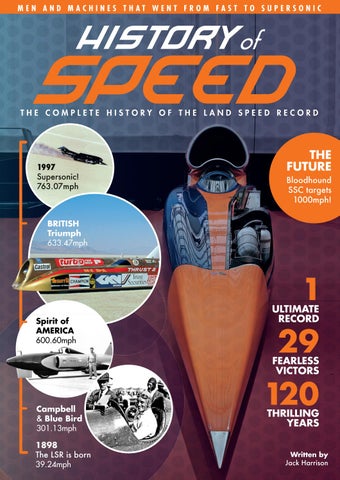
This story begins with a rather serene run of 39.24mph in the French countryside, and culminates with a supersonic roar of 763.07mph across a desert in Nevada. At the very basic level, both events were man and machine pushing past what people believed to be possible and finding a level beyond. But the incredible difference in the speeds achieved demonstrates just how far the land speed record has progressed in the 120 years since its inception. Without any doubt, advancements in technology and engineering have been pivotal. The development of the petrol engine, a greater understanding of aerodynamics, the embracing of jet power, the deployment of rocket propulsion… all have had a crucial impact. Whatever the tools available though, the key driver behind the mind-boggling increases is sheer human ingenuity and desire. From 1898 through to 1997 and beyond, this potent combination has fuelled a relentless pursuit of speed – and it’s spawned a truly remarkable competition that has produced some fascinating characters and their weird and wonderful machines. It has been my absolute pleasure to tell their tales in the 132 pages before you; I sincerely hope I’ve done it the justice it so clearly deserves. Jack Harrison Author
77.13 83.47 84.73 94.78 97.25 103.56 104.52 109.65 121.57 125.95 124.12 133.75 143.31 146.01 146.16 150.76 152.33 169.30 171.02 174.88 203.79 206.96 207.55 231.45 246.09 253.97 272.46 276.82
RECORDS HOLDERS BY NATION
301.13 312.00
10
345.50
GREAT BRITAIN
350.20
8
357.50 369.70
FRANCE
394.20
7
407.45
USA
403.10
3
413.20
BELGIUM
434.02
1
468.72
IRELAND
526.28 536.71 555.48 576.55 600.60 630.39 633.47 714.14 763.07
1000MPH?
The FEARLESS FEW
Gaston de ChasseloupLaubat The first fastest man
F
rench aristocrat Count Gaston de Chasseloup-Laubat cemented his name as a pioneer of motor racing when he won the prestigious Marseille-La Turbie road race in 1897. Victory in the 140-mile event might have proved to be a defining career moment, but the following year La France Automobile magazine launched a new campaign to find the world’s fastest carand-driver combination; Chasseloup-Laubat duly entered. Aboard an electric-powered vehicle provided by French car manufacturer Jeantaud, he completed the one-kilometre course at Achères, some 15 miles north of Paris, in 57 seconds and wrote his name into the history books by setting the first ever land speed record of 39.24mph. During the course of the next three months, Chasseloup-Laubat and his arch-rival Camille Jenatzy went back and forth – each ending up with three records to their names. It was Jenatzy who had the final say. As the new century dawned, the original record holder would have to contend with a very different kind of fight, this time against an illness that would, sadly, go on to claim his life in 1903.
RECORDS Date December 18, 1898 January 17, 1899 March 4, 1899
6
History of Speed
Speed 39.24mph 43.69mph 57.60mph
Place Achères, France Achères, France Achères, France
Car. Jeantaud Duc Jeantaud Duc Jeantaud Duc
BELOW: Chasseloup-Laubat, driving, with a companion in 1885 – 13 years before his record-breaking exploits. MPL
History of Speed
7
The FEARLESS FEW
The Red Devil
8
History of Speed
Camille Jenatzy
W
LEFT: Jenatzy at the wheel. MPL
hen Belgian racer Camille Jenatzy heard of Chasseloup-Laubat’s record-setting feat, he responded with a letter to La France Automobile in which he expressed disappointment at not being part of the original competition at Achères. He went on to challenge the Frenchman to a duel, and declared that under the same conditions he would defeat the Jeantaud. The land speed record holder duly accepted, and the pair went headto-head on January 17, 1899. Jenatzy, nicknamed Le Diable Rouge (The Red Devil) on account of his flowing ginger beard, became the first man to break the coveted mark by setting a speed of 41.42mph. However, his joy was short-lived as a mere 10 minutes later Chasseloup-Laubat claimed back the crown. A fierce rivalry ensued, and conventional wisdom might have seen Jenatzy give up the fight when his nemesis clocked nearly 60mph in March of the same year, but the Belgian was undeterred. He returned with a modified electric machine and became the first man to drive at more than a mile per minute – a record that would remain unbroken for three years. Jenatzy continued to race on tracks and roads across Europe, and piloted a Mercedes to victory in the highly sought-after Gordon Bennett Cup in Ireland in 1903 – subsequently offering a strange prediction that he would lose his life in the same make of car. In a cruel twist of fate, his prophecy was realised in bizarre circumstances 10 years later. Hunting with friends in Luxemburg, he hid behind a tree and pretended to be an animal, a prank that worked far too well and led to another member of the party firing at him. Jenatzy was rushed to hospital, in a Mercedes, but bled to death before reaching a hospital.
RECORDS Date January 17, 1899 January 27, 1899 April 29, 1899
Speed 41.42mph 49.92mph 65.79mph
Place Achères, France Achères, France Achères, France
Car. CGA Dogcart CGA Dogcart La Jamais Contente History of Speed
9
The FEARLESS FEW
RECORDS Date April 13, 1902
10
History of Speed
Speed 75.06mph
Place Nice, France
Car. Gardner-Serpollet
Léon Serpollet Engineering excellence
T
hroughout the history of the land speed record, several engineers have piloted their own creations to glory – Frenchman Léon Serpollet was the first. Born in the eastern part of the country in 1858, Serpollet developed a passion for mechanical work and moved to Paris, where he opened his own factory. Initially he concentrated on producing steam-powered threewheeled carriages, his creations capable of more than 20mph – an impressive feat in 1894. Two years later he perfected the design of a flash boiler suitable for use in cars, and so began a journey that would see him become the third man to hold the coveted title of fastest car and driver combination on the planet. First, however, Serpollet turned his talents to the railroads and used his new steam technology to upgrade outdated French steam locomotives. By 1902 he had refocused on four wheels and, financed by American industrialist Frank Gardner, modified a car capable of challenging Jenatzy’s near three-yearold mark. On April 13, 1902, Serpollet took the car, nicknamed Easter Egg, on to the Promenade des Anglais in Nice, where he clocked more than 75mph over the flying kilometre. A new land speed record had been set.
LEFT: Serpollet, with his wife as passenger, drives his Easter Egg steam car through the English seaside town of Bexhill in 1902. MPL History of Speed
11
CHAPTER ONE
39.24MPH
75.06MPH
LAND SPEED PIONEERS
T
he concept of going fast is a relatively modern phenomenon. Steam engines on the railways took centre stage first, and as they developed and then found reliability in the mid-to-late 19th century it became apparent that speeds in excess of 30mph and 40mph were possible. In fact, as early as 1854 it’s reported that a British train hit 81.80mph in Somerset; there’s also evidence of a French locomotive travelling at 89.48mph in the north-east of the country in 1894. While there are certainly questions to be asked about the accuracy of the timings, the stories of these mammoth achievements did make sure of two things: by the close of the century rates of 55mph to 60mph were now well within range, and any myths that still existed about the suffocating effect of speed on the human body had been well and truly shattered. Less than 100 years prior, even the term ‘miles per hour’ would have had little meaning in the countries where these impressive efforts were being made. Now it
12
History of Speed
was the all-important benchmark, and it soon extended into other fields of engineering such as the advances being made in the development of the motor car. German engineer Karl Benz introduced the first petrolpowered automobile in 1886, and it proved to be a huge leap forward.Various incarnations of steam and electric cars already existed, but they were made for comfort and convenience and not for speed. The internal combustion engine changed the industry. As the number of cars swiftly multiplied, speed became the ultimate measure of performance. Whether it was the early drivers wanting to push the boundaries, or fascinated onlookers thrilled by the spectacle of these horseless carriages roaring past in a blur, people wanted to know just how fast cars could go. The interest led to competition. Respective proponents of steam, electric and petrol wanted to prove that their power was better than the other. On top of that, each wanted to go faster than any other car had gone before.